
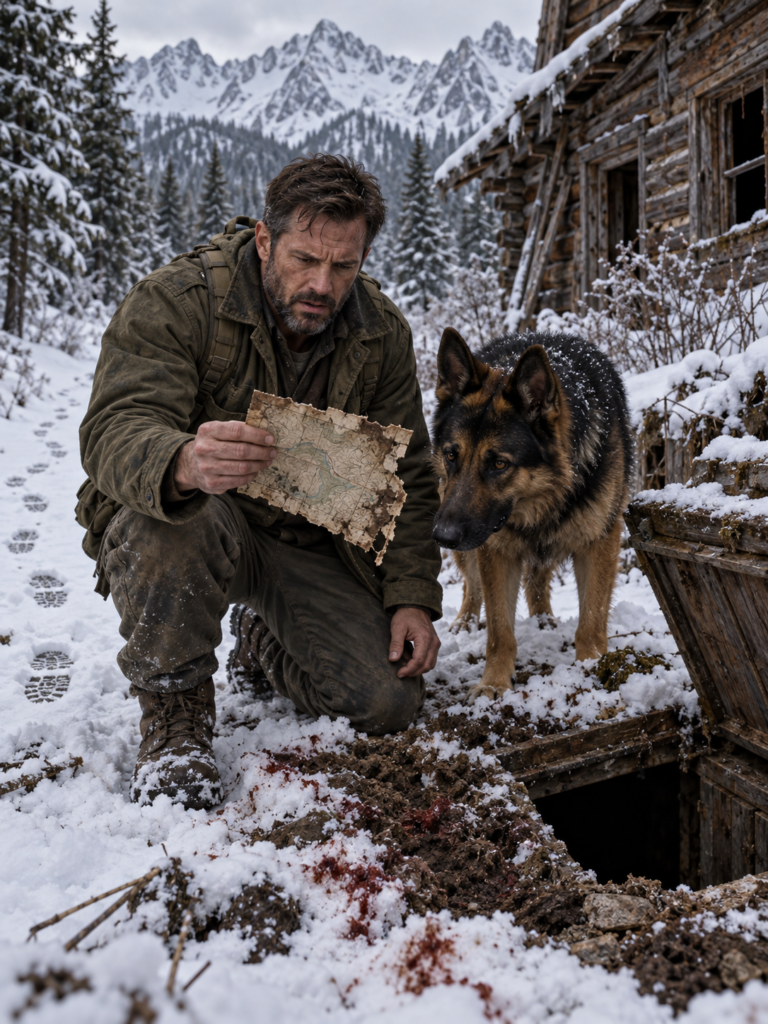
The hidden hatch rose several inches, releasing a breath of cold, stale air.
Logan shifted his grip and pulled again.
A narrow staircase appeared beneath the wood.
Stone steps disappeared into darkness.
Shadow moved closer, his nose working rapidly along the opening.
Logan caught the dog’s collar.
“Not until I know what’s down there.”
He searched beside the cabin and retrieved an old lantern.
After lighting it, he returned and lowered its glow toward the stairs.
The walls below were reinforced with timber and stone.
This was not an animal den or a forgotten drainage opening.
Someone had constructed a cellar beneath the ground beside Mason’s cabin.
Logan tested the first step.
Then the second.
Shadow remained near him as he descended.
The cold seemed to deepen.
At the bottom, the passage opened into a room lined with shelves.
Old food supplies.
Blankets.
Tools.
A workbench against the far wall.
Nothing about the storage itself seemed extraordinary.
Mason had always believed in being prepared.
Logan could imagine him stocking a shelter for bad weather.
But the workbench told another story.
A thick binder lay beside a waterproof pouch.
There were photographs, maps, and papers organized into separate stacks.
A small flash drive had been secured beneath a wooden container.
Logan stopped.
He recognized Mason’s habit of arranging materials by date and subject.
The same methodical approach had once helped them keep track of difficult assignments overseas.
He opened the binder.
The first pages contained maps and dated observations.
Farther in were notes about public contracts, payment schedules, deliveries, and conversations Mason had recorded.
Logan frowned.
This wasn’t simply a survival cache.
Mason had been investigating something.
He turned to an entry written shortly before Mason’s death.
It concerned emergency contracts connected to a veterans clinic in Idaho Falls.
Money allocated for the clinic apparently had not reached the intended work.
Mason suspected the funds had been redirected through construction arrangements.
Logan read the paragraph twice.
Then he saw the names.
Mayor Ellen Harding.
Sheriff Hughes.
Rick Carver.
His breath caught.
Carver.
The man who had withheld wages.
The man who accused Shadow of being dangerous.
The man whose mockery had helped drive Logan out of town.
Logan sat down slowly.
He remembered Rick’s confidence at the community meeting.
The sheriff’s reluctance to challenge him.
The way people accepted the allegations against Logan without asking what actually happened.
Until that moment, Logan had understood those events as prejudice and gossip.
Now another possibility demanded consideration.
Had the people spreading rumors about him also wanted him away from something Mason was investigating?
He could not prove that from names in a binder.
But the overlap was impossible to ignore.
Logan opened the waterproof pouch.
Inside were budget reports and documents bearing official markings.
He compared figures in the reports with amounts listed in the binder.
Payments appeared where the corresponding materials or completed work were not adequately accounted for.
Contract references led to projects Mason believed were fictitious or inflated.
The documents suggested substantial financial wrongdoing.
But Logan understood that incomplete records could also be misinterpreted.
He needed the underlying evidence examined.
He turned several more pages.
Mason had recorded discrepancies methodically.
Numbers.
Dates.
Names of contracts.
Relevant correspondence.
Then Logan reached a note indicating that the most important supporting material was stored separately.
His eyes shifted toward the flash drive.
Shadow nudged his elbow.
Logan took a slow breath.
“You were building a case,” he whispered.
Not hiding money.
Not preserving family heirlooms.
Building a case against people powerful enough to influence how the town viewed anyone who challenged them.
He reached beneath the container and carefully removed the drive.
A small envelope lay beside it.
His name was written across the front.
Logan.
He opened it.
Mason’s message explained that if Logan found the cellar, the materials inside were intended to ensure the investigation survived.
The strongest evidence was on the drive.
Mason had trusted Logan to keep it from disappearing.
Logan lowered the letter.
A different kind of grief rose through him.
His friend had apparently been in danger while gathering these records.
And Logan hadn’t known.
He thought of the stains outside.
The footprints.
The incomplete map.
None proved what had happened to Mason.
But they made his friend’s warnings difficult to dismiss.
Shadow suddenly stiffened.
His ears pointed toward the staircase.
Logan stopped moving.
A faint sound came from above.
Snow compressing beneath a boot.
Then another step.
Someone was outside the cabin.
Logan extinguished the lantern.
Darkness swallowed the cellar.
He gathered Mason’s letter, binder, and flash drive close, listening as footsteps moved across the ground overhead.
The steps stopped near the cabin door.
A metal sound followed.
Then the faint creak of wood.
Shadow’s growl vibrated through the darkness.
Logan rested one hand against the dog’s shoulder.
Whoever had come to the cabin might be a stranger searching for shelter.
Or the person responsible for the tracks and stains.
Or someone connected to the names in Mason’s binder.
He didn’t know.
But he could no longer pretend the cellar was merely an abandoned storage room.
He slipped the flash drive into his jacket, held the binder close, and carefully started toward the staircase as the footsteps stopped directly above them.
Logan placed his boot on the first stone step and stopped.
Above him, the cabin door creaked.
Shadow stood at his side, every muscle tense.
Logan listened.
There was a pause, followed by another faint movement.
Then the sound of the door closing.
Footsteps retreated across the snow.
Logan waited until he could no longer hear them.
He did not follow.
The documents against his chest mattered more than discovering who had come to the cabin at that moment.
After several minutes, he relit the lantern and returned to the cellar workbench.
He opened Mason’s binder again.
This time he read slowly, separating what Mason had observed from what he had concluded.
The financial records were more detailed than Logan had initially realized.
Payments were listed against construction contracts associated with emergency improvements to the veterans clinic.
Other documents recorded what materials had supposedly been delivered.
Still others showed what projects had actually been completed.
The differences were significant.
One set of records described expenditures that the corresponding inventories did not support.
Another referred to construction work Mason could not verify.
The pattern appeared repeatedly.
It wasn’t a single misplaced invoice.
It looked like an organized effort to divert money intended for veterans.
Mason had identified the mayor’s office, Sheriff Hughes, and Rick Carver’s construction business as connected to the questionable transactions.
Logan stopped at Carver’s name.
He remembered the contractor’s yard.
The delayed wages.
Rick pushing him when Logan questioned the money he was owed.
Shadow placing himself between the two men.
Rick had later presented the incident as evidence that Logan was unstable.
Logan had assumed the accusation grew from Rick’s anger and the town’s discomfort with his PTSD.
That explanation still accounted for part of what happened.
But Mason’s records suggested Rick had another reason to fear scrutiny.
Carver’s business was involved in the very contracts Mason had been questioning.
Logan continued reading.
The investigation had apparently been underway before Logan left Idaho Falls.
Mason’s notes showed repeated attempts to establish where public funds had gone.
He had collected budget records, contractor information, and communications that he believed supported his suspicions.
The binder did not prove that every person named had committed a crime.
But it showed that Mason’s suspicions were based on specific discrepancies rather than rumor.
And the waterproof pouch contained documents that could be checked independently.
Logan looked at the flash drive.
The letter said it held stronger evidence.
He wasn’t going to destroy or alter it by experimenting carelessly.
He secured it with the written materials.
Then he turned toward the stairs.
“We’re getting out of here, Shadow.”
The dog followed him into the cold daylight.
Outside, the forest was quiet.
Fresh snow covered much of the disturbed ground.
Logan studied the cabin from the clearing.
The cellar hatch was hidden well enough that an ordinary visitor might never notice it.
Mason had chosen an effective location.
Logan returned the hatch to its place, covering the entrance as it had been before.
Then he examined the cabin.
The door appeared closed.
Nothing obvious had been taken.
Whoever had approached seemed to have left.
That did not make Logan feel safe.
He had found evidence potentially implicating influential people in Idaho Falls.
He had also found signs of recent visitors to Mason’s isolated property.
It was possible the two things were unrelated.
But it would be reckless to assume so.
Logan kept the flash drive with him.
He spent the remainder of the afternoon making the cabin as secure as he reasonably could.
Then the weather changed.
Clouds gathered over the mountains.
The temperature dropped.
Wind began moving through the pines with increasing force.
Logan checked the roof.
One section near the chimney had shifted badly.
He knew another heavy storm could worsen the damage.
Working cautiously, he climbed to secure the loose material.
Shadow paced beneath him.
“Almost done,” Logan called.
Then a heavy branch broke above the cabin.
It struck the roof.
The impact shifted the timber beneath Logan’s boot.
He lost his balance.
For an instant, he caught the edge.
Then he fell.
The ground struck his side.
Pain spread through his ribs.
He lay motionless for several seconds, trying to breathe.
Shadow reached him almost immediately.
The dog whined and pushed his nose against Logan’s face.
“I’m here,” Logan gasped.
He tried to sit.
Pain stopped him.
His ribs might have been badly bruised or fractured.
He couldn’t tell.
The wind was rising.
Remaining outside would make things worse.
Logan forced himself upright.
With Shadow beside him, he made his way inside.
He had barely closed the door before snow began blowing across the clearing.
The storm strengthened quickly.
The cabin shook under repeated gusts.
Logan settled near the stove, each breath reminding him of the fall.
He needed help.
But the road was already becoming difficult to see.
He looked at the papers.
Mason had left evidence that could matter to the entire town.
Logan had come too far to lose it because of one reckless climb.
He arranged the documents where they would remain dry and accessible.
Then he heard a sound outside.
A deliberate crunch beneath the window.
Shadow lifted his head.
Logan listened.
Another step.
Then a brief flash of light moved through the snow.
A flashlight.
Someone was walking around the cabin in the storm.
Logan’s first instinct was to call out.
He stopped himself.
After the unknown visitor earlier that day, he had no reason to assume this person was harmless.
He moved away from the window.
Shadow stayed close.
The footsteps circled the building.
Then stopped.
Minutes passed.
Logan waited with the dog beside him.
Eventually the sounds retreated.
He could not identify whoever had been outside.
But by morning, the weather had covered whatever fresh tracks they left.
The storm passed, and Logan returned to the rear of the cabin.
Shadow immediately began sniffing around the concealed cellar hatch.
Logan checked that it remained closed.
Then he surveyed the clearing.
Several patches of disturbed snow suggested recent movement.
But he couldn’t establish exactly how many people had come or what they had been doing.
He no longer felt comfortable staying in the cabin.
He had hoped this place would let him escape the judgment of Idaho Falls.
Instead, Mason’s final investigation had followed him into the mountains.
Logan retrieved the binder and flash drive.
He considered driving to town.
But the road was uncertain after the storm, and someone appeared to be watching the property.
He needed another way to reach someone he trusted.
The answer, he remembered, might already be in Mason’s cellar.
He returned to the hidden room and searched the supplies more carefully.
Among the equipment was an emergency satellite communication device.
He checked it.
It still worked.
Logan exhaled.
Mason had preserved more than evidence.
He had also left a way for that evidence to leave the mountain.
Before Logan could act, Shadow’s posture changed.
The shepherd stood near the cellar entrance, listening.
A distant sound carried through the trees.
Voices.
Not close enough to understand.
But close enough to tell Logan that people were approaching.
He gathered the most important materials and extinguished the lantern.
Then he climbed out.
He had one clear objective.
Get the evidence beyond the reach of whoever wanted it suppressed.
He could not accomplish that by waiting inside a damaged cabin.
Logan and Shadow left the clearing.
The mountains were difficult to traverse after the storm.
Snow hid uneven ground.
Fallen branches obstructed the easier routes.
Logan moved slowly because of his ribs.
Shadow stayed near his leg.
They crossed into a wooded ravine, pausing whenever sounds approached from behind.
At one point, voices became distinct.
Men discussing tracks.
One of them mentioned Barrett.
Logan stopped.
This was no longer a matter of an unknown hunter passing through the woods.
The people behind him knew his name.
He pulled Shadow into cover beneath low branches.
Both remained still while a flashlight beam moved across the snow.
The men passed without seeing them.
Only after the voices faded did Logan begin moving again.
He checked the flash drive inside his jacket.
Still there.
Dry.
Undamaged.
Shadow pressed against his knee.
Logan looked toward the higher ground.
There was no safe way back to Idaho Falls on foot.
But somewhere above the ravine, the satellite device might find a clear connection.
He knew whom he wanted to contact.
Henry Waters.
A federal agent who had once served alongside him overseas.
Someone Logan trusted from experience, not because of an office or title.
He had not spoken with Henry in years.
But Mason’s evidence warranted outside review.
Logan also understood that contacting local authorities could be complicated because Sheriff Hughes was named in the records.
He would not hand the material to the very office Mason suspected of involvement.
He and Shadow continued uphill.
Twice, Logan stopped to catch his breath.
His ribs ached.
The dog was becoming tired.
They reached a narrow rocky passage as afternoon light began shifting across the ridge.
Logan studied the area.
The terrain restricted movement, offering a chance to put distance between himself and the men following.
He was not interested in killing anyone.
He wanted to protect Shadow and keep the evidence intact long enough for an independent investigation.
He found a sheltered position overlooking the approach.
Then he took out the satellite device.
His hands were cold.
He searched for Henry Waters’s contact information.
It was still there.
Logan began composing the message.
He identified Mason Drew.
Described the hidden cellar.
Explained the suspicious contracts involving the veterans clinic.
Named the officials Mason had investigated.
And indicated that the supporting records were preserved on the flash drive.
He attached the available material and prepared to transmit it.
For the first time since entering the cellar, Logan felt that he was doing exactly what Mason had intended.
Not avenging a friend through violence.
Putting his evidence where it could be examined.
He pressed send.
The device indicated that the transmission had gone through.
Logan closed his eyes briefly.
“It’s out, Mason.”
Shadow nudged his hand.
Logan looked down at the dog.
“We did it.”
Then voices sounded below the ridge.
Two men were approaching.
Logan recognized their anger before he could distinguish their faces.
The search had reached him.
He put the device away and moved into cover with Shadow.
The men entered the narrow passage.
One noticed signs that someone had been nearby.
He shouted Logan’s name.
Logan watched them carefully.
The immediate question was no longer whether Mason’s evidence could be transmitted.
It had been.
Now Logan had to survive long enough to tell Henry where the originals were hidden.
And when one of the men raised his weapon toward the rocks, Logan understood that the people pursuing him were willing to use force to prevent that from happening.
The armed man moved farther into the rocky passage.
Logan remained behind cover.
Shadow stood close enough that Logan could feel the shepherd’s breathing against his leg.
The second man called out again.
“Barrett! We know you’re here.”
Logan looked at the satellite device in his jacket.
The message had been sent.
The evidence was no longer confined to Mason’s cellar.
Whatever happened next, somebody outside the mountain now had information about the financial records.
That knowledge steadied him.
He did not need to defeat the men in some final battle.
He needed to stay alive.
And he needed Shadow alive beside him.
The men advanced carefully.
Loose snow shifted beneath their boots.
One stumbled, striking the rock wall with his shoulder.
The other turned toward the noise.
Logan used the brief distraction to move away from his position.
Shadow followed.
The men noticed movement and shouted.
Logan stopped behind another outcropping.
He knew they had the advantage of weapons.
But the narrow terrain also limited their approach.
For several tense moments, neither side moved.
Then one man came around the rock.
Logan reacted before the weapon could be brought toward him.
The two struggled.
The firearm fell into the snow.
The man lost his footing and landed heavily.
The second pursuer advanced.
Shadow barked.
Logan moved back toward the stone wall, keeping the dog behind him.
The confrontation was brief and chaotic.
One man fled downhill after being disarmed.
The other retreated when he realized Logan was not trapped where he expected.
Logan did not pursue either of them.
He remained against the rock until the sounds of their movements faded.
Then he checked Shadow.
The dog was trembling from exertion.
One shoulder was sore.
Logan knelt.
“Let me see.”
Shadow remained still while Logan examined the injury.
There was swelling and a superficial wound that needed proper attention.
The dog was able to walk, but Logan knew they could not keep moving indefinitely.
He cleaned and covered the injury with the supplies he carried.
Then he checked the satellite device.
No immediate reply.
He looked toward the distant ridge.
Somewhere beyond the mountains, Henry Waters might already have received the evidence.
Logan hoped he would understand its urgency.
The next hours passed slowly.
Logan and Shadow remained sheltered from the worst of the wind.
He tried to conserve their strength.
His ribs still hurt whenever he moved.
The dog rested close against him.
For a while, Logan’s thoughts returned to Idaho Falls.
The morning he left.
Rick Carver calling from his porch.
Mrs. Carver refusing to acknowledge him.
The sheriff suggesting that everyone would be more comfortable if Logan spent time away.
He remembered how thoroughly those moments had damaged his sense of belonging.
He had believed the entire town saw him as dangerous.
Perhaps some people did.
Others might simply have believed stories repeated by people they trusted.
But Logan had never been offered a fair opportunity to correct them.
Now he wondered how many other stories the town had accepted without examining the evidence.
Mason had apparently been asking questions long before Logan understood why those questions mattered.
A veterans clinic had been promised money for emergency work.
Documents indicated that public payments were not matching the work actually performed.
Officials and contractors had explanations to give.
Yet the people who should have protected the clinic’s resources were among those Mason suspected.
Logan looked at the flash drive.
The physical object was ordinary.
Small enough to disappear inside his closed fist.
But its contents could expose financial decisions made by people with considerable local influence.
Mason had protected it in a hidden cellar.
Logan had risked his life carrying it into the mountains.
He wondered how many veterans had gone without needed services while money intended for the clinic was redirected.
He did not yet know the full answer.
That was for investigators to establish.
But the question made the records more than an argument between Logan and the men who had humiliated him.
The money belonged to a public purpose.
If it had been stolen, there were real people who had paid the price.
Shadow stirred.
Logan rested a hand on the dog’s neck.
“It’s bigger than us, boy.”
The shepherd opened one eye.
Logan smiled faintly.
“Always was.”
A response eventually reached the satellite device.
Henry Waters had received the information.
He wanted the original documents preserved.
He also wanted Logan’s location and a description of the men pursuing him.
Logan sent what he could.
He did not exaggerate.
He explained that he had not identified every pursuer.
He described the encounters around the cabin and in the forest.
He told Henry about the bloodstained ground and torn map.
But he did not claim those details proved who had killed Mason.
The evidence needed examination.
Mason deserved facts, not guesses disguised as certainty.
Henry acknowledged the message and began arranging an appropriate response.
For the first time since the men entered the rocky passage, Logan allowed himself to believe that help was approaching.
The following morning, federal personnel reached the area.
Logan was exhausted.
His ribs ached.
Shadow moved carefully beside him.
But both were alive.
Henry Waters approached Logan with the guarded expression of someone seeing an old friend under difficult circumstances.
For a moment, the two men simply looked at each other.
Then Henry extended his hand.
Logan took it.
“Good to see you,” Henry said.
Logan gave a tired smile.
“Would’ve preferred better circumstances.”
Henry looked toward Shadow.
“And you brought your partner.”
“Couldn’t have done it without him.”
The shepherd leaned lightly against Logan’s leg.
Henry’s expression softened.
Then business returned to his face.
“The records you sent are serious.”
Logan nodded.
“Mason collected them.”
“We’re going to examine the originals.”
Logan reached into his jacket and produced the flash drive.
He handed it over carefully.
“I haven’t altered it.”
Henry accepted it.
“We’ll document everything.”
Logan then explained where the hidden cellar stood.
He described the hatch behind the cabin.
The binder.
The waterproof pouch.
The photographs and other materials.
Henry listened without interrupting.
When Logan finished, the agent looked toward the mountains.
“Your friend did a great deal of work.”
“Yes.”
Logan swallowed.
“He died before he could finish.”
Henry studied him.
“We’ll follow the evidence.”
Logan nodded.
That was all he could ask.
The next stage unfolded quickly.
Investigators examined Mason’s records.
The budget reports were compared with the contracts and financial information available through official channels.
Payments linked to emergency work at the veterans clinic became central to the inquiry.
The supporting files gave investigators more than Mason’s handwritten suspicions.
They provided a route through the transactions.
Amounts.
Dates.
Signatures.
Contract references.
Documentation of work claimed but not properly substantiated.
A figure emerged from the examination.
Approximately $2.7 million in funds intended for the veterans clinic was missing or improperly diverted.
That number traveled through Idaho Falls faster than the rumors about Logan ever had.
Residents who had dismissed him as unstable now saw the names of public officials and a prominent construction contractor connected to a federal corruption investigation.
Sheriff Hughes.
Mayor Ellen Harding.
Rick Carver.
The people who had occupied positions of authority while Logan was being pushed out of town were now being asked to account for their own conduct.
The investigation also examined attempts to pressure witnesses and suppress concerns.
What Mason had been uncovering before his death was no longer hidden inside a deteriorating cellar.
It was subject to formal scrutiny.
In Idaho Falls, agents arrived at the sheriff’s office.
Hughes had once stood at the community meeting and suggested that Logan isolate himself for everyone’s comfort.
Now he faced questioning about decisions made under his own authority.
The office that had treated Logan’s reputation as a public-safety concern became the focus of a far more substantial inquiry.
Mayor Harding also faced investigation.
Her public statements had repeatedly emphasized responsible leadership and community stability.
Now reporters were asking why money allocated to the veterans clinic had not reached its intended projects.
Documents were seized and examined.
Her explanations were challenged.
The polished certainty that had defined her public image began to fracture.
At Carver’s construction business, federal officers arrived while employees were gathering for work.
Rick had spent months ridiculing Logan.
He had portrayed the veteran as unreliable.
He had treated Shadow’s protective behavior as proof that the dog was dangerous.
He had encouraged the town to view Logan as a problem rather than a person.
Now the contractor faced questions about invoices, emergency contracts, and his business’s role in payments under investigation.
The same workers who had once heard Rick accuse Logan were watching officers examine the company’s records.
For the first time, Rick’s confidence did not control the story.
But the investigation was not complete simply because officials had been confronted.
Records had to be authenticated.
Witness statements had to be tested.
The relationship between the money and the decisions made by each person had to be established.
And Mason’s death required careful consideration of whatever evidence remained.
Logan resisted the temptation to declare every question answered.
He wanted accountability.
But he did not want to repeat what Idaho Falls had done to him—turning suspicion into certainty before the facts were examined.
Henry understood.
When they spoke about Mason, Logan made one request.
“Don’t let what happened to him get lost behind the money.”
Henry looked at him.
“We won’t ignore it.”
Logan nodded.
There were limits to what could be established immediately.
Mason’s warnings, the disturbed ground near his cabin, and the suspicious activity around the property were important.
They indicated that the hidden evidence had attracted attention.
But they did not, by themselves, identify exactly who had caused Mason’s death.
That question required its own investigation.
Logan could accept uncertainty if it was treated honestly.
What he couldn’t accept was the deliberate burial of evidence.
And that burial had finally ended.
As the findings became public, the atmosphere in Idaho Falls shifted.
The first reports spread through local news.
Then photographs of official activity appeared.
Then came discussions about the missing clinic funds.
Residents who had once repeated Rick’s accusations began reconsidering what they believed about Logan.
At the grocery store, workers remembered the argument that had helped transform an ordinary disagreement into a townwide suspicion.
At Carver’s construction yard, employees recalled delayed wages and the contractor’s aggressive response to Logan’s questions.
Others remembered Shadow standing protectively without attacking anyone.
The original story began to look very different.
Mrs. Carver, who had watched Logan leave without saying goodbye, now found herself confronted with the conduct of her own son.
The community meeting became another uncomfortable memory.
People recalled their remarks about Logan’s mental health.
Some had called him dangerous.
Others had suggested he should no longer be trusted around children.
Most had never witnessed the incidents they described.
They had accepted secondhand accusations because the accusations fit the image of a veteran whose symptoms made them uneasy.
Now those assumptions were being publicly challenged.
Even the people who had remained silent had to confront a question.
Why had they found it easier to believe Rick Carver than a man they had known for years?
Not everyone answered honestly.
Some insisted they had never been unkind to Logan.
Others minimized their part in the meeting.
A few argued that the financial investigation had nothing to do with whether Logan needed time away from town.
But among the people who remembered the morning he left, there was a growing recognition that he had been judged unfairly.
They had treated symptoms of trauma as proof of bad character.
And their judgment had made it easier for influential people to discredit him.
That was a separate wrong from the missing money.
But both had consequences.
The case involving the clinic funds advanced.
The officials and contractor implicated by the records faced the consequences of the investigation, including criminal proceedings where the evidence supported them.
The town could no longer dismiss Mason’s suspicions as unimportant.
His records had exposed a serious misuse of public resources.
Nor could it honestly portray Logan as the dangerous man who had needed to disappear into the mountains.
The veteran had preserved evidence.
He had sought independent help.
He had survived threats without abandoning his responsibility to the truth.
The man people had mocked had become central to bringing the investigation into the open.
Yet when the news reached Logan, he did not celebrate.
He was sitting near a small fire in the mountains.
Shadow rested beside him, recovering from the injuries sustained during their ordeal.
The valley stretched quietly beneath the morning sun.
Henry’s updates had answered the question that mattered most.
Mason’s work had not been wasted.
The missing funds were being investigated.
The people implicated were being held to account through a process that could examine evidence rather than gossip.
Logan felt the relief in his shoulders before he could put it into words.
He looked down at Shadow.
“They know now.”
The dog shifted closer.
Logan rested his hand against the shepherd’s neck.
“Mason wasn’t imagining it.”
He watched the fire for a long time.
The last few days had transformed almost everything he believed about his departure from Idaho Falls.
When he drove away, he thought he was leaving because the town no longer had room for a man like him.
Someone who struggled.
Someone who needed quiet.
Someone whose dog understood him better than most people did.
He had believed the cabin represented exile.
A place to disappear until the world forgot him.
But Mason had left something there that changed the meaning of his journey.
An investigation.
Evidence.
A responsibility entrusted to someone who would recognize why it mattered.
Logan had initially wanted only to escape.
Then he found the map.
The stains in the ground.
The cellar.
The binder.
The flash drive.
And the letter Mason had left behind.
Each discovery had forced him to reconsider the one before it.
The footprints were not enough to prove that Mason had been murdered.
The map did not identify an attacker.
The binder’s allegations needed corroboration.
And the flash drive was not a verdict by itself.
But together, properly examined, the records established a case that the town’s most powerful figures could no longer ignore.
Logan thought about the hidden cellar entrance.
Mason had concealed it beneath branches, soil, and weathered wood.
For years, it had been merely another uneven patch of mountain ground.
Then Shadow had found it.
A dog’s curiosity had led Logan to a place where his friend had worked to protect information that others wanted suppressed.
The thought made him smile faintly.
“You always find what I miss, don’t you?”
Shadow’s tail moved.
Logan reached for Mason’s letter.
He had kept it carefully folded.
The paper had become creased from repeated reading.
He opened it one more time.
Mason had believed Logan would not turn away from a difficult responsibility simply because it offered no reward.
That faith had been painful to confront.
For months, Logan had measured himself by the town’s reaction to him.
The refusal to hire him.
The sidelong looks.
The embarrassment in conversations that stopped when he approached.
Rick’s laughter.
The sheriff’s request that he stay away for everyone’s comfort.
He had allowed those judgments to settle into his understanding of himself.
But Mason had remembered another Logan.
The man who had helped others during war.
The man who protected friends.
The man who understood the difference between authority and integrity.
Finding the cellar had not cured his PTSD.
The nightmares did not disappear.
The sound of helicopters could still bring back memories.
Sudden noises could still make his heart race.
He still grieved for the soldiers who died.
And he still missed Mason.
But he no longer saw those struggles as evidence that the town had been right about him.
He was a veteran living with trauma.
He was also capable of judgment, loyalty, and courage.
Both truths could exist together.
That understanding changed his plans.
The cabin was damaged.
The roof needed repairs.
The porch would require rebuilding.
The old stove needed attention.
Yet Logan no longer wanted to abandon the property.
He wanted to restore it.
Not as a monument to the corruption Mason uncovered.
As a place that preserved his friend’s memory and the evidence of what he had tried to accomplish.
The materials Mason left behind would remain available for the continuing investigation.
The letter would stay with Logan.
And the cabin could become the quiet refuge he had first imagined.
But this time, he would not use solitude to punish himself.
He would choose it because it offered something worthwhile.
In time, the mountain property would become a place where Logan could recover strength, care for Shadow, and decide how to reconnect with the world on his own terms.
The people of Idaho Falls might apologize.
Some eventually would.
Others might never admit how badly they had treated him.
Logan could not control that.
He could decide whether to return to town.
Whether to speak with the neighbors who had avoided him.
Whether to accept apologies from people who had failed him.
And whether to tell his story publicly.
He would not allow their guilt to become another obligation placed upon him.
Forgiveness, if it came, would be his choice.
For now, he chose the mountains.
He chose to keep Mason’s memory alive.
He chose to continue caring for Shadow.
And he chose not to let the town’s earlier judgment determine the rest of his life.
One afternoon, after the worst of the weather had passed, Logan returned to the cabin clearing.
The broken roofline stood against the pale sky.
The damaged shutter moved slightly in the breeze.
The old porch creaked beneath his weight.
Shadow walked beside him.
The dog’s shoulder was healing.
Logan looked toward the back of the cabin.
The place where the bloodstained map had been found.
The concealed cellar entrance.
The ground that had first suggested something was wrong.
He remembered kneeling there and reading Mason’s handwriting.
At the time, the warning had frightened him.
Now it meant something different.
It was evidence that Mason had recognized danger and tried to preserve what he knew.
Not proof of every suspicion.
Not a complete account of how he died.
But proof that his efforts to document wrongdoing had continued even when he feared the consequences.
Logan stood for a long moment.
Then he crossed to the hidden hatch.
He rested one hand against its weathered surface.
The cellar beneath it was no longer simply a secret.
Its contents had reached investigators.
Its significance was understood.
Mason had succeeded in protecting the evidence long enough for someone else to find it.
Logan looked down at Shadow.
“We finished the important part.”
The shepherd nudged his hand.
Logan smiled.
“Now we’ve got some living to do.”
He turned back toward the cabin.
Inside, there was work waiting.
Loose boards.
A stove to repair.
Mason’s belongings to preserve.
Ordinary problems with ordinary solutions.
Logan found himself grateful for them.
He could fix a roof.
He could rebuild a porch.
He could create a home.
Those tasks would not erase the past, but they could give his days shape again.
He stepped through the doorway.
Sunlight fell across the small cot.
The folded blanket still rested at its foot.
Above it, Mason’s wooden box remained on the shelf.
Logan approached.
For the first time since arriving, he felt ready to open it.
He lifted the lid.
The contents were modest, personal reminders of the man he had known.
He handled them quietly, allowing himself to remember Mason without turning every memory into a question about his death.
His friend had been more than the evidence he collected.
More than a victim of circumstances still being investigated.
More than a name appearing in federal records.
He had been a man who laughed easily, wrote thoughtful letters, and once helped Logan believe he could survive the worst day of his life.
That was the Mason Logan wanted to keep remembering.
He closed the box carefully.
Shadow moved beside him.
Logan sat on the edge of the cot.
For a moment, he thought of the two men who never returned from the mission overseas.
Then of Mason.
He could not bring any of them back.
He could not change the ambush.
He could not undo the years when grief had made him withdraw from the people around him.
But he could honor those men through what he did next.
He could preserve the truth.
He could refuse to let false accusations define him.
And he could continue living a life they would have wanted him to have.
Shadow rested his head on Logan’s knee.
Logan placed his palm against the dog’s fur.
Outside, the wind moved softly through the pines.
It sounded nothing like gunfire.
Nothing like shouting.
Nothing like the angry voices at the Idaho Falls community meeting.
Just wind.
Just trees.
Just a mountain afternoon.
Logan let himself listen.
Then he rose and began gathering the tools needed to repair the cabin.
He wasn’t leaving.
Not because he had nowhere else to go.
Because, after everything that had happened, he had finally found somewhere he wanted to stay.
And the abandoned cabin that people had mocked was no longer a symbol of his failure.
It was the place where Mason Drew’s buried evidence had been recovered.
The place where a loyal German Shepherd had led his owner toward the truth.
And the place where Logan Barrett began to understand that the people who had rejected him had never possessed the authority to decide his worth.
As evening settled over the Sawtooth Mountains, Logan stepped onto the porch with Shadow at his side.
The fading sunlight turned the snow a pale gold.
Somewhere far away, Idaho Falls was learning to live with the consequences of what its leaders had done and what its people had believed.
Logan no longer needed to be there to watch.
The evidence was out.
The investigation was moving forward.
Mason’s work had been honored.
And the man who had driven away beneath a chorus of laughter was still standing.
Logan looked down at Shadow.
“Come on, boy. We’re home.”
The German Shepherd rose and followed him inside.
The cabin door closed gently behind them.
And for the first time since leaving Idaho Falls, Logan did not hear the laughter in his memory.
He heard the quiet breathing of the companion who had never abandoned him.

