
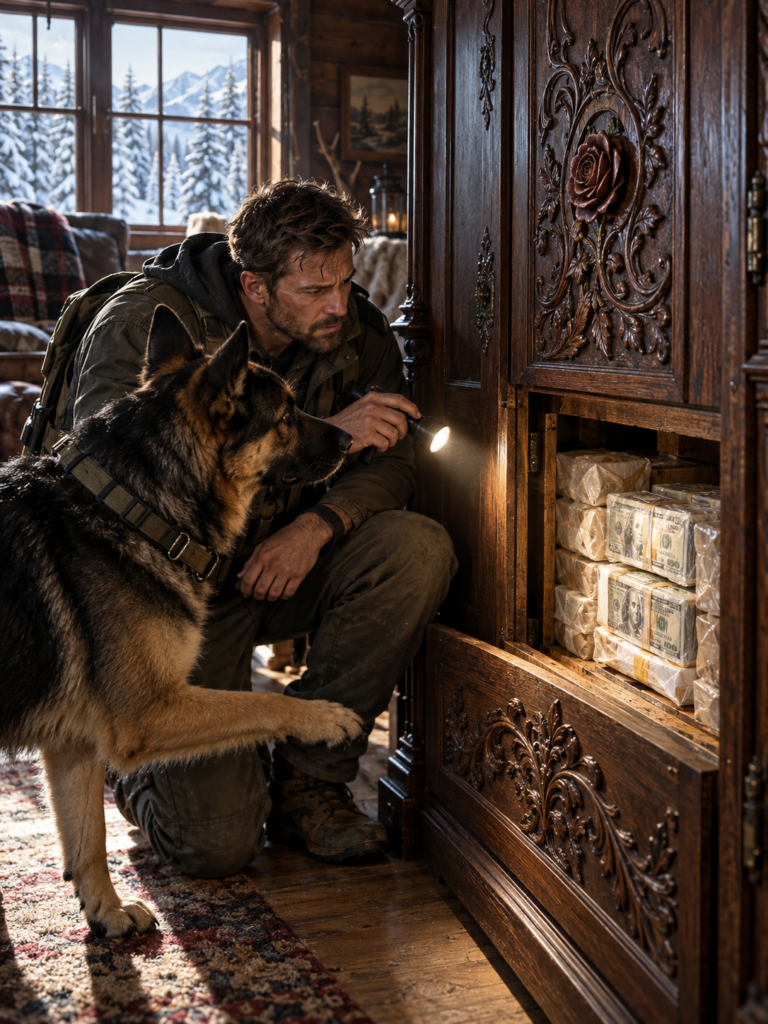
The first sentence explained why Margaret had expected Caleb to find the hidden compartment.
She had hoped he would accept the armoire even when everyone else dismissed it.
Caleb swallowed.
He read the sentence again.
Margaret hadn’t been guessing about her family’s reaction.
She had known exactly how Victor, Diane, and Trevor would behave.
The next lines described how they measured worth through property, investments, and things that could be sold quickly.
Caleb felt the sting of the funeral return.
Victor’s laughter.
Trevor’s insult.
Diane’s impatience.
And himself, quietly moving an impossibly heavy wardrobe because it was the last thing his aunt had chosen for him.
Margaret had seen the difference.
The letter explained that she believed Caleb valued people, loyalty, and things that endured.
He stopped reading.
Atlas leaned against his leg.
Caleb closed his eyes.
During the years after Afghanistan, he had grown accustomed to people seeing only what was wrong with him.
Unsteady work.
An old truck.
A tiny cabin.
Nightmares that still woke him trembling.
He had forgotten that someone might have looked at those same circumstances and seen a man who kept going.
He resumed reading.
Margaret had hidden the cash years earlier, after selling her company.
She had deliberately kept its existence from relatives she believed would quarrel over it.
Caleb looked across the floor at the bundles.
So that was the first answer.
The money hadn’t simply been forgotten inside an old piece of furniture.
It had been concealed intentionally.
And the woman who concealed it had wanted him to discover it.
That did not automatically settle every legal or financial question.
But it changed the meaning of the discovery.
The armoire wasn’t an accidental windfall.
It was part of Margaret’s deliberate final gift.
Caleb studied the letter again.
She had chosen him because she trusted his character.
And because she knew he would care for Atlas.
Near the end, Margaret reminded him to look after himself and the remarkable dog who had stayed with him.
His vision blurred.
He lowered the page.
Atlas rested his head on Caleb’s knee.
For several seconds, Caleb couldn’t speak.
Then he whispered, “She remembered you, too.”
The shepherd’s tail moved once.
Caleb looked back at the open compartment.
He had already removed enough packages to cover much of the cabin floor.
But a closer inspection revealed that the cavity did not end where he initially thought.
A deeper partition separated it from another concealed section.
He directed the flashlight through the narrow space.
More bundles.
Stacked farther back.
The armoire appeared to have an elaborate internal construction, with multiple concealed areas rather than a single shallow compartment.
Caleb stared at it.
The value could be far greater than his first estimate.
He set the letter safely on the kitchen table and took out his calculator.
First, he counted the accessible bundles again.
He checked their denominations.
Then he began estimating the number of packages concealed in the various sections.
The numbers climbed.
Hundreds of thousands.
Millions.
His first estimates were uncertain, but the apparent scale of the cache was enormous.
One rough calculation made him stop.
Two hundred seventy million dollars.
Caleb looked at the calculator.
Then at the armoire.
Then at Atlas.
“That can’t be right.”
He checked his assumptions.
The number was only an estimate, not a verified total.
And an amount that large raised serious questions about storage, provenance, accounting, and ownership.
But the calculation was enough to tell him that this discovery could change far more than his monthly bills.
He would need trustworthy professional help.
He would need to preserve Margaret’s letter.
And until the money could be properly examined, he needed to keep the armoire secure.
Caleb began returning the bundles to their compartments.
One by one, the stacks disappeared behind the carved panel.
When the last package was back inside, he carefully slid the cover into place.
The mechanism clicked.
The wooden rose returned to its original position.
From across the room, the wardrobe looked exactly as it had before.
Old oak.
Carved flowers.
A piece of furniture no one wanted.
Caleb held Margaret’s letter against his chest for a moment before placing it in a small metal box.
Then he returned to the armoire.
He rested his hand on its dark wood.
“You knew what they would do,” he whispered.
He had one immediate question left.
What would happen when Victor discovered there might have been something valuable inside the piece he’d laughed at?
Caleb looked toward the window.
Snow was beginning to fall again.
He reached for Margaret’s letter and opened it once more, determined to read every line before making his next decision.
Caleb unfolded the letter beneath the kitchen light and read the lower portion slowly.
He had been so overwhelmed by the discovery that he hadn’t paid proper attention to a smaller paragraph near the bottom.
Margaret had anticipated something else.
Trouble.
She warned him that if the money ever brought conflict to his door, he should remember that its greatest value would come from what he chose to do with it.
Caleb sat down.
For years, money had represented immediate problems.
A repair bill he couldn’t comfortably afford.
A truck that needed another part.
A winter’s worth of firewood.
A month when the available farm work barely covered his expenses.
Now, Margaret’s words asked him to think beyond survival.
He looked across the cabin.
There was barely enough room for the enormous armoire.
His couch was worn.
The kitchen table had a crack along one edge.
The floorboards creaked whenever Atlas crossed the room.
He could replace everything.
Buy a large house.
Purchase new vehicles.
Never take another repair job.
Yet those possibilities didn’t bring the satisfaction he expected.
Instead, he thought about other veterans who had come home from military service and found it difficult to return to ordinary life.
He remembered how lonely his own first years had been.
How people offered advice without understanding the nights.
How much easier it was to say “I’m fine” than explain that a thunderstorm could sometimes pull his mind halfway across the world.
Atlas had helped him endure those moments.
Not by fixing what had happened.
By staying.
Caleb wondered what it would mean to create a place where other veterans could find that same kind of steady support.
He looked down at the dog.
“Maybe Margaret had something bigger in mind than buying me a new truck.”
Atlas lifted his ears.
Caleb smiled faintly.
“We’ll see.”
He folded the letter.
Whatever the future held, he would proceed carefully.
The money’s amount and legal status needed professional examination.
Margaret’s written explanation mattered, but it was not a substitute for proper estate and financial review.
He would not repeat his relatives’ mistake of treating money as something that needed to be claimed before it was understood.
For several days, Caleb maintained his ordinary routine.
He repaired equipment.
Visited neighboring farms.
Bought groceries in Silver Ridge.
Returned home to the same quiet cabin.
Nobody in town knew about the armoire’s concealed contents.
When the nightmares came, Atlas still settled beside him.
When the weather cleared, Caleb still worked with his hands.
The discovery had not erased the eight years since Afghanistan.
And it had not suddenly made him a different person.
But his thoughts kept returning to the money.
More specifically, to the people who might benefit from it.
Then, one evening, Atlas raised his head toward the window.
Caleb was sitting at the kitchen table with Margaret’s letter.
He heard tires grinding through the snow on the narrow road.
A black SUV appeared between the pine trees.
Caleb recognized the vehicle immediately.
Victor Dawson.
His cousin.
The man who had laughed the loudest when the attorney announced Caleb’s inheritance.
The SUV stopped outside.
Victor stepped into the falling snow and approached the porch.
Atlas rose and moved between Caleb and the door.
Three heavy knocks sounded.
“Caleb.”
Caleb rested his hand on the dog’s neck.
“Easy.”
Another knock.
“I know you’re in there.”
Caleb folded Margaret’s letter and returned it to the metal box.
Then he opened the door.
Victor stood in a heavy coat, snow collecting across his shoulders.
His eyes moved past Caleb into the cabin.
“Long drive,” Victor said.
“What do you need?”
Victor offered a thin smile.
“Can’t I visit family?”
“You’ve never visited before.”
The smile faded.
Victor glanced toward the armoire.
There it stood beside the wall, the carved rose facing the room.
“So you actually kept that thing.”
“Yes.”
“Surprised it fit.”
Caleb said nothing.
Victor stepped inside after Caleb allowed him to enter.
Atlas remained close.
The visitor looked around the small cabin.
His gaze passed over the woodstove, the old couch, and the kitchen table before returning to the enormous wardrobe.
“You know,” Victor began, “I’ve been thinking about Aunt Margaret.”
Caleb waited.
“She was a clever woman.”
“Yes.”
“Always planning ahead.”
Caleb felt a quiet warning in the back of his mind.
Victor continued.
“I thought maybe she left you something more interesting than we realized.”
Caleb met his eyes.
“What makes you say that?”
Victor shrugged.
“Just a feeling.”
He approached the armoire.
Caleb watched carefully.
Victor examined the carved doors and opened one.
Inside were the empty shelves Caleb had inspected before finding the concealed mechanism.
Victor knocked against the wood.
He looked along the corners.
Then he ran a hand over the decorative carvings.
Atlas moved closer.
Caleb gave a quiet command, and the dog stopped beside him.
“Looking for something?” Caleb asked.
Victor glanced back.
“It’s an antique. Might be worth something.”
“You told me it was worthless.”
“People change their minds.”
Victor closed the door.
His fingers paused near the carved rose.
Caleb watched without moving.
Victor touched the flower.
For a brief instant, Caleb thought the man had found the seam.
But Victor’s attention shifted.
He stepped back.
“Mind if I take a closer look another time?”
“I’d rather you didn’t.”
Victor’s expression hardened.
“Why?”
“Because Margaret left it to me.”
Victor laughed without warmth.
“You’re making an awfully big deal over some old furniture.”
“Then it shouldn’t matter to you.”
The room fell silent.
Victor looked at him more carefully.
“You’re hiding something.”
Caleb didn’t answer.
He wasn’t going to lie about what the family might eventually have a legitimate reason to examine.
But he also wasn’t going to surrender possession of Margaret’s gift because Victor had become curious.
Victor walked toward the door.
“We’ll see,” he said.
Then he left.
Caleb watched the black SUV disappear through the trees.
Only when the taillights were gone did he release the breath he’d been holding.
Atlas sat beside him.
“Too close,” Caleb murmured.
The dog pressed his head against Caleb’s hand.
Caleb crossed the room and rested his fingers on the carved rose.
Victor hadn’t opened the compartment.
But the visit proved something.
Margaret had been right to anticipate a fight.
Caleb could no longer assume the family’s interest would end with curiosity.
He began taking more deliberate steps to protect the documents and establish the facts surrounding the inheritance.
The written will identified the armoire as his specific bequest.
Margaret’s letter explained her intention regarding the cash.
Those documents would be essential.
He also understood the need for proper verification of the money, its source, and any applicable obligations.
A discovery this large could not safely remain a private stack of bills behind a wooden panel forever.
The weeks passed.
Winter gradually loosened its grip on the valley.
Snow melted from the lower slopes.
The dirt road became a mixture of gravel and mud.
Then an official envelope arrived at Caleb’s cabin.
He noticed the law firm’s return address before opening it.
Atlas lay near the stove.
Caleb sat at the kitchen table and read.
Victor Dawson had initiated a legal challenge involving Margaret’s estate and the armoire.
Caleb read the document twice.
Victor was no longer merely asking questions.
He was attempting to contest the consequences of Margaret’s final wishes.
Caleb set the paper down beside her letter.
He felt anger rise.
Not because he believed no one should ask legitimate questions about the estate.
But because he remembered the laughter.
Victor had been content to let Caleb haul away the enormous wardrobe when everyone believed it worthless.
Now he was willing to challenge what Margaret had explicitly chosen to leave him.
Caleb opened the metal box.
Margaret’s handwriting rested inside.
He read her message about loyalty.
Then the warning about what money could bring to his door.
The situation had unfolded almost exactly as she feared.
Atlas rose and approached the table.
Caleb rested a hand against his broad head.
“I guess we’re going to have to stand up for what she wanted.”
The dog’s tail moved once.
Caleb gathered the documents.
For once, he wasn’t planning to disappear into work and hope the problem would go away.
He would answer the challenge.
He would have the evidence examined.
And he would allow the facts, rather than Victor’s confidence, to determine what Margaret’s gift legally meant.
The dispute eventually brought Caleb and his relatives into a formal legal proceeding.
The room was nothing like the old farmhouse dining room.
There would be no casual jokes about junk furniture.
No easy assumption that wealth belonged to the loudest person.
Margaret’s will could be examined.
Her letter could be considered.
The armoire’s contents could be accounted for.
Victor would have the opportunity to present his arguments.
Caleb would have the opportunity to respond.
Before the proceeding began, Caleb stood quietly beside Atlas outside the courthouse.
Across the way, Victor was speaking with his legal representative.
He glanced toward Caleb.
For the first time since the funeral, Victor’s expression held no amusement.
Caleb looked down at the shepherd.
“Remember that old bedroom?”
Atlas tilted his head.
“They thought we were walking away with nothing.”
Caleb drew a steady breath.
Then he picked up the folder containing Margaret’s documents and walked toward the courtroom door.
Caleb carried Margaret’s documents into the courtroom and took his place.
The folder felt surprisingly light.
Inside were copies of the will, the handwritten letter recovered from the armoire, and materials documenting the discovery and examination of the concealed cash.
He had spent so much time thinking about the money’s weight.
Now the papers that could help establish Margaret’s intentions weighed almost nothing.
Atlas was waiting outside with a handler.
Caleb had insisted that the dog receive proper care during the proceedings.
For years, the shepherd had stood beside him through far more frightening circumstances than a legal dispute.
Caleb could manage this part himself.
Across the room, Victor sat with his representative.
Diane and Trevor were present as well.
Their expressions were markedly different from the afternoon at the Lawson ranch.
Nobody was laughing now.
The dispute centered on Margaret’s estate, the antique armoire specifically left to Caleb, and the substantial wealth discovered inside it.
Victor argued that the concealed contents should not simply be assumed to belong to Caleb because he had inherited the surrounding piece of furniture.
Caleb understood why such a question required careful review.
An armoire and its contents were not automatically the same thing in every legal circumstance.
But Margaret had left more than a wooden cabinet.
She had left written evidence explaining her decision.
The proceedings examined the estate documents and the circumstances surrounding the discovery.
Howard Bell’s role in administering the will provided context for the original distribution.
Margaret had identified specific gifts.
The western pastureland and associated barns went to Victor.
The principal farmhouse and its designated furnishings went to Diane.
The classic-car collection went to Trevor.
The armoire went to Caleb.
That distinction was clear.
The cash, however, required more than the will’s short description of a piece of furniture.
Its presence, amount, and origin needed to be established.
The letter inside the concealed compartment therefore became especially important.
Caleb remembered the moment he found it.
Atlas sitting beside him.
The wax-paper bundles spread across the wooden floor.
His name written on the envelope.
Margaret’s familiar handwriting.
The letter explained that she had intentionally concealed the money after selling her company.
It also stated why she had entrusted the armoire to Caleb rather than to the relatives who openly competed for her most visible assets.
Victor listened as the substance of that explanation was considered.
His expression became increasingly rigid.
At the reading of the will, he had treated Caleb’s inheritance as a joke.
Now the same choice was being examined as a deliberate act.
Caleb glanced toward Diane.
She avoided his eyes.
Trevor sat motionless.
Nobody could claim that Margaret had accidentally mentioned the wrong piece of furniture.
She had identified the armoire.
Caleb had accepted it.
He had removed it from the ranch.
He had transported it to Colorado.
And the hidden compartment had remained closed until Atlas directed Caleb’s attention toward the carved rose.
The sequence was supported by Caleb’s account and the physical structure of the armoire.
Still, Caleb’s account alone could not establish every financial fact.
He had originally estimated the cache at roughly two hundred seventy million dollars after counting some bundles and extrapolating from the concealed sections.
That estimate had been staggering.
It had also been provisional.
The eventual accounting and financial review were necessary to determine the actual value and assess the surrounding obligations.
The enormous scale of the discovery was confirmed in the story of the estate, but the legal outcome rested on the complete evidence rather than an excited calculation made on a cabin floor.
Caleb appreciated the distinction.
He didn’t need an impressive number to prove Margaret had cared for him.
Her letter had already done that.
When the decision ultimately went in Caleb’s favor, he felt strangely quiet.
The court rejected Victor’s attempt to take the inheritance away from him.
The estate evidence supported Caleb’s claim, and after the necessary legal and financial arrangements, the fortune passed into his control.
Victor was visibly furious.
Outside the courthouse, Caleb stood with Atlas beside him.
The dog greeted him with an eager movement of his tail.
Caleb crouched.
He wrapped one arm around the shepherd’s shoulders.
“Looks like we made it.”
Atlas leaned against him.
Across the street, Victor stood beside his vehicle.
For several seconds, the two cousins looked at each other.
Victor’s face was tight with resentment.
Caleb remembered that same face at the funeral.
The mocking smile.
The raised eyebrows.
The certainty that Caleb had received the only worthless inheritance.
Now Victor knew how wrong he had been.
Caleb expected to feel triumph.
He had imagined this moment during the months of uncertainty.
He thought he might enjoy seeing Victor realize that the family member he had dismissed was now the one holding the greatest fortune.
But the feeling never came.
Instead, Caleb felt tired.
His aunt was still gone.
The years when they might have spent time together were still gone.
Nothing about winning the dispute would bring back her letters arriving at a military base or the warmth of her embrace when he briefly visited after coming home.
And no amount of money could erase what Afghanistan had left inside him.
Victor got into his SUV.
The door slammed.
He drove away without speaking.
Caleb watched until the vehicle disappeared.
Then Atlas nudged his hand.
Caleb smiled.
“Yeah. Let’s go home.”
The drive toward Colorado felt different from the journey he had made after Margaret’s funeral.
Back then, he’d carried an old wardrobe in the bed of his pickup and listened to the truck struggle along the highway.
He had been embarrassed by his relatives’ behavior but determined not to let them spoil the small thing Margaret had left him.
He hadn’t known about the hidden compartment.
He hadn’t understood why Atlas kept turning to look at the armoire.
He certainly hadn’t imagined the number that would eventually appear on his calculator.
Now the money was no longer simply a hidden discovery.
It was a responsibility.
And responsibility was something Caleb understood.
He had spent years performing jobs other people needed done.
Repairing irrigation pumps.
Fixing machinery.
Replacing damaged fence posts.
He knew the satisfaction of seeing something broken work again.
Yet the kind of damage he most wanted to address wasn’t mechanical.
He thought about the men he had served beside.
Some had returned to families who understood them.
Others had come home to relationships strained by experiences they couldn’t easily describe.
There were men who found steady work and men who struggled to keep it.
Men who could talk openly about the war and men who could barely bring themselves to mention it.
Caleb recognized pieces of himself in many of them.
And he knew that no amount of determination could replace qualified support, stable housing, and people willing to listen.
One evening, back at his cabin, he sat at the small kitchen table and opened Margaret’s letter again.
Atlas lay near the woodstove.
Outside, the pines moved softly in the wind.
The fortune had been professionally accounted for and placed under appropriate financial management.
Caleb now received advice about investments and long-term planning.
He could have retired immediately.
That suggestion came up repeatedly.
But retirement wasn’t what he wanted.
Not yet.
He looked across the room at the armoire.
The carved wooden rose caught the firelight.
He remembered Margaret’s final message about what he chose to do with the money.
Then he looked at Atlas.
The shepherd had helped him survive the most difficult nights after the war.
The thought came to him simply.
What if other veterans had somewhere to go when they needed that kind of help?
Not merely a place to sleep.
A place where their experiences weren’t treated as an embarrassment.
Somewhere they could receive support without being made to feel weak for asking.
Somewhere trained professionals could help them rebuild routines and relationships.
Somewhere dogs like Atlas could become part of structured animal-assisted support.
Caleb leaned forward.
He had the resources to pursue such a place.
For the first time, the scale of Margaret’s inheritance became emotionally comprehensible.
It wasn’t about the number of bank accounts.
It was about how many people could be helped.
He began making plans.
The work was slower than he expected.
There were professionals to consult, property decisions to make, facilities to design, and people with relevant experience to involve.
Caleb listened carefully.
He had no intention of pretending his military service made him an expert in every aspect of recovery.
The center would need doctors.
Counselors.
Qualified trainers.
People who understood trauma care.
People who could help veterans navigate practical problems as well as emotional ones.
And it would need an atmosphere very different from the one Caleb remembered at family gatherings.
Nobody should walk through its doors and feel they had to prove their worth before receiving kindness.
The idea gradually became a concrete project.
Land was identified in a mountain valley near Silver Ridge.
Plans were drawn for cabins, a larger central lodge, and open spaces where residents could walk beneath the pines.
The facilities were designed around practical needs rather than luxury.
Caleb wanted the buildings to feel welcoming.
Comfortable.
Useful.
He knew that feeling safe often depended on small details.
A quiet place to sit.
A predictable daily routine.
A room where someone could close the door without feeling abandoned.
Staff who understood the difference between offering support and forcing a person to explain more than they were ready to share.
The center began taking shape.
Timber walls rose against the mountain landscape.
Paths connected the cabins.
Work continued through changing seasons.
Atlas accompanied Caleb on many visits.
The dog grew older as the project developed.
The scar on his ear became more noticeable against the graying fur around his muzzle.
His movements slowed slightly.
But when Caleb felt the familiar tension of a nightmare or an unexpected loud noise, Atlas still knew to come close.
One evening, Caleb stood beside a partly completed building as the sun went down.
He looked at the open land around it.
He thought of the men who might one day walk there.
Men carrying memories they had never fully learned to live alongside.
Men afraid that asking for help would make them less worthy of respect.
He remembered the first years after Afghanistan.
How often he had felt that his usefulness had ended when his military service did.
How difficult it had been to explain his struggles to relatives who seemed more interested in his lack of money than in what he had survived.
Aunt Margaret had been different.
She hadn’t asked him to justify himself.
She had simply kept writing.
He wished she could see what her gift was becoming.
Then he realized that, in a sense, her values were already present in everything being built.
The same woman who valued loyalty over display had given him the opportunity to create something lasting.
And he intended to honor that trust.
Nearly two years after the legal dispute, the Rocky Mountain Veterans Recovery Center opened in the Colorado mountains.
Its buildings stood among tall pine trees.
Several small cabins surrounded a central lodge.
Open fields stretched toward the foothills.
The atmosphere was quiet without feeling isolated.
On the first morning, Caleb stood near the entrance.
Atlas sat beside him.
The shepherd’s once-dark muzzle now carried strands of gray.
But his eyes remained alert.
Vehicles began arriving after sunrise.
Some were old pickups.
Others were worn sedans or borrowed cars.
Several men stepped out slowly, surveying the buildings with the cautious expressions of people unsure what they would find.
Caleb recognized that hesitation.
He had worn it himself.
A man remained standing beside his car long after the others began walking toward the lodge.
He was older than Caleb.
His hands trembled slightly.
He appeared uncertain whether to approach.
Atlas noticed him.
The shepherd looked up at Caleb.
Caleb gave a small nod.
“Easy, buddy.”
Atlas walked slowly toward the man.
He stopped a short distance away and sat.
The man looked at him.
For several seconds, neither moved.
Then the veteran crouched and carefully reached out.
His hand settled on Atlas’s fur.
The dog remained still.
The man’s shoulders began to relax.
Caleb watched from the entrance.
He remembered waking on the floor of his cabin after nightmares.
Atlas’s weight against his leg.
The reassuring warmth of another living creature.
The reminder that he was not back in Afghanistan.
That the explosion had happened years earlier.
That he was home.
Now Atlas was offering another man the same simple companionship.
Caleb felt his throat tighten.
This was why the center existed.
Not because a fortune needed to be spent.
Because people needed somewhere to begin.
Inside the lodge, staff prepared for the morning’s arrivals.
Some were veterans themselves.
Others were medical professionals, counselors, trainers, and volunteers.
The center also supported programs involving appropriately trained dogs.
Atlas’s role in Caleb’s life had helped inspire those efforts, though the programs relied on qualified people and careful training rather than expecting any one animal to provide treatment.
A young staff member approached with a clipboard.
“Mr. Dawson?”
Caleb turned.
“We have three new arrivals coming this morning.”
“Are their rooms ready?”
“Yes, sir.”
Caleb smiled.
The word still felt strange when he heard it outside military life.
“All right. Make sure somebody welcomes them personally.”
“Of course.”
The staff member headed toward the lodge.
Atlas returned to Caleb’s side.
The older shepherd leaned lightly against his leg.
Caleb rested a hand on his neck.
“Look what you started,” he murmured.
Atlas’s tail moved.
Caleb glanced across the valley.
He could hear quiet conversation coming from the lodge.
A laugh.
Then another.
Not loud.
Not forced.
Just ordinary people beginning to feel comfortable around one another.
Caleb hadn’t heard much laughter when he first returned from the war.
Not the kind that made him want to stay in the room.
At family gatherings, laughter often carried an edge.
Someone making a joke about his old truck.
His small cabin.
His lack of steady employment.
His dependence on a dog.
He had learned to smile politely and wait for the moment to pass.
But the laughter coming from the lodge sounded different.
It was warm.
Welcoming.
He hoped the men arriving that morning would come to recognize the difference too.
Later that afternoon, Caleb drove back toward his cabin.
The familiar dirt road wound through the pines.
He had repaired the roof and reinforced the walls over the past two years.
The place was more comfortable now.
But he had deliberately kept it modest.
He could afford something far larger.
He simply didn’t need it.
The old pickup remained part of his life, though it no longer had to be his only transportation.
The woodstove still warmed the main room.
The kitchen table still stood beside the window.
And against the far wall remained the enormous antique armoire.
Margaret Lawson’s last gift.
Caleb stepped inside.
Atlas followed.
The dog walked straight toward the woodstove and settled onto his usual spot.
Caleb smiled.
“Some things never change.”
He crossed the room toward the armoire.
It looked exactly as it had on the day he brought it home from Wyoming.
Tall.
Dark.
Heavy.
Its carved vines curling across the doors.
A single rose positioned near the center.
Caleb reached out and touched the flower.
He remembered the morning Atlas had tapped it with his paw.
The hollow sound.
The measuring tape.
The narrow seam.
The click of the concealed mechanism.
He remembered the wax-paper bundles.
The stacks of currency.
And the envelope bearing his name in Margaret’s unmistakable handwriting.
He had not opened the hidden compartment in a long time.
The money was no longer concealed behind the wooden panel.
It had been examined, secured, and put to use.
But Caleb had never considered selling the armoire.
Victor would probably still have called it worthless if he hadn’t learned about the fortune.
Trevor might still have laughed at its size.
Diane might still have complained that nobody needed such an inconvenient piece of furniture.
Caleb understood something they had missed.
Margaret had kept the wardrobe for decades.
Its real significance was never limited to what could be sold.
It had carried her secret.
And through that secret, her final expression of trust.
Caleb rested his palm on the wood.
He could almost hear her voice reminding him to visit when he came home.
The regret remained.
He would always wish he’d gone to see her more often.
He would always wish he’d thanked her while she was alive.
But there was something comforting about knowing that she had understood him better than he realized.
She had not seen him as a failed soldier.
Or an unemployed burden.
Or a relative who owned too little to deserve respect.
She had seen his loyalty.
She had remembered Atlas.
And she had trusted him with the choice of what to do next.
The center in the valley was his answer.
Not a monument to money.
A place built around the belief that people who had endured difficult things still deserved meaningful futures.
Caleb heard Atlas move behind him.
The shepherd approached and sat beside the armoire.
For a moment, Caleb looked from the carved rose to the dog’s graying muzzle.
He laughed softly.
“You know, everybody thought this was junk.”
Atlas tilted his head.
Caleb knelt and rubbed behind the scarred ear.
“But you didn’t.”
The dog leaned into his hand.
Caleb remembered Afghanistan.
The roadside blast.
The moment Atlas had dragged him toward cover.
Then Colorado.
The nights when thunder brought back memories he could barely manage.
The mornings when the dog waited patiently for him to get out of bed.
And finally, the armoire.
The carved flower that had attracted Atlas’s attention when nobody else bothered to look closely.
Caleb had spent years believing his life had become smaller after leaving the military.
He had been wrong about that.
His world had changed, but it had not ended.
The man who once took whatever farm work he could find was now helping provide support for veterans who needed a fresh beginning.
His dog, once trained to protect soldiers in war, had inspired another way of helping them after they came home.
And Aunt Margaret’s forgotten wardrobe had become the unlikely link between those two lives.
Caleb stood and looked around the cabin.
He felt no need to prove anything to Victor.
The legal dispute was over.
The inheritance had been settled.
The money was being managed for purposes Caleb had chosen.
The old family insults had lost much of their power.
They were memories now.
Not instructions about who he had to become.
Outside, the afternoon sun began descending behind the Rocky Mountains.
Warm orange light entered the window and spread across the armoire’s carved doors.
The wooden rose caught the last of it.
Atlas moved toward the front door.
Caleb picked up his jacket.
“Going somewhere?”
The shepherd looked back.
Caleb smiled and followed.
On the porch, the air smelled of pine and damp earth.
Farther down the valley, the recovery center’s buildings stood among the trees.
Lights had begun appearing in several windows.
Inside those buildings were people who had come seeking something money alone could never purchase.
Understanding.
Patience.
A chance to rebuild.
Caleb knew not every recovery would be simple.
He knew from experience that healing rarely moved in a straight line.
There would be difficult days.
Setbacks.
Men who needed more help than they initially believed.
Others who might leave and return.
But the center would remain.
Its doors would be open.
Its staff would be there.
And nobody would be made to feel worthless merely because they were struggling.
Atlas sat beside Caleb at the porch railing.
The dog rested against his leg.
Caleb lowered one hand to the familiar scar near his ear.
For a long moment, he watched the mountains without speaking.
Then he looked down at his oldest friend.
“You saved my life more than once.”
Atlas lifted his head.
Caleb smiled.
“And I guess Margaret found a way to help us save a few more.”
The shepherd’s tail moved slowly across the porch boards.
Inside the cabin, the armoire stood where Caleb had placed it after that long drive from Wyoming.
The same piece of furniture his relatives had mocked.
The same dark oak doors.
The same carved rose.
But Caleb no longer thought first about the fortune it had concealed.
He thought about Margaret.
About the letters she had sent while he was overseas.
About the extraordinary trust she had placed in someone the rest of the family dismissed.
And about the dog who had refused to stop pawing at a wooden flower until Caleb finally listened.
The money had changed his circumstances.
Margaret’s faith had changed how he understood himself.
And Atlas had been beside him through both.
Caleb turned toward the open cabin door.
“Come on, partner. Let’s get inside.”
Atlas rose and followed.
The evening settled quietly over Silver Ridge.
And in the little mountain cabin, the old wooden armoire remained a reminder of the most important thing Caleb had discovered.
Not that a forgotten piece of furniture could hide an extraordinary fortune.
But that a person everyone had underestimated could still build something extraordinary with the life he had been given.

