
Part 1
For a moment, nobody moved.
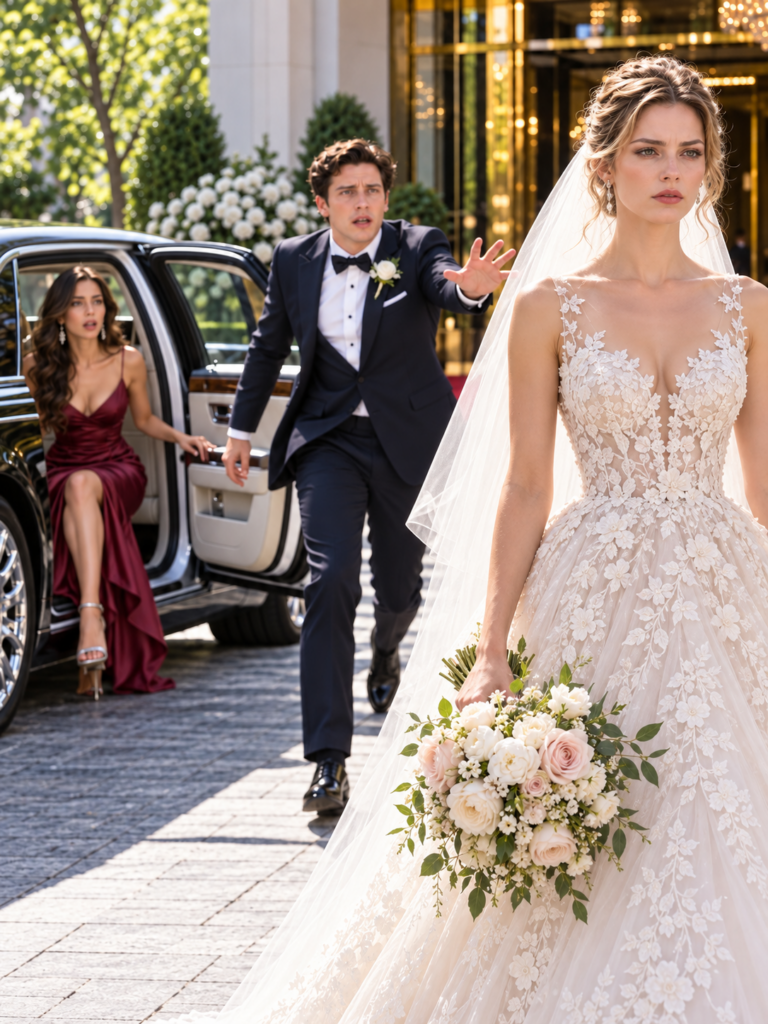
The September sunlight fell across the driveway in long golden strips. Somewhere behind us, the last of our wedding guests were laughing as they climbed aboard the shuttle buses waiting near the garden gate. White ribbons fluttered from the mirrors of the black Lincoln, and the photographer was still taking pictures beneath my parents’ maple trees.
I could hear the little stones crunching beneath my satin shoes.
“Nora?” Adrian called.
I stopped but didn’t turn around.
“Where exactly do you think you’re going?”
His voice had that familiar edge, the one he used when he believed I was making something unnecessarily difficult.
I looked back.
My new husband sat in the rear seat, his black tuxedo immaculate, one arm stretched along the leather upholstery. Standing beside the open door was Tessa Vale, wearing a wine-colored dress that looked expensive enough to pay somebody’s mortgage for a month.
Tessa had dated Adrian for nearly four years before we met.
He had once told me they were practically engaged.
Now she stood beside our wedding car with a small gold purse in her hand, waiting for me to make room.
“You heard me,” I said. “I’m going home.”
Adrian glanced toward the photographer and lowered his voice.
“Would you stop making a scene? Her rental car won’t start. We’re all going to the same reception.”
“There are two shuttle buses right there.”
“They’re full.”
I looked toward the gate. The second bus hadn’t even closed its doors.
Tessa followed my gaze and gave a little shrug.
“Oh, Nora. It’s one short ride. I didn’t realize this was going to turn into a territorial thing.”
Territorial.
The word landed harder than I expected.
Less than an hour earlier, I’d stood beneath an arbor my father had built himself, promising to love and honor the man sitting in that car. My mother had cried when Adrian took my hands. My father had kissed my forehead before walking me down the garden path.
Now I was being made to feel unreasonable for wanting to sit beside my husband on our wedding day.
I looked directly at Adrian.
“Are you actually asking me to share our wedding car with Tessa?”
He exhaled, staring at the sky.
“I’m asking you to act like an adult.”
Tessa pressed her lips together, hiding a smile.
I waited.
I don’t know what I expected. Maybe an apology. Maybe for Adrian to look at my face and understand how much he’d hurt me.
Instead, he reached for the door handle.
“Either get back in or don’t. But I’m not having this argument in front of everybody.”
That was the moment something changed.
Not because he had chosen Tessa over me in some grand romantic declaration.
It was smaller and somehow worse.
He had decided my feelings were an inconvenience, and he expected me to swallow them because people were watching.
I reached beneath my veil, found the pins securing it, and removed them carefully.
Adrian frowned.
“What are you doing now?”
“Making things easier.”
I laid the veil across the empty seat.
“There. Plenty of room.”
His expression hardened.
“Nora, don’t.”
But I had already closed the door.
I walked toward the house, carrying the heavy skirt of my gown over one arm. Behind me, I heard Tessa say something I couldn’t quite make out.
Then Adrian laughed.
It was only a short laugh.
I remembered it for months.
My mother was in the kitchen when I came through the back door.
She was still wearing the lavender dress she’d chosen three months earlier, and she had a dish towel in her hands. On the counter sat a plate of sandwiches she’d packed for the caterers.
When she saw me, the towel dropped.
“Nora?”
I couldn’t answer immediately.
She took two steps toward me.
“Sweetheart, what’s happened? Did somebody get hurt?”
I shook my head.
“I’m not going to the reception.”
My mother stared at my dress, then at the veil in my hand.
“Where’s Adrian?”
“With Tessa.”
She blinked.
“Tessa Vale?”
I nodded.
“He asked me to move over so she could ride in our wedding car.”
My mother looked toward the window.
For a few seconds she said nothing.
Then she walked over and closed the kitchen blinds.
“Sit down,” she said.
I sank into one of the wooden chairs at the farmhouse table.
I’d sat at that table when I was seven, doing spelling homework while my mother peeled apples. I’d sat there at sixteen after failing my driving test, at twenty-three after my grandmother died, and at twenty-eight when my first serious relationship ended.
Now I sat there at thirty-four, wearing a wedding dress that had cost more than my first used car.
My mother filled a glass of water.
“Did you tell him how you felt?”
“Yes.”
“And?”
“He said I was embarrassing him.”
She set the glass down carefully.
My mother rarely raised her voice. She believed almost every argument could be made worse by speaking too loudly.
But her eyes changed.
“On your wedding day?”
“On our wedding day.”
She drew out the chair beside mine.
“Then he embarrassed himself.”
I tried to smile.
Instead, I started crying.
Not loudly. There was no dramatic collapse.
I just sat with my hands folded over the white satin in my lap while tears slid down my face.
My mother reached for a napkin.
“Don’t rub your eyes,” she whispered. “The makeup will sting.”
It was such an ordinary, motherly thing to say that I cried harder.
My father appeared a few minutes later.
Henry Lawson was sixty-eight and still wore his work boots whenever he could get away with it, including that afternoon beneath his tailored gray suit.
He’d been checking the garden for forgotten equipment when one of the ushers told him I’d returned to the house.
“What happened?” he asked.
My mother explained.
Dad listened without interrupting.
When she finished, he pulled out the chair across from me.
“Are you certain that’s why he let her in the car?”
The question hurt.
I looked down.
“Dad.”
He raised a hand.
“I’m not doubting you. I’m trying to understand what kind of man would think that was appropriate.”
I looked at him then.
“I don’t think it was really about the car.”
He nodded slowly.
“No,” he said. “Neither do I.”
My phone began vibrating on the table.
Adrian.
I let it ring.
A minute later, a message appeared.
Are you seriously doing this?
Then another.
People are waiting.
And another.
I cannot believe you would humiliate me like this.
I turned the phone face down.
My father watched me.
“Nora, there are two different decisions here. You can decide not to attend the reception. Ending a marriage is something else.”
“I know.”
“Don’t confuse being hurt with knowing what you want.”
I looked toward the back door.
Beyond its little glass window, I could see the arbor, still covered in white roses.
“I don’t want to spend the next thirty years explaining why I deserve to be treated like his wife.”
Dad lowered his gaze.
Then he reached across the table and squeezed my hand.
“All right.”
Those two words steadied me.
My father had founded Lawson & Bell Restoration thirty-seven years earlier with my grandmother’s savings and a truck that broke down every other week.
We weren’t a famous company.
We restored old industrial buildings across western Pennsylvania: textile mills, warehouses, abandoned schoolhouses, and historic storefronts that towns couldn’t afford to lose.
At our busiest, we employed fifty-three people.
My father had built the company. My grandmother had kept its books. I had spent most of my adult life learning both sides of the business.
Adrian had joined us five years earlier as director of operations.
We met during a complicated warehouse restoration outside Pittsburgh.
He was charming, confident, quick with numbers, and remarkably good at reassuring angry contractors. When an inspector held up a project, Adrian could spend twenty minutes talking to him and somehow leave with everybody smiling.
I admired that.
When he asked me to dinner, I hesitated because we worked together.
He persuaded me that adults could separate professional and personal lives.
For a long time, I thought we had.
He remembered my grandmother’s birthday. He brought soup when my mother had pneumonia. He once drove three hours through a snowstorm to bring me a spare key after I locked myself out of my apartment.
Those things had mattered.
So had the smaller things I’d gradually learned to excuse.
The way he interrupted me during meetings.
The way he introduced me to new clients as Henry Lawson’s daughter rather than the person managing their projects.
The way he joked that I had never needed to worry about being unemployed because the family business would always catch me.
I told myself he was proud.
I told myself he didn’t mean anything by it.
Sometimes we become so skilled at explaining away somebody else’s behavior that we stop noticing what we’re explaining.
And then there was Tessa.
She had returned to Adrian’s life eighteen months earlier, shortly after opening a consulting company called Vale Civic Strategies.
Adrian described her as an old friend with experience in economic development.
When I questioned why she needed to attend our company dinners, he said I was being old-fashioned about relationships.
When she began appearing at industry conferences beside him, he said networking required maturity.
And when his mother insisted that Tessa be invited to our wedding because their families had known one another for years, he told me refusing would make me look insecure.
I had agreed.
I had wanted to be generous.
Sitting in my parents’ kitchen, I began to understand how often my generosity had required me to become smaller.
My phone rang again.
This time I answered.
“Where are you?” Adrian demanded.
I could hear music behind him.
“At my parents’ house.”
“Still?”
“Yes.”
“You have two hundred people at the reception asking where you are.”
“Then tell them.”
“Tell them what? That my wife threw a fit because I gave someone a ride?”
I shut my eyes.
“Adrian, you could have asked Tessa to take the shuttle.”
“Oh, for heaven’s sake.”
I heard Tessa in the background.
“Is she still upset?”
Then his voice, slightly muffled.
“She’ll calm down.”
I stared at the wall.
My grandmother had hung a little embroidered sampler there decades ago.
Do what is right, not what is easy.
I had passed it hundreds of times without really seeing it.
“Adrian,” I said, “I’m not coming to the reception.”
His tone changed immediately.
“Don’t you dare.”
There it was again.
Not please.
Not I’m sorry.
A warning.
“I’m staying here.”
“You know how this makes me look?”
“I think you should have considered that before you asked me to move aside.”
A long silence followed.
Then he said something I would remember even longer than his laughter.
“You’ve always thought being Henry Lawson’s daughter meant you could have everything your way.”
I looked at my father.
He was sitting motionless.
“Maybe,” I said. “But I don’t want everything my way. I wanted one seat beside my husband.”
I ended the call.
Dad stood and went to the sink.
He stayed there for a moment, looking through the window.
Finally he said, “You should call Vivian.”
Vivian Price was our family’s attorney, and she’d handled everything from property acquisitions to my grandmother’s estate.
She had also insisted on a prenuptial agreement.
Adrian had hated the idea.
He’d said it made marriage feel like a business transaction.
Vivian explained that protecting separately owned business interests was sensible, especially when dozens of employees depended on the company.
Eventually he signed.
What Adrian never seemed to understand was that the business interests being protected were mine.
Three years earlier, Dad had transferred a substantial block of voting shares to me as part of his retirement planning. Combined with the shares I’d inherited from my grandmother, I owned sixty-three percent of Lawson & Bell.
Dad still served as president and chaired the board.
He was the public face of the company, and he liked it that way.
I managed major projects, supervised financial planning, and had the final shareholder authority over certain corporate decisions.
Adrian knew I had shares.
He’d signed a detailed disclosure schedule before our wedding.
But he had always spoken as though my father controlled the company and I simply enjoyed the benefits of being his daughter.
I’d never felt the need to remind him of the percentages.
That afternoon, for the first time, I wondered whether he had read the agreement at all.
Vivian arrived just before six.
By then, the caterer had called twice, my aunt had left three concerned messages, and my mother had arranged for the florist to collect the decorations from the house the following morning.
Vivian carried a leather briefcase and wore an expression that suggested she had canceled dinner plans.
She listened to the story.
Then she asked me one question.
“Are you asking me to help you get through a wedding-day argument, or are you asking me to help you end this marriage?”
I looked down at my wedding ring.
“I want to end it.”
Vivian didn’t immediately agree.
She explained the legal process. Our ceremony and signed license had created a marriage, regardless of whether the officiant had returned the paperwork to the county.
There would be no magical way to erase it by refusing to attend the reception.
We would need to handle the separation, financial disclosures, and eventual divorce properly.
“I understand,” I said.
She looked at me for another moment.
“All right. We’ll proceed carefully.”
My father shifted in his chair.
“There’s something else.”
I knew what he meant.
Two weeks before the wedding, I’d asked Vivian to recommend an independent forensic accountant.
Our controller, Ellen Brooks, had noticed unusual payments related to the Fulton Mill project.
The invoices came from Vale Civic Strategies.
Tessa’s company.
At first, I thought it might be a legitimate consulting arrangement I hadn’t personally reviewed.
But the amounts kept growing.
One invoice described community outreach.
Another billed for feasibility analysis.
A third claimed a complete review of redevelopment incentives.
When I asked Ellen for the work products, she could find only two short reports and several generic spreadsheets.
Adrian had approved every payment.
I had wanted independent answers before confronting him, especially because I knew my personal feelings about Tessa might cloud my judgment.
The accountants had begun reviewing the records.
They were due to deliver preliminary findings the following week.
Now Vivian looked at me across the table.
“Do you want to discuss that investigation tonight?”
I glanced at my wedding ring again.
“Yes.”
“Then we need to keep the personal situation and the company investigation separate. Everything has to be handled properly.”
“I know.”
“Do not access his personal accounts. Do not change company records. Do not send accusations to the employees.”
“I won’t.”
Vivian leaned forward.
“But we should preserve the company records immediately.”
I nodded.
She called Ellen and the outside accountants while I went upstairs to change.
My wedding dress had dozens of tiny covered buttons running down the back.
My mother came in to help.
For a while, neither of us spoke.
As she undid the buttons, she said quietly, “I liked him, you know.”
I watched her reflection in the mirror.
“I know.”
“I thought he made you happy.”
“He did. Sometimes.”
She took another pin from my hair.
“Sometimes is a difficult word in a marriage.”
I looked at her.
“Did you ever think something was wrong?”
She hesitated.
“Last Christmas, when you explained your plan for the old schoolhouse at dinner, he interrupted you three times. Then he told everybody the same plan as though it were his own.”
I remembered.
I’d been embarrassed, but Adrian apologized later.
He said he had only been excited.
“You never told me that bothered you.”
My mother set the pin on the dresser.
“I didn’t want to interfere.”
I swallowed.
“I wish you had.”
She rested her hands on my shoulders.
“I wish I’d known you needed me to.”
Downstairs, my phone began ringing again.
By the time I changed into jeans and an old sweater, there were eleven missed calls.
One final message sat at the top of the screen.
If you keep embarrassing me, I’ll ask your father to remove you from the Fulton Mill project. You’re clearly not thinking straight.
I read it twice.
Then another message arrived.
It was a photograph.
Adrian stood beside Tessa at our reception, smiling beneath the hanging lights. She was holding my bridal bouquet.
The flowers I’d carried down the aisle.
Under the picture, Adrian had written:
At least somebody knows how to enjoy a celebration.
I didn’t cry.
I walked downstairs, handed the phone to Vivian, and asked her to preserve the messages.
Then I looked at my father.
“Dad, tomorrow we need to talk about the company.”
He studied my face.
“What are you thinking?”
“That Adrian believes he can use my marriage, my father, and my company against me.”
I took a breath.
“And I think it’s time we find out what he’s been doing when nobody’s looking.”
Part 2
Sunday morning began with the sound of my mother washing dishes.
I woke in my childhood bedroom, staring at a ceiling covered with tiny cracks I’d known since I was a girl.
For several seconds, I forgot what had happened.
Then I saw my wedding dress hanging on the wardrobe door.
The memory came back so quickly that I felt physically sick.
My phone was full of messages.
Some were sympathetic.
Others were curious.
A few were cruel.
Adrian’s mother, Marlene, had sent a paragraph about how marriage required compromise and how deeply I’d wounded her son.
One of his cousins asked whether I’d suffered a panic attack.
A woman from our church wrote that she’d heard I had refused to attend my own reception because Adrian had spoken to an old friend.
By eight o’clock, a completely different version of my wedding was circulating around town.
According to that version, Adrian had been considerate, Tessa had been stranded, and I had stormed off because I couldn’t tolerate my husband’s friendship with another woman.
I sat on the edge of the bed with my phone in my hand.
For a moment, I wanted to answer every message.
I wanted to explain what had happened, describe the expression on Tessa’s face, and repeat every word Adrian had said.
Instead, I called Vivian.
She answered on the third ring.
“Good morning.”
“Apparently I’m the villain.”
“That’s often how these situations begin.”
“What should I do?”
“Tell the truth when you need to. Don’t argue with strangers. And absolutely do not discuss the financial investigation with anybody outside the people authorized to know.”
I looked toward the dress.
“He’s telling people I had some kind of breakdown.”
“Then preserve the messages. We’ll deal with them if they become relevant.”
After hanging up, I made coffee and went out onto the back porch.
Dad was sitting in his usual chair, reading a newspaper he clearly wasn’t concentrating on.
He put it aside.
“Morning.”
“Morning.”
For a while we watched the birds gathering beneath the feeder.
Then he said, “Your mother tells me Adrian’s been calling.”
“He wants me to apologize to his family.”
Dad made a quiet sound.
“Interesting.”
I looked at him.
“Did you ever dislike him?”
My father considered his answer.
“I respected his abilities at work. He was good with suppliers, schedules, and difficult people.”
“That wasn’t what I asked.”
“No,” he admitted. “It wasn’t.”
He folded the newspaper.
“I thought he was ambitious. I worried he cared too much about titles. But you loved him, and I thought perhaps he would grow into the man you believed he was.”
I pressed my hands around the coffee mug.
“So we both saw things we wanted to explain away.”
Dad nodded.
“That’s a fair way of putting it.”
He glanced toward the driveway.
“Your grandmother used to say the trouble with charm is that it makes you feel rude for asking ordinary questions.”
I smiled faintly.
“She used to say a lot of things.”
“She was usually right.”
At ten, Ellen Brooks called.
Ellen had worked at Lawson & Bell for nineteen years. She was a careful, practical woman who brought homemade soup to sick employees and could remember an invoice number from three tax seasons earlier.
She rarely sounded shaken.
That morning she did.
“Nora, I need you to come into the office tomorrow.”
“Did something happen?”
“The accountants found more payments.”
I straightened.
“How much more?”
“About seventy-eight thousand dollars in reimbursements tied to Adrian’s corporate card and expense account.”
“For what?”
She hesitated.
“Travel. Hotels. A jewelry purchase submitted as a client gift. Some expenses were charged to the Fulton Mill project, but we can’t match them to meetings or approved business purposes.”
I stared across the lawn.
“Are you sure?”
“That’s what the records show. We’re still verifying.”
My throat tightened.
“Is Tessa involved?”
“We found her name on several hotel reservations.”
The porch suddenly seemed too bright.
I listened while Ellen explained that the outside accountants had also identified payments totaling more than two hundred thousand dollars to Vale Civic Strategies.
Some invoices appeared duplicative.
Others referenced deliverables that nobody could locate.
Most troubling, Adrian had approved exceptions to our normal vendor-review process, describing the company as a specialized consultant urgently needed for Fulton Mill.
“Please don’t confront him yet,” Ellen said.
“I won’t.”
“There may be perfectly ordinary explanations for some expenses. But taken together, it’s serious.”
I knew she was choosing every word carefully.
“So what happens next?”
“We finish the review, preserve the records, and bring the findings to the board.”
After the call, I remained on the porch.
I was trying to understand how the man who had helped me choose kitchen cabinets for our new house could also have been approving suspicious payments to his former girlfriend.
Our relationship had been built out of ordinary things.
Weekend grocery shopping.
Arguments about whether the living room needed another lamp.
His habit of falling asleep halfway through movies.
My habit of leaving half-finished crossword puzzles beside the bed.
I’d believed those ordinary things meant I knew him.
Now I wondered how much could be concealed inside an ordinary life.
Monday morning, I arrived at the Lawson & Bell office at seven-thirty.
The building had once been a small insurance agency. My father bought it in the nineties and renovated it himself.
The receptionist, Cheryl, stood as I entered.
Her eyes moved to my left hand.
I was no longer wearing my wedding ring.
“Morning, Nora,” she said gently.
“Morning.”
She looked as though she wanted to say more.
I smiled.
“I’m all right, Cheryl.”
She nodded.
But as I turned toward the hallway, she said, “For what it’s worth, I thought you looked beautiful on Saturday.”
I stopped.
“Thank you.”
“And I hope you know nobody here expects you to explain yourself.”
I nearly cried again.
Instead, I thanked her and walked into my office.
Adrian wasn’t there.
Ellen had arranged, through counsel, for his access to certain financial systems to be temporarily restricted while records were preserved. His broader employment status would require proper action under company procedures.
A message from him waited in my inbox.
Subject: We Need to Be Adults.
He wrote that our personal disagreement was damaging the company.
He accused me of creating an uncomfortable atmosphere for the staff.
Then he asked me to meet him privately before I made “another emotional decision.”
I forwarded the message to Vivian without answering.
At nine, Ellen entered carrying a thick folder.
Behind her was Michael Chen, the forensic accountant Vivian had retained.
Michael was a reserved man in his forties with wire-framed glasses and the habit of checking each page before turning it.
He didn’t waste time.
“The records raise three separate concerns,” he said.
The first involved Vale Civic Strategies.
The company had billed Lawson & Bell for community outreach, market analysis, and redevelopment feasibility work connected to Fulton Mill.
The second involved Adrian’s reimbursements.
The third involved certain project documents used to justify the consultant’s fees.
Michael opened a binder.
“These are the two reports we recovered.”
I recognized the covers.
Adrian had shown me one six months earlier.
It was a glossy presentation about retail opportunities surrounding the old mill.
I remembered being unimpressed.
The demographic data appeared old, and several recommendations seemed copied from other towns.
When I mentioned it, Adrian said I didn’t appreciate economic-development consulting.
Michael laid another report beside it.
“Look at page fourteen.”
I did.
Then I looked at the other report.
The paragraphs were identical.
Even the misspelled street name.
“Is that unusual?” I asked.
“Reusing a template isn’t automatically improper,” Michael said. “But billing for distinct original analyses and delivering substantially identical work raises questions.”
He showed me a third document.
An invoice for public listening sessions.
Forty-two thousand dollars.
I frowned.
“We held two public meetings ourselves. I organized them.”
“Did Vale Civic Strategies conduct any additional sessions?”
“Not that I’m aware of.”
“That’s what we’re trying to verify.”
Ellen opened her notebook.
“We contacted the town’s redevelopment coordinator. She’s searching her records.”
I leaned back.
Fulton Mill had been my grandmother’s favorite project.
It was a four-story brick building beside the river, built in 1908 and abandoned for nearly twenty years.
My grandmother used to take me there when I was small, back when the owners still allowed supervised tours.
She loved the arched windows and the enormous wooden beams.
After her death, I persuaded Lawson & Bell to buy the property.
The plan was to convert it into affordable workshop space, small offices, and a community arts center.
It wouldn’t make us rich.
But it would preserve something that mattered to our town.
Adrian had always seemed enthusiastic.
He called it my legacy project.
Now the words sounded different.
Michael turned another page.
“We also discovered something about the property’s proposed disposition.”
I looked up.
“Disposition?”
“A draft letter of intent proposing to sell Fulton Mill to a private development group.”
I shook my head.
“That’s impossible. The board hasn’t authorized a sale.”
“The letter isn’t a completed contract. But Adrian had been communicating with a buyer.”
“Which buyer?”
Michael looked toward Ellen.
She answered.
“Hawthorne Commercial Partners.”
I’d heard the name.
They specialized in buying distressed buildings, stripping them of valuable fixtures, and reselling the properties.
Fulton Mill was exactly the sort of place they would target.
“How much were they offering?”
Michael slid a document across the table.
I stared at the number.
It was well below the most recent independent appraisal.
My jaw tightened.
“Adrian told me he was trying to secure additional financing for the renovation.”
Ellen nodded.
“That was what he told me, too.”
I thought of every meeting where he’d complained that the project was taking too long.
Every time he suggested we might be better off cutting our losses.
Every conversation in which he called my attachment to the building sentimental.
And suddenly I understood why he had been so interested in the consulting reports.
A negative feasibility study could make a low sale price appear reasonable.
Michael cleared his throat.
“We haven’t established that the reports were intentionally manipulated. But we need to examine whether they were used to support a decision somebody was already trying to make.”
I sat very still.
The investigation was no longer only about my marriage.
There were employees, investors, subcontractors, and an entire town development plan involved.
“Finish the review,” I said.
Michael nodded.
“We will.”
That afternoon, I went to Fulton Mill.
I needed to see something that existed outside the spreadsheets and accusations.
The building stood at the edge of downtown, its tall windows reflecting the gray sky. Weeds grew between the paving stones, and the old loading dock still had numbers painted above its doors.
Leah Ortiz, our site supervisor, was there inspecting the roof drains.
She was fifty-six, practical, and possessed of a dry humor that could make the grumpiest contractor smile.
When she saw me, she removed her hard hat.
“I heard about Saturday,” she said.
I sighed.
“Has everybody?”
“Small town.”
She didn’t ask what happened.
Instead, she handed me a hard hat and pointed toward the side entrance.
“Want to see what we’ve got?”
We walked through the old weaving room.
Dust floated in the light from the upper windows.
Our crew had stabilized the brickwork and restored most of the original framing.
For the first time in years, the place smelled more like clean lumber than damp plaster.
Leah stopped beside a stack of steel supports.
“Adrian told me last month to hold off ordering these,” she said.
“Why?”
“He said the project’s future was uncertain.”
My stomach tightened.
“He didn’t tell me that.”
“Didn’t think so.”
She turned toward the windows.
“I’ve worked for your family sixteen years, Nora. Your dad doesn’t always make the easiest decisions, but he’s always told me the truth about what we’re building.”
I looked at her.
“Has something been worrying you?”
She hesitated.
“There’s something you ought to see.”
From a locked cabinet in the site office, she retrieved a thick project log.
She opened it to a page from four months earlier.
It showed dates, contractor visits, inspection notes, and consultant appointments.
Several entries had been crossed out.
“Adrian asked me to list Vale Civic as the lead consultant on these meetings,” she explained.
“Were they there?”
“No.”
“Are you certain?”
“I was running every site visit. If somebody in a red blazer had been conducting community outreach in my building, I’d remember.”
I looked up sharply.
“Red blazer?”
Leah nodded.
“Tessa wore one the only time she came here. Took some pictures. Complained about the dust.”
I looked back at the log.
“Why didn’t you tell me?”
“I mentioned it to Adrian. He said the accounting descriptions were for administrative convenience and told me not to worry about it.”
“Did you change the entries?”
“No.”
Leah closed the binder.
“My job is to record what happens on-site. I wasn’t going to sign off on work I didn’t see.”
I felt a rush of gratitude.
“Thank you.”
She shrugged.
“Your grandmother gave me my first steady job after my husband got sick. I remember what this place means.”
The mention of my grandmother nearly undid me.
We stood looking through the tall windows at the river.
Then Leah said softly, “You don’t have to tell me about your marriage. But don’t let anybody convince you that standing up for yourself makes you difficult.”
I looked at her.
“Did my grandmother tell you that?”
Leah smiled.
“Every Thursday for about ten years.”
That evening, Adrian came to my parents’ house.
I was sitting in the living room when the doorbell rang.
My father opened the door but didn’t invite him in immediately.
Adrian stood on the porch wearing a blue sweater I’d bought him the previous Christmas.
He held a bouquet of yellow roses.
“I’d like to speak to my wife.”
Dad looked toward me.
I nodded.
“It’s all right.”
We went into the sitting room.
Adrian placed the flowers on the coffee table.
He looked tired.
For one foolish second, my heart softened.
“There you are,” he said.
I waited.
He sat across from me.
“Nora, this has gotten completely out of hand.”
“Has it?”
“People are talking. My mother is devastated. Half the reception guests think you had some kind of breakdown.”
“Who told them that?”
He looked uncomfortable.
“I said you were overwhelmed.”
“Was I?”
“You were clearly upset.”
“Because you asked me to make room for Tessa in our wedding car.”
He leaned forward.
“Again with the car.”
I stared at him.
“Do you understand why it hurt me?”
He rubbed his face.
“Of course I do. But it wasn’t an affair. It was a ride.”
“Then why couldn’t you simply say you were sorry?”
“I am sorry you were upset.”
I shook my head.
“That’s not an apology.”
He looked toward the ceiling.
“Fine. I’m sorry I let her get in the car. There. Can we move on?”
I studied him.
“Were you still involved with Tessa when you proposed to me?”
He became very still.
Then his expression darkened.
“Where is this coming from?”
“Answer me.”
“No.”
I wanted to believe him.
That was the most painful part.
Even after the wedding, the messages, and the financial questions, some part of me still wanted to believe the man I’d loved was sitting in front of me.
Then he said, “You know what’s really happening here? You’ve let your father turn you against me.”
I blinked.
“My father?”
“He’s never accepted that I’m the one who can take this business forward. He likes keeping you dependent on him.”
I sat straighter.
“That isn’t true.”
“He’s nearly seventy, Nora. Somebody has to make practical decisions.”
“Like selling Fulton Mill?”
The color changed in his face.
“Who told you about that?”
I didn’t answer.
He glanced toward the hallway.
“So you’re looking through my business files now?”
“I’m reviewing company records.”
“That project is eating money. Hawthorne made an offer. I was exploring an option.”
“Without telling me?”
“You get emotional about that building.”
I stared at him.
“You were negotiating the possible sale of a company asset without the appropriate approval.”
“Don’t start speaking to me like I’m an employee.”
“You are an employee, Adrian.”
His face hardened.
For a moment, he looked like a stranger.
Then he smiled coldly.
“You might want to remember who signs the checks around there.”
I felt something inside me settle.
“Is that why you came here? To warn me?”
He stood.
“I came to save our marriage. But apparently you’d rather play businesswoman.”
He picked up the flowers, then reconsidered and dropped them back onto the table.
“At least Tessa understands how the real world works.”
I nodded slowly.
“There it is.”
He frowned.
“What?”
“The person you really came here to defend.”
He walked toward the door.
Before leaving, he turned.
“Don’t make decisions you can’t take back, Nora.”
I watched him go.
Later that night, Vivian called.
Her voice was unusually tense.
“Are you sitting down?”
“Yes.”
“We received copies of a document Adrian circulated to two outside directors. It purports to authorize him to exercise temporary executive powers on your behalf.”
I frowned.
“What powers?”
“Certain project and transaction decisions.”
“Why would he have that?”
“That’s what I need to ask you. Nora, the document contains an electronic signature that appears to be yours.”
The room went quiet around me.
I gripped the phone.
“I never signed anything like that.”
Vivian paused.
“Then we have a much more serious problem.”
Part 3
By Tuesday morning, the document had become the center of the investigation.
It was three pages long.
Across the top were the words Temporary Delegation of Project Authority.
According to the document, I had authorized Adrian to act on my behalf concerning Fulton Mill while I was dealing with “personal circumstances affecting my availability.”
It claimed that the delegation had been executed the Friday before our wedding.
My signature appeared at the bottom.
I stared at it on Vivian’s conference-room screen.
It looked like mine.
Same slant.
Same long sweep beneath the last letter.
But I hadn’t signed it.
“I was at the florist that afternoon,” I said. “Then I met my mother for the rehearsal dinner.”
Vivian nodded.
“Do you have records showing where you were?”
“Receipts. Messages. Probably photographs.”
“We’ll gather them. More importantly, we need to authenticate the electronic signing process.”
Michael Chen sat beside her with a laptop.
He explained that the file had been generated through software used by our company.
The audit trail showed a signature image added to the document from an existing corporate template.
There was no verified signing session attributable to me.
No authentication from my account.
And the document had been created on a computer assigned to Adrian’s office.
I stared at the screen.
“Could somebody else have used his computer?”
“Possibly,” Michael said. “We need to preserve the device and examine the access records before drawing conclusions.”
Vivian turned to me.
“Fortunately, this document does not satisfy the corporate approvals required to transfer those powers. But circulating it as though it does is serious.”
I looked down at the page.
Adrian had taken something I’d entrusted to him professionally—my name, my reputation, my signature—and used it to make me disappear from decisions that were mine to participate in.
The wedding car had been only the most visible example.
I stood.
“What do we do?”
“We follow the evidence,” Vivian said. “And we allow the board to do its job.”
At eleven, my father convened an emergency meeting with the independent directors.
Adrian was notified that his authority over company financial accounts and transactions was suspended pending review.
His employment status would be considered after he had an opportunity to respond to the findings.
The proposed Fulton Mill sale was halted.
Hawthorne Commercial Partners was informed that Adrian had no independent authority to negotiate or execute an agreement on the company’s behalf.
And every relevant document was placed under preservation procedures.
For the first time since Saturday, I felt as though we had stopped reacting to Adrian and begun making decisions of our own.
But the worst part of the investigation was still to come.
On Wednesday, Michael showed me a set of hotel records.
Several expenses were associated with weekends when Adrian had told me he was attending regional development conferences.
One stay dated back to the week before his proposal.
The room had been booked for two adults.
The second guest was Tessa.
I looked at the reservation for a long time.
I remembered that week.
Adrian had called from Cleveland to tell me he was exhausted from meetings.
I had ordered dinner to his apartment for when he returned.
Three days later, he took me to the overlook above the river, knelt beside a bench, and asked me to marry him.
I remembered how his hands trembled.
I’d thought it meant he was nervous because he loved me.
Now I didn’t know what it meant.
Michael spoke gently.
“Hotel records establish who was listed on the reservation. They don’t tell us exactly what happened there.”
“I understand.”
I did understand.
But the distinction couldn’t erase the feeling that my memories had been altered without my permission.
I excused myself and went into the empty conference room.
There, alone beside a table covered in old construction plans, I finally let myself grieve.
I cried for the woman I had been on Saturday morning.
For the marriage I had pictured.
For the quiet house Adrian and I had planned to buy, with a vegetable garden and a porch large enough for two rocking chairs.
And for the years in which I had mistaken his confidence for loyalty.
When I could breathe normally again, I washed my face and returned to Vivian’s office.
“I’m ready,” I told her.
She didn’t ask whether I meant the investigation or the divorce.
By then, both answers were the same.
The formal board hearing took place the following Monday.
Adrian arrived wearing a dark suit and carrying a leather portfolio.
He looked composed.
Behind him walked Tessa.
I hadn’t expected her.
She wore a cream-colored jacket with a gold pin at the collar and carried a folder of documents.
Adrian spoke before anyone else could.
“Tessa’s here to answer questions about her firm’s work.”
Vivian looked at the board chair, Marcus Avery.
Marcus was a retired civil engineer who had served as an independent director for eight years.
He turned to Adrian.
“Ms. Vale may be interviewed concerning the consulting contracts. She won’t participate in the board’s deliberations.”
Tessa’s smile disappeared.
Adrian looked annoyed but said nothing.
We moved into the conference room.
My father sat at one end of the table.
Marcus chaired the hearing.
Ellen and Michael sat beside Vivian.
I took my regular seat near the middle.
Adrian looked at me.
“Are you really going through with this?”
I didn’t answer.
Marcus opened the meeting.
“We’re here to review documented concerns about procurement approvals, expense reimbursements, and representations made regarding company authority.”
Adrian leaned back.
“Let’s get it over with.”
Michael began with the consulting invoices.
He explained the amounts paid, the missing supporting work, the duplicated material, and the discrepancy between billed services and verified activity.
Adrian interrupted twice.
Finally Marcus said, “You’ll have an opportunity to respond after the presentation.”
Adrian folded his arms.
Michael then reviewed the reimbursements.
Several had no established business purpose.
A number involved travel during which no company meetings could be verified.
Others had been described as client entertainment, although no clients were identified.
The accountant did not accuse Adrian of every wrongdoing suggested by the records.
He simply showed what could be established and what remained unexplained.
That restraint made the presentation more difficult to dismiss.
Then he displayed the draft Fulton Mill sale documents.
Marcus frowned.
“I don’t recall the board authorizing negotiations with Hawthorne.”
“You didn’t,” I said.
Adrian glanced at me.
“I was exploring alternatives.”
“That’s not prohibited,” Marcus replied. “But the representations you made to the buyer suggest broader authority than you possessed.”
Adrian’s jaw tightened.
He opened his portfolio.
“I have a delegation document.”
Vivian spoke.
“We’re aware.”
He slid a copy across the table.
“Nora signed this.”
“No,” I said.
The room became quiet.
Adrian looked at me with open irritation.
“Don’t deny something simply because you’re angry.”
“I didn’t sign it.”
Vivian asked Michael to explain the electronic record.
He described the source computer, the inserted signature image, and the absence of a verified signing session.
Adrian shifted in his chair.
“That proves nothing. My assistant could have prepared it.”
Marcus looked at him.
“Who instructed your assistant to prepare it?”
Adrian didn’t answer immediately.
“I don’t remember.”
“Who directed it to be circulated?”
“I was handling a difficult situation.”
“That wasn’t my question.”
Adrian’s face reddened.
He turned toward me.
“This is ridiculous. You’re letting your father and these people turn a marriage dispute into some kind of criminal investigation.”
Marcus raised his hand.
“We’re discussing company records, not your marriage.”
Adrian laughed bitterly.
“Then why is Nora sitting there? She’s barely been functional since the wedding.”
I felt my father stiffen.
I stayed still.
Adrian continued.
“She has no idea what it takes to run a business this size. Henry has protected her for years.”
Nobody spoke.
Then he looked directly at me.
“You should be grateful somebody competent was willing to take responsibility.”
I watched him for a moment.
For five years, I’d been afraid of exactly this kind of conversation.
Afraid of appearing petty.
Afraid of sounding defensive.
Afraid of being the owner’s daughter who couldn’t tolerate criticism.
Now I felt neither angry nor defensive.
I simply felt tired of pretending.
“Adrian,” I said, “who do you think owns Lawson & Bell?”
He stared at me.
“What?”
“The company. Who owns it?”
He gave an impatient laugh.
“Your father, obviously.”
My father said nothing.
I turned toward Vivian.
She opened a separate folder.
Marcus leaned forward as Vivian distributed certified copies of the shareholder register and relevant corporate resolutions.
Adrian barely glanced at them.
Then he stopped.
His expression changed.
He looked at the first page, then the second.
“This can’t be right.”
Vivian spoke calmly.
“Nora Lawson holds sixty-three percent of the voting shares. Henry Lawson retains twenty-four percent, and the remaining shares are held through the company’s employee ownership trust.”
Adrian stared at her.
“Since when?”
“Most of the transfer occurred three years ago,” my father said.
Adrian turned toward him.
“You gave her control?”
“I transferred the shares,” Dad replied. “She earned my confidence long before that.”
Adrian looked at me.
“Why didn’t you tell me?”
“I did.”
He shook his head.
“No, you didn’t.”
“The ownership information was included in the financial disclosures attached to our prenuptial agreement.”
Vivian nodded.
“He received the documents and acknowledged them before signing.”
Adrian’s eyes moved between us.
He looked genuinely stunned.
I almost felt sorry for him.
Almost.
“You never asked,” I said. “You just assumed.”
He sat back.
For the first time since I’d known him, he appeared unable to find an answer.
Then he said, “So this has been a trap?”
I shook my head.
“No. The company has had the same ownership structure for years. You’re only discovering it now because you never thought it mattered.”
Marcus cleared his throat.
“The ownership question is relevant to certain authority claims, but we need to return to the financial concerns.”
And we did.
There was no dramatic announcement that I had fired Adrian.
No applause.
No security guards bursting into the room.
Real consequences usually arrive through paperwork, difficult questions, and people doing their jobs.
The board reviewed the evidence.
Adrian was given the opportunity to explain the invoices and expenses.
He maintained that Vale Civic had performed legitimate work.
He said the expenses had business purposes.
He denied authorizing an improper delegation document.
He also accused Ellen of misunderstanding his accounting procedures and claimed the Fulton Mill sale was a reasonable business opportunity.
Then Marcus requested that Tessa be brought in for a separate interview.
She entered looking considerably less confident than before.
Vivian asked her to identify the consulting services her company had provided.
Tessa described meetings, research, and strategic advice.
Michael asked for supporting records.
She produced several email exchanges and planning documents.
Some were relevant.
Others duplicated material already examined.
When asked about the billed listening sessions, she hesitated.
“I supervised outreach planning.”
“Who attended the sessions?” Michael asked.
“Local stakeholders.”
“Which stakeholders?”
“I would need to review my records.”
“You billed forty-two thousand dollars for the completed work. Do you have attendance sheets, notes, or correspondence?”
Tessa looked toward Adrian.
He was staring at the table.
“I handled the strategic side,” she said.
Michael nodded.
“And who approved the invoices?”
“Adrian.”
After a pause, Marcus asked another question.
“Were you aware of the draft proposal to sell Fulton Mill?”
Tessa’s hands tightened around her folder.
“Yes.”
“Did you prepare any consulting material used to support that proposal?”
“I prepared a feasibility assessment.”
“Was it commissioned before or after discussions with the potential buyer began?”
She hesitated.
“I don’t remember the exact dates.”
Michael placed two emails on the screen.
One referenced discussions with Hawthorne weeks before the assessment had supposedly begun.
Another showed Adrian requesting that Tessa emphasize the risks of retaining the property.
Tessa read them.
Then she looked at Adrian.
“You told me the board wanted an independent justification for selling.”
Adrian stiffened.
“Tessa.”
She turned toward him.
“You said everyone was already on board except Nora.”
“Tessa, stop talking.”
Marcus intervened.
“Mr. Keene, let her answer.”
She swallowed.
“I was told it was a legitimate company strategy.”
Her voice had begun to shake.
I watched her.
For months, I’d imagined that confronting Tessa would feel satisfying.
I thought I would enjoy seeing her embarrassed.
But sitting there, I realized that she had helped build something ugly, and now she was discovering that the person she’d trusted might not protect her either.
That didn’t excuse what she’d done.
It simply made the situation sadder.
Vivian continued questioning her about the invoices.
By the time the interview ended, several claims remained disputed, but important inconsistencies had been documented.
The board adjourned to deliberate.
Adrian was asked to wait outside.
As I gathered my papers, he caught my arm.
Not roughly, but firmly enough that I stopped.
“Nora.”
I looked down at his hand.
He let go.
“Can we talk?”
“We’ve been talking.”
“Not like this.”
His voice had lost its sharpness.
“Please.”
We stood near the conference-room windows.
He looked exhausted.
“I didn’t know your father had transferred those shares.”
“I know.”
“I thought I could prove myself if I turned the company around.”
“By making unauthorized arrangements?”
He shook his head.
“I was trying to build something of my own.”
“You had a good job. You had a future here.”
“I would always be the man who married the boss’s daughter.”
I stared at him.
“So you decided to treat me like somebody who didn’t belong?”
He looked away.
“You don’t understand what that felt like.”
“Perhaps not.”
For a moment, he seemed encouraged.
Then I said, “But you never asked what it felt like to be the woman you kept pushing aside.”
He lowered his eyes.
“About Saturday—”
I waited.
He rubbed his forehead.
“I shouldn’t have let Tessa into the car.”
“No.”
“I should have handled it differently.”
“Yes.”
He looked at me.
“I do love you, Nora.”
There it was.
The sentence I’d wanted so desperately to hear.
Six weeks earlier, it might have been enough to make me ignore a dozen warning signs.
But now love sounded too small to carry all the things he’d done.
“I loved you, too,” I said.
His expression softened.
“Then we can fix this.”
I shook my head.
“You’re still talking as if the problem is one afternoon.”
“It started with the wedding.”
“No. The wedding was when I stopped making excuses.”
He looked toward the conference-room door.
“What happens now?”
“I don’t know everything that happens now. The board has to decide what the evidence supports. Vivian will handle the legal questions. And our divorce attorneys will deal with the marriage.”
He swallowed.
“And us?”
I took a breath.
“There is no us anymore.”
He stared at me.
For several seconds, I thought he might argue.
Instead, he whispered, “I didn’t think you’d actually leave.”
I looked at him.
“I know.”
The board’s initial decision was to continue Adrian’s suspension, revoke his transaction authority, and complete the investigation before determining his employment status.
Three weeks later, after additional records were reviewed and Adrian had another opportunity to respond, the board terminated his employment for cause under the company’s policies and agreement.
The company pursued civil recovery of the disputed funds.
Our lawyers referred evidence of possible financial crimes to the appropriate authorities, leaving investigators to determine whether criminal charges were warranted.
Nothing happened instantly.
There were interviews.
Letters.
Legal bills.
More records than I had imagined could exist.
Tessa eventually provided additional documents through her attorney. Her company lost its contract with Lawson & Bell, and she became involved in the civil litigation.
A partial recovery was reached through a negotiated settlement the following spring, while other claims remained unresolved.
I learned that justice was not always a single triumphant moment.
Sometimes it was the slow, unglamorous work of making sure the truth had somewhere to stand.
My divorce took longer than I wanted.
Adrian fought over some financial questions, although our prenuptial agreement helped clarify the ownership of premarital assets.
We communicated almost entirely through attorneys.
His mother stopped calling me.
A few mutual friends remained distant.
Others apologized after learning that the wedding-day argument had not been the entire story.
I didn’t try to convince everybody.
I was discovering how much peace came from no longer believing I needed universal approval.
By the following summer, Fulton Mill had resumed construction.
We adjusted the financing, replaced several consultants, and brought new oversight into our procurement process.
Ellen developed stricter approval procedures.
Leah became the permanent site manager.
And my father finally reduced his office hours to three mornings a week, although he still appeared unexpectedly whenever somebody operated equipment he considered interesting.
One September afternoon, almost a year after the wedding, we opened the first renovated floor of Fulton Mill to the public.
There were no fancy speeches.
Just folding chairs, coffee in paper cups, and a small brass plaque honoring the people who had preserved the building.
Local craftspeople had already rented several workshops.
A nonprofit literacy group was preparing to open a classroom.
And the town historical society had arranged an exhibit of photographs showing the mill through the decades.
My mother stood beside me in the old weaving room.
She wore the same lavender dress she’d worn to my wedding.
“Was that intentional?” I asked.
She smiled.
“I thought it deserved a better memory.”
I laughed.
For a while, we watched children racing between the tall windows while their parents studied the exhibits.
Then my mother reached into her purse.
“I have something for you.”
She handed me a small velvet box.
Inside lay the pearl earrings my grandmother had worn on her fiftieth wedding anniversary.
My mother had offered them for my wedding, but I’d chosen another pair.
“I thought you might like these now,” she said.
I lifted one carefully.
“They’re beautiful.”
“You don’t have to save them for an occasion.”
I looked at her.
“I won’t.”
She squeezed my hand.
Then she asked, very quietly, “Do you ever regret leaving that car?”
I turned toward the windows.
Beyond them, the river moved steadily beneath the late-afternoon sun.
I remembered the white satin gown.
The flowers.
The laughter behind me.
The way I’d held my dress above the gravel, walking back toward the only home I could think of.
“I regret how long I tried to become somebody Adrian would respect,” I said.
My mother nodded.
“But leaving?”
I shook my head.
“No.”
I had spent months learning that the end of a marriage could be both heartbreaking and necessary.
I missed things sometimes.
Not Adrian, exactly.
I missed the future I’d imagined with him.
The holidays we would never share.
The children we’d talked about having.
The ordinary Sunday mornings I’d believed were waiting for us.
But missing a dream wasn’t a reason to return to the person who had broken it.
My father appeared at the doorway.
“Nora, they’re ready to open the upstairs gallery.”
I slipped the pearl earrings into my pocket.
“Coming.”
As we climbed the restored staircase, I saw my reflection in one of the enormous windows.
I looked different from the woman in the wedding photographs.
Not younger.
Not untouched by what had happened.
Just more certain of herself.
At the top of the stairs, Leah was waiting beside a freshly painted door.
She held out a brass key.
“Thought you should do the honors.”
I took it.
Behind me stood my parents, Ellen, the workers who had spent months repairing the building, and neighbors who had waited years to see the old mill come back to life.
I turned the key.
The lock clicked.
I opened the door and stepped into a room filled with sunlight.
There was no one beside me telling me where to sit.
No one asking me to move aside.
And for the first time in a very long while, I wasn’t thinking about the place somebody else might allow me to have.
I was standing in a life I had chosen for myself.
The door was open.
And I walked through it.

