
Part 1
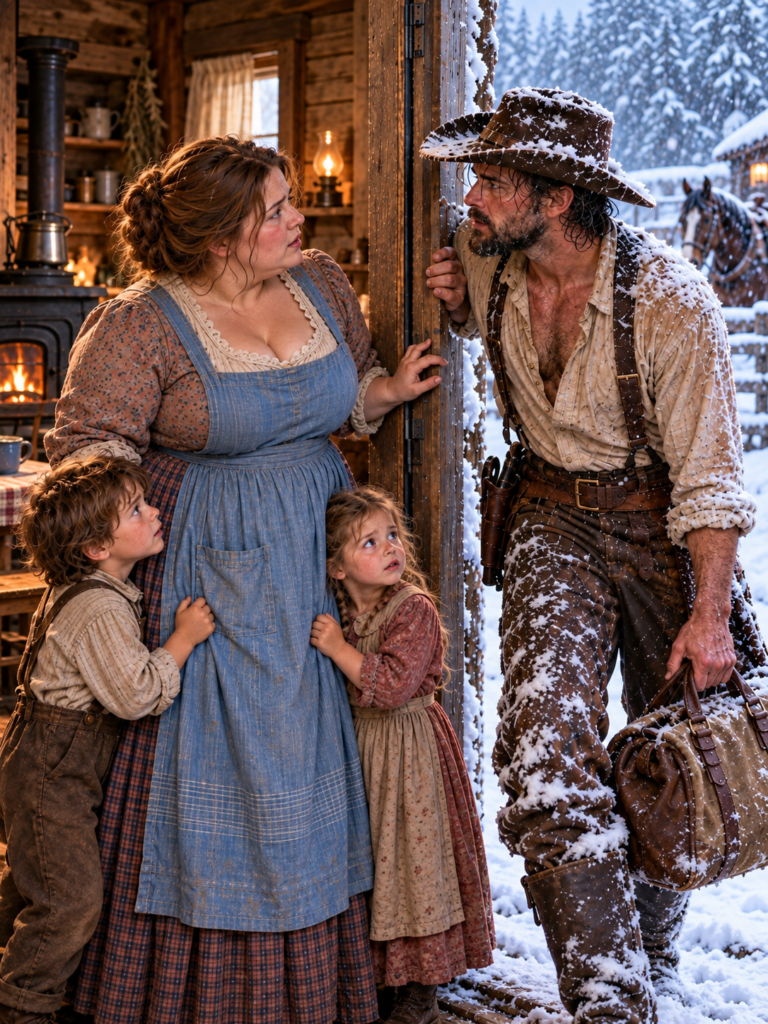
The man standing beyond Elowen Hart’s door had enough money to purchase every building in the nearest town.
But at that moment, he could not lift his right hand high enough to knock again.
His fingers had turned a frightening shade of gray. Ice hung from his beard, and the shirt beneath his torn vest had frozen against his chest. Somewhere behind him, nearly swallowed by the darkness, a horse stood trembling with one foreleg raised.
Elowen saw none of the wealth that belonged to him.
She saw only a stranger dying in the snow.
“Please,” he managed. “I saw your light.”
The wind swept through the doorway, scattering ash across the floor.
Behind Elowen, her eight-year-old son seized the handle of a fireplace poker.
“Don’t let him in, Mama.”
The stranger swayed.
Elowen had been frightened of men before. She knew what a desperate man could do inside a house where there was no one strong enough to stop him.
She also knew what would happen if she closed that door.
“Samuel,” she said, “put down the poker and fetch the other blanket.”
The boy stared at her.
“Now, please.”
She caught the stranger beneath his arm just as his knees buckled.
And in the winter of 1884, along a forgotten stretch of Wyoming creek country, a woman who could barely feed her own children brought a dying man into the only home she had left.
Neither understood that the decision would change the course of their lives.
Outside, the blizzard erased his footprints before the door had even closed.
Inside, the fire was small.
The cabin stood a little more than three miles from the old wagon road, on land Elowen believed her dead husband had claimed nine years earlier. Its walls were made of uneven pine logs, its roof had been patched with flattened pieces of tin, and the front window was covered with greased paper where the glass had broken.
There were two beds, one iron stove, a table with three mismatched chairs, and a wooden shelf holding a Bible, a cracked pitcher, and a blue plate that had belonged to Elowen’s mother.
A faded curtain separated the children’s sleeping corner from the rest of the room.
The stranger was too heavy for her to carry, but she managed to guide him into the chair nearest the stove.
“Your boots,” she said. “We have to get them off.”
He tried to bend forward. His hands would not obey him.
Samuel stood nearby, watching with a suspicion far too old for his face.
“Will he die?”
“Not if we can help it.”
Elowen knelt and worked at the frozen leather.
The stranger winced when she pulled off the first boot. His stocking was soaked, but his toes still had color. She wrapped his feet in dry cloth and began warming him gradually while Samuel brought another armful of wood.
“Ruthie,” she called, “bring Mama the kettle.”
Her five-year-old daughter emerged from behind the curtain, clutching a rag doll with one missing button eye.
“Is he a bad man?”
Elowen glanced up.
“I don’t believe so.”
“How can you tell?”
She looked at the stranger’s shaking hands.
“Sometimes you can’t tell right away.”
Ruthie considered that answer, then placed the kettle carefully on the floor.
The man opened his eyes.
“I shouldn’t have come.”
“You would have frozen outside.”
“I haven’t anything to pay you.”
Elowen continued unwrapping his wet clothing.
“Then it’s fortunate I haven’t named a price.”
He studied her face as though trying to understand a language he had not heard in years.
“I mean it, ma’am. Not a cent.”
“And I mean it, sir. You’ll have warmth tonight.”
For a long moment, he said nothing.
Then he closed his eyes again.
Elowen wondered what kind of man would apologize for needing help while he was close to death.
She was about to find out.
An hour earlier, she had been kneeling beside that same stove, praying that her children might somehow have enough to eat tomorrow.
Now she was wondering how to feed a fourth person.
The irony was painful enough to make her almost smile.
Almost.
Earlier that evening, Ruthie had asked for another piece of bread.
There had been three small portions on the plate.
Elowen had given her daughter the largest one, Samuel the next, and kept the smallest for herself. When Ruthie finished and looked hopefully toward the table, Elowen pushed her own portion across.
“I’m not hungry, sweetheart.”
Samuel had watched her closely.
At eight, he was already learning to recognize the lies his mother told out of love.
Now those same three portions were gone, and the small round loaf set aside for breakfast was the last bread in the house.
Elowen had a little flour, some salt, and a handful of dried apple peelings.
There was no meat.
No milk.
No money hidden in the flour tin.
For two winters she had washed other people’s clothing, mended wagon covers, and taken whatever honest work she could find. In summer, there had been vegetables from the garden and trout from the creek. In winter, there was often nothing but labor and prayer.
Her husband, Silas Hart, had promised her a prosperous life when they married.
He had brought her west from Missouri when she was nineteen, speaking of rich grazing land, new beginnings, and a home no one could take from them.
What he had given her instead was a cabin with a leaking roof and years of anger.
Silas disliked being questioned, disliked being contradicted, and most of all disliked hearing that his wife had been praying.
He had once thrown her Bible against the wall because she had spent lamp oil reading after he went to bed.
Another time, when Samuel was only four, he had struck the table so violently that the boy crawled beneath it and remained there until morning.
Silas finally disappeared toward the Montana mining camps, chasing a rumor of gold and a chance to become rich without working for it.
A letter arrived the following spring.
He had been killed in a gambling-house quarrel.
Elowen mourned the man he might have become, but she could not honestly mourn the fear that had departed with him.
Since then, she had raised her children alone.
She could have written to her father.
He was a minister in Missouri, a stern but loving man who had warned her about Silas before their marriage.
She still remembered his final words.
You are always my daughter, Elowen. Even when you refuse to listen to me.
But pride and shame had made the distance between Wyoming and Missouri seem wider than any ocean.
She could imagine his disappointment too clearly.
And so she stayed.
That evening, when she opened her Bible to the twentieth chapter of Second Chronicles, she found a line she remembered hearing from her father’s pulpit.
Neither know we what to do: but our eyes are upon thee.
She had read it aloud in the quiet cabin.
“Lord,” she whispered, “I truly don’t know what to do.”
She had not asked for riches.
Only for enough to keep her children safe.
Then came the knocking.
And now a stranger sat beside her stove, wrapped in Samuel’s blanket, while his exhausted horse waited under the lean-to outside.
Elowen looked at the last loaf of bread.
She could almost hear Ruthie’s voice asking for breakfast.
The stranger noticed where she was looking.
“Please don’t trouble yourself with food.”
“You need something warm.”
“I’ll manage.”
His words were brave, but his eyes followed the bread before he looked away.
Elowen lifted the loaf.
She sliced it carefully, warmed the pieces near the stove, and poured a little hot water over the dried apple peelings.
Samuel stepped closer.
“Mama.”
She turned.
He did not speak again, but his eyes asked the question plainly.
What will we eat tomorrow?
Elowen placed a hand against his cheek.
“We’ll see what tomorrow brings.”
He looked at the bread.
“Papa used to say people only come to us when they want something.”
The stranger stiffened.
Elowen felt the old wound open inside her son.
“Your father said many things,” she answered gently. “Some were true. Some weren’t.”
She carried the plate to the stranger.
He stared down at it.
“Is this yours?”
“It’s bread.”
“Is it all you have?”
She did not answer quickly enough.
He looked toward the children.
Then toward the bare shelf.
“No.”
The word came out almost sharply.
“I won’t take food out of those children’s mouths.”
Elowen drew up the other chair.
“May I tell you something?”
He nodded.
“When I was a girl, my father preached about a widow who had almost nothing left. A stranger came to her asking for food, and she had to decide whether fear would close her hand.”
The man watched her.
“My father said the greatest acts of faith aren’t always performed by people who have plenty. Sometimes they’re performed by people who know exactly what the gift will cost them.”
She pushed the plate closer.
“I have no intention of making a sermon out of your supper. Eat while it’s warm.”
He lowered his head.
For several seconds, he did nothing.
Then he broke off a small piece.
His hands shook as he lifted it to his mouth.
Ruthie approached him cautiously.
“Does it taste good?”
He swallowed.
“Better than anything I’ve eaten in a very long time.”
She smiled, then offered him her doll.
“You can hold Annie if you’re lonely.”
He stared at the faded bundle of fabric.
The doll had been repaired so often that hardly any of its original blue dress remained.
Still, he accepted it with extraordinary care.
“Thank you, Miss Ruthie.”
She giggled at being called Miss Ruthie.
Samuel did not smile.
But he set down the fireplace poker.
That was the first small victory of the night.
The stranger’s name was Gideon.
He offered no surname.
When Elowen asked where he had come from, he told her about the creek crossing.
His horse had stepped onto snow-covered ice that collapsed beneath them. The animal had fallen through up to its shoulders, and Gideon had climbed into the black water to free it.
He had stripped off his heavy coat after the crossing because the wet wool was freezing rigid around him.
His gloves were gone, one boot had nearly been lost, and he had spent hours wandering through wind and darkness.
He had noticed a light in the distance.
Her light.
“I thought I was imagining it,” he admitted.
“You weren’t.”
“I know that now.”
There was something unusual about his speech.
He did not sound like the drifters who sometimes passed through the valley. His words were measured, and although his clothes were torn and rough, he held himself with the unconscious assurance of a man accustomed to being heard.
Elowen noticed his hands, too.
They were strong and weathered, but his fingernails were neatly trimmed. There was an old scar across one knuckle and a pale mark around his wrist where a fine watch had once rested.
She said nothing.
Everyone had a history.
Some histories were best left unopened until their owners were ready.
Later, Samuel helped Gideon to a pallet beside the stove.
The horse had been rubbed down and sheltered, with hay borrowed from the few bundles Elowen kept for a neighbor’s animals.
The wind continued to hammer the cabin.
But inside, the stranger’s breathing gradually grew steady.
Elowen settled the children beneath their quilt.
Samuel whispered before she could leave.
“Are we going to have food tomorrow?”
She tucked the blanket beneath his chin.
“I can’t promise what I haven’t got.”
His eyes filled.
“Then why did you give him our bread?”
She sat beside him.
“Because I knew he might die without help.”
“What if we need help?”
“Then I hope someone will open a door for us.”
Samuel considered that.
“Would you still have let him in if he were bad?”
Elowen brushed his hair from his forehead.
“I don’t know, darling. A mother has to protect her children, too. I watched him carefully, and I made the best choice I could.”
Samuel reached for her hand.
“Papa wouldn’t have let him in.”
“No,” she said softly. “I don’t believe he would.”
She remained until both children slept.
Then she returned to the stove and sat with her Bible open in her lap.
The cabin was quiet except for the wind.
She thought Gideon was sleeping.
Then she heard him move.
He had lowered himself awkwardly from the pallet onto his knees.
Elowen froze.
His voice was barely more than a breath.
“Father, I don’t know whether You still care to hear from me.”
She looked down at the page.
“I haven’t spoken to You properly in years. I thought I had no need. And when I did need someone, I blamed You for taking her.”
His words faltered.
Elowen understood suddenly that he was speaking about someone he had lost.
“Mother always said You knew the road home, even when we forgot it.”
He stopped, struggling for breath.
“I’ve got more than enough of everything a man can count. And tonight I nearly died without a soul knowing where I was.”
Elowen’s fingers tightened around the Bible.
More than enough?
She glanced toward his ruined clothing.
Perhaps he meant something other than money.
Gideon bowed his head.
“That woman opened her door when she should have been afraid. She gave me food her own children needed. I haven’t known kindness like that since Mother died.”
A long silence followed.
Then he whispered the words that made Elowen’s heart ache.
“Lord, if You still mean for me to have a wife someday, send me a godly woman. One who will tell me the truth when I’m wrong. One who will love my soul more than whatever I possess.”
He drew a shaky breath.
“And teach me to deserve her. Because right now, I don’t believe I do.”
Elowen stared at the flames.
She had heard men pray before.
Her father prayed from the pulpit with a voice strong enough to fill a church.
Silas had prayed once or twice when illness frightened him, always bargaining for what he wanted.
But Gideon sounded like a man standing before someone who already knew every secret he carried.
There was no performance in it.
No expectation of being admired.
She quietly closed her Bible.
She did not want him to know she had heard.
Still, long after he returned to his pallet, those words stayed with her.
Teach me to deserve her.
For the first time in years, Elowen found herself wondering what it might be like to know a man who asked God how to become worthy of love instead of demanding love as his right.
She immediately dismissed the thought.
Her children needed food, not dreams.
And the stranger would be gone by morning.
When daylight arrived, the storm had passed.
Snow covered the valley in smooth white folds. The creek lay beneath a crust of ice, and the bare cottonwood branches glittered in the cold sunlight.
Gideon was strong enough to stand, although his movements remained stiff.
Samuel helped him examine the injured horse.
The animal, a chestnut gelding named Copper, had a swollen foreleg but was able to bear weight.
“He needs rest,” Samuel announced with an authority that surprised Gideon.
“You know horses?”
“A little.”
“Then you know more than some men who claim to.”
Samuel almost smiled.
Gideon looked toward Elowen.
“I owe you more than I can repay.”
“You don’t owe us anything.”
“I can’t agree with that.”
“Then disagree when you’re well enough to stand without leaning on my door.”
That earned the first genuine laugh she had heard from him.
Before leaving, he paused beside the stove.
His gaze moved to the children’s narrow beds, the worn furniture, and the Bible lying beside the blue plate.
“Mrs. Hart, may I come back?”
She looked up.
“To return the blanket?”
“That. And to see whether there’s anything I can do around the place.”
Elowen folded her arms.
“I don’t take charity easily, Mr. Gideon.”
“Neither do I, apparently. Yet here I am.”
She studied him.
He appeared almost embarrassed.
At last she reached for a gray wool scarf hanging beside the door.
She had knitted it the previous autumn, intending to sell it at the general store. No one had bought it.
She wrapped it around his neck.
“You’ll need this.”
He touched the wool.
“Won’t you?”
“I’ve got another.”
It was a small lie.
He seemed to know it.
But instead of challenging her, he nodded.
“Then I’ll bring it back.”
“See that you do.”
He mounted Copper carefully and rode away along the frozen creek.
Elowen watched until horse and rider vanished between the cottonwoods.
Then she turned toward the kitchen shelf.
There was barely enough flour left to make a thin breakfast for the children.
She heated water, stirred in what remained, and served it in their chipped bowls.
They ate without complaint.
Afterward, while Samuel carried ashes outside, Ruthie climbed into her mother’s lap.
“Will the man come back?”
“I don’t know.”
“I think Annie likes him.”
“Does she?”
“She said he looks sad.”
Elowen kissed the top of her daughter’s head.
“Perhaps he won’t be sad forever.”
More than thirty miles away, Gideon Thorne rode through the iron gates of an immense stone residence outside Cheyenne.
Three stablemen hurried forward.
One nearly dropped his bucket when he recognized the rider.
“Mr. Thorne! Good Lord, sir. We’ve had men looking everywhere!”
Gideon dismounted without assistance.
His foreman, Amos Bell, came running from the house.
“Where have you been? We thought you’d been thrown or killed!”
“Nearly both.”
Bell stared at the ruined clothes, the swollen hands, and the gray scarf.
“Your horse?”
“Needs a veterinary man and several days’ rest.”
“And you?”
Gideon looked back toward the eastern hills.
“I think I may finally be getting well.”
Bell had no idea what he meant.
Few men ever did.
At forty-two, Gideon Thorne owned vast stretches of grazing country, tens of thousands of cattle, and enough influence that bankers who refused other ranchers credit would extend him terms without hesitation.
His twelve-room house contained imported furniture, expensive paintings, and silver that required two servants to polish.
It also contained a dining table long enough for fourteen people.
For ten years, he had eaten most of his meals there alone.
His mother had died in that house.
She had been the one person who never cared whether the cattle markets rose or fell, whether his acreage doubled, or whether his name appeared in the newspaper.
She had cared only whether he was becoming a good man.
After her death, he had worked harder, bought more land, and gradually abandoned the habit of attending church.
He told himself there was simply too much to do.
But deep down, he knew his growing fortune had become a convenient shelter from grief.
The day of the blizzard had marked ten years since her burial.
He had ridden out to visit her grave without telling anyone.
Now he stood in the entrance hall, surrounded by polished wood and expensive rugs, remembering a woman who had placed her children’s last bread before him.
For the first time in years, the house looked unbearably empty.
That evening, Gideon entered his mother’s old sitting room.
Nothing had changed.
A blue shawl rested over the back of her chair. Her spectacles lay beside a stack of hymnbooks, and the little Bible she had carried for most of her life remained inside the desk drawer.
He took it out.
There was a folded paper tucked inside the front cover.
On it, in his mother’s handwriting, were the words:
For Gideon, whenever he is ready to come home to the things that matter.
He sat down.
The clock struck nine.
By midnight, the lamp was still burning.
Three days later, Elowen Hart opened her door to find Gideon standing on the step again.
He wore the same faded work clothes, now dry and neatly repaired.
The gray scarf was folded in his hands.
A large sack rested near his boots.
“I brought back what I borrowed,” he said.
Elowen glanced at the sack.
“That appears considerably heavier than a scarf.”
“It is.”
“What have you done?”
“Found employment.”
She raised an eyebrow.
“Doing what?”
“Making myself useful. If you’ll allow it.”
He brought the sack inside.
There was flour, beans, coffee, salt pork, and several apples. Tucked into one corner were two peppermint sticks wrapped in paper.
Ruthie gasped.
Samuel came running.
Elowen stared at the food.
“Gideon, I can’t accept all this.”
“You accepted me when I was half-dead.”
“That was different.”
“Was it?”
She opened her mouth, then closed it.
He continued more gently.
“I have money for provisions, Mrs. Hart. I won’t pretend otherwise. But I don’t want to pay for the kindness you showed me. I want to be a good neighbor, and I would like the chance to work for my supper.”
She hesitated.
“There’s a leak in the roof.”
“Then I ought to start there.”
“And the back fence needs fixing.”
“I saw that.”
“The woodpile is almost gone.”
“Already noticed.”
Her lips twitched.
“You’re a troublesome man.”
“So I’ve been told.”
She let him stay.
By evening, the stove was hot, the children had eaten well, and Gideon had repaired the loose boards beside the doorway.
He left before dark, promising to return with tools.
Elowen stood at the window after he disappeared.
For the first time in months, there was enough flour in the house for another week.
She thought of the ancient story her father used to preach.
The widow.
The stranger.
The nearly empty jar.
Her eyes filled with tears.
Yet outside the warm cabin, beyond the woodpile, another story was quietly beginning.
A rider wearing the insignia of Thorne Land and Cattle had stopped near the creek.
He dismounted, examined a folded survey map, and measured a distance from the eastern cottonwood.
Then he drove a sharpened wooden stake into the frozen ground.
A red strip of cloth fluttered from its top.
Beside it, he hammered a second stake.
And a third.
He wrote several numbers in a small notebook, remounted, and rode away without approaching the house.
By morning, the stakes formed a straight line across the land Elowen believed belonged to her family.
She had no reason to recognize the cattle company’s marking.
And Gideon Thorne had no idea that an agreement he had signed before the blizzard was already moving toward her cabin.
The woman who had saved his life was about to be driven from her home.
By his own company.
Part 2
Samuel discovered the stakes before his mother did.
He had gone outside to collect kindling when he noticed the red strips of cloth moving in the wind.
At first, he thought someone had marked trees for cutting.
Then he saw the numbers.
He pulled one of the stakes from the ground and carried it into the cabin.
“Mama, what’s this?”
Elowen turned from the washing basin.
“Where did you find it?”
“Near the creek. There’s more of them.”
She wiped her hands on her apron and followed him outside.
The stakes ran along the meadow, crossing the place where she planted potatoes each spring. Another stood beside the split-rail fence enclosing her garden.
Someone had measured her land.
Without asking.
She knew enough about frontier life to understand that surveyors seldom appeared without a reason.
For two days, she watched the road.
On the third morning, a man arrived in a dark overcoat with a leather document case strapped behind his saddle.
He introduced himself as Harlan Pike.
“Land agent,” he said. “Thorne Land and Cattle Company.”
He spoke with the smooth confidence of someone who expected his words to settle any question.
Elowen invited him onto the porch but not inside.
“My boy found stakes in our meadow.”
“Yes. Our survey crew has been working along the creek.”
“Your survey crew?”
“Our company recently acquired the eastern watershed property. We’re establishing the boundaries.”
Elowen felt something cold settle beneath her ribs.
“This cabin is my husband’s homestead.”
Pike opened his case.
“Your late husband occupied the property, Mrs. Hart. That is not quite the same as owning it.”
“He filed his claim.”
“An application, apparently. But there’s no completed patent in the records we examined.”
She stared at him.
Silas had handled all the papers.
He had often spoken of going into town to settle the land claim, but he always returned with some excuse.
The office was closed.
The official had gone away.
The fee was higher than expected.
She had believed him because she had no means of finding out otherwise.
“What does that mean?” she asked.
“It means the company holds the present title to this parcel. Your continued occupancy will require a purchase agreement.”
“How much?”
“Four hundred dollars.”
She nearly laughed.
The figure was so far beyond anything she could earn that it sounded unreal.
“I wash clothes, Mr. Pike.”
“I understand.”
“I have two children.”
“I’m aware.”
“Then surely you understand I cannot pay four hundred dollars.”
Pike closed the document case.
“I’m not authorized to negotiate below the stated price.”
“What if I refuse?”
“You’ll receive formal notice.”
He mounted his horse.
Before riding away, he looked toward the cabin and the patched roof.
“Mrs. Hart, I don’t enjoy these conversations. But this company has stockmen depending on reliable winter water. The creek is worth considerably more than the house.”
Elowen stood very still.
“That house has sheltered my children since they were born.”
Pike adjusted his reins.
“I’m sorry. My instructions concern the land.”
He rode away.
Samuel emerged from behind the doorway.
“Mama, are they going to take our house?”
Elowen could not bring herself to lie.
“I don’t know.”
That evening, Gideon found her sitting at the table with her hands folded around a cup of cold coffee.
The children were unusually quiet.
He noticed immediately.
“What happened?”
Elowen told him.
She described Pike, the stakes, the disputed title, and the four hundred dollars.
Gideon listened without interrupting.
But when she mentioned the company’s name, the color drained from his face.
“Thorne Land and Cattle?” he repeated.
“Yes.”
“Did Pike leave anything?”
“Only a warning. The formal notice hasn’t come yet.”
Gideon crossed to the window.
For a moment, he looked like a man who had discovered a fire spreading beneath his own floorboards.
Elowen misunderstood his silence.
“I’m sorry. I shouldn’t have burdened you.”
He turned.
“Don’t say that.”
“I know there’s little you can do.”
“There may be more I can do than you think.”
She gave a weary smile.
“Unless you have four hundred dollars hidden in your boots, I doubt it.”
He did not smile back.
Instead, he asked whether she had any papers connected to Silas’s claim.
She brought him a tin box containing receipts, a faded marriage certificate, two letters, and a folded document nearly ruined by water.
Gideon examined them closely.
“May I take these to someone who understands land records?”
Elowen hesitated.
“Who?”
“A man in Cheyenne.”
“Would he charge?”
“I’ll see to that.”
She drew back.
“Gideon—”
“I’m not offering to purchase your pride, Elowen.”
It was the first time he had used her given name without asking.
Neither seemed to notice until the silence afterward.
He lowered his voice.
“I only want to find out what the law says.”
After a moment, she agreed.
Gideon took the papers.
He intended to leave immediately for Cheyenne.
But Ruthie appeared from behind the curtain carrying his gray scarf.
“You forgot this.”
He knelt.
“Thank you, little lady.”
She placed it around his neck.
“Now you won’t get cold.”
He kissed the top of her head before he could stop himself.
Across the room, Elowen watched the gesture.
Something tender and frightening moved through her.
She had promised herself that no man would ever become necessary to her children’s happiness again.
Yet here was Gideon, kneeling in the lamplight as though Ruthie’s small concern were a gift of immeasurable value.
And Samuel, who once slept with a fireplace poker beside his bed, now waited eagerly for the sound of Gideon’s horse.
It was becoming dangerous to imagine him staying.
Over the following weeks, Gideon continued to visit.
Sometimes he brought repairs for the house. Sometimes he came with no apparent purpose beyond helping Samuel tend the small garden beds and listening to Ruthie’s elaborate stories about her doll.
Once, Samuel accidentally broke a wooden chair while trying to stand on it to reach a shelf.
He froze when Gideon entered.
His face turned pale.
“I didn’t mean to.”
Gideon looked at the chair.
“I see that.”
“I’ll fix it.”
“Probably best to have a grown man help.”
Samuel stood trembling.
“You aren’t angry?”
“No.”
“Papa would have been.”
Gideon set down his tools.
“Your papa and I must have looked at broken chairs differently.”
Samuel lowered his eyes.
“He said boys who broke things needed to be taught a lesson.”
Gideon crouched beside him.
“Then here’s a lesson worth learning. Wood can be repaired. So can most mistakes. But frightening a child doesn’t make him wiser.”
Samuel’s mouth tightened.
He fought the tears until they came anyway.
Gideon did not reach for him.
He waited.
At last, the boy stepped forward and rested his forehead against Gideon’s shoulder.
Gideon closed his eyes.
It had been ten years since he had held anyone who trusted him without reservation.
That evening, when the children were asleep, he and Elowen sat beneath the porch roof listening to snow slide from the trees.
“Samuel was frightened of me today,” Gideon said.
“He’s frightened of disappointing people.”
“Because of his father?”
She nodded.
Gideon rubbed his hands together.
“I don’t want him to feel that way around me.”
“He doesn’t anymore.”
Elowen looked toward the cabin.
“He’s growing attached to you.”
“And that troubles you.”
“Yes.”
He accepted the answer.
For a while, neither spoke.
Then Elowen told him about Silas.
Not the shortened story she offered neighbors, but the truth.
She told him about the broken dishes, the mocking laughter when she prayed, the fear of footsteps approaching the porch after dark.
She told him about her father and the warning she had ignored.
“I knew what people would say if I went home,” she confessed. “They’d say he had been right.”
“Was he?”
“About Silas, yes.”
“Then why should that keep you from writing?”
She looked away.
“Because I don’t want to arrive on his doorstep with two hungry children and nothing to show for my choices.”
Gideon considered her words.
“My mother and I quarreled before she died.”
Elowen turned toward him.
“About what?”
“Something foolish. I wanted to purchase a neighboring ranch. She told me the price was too high, not in money, but in what it would do to the families living there.”
“What did you say?”
“That she didn’t understand business.”
His voice roughened.
“She understood people considerably better than I did.”
“Did you apologize?”
“No.”
He looked into the darkness.
“She died three days later.”
Elowen felt the weight of that silence.
“Gideon, you couldn’t have known.”
“I know. But I’ve spent ten years wishing I’d said one different sentence.”
He turned toward her.
“If your father still lives, don’t let pride steal the chance I lost.”
The following morning, Elowen wrote a letter.
She told her father that Silas had died, that she had two children, and that life in Wyoming had been harder than she was willing to admit.
She did not ask for money.
She did not ask him to say he had been wrong.
She simply wrote:
Father, I am tired of being afraid to come home in your thoughts. If you can bear to hear from me, I would be glad to hear from you.
She sealed the envelope before she could change her mind.
Gideon carried it to the post office.
He returned that evening with an unusual brightness in his eyes.
“Your letter is on its way.”
Elowen breathed out slowly.
“Now I suppose I must trust the postmaster and Providence.”
“They’ve each surprised me before.”
They laughed together.
And for a few precious days, the uncertain future seemed less frightening.
Then the formal notice arrived.
Pike himself delivered it.
Fourteen days.
That was how long she had to purchase the property or surrender possession.
Afterward, the company would take whatever measures the law permitted to clear the site.
Elowen read the paper twice.
Four hundred dollars.
Fourteen days.
Her entire life reduced to two numbers.
When she looked up, Pike was studying the repaired porch boards.
“Someone’s been making improvements.”
“A friend.”
“Then I suggest your friend help you move.”
She folded the notice carefully.
“You talk as though none of this matters to you.”
Pike’s expression hardened.
“Mrs. Hart, I have twenty-three ranch hands whose wages depend on this company. If we lose control of winter water, we lose cattle. And if we lose cattle, those men lose their work. You aren’t the only person with people to feed.”
For the first time, she heard something besides arrogance in his voice.
Fear.
But it did not make his demand any less cruel.
“Then tell your employer,” she said, “that my children are people, too.”
Pike looked away.
“I’ll record your objection.”
He left.
Elowen waited until his horse had disappeared before she allowed herself to cry.
She stood in the doorway with the notice crushed against her apron.
Ruthie slipped a small hand into hers.
“Are we moving?”
Elowen knelt.
“I don’t know, sweetheart.”
“Will Mr. Gideon come with us?”
That question hurt more than the notice.
“I don’t know that either.”
At the Thorne estate outside Cheyenne, Gideon was beginning to understand the size of the mistake he had made.
His land agent had acquired a broad stretch of creek country on the eastern side of the valley. The purchase was intended to secure reliable water for winter grazing.
Gideon remembered signing the authorization.
Pike had placed several contracts before him on the morning he left to visit his mother’s grave.
The acquisition had seemed routine.
The maps showed acreage, water frontage, and estimated grazing value.
They did not show a widow struggling to keep two children alive.
Or perhaps they did, if he had taken the trouble to look.
That possibility sickened him.
He spread the documents across his office desk.
“Why wasn’t I told people were living on this land?”
Pike stood opposite him.
“You were, sir. The occupancy report was attached.”
Gideon searched the papers.
There it was.
A list of dwellings.
Family names.
Estimated improvements.
Beside one entry, in Pike’s neat handwriting:
Hart, Elowen. Widow. Two dependents. No perfected title. Recommend removal.
Gideon stared at the sentence.
He had signed beneath it without reading.
“What have you done?” he asked quietly.
Pike shifted.
“I followed the approved plan.”
“How many households?”
“Seven, if you count the creek laborers.”
“And all have received notices?”
“Five so far. The remaining two are being prepared.”
Gideon stood.
“No more notices.”
“Sir?”
“Withdraw every one you’ve sent.”
Pike blinked.
“The winter grazing plan—”
“Can be revised.”
“Not without expense.”
“Then we’ll bear the expense.”
Pike’s face reddened.
“Mr. Thorne, we made commitments to cattle buyers based on that water. I’ve negotiated supply terms, feed contracts, and grazing arrangements. We can’t simply surrender the creek.”
Gideon walked to the window.
He remembered Elowen’s cabin.
He remembered Ruthie’s doll.
Samuel’s frightened question about broken furniture.
A woman trying to conceal the emptiness of her cupboard.
For years, he had told himself he was a fair employer because he paid wages on time and kept honest books.
Yet a widow had nearly lost her home because her name was merely one line in an attachment he had not considered worth reading.
“Find another plan,” he said.
Pike’s voice sharpened.
“May I ask what has happened to make you abandon sound business judgment?”
Gideon turned.
“A woman gave me food when she had almost nothing. I am not going to repay her by putting her children into the snow.”
Pike stared.
Understanding slowly changed his expression.
“The Hart widow?”
Gideon said nothing.
“You know her?”
“Yes.”
“Personally?”
“Yes.”
Pike looked back at the map.
“Then perhaps you ought to consider whether personal feelings are interfering with your judgment.”
Gideon’s voice remained calm.
“Personal feelings should have interfered with my judgment a little sooner.”
He gathered the documents.
“I want a surveyed parcel of one hundred and sixty acres surrounding her house, including the creek frontage necessary for her use. Prepare a conveyance without payment or conditions.”
Pike’s eyes widened.
“One hundred and sixty acres?”
“In her own name.”
“But that would separate valuable land from our holding.”
“Then separate it.”
“And the other residents?”
“We’ll review every household individually. No one is to be removed while that review is pending.”
Pike shook his head.
“You’re going to ruin our arrangements.”
“No,” Gideon said. “I’m going to correct them.”
He gave the agent until noon to begin.
But correcting an injustice proved harder than giving an order.
Pike had already negotiated winter water access with several neighboring stockmen. The company had pledged the newly acquired acreage as part of a financing arrangement for cattle purchases.
The bank would require revised security.
Survey lines had to be changed.
New documents had to be prepared and recorded.
Gideon could absorb the financial cost.
What he could not recover was the trust he had already endangered.
That evening, alone in his office, he unfolded the gray scarf Elowen had knitted.
He held it for a long time.
Then he opened his mother’s Bible.
A verse underlined in faded pencil caught his eye.
To whom much is given, of him shall much be required.
He sat with the words until the lamp burned low.
For the first time, he understood that ownership was not only a privilege.
It was a responsibility that did not disappear merely because a man refused to look at the people affected by his decisions.
He wanted to ride to Elowen immediately.
To confess everything.
To tell her he was the man who could stop the eviction.
But he pictured her face when she discovered his surname.
He remembered how she had spoken to him without fear of his money.
How she had argued with him, teased him, and trusted him with the small daily sorrows of her children.
He was terrified of losing that.
So he did what frightened men sometimes do.
He delayed the truth, hoping he could repair the damage before admitting he had caused it.
The following week became a contest between Gideon’s instructions and the consequences of the company’s old agreements.
He met the banker.
He consulted a lawyer.
He rode with a surveyor over the frozen creek country and personally marked the boundaries that would protect the Hart cabin.
He pledged securities from his private holdings so the company could release the land from its financing arrangements.
Then he ordered Pike to prepare the withdrawal notices.
Pike obeyed outwardly.
But he remained convinced Gideon was sacrificing valuable water access over one woman’s gratitude.
And when he learned that a bank officer required final paperwork before the revised agreement became effective, Pike chose not to inform the widow.
He believed the threat of eviction might persuade her to leave voluntarily.
If she was gone, the entire problem would solve itself.
Gideon did not know what his agent intended.
Elowen knew only that he had stopped visiting.
Four days passed.
Then six.
She tried to reassure herself that he was occupied with work.
But each evening, Ruthie went to the window.
“Maybe Mr. Gideon is coming tonight.”
Samuel stopped asking after the third day.
Instead, he began helping his mother pack.
They had one wooden trunk.
Elowen placed the children’s winter clothing inside, followed by the cracked blue plate and the few letters she had saved.
She wrapped the Bible in a clean piece of cloth.
The eviction deadline approached.
There was no letter from Gideon.
No notice of cancellation.
No word from the land company except the same demand.
On the seventh evening, Samuel carried in an old newspaper he had found beneath a loose floorboard in the shed.
“Could we use this to wrap the plates?”
Elowen took it.
It was a Cheyenne paper from the previous autumn.
A familiar name caught her attention.
THORNE LAND AND CATTLE ANNOUNCES EASTERN EXPANSION.
Beneath the headline was an engraving of a man standing beside a prized breeding bull.
She nearly dropped the paper.
The face was unmistakable.
The square jaw.
The deep-set eyes.
The same scar beside the brow.
The caption read:
Gideon Thorne, proprietor.
Elowen sat down.
For several moments, the room seemed to tilt around her.
Gideon.
Her Gideon.
The poor traveler who had eaten her children’s bread.
The man who carried water and repaired broken chairs.
The man who prayed beside her stove.
He was the owner of the company threatening to throw her children into the snow.
Samuel leaned against her.
“Mama, what’s wrong?”
She could not answer.
She looked from the newspaper to the eviction notice.
The signatures and company name were no longer mysterious.
Every promise Gideon had made returned to her with a different meaning.
There may be more I can do than you think.
Leave the papers with me.
Trust me.
Had he known from the beginning?
Had her struggles been some sort of amusement to a wealthy man?
Had he returned to her cabin because he enjoyed being admired by people who thought him poor?
Or had the kindness between them been real?
That uncertainty wounded her most.
Outside, horse hooves sounded on the frozen road.
Ruthie ran to the window.
“It’s him!”
Elowen remained seated.
Gideon entered a moment later, breathless from the cold, carrying a leather portfolio.
“Elowen, I have news.”
He stopped.
She was holding the newspaper.
The room fell silent.
He looked at the engraving.
Then at the eviction notice lying beside it.
He knew instantly.
“Please,” he began.
She rose slowly.
“Is your name Gideon Thorne?”
He lowered his eyes.
“Yes.”
“Do you own the company trying to take this house?”
“Yes.”
Her expression changed in a way he would remember for the rest of his life.
Not anger at first.
Something worse.
The sudden collapse of trust.
“You let me believe you were a poor man.”
“When I came here that night, I had nothing with me.”
“But you had all of that.”
She raised the newspaper.
“You had land and cattle and servants and a home large enough to swallow this cabin ten times over.”
He did not defend himself.
She stepped closer.
“And while my children learned to love you, your company was measuring the ground beneath their beds.”
“Elowen, I didn’t know—”
“Then you should have known!”
The words struck him silent.
Tears ran down her cheeks.
“I told you everything. About Silas. About my father. About the things I was ashamed of. And all that time, you kept the one truth that mattered most.”
Gideon held the portfolio tightly.
“I wanted to tell you.”
“But you didn’t.”
“No.”
“Were you waiting until you could arrive here like a king and save us?”
He flinched.
She saw that she had found the truth, or at least part of it.
“Do you know what I loved about having you here?” she whispered. “For the first time in years, I thought someone saw me without measuring what I owned or what I lacked.”
“I did see you.”
“Then why didn’t you let me see you?”
He had no answer sufficient to heal the hurt.
Samuel stood beside his mother.
Ruthie clutched her doll.
Gideon looked at the children, then back at Elowen.
“The eviction will be stopped. I swear it.”
She glanced at the papers in his hands.
“You’re still making promises.”
“I can prove this one.”
“Then prove it to the county clerk. Not to me.”
Her voice trembled.
“Please leave.”
Gideon went very still.
He wanted to explain the bank, the surveys, the orders he had issued.
He wanted to tell her that the land was nearly hers.
But she had asked him to go.
And for once, he understood that love could not be made honorable by ignoring another person’s wishes.
He set the portfolio on the table.
Inside were copies of the proposed deed, the survey, and the withdrawal instructions.
“Those papers are yours to read,” he said.
Then he removed the gray scarf from his neck.
He placed it gently beside the Bible.
Elowen turned away.
Gideon walked to the door.
Ruthie cried out.
“Are you coming back?”
He looked at the little girl.
“I hope so.”
Then he stepped outside.
The door closed behind him.
Elowen stood motionless until the sound of his horse had faded.
Only then did she open the portfolio.
At the top of the first page was a proposed conveyance granting her one hundred and sixty acres.
But the final recording information had not yet been completed.
The papers were not enough to protect her.
The withdrawal notices had been prepared, but no proof of delivery appeared among them.
And beneath the documents lay a letter from the bank stating that the revised security agreement required final execution.
Elowen stared at the unfinished paperwork.
A wealthy man had promised to save her.
Yet the law still gave her no certainty.
There were only two days left.
And the person she had trusted to protect her family was the man who had permitted the danger in the first place.
Part 3
Gideon Thorne did not return to his stone mansion that night.
He rode straight to the company office in Cheyenne.
The lamps were still burning.
Harlan Pike sat at his desk, examining a ledger.
He looked up in surprise.
“Mr. Thorne. I thought you had gone home.”
“Show me the withdrawal notices.”
Pike hesitated.
“They’re being processed.”
“I asked you to show them to me.”
The agent opened a drawer and took out a stack of papers.
Gideon examined the first.
Then the second.
None had been delivered.
The original eviction notices remained in force as far as the families had been told.
Gideon slowly set the documents down.
“I gave you a direct order.”
Pike straightened.
“The bank hadn’t approved the new arrangement.”
“That did not prevent you from notifying the families that enforcement was suspended.”
“I thought it unwise to surrender our position before everything was settled.”
“Unwise for whom?”
Pike’s expression tightened.
“For the company, sir.”
Gideon leaned forward.
“There are children sleeping in houses whose occupants believe they may be turned out in two days. Because you chose not to send six letters.”
“Seven households, Mr. Thorne. And there are scores of employees whose livelihoods depend on our decisions.”
Gideon was silent for a moment.
He knew Pike was not wrong about the company’s responsibilities.
Water mattered in Wyoming.
A failed winter grazing plan could ruin ranchers who had borrowed against their herds. The wages of cowhands, teamsters, and stable workers were no small matter.
But Pike had made those legitimate concerns into an excuse to threaten people who lacked the means to defend themselves.
“We will keep our employees working,” Gideon said. “And we will not drive families from their homes to do it.”
“The two objectives may not be compatible.”
“Then our business arrangements will have to change.”
Pike shook his head.
“You’re letting sentiment run the company.”
Gideon looked at him steadily.
“No. I let indifference run it for too long.”
He gathered the notices.
“You’re relieved of responsibility for this matter. Amos Bell will oversee the land office until I appoint a replacement.”
Pike’s face went white.
“After twelve years?”
“After you knowingly refused to carry out an order that would have protected seven households.”
For the first time, the agent appeared genuinely shaken.
“I never meant to make children suffer.”
Gideon paused at the door.
“Then remember that the next time you’re tempted to describe a home as an obstruction on a map.”
He left Pike sitting beneath the lamplight.
By dawn, Gideon had summoned his attorney, his foreman, and the banker who held the company’s financing agreement.
The meeting lasted most of the morning.
The banker wanted a substantial additional pledge before releasing the creek land.
Gideon offered a portion of his unencumbered grazing property and securities from his personal holdings.
The man looked at the figures twice.
“Mr. Thorne, this is a considerable personal commitment.”
“I understand.”
“You could accomplish the company’s original plan at a fraction of the cost.”
“I understand that, too.”
“Then why?”
Gideon thought of Elowen standing beside the table, holding a newspaper that had exposed everything he was ashamed to admit.
“Because the original plan costs more than you have calculated.”
The banker sighed.
“Very well. If your attorney puts the documents in order, we can have the revised agreement executed today.”
Gideon nodded.
“Then let’s do it.”
Meanwhile, Elowen had come to a decision of her own.
She would not spend her final day waiting beside the window for Gideon to rescue her.
She had spent too many years allowing the decisions of men to determine where she could live, what she could own, and whether she was entitled to peace.
Silas had controlled her with anger.
Pike had tried to control her with legal papers.
And Gideon, however kindly he had intended it, had kept her dependent upon promises he alone understood.
She could not undo the past.
But she could refuse to remain helpless before it.
Before dawn, she woke Samuel.
“Get dressed, darling.”
“Are we leaving?”
“We’re going into Cheyenne.”
“What for?”
“To find out precisely what rights we have.”
She placed the old homestead papers, the proposed deed, and the eviction notice inside her satchel.
Then she opened the tin box again.
Beneath Silas’s old letters lay a bundle of receipts.
She had forgotten them.
Years of small purchases made to improve the property.
Roofing materials.
Fence nails.
Seed.
A stove purchased on credit.
She gathered them along with a notebook in which she had recorded work done on the cabin and garden.
Perhaps the documents would prove nothing.
But she intended to ask someone who knew.
Samuel watched her.
“Mr. Gideon said he’d fix everything.”
Elowen tied the satchel shut.
“I know.”
“Don’t you believe him?”
She looked at her son.
“I believe he wants to do what’s right.”
“Then why are we going?”
“Because wanting to do right and making certain it’s done aren’t the same thing.”
Samuel thought about that.
Then he picked up the wooden trunk.
“Can I help?”
She smiled.
“You can carry the satchel.”
A neighbor farther down the creek, Mrs. Bellamy, agreed to take Elowen and the children into town in her wagon. Her own household had received a company notice, and she wanted answers as badly as Elowen did.
They traveled beneath a pale winter sky, the horses’ breath rising like smoke.
By late morning, they reached the county offices.
Elowen had never entered such a building alone.
The floors were polished, the doors heavy, and men in dark coats moved through the corridors carrying leather cases.
For an instant, she felt terribly out of place in her faded brown dress and carefully mended boots.
Then Ruthie slipped her hand into hers.
Elowen straightened.
She was not there to impress anyone.
She was there to protect her home.
At the land records office, a clerk examined her documents.
He explained the difficulty with Silas’s original claim and confirmed that the property was presently recorded under the company’s ownership, subject to the financing arrangements Gideon was trying to revise.
Her old receipts could help establish the history of her improvements, but they could not by themselves replace a valid title.
Elowen listened carefully.
“Then what would protect us?”
“A properly executed and recorded deed, ma’am. Once the land is released from the bank’s security and conveyed to you, the company won’t have the right to remove you from that parcel.”
She looked at him.
“Would it matter if the owner of the company promised me I could stay?”
“Promises are useful when people keep them. Recorded instruments are rather better for land.”
She almost smiled.
“That’s what I thought.”
Then the door behind her opened.
“Mrs. Hart?”
She turned.
Gideon stood in the entrance.
He wore a black coat, clean boots, and a dark hat.
For the first time, he looked exactly like the man from the newspaper.
Behind him stood an attorney carrying a leather portfolio.
Gideon seemed genuinely startled to see her.
“Elowen.”
“I came to ask about my land.”
He glanced at the clerk.
“And you were right to.”
Neither moved closer.
The attorney stepped forward.
“Mr. Thorne, the bank has executed the release. We’re ready for the conveyance.”
Gideon looked at Elowen.
“I’d like you to hear everything before you sign anything.”
She nodded.
They sat at the clerk’s desk.
The attorney explained the documents one by one.
The bank’s lien on the selected property had been released.
A survey described the boundaries of one hundred and sixty acres, including the cabin, meadow, garden, and the frontage required for access to the creek.
The company was conveying that parcel to Elowen Hart without payment.
There was no provision requiring her to marry, work for, or otherwise compensate Gideon.
Her ownership would not depend on his continuing favor.
Elowen asked the attorney to read the most important clauses aloud again.
He did.
Then she asked the clerk whether the papers would remain valid if Gideon changed his mind.
The clerk nodded.
“Once properly signed, delivered, and recorded, this deed transfers the company’s interest. Mr. Thorne won’t be able to take the property back merely because he regrets the gift.”
Elowen turned toward Gideon.
“And you understand that?”
His eyes did not leave hers.
“Completely.”
She picked up the pen.
But before signing the acknowledgment of delivery, she paused.
“What about Mrs. Bellamy?”
Gideon blinked.
“The other families?”
She opened her satchel and withdrew the list of names she had gathered from neighbors along the creek.
“Mr. Pike told me the company’s plans concerned more than my cabin. There are children in those houses, too.”
Gideon looked down at the list.
“I’ve suspended every eviction and begun a review of each household.”
“For how long?”
“Until a lawful settlement is reached.”
“And will they have the chance to own their homes?”
“That depends on their existing rights and the land involved. But no family will be forced out while we determine a fair arrangement.”
Elowen held his gaze.
“Then I hope you’ll put that in writing, too.”
Gideon turned to his attorney.
“Prepare the notices for all seven households. And make certain each family receives a copy.”
He looked back at Elowen.
“Is there anything else?”
She considered him for a long moment.
“Yes.”
“What?”
“Don’t become a better man only because you love one particular woman.”
The words struck deeper than any accusation she had made the night before.
Gideon swallowed.
“I’ll try not to.”
She nodded.
Then she accepted the pen.
Her hand trembled as she signed the acknowledgment.
The clerk completed the recording process.
He turned the official record toward her and pointed out the identifying information.
“There, Mrs. Hart. The conveyance is entered.”
Elowen stared at the writing.
For nine years, she had lived on that land believing it belonged to her family.
Now, for the first time, she held reliable proof.
She pressed a hand over her mouth.
Samuel leaned forward.
“Mama?”
She drew him close.
“We can go home.”
“Really?”
“Yes.”
“And nobody can make us leave?”
“Not because of that company’s claim, darling.”
The boy wrapped both arms around her waist.
Ruthie began laughing without understanding the legal details.
She only knew her mother was crying and smiling at the same time.
Across the desk, Gideon turned away.
He had negotiated cattle contracts worth many thousands of dollars.
He had bought entire ranches without losing a night’s sleep.
Yet watching a little boy embrace his mother over a recorded deed left him struggling to keep his composure.
Elowen noticed.
For a brief instant, she saw the same vulnerable man who had knelt beside her stove in the darkness.
But forgiveness was not as simple as recognizing someone’s sorrow.
She gathered her documents.
“Thank you for doing what was right, Mr. Thorne.”
The formality of his surname hurt him.
He accepted it.
“You deserved nothing less.”
She walked toward the door with her children.
Gideon did not stop her.
Then Samuel turned around.
“Mr. Gideon?”
“Yes, son?”
“Will you still come help fix the fence?”
Gideon’s throat tightened.
He looked toward Elowen.
The decision was hers.
She stood beside the doorway for several seconds.
Finally, she said, “There isn’t much left to fix.”
Gideon attempted a smile.
“Then perhaps I could find something else useful to do.”
Elowen did not answer.
But she did not say no.
Spring came slowly to the Wyoming valley.
The snow withdrew from the southern hills first, exposing brown grasses and muddy wagon tracks.
Water returned to the creek with a steady rush.
The cottonwoods began to show green.
And along the newly surveyed boundary of Elowen Hart’s property, the old red stakes were removed.
Fresh markers took their place.
This time, they stood as evidence of what belonged to her.
Not what someone intended to take away.
Gideon kept his promise to the other families.
The settlements were not identical.
Some residents possessed legitimate claims that needed correcting or documenting. Others negotiated purchases on affordable terms. The company preserved access to water for its cattle through carefully written agreements rather than by clearing occupied homes.
The process cost money.
It also required Gideon to confront the way his company had been managed.
He spent more time in the field speaking with families, cowhands, and smallholders whose names had previously existed for him only in ledgers.
Amos Bell noticed the change.
One afternoon, after a long meeting, the foreman remarked, “You used to say a good ranch ran on firm numbers.”
“It still does,” Gideon replied.
“Then what’s changed?”
Gideon closed the ledger.
“I’ve learned that people aren’t numbers.”
As for Harlan Pike, Gideon did not restore him to his old position.
But neither did he deny that the man had given years of competent service.
Pike was paid what he was owed and departed to seek work elsewhere.
The last time they spoke, Gideon told him, “A business can survive an expensive mistake. It’s harder to survive becoming a place where no one remembers what mercy is.”
Pike said nothing.
Yet when he reached the door, he removed his hat.
It was the first time Gideon had seen him do so without being required.
At the Hart cabin, life became quieter.
Gideon did not visit every day.
He had learned that the woman he loved did not need to be surrounded by constant displays of generosity.
Sometimes he came on Saturdays to help Samuel repair the fence.
Sometimes he brought books from his mother’s library and sat on the porch while Ruthie asked questions about pictures of distant cities.
He never arrived with extravagant gifts.
He never used his wealth as an argument for being welcomed.
And he never entered the house without an invitation.
Elowen watched him carefully.
Not because she wished to punish him.
Because she had learned that trust should be built by repeated actions, not beautiful promises.
One afternoon, Gideon brought Samuel a small wooden toolbox.
Inside were a hammer, a measuring rule, a screwdriver, and several other tools sized for a boy’s hands.
Samuel examined them with wonder.
“Are these really mine?”
“They are.”
“What if I break one?”
“Then we’ll see whether it can be repaired.”
Samuel smiled.
He understood.
From the doorway, Elowen watched Gideon help her son fit the tools into their places.
She remembered the frightened child who once slept with a poker nearby.
That night, Samuel placed the toolbox beside his bed.
Not for protection.
Because he was proud of it.
And Elowen realized that something far more important than a broken fence had been mended.
Several weeks later, a letter arrived from Missouri.
The handwriting on the envelope was unmistakable.
Elowen carried it inside with shaking hands.
She sat at the table and broke the seal.
Her father had written three pages.
At first, she could barely read them through her tears.
He told her that he had received every letter she sent in the early years of her marriage, though there had been far too few.
He said he had often considered traveling west to find her, but feared that appearing uninvited would only drive her farther away.
He told her that he had kept her childhood room as it had been, long after everyone said she would never return.
Then came the lines that undid her completely.
My dear daughter,
You speak of shame as though it were a debt you must pay before you may come home.
But a father does not stop loving his child because she has suffered.
I was right to worry about the man you married. I was wrong to let you believe that being right mattered more to me than having you safe.
You have nothing to prove before I embrace you again.
If you will permit an old man to travel, I would very much like to meet my grandchildren.
Elowen pressed the letter against her chest.
For years, she had imagined her father standing in judgment.
Instead, he had been waiting with an open heart.
She wept until Ruthie climbed into her lap and asked whether Grandpa had said something sad.
“No, sweetheart.”
Elowen kissed her.
“He said something very kind.”
That Sunday, Gideon attended worship at the small church near the wagon road.
He had not been inside a church for years except to attend funerals.
He sat near the back.
After the service, he found Elowen standing beneath the cottonwoods with the children.
“Your father wrote?” he asked.
She nodded.
“He’s coming in May.”
Gideon smiled.
“I’m glad.”
She watched him for a moment.
“Do you still read your mother’s Bible?”
“Every night.”
“Even when you’re tired?”
“Especially then.”
A breeze stirred the branches above them.
Elowen glanced toward the children, who were examining a beetle on the church steps.
Then she looked back at Gideon.
“I heard you praying.”
He frowned slightly.
“When?”
“The first night. After you thought everyone had gone to sleep.”
The color rose in his cheeks.
“Oh.”
She smiled faintly.
“You asked God to send you a godly woman.”
Gideon lowered his head.
“Yes.”
“And to make you worthy of her.”
“Yes.”
She stepped closer.
“Do you know what I was praying before you knocked?”
He shook his head.
“I was asking God to show me what to do. I had almost no food left. I didn’t know how I was going to care for my children.”
Gideon’s expression grew solemn.
“I came and made that problem worse.”
“For one night, perhaps.”
They both smiled.
Then her voice softened.
“I used to think an answered prayer would look like the problem disappearing. A full cupboard. Money enough to pay every debt. A road opening where there hadn’t been one.”
She looked toward the mountains.
“But I asked for help, and there was a man freezing on my doorstep.”
Gideon said nothing.
“I don’t pretend to understand everything God allows,” she continued. “I don’t believe every sorrow exists simply to lead us somewhere pleasant. There are things Silas did that will never become good just because my life has changed.”
He nodded.
“But I do know that opening my door that night was the right thing.”
She met his eyes.
“And I know you have tried to become the man I thought you were.”
Gideon’s voice was unsteady.
“I’d like to keep trying.”
Elowen reached for his hand.
“Then I think you should.”
He held her hand as though it were something precious and easily broken.
“May I court you properly, Elowen?”
She studied his face.
The wealthy rancher who had once concealed his name now stood before her with nothing concealed at all.
“I would like that,” she answered.
He closed his eyes for a moment.
When he opened them, there was an astonished happiness in his expression that made her laugh softly.
“But I have conditions,” she added.
“Name them.”
“My children come first.”
“Always.”
“You must never ask me to be silent when I believe you’re wrong.”
“I’d be disappointed if you did.”
“And I won’t have you building some enormous house to prove what a fine husband you could be.”
He laughed.
“Then I’ll have to prove it some other way.”
She smiled.
“I suspect you will.”
Gideon did not propose marriage the next day.
He courted her through the spring.
He attended church with her family.
He helped Samuel put in the vegetable garden.
He listened to Ruthie read from her first little book.
He sat with Elowen on the porch after sunset and told her the truth about his life, including the parts that did not flatter him.
She spoke of her dreams.
Not grand dreams.
She wanted a proper school for the children, a garden large enough to supply vegetables through the summer, and a small room where she could sew without having to clear the supper table first.
Gideon listened.
He discovered how deeply he loved the ordinary things she hoped for.
In May, Elowen’s father arrived by train in Cheyenne.
Gideon drove the wagon to meet him.
The elderly minister descended onto the platform carrying a black traveling bag and a worn Bible.
His hair was white, his shoulders stooped, and his eyes searched the crowd anxiously.
Elowen stood beside the wagon with Samuel and Ruthie.
For a moment, father and daughter simply looked at one another.
Nine years of silence lay between them.
Then the old man opened his arms.
“Elowen.”
She crossed the platform almost at a run.
He held her as though she were still the girl who had once fallen asleep in the front pew while he preached.
“I’m sorry, Papa.”
His arms tightened.
“Hush, child.”
“I should have written sooner.”
“Then we’ll make up for the lost letters.”
She began to cry.
He kissed her hair.
“You came back to me. That’s enough.”
When he finally released her, Samuel approached cautiously.
“Are you our grandpa?”
The minister knelt with difficulty.
“I believe I have that honor.”
Ruthie placed Annie the rag doll in his hands.
“She’s part of the family, too.”
The old man laughed through his tears.
“Then I’ll have to learn everyone’s name.”
Gideon watched from several steps away.
Elowen’s father noticed him.
“And you must be Mr. Thorne.”
“Yes, sir.”
The minister studied him carefully.
“My daughter has told me quite a story about you.”
Gideon straightened.
“I imagine she has.”
“She’s also told me that you made a serious mistake.”
“I did.”
“And that you have worked to correct it.”
“I’m still working, sir.”
The old man’s expression softened.
“Good. A man who believes he has nothing left to learn is a poor choice for a husband.”
Gideon looked startled.
Elowen turned bright red.
“Papa!”
The minister smiled.
“An old preacher can still recognize affection when he sees it.”
The wedding took place in June.
It was held in a small white church surrounded by prairie grass and wildflowers.
There were no elaborate decorations.
Elowen wore a simple cream-colored dress that she had sewn herself, with tiny pearl buttons from her mother’s old sewing box.
Samuel wore a freshly brushed jacket that was slightly too large.
Ruthie carried a handful of yellow wildflowers and took her responsibility so seriously that she barely smiled until the ceremony began.
Gideon stood at the front wearing a dark suit.
Around his neck, hidden beneath his collar, was the gray wool scarf.
It was much too warm a day for it.
But he had insisted.
When Elowen noticed, she leaned toward him and whispered, “You’ll roast alive.”
He smiled.
“I’ve survived worse weather.”
Her father opened his Bible.
His hands trembled as he began.
For years, he had prayed that his daughter might be safe.
Now she stood before him with a man whose greatest promise was not that she would never suffer again, but that she would no longer have to face life’s troubles alone.
When the minister asked Gideon to make his vows, the rancher spoke clearly.
He promised faithfulness.
Honesty.
Patience.
He promised to protect without controlling, to provide without making love a debt, and to honor the family Elowen had struggled so hard to preserve.
Then he knelt briefly before Samuel and Ruthie.
“I can’t replace your father,” he told them softly. “And I won’t pretend I can. But if you’ll allow me, I would like to be someone you can always count on.”
Samuel looked at his mother.
Then he looked back at Gideon.
“You already are.”
Ruthie threw her arms around his neck.
The congregation laughed, and several people wiped their eyes.
When the ceremony ended, Gideon took Elowen’s hand.
They walked together through the church doors into the bright Wyoming sunlight.
That evening, there was a supper at the Hart cabin.
Not because Gideon lacked a larger home.
Not because Elowen had to remain there.
But because that small house had become the beginning of something neither wished to forget.
The table stood outside beneath the cottonwoods.
Neighbors brought food.
Amos Bell arrived with fresh bread and a wagon full of firewood.
Mrs. Bellamy contributed jars of preserves.
The children ran through the meadow until they were breathless.
And for the first time in many years, Elowen watched people laughing around her home without worrying whether there would be enough to feed them.
Later, when the guests departed and the children had gone to bed, Gideon found her standing beside the open doorway.
The evening air smelled of grass and woodsmoke.
“What are you thinking?” he asked.
She looked at the old cabin.
“About the night you came here.”
He smiled.
“I remember being certain you would close the door.”
“I nearly did.”
“I wouldn’t have blamed you.”
She slipped her hand into his.
“I was frightened, Gideon. We were hungry, and I had nothing left to give.”
“You gave more than I deserved.”
“You were cold.”
“And you were kind.”
They stood together quietly.
At last, Gideon said, “Do you know what I prayed about most after my mother died?”
Elowen shook her head.
“That I might someday have enough to feel safe from losing anything again.”
He glanced toward the meadow.
“So I bought land. Cattle. Houses. More than I could ever use.”
He looked back at her.
“And none of it made me feel safe.”
She rested her head against his shoulder.
“What changed?”
“A woman with an empty cupboard opened her door and showed me that I had spent years collecting things while forgetting how to love people.”
Elowen closed her eyes.
“And you showed me that trusting again doesn’t have to mean surrendering myself.”
Gideon kissed her forehead.
Inside the cabin, the Bible lay open on the table beside the blue plate.
Its pages stirred in the evening breeze.
Elowen walked inside and placed one hand gently upon it.
She remembered the night she had knelt beside the nearly empty stove.
She remembered the fear.
The hunger.
The uncertainty of not knowing whether she could keep her children alive through another winter.
She remembered the words she had read.
Neither know we what to do: but our eyes are upon thee.
She had not been given a map of the future.
She had not been spared every hardship.
And the help that came to her door had brought complications she could never have imagined.
Yet she had found the courage to act when she could see only one step ahead.
Gideon joined her.
He took his mother’s Bible from the shelf where he had placed it beside hers.
Between its pages lay an old note in her handwriting.
He showed it to Elowen.
For Gideon, whenever he is ready to come home to the things that matter.
Elowen read the words.
Then she looked around the little cabin.
At the repaired chairs.
The children’s beds.
The newly stocked shelves.
The gray scarf hanging near the door.
And the man standing beside her.
“Do you think she’d have liked it here?” she asked.
Gideon’s eyes filled.
He looked at the modest room, remembering his mother’s kindness and her impatience with pride.
“Yes,” he whispered. “I believe she would have loved it.”
Outside, the last sunlight touched the cottonwoods.
Beyond them lay one hundred and sixty acres that no longer depended on another man’s permission for Elowen to call her own.
Farther away were the immense grazing lands Gideon still managed, with all their responsibilities and uncertainties.
There would be hard seasons ahead.
There would be illness, failed crops, bitter winters, and troubles no amount of money could prevent.
But there would also be laughter around the table.
Children growing without fear.
A father and daughter reunited.
And two people who had found love not by escaping their difficult pasts, but by learning how to live differently because of them.
Gideon reached for the lamp.
Elowen stopped him.
“Leave it burning a little longer.”
He glanced toward the doorway.
“Why?”
She smiled.
“Someone traveling late might need to see the light.”
Gideon looked out into the darkening valley.
Then he set the lamp back on the table.
Its warm glow filled the little cabin.
The same light that had guided him through the snow.
The same light a frightened widow had once considered too costly to keep burning.
And as night settled over the Wyoming frontier, it shone through the window of a house where there was bread enough for tomorrow, a family gathered in peace, and a door that had not forgotten how to open.
The End.

