
Part 1
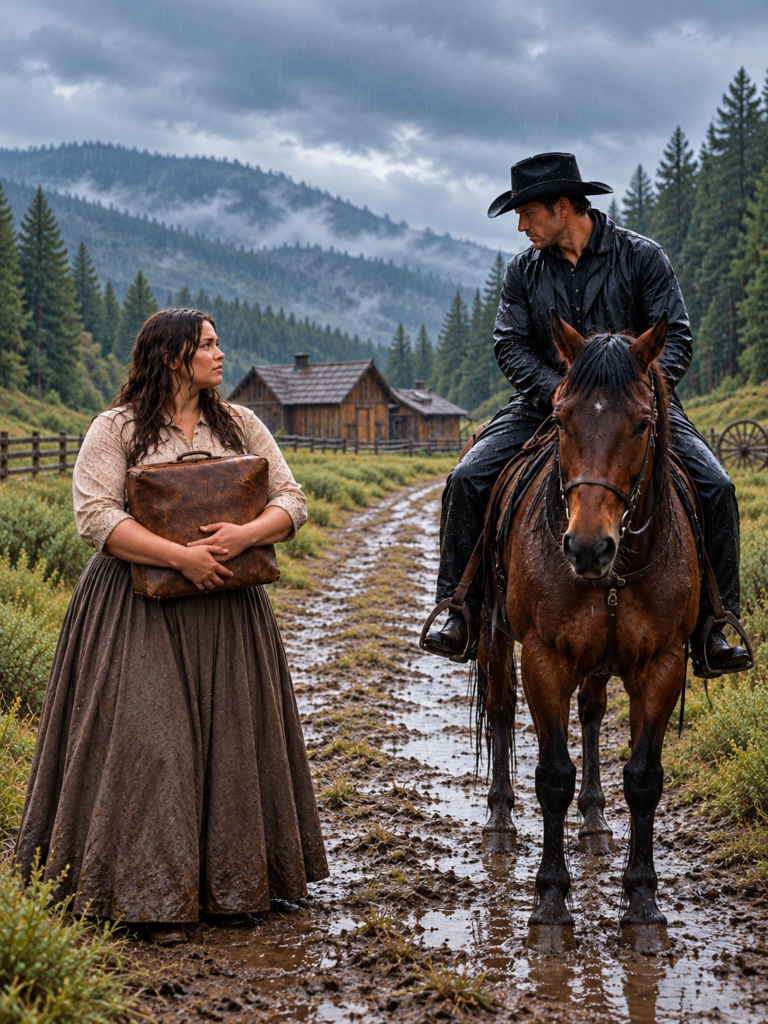
The first thing Silas Carter saw was a woman’s hand disappearing beneath the brown water.
It happened where the old stage road crossed a narrow drainage ditch, six miles west of Willow Creek, Montana Territory. Rain had been falling since noon, turning the wagon ruts into streams and the open prairie into a wilderness of mud. Silas was riding home with a sack of oats tied behind his saddle when his horse stopped so suddenly that he nearly pitched forward.
At first, he thought a deer had fallen into the ditch.
Then the hand appeared again.
Five pale fingers clawed at the muddy bank, slipped, and vanished beneath the rushing water.
Silas was out of the saddle before he had properly considered what he was doing.
He stumbled down the embankment, caught sight of a woman’s dark hair beneath the water, and seized the back of her dress. The current pulled hard against them both. His boots sank into the mud as he dragged her toward the bank, and for one terrible instant, he thought the soaked fabric might tear away in his hands.
Then she coughed.
Silas caught her beneath the arms and hauled her onto the grass.
She was young, perhaps twenty-six, though exhaustion had made her face look older. Her blue traveling dress was torn at the shoulder. One shoe was missing, and the other hung from her foot by a broken strap. Her lips had turned the color of ashes.
But even as Silas lifted her clear of the water, she reached desperately toward the ditch.
“My bag.”
Silas looked behind him.
A small brown valise had lodged against a willow root, half submerged in the flood.
“Forget the bag.”
She struggled weakly against his arms.
“Please. It’s all I have.”
Something in the way she said those words stopped him.
He lowered her carefully onto the grass, waded back into the rushing water, and caught the leather handle just before the current tore it free.
By the time he returned, the woman had collapsed onto her side.
Silas knelt beside her.
“Ma’am?”
Her eyelids fluttered.
“Can you hear me?”
She made a faint sound that might have been an answer.
He looked toward the western horizon, where another wall of black cloud was rolling over the mountains.
He had no wagon, no spare horse, and no proper shelter closer than his own cabin.
There was no time to think about whether bringing a strange woman into his home was wise.
He wrapped her in his oilskin coat, lifted her onto his horse, and climbed into the saddle behind her.
“Hold on,” he said.
She leaned against him, shaking so badly he could feel her teeth striking together.
They had ridden perhaps half a mile when she spoke.
“He said he’d be waiting.”
Silas lowered his head toward her.
“Who?”
“The man.”
Her voice was scarcely louder than the rain.
“He promised.”
Then her head fell against his chest, and she said nothing more.
Silas turned the horse toward home.
He had spent eleven years avoiding other people’s troubles.
Somehow, in the middle of a Montana thunderstorm, one had found him anyway.
The Carter place stood at the edge of a shallow valley, where cottonwoods followed a crooked creek through the grassland.
Once, the property had belonged to a much larger ranch. The house, the northern pasture, and most of the good water had been sold years earlier. What remained was a weather-beaten cabin, a barn with a sagging roof, two fenced fields, and enough land to keep a solitary man occupied from sunrise until dark.
Silas had lived there alone since he was nineteen.
He was thirty now, with broad shoulders, dark hair beginning to gray near his temples, and the habit of speaking only when silence would no longer serve.
The cabin reflected its owner.
A broken chair sat beside the stove. Dust lay on the windowsills. A stack of newspapers, some nearly three years old, occupied one end of the table. The walls were bare except for a clock that ran six minutes slow and a faded photograph of two people Silas could no longer look at without feeling something tighten beneath his ribs.
He carried the woman into the spare bedroom and laid her on the narrow iron bed.
Then he stood there, uncertain.
She needed dry clothing, hot food, and someone who knew more about nursing than he did.
He had none of those things immediately available.
Silas found an old flannel shirt, a pair of woolen drawers, and two blankets. He placed them beside the bed, filled a basin with warm water, and stepped into the front room.
“There’s a bolt on the door,” he called. “You can use it. I’ll have coffee and something hot waiting.”
He heard no reply.
For twenty minutes, he kept himself busy with the stove.
When the bedroom door finally opened, the woman stood in the doorway wearing his shirt with the sleeves rolled four times. A blanket covered her shoulders, and her wet hair hung loose down her back.
She held the valise against her chest.
Silas turned his eyes toward the stove.
“Sit down before you fall down.”
“I don’t mean to be any trouble.”
“Too late for that.”
She went still.
Silas glanced up and saw the fear in her expression.
He regretted the words immediately.
“Didn’t mean it that way,” he muttered. “You’ve already near drowned. No sense adding a fall to it.”
She nodded and took the chair nearest the fire.
He gave her a bowl of beans, a piece of hard bread, and coffee sweetened with the last spoonful of sugar in the house.
She ate slowly at first.
Then faster.
By the time she finished, Silas had reached an uncomfortable conclusion.
The woman had not eaten a proper meal in days.
“What happened to you?” he asked.
She stared at the empty bowl.
For a long moment, only the rain answered.
Then she said, “I came here to be married.”
Silas did not move.
She swallowed.
“My name is Faith Whitcomb. I’m from Cincinnati, Ohio.”
He introduced himself, and she began speaking in the careful, restrained voice of someone determined to tell the truth without allowing herself to feel it.
Her parents had died of scarlet fever when she was seventeen.
For eight years, she had worked in a textile mill, sewing shirtwaists until her fingers stiffened and the steam from the pressing room made her lungs ache. She lived in a boardinghouse, shared a room with two other women, and put aside whatever pennies she could spare.
Then, one winter evening, she found an advertisement in a newspaper.
A Montana rancher wanted a wife.
He described himself as thirty-five, respectable, hardworking, and established on a prosperous cattle property near Willow Creek.
He wanted a companion willing to build a Christian household and endure the hardships of frontier life.
Faith had almost thrown the advertisement away.
Instead, she answered it.
Three months of correspondence followed.
The man wrote about spring grass, honest work, Sunday suppers, and the children he hoped one day to have. He spoke kindly of her parents and assured her that he did not require wealth or beauty.
He wanted a woman who understood loyalty.
“Nobody had written to me like that before,” Faith said.
She paused and turned the cup between her hands.
“He said that when I stepped off the train, he’d be there wearing a blue kerchief. He said I wouldn’t have to be afraid of being alone again.”
Silas watched the flames.
“Was he there?”
Faith shook her head.
“I waited through two trains. Then another. I thought perhaps he’d been injured or something had happened at his ranch.”
She had spent her first night on a bench at the depot.
The second night, the stationmaster permitted her to remain inside until midnight before closing the building.
On the third morning, she learned that a ranch by the name in the letters could not be found.
The stationmaster suggested a similar property nearly forty miles away.
With only a few coins left, Faith began walking.
For three days, she followed roads and wagon tracks through unfamiliar country, sleeping beneath sheds or wherever she could escape the wind.
The storm caught her before she reached the valley.
Silas felt an unpleasant pressure building behind his ribs.
“What’s this fellow’s name?”
Faith loosened her grip on the valise.
She opened it and removed a small packet wrapped in muslin.
Inside were letters bound with kitchen string.
She selected one and held it toward him.
Silas accepted it.
The handwriting was neat, slightly slanted, with an elaborate flourish beneath the signature.
He knew the writing before he finished reading the name.
James Hollister.
For a moment, he could hear nothing but the rain striking the roof.
Faith noticed the change in his face.
“You know him.”
Silas looked at the letter again.
There was no mistaking it.
He had seen that same handwriting on bills of sale, account books, and receipts for supplies purchased at the Willow Creek general store.
James Hollister was not a cattle rancher.
He did not own a prosperous homestead beyond the valley.
He had never, as far as Silas knew, possessed more than three horses.
He was a merchant.
And he had a wife named Beatrice and two children who attended the town school.
Silas laid the letter on the table.
“Miss Whitcomb, I need to tell you something.”
She sat very straight.
“Is he dead?”
“No.”
“Ill?”
“No.”
“Then where is he?”
Silas looked into her eyes.
“He’s in Willow Creek. Runs the general store.”
Her brow tightened.
“But his ranch—”
“There isn’t any ranch.”
A silence settled over the room.
Faith looked at the letter.
Then she looked at the remaining bundle in her lap.
“What do you mean?”
Silas made himself answer plainly.
“James Hollister is married. Has been twelve years, maybe thirteen. Two young children.”
Faith did not cry.
That was the first thing Silas noticed.
She simply stopped moving.
Her hands rested motionless on the faded muslin, and all the color seemed to drain from her face.
After a while, she asked, “Are you certain?”
“I’ve bought supplies from him for years.”
“Could there be another man?”
Silas pointed to the signature.
“That’s his hand.”
She glanced at the letters once more.
Three months of promises.
Three months of sitting awake after factory shifts, imagining mountains she had never seen and a kitchen she might someday call her own.
Every possession she had sold.
Every mile she had traveled.
Every night she had spent believing that somewhere in Montana, a good man was waiting for her.
Her lips parted.
“I thought—”
The words failed.
Silas wanted to say something kind.
Nothing came.
Finally, Faith rose from the chair.
She carried the letters to the stove and opened its iron door.
Silas stood.
“Miss Whitcomb, you might want to keep those.”
She looked at him.
“What for?”
“In case you ever need proof of what he did.”
Her expression changed.
For an instant, anger appeared beneath the exhaustion.
“Proof for whom? A judge? His wife? The people who’ll ask why I believed him?”
Silas said nothing.
“Every time I opened one of those letters, Mr. Carter, I thought I was getting closer to a home.”
She looked down at the paper in her hands.
“I won’t let him keep promising me one.”
One by one, she dropped the letters into the fire.
Silas watched the edges curl.
The black ink reddened, cracked, and disappeared.
Faith waited until the final sheet had turned to ash.
Then she shut the stove door.
“I’ll leave in the morning,” she whispered.
Silas studied the woman standing barefoot in his borrowed clothes.
Her cheeks were hollow. One foot was swollen. There was a cut near her forehead, and the hand resting against the stove trembled with exhaustion.
She had been deceived, abandoned, and nearly drowned.
And still, she was worried about imposing on him.
“No,” he said.
Faith turned.
He cleared his throat.
“You’re not fit to walk anywhere.”
“I can’t pay for a room.”
“Didn’t ask you to.”
“I won’t stay as charity.”
Silas considered that.
“Can you sew?”
She looked almost offended.
“I worked in a sewing mill eight years.”
“I’ve got shirts that need mending, horse blankets coming apart, and curtains that haven’t been washed since President Cleveland first took office.”
Despite herself, Faith blinked.
“That’s a considerable amount of work.”
“Reckon it is.”
Silas pulled the other chair away from the table.
“We can call it wages and board until you’re strong enough to decide what comes next.”
Faith hesitated.
“What wages?”
He thought of the few dollars in the tobacco tin above his stove.
“Fifty cents a week to start. We can settle accounts fair when I sell my next calves.”
She looked around the cabin.
At the cracked window.
The worn floorboards.
The stove, giving off more smoke than heat.
Then, for the first time since he had dragged her from the flood, something almost like amusement touched her face.
“You do need help.”
Silas looked toward the broken chair.
“Been told that before.”
Faith lowered her eyes.
“I’d like to stay a little while.”
He nodded.
“Then stay.”
Neither of them understood how much those two words would eventually cost.
The first morning Faith was well enough to rise, Silas discovered that his spare room had been transformed.
The blankets were folded. Her damp clothes hung neatly beside the window. The little valise had been polished with a scrap of cloth.
On the table lay a small silver thimble.
It was the only object Faith owned that had not been bought for practical use.
“It belonged to my mother,” she explained when she saw him looking at it.
Silas picked it up carefully.
The silver was scratched and dented, but a tiny engraved flower remained visible along its rim.
“She teach you to sew?”
“She taught me most everything worth knowing.”
He set it down.
Faith began with the kitchen.
She scrubbed the dishes, cleaned the cupboards, and threw away a jar of something Silas had been calling preserved peaches, though neither of them could identify its original contents.
She washed the windows.
She repaired his work shirts and strengthened the seams of two horse blankets.
Before the end of the week, she had prepared a breakfast of cornmeal cakes and fried apples that made Silas stop halfway through taking off his coat.
“Where did you get apples?”
“There were three in a barrel behind the shed.”
“Thought those had spoiled.”
“Two had.”
He sat down.
After a few bites, he looked at her.
“You’re a dangerous woman, Miss Whitcomb.”
She raised an eyebrow.
“How so?”
“Making a man realize how badly he’s been living.”
Faith smiled.
It was the first true smile he had seen.
Something unexpected moved inside him.
He quickly reached for his coffee.
For the next ten days, they built a quiet arrangement around one another.
Silas worked outside, repairing fences, tending horses, and preparing the northern field for planting.
Faith worked indoors until she could walk comfortably, then began helping in the garden.
They spoke little at first.
But silence gradually became less awkward.
She learned he liked his coffee strong and disliked onions in his beans.
He discovered she hummed hymns while sewing, could mend a torn saddlebag better than the town harness maker, and possessed firm opinions about the proper way to stack firewood.
One afternoon, Silas found her kneeling beside the porch, digging small holes in the wet soil.
“What are you doing?”
“Planting flowers.”
He looked at the bare strip of dirt.
“Flowers don’t feed anybody.”
“No.”
“They don’t keep the rain out.”
“No.”
“Then why?”
Faith brushed the soil from her hands.
“Because not everything has to earn its place by being useful.”
Silas had no answer.
She showed him a small paper packet she had carried from Ohio.
Marigold seeds.
Her mother had grown them beside their kitchen door.
Faith had saved a few seeds from the last plants that bloomed before the family home was sold.
“I’ve carried them for nine years,” she said.
Silas crouched beside her.
“Think they’ll grow here?”
“If the soil’s willing.”
He took the spade from her hand and began loosening the hard earth along the porch.
They worked together until the sunlight faded.
That evening, Faith left her valise in the spare bedroom instead of carrying it near the table.
Silas noticed.
He did not mention it.
A week later, they went to Willow Creek.
Faith needed thread, a length of muslin, and postage for a letter to an old friend in Cincinnati.
Silas needed flour, nails, and a replacement hinge for the barn door.
He would have preferred to wait another month before taking her into town.
But Faith had already spent too much of her life waiting for other people to decide when she was allowed to begin living.
Willow Creek was a small settlement with a church, a bank, two saloons, a feed store, and a row of commercial buildings facing the main road.
The arrival of Silas Carter with a woman riding beside him attracted immediate attention.
He could feel people watching as they dismounted.
Faith wore her freshly repaired blue dress and a plain straw bonnet. Her hair was pinned neatly at the nape of her neck, and she carried her valise only because it held the letter she meant to post.
They entered Hollister’s general store shortly before noon.
A bell rang above the door.
Martha Perkins, who frequently helped behind the counter, turned from a shelf of canned goods.
“Well, goodness. Silas Carter.”
Her eyes shifted to Faith.
“And who’s this?”
“Miss Whitcomb,” Silas said. “She’s staying at my place for a spell.”
Martha’s expression became carefully pleasant.
“Is that so?”
Faith stepped forward.
“Good afternoon, Mrs. Perkins.”
“It’s Miss Perkins, dear.”
“My apologies.”
Martha smiled thinly.
“No harm done.”
Behind the counter, James Hollister stood reviewing an account book.
He looked up.
And dropped his pencil.
Faith turned toward him.
Silas saw recognition dawn, not because she knew the man’s face, but because she saw what his expression revealed.
Hollister’s gaze went from Faith to Silas and then to the little valise hanging from her hand.
“Can I help you?” he asked.
His voice was strained.
Faith stood very still.
For a moment, Silas feared she might collapse.
Instead, she stepped to the counter.
“I need two spools of dark thread, a packet of needles, and a postage stamp.”
Hollister blinked.
“Of course.”
He gathered the items with clumsy fingers.
When he named the price, Faith counted out her own coins.
She waited for him to meet her eyes.
He would not.
Only after receiving her change did she speak again.
“I believe you know my name, Mr. Hollister.”
His face turned white.
Martha looked from one to the other.
“What an unusual thing to say.”
Hollister recovered himself.
“Can’t say I do, ma’am.”
Faith held his gaze.
“Then I suppose we have nothing further to discuss.”
She picked up her purchases and walked out.
Silas followed.
They were halfway down the boardwalk when Martha’s voice drifted through the open doorway.
“Is that the girl who came looking for a husband last month?”
Another woman answered.
“Stayed at the depot until the stationmaster put her out.”
“Imagine living alone with Silas Carter.”
There was a small, ugly laugh.
Silas stopped.
Faith caught his sleeve.
“Don’t.”
He turned toward her.
“They’ve no right.”
“I know.”
Her voice was quiet but firm.
“If you go back there angry, they’ll talk about your temper instead of what he did.”
Silas stared at the store.
James Hollister had come to the doorway.
For one brief instant, the two men’s eyes met.
Hollister retreated inside.
Silas wanted to drag him into the street and make him explain himself before every person in Willow Creek.
Instead, he took Faith’s parcels.
“Come on. Let’s go home.”
On the ride back, she said very little.
Only when the Carter cabin appeared beyond the cottonwoods did she finally speak.
“Do you regret bringing me here?”
Silas looked at her.
“No.”
“Even now?”
“Especially now.”
She lowered her head.
He could not see her expression beneath the bonnet.
But when she reached for the saddle horn, her hand rested briefly against his.
It was a small gesture.
Almost accidental.
Silas thought about it long after the lamps were out.
The robbery happened nine nights later.
At first, it seemed to have nothing to do with either of them.
Four masked men entered the Willow Creek Bank shortly after closing, forced the night watchman to open the rear door, and carried away nearly eight thousand dollars in cash and negotiable notes.
The watchman was struck with a revolver and left unconscious.
By morning, the sheriff had organized a search.
By noon, everyone in town had a theory.
By evening, one theory had become more dangerous than the others.
Old Ezra Jenkins, who lived near the bank, claimed to have seen a woman moving through the alley behind the building shortly before the robbery.
He described her as slender, wearing a dark shawl, and carrying something in one hand.
He could not say what the object was.
He could not describe her face.
But he remembered that she was a stranger.
And in Willow Creek, there was only one woman everyone had lately agreed to call a stranger.
Faith Whitcomb.
Wilbur Hayes, the mail carrier, brought the news to the Carter place the following afternoon.
He remained in the saddle, looking uncomfortable.
“Silas, I figured you ought to hear it from somebody who ain’t looking to start trouble.”
Silas stood beside the gate.
“What trouble?”
Wilbur glanced toward the cabin.
“Folks are saying Miss Whitcomb was seen behind the bank.”
Silas felt his jaw tighten.
“She was here.”
“I expect she was.”
“Then why are they saying otherwise?”
Wilbur removed his hat.
“Because they don’t know her. And because somebody’s been telling people she came west under suspicious circumstances.”
Silas looked toward the distant road.
“Who?”
The mail carrier hesitated.
“James Hollister’s been saying she approached him with some peculiar story about marriage. Says he never wrote her a single letter.”
For a moment, Silas’s hand tightened around the gatepost.
“That lying—”
“There’s more.”
Wilbur’s face grew grave.
“Sheriff Harlan’s coming tomorrow.”
He paused.
“And Silas? The bank manager is asking questions about your outstanding note. Says anybody sheltering a suspected robber might have trouble convincing the bank he’s a dependable man.”
Silas looked toward the cabin.
Through the kitchen window, he could see Faith standing beside the table.
She was arranging a small jar of wildflowers.
A woman who had crossed half a continent searching for an honest promise.
A woman who had lost everything she owned except a valise, a thimble, and a handful of seeds.
Now the very town that had helped deceive her was preparing to call her a criminal.
Wilbur lowered his voice.
“Maybe you ought to send her away until this settles.”
Silas did not answer immediately.
He looked at the house that had stood empty in every meaningful way for eleven years.
Then he looked at the flowers growing beside the porch.
“No,” he said.
Wilbur sighed.
“You’re making a dangerous choice.”
Silas opened the gate.
“Reckon that’s mine to make.”
But that night, after Faith had gone to bed, Silas opened the family Bible and removed the folded deed to his land.
He spread it across the table beneath the lamplight.
Beside it lay the bank note he still owed.
He read both documents carefully.
Then he folded them away.
For the first time in years, he was afraid of losing his home.
Not because of fire, drought, or a hard winter.
But because he had opened his door to someone who needed help.
And the next morning, when Sheriff Harlan came riding up the valley road, Silas Carter was waiting on the porch.
Part 2
Sheriff Nathaniel Harlan was a patient man.
In fourteen years wearing a badge, he had learned that guilty people often spoke too much, innocent people sometimes lied from fear, and the loudest person in a room was rarely the one who understood what had happened.
He was fifty-three, with a weathered face, a gray mustache, and a slight limp from a bullet wound received during a cattle dispute.
Silas had known him for years.
That made it worse when the sheriff dismounted, removed his hat, and looked toward Faith standing in the doorway.
“Morning, Miss Whitcomb.”
“Good morning, Sheriff.”
“I need to ask you some questions.”
Faith stepped onto the porch.
“Of course.”
Harlan opened a small notebook.
He asked when she had arrived, where she had lived before coming west, and whether anyone in Willow Creek could confirm her identity.
She answered without hesitation.
Then he asked where she had been on the night of the robbery.
“Here,” she said.
“All evening?”
“Yes.”
“Did you go outside?”
“To bring in the washing before dark. After supper, I stayed indoors.”
Harlan turned toward Silas.
“You confirm that?”
“I do.”
“All night?”
“She was in the house.”
“Did you see her every minute?”
Silas’s expression hardened.
“Did you see your wife every minute last night, Sheriff?”
Harlan closed his notebook slightly.
“Easy, Silas.”
“Then ask a fair question.”
“I’m trying to.”
Faith touched Silas’s arm.
“It’s all right.”
She turned back to the sheriff.
“I was sewing by the stove until nearly midnight. Mr. Carter was repairing a harness at the table. He can tell you what I worked on.”
“A blue shirt,” Silas answered. “And the left seam of my winter coat.”
Harlan made a note.
“Anybody else come by?”
“No,” Faith said.
She hesitated.
“Though I did hear horses sometime after we turned out the lamp.”
Silas looked at her.
“Horses?”
“Several. They sounded as though they were moving quickly along the north track.”
Silas frowned.
He remembered hearing something himself.
He had assumed it was thunder rolling beyond the hills.
Harlan’s pencil stopped moving.
“Which direction?”
“Toward the old freight crossing, I think.”
The sheriff studied her for a moment.
“Why didn’t you mention that first?”
“Because I didn’t know it mattered.”
Harlan wrote another line.
Then he asked about the letters.
Faith’s fingers tightened against her apron.
“What letters?”
“The ones you supposedly received from Mr. Hollister.”
Silas stepped forward.
“She received them.”
“James says otherwise.”
“James is a liar.”
“Maybe so. But at present I’ve got his word against yours.”
Faith looked at the sheriff.
“I burned them.”
Harlan sighed.
“All of them?”
“Yes.”
“That was unfortunate.”
Her face changed.
“Unfortunate?”
“Those letters could have helped establish your reason for coming here.”
Faith stared at him.
“Do you think I crossed two thousand miles to rob a bank in a town I’d never heard of?”
“No, ma’am. I haven’t decided what I think.”
“Then perhaps you ought to begin by deciding whether Mr. Hollister is telling the truth.”
Harlan closed his notebook.
“I intend to speak to him again.”
He turned toward Silas.
“There’s a sworn statement from Jenkins. He’s willing to identify the figure he saw as this young woman.”
“Jenkins couldn’t identify his own horse if you painted it red,” Silas said.
“I know his eyesight isn’t good.”
“Then why are you listening?”
“Because a man nearly died during that robbery, and eight thousand dollars is missing.”
The sheriff put on his hat.
“I’m not accusing anybody today. But Miss Whitcomb, until this is settled, I need you to remain in the county.”
Faith nodded.
Harlan mounted his horse.
As he turned toward the road, Silas called after him.
“Sheriff.”
Harlan stopped.
“If somebody had robbed that bank wearing my coat, would you have come here asking if I did it?”
The sheriff considered the question.
“Probably not.”
“Then ask yourself why you’re so willing to believe a stranger did.”
Harlan did not answer.
He rode away with his shoulders slightly hunched.
For several minutes, Faith and Silas remained on the porch.
Then she said, “He’s doing his work.”
Silas looked at her.
“That doesn’t mean he’s doing it well.”
She went inside.
He followed a moment later and found her standing beside the stove.
For the first time, he noticed how her hands were trembling.
The days that followed were the longest Silas could remember.
Willow Creek had always been a town where gossip traveled faster than a horse. Now every ordinary action became evidence of something sinister.
Faith’s presence at the Carter place was described as secretive, though everyone knew where she lived.
Her quiet manners became proof she was hiding something.
Her willingness to work was called an attempt to make Silas trust her.
Even her refusal to defend herself was interpreted as guilt.
The church preacher, Reverend Bell, stopped by one afternoon with a basket of bread.
He meant well.
Silas knew that.
But after drinking coffee at the kitchen table, the reverend cleared his throat.
“Miss Whitcomb, I wonder whether it might be best for everyone if you found accommodation with a respectable family in town until these difficulties pass.”
Faith set down the cup she had been drying.
“Do you know a family willing to receive me?”
The reverend shifted in his chair.
“Well, I haven’t spoken to anyone specifically.”
“Then where would you suggest I go?”
He did not answer.
Faith folded the dishcloth.
“I appreciate the bread, Reverend.”
Silas rose and opened the door.
The reverend left shortly afterward.
When he was gone, Silas returned to the table.
“Didn’t think much of that.”
Faith looked toward the empty doorway.
“He thinks he’s protecting me.”
“From what?”
“From people like him.”
Silas almost smiled.
But she did not.
That evening, he found her mending a pair of trousers by lamplight.
She had been working longer than usual, and her fingertips were raw.
“You can leave those till tomorrow,” he said.
“I’m nearly finished.”
“Faith.”
It was the first time he had spoken her given name without adding Miss Whitcomb.
She looked up.
He hesitated, startled by his own familiarity.
“You don’t have to work yourself sick to stay here.”
Her needle stopped.
“I know.”
But her expression told him she did not entirely believe it.
Three nights later, Silas woke to the sound of the front door opening.
The clock showed a little past two.
He reached for the rifle beside his bed, then heard something drag across the floor.
He put the rifle down and stepped into the front room.
Faith stood near the door wearing her traveling dress.
Her valise rested at her feet.
For a moment, neither spoke.
Then Silas asked, “Where are you going?”
Faith did not turn.
“I thought I might leave before daylight.”
“Where?”
“East.”
“That’s a direction, not a destination.”
She closed her eyes.
“I have a little money.”
“Not enough to get to Cincinnati.”
“Enough to get away from here.”
Silas looked at the valise.
“You’re planning to walk?”
“If I can reach the freight road, perhaps someone will give me a ride.”
He glanced at the darkness beyond the doorway.
A storm was gathering over the mountains.
He remembered her pale hand disappearing beneath the water.
“No,” he said.
Faith turned sharply.
“You can’t tell me I have to stay.”
“Didn’t say that.”
“Then don’t tell me I can’t leave.”
Silas drew a slow breath.
“You’re free to walk out of this house whenever you please. But I’m not going to stand here and pretend walking alone through that country in the dark is sensible.”
Her face tightened.
“You don’t understand.”
“Then explain it.”
“I’ve seen the bank manager looking at your place. I’ve heard what people say. They think you’re protecting a thief.”
Silas said nothing.
“They’ll ruin you because of me.”
“They can try.”
“You could lose this house.”
Her voice broke on the final word.
It startled them both.
Faith looked away quickly, ashamed of the tears rising in her eyes.
Silas pulled out a chair.
“Sit down.”
“I don’t want coffee.”
“Wasn’t offering any.”
He sat across from her.
For a while, he examined his hands.
Then he spoke.
“When I was fourteen, my father died in a winter fever. My mother followed three weeks later. My brother Eli was eight years older and already running most of the ranch.”
Faith lowered herself slowly into the chair.
Silas continued.
“Eli told me he’d look after things. Told me nothing important would change.”
He glanced toward the dark window.
“Six months later, I came home from working cattle and found strangers measuring the fields.”
Faith remained silent.
“Eli had sold nearly all the property. Said he owed money. Some of that was true. Some wasn’t. Took the proceeds and left for California.”
“Did he ever come back?”
“No.”
“Did you look for him?”
Silas nodded.
“First year, I wrote twice. Second year, once. Never heard a word.”
He stared at the floor.
“I spent the next fifteen years or so convincing myself a man was better off depending on nobody.”
Faith studied him.
“Is that why you live alone?”
“Partly.”
“And the other part?”
Silas gave a humorless smile.
“After a while, people stop expecting you to be any different.”
The clock ticked softly.
Then Faith said, “My mother used to tell me that a home wasn’t a place where nothing bad could happen.”
Silas looked up.
“What was it, then?”
“Somewhere you were allowed to be afraid without being made to feel ashamed.”
Her voice trembled.
“I haven’t had that since she died.”
Silas leaned forward.
“Faith, I don’t know who robbed that bank. But I know who was sitting at my table sewing a winter coat that night.”
She wiped her cheek.
“And I know what it’s like to have somebody make a promise and vanish when keeping it gets difficult.”
He paused.
“I’m not going to do that.”
She looked at him a long time.
“What if you lose everything?”
Silas looked around the room.
At the freshly washed curtains.
The mended chair.
The clean table and the little vase of dried flowers near the stove.
“Maybe,” he said quietly, “I’ve been measuring everything wrong.”
Faith covered her mouth.
For a moment, he thought she might begin crying in earnest.
Instead, she reached across the table and placed her hand over his.
It was the first time either of them had deliberately touched the other without some practical necessity.
Silas turned his hand beneath hers.
Neither spoke.
After a while, Faith rose.
She carried the valise back to her room.
And the next morning, Silas found her planting a second row of marigolds.
But the danger had not passed.
The following week, Wilbur Hayes came to the cabin with a message.
James Hollister wanted to speak to Silas privately.
He claimed it concerned Faith’s reputation.
Silas considered refusing.
Then he decided that a man who had hidden behind respectable appearances for so long deserved to explain himself without an audience.
He rode into Willow Creek that afternoon.
Hollister received him in the storeroom behind the general store.
The merchant was a heavyset man with carefully trimmed whiskers and soft hands. A gold watch chain hung across his waistcoat, and his shirt collar was starched so stiffly it seemed uncomfortable.
He shut the storeroom door.
“I take it you’ve heard what’s being said.”
Silas stood near a barrel of flour.
“I’ve heard what you’ve been saying.”
Hollister’s mouth tightened.
“That woman has made an unfortunate mistake.”
“Her name is Faith Whitcomb.”
“I know perfectly well what her name is.”
Silas watched him.
“Then you remember the letters.”
For a moment, Hollister’s composure slipped.
Then he said, “I receive correspondence from dozens of people.”
“Did you write to her?”
“There’s no proof of that.”
“That wasn’t my question.”
Hollister looked toward the door.
“Listen, Carter. I made no promise to marry anybody. Whatever she imagined from a few friendly exchanges is her own affair.”
Silas took one step forward.
“Friendly exchanges?”
Hollister raised his hands.
“I never asked her to come here.”
“She sold everything she owned.”
“Then she behaved foolishly.”
The words landed between them.
Silas felt the old, dangerous anger rising.
He wanted to hit Hollister.
He wanted to wipe the comfortable certainty from the man’s face and make him understand what it had cost another human being.
Instead, he forced his hands to remain at his sides.
“Why did you write to her?”
Hollister looked away.
“That’s none of your concern.”
“She’s living under my roof. You’ve made it my concern.”
The merchant sighed.
“My wife and I had disagreements. I was lonely. A man can be lonely inside a marriage, Carter. I answered an advertisement out of curiosity. Then things went further than I intended.”
“She answered your advertisement.”
Hollister’s cheeks reddened.
“Well, yes.”
“You told her you owned a ranch.”
“It was an exaggeration.”
“You told her you’d marry her.”
“I never expected she’d actually come.”
Silas stared at him.
“Three months of letters, and you didn’t expect her to believe you?”
Hollister said nothing.
Then he straightened his waistcoat.
“Let me give you some advice. The bank is already questioning your affairs. If I were you, I’d send the woman away before she brings more trouble onto your land.”
Silas stepped closer.
“Did you tell the sheriff she approached you with some marriage story?”
Hollister’s face hardened.
“I told him she appeared at my store making accusations.”
“You know that’s not the truth.”
“It is the account I intend to stand by.”
Silas considered him for a long moment.
Then he turned toward the door.
Behind him, Hollister spoke again.
“She’s an embarrassment, Carter. Surely you can see that.”
Silas stopped.
He looked back.
“No,” he said. “I see a woman who believed a coward.”
He left before his restraint failed.
Unknown to either man, Beatrice Hollister had been standing in the narrow hallway beyond the storeroom.
She had heard enough.
Two days later, Beatrice arrived at the Carter cabin in a small buggy.
Faith was outside hanging laundry when she saw her.
The woman looked tired.
She was dressed properly, with gloves, a dark bonnet, and a silver brooch at her throat. Yet there was something uncertain in the way she climbed down.
“Miss Whitcomb?”
Faith lowered a wet sheet.
“Yes.”
“I’m Beatrice Hollister.”
Faith stood very still.
Beatrice glanced toward the house.
“Could we speak?”
They sat together at the kitchen table.
Silas was out repairing the north fence, so the women were alone.
For several moments, Beatrice studied her hands.
Then she said, “My husband tells me you’ve accused him of writing letters promising marriage.”
Faith looked at the woman’s face.
She could see the strain around her eyes.
“I didn’t come here intending to hurt you.”
“That isn’t what I asked.”
Faith took a breath.
“Yes. He wrote to me.”
“How many letters?”
“Fourteen. Perhaps fifteen. I stopped counting.”
Beatrice closed her eyes.
“Did you keep them?”
“No.”
“Why?”
“Because I couldn’t bear looking at them.”
Beatrice remained quiet.
Faith folded her hands.
“I know what people are saying. They think I tried to steal your husband.”
A bitter sound escaped Beatrice.
“James isn’t a parcel to be stolen.”
Faith looked up.
For the first time, Beatrice’s composure broke.
“He has lied to me before. About money, mostly. About small matters that were easier to conceal than explain.”
She turned her wedding ring slowly.
“But I never imagined this.”
Faith’s expression softened.
“I’m sorry.”
Beatrice shook her head.
“You owe me nothing.”
The words seemed difficult for her to say.
After a moment, she stood.
“I can’t promise what I’ll do. I have children to consider.”
“I understand.”
Beatrice moved toward the door, then paused.
“Did he really tell you he wore a blue kerchief?”
Faith looked startled.
“Yes.”
A faint flush rose into Beatrice’s cheeks.
“James bought a blue silk neckerchief in January. He told me it was for a church social.”
She looked away.
“I thought he looked ridiculous in it.”
Faith gave a sad, involuntary smile.
Beatrice opened the door.
Before leaving, she said, “If I discover he lied, Miss Whitcomb, I won’t ask you to protect him.”
That evening, Silas found Faith sitting beside the porch.
She had finished the laundry and was watching the wind move through the grass.
He sat beside her.
“Mrs. Hollister came,” she said.
“I saw the buggy tracks.”
“She knows.”
Silas nodded.
“What did she say?”
“That she has children.”
He understood.
Faith stared toward the mountains.
“I used to imagine meeting his family someday. I thought perhaps he had a sister or an aunt who would welcome me.”
She gave a small, unhappy laugh.
“Now I know there was a family all along. Just not one he meant me to join.”
Silas rested his elbows on his knees.
“None of this makes you foolish.”
She looked at him.
“Doesn’t it?”
“It makes you somebody who took a man’s word seriously.”
“And what does that make him?”
Silas considered the question.
“Somebody who never learned the value of his own.”
Faith said nothing.
After a while, she leaned her shoulder lightly against his.
They sat until the last sunlight disappeared.
The following morning, Silas found a torn strip of yellowish oilcloth caught on the wire near the north pasture gate.
It was a narrow piece, with coarse black stitching along one edge.
He assumed it had blown loose from some passing freight wagon.
When Faith came to help him gather tools, she noticed it in his hand.
“That’s a peculiar seam,” she said.
“Looks like somebody’s wagon cover came apart.”
“Maybe.”
She examined the stitching.
“Whoever repaired it used harness thread. Too heavy for ordinary cloth.”
Silas shrugged and put the scrap on the porch rail.
They had other worries.
The bank manager had refused to extend Silas’s outstanding note.
Thirty days remained before payment was due.
The calf sale might cover most of it, but only if the buyer arrived on schedule and offered a fair price.
Meanwhile, the rumors grew more poisonous.
Martha Perkins claimed Faith had asked peculiar questions about the bank when she visited town.
A customer claimed she had seen Faith studying the rear alley.
Neither accusation was true.
But truth had become less important than repetition.
Then, on a cold morning beneath a low gray sky, Sheriff Harlan returned.
This time, he did not come alone.
Deputy Collins rode beside him.
Silas stepped out of the barn.
“What is it?”
Harlan dismounted slowly.
“I need to speak with Miss Whitcomb.”
Faith appeared on the porch.
She had been kneading bread.
White flour covered her hands.
The sheriff removed a folded paper from his coat.
“Miss Whitcomb, there’s been another statement.”
Silas felt something cold settle in his stomach.
“From whom?”
“James Hollister.”
Faith did not move.
Harlan continued.
“He says you threatened him over money shortly before the robbery. Claims you told him you’d find a way to get what was owed you.”
Faith stared at him.
“That’s a lie.”
“He’s sworn to it.”
“I asked him for nothing.”
Harlan’s expression was strained.
“I have the Jenkins identification, statements placing you near the bank, and now an allegation of a dispute involving money. The justice has authorized your detention pending further examination.”
Silas stepped between them.
“You’re not taking her.”
Harlan’s jaw tightened.
“Don’t make this worse.”
“You know that man is lying.”
“I suspect there’s more to his story than he’s told. But suspicion doesn’t give me leave to ignore a warrant.”
Faith stepped forward.
“Silas.”
He turned toward her.
She looked pale, but her voice was steady.
“Move aside.”
“Faith—”
“Please.”
He stared at her.
She wiped the flour from her hands and walked down the porch steps.
“Will I be allowed to speak before the justice?” she asked.
Harlan nodded.
“Tomorrow morning.”
“Then I’ll come.”
Silas looked from her to the sheriff.
“She’s done nothing.”
Faith turned toward him.
“I know.”
Her eyes filled briefly, but she held his gaze.
“That’s why I won’t run.”
She went inside to change.
When she returned, she wore the same blue dress she had worn when she first stepped into Hollister’s store.
She carried no valise.
Only her mother’s silver thimble, tucked in a pocket.
Silas helped her into the sheriff’s wagon.
Their hands lingered together.
“I’ll come for you,” he said.
Faith shook her head gently.
“Don’t come because you pity me.”
Silas swallowed.
“I’m coming because I believe you.”
She looked at him for a long moment.
Then the wagon began moving.
Silas watched until the dust swallowed it.
When it was gone, he walked back toward the house.
On the porch rail lay the torn yellow cloth he had found at the north gate.
The wind lifted one corner.
Silas caught it before it blew away.
And suddenly, he remembered what Faith had told the sheriff.
Several horses.
Moving quickly.
Toward the old freight crossing.
He turned the strip over in his hand.
The black harness stitches were uneven.
The cloth smelled faintly of horse sweat and coal oil.
Silas looked beyond the pasture toward the abandoned freight road.
There had been no thunder that night.
Only hoofbeats.
He hurried to the barn, saddled his horse, and rode toward the north gate.
What he discovered there made him understand that the sheriff might have spent the last two weeks searching in entirely the wrong direction.
Part 3
The tracks began where the northern fence dipped toward the creek.
Silas nearly missed them.
Most of the open ground had hardened since the rain, and cattle had churned the mud into a confusion of hoofprints. But beneath the shelter of an overhanging bank, the earth remained soft and undisturbed.
There were wagon tracks.
And beside them, the prints of several horses.
Silas dismounted.
He studied the ground carefully.
One horse had worn a damaged shoe on its left hind hoof. A small piece was missing from the outer edge, leaving a distinctive crescent in the mud.
Silas knew that mark.
Three weeks earlier, a freighter had stopped at his place asking for water. The man had been driving a wagon loaded with supplies for the mining settlements beyond Bridgewater.
His name was Amos Voss.
He had a reddish beard, a crooked nose, and a large roan horse with a broken shoe.
Silas had offered to replace it.
Voss had refused.
“She’ll manage till Bridgewater,” he had said.
Now Silas crouched beside the same peculiar print.
The wagon tracks led through the shallow crossing, then vanished onto a strip of stony ground.
He followed them for nearly two miles before finding another piece of yellow oilcloth tangled in a thornbush.
Its edge matched the torn scrap from his fence.
Silas remembered Voss’s wagon cover.
Yellow oilcloth, patched with black harness thread.
He felt his pulse quicken.
The bank robbers had fled this way.
And if Amos Voss had been driving the wagon, the sheriff had a name to follow.
Silas mounted his horse and turned toward Willow Creek.
He rode hard enough that foam gathered along the animal’s neck.
By the time he reached the sheriff’s office, the sun was beginning to lower behind the hills.
Harlan was sitting at his desk, reviewing a stack of papers.
He looked up sharply when Silas entered.
“Where’s Faith?”
“In the rear cell. She’s safe.”
Silas placed the two pieces of oilcloth on the desk.
“Take a look at these.”
Harlan frowned.
“What am I looking at?”
“Pieces from a freight wagon. Found one at my north gate and another along the old crossing.”
“So?”
“The night of the robbery, Faith heard horses moving toward that road. I found the tracks. One animal’s got a damaged shoe.”
Harlan leaned forward.
Silas continued.
“I know that horse. Belongs to a freighter named Amos Voss. Headed toward Bridgewater three weeks back.”
Something changed in the sheriff’s expression.
“Voss?”
“You know him?”
Harlan reached into a drawer and removed another sheet of paper.
“The bank watchman regained consciousness yesterday. He remembered one of the robbers saying a name.”
Silas waited.
“He thought it sounded like Moss.”
“Or Voss.”
Harlan looked down at the oilcloth.
Then he stood.
“Show me where you found this.”
They left within the hour.
Deputy Collins remained at the jail while Silas led Harlan and two other riders toward the crossing.
The sheriff examined the prints himself.
He knelt beside the damaged hoofmark, placed his pencil against the crescent-shaped indentation, and nodded slowly.
“That’s worth following.”
At the second piece of torn oilcloth, he studied the direction of the wagon ruts.
“They avoided the main road.”
“Wouldn’t you, carrying eight thousand dollars?”
Harlan gave him a sharp glance.
Then, unexpectedly, he smiled.
“Reckon I would.”
For the first time since Faith’s arrest, Silas felt something other than helpless anger.
The sheriff was listening.
They followed the old freight road until darkness made tracking impossible.
At a deserted way station, they found cold ashes, fragments of a torn bank deposit wrapper, and a length of rope stained with red sealing wax.
Harlan recognized the wrapper immediately.
The bank used that particular printed paper for transporting currency between branches.
He folded the fragment carefully.
“We’ve got something now.”
Silas looked toward the black hills beyond the station.
“Then let’s bring her home.”
But Harlan shook his head.
“We need more than wagon tracks. If Voss is involved, he may have three armed men with him. We’ll need a proper search.”
Silas took an angry breath.
Harlan stepped closer.
“Listen to me. You’ve done more today than half the town has managed in two weeks. Don’t spoil it by getting yourself killed.”
Silas looked away.
After a moment, he nodded.
They rode back to Willow Creek before dawn.
The next morning, Faith stood before the local justice in a cramped room above the feed store.
She had slept little.
The sheriff had treated her decently, but the cell was cold, and every sound from the street reminded her that she was being held as a criminal in a place she had once hoped to call home.
Silas sat near the front.
Beside him was Wilbur Hayes.
Across the room sat James Hollister, his face carefully composed.
Martha Perkins occupied a seat near the window.
Several townspeople had gathered to watch.
Justice Alden opened the examination.
The proceedings were brief and uncomfortable.
Ezra Jenkins repeated his account of seeing a slender figure behind the bank.
Under questioning, he admitted he had never seen the person’s face.
He could not be certain of the figure’s height.
He had not seen a weapon.
When asked whether he could identify Faith without being told she was a suspect, the old man hesitated.
“I reckon I might.”
The justice leaned forward.
“Mr. Jenkins, reckonings aren’t the same as certainty.”
Jenkins lowered his eyes.
“No, sir.”
Then James Hollister was called.
He rose, adjusted his coat, and described Faith as a desperate woman who had approached him for money.
“She made threats,” he declared. “Said I’d regret refusing her.”
Faith sat very still.
Silas’s hands curled into fists.
The justice asked whether Hollister had exchanged letters with Faith before she arrived in Montana.
Hollister shook his head.
“Never.”
The room fell silent.
Then a woman’s voice spoke from the doorway.
“James.”
Everyone turned.
Beatrice Hollister stood at the entrance.
She wore a dark traveling dress and carried a small leather writing case.
Her husband went pale.
“Beatrice, what are you doing here?”
She walked slowly down the aisle.
“I’ve come to answer a question.”
The justice studied her.
“Mrs. Hollister, this is an official proceeding.”
“I understand.”
She opened the writing case.
Inside lay several sheets of folded paper.
Silas stared.
Faith gripped the edge of her chair.
Beatrice held the papers toward the justice.
“These were in my husband’s private desk. I found them after hearing him deny knowing Miss Whitcomb.”
The justice unfolded the first sheet.
He read silently for a moment.
Then he looked at Hollister.
“Is this your handwriting?”
Hollister said nothing.
The justice read aloud a short passage describing a ranch, a future wife, and a promised meeting at the Willow Creek depot.
Faith closed her eyes.
She knew those words.
They were from one of the letters she had received.
But this was not the letter itself.
It was an earlier draft, written on the back of a discarded store invoice.
Beatrice had found several.
Hollister had apparently composed his promises in the account room, changing sentences before copying them onto proper stationery.
The justice unfolded another page.
There was a list of expenses.
Postage.
Stationery.
A notation for blue silk.
And beside one entry, in Hollister’s handwriting, the name Faith Whitcomb.
A low murmur spread through the room.
Hollister’s face had turned a deep, miserable red.
Beatrice looked at him.
“Tell them.”
He stared at his wife.
“Beatrice—”
“Tell them what you did.”
The merchant swallowed.
At last, he lowered his head.
“I wrote the letters.”
Faith felt the room shift around her.
The justice remained silent.
Hollister spoke again, barely above a whisper.
“I put an advertisement in a newspaper. I told her I owned land. I told her I intended to marry.”
“Did you intend to keep that promise?” the justice asked.
“No.”
“Then why make it?”
Hollister’s mouth worked.
“I was unhappy. I wanted… I wanted someone to think better of me than I thought of myself.”
Beatrice’s expression tightened.
“And you thought it acceptable to use a young woman’s future to accomplish that?”
Hollister looked down.
“I didn’t think she’d come.”
Faith stood.
Every eye turned toward her.
She had imagined this moment dozens of times.
Sometimes, in her imagination, she had shouted.
Sometimes she had wept.
Sometimes she had demanded that James Hollister feel every mile she had walked and every hour she had waited.
But now, standing in front of the man who had destroyed her old life, she felt strangely calm.
“You wrote that you wanted an honest woman,” she said.
Hollister did not look up.
“You wrote that a marriage should begin with trust.”
Her voice remained steady.
“I believed you. I sold my furniture, my winter coat, and the sewing machine I’d worked four years to buy.”
A few women in the room lowered their eyes.
Faith continued.
“I left the only city I’d ever known because I thought somebody had finally chosen me.”
Hollister whispered, “I’m sorry.”
Faith shook her head.
“No. You’re sorry that everyone knows.”
The words struck harder than shouting would have.
She looked toward Beatrice.
“I never intended to take anything from your family.”
Beatrice’s eyes filled.
“I know that now.”
Faith turned back to the justice.
“I didn’t rob the bank. I didn’t threaten Mr. Hollister for money. I came here because I believed a promise, and when I learned it was false, I tried to begin again.”
She drew a breath.
“That’s the whole truth.”
Silas watched her.
He had never seen anyone look so vulnerable and so strong at the same time.
Justice Alden considered the papers.
Then he looked at Sheriff Harlan.
“What other evidence have you?”
Harlan placed the fragment of the bank wrapper on the table.
“We have a fresh lead involving a freighter named Voss. I’ve sent word to the Bridgewater constable and am preparing a search.”
The justice frowned.
“Does anything here directly connect Miss Whitcomb to the robbery?”
Harlan looked toward Faith.
“No, sir.”
The room grew quiet.
The justice folded his hands.
“Then she is to be released. There is insufficient evidence to hold her.”
For a moment, Faith did not understand what she had heard.
Then Silas stood.
He made no speech.
He simply walked toward her and offered his hand.
She took it.
And together, they left the room.
Outside, the afternoon sunlight fell across the boardwalk.
Faith stood blinking in the brightness.
A wagon rattled past.
Somewhere nearby, a blacksmith’s hammer rang against an anvil.
Ordinary life continued, almost offensively indifferent to what had happened.
Silas looked at her.
“Are you all right?”
She nodded.
Then shook her head.
“I don’t know.”
He removed his hat.
“You’re free.”
Faith gazed down the street.
“Am I?”
Silas followed her eyes.
Martha Perkins stood outside the general store with two other women.
They stopped talking when they saw Faith.
No one smiled.
No one apologized.
Silas understood.
The justice had released her, but the town had not yet admitted what it had done.
“Come home,” he said quietly.
Faith looked at him.
He hesitated.
Then added, “If that’s still what you want.”
She took his hand again.
“Yes.”
The search for Amos Voss continued.
Harlan organized a small posse with the Bridgewater constable, following reports of four men hiding near an abandoned ore mill.
Three days later, they found the wagon beneath a canvas cover inside a disused stable.
Its yellow oilcloth awning had been torn along one side.
The missing section matched the pieces Silas had recovered.
The roan horse was still there.
Its left hind shoe carried the same broken crescent.
Inside the building, the lawmen discovered banknotes, several bags of coins, and a bundle of negotiable papers bearing the Willow Creek Bank’s seal.
Voss and three accomplices were arrested.
Two confessed after the stolen property was recovered.
One admitted that a younger member of the gang had passed behind the bank wearing a dark cloak and a wide-brimmed hat to conceal his appearance.
The young man had long, fair hair.
From a distance, especially through failing eyes, he could easily have been mistaken for a woman.
There had been no female accomplice.
Faith Whitcomb had never been involved.
When Sheriff Harlan brought the news to the Carter place, he dismounted before reaching the porch.
Silas was splitting wood.
Faith stood in the garden, watering the first marigolds.
The sheriff removed his hat.
“Miss Whitcomb.”
She turned.
“We caught the men.”
The watering can became still in her hands.
Harlan explained what had happened.
He described the wagon, the stolen money, and the confession.
Then he drew a slow breath.
“I owe you an apology.”
Faith looked at him.
The sheriff continued.
“I should have examined Jenkins’s statement more carefully. I should have questioned Hollister harder. And I should not have allowed the town’s opinion to carry so much weight.”
For a moment, Faith said nothing.
Then she placed the watering can on the ground.
“Thank you for telling me, Sheriff.”
Harlan nodded.
“I hope you’ll forgive my mistakes.”
Faith considered him.
“I expect I will.”
He gave a faint smile.
She added, “But not this afternoon.”
The sheriff lowered his head.
“Fair enough.”
He turned toward his horse.
Before mounting, he looked at Silas.
“You were right about her.”
Silas glanced toward Faith.
“Wasn’t difficult.”
Harlan rode away.
Faith remained beside the flowers.
After a while, Silas approached her.
“How do you feel?”
She looked down at the marigolds.
“Strange.”
“Strange how?”
“For weeks, I thought if people knew the truth, everything would be better.”
“And now?”
She brushed a leaf gently with her fingers.
“Now they know. And I still remember what they said.”
Silas stood beside her.
“That won’t disappear in a day.”
“No.”
He watched the breeze move through the young plants.
“But it might get smaller.”
Faith looked up at him.
“Perhaps.”
The news spread through Willow Creek.
Some people reacted with relief.
Others were embarrassed.
A few insisted they had never truly believed the accusations, though Silas remembered exactly what they had said.
Martha Perkins arrived at the Carter cabin the following Sunday with a fresh apple pie.
She stood on the porch holding it in both hands.
Faith opened the door.
For several moments, neither woman spoke.
Then Martha cleared her throat.
“I thought you might like something sweet.”
Faith looked at the pie.
“That’s kind of you.”
Martha shifted uncomfortably.
“I suppose some things were said that shouldn’t have been.”
Faith waited.
The older woman looked away.
“People get frightened when something like that robbery happens.”
“Yes,” Faith said. “They do.”
Martha’s cheeks reddened.
“I shouldn’t have repeated what I heard.”
“No, you shouldn’t.”
The words were not cruel.
But they were firm.
Martha looked back at her.
“I’m sorry.”
Faith considered the woman standing before her.
She could see that the apology had cost Martha something.
It did not erase the humiliation.
But perhaps it was a beginning.
“Thank you for saying so,” Faith replied.
She accepted the pie.
Then she added, “I hope you’ll tell the people you spoke to that you were mistaken.”
Martha blinked.
“Of course.”
Faith held her gaze.
“All of them.”
The older woman nodded.
“All of them.”
When Martha left, Silas emerged from the barn.
“Was that an apology?”
“Something close.”
He eyed the pie.
“Does it taste sincere?”
Faith laughed.
The sound surprised both of them.
It was warm and unguarded, unlike the careful smiles she had offered during her first weeks at the cabin.
Silas felt himself smile in return.
“Well,” he said, “suppose we’d better find out.”
Summer came slowly to the valley.
The snow retreated from the distant mountains, and the grass turned a deep, living green.
Silas sold his calves for a better price than he had expected.
He paid the bank note in full, carried the stamped receipt home, and placed it inside the family Bible.
For the first time in years, the property was free of debt.
Faith began taking sewing work from neighboring ranch families.
At first, orders came from people who had never joined the gossip.
Then other women approached her quietly, asking whether she could make dresses, repair coats, or prepare clothing for children.
She accepted the work she wanted.
She refused a few customers whose sudden friendliness rang hollow.
Silas admired that.
One afternoon, he returned from the lower pasture to find Faith sitting beneath the cottonwood tree with six freshly finished shirts folded beside her.
She was calculating her earnings in a small notebook.
“Business good?” he asked.
“Better than I expected.”
“How much?”
She raised an eyebrow.
“That is a rather personal question, Mr. Carter.”
Silas removed his hat.
“My apologies, Miss Whitcomb.”
She smiled.
“Enough that I can repay you for the train fare you offered me when I thought of leaving.”
He frowned.
“Didn’t lend you any train fare.”
“I know. But you would have.”
He sat beside her.
“Faith, you don’t owe me for being decent to you.”
Her expression softened.
“I wasn’t thinking of it that way.”
“Then how?”
She looked at the notebook.
“I’ve spent most of my life depending on somebody else’s good opinion. My employer’s. The boardinghouse keeper’s. Then James Hollister’s.”
She closed the book.
“I want to know I can stand on my own two feet.”
Silas nodded slowly.
“Seems to me you’ve already proved that.”
Faith turned toward the house.
“I’d like to buy a sewing machine one day.”
“Then you should.”
“And perhaps rent a little room in town.”
Silas went still.
She noticed.
“I haven’t decided anything.”
He studied his hat.
“Of course.”
The quiet that followed was different from their usual comfortable silence.
Faith looked at him.
“Would you want me to leave?”
Silas shook his head.
“No.”
The answer came so quickly that he surprised himself.
Faith waited.
He rubbed a hand across his jaw.
“I suppose there’s something I’ve been meaning to say.”
She sat straighter.
Silas looked out toward the pasture.
Eleven years of solitude had taught him how to mend a fence, shoe a horse, survive a bitter winter, and make do with almost nothing.
They had not taught him how to say what mattered most.
“I’ve gotten used to hearing you in the kitchen,” he began.
Faith listened.
“And finding you’ve moved my tools because I put them somewhere foolish.”
She smiled faintly.
“And waking up to the smell of bread.”
He looked toward the porch.
“Gotten used to those flowers, too.”
Her expression changed.
Silas drew a breath.
“But I don’t want you staying because you’ve nowhere else to go.”
Faith said nothing.
“I want you to have choices. Money of your own. Work of your own. A place of your own, if that’s what you need.”
He turned toward her.
“And if, after all that, you still wanted to make a life here…”
His voice caught slightly.
“I’d be grateful for the chance to make it with you.”
Faith stared at him.
For a long moment, neither moved.
Then she asked, very softly, “Silas Carter, are you asking me to marry you?”
He let out an uncertain breath.
“I was working my way around to it.”
A smile began at the corners of her mouth.
“You took a rather long road.”
“Been known to do that.”
Faith looked down at the silver thimble resting on her finger.
She had worn it while sewing that afternoon.
It gleamed in the sunlight.
“When I came west,” she said, “I thought marriage was the only way I’d ever have a home.”
Silas nodded.
“I know.”
“I thought if a man chose me, it would mean I was finally worth something.”
She drew the thimble from her finger and turned it in her palm.
“But I was worth something before James Hollister wrote me a single word.”
Silas looked at her.
“Yes, you were.”
“And if I marry you, I don’t want it to be because you rescued me.”
“It wouldn’t be.”
“Or because I cook your meals.”
“Though I admit that’s an advantage.”
Faith laughed softly.
Then she became serious.
“I want to marry you because you’ve never once made me feel that kindness was a debt I had to repay.”
Silas’s eyes brightened.
She reached for his hand.
“And because somewhere between the broken windows and the garden, I stopped feeling like a woman who was waiting for her life to begin.”
He swallowed.
“Does that mean yes?”
Faith smiled through sudden tears.
“Yes, Silas. It means yes.”
He looked at her for another moment, as though afraid the answer might vanish.
Then he leaned forward.
He stopped just short of her face.
“May I?”
Faith nodded.
Their first kiss was gentle and a little awkward.
It had none of the grand certainty of the letters Faith had once received.
There were no extravagant promises.
No descriptions of perfect futures.
Only the warmth of his hand against hers and the simple knowledge that he had asked rather than assumed.
When they drew apart, Faith rested her forehead lightly against his.
“I think,” she whispered, “I’d like to stay.”
Silas smiled.
“Reckon I can make room.”
They were married six weeks later in the small Willow Creek church.
Reverend Bell performed the ceremony.
Wilbur Hayes stood beside Silas.
Beatrice Hollister attended quietly, with her two children, though her husband remained absent.
Faith wore a cream-colored dress she had sewn herself.
At her throat was a small silver brooch Beatrice had given her.
Inside her glove, she carried her mother’s thimble.
There were no grand celebrations.
No expensive gifts.
Only a supper at the cabin, a few neighbors, fresh bread, roast chicken, and the last of the summer strawberries.
Martha Perkins brought another apple pie.
This time, Faith invited her inside.
As the evening ended, Silas stepped onto the porch and looked across the valley.
The garden was blooming.
Marigolds stood bright and golden beneath the windows.
New curtains moved softly in the breeze.
Light glowed from every room.
Behind him, he heard Faith laughing with the women as they cleared the supper table.
For a moment, he remembered the cabin as it had been before the storm.
The empty chairs.
The stale coffee.
The long winters when the only voices he heard belonged to men passing through with cattle.
He had thought surviving alone was a kind of strength.
Now he understood that opening his door had required a different kind.
Faith came outside a little later.
She stood beside him with her hands folded at her waist.
“There’s something I haven’t told you,” she said.
Silas turned.
“What’s that?”
“The day you found me, I wasn’t certain I wanted to live.”
His expression changed.
Faith looked toward the distant western road.
“I was so cold. So tired. I remember sitting beside the ditch and thinking that perhaps if I stopped walking, I wouldn’t have to be disappointed anymore.”
Silas took her hand.
She continued quietly.
“Then I fell into the water. And suddenly, all I wanted was another chance.”
The valley lay silent before them.
“I don’t remember much after that,” she said. “Only a man lifting me out of the mud. And the sound of his voice telling me to hold on.”
Silas looked down.
“Didn’t do anything another decent man wouldn’t have done.”
Faith shook her head.
“Perhaps. But you were the one who stopped.”
He had no answer.
After a while, she rested her head against his shoulder.
The same shoulder she had leaned against during that desperate ride through the rain.
Silas put his arm around her.
Inside the cabin, the last guests were saying their goodbyes.
Faith glanced toward the spare bedroom, where her old brown valise still sat beside the dresser.
For months, she had kept it ready.
Even after the accusations ended, some part of her had been afraid to unpack everything.
Afraid that happiness might prove temporary.
Afraid she would wake one morning to discover another promise had disappeared.
That evening, she went into the room and opened it.
At the bottom lay the few objects that had survived her journey from Ohio.
A faded handkerchief.
A small sewing kit.
The silver thimble.
And an empty envelope that had once held a letter from James Hollister.
She had forgotten about it.
Faith turned it over.
The address was written in her own handwriting.
She studied it for a moment.
Then she placed the envelope in the stove.
It burned quickly.
She did not watch until the last ash fell.
Instead, she returned to the bedroom and lifted the valise.
Silas appeared in the doorway.
“Going somewhere?”
She looked at him.
Then smiled.
“Yes.”
His expression became uncertain.
She walked past him and carried the bag into the front room.
There, she opened the cupboard beside the kitchen table and placed the valise on the highest shelf.
Empty.
Silas watched without speaking.
Faith shut the cupboard.
“I thought it was time to put that away.”
He smiled.
“Reckon so.”
Outside, the night had turned clear.
The stars stretched across the Montana sky, bright enough to make the distant mountains visible as dark shapes against the horizon.
Silas opened the front door.
Faith joined him on the porch.
For a while, they stood together watching the moonlight settle over the fields.
Then she looked down at the marigolds.
A few blossoms had begun to fade, but most were still bright.
“Do you think they’ll come back next year?” she asked.
Silas studied the plants.
“With care, and if you save the seeds, I don’t see why not.”
Faith leaned against him.
“My mother would have liked this place.”
“Think so?”
“She’d have complained about the windows.”
Silas chuckled.
“And the roof.”
“And the terrible way you used to keep the kitchen.”
“Now, that was a perfectly respectable kitchen.”
Faith laughed.
The sound drifted into the night.
Then she grew quiet.
“She would have liked you, too.”
Silas looked at her.
He saw no trace of the frightened woman he had first carried out of the storm.
There were still shadows in her eyes when old memories came.
There would always be things neither of them could undo.
But there was laughter now.
There was courage.
There was a future that had not been offered as a gift by a stranger.
It had been built through work, truth, and the stubborn decision to remain when leaving would have been easier.
Silas reached for her hand.
“Faith?”
“Yes?”
“I’m glad you came to Montana.”
She turned toward him.
“Even with all the trouble?”
He nodded.
“Even with all the trouble.”
Faith smiled.
“Then I’m glad you rode down that road.”
Behind them, the cabin glowed with lamplight.
Beyond the porch, the valley opened beneath the stars.
A cowboy who had spent half his life believing that everyone eventually left stood beside a woman who had once traveled across a continent searching for someone willing to stay.
Neither had found what they expected.
What they found was better.
And when the first cold wind of autumn moved through the marigolds, Faith did not reach for her valise.
She reached for her husband’s hand.
Together, they went inside and closed the door against the night.

