
Part 1
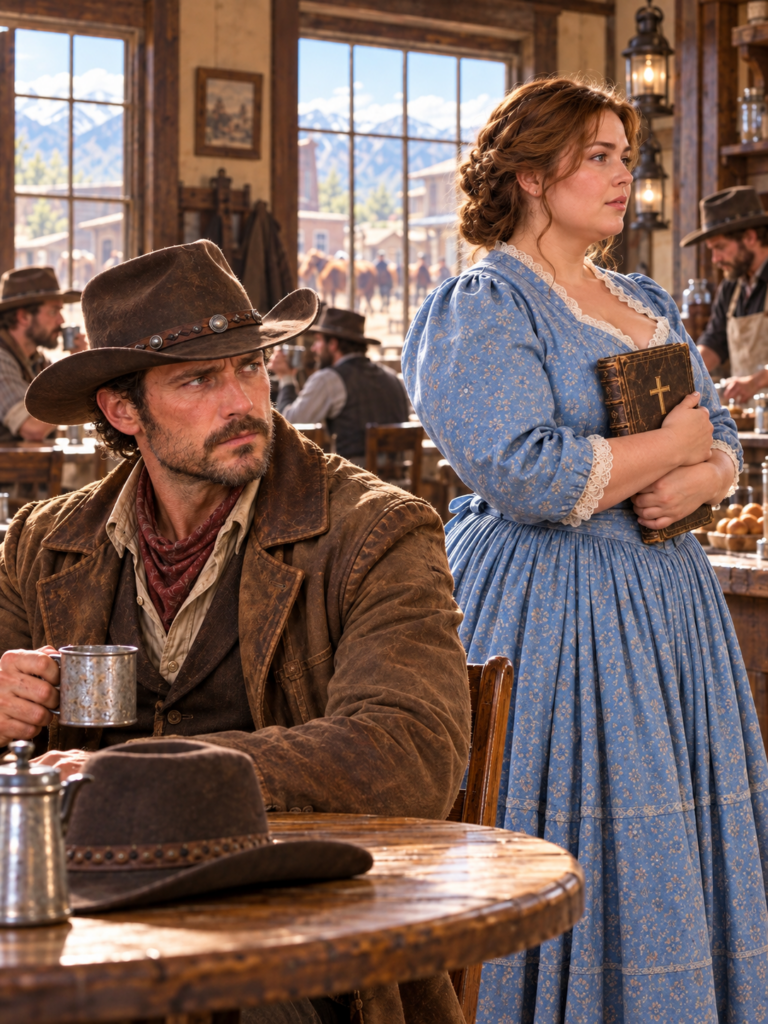
The first thing Jonas Whitaker noticed was the woman’s voice.
Not her face. Not the faded blue dress she wore or the brown hair pinned neatly beneath a modest straw hat.
Her voice.
It came from a corner table in a little roadside eating house outside Willow Creek, Idaho Territory, on a September afternoon in 1889.
Jonas had stopped for coffee.
Nothing more.
He had spent the morning negotiating the sale of six horses to an outfitter bound for Montana. The money was folded inside his coat, his horse was sound, and the sky above the distant mountains promised another five hours of good riding.
He had every reason to continue home.
Yet something about the small establishment, with its crooked sign advertising hot meals and fresh coffee, made him pull up his horse.
Perhaps he was tired.
Perhaps the silence of his own house had begun to weigh more heavily on him than he cared to admit.
Whatever the reason, Jonas tied his horse beneath a cottonwood tree, brushed the trail dust from his sleeves, and stepped inside.
The place smelled of woodsmoke, coffee, and bread fresh from the oven.
Three cowhands sat near the stove. A traveling salesman studied a newspaper beside the window. Behind the counter, a broad-shouldered woman was arguing with a stubborn kettle.
Jonas removed his hat.
“Coffee, please.”
“Five cents,” the woman replied. “Ten if you want a piece of pie.”
“Just coffee.”
He had scarcely taken a seat when he heard the voice.
“Sometimes, Mrs. Bell, the hardest thing is believing the Lord hasn’t forgotten us when everyone else seems to have.”
The words were spoken gently.
Jonas stopped moving.
He knew that voice.
He knew the quiet firmness beneath its softness, the slight hesitation before an important word, and the peculiar warmth that made even ordinary speech sound as though it had been carefully considered.
Twelve years had passed since he last heard it.
Twelve years of cattle drives, bitter winters, broken fences, dangerous rivers, and more lonely evenings than he could count.
Yet there was no mistaking it.
He turned toward the corner.
A woman sat beside an elderly traveler dressed in mourning black. The older woman’s gloved hands trembled around a cup of untouched tea.
The younger woman was holding a Bible.
A small, leather-bound Bible, worn along the spine, with a tiny brass cross fastened to its cover.
Jonas felt the blood drain from his face.
He knew that book.
His mother had carried it through twenty-seven years of marriage. She had read from it beside the beds of sick neighbors and beneath the flickering light of a farmhouse lamp. In the final days of her life, she had kept it beneath her pillow.
And twelve years earlier, Jonas had given it to the only woman he had ever asked to share his future.
Lydia Monroe.
For a moment he could only stare.
The woman beside the widow lowered her head.
“Would you mind if we prayed together?” she asked.
Mrs. Bell shook her head.
Lydia covered the older woman’s shaking hands with her own.
“Heavenly Father,” she whispered, “we don’t always understand why You lead us where You do. But please help us remember that we are never beyond Your care. Give us patience when we must wait, wisdom when we must choose, and the courage to recognize the good You place before us.”
Jonas looked down at his untouched coffee.
He had not prayed in years.
Not since his mother had died, and certainly not since the woman now sitting across the room had vanished from his life.
He had built fences instead.
Built barns.
Bought cattle.
Purchased pastureland until the Whitaker brand became known from Boise to the northern valleys.
He had found it easier to measure success in acres than to explain why the one person he had wanted beside him was no longer there.
When he raised his eyes again, Lydia was helping Mrs. Bell fold a letter.
“My daughter promised to meet me Tuesday,” the widow was saying.
“Perhaps the coach was delayed.”
“It’s Thursday.”
“I know.”
“I shouldn’t have come alone.”
Lydia smiled.
“Then you won’t be alone while I’m here.”
She said it as though the matter were settled.
A little boy near the counter dropped a slate, scattering chalk across the floor. Without hesitation, Lydia rose to help him gather the pieces. When the proprietor brought her a plate of beans and bread, she quietly pushed half toward the elderly widow.
Jonas watched her.
The twelve years had changed her.
Her face was a little thinner. There were fine lines near her eyes that had not been there when he was young. Her dress had been carefully mended at the cuffs, and the shoes beneath it were plainly worn.
But the way she moved among strangers, noticing what they needed before they asked, was painfully familiar.
He remembered a young woman sitting on the steps of her aunt’s boardinghouse in Red Bluff, reading aloud while he repaired a broken harness.
He remembered how she laughed when he tried to pronounce words he had never seen before.
He remembered her saying that a fine house meant very little if no one inside it was happy.
And he remembered leaving her.
The memory struck him so sharply that he nearly rose to escape it.
Then Lydia looked up.
Their eyes met.
The room seemed to grow still.
Her smile disappeared.
For several heartbeats she remained motionless, one hand resting on the Bible.
Then her lips parted.
“Jonas?”
He stood so suddenly that his chair scraped the floor.
“Lydia.”
Mrs. Bell looked from one face to the other.
“Goodness,” she murmured. “You two know each other.”
Neither answered.
At last Lydia found her voice.
“We knew each other a long time ago.”
The words hurt more than Jonas expected.
Mrs. Bell glanced at the window.
“I believe I’ll ask after the afternoon coach.”
She rose with surprising speed for a woman who had just been complaining of exhaustion.
When she had gone, Jonas approached the table.
“May I sit?”
Lydia looked at the empty chair.
“Of course.”
He sat.
For a while neither spoke.
The salesman turned a page of his newspaper. Somewhere behind the counter, dishes rattled. Outside, a wagon rolled past, its wheels thundering over the wooden planks.
Jonas had faced stampeding cattle and armed horse thieves with steadier nerves than he possessed at that table.
“You look well,” Lydia said finally.
“So do you.”
She gave a faint smile.
“That was kind of you.”
He realized at once how foolish his answer had sounded.
Her face was tired. The newspaper beside her plate was folded to a column of employment advertisements. She was wearing the same small silver brooch he remembered from her teaching days.
She was not doing particularly well.
And she knew he could see it.
“I heard about your ranch,” she continued.
“There’s not much to hear.”
“People say it’s one of the finest properties in the valley.”
“People say a great many things.”
“They say you’ve done very well.”
He looked at his hands.
“I’ve been fortunate.”
The silence returned.
His gaze drifted toward the Bible.
“You kept it.”
Lydia followed his eyes.
Something softened in her expression.
“It belonged to your mother.”
“That wasn’t what I meant.”
“I know.”
Her fingers moved over the old brass cross.
“She was kind to me, Jonas. Whatever happened afterward, I couldn’t bear to part with something she treasured.”
He felt as though a door had opened inside his chest, revealing a room he had spent twelve years pretending did not exist.
“I thought you might have thrown it away.”
“No.”
“You would have had reason.”
Lydia closed the book.
“I’ve had a great many reasons to do things I chose not to do.”
He accepted the rebuke.
He deserved it.
Or so he believed.
Because twelve years earlier, Jonas Whitaker had been a poor cowboy with one horse, a borrowed rifle, and scarcely enough money to keep himself fed through winter.
He had loved Lydia Monroe with a seriousness that frightened him.
She had been twenty-two then, teaching children in a small settlement school while helping her aunt manage a boardinghouse.
Jonas had been twenty-six and convinced that no respectable woman should have to marry a man who owned more debts than furniture.
Lydia had laughed at him for that.
“I don’t need a grand house,” she once told him. “I need a man who comes home when he says he will.”
He remembered the evening perfectly.
They had been sitting beneath a lantern outside her aunt’s boardinghouse. Beyond the town, the hills were turning purple in the last light.
“What if I could give you more?” he had asked.
“More what?”
“Land. Security. A house of your own.”
She leaned her shoulder against his.
“Will you be there?”
“Every evening I can manage.”
“Then I should call that a fine bargain.”
Three months later, Harlan Mercer offered Jonas a position with a cattle outfit traveling north into Montana.
The journey promised a share of the herd in payment.
For a poor man, such an opportunity could change everything.
But the outfit departed at dawn, and Lydia was away caring for her sick aunt.
Jonas wrote her a long letter.
He told her about the cattle, the opportunity, and his fear of remaining too poor to marry.
He told her he intended to send for her as soon as he had made a place for them.
And he asked her to become his wife.
He entrusted the letter to the local stage agent, paid the postage, and rode north before sunrise.
No answer ever came.
Months later, when he wrote again, his letters were returned.
Lydia had left Red Bluff.
Jonas concluded that she had chosen a different life.
He buried his disappointment beneath work, and when the cattle business prospered, he buried it beneath more work.
Eventually he stopped writing altogether.
Now she was sitting across from him, wearing a faded dress and holding the Bible he had given her on the last Sunday they spent together.
“What brings you to Willow Creek?” he asked.
“Work.”
“You’re still teaching?”
“When there’s a school willing to employ me.”
“What happened to your last position?”
“The school at Silver Fork closed in June. Three families moved away after the mine shut down. There weren’t enough pupils left to pay a teacher.”
“Have you found another place?”
“Not yet.”
She spoke without self-pity, but he noticed the way she folded the employment advertisements beneath her hand.
“I can keep accounts,” she added. “I can write business correspondence, teach reading and arithmetic, and make myself useful in most respectable households.”
Jonas stared at her.
For the first time that afternoon, he found something practical he could say.
“My bookkeeper is retiring.”
Lydia raised an eyebrow.
“How fortunate for him.”
“His eyesight has failed. Walter Price has looked after the ranch accounts for nine years, but lately he can barely distinguish a six from an eight.”
“I’m sorry to hear that.”
“I also have eleven children living on the property, from the families who work for me. The nearest school is fifteen miles away.”
Lydia became still.
“Eleven children?”
“Between six and fourteen.”
“And none of them attend school?”
“A few go when the weather permits. Most don’t.”
She looked toward the little boy near the counter.
Jonas recognized that expression.
Even after twelve years, he knew exactly when she was considering a problem.
“I could employ a teacher,” he said.
Lydia turned back sharply.
“Jonas.”
“I mean it.”
“I don’t want charity.”
“Neither do I.”
Her expression changed.
He continued carefully.
“I have correspondence piling up, accounts that need sorting, and children growing older without an education. You have the skill to put those matters right.”
“And you happened to discover all this in the same hour you discovered I needed employment?”
“I knew about the work before I came here.”
“That isn’t quite an answer.”
“No,” he admitted. “It isn’t.”
He leaned forward.
“Lydia, I won’t pretend our history has nothing to do with my asking. But it doesn’t change the fact that I need someone competent.”
She studied him.
“Would I be paid?”
“The same salary I’d offer any qualified bookkeeper and teacher.”
“Would I have my own room?”
“Of course.”
“And authority over the lessons?”
“Complete authority.”
“What about the accounts?”
“You’d report to me, but I wouldn’t hire you and then question every figure you entered.”
She looked almost amused.
“You’ve changed.”
“So have you.”
“I should hope so.”
He hesitated.
“There would be no other expectation.”
Lydia’s expression became serious again.
“That’s important.”
“I understand.”
“No, Jonas. I need you to understand very clearly.”
She placed both hands on the table.
“I was a young woman when we last knew each other. I am not that woman anymore. I’ve worked for my living, nursed people who died despite everything I did, buried my aunt, and learned how quickly a person’s circumstances can turn. I don’t want to become somebody’s reminder of happier years.”
He listened without interrupting.
“And I won’t come to your ranch to be rescued.”
“Then come to work.”
Her eyes remained on his.
“Just work?”
“Just work.”
Outside, the afternoon coach arrived in a commotion of hooves and shouted greetings.
Lydia turned toward the sound.
Mrs. Bell appeared at the door, waving both hands.
“My daughter!” she called. “She’s here after all!”
The younger woman hurried over to embrace her mother, apologizing for a broken axle and an unexpected overnight stop.
Lydia rose and helped gather the old woman’s belongings.
Jonas watched as Mrs. Bell embraced her.
“You were an answer to prayer, my dear.”
Lydia smiled.
“Then I’m glad I was here.”
After the travelers departed, she returned to Jonas’s table.
“Would you give me until tomorrow to decide?”
“Take whatever time you need.”
“One day will be enough.”
He rose.
“Lydia?”
She looked up.
“I meant what I said. You’d be paid for work, not gratitude.”
She nodded.
“And I meant what I said. I won’t live in the past.”
He picked up his hat.
“Neither will I.”
But as he stepped into the bright afternoon, Jonas understood that this promise might prove harder than any he had ever made.
Two days later, Lydia Monroe arrived at the Whitaker ranch in a hired wagon carrying one trunk, a carpetbag, and the old leather Bible.
She had expected the property to be prosperous.
She had not expected it to be beautiful.
The ranch house stood on a gentle rise overlooking a broad green valley. Beyond the corrals, fields of cut hay gleamed beneath the autumn sun. Cottonwood trees followed a creek along the southern pasture, and the mountains rose blue and immense in the distance.
The house itself was built of pale stone and dark timber, with two stories, a broad porch, and enough windows to suggest that its owner had once intended to fill every room with sunlight.
Inside, it was almost painfully quiet.
A housekeeper named Mrs. Finch showed Lydia upstairs.
“The master isn’t often indoors before supper,” she explained. “And Mr. Price has his own cottage now.”
“Does Mr. Whitaker have family?”
“Not living here.”
“Guests?”
“Very seldom.”
They passed a dining room containing a long polished table surrounded by twelve chairs.
Only one place was set.
In the parlor, a magnificent piano stood beneath a white dust sheet.
There were books in a glass-fronted cabinet, but none beside the chairs. Fresh flowers decorated the entry hall, though Lydia suspected Mrs. Finch had placed them there for her arrival.
The entire house seemed to be waiting for an occasion no one had bothered to announce.
Mrs. Finch opened a bedroom overlooking the east pasture.
“This will be yours.”
It was modest compared with the rooms downstairs, but clean and comfortable. A narrow writing desk stood beneath the window.
Lydia set the Bible on it.
“I think it will do very nicely.”
She unpacked before supper and met Walter Price the following morning.
Walter was a cheerful, silver-haired man whose spectacles were almost thick enough to distort his eyes.
“I told Jonas six months ago that he needed someone younger,” he said as he handed her a stack of ledgers. “But he’s stubborn as a fence post and twice as hard to move.”
“He doesn’t seem impossible.”
Walter chuckled.
“Give him a week.”
The account books were in worse condition than she expected.
Receipts had been tucked between unrelated pages. Purchases from Boise were recorded beside cattle sales from Montana. Three separate books contained entries for the same winter hay.
And scattered throughout the accounts were payments Lydia could not explain.
Money sent to families after accidents.
Medical expenses for children whose names she didn’t recognize.
Repairs to houses outside the ranch boundaries.
The sums were not insignificant.
She made notes.
By noon, she had begun imposing order on the confusion.
By evening, she had found two errors that would have cost Jonas nearly forty dollars.
He came to her office just before supper.
“How bad is it?”
“Worse than Mr. Price realizes.”
Jonas winced.
“But not beyond repair.”
“Thank goodness.”
“I’ve already begun reconciling the invoices. And I would like to inspect the building you’ve offered for the schoolroom.”
“Tomorrow, if that suits you.”
“Very well.”
He turned to leave.
“Mr. Whitaker?”
He stopped.
The formal name surprised them both.
“Yes?”
“I’ll need desks, slates, chalk, and suitable readers. Eleven children cannot be educated merely by gathering them in a room.”
“I know.”
“Then I would appreciate a proper budget.”
A slow smile appeared on his face.
“Write down what you need.”
“And if it’s expensive?”
“We’ll discuss it.”
“Not refuse it?”
“Not without a reason.”
Lydia inclined her head.
“Good evening, Mr. Whitaker.”
“Good evening, Miss Monroe.”
For the first time in twelve years, Jonas left a room with the strange sensation that something he had long thought dead had begun to breathe again.
That night, after the house had settled into silence, Lydia worked through another section of the accounts.
Among the documents was a purchase agreement for a narrow strip of land bordering an abandoned stagecoach route.
The property was listed as Cedar Fork Station.
She recognized the name.
Years ago, mail traveling between Red Bluff and the northern settlements had passed through that lonely relay stop.
An old invoice had been attached to the deed, authorizing the removal of the station’s ruined buildings before winter.
Lydia traced the faded lettering with one finger.
Cedar Fork.
She remembered watching stagecoaches leave Red Bluff when she was young, waiting for letters that never came.
From a drawer she retrieved a sheet of clean paper and began making notes for Jonas.
She could not have known that less than a mile from the land he had purchased, behind a rotting interior wall in an abandoned storeroom, a canvas mailbag had lain undisturbed for more than a decade.
And inside it were two letters that might have changed the course of both their lives.
Part 2
By the second week of October, the old bunkhouse had become the liveliest building on the Whitaker property.
Lydia had refused to begin lessons until the broken windows were repaired and the gaps in the walls properly sealed.
Jonas had sent two carpenters.
She had informed him that two carpenters were not enough.
He had sent four.
The men repaired the roof, built a small stove platform, and fashioned long wooden desks from boards stored behind the wagon shed.
Several mothers came to scrub the floors and sew curtains from leftover muslin.
One ranch hand painted a sign above the door.
WHITAKER SCHOOL.
Lydia stood beneath it on the first morning of lessons, regarding the eleven children gathered before her.
Their ages ranged from six to fourteen.
Some could read simple sentences. Others scarcely recognized their own names when written on paper.
One boy, Tommy Castillo, had never held a pencil.
He studied the slate she placed before him as though it were an unfamiliar piece of machinery.
“What am I supposed to do with this?”
“Learn to write.”
“Why?”
“So that one day nobody can tell you what a paper says and expect you to believe them without seeing for yourself.”
Tommy considered that.
“My pa says cowboys don’t need much writing.”
“Your father knows a great deal about cattle, I’m sure.”
“More than anybody.”
“Then perhaps you ought to learn to write down what he knows, so other people can learn it too.”
The boy’s expression changed.
That afternoon he practiced the letter T until the chalk broke in his hand.
Jonas arrived as Lydia was dismissing the children.
He stood in the doorway, broad-shouldered and dusty, watching Tommy hold up a slate bearing one imperfect letter.
“Look, Mr. Whitaker!”
Jonas studied it solemnly.
“That’s a fine T.”
“I made it myself.”
“I can see that.”
“Miss Monroe says I’ll be writing my name before Christmas.”
Jonas looked at Lydia.
“Then I reckon you’d better practice.”
Tommy ran outside, waving the slate above his head.
Jonas watched him go.
“He’s never been much interested in lessons.”
“He’s interested in learning,” Lydia replied. “He simply hadn’t found a reason.”
Jonas stepped into the classroom.
Sunlight lay across the new desks. A row of slates rested on the shelf. On the blackboard, Lydia had written three words.
HONESTY.
COURAGE.
KINDNESS.
“Those part of the reading lesson?” he asked.
“Part of every lesson, if I do my work properly.”
He was quiet for a moment.
“My mother would have liked this room.”
Lydia turned.
“She would have loved it.”
Jonas ran a hand along the edge of a desk.
“She always wanted a school near the ranch. Said a man who could raise two hundred head of cattle ought to be able to help ten children read.”
“That sounds like her.”
“I kept meaning to do something about it.”
“And now you’ve done it.”
He looked toward the open windows.
“No,” he said. “You have.”
Lydia was surprised by how much the simple acknowledgment meant to her.
For years she had taught in places where education was treated as a luxury, her wages paid reluctantly and sometimes months late. A woman could spend twelve hours teaching children and still be told that her work was less demanding than a man’s.
At Whitaker Ranch, Jonas asked what she needed and then made certain she had it.
He did not interfere with her lessons.
He never questioned her authority in front of the children.
And when she submitted the expense accounts, he examined them seriously.
It would have been easier to resist him if he had been arrogant.
Instead, she found herself growing accustomed to his quiet respect.
That frightened her more.
The accounts revealed another side of Jonas Whitaker.
Lydia noticed it while reconciling the expenditures from the previous winter.
A payment for seed grain to the Castillo family.
Three months of groceries delivered to a widowed ranch hand’s mother.
A physician’s bill for a sick child in Boise.
Money spent repairing the roof of a cabin whose owner had been unable to work after a fall.
There were dozens of such entries.
Most had been recorded without explanation.
Some were listed under the names of suppliers rather than the families who benefited.
Lydia carried the ledger to Walter Price.
“Mr. Price, why are these payments mixed into the ranch expenses?”
Walter peered through his spectacles.
“Because Jonas wouldn’t let me put them anywhere else.”
“But they’re personal expenses.”
“Depends how you look at it.”
“Money for a widow’s winter provisions cannot reasonably be classified as fence repairs.”
Walter chuckled.
“No, ma’am. But if you put her name in a separate charity account, he says someone may find out who paid.”
Lydia stared at him.
“He doesn’t want them to know?”
“Never has.”
“Why?”
The old man scratched his chin.
“Jonas once told me that when his mother was dying, the neighbors brought food every day. They never asked if he could repay them. Said helping a person ought not make that person feel small.”
Lydia looked down at the pages.
“He’s spent a great deal of money.”
“More than he’ll admit.”
“Surely some of these families could manage without assistance now.”
“Probably. But he doesn’t always wait for people to ask. He knows the difference between a man who’s lazy and a man who’s had a bad season.”
Walter leaned back.
“Mind you, he isn’t perfect. He’s proud, and he can be stubborn. But he tries not to let his good fortune make him forget how it feels to have none.”
Lydia returned to her office carrying the ledger.
For twelve years she had imagined Jonas becoming wealthy and forgetting everything they had once hoped to build.
She had pictured him surrounded by important people, living in a fine house, choosing comfort over affection.
The man she was discovering was different.
Not the same young cowboy she remembered.
Not necessarily better in every way.
But changed by life without losing the kindness that had first drawn her to him.
She found him that evening beside the lower corral, helping a hired hand mend a broken gate.
“May I ask you something?”
He straightened.
“Of course.”
“Why don’t you keep separate accounts for the money you give away?”
He glanced at the ledger beneath her arm.
“Walter’s been talking.”
“The figures have been talking.”
Jonas looked uncomfortable.
“People have hard winters.”
“That’s not an explanation.”
“It seems sufficient to me.”
“It makes my work unnecessarily difficult.”
He almost smiled.
“Then put them where you think they belong.”
“Under charitable expenses?”
“If you must.”
“Why hide them in the first place?”
He leaned against the gate.
“My mother used to say that if you help someone only so the world will admire you, you’ve already been paid.”
Lydia regarded him quietly.
“She was a wise woman.”
“She was.”
A breeze moved through the cottonwood trees.
Jonas lowered his eyes.
“I wasn’t always as generous as I ought to have been.”
“Few people are.”
“When I first started making money, I thought it would fix everything.”
“Did it?”
He gave a short laugh without amusement.
“It fixed the roof. Bought good cattle. Paid the men on time.”
“And the rest?”
He looked toward the distant house.
“The rest stayed much the same.”
She understood what he meant.
She wished she did not.
As autumn deepened, their evenings developed a quiet rhythm.
Lydia usually finished her lessons before sundown and spent another hour on the accounts.
Jonas came in from the pastures, washed at the pump, and ate supper with the household staff when business allowed.
Sometimes they met on the porch.
They spoke about the school, the weather, the ranch, and the difficulties of keeping hay dry when the mountain winds carried unexpected rain.
They were careful not to speak of Red Bluff.
But memories entered their conversations without permission.
One evening, Jonas brought out two cups of coffee.
“You still take yours without sugar?”
She accepted the cup.
“You remember?”
“I remember a great many things.”
“So do I.”
He sat in the chair beside hers.
For a while they watched the valley darken.
“Do you ever regret leaving?” she asked.
Jonas did not pretend to misunderstand.
“Red Bluff?”
“Yes.”
He turned the cup between his hands.
“I regret how I left.”
“You had an opportunity.”
“I had a choice.”
“You couldn’t have known when another opportunity would come.”
“No.”
She glanced toward him.
“But?”
“I should have spoken to you before deciding.”
“You wrote?”
He stiffened slightly.
“Yes.”
“Before you left?”
“Yes.”
Lydia looked away.
“I never received anything.”
He had expected that answer, yet hearing it struck him painfully.
“I thought you had.”
“I know.”
His voice lowered.
“You must have been angry.”
“I was hurt.”
The distinction settled between them.
“I came back to Red Bluff and found your room empty,” she continued. “Your horse was gone. The men said you’d joined a cattle outfit going north.”
“I was trying to make a future for us.”
“That wasn’t what it felt like.”
He bowed his head.
“I understand.”
For a long moment they listened to the wind.
Then Lydia said, “I waited for you to send word.”
Jonas turned toward her.
“What?”
She shook her head.
“It’s been twelve years. There isn’t much use in arguing over it now.”
“But Lydia—”
“Please.”
Her voice was quiet, but he recognized its firmness.
“We cannot untangle twelve years in one evening.”
He sat back.
“No,” he admitted. “I suppose not.”
When she finally rose to go inside, she paused beside his chair.
“Good night, Jonas.”
“Good night, Lydia.”
He watched her disappear through the doorway.
For the first time, the possibility occurred to him that he might not have been the only one waiting.
A cold rain arrived three days later.
It swept down from the mountains and settled over the valley, turning the roads to mud and sending the cattle huddling beneath the trees.
Jonas spent the morning inspecting haystacks and checking the lower fences.
By supper, his clothes were soaked through.
Lydia found him in the dining room, staring at a plate of beef and potatoes without eating.
“Is something wrong?”
“One of the lower hay shelters has a rotten beam. Lost part of the roof.”
“Can it be repaired?”
“It will be. But we’ll need to move several wagonloads before the next storm.”
“Have the men been paid for the extra work?”
“Not yet.”
“Then I’ll prepare the wages tomorrow.”
He looked up.
“You’ve already done more than enough today.”
“So have you.”
She took her usual seat.
Mrs. Finch entered with fresh bread and withdrew.
The two sat beneath the yellow glow of the dining-room lamps.
Lydia folded her hands.
“Would you mind saying grace?”
Jonas froze.
His gaze dropped to the table.
“I don’t think I’m the right person.”
“Why not?”
He hesitated.
“I haven’t prayed in a long while.”
“You prayed when we were young.”
“People change.”
“Yes,” Lydia said gently. “They do.”
He looked toward the windows.
“I never decided to stop believing. I just got tired of asking God questions I couldn’t answer myself.”
Lydia said nothing.
“At first I prayed that the business would succeed. Then I prayed that the winters wouldn’t ruin me. After a while, those were the only things I knew how to ask for.”
He rubbed a hand across his jaw.
“When the ranch began doing well, I found I could manage most troubles with money or labor. And the troubles I couldn’t manage…” He paused. “I didn’t care to speak of those.”
Lydia studied his face.
“God doesn’t require fine words, Jonas.”
“I’ve forgotten the ordinary ones.”
“Then tell Him the truth.”
The ticking clock in the hallway seemed suddenly loud.
Jonas lowered his head.
His hands rested on the table, broad and scarred from years of work.
For nearly a minute he said nothing.
Then he spoke.
“Lord, I’m grateful for this food.”
His voice trembled.
“And for the people who helped bring it to this table.”
Another silence.
“And for giving me another chance to do something right.”
Lydia closed her eyes.
“Amen.”
He raised his head.
She did not smile or congratulate him.
She simply passed him the bread.
And because she treated his awkward prayer as something natural, he found himself less ashamed of it.
Later, they sat on the porch beneath a blanket of low clouds.
“I heard you reading Scripture to Mrs. Bell,” Jonas said.
“The widow at the inn?”
“Yes.”
“You remember that?”
“I remember everything about that afternoon.”
Lydia rested her hands in her lap.
“You spoke to her about the Lord working all things together for good.”
“Romans, chapter eight.”
“Do you believe it?”
She considered her answer.
“I believe God can bring good from suffering. I don’t believe the suffering itself is always good.”
Jonas watched the rain dripping from the porch roof.
“That’s a distinction.”
“An important one.”
She turned toward him.
“If a child loses his father, I wouldn’t tell him the loss was a blessing. If a woman spends years waiting for an answer that never comes, I wouldn’t tell her that her loneliness was something she ought to celebrate.”
He looked at her.
“But I believe God can bring mercy into the years that follow,” she continued. “I believe sorrow can teach us to recognize someone else’s suffering. I believe a door can open without making the one that closed any less painful.”
Jonas looked away.
“And if the door never opens?”
“Then perhaps our task is to discover how to live faithfully on the side where we stand.”
He was silent for a long time.
“I used to think I understood that verse.”
“And now?”
“I think I was asking it to promise more than it says.”
Lydia reached for her coffee.
“Most of us do that when we are hurting.”
The men began dismantling Cedar Fork Station on the first Monday of October.
The old relay building stood beside a disused wagon road, its roof sagging beneath years of snow and rain.
Once it had sheltered travelers heading toward the northern settlements.
Now the stables were empty, the hitching posts had rotted, and weeds pushed through the floors.
Jonas had purchased the property because the surrounding pasture could be joined to his northern grazing land.
He intended to salvage the usable timber and remove the decaying buildings before winter.
On Wednesday morning, one of the carpenters arrived at the ranch house carrying a dusty canvas sack.
He found Lydia in her office.
“Miss Monroe?”
She looked up.
“Yes?”
“Mr. Whitaker told us to bring any old records or papers to you.”
He placed the sack on her desk.
“Found this behind a partition in the station’s storeroom. Looks like nobody touched it in years.”
Lydia examined it.
The canvas was stiff with dust and age. One side bore a faded postal marking.
CEDAR FORK RELAY.
“Where exactly was it?”
“Between an interior wall and the back of a storage shelf. The boards had warped. We wouldn’t have seen it if we hadn’t torn the wall down.”
“Was it sealed?”
“Had a leather strap around the top.”
He pointed to a cracked buckle.
“Probably forgotten there when they closed the place.”
After the man left, Lydia carried the sack to Walter Price.
He recognized it at once.
“Good heavens.”
“You know what this is?”
“Old mail pouch.”
“Why would it be behind a wall?”
Walter shook his head.
“Amos Reed ran that station. He was a decent enough fellow, but old and sickly toward the end. Took fever one winter and never properly recovered.”
“When did he die?”
“Spring of ’78, I believe. The stage company shifted the route about then. They sent word to close the station, but there wasn’t much business left.”
“Wouldn’t somebody have collected the mail?”
“Should have.”
Walter touched the worn canvas.
“Maybe Amos put the pouch aside during a busy night and never came back for it. Maybe somebody moved the shelf and didn’t notice. Hard to say now.”
Lydia returned to her office.
She placed the bag on the table and carefully unfastened the brittle strap.
Inside were fourteen envelopes.
Some were addressed to settlers who had long since left the territory. Others bore names she did not recognize.
There were business documents, a folded notice from a supply company, and a small packet addressed to a mining office.
Then she saw an envelope near the bottom.
Miss Lydia Monroe.
Care of Mrs. Abigail Turner.
Pine Hollow.
Her breath caught.
The handwriting was familiar.
A strong, slightly slanting script, careful at the beginning and hurried near the end.
She had watched its owner write cattle figures on scraps of paper, notes on the backs of receipts, and once, clumsily, a short poem he had been too embarrassed to read aloud.
Jonas.
Her fingers trembled as she lifted the envelope.
Beneath it lay another.
Mr. Jonas Whitaker.
Care of the Harlan Mercer Cattle Outfit.
Montana Territory.
She recognized her own handwriting.
For a long while she could not move.
The afternoon sun crossed her desk. Somewhere outside, a wagon creaked past the kitchen. Through the open window came the sounds of children reciting multiplication tables in the schoolroom.
All those ordinary noises seemed to belong to another world.
Twelve years.
She had spent twelve years believing he had chosen wealth instead of marriage.
Twelve years teaching herself not to resent a man whose memory still sometimes brought tears to her eyes.
And now the evidence lay before her.
Two unopened envelopes.
Two voices that had never been heard.
She did not open them.
Instead, she walked across the yard to the stable where Jonas was supervising the repair of a wagon wheel.
He looked up as she approached.
“Lydia?”
She held out the letters.
At first he seemed merely puzzled.
Then he recognized his handwriting.
His expression changed.
“Where did you get that?”
“Cedar Fork Station.”
He stared.
“What?”
“The men found an old mailbag behind a wall. These were inside.”
Jonas took one envelope.
His thumb moved over the faded address.
“I wrote this.”
“I know.”
“I wrote it the night before I left Red Bluff.”
Lydia swallowed.
“And I wrote the other one.”
He looked at her.
For a moment neither spoke.
The wagon repairman quietly gathered his tools and went outside.
Jonas lowered himself onto a wooden bench.
“Sit with me,” he said.
Lydia sat beside him.
Her hands were shaking too badly to break the seal.
Jonas noticed.
“Shall I?”
She nodded.
He opened his letter carefully and handed it to her.
The paper had yellowed, but the ink remained legible.
Lydia read.
My dearest Lydia,
By the time this reaches you, I may already be on the northern trail. Harlan Mercer has offered me a share in the cattle we deliver, and I believe this is the opportunity we have prayed for.
I wanted to tell you in person. I wanted to see your face before making this decision. But the outfit leaves at dawn, and I cannot ask forty men to delay their journey for me.
I am not leaving because I want to be away from you.
I am leaving because I want to come back able to give you a life where you never have to wonder whether there will be enough money for bread or coal.
When I have established myself, I will send the money for your journey. If you are willing, I want you to join me.
Marry me, Lydia.
Marry me when I have a place worthy of you.
I cannot promise you a grand house. I cannot promise that the winters will be easy.
But I promise that whatever home we make, I will work to keep it safe, and I will never willingly leave you to carry its burdens alone.
All my love,
Jonas.
By the time she reached his name, tears were falling onto the page.
Jonas sat motionless.
He had dreamed of her reading those words.
Then spent twelve years believing she had rejected them.
Lydia pressed the letter against her chest.
“You asked me to marry you.”
He nodded.
“I thought you knew.”
She could hardly breathe.
“I never knew.”
He reached for the second envelope.
His fingers were unsteady as he opened it.
Lydia watched his eyes move across the paper.
Dear Jonas,
I returned to Red Bluff and found you gone.
I won’t pretend it didn’t hurt. I had imagined you would tell me before leaving, even if the opportunity was too good to refuse.
But I know your heart. I cannot believe you left without a reason.
If you’ve gone north to make a future for us, I want you to know that I am willing to share it.
You don’t need to become a wealthy man before I can be your wife.
I would rather begin with one small room and honest work than spend my whole life waiting for a grand house that has no place for me.
If you still want me, send for me.
I’ll come.
Whatever we must build, we can build together.
With love and hope,
Lydia.
Jonas read the final lines again.
And then a third time.
When he looked up, his eyes were wet.
“You would have come?”
Lydia nodded.
“Yes.”
“Even if I had nothing?”
“You had yourself, Jonas.”
He bowed his head.
The sound that escaped him was almost a laugh, but it broke into something else.
For a moment he covered his face with one hand.
Lydia reached toward him, then stopped.
She had imagined meeting him again a thousand times over the years.
In some versions she was angry.
In others she was composed, indifferent, proud.
She had never imagined sitting beside him in a stable while he wept over a letter she had written when they were young.
“I wrote to you from Montana,” he whispered.
“I know that now.”
“Three letters. The first two came back because you had left Red Bluff. The third never found you either.”
“My aunt died that winter. I went south to find another teaching position.”
“I thought you didn’t want me.”
“And I thought you had decided you no longer wanted a schoolteacher once you’d become successful.”
Jonas shook his head.
“I should have looked for you.”
She stared at the old paper.
“I could have asked someone where the outfit had gone. I was afraid of learning you had made a new life without me.”
“I had the money to travel back. I told myself there was no reason to return.”
“Because I hadn’t answered.”
“Because I was proud.”
Lydia closed her eyes.
“So was I.”
For years, each had carried a wound the other had never intended to inflict.
There had been no cruel betrayal.
No rival.
No stolen fortune or wicked conspiracy.
Only a sick stage agent, a misplaced mailbag, changing addresses, and two frightened people who had mistaken silence for an answer.
Jonas held the letters in his lap.
“Twelve years,” he said.
Lydia rested her hand over his.
Neither tried to make the moment smaller with words.
They sat together until the sunlight began to fade.
That evening, Lydia returned to her room and placed the letters beside the Bible.
The discovery had given her something she had once believed she would never possess.
The truth.
But truth had not returned her youth.
It had not restored the years they had lost or erased the separate lives they had learned to lead.
She was thirty-four now.
Jonas was thirty-eight.
They were no longer the hopeful young people who had written those letters.
And the next morning, when Mrs. Finch brought the post, Lydia discovered that her future had become more complicated still.
A letter had arrived from the school board in Cedar Springs.
The town was expanding. A new school had been built. The board wanted a principal teacher with experience and references.
They had heard of Lydia’s work in Silver Fork.
The position offered a generous salary, a small cottage, and the opportunity to establish a proper curriculum for nearly forty children.
It was everything she had worked toward for years.
Professional independence.
A home of her own.
A school that might endure long after she left it.
She read the offer twice.
Then she looked toward the window.
Across the yard, Jonas was walking toward the barns beneath the cold morning sun.
Only yesterday she had learned that he had once asked her to become his wife.
Today she had been offered the chance to build a future that belonged entirely to her.
For the first time since arriving at Whitaker Ranch, Lydia realized that the hardest decision before her was not whether she could forgive the past.
It was whether she could trust herself to choose a new future without allowing the past to choose for her.
Part 3
Jonas found Lydia on the porch that evening.
She was sitting beneath the fading light with the letter from Cedar Springs folded between her hands.
He had spent the day wondering whether to speak of the letters they had discovered.
Now, seeing her expression, he knew something else had happened.
“Trouble?” he asked.
“Not exactly.”
She handed him the letter.
He read it slowly.
Then he returned it.
“That’s a fine offer.”
“It is.”
“A proper school. Good wages.”
“And a cottage.”
He nodded.
“You ought to be proud.”
Lydia looked at him.
“I wanted to tell you before I answered.”
“I’m glad you did.”
She waited.
Jonas took the chair beside her.
Below them, the valley lay quiet beneath the approaching dusk. The cattle were settling near the creek, and smoke rose from the kitchen chimney.
“Are you thinking of accepting?” he asked.
“Yes.”
The answer clearly hurt him.
But he did not look away.
“You should visit before deciding. See the school. Meet the people.”
“You wouldn’t object?”
“Why would I?”
“Because I came here to work for you.”
“And you’ve done more than I had any right to expect.”
“Because of what we learned yesterday.”
He lowered his gaze.
“That’s what I was afraid you’d say.”
Lydia drew a slow breath.
“Jonas, I don’t know what to do with those letters.”
“Neither do I.”
“For years I believed I understood what happened between us. I thought you’d gone away and chosen a different life.”
“I know.”
“I grieved for the man I thought you had become. Now I learn that he never existed.”
Jonas said nothing.
“But knowing you loved me then doesn’t tell me what we should do now.”
He looked toward her.
“No.”
She seemed surprised.
“You agree?”
“I do.”
He leaned forward, resting his elbows on his knees.
“Lydia, I’ve spent twelve years regretting what happened. Yesterday I learned it didn’t happen the way either of us believed. But that doesn’t mean I can ask you to forget twelve years of living.”
His voice was steady, though she could see the effort it cost him.
“I would give a great deal to have those years back. I’d give this house, half the cattle, and every fine thing I’ve purchased if it meant we could begin again at twenty-six and twenty-two.”
He paused.
“But we can’t.”
Lydia’s eyes filled.
“No.”
“And I won’t make the mistake of thinking money or regret gives me a claim on you.”
He stood.
She thought he meant to leave.
Instead, he turned toward her.
“When I was young, I loved a girl who believed I could become a better man than I was. I have treasured her memory longer than was probably good for me.”
Lydia lowered her eyes.
“But the woman who came to this ranch isn’t that girl.”
She looked up again.
“She’s braver,” Jonas continued. “She’s lived through hardship I know nothing about. She has eleven children learning to read, a ranch office running better than it has in years, and enough stubbornness to order four carpenters into a building I thought two could repair.”
Despite herself, Lydia laughed.
Jonas smiled faintly.
“I admire that woman. I admire her work, her judgment, and the way she sees people when the rest of us are too busy to notice them.”
He swallowed.
“And somewhere in these past weeks, I realized I wasn’t merely remembering why I loved you.”
His voice became quieter.
“I was beginning to love you as you are.”
Lydia pressed her fingers against the folded letter.
“Jonas…”
“But that doesn’t mean you owe me the same.”
He stepped toward the porch stairs.
“If Cedar Springs is where you believe you’re meant to go, I’ll help you get there. I’ll pay what I’ve promised and give you the finest reference I can write.”
She stared at him.
“And the school here?”
“I’ll find another teacher.”
“Even if it takes months?”
“Then we’ll manage until I do.”
He placed his hat on his head.
“I won’t ask you to sacrifice a good future because of a letter I wrote twelve years ago.”
Then he went down the steps, leaving Lydia alone with the evening.
She watched him cross the yard.
Twelve years earlier, she had wanted Jonas to come back for her.
Now he was willing to let her go.
And somehow that freedom told her more about the man he had become than any promise he could have made.
Three days later, Lydia traveled to Cedar Springs.
Jonas arranged for one of the ranch hands to take her to the stage stop, but he did not insist on accompanying her.
He simply placed a small envelope in her hand before she departed.
“Your wages through the end of the month.”
“Jonas, I haven’t decided to leave.”
“I know.”
“Then why pay me now?”
“Because you’ve earned it.”
She opened the envelope.
The sum was exactly what they had agreed upon.
Not a penny more.
She looked up.
“Thank you.”
He touched the brim of his hat.
“Safe journey.”
The road east wound through pine-covered hills and along narrow valleys where the first frost had turned the grass silver.
Lydia watched the landscape from the coach window.
For years, travel had meant uncertainty.
A new school.
Another rented room.
Another town where she would have to prove she was respectable, competent, and worth the wages promised to her.
But this journey felt different.
For once, she was not going somewhere because she had been forced to leave another place.
She was going because she had a choice.
Cedar Springs was a prosperous little town.
Its main street contained a general store, a blacksmith shop, a church, and several respectable boardinghouses. A newly constructed school stood near the center of town, with broad windows and a bell mounted above the entrance.
The school board received Lydia warmly.
They showed her three classrooms, a cabinet of geography books, and a small library donated by a merchant from Boise.
The cottage offered to her stood behind the church.
It had two rooms, a narrow garden, and a woodstove.
Everything was clean and orderly.
Everything promised the independence she had spent years trying to secure.
The chairman of the board, Mr. Alden, was an elderly gentleman with a careful manner.
“You would have considerable freedom to arrange the lessons, Miss Monroe,” he explained.
“And the salary?”
“Paid monthly, without exception.”
She smiled.
“That is reassuring.”
“We understand you have been teaching children on a ranch near Willow Creek.”
“Yes.”
“A temporary position?”
Lydia hesitated.
“That was my original intention.”
“And now?”
She looked through the window toward the schoolyard.
Several children were playing beside a newly planted tree.
“I haven’t decided.”
Mr. Alden folded his hands.
“You have excellent references, Miss Monroe. We’d be fortunate to have you.”
She thanked him.
That evening, alone in the little cottage, she imagined what her life might become.
She could teach here for twenty years.
She could fill the garden with flowers, buy books with her own wages, attend church on Sundays, and become a respected member of the community.
There was dignity in such a future.
Peace, perhaps.
And there was no reason to believe she could not be happy.
Yet as she sat beside the stove, she found herself remembering a boy named Tommy Castillo holding up a slate with a crooked letter T.
She remembered Walter Price chuckling over his spectacles.
Mrs. Finch carrying fresh bread into the dining room.
The sound of Jonas’s boots on the porch after a long day.
The way he listened when she disagreed with him.
The way he had lowered his head over supper and struggled to say a simple prayer.
She thought of the great house on the hill.
Not as she had first seen it, silent and polished and almost painfully empty.
But as it had begun to change.
Children visited after lessons to borrow books. Mrs. Finch sometimes hummed while she worked. Walter came for supper twice a week, bringing stories that made Jonas laugh.
And Jonas himself seemed less like a man defending a fortress he had built around his loneliness.
He had begun leaving his office door open.
One afternoon Lydia had found him sitting on the schoolroom steps, helping Tommy sound out the word cattle.
The ranch was becoming something different.
So was she.
Lydia opened her Bible.
Inside its cover, she had long ago written a single sentence in pencil.
Lord, teach me to recognize what is good, even when it does not come in the form I expected.
She remembered writing it after her aunt died.
At the time, she had been searching for the strength to begin again.
Now she read the words with a different understanding.
A good life did not have to be one she built entirely alone.
Neither did love have to mean surrendering the work God had placed in her hands.
She could choose both, if the man beside her truly understood what that choice required.
The next morning, Lydia thanked Mr. Alden and asked for several more days before giving her final answer.
Then she boarded the westbound coach.
She returned to Whitaker Ranch shortly before sunset.
A cold wind had swept across the valley, scattering yellow leaves along the road.
Jonas was outside the stable when her wagon appeared.
He came forward to help with her trunk.
“How was the journey?”
“Pleasant enough.”
“And Cedar Springs?”
“A fine town.”
He nodded.
“Did you like the school?”
“Very much.”
She could see him preparing himself for disappointment.
“The board made a generous offer,” she continued.
“They’d be wise to hire you.”
“Perhaps.”
He set her trunk on the porch.
Lydia stood beside it.
“Jonas, may I ask something?”
“Anything.”
“If I stayed here, what would become of the school?”
He looked puzzled.
“What do you mean?”
“Would it remain a room for ranch children? Or could it become something more?”
He considered the question.
“What have you in mind?”
“There are families in the northern valley whose children cannot travel to Willow Creek. Some live six or seven miles from us.”
“That’s true.”
“If the school were open to them, and if we approached the county trustees, we might eventually establish a proper district school.”
Jonas listened.
“We’d need another building,” she continued. “A larger one. And a second teacher once enrollment increased.”
“How many children?”
“Perhaps twenty-five to begin with.”
He thought for a moment.
“There’s ground east of the creek. High enough to stay dry through the spring thaw.”
“Yes.”
“Good road access from the north.”
“Exactly.”
“We could build before next autumn.”
Lydia stared at him.
“You would consider it?”
“Of course.”
“Even if I accepted Cedar Springs?”
Jonas looked almost offended.
“The children would still need a school.”
She lowered her head.
A long silence followed.
Then Lydia said, “That’s what I needed to know.”
He frowned.
“What?”
She lifted her face.
“I went to Cedar Springs because I needed to know whether I was choosing freely. Whether I wanted to stay here because of you, or because I was afraid of beginning again somewhere else.”
Jonas stood very still.
“And?”
“I discovered that Cedar Springs is a place where I could build a good life.”
He nodded slowly.
“I thought you might.”
“But it isn’t the only place.”
He did not move.
“I don’t want to return to the girl I was, Jonas. She was kind, and hopeful, and rather foolish in some ways.”
“She wasn’t foolish.”
“She was young.”
Lydia smiled sadly.
“She thought love meant that if two people cared enough for each other, nothing could truly separate them.”
Jonas looked down.
“We learned otherwise.”
“Yes.”
She took a step toward him.
“But I don’t think love is less valuable because it cannot protect us from every sorrow.”
Her voice trembled.
“I think perhaps it’s more valuable when two people understand what sorrow can cost, and still choose to trust one another.”
Jonas slowly raised his eyes.
“Lydia?”
“I’ve written to the board in Cedar Springs.”
He seemed unable to breathe.
“I thanked them for their kindness,” she continued. “And I told them I would not be accepting the position.”
He stared at her.
“Are you certain?”
“Yes.”
“You don’t have to decide because of me.”
“I’m not deciding because of a debt, Jonas.”
She reached for his hand.
“I’m deciding because I believe there is good work for me here. Because the children need a school. Because I have found people I care about.”
She paused.
“And because I love the man standing in front of me.”
Jonas closed his eyes.
For a moment he seemed to struggle for words.
Then he took both her hands.
“I don’t know what I’ve done to deserve another chance with you.”
Lydia shook her head.
“Don’t make it a matter of deserving.”
She smiled through her tears.
“We’ve both spent enough time measuring the past.”
He drew a shaky breath.
“What are you asking me, Lydia?”
She glanced toward the house.
“The same question I should have answered twelve years ago.”
His expression changed.
Slowly, he lowered himself onto one knee.
The gesture was awkward.
He was a rancher, not a courtly gentleman, and his knees had endured too many years in the saddle.
But he kept his eyes on hers.
“Lydia Monroe, I once asked you to marry me in a letter you never received.”
She smiled.
“Yes.”
“I was young, and proud, and thought I had to earn a fortune before I could offer you a home.”
He tightened his fingers around hers.
“I know now that a home isn’t something a man builds with timber and stone alone.”
His voice grew unsteady.
“I cannot give you back the years we lost. I cannot promise you a life without sorrow.”
He paused.
“But I can promise to listen when you’re hurt, to speak when I’m afraid, and never again let pride answer questions that only love can settle.”
Lydia’s tears were falling freely.
“I want to share the years God still gives us,” he said. “Not because we once loved each other, but because I love you now.”
He drew one last breath.
“Will you marry me?”
Lydia knelt in front of him, heedless of the dust gathering on her skirt.
“Yes, Jonas.”
He stared as though he had not heard correctly.
She laughed softly.
“Yes. I will marry you.”
He pulled her into his arms.
For the first time in twelve years, neither tried to hide what the other meant to them.
Above the ranch, the evening sky turned gold.
And the great house on the hill, so long a monument to a future that had never arrived, stood waiting for the one they had finally chosen.
Winter came early that year.
Snow covered the northern pastures before Thanksgiving, and the creek froze along its shallow edges.
The Whitaker school remained open whenever the roads were passable.
Lydia taught reading in the mornings and arithmetic after noon. Older pupils helped younger ones with their spelling, and Jonas arranged for extra firewood to be delivered each week.
Tommy Castillo wrote his full name for the first time shortly before Christmas.
He practiced it on three sheets of paper before choosing the best.
Then he carried it across the yard to Jonas.
“Look!”
Jonas examined the uneven letters.
“Thomas Castillo,” he read.
Tommy nodded proudly.
“Miss Monroe says I can sign things now.”
“That’s a useful skill.”
“My pa says maybe one day I’ll keep cattle accounts.”
“You just might.”
Tommy lowered his voice.
“Is it true you’re going to marry Miss Monroe?”
Jonas glanced toward the schoolroom.
“It is.”
The boy considered that.
“Will she still teach us?”
“If she wants to.”
Tommy looked alarmed.
“She has to.”
Jonas smiled.
“I think you’d better ask her.”
The boy ran away at once.
That evening Lydia came to supper laughing.
“Apparently there’s a rumor I’m abandoning my pupils.”
Jonas raised an eyebrow.
“Is there?”
“Tommy asked if I intended to spend the rest of my life sitting in the parlor.”
“And what did you tell him?”
“That he had better finish his multiplication tables because I intend to teach him fractions.”
Jonas laughed so loudly that Mrs. Finch appeared in the doorway to see what had happened.
Lydia watched him.
She was beginning to understand how much laughter that house had been missing.
Not because its owner was cold.
Not because he had forgotten kindness.
But because he had spent years protecting himself from the possibility of losing something precious again.
One evening, she found him in the parlor staring at the piano beneath its dust sheet.
“My mother played,” he explained.
“Do you?”
“Not a note.”
“Why is it covered?”
He shrugged.
“No one uses it.”
Lydia pulled back the sheet.
A few keys were badly out of tune.
She sat on the bench and played a simple hymn with hesitant fingers.
Her aunt had taught her years before, though Lydia had scarcely touched a piano since.
Jonas stood beside the fireplace, listening.
When she finished, he said nothing.
“Too dreadful?” she asked.
He shook his head.
“I’d forgotten what this room sounded like when somebody played.”
She looked at the empty space around her.
“Perhaps we ought to invite the children for Christmas singing.”
He smiled.
“Mrs. Finch will think the world has come to an end.”
“Then we must warn her.”
They filled the house with neighbors that Christmas.
There was singing, hot cider, bread, laughter, and children running through rooms that had stood almost unused for years.
Walter Price fell asleep beside the fireplace.
Mrs. Finch pretended to be annoyed when Tommy spilled cider on the rug.
Jonas watched Lydia moving among the guests.
She was wearing the same blue dress she had worn at the roadside inn, though Mrs. Finch had helped her alter it for the occasion.
At one point Lydia turned and caught him watching.
He smiled.
She smiled back.
No words were necessary.
In April of 1890, Jonas Whitaker and Lydia Monroe were married in the little wooden church at Willow Creek.
The ceremony was simple.
The windows stood open to the mild spring air, and the first wildflowers were blooming along the churchyard fence.
Lydia wore a modest ivory dress sewn by Mrs. Finch and two ranch wives.
Jonas wore a dark suit that made him look deeply uncomfortable until Lydia appeared at the entrance.
Then he forgot the suit altogether.
Walter Price stood beside him as witness.
The pews were filled with ranch hands, neighboring families, old friends, and eleven children dressed in their finest clothes.
Tommy Castillo sat in the front row holding a small wooden sign.
He had painted the words himself.
WELCOME HOME, MRS. WHITAKER.
One letter leaned slightly to the right.
Lydia thought it was the most beautiful sign she had ever seen.
Near the front of the church stood a small table.
Upon it lay three objects.
An old leather Bible with a brass cross on the cover.
A yellowed letter written in a young cowboy’s hurried hand.
And another letter, written by a schoolteacher who had once promised to follow him wherever life might lead.
They were not displayed as trophies of lost years.
They were reminders of something both Jonas and Lydia had come to understand.
Silence could do terrible harm when people mistook it for certainty.
Pride could keep a wound open long after the original injury.
And forgiveness did not restore the past.
It made room for a future.
When the minister asked whether Jonas would take Lydia as his wife, he answered without hesitation.
“I will.”
When Lydia made the same promise, her voice was steady.
“I will.”
Afterward, as the congregation sang, Jonas leaned close to her.
“I have something to confess.”
She turned with a smile.
“Already?”
“I was so frightened you’d change your mind this morning that I went out and checked the horses three times.”
Lydia laughed.
“Did they offer you any advice?”
“No. But they listened better than Walter.”
She pressed his hand.
“I wasn’t going to change my mind.”
“I know.”
He looked at her.
“I think I’m still learning how to believe good things can stay.”
Lydia’s expression softened.
“Then we’ll learn together.”
By the following autumn, work had begun on a new schoolhouse east of the creek.
The building stood on land Jonas had set aside for the surrounding families, and Lydia had worked with the local trustees to make the school available beyond the ranch.
Twenty-three children were enrolled.
Another teacher had been hired to assist with the youngest pupils.
The first day the new bell rang, Jonas stood outside beneath a bright morning sky.
Lydia appeared at the doorway holding her attendance book.
“Are you coming in?”
“I thought I’d leave the important work to you.”
“Then you can help carry the books.”
He grinned.
“Yes, ma’am.”
She handed him a stack.
As they walked into the schoolroom, Tommy Castillo hurried past with a reader tucked under one arm.
He had grown taller, though his boots still seemed too large for his feet.
“Morning, Mrs. Whitaker!”
“Good morning, Tommy.”
“Morning, Mr. Whitaker!”
“Morning, son.”
Jonas followed Lydia to her desk.
Through the windows, he could see the ranch house standing on the hill beyond the cottonwoods.
The same house he had built years earlier.
The same valley he had spent much of his life trying to make prosperous.
But the sight no longer filled him with the old, aching sense that something important was missing.
He knew now that he had confused security with belonging.
He had worked so hard to build a place where nothing could be taken from him that he had nearly forgotten a home was meant to be shared.
Lydia set her Bible beside the attendance book.
The old leather cover had grown softer with age, and the brass cross had been polished by generations of hands.
Jonas touched it briefly.
His mother’s Bible.
The book he had once given to a young woman because he hoped she would become his wife.
The book she had carried through twelve lonely years.
And the book that had brought his attention to her in a roadside inn on an afternoon when he had intended to stop for nothing more than coffee.
Lydia noticed his expression.
“What are you thinking about?”
He looked at her.
“How close I came to riding past that little inn.”
She smiled.
“But you didn’t.”
“No.”
Outside, the school bell rang again.
Children poured through the doorway, filling the room with voices, footsteps, and laughter.
Lydia moved toward them.
Jonas remained for a moment beside the desk.
Then he followed her.
They could not recover the twelve years that had passed between them.
Those years were real.
So were the missed birthdays, the separate hardships, the lonely winters, and the words that had never reached their destination.
Neither pretended otherwise.
But the years ahead were real too.
And Jonas Whitaker, who had once believed that a lost opportunity meant the end of his happiest days, had learned that a life could hold more than one beginning.
That evening, when the school was quiet and the cattle had settled beneath the cottonwoods, Jonas and Lydia sat together on their porch.
Two coffee cups rested on the railing.
From the open windows came the warmth of lamplight and the familiar ticking of the hallway clock.
Lydia leaned against his shoulder.
“Do you ever wonder,” she asked, “what our lives would have been like if those letters had arrived?”
Jonas considered the question.
“Sometimes.”
“And?”
He looked toward the mountains, where the last sunlight touched the peaks.
“I reckon we might have had some wonderful years.”
She nodded.
“Yes.”
“We might have had difficult ones too.”
“Certainly.”
He turned toward her.
“But I know what I have now.”
Lydia reached for his hand.
“And what is that?”
Jonas smiled.
“A home worth coming back to.”
She rested her head against him.
Above them, the first evening star appeared.
Inside, the house was warm.
Tomorrow there would be lessons to prepare, cattle to tend, wages to settle, and ordinary troubles that neither love nor faith could make disappear.
But they would face those things together.
And for Jonas and Lydia Whitaker, that was enough.
Not because every loss had been restored.
Not because every sorrow had been explained.
But because the life before them still contained something beautiful.
Something neither could have planned.
Something they had finally been brave enough to choose.
The old letters remained safely tucked inside the family Bible.
They no longer needed to be read.
Their message had at last been heard.

