
Part 1
The first time Caleb Mercer heard Lucy Harper pray, he was sitting beneath a leaking church roof, wondering whether a man could become so accustomed to loneliness that he eventually stopped recognizing it.
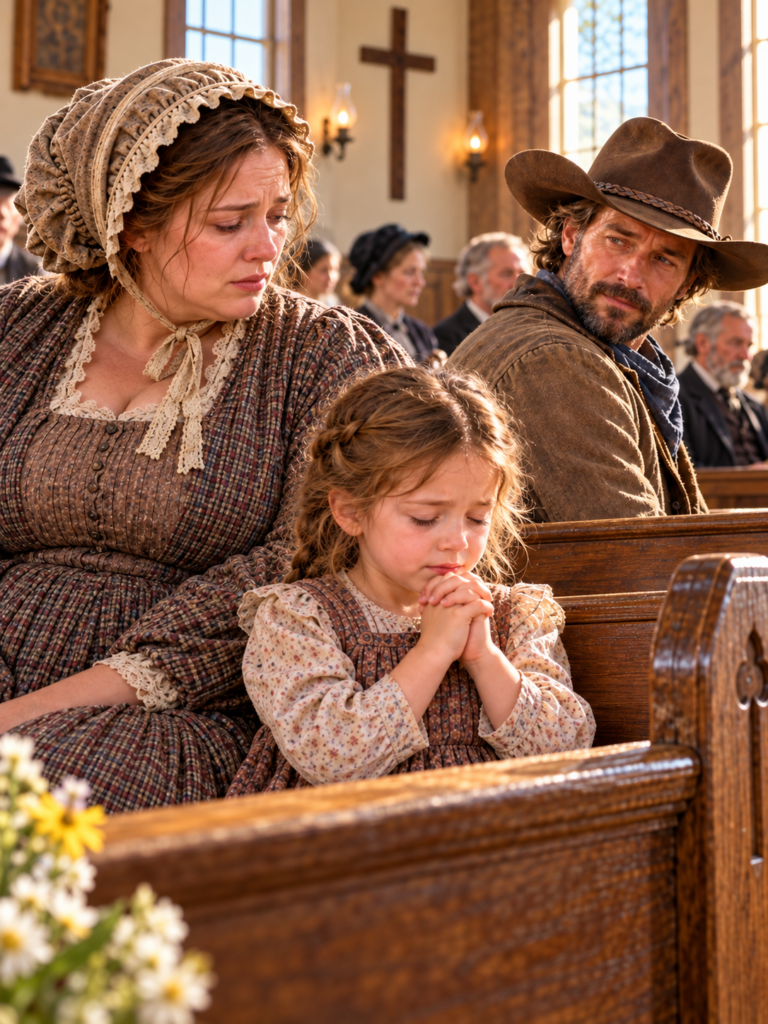
Rain tapped against the windows of Clearwater’s little white church. The congregation had gathered for Sunday worship despite the muddy streets, and the minister was halfway through his closing prayer when a child’s voice rose from the pew ahead of Caleb.
“Dear Lord, Mama says we shouldn’t ask for more than we need.”
A few heads turned.
Caleb lowered his eyes.
The little girl continued.
“But I think we need somebody who’ll be good to her. Somebody who won’t make her cry when she thinks I’m asleep.”
A woman’s hand settled gently on the child’s shoulder.
“Lucy,” she whispered.
“And please let him know how to come home,” the girl added. “Because Papa couldn’t anymore.”
The church became painfully quiet.
Caleb stared at the hat resting between his hands.
He had heard men pray for rain, cattle, forgiveness, and the recovery of fortunes lost at gambling tables. He had never heard anyone pray quite like that.
The woman beside the child bent close and murmured something Caleb couldn’t catch.
When the congregation rose, he saw her face for the first time.
She was young, perhaps twenty-eight, though exhaustion had placed shadows beneath her eyes. Her brown hair was gathered beneath a faded bonnet. The dark blue dress she wore had been carefully pressed, but the stitching along one sleeve had come loose.
She carried herself with the stiff dignity of someone determined that poverty would not be mistaken for permission to interfere in her life.
The little girl beside her had reddish curls and a stubborn chin.
Caleb knew that chin.
Not because he had seen the child before, but because he had once possessed the same determination himself.
After the service, he waited near the church doors while the congregation exchanged news of washed-out roads and troublesome livestock.
The woman was speaking with Mrs. Pike, who ran the boardinghouse near the railroad depot.
“I’m afraid Wednesday is as long as I can allow,” Mrs. Pike said quietly. “I have another family coming.”
“I understand.”
“I’ve nothing against you, Mrs. Harper.”
“I know you haven’t.”
The words were polite. The woman’s fingers, however, tightened around the little girl’s hand.
Caleb turned away before either noticed him listening.
He had no wish to make their embarrassment worse.
Outside, rainwater ran through the wagon ruts along Main Street. Caleb crossed to his horse, climbed into the saddle, and rode west toward the Mercer ranch.
He told himself the girl’s prayer was none of his concern.
By the time he reached home, he had repeated that thought at least a dozen times.
The ranch stood beyond four miles of rolling pasture, its main house sheltered by cottonwoods planted long before Caleb inherited the property.
The building was large, sound, and remarkably empty.
His cook had retired in March. The housekeeper before her had gone to live with a married daughter. Since then, Caleb had relied upon the occasional assistance of ranch hands who could barely keep their own quarters respectable.
He entered the kitchen and found yesterday’s bread still sitting beneath a cloth.
A pot stood on the stove.
Inside it was something that might once have been stew.
Caleb inspected the contents and decided against making inquiries.
He poured coffee instead.
Through the doorway lay the dining room, with its long walnut table and eight straight-backed chairs.
He hadn’t used the room properly in years.
Once, a woman named Ruth had stood beneath its windows measuring fabric for curtains. She had insisted the afternoon light would make the room beautiful.
Caleb had believed her.
Three weeks before their wedding, fever had taken her.
Afterward, he had kept the curtains but lost the habit of opening them.
He sat at the kitchen table, where there was only one chair, and thought again of the little girl in church.
Someone who knew how to come home.
He looked around the silent house.
Then he drank his coffee before it grew cold.
Eliza Harper had no intention of marrying again.
She had been widowed in February, and the loss was still too near for her to imagine another man’s name beside her own.
Her husband, Daniel, had been a decent man with an untidy mind and an extraordinary talent for finding humor when there was little reason for it.
He had also been a poor keeper of money.
When illness took him, he left Eliza with a few household possessions, unsettled accounts, and a daughter too young to understand why a father who had always promised to return could no longer keep that promise.
Relatives had offered advice.
An aunt suggested that Lucy live with cousins until Eliza established herself.
Daniel’s older brother thought she should marry a widower who owned a grain business.
A church acquaintance recommended placing the child with a respectable family while Eliza worked as a servant.
Everyone seemed to have a solution.
Few had asked Eliza what she wanted.
So she sold the furniture that could be sold, kept Daniel’s pocket Bible and a little tin box of Lucy’s treasures, and traveled to Clearwater.
She had heard there might be work.
By Tuesday evening, that possibility had nearly disappeared.
The laundry wanted strong women willing to work six days a week, but children were not permitted on the premises.
The schoolmaster needed someone to clean the classrooms, though the wages would hardly purchase flour.
A merchant offered employment sorting deliveries for two afternoons each week.
Nothing would provide a secure roof for both Eliza and Lucy.
That night, Lucy sat cross-legged on the boardinghouse bed, arranging three smooth pebbles on the quilt.
“Will we go somewhere else?” she asked.
“Perhaps.”
“Somewhere with horses?”
“Possibly.”
“Somewhere with a kitchen?”
Eliza smiled faintly.
“I certainly hope so.”
Lucy moved one pebble away from the others.
“Does everybody have to keep finding a new place?”
“No, sweetheart.”
“Then why do we?”
Eliza folded a patched stocking carefully before answering.
“Because I’m still finding the right work.”
Lucy considered that.
“Does God know where it is?”
“I expect He knows more than I do.”
“Then I’ll ask again.”
Eliza looked up quickly.
“Perhaps this time you could ask quietly.”
The child studied her with solemn eyes.
“Was it wrong to ask for somebody to make you happy?”
Eliza crossed the little room and sat beside her.
“No.”
“Then why did your face turn red?”
“Because some things are private.”
Lucy leaned against her mother’s arm.
“I didn’t know being happy was private.”
For a moment, Eliza could think of nothing to say.
On Wednesday morning, Eliza entered the general store to purchase half a pound of dried beans.
Mr. Sutter, the owner, was arguing with a delivery driver over an invoice.
“That’s thirty-seven sacks,” the driver insisted.
“I have a bill for forty.”
“Then somebody has written the bill incorrectly.”
“That somebody is standing in front of me.”
Eliza waited while the disagreement worsened.
Finally, she glanced at the delivery sheet lying on the counter.
“Pardon me,” she said. “The total includes three sacks marked as returned from the previous shipment.”
Both men turned.
Mr. Sutter frowned.
“What?”
She pointed to the notation.
“Those aren’t part of today’s delivery. They’ve been carried forward twice.”
Mr. Sutter examined the paper.
The driver leaned over his shoulder.
Then the storekeeper made an irritated sound.
“Well, I’ll be.”
A voice from behind Eliza spoke.
“That explains why Sutter seems to believe every ranch in the county is eating twice as much flour as it ought to.”
She turned.
Caleb Mercer stood near a barrel of nails, holding a folded list.
He removed his hat.
“Mrs. Harper.”
She recognized him from church and felt an uncomfortable flush rise to her cheeks.
“Mr. Mercer.”
Sutter grumbled something about careless clerks and returned to the invoice.
Caleb watched Eliza place her beans on the counter.
“Do you keep accounts professionally?”
“I have done.”
“Household accounts?”
“Those as well.”
“Inventory?”
“Yes.”
“And can you cook?”
She looked at him more carefully.
“Is this an examination?”
“Possibly.”
“Then I should like to know what position I’m being examined for.”
A hint of amusement appeared in his expression.
Caleb explained that his ranch needed someone to supervise meals, manage household purchases, and put the accounts into a condition a sensible person could understand.
Eliza listened, but she didn’t allow herself to become hopeful.
“Would I be expected to live there?”
“Preferably.”
“My daughter lives with me.”
“I understood that.”
“She will continue to live with me.”
“I wasn’t suggesting otherwise.”
“I must be clear, Mr. Mercer. Several people have offered employment under conditions that required my daughter to become somebody else’s responsibility.”
Caleb’s expression changed.
“Then those people weren’t offering the kind of employment you needed.”
For the first time that morning, Eliza found herself without an immediate answer.
He continued.
“There’s a small house beyond the kitchen garden. It has two rooms, a good stove, and a roof that doesn’t leak. You and your daughter could use it.”
“What wages?”
He named a figure.
She considered it.
“And the hours?”
They discussed those.
“And if the cattle hands expect washing, sewing, or other work beyond the duties we’ve agreed upon?”
“Then we’d discuss additional wages.”
Eliza folded her hands.
“Would you be willing to put everything in writing?”
“Certainly.”
Mr. Sutter looked up from his ledger.
“Mercer, you’ve never had a written agreement with a housekeeper in your life.”
Caleb glanced at him.
“Then it appears I’ve been fortunate nobody has asked me to remember what I promised.”
Eliza tried not to smile.
She wasn’t entirely successful.
That afternoon, Caleb drove Eliza and Lucy to the ranch.
Lucy spent most of the journey asking questions.
Did coyotes eat chickens?
Could horses recognize people?
Why were some cows brown and others black?
Had Caleb ever fallen from a horse?
“Yes,” he admitted.
“Did you cry?”
“Not until I saw the state of my trousers.”
Lucy laughed so loudly that a meadowlark startled from the roadside grass.
Eliza watched Caleb’s hands on the reins.
They were broad, weathered hands, marked by old cuts and the calluses of someone who worked alongside his employees.
He answered Lucy without impatience.
That surprised her.
Men generally found her daughter charming for the first five minutes and exhausting after the tenth.
Caleb seemed to accept both conditions as part of the same child.
The ranch came into view shortly before four.
A broad veranda shaded the house. Barns and corrals stood farther downhill, while a garden stretched beside a whitewashed fence.
The little cottage was plain, but the windows were intact and the doorway sturdy.
Eliza tested the latch.
Then she tested it again.
Caleb noticed.
“I can have a carpenter look at it.”
“There’s nothing wrong with it.”
“Then why twice?”
“Because a door should stay closed when a woman means it to.”
He regarded her for a moment.
“Fair enough.”
Lucy had already discovered the old mare grazing in the nearest pasture.
“What’s her name?”
“Juniper.”
“Why?”
“She was born beside a stand of juniper trees.”
“Does she know that’s her name?”
“She comes when I call it.”
Lucy considered this excellent evidence.
Inside the main house, Eliza found a different sort of evidence.
An impressive collection of dirty pans occupied the kitchen. A drawer contained four separate lists of provisions, none apparently related to what was actually in the pantry.
The household ledger stood open beside a pile of unpaid invoices.
She examined the first few pages.
Then she turned another.
And another.
“Mr. Mercer?”
“Yes?”
“How many people are responsible for purchasing supplies?”
“Usually me.”
“Does anyone check what arrives?”
“Whoever is nearby.”
“And who compares the deliveries with the bills?”
He paused.
“Until this moment, I hadn’t realized those were three separate questions.”
Eliza looked at him.
Caleb looked back.
Then, unexpectedly, they both laughed.
It was the first unguarded laughter Eliza had known since Daniel’s funeral.
The sound startled her enough that she immediately looked away.
Caleb did not embarrass her by mentioning it.
Instead, he fetched a clean sheet of paper and set it on the table.
“What would you need before deciding?”
Eliza sat down.
“First, the agreed wages. Second, the cottage for as long as I remain employed, with reasonable notice if the position ends. Third, I must have authority to correct purchasing errors without obtaining your permission for every penny.”
He listened.
“And fourth?”
She looked at him sharply.
“How did you know there was a fourth?”
“You seem like someone who keeps a complete list.”
Eliza drew a breath.
“My daughter and I are not to be treated as objects of charity. If you offer us this position, it must be because the work is worth paying for.”
Caleb pulled out a chair.
“Mrs. Harper, there’s a delivery of oats in my barn that I apparently paid for twice. My pantry contains enough molasses to last until Christmas, and I’ve been having coffee for supper because I forgot to purchase potatoes.”
He rested his elbows on the table.
“I assure you, I need somebody who knows what she’s doing.”
Eliza studied him.
He had not offered sympathy.
He had offered evidence.
That was something she could understand.
They wrote the agreement together.
When it was finished, Caleb signed first and handed her the pen.
Eliza signed beneath his name.
A few minutes later, Lucy appeared in the doorway carrying a wildflower.
“Are we going to live here?”
Eliza looked down at the paper.
Then at the honest key lying beside it.
“Yes, sweetheart.”
“For how long?”
Eliza hesitated.
Caleb remained silent.
At last she answered.
“For a good while, if all goes properly.”
Lucy crossed the kitchen and slipped her small hand into her mother’s.
“Then I can take my doll out of the suitcase?”
Eliza felt something tighten behind her ribs.
“Yes.”
The child smiled.
Not the excited smile of someone receiving a gift.
The relieved smile of someone being given permission to stop preparing for departure.
That evening, after Caleb had driven them back to Clearwater, Eliza unfolded the employment agreement beneath the boardinghouse lamp.
She read every line once more.
It promised money.
It promised work.
It promised a roof.
It promised nothing about affection.
She was grateful for that.
Love had become the most frightening uncertainty in her life.
A clear agreement seemed infinitely safer.
She did not yet understand how much more difficult it would be when the man who honored every written promise began keeping promises nobody had asked him to make.
Part 2
By the middle of June, the Mercer ranch had acquired three things it had been missing for years.
Order, proper meals, and the sound of a child singing badly in the yard.
Caleb considered all three improvements.
Eliza organized the pantry first.
She discovered bags of rice behind old seed catalogs, a barrel of flour left too near a damp wall, and a surprising quantity of broken crockery that somebody had apparently intended to mend.
Next came the accounts.
She established separate books for household purchases and ranch expenses, arranged weekly inventories, and persuaded Caleb that a man owning several hundred head of cattle should not depend upon memory to determine what he owed the feed merchant.
Within three weeks, she uncovered enough duplicated charges to equal almost a month’s wages.
Caleb studied the corrected figures one evening.
“Sutter will be miserable when he sees this.”
“He may discover honesty improves his disposition.”
“He’ll claim his clerk made the mistakes.”
“Then his clerk has been unusually consistent.”
Caleb laughed.
Eliza was beginning to enjoy making him do that.
It remained an unsettling pleasure.
He was not the sort of man who scattered affection through compliments.
He spoke sparingly, seldom praised himself, and looked uncomfortable whenever anyone thanked him for ordinary decency.
Yet he noticed things.
When Eliza complained that the kitchen window admitted too much smoke, a carpenter arrived the next morning to repair the flue.
When she asked for stronger shelves in the storeroom, Caleb measured the wall and built them himself.
When Lucy developed a fascination with the horses, he explained the stable rules to Eliza before offering the child a single privilege.
“She may stand outside Juniper’s stall,” he said, “but only when I or one of the men is there. She doesn’t go behind a horse, and she doesn’t enter the corral alone.”
Eliza nodded.
“And if she forgets?”
“Then we begin the lesson again.”
Lucy, listening nearby, folded her arms.
“I don’t forget everything.”
“No,” Caleb agreed. “Only the things you haven’t remembered yet.”
She seemed satisfied with the distinction.
Soon, her little drawings appeared in the kitchen.
A horse with an enormous head.
A fence leaning at an impossible angle.
A portrait of Caleb that gave him the shoulders of a buffalo and ears larger than either seemed necessary.
He hung that one beside the pantry door.
Eliza found him studying it after supper.
“You’re not particularly flattered by the resemblance, I hope.”
“The likeness is remarkable.”
“Especially the ears?”
“Those may be useful. I’ve been told I don’t listen well enough.”
She lowered her eyes to hide a smile.
Caleb noticed anyway.
Their companionship developed in small, inconvenient ways.
Eliza learned that Caleb disliked beans cooked too soft, though he ate them without complaint.
Caleb discovered that Eliza sometimes stayed awake late to mend clothing after spending an entire day managing his household.
He also learned she kept a small savings book in a locked tin box beneath her bed.
He never asked how much money it contained.
Once, when she needed a new pair of work shoes, she walked into town on her afternoon free and purchased them with her own wages.
Caleb noticed the shoes.
“Are they comfortable?”
“Very.”
“Good.”
That was all.
Eliza had expected him to ask why she hadn’t allowed him to buy them.
Instead, he asked whether the road had dried enough for the wagon.
Her relief embarrassed her.
She had become so practiced at guarding her independence that she sometimes failed to recognize when no one was threatening it.
The first serious disturbance came from Mrs. Haskell, the wife of a neighboring cattle buyer.
At a church supper, the woman examined Eliza’s freshly mended dress and asked how she was settling into the Mercer household.
“Very well, thank you.”
“And the child?”
“Lucy is happy.”
“How fortunate.”
Mrs. Haskell lowered her voice.
“Of course, people do talk.”
Eliza understood immediately.
“About what?”
“Well, a widower’s house. A young widow. A little girl who seems rather attached to him.”
“Mr. Mercer isn’t a widower.”
Mrs. Haskell blinked.
“No, I suppose not. But he’s lived alone for years. You can appreciate how things might appear.”
Eliza placed her cup carefully on the table.
“My position is a paid one, Mrs. Haskell.”
“Naturally. Though I imagine a man like Caleb Mercer could afford a wife more easily than a housekeeper.”
The remark struck harder than Eliza expected.
Not because she believed it.
Because she feared other people might.
And because a small, unwelcome part of her had begun imagining what it might be like to sit beside Caleb at church without explaining why.
That evening, she returned to the ranch unusually quiet.
Caleb found her checking the storeroom shelves long after the work should have been finished.
“Something wrong with the provisions?”
“No.”
“Then you’ve been counting the same jars for twenty minutes.”
She closed the ledger.
“Perhaps I’m checking your arithmetic.”
“That would be a sensible precaution.”
She tried to smile.
He waited.
Finally, she told him what Mrs. Haskell had said.
Caleb listened without interruption.
Then his jaw tightened.
“I’ll speak to Haskell.”
“No.”
“Eliza—”
“Please don’t.”
It was the first time she had used his Christian name without thinking.
Both noticed.
She continued quickly.
“I can manage unpleasant conversation. I have been doing so most of my life.”
“That doesn’t mean you ought to have to.”
“No. But I won’t have people believing I require you to defend my reputation every time someone invents a story.”
Caleb looked toward the darkened yard.
“Then what would you like me to do?”
She had prepared herself for argument.
The question left her unexpectedly vulnerable.
“Nothing,” she said at last. “Just continue treating me as you have.”
He nodded.
“I can do that.”
He went back to the ranch office without another word.
Eliza remained beside the shelves.
She had expected him to be angry.
Instead, he had given her what she asked.
Why, then, did she feel close to tears?
A week later, a summer storm broke over Clearwater.
The rain came so suddenly that the dry road vanished beneath flowing water. A section of pasture fence collapsed near the creek, and Caleb rode out with two men to bring the scattered cattle away from the rising bank.
Eliza watched the storm through the kitchen window.
By dusk, the men had returned.
All except Caleb.
One of the hands told her he had gone around the west boundary to check a narrow crossing.
“He knows the ground,” the man said.
Eliza nodded.
She finished supper.
She cleared the tables.
She laid out clean towels for the returning men.
Then she stood in the doorway listening to thunder move beyond the hills.
Lucy came beside her.
“Is Mr. Mercer coming?”
“Yes.”
“When?”
“Soon, I expect.”
The child took her hand.
“Papa used to say soon.”
Eliza knelt.
For a moment, the old terror returned with such force that she could scarcely breathe.
Daniel had gone away in February to fetch a doctor for a fever spreading through the settlement where they lived. He fell ill himself, and the news arrived only after days of silence.
In Lucy’s memory, it was simpler.
Her father had left.
Her mother had waited.
Then everyone had begun speaking softly.
Eliza gathered her daughter close.
“Mr. Mercer went to look after the cattle. We know where he intended to go.”
“But what if he doesn’t come?”
Eliza had no comforting lie to offer.
“Then we’ll find out why.”
Half an hour later, hoofbeats sounded beyond the kitchen garden.
Caleb appeared through the rain, his coat muddy and his hat dripping.
He dismounted stiffly.
Eliza was halfway down the steps before she realized she had moved.
“Where have you been?”
“The crossing washed out. I had to ride north.”
“You might have sent somebody.”
“I did. Didn’t Will get here?”
“He came back before you went north.”
Caleb stopped.
Then he understood.
“I’m sorry.”
She stared at him.
He was soaked, exhausted, and apparently more concerned with her alarm than with his own discomfort.
“I should have explained where I was headed,” he said.
Eliza folded her arms tightly.
“You had cattle to save.”
“And a house full of people who didn’t know where I was.”
Behind her, Lucy ran down the steps.
Caleb crouched despite the mud and rain.
“Miss Harper, I’m very sorry to have worried you.”
“Did the river try to take you?”
“It made a poor attempt.”
“Will you tell us next time?”
“I will do my best.”
Lucy wrapped her arms around his neck.
Eliza turned away quickly.
She was not prepared for the sight of Caleb returning the embrace.
Later, when Lucy had been put to bed and the rain softened, Eliza brought hot tea into the kitchen.
Caleb sat near the stove in dry clothes.
“You needn’t have apologized to her,” she said.
“She was frightened.”
“Children become frightened.”
“Adults, too.”
Eliza lowered herself into a chair.
For a long time, neither spoke.
Then Caleb said, “Ruth died in this house.”
Eliza looked up.
He had never told her more than the woman’s name.
“She became ill at the end of winter,” he continued. “At first we believed she had a cold. Then fever came. The doctor rode out twice, but he couldn’t help her.”
He stared at his cup.
“I spent months afterward remembering everything I might have done differently.”
Eliza understood that particular torment.
“The trouble with grief,” he said, “is that there’s always another question. Something you could have asked. Somewhere you might have ridden sooner.”
“Or someone you wish you’d begged not to leave,” Eliza whispered.
He looked at her.
She told him about Daniel.
About the winter sickness.
About the doctor who arrived too late.
About Lucy standing by the window for three mornings because nobody had yet found the courage to tell her that her father would not return.
“I know it wasn’t his choice,” she said. “But she remembers waiting.”
Caleb set down his cup.
“I can’t promise nothing will ever happen to me, Eliza.”
“I wouldn’t believe such a promise.”
“But I can promise not to leave people wondering when I can prevent it.”
Something inside her shifted.
It was not the magnificent assurance of a storybook hero.
It was smaller.
And therefore more believable.
She reached across the table and touched his hand.
Only for a moment.
Then she withdrew it.
Caleb did not follow.
He simply allowed the moment to remain what she had chosen to make it.
By August, Eliza had saved enough money to buy passage to another town if necessary.
She had also become indispensable to the Mercer ranch.
The cattle hands respected her. Deliveries arrived with proper records. The household accounts were clear enough that Caleb could make decisions without discovering fresh debts afterward.
One afternoon, he brought her a revised employment agreement.
“I’d like you to stay through winter,” he said.
She read the paper.
The wages were unchanged, though the busiest cattle season would soon end. Her work would include more of the ranch purchasing records.
There was also a provision granting her one month of notice if the arrangement ended.
She glanced up.
“You’ve thought this through.”
“I had an excellent example.”
He smiled.
She didn’t.
The agreement was generous.
Too generous, perhaps.
Because her heart had begun making its own arrangements.
She had grown accustomed to hearing his boots on the porch.
She knew the sound of his laughter when Lucy invented impossible stories.
She knew he put fresh flowers beside Ruth’s photograph every spring, and that he had not done so secretly after Eliza came.
Sometimes, while he read the newspaper aloud in the evenings, she caught herself wondering whether they might someday grow old in the same room.
Then she would return to the cottage and count her savings.
Numbers were easier to trust than longing.
“I should like a little time,” she told him.
“Take whatever you need.”
He left the agreement with her.
The next morning, Eliza wrote to Mrs. Whitcomb, a former employer in Fairford, asking whether any suitable positions might be available.
She told no one.
Not because she intended to deceive Caleb.
Because she needed to know that her life still possessed doors she could open herself.
The letter arrived three weeks later.
The Fairford Hotel required a new manager for its kitchen and stores.
The wages were higher.
There would be a private room for Eliza and Lucy, schooling nearby, and the prospect of advancement if the hotel’s business continued to grow.
Mrs. Whitcomb had recommended Eliza personally.
The position was hers if she accepted within ten days.
Eliza read the letter beside the cottage window.
Outside, Lucy and Caleb were attempting to construct a small wooden cart for her doll.
The cart had already collapsed twice.
Caleb sat on an overturned bucket, examining a wheel.
“I believe your passenger may require a lighter carriage.”
“Or a stronger horse,” Lucy suggested.
“There isn’t a horse.”
“That’s why it isn’t going anywhere.”
He looked at her with grave admiration.
“An excellent observation.”
Their laughter drifted through the open window.
Eliza folded the letter.
She had wanted a choice.
Now she had one.
And for the first time in her life, the difficulty was not finding a safe place.
It was deciding whether she could trust the place she had found.
That evening, she told Caleb about Fairford.
He read the letter carefully.
Then he returned it.
“It sounds like a fine opportunity.”
She watched him.
“That’s all?”
“What would you like me to say?”
“I don’t know.”
He rested his hands on the table.
“Would it help if I told you I don’t want you to go?”
Her heart lurched.
“Do you?”
“Yes.”
The word was so plain that she almost wished he had made it harder to understand.
“But I won’t tell you to refuse work you’ve earned.”
She looked away.
“What if I stay because I’m afraid of losing what we have here?”
Caleb was quiet for a long moment.
“Then I would never know whether you were staying for me.”
Her eyes returned to his.
He seemed older suddenly.
More vulnerable.
“There is something I ought to have told you months ago,” he said.
She waited.
“I heard Lucy praying in church. The first Sunday you were in Clearwater.”
Eliza felt the blood drain from her face.
“You heard?”
“Every word.”
“Then the position—”
“I offered it because I needed someone capable of doing the work.”
“But you noticed us because of her.”
“Yes.”
She stood, unable to remain seated.
For months, she had protected herself from charity.
Now she feared that everything she had accepted might have begun with pity.
Caleb rose, but kept his distance.
“Eliza, I can tell you exactly what I thought that morning. I thought there was a child frightened of losing another person, and a mother carrying more than she should have had to carry.”
“Then you wanted to help us.”
“I did.”
She closed her eyes.
“But wanting to help someone isn’t the same as deciding what they owe you afterward.”
He paused.
“And somewhere between those first few weeks and now, I stopped thinking of the two of you as visitors.”
Her breath caught.
“I started coming home before dark because there were people I hoped to see. I started looking forward to ordinary arguments about flour and broken machinery. I began saving stories because I thought you might laugh at them.”
Eliza remained still.
“I care for you,” he said. “Not because Lucy asked heaven for a stranger. Because I’ve come to know the woman standing in front of me.”
She wanted to step toward him.
Instead, she whispered, “I’m afraid.”
“So am I.”
She searched his face.
“If I went to Fairford, would you be angry?”
“Heartbroken, perhaps.”
The answer struck deeply.
“But not angry,” he added. “You haven’t promised me anything.”
“Would you ask me to stay?”
He considered her question.
“I could. But I think you’ve spent too many years listening to other people tell you where you belong.”
He picked up the employment agreement and placed it beside her letter.
“This decision ought to be yours.”
Eliza accepted the position in Fairford.
She wrote the acceptance before dawn.
When she told Caleb, he looked at her for several quiet seconds.
Then he asked when she needed to leave.
Nothing in his conduct changed.
He settled her wages.
He arranged for a wagon to take their luggage.
He helped Lucy repair the wooden cart so it could travel without losing a wheel.
On the morning before their departure, Eliza found an envelope beneath the household ledger.
It was addressed to the manager of the Fairford Hotel.
Inside was a letter of recommendation.
Caleb had written it in his careful, slightly awkward hand.
He described Eliza’s accomplishments at the ranch, the money she had saved through correcting accounts, the responsibility she had carried, and the judgment she had demonstrated.
Near the end, one sentence stopped her.
Mrs. Harper needs neither supervision beyond the requirements of honest employment nor assistance disguised as wages. Any establishment fortunate enough to engage her will discover the value of her work for itself.
Eliza read the words three times.
Then she pressed the letter to her chest.
She had spent months wondering whether Caleb believed she needed him to survive.
He had just given another employer every reason to believe she did not.
That evening, Lucy wandered into the kitchen carrying her doll.
“Mr. Mercer?”
“Yes?”
“Will you forget us?”
Caleb put down the piece of harness he was repairing.
“No, Lucy.”
“Even if we live far away?”
“Even then.”
“Will Juniper forget?”
“She’ll remember your apples.”
The child hesitated.
“And if Mama doesn’t come back?”
Caleb looked toward Eliza, who had stopped outside the doorway.
He did not know she was listening.
“Then I’ll hope she’s happy wherever she chooses to be.”
Lucy frowned.
“But won’t you be sad?”
“Very.”
“Then why are you helping us go?”
Caleb was silent for a moment.
“Because caring about someone means wanting them to have a good life, even when you don’t get everything you wish for.”
Lucy thought about this.
Then she placed the doll’s newly repaired cart beside him.
“I think loving people sounds difficult.”
Caleb smiled sadly.
“It can be.”
Outside the doorway, Eliza covered her mouth with one hand.
She had believed leaving was the only way to prove she was free.
Now the man she loved was helping her leave.
And she could no longer pretend that freedom required her heart to remain untouched.
Part 3
The morning coach arrived beneath a sky the color of old pewter.
Clearwater was just waking when Caleb drove Eliza and Lucy into town.
Shutters opened along Main Street. A baker carried warm loaves into his window. Somewhere beyond the railroad depot, a locomotive sounded its whistle.
The ordinary life of the town continued, indifferent to the fact that three people were approaching a separation none of them wanted.
Lucy sat between the adults, clutching her doll.
Eliza held her purse and travel papers.
Caleb drove without speaking much.
At the coaching office, he unloaded their trunk and carried it beneath the awning.
Then he returned with the smaller suitcase.
“Everything appears in order,” he said.
“Thank you.”
“The driver says the roads are good through the valley.”
“That’s a mercy.”
Neither moved.
Lucy suddenly tugged at her mother’s sleeve.
“May I go into the church?”
Eliza looked across the street.
The little white building stood with its doors open. The sexton was working inside.
“We haven’t much time.”
“Just a minute.”
Eliza glanced at Caleb.
“I’ll take her,” he offered.
“No. I’ll come.”
They crossed together.
Inside, the church smelled of damp wood and floor soap.
Lucy walked directly to the pew where she had knelt on their first Sunday in Clearwater.
She folded her hands.
Eliza stood near the aisle.
Caleb remained a respectful distance behind them.
This time, Lucy’s prayer was quiet.
“Dear Lord, thank You for Mr. Mercer. Please take care of him when we aren’t here.”
Eliza closed her eyes.
“And please don’t let Mama think she has to be unhappy just because she’s trying to be brave.”
The words pierced her more deeply than any plea to remain.
She sat beside her daughter.
“Lucy.”
The child looked up.
“Am I wrong again?”
“No.”
Eliza smoothed the reddish curls away from her forehead.
“But there’s something I need you to understand. You are not responsible for finding someone to make me happy.”
“I only wanted somebody kind.”
“I know.”
“Mr. Mercer is kind.”
“Yes.”
“Then why can’t we stay?”
Eliza looked across the empty church.
She could have said because she was afraid.
Because loving Caleb meant opening a door grief might someday walk through again.
Because she had confused independence with never needing anyone.
But Lucy was six.
She deserved an answer she could carry.
“Sometimes grown people need time to understand their own hearts,” Eliza said.
Lucy considered this.
“Like when I can’t decide whether I want the blue ribbon or the red one?”
Eliza laughed through sudden tears.
“Something like that.”
The child slipped her hand into hers.
“Then you can take your time.”
Eliza held her close.
When they left the church, Caleb was waiting beneath the porch roof.
He didn’t ask what Lucy had said.
He simply accompanied them back to the coach.
At the carriage door, Eliza turned.
“Caleb.”
He looked at her.
“I don’t know what will happen.”
“Neither do I.”
“I don’t want you to think I’m leaving because I don’t care for you.”
His expression softened.
“I never thought that.”
She swallowed.
“I think I care for you more than I know how to manage.”
For a moment, the sounds of the street seemed to fall away.
Caleb lifted his hand, then allowed it to rest on the railing rather than reaching for her.
“Then perhaps one day we’ll know what to do with that.”
She nodded.
The driver called for passengers.
Caleb helped Lucy aboard.
Then he offered Eliza his hand.
She took it.
For one brief instant, neither let go.
“Goodbye, Caleb.”
“Goodbye, Eliza.”
The coach began moving.
Lucy leaned toward the window.
“Remember us!”
Caleb lifted his hat.
“I will.”
Eliza watched him until the road curved and the town disappeared.
Then she drew the curtain and held her daughter while both of them cried.
Fairford was larger than Clearwater, with two busy hotels, a freight yard, and streets crowded with wagons bringing produce from neighboring farms.
The hotel position proved exactly what Mrs. Whitcomb had promised.
It was respectable work.
Demanding work.
Work Eliza was entirely capable of doing.
She supervised kitchen purchases, negotiated with suppliers, organized deliveries, and managed employees who had initially expected the new widow to require instruction.
Within a month, she had corrected the stores, reduced waste, and established a proper system of accounts.
Her employer, Mr. Bennett, was pleased.
“You’ve a remarkable head for figures, Mrs. Harper.”
“Thank you.”
“I hope you’ll consider remaining beyond the first year.”
“I haven’t decided.”
“Well, you’ve time.”
Lucy began attending school.
She made friends, learned new songs, and developed an enthusiastic opinion about nearly everything.
Their room was comfortable.
Their wages were sufficient.
For the first time since Daniel’s death, Eliza possessed both savings and an independent future.
She ought to have felt perfectly satisfied.
Most days, she did.
Yet each evening, when the kitchen had been cleaned and the last account closed, she found herself remembering the sound of boots on a ranch porch.
She missed arguments about coffee.
She missed the old mare standing patiently at the paddock fence.
She missed a man who understood that an unasked question could sometimes be a courtesy.
Most of all, she missed being known without being managed.
Three weeks after their arrival, a letter came from Clearwater.
Caleb’s handwriting appeared on the envelope.
Eliza carried it upstairs before opening it.
He wrote about ordinary things.
The south pasture fence had been repaired.
Sutter had hired a better clerk.
Juniper had stolen an apple from a ranch hand who should have known better.
The first frost had silvered the cottonwoods.
Near the bottom, Caleb had written:
I passed the cottage yesterday and noticed the rosebush by the window still blooming. I thought you might like to know it has survived my care, which is more than can be said for most plants entrusted to me.
Eliza laughed aloud.
Then she cried.
She answered him that evening.
She described the hotel, Lucy’s school, and the kitchen servants.
She told him about discovering a supplier who charged for twelve pounds of butter when only nine had been delivered.
Caleb replied that Sutter would doubtless admire such a man.
Their letters continued.
Not every week.
Sometimes the weather interrupted the mails.
Sometimes ranch business kept Caleb occupied.
But when he could not write, he explained why in his next letter.
He never accused her of forgetting him.
Never asked how much longer she intended to remain away.
Never disguised pressure as devotion.
In return, Eliza stopped pretending that writing to him was an obligation.
She wrote because she wanted to.
The difference mattered.
Winter arrived in Fairford with a hard north wind.
By December, Eliza had accumulated enough savings to leave the hotel if she chose.
Her employer offered an increase in wages for the coming year.
It was a generous proposal.
She thanked him and requested several days to consider it.
That evening, she placed her savings book on the small desk beside the window.
The figures were clear.
She could continue working in Fairford.
She could find employment elsewhere.
She could even establish herself in Clearwater, where a growing number of businesses lacked anyone competent to manage their books.
For the first time, returning to Caleb would not mean returning because she needed his roof.
She had another life available.
A good one.
She opened the drawer and removed his latest letter.
It contained a small sketch Lucy had sent him weeks before.
Caleb had drawn beside it.
His horse looked worse than hers.
Beneath the picture, he had written:
I am informed that my artistic abilities are beyond repair. I hope this does not diminish my standing in the household.
Eliza laughed softly.
Then she sat very still.
She thought of Daniel.
How loving him had never guaranteed another tomorrow.
How his death had convinced her that dependence was dangerous and affection even more so.
She had spent much of the year trying to build a life no loss could destroy.
But a life without risk was not necessarily a life without loneliness.
She could not protect Lucy from every sorrow by refusing to let her love anyone.
Nor could she protect herself by treating every attachment as a trap.
Eliza looked again at the savings book.
She had earned every dollar.
No man could take that accomplishment away.
And now, if she returned to Clearwater, she would be choosing a person rather than grasping at security.
The realization did not make her fearless.
It made her certain.
She took a clean sheet of paper and began a letter.
Dear Caleb,
I have discovered something rather inconvenient.
I can manage perfectly well without you.
She stopped, smiling through tears.
Then continued.
And I find that I would very much prefer not to.
Caleb read the letter standing beside the kitchen stove.
He read it once.
Then again.
Then he sat down because his knees had begun behaving in a manner he considered undignified.
Eliza was returning to Clearwater in January.
She had arranged to rent two rooms above Mrs. Pike’s boardinghouse for several months while establishing a small bookkeeping business.
She already had promises of work from two merchants and a neighboring farm.
She did not ask Caleb for employment.
She did not ask him for a house.
At the end of the letter, she wrote:
If your offer to court me was sincerely meant, I should like to discover whether it remains open.
Caleb folded the paper carefully.
Then he carried it to the sitting room.
Ruth’s photograph stood upon its familiar shelf.
For years, Caleb had believed that loving another woman would somehow lessen what Ruth had meant.
He knew better now.
Ruth had been part of his life.
Eliza was not replacing her.
She was asking whether there might still be a future.
He set the letter beside the photograph and stood quietly for several minutes.
Then he returned to the kitchen, where the ranch foreman found him attempting to make supper.
“Boss,” the man said, staring at the stove, “something burning?”
“Probably.”
“Want me to fetch somebody?”
“No.”
Caleb lifted the pot.
A blackened crust covered the bottom.
He regarded it thoughtfully.
“On second thought, perhaps you’d better.”
Eliza returned to Clearwater on a cold January afternoon.
The coach had scarcely stopped when Lucy pressed her face against the window.
“There he is!”
Caleb stood near the station with his hat in his hands.
His coat was brushed.
His boots were clean.
He looked so nervous that Eliza almost laughed.
He stepped forward when the driver opened the door.
Lucy came down first and flew into his arms.
“Mr. Mercer!”
He caught her.
“You’ve grown.”
“I’ve learned multiplication.”
“Then I shall have to be more careful with my accounts.”
She nodded solemnly.
“You truly shall.”
Eliza descended behind her.
For a moment, she and Caleb simply looked at each other.
Then he removed his hat.
“Mrs. Harper.”
“Mr. Mercer.”
“I hope you had a pleasant journey.”
“It was tolerable.”
“Good.”
Lucy looked between them.
“Are you both going to stand here until supper?”
Eliza laughed.
Caleb’s smile broke across his face.
“No, Miss Harper. I believe we have better things to do.”
He carried their bags to the boardinghouse.
He did not presume that Eliza would come back to the ranch.
He admired the two rooms she had rented, praised the light from the south window, and offered to introduce her to several men who required help with their business accounts.
She accepted the introductions.
Not as favors.
As opportunities.
That evening, after Lucy had gone upstairs with Mrs. Pike, Eliza and Caleb walked along the quiet street.
Snow lay against the fences.
The church bell sounded seven.
“I have something to ask you,” Caleb said.
She turned toward him.
“Yes?”
“Would you permit me to call on you Sunday afternoon?”
She smiled.
“That depends.”
“Upon what?”
“Whether you’re coming as my former employer or as a gentleman seeking my company.”
He stopped.
“Eliza, I have spent four months regretting that I didn’t ask you properly before you left.”
“Then perhaps this is your opportunity.”
He took a breath.
“May I court you?”
Her heart beat hard.
She was still afraid.
Perhaps she always would be, a little.
But fear no longer held the authority she had once given it.
“Yes, Caleb.”
He smiled.
She held out her hand.
He took it.
And they walked the rest of the way beneath the winter stars.
Their courtship was neither grand nor particularly smooth.
Caleb sometimes spoke too little when he was troubled.
Eliza occasionally insisted upon solving difficulties alone when accepting help would have made more sense.
They disagreed about household expenditures, the proper way to sharpen kitchen knives, and whether Lucy should be allowed to keep the half-grown stray dog she discovered near the feed store.
Lucy won the last argument.
The dog was named Biscuit.
Caleb claimed it was the ugliest animal in Montana Territory.
Biscuit adored him.
Eliza’s bookkeeping business prospered.
She kept her own money, purchased her own supplies, and accepted contracts under her own name.
On Sundays, Caleb called at the boardinghouse.
Sometimes they attended church.
Sometimes they drove into the country.
Sometimes they simply sat beside the stove while Lucy read aloud and Biscuit slept at Caleb’s feet.
When spring arrived, Caleb brought Eliza to the stand of cottonwoods beyond the ranch’s west pasture.
The creek ran high with melting snow.
They walked beside it while Lucy searched for interesting stones farther along the bank.
Caleb stopped beneath the branches.
“I’ve been thinking about the house,” he said.
Eliza glanced at him.
“Has the roof begun leaking?”
“No.”
“Another disaster in the pantry?”
“Not yet.”
“Then I’m afraid you’ll have to explain.”
He took both her hands.
“For a long time, I believed that house belonged to a life I’d lost. I kept it exactly as it was because changing anything seemed like admitting there would never be anyone else.”
Eliza listened.
“Then you and Lucy came. You didn’t erase anything. You simply made me notice how much living I’d stopped doing.”
His voice became unsteady.
“I don’t need a housekeeper, Eliza. I can hire one. And I don’t need you to surrender your work or your money or your judgment.”
He smiled faintly.
“Though I confess your judgment is superior to mine in nearly every matter involving a ledger.”
She laughed through gathering tears.
“What are you asking, Caleb?”
He reached into his coat and withdrew a small velvet box.
Inside lay a plain gold ring.
“I’m asking whether you’d be willing to build a life with me. One where we decide things together. Where Lucy knows she’s loved without having to earn it. Where we remember the people we’ve lost and still make room for what comes next.”
He swallowed.
“Will you marry me?”
Eliza looked at the ring.
Then at the man holding it.
She thought of the months in Fairford.
Of the independent life she had built.
Of the journey back to Clearwater, made not from desperation but from choice.
“Yes,” she whispered.
Caleb closed his eyes briefly.
Then she laughed and said it again.
“Yes, Caleb. I will.”
He slipped the ring onto her finger.
And when he kissed her, there was no sense of debt settled or rescue completed.
Only two people who knew what it meant to lose a future and had found the courage to imagine another.
They married in the little church at Clearwater the following autumn.
The ceremony was simple.
Eliza wore a deep blue dress she had purchased with her own earnings.
Caleb stood beside her looking as though he would rather face a stampede than the possibility of forgetting his vows.
Lucy carried flowers.
Biscuit was forbidden entry after demonstrating an unfortunate interest in the minister’s trousers.
The congregation laughed when the dog barked from outside.
Even Mrs. Haskell smiled.
After the ceremony, Eliza and Caleb returned to the ranch together.
Her bookkeeping business continued.
She arranged her schedule so that she could manage accounts for several Clearwater merchants while assisting with the ranch books by agreement.
Caleb never once suggested that marriage made her earnings less her own.
Lucy attended school and spent her afternoons exploring the ranch within the boundaries her mother and Caleb established.
Daniel’s Bible rested on a shelf in the family sitting room.
Ruth’s photograph remained where it had always stood.
Neither was hidden.
Neither was treated as a rival to the happiness that had come afterward.
Once, Lucy asked Caleb whether he minded hearing stories about her father.
He sat beside her on the veranda.
“Why would I mind?”
“Because he was Mama’s husband first.”
Caleb considered his answer.
“Your father loved you, Lucy. He loved your mother. Nothing about me changes that.”
She looked down at her hands.
“Can a person love somebody who’s gone and somebody who’s here?”
“I believe so.”
“How?”
Caleb smiled gently.
“Well, you loved your father. And you’ve made room in your heart for me, haven’t you?”
Lucy nodded.
“Quite a lot of room.”
“Then perhaps your heart knows something the rest of us are still learning.”
She thought about that.
Then she leaned against his shoulder.
“You’re not going to disappear, are you?”
Caleb looked toward the yard, where Eliza was speaking with one of the ranch hands.
“I can’t promise that nothing bad will ever happen, sweetheart.”
Lucy waited.
“But I can promise you something else.”
“What?”
“When I go somewhere, I’ll tell you where I’m going. When I can come home, I will. And when something keeps me away, I’ll do everything I can to let you know.”
She considered the answer.
It was not the impossible promise she had once hoped someone would make.
But it was a promise a real person could keep.
“All right,” she said.
Then she ran into the yard to find Biscuit.
That winter, a heavy snowstorm swept across the valley.
Caleb had ridden out before dawn with two hands to repair a broken fence near the eastern pasture.
By afternoon, snow covered the road.
Eliza stood at the kitchen window watching the white fields disappear beneath the storm.
For an instant, she felt the old fear stirring.
Then a rider appeared beyond the gate.
It was one of Caleb’s men.
He brought word that the repairs had taken longer than expected, but Caleb was safe and would return after the weather eased.
Eliza thanked him.
She went back to the stove.
Lucy sat at the table practicing her letters.
“Is Mr. Mercer coming home tonight?” she asked.
“Yes. He’s delayed, but he’s safe.”
“Good.”
Lucy bent over her schoolbook again.
There was no frightened questioning.
No desperate vigil beside the window.
She knew where Caleb was.
She knew somebody would tell them if plans changed.
And she trusted that when he could come home, he would.
After dark, the kitchen door opened.
Caleb stamped snow from his boots and set his hat on its peg.
Biscuit rushed forward barking.
Lucy looked up.
“You’re late.”
“I am.”
“Did you fix the fence?”
“Every post.”
She nodded approvingly.
“Then you can look at my sums after supper.”
Caleb sighed.
“That sounds considerably more dangerous.”
Eliza laughed.
He crossed the kitchen and kissed her gently.
“Everything all right here?”
“Everything’s fine.”
She set another plate at the table.
Caleb pulled out his chair.
Lucy pushed her schoolbook toward him.
And for several quiet minutes, they shared the ordinary news of an ordinary winter day.
Outside, snow gathered against the windows.
Inside, the lamps glowed warmly over the table.
There were still troubles ahead of them.
Hard winters.
Failed harvests.
Sickness.
Disappointments neither could foresee.
Life had promised them no exemption from sorrow.
But love had taught them something more useful than certainty.
It had taught them how to face uncertainty together.
Eliza looked from her husband to her daughter.
She remembered a rainy Sunday in a little white church, when a six-year-old child had prayed for someone who would make her mother happy.
At the time, Eliza had believed the prayer was asking for a man who would never leave.
Now she understood that its answer had never depended on such an impossible promise.
It had depended on something quieter.
A man willing to tell the truth.
A woman brave enough to choose love freely.
And a little girl who had finally learned she no longer needed to watch every road for someone who might not return.
Caleb caught Eliza looking at him.
“What is it?”
She shook her head, smiling.
“Nothing.”
Then she reached across the table and took his hand.
And when the wind rattled the windows, Lucy did not look toward the door.
She simply continued writing, certain that the people who loved her were exactly where they meant to be.

