
Part 1
At two in the morning, Silas Redmond’s phone rang on the coffee table, and four years of fatherhood launched him upright before he was fully awake.
He had fallen asleep on the couch in his work clothes, steel-toed boots still on, after fourteen hours replacing medium-voltage cable at a substation west of Albuquerque. The television played soundlessly against the wall, washing two framed photographs in weak blue light.
One showed his daughter, Poppy, in kindergarten, grinning around two missing front teeth.
The other showed Corinne.
Thirty-four years old. Laughing in their old backyard with a garden hose in one hand, tomato plants behind her.
Forever thirty-four.
Silas reached for the phone.
Poppy was spending the night with her best friend, Zoe. That meant a call at two in the morning could only be trouble.
But the number on the screen was unfamiliar.
“Hello?”
“Blake?”
A woman.
Her voice was thin and shaking.
“Blake, I need you. Rio Vista Medical Center. Room 412. Please. Please come.”
Silas sat forward.
“I think you have the wrong number.”
Silence.
Then the woman said, “Blake, is that you? I’m so scared. I don’t want to be alone. Not tonight.”
Something inside Silas stopped resisting.
Not because he knew her.
Because he knew that fear.
Four years earlier, he had sat in another hospital beneath lights that never dimmed and learned that his wife was never coming home. He remembered what it was like to have the world collapsing around him with no hand to hold.
“I’m not Blake,” he said quietly.
The woman made a small, broken sound.
“But I can come.”
Another silence.
“Just keep breathing, okay? I’m on my way.”
He ended the call.
Then he stared at the cracked screen in his hand.
“What the hell am I doing?”
Logic arrived too late.
He had just promised to drive across Albuquerque in the middle of the night because a stranger had misdialed a phone number.
Worse, he had promised to go to a hospital.
Silas had not willingly entered one since Corinne died.
He called Opal Greer, the elderly neighbor who had long ago appointed herself emergency backup for both Redmonds. After apologizing for waking her, he explained enough for her to agree to watch the apartment in case Poppy came home unexpectedly.
Then Silas picked up his keys.
Albuquerque before three in the morning looked abandoned. Traffic lights changed for empty intersections. The Sandia Mountains stood black against the eastern sky.
Every mile toward Rio Vista gave him another opportunity to turn around.
He didn’t.
The hospital’s sliding doors opened.
The smell hit him first.
Disinfectant. Chemically washed linen. Climate-controlled air.
Silas stopped in the lobby.
For one terrible second, Rio Vista vanished.
He was four years younger, standing on another fourth floor with two vending-machine coffees in his hands while a nurse walked toward him too slowly.
Corinne had died at 4:17 on a Tuesday morning in October.
Ovarian cancer.
Detected late enough to destroy hope and early enough to give them eleven months to watch it happen.
Silas had spent every night he could beside her.
Afterward, he promised himself he would never breathe hospital air again.
The elevator opened.
He nearly left.
Then he remembered the voice.
I don’t want to be alone.
He stepped inside and pressed four.
Room 412 was partly open.
Silas knocked.
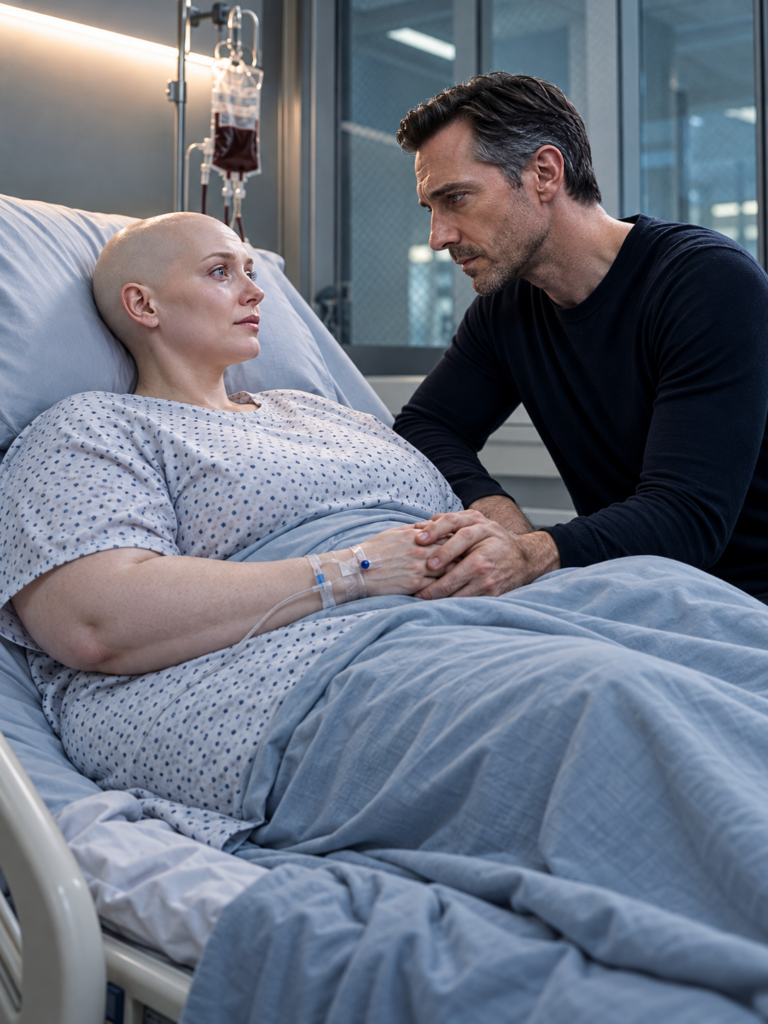
The woman in the bed was younger than he had expected. Early thirties, perhaps. Ash-blond hair lay against her pillow, noticeably thin near her temples. Her face was pale, her lips cracked.
But her gray eyes were alert.
Defiant, even now.
“You’re not Blake.”
“No. Silas.” He stayed near the door. “Silas Redmond. You called the wrong number.”
Her expression changed.
Before embarrassment could turn into panic, he added, “You sounded scared. I figured nobody should have to be scared like that alone.”
She stared at him.
Then a rough laugh escaped her.
“Dalia Everhart.”
Silas knew the name immediately.
Everyone in New Mexico knew it.
Everhart Aerospace. Satellite assembly outside the city. White antenna fields scattered across the desert. A company Arthur Everhart had built from almost nothing.
Silas’s crews had laid power cable near Everhart installations before.
He looked down at his stained work shirt.
Apparently galaxies could collide after all.
“Blake and I broke up about a month ago,” Dalia explained. “I deleted his number three weeks back.”
“Yet you called him.”
“Apparently impending death damages your standards.”
Silas almost smiled.
“I remembered the number. Three years together. Ten digits.” She gave him a tired look. “Except I got one wrong.”
Before he could answer, the door opened.
A compact woman with graying hair entered, glanced at Dalia’s monitors, then at Silas.
“I’m Dr. Hannah Voss. And you are?”
Silas heard himself say, “A friend.”
The lie surprised him.
Dr. Voss asked him into the hallway.
Dalia had severe aplastic anemia. Her bone marrow had nearly stopped producing blood cells. Three months of immunosuppressive treatment had stopped working. Now her white-cell count had fallen dangerously low, and she had developed a fever.
For a healthy person, the infection might have been minor.
For Dalia, the next forty-eight hours could decide whether she lived.
Long-term, she needed a bone marrow transplant.
If they found a match.
Silas knew every word in that language.
Count.
Response.
Critical window.
He had learned another vocabulary once: stage, spread, progression, palliative.
“She wants you to stay,” Dr. Voss said.
“I’m not family.”
“Tonight, that matters less than you think.”
Silas looked at the door to Room 412.
His entire body wanted to run.
Instead, he went back inside and pulled a chair close to the bed.
Dalia watched him.
“The doctor told you the frightening part.”
“Yeah.”
“People usually disappear after the frightening part.”
“I’m starting to notice you have low standards for people.”
That earned the smallest smile.
Silas settled into the chair.
“So, Dalia Everhart of Everhart Aerospace, tell me why the heiress to a satellite empire is alone at three in the morning.”
“You know the company?”
“I’ve laid cable beside your antenna fields. Electricians have a name for them.”
Her eyes narrowed.
“Mushroom farms.”
She laughed.
It was the first real laugh of the night.
And because it was three in the morning, because neither had expected to know the other by sunrise, the conversation became more honest than either of them intended.
Dalia asked who mattered most in his life.
“Poppy. My daughter. She’s ten.”
No hesitation.
“Tell me about her.”
“She argues with me about direct current.”
Dalia blinked.
“I’m serious. She thinks Edison cheated Tesla personally and remains offended on his behalf. She draws power poles, transmission lines, sunsets. Other kids draw houses. Mine draws the electrical grid.”
He realized he was smiling.
“She’s like her mother that way. Looks at something broken and refuses to accept that it can’t be fixed.”
Dalia’s expression softened.
Silas told her Corinne had died four years ago. Cancer. That she had grown the best tomatoes in their neighborhood and lost at tic-tac-toe for a decade without ever admitting Silas was better.
“And you still came here,” Dalia said.
“To a hospital.”
He looked away.
Some questions lost something when answered aloud.
So Dalia offered him truths of her own.
Arthur Everhart had died eighteen months earlier from a stroke, leaving his only daughter a company with four thousand employees and a board full of men who believed inheritance was not the same thing as leadership.
Her mother had remarried and lived in Europe.
Blake, her boyfriend of three years, had lasted two weeks after the diagnosis.
His final voice mail remained on her phone.
I’m sorry. I wasn’t built for this.
“And friends,” Dalia said. “That turned out to be a word with an expiration date.”
“When?”
“The day you get sick.”
The humor left her face.
“They said I might not make it through the morning.”
Silas felt the old corridor close around him.
“That’s why I called Blake.” Her fingers tightened weakly around the blanket. “I didn’t want to die alone.”
Silas moved no closer.
He did not promise she would live.
He had learned what promises like that were worth.
“I’ll stay.”
She looked at him.
“All night?”
“As long as it takes.”
Her eyes filled, but she blinked the tears back.
“Why?”
“Because nobody should do this alone.”
So a single father with cable grease beneath his fingernails sat beside a dying billionaire heiress through fever, three changes of antibiotics, and the terrible hour around four in the morning when hospitals seemed to hold their breath.
Dalia survived.
Near sunrise, the fever finally broke.
Red light touched the Sandia Mountains outside her window.
Before Silas left, she asked for his number.
This time she entered it carefully.
All ten digits.
“Thank you,” she said.
“You shouldn’t have to thank people for doing what people are supposed to do.”
“You clearly haven’t met enough people.”
“Take care of yourself, Dalia Everhart.”
He drove away believing the strange night was finished.
Three days later, as he pulled down the door at Redmond Electric, a polished black SUV stopped outside.
A driver in a gray suit handed him a cream envelope.
“Miss Everhart requests your presence at her residence tomorrow evening at seven.”
Silas stared at him.
“She also instructed me to say it is extremely important.”
It was exactly the kind of complication his life did not need.
Unfortunately, he went.
Dalia’s house stood in the northern hills above the Rio Grande Valley, all desert stone and glass.
Silas arrived in his best shirt and nicest shoes and still felt like a spare bolt dropped inside a jewelry case.
Dalia waited in a room filled with late-afternoon light. She looked stronger than she had at the hospital. A silk scarf hid her thinning hair.
Still, he could see how carefully she held herself.
“I have a proposal.”
“That sentence has probably ruined a lot of men’s evenings.”
The corner of her mouth moved.
“This one may ruin yours.”
Her illness was only half the problem.
The Everhart board was using it to question her ability to remain in control.
The man leading the effort was Gideon Volk, the vice chairman who had worked beside Arthur for thirty years.
Dalia refused to describe him as simply greedy.
In 1998, when Everhart nearly collapsed, Volk had mortgaged his own house so employees could be paid. To him, the company was not a portfolio.
It was something he had once bled to keep alive.
Which made him more dangerous.
Dalia wanted to build a low-earth-orbit satellite constellation providing broadband to rural America, including communities in New Mexico where children still sat in library parking lots to get enough Wi-Fi to finish homework.
Volk believed she was gambling four thousand livelihoods on a vanity project.
“And this concerns me how?” Silas asked.
“Every time I’m hospitalized, Volk gains another argument that I’m isolated, unstable and incapable of leading.”
Dalia leaned forward.
“I need someone beside me.”
“Hire a publicist.”
“I have several.”
“A bodyguard.”
“I have those too.”
“Then what exactly are you asking?”
Her gaze held his.
“I want to hire you as my companion for six months. Treatments. Board meetings. Public appearances.”
Silas waited.
“Seven hundred fifty thousand dollars.”
He laughed.
Dalia did not.
“You’re hiring me to be your fake boyfriend?”
“Companion.”
“That sounds more expensive.”
“You’re perfect precisely because you have nothing to do with my world. No corporate alliances. No hidden agenda. You came to me when there was nothing to gain.”
Then she said the one thing she knew would matter.
“That money could change Poppy’s future.”
Silas stopped smiling.
A house with a yard.
A real college fund.
A proper workshop.
No more deciding which bill could be paid late.
Dalia watched him wrestle with it.
“All you would have to do is stand beside me while I fight to stay alive.”
He left without answering.
His truck eventually carried him to the cemetery.
Corinne’s grave sat beneath a thin crescent moon.
Silas stood with his hands buried in his coat pockets.
“What would you tell me to do?”
He could almost hear her.
You already know. You just want permission.
Except he didn’t know.
Near midnight, back at the apartment, the kitchen light started flickering again.
Silas opened the breaker panel, traced the circuit, found a loose connection, tightened it, insulated it, closed the breaker.
The light steadied.
That was why he liked electricity.
A connection was secure or it wasn’t.
A circuit was complete or broken.
Find the fault. Repair it. The light returned.
Human beings offered no such clarity.
Cancer did not have a loose screw he could tighten.
Grief had no breaker to reset.
And somewhere between Dalia’s offer and Corinne’s grave, Silas understood that the real question had nothing to do with money.
Could he deliberately enter another life knowing it might end in another hospital?
The answer came the next morning.
Poppy sat at the kitchen table using a pair of small pliers from his toolbox to repair the zipper on a coat she had worn for two winters.
She had not asked for another.
At ten years old, she had already learned to treat limitations like laws of nature.
Silas suddenly hated that lesson.
He called Dalia.
“I’ll do it.”
Her exhale was audible.
“But I have conditions. Poppy comes first. Always. And I don’t lie to her.”
“Agreed.”
“My work matters too.”
“Agreed.”
“My life doesn’t become property of your board.”
“Agreed.”
Silas rubbed a hand over his face.
“When do we start?”
“Monday. Treatment.”
That evening, over green-chile cheeseburgers at the diner Poppy considered the pinnacle of civilization, Silas explained the arrangement.
“So,” she said, “are you dating her?”
“No.”
“Is she becoming my new mom?”
“No, peanut.”
Poppy studied him with Corinne’s unnerving expression.
“But if people think you’re dating when you’re not, isn’t that lying?”
Silas could have evaded the question.
He didn’t.
“Kind of.”
Her eyebrows climbed.
“There are lies people tell to hurt somebody. And sometimes people bend the truth because they’re trying to protect someone.”
Poppy considered this.
“Like when you told Mrs. Opal her cookies were good even though they were burned into bricks?”
Silas laughed despite himself.
“Yes. Something like that.”
Poppy returned to her burger.
Then her voice changed.
“Is Miss Dalia sick in the hospital?”
“Yes.”
“I don’t like hospitals.”
Silas reached across the table.
Poppy looked down.
“They smell like Mom did at the end.”
He closed his hand around hers.
Neither spoke for a while.
On Monday, Silas stepped into Dalia Everhart’s life.
And neither of them was prepared for what standing beside someone would begin to mean.
Part 2
Camille Winters met Silas in Dalia’s foyer with a printed schedule and the focused expression of someone who was mentally living twenty minutes ahead of everyone else.
Silas wore pressed trousers and a cashmere sweater Dalia’s staff had sent to his apartment.
He had never owned anything so soft and distrusted it on principle.
Camille led him down the stone corridor.
“I’ve worked for Miss Everhart for five years,” she said. “Started as an intern.”
Then, after a pause, “The Everharts once helped my family. I don’t forget things like that.”
Silas noticed the weight behind the statement.
He did not ask.
Later, he would wish he had.
Dalia’s private treatment center had leather recliners, warm lamps and fresh flowers instead of fluorescent lights.
It changed nothing important.
Ten minutes into her second infusion bag, Dalia began to shiver.
Not a mild tremor.
Her entire chair shook. Her teeth knocked together despite the warm room.
A nurse brought heated blankets and medication.
Then came the nausea.
Silas caught the basin and braced Dalia’s shoulders while she vomited.
The woman who had adjusted his collar before they left the house now clung to his forearm with barely enough strength to hold herself upright.
When it ended, she collapsed against the chair.
Fine strands of ash-blond hair remained on the white pillow.
Silas quietly gathered them before she saw.
“You don’t have to stay in here,” she whispered.
“Yes, I do.”
“The lobby is comfortable.”
“I’m not here for the furniture.”
“Everyone here knows who I am.”
He pulled the chair closer.
“Then tell me something I don’t know. What does Everhart Aerospace actually do with those mushroom farms?”
Her exhausted laugh made the nurse glance in.
Over the next three hours, Dalia explained satellites.
She spoke about orbital coverage and rural broadband, about schoolchildren who should not have to drive twenty miles for an internet signal, about the project Arthur would never have approved because he had spent his life terrified that one catastrophic gamble could erase everything he built.
She loved the company.
Silas realized that first.
Not its money.
Not the tower.
The work.
That afternoon, he saw the other Dalia.
Everhart Tower rose from Albuquerque’s technology corridor in black glass.
Dalia entered wearing a flawless wig, carefully applied makeup and a suit sharp enough to make weakness look like a rumor.
Five hours earlier, Silas had held a basin while she was sick.
Now executives rose when she entered.
The contrast unsettled him more than wealth ever could.
In the boardroom, Gideon Volk sat at the far end of a polished walnut table.
Silas had expected a predator.
Volk looked like an old craftsman.
Large hands. Silver hair. A face shaped by decades of actual work.
Only his eyes were cold.
Dalia introduced Silas simply.
“My partner.”
Several board members studied him with open curiosity.
Volk removed his glasses.
“Mr. Redmond, what exactly is your role here?”
Dalia started to answer.
Silas leaned forward.
“I’m here to stand beside Dalia however she needs.”
Volk’s gaze sharpened.
“Professionally?”
Silas held it.
“Some people might call it love. Some might call it basic decency. Call it whatever makes you comfortable. I’m not going anywhere.”
The words came before he had decided whether they were part of the job.
Under the table, Dalia’s hand found his.
Her fingers pressed once.
Silas pressed back.
Later, walking toward the parking garage, she said, “That answer wasn’t in anything Camille prepared.”
“I have an allergy to that tone.”
“Thank you.”
He glanced at her.
“You pay me an unreasonable amount of money. Apparently improvisation is included.”
Dalia smiled, but it faded quickly.
“Be careful with Volk. He isn’t fighting to win a round. He thinks he’s fighting for his life.”
Two weeks later, Gideon Volk appeared outside Redmond Electric.
Silas was closing the shop when he saw the black sedan.
Volk studied the worn sign above the building.
“Respectable place,” he said. “I started with my hands too. Aerospace engineer. Forty years ago I spent more time underneath airplanes than in a bed.”
Then his friendliness disappeared.
“How much is she paying you to play the man who loves her?”
Silas kept his face still.
“You’ve got the wrong door.”
“Do I?”
Volk took one step closer.
“Your daughter is Poppy. Sandy Avenue Elementary. Talented little artist, I hear.”
Three seconds of silence transformed a statement into a threat.
Silas’s hands curled.
Volk continued.
“I know what is worth knowing. It has been part of my work for thirty years.”
He produced a business card.
“Two million dollars. You leave. You tell the press the relationship was staged.”
“You want to destroy her.”
“I want to save four thousand people from the fantasies of a spoiled child.”
For the first time, anger broke through Volk’s control.
“In 1998, I signed away my house so Everhart employees could receive Christmas paychecks. Arthur understood what this company was. Wages. Insurance. College tuition. Four thousand families.”
He pushed the card toward Silas.
“Think about your daughter. What kind of father refuses that much security?”
Silas did not tear up the card after Volk left.
That would have made the decision easier than it was.
Instead, he brought it home.
He sat at the kitchen table after midnight and calculated.
A house.
College.
Art classes.
Security.
Two million dollars could buy Poppy choices Silas had never possessed.
He calculated again.
The result remained unchanged.
Then, at 1:41 a.m., his phone rang.
“Silas?”
Dalia could barely speak.
“Fever. One-oh-four. Camille isn’t answering. I can’t—”
Something crashed.
The line went quiet.
Silas never remembered putting on his shoes.
He only remembered driving.
Not again.
Rio Vista was worse than the first night.
Sepsis.
Dangerously low neutrophils.
Falling blood pressure.
Silas stood against the emergency-room wall while doctors and nurses moved around Dalia’s stretcher.
For the first time since Corinne’s funeral, he prayed.
Near dawn, the crisis eased.
Dalia slept in isolation, pale beneath a crooked scarf. What remained of her real hair showed beneath it in fragile patches.
Silas stayed.
When she woke, she saw him and immediately turned her face away.
“Don’t look at me.”
He frowned.
“I’m ugly now.”
“You’re wrong.”
“Silas—”
“I’ve been an electrician for twenty years. I know what something looks like when it’s carrying everything it possibly can.”
A tear slipped across her nose onto the pillow.
Silas did not wipe it away.
He did not tell her she was beautiful.
He simply remained where he was, making no demand that she perform strength for him.
On his way home, he stopped at Redmond Electric.
Gideon Volk’s business card was still in his pocket.
Silas fed it into the old paper shredder and watched two million dollars become strips.
Three days later, photographs appeared online.
Silas entering Dalia’s residence near two in the morning.
Camille handing him a thick envelope.
The envelope contained his first monthly payment, but a telephoto lens made it look like cash changing hands.
Then came photographs of two pages from the contract.
The word companion.
The amount.
The headlines wrote themselves.
EVERHART HEIRESS HIRED FAKE LOVER TO FOOL BOARD
The company’s stock fell fifteen points before the market opened.
Silas reached Dalia’s house expecting panic.
He found her sitting in the reading room, perfectly upright, watching the news crawl across a television.
“I’m sorry,” he said. “Volk must have had someone watching me.”
“That part isn’t your fault.”
“There’s a worse part?”
“The contract.”
Dalia turned toward him.
“There are three copies. Mine. My attorney’s.”
“And?”
“One in the office safe.”
Her expression answered the question before he asked it.
“Who has the combination?”
“Two people.”
Camille.
Silas understood.
Dalia inhaled.
Then something changed in her face.
The patient disappeared.
The chairwoman returned.
“We’re not denying it.”
Silas stared.
“Excuse me?”
“Denial gives them control of the story.”
“What are we doing?”
“Telling the truth.”
The press conference was held on the steps of Everhart Tower.
Cameras crowded the entrance.
Dalia stood at the microphone with Silas beside her.
“Yes,” she began. “My relationship with Silas Redmond began as an agreement.”
The reporters erupted.
She waited.
“When I met Silas, I had just received medical news that terrified me. In the middle of the night, I dialed a number incorrectly. Instead of hanging up, a stranger drove across Albuquerque and sat beside me through what I believed might be the final night of my life.”
The noise diminished.
“Afterward, I formally hired him to accompany me during treatment and public obligations because I needed one person around me who had no connection to the money or power surrounding my name.”
Her eyes shifted toward Silas.
“What I did not anticipate was what that agreement would quietly become.”
Silas forgot the cameras for one beat.
He stepped toward the microphone.
“The money was never the point.”
Someone shouted a question.
He continued.
“The point is that powerful people sometimes need somebody beside them too. Even a chairwoman. Even a single dad from the other side of Albuquerque.”
By afternoon, the wrong-number story had overtaken the scandal.
That evening, Camille entered Dalia’s office carrying a resignation letter and a USB drive.
“I did it.”
Dalia sat very still.
“I photographed the contract.”
Silas looked at Camille.
“Why?”
“Six years ago, my father fell from scaffolding. Two broken vertebrae. The employee assistance fund loaned my family money for his surgery. Mr. Volk’s office administered it.”
Her voice weakened.
“Three weeks ago he called me upstairs. He said if I didn’t cooperate, they would demand repayment immediately and make sure I never worked in this industry again.”
She swallowed.
“I chose my father.”
The USB contained recordings, emails ordering her to photograph documents, and evidence that Volk had distributed Dalia’s confidential medical information to three board members.
Camille placed her resignation on the desk.
“I know what I did is enough to destroy me. I’m only asking you not to touch my father’s loan.”
Dalia looked at the letter.
Then she pushed it back.
“You chose your father.”
Camille’s eyes widened.
“I’ve spent most of my life trying to deserve mine. I don’t have the right to pretend I can’t understand.”
Dalia lifted the USB.
“But now I need you to choose again.”
“For what?”
“To tell the board the truth.”
Camille stared at the woman who had every reason to ruin her.
Then she nodded.
“Yes.”
The public scandal reached Poppy next.
Silas got a call from her school in the middle of the day.
Older students had shown her the headlines. A boy named Mason had repeated a phrase he had heard adults use.
Gold digger.
Your dad gets paid to pretend he loves her.
Poppy punched him in the nose.
Silas drove her home in silence.
He was sick with guilt.
He had been willing to let strangers judge him. He had not been prepared for Poppy to pay for his choices.
That night, while he tucked her into bed, she spoke into the dark.
“I didn’t hit him because of what he called you.”
“Then why?”
“He said Miss Dalia was going to die.”
Silas sat down.
Poppy turned toward him, tears shining in the night-light.
“He said everyone with diseases like hers dies like they do in movies.”
Her voice became smaller.
“Dad, what if I start loving her and she leaves like Mom did?”
Silas could not breathe for a moment.
“I don’t want to love anybody anymore if people are just going to keep leaving.”
There were easy answers.
She’ll be fine.
Don’t worry.
The doctors know what they’re doing.
Silas had learned to hate easy answers.
“I’m scared of the same thing.”
Poppy stared at him.
“Every day,” he admitted. “I can’t promise you Dalia will get better. Nobody can.”
He took her hand.
“But when your mom was sick, dying wasn’t the thing that scared her most. She was afraid you and I would become too frightened to love people afterward.”
Poppy began to cry.
Silas continued, because he needed to hear it too.
“If we close ourselves off so nobody can hurt us, we don’t escape losing things. We lose everything before anyone has even left.”
Poppy climbed into his arms.
Silas held her.
And for the first time, he understood that the danger Dalia represented was not that he might lose her.
It was that he already had something to lose.
Part 3
Nothing changed all at once.
That was what made it real.
There was no miraculous afternoon when the whispers stopped, Dalia became healthy and Poppy forgot hospitals.
Instead, life accumulated in smaller pieces.
Thursday evenings, when Dalia was strong enough, became telescope nights at the Everhart house.
Arthur’s old telescope came out onto the rear terrace.
Poppy brought sketchbooks.
Dalia taught her composition and shading and confessed that she had once spent two years studying art back East before Arthur pushed her toward business.
“You wanted to be an artist?” Poppy asked.
“I was an artist.”
“What happened?”
“I became stubborn in a more expensive building.”
Poppy decided this was acceptable.
Silas usually sat several feet away, pretending to repair something that did not need repairing.
One evening Dalia caught him adjusting a perfectly functional hinge for the third time.
“You know that door worked before you touched it.”
“I’m improving it.”
“You’re hiding from an eleven-year-old’s critique of your drawing skills.”
“She said my horse looked like a transformer with anxiety.”
“She was being generous.”
He looked at Dalia.
She was laughing.
Not the brittle hospital laugh. Not the controlled smile she used in front of cameras.
An ordinary laugh.
Silas realized he had begun collecting those without meaning to.
The first sip of coffee she made a face at because it was too sweet.
The way she removed her shoes under the terrace table when exhausted.
The fact that treatment made certain foods taste metallic, so Poppy maintained an evolving list of meals Dalia could tolerate.
The way Dalia never asked him to stay after a difficult day.
She only made room for him if he did.
He always did.
Poppy kept drawing.
Eventually her classmates stopped asking about headlines and started asking what she was working on.
Even Mason apologized.
After studying him for three long seconds, Poppy handed him her newest drawing instead of answering.
It went onto the Redmond refrigerator later.
Power poles stretched toward a sunset.
Silas’s world.
Above them, against a purple strip of sky, Poppy had drawn a tiny satellite.
Dalia’s world.
Neither Silas nor Dalia commented on what the picture suggested.
Poppy had already done enough explaining for all three of them.
By the fifth month, two pieces of news arrived three days apart.
The first came from Dr. Voss.
A compatible bone marrow donor had been found.
Dalia had been halfway through dinner when she took the call.
She sat down before Dr. Voss finished speaking.
The transplant was scheduled in two weeks.
Poppy cheered.
Silas could not.
Not immediately.
He knew too much about what came before the hope.
Conditioning.
Isolation.
Risk.
Waiting.
Dalia saw it in his face.
“You look like she gave us bad news.”
“No.”
“Then what?”
He set his fork down.
“I remember being told treatments were good news before.”
The table grew quiet.
Dalia looked at him for a long moment.
“Silas.”
He shook his head.
“I’m working on it.”
“You don’t have to make this easier for me.”
“I know.”
“Then say it.”
He looked at her.
“I’m terrified.”
Dalia reached across the table.
Silas turned his hand over beneath hers.
No performance.
No board.
No contract.
“I am too,” she said.
Three days later, the board secretary called.
Gideon Volk had formally requested an extraordinary meeting and a no-confidence vote on Dalia’s leadership.
The date was not accidental.
He chose the third day of her conditioning regimen, when she would be inside a sterile isolation room preparing for transplant.
Unable, he assumed, to attend.
“He did the math,” Dalia said after reading the notice.
“A chair sitting empty. That’s his entire presentation.”
Silas looked up.
“Then don’t leave it empty.”
On the morning of the meeting, the thirtieth-floor boardroom filled.
Volk took his seat.
Directors arranged documents.
Legal counsel waited.
Then the large screen at the end of the room turned on.
Dalia appeared from Rio Vista.
No wig.
No scarf.
Her head was shaved.
Two IV lines were taped to the back of her hand.
She looked directly into the camera.
“You wanted to see me weak.”
No one moved.
“So look carefully.”
She lifted her hand slightly, displaying the hospital tubing.
“This is me on day three of conditioning, two days before a bone marrow transplant. I am finished hiding my illness to make other people comfortable.”
Silas sat in the rear of the boardroom.
Dalia continued.
“But before you vote on my competence, someone here would like to address the conduct of the man who called this meeting.”
Camille rose.
Her hands shook.
Her voice did not.
She presented the recordings.
The emails.
The instructions to photograph the contract.
The evidence that Gideon Volk had distributed Dalia’s private medical records.
Everhart’s head of legal barely needed to speak.
Volk did not deny it.
That was somehow worse.
When Camille finished, he removed his glasses, cleaned them slowly and put them back on.
“In 1998,” he said, “I mortgaged my house to keep this company alive.”
Everyone waited.
“I believed I was doing the same thing again. Saving it at any cost from a gamble.”
He looked toward the screen.
Toward Dalia.
“But you don’t save something by poisoning it.”
For the first time, the old certainty left his face.
“Arthur would have told me that.”
He stood.
“I withdraw the motion.”
A long breath seemed to pass through the room.
“And I resign.”
At the door, Volk stopped.
He did not turn around.
“I hope you survive, Miss Everhart.”
Dalia’s expression changed by one degree.
“I mean that.”
Then he left.
The no-confidence vote never happened.
The transplant did.
Forty minutes.
That was all it took for one dark-red bag of donated cells to flow through a central line.
After months of illness, corporate warfare, headlines and fear, the boundary between two possible versions of Dalia’s life looked absurdly small.
Then came the waiting.
Silas marked each day in pencil on the edge of a calendar in the sterile waiting area.
One.
Two.
Five.
Nine.
Thirteen.
He read lab values every morning the way other people followed storm warnings.
Poppy made drawings he could hold up against the glass when Dalia was too immunocompromised for normal visits.
On day eighteen, Dr. Voss came toward Silas carrying a printed report.
He tensed automatically.
Then he noticed something unfamiliar.
She was smiling before she reached him.
“The count is rising.”
Silas stared.
“Say that again.”
“Her white-cell count is rising. The graft is taking.”
For several seconds, he did nothing.
Then he sat down hard.
He covered his face.
He laughed once, helplessly.
And cried.
Recovery was not immediate.
But it came.
Slowly.
Autumn arrived.
One evening near the end of September, Dalia and Silas sat on the terrace overlooking the valley.
A cup of tea cooled between her hands.
She had been quiet too long for the silence to be accidental.
Silas waited.
Months with Dalia had taught him that waiting was sometimes the most respectful thing a person could do.
Finally she said, “Before the transplant, they made me sign forms.”
He looked over.
“About permanent effects from conditioning.”
Her fingers tightened around the cup.
“I can never have children.”
Silas did not move.
“I knew,” she continued. “Before treatment. I signed the consent alone in isolation and told myself I understood the exchange.”
She gave a strained laugh.
“My fertility for my life. Very clean arithmetic.”
Her voice broke.
“So why do I keep dreaming about a baby who doesn’t have a face?”
Silas could have said at least you survived.
He could have said there are other ways to have a family.
He said neither.
He had spent enough time beside hospital beds to know that some grief became crueler when people tried to fix it too quickly.
He reached out.
Dalia gave him her hand.
He held it between both of his.
And together they watched white mist gather over the valley while Dalia mourned a person who had never existed and now never would.
The grief did not disappear.
It changed shape.
A few weeks later, Poppy came running toward Dalia carrying a school art-show invitation.
“There’s a box here.”
Dalia took the paper.
“What box?”
“Parent or guardian.”
Poppy pointed.
“Can I put your name?”
Dalia went still.
Poppy, oblivious to the devastation she had just caused, continued.
“You’re the one teaching me art.”
Dalia looked at Silas.
He did not rescue her from the moment.
He only stayed.
When she finally signed the paper, she wrote her name more carefully than Silas had ever seen her sign contracts worth hundreds of millions of dollars.
In October, Everhart Aerospace launched the first six satellites in its rural broadband constellation.
The board approved the project unanimously.
On launch night, three people lay in the bed of Silas’s old truck on high ground east of Albuquerque.
Two blankets covered them.
A thermos of hot chocolate traveled back and forth.
Poppy lay in the middle with a sketchpad resting on her chest.
The Sandias stood black against a sky crowded with stars.
“Where is it?” Poppy whispered.
Dalia pointed.
“There.”
A small point of light moved silently across the darkness.
Months earlier, it had been a proposal people called reckless.
Now it traveled above communities where, by morning, some children would no longer need to sit outside libraries to finish homework.
Poppy watched until her eyelids surrendered.
Soon she was asleep between them.
Silas carefully pulled the blanket higher around her shoulders.
Then he looked at Dalia.
“Hey.”
“What?”
“You still owe me an answer.”
Her mouth curved.
“To what?”
“That first night.”
The smile faded.
“What if you’d remembered Blake’s number correctly?”
Dalia turned her eyes back to the sky.
“I think about that more than I should.”
Silas waited.
“Ten digits,” she said. “I’d known them for three years.”
“Exactly.”
“People don’t usually misremember something like that.”
Silas looked at her.
Dalia continued slowly.
“I think my hand was trying to call him. But some part of me already knew he wouldn’t come.”
A satellite moved steadily between stars.
“And maybe that part of me changed one number on purpose.”
Silas said nothing.
“My memory refused to call the man who wouldn’t answer.”
She turned toward him.
“It saved the line for the man who would.”
Silas looked down at the sleeping child between them.
Four years ago, he had built his entire life around preventing another loss.
Work.
Poppy.
Schedules.
Wires.
Circuits.
Things that could be tested and repaired.
He had believed safety meant keeping his world small enough that nothing else could be taken from him.
Then a woman he had never met dialed one wrong number at two in the morning.
She had asked for somebody else.
And he had gone anyway.
Now Poppy slept with one hand tangled in Dalia’s blanket.
Dalia followed the light crossing the sky with the fierce attention she gave everything she had nearly lost.
Silas reached across the small space between them.
His hand found hers.
There was no audience to convince.
No contract left to fulfill.
No board member to impress.
Dalia laced her fingers through his.
Above them, the satellite continued west.
In the simplest sense, it was only a machine receiving a signal from one place and carrying it somewhere else.
Connecting people who might otherwise never reach one another.
Six months earlier, another signal had left Room 412 searching for Blake and arrived instead at a battered phone with a cracked screen on a coffee table across Albuquerque.
People would call that a mistake.
Silas no longer knew if he believed them.
Maybe luck was not living a life in which no one ever had to call into the dark.
Maybe it was calling anyway.
And somewhere on the other end, hearing a voice say:
“I’m not the person you were looking for.
But I’m here.”

