
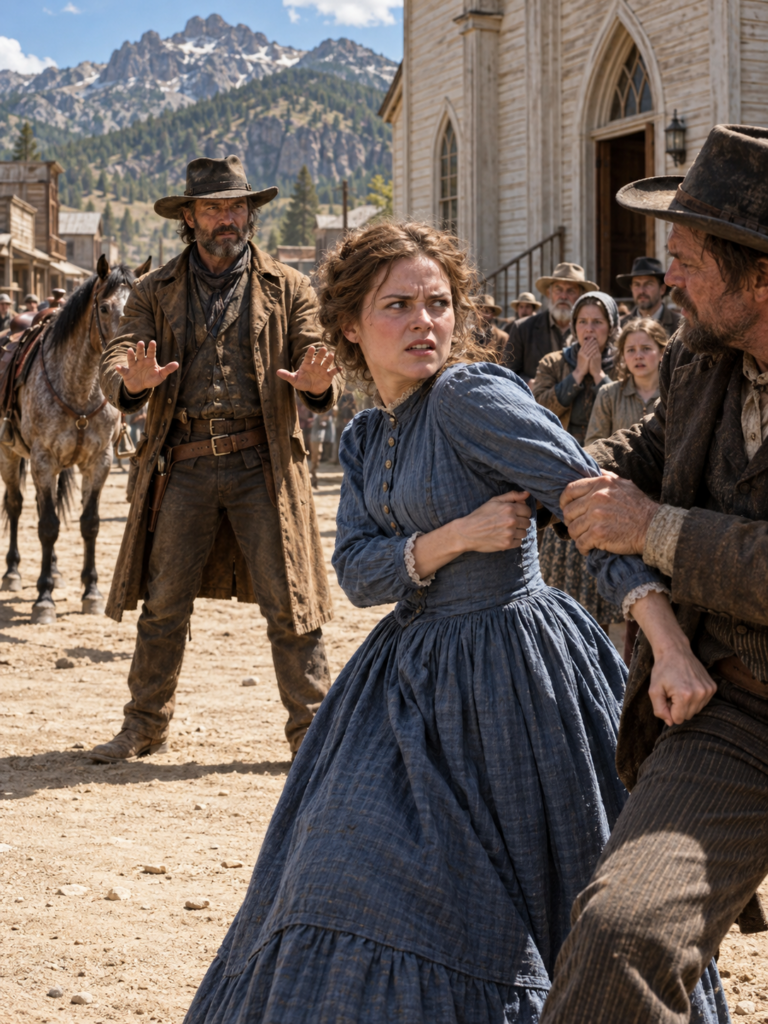
The three riders spread across the fork before Will could reach the ridge road.
Hector Greer occupied the middle, his horse planted squarely across the track. The other men positioned themselves on either side.
Will brought his mare down to a walk.
Nobody drew a gun.
That made the confrontation no less dangerous.
“Mr. Blackwood requests your company,” Hector announced.
“I’ve got somewhere to be.”
“Your destination can wait.”
Will looked toward the rising ground beyond them.
The ridge route was narrow in places. His mare had already traveled hard that morning. A reckless dash through three mounted men might leave her injured and the papers lost.
“Suppose I decline?”
Hector’s companions edged closer.
“Don’t make the afternoon difficult.”
Will studied the three faces, then loosened the reins.
“All right. Show me the way.”
At Blackwood’s ranch, Nathaniel received him behind an enormous desk.
The banker looked scarcely troubled by news that his intended daughter-in-law had escaped the church.
“Mr. Carter. An unusual amount of trouble for a traveler with no interest in local affairs.”
“I saw a woman being forced into marriage.”
“You saw a business matter you didn’t understand.”
“Then explain how nine hundred dollars became twenty-five hundred.”
Blackwood’s pen stopped.
For the first time, he looked directly at Will’s coat.
“What have you brought into my house?”
“Nothing that belongs to you.”
Blackwood’s voice hardened.
“Hector.”
The men moved before Will could put distance between them.
Three against one left little room for cleverness.
They seized his coat and searched it.
Hector produced the copied note and Dupree’s written statement.
Blackwood read both.
His expression became dangerously blank.
“Where is the original?”
Will said nothing.
“Answer me.”
“Miss Whitmore keeps her own property.”
Blackwood carried the papers to the fireplace.
Will watched the flames consume them.
“That should conclude your involvement,” Blackwood said.
“It doesn’t conclude what your clerk knows.”
“An embittered former employee?”
“Or what Miss Whitmore can prove.”
The banker’s eyes narrowed.
“Lock him in the east guest room until tomorrow’s ceremony is finished.”
Within minutes, Will found himself behind a locked door.
The room was clean. The window had been nailed shut. A pitcher stood beside the bed.
Comfortable imprisonment.
He examined the frame, found old nails loosened by dry wood, and began testing it carefully.
At the Whitmore ranch, Clara had no idea what had happened inside Blackwood’s house.
But she knew Will should have been well beyond town.
She also knew Hector.
By late afternoon, she could no longer pretend the delay meant nothing.
She carried water to her horse, tightened the saddle, and slipped her father’s original note inside her boot.
Then she rode toward Blackwood’s property.
Not through the main entrance.
She followed a fence line to an old cottonwood where Henry Blackwood sometimes rode alone.
He appeared as the light began leaving the valley.
Henry pulled his horse up sharply.
“Clara?”
“Where is William Carter?”
His silence told her enough.
“Your father has him.”
“He isn’t hurt.”
“That wasn’t my question.”
Henry glanced toward the ranch house.
“He’s being held in the east guest room.”
“Against his will?”
Henry swallowed.
“Until tomorrow.”
Clara dismounted and stood facing him.
“You know the debt is false.”
“I know there’s a dispute.”
“No. You’ve seen your father’s records. You’ve heard about the Corrian family. You know what happened to them.”
Henry looked away.
“Clara, there are things you don’t understand about my father’s affairs.”
“Then explain them under oath.”
He turned back.
“You’re asking me to ruin my family.”
“I’m asking you to stop helping your father ruin mine.”
Henry’s face reddened.
She continued before he could answer.
“I never agreed to marry you. There was never a bargain between us. Your father promised you a wife by threatening her home.”
“I didn’t ask him to do it this way.”
“But you let him.”
The words landed harder than an accusation shouted in anger.
For several moments, neither spoke.
Then Henry said, almost inaudibly, “What do you want?”
“Release Will tonight.”
“My father will know.”
“Yes.”
“He may put me out of the house.”
“Yes.”
Henry stared past her toward the fading mountains.
Clara softened her voice without retreating.
“I can’t choose courage for you, Henry. And I won’t marry you to make your life easier.”
She stepped toward her horse.
“I’ll go into that church tomorrow with the real note whether Will reaches the judge or not.”
Henry caught his breath.
“You’d face my father alone?”
“I already have.”
She put her boot in the stirrup.
Then Henry spoke.
“Wait.”
Clara stopped with one foot raised.
“After the house settles, I’ll unlock Carter’s door. His horse is in the east stable.”
She turned toward him.
“Are you giving me your word?”
Henry looked miserable.
“Yes.”
Clara lowered her foot from the stirrup and faced him fully.
“Then give me something more important than your word.”
“What?”
“Be in that church tomorrow. And when your father lies, tell everyone what you know.”
Henry sat motionless.
Because opening one locked door might save a stranger.
But telling the truth in front of the whole town would cost Henry Blackwood the life he had always expected to inherit.
Henry stared at Clara as though she had placed something heavier than a rifle in his hands.
“You want me to accuse my father in front of everybody?”
“I want you to tell the truth.”
“He’ll destroy whatever future I have.”
Clara held the reins of her horse.
“Then you’ll understand something of what he’s been trying to do to me.”
Henry looked toward the ranch house.
The windows glowed with lamplight. Inside was everything he had grown up believing would someday belong to him.
Outside stood a woman whose father had worked thirty years for land his family intended to take.
At last, Henry removed his hat.
“I’ll be there tomorrow.”
Clara studied him.
“Your father mustn’t know you’ve spoken to me.”
“He won’t hear it from me.”
She mounted and turned toward the road.
Behind her, Henry called softly, “Clara.”
She looked back.
“I never thought it would come to this.”
“It came to this long before you noticed.”
She rode away before he could answer.
By the time she reached the Whitmore ranch, darkness had settled over the valley.
Clara unsaddled her horse, brought water to the trough, and made certain the barn was secure.
Then she entered her father’s study.
The original nine-hundred-dollar note lay inside her boot.
She placed it on the desk beside the old ledger.
For years, Thomas Whitmore had recorded purchases, payments, wages, and supplies in those pages. His handwriting had grown less steady toward the end, but the figures remained careful.
Clara knew the accounts almost as well as her father had.
She opened the bank’s statements and began again.
Not merely looking for the largest discrepancy.
Looking for how the discrepancy had been built.
One questionable charge stood alone.
Another followed weeks later.
An adjustment appeared without corresponding business in the ranch ledger.
A fee was entered against a transaction her father had already paid.
The pages gradually revealed something more troubling than a single altered note.
The bank had been increasing the supposed debt through repeated entries, each small enough to discourage an argument and together large enough to threaten the ranch.
Clara worked by lamplight, comparing every date.
When she finally straightened, her eyes burned.
Twenty-three disputed fees and adjustments.
A pattern that supported what Dupree had told her.
And a difference that brought the bank’s inflated claim into focus.
She copied the figures onto clean sheets.
The numbers were not enough to convict Nathaniel Blackwood by themselves.
But they were enough to challenge him before witnesses.
She looked toward the window.
Somewhere beyond those mountains, William Carter might be riding toward the judge.
Or he might still be a prisoner.
She had no way to know.
So she made a decision.
She would not wait for Will to save her.
She would enter the church herself.
And this time, she would make Grey Hollow hear her.
***
At the Blackwood ranch, Henry waited until the household settled.
Then he took a lamp and walked down the east passage.
A key turned quietly in the guest-room lock.
Inside, Will had been working an old nail loose from the window frame.
He turned sharply.
Henry stood in the doorway.
“Your mare is saddled,” Henry whispered. “East stable. There’s food and water packed.”
Will looked from Henry to the open door.
“Clara asked you to do this?”
“Yes.”
“Does your father know?”
“No.”
Will collected his coat.
The papers were gone. Blackwood had burned both the copied loan note and Dupree’s signed statement.
But Clara still possessed the original.
And Dupree himself could testify.
As Will stepped into the passage, he stopped.
“Tomorrow morning. Will you stand with Miss Whitmore?”
Henry tightened his grip on the lamp.
“I don’t know if it’ll make any difference.”
“Maybe not. But she’ll be there with your father and his men. She ought not be the only one willing to say what’s true.”
Henry lowered his eyes.
“I’ll be there.”
Will considered him.
“Then you’ve got your own hard road ahead.”
“It’s about time,” Henry answered.
Minutes later, the roan mare carried Will through the east gate.
He followed the ridge route by moonlight, giving the horse her head on familiar stretches and easing her over rough ground.
A night ride was not a small undertaking.
He stopped to water and rest the mare when the terrain permitted, knowing that an exhausted animal might cost him the very hours he hoped to save.
The journey to Crow Creek Junction was ordinarily measured in days.
Will pressed on through the night, using the shorter ridge route he knew, with no certainty that he could find Judge Puit in time.
He carried no signed statement now.
Only his knowledge of what had happened, Clara’s account of the figures, and the names of people willing to speak.
Whether that would be enough remained uncertain.
***
Saturday morning broke bright and merciless over Grey Hollow.
By nine o’clock, the church was filling.
Nathaniel Blackwood had arranged food for a reception, brought in a fiddler, and invited practically everyone of consequence in town.
He wanted the affair to appear respectable.
He wanted a public celebration to conceal a private threat.
Clara arrived wearing her ordinary riding clothes.
No bridal gown.
No flowers.
No family escort.
Her documents were secured inside her jacket.
Margaret Ellison stood outside the dry goods store.
When she saw Clara, she looked down.
Clara reined in.
“Margaret.”
The older woman reluctantly raised her head.
“I can’t stand against Blackwood. My husband’s bank note—”
“I know.”
Clara’s voice was quiet.
“I’ve never asked you to risk your home for mine.”
Margaret’s eyes filled.
“Then what can I do?”
“Listen today. Don’t pretend you haven’t heard.”
Margaret glanced toward the church.
Then she nodded.
Clara rode on.
She tied her horse outside and walked through the open doors.
Conversation faltered.
The crowd had expected a bride.
Instead, they saw a woman carrying proof that the marriage should never take place.
Hector hurried from beside a rear pew.
“You’re supposed to be waiting in the vestry.”
“I’m exactly where I intend to be.”
He caught her arm.
Clara stopped.
“Remove your hand.”
When he hesitated, she repeated the demand loudly enough for the nearby pews to hear.
This time, Hector released her.
And she continued down the aisle.
Henry stood beside his father.
His face was pale.
Their eyes met briefly.
Clara saw fear there.
But he did not look away.
She stopped before the altar.
“Reverend Hail, I need five minutes to speak.”
The minister’s mouth tightened.
“Miss Whitmore, this is highly irregular.”
“So is arranging a wedding without the bride’s consent.”
Several people stirred.
Clara turned toward him fully.
“You knew my father. You buried him. You know he would never have wanted his daughter brought here by threats.”
Hail looked at Blackwood.
Then at the congregation.
Finally, he stepped aside.
“Five minutes.”
Clara withdrew the original note.
“My father borrowed nine hundred dollars from the Blackwood Bank. Here is the document he signed.”
She held the paper high.
“Mr. Blackwood now claims twenty-five hundred dollars. I have found no legitimate agreement increasing that original principal, and the bank’s later charges do not agree with my father’s records.”
Nathaniel Blackwood rose slowly from his pew.
“This is neither the time nor the place for such accusations.”
“It became the place when you decided to announce my marriage here.”
Clara unfolded her analysis.
“I have listed twenty-three disputed charges and adjustments. The bank must explain them.”
Blackwood approached.
“You expect respectable people to accept figures prepared by a grieving daughter?”
“No. I expect them to examine the figures and decide whether they are correct.”
A murmur spread.
Blackwood’s expression remained controlled.
“Miss Whitmore, a financial disagreement does not excuse public slander.”
“Then allow an independent examination.”
“You have no authority to demand one.”
Clara faced the congregation.
“Perhaps I don’t. But there are people here who know this bank has treated other families in the same fashion.”
She raised her voice.
“Mr. Dupree?”
The elderly former bank clerk emerged from the rear of the church.
He had dressed carefully, although his coat showed years of wear.
He walked slowly down the aisle.
Nathaniel Blackwood stopped smiling.
Dupree reached Clara’s side.
“I worked at the bank,” he told the congregation. “I objected when the accounts stopped reflecting what customers had actually borrowed and paid.”
Blackwood interrupted.
“You were dismissed for incompetence.”
Dupree did not raise his voice.
“I was dismissed after refusing to approve figures I believed were false.”
He named the Corrian family.
He described how their six-hundred-dollar loan had been presented as a much larger obligation.
He spoke of the property they had lost.
Then he mentioned the Marshfield accounts.
A rancher near the seventh pew stood.
“My brother questioned his loan adjustments, too.”
Someone else began speaking.
The congregation was no longer one silent audience.
It was becoming a room filled with people remembering things they had been afraid to say.
Blackwood turned sharply toward the sheriff.
“Stop this disturbance.”
Ormsby shifted uncomfortably.
“I don’t see a disturbance, Nathaniel. I see people asking about their money.”
The banker’s face darkened.
Then Henry stepped into the aisle.
“Father.”
Nathaniel turned.
“Not now.”
“Yes. Now.”
Henry’s voice shook.
Clara watched him struggle against a lifetime of obedience.
Then he faced the town.
“My father knew some of those figures were wrong.”
The words seemed to empty the church of air.
Henry continued.
“I knew it, too. I saw what happened to the Corrians. I knew there were questions about the Marshfield accounts.”
“Henry,” Blackwood said sharply.
“I said nothing because I enjoyed the life the bank gave me.”
The young man’s face burned with shame.
“I knew enough to ask questions. I chose not to.”
His father stared.
“Sit down.”
Henry remained standing.
“This marriage was never Clara’s choice. And the debt being used to force it deserves investigation.”
Blackwood looked at his son as though a stranger had taken his place.
For the first time, Clara saw fear disturb the banker’s confidence.
Not fear of a weapon.
Fear that the people he had always controlled might begin making decisions without him.
Then the church doors opened.
Footsteps sounded against the wooden floor.
William Carter entered, pale with exhaustion, his dusty coat hanging from his shoulders.
Behind him came an older man carrying a leather document case.
Will’s eyes found Clara.
For an instant, nothing else mattered.
He was alive.
He had returned.
And he had not come alone.
“Miss Whitmore,” he said, breathing hard, “I believe Judge Harlon Puit would like to see your father’s note.”
The man beside him stepped forward.
“Indeed I would.”
Judge Puit surveyed the church, the trembling minister, the bewildered congregation, and Nathaniel Blackwood standing beside the altar.
Then he spoke with the authority of someone accustomed to hearing evidence rather than accepting reputations.
“Mr. Blackwood, this gathering is not a court. And no wedding can settle a debt without the willing consent of those entering it.”
He turned to Clara.
“Miss Whitmore, I understand you are disputing both the bank’s claim and its conduct.”
“Yes, sir.”
“May I examine your documents?”
She placed them in his hands.
Puit reviewed the original note and her calculations.
He asked several precise questions.
Clara answered each.
Then he faced Blackwood.
“The discrepancies warrant a formal examination. Pending appropriate proceedings, there will be no wedding imposed under these alleged terms, and this matter will be brought before the court.”
Blackwood protested immediately.
The judge cut him off.
“You may challenge the evidence through lawful proceedings. You will not resolve that challenge by threatening this woman in a church.”
Clara remained very still.
The room seemed different.
Not safer in every way.
Not yet.
But something essential had changed.
The townspeople were looking at her now, rather than looking away.
And Nathaniel Blackwood no longer sounded like a man whose words could settle every dispute.
Judge Puit turned toward his clerk.
“Make arrangements to take statements this afternoon. We’ll begin with Miss Whitmore, Mr. Dupree, and anyone else prepared to testify.”
Then he addressed Blackwood.
“And your bank’s books will be required.”
Clara felt Will move quietly to her side.
He made no effort to take her hand.
He simply waited.
“You reached him,” she whispered.
“Found him at the junction. Had to make a hard case of it.”
“Your horse?”
“Tired. Fed and watered now.”
She almost smiled.
Even at a moment like this, he remembered the animal that had carried him.
Across the aisle, Blackwood stared at Henry.
“You’re finished in my house.”
Henry swallowed.
“Then I’ll have to find another place.”
Clara looked between father and son.
She knew the battle had not ended.
A banker’s power did not disappear because someone questioned it in public.
There were records to examine, witnesses to protect, debts to reconstruct, and families whose losses stretched back years.
But Nathaniel Blackwood had made one mistake he could not undo.
He had brought the entire town together expecting them to witness his triumph.
Instead, they had witnessed the beginning of his undoing.
And when Judge Puit ordered the evidence assembled at the church hall, Clara stepped forward with her father’s ledger under her arm, ready to show exactly how far the deception reached.
Clara placed her father’s ledger on the church-hall table and opened it to the first disputed account.
Judge Puit bent over the page.
Beside him, his clerk arranged the bank statements in date order.
“Show me where you first noticed a charge that didn’t belong,” the judge said.
Clara pointed to an entry.
“Here. My father recorded the payment. The bank later carried forward an amount that doesn’t agree with it.”
Puit compared the documents.
“And the next?”
She turned a page.
“Three weeks later.”
The questioning continued through the afternoon.
At first, Clara had to explain the layout of her father’s books.
Before long, the judge’s clerk was following the figures without assistance.
That gave her a peculiar feeling.
For days, she had carried the evidence as though it were a burden no one else would touch.
Now strangers were checking her work.
And the numbers held.
Hector Greer was questioned.
He admitted knowing that the bank’s collection documents differed from the figures Clara had disputed.
He insisted he had merely followed instructions.
Judge Puit wrote down the answer.
“Instructions don’t make a discrepancy disappear, Mr. Greer.”
Other witnesses came forward.
A rancher spoke about unexplained fees.
A merchant described revised payment terms.
Dupree confirmed what he remembered from his employment at the bank.
None of it was sufficient alone.
Together, the accounts suggested that the Whitmore case was part of something larger.
Then, shortly after midday, the bank’s current head clerk entered the hall.
His name was Aldis Webb.
He carried a narrow, dark-bound ledger beneath his arm.
Clara had seen the man working behind the bank’s counter many times.
She had never seen him look so frightened.
“I need to give the judge something,” Webb said.
Puit motioned him forward.
Webb placed the book on the table.
“There are two sets of accounts.”
Nobody moved.
The clerk swallowed.
“One set records the transactions as they occurred. The other contains the figures shown to customers and used in the bank’s demands.”
Puit opened the ledger.
Webb explained that Blackwood had required him to maintain the separate records and that certain adjustments could be traced to the banker’s instructions.
He had kept the concealed book for years, frightened of the consequences of revealing it.
“Why bring it now?” the judge asked.
Webb looked at Clara.
“Because I watched what happened this morning. And because there are families who lost more than money.”
He lowered his eyes.
“I’ve helped keep those books. I can’t pretend otherwise anymore.”
Clara looked down at her father’s ledger.
For weeks she had wondered whether she had misunderstood something.
Whether grief had affected her judgment.
Whether the banker’s polished certainty concealed a legitimate explanation she simply lacked the knowledge to see.
Now the answer was sitting on the table in a second ledger.
She had not imagined the pattern.
Someone had constructed it.
***
Nathaniel Blackwood returned to the church hall late that afternoon.
He entered with Hector Greer and stopped when he saw the dark-bound book.
The judge watched him closely.
“Mr. Blackwood. We will require a statement from you.”
Blackwood approached the table.
He studied the ledger without touching it.
For a long moment, Clara could hear only the rustling of papers.
Then Blackwood began speaking about the bank.
He spoke of the businesses it financed, the roads it supported, the families it employed, and the difficulties of building a prosperous settlement in harsh country.
His voice was controlled, even persuasive.
Some of what he said was true.
Grey Hollow had benefited from the credit his institution provided.
But Clara knew the missing half of the account.
The families whose land had become the price of that prosperity.
The people who had paid charges they could not explain.
Her father, sitting alone at his desk, writing letters nobody intended to answer.
Finally, Henry spoke from the back of the hall.
“Father, stop explaining what the bank built. Answer what it took.”
Blackwood turned toward him.
“You know nothing of what it costs to keep an institution alive.”
“I know what happened to the Corrians.”
“Henry—”
“And I know what you did to Miss Whitmore’s account.”
The banker stared at his son.
Henry’s voice grew steadier.
“You can tell everyone you were protecting the bank. You can even believe it. But you still altered what those people owed.”
Blackwood’s face tightened.
The silence lasted long enough for Clara to wonder whether he would simply walk out.
Instead, he looked toward Judge Puit.
“The original Whitmore loan was nine hundred dollars,” he said at last.
Clara’s hands closed around the edge of her chair.
Blackwood continued.
“I authorized adjustments to the account. Some of those adjustments were improper.”
Puit picked up his pen.
“Were similar practices used on other accounts?”
A long pause followed.
“Yes.”
No one cheered.
No one applauded.
Clara closed her eyes.
Her father had been telling the truth.
All those evenings when he had studied the figures, wondering how a debt seemed to grow no matter how carefully he paid it—he had not been foolish.
He had been deceived.
For the first time since the funeral, Clara felt able to remember him without the banker’s threat standing between them.
She remembered his rough hands.
His patience with frightened horses.
The way he had taught her to keep the accounts because, he said, a good rancher ought to know exactly what the place needed.
She opened her eyes.
Will was standing near the doorway.
He met her gaze.
There was no triumph in his expression.
Only the knowledge that a wrong had finally been named.
***
The examination occupied the following days.
Clara assisted the judge’s clerk in comparing the two sets of banking records.
By the fourth day, the investigators had identified improper dealings involving eleven families over fourteen years.
Several had lost property.
Others had paid inflated balances to avoid losing theirs.
The disputed amounts ran into thousands of dollars.
The evidence provided the foundation for criminal charges and efforts to restore wrongly transferred property.
It could not undo every hardship.
Some families had spent years rebuilding elsewhere.
Some had lost savings that could not simply be returned with the stroke of a pen.
But the false accounts could finally be challenged.
On the fifth day, Judge Puit met with Clara.
“The court has sufficient grounds to set aside the bank’s claim against your father’s estate,” he told her. “The wrongful proceedings against your ranch will not stand.”
Clara remained seated.
“Then Blackwood cannot take the property?”
“Not on this claim.”
“And the marriage?”
“That was never something a creditor had the right to impose.”
She nodded.
She had known that in her heart.
But hearing it acknowledged by someone with the authority to act brought a relief she could scarcely put into words.
Puit pushed her father’s ledger toward her.
“You’ve done exceptional work, Miss Whitmore. Have you ever considered making a profession of it?”
She gave a tired smile.
“I’ve been keeping ranch books most of my life.”
“That wasn’t quite my question.”
The judge explained that public offices needed people capable of examining property accounts, assessments, and disputed records.
Clara listened carefully.
It was the first time anyone outside her family had spoken of her skill as something that might carry her beyond the Whitmore ranch.
And she found herself wanting to know more.
***
That evening, she returned home with Will.
The ride was slow.
Both horses needed an easy journey after the long days.
When the Whitmore buildings finally appeared beyond the ridge, Clara felt something unfamiliar.
For weeks, every return had been shadowed by the possibility that Blackwood’s men would arrive and order her out.
Now she could see the barn, the fence, and the narrow strip of creek without imagining them already lost.
Will dismounted beside the trough.
He loosened his mare’s girth and began tending to her.
Clara watched for a moment.
“You ought to sleep for a week.”
“I’ll settle for tonight.”
She smiled.
Then her expression grew serious.
“Why did you really stop that morning?”
Will kept working.
“You heard a woman tell men to release her.”
“That explains why you stopped. It doesn’t explain why you kept riding after you knew what kind of man Blackwood was.”
He rested a hand against his mare’s neck.
For a while, Clara thought he would refuse to answer.
Then he turned toward her.
“Ten years ago, my family was in trouble. We needed someone to act, and help didn’t come when it was needed.”
He stared toward the mountains.
“I’ve spent a good deal of time remembering how it felt to be waiting.”
Clara said nothing.
He continued.
“I learned to keep moving. Tracking horses, taking work where I found it, not staying anywhere long enough for people to count on me.”
His mouth tightened.
“I told myself I was being sensible.”
“And now?”
“Now I think there’s a difference between staying out of trouble and leaving someone alone with it.”
Clara considered that.
“You couldn’t change what happened ten years ago.”
“No.”
“And helping me won’t change it either.”
“I know.”
“Then don’t spend the rest of your life trying to pay a debt to the past.”
He looked at her.
She stepped closer.
“You did a good thing because you chose to. That ought to be enough.”
For once, Will seemed unable to find an answer.
He looked away first.
But before Clara returned to the house, he said quietly, “You did most of the fighting yourself.”
She turned.
“I couldn’t have done all of it alone.”
“No,” he agreed. “But that doesn’t make the victory belong to anyone else.”
The words stayed with her long after the lamps were extinguished.
***
During the weeks that followed, the ranch found its ordinary rhythm again.
Clara checked the cattle, examined the fences, kept the accounts, and hired help where it was needed.
Will assisted with neglected repairs and spent time bringing the ranch horses back into better working order.
He never treated the land as his simply because he had helped defend it.
When something needed changing, he asked.
When Clara made a decision, he respected it.
And when they disagreed, they discussed the matter rather than pretending the disagreement did not exist.
One afternoon, Clara found him replacing a worn section of fence near the southern creek.
He had removed the broken rail and was measuring another.
“You’re doing that the hard way,” she observed.
He glanced up.
“There’s an easier one?”
“Come here.”
She showed him how her father had fitted the rails to accommodate the uneven ground.
Will examined the old joinery.
“That’s clever.”
“Papa was clever.”
“Seems his daughter learned a fair amount.”
Clara picked up the next rail.
“More than you know, Mr. Carter.”
He smiled.
It was a small moment.
No rescue.
No danger.
Nothing that would ever become a story told in town.
Yet Clara remembered it more tenderly than many of the dramatic things that had happened.
Because Will was not trying to become the master of the Whitmore ranch.
He was willing to learn how she understood it.
And that mattered.
***
One morning, Will announced that he needed to return toward Laramie.
His earlier employment had not been completed. A rancher was still waiting for the results of his search for stolen horses.
Clara was in the barn when he told her.
She kept her hands busy with a harness.
“When?”
“Tomorrow morning.”
She nodded.
The leather strap suddenly required a great deal of attention.
“Will you come back through Grey Hollow?”
“If the road brings me this way.”
She lifted her eyes.
“That’s not much of an answer.”
“No, ma’am.”
He hesitated.
Then he said, “I’d like to come back.”
Clara looked at him for a long moment.
“You know where the ranch is.”
“I do.”
“And you know I’m not looking for someone to take charge of it.”
“I’ve never mistaken you for someone who needed that.”
She smiled faintly.
“Good.”
He stepped toward the door.
“Clara?”
“Yes?”
“I hope you take Judge Puit seriously about that work.”
She stared at him.
“You think I should leave the ranch?”
“I think you should have the chance to do what you’re good at. The ranch doesn’t change that.”
He went outside before she could answer.
The next morning, Clara watched him ride north.
She did not ask him to stay.
He did not ask her to wait.
They had both earned the right to choose their own roads.
But as the roan mare disappeared beyond the ridge, Clara discovered that freedom and longing could occupy the same heart.
***
The investigations continued through August.
Nathaniel Blackwood faced formal accusations arising from the bank’s fraudulent records and improper property dealings.
The proceedings were not swift.
He retained attorneys and challenged portions of the evidence.
But the days when his instructions alone could determine a family’s future were ending.
Henry Blackwood began taking responsibility for what he could lawfully correct.
Where his own title interests permitted it, he helped return property wrongfully taken, including the Corrian family’s ranch.
Clara assisted in examining the relevant records.
She did not mistake Henry’s efforts for a complete repair of the past.
For years, he had benefited from his father’s conduct.
But now he was accepting consequences rather than hiding behind ignorance.
When the Corrians returned to Grey Hollow to arrange the restoration of their property, Clara met them at the church hall.
James Corrian seemed almost afraid to believe the news.
“You’re certain?” he asked.
“The restoration documents have been filed. There are still details to settle, but the claim is being corrected.”
His wife covered her mouth.
James looked at Clara.
“Your father would be proud of you.”
Clara’s eyes stung.
She had endured Blackwood’s threats without crying.
She had stood inside a crowded church and accused the most powerful man in the valley.
But those few words nearly undid her.
She steadied herself.
“He taught me to check the figures.”
James reached for his wife’s hand.
Clara turned away to give them their moment.
She knew better than anyone that recovering a home meant far more than recovering a deed.
***
Later that month, Henry came to the Whitmore ranch.
He arrived alone and removed his hat at the porch.
“I’m leaving Grey Hollow,” he told her.
“Where will you go?”
“Denver. There’s work connected with land records and title disputes. I think I might be able to do some good.”
Clara considered him.
Henry’s fine clothes were gone. He looked older than the man who had once assured her that marriage to him would not be so unpleasant.
“I owe you an apology,” he said.
“Yes,” Clara answered.
He looked down.
“I knew there were things wrong in the bank. I didn’t know every detail of what Father intended for you, but I knew enough to question him. I should have done it before anyone was hurt.”
Clara listened.
“I can’t promise you’ll forgive me,” he continued.
“Then don’t ask for a promise.”
He raised his eyes.
She spoke gently.
“What you do next matters. Keep doing better when nobody is watching.”
Henry nodded.
He put his hat on and went to his horse.
At the gate, he turned.
“Goodbye, Clara.”
“Safe travels, Henry.”
He rode away.
She watched until the road was empty.
There was no romance left unfinished between them.
There had never been a romance to finish.
Only a wrong that had finally been faced.
***
On August twenty-second, a letter arrived from Crow Creek Junction.
Clara opened it at her father’s kitchen table.
The assessor’s office had received her inquiry.
Its officials had reviewed her experience with ranch accounts and the investigation into the Blackwood Bank.
They wished to discuss an associate assessor position.
Could she travel to Crow Creek Junction in September?
Clara read the letter three times.
She pictured the ranch.
The barn that needed regular attention.
The creek her father had relied upon.
The cattle and fences and accounts.
Then she pictured the families whose records had passed across her hands during the investigation.
People who had signed documents they did not understand.
People frightened to question the figures presented to them.
People who might have avoided years of hardship if someone competent and independent had examined their accounts.
For the first time, the future appeared to contain more than one possible life.
She could remain a rancher.
And she could use her knowledge beyond the ranch.
The two possibilities might require careful arrangements, reliable help, and a great deal of work.
But they did not have to cancel each other.
Clara took up her pen.
She accepted the invitation.
***
On the first morning of September, hoofbeats sounded outside the barn.
Clara looked up from the harness she was mending.
She knew that rhythm.
There was something unmistakable about the deliberate, even steps of William Carter’s roan mare.
For a moment, she did not move.
Then she laid the harness aside and walked into the sunlight.
Will was fastening the reins to the fence.
He turned when he heard her.
Neither spoke immediately.
He looked thinner from the trail, his coat carrying fresh dust.
But his eyes were as steady as she remembered.
“You came back,” she said.
“I had business north of here. Finished it.”
“And?”
He looked toward the mountains.
“Then I chose the road south.”
Clara felt herself smile.
“That’s a long way to travel for coffee.”
“I’ve ridden farther for worse.”
She laughed.
It surprised them both.
Will’s face softened.
“How’s the ranch?”
“Mine.”
He nodded.
“That’s a fine answer.”
“The creek is holding. The fences are better. I’ve hired hands I can rely on.”
“Good.”
“And I’ve got news.”
He waited.
“I’ve been invited to Crow Creek Junction to discuss a position with the assessor’s office.”
Will smiled.
“I hoped you might.”
“You aren’t going to tell me a woman has no business traveling around examining accounts?”
“I’d be more concerned about the accounts. They’ve got no idea what’s coming.”
She laughed again.
Then the smile faded into something more thoughtful.
“Will, I don’t know exactly what that work will demand.”
“Most worthwhile things take some figuring.”
“I intend to keep this ranch.”
“Then keep it.”
“And I don’t intend to give up my work simply because someone wants me somewhere else.”
His expression remained serious.
“Nor should you.”
Clara studied him.
That was the answer she had needed to hear.
Not because she required permission.
Because she wanted to know whether the man she had begun to care for could respect the person she intended to become.
Will glanced at the house.
“Would it be presumptuous to ask for that coffee?”
“Only if you expect me to serve it while you stand there looking pleased with yourself.”
He grinned.
“I’ll put the mare away first.”
She watched him lead the horse toward the barn.
There had been a time when her home had seemed like the last piece of her father’s life she might lose.
Now she was beginning to understand that keeping it did not mean remaining unchanged inside it.
***
A little later, Will sat across from her at the kitchen table.
The same table where Clara had once discovered that Blackwood intended to make her father’s debt into the price of her freedom.
Two cups of coffee stood between them.
Her father’s ledger lay on a shelf nearby.
Clara folded her hands.
“How long are you planning to stay?”
Will considered his answer.
“How long would you want me here?”
She appreciated the difference.
He had not assumed he belonged.
He was asking whether she wished him to remain.
“I could use someone who knows horses,” she said.
“That’s work I know.”
“And someone willing to help with the ranch without thinking it automatically makes him the owner.”
“I can manage that.”
She looked down into her coffee.
“And I’d like the company.”
Will grew quiet.
Outside, a breeze stirred the cottonwood leaves.
“Clara,” he said, “I don’t have a great deal to offer in the way of settled property.”
“I have property.”
“I know.”
“I don’t need you to give me another ranch.”
“I know that, too.”
She met his eyes.
“Then what do you want?”
Will took his time.
“To stay for a while. Do an honest day’s work. See whether the two of us might make something good out of the days we’re given.”
Clara felt the meaning beneath the simple words.
He was offering companionship without demanding possession.
He was offering work without pretending it gave him authority.
And he was offering a future without asking her to surrender the one she had already chosen.
She reached across the table and rested her hand, palm upward, on the wood.
Will looked at it.
Then he placed his hand beside hers.
Their fingers touched.
No grand declaration followed.
Neither needed one.
“Stay a while,” Clara said.
Will smiled.
“I’d be glad to.”
***
Clara traveled to Crow Creek Junction later that month.
She returned with the associate assessor position and began work that would eventually take her through difficult property disputes across the surrounding territories.
The Whitmore ranch remained hers.
Reliable hands looked after it when her duties took her away, and Will worked beside her when he was home, caring for the horses, fences, and the practical needs of the place.
Their partnership grew through ordinary decisions.
There were accounts to balance.
Animals to tend.
Journeys to arrange.
Differences of opinion to settle.
Nothing about a shared life removed the need for patience.
But the respect that had begun in the dusty street outside Grey Hollow’s church endured.
Will never treated Clara’s independence as an insult.
Clara never treated his restless years as evidence that he was incapable of belonging.
They learned what the other needed.
They learned when to speak.
They learned when to listen.
And they discovered that affection could be expressed as plainly as a repaired gate, a horse made ready before dawn, or a warm cup waiting at the end of a difficult journey.
Grey Hollow changed, too.
Margaret Ellison began questioning decisions she would once have accepted without speaking.
Other bank customers demanded proper accounts.
Reverend Hail eventually addressed the responsibility of decent people who had remained silent while their neighbors were mistreated.
Old Dupree continued sitting outside the bank, telling anyone willing to listen how the town had once mistaken fear for prudence.
The people of Grey Hollow did not become perfect.
But they became harder to frighten into silence.
And that was a beginning.
***
One autumn evening, Clara walked onto the porch of her father’s house.
The sun was lowering behind the Rockies.
Below the pasture, the creek moved steadily through the shallow channel Thomas Whitmore had maintained for years.
Will was finishing the evening work near the barn.
He saw her and raised one hand.
She raised hers in return.
The gesture was small.
Yet Clara remembered another moment.
A street full of people.
Two men gripping her arms.
A church waiting at the end of a path she had refused to take.
And a stranger stepping down from a roan mare.
He had not promised to make her his wife.
He had not offered to buy her freedom.
He had simply insisted that her refusal mattered.
Then he had helped her make certain the law heard what she had to say.
Clara looked toward the house behind her.
Her father had built it for a life he hoped would continue after his own.
For a while, she had believed preserving that life meant protecting every board and stone exactly as he had left them.
But a home was not meant to be a monument to what was gone.
It was meant to shelter the living.
Will came up the steps.
“Everything all right?”
Clara smiled.
“Everything’s where it ought to be.”
He followed her gaze toward the creek.
“Fine piece of country.”
“Yes,” she said. “It is.”
He stood beside her, close enough that their shoulders touched.
Clara took his hand.
She thought of the difference between the man who had tried to claim her through a false debt and the man standing quietly beside her now.
One had promised security in exchange for obedience.
The other had given her the freedom to decide whether he stayed.
And she had chosen him.
Not because she needed rescuing anymore.
Not because she owed him for what he had done.
But because, after the danger passed and every road opened before her, his was the company she wanted.
Below them, the creek continued through the valley.
The ranch belonged to Clara Whitmore.
Her future belonged to her as well.
And beside her stood a man who understood that loving her meant never asking her to surrender either one.

