
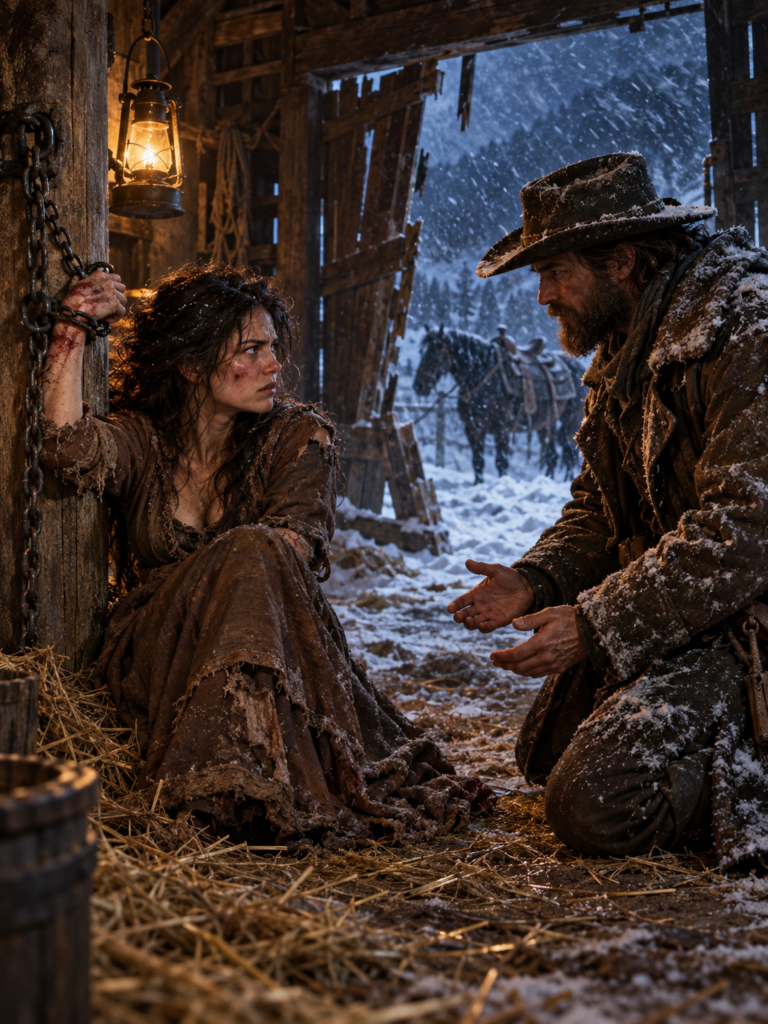
Caleb slid one arm behind Eliza’s back and the other beneath her knees, keeping the dangling chain from scraping her injured wrist.
When he straightened, pain flashed across his own face.
She was lighter than she ought to have been.
“How long since you’ve eaten properly?” he asked.
Eliza attempted an answer, but her lips barely moved.
He tightened his hold just enough to keep her from slipping.
“Never mind. Save your strength.”
“Tell me,” she insisted.
“Tell you what?”
“What Nathan did.”
Caleb hesitated at the broken doorway.
The snow outside was deep enough to make every step uncertain. His horse waited beyond the barn, shifting uneasily beneath a coating of ice.
“Eight years ago, my younger brother took work guarding one of Crowe’s freight shipments.”
Eliza’s fingers tightened around his coat.
“Samuel,” Caleb continued. “That was his name.”
He carried her into the storm.
“Sam wasn’t much older than a boy when he started working that road. Good with animals. Better with people than I ever was.”
“What happened?”
“Crowe sent a heavily loaded freight party through Ratten Pass too late in the season. Storm caught them. Five men never came home.”
Eliza shut her eyes.
She had heard Nathan mention that journey.
He always called it an unfortunate business loss.
“Your brother was one of them?”
Caleb nodded.
“By the time anyone reached the pass, there was nobody left to save.”
He reached the horse and lowered Eliza against its saddle while adjusting his coat around her shoulders.
“And Nathan?”
“Came home alive. Said the men had ignored his instructions.”
“That isn’t true.”
Caleb went still.
Eliza opened her eyes.
“Nathan kept two sets of freight records. He always did.”
For the first time since entering the barn, Caleb looked genuinely startled.
“How do you know that?”
“I lived in his house for three years. I heard things he assumed a wife was too foolish to understand.”
Caleb studied her.
“Can you tell me where those records are?”
“Not yet.”
He nodded.
“All right.”
She waited for the demand.
It did not come.
Instead, he asked whether she could bear being lifted onto the horse.
Eliza gave permission, and he carefully settled her across the saddle. He mounted behind her, securing her against his chest so she would not fall.
The horse began climbing.
For a time they heard only the wind, the animal’s labored breathing, and the crunch of breaking snow.
Then Eliza spoke.
“You were a lawman when Samuel died.”
“I was.”
“You tried to put Nathan away.”
Caleb’s silence answered her.
“Did he buy his way clear?”
“Bought enough people to make the evidence useless. My badge went with the case.”
“That’s why you live alone.”
“Part of it.”
Eliza looked down at her wounded hand.
“Then we’re both people Nathan Crowe thought he could throw away.”
Caleb drew a slow breath.
“Seems so.”
Her head rested briefly against his coat.
“He’s going to come looking when he discovers that barn empty.”
“Likely.”
“And if he finds your cabin?”
“We’ll deal with that when we’ve got you warm.”
“No.”
There was enough force in that single word to surprise him.
“I won’t be shut away again while men decide what happens next.”
Caleb slowed the horse.
“Then you won’t be.”
“You can’t promise that.”
“I can promise I won’t be the one shutting you in.”
Eliza remained silent.
After another difficult stretch, the dark shape of his cabin appeared through the snowfall.
Caleb dismounted, helped her down, and carried her to the door. Inside, the hearth held only a little banked heat.
He laid her on his narrow bed and moved toward the fire.
“Don’t touch my hand yet,” she said.
He stopped.
“I wasn’t going to.”
She watched him build the flames until the room began to warm.
Only then did he kneel several feet away.
“Eliza, that cuff needs tending. The cold has injured your hand badly. I can try to free it and dress the wound, but I cannot promise what condition those fingers will be in afterward.”
She stared at the iron.
“Will you cut my hand off?”
“Not tonight. And I’ll get you proper help as soon as travel allows.”
For a long moment, she said nothing.
Then she lifted her wrist.
“You may take it off. But you tell me what you’re doing before you do it.”
“I will.”
He brought his tools closer.
The first careful movement of the file made her gasp.
Caleb paused.
She shook her head.
“Keep going.”
Slowly, he resumed.
Outside, the wind rose against the cabin walls.
Eliza watched the man whose brother Nathan had sent to his death working to remove the iron Nathan had placed around her wrist.
Then a frightening realization struck her.
“Caleb, the proof about Samuel—the real freight ledger—I know where Nathan hides it.”
The file stopped.
“Where?”
Eliza looked toward the cabin door.
“Under the freight office. In the cellar where he kept me.”
Caleb held the file motionless against the iron.
“The same cellar?”
Eliza nodded.
“There’s a strongbox against the far wall. Nathan keeps the records he doesn’t show his customers. He thinks nobody knows the difference.”
“And he kept you down there?”
“Three weeks.”
Caleb slowly lowered the tool.
For eight years, he had believed the evidence against Nathan Crowe was lost.
Now it might be lying inside a freight office less than a day’s difficult journey below the mountain.
But the woman who knew where to find it could barely sit upright.
“First things first,” he said.
Eliza mistook his meaning.
“Don’t tell me to forget it.”
“I wasn’t going to.”
“Because I haven’t forgotten one single thing he did. Not one.”
“Good. You may need that memory. But you’ll need your hands and your strength too.”
He continued working on the cuff.
It took patience, gentle warming, and repeated pauses when pain became unbearable. When the iron finally parted, Eliza stared at the exposed wrist.
A deep, discolored band marked where it had rested.
Her fingers moved only slightly.
Caleb cleaned and covered the injury with what supplies he had. He told her plainly that the damage might be lasting and that a physician ought to examine it when the roads opened.
Eliza listened without interrupting.
Then she said, “I’d rather have a scar than a chain.”
He placed the broken cuff on the hearthstone.
“You’ll never have to wear that one again.”
***
The blizzard continued for days.
During the first two, Eliza scarcely left the bed. Caleb kept a steady fire, prepared small meals, changed the dressing on her wrist, and slept on the floor near the door.
He never treated the cabin as a place where she owed him obedience.
If she wanted silence, he gave her silence.
If she wanted the door unlatched, he left it unlatched while he was there to guard against the weather.
And when she woke in terror, believing herself back beneath Nathan’s freight office, Caleb spoke from wherever he happened to be without rushing to touch her.
Once, before dawn, she found him sitting awake near the fire.
“Do you ever sleep?” she asked.
“Some.”
“Not enough.”
“Probably.”
“Samuel?”
He looked up.
She did not press him.
After a while, he answered anyway.
“The last time I saw him, he was laughing at something foolish I’d said. I remember being annoyed with him.”
Eliza waited.
“After they found him, I spent years wondering whether he’d been frightened. Whether he’d waited for somebody to come.”
“You couldn’t have reached him.”
“I know that with my head.”
He touched the cold handle of the coffee pot.
“Rest of me hasn’t caught up.”
Eliza studied his face.
The man who had broken into the barn wasn’t fearless.
He had simply chosen to move toward somebody else’s suffering despite his own.
“I was frightened when you opened that door,” she said.
“I noticed.”
“I thought Nathan had sent you.”
“Reasonable enough.”
“But you stopped when I asked.”
Caleb shrugged.
“You asked.”
The simplicity of his answer stayed with her long after he returned to the fire.
***
By the fifth day, Eliza could walk around the cabin without assistance, though the effort exhausted her.
She began asking Caleb about roads, freight routes, and the men who worked under Nathan.
He found an old scrap of paper, and together they drew a rough plan of the valley.
Eliza named the freight office, its storeroom, the concealed stairway, and the outside cellar hatch near the woodpile.
“How do you remember all this?” Caleb asked.
“Counting was something to do in the dark.”
She tapped the plan with her good hand.
“From where Nathan kept me, I could hear the floorboards above. I learned who walked across them. His steps were different from his clerks’.”
Caleb said nothing.
She pointed again.
“The strongbox is here. The true ledger. The papers from the pass too, unless he’s moved them.”
“Why would he keep evidence of his own wrongdoing?”
“Because a man running a freight business needs to know where his money went. Nathan trusted his locks more than his neighbors.”
“And you learned his secrets.”
“I learned enough.”
She lifted her eyes.
“Those books could give Samuel a proper accounting.”
Caleb sat back.
“I spent years trying to prove my brother wasn’t responsible for those men dying.”
“Then we ought to finish what you started.”
He shook his head.
“Not at the price of losing you.”
Eliza regarded him.
“You’re beginning to sound as though you have a right to decide what price I pay.”
Caleb accepted the rebuke.
“You’re right. I spoke poorly.”
“You don’t have to keep me safe from every decision.”
“No.”
“You have to tell me the truth about the danger.”
“That I can do.”
And he did.
They talked about Nathan’s money, the men he employed, the local sheriff’s allegiance to him, and the risk of approaching the freight office without a trustworthy witness.
Eliza mentioned a young deputy named Apprentice, newly arrived from Denver, who had never seemed comfortable with Nathan’s favors.
Caleb knew the danger of placing too much faith in one officer.
But they had little else.
***
On the ninth morning, the storm finally ended.
A pale light fell across the snow outside the window.
Caleb studied the slope.
“The lower trail may be passable soon.”
Eliza came beside him.
“Then Nathan will reach the barn.”
“He may already be making preparations.”
“And if he discovers I’m gone?”
Caleb did not soften his answer.
“He’ll want to know where you’ve gone. Then he’ll start making sure nobody finds those books.”
Eliza felt the familiar panic tighten around her chest.
The cellar.
The darkness.
The sound of Nathan’s boots overhead.
For a moment, the cabin seemed much smaller.
Caleb noticed her expression but did not reach for her.
“We can stay,” he said. “You can recover properly. We can look for evidence afterward.”
“And the strongbox?”
“May be empty by then.”
She stepped away from the window.
“What would you do if you were alone?”
“Try to reach the office before him.”
“Then why shouldn’t I?”
“Because you’re recovering from terrible exposure, you’ve hardly been eating properly, and that wrist needs looking after.”
“Those are reasons to be careful. Not reasons to surrender.”
Caleb looked down.
He could not argue with that.
Finally, he said, “I won’t pretend it’s safe. And I won’t call you foolish if you choose to wait.”
Eliza considered both possibilities.
She had spent years trying to escape Nathan Crowe.
Returning to his cellar seemed almost unbearable.
But allowing him to destroy the evidence would leave him free to reshape the truth again.
“I want to go,” she said.
“Tomorrow?”
“At first light.”
Caleb nodded once.
“Then tonight we prepare.”
***
They worked beside the hearth until late.
Caleb checked his rifle, rope, supplies, and the condition of his horse.
Eliza corrected his drawing of the freight office.
When he placed the outside hatch too close to the stable, she moved it.
“When you reach the woodpile, there’s a narrow space between the rear wall and the stacked logs,” she explained. “You can’t see the hatch from the road.”
“What about the storeroom?”
“There’s another stair inside. Nathan uses that one.”
“Which way would Apprentice come?”
“Through the yard from the town road.”
Caleb considered the plan.
“We ought to get him before we enter.”
Eliza agreed.
“If Nathan’s already there, we need somebody who can arrest him.”
There were moments when her hand shook badly enough that she had to set down the pencil. Caleb never offered to take over unless she asked.
Before they finished, he looked at her across the table.
“Eliza, what do you want when this is over?”
She blinked.
“You mean when Nathan’s arrested?”
“I mean afterward. When you don’t have to think about him every morning.”
No one had asked her that in years.
She thought of roads she had once wanted to travel, books she had wanted to keep, the freedom to work without asking permission.
Then she thought of doors.
Nathan had locked so many of them against her.
“I want a little place of my own,” she said.
“What sort?”
“One with a garden. A room where I can work. And a door I can fasten from my side.”
Caleb listened.
“That sounds worth having.”
“I’d like to keep accounts for people. I’m good with figures. Nathan hated that.”
“Then I expect you’ll do well.”
She smiled faintly.
“And you?”
Caleb looked around his cabin.
“For eight years I thought being alone was all I wanted.”
“Was it?”
“Most days I managed to convince myself.”
“And now?”
His eyes found hers.
“Now I know convincing myself isn’t the same as being content.”
There was something more he might have said.
But Eliza was not ready for promises.
Neither was he.
So they returned to their plans.
***
They left before sunrise.
Caleb broke the trail while Eliza followed, carrying only what she could manage with her injured wrist.
They took frequent rests, and when the footing became treacherous, she accepted his steadying hand.
As they descended, the snow thinned.
Smoke rose from the distant town.
Eliza recognized the freight yard long before they reached it.
Her steps faltered.
Caleb waited beside her.
“I can turn back,” she said, testing the words.
“Yes.”
“And you wouldn’t hate me?”
“No.”
She looked toward the office.
“Then I’m going forward.”
They approached through the quieter rear lane, using buildings and stacked supplies for cover.
The town had begun stirring.
A wagon rattled along the main road.
Somebody shouted for a stable hand.
The ordinary sounds struck Eliza harder than the sight of the cellar.
Those had been the sounds she heard while imprisoned.
People living ordinary lives just above her.
Caleb noticed her breathing change.
“Do you need a moment?”
She shook her head.
“Let’s find Apprentice.”
They were approaching the yard when she caught sight of a familiar figure beyond the woodpile.
Nathan Crowe.
He was carrying a leather-bound book toward the office.
The true ledger.
Eliza stopped so suddenly that Caleb nearly collided with her.
Nathan stepped inside, leaving the rear door partly open.
For a brief instant, Caleb’s old instincts surged ahead of his judgment.
Then Eliza caught his sleeve.
“Not yet,” she whispered.
He turned.
“If you rush him, he hides the book. He tells his men you’re a bitter stranger with an old grievance.”
“What do you suggest?”
“We get the deputy. Then I go through that door where people can see me.”
Caleb looked from the office to her face.
“And if Nathan recognizes you?”
“He will.”
She drew a shaking breath.
“That is precisely why I need the witness.”
Caleb nodded.
He began backing toward the lane leading to the sheriff’s office.
Then another sound reached them.
The click of boots on the boards behind the woodpile.
Nathan had returned.
His gaze settled first on Caleb, then on the woman beside him.
The leather ledger hung from his hand.
His expression emptied.
For three long seconds, he stared at the wife he had buried.
“Eliza?”
She stepped into the open yard.
“I’m alive, Nathan.”
His eyes shifted toward the street.
There was nobody close enough to hear.
Slowly, his hand moved toward the pistol at his belt.
And Eliza understood that the moment she had dreamed about for three years might become the moment that killed them both.
Nathan’s fingers closed around the pistol grip.
Caleb moved sideways, placing himself between Nathan and the open lane without blocking Eliza’s route of escape.
“Don’t,” Caleb said.
Nathan’s eyes narrowed.
“You’ve no business here.”
“Neither does that gun.”
Nathan looked again at Eliza.
She was thinner than he remembered. Her left wrist was wrapped beneath her sleeve. Her face still bore the exhaustion of the mountain.
But she was standing.
Alive.
And looking directly at him.
For the first time in their marriage, Nathan seemed unable to find the right words.
“How did you—”
“Survive?”
Her voice shook, but she held her ground.
“A man heard me.”
Nathan’s gaze returned to Caleb.
Then recognition began to dawn.
“Whitaker.”
Caleb said nothing.
“You’re Samuel Whitaker’s brother.”
“That’s right.”
Nathan’s mouth twisted.
“Eight years on that mountain and you’re still nursing a grievance.”
“A grievance?” Caleb asked.
“That freight business was settled.”
“Not as thoroughly as you hoped.”
Nathan tightened his grip on the ledger.
Eliza saw his attention shift.
Not to Caleb’s rifle.
Not to the road.
To the book.
“There’s no need for this to become unpleasant,” Nathan said.
Eliza almost laughed.
“You chained me inside a barn during a blizzard.”
“You were unwell.”
“I was imprisoned.”
“You’ve always had a talent for making a disagreement sound like a catastrophe.”
Caleb moved another step.
Nathan’s hand dropped fully onto the pistol.
“Stay back.”
Caleb stopped.
The two men faced each other across the snowy yard.
Eight years of grief stood between them.
So did five dead freight workers.
And one living woman whom Nathan had already buried.
Eliza looked toward the road.
She knew that if Nathan could keep the argument between the three of them, he might still manipulate the outcome.
So she raised her voice.
“Nathan Crowe told this town his wife was dead!”
A stable worker at the far side of the yard looked around.
Nathan went pale.
“Be quiet.”
Eliza took another breath.
“He put a gravestone over an empty grave and kept me locked beneath his freight office!”
The stable worker began moving toward them.
A woman at the nearby store doorway stopped carrying her basket.
Nathan glanced toward the gathering witnesses.
“Eliza, you’re confused.”
“No.”
She pulled back her sleeve.
The wound was still swollen beneath the dressing.
“You put that chain around my wrist.”
Nathan stepped forward.
Caleb shifted to intercept him.
“Careful.”
Nathan’s hand returned to the pistol.
Before either man could move farther, another voice rang from the road.
“Mr. Crowe! Take your hand away from that weapon.”
Deputy Apprentice was coming through the gate.
Caleb had not reached him.
But Eliza’s shouting had brought the young officer running from the nearby street.
He stopped when he saw her.
For a heartbeat, he looked as shocked as everyone else.
“Mrs. Crowe?”
“Eliza Carter,” she answered. “And I need you to hear what happened.”
Nathan began protesting.
The deputy raised one hand.
“Sir, step away from her.”
“You know me, Apprentice.”
“I do.”
“Then you know this woman’s been ill.”
The deputy’s eyes moved to the torn dress, the bandaged wrist, and the man beside her.
“Step away.”
For the first time, Nathan obeyed somebody who was not himself.
Eliza pointed toward the ledger.
“That book is the record Nathan never shows anyone. It contains the freight accounts he kept hidden.”
Nathan clutched it tighter.
“She’s lying.”
“Then let the deputy examine it.”
Apprentice hesitated.
A wealthy businessman stood before him.
A former lawman with a grievance stood beside the woman who was supposed to be dead.
And half the town seemed ready to watch what he did next.
“Put the book down, Mr. Crowe.”
Nathan shook his head.
“That belongs to my business.”
“Then it will be treated as business evidence.”
Nathan started toward the office.
Caleb moved to block the entrance.
For an instant, Nathan reached for his pistol again.
Apprentice drew his revolver.
“Stop.”
The command carried across the yard.
Nathan froze.
His eyes passed from the deputy to Caleb, then to Eliza.
She had never seen him look uncertain before.
At last, he lowered the ledger onto a wooden crate.
Apprentice approached, kept Nathan away from the book, and opened it.
He turned several pages.
His expression changed.
“What is this?”
Eliza stepped forward.
“Look for the Ratten Pass shipment. Eight years ago.”
Caleb went still.
The deputy searched.
Then he found it.
The entries recorded the extra freight taken onto the wagons and the money received for moving it through the pass.
They contradicted the story Nathan had told after five men died.
Beneath those figures were notes concerning compensation, testimony, and the complaint brought by Samuel Whitaker’s brother.
Caleb stood with his fists clenched.
For years, he had carried the belief that he had failed Samuel.
Now his brother’s name was written plainly in the book of the man responsible.
The deputy closed the ledger.
“Mr. Crowe, I’m placing you under arrest pending examination of these records and the complaint this woman has made.”
Nathan’s face hardened.
“You’ll regret this.”
“Maybe,” Apprentice said. “But I reckon I’ll regret letting you walk away more.”
He secured Nathan’s hands.
By then, people had gathered throughout the freight yard.
Some had attended Eliza’s funeral.
Some had helped Nathan mourn her.
Now they watched the supposed dead woman stand beside the man who had found her.
Mrs. Akerly, who had brought food to Nathan’s house after the funeral, approached slowly.
“Eliza?”
Eliza turned.
The older woman’s eyes filled.
“Child, we thought—”
“I know.”
“We didn’t know.”
“I know that too.”
Mrs. Akerly looked at the bandaged wrist.
Then toward the freight office.
Her face crumpled.
“I’m sorry.”
Eliza wanted to say something comforting.
She couldn’t.
Not yet.
Instead, she faced Deputy Apprentice.
“There’s a cellar beneath that building. I can show you.”
Caleb stepped closer.
“You don’t have to go down there.”
“I know.”
She looked at the office entrance.
“I want him to see what I lived through.”
Apprentice arranged for Nathan to remain guarded while they examined the building.
Eliza led them through the storeroom.
Every step brought back a memory.
The smell of damp wood.
The narrow staircase.
The scrape of the heavy door.
At the bottom, she stopped.
The cellar was exactly as she remembered.
Cramped walls.
A low ceiling.
A little opening near the floor.
And the place where Nathan had kept her hidden from a town that believed she was buried.
She pointed out the provisions, the marks on the door, and the strongbox where the real freight records had been stored.
Apprentice took notes and began securing the evidence.
Caleb remained near the stairs.
Eliza looked around once more.
Then she turned.
“I’m finished down here.”
She walked back into daylight without anyone leading her.
***
Nathan Crowe’s arrest changed the valley.
The investigation reached beyond Eliza’s imprisonment.
The freight records exposed years of dishonest accounts, concealed payments, and the decisions that had led to the deaths in Ratten Pass.
Former employees began speaking.
People who had once feared losing their livelihoods found that Nathan no longer controlled the office, the wagons, or the men investigating him.
The original complaint involving Samuel Whitaker was reopened.
Caleb had difficulty believing it.
There were days when he stood outside the courthouse and stared at its doors, remembering the last time he had entered a courtroom with his brother’s name on his lips.
Eliza stayed beside him when he wanted her there.
And when she needed to be alone, he respected that too.
At the trial, she was asked to describe her marriage, her attempts to leave, her captivity beneath the freight office, and the night Nathan abandoned her in the barn.
For weeks before she testified, she worried she would lose her voice.
The last time she had been forced to speak about Nathan in public, he had stood beside her controlling the story.
This time he would sit opposite her.
The thought made her physically ill.
On the morning she was called, she stopped outside the courtroom.
Caleb waited nearby.
“What if I can’t get the words out?” she asked.
“Then the deputy still has the evidence.”
“What if they don’t believe me?”
“They have the cellar. They have the ledger. They have witnesses who saw you return.”
She looked down.
“I want them to hear it from me.”
“Then speak when you’re ready.”
Eliza entered the courtroom.
She found Caleb in the front row.
The examination began.
At first, her voice was nearly inaudible.
Then she remembered standing in the frozen barn, shouting into a storm that seemed determined to swallow her words.
She had been heard once.
She could make herself heard again.
She told the court what Nathan had done.
She described the confinement, the false funeral, the empty grave, and the chain fastened around her wrist.
When Nathan attempted to interrupt, the judge silenced him.
Eliza did not look at her former husband.
She kept speaking.
And the more she spoke, the less his presence seemed to fill the room.
By the time she finished, her hands were trembling.
But she had said everything she came to say.
The evidence against Nathan proved overwhelming.
He was convicted of the serious crimes exposed by the investigation, including the crimes against Eliza and those connected to the fatal freight journey.
The court sentenced him to death.
For years, Nathan had used influence and money to make other people bear the consequences of his decisions.
This time he could not persuade the court to let another man carry them.
When the sentence was announced, Eliza did not cheer.
She went outside.
Caleb found her sitting in the grass beyond the courthouse.
“Thought I’d feel happier,” she admitted.
Caleb sat beside her.
“Me too.”
“Doesn’t seem fair.”
“No.”
For a while they watched the breeze move through the early spring grass.
Then Eliza said, “I don’t want the rest of my life to be about him.”
Caleb turned toward her.
“What do you want it to be about?”
She thought for a moment.
“Work. A garden. A place to live where nobody makes me afraid of coming home.”
He smiled a little.
“Still want that door?”
“More than ever.”
“Then let’s see about finding one.”
***
Eliza took a modest house near the edge of town.
It was plain, needed repairs, and had a small plot of ground behind it.
But the door belonged to her.
She could open it whenever she wished.
And when she turned the key at night, the sound no longer meant that someone had trapped her.
It meant she had chosen to remain inside.
She found work keeping accounts for a local businessman named Cobb.
For the first time in years, her talent with figures was treated as something valuable.
She checked invoices, reconciled payments, and caught mistakes that other people overlooked.
Cobb soon began recommending her to neighboring tradesmen.
Eliza bought seeds with her first earnings.
On the morning Nathan’s sentence was carried out, she chose not to attend.
Caleb came to her house and found her kneeling in the garden with a little packet of beans.
“Want some company?” he asked.
She moved aside to make room.
They planted until the soil was dark beneath their fingernails.
A distant bell eventually sounded.
Eliza paused.
Then she pressed another seed into the ground.
“That’s what I want to remember about today,” she told Caleb.
“What?”
“That I planted something.”
He looked at the rows.
“Reckon we’ll need more stakes when those beans come up.”
“We?”
The word escaped her before she could stop it.
Caleb looked embarrassed.
“If you’d like the help.”
Eliza smiled.
“I would.”
It was not a declaration of love.
Not yet.
But it was the beginning of a future neither had dared to picture in the snow.
***
Summer brought green shoots and new troubles.
Nathan’s freight business had been burdened with debts, and men who had once dealt with him began searching for someone to pay them.
A lawyer named Ambrose Fisk arrived from Denver with papers concerning the estate.
He called Eliza Nathan’s widow.
She corrected him.
He continued.
He suggested that, as the surviving spouse, she might be responsible for claims against the business.
Eliza listened carefully.
Then she refused to sign anything.
Fisk’s smile thinned.
Caleb, who had been repairing a loose window frame, stepped forward and asked to see the records on which the claims were based.
His years in law enforcement had not made him a lawyer, but he knew enough to recognize that the estate’s position was far less straightforward than Fisk pretended.
He pointed out the false declaration of Eliza’s death and the contradictions in Nathan’s own records.
Eliza added the history of the fraud established at trial.
Fisk gathered his documents.
He said he would review the matter.
Afterward, the creditors pursued the assets of Crowe’s business, and the disputes were resolved without taking Eliza’s house or making her responsible for the company’s debts.
She signed a formal release relinquishing any interest she might have been said to possess in the estate.
She signed with the name she had reclaimed.
Eliza Carter.
When she returned home, she placed the paper in a drawer and went out to inspect her garden.
Caleb was repairing the gate.
“You all right?” he asked.
“Better than I thought I’d be.”
“Good.”
She watched him work.
“Caleb, why don’t you come down from the mountain for good?”
He stopped hammering.
“That an invitation?”
“It might be.”
He set the hammer aside.
“Eliza, I care a great deal for you. More than I’ve been willing to say.”
She felt her face warm.
“I know.”
“But your house is yours. Your work is yours. I’d never want you thinking I’m entitled to any of it because I found you that night.”
She stepped closer.
“I’ve had enough of men telling me what belongs to them.”
“I know.”
“And I’ve had enough of hiding what I want because I’m afraid somebody will take it away.”
Caleb waited.
“I want you near me,” she said. “Not because I need somebody to keep me alive. Because I like who I am when I’m beside you.”
His expression softened.
“Then I’d be proud to stay near.”
She offered him her hand.
The wrist still bore the pale mark of the iron.
He accepted it gently.
And they stood together beside the garden gate while the afternoon sun warmed the road.
***
The year that followed was not free of difficulty.
Some townspeople struggled to accept Eliza’s independence.
Prudence Gill, who had once praised Nathan in church, began whispering about the propriety of Eliza’s friendship with Caleb.
Eliza let the rumors pass for a time.
Then one Sunday, when the remarks became impossible to ignore, she confronted Prudence before the congregation.
She did not shout.
She reminded the woman how readily the town had accepted Nathan’s story and how little anyone had questioned the circumstances of her disappearance.
Then she asked whether judging a woman who had survived imprisonment was truly the best use of their Christian charity.
Prudence had no satisfactory answer.
Mrs. Akerly quietly stood beside Eliza.
Others followed.
The town did not become perfect overnight.
But the whispers lost much of their force.
Caleb waited outside the church.
When Eliza emerged, he was smiling.
“What?” she asked.
“Just remembering that woman in the barn.”
“So am I.”
“I thought you needed someone to pull you out.”
“I did.”
He nodded.
“But everything you’ve done since, that’s yours.”
She touched his weathered cheek.
“And you were the man who bothered to turn around when he heard me.”
For a moment neither spoke.
Then Caleb covered her hand with his.
“I’m glad I did.”
“So am I.”
***
Winter returned.
For weeks, Eliza had feared the first heavy snowfall.
She worried the sight of the white mountains would bring back the cellar, the barn, and the helplessness of that long night.
At first, it did.
Some nights she woke and checked the latch twice.
Other times she stood beside the window while snow collected on the sill.
Caleb never mocked her fear.
He made sure she had sufficient firewood, repaired the roof, and asked before entering whenever her door was closed.
Gradually, Eliza discovered that the storm outside did not always have power over the peace inside.
One particularly cold night, the wind rose with a violence that reminded her of the night Caleb had found her.
She woke with her heart pounding.
For several moments she listened.
Then she sat upright, looked around her own room, and saw the familiar furniture.
The books she kept.
The curtains she had chosen.
The little shelf where she placed her accounts.
The door fastened from her side.
She got out of bed, checked the latch once, and returned beneath the blankets.
By morning the storm had passed.
Caleb found her standing in the doorway with a cup of coffee.
“Sleep any?” he asked.
“All night, after a while.”
“Even through that wind?”
“Even through that.”
She glanced toward the snow-covered garden.
“I think the weather has finally stopped reminding me of him.”
Caleb looked at her a long moment.
Then he smiled.
“That’s a fine thing.”
“It is.”
And for the first time, she believed the winters ahead might hold beauty rather than only danger.
***
They married the following spring.
Eliza made the decision freely, after more than a year of having her own home, her own work, and the knowledge that she could live independently.
Caleb asked her plainly.
She answered plainly.
Neither needed promises of ownership or grand speeches about destiny.
At the ceremony, Eliza wore her scar uncovered.
When someone afterward suggested she might have concealed it beneath lace, she looked at the pale ring around her wrist.
“Why would I hide the evidence that I survived?”
Caleb heard her and smiled.
He had never been prouder of her.
Together, they built a life through ordinary work.
Caleb found that he loved carpentry almost as much as he had once loved solitude. He repaired buildings, made furniture, and eventually helped build a larger house on the mountain road.
Eliza continued her bookkeeping.
Her reputation for careful, trustworthy accounts spread through the valley.
The garden grew.
So did the number of people who came to her seeking advice, employment, or simply somebody willing to listen.
Then Eliza proposed something larger.
A house where women fleeing violent homes could find temporary shelter without being required to repay that kindness with obedience.
Caleb listened to her plans.
He drew the building.
She planned the accounts and supplies.
They worked together to make it possible.
The house stood near the edge of town, with sturdy walls, a warm hearth, and rooms whose doors could be fastened from the inside.
Women arrived there with little more than the clothes they wore.
Some were frightened.
Some were angry.
Some could barely believe that they were permitted to make their own decisions.
Eliza understood each of them.
She did not demand that they tell their stories.
She offered food, a place to sleep, and information about what choices lay ahead.
Caleb repaired broken things, carried supplies, and made himself scarce when privacy was needed.
They had learned that kindness sometimes meant stepping forward.
And sometimes it meant stepping away.
***
Years later, on a snowy evening, Eliza was closing the shutters when she heard a faint knock at the shelter door.
A woman stood outside, trembling beneath a worn shawl.
Behind her, the mountain road was disappearing beneath new snow.
Eliza opened the door wider.
“Come in out of the cold.”
The woman hesitated.
“I haven’t any money.”
“You don’t need any tonight.”
“I don’t know how long I can stay.”
“We can talk about that when you’re warm.”
The woman stepped across the threshold.
Eliza gave her a blanket and showed her a small room with a bed, a basin, and a window looking toward the garden.
She pointed out the latch.
“It works from your side.”
The woman stared at it.
Then at Eliza.
“You’re sure?”
“Quite sure.”
The woman touched the latch with trembling fingers.
Eliza left her in peace.
When she returned to the kitchen, Caleb was adding another log to the hearth.
“Another traveler?” he asked.
“Yes.”
“Will she stay?”
“That’s for her to decide.”
Caleb nodded.
Beyond the windows, snow moved across the mountain road.
Eliza looked at her wrist.
The scar remained.
She no longer wished it away.
Once, an iron chain had kept her inside a frozen barn while an entire valley believed she was dead.
Now she possessed a home, a livelihood, a husband who respected her choices, and a house where other women could discover that their lives still belonged to them.
Caleb came to stand beside her.
“Thinking about that first night?”
“A little.”
“I nearly kept walking,” he admitted.
“I know.”
“Still troubles me.”
She turned toward him.
“But you didn’t.”
He looked into her eyes.
“No. I didn’t.”
Eliza reached for his hand.
Outside, the storm continued.
Inside, a frightened woman was discovering that she could close a door without being imprisoned by it.
And Eliza Carter Whitaker, once mourned beneath a gravestone meant to erase her, stood beside the man she had chosen and listened to the welcome sounds of a house full of life.
There was no chain on her wrist.
No key held by another hand.
No husband deciding whether she was permitted to exist.
Only warmth, work, love, and a door she could open whenever she pleased.
That was the life she had fought to reclaim.
And it was finally, entirely, her own.

