
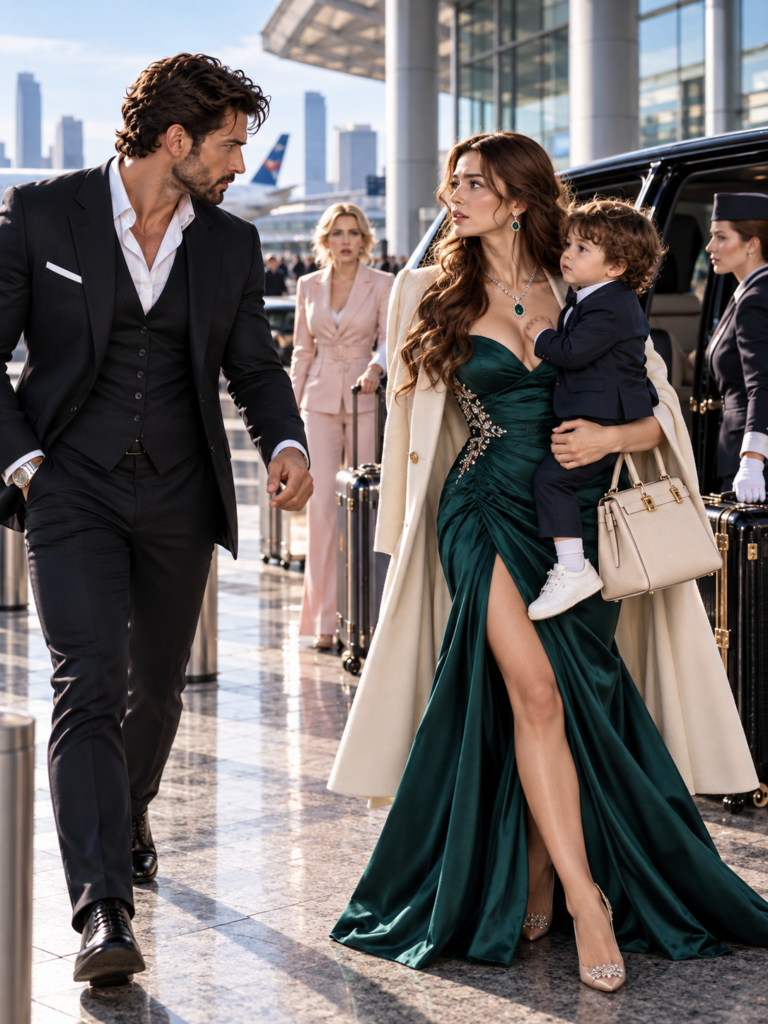
PART 2
I did not give Dante ten minutes.
I gave him twenty.
Not because he deserved them.
Because after eight years of unanswered questions and three years of forcing myself not to ask them anymore, I realized I needed to know.
There was a difference.
Mia disagreed.
“You blocked him twice,” she said from the passenger seat while Leo slept peacefully in the back of our rented SUV. “That was excellent work. Strong boundaries. Very mature. I was proud of you.”
I stared through the windshield.
“And now?”
“Now you’re considering meeting a man who has apparently developed an unlimited supply of phone numbers.”
“He asked for ten minutes.”
“He married your sister.”
“I remember.”
“I’m making sure.”
I gave her a look.
Mia sighed.
Outside, Chicago moved beneath a pale afternoon sky, familiar and foreign all at once.
I had once known every street surrounding Dante’s house.
I knew which bakery opened earliest.
Which restaurant kept a private table for him even when it was fully booked.
Which intersection flooded after heavy rain.
Three years in Switzerland had softened those details.
I had built something new there.
A small apartment in Zurich at first, then a larger one when Leo learned to walk and transformed every room into territory requiring exploration.
I had work.
Friends.
A preschool Leo loved.
Sunday mornings at a café near the river.
A life that had nothing to do with Dante Moretti.
I wasn’t about to surrender that life because he had appeared outside an airport.
But unanswered questions had traveled with me across an ocean.
Maybe answering them was the only way to leave them here.
“I’ll meet him,” I said.
Mia turned.
“Elena.”
“In public. Without Leo.”
“And without disappearing into one of his mysterious black cars.”
“Yes.”
“And I’m staying nearby.”
“Yes.”
“And you tell him he gets twenty minutes because ten isn’t enough to explain eight years of nonsense.”
Despite everything, I almost smiled.
“I’ll tell him.”
We chose a café on Wells Street.
Not one of Dante’s places.
Not one of mine.
Neutral territory.
Mia took Leo to the aquarium, where he had already been promised sharks, jellyfish, and something called a touch pool that I suspected would become the only thing he discussed for the next six months.
I arrived seven minutes early.
Dante was already there.
Of course he was.
He sat at a table near the window wearing a charcoal sweater beneath his coat.
No entourage.
No visible bodyguards.
No commanding room filled with men waiting for his instructions.
Just Dante.
For the first time since the airport, I allowed myself to really look at him.
Three years had changed him.
There was a little more gray near his temples.
A faint line between his eyebrows had deepened.
He looked tired in a way Dante Moretti had never allowed anyone to see when we were together.
Then he stood.
“Elena.”
I stopped beside the empty chair.
“Twenty minutes.”
Something passed through his expression.
Surprise, perhaps.
Then gratitude.
“Thank you.”
“Don’t.”
His mouth closed.
I sat.
Dante sat across from me.
For several seconds neither of us spoke.
A server approached.
I ordered tea.
Dante already had untouched coffee.
I almost laughed.
He had always ordered coffee and forgotten about it whenever something important was happening.
Some things apparently survived everything.
He folded his hands on the table.
“I should start with the part that matters most.”
“You married Victoria.”
“The part before that.”
I waited.
“I loved you.”
My chest tightened.
“That isn’t helpful.”
“I know.”
“Then don’t begin there.”
He nodded slowly.
“All right.”
He looked toward the window, then back at me.
“The reason I kept refusing to marry you wasn’t because I didn’t want you.”
“I know what you told me.”
“You don’t know what I was doing.”
“No. Because you never told me.”
“I was trying to leave.”
That stopped me.
I frowned.
“Leave what?”
“My family’s criminal operations.”
The words were quiet.
Not dramatic.
Almost exhausted.
I stared at him.
Dante continued.
“When my father died, I inherited everything at twenty-nine. Legitimate companies, properties, contracts…and everything underneath them.”
I knew that much.
Everyone in Chicago knew some version of it.
Dante’s father, Salvatore Moretti, had built an empire that existed in two worlds.
There were hotels, construction companies, logistics businesses.
And there were the things no one discussed at dinner.
“I thought I could separate them quickly,” Dante said. “I was wrong.”
“How does that explain refusing to marry me?”
“Because every lawyer I trusted told me the transition could take years. There were partners I couldn’t simply walk away from. Contracts. Financial exposure. Investigations. People who had spent decades believing the Moretti name meant certain obligations.”
I crossed my arms.
“And?”
“And marrying you would have tied you legally and publicly to all of it.”
I felt anger rising.
“You were perfectly willing to let me live with you.”
“Yes.”
“You were willing to let me love you.”
“Yes.”
“You were willing to let me spend eight years waiting.”
His expression tightened.
“Yes.”
“But marriage was where you suddenly became concerned about my future?”
“When you say it like that—”
“How else should I say it?”
“You shouldn’t.”
He looked down.
“Because that was exactly the contradiction.”
That admission silenced me.
Dante had never been good at admitting he was wrong.
Not because he believed himself perfect.
Because in his world, hesitation had consequences.
I had watched him turn certainty into armor.
Now he sat across from me without it.
“I kept thinking I needed another six months,” he said. “Then another year. I kept telling myself that once the illegal side was dismantled, I could ask you properly.”
“Except I was asking you.”
“I know.”
“And you kept saying no.”
“Yes.”
“Why not tell me?”
“Because I knew what you would say.”
“What?”
“That you didn’t care.”
I stared.
“You’re right. I probably would have.”
“And I would have believed you. Then I would have married you. And I would have spent every day wondering whether loving me had cost you the life you could have had.”
My fingers tightened around my cup.
“You made that decision for me.”
“Yes.”
His answer came immediately.
No excuse.
No defense.
“Yes, I did.”
The anger inside me lost its direction for a moment.
It would have been easier if he argued.
Instead, Dante said, “That was my first mistake.”
“First?”
His mouth curved without humor.
“There were several.”
“I’ve noticed.”
For half a second, his eyes warmed.
Then the distance returned.
“What happened with Victoria?” I asked.
Dante’s shoulders lowered slightly.
“That began with your father.”
My breath caught.
“My father?”
“Six months before the wedding, his company was failing.”
“I knew Carter Development was struggling.”
“You didn’t know how badly.”
Apparently not.
My father and I had been complicated.
Richard Carter loved his daughters, but his love had often arrived dressed as expectation.
Victoria was the responsible eldest.
I was the impulsive youngest.
At least, those were the roles assigned to us before either of us was old enough to object.
“He had personally guaranteed loans,” Dante continued. “The company was weeks from default. If it collapsed, hundreds of employees would lose their jobs.”
“And you helped him.”
“At first.”
“What does Victoria have to do with it?”
“She owned forty-one percent of the company.”
I blinked.
“She never told me.”
“Your grandfather left those shares to her.”
That sounded like my family.
Old arrangements.
Quiet inheritances.
Everyone knowing everyone else’s business except me.
“Your father wanted Moretti Holdings to acquire Carter Development,” Dante said.
“And?”
“And I refused.”
That surprised me.
“Why?”
“Because he wanted the acquisition tied to a marriage agreement.”
I stared at him.
For several seconds, the sounds of the café disappeared.
“No.”
“Elena—”
“My father arranged your marriage to my sister?”
“No.”
“But you just said—”
“Your father suggested it.”
I laughed once, sharply.
“Of course he did.”
“He believed combining the companies and the families would reassure creditors.”
“And apparently everyone thought this was 1890.”
“So did I.”
“Yet you still did it.”
“Yes.”
There it was.
The part that mattered.
I leaned back.
“Why?”
Dante was quiet.
“Because Victoria asked me to.”
That hurt more than I expected.
Not because it made sense.
Because it didn’t.
“My sister asked you to marry her.”
“Yes.”
“Knowing about us?”
“Yes.”
My throat tightened.
“Wonderful.”
“It wasn’t what you think.”
“What exactly am I supposed to think?”
“That she wanted me.”
“You’re saying she didn’t?”
“No.”
I stared at him.
Dante rubbed a thumb along the edge of his coffee cup.
“Victoria had spent ten years trying to protect the company from your father’s worst decisions. If Carter Development collapsed, she would lose everything she had built. More importantly, so would a lot of people who had worked there longer than either of us had been alive.”
“So this was business.”
“At the beginning.”
My eyes narrowed.
“What does that mean?”
“It means Victoria proposed a civil marriage for eighteen months. Public enough to steady the company and close the restructuring. Private agreement. Separate lives.”
My heartbeat sounded loud in my ears.
“You married my sister as part of a corporate restructuring.”
“When you say it that way, it sounds absurd.”
“It is absurd.”
“Yes.”
“Did my father know you loved me?”
Dante went still.
“Yes.”
That answer was a blade slipping between ribs.
“And he suggested Victoria anyway.”
“Yes.”
“Did Victoria know?”
“Yes.”
I looked away.
For the first time, I wished I had kept walking at the airport.
Some truths did not free you.
Some simply gave precise names to old wounds.
“You could have said no.”
“I should have.”
“Why didn’t you?”
Dante’s voice became quieter.
“Because two weeks before Victoria made the proposal, you told me you were done waiting.”
I remembered.
We had been in his kitchen.
Two in the morning.
I had asked him, one final time, whether he could imagine marrying me.
He had said, “Not yet.”
I had cried.
Then I had told him I couldn’t keep building a life around someday.
I had left for three days.
When I returned, he acted as though nothing had changed.
Apparently everything had.
“I thought I’d already lost you,” he said.
“You hadn’t.”
“I know that now.”
“You could have asked.”
“Yes.”
“You could have told me.”
“Yes.”
“You could have done almost anything other than marry my sister.”
“Yes.”
His acceptance irritated me more than an argument might have.
I stood.
Dante did too.
“You said twenty minutes.”
“We have four left.”
“I don’t need them.”
“Elena.”
“What?”
“There’s something else.”
I closed my eyes briefly.
“Of course there is.”
“The marriage wasn’t supposed to happen the way it did.”
“How many ways are there to marry someone?”
“Victoria changed the agreement.”
I stared at him.
Dante hesitated.
It was the first true hesitation I had seen from him.
“She refused to sign the final restructuring documents unless I promised not to contact you after the wedding.”
My skin went cold.
“What?”
“I refused.”
“Apparently not for long.”
“She told me you needed a clean break.”
“My sister told you what I needed?”
“She showed me something.”
Dante reached slowly into his coat.
Not a weapon.
An envelope.
Old.
Creased at the corners.
He placed it on the table.
I recognized the handwriting instantly.
Mine.
My stomach dropped.
“That’s my handwriting.”
“Yes.”
I opened the envelope.
Inside was a single sheet of paper.
The stationery came from my old apartment.
The words looked like mine.
The loops.
The slant.
Even the way I crossed my t’s.
Dante,
I can’t do this anymore. I’ve spent eight years waiting for something you clearly cannot give me. Please don’t follow me, don’t call me, and don’t try to change my mind.
I want a life that doesn’t begin and end with waiting for you.
Marry whoever you need to marry.
Just let me go.
Elena.
My hands began shaking.
I read it twice.
Then a third time.
“I never wrote this.”
Dante said nothing.
I looked up.
“I never wrote this.”
His face changed.
Not disbelief.
Something worse.
Recognition.
“You’re sure?”
“Of course I’m sure.”
I pushed the letter toward him.
“I never wrote you a letter telling you to marry someone else.”
Dante slowly sat down again.
For perhaps the first time in all the years I had known him, Dante Moretti looked genuinely lost.
“Victoria gave this to me,” he said.
“When?”
“The night before I agreed to the engagement.”
Something clicked into place.
Not enough to form an answer.
Enough to create a terrible question.
“Did Victoria say where she got it?”
“She said you left it with her after you two had dinner.”
I shook my head.
“I didn’t have dinner with Victoria that week.”
Dante stared at me.
The café felt suddenly too warm.
“I need to speak to my sister.”
“I’ll come.”
“No.”
“Elena—”
“No. This is between Victoria and me.”
His jaw tightened, then relaxed.
“All right.”
I folded the letter.
Dante reached for it.
I pulled it away.
“I’m keeping this.”
He nodded.
I put it inside my bag.
Then he said, “What about Leo?”
The anger drained just enough for fear to return.
Not fear of Dante hurting him.
I had never believed that.
Fear of everything becoming complicated.
“He’s happy,” I said.
“I can see that.”
“You saw him for thirty seconds.”
“I saw him holding your hand.”
Something in Dante’s voice changed.
Softened.
“He trusts you completely.”
“He should.”
“Yes.”
His eyes lowered.
“I missed almost three years.”
The words weren’t an accusation.
That somehow made them harder to hear.
“You didn’t know.”
“No.”
“I wasn’t punishing you.”
“I know.”
“I found out after I left.”
“I believe you.”
I studied him.
“I’m not changing Leo’s life in five days.”
“I’m not asking you to.”
“You’re not taking him anywhere alone.”
“I wouldn’t ask.”
“You’re not telling him you’re his father without us deciding together.”
Dante nodded.
“Agreed.”
“And whatever happens between you and me has nothing to do with what kind of relationship you might build with him.”
For the first time, emotion broke fully through his controlled expression.
“Thank you.”
I looked away.
“Don’t thank me yet.”
A tiny smile touched his mouth.
“I remember you saying that a lot.”
“And you never listened.”
“No.”
“Maybe start.”
“I’m trying.”
Victoria Carter Moretti lived in Lincoln Park.
I knew because Mia had looked up the address before we landed.
I did not call first.
But when Victoria opened the door that evening, she did not look surprised.
She looked tired.
Three years had changed her too.
Her blonde hair was shorter now.
Her face softer.
She wore jeans, a cream sweater, and no wedding ring.
My eyes went immediately to her bare hand.
Victoria noticed.
“He moved out fourteen months ago.”
I said nothing.
“We’re legally separated.”
Still nothing.
She stepped aside.
“You should come in.”
“I’m not staying.”
“Elena.”
I took the letter from my bag.
Her face lost color.
That was answer enough.
“You wrote this.”
Victoria closed her eyes.
“Yes.”
The word was almost a whisper.
Something inside me cracked open.
Not loudly.
Not dramatically.
Just enough.
“Why?”
Victoria looked toward the living room.
“Because Dad asked me to.”
I laughed bitterly.
“Of course he did.”
“That doesn’t excuse me.”
“No.”
“I know.”
“Stop saying you know.”
She flinched.
For several seconds, neither of us spoke.
Then Victoria moved toward the kitchen.
Not because she expected me to follow.
Because she seemed to need something solid to lean against.
I followed anyway.
“Dad was sick,” she said.
My anger paused.
“What?”
Victoria looked at me.
“He’d been diagnosed with pancreatic cancer four months before the wedding.”
The room tilted slightly.
“No.”
“He didn’t want you to know.”
My father had died eleven months after I left America.
A heart complication, I had been told.
I had returned quietly for the funeral.
I had stood at the back.
Left before Dante arrived.
Then flown home to my six-month-old son.
“You lied about how he died.”
“No. The cardiac arrest was real. But the cancer had already spread.”
I gripped the back of a chair.
“Why didn’t anyone tell me?”
“Dad made me promise.”
“And apparently promises to Dad mattered more than telling your sister the truth.”
Her eyes filled.
“Yes.”
That single word stopped me.
Because Victoria was not defending herself.
She looked ashamed.
“He was terrified,” she said. “Not of dying. Of leaving the company destroyed. He’d made terrible financial decisions, Elena. He knew it. By the time he admitted everything to me, the company was barely surviving.”
“And Dante could save it.”
“Yes.”
“So Dad decided you should marry him.”
“Yes.”
“And decided I should conveniently disappear.”
Victoria looked down.
“He believed Dante would eventually leave you because he would never marry you.”
“He was wrong.”
“I know.”
“How?”
Victoria took a breath.
“Because Dante told me.”
I stared at her.
“The first night after our wedding,” she said, “he told me there would never be anything romantic between us. He said he loved you, and that if you ever wanted him back after the agreement ended, he would spend the rest of his life trying to earn the chance.”
My eyes burned.
I hated that they did.
“Then why keep the lie?”
“Because I had already done something unforgivable, and every day I waited made telling you harder.”
“That’s not enough.”
“No.”
“Nothing you’re saying is enough.”
“I know.”
This time, I let her say it.
Victoria wiped beneath one eye.
“Dad believed he was protecting you.”
“From what?”
“From all of us.”
That was not the answer I expected.
“He thought you had spent your whole life adjusting yourself to other people,” she continued. “To him. To me. To Dante. He thought if you stayed, you’d spend the rest of your life doing it.”
“So he destroyed my relationship to free me?”
“He was dying. He was frightened. And he mistook control for love.”
The words settled heavily.
Because they sounded like my father.
A man who could love deeply and still believe he knew what everyone else needed.
I looked at my sister.
“And you went along with it.”
“Yes.”
“Why?”
Victoria’s expression changed.
Not guilt.
Something older.
“I was angry with you.”
That surprised me.
“With me?”
“You got to leave.”
“I didn’t leave until after the wedding.”
“Not Chicago. The family.”
I stared.
“You always refused Dad when he demanded too much. You fought with him. You walked away. You built your own career. You loved whoever you wanted.”
“You think I had it easy?”
“No.”
Victoria shook her head.
“I think I was jealous because you were brave enough to disappoint him.”
I had never imagined my older sister envied anything about me.
Growing up, Victoria was perfect.
Top grades.
Proper clothes.
Correct answers.
The daughter who knew which fork belonged beside which plate.
I was the one who forgot appointments, changed university majors twice, and once arrived at Christmas dinner wearing mismatched earrings because I had gotten dressed in the dark.
“I thought saving the company would finally make him proud of me,” Victoria whispered. “And I convinced myself the letter was just helping everyone accept what was already inevitable.”
I swallowed.
“But it wasn’t.”
“No.”
“Dante loved me.”
“Yes.”
“And I loved him.”
“Yes.”
“And you knew.”
“Yes.”
Silence spread between us.
There was no sentence capable of fixing that.
Maybe there never would be.
I picked up my bag.
Victoria whispered my name.
I stopped.
“There’s one more thing.”
I almost laughed.
Apparently my family had been saving truths in bulk.
“What?”
Victoria opened a drawer and removed a small leather notebook.
“I found this when I cleared Dad’s office after he died.”
She held it toward me.
I didn’t take it.
“What is it?”
“His journal.”
“My father didn’t keep a journal.”
“Not usually.”
She placed it on the table.
“There are only seventeen entries.”
“Why are you giving it to me?”
“Because the last one is about you.”
My fingers went cold.
“What does it say?”
Victoria’s eyes met mine.
“You should read it yourself.”
I stared at the notebook.
Then slowly opened it.
The final entry was dated three days before my father died.
The handwriting was unsteady but unmistakable.
I read the first line.
Then the second.
By the third, I had to sit down.
Because my father had known where I was.
He had known I was in Switzerland.
And somehow—
impossibly—
he had known about Leo.
PART 3
For several seconds, I could not continue reading.
Victoria remained across the kitchen, silent.
My father’s handwriting blurred beneath my eyes.
I blinked and forced the words into focus.
September 11.
Victoria believes Elena has begun again in Zurich.
I hope she has.
I have no right to ask otherwise.
There was nothing unusual in that.
Then came the next line.
She has a son.
Leo.
My throat tightened.
I looked up.
“How did he know?”
“I don’t know.”
“You said you found this after he died.”
“Yes.”
“Did you know about Leo?”
“No.”
Victoria’s answer came so quickly that I believed her.
“Then who told him?”
“I’ve wondered that for three years.”
I looked back down.
My father had written more.
I saw the photograph today.
He has Elena’s smile.
Everything else reminds me of Moretti.
I closed my eyes.
A photograph.
There had been photographs of Leo online.
Very few.
I had never posted publicly, but friends had.
Mia once uploaded a picture from a park before deleting it when I asked.
Perhaps someone had shown my father.
Perhaps it had been that simple.
Yet there was more.
I turned the page.
I have made peace with many things poorly.
This is one of them.
I wanted Elena beyond Dante’s reach because I believed his world would swallow hers. I told myself I was protecting my daughter.
The truth is less generous.
I was afraid.
Afraid of leaving my company ruined.
Afraid Victoria would fail where I had failed.
Afraid Elena would choose Moretti no matter what I said.
So I arranged circumstances and called them solutions.
Richard Carter had always loved elegant language.
Even when confessing.
Especially when confessing.
I continued.
The marriage saved the company.
It did not save my daughters.
That cost belongs to me.
I read the sentence twice.
Across from me, Victoria sat down.
My father’s final paragraph was shorter.
If Elena ever comes home, Victoria must tell her everything.
If she refuses, give Elena the blue file.
There are truths in it that belong to her, not to me.
I looked up.
“What blue file?”
Victoria went still.
“I don’t know.”
“You don’t know?”
“I searched his office.”
“And?”
“There was no blue file.”
My frustration sharpened.
“He wrote this three days before he died.”
“I know.”
“You had three years.”
“I know.”
“Stop—”
“I looked, Elena.”
Something in Victoria’s voice stopped me.
Not defensiveness.
Exhaustion.
“I emptied every drawer. I checked the house, the company archive, his safe-deposit box. I asked his attorney without telling him why. There was no blue file.”
“Then maybe he destroyed it.”
“Maybe.”
But neither of us believed that.
My father hoarded documents.
Birthday cards from twenty years ago.
Old tax returns.
Receipts from restaurants that no longer existed.
If Richard Carter called something important enough to mention in his last journal entry, he would not casually throw it away.
I closed the notebook.
“I need to go.”
“Elena.”
I stood.
Victoria did too.
“I’m sorry.”
I looked at my sister.
Three years ago, those words might have made me furious.
Now they simply felt insufficient.
“I believe you’re sorry.”
Her eyes filled again.
“But?”
“But being sorry doesn’t restore three years.”
“No.”
“It doesn’t give Leo his father.”
“No.”
“It doesn’t give me back the choice everyone apparently decided I wasn’t capable of making.”
Victoria looked down.
“No.”
I picked up the journal.
“I need time.”
She nodded.
“I know.”
At the doorway, I stopped.
“Why did you and Dante separate?”
Victoria gave a faint, tired smile.
“Because our eighteen-month agreement lasted exactly eighteen months.”
I frowned.
“You said he moved out fourteen months ago.”
“The legal separation happened later.”
“Why?”
“Dad died. The company stabilized. Dante completed the restructuring. There was no reason to remain married except public convenience.”
“And?”
“And I finally realized convenience had already cost enough.”
For the first time since arriving, I saw something in Victoria I had never recognized when we were younger.
Not perfection.
Not obedience.
Someone who had spent years living according to roles assigned by everyone around her.
Maybe we had both been trapped by my father’s expectations.
Just in different rooms.
“That doesn’t mean I forgive you,” I said.
“I know.”
“But I understand you more than I did yesterday.”
Victoria smiled sadly.
“For now, that’s more than I expected.”
Leo fell asleep with a stuffed beluga whale tucked beneath his chin.
Mia had apparently allowed him to choose one item from the aquarium gift shop.
Leo had negotiated this into three.
“There was a misunderstanding,” Mia explained.
“You’re thirty-two.”
“He’s persuasive.”
“He’s almost three.”
“Exactly. Ruthless age.”
I stood beside the hotel bed watching my son sleep.
The familiar sight steadied me.
Children simplified some truths.
Leo did not care about corporate restructuring.
He did not care that his grandfather had tried to rearrange the lives of everyone around him.
He cared that his whale had a name.
Marvin.
He cared that pancakes should be round.
He cared that when he woke after a bad dream, someone he trusted came when he called.
Maybe adulthood was partly the process of recovering truths children understood instinctively.
Love mattered most when it made you feel safe enough to be yourself.
My phone buzzed.
Dante.
I had unblocked him after leaving Victoria’s.
Not because everything was forgiven.
Because Leo deserved adults who could communicate.
Did you speak to her?
Yes.
Are you all right?
No.
Several seconds passed.
Then:
Do you want me to come?
I stared at the message.
Three years ago, I would have said yes immediately.
Eight years before that, probably the same.
Tonight I typed:
No.
His reply came less than a minute later.
All right.
Then:
I’m here if that changes.
No pressure.
No demand.
No attempt to turn concern into access.
I hated how much that mattered.
The next morning, Leo met Dante properly.
We chose Maggie Daley Park.
Mia came.
So did a man named Marco who stayed far enough away to be unobtrusive.
“Security?” I asked.
Dante glanced toward him.
“Old habit.”
“Send him away.”
Dante did.
No argument.
That mattered too.
Leo had spent the morning asking questions.
“Is he your friend?”
“Sort of.”
“Does he know Marvin?”
“No.”
“Does he like dinosaurs?”
“I don’t know.”
“Everyone likes dinosaurs.”
Apparently, this was established fact.
When Dante approached us near the playground, Leo studied him with such intensity that I nearly laughed.
It was like watching Dante interrogate someone across a boardroom table.
Except this version was wearing red sneakers.
Dante stopped several feet away.
“Hello, Leo.”
Leo hid slightly behind my leg.
Dante did not move closer.
“I’m Dante.”
“I know.”
Dante raised his eyebrows.
Leo pointed.
“Airport man.”
For a moment Dante looked almost offended.
Mia coughed to hide a laugh.
“Yes,” Dante said. “Airport man.”
Leo considered this.
Then pointed at Dante’s coat.
“Black.”
“Yes.”
“Mommy says Chicago is cold.”
“She’s right.”
Leo nodded solemnly.
Apparently Dante had passed the first examination.
Then Leo produced Marvin.
“This is whale.”
“Hello, Whale.”
“Marvin.”
“My mistake. Hello, Marvin.”
I saw Dante’s mouth twitch.
For twenty minutes, that was all it was.
A man meeting a little boy.
No announcement.
No enormous emotional revelation.
Dante let Leo determine the pace.
They discussed dinosaurs.
Dante claimed his favorite was a triceratops.
Leo informed him this was acceptable but incorrect because Tyrannosaurus rex was clearly superior.
Then Dante made the terrible mistake of saying velociraptors were interesting.
Leo launched into a four-minute speech based on facts he had apparently invented himself.
By the end, Dante was listening as seriously as though someone were briefing him on international markets.
I stood beside Mia.
“He’s good with him,” she said quietly.
“I noticed.”
“Are you annoyed?”
“Yes.”
“Because you wanted him to be terrible?”
“No.”
I watched Dante crouch as Leo showed him a leaf.
“Because it would be easier.”
Mia slipped her arm through mine.
“Easy is overrated.”
“You say that because none of your ex-boyfriends secretly married your sibling.”
“True.”
She considered.
“Though Daniel did steal my espresso machine.”
“Not equivalent.”
“It was Italian.”
I laughed despite myself.
Across the grass, Dante looked up.
Our eyes met.
For one brief second, it felt like three years disappeared.
Then Leo shouted, “Mommy, look!”
And reality returned.
Dante saw Leo twice more during our five-day trip.
Always with me there.
Always somewhere ordinary.
Lunch.
A museum.
A walk beside Lake Michigan where Leo insisted the lake was obviously an ocean and Chicago had mislabeled it.
Dante never asked me to change our flight.
Never asked whether Leo could stay.
Never used the words custody, rights, lawyer, or Moretti.
On our fourth evening, I finally asked why.
We were sitting on a bench while Leo and Mia fed ducks several yards away.
“You know you have legal rights.”
Dante looked at me.
“Yes.”
“You haven’t mentioned them.”
“No.”
“Why?”
“Because rights are not the same thing as relationships.”
I studied him.
“I’m his father.”
He glanced toward Leo.
“That gives me responsibilities before it gives me anything else.”
The answer unsettled me because it was the right one.
“What do you want?”
“With Leo?”
“With everything.”
Dante was quiet for a while.
Then he said, “I want to know my son.”
“And me?”
His expression changed.
“I want you.”
My stomach tightened.
“But wanting you is not the same as deserving you.”
I looked away toward the water.
Wind moved across the lake, lifting strands of hair against my cheek.
“You never used to talk like this.”
“I used to think solving problems meant controlling every variable.”
“My father would have liked that philosophy.”
Dante smiled faintly.
“I learned from men like him.”
“And now?”
“Now I think sometimes solving a problem means accepting you don’t get to choose the outcome.”
I glanced at him.
“What happened to you?”
“You left.”
There was no accusation in it.
Just fact.
“For the first six months after the wedding, I told myself you needed space. Then I started looking for you.”
My body stiffened.
“How hard?”
“Not hard enough.”
“What does that mean?”
“It means I could have found you.”
I stared at him.
Dante looked down at his hands.
“I had people capable of finding almost anyone. I made a decision not to use them.”
“Why?”
“Because the letter said not to.”
“The letter was fake.”
“I didn’t know that.”
“No.”
“I believed you had finally chosen yourself.”
I swallowed.
“So you let me disappear.”
“Yes.”
His voice was quiet.
“And every day since, I’ve wondered whether respecting what I thought was your choice was actually just another form of cowardice.”
I looked back toward Leo.
“He would have changed everything.”
“I know.”
“Would you have left Victoria?”
“Yes.”
“You didn’t even hesitate.”
“No.”
“Even with my father’s company?”
“I would have found another way.”
“That’s easy to say now.”
“Yes.”
Again, no defense.
I sighed.
“You’re extremely irritating when you agree with me.”
“I remember.”
That night, I received a call from Victoria.
“I found something.”
My pulse quickened.
“The blue file?”
“Maybe.”
“What does that mean?”
“I called Dad’s former assistant.”
I remembered Margaret Sloan.
Efficient.
Sharp-eyed.
She had worked for my father for nearly twenty years and retired shortly before his death.
“She remembers the file,” Victoria said.
I stood from the hotel desk.
“Where is it?”
“She doesn’t know.”
“Victoria.”
“She remembers Dad giving it to his lawyer.”
“Which lawyer?”
“Harold Bennett.”
I knew the name.
He had handled Carter family matters for decades.
“Did you call him?”
“Yes.”
“And?”
“He wants to speak to you directly.”
That was strange.
“Why?”
“He says the file contains something Dad instructed him to release only if you personally requested it.”
My heartbeat increased.
“He knew where I was?”
“Apparently.”
“Then why didn’t he contact me?”
“Because Dad specifically told him not to.”
I closed my eyes.
Of course he did.
Even from his deathbed, Richard Carter had found a way to manage information.
“When can I see him?”
“Tomorrow morning.”
Our flight left tomorrow afternoon.
“Fine.”
Harold Bennett’s office occupied the twenty-sixth floor of a building overlooking the river.
He was nearly seventy now.
White-haired.
Polite.
He greeted me as if three years had not passed.
“Elena.”
“Mr. Bennett.”
“I’m sorry we’re meeting under these circumstances.”
“So am I.”
Victoria had offered to come.
I told her no.
This belonged to me.
Mr. Bennett opened a cabinet and removed a blue folder.
Actual blue.
My father had never been subtle.
He placed it on the desk.
“Your father gave me this twelve days before his death.”
“Why not contact me?”
“His instructions were explicit. I was to keep it unless you returned to Chicago and personally asked whether he had left anything for you.”
I stared at him.
“That’s ridiculous.”
“I told him the same.”
“And?”
Mr. Bennett almost smiled.
“You remember your father.”
Unfortunately, I did.
“What’s inside?”
“You should read it.”
Apparently everyone in Chicago had agreed this week to hand me mysterious documents and insist I read them personally.
I opened the file.
The first document was legal.
A trust.
I scanned the first page.
Then looked up.
“What is this?”
“Your father established a trust for his grandchild.”
My heart stopped.
“He knew.”
“Yes.”
“How?”
Mr. Bennett folded his hands.
“He hired a private investigator after you left.”
Anger flashed through me.
“He had me followed?”
“For approximately six weeks.”
I stood.
“That is unbelievable.”
“I agree.”
“Did Dante know?”
“No.”
“Victoria?”
“No.”
“Why?”
“He was concerned you were alone.”
“He could have called.”
“I told him that too.”
I sat again.
My father, apparently, had spent his entire life choosing every method of communication except direct conversation.
“How much is in the trust?”
Mr. Bennett named the amount.
I nearly dropped the document.
“No.”
“Yes.”
“That’s—”
“A substantial portion of what remained of his personal estate.”
I swallowed.
“Why?”
“There’s a letter.”
Of course there was.
He handed it to me.
This time, the handwriting was unmistakably my father’s but weaker.
Elena,
If you are reading this, then you came home.
Perhaps not permanently. You were always better at leaving than I was at letting people go.
I stopped.
That sounded exactly like him.
I continued.
I learned about Leo because I was worried about you and chose the wrong way to satisfy that worry.
I paid someone to find you.
You are allowed to be angry about this.
I suspect you will be.
Despite myself, a broken laugh escaped.
My father had known me.
Sometimes that had been the problem.
I read on.
The investigator sent one photograph before I ended the arrangement.
You were sitting beside a river with your son.
You looked tired.
You also looked happier than I had seen you in years.
I realized then that I had spent much of your life mistaking proximity for love.
I wanted you close because having you close comforted me.
I wanted you away from Dante because his life frightened me.
I wanted Victoria beside me because I depended on her.
Too often, I called these things protection.
They were fear.
My vision blurred.
I turned the page.
I will not ask you to forgive me.
I will ask one thing.
Do not inherit my habit of deciding what people deserve without allowing them to speak for themselves.
Not Victoria.
Not Dante.
Not even me.
Especially not yourself.
The last paragraph was shorter.
Leo should know that before I ever met him, his grandfather loved the idea of him.
That is a poor substitute for being there.
But it is what I have left to give.
Dad.
I lowered the letter.
For a long time, I said nothing.
Mr. Bennett waited.
Finally, I asked, “Did he ever speak to Dante after the wedding?”
Mr. Bennett hesitated.
“Yes.”
“When?”
“Two days before your father died.”
“What did they discuss?”
“I wasn’t present.”
“But you know something.”
He reached into the folder again.
“There is one additional document.”
He slid a sealed envelope across the desk.
Unlike everything else, this was not addressed to me.
It was addressed to Dante.
“Why do I have this?”
“Your father instructed me to give it to you.”
“And?”
“You were to decide whether Dante ever received it.”
I stared at the handwriting.
“What is it?”
“I don’t know.”
For once, I believed that someone truly didn’t.
I turned the envelope over.
Still sealed.
Three years old.
Waiting.
I thought about my father’s letter.
Do not inherit my habit of deciding what people deserve without allowing them to speak for themselves.
For most of my life, everyone around me had been making decisions on someone else’s behalf.
My father for me.
Dante for me.
Victoria for me.
And then, perhaps, I had done something similar.
I had left without telling Dante I was pregnant.
I had good reasons.
Painful reasons.
But Leo existed now.
And whatever happened next belonged partly to him.
I took out my phone.
Dante answered on the second ring.
“Elena?”
“I have something that belongs to you.”
There was a pause.
“What?”
“A letter from my father.”
Silence.
Then Dante said something I did not expect.
“I know.”
I froze.
“What do you mean you know?”
“Because he told me he had written it.”
My fingers tightened around the phone.
“You spoke to him before he died.”
“Yes.”
“What did he tell you?”
Dante was quiet.
Then he said, “That depends on whether you want the version he told everyone else…”
A pause.
“…or the reason he finally asked me to come see him.”
And suddenly I understood.
Whatever my father had written in that envelope had never really been about business.
It had been about us.
PART 4 — THE END
I met Dante at my father’s grave.
Not because either of us had planned it.
Because that was where I had gone after leaving Harold Bennett’s office.
Three years earlier, I had attended my father’s funeral from a distance.
I had been afraid of seeing Dante.
Afraid of Victoria.
Afraid someone would look at six-month-old Leo and understand immediately.
So I had stood beneath an umbrella near the edge of the cemetery while rain blurred the people gathered around Richard Carter’s grave.
Then I left.
I had told myself I would return properly someday.
Apparently someday had arrived.
The morning was bright and cold.
I stood in front of the stone with my hands inside my coat pockets.
RICHARD ALAN CARTER.
FATHER.
BUILDER.
BELOVED.
Simple words for a complicated man.
“You always hated cemeteries.”
Dante’s voice came from behind me.
I did not turn immediately.
“So did Dad.”
“I remember.”
Dante stopped several feet away.
I finally looked at him.
No black overcoat today.
Just a dark wool jacket and gray scarf.
Strangely ordinary.
I held up the envelope.
“You knew about this.”
“Yes.”
“What did my father tell you?”
Dante looked at the grave.
“He apologized.”
I waited.
“He asked me to come to the hospital,” Dante continued. “Victoria wasn’t there. He didn’t want her to know.”
“What did he apologize for?”
“For convincing himself he had the right to decide your future.”
A bitter laugh escaped me.
“That covers several things.”
“Yes.”
“Did he tell you the letter Victoria gave you was fake?”
Dante’s eyes met mine.
“No.”
I frowned.
“He didn’t?”
“No.”
“Then what did he tell you?”
“That he had interfered.”
“In what way?”
“He said, ‘I made sure Elena believed you chose Victoria over her.’”
My chest tightened.
“He admitted that?”
“Yes.”
“What did you say?”
“That I had chosen Victoria over you.”
Dante’s expression did not change.
“Whatever pressure existed, whatever business problem existed, whatever your father suggested—I said yes.”
I looked away.
The honesty still hurt.
But it no longer felt like a weapon.
“I asked where you were,” he said.
“And?”
“He refused to tell me.”
“He knew.”
“I suspected he did.”
“You could have found me.”
“Yes.”
“But you didn’t.”
“No.”
“Because of the letter.”
“Partly.”
“What was the other part?”
Dante looked toward my father’s grave.
“Shame.”
That answer surprised me.
“I thought if you had left because of what I did, following you would only prove I still cared more about what I wanted than what you wanted.”
“You didn’t know about Leo.”
“No.”
“If you had—”
“I would have come.”
I believed him.
That was dangerous.
Believing Dante had always been dangerous because once I began, I tended to do it completely.
This time, I wanted something different.
Not blind faith.
Earned trust.
There was a difference.
I extended the envelope.
“This belongs to you.”
Dante looked at it.
“Your father gave it to you.”
“To decide whether you should have it.”
“And?”
“I’m tired of people deciding what other adults are allowed to know.”
A faint expression crossed his face.
Approval, perhaps.
He took the envelope.
“Do you want me to open it here?”
“Yes.”
He slid one finger beneath the seal.
Inside was a handwritten page.
Dante read.
His face remained still at first.
Then something changed.
“What?”
He held the letter toward me.
“You should see.”
“It’s addressed to you.”
“He wrote about you.”
I took it.
Dante,
I owe you no request for forgiveness.
You owe me none either.
We both failed Elena in different ways.
That sentence alone felt like my father reaching through time to rearrange the room.
I kept reading.
You believed refusing marriage kept her safe from your world.
I believed separating her from you kept her safe from pain.
We were both arrogant enough to confuse love with authority.
If you ever find her, do not ask her to return to who she was.
Meet the woman she became without you.
If she wants nothing from you, accept it.
If she wants answers, give all of them.
If she wants you, do not make her ask twice.
I stopped.
My throat tightened.
The final lines were about Victoria.
My eldest daughter has spent her life carrying what I handed her.
If you remain married to her after the company is secure, make certain it is because you both freely choose it.
Otherwise, end the arrangement kindly.
She deserves a life that belongs to her too.
Richard.
I folded the letter carefully.
For a moment neither of us spoke.
Finally, Dante said, “He was difficult.”
I laughed through the tightness in my throat.
“That might be the gentlest description anyone has ever given Richard Carter.”
Dante smiled.
Then he became serious.
“Elena.”
I looked at him.
“I need to tell you something without expecting an answer.”
“That sounds ominous.”
“It isn’t.”
He looked toward the skyline beyond the cemetery.
“I finished what I started.”
“What?”
“The Moretti businesses.”
My pulse changed.
“The criminal side?”
“Gone.”
I stared at him.
“What do you mean gone?”
“I mean I spent the last four years separating everything legitimate from everything that wasn’t.”
“That’s what you were trying to do before the wedding.”
“Yes.”
“Four years?”
“Almost five.”
I thought of the tiredness I had noticed in him.
The gray at his temples.
“You actually did it.”
“Yes.”
“How?”
“Slowly.”
A small smile.
“Very slowly.”
“Is that why you and Victoria could separate?”
“Partly.”
“What happens now?”
“Moretti Holdings is exactly what the paperwork says it is. Hotels. Logistics. Property management. Construction partnerships.”
“No hidden empire?”
“No hidden empire.”
I studied him.
“And what does Dante Moretti do with himself when he isn’t being Chicago’s terrifying mysterious crime lord?”
His eyebrows lifted.
“Terrifying?”
“According to newspapers.”
“I own six hotels.”
“That sounds significantly less dramatic.”
“I attend budget meetings.”
“Tragic.”
“Last Tuesday I spent forty-five minutes discussing carpet.”
I laughed.
Actually laughed.
Not because everything was suddenly fine.
Because the image of Dante Moretti conducting an intense negotiation about hotel carpeting was genuinely funny.
His smile widened.
For a moment, I remembered the man I had loved before everything became complicated.
Then I remembered something else.
“I leave today.”
“I know.”
“You’re not going to ask me to stay?”
“No.”
“Why?”
“Because your life is in Zurich.”
I stared at him.
“Leo’s life is in Zurich.”
“Yes.”
“My work is there.”
“Yes.”
“My friends are there.”
“I know.”
“Then what do you want to do about Leo?”
Dante took a breath.
“Whatever causes the least disruption for him.”
“That’s vague.”
“I can come to Zurich.”
I blinked.
“What?”
“Not permanently tomorrow.”
He almost smiled.
“But regularly. If you agree.”
“You would fly to Switzerland every few weeks?”
“Yes.”
“Why?”
He looked genuinely puzzled.
“Because my son lives there.”
Something in my chest broke open quietly.
For years I had imagined what would happen if Dante discovered Leo.
In my angriest moments, I imagined arguments.
Demands.
Impossible choices.
I had never imagined this.
A father simply adjusting his life around his child.
“You’d really do that?”
“Yes.”
“What about your company?”
“I own telephones.”
Despite myself, I smiled.
“And airplanes exist.”
“I’m aware.”
“Excellent. Then we’ve solved logistics.”
“You make international co-parenting sound very straightforward.”
“It won’t be.”
He looked at me.
“But hard doesn’t mean wrong.”
We did not reconcile at the cemetery.
I think the old Elena might have.
The woman who loved Dante at twenty-three would have heard everything and decided that love itself was proof enough.
The woman I became in Zurich knew better.
Love was not proof.
Love was potential.
What mattered was what people built with it.
So I boarded the plane that afternoon.
Dante came to the airport.
This time, nobody ran.
Leo held my hand and Marvin beneath his arm.
Dante crouched in front of him.
“I’ll see you soon.”
Leo frowned.
“Tomorrow?”
“Not tomorrow.”
“Tuesday?”
“No.”
Leo considered this unacceptable.
Dante looked at me.
“How soon can I come?”
I almost laughed.
“Next month.”
He looked back at Leo.
“Next month.”
Leo held out Marvin.
Dante stared.
“You want me to take him?”
“No.”
Leo hugged the whale protectively.
“You say bye.”
Dante nodded gravely.
“Goodbye, Marvin.”
Leo seemed satisfied.
Then, after a hesitation, he wrapped both arms around Dante’s neck.
Dante froze.
So did I.
It lasted perhaps three seconds.
Then Leo released him and announced that he needed crackers.
Children were merciful that way.
They experienced life without waiting for adults to catch up.
Dante stood slowly.
His eyes were bright.
He looked at me.
I pretended not to notice.
“Next month,” I said.
“Next month.”
Dante came to Zurich four weeks later.
Then again three weeks after that.
Then twice in December.
At first he stayed in a hotel.
Leo called it “Dante’s house,” which offended Dante because apparently no Moretti should have to claim a standard hotel room as a residence.
Their relationship grew in small pieces.
Saturday pancakes.
Video calls.
Trips to the park.
A wooden train set Dante bought after I explicitly told him not to bring enormous gifts.
“That is enormous,” I said when he carried it into my apartment.
“It’s educational.”
“It takes up half the living room.”
“Spatial reasoning.”
“Dante.”
Leo appeared behind me.
His eyes widened.
“TRAIN!”
Dante gave me a look that said the matter had been democratically settled.
I pointed at him.
“You’re assembling it.”
“I expected to.”
“And storing it.”
His expression faltered.
Apparently even powerful men could be defeated by storage space.
Victoria began calling too.
At first, I answered only occasionally.
Then more often.
Forgiveness did not happen as a grand event.
It arrived in inches.
She apologized without asking me to reassure her.
She told me about therapy.
About selling her shares in Carter Development after helping employees buy a minority stake.
About starting a small consulting firm that worked with family-owned businesses trying to plan succession without destroying their relationships.
“That seems oddly specific,” I told her.
“Experience,” she said dryly.
Eventually, she came to Zurich.
Leo adored her within twelve minutes because she brought him a puzzle shaped like Europe.
He called her Aunt Vicky.
She cried in my kitchen after he went to sleep.
“I missed everything.”
“You didn’t know.”
“I should have.”
I poured her tea.
“No.”
She looked at me.
“I spent a long time thinking everyone should have known things they were never told.”
I sat across from her.
“That’s how this family got into trouble in the first place.”
A watery laugh escaped her.
“Dad would hate how much therapy language we use now.”
“He absolutely would.”
We laughed.
It was the first time my sister and I had laughed together in years.
By Leo’s fourth birthday, he knew Dante was his father.
We told him together.
Nothing dramatic.
No enormous speech.
We sat at my kitchen table while Leo ate strawberries.
Dante said, “You know how families can be different shapes?”
Leo nodded.
He was mostly focused on choosing the largest strawberry.
“Well, I’m your dad.”
Leo stopped chewing.
He looked at Dante.
Then at me.
Then back at Dante.
“You are?”
“Yes.”
Leo considered this for approximately four seconds.
“Okay.”
Dante blinked.
I covered my mouth.
Leo held up a strawberry.
“Dad, want this?”
Dante looked at me.
His expression was almost comically stunned.
I nodded.
“Take the strawberry.”
He did.
That was how Dante Moretti became Dad.
With one word and half a strawberry.
A year passed.
Then another.
Chicago became part of Leo’s life instead of a secret inside mine.
We visited during summers.
Dante came to Zurich constantly.
Sometimes he stayed in the guest room.
Eventually, he stopped booking hotels entirely.
We were careful.
Not because there was no love.
Because there was.
Too much, perhaps.
I did not want to rebuild our relationship only because we shared history and a child.
I wanted to know whether we could love each other as the people we had become.
Dante learned to explain himself.
I learned to ask instead of assuming.
He learned that silence was not protection.
I learned that independence did not mean never needing anyone.
We disagreed.
Sometimes badly.
About schools.
Schedules.
The correct number of Christmas gifts for a five-year-old.
Apparently Dante considered twelve conservative.
I considered twelve evidence that he had lost his mind.
But there was no disappearing.
No secret decisions.
No one deciding what the other person could handle.
That became our rule.
Speak.
Even when it was uncomfortable.
Especially then.
Three years after I returned to Chicago carrying a secret, I came back again.
This time voluntarily.
Leo was almost six.
We stood outside the house where Dante and I had once lived.
He had kept it all those years.
But it looked different.
Brighter.
The heavy furniture was gone.
The back garden had been redesigned.
There was a small soccer goal near the trees.
Leo immediately ran toward it.
I looked at Dante.
“You did that?”
“He likes soccer.”
“He likes dinosaurs too. I’m relieved there isn’t a velociraptor.”
“I looked into it.”
I laughed.
Dante shoved his hands into his coat pockets.
He seemed strangely nervous.
That made me suspicious.
“What?”
“Nothing.”
“That is never true when you say it like that.”
He glanced toward Leo.
Then back at me.
“I need to ask you something.”
My heart began beating faster.
“Dante.”
“Not what you think.”
“Now I definitely think it’s what I think.”
He smiled.
Then reached into his pocket.
I stared.
“Absolutely not.”
His hand stopped.
“Elena.”
“If you kneel in the garden, I’m walking back to Switzerland.”
“I wasn’t going to kneel.”
“You were thinking about it.”
“I was informed it’s traditional.”
“By whom?”
“Mia.”
I closed my eyes.
“Of course.”
Dante laughed.
Then his expression softened.
He did not kneel.
He stood in front of me exactly as he was.
No performance.
No audience except our son kicking a soccer ball badly across the lawn.
Dante took out a small ring box.
He did not open it.
“I asked you to wait for me for eight years without ever giving you a real choice.”
My throat tightened.
“So I’m not asking you to wait now.”
He looked at me.
“And I’m not asking because of Leo. He already has both of us.”
The wind stirred his dark hair.
“I’m asking because I love the woman you were when we met, and I love the woman you became when I wasn’t there to see it.”
My eyes burned.
Dante continued.
“I love our life when it’s inconvenient. I love arguing with you about train sets and plane schedules and whether six presents is enough.”
“It is.”
“It isn’t.”
“Dante.”
He smiled.
“Sorry.”
I laughed through tears.
Then he became serious again.
“I don’t need an answer today.”
I stared at him.
He raised the box slightly.
“But if you want the same life I want, I would like to marry you.”
For eight years, those were the words I had wanted more than anything.
Back then, I thought hearing them would repair something in me.
Now I understood there had never been anything missing.
Marriage would not make me chosen.
I had learned to choose myself.
That was why I could finally choose someone else freely.
“Open it,” I whispered.
Dante did.
The ring was simple.
Elegant.
Nothing enormous.
Nothing designed to announce his wealth to a room.
It looked like something he had chosen by thinking about me instead of tradition.
I looked up.
“One condition.”
“Anything.”
“We live between Chicago and Zurich until Leo is older.”
“Yes.”
“No making major decisions without discussing them.”
“Yes.”
“No mysterious sacrifices because you think they’re for my own good.”
“Yes.”
“No twelve Christmas presents.”
Dante hesitated.
I narrowed my eyes.
“Ten.”
“Six.”
“Eight.”
“Seven.”
“Done.”
I laughed.
Then I touched his face.
The faint scar near his jaw was still there.
The one that bothered him in winter.
I knew because some things you remember forever.
“Yes,” I said.
He went completely still.
I smiled.
“You waited so long to say it that apparently you forgot how proposals work.”
“Elena.”
“Yes.”
His eyes closed briefly.
Then he kissed me.
Not like the movies.
No dramatic music.
No cheering crowd.
Just Dante’s hand against my cheek and my fingers curled into his coat while somewhere behind us Leo shouted—
“Dad!”
We separated.
“What?”
“The ball went in the bushes!”
Dante sighed.
I laughed.
“Your responsibilities are calling.”
“Our responsibilities.”
He looked at me.
There was something peaceful in his expression.
Not victory.
Not possession.
Home.
“Our responsibilities,” he agreed.
We married six months later.
Small ceremony.
Family only.
Mia stood beside me.
Victoria did too.
That decision surprised people.
It did not surprise me.
Forgiveness was not pretending the past never happened.
It was understanding that the past did not have to be the only thing a relationship was allowed to become.
Victoria had hurt me.
She had also spent years accepting responsibility for it without excuses.
She had become someone I trusted again.
Different from before.
Maybe stronger.
My father’s chair remained empty.
But I placed one thing on it.
His journal.
Not because he deserved to be rewritten into a perfect father.
He hadn’t been.
He had been controlling.
Proud.
Afraid.
Loving.
Wrong.
Human.
The ceremony took place beside Lake Michigan.
Leo carried the rings.
Halfway down the aisle, he stopped to wave at Dante.
Everyone laughed.
Dante waved back.
When I reached him, he took my hands.
“You came,” he whispered.
I raised an eyebrow.
“I was on the invitation.”
His mouth curved.
“You know what I mean.”
I did.
Three years earlier, I had arrived in Chicago hoping to leave without Dante ever knowing I was there.
Now our son stood between us, impatiently reminding the officiant that he was holding “very important jewelry.”
Mia cried.
Victoria cried.
Dante pretended he didn’t.
I absolutely did.
Later, after dinner, Leo fell asleep across two chairs with his jacket rolled beneath his head.
Victoria covered him with a blanket.
Mia danced with a man she insisted she did not find interesting despite having spoken to him continuously for four hours.
And Dante found me outside near the water.
Chicago glittered across the lake.
He slipped his hand into mine.
“Regrets?”
I looked at him.
“About marrying you?”
“Yes.”
“We’ve been married for three hours.”
“That wasn’t an answer.”
I smiled.
“No.”
His shoulders relaxed.
“You?”
“No.”
We stood quietly.
Then I said, “I used to think the worst thing that ever happened to me was watching you marry Victoria.”
Dante looked down.
“I’m sorry.”
“I know.”
“And?”
“And now I think the worst thing was that none of us trusted each other enough to tell the truth.”
He was silent.
“The marriage was only the consequence.”
Dante squeezed my hand.
“You’re probably right.”
“I usually am.”
“That seems statistically unlikely.”
I elbowed him.
He laughed.
Then I leaned against his shoulder.
Across the terrace, Leo stirred beneath the blanket.
Victoria immediately went to check on him.
He settled again.
Family.
Not the family I once imagined.
Not one untouched by mistakes.
Something better, perhaps.
One built by people who finally learned that loving someone did not give you the right to choose their life.
My father had learned too late.
Victoria learned painfully.
Dante learned through loss.
And I learned somewhere between Chicago and Zurich, somewhere between leaving and returning, somewhere between being loved and finally understanding what love required.
Choice.
Truth.
Room to grow.
Dante kissed my temple.
“What are you thinking?”
“That you owe me eight years.”
His body went still.
Then he realized I was smiling.
“That seems difficult to repay.”
“It is.”
“Any suggestions?”
I looked toward our son sleeping beneath Victoria’s careful watch.
Then back at the man beside me.
“Yes.”
“What?”
“Don’t waste the next eight.”
Dante’s expression softened.
“I won’t.”
This time, I believed him.
Not because Dante Moretti had finally learned to make perfect promises.
Because neither of us needed perfection anymore.
We needed honesty.
We needed patience.
We needed the courage to choose each other again when choosing became difficult.
And as Chicago lights shimmered across the water, Dante’s fingers threaded through mine.
Once, I had spent eight years waiting for him to choose me.
In the end, that had never been the real answer.
The answer was that I finally learned to choose my own life—
and discovered that, when given the freedom to do the same, Dante chose to build his beside mine.

