
Part 1
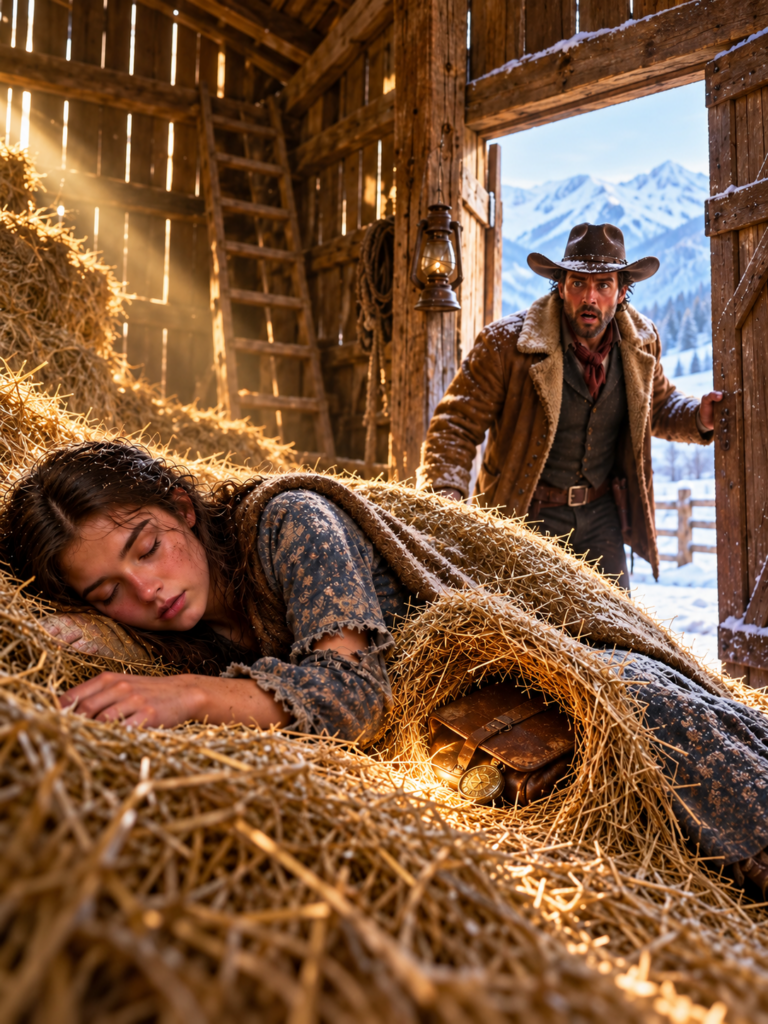
Owen Brennan pushed the barn door open an hour before sunrise and the cold came in with him. The mare shifted in her stall and nickered low the way she did when something was not right. He lifted the lamp. Against the far wall a woman lay asleep in the hay, coat pulled close, breath visible in the air. As he stepped nearer the light caught a small hand just under the straw. He understood. She had hidden a child there. Her own hand rested over the place where the child lay.
He was thirty-eight. Four years earlier his wife Emma and their newborn son had died of complications in childbirth. In the years since he had built a life of work and silence. He rose before dawn, tended the stock, rode fence, and kept accounts in spare columns. He spoke to no one unless business required it. The house stayed cold even when the stove was lit. The door to the room where Emma had labored and the boy had drawn his only breaths stayed locked. He had stopped noticing the silence that filled every corner.
The woman woke when the light touched her face. Her eyes opened fast and sharp. She sat up in one motion and pulled the child closer. Her voice was steady but wary. “I didn’t take anything. We’ll leave now if you want us gone.”
Owen set the lamp on a post and kept his hands where she could see them. “Didn’t say you took anything. Didn’t say you had to leave either.”
She studied him. The child stirred under the coat and blinked awake, a small girl with dark hair and wide serious eyes. She looked at Owen without fear. “Is he going to make us leave?”
“Alice, hush,” the woman said.
Owen shook his head. “Barn’s warm enough. You’re not hurting anything being here.”
The woman stood and brushed straw from her skirt. Her spine straightened. “I don’t take charity. If you’re offering shelter I’ll work for it. I can mend. I can cook. I can keep house. I’ll earn what you give us.”
Owen considered that. “Can you keep books?”
She blinked. “Yes. I kept all my husband’s business records. Figures, receipts, correspondence. I’m careful with numbers.”
He nodded toward the house. “Ranch accounts are a mess. I write what I spend and what comes in, but I don’t balance them properly. If you can make sense of that and keep it straight, and if you can handle mending and help with meals, you can stay in the barn or the spare room, whichever you’d rather. I’ll pay a fair wage until you’re ready to move on.”
Alice still held her mother’s hand. “We don’t have anywhere to move on to yet.”
The woman’s face flushed, but she did not correct the child. Owen looked at the girl and then back at her. “Then there’s no hurry. You’ll stay until you do.”
Her jaw tightened. For a moment he thought she might refuse. Then she glanced at Alice, who was shivering despite the coat. “I’ll take the work and the spare room if it’s not an imposition. But I’ll not owe you more than labor can repay.”
“You’ll owe what you owe and no more,” Owen said. He picked up the lamp. “Come up to the house when you’re ready. I’ll put coffee on.”
He walked out into the cold pre-dawn air. Behind him he heard Alice’s voice, small and certain. “Mama, I think he’s all right.” The reply was too quiet to catch, but he heard the exhale in it.
By mid-morning the woman—Clare Hartley, she said—had the stack of ledgers out of the kitchen drawer and laid them on the table in a row. She asked clear questions about feed costs, what the stock brought at market, whether he tracked expenses by month or season, and wrote his answers in neat columns. Alice sat on the floor near the stove with a rag doll and watched them both. By late afternoon Clare had reorganized three years of records, found two unpaid invoices Owen had forgotten, and mended a torn shirt he had been meaning to discard. She worked without stopping more than a few minutes at a time. He understood she was proving herself as quickly and thoroughly as she could.
When the sun began to set he made a simple supper of beans and coffee and set the table for three. Alice climbed into a chair without being asked and folded her hands. Clare hesitated, then sat. Owen took the third chair, said a brief plain grace, and they ate in silence broken only by the small sounds of spoons on plates. It was the first time in four years he had set a table for more than one. No one remarked on it, but he felt the change like a door that had been sealed too long finally beginning to open.
Part 2
By the third day Alice had named the barn cat Chairman, corrected Owen’s arithmetic twice, and announced that the coffee tasted like it had been made from dirt that was already tired. Clare apologized for her daughter’s bluntness. Owen found himself almost smiling. The child had no filter and no fear. She asked questions the way most people asked for directions, expecting honest answers.
That afternoon, while he mended a fence rail in the yard, Alice appeared at his elbow. “Why do you live all alone in a house this big?”
He stopped and looked down at her. She waited, patient and serious. He had no answer that would make sense to a five-year-old and perhaps none that made sense to himself. “I reckon I got used to it.”
Alice frowned. “That’s not the same as liking it.” She turned and walked back toward the house, leaving him standing in the cold with the truth of what she had said settling in his chest.
That evening, after Alice had been put to bed, Owen sat by the stove with a piece of firewood and his knife and began to carve. He had not made anything with his hands beyond what the ranch required in four years, but his fingers remembered the rhythm. The work quieted something in him that had been restless since the morning he found them. By lamplight he shaped a small horse, simple and smooth, with a carved mane and careful legs. It was the first gift he had made since his son was born. He set it on the table and went to bed without looking at it again.
The next morning Alice found it beside her plate. She picked it up with both hands and turned it over slowly. “Is this for me?”
Owen nodded. “If you want it.”
She held it close to her chest. “I’m going to name him Steadfast.”
Clare’s face softened in a way Owen had not seen before. “What do you say, Alice?”
“Thank you. And because she was,” Alice added. “It’s better than the story you told last night. That one wasn’t very good.”
Owen’s mouth twitched. “I’ll try to do better next time.”
By the end of the week Alice had appointed herself manager of the kitchen and directed them around the stove with the confidence of a foreman. She told Owen to move left when he reached for the coffee pot at the same moment Clare reached for the skillet. When they both stepped the same direction she sighed. “You’re both terrible at this. Mama, you stay there. Owen, you go around the other way.”
Clare laughed. The sound was so unexpected and bright that Owen stopped moving and just looked at her. It was the first time he had heard her laugh, and it changed her face in a way that made him realize how much worry she carried the rest of the time. Alice said, “Now you’re just standing there. That’s even worse.” Owen laughed then, a short surprised sound that came up from somewhere he had thought was closed. It was the first time he had laughed in months, maybe longer, and it felt both strange and necessary, like a muscle that had been too long unused.
That same week Mrs. Abernathy, who owned the dry goods store in town, rode out with a jar of preserves and a thin excuse about checking on him after the hard freeze. She took in the scene in the kitchen—Clare at the table with the ledgers, Alice on the floor with the carved horse, Owen coming in with an armload of firewood—and said nothing pointed, only smiled and handed over the jar. Later, back in town, she began counting. Owen rode in for salt on Monday, thread on Wednesday, a particular grade of lamp oil on Friday, and each time he bought something small and unnecessary that could have waited. By the second week she had tallied six trips for supplies that could have been managed in one. She told her sister who helped in the store, “That man hasn’t ridden to town twice in a month for three years running. Now he’s here every other day with a list as thin as paper. You do the arithmetic.”
One evening nearly two weeks after they arrived, Clare came downstairs after putting Alice to bed and found Owen standing in the hallway outside the locked room, hand resting on the door frame, face still and distant. She stopped at the bottom of the stairs. He turned and saw her. For a moment neither moved. Then he said, “This was my wife’s room. Emma. She died here. He lived less than an hour.”
Clare came forward slowly. “I’m sorry.”
Owen shook his head. “It was four years ago. I locked the door the day after we buried them both, and I haven’t opened it since.” He looked at the door as if it were something he did not recognize. “I don’t know why I’m standing here now.”
“Maybe because you’re ready,” Clare said quietly. “Or maybe just because you’re not alone anymore.”
They went to the sitting room and sat by the fire. Owen told her the rest of it. How Emma had been strong and sure and had laughed easily. How the labor had gone on too long and the midwife had done everything she knew. How he had held his son once and felt the baby’s heartbeat slow and then stop in his hand. He spoke plainly without decoration. Clare listened without offering soft words or false comfort. When he finished she sat silent for a long moment. Then she said, “My husband died of fever eighteen months ago. He was a good man. Quiet, fair, steady. We didn’t have much, but we had enough. And he loved Alice more than anything in the world. After he died, his uncle, Sterling Vance, decided I wasn’t fit to raise her. He has money and standing and the kind of voice that makes a judge listen. I have nothing but her, and the law doesn’t always think that’s enough. So I ran.”
Owen looked at her. “What did your husband want?”
Clare’s voice was firm. “He wanted her raised by me. He said it plain and he wrote it plain. But Vance has a lawyer’s way of making the plain sound questionable.”
“Then we’ll make it plain again,” Owen said.
The next morning the locked door was open. Owen had swept the room clean, aired it out, and made up the bed with fresh linens. When Clare came downstairs with Alice she found him standing in the hallway and understood without him saying a word. She looked into the room, then at him. “Are you sure?”
Owen nodded. “There’s room for both truths. She was here. And now Alice is.”
Alice walked into the room, set the carved horse on the windowsill, and said, “This is a good room. It has more light than the other one.”
Clare’s eyes were bright, but she did not look away from Owen. “Thank you.”
He said simply, “It’s what’s right.”
That night, sitting by the fire after Alice had fallen asleep, they did not speak of what was growing between them, but both had begun measuring the days differently, counting not what had been lost but what might still be built.
Part 3
In the Wyoming Territory of 1891 a widowed mother’s claim to her own child was not absolute. Relatives with means and standing could petition for guardianship, and judges often favored male guardians and financial security over a mother’s bond. But Wyoming had granted women the right to vote in 1869, and its territorial courts were beginning to weigh a child’s welfare more carefully than custom alone. That mattered.
Sterling Vance had already arrived in the nearest town. He rode up to the ranch on a cold afternoon in early March. Owen saw him coming from a long way off, a man in a fine coat on a well-kept horse, moving at the unhurried pace of someone who could afford to wait. Vance dismounted and offered his hand with a practiced smile. “You must be Mr. Brennan. I’m Sterling Vance, attorney at law. I’m here on a matter concerning Mrs. Clare Hartley and her daughter Alice.”
“They’re here. What’s your business?”
Vance’s smile did not change. “I have a legal claim to the child’s guardianship. Mrs. Hartley left the state without notice, taking Alice from her home and her family. I’ve filed a petition with the territorial court and a hearing has been scheduled six weeks from today. I thought it only fair to inform Mrs. Hartley in person.” He drew a folded document from his coat and held it out. “This is a copy of the petition and the court order. She’s welcome to retain counsel, of course, though I imagine that will be difficult given her circumstances.”
Owen took the paper and read it carefully. The language was precise and cold, listing Clare as unfit on the grounds of insufficient means, lack of a permanent residence, and unsafe travel conditions with a minor child. Vance had signed it in a smooth, confident hand. Owen folded the paper and looked at him. “She’ll be at the hearing.”
Vance inclined his head. “I’m glad to hear it. For Alice’s sake, I hope this can be resolved quickly and reasonably. The child deserves stability, Mr. Brennan. I’m sure you understand that.”
Owen said nothing. Vance mounted, tipped his hat with perfect courtesy, and rode back the way he had come. Owen stood in the yard until the man was out of sight, then went inside and found Clare at the table with the ledgers. He set the paper in front of her. “He’s here. And he’s brought the law with him.”
Clare read the petition twice, her face going pale and then hard. When she looked up her hands were shaking. “He’ll win. He has money, standing, witnesses who will say I’m unstable. I have nothing but my word, and the law doesn’t care about that.”
Owen pulled out a chair and sat across from her. “What do you have? Letters, records, anything your husband wrote down.”
Clare hesitated, then went upstairs and came back with a small wooden box. Inside were letters from her late husband, a copy of his will naming her sole guardian, and a ledger she had kept documenting every expense related to Alice’s care, every doctor’s visit, every piece of clothing. Owen spread the documents on the table and studied them. “This is good. This is careful. A judge will see that.”
Clare shook her head. “Vance will have a dozen witnesses who will say I’m unfit. He’ll have affidavits, statements, money to make it all sound reasonable.”
“Then we’ll have witnesses too,” Owen said. “And we’ll have the truth written plain.”
The next morning he rode to town and found Judge Halford in his office, a careful quiet man with steel-rimmed spectacles and a reputation for fairness. Owen laid out the situation plainly. The judge reviewed the law without hurry. When he finished he looked at Owen over his glasses. “What will matter in court is evidence of care, witnesses to her character, and the child’s own voice, if she’s old enough to speak clearly. The law gives me some discretion, but I’ll need more than sentiment. Bring me facts.”
“We will,” Owen said.
Over the next six weeks they prepared. Mrs. Abernathy agreed to testify, as did the minister’s wife, the postmaster, and two neighboring ranchers who had seen Clare working at the ranch and observed her care of Alice. Clare practiced speaking plainly about her husband’s wishes and her own competence. Owen arranged for affidavits documenting her employment and the condition in which he had found her. Alice, when told what was happening, held the carved horse tightly and said, “I’ll tell them. I want to stay with Mama.”
Clare knelt in front of her. “You’ll tell them the truth, whatever that is. No one’s asking you to lie.”
Alice looked at her with solemn certainty. “The truth is I want to stay with you and Owen.”
The work of the ranch continued. Clare kept the books current and balanced. She mended what needed mending and cooked meals that were better than beans and coffee. Owen rode fence, tended the stock, and came in at the end of the day to a house that no longer felt empty. Alice followed him to the barn some mornings and stood on a crate to brush the mare while he forked hay. In the evenings after she was in bed, Owen and Clare sat by the stove and went over what they would say and what they would not. Neither of them spoke of what would happen after the hearing. They simply did the next necessary thing, and then the next.
Part 4
The courtroom was small and plain, with wooden benches and a single window that let in cold spring light. Vance arrived with a leather case full of documents and two witnesses, men who would testify that Clare had been seen traveling in poor conditions, that she had no permanent home, and that Alice deserved the stability and education that Vance’s household could provide. Vance himself spoke with calm confidence, presenting his case as a matter of the child’s welfare rather than personal ambition. “I do not question Mrs. Hartley’s love for Alice,” he said. “I question only whether love alone is sufficient when a child’s future is at stake.”
When it was Clare’s turn she stood and presented her ledger, her witnesses, and her husband’s will, which named her sole guardian in clear, unambiguous language. She spoke plainly about her husband’s wishes and her own record of care. Owen testified that she was employed, capable, and trusted with his ranch accounts. Mrs. Abernathy testified that Clare was known in town as honest and hardworking. The minister’s wife testified that Alice was well-mannered, healthy, and clearly loved. Judge Halford listened to it all without expression. Then he looked at Alice, who sat in the front row holding the carved horse, and said gently, “Alice, do you understand why we’re here today?”
Alice nodded. “Mr. Vance wants to take me away from Mama.”
“And what do you want?”
Alice stood up, still holding the horse. “I want to stay with my mama and Owen.”
Judge Halford made a note, then looked at Vance. “Mr. Vance, I have reviewed the evidence. Mrs. Hartley has demonstrated both means and devotion. She is employed. She has maintained meticulous records of her daughter’s care, and her late husband’s will explicitly names her as guardian. I see no grounds to overturn that guardianship. The petition is denied.”
Vance’s face tightened, but his voice stayed smooth. “Your honor, I must respectfully—”
Judge Halford cut him off. “The ruling stands, Mr. Vance. Mrs. Hartley retains full guardianship. This matter is closed.”
Vance gathered his papers in silence and left the courtroom without looking at Clare or Alice. Owen walked them back to the ranch. That evening, by Mrs. Abernathy’s count, Sterling Vance left town on the morning stage without speaking to anyone. He did not return.
A week after the hearing a letter arrived from Oregon, postmarked from Clare’s sister. Owen brought it in from town and set it on the table without comment. Clare opened it that evening after Alice had gone to bed. Owen watched her face change as she read. When she finished she laid the letter flat and stared at it for a long moment. Her sister had enclosed money for passage and offered a permanent home, a room of their own, work in the family store, safety and family, and the fresh start Clare had been running toward all along.
Owen picked up the letter and read it carefully, then set it back down on the table between them. He said quietly, “The choice stays entirely yours.”
Clare looked at him. “What do you want?”
Owen met her eyes. “You’re free now. I’d like you to stay free. That means choosing, not owing.”
She sat with that for a moment, then asked, “And if I choose to go?”
“Then I’ll see you off with enough supplies to get you there safe,” he said. “And I’ll wish you well. And I’ll mean it.”
She heard the truth in it. “And if I stay?”
Owen’s voice was steady. “Then I’d ask you to stay for the right reason. Not because you’re grateful or because you think you owe me or because you have nowhere else. Stay because it’s what you want. Stay because you choose it.”
Clare said nothing more that night. Owen did not press her. She sat by the fire long after he had gone upstairs, holding the letter and looking at the empty room where Emma’s door had been.
Part 5
In the morning she had made her decision. She woke Alice before dawn and took her by the hand down to the barn, the same barn where Owen had found them months before. The mare nickered softly in her stall. The early light came cold and pale through the cracks in the wood. Clare knelt in front of Alice. “Your aunt in Oregon wants us to come live with her. We’d have a home there and family and everything we need. It’s a good offer, and it’s yours if you want it.”
Alice, holding the carved horse, looked at her mother with that solemn, measuring gaze. “What do you want, Mama?”
Clare’s voice was firm. “I want to stay here. Not because I have to. But I’ll only stay if you choose it too.”
Alice considered that. “Will Owen still be here?”
Clare smiled. “Yes.”
Alice nodded. “Then I choose here too.”
They walked back to the house together. Clare found Owen in the kitchen making coffee the same way she had found him that first morning. She stood in the doorway and said plainly, “I’m staying. Not because I have nowhere else. Because I choose here. I choose you.”
Owen set the coffee pot down and turned to face her. He crossed the room slowly and stopped in front of her, close enough that she could see the relief and the hope he had been holding back. He said, “Then I’d like to marry you if you want that too.”
Clare’s answer was immediate. “I do.”
Alice, who had followed her mother into the kitchen and was standing just behind her with the carved horse clutched in both hands, said with perfect seriousness, “Can I still call you Owen, or do I have to call you Pa now?”
Owen looked down at her and his mouth twitched into something close to a smile. “You can call me whatever feels right.”
Alice thought about that. “I’ll try both and see which one works better.”
Clare laughed, and Owen reached out and took her hand, and the three of them stood together in the kitchen as the sun came up over the hills and turned the frost on the windows to gold.
The ceremony was held two weeks later in the small church in town with Mrs. Abernathy and the minister’s wife as witnesses and a handful of neighbors filling the pews. Clare wore a simple dress she had mended herself. Owen wore his best shirt and a coat that still smelled faintly of cedar from the trunk where it had been stored. The vows were spoken quietly without flourish. When the minister pronounced them married, Alice, who had been sitting in the front row holding the carved horse the entire time, stood up and said, “Now can we go home?”
The laughter was gentle and warm. Owen looked at her and said, “Yes. Now we can go home.”
One year later the carved horse sat on the mantel in the main room, its wood worn smooth from Alice’s handling but still recognizable, still steady. The locked door was gone entirely. The room was now Alice’s, full of light and the small particular disorder of a child who felt safe enough to leave her things scattered. Outside, Alice stood at the fence teaching a new foal to eat grain from her hand, her voice patient and firm the way Owen’s had been when he taught her. Owen came out of the barn and called her name. She turned and grinned and called back, “Pa, he’s doing it. He’s eating right from my hand.” And Owen felt the words settle into place like something that had always belonged there.
Inside the house Clare’s ledger books rested on the ranch desk, not put away or hidden but open and current, marking her as a full partner in everything the ranch was and everything it would become. The table in the kitchen was set for three. The house was no longer cold even when the stove was unlit, because it was full of voices and motion and the small steady rhythms of a family that had chosen itself.
Owen once believed that protecting his heart meant closing every door. Clare spent years believing that safety for her daughter meant never stopping long enough to be found. It took a barn door left open, a wooden horse carved by lamplight, and a judge who listened to a child to teach them both that home is what you build together, not what you run toward or away from. Love is the choice you make when you are finally free to choose.

