
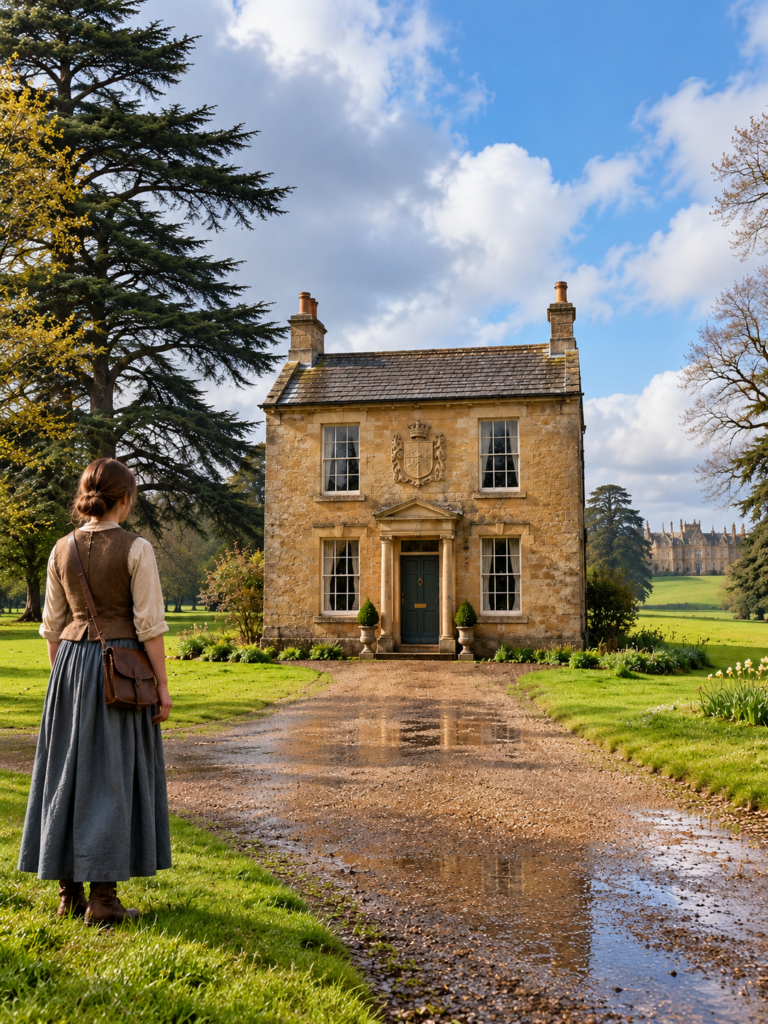
the will left her the smallest house on the edge of the ruined place and a title no living man had claimed in sixty years
Part 1
Eighteen-year-old Catherine Holt had lost her mother, her father, and the only person who ever called her clever, and by the spring of 1870 she had a tin trunk, a rosewood folding rule, and eleven shillings to her name. Then a will nobody had read in sixty years gave her a small stone cottage on the edge of a ruined farmstead, and a title that no living man had troubled to claim.
She thought she had been left a roof.
Alden Hollow lay in the fold of a shallow valley where the river ran brown over gravel, and it held ninety-one souls, a grist mill that ground oats for four townships, a church of gray stone with a tower too short for its ambitions, and one house large enough to be called the old place, though nobody had lived in it properly for a long while. The maple avenue leading to it had gone half wild, self-sown ash crowding out the planted trees, and the two gatehouses had lost their roofs to a gale in 1858 and never had them put back. The old place was ninety feet of lichen-stained stone with shuttered windows and a portico that had dropped a corner, and it stood at the end of that avenue like something waiting to be told whether it was still alive.
The last man to hold clear title to the Alden place had died in the summer of 1810 and left no will anyone could find. For sixty years the land had been picked over by cousins and their cousins, argued about in chancery, mortgaged twice, let to tenant farmers who plowed the park for corn, and administered from a small dusty room above a stable block by a succession of stewards who were paid to keep the tenants paying. Nobody in living memory had called himself master of the place. After a generation or two, the village stopped noticing the absence, the way you stop noticing a draft through a door.
Catherine Holt was born on the twenty-fourth of June, 1851, in the two rooms above the estate office, and she was the only child of Godfrey Holt and his wife Margaret. Godfrey Holt had come into the world in 1809 in a thatched cottage at the low end of the village, the son of a thatcher, and at sixteen he had been apprenticed to a solicitor’s clerk in the county town, which was as far as a thatcher’s son could reasonably climb. He came back to Alden Hollow at four-and-twenty as clerk to the steward at thirty-five pounds a year, and the rooms above the office. For twenty-three years he copied rent rolls, the enclosure award of 1809, the tithe apportionment of 1841, and every deed and abstract the place had ever generated. And he did it in a hand so level and clean that solicitors in the county town would ask for the Alden copies by preference. He could read a court hand which was dying out. He could read the older court hand behind it, which was already dead.
Margaret Holt had been a dressmaker of sorts. She took in the place’s linen, but little of it was still in use, and the linen of the parsonage and the mill, and she worked it in a copper in the back scullery with soap she made herself from wood ash and rendered fat. And the smell of it, that gray, clean, faintly acrid smell, was the smell Catherine thought of when she thought of being very small and completely safe. Her mother taught her letters at four out of the Bible and the parish hymn book, and her father taught her to cipher at six on the backs of spoiled rent receipts. And between the two of them, they gave her the only dowry a clerk’s daughter was ever likely to have. She could read anything put in front of her and she could count.
Her mother died in January of 1861 of a fever that took nine people in Alden Hollow that winter and was buried in the churchyard under the yew, and Catherine was nine years old. After that she kept the house. She learned to bake a six-pound loaf in a brick oven, and to know by the sound of the crust when it was done, to salt and hang bacon, to brew small beer, to turn a collar, to darn a heel so it did not rub, and to keep her father’s accounts in an exercise book ruled with a pencil and a straight edge. Every penny entered, because a man who copies other people’s money for a living cannot be careless with his own.
Joseph Wick came to her after that. He was the estate joiner and he had worked fifty years at the trade out of a workshop behind the old stables. A long room smelling of shavings and linseed oil with sawdust packed between the joists to deaden the sound of rain on the roof. His wife Betsy had died in 1858 and there were no children. He was seventy-one years old and did not talk much. But when Catherine was eleven, she began to sweep the curls off his bench in exchange for being allowed to watch. And by twelve, she was holding the plane. And by fourteen, she could mix lime plaster to a proper putty, set a slate, true a sagging door on its hinges, read a spirit level, and judge whether a beam was sound by the ring of it under a knuckle. He was the first person who ever said she was clever, and he said it flatly, the way he said everything. “Let the tool do the work, girl. Your hands are not for hurrying.”
She turned fifteen on the twenty-fourth of June, 1866, and he gave her his rosewood folding rule. Two feet when opened, brass hinged, the edges worn pale as bone at the joints by fifty years of another man’s hands, and his initials JW burned into the timber with a hot wire. She carried it in her apron pocket from that day forward.
Her father died in February of 1867 of a congestion of the lungs in the same room where she had been born, and she was fifteen years old and alone in the world except for an old joiner in a workshop. They buried Godfrey Holt beside his wife, and Catherine took his pen and his ink and the exercise book, and the new steward, a man from the county town who did not care for village girls, kept her on at a shilling a day to dust the office, sort the deed boxes, and copy abstracts in a fair hand. It was not a livelihood. It was a foothold, and she knew the difference. She kept the boxes in order because keeping them in order was the only thing she had to give, and in doing so she learned what was in them. A great deal of paper and almost nothing of consequence. Her father had told her that once on a wet afternoon when she was thirteen and asked him about the oldest box, the one with the iron corners. He put down his pen and said, “Everything in this office is copycat. Every last sheet of it. The place’s true old title, the one that matters, is not here, and nobody has troubled to find it in fifty years.” Then he picked the pen back up and went on copying, and she had not known what to do with the sentence. So she kept it, the way you keep a key to a door you have not found yet.
Joseph Wick died in December of 1869 in his chair by the workshop stove with his pipe going out in his hand, and Catherine was eighteen. That left her the last person in Alden Hollow who remembered both the man who copied the place’s paper and the man who kept its timber standing, and it left her with a folding rule, a tin trunk, eleven shillings in a cocoa tin, and no claim on anything in the world that a lawyer would recognize. She was in that spring of 1870 a clerk’s daughter of no consequence whatsoever, no dowry, no patron, no family nearer than a cousin of her mother’s in a town three counties off who had never written. The parson’s wife had once offered kindly enough to take her into service and train her up. Catherine had thanked her and declined, and could not afterward have explained exactly why, except that she had spent eighteen years watching men write down what belonged to other people, and she had begun to suspect that the writing was not always right.
The letter came on a Tuesday in the second week of March, carried up from the county town by a boy on a cob, who left it with the maid at the parsonage, who walked it across the churchyard and knocked at the estate office door. Catherine was at the long deal table copying the quarter’s rent abstract into a fresh book, and she wiped her pen before she took the envelope. It was addressed to the steward, but the steward had not been at Alden Hollow since Candlemas, and when he was absent, he had left word that any letter marked urgent was to be opened by the clerk’s daughter, who kept his papers. She slit the seal with the bone paper knife her father had used for twenty-three years and read the thing straight through twice.
The chancery suit, it said, had at last been settled. After sixty years of pleadings and counter-pleadings and the deaths of most of the original parties, the court had apportioned the Alden estate among the surviving claimants. Three cousins descended from the sisters of the last owner, none of whom had ever set foot in the village. The old place, the home farm, the mill, the maple avenue, the gatehouses, the park, and the rents of the eleven tenanted farms were to be divided in shares and sold at auction before Michaelmas. The estate office was to be closed. All papers were to be removed to the solicitors in the city by the end of the month. The clerk employed to tend them, the letter observed in the second to last paragraph, was to be given a fortnight’s notice, and a payment of fifteen shillings in lieu of further service, and the rooms above the office were to be vacated by Lady Day, which fell that year on the twenty-fifth.
Catherine read the paragraph a third time, folded the letter along its old creases, and placed it in the deed box with iron corners because it seemed on reflection to belong there. Then she went downstairs and out into the yard where the March light was thin and the hens of the home farm were picking at the frost-killed grass. And she stood for a minute with her hands in her apron pockets and did not weep. She had known from the day the steward last mounted his horse without saying when he would return that something of this kind was coming. She had only not known its shape.
That night she sat up at the table with her father’s exercise book and made two columns, things to keep and things that were not hers. Her column was short: the tin trunk, which had been her mother’s and held her mother’s winter shawl and three plain dresses and a prayer book inscribed in a hand she did not recognize; the rosewood rule in her apron pocket; the cocoa tin with its eleven shillings; her father’s pen and ink, and his exercise book; a pewter plate, a tin cup, a flint and steel, a housewife of needles, a small flat iron, a horn comb, a square of unbleached linen she had been meaning to make into aprons.
The parson’s wife came up the stair on the Thursday and offered again, more gently now, to find her a place. And Catherine thanked her and said she had been left a cottage. The parson’s wife blinked and said, “A cottage, child. Where?” And Catherine said, “At the far end of the park, past the broken paling, the one they called the Holt place when my grandfather was alive.” The parson’s wife said she had not known there was such a cottage, and Catherine said she had not been certain either, but her father had written it in the margin of a tithe map, and she meant to go and see.
She went on the morning of the twenty-fourth, which was a Friday, and the day before Lady Day. The carter who hauled oats to the mill had agreed for a penny and the promise of a mended coat to take her trunk as far as the broken paling at the park’s far corner. And from there she would walk. She rose before five and dressed in the dark by the light of the stove’s remaining embers, and she wound her hair tight and pinned it under her plainest bonnet, and she tied her mother’s shawl across her chest in the double knot her mother had used for carrying washing. She left the rooms above the office swept and the stove cold and the key on the mantelpiece where the city solicitors could find it, and she closed the door behind her without turning the handle twice, which was a thing her father had always said was unlucky.
The yard was still dark. The carter was waiting with his lantern hooked to the shaft and his horse’s breath standing in the cold like washing on a line. He touched his cap to her and did not speak, which she was grateful for. And he set the trunk between the oats sacks and gave her his hand up to the board. They went out past the shuttered old place in the first gray of the morning, past the roofless gatehouses with their beams showing like the ribs of drowned things, past the long maple avenue where the self-sown ash had grown as high as a man and were themselves beginning to seed. And the frost crunched under the iron tires, and the horse’s hooves made a soft, dull sound in the mud of the lane. The sky was the color of pewter above the hedgerows, and the hedgerows were still bare, and in the hawthorn she could see the first green points of leaf, no bigger than a mouse’s ear. A field clattered up out of the ditch, and the carter watched it go without turning his head.
Catherine held the folding rule in her apron pocket, through the cloth, and ran her thumb along the brass hinge where the pale wear was. The cold was in her boots within a mile and in her knees within two. They passed through the park gate, one leaf fallen off its hinge long since and lying in the grass with ivy grown through its ironwork, and turned down the rutted track that bordered the old deer paling. On the right lay what had once been pasture and was now fifteen seasons of nettle and bramble. On the left, the paling itself, oak posts and oak rails, gray and softened and gap-toothed, where the tenant farmers had taken what they wanted for firewood. The carter asked without looking at her how far down this track she meant to go, and she said, “As far as the stone bridge over the little beck.” And he nodded and clucked the horse along.
The light came up slowly behind the elms. By the time they reached the bridge, which was two courses of dressed stone with a hazel handrail someone had wedged into the mortar, she could see her breath and the horse’s breath and the thin trail of smoke that rose impossibly and unmistakably from a stand of hollies at the park’s far corner. Not the cottage, she thought, for the cottage was supposed to be empty, but someone’s small fire of hedge trimmings somewhere beyond. The carter lifted the trunk down onto the frost-stiffened grass at the end of the bridge, took his penny, touched his cap again, and turned the cart back up the track. Catherine stood with the trunk at her feet, and her shawl pulled tight, and watched him go until the sound of the wheels was lost in the wind. And then she turned and she picked up one handle of the trunk and she began to drag it step by short step along the overgrown path that led in through the hollies toward the place her father had once marked in his neat clerk’s hand on the back of a tithe map that nobody else had thought to read.
Part 2
The hollies closed above her head as she dragged the trunk along the leaf-mold path, and the path turned once beneath a leaning yew, and the cottage came into view through the bare branches at the end of a short clearing. A small stone house, single-storied under a steep roof, with its gable end set square to her, and its door in the long side facing south. She left the trunk where it stood, and walked the last twenty paces alone. The cottage was perhaps twenty-two feet by sixteen, built of the same local stone as the old place, and bedded in lichen the color of old bronze, and its roof was Welsh slate laid in diminishing courses, with four slates missing from the eastern slope, and one from the ridge, and a square stone chimney at the gable end, from which no smoke rose. The smoke she had seen from the bridge came from somewhere beyond the hollies, perhaps the woodman’s hut she had heard her father mention once, and it drifted off eastward on the small wind, and did not concern her.
She stood for a moment, and took stock of the walls, which were sound to her eye, with no bellied courses, and no cracks that she could see through the ivy, and the door, which was oak, blackened by weather, and still square in its frame, and the two small windows which had their leaded panes complete but for one quarter missing in the lower left where a bird had perhaps gone in and out. The threshold stone was worn into a shallow dish by generations of boots. The key was not in the lock, nor was it under the stone to the left of the door where her father had told her once offhand that keys to such places were kept. But when she pushed the latch, the door opened of its own weight, with a short complaint from its hinges and a sigh of cold air from within.
Inside the cottage was one room on the ground floor, with a stair in the corner going up to a half loft under the slates, and the room measured by the folding rule she took from her apron and opened against the inside wall, nineteen feet by fifteen. The floor was flagged in squared stone, grouted with lime, and the flags were sound but dusty, with mouse droppings in the corners and a scatter of fallen plaster beneath the window where damp had worked at the ceiling. There was a wide hearth in the gable wall, deep enough to stand in, with a cast-iron fireback pitted with age, and the initials and date illegible under rust, and above it an oak lintel squared from a single beam, blackened to the color of a kettle. A hook for a chain hung from a swivel inside the chimney, and the chain itself lay coiled on the hearthstone, red with rust, but whole. To the right of the fireplace, a door closed and warped led to what she presently found was a scullery with a shallow stone sink, a copper of about ten gallons set in brickwork, and a small window looking into the hollies. Beneath the stair, a plank trap in the flagstones, lifted with difficulty by its iron ring, gave onto a short flight of stone steps, and a cellar perhaps eight feet by ten, barrel-vaulted in brick, lime-washed over, the floor beaten earth and dry. She did not go down into the cellar then. She went instead up the stair, which took her weight, though it creaked, and found the loft above swept bare and sweet-smelling, with an old straw mattress rolled against the wall, and a square shuttered window at each gable through which the pewter light came in gray. The slates showed daylight in two places and would need to be made good before any rain of consequence. But the ridge tree was straight, and the rafters sound to the touch of her knuckles.
She came down again slowly, and she stood in the middle of the one great room, and she set her trunk down inside the door, and she took off her bonnet, and she said aloud to no one that it would do.
In the afternoon, after she had swept the flags with a besom tied from birch twigs and eaten a corner of bread and a slice of bacon from her trunk, Catherine took her father’s horn-handled lantern and the rosewood rule and went down into the cellar. She lit the candle, carried it down the worn steps, and raised it to look about her. The vault was dry, the lime wash was chalky and darkened by candle smoke long since gone cold. When she walked along the north wall, rapping it with her knuckles, as Joseph Wick had taught her to test a panel, the sound changed once in a patch three feet wide at the height of her waist, from the dull tap of brick and plaster to something hollower. She measured the patch with the folding rule, then went up for the flat iron from her trunk. She tapped around the edge, and the lime wash cracked away in soft flakes, and under it was a square of plaster laid later than the rest, finer in grain. She worked patiently with the iron and her fingers until the plaster came away in slivers, and she saw a wooden board set flush into a shallow niche. The board was oak, planed smooth. When she had cleared around it, she drew it out, and behind it she found a cavity about the size of a bread oven. And in the cavity, wrapped in oiled linen gone the color of weak tea, three parcels.
She carried them one by one to the hearthstone. The first was a leather purse drawn with a cord, and when she loosened it, she poured into her lap forty-two gold sovereigns, milled and heavy, each with the young queen’s head or old king’s head looking up from her apron. She tied the cord again and opened the second parcel. A folded sheath of four parchments, each sealed in red wax in a hand so old it took her a minute to find her way in. Her father had taught her court hand on winter evenings for just such a reason. And when she had read a few lines of the uppermost, she sat back on her heels, because what she held was the freehold of this cottage and the two acres about it, granted in the ninth year of King Henry the Eighth to one Walter Holt, mason, and his heirs forever, and confirmed in the fifty-first year of King George the Third to Jeremiah Holt, freeholder.
The third parcel was a letter folded once and sealed with red wax, addressed carefully to whoever of my blood shall next come to this door. She broke the seal with her thumb and read it by the lantern.
I am Jeremiah Holt, mason of Alden Hollow, and I have lived in this cottage thirty-nine years, and my father before me forty-one, and his father before him beyond my knowing. I write this in August of 1810. The owner of the place three weeks dead and the cousins already at law. I have no child living. My daughter Anne was taken from me at four and my son Thomas at seven and my wife last winter. Whoever reads this is of my blood through my brother Edward’s line, which is the only line left to carry the name. And I have hidden these deeds and these sovereigns behind this wall because I do not trust the chancery to leave an honest freehold alone. And I would rather you find them than they. The forty-two sovereigns are fifteen years of good work saved and they are yours to begin with. The parchments make this cottage yours by right and not by any man’s gift. And no steward and no cousin and no court of Westminster can take them from you if you keep them safe. I hope you are young and strong and have somebody who loves you. Jeremiah Holt, freeholder. This fourteenth day of August 1810.
Catherine sat on the hearthstone with the letter on her knee and the sovereigns at her hip, and she did not weep, but she laid the rosewood rule across the letter, so the brass hinge held the paper flat. And she sat a long while in the lamplight and said nothing at all.
Part 3
In the morning, she rose before the slates were fully light, folded the letter back into its oiled linen, placed the four parchments between two boards of her father’s exercise book, and knotted the leather purse inside her mother’s shawl at the bottom of the tin trunk. Then she took the rosewood rule from her apron pocket and began, as Joseph had taught her, at the top. She climbed into the loft with a tallow candle and a strip of chalk, counted the rafters, marked the two places where daylight showed through, and measured the pitch of the roof against the rule’s open two feet. She wrote the figures on the back of a rent receipt. She descended, swept the hearth clean of ash a generation old, laid a fire of hazel sticks gathered from the hollies, and lit it with her flint and steel. The chimney drew clean. The smoke rose straight.
She walked the two miles into Alden Hollow village at nine, carrying one sovereign tied inside a square of linen in her apron pocket and the four parchments wrapped flat against her ribs beneath her shawl. At the smithy, she asked after a man called Thomas Marple, aged sixty-two, slater and roofer, who had patched the parsonage roof in 1864, and whom Joseph had once called the only man in the parish he would trust on a ridge. Marple came out in his leather apron, listened without interrupting, named his price at five shillings and his dinner, and said he would come on Monday with his lad and a bundle of Welsh slates reclaimed from a dairy roof pulled down at Michaelmas. He asked where she was living. She said at the Holt place. He looked at her a moment longer than was polite, nodded once, and said he had known her father.
From the smithy she went to the office of Mr. Payton, solicitor, above the saddler’s shop at the top of the village street. Mr. Payton was fifty-four, a Methodist, and had drawn Godfrey Holt’s small will three years earlier for the price of a shilling and a bottle of elderflower cordial. Catherine laid the four parchments on his green baize desk and asked him to read them. He read them twice. He fetched a magnifier for the older seals. He asked where she had found them. She told him. He sat back in his chair, took off his spectacles, polished them on a yellow silk, and said that if the parchments were what they appeared to be, they were as good a title as any in the county, and the cottage and its two acres had never been part of the place to sell. He said more than that. He said the freehold carried under the ninth-year grant the ancient right of the original Holt holding in its own right, severed from the great estate by the Tudor crown’s hand, and that no one had claimed the clear senior title in sixty years, because no one had known where the oldest deed lay. He wrote her a receipt for the parchments, locked them in his iron safe for the week it would take him to prepare the recital, and charged her nothing until the thing was done.
She spent four shillings at the ironmonger’s for a pound of three-inch nails, a hank of cord, a bundle of lath, and a tin of white lead, and she carried them home across the park on her back. By dusk she had sat on the hearthstone eating bread and bacon again with the fire alive at her knee and the rosewood rule laid along the mantel shelf, and she had begun a column in her father’s exercise book headed “work and the day it was done.” Under Saturday the twenty-fifth of March she wrote: swept flags, measured roof, lit hearth, walked village, engaged Marple, lodged deeds with Payton.
On Monday Marple came with his lad Harry, aged seventeen, carrying two long ladders tied along the side of a cart drawn by a gray pony and a canvas bundle of reclaimed slates and a bag of oak pegs cut square. They worked three days on the eastern slope and one on the ridge, and Catherine passed slates up to Harry on the ladder, and learned the knack of setting a peg so the slate hung true. She paid Marple his five shillings and gave him his dinner of bacon, bread, and small beer from the copper. And he said the roof would last her thirty years if she kept the ridge pointed. He left a dozen slates against the gable wall for the next storm.
On Thursday, a woman called Hannah Beck, aged forty-one, widow, mother of three, who kept hens at the lower end of the village and had taken in Margaret Holt’s washing twice when Catherine was small, walked up the path with a half-grown pullet under one arm and a jar of elder jelly under the other. She said she had heard the chimney was smoking again. She stayed an hour and showed Catherine how to lime-wash the scullery wall properly with the brush held low and the stroke long, and she took away a shilling for the pullet and promised to come again in a fortnight. She did not ask about the deeds and Catherine did not tell her.
By the first week of April, the loft was weathertight, the scullery whitened, the leaded quarter in the lower left window replaced with a pane the glazier at Alden Mill had cut for ninepence, and the warped door between kitchen and scullery eased on its hinges with a plane borrowed from the smith. Catherine filed with Mr. Payton the recital of her title and the petition for recognition of the senior freehold. And he lodged copies with the county registry and sent a sealed packet to the city solicitors handling the chancery apportionment. He wrote on the outside in a hand Godfrey Holt would have admired that the cottage known as the Holt Place and its two acres were severed from the larger holding by prior freehold and that the senior right so long disputed was vested by the ninth-year grant in the senior heir of Walter Holt, mason, now proved to be Catherine Holt, spinster of the same parish.
The reply came by the Tuesday post, carried from the county town by the same boy on the same cob who had brought the dismissal in March. The three cousins’ city solicitors demanded Catherine’s immediate removal from the cottage, calling her occupation unlawful and her claim fantastical and setting a date for a hearing at Michaelmas. Mr. Payton read the letter aloud at his green baize desk and said quietly that they had expected it and would answer in kind. He sent back the recital, a certified copy of the ninth-year grant, a certified copy of the fifty-first-year confirmation, and the opinion of a city barrister engaged for two guineas out of Catherine’s sovereigns. The barrister’s opinion filled four pages and concluded in the plainest sentence Catherine had ever read in a legal paper that the cottage was not theirs to sell, and the senior freehold was not theirs to divide.
The cousin solicitors did not reply for three weeks. In those three weeks, Catherine cleared the strip of ground that lay south of the cottage, two chains long and half a chain wide, where Jeremiah Holt had once kept his beans and onions. The soil beneath thirty years of nettle was black and sweet. She hired a boy called Will Ashby, aged thirteen, for three pence a day and his dinner. And together they turned the ground with a borrowed spade and a mattock, picked out the flints into a pile beside the wall, and planted potatoes, cabbages, leeks, and a row of broad beans from seed Hannah Beck had carried up in a twist of paper. By the end of April, the chimney smoked morning and evening. The hens scratched in the yard, and the path through the hollies had been widened by Catherine’s own daily passage, until the leaf mold was pressed into a visible track.
Word of the Holt place spread through the village by the slow accretions by which such things always spread, through Marple at the smithy telling his wife the roof had been well paid for, through Hannah Beck telling the parson’s wife the pullet had gone to a girl who kept a clean scullery, through Mr. Payton’s clerk mentioning a petition that had been sent to the city, and through the boy Will Ashby telling his mother that Miss Holt paid in silver and gave a dinner of good bread. By Easter Sunday, when Catherine walked down to church in her plainest dress and her mother’s shawl, and sat in the pew her father had always taken, three women turned to greet her by name. The parson in his short gray vestry afterwards shook her hand and said he was glad to see her. He did not say glad to see her where. He simply said glad.
Part 4
The Michaelmas hearing was called on the fifteenth day of September in a paneled room above the county court and was over in forty minutes. Mr. Payton stood in a plain black coat and read the recital. The barrister from the city, a thin man of fifty with ink on his cuff, laid the ninth-year grant and the fifty-first-year confirmation on the bench. And the judge, having read the papers in his chambers, said only that the cottage and its two acres were severed by prior freehold, and the senior right of the original Holt holding was vested by the oldest surviving title, and by direct descent, in Catherine Holt, spinster of that parish.
The three cousins were not present. Their solicitors bowed and gathered their papers. Catherine walked back down the stone stairs with Mr. Payton behind her and did not speak until they were in the street, where she said she would walk the eighteen miles home rather than take the coach because she wished to think along the way. And she did, arriving at the Holt place a little after dark, with her boots gray with dust, and her mother’s shawl smelling of wood smoke from a fire some reaper had been burning in a stubble field.
She sat that night on the hearthstone, with the fire low, and the kettle warming on the chain. On the mantel shelf, in the order she had placed them weeks before, and had not since moved, lay the rosewood folding rule with its brass hinges and the pale initials JW burned into the wood, and beside it the oiled linen packet in which Jeremiah Holt’s letter was folded along its old creases, and between them, propped against the chimney stone, her father’s exercise book, with the four parchments pressed flat inside its covers. Two men she had never spoken to as grown company, and one she had buried in a frost, had between them given her a house, a trade, a name, and a clear title that no one in the parish had worn for sixty years.
Her mother’s shawl was across her knees. The pullet Hannah Beck had brought in April had grown into a brown hen that slept in a crate by the scullery door. The potatoes were lifted and in sand. The cabbage was still standing in the garden, and the broad beans cut down had gone back into the ground as green manure the way Joseph had once told her beans would. She thought of the steward who had never come back and of the three cousins in their city houses who had meant to divide a park they had never walked and of the parson’s wife who had offered to find her a place in service, and she felt no bitterness toward any of them, only the small clean distance a person feels toward weather that has passed.
Part 5
She was the holder of the senior freehold of the Holt place, which meant very little in law beyond the right to the title and the ancient dues of a court leet no one had held since before her grandfather was born. And it meant a great deal in the village, where men touched their caps now when she passed on the lane, and women called her Miss Holt with a particular care in the second word. She was eighteen years old, and she had that spring possessed a tin trunk, a rosewood folding rule, and eleven shillings in a cocoa tin. She had walked out of the rooms above the estate office with those things, and with nothing else, and she had come down a rutted track to a cottage she had never seen. And inside its cellar wall she had found forty-two sovereigns and four parchments and a letter from a dead mason who had hoped she would be loved.
It was the best eleven shillings she ever carried.
The winter that followed was hard but not cruel. Snow came early and lay long on the hollows, and the little beck froze solid enough to walk, but the chimney drew clean every morning and the loft stayed dry. Catherine spent the short days mending what the frost had loosened, pointing the ridge where Marple had told her it would need it, and sorting the papers Mr. Payton had returned to her once the registry had entered the recital. She kept the four parchments between the boards of her father’s exercise book and the letter in its oiled linen, and she read the letter once a week by the fire the way other people read a psalm, not because the words changed but because the weight of them settled differently each time.
In January Hannah Beck came up the path with a jar of pickled cabbage and stayed the afternoon. She did not speak of the court or the cousins. She spoke of the hens and of a boy in the village who had broken his arm falling from a hayloft, and of the price of seed potatoes. When she left she said, without looking back, that the path through the hollies was clearer than it had been in her memory, and that a person walking it could find the cottage without asking. Catherine stood in the doorway until the sound of the other woman’s boots was gone, then she closed the door and put the jar on the shelf beside the cocoa tin, which still held a few coins but no longer held the whole of her fortune.
By March the ground was soft enough to turn again. Will Ashby came back for two days and they put in early peas and a second row of beans. The brown hen had hatched six chicks under the scullery step, and Catherine moved the crate so the mother could walk them in the morning sun. On the twenty-fourth of June, her nineteenth birthday, she walked alone to the churchyard and stood a while by the two stones under the yew. She did not speak. She set a small bunch of the first wild roses at the foot of each stone, then she walked home by the long way, past the shuttered old place and the roofless gatehouses, and she did not look back.
That summer the village began to call the cottage the Holt place again, the way Jeremiah had written it, without the “halt” the tenants had used when they thought the land was empty. Men who had once tipped their caps only to the steward now tipped them to her when she passed on the lane with a basket of eggs. The parson’s wife, meeting her at the mill one market day, asked after the garden and said the pullet had been a good one. Catherine answered that it had, and that the roof was holding, and that she was grateful for the help she had been given. She did not say more. She did not need to.
In September Mr. Payton rode out on a quiet afternoon and brought her a copy of the final enrollment, sealed and entered. He sat on the settle by the fire while she read it, and when she looked up he said only that the cousins’ solicitors had written once more to inquire whether she would sell the two acres at a fair price, and that he had answered for her that she would not. He left the copy on the mantel between the folding rule and the oiled linen packet. She walked him as far as the bridge and watched him go up the track, then she went back inside and sat on the hearthstone with the paper in her lap until the light failed.
The years that followed were ordinary in the way that a life built by hand is ordinary. She kept the roof pointed and the flags swept and the garden turned. She took in a little copying when the mill or the parsonage needed a clean hand, and she charged what was fair and no more. Hannah Beck’s eldest daughter came twice a week to help with the washing and learned to set a seam so it did not pull. Will Ashby grew into a quiet young man who still came in the spring to turn the ground, and who once, without being asked, mended the gate that the frost had lifted. The brown hen grew old and was replaced by another that Hannah brought up in a basket, and the new one scratched in the same dust under the same window.
Catherine never married. She did not speak of it, and no one asked. On winter evenings she sat by the fire with the folding rule open across her knee and the letter open beside it, and she read the old mason’s words until she could say them without looking. She thought often of the steward who had ridden away without looking back, and of the three cousins who had meant to divide a valley they had never walked, and of the parson’s wife who had offered her a place in service when she had nothing else. She felt no bitterness. The weather had passed. What remained was the cottage, the two acres, the clear title, and the small daily work of keeping them.
On the mantel, in the same order she had set them the first night, lay the rosewood rule with its pale initials, the oiled linen that held Jeremiah Holt’s letter, and her father’s exercise book with the four parchments pressed flat inside. Two men she had buried and one she had never met had between them given her a house that no court could take and a name the village had learned again to say with care. She was no longer the clerk’s daughter who had walked out with eleven shillings. She was Catherine Holt of the Holt place, and the place was hers by the oldest paper that still existed, and by the hands that had kept it standing.
The chimney drew clean every morning. The path through the hollies stayed clear. And when the first frost came each November she would stand a moment in the doorway with her mother’s shawl across her shoulders and listen to the little beck under the bridge, and she would think of the day she had dragged the tin trunk along that same path, and of the hollow sound the wall had made under her knuckles, and of the letter that had hoped she would be young and strong and loved. She had been the first. She had become the second. The third, she thought, had come in its own time, in the quiet way that a village learns a name again after sixty years of forgetting it.

