
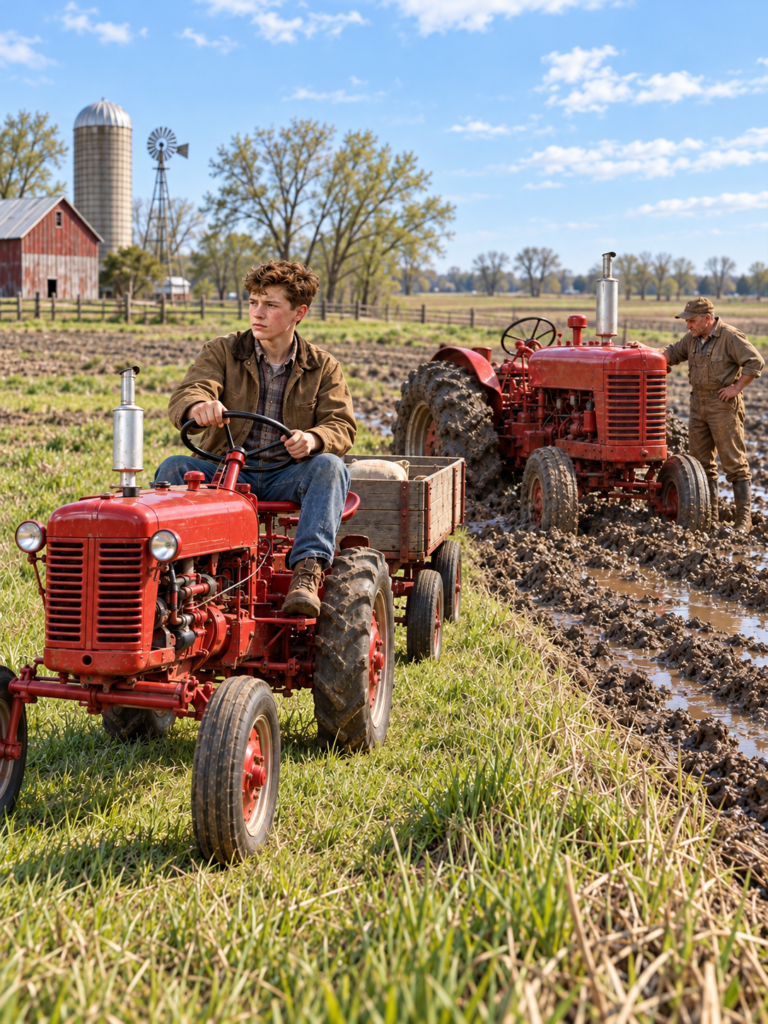
they called the little red cub a toy when the sixteen year old paid three hundred twenty five for it but the wet spring showed what the ground would allow
Part 1
The Voss sale was held on a gray Saturday in November of 1955 with the wind coming across the cornstalk stubble from the west. Gerald Voss was retiring. No son wanted the place, so he was selling it all. Cattle, tools laid out on hay racks in rows, and the machinery lined up along the lane in the order the auctioneer meant to sell it. Two hundred people stood around in barn coats with their collars up, drinking coffee from the church lady’s stand. They watched the prices carefully because a farm sale was where a man learned what things were really worth.
Caleb Ror came with his father. He was sixteen, tall for it, with hands he had not grown into yet. In his pocket was three hundred forty dollars—two summers of detasseling, the check from a 4-H market hog, and what he had cleared trapping muskrats along the drainage ditch. He had counted it so often the bills had gone soft. The Rors farmed one hundred sixty acres and they had one tractor, a Farmall M a little over five thousand pounds, kept alive by Frank Ror’s grease gun and patience. It plowed, disced, pulled the planter, and ran the picker. But it also did a hundred jobs that did not need it. It dragged a wagon of feed to the hog lot. It mowed the lane. It cultivated a single small field, burning the same fuel plowing morning burned. And every spring, when everything needed doing at once, the M could only be in one place. Caleb had spent three springs waiting for it.
Near the end of the row sat a Farmall H, worn paint, a bent fender, tape on the seat, but the Voss hired man cranked it over and it caught clean and ran clean. It came with a two-row cultivator. Everyone who knew anything had picked that H as the one to buy. If you wanted a second tractor and your money was limited, the H was the sensible choice. Frank stood by it earlier and laid a hand on the hood.
“That one do us,” he said. It was as close as he came to asking.
When the H came up, Caleb bid. He went to three hundred forty, which was everything he had. Then Frank beside him said quietly, “I’ll sign the note for the rest.”
Caleb stood there with his hand in the air. He could have it. That was the part nobody told you. Frank’s signature at the bank and every dollar of his savings would put the H in the yard by Monday. A second real tractor. Two men working at once. No more waiting on the M. But he had lain awake over this for a month. And the question would not leave him. What would they do with a second big tractor? Use it for the same small jobs. Burn the same fuel. Wear out two machines instead of one. He lowered his hand. The H sold to Orville Puit, cousin to Harlon Puit, for four hundred forty. Frank said nothing. His face said it had been a fair price.
Then the auctioneer, a big man named Dutch Howerin, reached the end of the row. “Folks, here’s a nice little tractor.” It was a Farmall Cub, about seven hundred pounds, a third of the M, a one-row machine on narrow tires built for garden work and truck farms. The Voss family had used it for the lane and the garden for years. The tires were sound, the engine ran, nothing on it was broken.
“Now I know it’s not much to look at,” Dutch said. “Somebody’s got a use for it. Who’ll give me two hundred?”
Someone laughed. A man in a feed store cap said hitch it to a lawn cart. Someone else said it would get lost in a corn row. Caleb raised his hand. Near the front, an old farmer named Amos Tillery turned and looked at him. Tillery was past sixty, weathered like a fence post, a man whose opinion carried in that township. He did not laugh, but he did not look away, and the look said the same thing the laughter did. Only one other man bid, a fellow who wanted it for a nursery. Caleb bought the Cub for three hundred twenty-five. A few men clapped the way you clap for a boy doing something he will regret. Harlon Puit, who farmed four hundred acres and had come to see what machinery brought, shook his head as Caleb passed.
“Son,” he said, not unkindly. “That’s a toy.”
“Yes, sir,” Caleb said.
On the road home he drove the Cub behind his father’s truck at ten miles an hour, and every car that passed slowed down to look. It took an hour and a half. When they reached the farm, Frank got out and looked at the little tractor for a while.
“You thought about what it’s for?”
“Yes, sir.”
“Tell me.”
It was simple, and that was the trouble. “The M’s too much machine for half of what we use it for,” Caleb said. “If I hook it to one feed wagon, it burns what it burns plowing. If I cultivate that little field behind the barn, I’m running five thousand pounds for a job that needs a tenth of it. If the Cub does the small work, the M’s free for the real work.”
Frank looked at the Cub a long time. “That’s not foolish,” he said. “It isn’t the same as right.” He let Caleb keep it because it was Caleb’s money. But at supper in front of Edna and ten-year-old Tommy, he said that H would have let two of us work at once. “I know,” Caleb said. “Just so you know.” Caleb ate his potatoes. He did know. For the first time he felt the weight of what he had turned down. It did not feel like a decision anymore. It felt like a debt.
Part 2
Winter was easy on the Cub. It pushed snow from the lane, hauled feed to the hog lot, and moved manure. It did all of it on a fraction of the fuel, and Caleb felt vindicated. Then March came, and the frost went out of the ground, and the real work started. On a Saturday in late March, with the M down for a repair, Caleb hitched the Cub to the family’s eight-foot disc and went to work on the oat ground. He wanted the oats seeded early and the Cub could pull it. It crept along, the engine laboring, and he thought, well, that’s all right. Then the disc bit into a heavy patch and the engine dropped. He eased the throttle forward. It lugged harder. The rear tires spun, caught, spun again. He raised the disc shallower and covered ground at about a third of the M’s pace. By noon he had done two acres. The M on a decent day did ten in the same time. Frank walked out and watched.
“How’s she going?”
“Slow.”
“What’d you expect?”
Caleb did not answer. That afternoon he tried hauling a loaded spreader up the slope behind the barn. The Cub got halfway before the wheels slipped. He backed down, lightened the load, and made it. It took three trips to do what the M did in one. That evening Caleb sat on the spreader tongue and let the thought come up whole. Maybe they were right. Two weeks earlier he had seen Orville Puit on the road pulling a plow with the H, doing exactly what a tractor should. Caleb had three hundred twenty-five dollars in a machine that could not pull a disc, and a Farmall H he could have had was working down the road. The question was not whether he had been right. The question was whether he had thrown away two years of summers.
Walt Dumbrosski ran the implement shop in town, a short, heavy man with grease in the creases of his hands and twenty-two years of Farmalls behind him. Caleb brought the Cub in. Nothing was broken. He just wanted to know what was wrong with it. Walt walked around it twice, lifted the hood, and asked exactly what he had hooked it to. When Caleb told him, Walt laughed. It was not mean.
“An eight-foot disc?”
“Yes, sir. Well, it moved it. That’s something.”
Walt wiped his hands. “Son, this is a one-row tractor. Nine, ten horsepower on a good day. Your M’s better than thirty. It’ll pull a one-bottom plow if you’ve got all week. It’ll run a mower, cultivate one row at a time, and haul a light wagon on a firm lane. It’s not a small M. It never was.”
“I know that now.”
“A lot of men wouldn’t. They’d just get mad at the tractor.”
Caleb drove home slowly and somewhere around the Tillery place he stopped asking the wrong question. He had been asking whether the Cub could do the M’s work. The question was what the Cub was actually good for. He began to write the answer down. By the end of March he had a list on the back of a feed store receipt. The Cub would mow the lane and fence lines. It would haul feed and empty wagons, pull a light drag, carry seed from the crib to the field, and cultivate when the corn came up. It would shuttle implements from one end of the farm to the other so the M never stopped for a hitch. The M would do what needed weight and power: plowing, discing, pulling the planter, and eventually the picker. The first week showed up in the M’s hour meter, which climbed slower than it ever had in spring. Frank noticed. He said nothing, but he looked at it twice.
The real change came on the fourth of April. With the Cub moving feed and wagons, Frank put the M on the three-bottom plow at daylight and kept it there. Forty acres of corn stalks went under in three and a half days. Most years the plowing was not done until the eighteenth. On April sixth Caleb disced the oat ground behind the M while Frank ran the drill and the Cub dragged the seedbed behind them and carried the seed sacks to the drill. The thirty acres of oats went in on April ninth, a week early. It was the first time Caleb felt the idea working. The M did heavy work every hour it ran, and the Cub covered the rest. But the early plowing had a price he had not thought about. Forty acres of open turned ground was waiting for the rain.
Part 3
It came on April sixteenth. It was not a storm. No flood, no black wall of cloud. Nothing a person would remember as one night. It was a pattern. A gray day, a drizzle, a heavy shower in the evening, then a clear morning, then another round before the ground finished drying. One working day, two waiting days, then rain. The turned forty stayed dark and heavy for days. Frank walked it every morning, pushing a boot toe into the furrow slice, and said the same thing each time. Not yet. Every farm in the township had the same argument going at the kitchen table. Wait for better ground and lose days nobody had to spare. Or go in on marginal ground with the heaviest machines you owned and hope. Frank waited. But Harlon Puit farmed four hundred acres with machines that cost real money to own. And every day of waiting was forty or fifty acres not planted. He could not wait the way a one-hundred-sixty-acre farmer could. He was not foolish. His big Farmall did in one afternoon what Frank’s M did in two. And on dry ground that advantage was worth a great deal. On the thirtieth of April he went in on his high ground. It worked. The tracks were deep, but the ground held. By the first week of May he had two fields in. Men at the elevator said Harlon had gambled right.
Then he moved to the low fields. It started in the corners. A big tractor went in. The wheels sank a little deeper than expected, and the operator backed out and went around. Then the wheels crossed the same ground again, and the ruts deepened. Then one wheel spun and a tractor sat in a field with mud flying off its tires in clumps. A neighbor lost a morning getting out of a wet corner. Another lost a day. The big machines did what they were built to do, which was push forward. But the ground was not asking how much power they had. It was asking how much weight they were putting down. On May eighth Harlon Puit’s big Farmall went down to its axles in a creek-bottom field. Caleb saw it from the road, stopped on the headland with the Cub hauling seed to the home thirty. He watched Puit climb down, look at the tires, and say something short to his hired man, Lyall Brandt. Then, because it was the only firm path, Caleb drove the Cub down the edge of that same headland with a wagon of seed behind it. It crossed the ground that had swallowed a tractor three times its weight and had left a track no deeper than a man’s thumb. Lyall watched it go by.
That evening Orville Puit’s H worked a field that Frank had refused to put the M into. Caleb heard about it at supper.
“The H went in,” Frank said. “M wouldn’t have.”
“The Cub went in,” Caleb said.
“The Cub’s not pulling a planter.”
Caleb did not answer, but his father had said it plainly, and it stayed with him. Weight was not just big and small. The H sat between them, and nobody could tell him how much it mattered. He sat on the Cub’s fender in the shed that night, and the answer came up so clean he was sure it was right. “It’s the weight. The big ones are too heavy. The little one isn’t,” he told his father at breakfast. Frank chewed his eggs and said, “That’s part of it. It’s most of it. It’s some of it. Ground’s got more than one way to hurt you.” But Caleb had watched what he had watched, and his eyes had not lied. For the first time since November he felt like a boy who had bought the right tractor. The men who laughed were the ones stuck in the mud, so he tested it. On May ninth and tenth, with the home thirty-two wet for the M, Caleb hitched the Cub’s one-row planter and went in on the high ground. The Cub’s tires barely marked it. He planted six acres the first day, which was a long day’s work for what the M would have done in two hours, but the corn was in the ground and the M was still sitting in the yard. Lyall Brandt stopped at the fence on the second day.
“You planting with that thing?”
“Yes, sir. Ground holding so far.”
Lyall looked at the track behind the Cub, then at the big tire marks on Puit’s side of the line. He did not say anything else, but he stayed at the fence longer than he needed to. By the evening of the tenth, twelve acres were planted, twelve of seventy.
Part 4
On Thursday the seventeenth of May Caleb took the Cub into the creek forty. It was the lowest field on the farm, and the corn ground there still needed a pass with the light drag before the planter went in. It had stopped raining the day before. The surface looked firm. The Cub had crossed worse. Frank had said another day or two. Caleb did not want to wait. He drove in along the edge with the drag behind him and the engine steady. For the first hundred yards it went fine. The tires sank an inch, maybe two. He felt that old surge, the one that said he had been right. Then he turned toward the low pocket in the southeast corner where water ran last. The rear tires dropped. He felt it before he saw it. A soft give as if the field had taken a breath. He eased the throttle forward. The tires spun and the Cub shuddered and the front end dug in. He backed up. The tires spun backward and dug a hole. He rocked it forward and back the way he had seen Frank do. Every rock sank him deeper. In a minute the Cub was into its axles, the drag buried behind it, and Caleb sat on the seat with the engine idling and a feeling in his stomach he had never had before.
A pickup was coming along the north road. It slowed. It stopped. A man got out. It was Amos Tillery. He did not say anything. He walked to the edge of the field, looked at the tractor, then crouched by the rut and pushed a thumb into the mud, watching it ooze up. Caleb waited for it. The laugh, the comment about toys. He had earned all of it. Amos stood up.
“Same as Harlon’s,” he said, “just not as deep.”
He went back to his truck, took out a chain, and drove his old Case tractor in along the firm edge. He hooked the chain to the Cub’s rear axle and pulled. It took three tries and a long, slow strain, and the Cub came free with a sound like a boot leaving a bog. Amos unhooked the chain and coiled it. “It’ll be fit Saturday, maybe,” he said. “Not today.” He drove off.
Caleb sat on the seat with mud to his knees. The shame went down deep. And it was not about being stuck. It was how sure he had been. He had stood on the ground where Puit’s tractor sank and decided he was different. And in front of the one man who had looked at him in November, the ground had told him he was not. He told Frank at supper. Frank listened without interrupting. When Caleb finished he asked, “What did you learn?”
Caleb thought a long time. “The little one gets more room to be wrong,” he said. “That’s all.”
Frank did not say he was right. But he put a hand on his son’s shoulder and left it there a second longer than he needed to. Caleb stopped trusting what a field looked like. The next morning he cut a three-foot length of half-inch rod from old fence stock and pushed it into the ground at the edge of the home thirty. It went in easily at first, then stopped hard at about a foot. He pushed it in again fifty feet away, and it slid to his hand. Same field, same morning. Two kinds of ground. So he made a rule, and Frank backed him on it. No machine went on any ground where the rod went in past six inches. Not the Cub, not the M. It was a good rule. It was also the beginning of the next problem.
Rain came on the twentieth and again on the twenty-second. Each time the rod said no. Caleb spent days at fence lines with his rod and his boots waiting for ground that would not firm. So he tried sorting. He worked the firm sections of each field first and left the wet corners for later. That fixed one problem and built another. All the machines now came and went through the same few openings, and the gates took the beating. By the twenty-fifth the worst ruts on the farm were not in the middle of any field. They were at the gates, deep enough to turn an ankle. He stood at the south gate and looked at what he had done. His careful sorting had piled the damage where nobody was watching. So he chose one gate per field on the firmest corner and made every machine use it. The ruts stopped, but wagons and implements now came in the long way, and every hitch and unhitch took longer. Each answer cost something. He was starting to see that the cost was the lesson, but the calendar did not care what he was learning.
On the evening of May twenty-eighth Frank sat down at the kitchen table with the feed store receipt where Caleb kept his list and a pencil. “Corn,” he said, “seventy acres. How many in?”
“Twelve.”
“Beans thirty-five. How many?”
“None.”
“Today’s the twenty-eighth.”
“Yes, sir.”
Frank was not angry. He laid the pencil down. “I’ve known men who lost a crop standing at a fence waiting for a perfect day. It doesn’t come. You take what the ground gives you and you work it.” He looked at his son. “Corn goes in after the first of June. You give up bushels every day. I can’t tell you how many. I can tell you I’ve seen it. If the M goes in wet—”
“I didn’t say wet. I said fit.” He tapped the table. “Your rod says no to the whole farm. Is the whole farm wet?”
Caleb did not answer. He knew the high ground on the home thirty had dried days ago, but he had fenced it off from the rest with the same rule.
“Orville rent us that H by the day,” Frank said. “I’m not saying do it. I’m saying it’s a question.”
It sat there on the table between them. To take the H even for a day was to say he had been wrong in November. Caleb felt it in his chest, hard and ugly. “Give me till Friday,” he said.
“I’ll give you tomorrow,” Frank said. “After that, the M goes where it can work.”
On the twenty-ninth Frank put the M on the high ground of the home thirty with the disc and the two-row planter. He worked the firm ground from noon until dark and planted fourteen acres. Caleb watched from the fence line with the rod in his hand and nothing to say. The M’s tracks showed, but they were shallow, and the ground behind it was firm underfoot. It was not a mistake. It was the right ground for the right tractor, and Caleb had refused to see it because he had been afraid of being wrong twice. Fourteen acres in one afternoon. The Cub would have needed a week. Caleb saw it plainly then and he overcorrected the other way. If the M was going to work the high ground, the Cub would do everything else. All of it. Every wet corner, every light job, every row it could reach. He would prove the little tractor could carry its share.
Part 5
On the first of June he put the Cub on the one-row planter at six in the morning and worked until dark. He planted seven acres. The next day nine. By then the corn he had planted on the tenth and eleventh of May was up, and it needed cultivating. So he split the Cub between planting and cultivating a few hours each. By the third of June he had planted thirty-one of seventy acres and cultivated twenty. The beans sat in their sacks. On the afternoon of the third, after eleven hours in a day that hit ninety degrees, the Cub coughed, stuttered, and quit. A spark plug had fouled. While he was cleaning it the shear pin on the cultivator broke, and the nearest spare was in town. That cost another hour and a half. Caleb sat in the grass beside the dead tractor with the sun on his neck. It was a hard thing to see. In his first spring he had been determined not to overwork the M. And here he was overworking the Cub with half the capacity, running it into the ground to avoid admitting it could not carry the farm. The Cub could plant seven acres a day. The M on the same ground planted twenty. Thirty-nine acres of corn and all the beans were left. And the Cub alone needed six more days for the corn and a week for the beans. If it did not break and if it did not rain. It would rain. It always did.
That night Frank did not ask any questions. He just looked at the list. Then he said, “You’ve got two tractors, Caleb. Use them.”
It took him until the next morning to understand what his father meant. For six weeks he had been arguing about tractors. Small against big, light against heavy. He had been so busy proving one of them right that he had never asked the simplest question. What does this job need? He sat at the kitchen table before daylight with the receipt and wrote it out. Then he did something he had not done before. For each job he wrote what it asked of the machine and whether the ground could take it that day. Planting at twenty acres a day needed the M. The Cub could not carry it, and he would stop asking. Hauling seed and moving wagons needed nothing but motion. The Cub. Cultivating on firm ground with a lot of acres and nothing else pressing needed the M for speed since it covered two rows to the Cub’s one. Cultivating on soft ground or on a day the M was busy was the Cub’s. Dragging, mowing, and shuttling implements were the Cub’s every time. The rest followed from that, and it happened over the next five days, one change at a time. He hitched the harrow behind the disc so two jobs crossed the field in one pass. The first time the drag caught on a clawed line and he had to stop, unhitch, and cross the ground a second time. It cost an hour, but he learned the order, and the next field went right. He left the seed wagon at the field edge the night before so the work could begin the moment the ground firmed. That held until a shower soaked a bag of seed corn he had left too near the edge. After that seed stayed in the crib until morning, and only the empty wagon and the drag stayed out. He would have called it foolish in May. He ran the M, the Cub, and the wagon along the same track, and the track took the wear. A worn lane, he decided, was cheaper than a marked field. When the lane deepened he moved it. He and Frank stopped planting by the calendar and began planting by the ground.
On the morning of the fifth they rodded the home thirty at six and again at noon. The wind and sun had done their work. Frank put the M on the planter at one, and Caleb staged the Cub at the gate with the seed. They planted fifteen acres before the evening’s rain. The sixth it rained. They stayed out. On the seventh they got ten acres in the morning. On the eighth thirteen acres, and the last of the corn went into the creek forty at two in the afternoon. Ground the rod had passed twice that day. The Cub had skipped the pocket in the southeast corner. Caleb left it for last and planted around it. On the eighth he rodded it again, and the rod stopped at four inches. It was fit. He planted it with the M and hauled the seed in by Cub along the firm edge. Seventy acres of corn were in by the eighth of June. It was late, but it was in. The beans went in on the twelfth and thirteenth, thirty-five acres, with the M on the drill and the Cub running seed and moving wagons. The old way would have crossed those fields five times for planting and drag work and cultivating. They were down to three, and the first cultivation went to the Cub one row at a time while the M moved to hay. Frank walked the fields at dusk and said nothing. For Frank that was an answer.
In July Caleb walked the fence line between the Ror corn and Puit’s. His own rows stood even and green, if a little short from the late planting. Along Puit’s side some of the rows nearest the old wheel tracks stood shorter and paler. Caleb could not say for certain why, but he remembered exactly where those tractors had run wet in May. Puit’s good fields, the ones planted early on high ground, stood tall and heavy, better than the Ror corn. Caleb never pretended otherwise. A big machine in the right ground had done what it was built to do. Orville Puit came by on a hot afternoon in August and leaned on the fence.
“Heard you moved your gates,” he said.
“One per field. Firmest corner. That cut the ruts mostly.”
Orville nodded slowly. “Huh.” It was the first time anyone had asked Caleb a question about the work.
The wet came back in October. Rain every few days, slow drying, and corn standing ripe in the fields. And the Ror family faced a job the Cub could not do. To pick corn in 1956 you needed a picker. And the Rors’ was a two-row mounted unit that bolted onto the M. It snapped the ears off the stalks, stripped the husks, and sent the ears up an elevator into a wagon trailing behind. Nothing smaller than the M could carry it or run it. The Cub did not have the power to turn its rolls, and the first field to pick was the creek forty—forty acres, the best corn they had. On those forty acres, at about eighty bushels of ears to the acre, the wagons would carry over three thousand bushels. It also held the pocket. It was a low patch in the southeast corner, about four hundred feet deep and one hundred fifty wide. Forty-five rows of corn stood in it. It was the same ground where the Cub had sunk in May, and where it had stayed soft all summer. Now Caleb had to put the heaviest machine they owned onto it with a picker bolted to its side and a wagon behind, on ground he had spent five months trying to protect.
He did not sleep much that week. Frank wanted to start Monday. Corn was dry enough and the radio said clear through Friday with rain by Saturday night. “Give me till Tuesday,” Caleb said.
“We lose a day.”
“I know.”
Frank studied him. Then he said, “Tuesday.” He went to the barn. Caleb walked the creek forty with the rod. Everywhere but the pocket it stopped hard. In the pocket it went in past six inches in some places and sank to his hand in two. He drove a stake at each one. He thought about what the M could do and what it could not. Two rows at a time meant the M would have to work its way across the whole forty. Nothing Caleb planned could eliminate the picking passes. What he could eliminate were the trips that accomplished nothing. First, the route. He would enter the soft pocket with the wagon nearly empty and pick toward firmer ground, so the wagon gained most of its weight after the worst ground was behind it. The heavy load would ride the firm ground, not the soft. Second, the wagons. Frank normally let them fill heavy before hauling them out. Caleb wanted them lighter. It meant more trips to the crib, but those trips would be made by the Cub along the firm lane. The M would not have to drag a heavy wagon through the soft ground any longer than the picking required. Third, the staging. Empty wagons would wait at the south headland, hitched and ready on the firm strip he had used all summer. A loaded wagon would never go back into the field. At the north headland the M would drop it. The Cub would take it down the packed west lane to the crib, and an empty would be there for the next trip. Fourth, the returns. The M would pick the pocket rows south to north and then go back around to the south end along the west lane outside the corn. It would not run the rows backward. It would not turn in the pocket. Every trip through the soft ground would be a picking trip.
He laid it out for Frank on Monday night.
“That’s a lot of driving that isn’t picking,” Frank said.
“The driving’s on the lane. The picking’s in the corn.” Caleb pointed at the map he had drawn. “Twenty-two trips around. Maybe two hours all told. And a lot more wagon trips.”
“Yes, sir. It’s slower.”
“Yes, sir. Lot of driving on the lane. Nothing crosses that pocket unless it’s doing work.”
Frank looked at the drawing. Then at his son. “Tuesday,” he said.
Tuesday morning came clear and windy. They started on the firm ground, the north and west, where the rod stopped hard. The M ran steadily. The picker rolls rattled, and the ears snapped and clattered up the elevator. When a wagon had enough on it, Tommy, eleven now, ran to pull the pin. Edna drove the Cub with the empty and then took the loaded wagon down the lane, and Frank ran the elevator at the crib. The system held. Caleb counted the minutes between swaps. They picked twelve acres on Tuesday and eleven on Wednesday. Wednesday night it rained. It was a light rain, less than half an inch, nothing the radio had mentioned. But Thursday morning Caleb rodded the pocket and the rod sank to his hand in nine places. He stood at the edge of the corn with the rod hanging at his side. Frank came up beside him.
“How bad?”
“Soft.”
“Then we pick the rest of it. Come back to it.”
“If it rains Saturday night it won’t be fit for two weeks.”
“Then we pick it Friday.”
“It won’t be any drier Friday.”
Frank was quiet. “Then what?”
Caleb looked at the sky. It was clear with a stiff wind from the west. “Saturday midday. If the wind holds.”
“That’s cutting it close.”
“Yes, sir.”
Frank rubbed his jaw. He could have overruled him. And Caleb knew it. But the pocket was forty-five rows out of four hundred, and the ground around it was good. “Saturday,” Frank said.
They picked the rest of the field Thursday and Friday, sixteen acres, with the M crossing no ground the rod had not passed. That left the pocket and the rows beside it. Four acres. Forty-five rows. The morning of the day it was supposed to rain by dark. Saturday Caleb rodded the pocket at nine. At ten. At eleven. At eleven-thirty, in a stiff wind with a gray line building to the west, the rod stopped at five inches in the last of the stakes. “It’ll hold,” he said. Frank looked at the cloud bank, then at the stakes. He said nothing. Caleb climbed onto the M. He entered from the south headland through the packed strip with an empty wagon behind him. He lined up on the first two rows of the pocket and eased the clutch out. The picker rolls began to turn. The M settled. He felt the ground take it. Not a sink, but a slow, soft give. The tractor settling into the dirt like a man sitting into a deep chair. He kept the engine steady. He kept his speed down. He watched the track behind him in the mirror of his own memory, and it stayed shallow. The wagon behind him was still light. Four hundred feet. Out of the soft ground onto the firm slope, and the ground rose to meet the tires. The ears ran up the elevator, the wagon grew heavier, and he reached the north headland with the stalks standing clean in the rows behind him. He swung out onto the west lane and drove the long way around. It took six minutes to get back to the south end. Frank stood at the gate with his arms folded, watching the clock on his wrist and the clouds in the west.
Caleb made the next pair of rows and the next. On the ninth trip the wagon filled earlier than expected, and he swapped it at the south headland, never taking the full load into the soft rows. On the fourteenth Edna called from the Cub that the lane was holding fine. The gray line in the west crept closer. By two o’clock the first spits of cold rain came on the wind. On the twenty-second trip Caleb ran the last two rows of the pocket and came out onto the firm ground with the picker rolls turning on the last stalks. He shut the engine down. Behind him forty-five rows stood picked. Every pass the M had made through that soft pocket had picked corn. The unnecessary travel had stayed on the firm lane. The tracks were there, deep in a few places, but they were tracks, not trenches. The ground was still firm enough to walk across, and Tommy ran out into it to prove it. The rain began at four. By dark it was coming down steadily, and it kept coming for nine days.
Caleb sat in the kitchen that night with the rain on the roof and the creek forty picked clean, and he understood what he had done. It was not a victory over the ground. The ground had not lost. He had asked it for exactly as much as it could give, and he had done it with the heaviest machine on the farm because nothing else could. The corn came in over the next three weeks between rains. It was not a spectacular crop. Puit’s best ground made more bushels to the acre, and Caleb never claimed otherwise. But the creek forty made respectable corn, about what a fair year should, and the fields where the ruts had run deepest in May on other farms came in thin and uneven. Edna kept the books. At the end of October she sat at the kitchen table with the fuel tickets and repair bills for a long while.
“The M’s hour meter,” she said. “It’s down about thirty hours from last year. This far in.”
Frank looked up. “Is it?”
“And the repairs are lower.”
He said nothing. But the next morning he walked out to the shed and stood beside the Cub and laid his hand on its fender just for a moment. Nobody praised Caleb. Nobody came to the farm to ask for advice. That was not how it went. But on the last Saturday of October Amos Tillery drove down the lane along the creek forty, stopped his truck, and got out. He walked into the stubble. He stood in the pocket and looked at the tracks, the stalks, the stakes still standing. He walked the length of it slowly, looking at the ground. Caleb stopped what he was doing. Amos came back and stood at the edge of the field with his hands in his coat pockets.
“Those wagons ever cross that low piece?”
“No, sir. Stayed on the lane.”
Amos looked toward the pocket. “Picker only when it was picking.”
“Every return went around the outside. So every trip through there did something.”
“Yes, sir.”
Amos looked at the pocket again. “Huh,” he said. That was all. He went back to his truck. In November Caleb noticed that Amos’s own wagons stood lined up at a firm headland on his place and that he used only one gate to his corn. Caleb did not feel proud. He felt something quieter, harder to name. He felt asked.
The sale was in February on a cold Saturday with a low sky. It was an estate sale on a farm south of town with the machinery lined up along the lane the way it had been at the Voss place. Caleb came with his father, hands in his pockets, and walked the row without much interest. He had no money to spend and no need. Near the end of the row sat another Cub. It was older than his. Rust on the hood, tires wearing thin. But it sat there on the cold gravel, small and red, and when it came up Dutch Howerin looked at it with a faint smile.
“Folks, here’s a nice little tractor.” Someone laughed. “Runs good. Somebody’s got a use for it.” More laughter. Softer than before. “Who will give me two hundred?”
A few men chuckled. Nobody raised a hand. Then, near the front, a man in a worn barn coat lifted his. It was Harlon Puit. Dutch looked at him. He looked at the crowd. “I’ve got a bid,” he said. And for a moment nobody laughed. Another hand went up. An older man in the second row. Amos Tillery. The price began to climb. Caleb stood at the back of the crowd with his father watching. He did not raise his hand. He did not need to. He already had the tractor he needed.

