
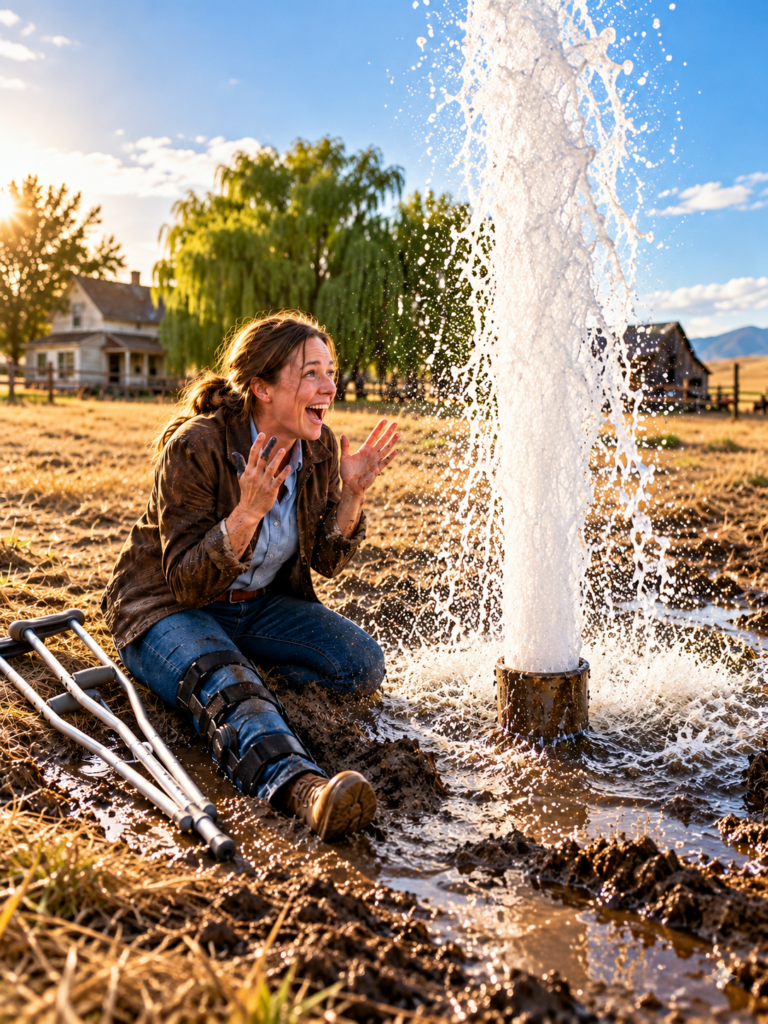
they sold the disabled single mom the dying montana farm and laughed at her leg then the ground exploded with water and the man who called it dead came begging
Part 1
The asphalt outside the old paneled office had gone soft under the August sun. Tessa Rowan parked the truck as close as the curb allowed, pulled the forearm crutch from the passenger seat, and took her time walking in. Early meant she did not have to hurry while anyone watched. Nine years of the left leg had taught her that much.
Inside, the air was cooler but still carried the smell of floor wax and old paper. Preston Whitmore was already seated, fifty-four and dressed the way men dress who have never once had to guess at the weather. His soft voice made everything he said sound reasonable until the moment it stopped being reasonable. A young man from his office stood by the window. When Preston glanced at the crutch leaning against the arm of her chair and at the brace under the hem of her jeans, the young man laughed. It was short and quickly swallowed, the kind of laugh that comes out when somebody has been given permission.
Tessa let it pass across the table and land somewhere behind her. She had learned that most people say the cruel thing once and then feel obligated to defend it forever if you argue. Preston ran out of reasons to be sorry for her. She asked one question.
“The water rights convey with the whole property, correct?”
There was a pause, not a long one, maybe the width of a breath. His paralegal turned a page and pointed at a paragraph. Preston said yes, of course, everything appurtenant to the parcel conveyed as described. He seemed to find the question funny in a tired way. There was no water at Sage Hollow. Asking who held the rights to it was, in his view, like asking who inherited the ashes.
She was at the counter getting her keys when she heard him across the room speaking to the broker in a voice that was not lowered nearly enough.
“Well,” Preston said, “at least we found somebody willing to pay us to haul off the dead ground.”
Tessa did not turn around. There is a kind of anger you carry out the door undiscussed and use later on something structural. She drove out alone that evening, past the leaning gate and the cedar plank with Sage Hollow Farm burned into it, and parked in the middle of the flat where the hay ground used to be. Heat came off the dirt in a shimmer. Her boots crunched on soil dried into plates the size of dinner platters, curled at the corners, white with alkali along the cracks. It looked exactly like what everyone said it was.
She stood a long while, letting her legs settle, and then looked out toward the north fence and saw something that did not belong. Thirty yards off, in the middle of all that white, stood a cluster of small willows, not sage, not the tough gray brush that survives anywhere. Willows eight or nine feet high, with green leaves on them in the worst August the valley had seen in a decade. Anyone who has worked around water knows what willows mean. They do not grow on hope. They grow with their feet wet. Somewhere under that cracked, allegedly dead ground, something was holding water close enough to the surface to keep those trees alive while grass died two hundred feet away.
The first weeks taught her exactly how hard the next two years would be, and she let them. She paid a welder in town forty dollars to fabricate a lower step for the old tractor so she could get into the seat without hauling her weight through her left knee. She moved every tool she used regularly down to chest height on the shop wall and left the top row for things she touched twice a year. She bought a used four-wheeler with a rack because a quarter-mile of walking cost her the whole afternoon and a quarter-mile riding cost her nothing. That was what she did.
She had a plat map blown up at a print shop until it filled a sheet of poster board, taped it to the kitchen wall, and mapped her own farm one piece at a time. She marked the pipe runs and the sound fence and the decorative fence. And in green pencil she marked every place on one hundred forty-two acres of dead ground where something was still growing that should not have been. Her son called on Sunday nights from the university four hundred miles away. She told him the house was sound and the well was not, and she did not tell him about the willows yet.
Part 2
What finally got her heart going was smaller than any of it. She went out at five-forty one morning to check a gate, walked past a low spot, and the toe of her boot came up dark. Not muddy, damp. A patch of damp soil the size of a card table ringed by ground gone to powder. She stood over it in the gray light and did not move for a full minute. Her first thought was a leak because her first thought was always the boring answer. She and Dale spent three days tracing every foot of abandoned main they could find and digging up two junctions. They found the whole system dry as bone and packed with dirt and mouse nests, sitting at a grade that ran away from the low spot instead of toward it. No stock tank within four hundred yards. No leak. No explanation anywhere on the surface at all, which meant the explanation was underneath.
She called Gideon Hail that evening from the porch. Gideon was past sixty-five and had drilled water wells in three states for most of his life. He had known Tessa back when she was the woman who called about invoices and told him kindly that his handwriting on a driller’s log was a crime against the profession. He listened to her describe the willows and the cottonwood and the damp patch without interrupting once. Then he told her the truth instead of what she wanted.
“Could be a clay lens,” he said. “A shallow pan of tight clay holds winter moisture like a bathtub and feeds a willow root for years. Doesn’t mean there’s a drop under it worth pumping. I’ve watched men chase a green spot straight into bankruptcy.”
“I know,” Tessa said. “I typed the invoices.”
Word got around the valley the way it always does, through the feed store and the county road. Four days later a pickup she had never seen came up her lane trailing dust. Preston Whitmore parked at an angle in her yard without asking and got out.
“Don’t dig the rest of your money into the ground, Miss Rowan,” he said. “I’ve seen it done. It’s not a good way to spend a year.”
Then he made an offer. He would buy the farm back today. Paperwork inside two weeks for about twenty percent less than she had paid his own company eleven weeks earlier. He said the number kindly. She would lose some, yes, but she would walk away with most of her savings and her loan retired and she could find something reasonable, something with a level driveway and a well that worked and forty acres instead of one hundred forty-two.
“I’m offering you a way out,” he said. “People don’t usually get one.”
A man who genuinely believes he has just watched a fool refuse a mercy does not linger. Preston stood in her pasture with his hands in his pockets looking north. After a moment he said, in the same easy voice, “Have you dug up on the north end yet?”
Six words. A question about geography. That night she sat with the poster-board map in front of her and could not make the question fit. If Sage Hollow was worthless, it did not matter where she dug. If she was a joke, the punchline was the same at every point of the compass. He had driven eleven miles out of his way, offered to take a loss on paper to get the deed back, and then asked one specific question about one specific end of the property. She got up and wrote it along the bottom of the map in green pencil, the way she wrote everything down. Why does he care where I dig?
The county records office sat in the courthouse basement and smelled like dust and floor wax and old glue. Tessa went on a Tuesday because Tuesdays were slow and she brought both crutches because the trip meant standing at counters and she had stopped negotiating with herself about that. A clerk named Ruth Anne Prine, twenty-two years on the job and clearly in possession of opinions about everyone in the valley, brought her the Sage Hollow boxes on a rolling cart and then over the afternoon brought three more that Tessa had not known to ask for.
Most of it was nothing. Sage Hollow had belonged to a family named Bellamy from 1906 until the early fifties, then passed through four owners in thirty years, each holding it a little more briefly than the last. Then in a folder of well records she found one typed line dated 1968. North pasture flowing test bore. Tessa read it four times. Flowing, not pumped. In the language of the trade, a flowing bore is a hole that produces water without help at all because the water below is under enough natural pressure to climb the pipe and come out the top on its own. She had transcribed that phrase onto invoices a hundred times. She turned the page. The next document in the same folder, dated 1974, was a state well log for the same quarter section stamped in faded purple ink. Abandoned non-productive. Two records six years apart on the same piece of ground saying opposite things.
There were maps too, a whole flat file of them, some drawn by hand on linen gone the color of weak tea. On the third one she unrolled a county water survey from the middle of the century. There was a small circled symbol just west of a stand of trees drawn exactly where her willows stood. And beside the circle in a draftsman’s tidy capitals, two words: artesian test.
Part 3
Groundwater is not one thing. It comes in layers, stacked and separated by rock. The shallow layer everybody drills into is the one drought empties first. But sometimes there is a deeper layer trapped between two beds of tight rock, recharged from high country miles away, sitting under enormous natural pressure with nowhere to go. Punch into that and you do not get a well you have to pump. You get a fountain. Ranchers in the west had found them by accident for a hundred years and had also spent fortunes drilling for them and hitting nothing but expensive gray shale.
They agreed on a middle step, which was his idea and which she would later think of as the smartest four thousand dollars she ever spent. Instead of drilling blind, they brought in a two-man crew with resistivity equipment and ran a geophysical survey across the north pasture, dragging electrodes in a line and reading how the ground below resisted a current because water-bearing rock and dry rock argue with electricity differently. The results came back Wednesday as a printout of colored bands that would have looked to anybody else like a weather map of nothing. Gideon spread it on her kitchen table and put a finger on a formation lying roughly ninety feet below the bottom of the old abandoned well. A confined structure, tilted, continuous under most of the north end.
“That’s something,” he said. “And I want to be clear that could be a saturated confined bed under pressure. It could also be a tight sandstone with nothing in it and no way on earth to tell from up here. If we drill and it’s dry, you’re out somewhere between eleven and nineteen thousand and you still own a dead farm.”
Tessa had exactly twenty-three thousand left in the world. It was the money meant to carry her through two years of hay purchases and truck repairs and propane bills and whatever the house decided to do next. She spent two nights with a legal pad, running it as coldly as she used to run other people’s disasters. In the morning she called and told him to schedule the rig.
Preston heard within four days. He came in the middle of the afternoon and found her in the shop doorway with a parts catalog and he did not smile the way he had before. The amusement had thinned out into something closer to irritation. He told her the nineteen-sixties records were garbage, that the state had rewritten its well standards three times since then, that half those old logs were filed by men who could not read a tape measure, and that anyone selling her hope out of the Johnson administration was taking her money. Then he looked over at the crutch leaning on the tractor tire and let his voice go soft and sorry.
“What are you trying to prove out here, Tessa? That if you just try long enough, the land will feel sorry for you.”
The shop went quiet. Dale, twenty feet away under the swather, stopped moving entirely. Tessa set the catalog down on the bench. She was surprised afterward by how little she wanted to shout.
“The land doesn’t feel sorry for anybody,” she said. “That’s the reason I trust it more than I trust you.”
Preston left well, unhurried, with a nod, the way a man does when he intends to come back with better tools. Gideon had come out of the shop and stood beside her, wiping his hands on a rag, watching the dust hang over the road.
“Tessa,” he said, “if that man is certain we won’t find anything down there, why does he keep coming back?”
The rig came up her lane at seven on a Monday morning in late September. By the standards of the industry it was small and unglamorous, a truck-mounted rotary Gideon had owned since the nineties, painted a green that had faded closer to gray. His helper was named Marcus Tibet and did not speak before noon on principle. They set up eighty feet west of the willows on a line Gideon picked off the resistivity printout and started making a hole in the ground.
Day two produced shale, gray and slick and faintly sulfurous, and it kept coming hour after hour until the sound of the rig became a kind of weather. Gideon changed bits at midday which cost money. The mud pump needed a seal which cost money. Somewhere in the afternoon Tessa did the arithmetic quietly in the corner of her clipboard and found she had spent a little over nine thousand proving there was a great deal of rock under Montana. That was the week Preston stopped coming out and started calling instead. The first call came Tuesday night. He was pleasant, almost warm, and he offered to buy Sage Hollow for exactly what she had paid, every dollar back. He framed it as generous, which technically it was, and as final, which it was not. The second call came Thursday, an hour after the rig shut down for the day. This time the number was fifteen percent above what she had paid.
Tessa held the phone against her ear and looked at the poster-board map, at all those little green marks and at the question written along the bottom edge. There is a particular feeling when a set of facts finally clicks into an order that makes sense, and it is not triumph. It is closer to vertigo. Eleven weeks ago this man had stood in a paneled office and called her farm dead ground and told a broker he was glad to find somebody willing to haul it off. Now he was bidding above market on the same acreage in the middle of a drought while a drill rig sat on it. Nobody bids up a corpse. Preston Whitmore was not trying to rescue her from a bad investment. He was trying to get something back. She did not know yet what he thought was down there, or how long he had thought it, but she knew with total certainty that she was no longer the only person at Sage Hollow who believed there was water. She said no. Then she called Gideon at nine at night and told him to keep drilling.
Part 4
Day three started cold, frost on the folding chairs and steam coming off the mud tank. Around ten in the morning the sound of the rig changed. Gideon heard it before the gauges showed it, the way men who have done one thing for forty years hear things. The bit had passed out of shale into something harder and more crystalline. The cuttings coming over the shaker changed color, and when Marcus put a bare hand in the return flow he changed his mind about speaking.
“That’s cold,” he said.
At eleven-twenty the penetration rate jumped. The bit dropped through something into something else. The whole rig registered it as a brief slackening and then the pressure on the annulus began to climb. Gideon called out a number. Marcus repeated it. They started closing things. Water came up first as almost nothing, a ring of dampness around the casing, then a slow welling, maybe two gallons, spreading on the dry ground in a dark stain the shape of a hand. Everyone watched it and then it stopped. The stain sat there, shrank at the edges, and the ground drank it. After four minutes there was nothing left but discolored dirt. Marcus swore softly. Tessa felt her whole chest go hollow. That was it then. A pocket, a seep. Nineteen thousand to find a damp spot she had already found for free with the toe of her boot in August.
Gideon did not move. He stood looking at the wellhead with his jaw working.
“No,” he said to nobody. “That’s not a pocket. That’s a seal. Something down there is still holding.”
Then he advanced the bit eleven more feet. The pressure came up fast the second time and it kept coming. The gauge climbed past the first reading and did not stabilize. A vibration ran up the drill string, a low shuddering Tessa felt through the ground under her chair before she heard it. And then she heard it, a groan and then a deep concussive thump from far below as though a door had been kicked open in a basement. Gideon started shouting. He wanted the control valve shut. He wanted Marcus off the deck. He wanted the rig throttled down and all of it happened in about nine seconds in a language of hand signals and single words. They almost got there before the system came fully under control.
The water arrived. It came out of the wellhead in a white column that went higher than the rig mast, thirty-five or forty feet roaring, and it did not fall back the way a pumped stream falls back. It stood up. It held itself in the air on its own pressure, a shaking white pillar in the late light. And the spray came down over everything in a fine cold rain that carried a hundred feet on the wind. It was not oil. It was not treasure. It was water, the most ordinary substance on earth, worth nothing anywhere it happens to be plentiful. In a valley where the shallow aquifer had been failing for fifteen years, where three families had sold out in four seasons while a man with thousands of acres bought dry ground at a discount and waited, it was worth more than almost anything else Tessa Rowan could have found under one hundred forty-two acres.
She did not scream. She did not raise her hands. She got up out of the folding chair, found her balance, walked eight steps toward it, and stood in the drift of the spray with her face turned up and let the cold come down on her. Her hair soaked through, her jacket soaked through. Down the pasture the willows stood in the mist, looking exactly as they had looked all summer, which is to say correct.
Gideon would not go further, and she respected him for it. What they had was a flowing bore with strong natural pressure. What they did not have was a single number anyone could defend. He wanted a certified lab panel, a flow test measured over days rather than minutes, and a drawdown analysis to learn whether the pressure held or whether they had simply opened the top of a bottle. Until then, he said, the honest word was unproven. They spent the rest of the night cutting a channel so the flow ran into the old stock pond and the pond that had been a dish of cracked mud since before she owned it began to fill from one end.
Around six that evening a black sport utility came up the county road and stopped on the far side of Tessa’s fence without turning into the lane. The driver’s door opened and Preston Whitmore got out and stood there in a clean shirt looking across four hundred feet of dead pasture at the wet gravel, the excavator, the pond that was no longer empty, and the pipe running white with water into the sunlight. For the first time since she had met him he was not smiling. He walked up the lane, which she had not expected, and it cost him because the ground was rough and his boots were wrong for it. When he spoke, every trace of the man from the closing table was gone. He did not say dead ground. He did not mention her leg or the driver’s seat. He talked to her the way he would talk to a stranger in a boardroom and he made an offer and the offer was three times what she had paid his company for Sage Hollow Farm.
Tessa had water in her boots and her jacket was still dripping and her leg was screaming and she looked at him and asked why. Investment, Preston said. It was such a thin answer that it landed almost as an insult. A man does not triple a number in eleven weeks on a thesis. He does it because he knows something he is not saying. Tessa said no and added a sentence because she wanted to see what he would do with it. If you want to make me a real offer, you’ll have to tell me the actual reason.
The lab and flow results came back two days later and they were, in Gideon’s phrasing, better than they had any right to be. Sustained flow enough to irrigate real acreage. Chemistry heavy in dissolved minerals but usable for stock and irrigation after basic treatment. Pressure that held steady across a sixty-hour test instead of collapsing. And an isotope note that made him quiet for a full minute. The water was old, recharged far away and higher up, with nothing to do with the shallow layer that had been failing under the valley for fifteen years, which meant, subject to study, that producing it was not the same as stealing from her neighbors.
Preston’s answer was patient, deniable, and almost entirely legal, and it taught her more about power than anything else in the whole story. Her loan officer called with questions that had never been questioned before about operating projections and collateral coverage and mentioned apologetically that the bank was reviewing its agricultural exposure in the county. A pipe and supply house in Miles City that had quoted her a full irrigation package at fifty-one thousand called back nine days later to say they had reconsidered their capacity for the season. The excavation contractor she wanted for the tank pad returned two calls and then stopped returning them. Her neighbor Marjorie Kesler, a widow who had run cattle east of her since 1978, explained it over coffee cake one evening. Whitmore was the largest customer of nearly every agricultural business within a hundred miles and sat on the bank’s advisory board, so he never had to threaten anyone.
“He’s not going to sue you, honey,” Marjorie said. “He’s going to make you tired.”
He came out again in October and Tessa noticed he had adjusted his entire approach. There was no reference to her body, not once, not even sideways. He had apparently concluded that contempt had failed as a strategy, which was in its own way the first respect he had ever shown her. He stood in her shop and spoke like a businessman.
“You found water. Congratulations, sincerely. But finding it and making money from it are two completely different projects. And the second one takes capital you don’t have and relationships you’ll never build here.”
Tessa was sitting on a stool with her braced leg out straight. “Then why do you want it so badly?”
Preston did not answer. He looked at her a long moment, changed the subject to the weather, and she understood that she had finally asked the question with no safe reply.
Part 5
So she went back to the courthouse where Ruth Anne Prine had by now developed a personal interest and had started setting boxes aside. It took three visits and what she found was not in the Sage Hollow file at all. It was in a state index of private consulting reports cross-referenced by township and range. A hydrogeologic assessment dated 1987 discussing the probability of a deep confined aquifer beneath the north end of a parcel identified by its legal description. Her parcel. Her north pasture. Her willows. The report concluded that the probability of a productive artesian bed was moderate to good and that confirming it would require drilling below three hundred feet with equipment that in 1987 would have cost a fortune with no guarantee of anything. The report had been commissioned and paid for by Whitmore Land and Cattle.
Here was the part that took her a while to see clearly and that made her angrier than any insult he had ever handed across a table. Preston Whitmore had not sold Sage Hollow to her because he was sure the water was gone. He had sold it to her because he was sure she could never find it. A disabled woman on a crutch, a single mother, under-capitalized, no crew, no equipment, no name in the valley. She was, in his assessment, the safest possible buyer for a parcel with a dangerous secret filed under it. He had looked across that table and seen somebody who would spend two seasons failing to keep grass alive and then sell it back to him for less than she paid. He had not been beaten by her luck. He had been beaten by his own contempt. It was the contempt that had chosen her.
She built the thing in phases slowly with less money than the job required, and it worked precisely because she had never expected it to be fast. Gideon brought a retired irrigation engineer named Walt Brewbaker who had designed systems in Wyoming for thirty years and was extremely bored. Walt drew a plan that could be built in stages. A ten-thousand-gallon tank on the high ground east of the wellhead so the artesian pressure did the lifting for free and gravity did the delivering. A regulation and filtration skid at the tank outlet, a buried main down the slope and drip line rather than sprinklers on fourteen test acres because drip put water at the root instead of in the air, and in that valley the air took a third of everything you gave it. She did not plant anything greedy. Everyone expected row crops the way people do when they suddenly have water and want to feel rich. Instead she put in alfalfa and a hearty grass mix suited to the country because hay was what the valley needed. Hay could be sold to neighbors who were selling cattle for lack of feed. And hay did not require her to bet an aquifer on a market she did not understand.
The green came up in the second week of June, and it came in a way she was not prepared for. From the road Sage Hollow was still one hundred forty-two acres of pale yellow. But across the north end, running with the drip lines, there were fourteen acres of straight dark stripes, deliberate, unmistakably intentional, laid over the dead ground like handwriting. Across the county road on Whitmore ground the pasture was the color of a paper bag. And that image, more than any lab report, was what moved the story out of Tessa’s kitchen and into the valley, because everybody in that country drove that road.
Preston understood the danger before anyone else, and it was much larger than one farm. For nine years his company had been quietly buying dry parcels at prices that reflected one common assumption: the water in that country was going away, so the land in that country was going down. He had assembled close to nine thousand acres on that theory, planning to consolidate it into a single enormous ranch once the last holdouts quit. The assumption was the engine of the plan. The assumption was in effect the price. Fourteen acres of dark green stripes on the deadest farm in the county destroyed the assumption because if a deep confined aquifer could be reached and sustainably produced under Sage Hollow, then every landowner in the valley had a reason to commission a survey instead of a listing. Ground worth six hundred an acre as a dust patch was worth several times that with a demonstrated deep water prospect beneath it. Marjorie Kesler was not going to sell at a dry-ground price. Nobody was. Preston Whitmore was not fighting for a farm. He was fighting to keep the valley believing it was doomed.
He made his move at the county agricultural association meeting in July in a metal building behind the fairgrounds with folding chairs and bad coffee and seventy people in it. He did it well, too. He never attacked her and never used her name. He spoke with real gravity about aquifer stewardship, about the decline everyone in the room had lived through, and about his concern that an unregulated high-volume well on a single parcel might be drawing down water the whole community depended on. He said “our common resource” four times and mentioned sadly that some operators new to the area might not fully appreciate what they were doing.
She had been ready for six weeks. She stood up with the crutch and did not raise her voice and did not sound wounded. She said she agreed completely that the aquifer mattered and then she read numbers. The certified sixty-hour flow test. The engineer’s sustainable yield assessment which capped her annual withdrawal at a fraction of tested capacity. The isotope analysis showing a deep confined bed recharged in the mountains to the west, hydraulically separate from the shallow layer every well in that room was drilled into. Her state permit number, her metering requirement, and the annual reporting she had volunteered to file with the county.
“If you’re this concerned about the deep aquifer,” she said, “can you explain why your company surveyed it in 1987?”
The building went completely silent. Somebody’s chair creaked. Preston said he was not familiar with every report in forty years of company files, which was the only answer available to him and which was in that room worse than saying nothing. Marjorie Kesler four rows back said out loud, “You surveyed it?” A man near the coffee urn started laughing and that was the end of the meeting as a contest. Tessa did not press it. She sat down because she had learned that when you have made your point in a room full of your neighbors, the strongest thing you can do next is let them finish the sentence themselves.
Afterward, in the gravel lot, while people were still filing out, an old man came up to her truck. He was in his eighties, thin, with a hearing aid and a hat that had been shaped by decades of one particular head. He said his name was Elwood Cassiday, that he had worked for the Whitmore family for thirty-one years, first for Preston’s father and then briefly for Preston, and that he had been let go in a manner he still had feelings about. He stood there while she got the door open and worked her leg in.
“You’ve been down in those records,” he said, “but you haven’t found the important part yet.”
He told her to stop looking in the well files and go look at the conveyances and to start in 1952. It took Ruth Anne and Tessa two days to find it because it had been recorded in a book of miscellaneous instruments rather than with the deeds, which is exactly where things go to be forgotten. In 1952 the Bellamy family, then owners of Sage Hollow, had entered into an agreement to deliver water from the Sage Hollow flowing bore to three neighboring parcels for stock and domestic use. It was a homely little document, two pages, typed on a machine with a bad letter E. And in establishing that arrangement it confirmed and described a specific decreed water right with a priority date in 1909, appurtenant to the Sage Hollow parcel itself.
Then history did what history does. The delivery arrangement collapsed in the sixties when the bore quit. The neighboring parcels were split, sold, split again, and absorbed. Everyone who remembered the agreement died, but the underlying right had never been severed from the Sage Hollow land. Never abandoned in a formal proceeding, never transferred, never adjudicated away. It had simply gone to sleep in a book in a basement while the ground above it turned yellow, and it had traveled with the parcel through every sale since, including one closing in a paneled office in August inside a paragraph that said everything appurtenant to the parcel conveyed as described.
Tessa hired a water-law attorney in Helena named Karen Dwire who charged three hundred twenty an hour and was worth every dollar and who spent six weeks and eleven thousand of borrowed money verifying it. Karen was also careful to strangle the more romantic hopes in their crib. This was not a magic paper. It did not make Tessa the owner of the valley’s water or give her authority over anyone else’s well. What it did was far more boring and far more useful. It gave her a senior priority date, a documented historical use, and a defensible foundation for producing her existing well at a confirmed level. In any contest over that water she was not standing where Preston Whitmore had assumed, and she had been standing somewhere stronger since the day she signed.
It was never only the water, and that was the thing that had drained the color out of his face at the fence line in September because Preston was a man who read documents for a living. Water can be litigated, permitted, restricted, drawn down, and challenged for years. What he had realized standing there watching that pond fill was that his own company had conveyed both the ground and everything appurtenant to it with no reservation of water rights whatsoever to a woman he had considered too limited to be a risk. No retained interest, no reverter, no option, no severance carved out for Whitmore Land and Cattle anywhere in those forty-one pages. He had held nothing back because it had never occurred to him that there was anything worth holding back from her.
He tried anyway. Of course he did. His attorneys filed for reformation of the conveyance on grounds of mutual mistake, arguing the parties had never intended to transfer a water right neither believed existed. It went badly for him with impressive speed. The purchase documents had been drafted start to finish by Whitmore Land and Cattle’s own legal department. The 1952 instrument had been publicly recorded in the county courthouse for seventy-one years. Whitmore had commissioned its own assessment of that exact ground and kept it in its own files. Tessa Rowan had concealed nothing, misrepresented nothing, and had asked on the record in front of three witnesses at the closing table whether the water rights conveyed with the whole property. Preston had said yes. The paralegal had pointed at the paragraph. The mistake had not been mutual. It had been entirely his, and it had been made of arrogance rather than ignorance.
They met once at a mediation in Karen Dwire’s conference room in Helena. And Preston, by then paying a great deal of money to be somewhere he did not want to be, said the truest thing he ever said to her.
“You don’t understand the value of what you’re holding.”
Tessa looked across the table. Her crutch was hooked on the arm of the chair. Outside the window it was starting to snow.
“You sold it to me,” she said, “because you thought I wouldn’t.”
When ridicule failed and the law failed, Preston Whitmore reached for the only instrument he had left. In February he made his final offer, and it was enormous. Tessa read it four times at her kitchen table with a pot of coffee and her legal pad, and she wants people to understand that she took it seriously because the version of this story where she laughs and tears it up is a lie about how choices actually feel. The number would have retired her loan, paid Karen Dwire in full, bought a small house in town with a level driveway and a bathroom she did not have to plan her day around, and left enough invested to carry her a very long time. Her son was in his second year at a university four hundred miles away, calling on Sunday nights, and the money would have covered the rest of that too. And her leg was worse. That is the part nobody put in the newspaper story that eventually ran. Nine months of grading pads and climbing into tractors and standing at counters had cost her something she was not going to get back. There were mornings in January when she sat on the edge of the bed eleven minutes before she could put weight on it. The farm needed another two hundred thousand of infrastructure to reach phase three. Selling would have solved every problem on the list at once forever.
She sat with it nine days. What decided it was not pride. It was the sixth page in among the schedules in language about the disposition of appurtenant water rights and covenants regarding future development of adjacent holdings. She read the actual purpose of the transaction. Whitmore did not want to farm Sage Hollow. Whitmore wanted the well shut in and the senior right held so the valley’s assumption stayed intact and nine thousand acres of dry ground stayed cheap and Marjorie Kesler and everyone like her eventually sold at a dry-ground price. He was not buying water. He was buying the silence of it.
Tessa declined. Then instead of doing nothing she did the thing he had never once imagined she was capable of doing. She started a company, small and unglamorous, and it took four months and Karen Dwire’s help to structure. Sage Hollow Water and Land Services entered into cooperative agreements with six neighboring operations beginning with Marjorie Kesler. Under each one Tessa’s outfit coordinated geophysical survey work on the neighbors’ ground at a group rate with Gideon’s crew, provided engineering and permitting help through Walt Brewbaker, and where a parcel could be tied into the Sage Hollow infrastructure, leased metered water against a documented, permitted, engineer-limited annual volume. She did not give water away. She was not running a charity and said so plainly at the second meeting when somebody asked. She did not save the valley in a night, and two of the six agreements failed in the first year for reasons that had nothing to do with anyone’s good intentions, but by the following spring four other farms in Dry Creek County had survey data in hand. Two of them drilled and one hit a flowing bore at three hundred forty feet. Land prices in the valley rose eleven percent that year, and Whitmore Land and Cattle did not acquire a single new parcel.
The last conversation happened in Tessa’s office, which was the converted front room of the farmhouse with a plywood desk and a filing cabinet and the poster-board map still taped to the wall with all its green pencil marks. Preston Whitmore came to ask about a cooperative agreement for two of his own dry parcels on the east side of the valley because his cattle needed water and the shallow wells on that ground had failed in August.
“Take your time with it,” she said. “I’ve learned that the seller ought to know exactly what he’s signing.”
Preston Whitmore read all nine pages. It took him twenty minutes. Then he signed and paid his metered rate every quarter for years on time.
Four summers on, Sage Hollow Farm was not a fortune, and Tessa liked it that way because she had watched what fast money did to people in that valley. What it was was alive. Four hundred ten irrigated acres between her own ground and two leased parcels, mostly hay, sold to neighbors who no longer hauled feed from two states away. Eighty head wintering on ground with reliable stock water, a new roof on the barn, and an old cottonwood at the north fence grown so heavy it had to be limbed away from the wire. The victory was never that she overcame her body. The victory was that she stopped trying to. She had built an operation shaped precisely around a woman who could not lift a bale and could not walk a section line, with low steps and short distances and hired hands and a four-wheeler and a plywood desk where the real work happened, and it outperformed operations run by men who could do all of those things and had never once questioned what they had been told about the water.
Preston drove past Sage Hollow one last time in September and slowed at the gate. From the road he could see the dark green running down the valley in long deliberate lines all the way to the willows. He said nothing. There was no audience and nothing left to establish. Tessa was up on the catwalk of the storage tank checking a pressure reading, and she saw the vehicle slow and recognized it, and the two of them looked at each other across four hundred feet of country once described in a paneled office as dead ground.
From the beginning everyone in that county had called Sage Hollow a dying farm. The bank had written it. The broker had implied it. Preston Whitmore had said it out loud with a laugh. But the farm had never been dying. That was the thing nobody bothered to examine. The water had been down there the whole time, under pressure, patient, older than the state, waiting nine hundred feet beneath a stand of willows that had been standing in plain sight in the middle of the north pasture, telling anyone who cared to look. The seed in that ground could still grow. The soil was fine. The only thing genuinely missing at Sage Hollow Farm was one person willing to ask a question that everybody smarter and richer and healthier had stopped asking two generations earlier.
The last afternoon of that summer was hot and still and gold. Tessa parked the four-wheeler at the head of the main line, got herself upright with one hand braced on the crutch, and with the other reached over and opened the valve. She heard the water go into the pipe before she saw anything, a low traveling knock running away down the slope. Then three hundred yards out the first heads began to turn and the next and the next out to the end of the field, spray lifting into the low sun, and the light came through all that falling water and laid a pale, uncertain band of rainbow across a pasture a great many educated men had agreed was useless.
On her way out she stopped at the road. The cedar plank with Sage Hollow Farm burned into it was still there, weathered gray, leaning slightly the way it always had, and bolted under it on the same posts was the sign Whitmore’s company had driven into that ground years before and never come back for. Tessa took it down. It took her a while with one hand and a socket wrench and her hip against the post. She did not smash it and she did not burn it. She laid it flat in the bed of the pickup the way you put away a tool you are finished with.

