
Part 1
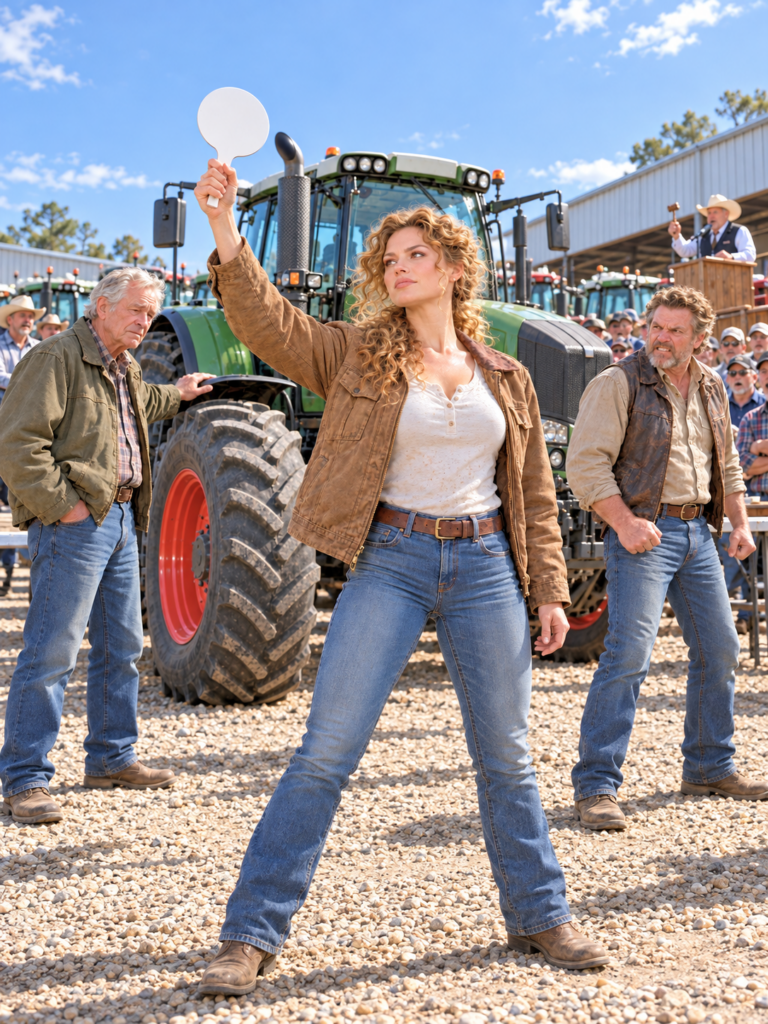
Rachel Monroe parked the F-150 at the far edge of the Harland County Equipment Auction lot and killed the engine. The truck settled with a soft rattle of loose sheet metal. Mud had dried in the wheel wells so thick it looked like someone had packed it there on purpose. The side mirror hung by a strip of black electrical tape that had been replaced twice already this season. She sat for a moment with both hands on the wheel and watched the lot through the dirty glass.
Dealers moved between the rows of equipment with the easy, appraising walk of men who had spent thirty years deciding in half a minute what a machine and the person standing next to it were worth. A couple of them glanced her way. One looked long enough to note the work jacket, the boots, the truck, then turned back to the man he was talking to. Rachel got out. The boots hit the gravel with the same sound they had made on the church steps six years ago. She had not replaced them. There had never seemed to be a reason.
She walked past a row of grain carts and stopped near the back fence where the older machines were parked. A seller in a clean shirt approached her before she had said a word. He started talking about financing options, payment plans, the kind of help a person might need if they were looking at equipment that was probably out of reach. Rachel listened until he finished, then thanked him and kept walking. She heard him say something low to the man beside him. She did not turn around.
Dean Mercer was standing near the registration tent with his assistant. He watched her for maybe ten seconds. Then he leaned in and spoke loud enough that the edges of the words carried across the open ground. He said not to waste too much time on her. She was shopping with hope, not money. Rachel kept her face still and her eyes on the equipment. She had heard versions of that sentence in three counties. She had learned not to answer them.
The sound that stopped the talking came from the far entrance. A diesel engine, low and steady, not the high idle of a machine being moved for display but the measured pace of someone who had driven it a long way and still intended to drive it farther. People turned. Rachel turned with them.
Walter Grayson brought the Fendt 926 Vario through the gate and onto the grass strip that led to the auction block. He was seventy-four. He drove with one hand on the wheel and the other resting on the armrest, the way a man drives a machine he has known longer than some of the people watching him have been alive. The tractor was clean in the way that comes from work done carefully, not from a wash bay the morning of the sale. The paint was still green where it should have been. The cab glass was clear. There were no fresh dents from loading and unloading. Several men in the crowd recognized it before they fully registered the man behind the wheel. In Harland County, equipment rumors moved almost as fast as weather, and Walter’s Fendt was one of the machines people knew by association. They knew which fields it had pulled, which seasons it had finished, and what it had cost him to keep.
He had bought it with Helen after a year that had nearly ended the farm. Custom harvest work for neighbors had paid the note, kept the land, and raised three children without the constant low sound of unpaid bills in the kitchen. After Helen died, Walter sold the combine, the planter, the grain carts, most of the livestock, and a good portion of the ground itself. The Fendt stayed. A dealer had once offered him a serious number for it. Walter had looked at the man and said, without raising his voice, that he would sell the farm before he sold that tractor. The dealer had taken it for sentiment. It had not only been sentiment.
Dean crossed the lot toward the tractor almost as soon as the engine shut off. He told Walter he was not selling that machine. Walter climbed down, closed the door, and said that today he was. He did not offer an explanation. The auctioneer checked the paperwork, confirmed the title, and announced that there was no reserve. Rachel walked to the open cab door and looked inside. There were notes tucked near the seat, a paper map with pencil marks, a worn notebook with acreage numbers written along the margins. She asked Walter why he was selling it. He said he did not need it anymore. She looked at his face. His eyes did not match the answer.
The bidding opened. Dean came in high and early, the way he did when he wanted the room to understand that the machine already belonged to someone. Rachel entered at twenty-eight thousand and stayed in. She watched Dean more than she watched the auctioneer. At forty-nine thousand he began speaking directly to her, loud enough for the people nearest the block to hear and enjoy it. He asked whether she understood that winning the bid meant actually paying for it. A few people laughed. Rachel raised her number. Fifty-four. Dean answered at fifty-six. She went to fifty-eight. Dean went quiet. The gavel came down.
Dean turned to the auction staff and requested proof of funds before the tractor left the lot. It was a legal request. It was also a public one, made in front of a crowd that was still watching. Rachel understood what he was doing and what it would cost her to answer. She carried the corporate authorization in the inside pocket of her jacket out of habit. Handing it over would put the name Monroe Agricultural Services on a terminal screen where anyone nearby could read it. She looked at Walter. He stood a few feet away with the same unreadable expression he had worn since he climbed down. She handed over the paper.
The name came up. One person read it aloud. Another took out a phone. Within a minute the information had moved through the crowd the way information moves at a county auction—fast, irreversible, and loud. Monroe Agricultural Services meant something in three counties. The people who recognized the name understood that the woman in the muddy boots had just outbid Dean Mercer for a tractor she could have bought twice over without filing a variance report. Phones came out. Someone read a company profile from a search result. A seller who had barely glanced at her twenty minutes earlier walked toward her with his hand out and a sudden memory of a combine he had forgotten to mention was available.
Dean stood near the terminal. His expression had stopped pretending to be anything other than what it was. He said nothing else. There was nothing useful left for him to say.
Rachel did not enjoy the shift in the room the way she might have expected to. She had been in this position before—the moment when people recalibrated and warmth arrived from directions that had been cold a few minutes earlier—and she had long since stopped finding it satisfying. What she noticed instead was Walter standing off to the side, watching the whole thing with the careful attention of a man who had seen rooms change temperature before and was not particularly surprised by any of it.
He asked her why she had let everyone think she was broke. She told him the truth. Once people saw money, they started showing her what they thought she wanted to see instead of what was actually there. Walter considered that for a moment. Then he told her not to make the mistake of thinking money was the only thing that blinded people. She did not fully understand what he meant. Not yet.
Part 2
They brought the Fendt to the Monroe equipment yard that afternoon. One of the operators began going through the cab to document the machine’s condition for the files. That was how the notebook was found, tucked behind the seat, thick and soft-covered, the kind that gets carried so often it starts to conform to the shape of the pocket it lives in. Rachel opened it expecting maintenance records. What she found instead was something closer to an archive.
Nearly twenty-seven years of handwritten field notes covered the pages from front to back. Every farm Walter had worked was documented—not just acreage and crop type, but the specific character of each property. Which fields drained fast after rain and which ones held water for days. Which roads looked fine on a map but would not take a loaded grain cart without risking a rear axle. Which bridges could handle the weight and which ones the county had quietly stopped maintaining. When each farmer typically wanted to start and whether that preference matched what the ground was actually ready to do. The notes were not organized like a database. They were organized like memory—layered, contextual, full of the kind of detail that only accumulates through years of showing up and paying attention.
Rachel spread the pages out on the operations table. Olivia Barrett, her operations director, helped enter the locations into the routing system. Within a few hours a pattern emerged that neither of them had expected. The farms Walter had served or monitored over the years were scattered in a way that looked random from above—too small individually to attract serious contractor interest, too spread out to seem worth the logistics. But when you sequenced them by soil readiness, crop maturity, and the natural movement of machinery through the region, they did not look scattered at all. They linked, farm by farm, field by field. They formed a continuous corridor that a well-organized operation could work start to finish without backtracking.
Rachel added up the total acreage. The number that came back was over eighteen thousand acres. Eighteen thousand acres of small farms that the large contractors had written off as unprofitable, that sat outside the reach of the corporate harvest operations that had come to dominate the region. Eighteen thousand acres that nobody was adequately serving. Olivia looked at the map for a long moment and said it was the size of a county they had been trying to crack for two years, except nobody had ever connected the pieces.
Rachel went back to Walter the next morning with the notebook and a printed map. She told him what she had found. He said it was a list of farms. She told him it was a network. He disagreed. She offered him one hundred thousand dollars for the rights to use it. He said no. She went to two hundred and fifty thousand. He closed the notebook. He told her she still did not understand what she was looking at. When she said she was trying to pay him what it was worth, he told her she was not. She was trying to turn what he knew into something she knew how to measure.
He opened the notebook to a page near the middle and pointed to a name. A farmer who had called him at three-forty in the morning when his combine threw a belt and he had no backup. Another name—a widow whose crop Walter had harvested first one season without being asked because he could see the rain coming and knew she could not afford to lose the yield. Another family that had nearly lost their entire crop one year when a large contractor had simply not shown up. He looked at Rachel and told her those were not accounts. They were people.
Rachel drove back to her office with the notebook still in the seat beside her. She sat with that sentence for a long time. She had spent years protecting herself from being misjudged by keeping her money invisible. And then she had looked at Walter Grayson’s twenty-seven years of handwritten knowledge and immediately tried to buy it. She had done to him exactly what she had always resented people doing to her—reduced him to the most transactable version of himself and called it fair.
Part 3
She went back a second time, not with an offer, but with a large-format map spread across his workbench. The farms, the weather zones, the road restrictions, the estimated crop windows. She told him she did not want the notebook. She wanted him to show her where her map was wrong. Walter looked at it for a long moment, then pulled up a chair.
They worked through it over several hours. Rachel brought satellite data, moisture readings, and route optimization outputs. Walter corrected her on the ground. A field she had routed early that sat on heavy clay and would be impassible after any significant rain. A road that looked viable until you were actually on it with a loaded trailer. Two farms she had separated in the sequence that Walter had always worked back to back because they dried out at the same rate and shared a usable access point. Olivia, watching from across the table, said quietly to Rachel that Walter did not have old data. He had context. And context, unlike data, could not be extracted from a notebook and uploaded.
Monroe Agricultural Services launched the small-farm harvest network with an initial corridor of just over three thousand acres. More farms signed on within weeks. Then six thousand. Then ten thousand. Walter began spending mornings at the operations yard, reviewing routes that the software flagged as optimal and flagging the ones that looked right on screen but would not survive first contact with actual ground conditions. He did not announce his involvement. He just showed up, and people in the yard started routing their questions through him the same way you use a landmark—naturally, without thinking much about it.
He trained a young operator named Ethan Price on the Fendt. He showed him how the tractor handled in soft ground, where its weight sat, how it responded when you were pulling a loaded grain cart across a field that was wetter than it looked. Ethan listened the way a man listens when he understands that the person speaking has already made the mistakes he is trying not to make. Walter did not talk much about Helen while he was teaching. But once, when they were checking the rear differential after a long day, he mentioned that she had been the one who insisted they buy the machine in the first place. She had said the farm needed something that would still be there when the season went wrong. He had not argued with her. He rarely had.
Part 4
Dean Mercer reappeared. He had connected with a large regional contractor. Once word reached him about what Rachel was building, they began cutting prices on the farms at the edges of her network, targeting the ones that had signed on most recently, the ones whose loyalty had not been tested yet. A handful of farms pulled their commitments. Rachel’s board called an emergency meeting and made very clear that the numbers were starting to concern them. The conversation was not comfortable.
And then the weather model updated. A major rain system had shifted track. It was no longer arriving in a week. It was arriving in seventy-two hours, and nearly half the acres in Rachel’s network were still standing in the field. The routing software had been running for forty minutes when it returned the same answer for the third time. At current capacity, with the machines and operators Rachel had committed to the network, completing the remaining harvest would take just over four days. The rain was arriving in three. The gap was not close. It was not a matter of pushing people harder or squeezing an extra hour out of each shift. The model simply did not work.
Rachel and Walter were looking at the same map when Walter pointed to a field near the eastern edge of the network, a property that the software had ranked low priority because of its distance from the main corridor. Rachel assumed he was about to suggest cutting it. He was not. He told her she kept routing by miles. She told him that was how transportation worked. He shook his head slowly and told her that was not how harvest worked. He pointed to a cluster of fields she had sequenced for the following day—closer, more convenient on paper, and sitting on some of the heaviest clay soil in the county. If rain came early, those fields would not take machinery for a week. The distant field he was pointing to had sandy loam that drained within hours of a light rain. If the system tracked wet, she would lose the close fields regardless. But the far one she could still finish even after the front moved through. He did not hand her a solution. He gave her a principle. The software had not been built to understand it. Stop optimizing for distance, and start asking which ground would stop letting you in first.
Rachel stood up and called her operations team together. Olivia had the routing board pulled up before Rachel finished the first sentence. Rachel told them to discard the existing route model entirely and rebuild it from scratch. Sequencing every field not by proximity, but by vulnerability—heaviest soil and worst drainage first, most forgiving ground last. She layered in crop moisture windows, machine mobility ratings, road weight restrictions, and the handwritten field notes from Walter’s notebook that her team had been digitizing over the previous weeks. The new model took two hours to build. When it came back, the math was different. Not comfortable—there was no version of this that was comfortable—but possible. Two continuous shifts. Fuel delivered to the field instead of pulling machines back to the yard. Grain carts staged ahead of the combines instead of trailing them, and the fleet divided into three moving corridors that would work the landscape from its most fragile edges inward. If everything held, they would finish with hours to spare. If one corridor fell behind, they would not. Rachel told the team that nobody was going home until the rain arrived.
Part 5
Before the operation moved out, Walter walked to the equipment yard where the Fendt 926 Vario had been staged with the rest of the fleet. Ethan Price was running pre-checks on the machine. He looked up when Walter approached and asked if he was sure he did not want to take it himself. Walter looked at the tractor for a moment—the machine he had believed, for longer than he would have admitted, was the last proof that he was still worth something—and told Ethan it was just a tractor. He told him to let it work.
The three corridors moved out before dawn. Corridor One covered the eastern farms: thirty-two hundred acres of corn that had been sitting at the edge of its harvest window for five days. Corridor Two ran the central ground: fifty-eight hundred acres spread across eleven properties, the most logistically complex section of the network, with two county road crossings and a bridge that Walter had flagged as weight-sensitive above a certain load configuration. Corridor Three handled the western farms: nine thousand acres of soybeans that had dried down faster than projected and were ready to run. Together the three corridors accounted for the full eighteen thousand acres still standing.
Rachel stayed at the operations center and managed the flow of information the way she had managed logistics her entire career—by keeping the overall picture clear while staying close enough to the details to catch problems before they became failures. A bridge closure on a secondary road forced a truck reroute through a longer county highway. A combine in Corridor Two developed a sensor fault that triggered a shutdown, and Rachel pulled a machine from Corridor One’s reserve to fill the gap within the hour. A farm on the western edge of Corridor Three called to say a large contractor had shown up that morning, promising to have their fields done before rain and asking significantly less per acre. Rachel called the farmer directly, not to argue, but to ask one straightforward question: whether that contractor had a single machine within twenty miles of his property right now. The farmer said he did not think so. Rachel told him to call her back when they showed up, and in the meantime her equipment was already staged at his field entrance. He stayed in the network.
Twelve hours passed, then twenty-four, then forty-eight. The radar showed the front accelerating slightly, arriving closer to sixty hours than seventy-two. The final group of fields, a cluster of properties at the northern boundary of the network, was running behind the projection—not catastrophically, but enough that the operations team flagged it as a concern. The software, rerun with updated machine positions and remaining acreage, showed a window that had narrowed to almost nothing. Walter looked at the map of remaining fields and identified a dry window—a gap in the precipitation forecast that suggested the rain would arrive unevenly, with the northern farms receiving the first bands and the westernmost properties getting a brief additional window before the system fully covered the region. If Rachel moved two combines from their current assignment to the western fields immediately and ran them through the night, she could clear the last of the vulnerable acres before the front closed in. Rachel looked at the data. She looked at Walter. He said nothing else. He had told her what the ground was doing. What she did with that information was hers to decide. She told the team to move the machines.
The Fendt led the grain carts through a field access road that Walter had noted in his records as the only viable heavy-load route into the northern cluster—a detail that had not appeared on any county map Rachel’s software had access to. The combines went in behind it. The team ran through the night without rotation, operators eating in cabs and fuel trucks staying positioned at the field edges. At one-forty in the morning, with the radar showing the leading edge of precipitation forty miles out, the last grain cart cleared the final gate. Ethan drove the Fendt out of the field and across the gravel road to the staging area. He cut the engine. Somewhere to the north, the first rumble of distant thunder arrived low and steady—the kind that does not announce itself dramatically, just appears and makes clear that it has been building for a while. The operation screen showed the network total: eighteen thousand two hundred and thirty acres completed.
Rachel stood in front of the monitor for a long moment. Walter was beside her. She told him he had been right. He asked about what. She looked at the list of farm names filling the screen—Hartley, Bradock, Simmons, Crane, all the others—and told him those were not accounts. They were people. Walter looked at the number on the screen and understood, perhaps for the first time, that the knowledge he had spent twenty-seven years accumulating had not disappeared when the phone stopped ringing. It had simply been waiting for someone who could see it.
In the weeks that followed, the board stopped calling the small-farm model unscalable. The network expanded into the next county. Walter joined Monroe Agricultural Services in a formal capacity as founding field adviser—not as a consultant brought in for meetings, but as the person who reviewed every harvest corridor before it was finalized, who trained dispatchers on the difference between a route that looked efficient and one that would actually survive contact with the ground. The Fendt 926 Vario remained in the company fleet, assigned to the Grayson field program where operators like Ethan were trained on the kind of field judgment that no software had yet figured out how to replace. Dean Mercer’s partnership with the regional contractor produced no lasting results in the area. The farmers who had briefly considered switching came back the following season without much explanation. The results from that harvest spoke clearly enough on their own.
One full season after the harvest, Rachel Monroe returned to the Harland County auction yard wearing the same faded work jacket and the same mud-worn boots she had worn the first time. She was not there for any machine in particular. Walter rode with her, and neither of them said much on the drive over. The yard looked the same as it always did—rows of equipment in various states of wear, dealers walking the lot with the practiced ease of people who had been reading strangers for thirty years. A man near the entrance recognized Rachel and smiled. He told her she was still dressing like she was broke. Before Rachel could say anything, Walter told the man she was not pretending to be broke. He said she was giving people a chance to show what they saw before money told them what to see.
Then the sound came—the low, familiar roll of a diesel engine from the far entrance. The Fendt 926 Vario came into the lot with Ethan Price behind the wheel, steady and unhurried, the same way Walter had driven it into this same yard a season ago. Someone standing near Walter watched the machine and asked whether it bothered him to see someone else in that cab. Walter watched the Fendt move through the yard. He said it was not his value anymore. Rachel did not look at him when he said it. She did not need to. She had heard what it cost him to mean those words instead of just say them, and she understood the distance between those two things better than she ever had before. The tractor kept moving. The auction went on around them. Neither of them spoke again for a while, and the silence between them was the easy kind—the kind that only exists between people who have already said what needed saying out in a field somewhere in the dark just before the rain arrived.

