
the auctioneer said nine hundred or walk away and the men laughed at the woman who bought the knocking john deere but the fields showed who had been listening
Part 1
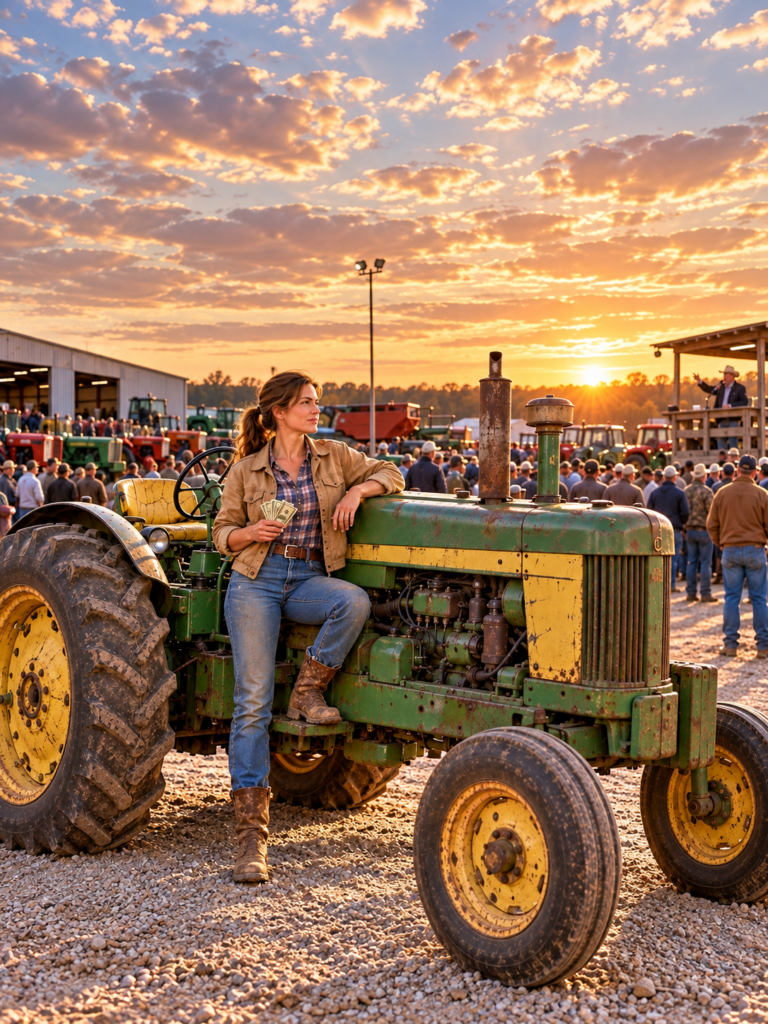
The auction yard smelled of diesel, wet gravel, and the sharp metal scent that rises when old machines are started after sitting too long. Evelyn Hartwell stood with her hands in the pockets of a faded canvas jacket, the torn cuff of one sleeve brushing her wrist. She was thirty, but the lines at the corners of her eyes and the grease worked deep into her knuckles made some of the men glance twice. She farmed eighty-six acres west of Sparta, Wisconsin, most of it hay and feed corn, with a handful of cattle in the back pasture. Nothing on the place was new. The house needed paint. The barn doors dragged when the weather turned wet. She had learned early that wishing did not fix what broke.
The John Deere sat on the gravel with its green paint faded to the color of old grass. Rust showed along the fenders. The seat was split, stuffing showing through. Someone had started it earlier. The sound it made was wrong—a heavy metallic knock that rose and fell with each revolution, the kind of sound that emptied a circle of buyers. Most of the men had already drifted toward a red International Harvester that idled cleanly nearby. The auctioneer on the raised platform kept calling bids into the microphone, but the Deere drew only quiet stares.
Oren Bishop stood closest to it, a broad man in a seed-company cap, arms folded. He had farmed the county longer than Evelyn had been alive. When the clerk asked if anyone wanted to open the bidding, Oren did not wait.
“Nine hundred cash,” he said, loud enough for the nearby men to hear. “Right now. Or walk away.”
A few chuckles moved through the small circle. Evelyn felt them watching her. She had come with the money folded inside her jacket, saved across two seasons after seed bills, fuel, and the ordinary repairs that never stopped. A leaking roof on the machine shed and a hay wagon that still needed bearings had both been waiting. She had told herself she would only look.
The knock continued. She listened the way she had taught herself to listen after a mistake she still remembered. Years earlier, at nineteen, a hay elevator had begun pounding under load. She had spent two days tearing into the gearbox before she found a single damaged chain link striking the guard with every turn. The gears had been fine. Since then she had kept one rule: never decide where a noise comes from until you know what is moving.
She stepped closer while the engine ran. When the operator shut it down, she rested one hand near the flywheel. There was play. Small, but it should not have been there. The men nearest her went quieter.
“There’s play here,” she said. “Shouldn’t be.”
Laughter came again, sharper this time. Oren’s mouth turned.
“Go right ahead, kid,” he said. “Buy yourself a busted crank.”
Evelyn looked at the tractor once more. The paint did not matter. The seat did not matter. What mattered was whether the knock lived in the crankshaft itself or in something that could still be reached. She could not be certain. She could only be certain that walking away without knowing would cost her more than the money.
“Write the ticket,” she said. “I’m taking the Deere.”
Oren counted the bills twice before he handed them to the clerk. The clerk wrote her name beside the old John Deere. Around them the auction kept moving. A man called bids for the International. Gravel cracked under boots. The men nearest the Deere stayed quiet a moment longer, then began to turn away.
Glenn Trowbridge stepped closer. He was a neighbor in the loose way county people were neighbors—seen at sales, recognized by the shape of his truck and the way he stood. He looked at the silent tractor, then at her.
“Hope you brought a trailer,” he said. “That thing won’t make it home under its own power.”
“I didn’t plan to drive it,” she answered.
He studied her a moment. “That’s probably the first sensible decision you’ve made today.”
A few men smiled. Evelyn folded the sales slip and put it into the inside pocket of her jacket. Nine hundred dollars was not spare money. She walked around the Deere once more, listening to the quiet that had replaced the knock. Behind her the auctioneer’s voice rose again. She kept walking, but the sound of that heavy knock followed her across the gravel until she reached the edge of the yard and began looking for someone with a tow truck.
By the time the truck turned into her lane, the afternoon had thinned and long shadows stretched across the pasture. The driver winched the Deere onto the trailer and later lowered it beside the machine shed. Evelyn paid him and stood alone looking at the old green hood. The money was gone. The leaking roof and the hay wagon were still waiting. Inside the flywheel connection something had moved when it should have held. Tomorrow she would take it apart. Tonight she could only stand in the cooling air and hope she had listened closely enough.
Part 2
Frost silvered the fence wire behind the machine shed when Evelyn came outside with a mug of coffee. The John Deere sat where the tow driver had left it, facing the open doors. Yesterday it had made enough noise to empty a yard. This morning it looked ordinary, almost harmless. She pushed the doors wide, hitched a tow bar to her smaller tractor, and eased the Deere onto the concrete floor. She would not start the diesel again until she understood the knock.
Under the shop lights the machine showed its age plainly. Dirt collected around the bolts. Oil stains marked the lower castings. Evelyn examined the flywheel area before she wiped anything away. A reddish powder clung near the hub. She touched it with one finger and rubbed it against her thumb. It was not ordinary field dust. It had the fine dark feel of metal worn against metal. Two fitted surfaces had been moving when they should have held tight. For the first time since the auction she felt a small relief. The noise might not have come from deep inside the engine after all.
Then she saw the marks around the connection. They were not fresh. Whatever had been loose had been working loose for a long time. She set her coffee down and opened a stained service manual on the bench. Before she loosened anything she sketched the position of the parts and wrote down what she could see. Her pencil paused beside one word: splines. The flywheel fitted onto the end of the crankshaft. If that joint had been pounding under load, the damage might reach farther than the hub. A replacement part would mean little if the metal it gripped was already worn beyond repair.
She laid clean cardboard beneath the flywheel and began. The first fastener resisted, then gave with a dry crack. She worked slowly, keeping each part in order and making certain the heavy assembly stayed supported. Near noon the outer cover was off. She aimed her work light into the narrow space behind it. On the edge of the hub she saw a bright crescent worn into metal that should have been smooth. The mark was small enough to hide beneath a thumb, but it told her the pounding had gone on for a long time. Her relief vanished.
The flywheel was too heavy to handle by hand. She rolled the shop hoist alongside the tractor, secured the lifting chain, and took the weight before she eased the assembly loose. It did not come willingly. She worked the puller a little at a time. Dust fell onto the cardboard. Finally the flywheel shifted with a dull pop. When the hub cleared the shaft she understood why the tractor had knocked. The internal splines were rounded along their working edges. What should have been sharp, even ridges had been battered into shallow shining slopes. The crankshaft was marked too. Its teeth had not disappeared, but several showed the same ugly wear.
Evelyn lowered the flywheel onto blocks and wiped her hands. Through the open door she could see the hay wagon waiting beneath a torn tarp. If only the hub was bad, there might still be a way forward. If the crankshaft could no longer hold a fitted flywheel securely, the old Deere could become the most expensive mistake she had ever made. She took out her calipers and began writing measurements on a clean sheet of paper. She checked them twice. Then she reached for the telephone mounted beside the workbench.
Warren Koenig answered at his machine shop in Sparta. He had spent most of his life fitting shafts, bushings, and worn farm machinery back together. Evelyn told him what she had found without softening any of it. Warren listened, then asked one question.
“How much of the shaft is still there?”
“Enough that I can’t call it ruined,” she said. “Not enough that I’ll trust a guess.”
There was a long pause. “Bring me the flywheel and your measurements,” he said. “But don’t promise yourself anything yet.”
After she hung up she stood looking at the silent Deere. For the first time since she handed over the money she wondered whether Glenn had been right. The shop felt colder. Outside, the wind pressed against the shed door. She covered the exposed shaft with clean cloth, closed the doors, and went to feed the cattle while the light still held.
Part 3
Warren Koenig’s machine shop smelled of cutting oil and warm steel. Evelyn arrived after breakfast with the John Deere flywheel secured in a wooden cradle in her pickup. Warren used his chain hoist to set it on a stand. He never asked what she had paid. He ran a fingertip across the battered hub. Beneath a work lamp the inner spline showed rounded edges and reddish dust still clung to the corners.
“That didn’t happen in one afternoon,” he said.
“No,” Evelyn answered. “And I don’t know what it did to the shaft.”
Warren took measurements and checked the hub against the figures she had brought. Every time he wrote down another number she watched his pencil, hoping his face would tell her something first. It never did. At last he laid the tool aside.
“A new flywheel won’t fix a shaft it can’t grip.”
She looked toward the window. A grain truck passed slowly through town, its bed rattling over the pavement. Back at her farm the hay wagon still waited for bearings. She had already spent the money meant for that work.
“Can you tell from this?” she asked.
“Not without seeing the crankshaft.”
They drove to her farm that afternoon. In the cold shed Warren bent over the exposed shaft while Evelyn held the light. He cleaned the section, inspected the damaged spline edges, then checked the least worn surfaces with his measuring tools. For a while the only sounds were the wind pressing against the shed door and a loose gutter tapping outside.
“There’s wear,” Warren finally said, “enough that putting the old hub back would be throwing good money after bad.”
Evelyn felt the words settle in her stomach. “But is it finished?”
Warren straightened slowly. “I haven’t said that.” He showed her the difference between the battered working faces and the metal that still held its original shape. Some damage could be corrected with a properly fitted replacement assembly. Too much lost material, however, would leave no reliable connection at all. He needed another set of measurements and the correct specifications before he could recommend anything.
After his truck disappeared down the lane, Evelyn returned to the shed. The exposed crankshaft looked smaller without the flywheel around it. She laid her hand on the bench beside the notebook that held every measurement. Finding the knock had been the easy part. Saving the tractor was still an open question. She thought of the men at the auction, the way their laughter had risen and then stopped when she paid. She thought of the two seasons of careful saving. She thought of the roof that still leaked when the rain came hard. None of those thoughts changed the measurements on the paper. She closed the notebook, covered the shaft again, and went inside to start supper while there was still light enough to see the stove.
Warren called the next morning while she was feeding the cattle. She hurried to the kitchen, pulling off one muddy boot before she answered.
“I checked those measurements against the service figures,” he said. “The shaft isn’t good as new, but there’s enough sound metal left for a properly fitted replacement hub.”
Evelyn leaned against the counter. Only the kitchen clock answered for a moment. “You’re sure?”
“I’m sure of my measurements. I won’t promise what I haven’t tested.”
It was the first good news she had received since the auction. Warren had found a supplier who could provide a replacement flywheel assembly suited to the repair. He would inspect the fit before anything went back on the tractor. There could be no filing the worn teeth until they looked better, or tightening loose bolts until the noise disappeared. The connection had to hold when the diesel pulled hard. Then he named the price.
Evelyn wrote it beneath the nine hundred already spent. Her pencil stopped. She could pay Warren, but only by delaying the hay wagon and leaving almost nothing for unexpected repairs. She looked out the kitchen window at the machine shed. The Deere was still open inside it. The cattle were fed. The day was ordinary except for the decision waiting on the notepad.
“Order it,” she finally said.
For the next several days the John Deere stood open in the shed. Evelyn cleaned old oil from the housing, examined the mounting surfaces, and sorted the removed parts on the bench. Each evening she covered the exposed shaft with clean cloth before she closed the doors. On the third morning Warren arrived with the replacement assembly. Together they checked the fit, stopping twice to compare their readings. Evelyn watched him run a fingertip across the contact surfaces, searching for the slightest unevenness.
“Now we have something worth putting together,” he said.
They supported the heavy flywheel with the hoist and brought it carefully into position. Evelyn followed the service instructions, checking alignment and tightening the fasteners in the proper sequence. Warren checked her work, then stepped aside while she made the final inspection. By late afternoon the tools were back on the bench. The tractor stood whole again, its green hood catching the last light through the doors. Evelyn climbed onto the worn seat and rested one hand beside the controls. She had wanted this moment since the auction, yet she did not reach for the starter. The new connection looked right. Every measurement said it should hold. She still remembered the sound of that knock.
Part 4
Evelyn stayed on the cracked seat while the last sunlight crept across the shop floor. Warren stood beside the open doorway, his hands tucked into his jacket. Neither of them said much. They had checked the fit, the fasteners, and the tools left on the bench. There was nothing more to learn with the engine silent. She followed the starting procedure. The old diesel caught, stumbled through a few heavy turns, then settled into the deep, uneven rhythm that had once made these tractors familiar across Wisconsin. Evelyn held her breath. The sharp metallic knock was gone. She looked toward Warren. He gave a small nod, but neither of them smiled. She watched the engine, listening beneath the ordinary two-cylinder beat for anything that did not belong. Minutes passed. The oil pressure held. No fresh dust appeared around the flywheel. When the engine began to warm she eased the throttle forward. A dull thump came from the left side.
She brought the speed back down. She tried one careful change again. Thump. It was softer than the hammering at the auction, but she felt it through the seat. She shut the engine down at once. Warren came across the floor.
“You heard it?”
“I felt it,” she said.
They waited for the machinery to stop completely before they opened the inspection area. Evelyn set a dial indicator against the end of the crankshaft and checked for movement along its length. Then she reset the gauge and repeated the measurement. The reading was too high. She checked it once more, slowly, hoping the needle would settle at a different mark. It did not. Warren compared it with the service manual.
“That shaft is walking farther than it should.”
Evelyn stared at the needle. The replacement hub had corrected the looseness they could see. It had not corrected everything that years of pounding might have done. She asked whether the new flywheel would have to come off again.
“Maybe,” Warren said. “First we find out where that extra movement is coming from.”
Outside, darkness gathered beyond the pasture fence. Evelyn thought of the payment she had made that morning. The hay wagon still waiting. And the crowd that had laughed when she bought the Deere. Then she reached for her notebook and wrote down the reading. The knock had almost vanished, but almost was not good enough to take a tractor into a field.
Morning brought cold rain against the machine shed roof. Evelyn had barely slept. Each time she closed her eyes she saw the dial indicator moving too far and heard that dull thump beneath the engine’s rhythm. Warren arrived with his service books wrapped in a grocery sack. Together they checked the indicator again, then traced the unwanted movement to the crankshaft’s thrust arrangement. Years of running with a loose flywheel had left wear that a new hub alone could not correct.
“The connection is holding now,” Warren said, “but the shaft still has room to move.”
Evelyn looked at the Deere. “Then we take care of that, too.”
The work was slower than either had hoped. They removed the parts needed for access, examined the worn thrust surfaces, and checked their measurements against the manual. Warren had a suitable replacement part at his shop, but he would not use it until they confirmed its dimensions. While he drove to Sparta, Evelyn cleaned the work area and laid the pieces in order on fresh cardboard. Rain traced silver lines down the windows. She thought of the nine hundred dollars and the neighbors who would say she should have walked away. She thought of the hay elevator years earlier and the wasted hours that had taught her to measure before she decided. She thought of the cattle waiting in the pasture and the ordinary work that would still be there whether the Deere ran or not.
By late afternoon Warren returned. They fitted the replacement, adjusted the assembly according to the service procedure, and checked the movement again. Evelyn set the indicator to zero and repeated the test three times. Each reading stayed within the specified range. Warren stepped back.
“Now I’m willing to hear it run.”
The next morning Evelyn finished the final inspections and brought the Deere outside into the clear air. She checked the oil, looked over the guards, and climbed onto the cracked seat. The diesel caught after its usual heavy turns. Two cylinders settled into their steady, rolling beat. Evelyn waited for the knock. Nothing. She brought the engine gradually to working temperature, changed speed carefully, and listened again. No metallic hammer, no thump. Warren watched the flywheel side from a safe distance, then raised one hand. Evelyn shut it down for another inspection. Nothing had shifted. They later gave the tractor a short, controlled pull with an empty wagon on level ground. The old Deere held its rhythm all the way home. For the first time since the auction Evelyn allowed herself a smile. She had a running tractor. Whether she had a working tractor was a question the fields would have to answer.
Part 5
Three mornings after the Deere pulled the empty wagon without a knock, the weather radio warned of hard winds crossing western Wisconsin by nightfall. Evelyn heard the report while she washed breakfast dishes. She looked through the kitchen window at the bare oaks bending along her fence. Her own corn was in, but plenty of farms still had ears drying on the stalk. A hard wind could flatten those rows and leave a man picking through the dirt for what the machine missed.
By noon the sky had turned the color of cold steel. Evelyn had finished checking the Deere’s oil and was listening to it idle when a pickup rolled slowly into her yard. She recognized the driver before he stepped out. Glenn Trowbridge. At the auction he had told her the tractor would never make it home under its own power. Now he stood beside it, listening to the diesel idle. The old engine beat steadily with none of the hammering that had driven bidders away.
“That’s the nine hundred dollar Deere?” he asked.
“Same tractor.”
He walked toward the left side, stopping well clear of the moving parts. His eyes settled where the flywheel had been loose. “You fixed it?”
“I fixed what I found. Then I tested it.”
Glenn took off his cap and looked across the yard. Evelyn waited. She knew what pride sounded like when it was having a hard time finding words.
“My tractor lost its power take-off yesterday,” he finally said. “I’ve got eight acres of dry ear corn standing, and the picker won’t run without it. Nobody nearby who can help. Everybody’s finishing their own fields. I called three places.”
A gust rattled the loose tin at the corner of the shed. Glenn glanced toward the darkening western sky. “If that wind lays the stalks down, I’m going to lose more than I can afford.”
Evelyn remembered his smile at the auction, the way he had spoken as though her nine hundred dollars belonged in the scrapyard. She could have repeated his words back to him. Instead she looked at the Deere.
“You trust it under load?” Glenn asked quietly.
“I do.”
He stared at her. He had come expecting a refusal, not an answer. “How much corn did you say?”
“Eight acres. Two-row picker. Wagons are ready.”
Evelyn listened to the diesel for one more steady beat, then reached for her jacket. “Let’s go see if we can get it in before the wind.”
Glenn led the way in his pickup with Evelyn following on the John Deere along the narrow county road. The diesel rolled steadily beneath her. On either side bare trees bent toward the east and dried leaves skittered across the pavement. The wind had arrived sooner than the radio predicted. At Glenn’s farm eight acres of standing corn stretched behind a weathered red barn. The ears hung low on brittle stalks. His two-row picker sat beside a wagon, gathering points dusty but straight. Glenn had already checked the machine and the wagons were waiting where he could swap them quickly.
Evelyn shut down the tractor before they connected the picker. Together they checked the drawbar hitch, the safety shields, and the power take-off shaft. She inspected the worn joints, then walked around the wagon. Nothing was going into the field until she knew the equipment behind her was ready. Glenn glanced at the sky.
“We better move.”
“We will,” she said. “But not with a loose shaft.”
When the checks were finished Evelyn climbed onto the cracked seat. She started the Deere and engaged the picker at a low engine speed, then brought it up to its proper working rhythm. The snapping rolls and gathering chains began to turn. She eased toward the first two rows. Dry stalks disappeared beneath the snouts. Ears traveled up the elevator and dropped into the wagon with a hollow wooden rattle. For a moment she watched the crop, then turned all her attention to the sound beneath her feet. The Deere was finally doing more than idling or pulling an empty wagon. Each stalk that entered the picker placed another demand on the engine. She could feel the load arrive through the seat and steering wheel.
Halfway down the field a gust pushed across the corn, rattling the leaves like loose paper. Evelyn held her speed. The engine deepened its note but gave no metallic knock. At the headland she disengaged the drive, stopped safely, and listened before she shut the engine off. Glenn approached from behind the wagon.
“Anything wrong?”
“Not yet.”
She checked the flywheel area for new dust or movement. Everything she could inspect remained where it belonged. She climbed back aboard as another gust bent the unpicked rows. One clean pass was a beginning. Nearly eight acres still stood between Glenn and the strongest wind.
Evelyn eased the John Deere back into the standing corn. The wind tugged at her jacket and the gathering chains rattled as the first stalks entered the picker. Behind her dry ears struck the wagon floor in a steady rain. She listened past that noise for the one sound she feared. There was no knock. At the end of each pass she turned carefully and lined up the next two rows. Glenn waited near the headland with his pickup, watching the wagon fill and the western sky grow darker. He had stopped looking at the old tractor as though it were a joke.
An hour passed, then another. The Deere worked at a steady pace, its two cylinders pulling against the picker without a stumble. Evelyn did not push it harder to beat the weather. She kept the engine at the speed the machine needed and let the rows come to her. When the wagon filled she shut down the drive and waited while Glenn brought the next one into place. He climbed down from his pickup with chaff in his hair and wind reddening his cheeks.
“Still sound right?”
“So far,” Evelyn said. “Keep those wagons coming.”
The first sharp gust hit halfway through the next section. Corn leaves slapped against the hood. Across the field a line of stalks bowed low before springing back. Evelyn felt the engine take a heavier bite as the picker entered a patch of tangled corn. Its note dropped, then steadied. She eased her forward speed rather than forcing it through. No hammering came from the flywheel side. No new vibration traveled through the seat.
By late afternoon the picked ground lay in long brown strips behind them. Glenn hauled another wagon toward the crib while Evelyn waited at the headland. She climbed down, shut off the tractor, and checked for heat, fresh metal dust, and looseness. Everything she could safely inspect remained sound. She looked toward the last standing rows. The wind was stronger now, bending their dry tops toward the ground. Glenn returned, stopped beside her, and followed her gaze.
“Think we’ll finish?”
Evelyn wiped her hands on a rag. “We’ll finish if we keep doing it right.”
She climbed back onto the cracked seat. The Deere started with its familiar heavy rhythm and the picker took the final rows. As the last ears rattled into the wagon a hard gust swept across the open field. Evelyn held the wheel steady and listened. The engine never knocked.
The last ears rattled into the wagon as a hard gust swept across Glenn Trowbridge’s field. Evelyn disengaged the picker, brought the John Deere to a stop at the headland, and looked behind her. Eight acres of dry corn had become rows of stubble. Not one standing row remained for the wind to flatten. Glenn came over with his cap pulled low. For a while he watched the old diesel idle. Its steady two-cylinder beat sounded nothing like the hammering they had heard at the auction.
“I called that one wrong,” he said.
Evelyn looked up.
“The tractor,” Glenn added, “and you. I figured you were throwing away nine hundred dollars. Didn’t think you knew what you were doing.”
“I didn’t know if I could save it,” she answered. “I just knew the noise wasn’t enough to tell me the whole story.”
Glenn glanced toward the wagon. “Well, you found out, and you got my corn in.”
He offered his hand. Evelyn shook it. There was no audience this time, no laughter, and nothing left for either of them to prove.
That night wind shook the shed doors on Evelyn’s farm. Branches scraped the roof and rain swept across the yard. By morning she could see patches of corn bent low along the county road. Glenn’s crop was already under cover. She went out to the shed and rested a hand on the Deere’s faded hood. The hay wagon still needed bearings. The roof still leaked. Her repair bills had not disappeared. But the old tractor had done honest work, and she knew exactly what had been repaired and why. A bad sound was not proof of a ruined engine, and a loud opinion was not the same as a careful diagnosis. She had taken the risk, listened, measured what she found, and asked for help when the job called for another pair of experienced hands. The fields had answered. That was enough.
the auctioneer said nine hundred or walk away and the men laughed at the woman who bought the knocking john deere but the fields showed who had been listening
Disclaimer: This story is fictional and created for entertainment purposes only.
Any names, characters, places, or events are fictitious or used fictitiously.
No real person or organization is intended to be portrayed.
Share:
Older story
the woman in the muddy boots outbid the dealer for the fendt 926 vario the old man swore he would keep until the day he died and then the rain came for every small farm no one else would touch
Newer story
the young woman in the grease stained jacket told the auction crowd she would finish eighty acres of stubble before the rain and keep the heavy disc harrow if that whistling john deere could pull it

