
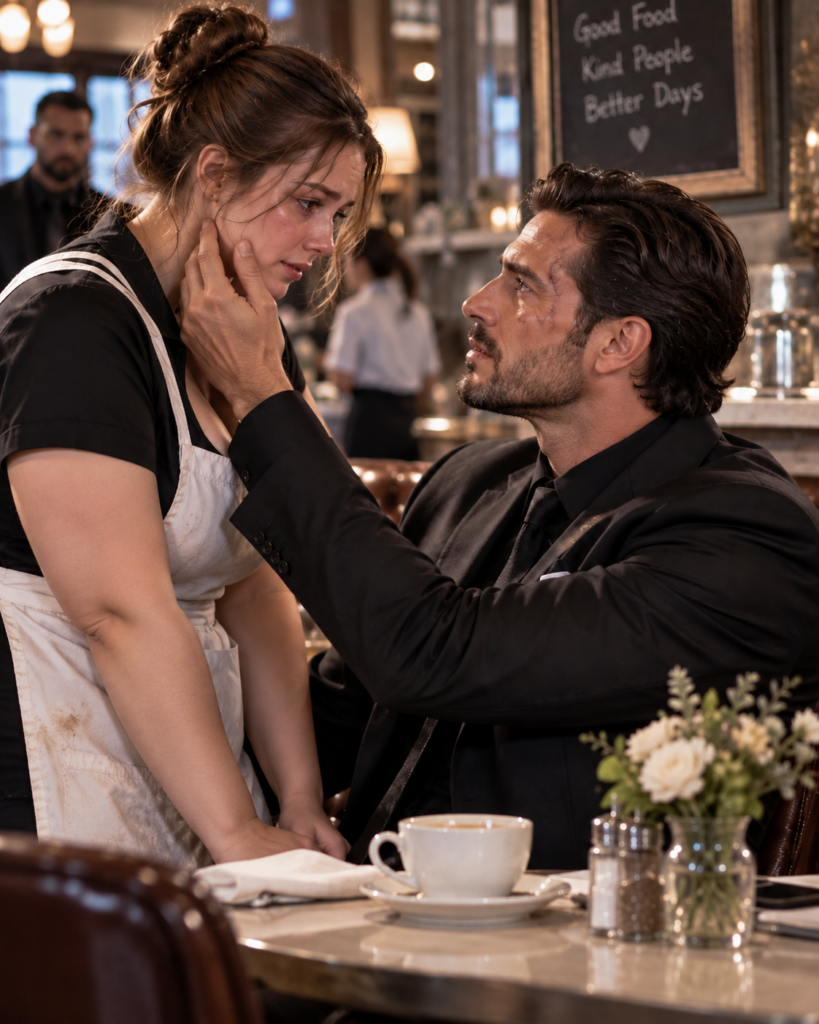
Three weeks earlier, I had dragged a bleeding stranger from a burning car and disappeared before the police arrived.
Now four armed guards stood inside my diner while their boss watched me as though he already knew every secret I had.
Then he placed a photograph on the table—and I realized the man I had saved was the one person in the city everyone else feared.

PART 1 — THE MAN WHO WALKED OUT OF THE FIRE
Rosie’s Diner smelled of scorched coffee, frying onions, and the lemon disinfectant we used when there was no money for anything better.
I had been working for eleven hours. My donated sneakers squeaked across the cracked linoleum, and the fluorescent lights buzzed in time with the ache behind my eyes.
“More coffee?” I asked the truck driver at table six.
He grunted without looking up.
At 11:47 p.m., three black SUVs stopped outside.
They moved with unsettling precision, their dark windows reflecting Rosie’s flickering neon sign. The bell above the entrance chimed as four men in tailored suits entered and quietly studied every exit.
Then their employer stepped through the door.
He was perhaps thirty-four, tall and dark-haired, wearing a charcoal suit that looked strangely elegant beneath the diner’s sickly lights. His gaze crossed the room and stopped on me.
“Table for one,” he said.
I led him to the back booth. One of his men swept the seats with a small electronic device before allowing him to sit.
“What can I bring you?”
“Whatever you recommend.”
“The meatloaf is good. The apple pie is better.”
“Both, then.” He paused. “Your name?”
Every instinct warned me not to answer.
“Emma.”
He repeated it slowly. “Emma.”
I recognized him then.
Dominic Salvatore had appeared on the news after prosecutors failed to connect him to an alleged criminal network. Rumors said his family controlled half the city’s underground economy. Other rumors said people who crossed him disappeared.
“I know who you are,” I whispered.
His guards shifted.
Dominic’s expression cooled. “Do you?”
“I mean—you look important.”
He watched me lie, then gave the smallest smile. “Bring my dinner, Emma. Sit while I eat.”
It was not quite an order. It was certainly not a request I felt free to refuse.
I returned with meatloaf, water, and pie. My hands shook hard enough to make the plates rattle.
“You’re afraid of me,” he observed.
“No.”
“Fear is sensible. Don’t insult us both.”
I sat opposite him.
“Why this diner?” I asked. “You could eat anywhere.”
He placed down his fork.
“Three weeks ago, someone attacked my car two blocks from here. My driver died. I was trapped when the fuel caught fire.”
The room narrowed around his voice.
I remembered the explosion shaking the diner windows. I remembered running outside with an extinguisher, crawling through smoke, and pulling an injured man away seconds before the car burned beyond reach.
Dominic slid a grainy security photograph across the table.
It showed me kneeling beside him.
“I spent three weeks finding you,” he said.
“That was you?”
“You saved my life.”
“I helped a stranger.”
“In my world, that distinction matters.”
He reached across the table and gently turned my hand palm-up. A pale burn scar crossed my wrist from that night.
“I pay my debts,” he said. “What do you need?”
“Nothing.”
His gaze moved over my worn uniform and exhausted face. “That is not true.”
The words escaped before pride could stop them.
“My landlord tripled the rent. I have a three-year-old daughter. We’re going to lose our apartment.”
Dominic released my hand and placed a cream-colored card on the table.
“One number,” he said. “Call tomorrow. My people will find you a safe home.”
“I can’t accept that.”
“Then have dinner with me.”
“What?”
“One dinner. Ask every question you’re too frightened to ask here.”
“And if I refuse?”
He stood. His guards immediately moved closer.
“I will respect your answer.”
Relief reached me too soon.
Then Dominic leaned down, his voice quiet beside my ear.
“But before you decide, you should know your landlord does not own your building.”
I looked up sharply.
“He works for the men who tried to kill me,” Dominic said. “And tonight, they photographed you through that window.”
PART 2 — THE DEBT THAT BECAME A TARGET
The Card on the Milk Crate
I did not sleep.
My daughter, Lily, lay curled against me beneath a blanket too thin for the October cold. Passing headlights crawled over the water-stained ceiling of our one-bedroom apartment, revealing cracks that branched like dark veins.
Dominic’s business card rested on the milk crate beside the bed.
One number. No name.
I watched it until dawn.
The refrigerator contained half a carton of milk, two apples, and a plastic container of pasta from the diner. My bank account held forty-seven dollars. Rent was due in thirteen days.
Poverty transforms decisions into traps. Pride tells you to refuse dangerous help; hunger asks whether pride can keep a child warm.
Lily stirred.
“Mommy?”
“I’m here.”
She opened her eyes. “Are we moving?”
The question stopped me.
“Why would you ask that?”
“Mr. Burke said our house costs more now.”
Our landlord had spoken to my three-year-old.
“When?”
“Yesterday. He said maybe we need a smaller place.”
A hard knot formed beneath my ribs.
“Did he come inside?”
“No. Mrs. Chen was with me.”
“Did he touch you?”
Lily frowned at the strange question. “He touched my hair.”
I sat upright.
The building’s pipes knocked inside the wall. Somewhere upstairs, a baby cried. The ordinary sounds suddenly felt like evidence that strangers could reach us whenever they wished.
I picked up Dominic’s card.
He answered on the first ring.
“Emma.”
“You knew I would call.”
“I hoped.”
“My landlord spoke to my daughter.”
Silence.
Then his voice changed—not louder, but stripped of warmth.
“Where is Lily now?”
“Beside me.”
“Do not take her outside. Marcus will arrive in nine minutes.”
“Who is Marcus?”
“The man I trust when trust matters.”
“I didn’t agree to anything.”
“No. But someone connected to my enemies approached your child. We can discuss pride after she is protected.”
The line went dead.
Eight minutes later, a knock sounded.
I looked through the peephole.
The large man with the scar through his eyebrow stood alone, hands visible.
“Miss Carter,” he called. “My name is Marcus Bell. Mr. Salvatore asked me to show you identification before you opened the door.”
He held a driver’s license and a private-security credential against the peephole.
I kept the chain fastened when I opened it.
Marcus was even larger in daylight, but his expression held none of Dominic’s sharp intensity.
“May I come in?”
“No.”
He nodded as if refusal were a reasonable answer.
“Then I’ll remain here. Two licensed protection officers are downstairs. Your landlord is not permitted into the building without notice under state law. Mr. Salvatore’s attorney has already informed him.”
“You work quickly.”
“Mr. Salvatore dislikes repeating preventable mistakes.”
“What does that mean?”
Marcus glanced toward Lily, who was peering around my leg.
“It means he should have provided security the moment he began searching for you.”
I lowered my voice. “Why was he searching?”
“You saved his life.”
“That cannot be the whole reason.”
“No,” Marcus said. “It probably isn’t.”
Before I could ask more, Lily stepped into view holding a stuffed rabbit by one ear.
“Are you a giant?”
Marcus considered this. “Only before breakfast.”
She smiled.
Something about his gentleness unsettled me more than intimidation would have.
“Mr. Salvatore would like you moved somewhere safe today,” he said. “Temporary housing. Your choice whether he knows the address.”
“He offered me dinner, not relocation.”
“The circumstances changed.”
“Because Burke touched Lily’s hair?”
“Because Burke should not have known her name.”
The hallway became colder.
Marcus handed me an envelope. Inside was a letter from a tenant-rights attorney explaining that the rent increase was unlawful. A second document showed my building belonged to North Harbor Property Group—not Mr. Burke.
“Who owns North Harbor?”
“A man named Anton Kozlov.”
I knew the name from local news. Kozlov operated nightclubs, towing companies, and several low-rent buildings known for impossible fees and sudden evictions.
“Is he one of the men who attacked Dominic?”
“That is being investigated.”
“Investigated by whom?”
“People qualified to do it.”
“That is not an answer.”
“It is the safest answer I can give in a hallway.”
He looked toward the stairs.
“We should leave.”
I packed two bags.
Not because Dominic had ordered it, I told myself, but because a stranger who knew my child’s name had entered the edges of our life. I took Lily’s medicine, two changes of clothes, her rabbit, and my mother’s wedding ring.
Everything we owned that mattered fit inside an old duffel bag.
Dinner Above the City
The temporary apartment belonged to a legal-aid foundation funded by one of Dominic’s companies.
That detail mattered to me. It meant we were not taken to a hidden safe house or locked inside his private world. The building had ordinary tenants, a doorman, security cameras, and a cheerful property manager who explained every rule directly to me.
No debt.
No unspoken price.
A tenant-rights attorney named Grace Patel met us there. She confirmed the housing arrangement in writing and advised me not to sign anything I had not reviewed independently.
“Mr. Salvatore agreed to that?” I asked.
“He paid for me to tell you when he is wrong.”
“That must become expensive.”
Grace smiled. “He considers it risk management.”
Lily fell asleep in the furnished bedroom before sunset.
At seven, Dominic arrived alone.
He wore a black coat darkened by rain. Without guards surrounding him, he appeared younger, though no less dangerous.
His gaze moved through the apartment before settling on me.
“Is she safe?”
“She’s asleep.”
Relief softened his face.
“You missed our dinner,” he said.
“I was busy discovering that my landlord works for your enemies.”
“Former landlord.”
“You cannot decide that.”
“No. Your attorney can. She believes you have grounds to terminate the lease.”
I folded my arms. “Do you arrange every conversation before entering it?”
“Usually.”
“That sounds exhausting.”
“It is why I rarely visit diners at midnight.”
Against my better judgment, I smiled.
We ate takeout at the small kitchen table because I refused his reservation at a private restaurant. Lily’s drawings from the afternoon lay between the containers.
“What do you really do?” I asked.
Dominic set down his fork.
“My family owns shipping warehouses, restaurants, construction firms, and security companies.”
“That is the brochure.”
“Yes.”
“I asked for the truth.”
He leaned back.
“My father built influence by operating outside the law. When he died, I inherited businesses that were partly legitimate and partly not. I have spent six years separating them.”
“You expect me to believe you’re a misunderstood businessman?”
“No.”
“Have you hurt people?”
His face became still.
“Yes.”
The answer frightened me.
Its directness kept me seated.
“Do you still?”
“I make decisions that have consequences. I have also turned evidence over to prosecutors, closed illegal operations, and made enemies among men who profited from the old system.”
“Kozlov?”
“He wanted our eastern shipping route. I refused because his cargo included trafficked workers and counterfeit medication.”
The food lost its taste.
“So he tried to kill you.”
“We believe so.”
“And because I saved you, he noticed me.”
“Yes.”
“Then you brought this danger to Lily.”
Pain crossed his face before control covered it.
“Yes.”
No excuse. No attempt to soften the cause.
“I’m sorry,” he said.
“Sorry does not make us safe.”
“No. Resources do.”
“There it is.”
“What?”
“The answer powerful men use when they don’t know how to repair fear.”
Dominic looked down at the little table. Lily had drawn three figures beneath a purple cloud. Two were smiling. The tallest had no mouth.
“My mother died when I was eleven,” he said. “My father doubled the guards and never spoke her name again. That was his answer to fear.”
“What happened to her?”
“She was caught between two families settling a dispute.”
“I’m sorry.”
“He called it the cost of weakness. I called it the day childhood ended.”
Rain tapped the windows.
“Why are you telling me this?”
“Because you asked for the truth.”
“No. You are telling me the part that makes you human.”
His eyes lifted.
“I am human.”
“That is what makes you more frightening. Monsters are simple.”
For a moment, neither spoke.
Then Dominic smiled faintly. “You are the first person who has said that to my face.”
“Most people enjoy staying alive.”
“So do you.”
“I have Lily. I don’t get to be careless.”
He looked at the closed bedroom door.
“What do you want from me?” I asked.
His answer came carefully.
“To repay the life you saved. To protect yours. And to know you.”
“Those are three different things.”
“Yes.”
“I will accept legal help with the apartment and temporary security until the threat is assessed. That repays nothing. I did not save you in exchange for housing.”
“Agreed.”
“I will not be watched inside my home.”
“Exterior protection only.”
“No one approaches Lily without my permission.”
“Agreed.”
“And knowing me is not part of your debt.”
His gaze held mine.
“No,” he said. “That part is a request.”
The distinction mattered.
I looked at the man Rosie had called poison. He sat beneath a cheap pendant light with rain on his coat, waiting for an answer he claimed he would respect.
“One dinner,” I said.
He glanced at the takeout containers.
“This counted?”
“It absolutely counted.”
A genuine laugh escaped him.
The sound transformed his face.
Then my phone rang.
Mrs. Chen’s name appeared.
When I answered, her voice trembled.
“Emma, two men came to your old apartment. They asked where you took Lily.”
Dominic stood immediately.
Mrs. Chen continued, “I told them nothing. But after they left, I found something pushed under your door.”
“What?”
“A photograph of you carrying Lily from preschool.”
On the back, someone had written:
The fire should have taken all three of you.
The First Boundary
Dominic’s response was immediate.
He did not shout. He made three calls, each shorter than the one before. Marcus arrived with Grace and two licensed security officers. Mrs. Chen was moved to her daughter’s home at Dominic’s expense after freely agreeing.
I watched the machinery of his influence move around us.
It was efficient.
That did not make it comforting.
“What happens now?” I asked.
“Police receive the note and photograph,” Grace said. “The building preserves surveillance footage. No one handles the evidence unnecessarily.”
I looked at Dominic.
“That is your plan?”
“Yes.”
“No private retaliation?”
His jaw tightened.
“I know what you think of me.”
“I know what you admitted.”
“And I know what I promised myself after my mother died. Children are not currency in adult wars.”
Lily appeared in the bedroom doorway, rubbing one eye.
“Mommy?”
I crossed the room and lifted her.
She rested her head on my shoulder. Her warm breath touched my neck.
Dominic looked away.
The gesture told me more than a speech. He understood he was witnessing something private.
“Can I have milk?” Lily asked.
“Of course.”
While I warmed it, Dominic remained near the window. His reflection overlapped the city lights.
“Who is he?” Lily whispered.
“A man I helped.”
“Is he sad?”
I glanced at Dominic.
“What makes you think that?”
“He looks at us like he lost something.”
Children notice the truths adults train themselves to ignore.
Dominic left after midnight. Before going, he placed a phone on the kitchen counter.
“One button reaches Marcus. Another reaches emergency services. You choose which.”
“I already own a phone.”
“This one works if the local network fails.”
I examined it. “Can you track me?”
“Yes.”
“Turn that off.”
He hesitated.
“Dominic.”
He removed the phone, changed a setting, and handed it back.
“Location access is disabled.”
“How do I verify that?”
“Grace can.”
She did.
That was the first time Dominic obeyed a boundary that reduced his control.
It would not be the last boundary we needed.
A Better Apartment
The rent case unfolded quickly.
Kozlov’s property company had issued illegal increases to seventeen families, ignored heating violations, and used unlicensed collection agents. Grace organized the tenants into a formal complaint.
Dominic offered to buy the building.
I refused.
“If you purchase it, everyone will believe safety depends on pleasing you.”
“I can renovate it.”
“Then fund the city housing partnership without controlling the tenants.”
He frowned. “That takes longer.”
“Justice often does.”
“You have strong opinions for someone living in an apartment I fund.”
The words landed badly.
Dominic knew it before I responded.
I went still.
He closed his eyes. “That was unacceptable.”
“Yes.”
“I’m sorry.”
“Are you?”
“Yes.”
“Or are you afraid I’ll leave?”
“Both.”
I appreciated the honesty and hated the answer.
“I will move when the attorney finds housing I can afford.”
“You and Lily require security.”
“Then separate security from shelter. If the help disappears when I disagree with you, it was never help.”
Dominic walked to the window.
Power had protected him from being challenged for years. I could almost see him fighting the instinct to replace dialogue with decisions.
Finally, he turned.
“You’re right.”
“I know.”
“That was unnecessary.”
“It was free.”
Three days later, Grace found a two-bedroom apartment above a family-owned bakery. The rent fit my diner wages plus the bookkeeping work I performed on weekends. Dominic’s foundation prepaid one month under an emergency victim-assistance program available to anyone in the same situation.
No special contract.
No hidden ownership.
I accepted.
He installed security only after showing me every camera location. None faced inside. The monitoring company reported to both of us.
Rosie visited on moving day.
She inspected the locks, the windows, and finally Dominic.
“You’re the reason she needed all this,” she told him.
“Yes.”
“And you think carrying boxes makes it even?”
“No.”
“Good.”
She handed him the heaviest box anyway.
Lily followed him from room to room, asking questions.
“Do you have a dog?”
“No.”
“Why?”
“I’m rarely home.”
“That’s sad.”
Dominic glanced at me.
“Yes,” he said. “It is.”
That evening, after Rosie and Marcus left, Dominic remained in the kitchen assembling a small table. He had removed his jacket and rolled up his sleeves. A pale scar crossed his forearm from the car fire.
“You’re doing that backward,” I said.
“The instructions are badly designed.”
“The piece marked B goes underneath.”
“I’m aware.”
“You’re holding piece D.”
He looked down.
I laughed.
He did too.
For ten minutes, we were simply two adults arguing over cheap furniture while a little girl colored on the floor.
Then Lily held up her drawing.
It showed the three of us standing outside a yellow house. Dominic had a mouth now.
He stared at it.
“What’s this?” he asked.
“Our family,” Lily said casually.
The screwdriver slipped from his hand.
I saw fear enter his face—not fear of enemies, police, or betrayal.
Fear of wanting something he did not believe he deserved.
“Lily,” I said gently, “Mr. Dominic is our friend.”
She considered this.
“Can friends be family?”
Neither of us knew how to answer.
The Man Following the Bakery
For two weeks, life pretended to become normal.
I returned to Rosie’s. Lily attended preschool with a discreet protection officer positioned outside. Dominic visited twice for dinner and once because he claimed the bakery’s bread was the best in the city.
It was not.
He came because we were there.
The attraction between us grew inside ordinary details. The way he removed his expensive coat before helping Lily clean spilled juice. The way he listened when I spoke, even when he disliked the answer. The way loneliness occasionally crossed his face when he believed no one was watching.
I did not confuse tenderness with safety.
Not yet.
One Thursday, Marcus drove me home after a late shift.
A dark sedan turned behind us.
Marcus checked the mirror once, then twice.
“Do you know that car?” I asked.
“No.”
His voice had changed.
He took three unnecessary turns. The sedan remained with us.
“Call Dominic,” he said.
“I thought we were going to the police.”
“We are. Call him anyway.”
Dominic answered before the first ring finished.
“Emma?”
“We’re being followed.”
“Where is Lily?”
“At Mrs. Chen’s daughter’s house for the evening.”
“Good. Marcus knows the protocol.”
The sedan moved closer.
Its headlights filled the rear window.
Marcus accelerated toward the nearest police station while speaking our location through the car’s hands-free system. A marked patrol unit pulled from a side street ahead.
The sedan turned sharply and disappeared down an alley.
Police searched the area but found only a stolen license plate discarded near the river.
Dominic arrived seven minutes later.
He opened my door and gripped the roof with one hand as though restraining himself from tearing the car apart.
“Did they touch you?”
“No.”
“Are you hurt?”
“No.”
His gaze moved over my face, searching for damage my words might have concealed.
“I’m fine.”
“You are not fine.”
“Neither are you.”
That stopped him.
His breathing was too fast. Rage and fear lived beside each other in his eyes.
“Come with me,” he said.
“Where?”
“My penthouse.”
“No.”
“Emma—”
“I will not move into your home every time someone frightens us.”
“This is not pride. They followed your car.”
“And we followed the agreed protocol. We called police and reached a protected location.”
“They escaped.”
“That does not make your home the only safe place in the city.”
His jaw hardened.
Marcus stepped away, giving us privacy beneath the blue wash of police lights.
“I cannot protect you if you refuse the safest option,” Dominic said.
“You cannot protect me by making my life smaller until it fits inside your control.”
His expression closed.
“What do you want me to do? Wait until they succeed?”
“I want you to trust the systems we established.”
“The system did not catch them.”
“Neither did you.”
Silence fell.
The sentence cut him.
I regretted its cruelty but not its truth.
Dominic stepped back.
“You’re right,” he said finally. “But I need twenty-four-hour protection until we identify them.”
“For a limited period.”
“Seven days.”
“Three.”
“Five.”
“Four.”
“Done.”
He looked exhausted.
I touched his sleeve.
It was the first time I initiated contact.
Dominic went completely still.
“You were afraid,” I said.
“Yes.”
“For me?”
“For what losing you would do to me.”
The honesty opened something dangerous inside my chest.
“You don’t own enough of me to lose me.”
“I know.”
“Do you?”
“I’m trying.”
His hand rose slowly, giving me time to move away. When I did not, he touched my cheek.
The city moved around us—radios crackling, tires hissing over wet asphalt, neon trembling in puddles.
He kissed me.
Not as a command.
As a question.
I answered for one breath, then two.
When I pulled away, we were both shaken.
“This changes nothing,” I whispered.
“It changes one thing.”
“What?”
“Now I know you wanted to.”
Before I could reply, Marcus called Dominic’s name.
A police officer held up a clear evidence bag containing a phone recovered near the discarded license plate.
Its screen was cracked.
But the last photograph displayed on it was unmistakable.
Lily stood outside her preschool.
Beside her was Rosie.
And behind them, reflected in the school window, was a man I recognized from my past.
Ryan Foster.
Lily’s father.
The man who had disappeared before she was born.
PART 3 — THE MAN WHO CAME BACK FOR THE WRONG REASON
Ryan’s Return
Ryan had not contacted me in four years.
He left when I was six months pregnant, taking eight hundred dollars from our kitchen drawer and the car my mother had helped me purchase. His final message contained three sentences.
I’m not built for this. You’ll be better without me. Don’t come looking.
I had not.
Now his reflection appeared in a stalker’s photograph.
Dominic studied the screen. “You know him.”
“He is Lily’s biological father.”
The word father felt undeserved, but biology had never asked my opinion.
“Why would he be working with Kozlov?”
“I don’t know.”
Marcus made a call. Within minutes, Grace began searching public records. Ryan had accumulated gambling debts, lost three jobs, and recently worked as a driver for a towing company controlled by North Harbor.
Kozlov had not discovered me by following Dominic.
Ryan had given him my name.
The realization stripped something raw inside me.
“Did he know Lily?” Dominic asked.
“He knew I was pregnant.”
“Has he ever met her?”
“No.”
Dominic’s face became unreadable.
“Do not decide anything,” I said.
“I haven’t spoken.”
“You don’t need words to become frightening.”
He looked at me. “What do you want?”
“I want him found alive, arrested if he committed a crime, and kept away from my daughter through a lawful order.”
“Understood.”
“No one hurts him.”
Dominic’s eyes held mine.
“Even if he sold photographs of Lily?”
“Especially then. I will not teach her that protection means men decide who deserves to disappear.”
Something moved behind his expression.
“My father would call that weakness.”
“What do you call it?”
He looked toward the police station.
“A future.”
The stolen phone contained messages arranging surveillance in exchange for clearing Ryan’s debt. He had provided our old address, Lily’s preschool, and my work schedule.
The evidence also showed growing reluctance.
His last unsent message to Kozlov read:
There’s a kid. I agreed to watch the mother, not the kid. I’m done.
That did not absolve him.
It meant he had discovered one boundary after crossing every earlier one.
Police located him the next morning in a motel near the highway.
He surrendered without resistance.
The Conversation Through Glass
Ryan asked to see me.
Grace advised against it. Rosie called him “a leaking garbage bag with hair.” Dominic said nothing until I asked his opinion.
“I want you never to be in a room with him again.”
“That is not an opinion. That is a wish.”
“Yes.”
“I’m meeting him at the detention center with Grace present.”
Dominic looked toward the window.
“Will you tell me not to?”
“No.”
“Will you punish me for going?”
“No.”
“Will you send Marcus?”
“If you want him.”
“I do.”
Dominic nodded.
That response mattered more than agreement obtained through pressure.
Ryan sat behind thick glass wearing county-issued clothes. He had aged badly. His sandy hair had thinned, and broken capillaries marked his nose.
When he saw me, his face crumpled.
“Emma.”
I picked up the phone.
“Why?”
He looked down.
“I owed money.”
“That explains your desperation. It does not explain choosing us.”
“They asked whether I knew the waitress who saved Salvatore. I heard about it through guys at the towing yard. I didn’t know they were going after Lily.”
“You gave them her school.”
“They said they needed proof you had a kid.”
“And you believed that made it harmless?”
“No.”
“Did you ever intend to meet her?”
His eyes filled.
“Sometimes.”
“Did you send birthday cards?”
“I didn’t know where you lived.”
“You found my address for men who threatened me.”
He closed his eyes.
That was the entire moral failure in one sentence.
“I’m sorry.”
“What do you want?”
“I want you to tell them I backed out.”
“The phone shows the unsent message. Investigators have it.”
“Will that help?”
“That is between you and your attorney.”
He pressed one palm to the glass.
“Can I see Lily?”
“No.”
“I’m her father.”
“You are a biological fact and a legal question. You are not yet a father.”
His mouth tightened.
“You replaced me with Salvatore?”
“You left an empty space. Do not confuse someone entering it with theft.”
“He’s dangerous.”
“So were the men you helped.”
“He’ll get you killed.”
“Dominic is changing his life. You sold access to ours.”
Ryan leaned closer. “Men like him don’t change.”
“Perhaps not because someone loves them. But they can change because they decide the life they are living is unacceptable.”
“And you believe he has?”
“I believe actions longer than promises.”
Ryan’s anger collapsed.
“What can I do?”
“Tell the truth. Accept the court’s decision. Get treatment for your gambling. If years from now you become stable and Lily wants information about you, she will have the right to choose.”
“Years?”
“You measured her life in silence. Do not complain when trust measures yours in time.”
I hung up.
Outside, Dominic waited beside the car. He had honored my request not to enter.
“How was it?” he asked.
“Necessary.”
“Do you want to talk?”
“No.”
He opened the car door.
I stopped before getting in.
“Thank you.”
“For what?”
“For waiting outside.”
Pain passed through his face, as though the gratitude revealed how little I had once expected from men.
“I said I would.”
“Yes.”
“That should be normal.”
“It should.”
What Justice Looked Like
The investigation reached Anton Kozlov two weeks later.
The attacks, property intimidation, and surveillance formed part of a larger federal case involving extortion, trafficking, and financial fraud. Dominic turned over internal records from companies his father had once connected to Kozlov’s network.
The decision exposed him.
Some of his senior men called it betrayal. Others feared prosecution. A few left.
Dominic did not hide the consequences from me.
“My family may lose contracts, influence, and people who believed loyalty meant silence,” he said.
“Will you lose the legal businesses?”
“Some. Not all.”
“Are you doing this for me?”
His first instinct was to say yes. I watched him stop himself.
“No,” he said. “You made delay impossible to justify. But if I do it only to keep you, I will resent you when it costs me.”
“That may be the most reassuring thing you’ve ever said.”
“It wasn’t romantic.”
“Good.”
He worked with attorneys and federal monitors to separate the remaining legitimate enterprises. Warehouses were audited. Employees involved in criminal activity were suspended. Workers who had no part in it kept their jobs.
Kozlov was arrested through a coordinated operation based on warrants and evidence.
No one disappeared.
No bodies appeared in alleys.
Justice was slower and less theatrical than vengeance. It also created records, trials, and a chance for innocent people to remain standing after powerful men fell.
Ryan accepted a plea agreement requiring cooperation, probation after a short sentence, addiction treatment, and a permanent protective order covering Lily and me.
I did not forgive him.
I stopped needing to imagine what I would say if he returned.
That was its own release.
The Penthouse Question
When the immediate threat ended, Dominic invited Lily and me to dinner at his penthouse.
Not to move in.
Just dinner.
The apartment occupied the top floor of a glass tower. Floor-to-ceiling windows revealed the city in every direction, beautiful enough to make danger look decorative.
Lily pressed both hands to the glass.
“The cars are tiny!”
“They are still regular size,” Dominic explained.
“No, they’re tiny.”
He considered arguing, then wisely surrendered.
Marcus cooked pasta because Dominic’s culinary ability ended with coffee and eggs. Lily insisted on placing napkins at every seat, including one for her rabbit.
After dinner, Dominic helped her build a tower from wooden blocks. He allowed her to change the rules whenever she started losing.
“You cannot do that,” I said.
“She is four.”
“She is cheating.”
Lily gasped. “I’m learning.”
Dominic looked at me solemnly. “She has a defense.”
“You two are impossible.”
Later, Marcus drove Lily to spend the night with Rosie, who had volunteered after subjecting Dominic’s driver to twenty minutes of questioning.
I remained on the terrace.
Wind moved between the towers, cool against my face. Dominic joined me carrying two cups of tea.
“No whiskey?” I asked.
“You dislike the smell.”
“You are allowed to like things I don’t.”
“I know. I didn’t want it tonight.”
He handed me a cup.
For several minutes, we watched the city.
“What happens now?” I asked.
“To Kozlov?”
“To you.”
Dominic rested his forearms against the railing.
“I step down from every operation that cannot survive an audit. I appoint independent executives to the legal companies. I continue cooperating.”
“And the men who believe you betrayed them?”
“They will either accept the new structure or leave.”
“That sounds simple.”
“It will not be.”
“Are you afraid?”
“Yes.”
The admission no longer surprised me.
He turned toward me.
“I also want you here.”
My body tightened.
“Dominic.”
“I don’t mean tonight. I don’t mean moving in tomorrow. I mean in my life, honestly, at a pace you choose.”
“You cannot offer a fortress and call it love.”
“I know.”
“I need work. Friends. My own money. My own key.”
“I know.”
“Do you?”
He reached into his pocket.
Instead of jewelry, he removed an ordinary brass key.
“This opens the elevator and front door. It gives you access. It does not track you. It does not oblige you to come. Grace reviewed the access agreement.”
I stared at it.
“You created a legal agreement for a key?”
“I learn slowly but thoroughly.”
I laughed.
Then my laughter faded.
“What do you get?”
“A chance.”
“At what?”
“Becoming a man Lily can trust even if you never love me.”
The humility of the answer hurt.
“I do love you,” I said.
Dominic went still.
The words frightened me the moment they became air.
He did not reach for me.
He did not use them as leverage.
“Say something,” I whispered.
“I am deciding how not to ruin this.”
“That would be new.”
He smiled, but his eyes shone.
“I love you, Emma.”
This time, when he kissed me, there was no debt between us.
Only choice.
The Life Between Fear and Trust
We did not move into the penthouse the following week.
Or the month after.
Dominic came to our apartment instead.
He learned to arrive without a convoy unless security required it. He carried groceries up three flights, fixed the loose cabinet hinge, and discovered that Lily refused crusts unless someone else’s sandwich still had them.
He read bedtime stories badly at first. Every character possessed the same low, intimidating voice.
“Princesses don’t sound like that,” Lily complained.
“How do princesses sound?”
She demonstrated.
The next night, Dominic attempted the voice. It was terrible.
Lily adored it.
I returned to community college to finish the accounting degree I had abandoned during pregnancy. Dominic offered to pay. I applied for grants and accepted only the portion provided through his public education foundation under the same rules as every other student.
He was frustrated.
Then proud.
We argued about security, his hours, and the instincts he had inherited from his father. Once, after a tabloid published my photograph, Dominic ordered his staff to remove the reporter from a public event.
I objected.
“He frightened Lily.”
“Then we set boundaries through event policy. We do not erase people because we dislike their questions.”
“You make morality sound like municipal paperwork.”
“Sometimes it is.”
He apologized to the event organizer and created a press protocol.
Change came through unglamorous repetition.
So did trust.
A year after we met, Dominic asked whether we would consider living together.
This time, he did not present the penthouse as the only safe option. We toured houses in ordinary neighborhoods with secure entrances, parks, and nearby schools.
Lily chose a brick house because a maple tree in the yard had a low branch.
“It’s for climbing,” she explained.
Dominic examined the branch as if reviewing structural risk.
“It appears unreliable.”
“You’re unreliable,” she told him.
We bought the house jointly.
My name appeared on every document.
Grace reviewed the agreement separately with me.
On moving day, Rosie placed a cactus in the kitchen and warned Dominic that it would outlive him if properly respected.
Marcus assembled furniture while pretending not to remember the disaster of the first kitchen table.
At bedtime, Lily called from the stairs.
“Daddy Dom, water!”
Dominic froze.
He looked at me.
Neither of us had suggested the name.
Lily called again, impatient now.
He walked into the pantry, closed the door, and remained there for almost a minute.
When he emerged, his eyes were red.
“You heard her,” I said.
“Yes.”
“Then bring her water.”
He laughed unsteadily.
“Yes, ma’am.”
The Proposal Without a Debt
Dominic proposed eighteen months later.
There was no restaurant, no orchestra, and no room filled with witnesses who might pressure me toward yes.
We stood in the kitchen after Lily had gone to sleep. Rain moved softly against the windows, and the dishwasher made an uneven clicking sound.
Dominic placed a small wooden box beside my textbook.
“I had a speech,” he said.
“What happened?”
“I realized most speeches are methods for preventing interruption.”
“Progress.”
He opened the box.
Inside was a simple ring with one clear stone.
“I cannot promise you a life without risk,” he said. “I can promise never to use risk as a reason to control you.”
I remained silent.
He continued, “I cannot promise I will never frighten you. I can promise to listen when you say I have.”
His voice roughened.
“I cannot promise Lily will never learn that I have done things I regret. I can promise she will hear the truth in a way that does not make her responsible for redeeming me.”
I touched the edge of the box.
“And us?”
“I will love both of you without treating either of you as property. I will remain even when staying requires me to change.”
No grand redemption.
No claim that my love had transformed him by magic.
Only responsibility.
“Yes,” I said.
Dominic blinked. “Yes?”
“Yes, you exhausting man.”
He laughed and covered his face with both hands.
“You were supposed to let me finish.”
“You said speeches prevent interruption.”
“That was not permission.”
I kissed him before he could continue.
We married six months later in the backyard beneath the maple tree.
Rosie cried while denying it. Marcus served as witness. Grace attended without a folder for the first time since we met.
Lily carried the rings in a small blue box and announced to every guest that she was “the important part.”
She was right.
Dominic cried when I walked toward him.
He did not hide it.
During his vows, he did not promise to protect me from the world. That promise would have placed him above me and fear between us.
He promised to stand beside me while we faced it.
When he slid the ring onto my finger, it did not feel like a lock or a debt.
It felt like an answer I had been free to refuse.
Five Years After the Fire
Five years later, Rosie’s Diner still stood beneath its pink-and-blue neon sign.
The coffee remained terrible.
The pie remained excellent.
Dominic’s legitimate companies had become part of a monitored public holding group. Profits once hidden behind private influence now funded tenant legal services, neighborhood clinics, and job programs for workers leaving criminal organizations.
Some people called it redemption.
Dominic called it repayment without an expiration date.
Kozlov was convicted through the courts. Ryan completed treatment and sent yearly letters through an attorney. I saved them for Lily, unopened, so she could choose when she became old enough.
She was eight now—curious, stubborn, and convinced adults were generally poor at explaining obvious things.
She had a little brother, Gabriel, who was two and believed Marcus existed entirely to carry him on his shoulders.
One Saturday morning, we took both children to Rosie’s.
Lily chose the back booth where Dominic had first questioned me. Gabriel smeared jelly across the table. Rosie threatened to charge us for the napkins.
A young waitress approached with a coffeepot.
“More coffee?”
Dominic looked at me.
“Only if Emma recommends it.”
“I recommend tea.”
“You recommended the meatloaf.”
“The meatloaf was good.”
“The coffee is not?”
“Some truths take courage.”
He ordered tea.
Outside, rain darkened the pavement exactly as it had on the night he found me. The renovated apartments across the street now belonged to a tenant cooperative created through Grace’s legal organization.
No one’s rent could be tripled without review.
No child’s home depended on the mood of a man with hidden ownership papers.
Rosie joined us carrying pie.
“You look respectable,” she told Dominic.
“I am devastated.”
“Don’t worry. I know better.”
Lily pointed her fork at him. “He wears pink nail polish to meetings.”
Rosie looked impressed. “There may be hope.”
Dominic had allowed Lily to paint his nails the night before. He wore the bright color without embarrassment beneath the cuff of his tailored coat.
These were the moments that convinced me—not the guards, house, money, or promises.
Power could stage a grand gesture.
Only character could survive ordinary tenderness.
After breakfast, we walked to the small memorial garden built on the corner where Dominic’s car had burned.
The city planted three trees for the driver and two security officers who died that night. A plaque listed their names without reference to criminal legends, powerful families, or the violence surrounding their deaths.
Only names.
Only lives.
Dominic stood before the plaque holding Gabriel.
Lily took my hand.
“Is this where you saved Daddy?”
“Yes.”
“Were you scared?”
“Very.”
“Then why did you run toward him?”
I looked at the street.
For years, I had told myself I ran because someone was trapped. That was true. But beneath it lay another truth.
At that point in my life, I had become so accustomed to being invisible that danger did not feel as shocking as hearing a stranger call for help.
“I didn’t have time to decide who he was,” I said. “I only knew he needed someone.”
Lily considered this.
“Would you do it again?”
Dominic turned toward me.
The question held our entire history.
The diner. The fire. The card. The threat. The boundaries. The fear. The years of difficult change.
“I would pull him from the car,” I said.
Dominic’s expression softened.
“But afterward, I would still ask every hard question.”
He laughed.
“That sounds like your mother,” he told Lily.
“She asks too many questions.”
“No,” Dominic said. “She asks the number that kept us alive.”
We walked home beneath a clearing sky.
That evening, after the children slept, Dominic and I stood on the porch. The maple leaves moved softly overhead, and warm light glowed through the windows.
Our home was smaller than the penthouse.
It held more life.
A bicycle lay on its side near the steps. One of Gabriel’s socks hung from a flowerpot. Lily’s chalk drawings covered the walkway in crooked stars.
Dominic placed an arm around me.
“Do you regret answering the card?” he asked.
“Sometimes.”
He looked wounded.
I smiled. “Usually when you leave coffee grounds in the sink.”
“That seems disproportionate.”
“You were warned that love requires accountability.”
He kissed my temple.
For a while, we listened to the night.
“I used to think you saved my life beside that car,” he said.
“I did.”
“You remain modest.”
“I carried you. You were extremely heavy.”
He laughed, then became serious.
“You saved more than my body.”
I turned toward him.
“No,” I said. “You chose what to do with the life that remained.”
The distinction mattered.
I had not redeemed Dominic by loving him. Lily had not purified his past by calling him father. Love was not a moral eraser, and family was not proof that harm had never happened.
He changed because he accepted responsibility when responsibility cost him power.
I stayed because he respected my right to leave.
That was the foundation beneath everything beautiful we built.
Inside, Gabriel cried.
Dominic moved first.
“I’ll get him.”
At the door, he glanced back.
The porch light warmed one side of his face while the night held the other.
For a moment, I saw every version of him at once: the injured stranger inside the burning car, the feared man in the diner, the controlling protector learning restraint, the father wearing pink nail polish, the husband who understood that safety without freedom was another kind of cage.
Then he went inside to comfort our son.
I remained beneath the maple tree, listening as his footsteps crossed the floor above me.
Five years earlier, the most dangerous man in the city entered my diner because he believed he owed me a debt.
In the end, neither of us paid the other back.
We built something different—choice by choice, boundary by boundary, truth by difficult truth.
Through the upstairs window, I saw Dominic lift Gabriel from the crib. Our son settled against his shoulder. A moment later, Lily appeared in the doorway dragging her blanket, and Dominic opened one arm to her without putting the baby down.
The three of them stood together in the soft hallway light.
Not an empire.
Not a debt.
A family.
Then Dominic looked toward the window and found me watching from below.
He smiled.
I walked inside, locked the door behind me, and climbed the stairs toward the life we had both chosen—knowing that the fire had brought us together, but everything that came after was what taught us how to stay.

