
Part 1
On the morning of her eighteenth birthday, Ellie Bennett bought herself a small chocolate cake.
It cost twelve dollars and ninety-nine cents, which was more than she should have spent. But it was September 24, and she had decided that turning eighteen deserved at least one good thing.
She bought it at the grocery store in Seattle where she worked part-time after school and on weekends.
The cashier, a silver-haired woman named Mrs. Parker, gave her a small discount.
“Happy birthday, honey. You doing anything special tonight?”
Ellie smiled.
“Probably just dinner at home.”
“Well, make sure somebody sings to you.”
Ellie promised she would try.
She carried the cake home through a light afternoon drizzle, holding the plastic box beneath her jacket.
For once, she was feeling hopeful.
Her aunt Diane wasn’t affectionate, but maybe she would let Ellie put candles on the cake. Maybe her cousin Tyler would come out of his room long enough to share a slice.
It had been a long time since they had done anything that felt like a family.
When Ellie opened the front door of their fifth-floor apartment, she stopped.
Two large duffel bags sat against the hallway wall.
One was stuffed with her winter clothes. The other held her shoes, toiletries, and the few books she had kept from childhood.
Beside them was her old school backpack, zipped shut.
For several seconds, she simply stared.
Then her aunt called from the kitchen.
“Ellie? Come here. We need to talk.”
Diane Mercer sat at the kitchen table in her bathrobe, a blue folder open in front of her.
She didn’t smile when Ellie entered.
“What’s all this?” Ellie asked.
Her aunt glanced at the cake.
“Put that in the fridge. Tyler might want some later.”
“It’s my birthday.”
“I know what day it is.”
Ellie remained standing.
Diane folded her hands.
“Look, sweetheart, you’re eighteen now. My legal responsibility for you ends today. You’re an adult, and it’s time you started taking care of yourself.”
Ellie looked toward the hallway.
“What does that have to do with my bags?”
“I packed your things. I figured it would make this easier.”
A cold feeling spread through Ellie’s stomach.
“You’re kicking me out?”
“Don’t make it sound ugly. I’m giving you a chance to stand on your own two feet.”
Ellie looked around the kitchen.
The curtains were the ones her mother had chosen. The refrigerator still had a dent near the handle from when she was nine and had tried to move a chair by herself.
Beside the sink stood a chipped ceramic mug decorated with tiny blue flowers.
It had belonged to her mother.
For four years, Diane had used it to store clothespins and rubber bands.
Ellie stared at that mug because it was easier than looking at her aunt.
“But I’ve lived here my whole life.”
Diane opened the folder.
“And I’ve explained this before. Your grandmother signed the apartment over to me. Your mother lived here, but she never owned it.”
“Mom paid for the new windows. And the kitchen.”
“That’s beside the point.”
“She spent three years paying off the remodeling loan.”
“Ellie, I’m not having this argument.”
Diane tapped the paperwork.
“The deed is in my name. That’s what matters.”
Ellie knew her aunt had been making this argument for years.
Her mother, Sarah Bennett, had died when Ellie was fourteen, after a long illness. Her father, Michael, had died even earlier, when she was only five.
After Sarah’s death, Diane became her legal guardian.
For a while, Ellie had believed they might grow close.
Instead, every meal, every new pair of shoes, and every school expense became something she was expected to feel grateful for.
Diane had also managed the Social Security survivor benefits Ellie received through her deceased parents.
“Those benefits paid for your expenses,” Diane continued, as if reading from an account statement. “Food, clothes, electricity, medical bills. There isn’t any money left.”
“I didn’t ask about the money.”
“Well, I’m telling you before you get ideas.”
Diane closed the folder.
“And I gave Tyler your laptop. He needs it for his classes.”
Ellie looked up sharply.
“What?”
“He’s doing online coursework. He needs a decent computer.”
“Mom bought that laptop for me.”
“Don’t start.”
“She gave it to me before she got sick.”
“Your mother would’ve wanted you to share.”
Ellie felt her throat tighten.
She remembered the afternoon her mother bought that laptop.
They had gone to an electronics store after Sarah received a bonus at work. They spent nearly an hour comparing models because Sarah wanted Ellie to have something that would last through high school.
That evening, Ellie had put a yellow cat sticker on the lid.
Her mom had laughed.
“Now everyone will know it’s yours.”
A door opened down the hallway.
Tyler appeared holding the laptop under one arm.
“Mom, where’s the charger?”
“In your room, honey.”
Tyler glanced at Ellie.
For a moment, he looked as though he might say something.
Instead, he lowered his eyes and walked away.
A second later, Ellie heard his video game start again.
Diane stood and reached into her purse.
She took out a fifty-dollar bill and laid it on the table.
“Here. This should help you get started.”
Ellie looked at the money.
Fifty dollars.
She had been working part-time at the grocery store since summer, earning just enough for her phone, bus fares, and the portion of the household bills Diane had started charging her.
Diane knew exactly how little she made.
“Where am I supposed to go?” Ellie asked.
“Find a room. Get a roommate. Plenty of people do it.”
“Rent in Seattle costs more than I make in a month.”
“Then work more hours.”
Ellie stared at her.
Diane pushed the bill closer.
“You’re not a child anymore. I can’t keep supporting you forever.”
There was nothing more to say.
Ellie took the fifty dollars, folded it, and slipped it into her jacket pocket.
She went into the hallway and put on her backpack.
The straps dug into her shoulders.
“Leave your keys on the counter,” Diane called.
Ellie removed the apartment key from the ring.
She left it beside the ceramic bowl near the door.
But she kept the key ring itself.
Attached to it was a tiny wooden fish, hand-carved from pale cedar, with delicate scales and a crooked tail.
Her grandfather had made it when she was eleven.
Before leaving, she turned.
“Aunt Diane?”
“What now?”
“Can I have Mom’s photo album?”
“It’s in your backpack. At the bottom.”
Ellie nodded.
Diane walked into the hallway, drying her hands on a kitchen towel.
“And Ellie? Don’t make a scene. The neighbors don’t need to hear our business.”
Ellie opened the door.
“Happy birthday to me,” she whispered.
She stepped into the hallway.
The door closed softly behind her.
Then she heard the deadbolt slide into place.
For a long moment, Ellie stood staring at the door.
She could still hear Tyler laughing at something on his computer.
The smell of dinner drifted faintly beneath the door.
And inside the refrigerator, a chocolate birthday cake sat waiting for a celebration that would never happen.
Ellie went down to the sidewalk.
Seattle traffic moved past in the rain. A bus stopped at the corner, and people climbed aboard carrying grocery bags and umbrellas.
Nobody knew that a girl standing beneath the awning of an apartment building had just lost her home.
She took out her phone.
There were almost no numbers she felt comfortable calling.
Her mother was gone.
Her father was gone.
And her grandfather lived several hours away in the forests of Washington’s Olympic Peninsula.
The last time Ellie had heard his voice was two years earlier.
Finally, she called her best friend.
“Hannah?”
“Ellie! Happy birthday! I was going to call you tonight.”
“Can I ask you something?”
“Sure.”
“Could I stay at your place for a few days?”
“Of course. What happened?”
Ellie swallowed.
“My aunt kicked me out.”
The line went quiet.
Then Hannah said, “Where are you?”
“Outside the apartment.”
“Don’t go anywhere. I’m calling my mom.”
Twenty-five minutes later, Hannah pulled up in her mother’s old Honda Civic.
She climbed out and hugged Ellie so tightly that Ellie finally began to cry.
Hannah’s mother, Carol Brooks, was waiting when they reached her apartment.
She took one look at the backpack and the swollen eyes.
Then she opened the door wider.
“Come inside, sweetheart. Dinner’s almost ready.”
Carol had made chicken noodle soup and cornbread.
Ellie ate at the small kitchen table while Hannah sat beside her.
Nobody interrupted until she had finished explaining what happened.
Carol listened with a tight expression.
When Ellie mentioned the survivor benefits, the apartment deed, and the laptop, Carol put down her spoon.
“Some of that sounds like something an attorney should look at.”
“The apartment belongs to my aunt,” Ellie said.
“Maybe. But let’s find out what the records actually say.”
Carol knew an estate attorney named Rachel Morgan, who had helped settle her father’s affairs.
“She’s a good woman,” Carol said. “I’ll ask her if she’ll talk to you.”
Ellie looked down.
“I can’t pay for a lawyer.”
“Let’s get some advice before we worry about that.”
That night, Hannah brought an air mattress into her bedroom.
Ellie lay awake listening to the rain tapping against the window.
Her thoughts kept returning to her grandfather.
Daniel Bennett lived in a small community outside Port Angeles, near the foothills of the Olympic Mountains.
He was her father’s father.
Every summer, before her mother became ill, Sarah had driven Ellie out to visit him.
His house stood at the edge of the woods beside a narrow creek, with a shed full of woodworking tools and stacks of carefully dried cedar.
Grandpa Daniel had been a woodcarver.
His hands were broad and rough, and his fingernails always seemed to hold a little sawdust no matter how often he washed them.
He made keepsake boxes, small wooden animals, bowls, picture frames, and carved panels.
Some of his work had been sold at local craft fairs.
A few pieces had even been purchased by museums and private collectors.
But the things Ellie remembered most were the ordinary ones.
A wooden spoon he carved because the old one broke.
A birdhouse he made for the kitchen window.
The little cedar fish hanging from her key ring.
He had taught her to carve simple patterns into scraps of wood, sitting beside her at the workbench while rain fell against the shed roof.
One summer, when she was eleven, she had tried to carve a row of fir trees.
They came out crooked, with branches leaning in different directions.
She had been furious.
Grandpa Daniel had examined the work and laughed.
“Sweetheart, have you ever seen a forest where every tree grows perfectly straight?”
“No.”
“That’s because the crooked ones belong there too.”
He had kept that little piece of wood.
Ellie never understood why.
After her mother’s death, Aunt Diane had stopped the summer visits.
She said the journey was expensive, that Ellie needed to concentrate on school, and that Daniel was getting too old to look after a child.
Grandpa called for a while.
But Diane usually answered and told him Ellie was busy.
Eventually, the calls became less frequent.
Ellie thought he had stopped caring.
Two years earlier, she had borrowed Hannah’s phone and called him secretly.
When he heard her voice, he had gone quiet.
Then he said, “Well, I’ll be. Ellie girl. You sound all grown up.”
They talked for ten minutes.
He asked about school, her favorite books, and whether she was still drawing.
At the end, he said, “Come see me when you can. I’ve got something to show you.”
She promised she would.
But she never made it.
Lying awake on Hannah’s floor, Ellie suddenly wanted to hear his voice again.
She decided to call him in the morning.
When she dialed, she heard an automated message.
The number was no longer in service.
She tried three more times that week.
Nothing.
Meanwhile, she kept working at the grocery store and looking through rental listings.
Every room seemed impossibly expensive.
Her savings wouldn’t cover a security deposit, much less the first month’s rent.
On Thursday afternoon, Carol drove her to Rachel Morgan’s office.
Rachel was a woman in her late fifties with short gray hair and a calm, practical manner.
She listened to everything Ellie said.
Then she checked the property records.
After reviewing the apartment deed, she turned back to Ellie.
“I’m sorry. Based on what I can see, your aunt is the legal owner.”
Ellie nodded.
She had expected that.
Rachel continued.
“There may be questions about how your benefits were handled and who owns certain personal belongings. But I don’t want to promise you an outcome without more records.”
“Okay.”
“Now, let’s check your father’s side of the family.”
She asked for his full name.
“Michael Bennett,” Ellie answered. “He died when I was five.”
“And his father?”
“Daniel Bennett. He lives outside Port Angeles.”
Rachel typed for several minutes.
Then she stopped.
She leaned closer to the screen.
“Ellie, when was the last time you spoke to your grandfather?”
“Two years ago. Why?”
Rachel looked at her carefully.
“I’m very sorry to tell you this. Daniel Bennett passed away on August twenty-first.”
Ellie stared at her.
“What?”
“He died a little over a month ago.”
“No. That can’t be right.”
Rachel turned the screen.
There was an obituary.
A photograph showed Grandpa Daniel standing in his workshop, wearing his familiar green flannel shirt.
Beneath it were his name and the dates of his birth and death.
Ellie read the obituary twice.
Then she read it again.
Her grandfather had died thirty-four days before her birthday.
Nobody had told her.
“Did he have a funeral?” she asked.
“Yes.”
“Why didn’t anyone call me?”
Rachel looked back at the records.
“There is an estate proceeding in Clallam County. Your grandfather left a will naming you.”
Ellie barely heard her.
“Me?”
“Yes. You’re the beneficiary of a piece of property he owned in the Olympic foothills.”
“What kind of property?”
“A small cabin and the land around it.”
Ellie remembered her grandfather once pointing toward the dark mountains behind his house.
“I’ve got a little place up there,” he had said. “Built it myself, years ago. One day I’ll take you.”
Rachel continued reading.
“The will was signed nine years ago. It specifically includes the personal property kept inside the cabin.”
Ellie looked up.
“Why would Grandpa leave me a cabin?”
“I can’t tell you why. But he was very clear about who should receive it.”
Rachel made a telephone call to the estate attorney handling Daniel’s will.
Her name was Margaret Whitcomb, and she worked in Port Angeles.
After the call, Rachel explained that Ellie needed to contact Margaret and begin the proper process to claim the inheritance.
Then she gently added something else.
“Your grandfather’s friend tried to notify your family when he died. The contact number he had was your aunt Diane’s.”
Ellie went very still.
“She knew?”
“That’s what his friend reported.”
Ellie covered her mouth.
She remembered all the times Diane had walked past her in the apartment during August.
She had watched Ellie go to work, wash dishes, and prepare for her birthday.
All that time, she had known Grandpa Daniel was dead.
And she had said nothing.
Rachel handed Ellie a box of tissues.
Ellie sat with her head lowered for several minutes.
When she finally spoke, her voice was almost inaudible.
“I would have gone to his funeral.”
Rachel nodded.
“I believe you.”
Two days later, Ellie boarded a bus toward Port Angeles.
Carol packed turkey sandwiches, apples, and a thermos of coffee.
Before Ellie left, she slipped some money into her palm.
Ellie tried to refuse.
“Please, Mrs. Brooks. You’ve already done so much.”
Carol closed Ellie’s fingers around the bills.
“You can pay me back someday. Right now, just go find out what your grandpa wanted you to have.”
The trip took Ellie across Puget Sound on the Edmonds–Kingston ferry and then northwest through the Olympic Peninsula.
From the ferry deck, she watched gulls circle above the gray water.
Beyond the shoreline rose dark forests and mountains half-hidden in cloud.
Everything seemed quieter the farther she traveled from Seattle.
By early afternoon, she reached Port Angeles.
Margaret Whitcomb’s office occupied a modest brick building a few blocks from the waterfront.
Margaret was a warm-faced woman in her sixties who greeted Ellie with both hands extended.
“You must be Daniel’s granddaughter.”
Ellie nodded.
“Your grandfather spoke about you quite a bit.”
Margaret brought out a folder.
Inside lay a copy of Daniel’s will.
Ellie recognized the signature immediately.
Her grandfather had always signed his name with a large looping D and a firm line beneath the last letter.
Margaret pointed to the relevant section.
The cabin, its surrounding parcel of land, and its contents were to pass to Ellie Bennett.
“Daniel insisted that the contents be included,” Margaret explained. “He wanted there to be no confusion.”
“Was there anything valuable inside?”
Margaret smiled faintly.
“He never said. But he was a very deliberate man.”
She explained that the estate paperwork would take time, though Ellie’s claim was clear.
Before Ellie left, Margaret handed her a small cedar pencil holder.
Its sides were decorated with carved diamonds and tiny fir trees.
“Your grandfather made this for me when we prepared the will.”
Ellie held it carefully.
She knew those patterns.
She had watched him carve them when she was little.
“Is there someone who can take me to the cabin?” she asked.
Margaret nodded.
“There’s a man named Walter Hale waiting outside. He was your grandfather’s closest friend.”
Walter was standing beside an old green Ford pickup.
He was tall, thin, and weathered, with a faded canvas jacket and a face that looked as though it had spent most of its life outdoors.
He studied Ellie for a long moment.
“You’ve got your daddy’s eyes,” he said.
Then he opened the passenger door.
“Come on. It’s a bit of a drive.”
An old reddish-brown shepherd mix lay on the back seat.
She raised her head when Ellie climbed in.
“That’s Ruby,” Walter said. “She was your grandpa’s shadow.”
He drove them west along the highway, then turned onto a narrow road leading into the foothills.
The houses grew farther apart.
Dense cedar and fir forests pressed against the roadside.
Eventually, Ellie asked the question she had been holding since Seattle.
“Walter, did you call my aunt when Grandpa died?”
The old man kept his eyes on the road.
“I did.”
“What did she say?”
“Told me you were busy. Said she’d pass the news along.”
Ellie turned toward the window.
“I never knew.”
“I figured that out when you didn’t come.”
Walter’s hands tightened around the steering wheel.
“We waited as long as we could before the service. Your grandpa would have wanted you there.”
Ellie closed her eyes.
Walter didn’t speak again until they reached a little cemetery near the edge of the valley.
Daniel Bennett’s grave stood beneath a tall cedar.
A simple wooden marker bore his name.
Someone had carved a small fir branch beneath the dates.
Walter removed his cap.
“I made that marker from the cedar he saved for his own work,” he said. “Thought he’d like it.”
Ellie knelt.
She took the little wooden fish from her key ring and laid it against the marker.
“I’m sorry, Grandpa,” she whispered. “I would’ve come. I promise I would’ve come.”
The afternoon wind moved through the cedar branches.
Walter waited quietly beside the path.
That evening, they ate beef stew at his farmhouse.
The house was old but comfortable, with a woodstove in the living room and framed photographs of forests, logging crews, and mountain lakes along the walls.
Daniel’s green flannel jacket still hung behind the kitchen door.
Walter had kept his friend’s small bedroom untouched.
Inside were a narrow bed, a bookshelf, reading glasses, and an old pocketknife lying beside a pencil.
But his woodworking tools were missing.
“Where’s everything from his workshop?” Ellie asked.
Walter rubbed his chin.
“Most of it went up to that cabin. He started hauling things there a few years back.”
“Why?”
“Never told me.”
Walter poured them tea.
“Your grandpa was one of the best woodcarvers around here. Could make a piece of cedar look like it was alive. But toward the end, he stopped selling his finest work.”
“What did he do with it?”
“Wrapped it up. Took it into the woods.”
Walter paused.
“Last July, he came back from the cabin looking exhausted but happy. Told me he’d finished the final piece.”
“The final piece of what?”
“He wouldn’t say.”
Ellie stared at the table.
Then she asked softly, “Was he mad at me?”
Walter looked genuinely surprised.
“Mad? For what?”
“For never visiting. For not calling.”
The old man shook his head.
“Ellie, that man never said one bad word about you. He knew somebody was keeping you away.”
He hesitated.
“Fact is, he wrote to you every year.”
Ellie looked up.
“What?”
“Birthday letters. He’d take them to the post office himself.”
“I never got any letters.”
Walter stared into his mug.
After a moment, he stood and disappeared into the mudroom.
He returned carrying a small hatchet and a folded piece of paper.
“This was Daniel’s.”
He laid the hatchet on the table.
It had a polished hickory handle and the initials D. B. engraved into the metal.
“He made me promise to give it to you when you came.”
Walter unfolded the paper.
It was a hand-drawn map of the forest.
A narrow logging road.
A creek.
A fork marked by a lightning-scarred tree.
Two footbridges, a marshy stretch, a ridge, and finally a small square representing a cabin.
Beneath it, in Grandpa Daniel’s familiar handwriting, were two words.
For Ellie.
Walter touched the map.
“The cabin’s about seven miles in, past the last old logging road. I’ll take you to the fork, but my knee won’t let me go much farther.”
Ellie stared at the little square.
“Why did he want me to go?”
Walter shrugged.
“All I know is that he wanted you to see it before anyone else.”
Outside, the wind began rising through the trees.
Walter looked toward the dark window.
“We’ll have to wait for decent weather. Storm’s coming in tonight.”
Ellie folded the map carefully.
She had traveled across Washington expecting to claim an old cabin.
Instead, she had learned that her grandfather had spent years hiding his finest work somewhere in the wilderness.
And he had left her a map showing exactly where to look.
Part 2
The storm lasted two days.
Cold rain battered Walter’s windows, and wind shook the fir trees behind his farmhouse. Higher up in the mountains, a dusting of early snow settled across the ridges.
Ellie spent most of the first day helping Walter stack firewood beneath the porch.
On the second, he laid out her supplies across the kitchen table.
He gave her a warm sleeping bag, extra socks, a flashlight, matches in a waterproof container, a first-aid kit, food, and a small cooking pot. He also packed a compass and showed her how to read it against the map.
“Don’t count on your phone working out there,” he warned. “And don’t wander off the trail looking for shortcuts.”
Ellie watched as he added a coil of rope.
“What’s that for?”
“You’ll find out why people carry rope when you’ve spent enough time in the woods.”
Ruby lay beneath the table, observing their preparations.
Walter scratched the dog’s ears.
“She knows the trail. Your grandpa took her up there more times than I can count.”
The next morning, the wind had stopped.
They left before sunrise in Walter’s pickup, following a gravel road into the forest.
At the end of the road, Walter parked beside an old gate.
From there, they walked.
The trail wound through towering Douglas firs, hemlocks, and western red cedars. Ferns crowded its edges, and fallen logs were covered in thick green moss.
The forest smelled of wet earth and cedar.
An hour later, they reached an enormous fir tree split by lightning decades earlier.
Its blackened trunk stood beside a fork.
Walter stopped.
“This is where I turn around.”
Ellie looked at the narrower trail leading left.
“You’re sure I’ll find it?”
“Follow the blazes on the trees. Your grandpa marked the entire route. The creek stays on your right until you reach the marsh. After that, it’s uphill.”
He handed her the map.
“Take your time. If the weather turns bad, find shelter. If you’re overdue, I’ll have people out looking for you.”
Ellie nodded.
Walter put a hand on her shoulder.
“Daniel walked this trail one last time in July. He could barely get around by then, but he made it.”
He looked toward the forest.
“Whatever’s waiting up there mattered to him.”
Ellie adjusted her backpack.
“Thank you, Walter.”
“Thank me when you’re back.”
Ruby trotted ahead.
Ellie followed.
For the first half mile, she talked to the dog constantly.
She told Ruby about Seattle, Hannah, the grocery store, and the birthday cake she never got to eat.
Eventually, she ran out of things to say.
The forest grew quiet.
Water dripped from the branches. Somewhere overhead, a raven called.
Ellie began noticing old axe marks in the tree trunks.
Each one faced the trail.
Some had darkened with age, while others showed fresh pale wood.
She touched one as she passed.
Her grandfather had made these marks.
His hands had been here.
On one tree, someone had carved a tiny fir with uneven branches.
Ellie stopped.
She knew that tree.
Or rather, she knew the design.
It was the same crooked little fir she had carved under his guidance when she was eleven.
She pressed her fingertips into the cuts.
“Grandpa,” she whispered.
Ruby returned and nudged her leg.
Ellie wiped her eyes.
“Okay, girl. Let’s keep going.”
The first bridge was made from two large logs secured across a narrow stream.
Ellie crossed carefully, one foot ahead of the other.
The second bridge had been damaged by flooding.
One log had shifted, leaving a gap above the rushing water.
Ellie searched upstream until she found a line of stones.
She tested each step before transferring her weight.
On the final stone, her boot slipped.
Cold water poured inside.
She scrambled onto the bank and sat on a fallen tree, breathing hard.
Her foot was soaked.
For several minutes, she could barely feel her toes.
Remembering Walter’s instructions, she dried her foot, pulled on fresh socks, and tucked the wet pair outside her backpack.
“That could’ve gone better,” she told Ruby.
The dog wagged her tail.
Farther along, the trail passed through a marshy section where old wooden poles had been laid over the mud.
The wood was wet and slick.
Halfway across, a grouse burst from the undergrowth with a loud beating of wings.
Ellie nearly jumped off the walkway.
“Seriously?”
Ruby stood waiting on the far side, looking entirely unconcerned.
By the time Ellie reached the ridge, her shoulders ached and her legs were beginning to shake.
The trail climbed through moss-covered rocks and thick roots. She stopped several times, drinking water and checking the map.
Then she reached the top.
The forest opened below her.
A narrow creek ran through a small valley surrounded by cedars and firs. Beyond them, dark mountains rose beneath a gray sky.
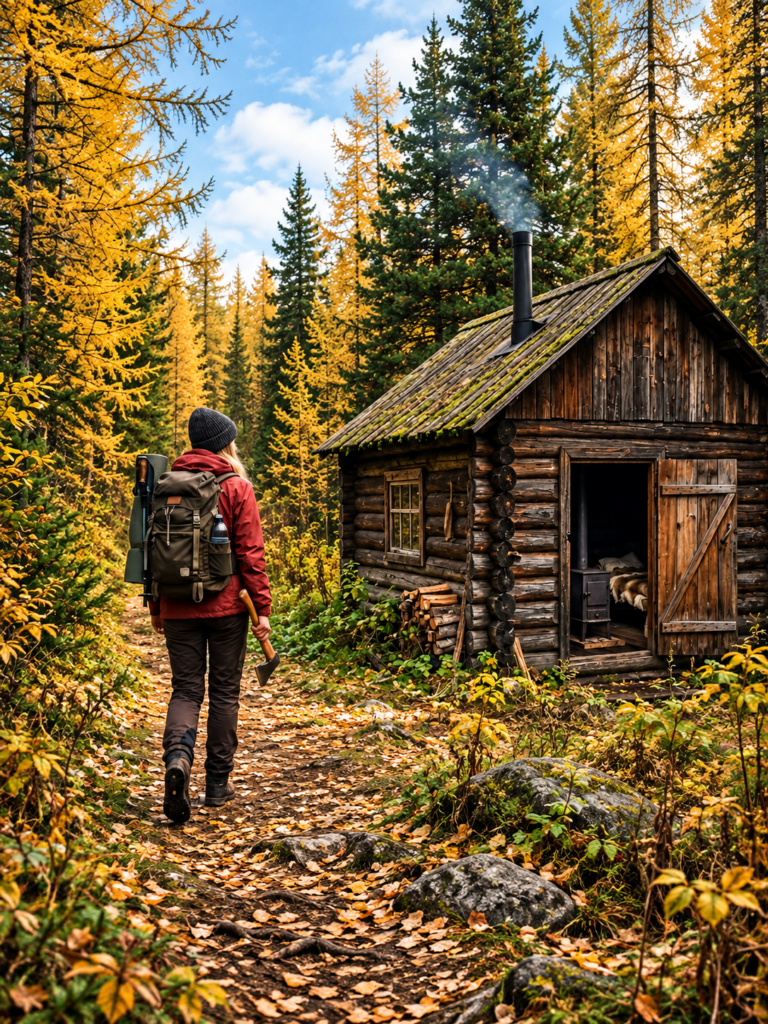
At the edge of a clearing stood a log cabin.
Its roof was covered in moss. An iron stovepipe rose above the shingles, and a single window faced the creek.
A woodshed leaned beside the building.
Ellie knew immediately that she had found it.
Ruby raced down the slope, stopped at the front door, and barked once.
Ellie followed.
For several seconds, she stood on the porch, staring at the rough cedar door.
Her grandfather had built this place.
He had cut the logs, fitted the joints, nailed the roof, and carried supplies into the woods.
And now it belonged to her.
She lifted the wooden latch.
The door opened with a long creak.
Inside, the cabin smelled of cedar, cold ashes, and old wood.
It was a single room.
A small cast-iron woodstove stood near the door. Along the opposite wall was a low sleeping bunk covered with an old wool blanket and a folded sheepskin.
A rough table sat beneath the window.
There were two chairs, a few shelves, a lantern, some candles, and a collection of metal cups and cooking pots.
Everything was tidy.
Ellie set down her backpack.
Her legs trembled as she sat on the bunk.
Ruby curled up beside her.
The cabin was cold enough that Ellie could see her breath.
She had to get the stove going.
Walter had shown her how to arrange the kindling.
She placed a few small logs inside, tucked dry shavings beneath them, and struck a match.
The fire caught.
For a moment, she felt proud.
Then smoke began pouring into the room.
Within seconds, her eyes were burning.
Ellie coughed, grabbed Ruby by the collar, and stumbled outside.
“What did I do wrong?”
She waited until the smoke thinned.
Then she stepped inside and examined the stove more carefully.
Above it, pinned to the wall, was a yellowing piece of notebook paper.
She took it down.
The handwriting was unmistakable.
Ellie girl,
Pull the damper all the way open before you light the fire. It sticks, so give it a good tug.
Dry wood is in the shed. Water is cleanest by the big rock upstream.
Love, Grandpa.
Ellie laughed.
Then, unexpectedly, she began crying.
She held the note against her chest.
Even now, he was looking after her.
She found the damper handle and pulled.
It resisted.
She braced one foot against the wall and tried harder.
With a metallic scrape, it moved.
The chimney began drawing, and the smoke cleared.
Within half an hour, the cabin was warm.
Ellie fetched water from the creek, heated soup, and ate at the table with Ruby lying near her feet.
Outside, evening settled over the trees.
She lit the lantern.
The little cabin glowed amber.
For the first time since her birthday, she felt completely safe.
After dinner, she examined the shelves and the corners of the room.
Walter had said her grandfather spent years carrying his best work here.
But there was almost nothing.
No display cases.
No wooden crates.
No cabinets filled with carvings.
Just the table, the stove, the bunk, and the few things needed to live here.
Had someone taken everything?
Or had Grandpa moved the collection somewhere else?
Ellie searched the shed, but found only firewood, old tools, and a few weathered boards.
Eventually, exhaustion overwhelmed her.
She lay down on the bunk, pulled the wool blanket over herself, and fell asleep listening to the creek.
The next morning, sunlight came through the little window and fell across the floor.
Ellie sat up.
Something on the end of the lower bunk plank caught her attention.
A dark burned mark.
She knelt and looked closer.
Two letters.
D. B.
Between them was a tiny fir branch.
It was her grandfather’s maker’s mark.
Beneath it, a small arrow pointed downward.
Ellie traced the arrow with her finger.
Then she grasped the plank.
It was heavy, but when she pulled it, the wood shifted slightly.
It wasn’t nailed down.
She lifted it from its wooden supports and laid it aside.
Beneath the bunk was a narrow compartment.
She turned on her flashlight.
Something large sat in the darkness.
A wooden chest, wrapped in heavy waxed canvas.
Ellie’s heart began pounding.
She removed two more planks and reached underneath.
The chest was almost three feet long.
It rested on short wooden supports to keep it above the damp earth.
Strong cord held the canvas in place.
Ellie pulled it toward her inch by inch.
Finally, it slid into the sunlight.
The chest itself was made from cedar, its surface rubbed smooth and decorated with carved diamonds, fir trees, and small suns.
Across the lid, in beautifully carved letters, was her name.
ELLIE.
For several minutes, she simply stared.
She remembered Grandpa Daniel sitting at his workbench, patiently sanding a piece of cedar until it felt smooth as glass.
She remembered the smell of sawdust.
His old green flannel shirt.
The way he hummed while he worked.
Slowly, she untied the cord and raised the lid.
The scent of cedar rose from inside.
On top lay a thick leather-bound notebook.
Beside it was a white envelope.
Her name was written on the front.
For Ellie. To be opened at the cabin.
Underneath were objects carefully wrapped in cotton cloth.
Ellie picked up the envelope.
She wanted to open it immediately.
But something stopped her.
As long as it remained sealed, there was still a conversation with Grandpa waiting to happen.
She placed it on the table.
Then she reached for the first wrapped object.
It was a small wooden keepsake box.
The cedar was pale and smooth, with a delicate fir-tree design around the sides.
On the bottom, her grandfather had burned the words:
For Ellie, age nine.
Ellie swallowed.
She opened the second bundle.
Another cedar box, slightly larger.
For Ellie, age ten.
The third had tiny carved suns.
For Ellie, age eleven.
She continued unwrapping the bundles.
There were ten boxes altogether.
One for every birthday from nine through eighteen.
Each was different.
Some were decorated with mountains.
Others carried carved rivers, pinecones, stars, and forest animals.
The workmanship became more intricate with each passing year.
The last box was the largest.
Its sides showed a forest of fir trees beneath a wide band of little suns.
Among the trees were several crooked ones.
Exactly like the design Ellie had made as a child.
On the bottom were the words:
For Ellie’s eighteenth birthday.
Finished in July.
Ellie stared.
“July,” she whispered.
Walter had told her Grandpa returned from the cabin in July and announced he had finished his final piece.
This was what he meant.
The last birthday gift.
The one he had spent years preparing.
Ellie sat back on her heels.
Ten birthdays.
Ten gifts.
And through every year they had been apart, he had never forgotten her.
She thought of her aunt telling her that Grandpa was too old to care about visits.
That he was losing interest.
That she needed to stop asking.
But he had been thinking of her all along.
There was another layer beneath the birthday boxes.
Twelve individually wrapped carvings lay packed together.
These were different.
They were works of extraordinary craftsmanship.
Some had finely carved patterns so delicate that Ellie could barely believe a human hand had made them.
Others had intricate inlaid details, carefully fitted lids, and landscapes carved across their surfaces.
One box showed mountains beneath a starry sky.
Another showed salmon moving through a river.
The largest displayed a small cabin beside a creek, surrounded by cedar trees.
Tiny curls of smoke rose from the chimney.
Ellie carried it to the window.
She looked outside.
The shape of the roof, the creek, the great cedar beside the porch—everything matched.
Grandpa had carved the cabin itself.
The place where she now stood.
At the bottom of the chest lay a canvas roll.
Ellie opened it across the bunk.
Inside were her grandfather’s woodworking tools.
Small chisels, gouges, carving knives, a hand plane, sharpening stones, and delicate awls were arranged in pockets.
She recognized several from childhood.
There was the little gouge he had let her use to carve her first fir tree.
And the old wooden mallet with a repaired handle.
In one pocket lay his metal maker’s stamp.
D. B., with the little fir branch.
Beside it was another stamp.
This one was new.
The letters were different.
E. B.
There was a folded note tied around the handle.
For your own work, if you ever decide to try.
Ellie held the stamp in her palm.
She was eighteen years old.
She had no home in Seattle, very little money, and no clear idea how she was going to support herself.
But Grandpa Daniel had made her a tool with her own initials.
As though he believed she could become something she hadn’t yet imagined.
Her eyes filled with tears again.
She sat on the floor among the carvings and cried until she couldn’t cry anymore.
Ruby came over and rested her head on Ellie’s knee.
After a while, Ellie reached for the leather notebook.
The first pages contained careful drawings and measurements.
Every birthday box was listed by year, wood type, and pattern.
The twelve larger carvings had their own entries.
The pages described how Grandpa selected wood, how he dried it, how he carved without splitting the grain, and how he fitted joints without visible nails.
Some notes were practical.
Others sounded exactly like his voice.
Never rush a piece because you’re tired of looking at it.
Measure twice. Then put the ruler down and look with your eyes.
Good work needs patience more than expensive tools.
The notebook contained decades of knowledge.
Near the back were empty pages.
On the final written page, Grandpa had left a single sentence.
You write the next chapter.
Ellie read it several times.
Then she picked up the envelope.
Her hands trembled as she broke the seal.
Inside were four handwritten pages.
The letter began simply.
My dear Ellie girl,
If you’re reading this, you found the cabin. I hope you remembered the stove damper. I know you probably didn’t, because I never remember things like that until I’ve filled a room with smoke myself.
Ellie laughed through her tears.
She continued reading.
Grandpa wrote that it was July and he was sitting by the cabin window, listening to the creek.
His knees were bad.
His heart had been giving him trouble.
He didn’t know how many more trips he could make.
But he was glad he had finished the last birthday box.
He told her that he had written to her every year after her mother’s death.
Several of the letters had come back marked undeliverable.
He didn’t know why.
He had kept them for her.
I never believed you stopped loving me, Ellie. I figured life had gotten in the way, and I hoped someday you’d find your way back.
Ellie stopped reading.
She pressed her hand over her mouth.
Then she continued.
He explained that the birthday boxes were meant to show her that she had never been forgotten.
The twelve larger carvings were the finest work he could make.
He had saved them because he wanted her to have something valuable if life became difficult.
She could sell them, keep them, or display them.
He trusted her to decide.
But the tools and the notebook were different.
Those were his way of passing on everything he had learned.
You used to get so angry when your little trees came out crooked. I hope you’ve learned by now that the crooked trees are usually the interesting ones.
Ellie smiled.
Then she reached the final page.
I built this cabin when I was a young man. It has been my quiet place for most of my life.
I wanted you to have a place of your own, Ellie. Somewhere nobody could tell you that you didn’t belong.
If you come here feeling lost, make a fire, put the kettle on, and listen to the creek.
You don’t have to know what you’re going to do with the rest of your life. Nobody does at eighteen.
Just start with the next good thing.
I love you, Ellie girl. I always have.
Grandpa.
Ellie lowered the letter.
Outside, the wind moved gently through the cedar branches.
For years, she had believed her grandfather had forgotten her.
Now she knew he had spent those years making sure she would never truly be alone.
At the bottom of the chest were four returned birthday letters.
Each envelope was addressed to Ellie at the Seattle apartment.
Across the front, written in blue ink, were the words:
RETURN TO SENDER — NOT AT THIS ADDRESS.
Ellie recognized the handwriting.
Diane’s.
She stared at the letters for a long time.
Her aunt hadn’t simply neglected to give her a message.
She had deliberately kept her grandfather away from her.
Ellie took the letters to the table.
She opened the first one.
Grandpa had written about the weather and the first snow of the season.
The second described Ruby chasing a squirrel into the creek.
The third contained a pressed autumn leaf and a drawing of a little fir tree.
The fourth said he hoped she was doing well in school and reminded her that she could always visit.
Nothing threatening.
Nothing cruel.
Only a lonely old man trying to stay close to his granddaughter.
Ellie closed the envelopes.
She thought about confronting Diane.
She thought about calling her right then and demanding an explanation.
But her grandfather’s final words returned to her.
Just start with the next good thing.
So she put the letters away.
She stayed another night in the cabin.
The following morning, she wrapped the carvings carefully and returned them to the chest.
She carried the notebook, the letters, her eighteenth-birthday box, and the two maker’s stamps in her backpack.
Before leaving, she stood in the doorway and looked around.
The cabin no longer felt abandoned.
It felt like a promise someone had kept.
Walter was waiting near the trailhead when Ellie returned.
He stood beside his pickup with a thermos of coffee.
When he saw her expression, he asked only one question.
“Did you find it?”
Ellie nodded.
And then she told him.
The birthday boxes.
The twelve masterpieces.
The tools.
The notebook.
The letter.
Walter listened without interrupting.
By the time she finished, his eyes were wet.
“That old fool,” he whispered, smiling. “All those years, and he never told me what he was making.”
He removed his cap.
“He loved you something fierce, Ellie.”
“I know,” she said.
For the first time in years, she truly did.
Over the next few weeks, Ellie helped Walter prepare the farmhouse for winter.
He showed her how to stack firewood properly, maintain a woodstove, and protect the pipes from freezing.
She helped him repair the shed roof and organize Grandpa’s remaining belongings.
When the weather allowed, Walter and a younger neighbor named Josh used a small utility trailer and sled to bring the cedar chest out along the old trail.
They transported the collection carefully to Walter’s house, where it would remain safe until Ellie decided what to do.
Walter then introduced her to a local woodcarver named Grace Sullivan.
Grace was in her early sixties and ran a small woodworking studio near Port Angeles.
She had known Daniel for almost thirty years.
When Ellie placed the box carved with the mountain landscape on Grace’s workbench, the older woman went completely still.
She put on her glasses.
Turned the piece toward the light.
Then examined the underside.
“Danny Bennett,” she whispered.
She traced the maker’s mark.
“I haven’t seen work like this from him in years.”
Ellie explained where she had found it.
Grace listened with growing amazement.
When Ellie mentioned the other eleven pieces, Grace slowly lowered herself onto a stool.
“Your grandpa was one of the finest craftsmen I’ve ever known,” she said. “But these might be some of his best pieces.”
Grace arranged for an independent appraisal.
The appraiser studied the collection’s craftsmanship, condition, and history.
Some individual carvings could command several hundred dollars.
Others, particularly the larger intricate boxes, could bring much more.
The collection as a whole was potentially worth tens of thousands of dollars, depending on the buyers.
Ellie sat quietly while the appraiser explained everything.
A few weeks earlier, she had been sleeping on an air mattress and wondering how to afford rent.
Now she possessed something valuable enough to provide a meaningful financial cushion.
But when she looked at the boxes, she didn’t see dollar signs.
She saw her grandfather sitting alone at his workbench, making birthday presents for a granddaughter he hadn’t seen in years.
Grace seemed to understand.
“There’s no need to make any decisions right away,” she said.
Not long afterward, a collector from Seattle contacted Ellie.
He had heard about Daniel Bennett’s final collection.
He offered to purchase everything together.
Cash.
No waiting.
He told her that, at her age, the money would be more useful than a collection of old wooden boxes.
Ellie thanked him.
Then she declined.
He raised the offer.
She declined again.
When he called a third time, she stopped answering.
That didn’t mean she would never sell a carving.
She understood that her grandfather had left them partly to give her options.
But she wasn’t ready to let the whole collection disappear into someone’s private home.
Grace eventually suggested something else.
“Why don’t you learn the trade?”
Ellie looked at her.
“I haven’t carved anything since I was little.”
“So?”
“I’m not very good.”
“Neither was your grandfather when he started.”
Grace picked up one of the old tools.
“Danny used to talk about your crooked fir trees. He said you had patience when you wanted something badly enough.”
Ellie examined the tool in Grace’s hand.
“What would I have to do?”
“Come to the studio a couple days a week. Sweep up. Sand boards. Help prepare materials. I’ll teach you what I know.”
“I can’t afford lessons.”
Grace smiled.
“Good. I’m not charging you.”
Ellie began working with Grace that November.
Her first projects were clumsy.
She split pieces of cedar.
She cut the joints incorrectly.
She ruined more than one box lid trying to make the pattern perfectly symmetrical.
But Grace never rushed her.
Each time Ellie made a mistake, the older woman showed her how to understand it.
“Wood tells you what it wants to do,” Grace said. “You have to learn to listen.”
Ellie began recognizing the grain beneath her fingers.
She learned how to sharpen tools, how to make shallow cuts, and how to let the design follow the wood.
And slowly, something changed.
She stopped working simply to produce a finished object.
She began enjoying the work itself.
The smell of fresh cedar.
The quiet scrape of a carving knife.
The satisfaction of making two pieces fit together.
For the first time since her mother’s death, she looked forward to mornings.
In December, Grace arranged a small exhibition at a local historical society.
The display was called A Grandfather’s Legacy: The Woodcarvings of Daniel Bennett.
The ten birthday boxes were arranged in chronological order.
The twelve masterpieces occupied the central case.
Beside them stood the old tool roll and photographs of Daniel working in his shed.
The exhibition attracted more attention than anyone expected.
Local newspapers ran a story.
A regional television station sent a camera crew.
When a reporter interviewed Ellie, she stood beside the smallest birthday box.
“Your grandfather left you a valuable collection,” the reporter said. “Why not sell it?”
Ellie looked at the ten boxes.
“Because I want people to see what he made,” she answered. “He wasn’t just leaving me things. He was teaching me something.”
“What was that?”
Ellie thought for a moment.
“That you can love someone even when you can’t be with them. And that it’s never too late to start building a life.”
The interview aired on a Thursday evening.
Three days later, a black SUV pulled into Walter’s driveway.
Ellie was in the kitchen helping prepare dinner when Ruby began barking.
She looked through the window.
A woman in an expensive winter coat stepped out of the vehicle.
A young man followed her.
Ellie’s stomach tightened.
It was Aunt Diane.
And Tyler.
They had driven all the way from Seattle.
Not when Ellie had nowhere to sleep.
Not when Grandpa Daniel died.
But now that his collection had appeared on television.
Part 3
Ruby started barking before the visitors reached the porch.
Aunt Diane stopped beside the SUV and pulled her coat tighter around her neck.
“Get that dog away from me!”
Walter stepped outside.
“Ruby, down.”
The dog settled beside his boots.
Diane looked at Walter.
“Are you Mr. Hale?”
“That’s right.”
“I’m Diane Mercer. Ellie’s aunt.”
Walter studied her.
“Yes, ma’am. I remember speaking with you back in August.”
For a brief moment, Diane’s expression faltered.
Then she smiled.
“Well, I’m here to see my niece. We haven’t been able to get in touch with her.”
Walter stepped aside.
Ellie stood in the kitchen doorway.
Her aunt looked her up and down.
“Ellie! Honey!”
She crossed the room and tried to hug her.
Ellie remained still.
Diane stepped back awkwardly.
“Look at you. You’ve lost weight. Are you eating enough?”
“I’m fine.”
“And living all the way out here? Honestly, sweetheart, you should’ve called us.”
Ellie looked at her.
“You knew where I was?”
“Well, not exactly.”
“You could’ve called.”
Diane brushed the comment aside.
“We saw you on television! Imagine our surprise. Your grandfather’s collection in a museum. You standing there giving interviews.”
She sat at Walter’s kitchen table without being invited.
Tyler lingered by the door, his hands pushed into his jacket pockets.
“We need to talk,” Diane said.
Ellie recognized the words.
They were the same ones her aunt had used on her eighteenth birthday.
Walter quietly put on the kettle.
Ellie sat across from Diane.
“What do you want to talk about?”
Diane sighed.
“First, I want you to understand how difficult things have been for me. I raised you for four years after your mother passed. I made sure you had food, clothes, a roof over your head.”
Ellie waited.
“And now I hear that your grandfather left you this property, plus all those valuable carvings.”
“He did.”
“Well, I had absolutely no idea Daniel had that kind of money.”
“He didn’t have much money,” Ellie said. “He made things.”
“Yes, well, apparently those things are worth quite a bit.”
Diane leaned forward.
“I’ve got bills, Ellie. The car payment, the apartment, Tyler’s tuition. I’m barely managing.”
Ellie glanced at her cousin.
He stared at the floor.
Diane continued.
“I think the fair thing would be for you to sell the collection and share some of the proceeds. After everything I’ve done for you, surely I deserve something.”
Ellie looked at her aunt’s expensive coat.
She remembered standing in their kitchen with her birthday cake while Diane counted out a fifty-dollar bill.
“How much?” Ellie asked.
Diane hesitated.
“Well, half seems reasonable.”
“Half?”
“I spent four years supporting you.”
Ellie folded her hands.
“Grandpa left the collection to me.”
“And I’m your family!”
“So was he.”
Diane’s face tightened.
“Don’t take that tone with me.”
Ellie didn’t raise her voice.
“Did Walter call you when Grandpa died?”
Diane looked toward the window.
“We’ve already been over this.”
“He called you on August twenty-first.”
“Yes.”
“And you told him you’d let me know about the funeral.”
“I was going to.”
“But you didn’t.”
Diane made an impatient gesture.
“You were busy with school and work. I wasn’t about to drag you halfway across the state for a funeral.”
Ellie stood.
She went into the small bedroom and returned carrying four envelopes.
She placed them on the table.
Diane looked down.
Her expression changed.
“Where did you get those?”
“Grandpa kept them.”
Ellie pointed to the handwriting on the first envelope.
“Isn’t that yours?”
Diane didn’t answer.
“All four letters came back,” Ellie continued. “You wrote that I didn’t live at our address anymore.”
Her aunt pushed the envelopes away.
“I was trying to protect you.”
“From what?”
“From getting mixed up in all that wilderness nonsense. Daniel filled your head with ridiculous ideas when you were little.”
Ellie opened one letter.
“He wrote about Ruby chasing a squirrel.”
She opened another.
“He wrote about the weather.”
Then the third.
“He said he hoped I was doing well in school.”
Diane crossed her arms.
“You don’t understand what it was like raising you.”
“Maybe I don’t.”
Ellie gathered the letters.
“But I understand what it was like thinking he didn’t care about me.”
Her voice began to tremble.
“For four years, I thought Grandpa had forgotten me. All that time, he was making birthday presents and writing letters.”
Diane looked away.
Ellie took a slow breath.
“I’m not going to fight you over the apartment. I’m not asking you to pay me back for anything. But I’m not giving you Grandpa’s collection.”
“You’re being selfish.”
“Maybe that’s how you see it.”
Diane rose abruptly.
“After everything I sacrificed, this is the thanks I get?”
Ellie stood too.
“I’m grateful I had a roof over my head after Mom died. But that doesn’t make what you did okay.”
Her aunt grabbed her purse.
“Fine. Keep the stupid boxes.”
She turned toward Tyler.
“We’re leaving.”
Diane marched outside, slamming the door behind her.
Ellie heard the SUV unlock.
Tyler didn’t follow immediately.
He stood near the doorway, shifting from one foot to the other.
Then he quietly opened his backpack.
“I brought something.”
He pulled out a laptop.
Ellie recognized it instantly.
The yellow cat sticker was still on the lid.
Her mother’s gift.
Tyler held it toward her.
“I should’ve said something that day.”
Ellie took the computer.
For a moment, she couldn’t speak.
“I didn’t really need it,” Tyler continued. “Mom just told me I could have it.”
He looked embarrassed.
“I’m sorry, Ellie.”
She ran her fingers over the sticker.
“Thank you.”
Tyler nodded.
Outside, Diane honked the horn.
He moved toward the door, then stopped.
“Hey, Ellie?”
“Yeah?”
“That cabin looked pretty cool on TV.”
She smiled a little.
“It is.”
“Could I come see it sometime?”
Ellie considered him.
She remembered the way he’d lowered his head when Diane took the laptop.
And the fact that he’d brought it back without being asked.
“Sure,” she said. “Maybe in the summer.”
His face brightened.
“Really?”
“Really. But you have to hike seven miles to get there.”
Tyler laughed.
“Guess I’d better get in shape.”
The horn sounded again.
He waved and hurried outside.
Ellie watched the SUV disappear down the gravel road.
Walter came into the kitchen carrying two mugs of coffee.
“You okay?”
Ellie nodded.
“I think so.”
He placed a mug in front of her.
“Your grandpa used to say you couldn’t carve a decent piece of wood while gripping your knife too hard.”
Ellie smiled faintly.
“Because you’d break the blade?”
“No. Because you’d be too busy fighting the wood to see what it wanted to become.”
Walter sat beside her.
“Some things you have to loosen your grip on.”
Ellie looked at the returned letters.
She knew she would never get those missing years back.
She might never forgive Diane.
But she didn’t have to carry her aunt’s anger into every day of her own life.
That evening, she called Hannah.
They talked for nearly an hour.
Hannah wanted to know everything about Diane’s visit, the museum exhibition, and the collection.
Then she asked something Ellie hadn’t expected.
“Are you coming back to Seattle?”
Ellie looked around Walter’s warm kitchen.
At the stove.
At Ruby sleeping near the door.
At the cedar shavings still caught in the cuffs of her sweater.
“I don’t think so,” she answered.
“Ever?”
“To visit, sure. But I think I want to stay here for a while.”
Hannah was quiet.
Then she said, “You sound happy.”
Ellie thought about it.
“I think I am.”
Winter settled over the Olympic Peninsula.
Rain filled the creeks, and snow covered the high mountains.
Ellie continued working with Grace at the woodworking studio.
She swept the floors, prepared materials, sharpened tools, and helped finish simple orders.
Grace paid her for her work whenever the shop could afford it.
Ellie saved what she could.
Her first completed keepsake box was crooked.
The lid didn’t fit properly.
One side was slightly taller than the other.
She carried it to Grace with an embarrassed smile.
“I messed it up.”
Grace examined it.
“Did you finish it?”
“Yes.”
“Does it open?”
“Yes.”
“Does it close?”
“Mostly.”
Grace laughed.
“Then you’ve made your first box.”
Ellie kept it on the shelf above her workbench.
By February, she could carve simple fir-tree patterns without ruining the wood.
By March, she was making small keepsake boxes that Grace considered good enough to sell at the shop.
The first one brought forty-five dollars.
Ellie held the money for a long time.
It wasn’t a fortune.
It barely covered a grocery trip.
But she had earned it with her own hands.
That night, she called Carol Brooks.
“Remember the money you lent me when I went to Port Angeles?”
“Ellie, honey, I told you not to worry about it.”
“I know. But I want to pay you back.”
Carol laughed.
“Your grandfather would be proud of you.”
Ellie smiled.
“I hope so.”
The estate paperwork was completed in the spring.
Margaret Whitcomb called Ellie into her office and handed her the documents confirming ownership of the cabin and its parcel of land.
Ellie sat staring at the papers.
Her name was printed beside the property description.
She had something that legally belonged to her.
Not something she was borrowing.
Not somewhere she could stay only until another person decided otherwise.
A home.
She carefully placed the documents in a folder and carried them back to Walter’s house.
That evening, Walter made meatloaf and mashed potatoes.
He insisted they should celebrate.
Ellie laughed.
“It’s just paperwork.”
“No,” Walter said, putting the plates on the table. “It’s a new beginning.”
By June, the snow had retreated from the higher trails, and the forest was green again.
Ellie decided it was time to return to the cabin.
She packed food, tools, her grandfather’s notebook, and both maker’s stamps.
Walter drove her to the trailhead.
Ruby jumped out of the truck and ran in an excited circle.
“You sure you don’t want me to send Josh along?” Walter asked.
Ellie shook her head.
“I know the trail now.”
Walter smiled.
“Yes, you do.”
She followed the familiar path through the cedars.
This time, she wasn’t frightened by every sound.
She knew where the creek crossed the trail.
She remembered the moss-covered logs and the ridge where the trees opened toward the valley.
She noticed new details.
Tiny wildflowers growing beside the path.
Sunlight falling through the fir branches.
A woodpecker tapping high above her head.
When she reached the lightning-scarred tree, she stopped.
The little crooked fir her grandfather had carved was still there.
Ellie touched it gently.
Then she continued.
By early afternoon, the cabin appeared below the ridge.
The roof was dark beneath the summer sun.
The creek glittered beside the clearing.
Ruby raced ahead and sat at the front door.
Ellie laughed.
“All right, girl. We’re home.”
Inside, the cabin smelled just as she remembered.
Cedar.
Old wood.
Cold ashes.
She opened the windows, swept the floor, and carried fresh water from the creek.
Then she lit the stove.
This time, she remembered to open the damper before striking the match.
The fire caught easily.
Ellie looked at the note pinned above the stove.
Pull the damper all the way open.
She smiled.
“Got it, Grandpa.”
Over the next three days, Ellie worked at the small table beside the window.
She had brought a piece of carefully dried cedar from Grace’s workshop.
She cut it into panels, shaped the base, and fitted the corners.
Then she carved a pattern into the sides.
Little fir trees.
Some straight.
Some leaning.
One deliberately crooked.
Just like the first trees she had carved when she was eleven.
She worked slowly.
When her hands became tired, she stopped.
When she made a mistake, she studied it rather than getting angry.
She could almost hear Grandpa Daniel sitting beside her.
Don’t fight the wood, Ellie girl. Let it tell you where the grain wants to go.
On the afternoon of the third day, the box was finished.
It was small, only a few inches wide.
The lid fitted neatly.
The corners were smooth.
The fir trees formed a simple forest around the sides.
Ellie turned it over.
She took out the new metal stamp Grandpa had left her.
E. B.
With the tiny fir branch.
Carefully, she burned the mark into the bottom.
Then she picked up his old stamp.
D. B.
She held it for a moment, looking at the darkened handle worn smooth by decades of use.
She had thought about this moment many times.
Her grandfather had been a master craftsman.
She was still learning.
But everything she knew had begun with him.
Gently, she pressed his mark beside hers.
Two sets of initials.
Two little fir branches.
One darkened with age.
The other brand-new.
Ellie sat back and studied the box.
It wasn’t perfect.
A few lines were uneven.
One corner could have been smoother.
And the crooked fir tree leaned farther than she had intended.
But she liked it.
She placed it on the shelf beside her grandfather’s note.
That evening, Ellie sat at the table with the cabin window open.
The sound of the creek filled the room.
Ruby slept by the door.
The stove gave off a gentle warmth.
Ellie took out her grandfather’s leather notebook.
She turned past the pages of measurements, sketches, and instructions.
Past the inventory of the ten birthday boxes.
Past the drawings of the twelve masterpieces.
Finally, she reached the last written page.
There, in Grandpa Daniel’s familiar handwriting, were the words:
You write the next chapter.
Ellie picked up her pencil.
For a moment, she hesitated.
Then she wrote beneath his sentence.
June.
My first cedar keepsake box made at the cabin.
Carved with small fir trees.
One of them crooked.
She smiled.
Then she added one more line.
I think Grandpa would have liked it.
Ellie closed the notebook.
Outside, the evening sun shone through the cedars, turning the creek gold.
The mountains stood dark in the distance.
A bird called somewhere near the ridge.
Ellie looked around the cabin.
At the rough table.
The old stove.
The handmade shelves.
The little box she had finished that afternoon.
A few months earlier, on her eighteenth birthday, she had walked out of a Seattle apartment carrying fifty dollars and a backpack.
She had believed nobody wanted her.
She had believed her family had forgotten her.
But deep in the Olympic forests, an old man had spent years preparing something for the granddaughter he hoped would someday return.
He had made ten birthday boxes, one for every year she had grown older.
He had preserved his finest carvings.
He had left her his tools, his knowledge, and a home of her own.
And most importantly, he had left her the certainty that she had always been loved.
Ellie stood, took the small cedar box from the shelf, and turned it over once more.
Her grandfather’s initials stood beside hers.
She traced them with her thumb.
“Thank you, Grandpa,” she whispered.
Then she placed the box back on the shelf.
Outside, the forest grew quiet.
Tomorrow, she would begin another piece.
And the day after that, another.
She didn’t know exactly what her life would look like in five years, or ten.
Maybe she would open her own woodworking studio.
Maybe she would teach children to carve, the way Grandpa had taught her.
Maybe she would travel, go back to school, or find something entirely different.
For the first time, not knowing didn’t frighten her.
She had a place to return to.
She had a craft to learn.
She had people who cared about her.
And she had the freedom to choose what happened next.
Ellie closed the cabin door as the last sunlight faded behind the mountains.
The stove crackled softly.
Ruby sighed in her sleep.
And in the little cedar cabin her grandfather had built with his own hands, Ellie Bennett finally understood the inheritance he had wanted her to find.
It wasn’t merely the land.
It wasn’t the valuable carvings hidden beneath the bed.
It wasn’t even the tools or the notebook.
It was the chance to build a life where she belonged.
A life that was hers.
And this time, nobody could tell her to leave.


