
Part 1
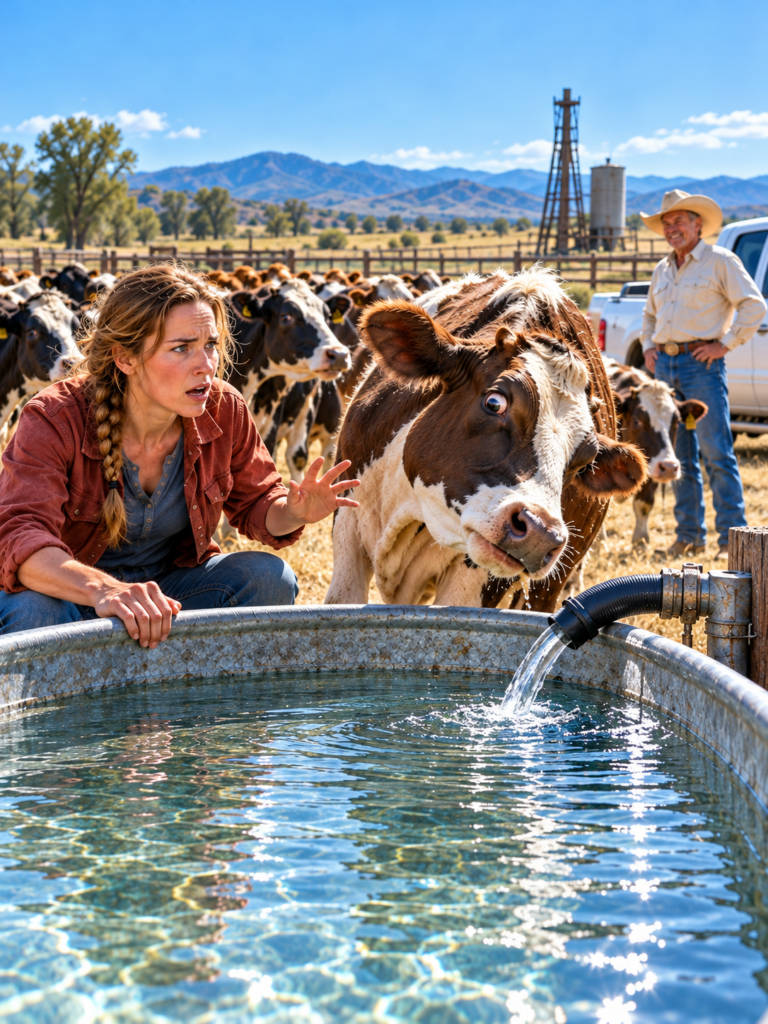
For three days, twenty-seven dairy cows refused to drink from the new well on Willa Hartley’s farm.
They stood beneath the merciless Montana sun, their flanks rising and falling in the heat, while a trough filled with perfectly clear water waited only a few feet away. Some approached cautiously. Others followed the older animals, expecting to drink. But each time a cow lowered her nose toward the surface, something made her pull away.
Not one of them took a swallow.
Willa had spent thirty-eight years learning the habits of cattle. She knew when a cow was about to calve, when a change in appetite meant illness, and when the herd was restless because a thunderstorm was rolling over the distant hills. She had never seen anything like this.
The water looked clean. The pipes were new. The well had cost eighteen thousand dollars she couldn’t afford to lose.
And her cattle were behaving as though someone had filled their drinking trough with poison.
Across the gravel road, the richest rancher in Brier Glenn was already paying attention.
His name was Preston Whitmore III, and before Willa understood what was happening beneath her property, he would arrive at her farmhouse with an offer to buy it.
What she didn’t know was that he had reasons for wanting her land that had nothing to do with cattle.
But that summer, before the laboratory reports, the legal threats, and the public hearing that would eventually divide their small Montana community, Willa’s entire world had narrowed to one simple problem.
Her cows needed water.
And she was running out of places to find it.
The Hartley farm occupied forty-six acres of eastern Montana pasture, bordered by cottonwood trees on the north and a gravel road on the east. Willa’s grandfather had planted those cottonwoods decades earlier. Her father had maintained the fences, worked the pastures, and converted the family’s small beef operation into a dairy farm during the 1980s.
Willa had inherited the work along with the land.
She had also inherited the debts.
The mortgage wasn’t enormous by the standards of modern agriculture, but it was enormous to a woman who counted every dollar of feed, veterinary care, electricity, and equipment maintenance before deciding whether she could replace a worn pair of boots.
Her daughter Nora had moved to Billings two autumns earlier to train as a surgical technician. Without her, the old farmhouse had become unusually quiet. Most mornings, Willa ate breakfast alone before daylight and returned to the kitchen long after the rest of the county had finished supper.
She didn’t mind the solitude as much as people imagined.
What bothered her was the possibility of losing the place.
Six years earlier, she had buried her father in the ground he had spent his life protecting. Standing near his grave, she had made herself a promise.
The Hartley farm would not be sold while she was alive.
It was the kind of promise that sounded simple until the weather turned against you.
By the middle of July, the drought had settled across Brier Glenn like a second season. The grass had faded from green to yellow and finally to the brittle brown of old straw. The creek beyond the southern fence had dwindled to a muddy ribbon. Even the cottonwoods seemed tired, their leaves hanging without movement in the afternoon heat.
Then the old well started failing.
At first, it was an occasional sputter in the pump. A cough of air that interrupted the flow for a second before the water returned.
Within a week, the interruptions lasted longer.
Willa measured the water level every morning with a weighted string, just as her father had taught her. She wrote the numbers on a feed-store calendar hanging beside the kitchen door.
Each new entry was worse than the one before.
For three nights, she sat at the kitchen table with her bills spread around her and a calculator beside a cup of coffee that kept going cold.
She knew exactly what the numbers meant.
Without a dependable source of water, she would have to sell the cows before winter.
Without the cows, she couldn’t make the mortgage payments.
And without the payments, the land would go.
On a Tuesday morning, she drove into town and borrowed eighteen thousand dollars.
The loan officer had known her since high school. He kept his eyes on the paperwork while he explained the repayment terms, and Willa noticed how carefully he avoided saying anything encouraging.
She signed anyway.
A week later, Caleb Ror arrived with his drilling rig.
Caleb was fifty-two, weathered by decades of working outdoors, and so economical with words that strangers sometimes mistook him for unfriendly. He had drilled wells across half the county, and he knew the local geology better than most people who owned the land above it.
He studied the maps, walked the ground northeast of the milking barn, and chose the location that promised the strongest yield.
For four days, his rig hammered into the earth.
Willa watched whenever her chores allowed it.
At approximately 120 feet, the material coming out of the hole changed. The drilling cuttings turned into a gray, claylike slurry.
Caleb rubbed some between his fingers.
He examined it longer than Willa expected, then returned to work.
At 180 feet, the drill reached water.
Plenty of it.
The pump brought up a strong, steady flow, and for the first time in months, Willa felt something inside her loosen.
She could keep her cattle.
She could keep her home.
Maybe she could even make it through the winter without borrowing another dollar.
Caleb continued pumping until the cloudy discharge ran clear. Then he filled a glass jar and held it toward the sunlight.
“Looks good,” Willa said.
“Looks aren’t a water test.”
He lowered the jar.
“Get a laboratory to check it before anybody drinks it. Cattle included.”
Willa nodded.
But the nearest laboratory in Miles City needed about a week to return routine results.
Her reserve tank held perhaps four days’ worth of water for twenty-seven thirsty dairy cows, and the old well was producing less every morning.
She was staring at a new well full of water while her farm slowly went dry.
The following morning, she connected a temporary line to the trough in the east pasture.
She opened the valve and watched the water rise.
Clover came first.
At eleven years old, Clover was the oldest cow in Willa’s herd. Willa had raised her from a lanky calf with a stubborn temperament, and the old animal still had a habit of deciding where the others ought to go.
She approached the trough with the calm confidence of a cow expecting an ordinary drink.
Then she stopped.
Her nostrils widened.
She lowered her head until her muzzle hovered just above the surface.
And lifted it again.
Willa waited.
“Clover. What’s the matter with you?”
The cow stepped backward.
Another cow moved forward, sniffed the water, and turned away.
Then another.
Within minutes, all twenty-seven had approached the trough and refused it.
Willa stood beside the fence, sweating through her shirt, trying to understand what she was seeing.
She checked the valve. She checked the line. She put her hand into the water.
It was cool and clear.
Nothing appeared wrong.
But when she shut off the new well and brought water from the reserve tank, the cows drank greedily.
That frightened her more than she wanted to admit.
By late afternoon, she was still trying to find a reasonable explanation when a white truck came up the driveway.
It was new enough to carry temporary registration.
Preston Whitmore stepped out wearing pressed jeans, clean boots, and a pale straw hat that looked as though it had spent most of its life indoors.
At fifty-nine, Preston had the silver hair and practiced composure of a man accustomed to receiving respect before he asked for it.
Whitmore Cattle Holdings controlled more than thirty thousand acres around Brier Glenn.
His family had been purchasing neighboring properties for generations, and plenty of local people considered him the closest thing the county had to royalty.
Preston admired Willa’s barn.
He asked about Nora.
He made polite conversation about the drought.
Then he offered to purchase the farm for ninety-five thousand dollars.
“Cash,” he said. “No inspection. We could close in three weeks.”
Willa stared at him.
“That land’s worth almost twice that.”
“Under better circumstances, perhaps.”
“These aren’t better circumstances for anybody.”
“That’s exactly my point.”
He spoke gently, almost sympathetically, explaining how expensive small-scale dairy farming had become and how little sense it made to keep fighting a business that couldn’t support itself.
Willa had heard versions of the same speech before.
“No, Preston.”
He glanced toward the east pasture.
The trough stood full.
The cows were gathered beneath the trees, nowhere near it.
A faint smile appeared.
“Well,” he said, “a woman who can’t get a few dozen cows to drink isn’t likely to manage a whole ranch much longer.”
Willa’s face grew hot.
For a moment, she considered telling him to leave.
Instead, she looked directly at him.
“My farm isn’t for sale.”
Preston put his hat back on.
“Suit yourself.”
He climbed into his truck, rolled down the window, and gave her one last look.
“You’ll call me before the summer’s over.”
She watched him drive away.
Only after the dust settled did another thought strike her.
She hadn’t told Preston about the new well.
She hadn’t told him about the cattle refusing to drink.
Yet he had looked straight toward the troublesome trough as though he already knew what was happening.
That evening, Willa walked out to the pasture with a flashlight.
The setting sun had turned the hills copper red. The trough’s surface reflected the fading sky without a ripple.
Clover stood nearby.
Willa dipped her fingers into the water again.
It felt unusually slick.
There was also a faint odor she couldn’t identify, something almost sweet beneath the ordinary smell of damp metal.
She brought her fingers closer to her nose.
Perhaps she was imagining it.
Clover approached, sniffed the water, and jerked backward so sharply that her shoulder struck the rail.
Willa turned off her flashlight.
For several seconds, she stood completely still.
The following morning, she scrubbed the trough until her arms ached.
She replaced the temporary plastic line with another section of pipe stored in the barn, flushed the system, and filled a clean stock tank.
The herd approached.
And refused again.
On the second day, Willa tried a different experiment.
She carried two identical galvanized tubs into the pasture and placed them eight feet apart.
One she filled from the old reserve.
The other she filled from the new well.
Then she opened the gate.
Twenty-seven cows crowded around the reserve water, pushing and jostling for space.
Not one touched the other tub.
Willa watched until she no longer needed to.
The problem wasn’t the trough.
It wasn’t the pipe.
It was the water.
She called Caleb.
He came out that afternoon, checked the pump, examined the adapter, and inspected everything he could reach.
Mechanically, the well was sound.
Then he asked about the gray material they’d drilled through.
“That layer around a hundred and twenty feet,” he said. “You remember it?”
“I remember you looking at it.”
Caleb removed his hat.
“In some parts of this county, that gray shale separates two different water systems.”
Willa waited for him to explain.
He looked down at the wellhead instead.
The silence stayed with her long after he left.
By the third day, the reserve tank was nearly empty.
Willa arranged a delivery of four thousand gallons of potable water from an out-of-town hauler.
The price was two hundred forty dollars a load, plus delivery.
It would take more than one load to keep her cattle supplied through a week of ninety-degree afternoons.
She calculated the cost while standing in the barn and realized she could last perhaps eleven days before the hauling charges began swallowing the money she needed for feed.
When the water truck finally arrived, she stood beside the tank as the hose discharged.
The cows drank.
Only after the driver had gone did Willa sit on the barn steps and cry.
Not because of the debt.
Not even because of the possibility of losing her land.
She had spent her life making sure animals in her care had food, water, and shelter. For the first time, she had come frighteningly close to failing at one of those basic duties.
Later that afternoon, Preston Whitmore returned.
This time, he brought his daughter.
Daphne Whitmore was thirty-four, a lawyer, and her father’s in-house counsel. She stepped out wearing a dark suit despite the heat, a leather portfolio held neatly beneath one arm.
Two neighbors, Hollis Puit and his son, had stopped to ask whether Willa needed help hauling water.
Preston waited until they could hear him.
He gestured toward the untouched trough and remarked that in all his years of ranching, he had never seen cattle reject water from a properly drilled well.
“Maybe the animals understand something their owner doesn’t,” he added.
Hollis’s son gave an embarrassed little laugh.
Willa kept her expression still.
Daphne opened the portfolio.
Inside was a prepared purchase agreement offering one hundred ten thousand dollars for the farm.
The offer expired in forty-eight hours.
After that, Preston explained, the price would fall.
“A property without reliable water doesn’t improve in value, Willa.”
She stared at the signature line.
He’d brought a lawyer and a contract before she had even asked him to make another offer.
“No.”
Preston sighed, as though she were making an unnecessarily difficult decision.
Daphne closed the folder.
When their truck disappeared down the driveway, Willa drove to the wellhead and collected a fresh sample.
This time she followed every instruction Caleb had given her. She let the line run, used clean sample containers, and avoided touching anything that might contaminate them.
Then she drove ninety minutes to an independent environmental laboratory near Miles City.
The technician who received her sample was Dr. Laurel Finch, a woman in her mid-forties with reading glasses and an efficient, unhurried manner.
Willa explained what had happened.
“The cows won’t drink it,” she said.
Laurel listened carefully.
“Do you want the standard panel?”
Willa hesitated.
The standard test was already expensive.
But she remembered the slick feeling on her fingers.
“I want the industrial chemicals checked, too.”
The full analysis cost four hundred ten dollars.
Willa paid with money she had intended for feed.
On the drive home, her phone rang.
It was the bank.
Her loan officer sounded uncomfortable. He explained that a financing company had inquired about purchasing her mortgage note outright.
“Why would anybody want my loan?”
“I can’t really say.”
“Who was asking?”
A pause followed.
“An outside company.”
He wouldn’t give her the name.
Willa hung up and drove the remainder of the road in silence.
She had borrowed money to save her farm.
Now somebody wanted to own the debt that could take it away.
The next morning, Laurel Finch called much sooner than Willa expected.
“Mrs. Hartley, I need you to confirm the address where that sample was taken.”
Willa repeated it.
“Your well is east of Whitmore Road?”
“Yes.”
Laurel fell silent.
“What’s wrong?”
“I need to confirm a result on another instrument. Until then, don’t use that water.”
“For the cows?”
“For anyone. Not the animals, not the house, not for washing your dairy equipment. Nothing.”
“Laurel, what did you find?”
“I don’t want to tell you something I haven’t verified.”
The call ended.
At the laboratory, Laurel had found something she had not expected to see in groundwater beneath a quiet agricultural community.
Trichloroethylene.
A chlorinated industrial solvent commonly used to degrease metal.
Its concentration was several times higher than the federal drinking-water limit.
Two related breakdown compounds appeared in the sample as well.
Those additional chemicals mattered.
They indicated the contamination had been underground long enough for the original solvent to begin degrading.
Whatever had happened, it hadn’t happened yesterday.
Laurel repeated the analysis on a different instrument.
The result remained the same.
She drove to the Hartley property herself, collected a verification sample from the wellhead, and explained the findings while sitting beside Willa on the tailgate of her truck.
“The water isn’t safe,” Laurel said.
Willa looked toward the barn.
“Not even for cleaning?”
“No.”
“And the cows knew?”
Laurel considered her answer.
“They noticed something. It could have been an odor, a taste, or another property of the water. Their behavior isn’t a chemical test, Willa. But it gave you a reason to investigate.”
Willa watched Clover grazing beneath the cottonwoods.
Eighteen thousand dollars had purchased a well she couldn’t use.
Every day she kept the herd alive cost more money.
And a wealthy neighbor was standing nearby with a purchase agreement waiting for her signature.
Laurel asked whether there had ever been an industrial operation on the Hartley property.
A mechanic’s shop.
A fuel depot.
A dumping site.
Anything involving solvents.
“Nothing like that,” Willa said. “My grandfather raised beef. Daddy changed over to dairy. That’s all this place has ever been.”
“What about the surrounding properties?”
Willa described the abandoned church, the hay ground, and the immense stretch of Whitmore pasture lying northwest of her farm.
Laurel became quiet.
She unfolded a groundwater map across the truck hood.
For eleven minutes, she studied the contour lines and traced the path of an ancient buried creek channel.
Then she pointed to the Hartley well.
“The deep water your new well reaches moves generally toward the southeast.”
Her finger traveled backward along the buried channel.
“If we follow that groundwater upgradient, we end up here.”
Willa looked at the map.
Whitmore land.
A section of northern grazing pasture that Preston’s company had controlled for decades.
“You’re saying he poisoned my water?”
“I’m saying we have a direction worth investigating,” Laurel replied. “A map doesn’t prove who caused contamination. We need more samples, more records, and actual monitoring data.”
Willa looked across the road toward the distant hills.
For the first time, they seemed less like a boundary around her farm and more like the beginning of something she couldn’t yet see.
And she wondered whether Preston Whitmore had been trying to buy her land because her well was failing.
Or because he already knew why.
Part 2
By Friday, everybody in Brier Glenn had heard that Willa Hartley’s new well was bad.
By Monday, some were saying she’d contaminated it herself.
Preston Whitmore never made that accusation directly.
Instead, he expressed concern about inexperienced operators, improper drilling methods, and the unfortunate consequences of trying to save money on essential agricultural infrastructure.
He said these things in the feed store and anywhere else people were willing to listen.
He sounded so reasonable that most people forgot he was offering explanations without evidence.
Within days, two of Willa’s milk customers had begun asking uncomfortable questions.
She showed them receipts for the delivered water. She explained that none of her cattle were drinking from the new well.
Their expressions told her that explanations were no longer enough.
Then Daphne Whitmore’s letter arrived.
It was printed on expensive cream-colored paper, signed in her capacity as attorney for Whitmore Cattle Holdings.
The language was polite and precise.
Any public statement connecting the company’s operations to contamination on the Hartley property, without adequate evidence, could result in legal action for defamation.
Willa read it twice.
She placed it beneath the salt shaker on her kitchen table, beside a stack of unpaid bills.
She was beginning to understand how a wealthy man could make another person’s life smaller without ever raising his voice.
What she didn’t know was that Daphne had questions of her own.
Several nights earlier, Preston had referred to the Hartley place as being “in the corridor.”
Daphne had asked him what corridor he meant.
He had changed the subject.
The answer disturbed her more than a direct refusal might have.
She had spent years working for her father, handling contracts and acquisitions. She knew Whitmore Cattle Holdings had purchased dozens of properties. She had always understood those transactions as opportunities for struggling landowners to escape debts they could no longer manage.
Her father called them rescues.
But now she found herself wondering why he had used a word that sounded more like something from an engineering report than a real-estate negotiation.
She began looking through the company’s property records.
Meanwhile, Laurel Finch was continuing an investigation of her own.
One contaminated well couldn’t establish the source of a problem.
She needed to know whether the chemical extended beyond Willa’s property.
Laurel contacted several landowners along the likely groundwater flow path and offered to screen their wells at no charge, using money from her laboratory’s operating budget.
Most declined.
Nobody in Brier Glenn wanted to discover a problem they couldn’t afford to solve.
But Evelyn Shaw agreed.
Evelyn was sixty-three and lived nearly two miles southeast of the Hartley place. She was a practical woman who had spent enough years farming to distrust anything that required an expensive specialist to explain.
Still, she remembered a summer when her tap water had developed an odd taste.
She had never been certain what caused it.
Nine days after Laurel collected her sample, the results arrived.
Trichloroethylene.
The same two breakdown compounds.
The concentration was lower than at Willa’s well, approximately one-third as high, but the chemical pattern was strikingly similar.
Laurel spread the two laboratory reports across her desk.
There was no longer just one suspicious well.
There were two, nearly two miles apart, aligned with the same buried groundwater channel.
She began searching the county’s historical records.
For three evenings, she worked through old business registrations, land leases, and waste-hauling permits.
Most of the files were dull enough to make a person sleepy.
Then she found Cordell Industrial Services.
The company had once transported spent degreasing solvents from metalworking businesses in several states. It had dissolved nineteen years earlier, leaving behind the kind of paper trail that was easily forgotten when nobody had reason to follow it.
One permit listed a rural staging address using a legal land description rather than a street name.
Laurel copied the description and checked it against the county parcel map.
The property belonged to Whitmore Cattle Holdings.
It was part of the same northern grazing ground she had identified when studying Willa’s well.
The discovery didn’t prove that Whitmore had caused the contamination.
But it gave Laurel a specific place to investigate.
And every new piece of information made the geography harder to dismiss.
A few days later, Willa drove to Evelyn Shaw’s house carrying two loaves of homemade bread.
Evelyn opened the screen door only after leaving her on the porch for a full minute.
“I don’t want trouble,” she said.
“Neither do I.”
“Then why are you here?”
“Because I think trouble found us anyway.”
Evelyn let her inside.
They sat at the kitchen table drinking coffee while Willa explained the test results.
Evelyn listened without interrupting.
Then she told Willa about the wells.
Twelve years earlier, several families on the south side of the county had noticed strange changes in their water. Some complained about odors. Others said the ice cubes tasted wrong or the hot water smelled like chemicals.
But laboratory testing was expensive.
And the people affected were farmers, retirees, and families already struggling with ordinary bills.
Some switched to bottled drinking water.
Others stopped using particular wells.
Most simply hoped the problem would disappear.
Then properties began changing hands.
Evelyn named four families who had sold their land after years of water trouble.
“Who bought them?” Willa asked.
Evelyn gave her a long look.
“Who do you think?”
Whitmore Cattle Holdings.
Or companies nobody recognized at first but that later turned out to have connections to the same interests.
Evelyn herself had sold eighty acres of her original 140-acre property.
The price had been low.
At the time, everyone said that was simply what the land was worth.
“Preston told me he was helping,” Evelyn said quietly.
Willa looked down at her coffee.
“So did he.”
For the first time, she understood that her experience might not be unusual.
She might simply be the latest person to face a choice other families had been forced to make years earlier.
And those families hadn’t known what was happening beneath their feet.
Caleb Ror appeared at her barn two evenings later.
He stood in the doorway holding his hat in both hands.
“I should’ve told you something,” he said.
Willa set down the tool she was carrying.
“About the well?”
“About Whitmore.”
Eleven years earlier, Preston’s company had hired Caleb to drill four small monitoring wells on its northern grazing property.
They weren’t intended to provide water for cattle.
They were narrow holes designed to measure groundwater conditions and collect samples.
An out-of-state consulting company had arrived with equipment and coolers. Technicians had taken water samples and left.
Two weeks later, Caleb received his payment.
He was also asked to sign a confidentiality agreement.
He signed it.
At the time, his wife was ill, work was uncertain, and the money mattered.
He had never been hired by Whitmore again.
“Why didn’t you say anything sooner?” Willa asked.
Caleb looked at the floor.
“Because I knew what happened to people who crossed him.”
Neither of them spoke for a moment.
Caleb earned his living drilling wells in a county where one family controlled an extraordinary amount of land and business.
Willa understood the calculation.
She also understood what his silence had cost.
Eventually, she contacted Grant Bellamy, a forty-three-year-old attorney whose office occupied the second floor of a modest storefront above a tax preparer in town.
Grant agreed to take her case on a contingency arrangement, along with a two-thousand-dollar initial payment.
Willa raised the money by selling her father’s welding equipment.
Handing it over hurt more than she expected.
Her father had spent countless evenings repairing machinery with that welder, refusing to replace something that could be made useful again.
Now she was selling it to preserve the farm where he’d used it.
Grant listened to everything Willa had discovered.
Then he offered a warning.
“Owning contaminated property isn’t automatically a crime,” he explained. “Neither is buying land cheaply. We have to prove more than that.”
“What do we have to prove?”
“That Whitmore knew about the contamination, had a legal obligation to act or report it, and failed to do so.”
He spread a series of parcel maps across his desk.
“We need records. Not suspicions.”
He began tracing ownership histories, leases, and business filings.
One document caught his attention.
Years before Cordell Industrial Services dissolved, a Whitmore subsidiary had leased approximately eleven acres of northern grazing land to an outside company.
The stated purpose was the storage and staging of equipment and containerized materials.
The rent was unusually high for an undeveloped piece of pasture.
Grant examined the agreement several times.
“Nobody pays this much money to park equipment on empty ground,” he said.
He submitted records requests to the state environmental agency and county offices, seeking any previous inspections, environmental assessments, or contamination reports associated with that parcel.
Willa also began providing information to the state about the water contamination.
Then they waited.
While Grant searched publicly available records, Daphne Whitmore searched the company’s private files.
She arranged fifteen years of property acquisitions by date and location.
At first, they looked like ordinary business transactions.
Then she marked each purchase on a map.
A pattern emerged.
The acquired properties weren’t scattered randomly across the county.
They formed a long, narrow band running southeast from the company’s northern grazing ground.
Parcel after parcel.
Family after family.
The pattern followed the same general direction as the buried groundwater channel.
In an old appraisal, Daphne found a note written in her father’s handwriting.
It referred to limiting the number of adjacent landowners.
She sat on the floor of her apartment, surrounded by acquisition folders, trying to make the sentence mean something innocent.
But each time she returned to the map, she saw the same thing.
A corridor.
Now she understood what her father had been talking about.
She still didn’t know exactly why those properties had been targeted.
But she was no longer comfortable accepting his explanation that Whitmore Cattle Holdings had merely been helping struggling neighbors.
By the third week of August, Preston stopped pretending to be patient.
Willa’s feed dealer informed her that her account would have to move to cash payments.
The man apologized repeatedly but wouldn’t explain what had changed.
Caleb learned that a maintenance contract with a Whitmore-affiliated operation wouldn’t be renewed.
Soon afterward, he told Willa he might be difficult to reach for a while.
She heard the defeat in his voice.
Then the bank sent a letter.
Her mortgage note had been sold.
The new servicing company intended to review whether she was complying with the agricultural-use requirements of her loan.
Willa spent an evening examining business filings until she found a connection between the company servicing her debt and a managing member named Whitmore.
She sat back in her chair.
First the offers.
Then the rumors.
Then the customers questioning her dairy operation.
Now a business connected to Preston’s family had gained a position of influence over her mortgage.
She couldn’t prove every setback was coordinated.
But she could no longer believe they were all unrelated.
In September, Preston organized a community meeting at the high school gymnasium.
The subject was officially drought response.
Almost everyone understood the meeting had another purpose.
Preston stood beneath the basketball hoop and spoke about the 340 jobs supported by his operations, the feed purchases, the taxes, and the economic health of the county.
He warned that reckless accusations could destroy businesses and livelihoods.
He never mentioned Willa by name.
Instead, he referred to a struggling family he’d generously offered to help.
Twice, he reminded the room.
Twice, his help had been rejected.
“At some point,” he said, “people have to accept responsibility for their own decisions.”
A murmur of approval passed through the gymnasium.
Willa sat among her neighbors and felt herself becoming a stranger in a town where she’d spent her entire life.
She knew some of those people.
She had helped them mend fences, lent equipment, delivered milk, and attended their family funerals.
Yet many were more willing to believe a wealthy man discussing economic responsibility than a farmer trying to explain poisoned groundwater.
She left before the meeting ended.
The following weeks became the hardest of her life.
One buyer suspended a nine-year milk contract, claiming concerns about her water supply.
Willa provided documentation showing she was using certified delivered water.
The buyer maintained the suspension.
Her hauling expenses reached nineteen hundred dollars in a single month.
She sold four cows to a man from Glendive.
She couldn’t bring herself to watch the trailer pull away.
That autumn, the ranch that had once supported twenty-seven animals was supporting twenty-three.
One October night, she discovered that two sections of her eastern fence had fallen.
Eleven cows had escaped onto the county road.
She spent hours walking the gravel shoulder with a flashlight, gathering frightened animals and guiding them home.
By the time she finished, it was nearly three in the morning.
The fence posts were old.
There was no evidence anyone had deliberately damaged them.
Willa hated not knowing.
She hated even more that suspicion had become such a familiar part of her life.
Two days later, Preston came to her kitchen door.
Alone.
He stepped inside and sat at the table.
He placed a new offer in front of her.
One hundred fifty thousand dollars.
The money could be wired within seventy-two hours. Her outstanding note would be satisfied at closing. She could even retain the farmhouse and two acres if she preferred.
There were conditions.
She would withdraw her environmental complaints, stop participating in further testing, and sign a release of claims.
Preston folded his hands.
“You can walk away from all this, Willa. You don’t have to keep fighting.”
She studied the paperwork.
The amount was enough to repay her debts, settle the hauling bills, and give her a chance to move the remaining herd somewhere else.
For the first time, the idea of accepting his offer didn’t make her angry.
It made her tired.
She was tired of worrying about the bank.
Tired of losing customers.
Tired of defending herself.
Tired of walking into town and wondering who believed she was incompetent, dishonest, or simply too stubborn to know when she’d lost.
She looked toward the window.
The pasture was turning brown again.
“I’ll have Grant look at it,” she said.
Preston smiled.
“Of course.”
After he left, she sat at the kitchen table for a long time.
She had not promised herself she would refuse.
The next morning, Grant called her into his office.
He had read the agreement.
“The release is the important part,” he said.
Willa frowned.
“What about the purchase price?”
“That’s what he’s offering you in exchange for everything else.”
Grant explained that the document didn’t merely settle her current claims.
It attempted to release future claims arising from environmental conditions on or beneath the property, including claims that might not yet be known.
Its language also extended to her heirs.
And buried within the agreement was another provision.
Willa would be prohibited from providing testimony or evidence in related proceedings brought by other parties.
She looked at him.
“Why would selling my farm mean I can’t talk about somebody else’s water?”
Grant tapped the page.
“That’s a very good question.”
He explained that such a provision could undermine Evelyn Shaw’s case and those of other affected neighbors.
It might also create serious complications if Nora ever developed health problems potentially connected to past exposure.
Willa stared at her daughter’s name in the notes Grant had made.
Nora had grown up drinking water from that farm.
The possibility that anything beneath the property could have affected her was frightening enough.
The idea of signing away possible legal protections made Willa feel physically ill.
She drove home without giving Preston an answer.
That evening, she sat on an overturned bucket inside the barn.
The light was fading through the boards.
Clover approached and stopped beside her.
Willa rested a hand on the cow’s warm shoulder.
“All this trouble,” she murmured. “Because you wouldn’t drink.”
Clover shifted her weight and continued chewing.
Willa remembered the first morning beside the new trough.
The confident way the old cow had approached.
The unmistakable refusal.
Everybody else had needed convincing.
Clover hadn’t.
Willa realized she had spent months defending a decision to take that refusal seriously.
And now she was being offered enough money to stop listening.
She stayed in the barn until the shadows swallowed the corners.
By the time she stood up, she knew she wasn’t going to sign.
At nine that night, a truck came slowly up her driveway.
Its headlights were off.
Caleb Ror stepped out carrying a photocopied drilling log and a worn spiral notebook.
He looked older than Willa remembered.
“I should’ve brought you this years ago,” he said.
He handed her the notebook.
She recognized the handwriting immediately.
Her father’s.
For several seconds, she couldn’t turn the first page.
Caleb explained that twenty years earlier, her father had asked him to examine a possible well location on the south side of the property.
Caleb had suggested a different site farther north, where the geology indicated better water production.
Her father had refused.
He’d told Caleb that nobody was going to drill into the northern corner of his property while he was alive.
At the time, Caleb thought it was an old family superstition.
Later, after drilling Whitmore’s monitoring wells, he had begun to wonder.
The notebook held nine years of observations.
Monthly groundwater measurements.
Dates when four heifers had unexpectedly gone off feed.
Notes about strange-tasting water in a northern pasture well during one particularly dry August.
And an entry, underlined twice, documenting the decision to cap that well and use the shallow southern water system instead.
Willa read slowly.
She recognized the careful handwriting, the abbreviated measurements, the habit of recording facts without explaining feelings.
It was exactly how her father had kept farm records.
On the final written page, dated the winter before his death, she found a warning.
Do not drill deep on the north side until someone who understands the rock has examined it.
She looked up at Caleb.
“Why didn’t he give this to me?”
“He gave it to me a few months before his stroke,” Caleb said. “Told me to hold on to it. Said if anything ever came of the water, I’d know what to do.”
“And you kept it?”
Caleb nodded.
“For six years?”
“I know.”
He had kept it through the confidentiality agreement, through his lost business, and through the meeting where Preston humiliated Willa in front of their neighbors.
Now he had finally brought it.
Together, they studied the old drilling records.
Her father’s shallow southern water system lay above the gray confining layer.
The deeper groundwater flowed beneath it.
Caleb believed the gray shale had kept those waters largely separated.
Willa’s new well, drilled where the maps promised the highest yield, had passed directly through that layer.
It had reached the deeper system connected to the northern grazing ground.
The same system Laurel believed was carrying the contamination.
Her father had spent years avoiding that water without fully knowing what was wrong with it.
She had borrowed eighteen thousand dollars to reach it.
Willa looked again at the warning.
Her father hadn’t been irrational.
He had been cautious.
He hadn’t possessed the money for extensive laboratory testing or the influence to challenge a wealthy neighbor.
But he had noticed strange patterns, kept records, and protected his family by changing where they drew their water.
All those years, the contaminated groundwater might have been moving beneath the surrounding properties while most people remained unaware of it.
The new well hadn’t created the contamination.
It had exposed a problem that had probably existed beneath Brier Glenn for decades.
Willa closed the notebook.
Until that night, she’d believed she was fighting to save the farm her father left her.
Now she understood that, in his own quiet way, her father had been fighting the same danger long before she knew it existed.
And somewhere in Preston Whitmore’s records, there might be proof that he had known about it, too.
Part 3
The records Grant Bellamy had requested finally arrived during the second week of November.
At first glance, they looked like another disappointing collection of government paperwork.
Then Grant found an environmental assessment commissioned eleven years earlier by Whitmore Cattle Holdings.
The report had been prepared by a consulting company from Denver as part of a financing arrangement involving the northern grazing property.
It described an abandoned storage area, stained soil, damaged vegetation, and the removal of industrial drums.
Grant read it twice.
The report repeatedly referred to groundwater testing performed at the site.
But the groundwater appendix was missing.
He counted nine references to information that wasn’t included.
The omission was too important to ignore.
He contacted the successor to the original consulting firm and requested the complete report.
When a polite request failed, he pursued a subpoena.
In January, four hundred pages arrived.
Among them was the missing groundwater appendix.
Grant spread the documents across his desk.
Three of the four monitoring wells drilled eleven years earlier had tested positive for the same chlorinated solvent found beneath Willa’s farm.
The report recommended further investigation to determine how far the contamination had traveled.
Its cover letter warned that groundwater pollution could migrate southeast beyond the original property.
It also recommended identifying people who might be using affected water.
Grant sat with the letter in his hands.
There it was.
Not merely evidence that contaminated groundwater had existed on Whitmore land.
Evidence that Whitmore Cattle Holdings had commissioned an investigation and received a professional warning about the possibility of contamination spreading beyond its property.
The report didn’t establish every legal question.
But it changed the case.
Preston Whitmore could no longer plausibly argue that his company had never been told there might be a serious problem.
Grant immediately contacted the investigators.
He also called Willa.
“I think we’ve found what we’ve been looking for.”
She was standing in the milking barn.
For a moment, she couldn’t speak.
Then she asked the question she’d been carrying for months.
“Does it mean he knew?”
“It means his company received a report warning about it.”
Willa lowered herself onto a stool.
Her father’s notebook lay at home beside the kitchen calendar.
She thought about how he had measured water levels month after month, searching for answers he couldn’t afford to find.
And she thought about a company wealthy enough to commission a professional environmental investigation, only for its most important recommendations to go unfulfilled.
But the discovery at Grant’s office was only half the story.
The other half was waiting inside Whitmore Cattle Holdings.
Daphne had continued searching through her father’s archived acquisition records.
In a box of old board materials, she discovered an internal memorandum written after the environmental consultants submitted their findings.
It discussed the recommended groundwater investigation.
Then it advised against expanding the study.
The reasons included cost and the possibility that further investigation could produce discoverable evidence.
Daphne read the memorandum again.
It proposed a different approach.
Rather than immediately determining the full extent of the contamination, the company could reduce the number of neighboring property owners by purchasing land as opportunities appeared.
Properties with documented water-quality complaints were to receive priority.
She looked at the words.
Then she looked at the acquisition map she’d assembled months earlier.
Everything aligned.
The properties bought at low prices.
The families who had complained about strange water.
The long southeast strip of land.
The repeated claim that her father had rescued struggling neighbors.
Daphne finally understood what the corridor meant.
Her family’s acquisitions had not simply followed ordinary real-estate opportunities.
According to the internal memorandum, they were part of a deliberate strategy to limit the number of landowners who might raise questions about the groundwater.
Daphne sat on the archive floor.
For years, she had admired her father’s ability to recognize troubled properties and negotiate deals when other buyers wouldn’t take the risk.
Now she was looking at evidence suggesting he had possessed information the sellers didn’t.
People had lost land.
Families had accepted prices far below what their farms might otherwise have been worth.
And the man buying their property had known about a problem they couldn’t afford to investigate.
Daphne photographed the documents.
Then she noticed the archive access terminal.
Her entry had been recorded.
Her father would be able to see that she’d opened the files.
By morning, she had already made her decision.
At 6:15, she arrived at Grant Bellamy’s office carrying the original documents.
When Preston discovered what she had done, Daphne was sitting across from two investigators from the state environmental agency.
She explained the acquisitions.
She explained the memorandum.
And she explained why the corridor on the company’s private maps matched the pattern of properties whose owners had experienced water trouble.
Her father called.
She did not leave the meeting.
In February, the state opened a formal environmental enforcement action.
Investigators installed independent monitoring wells, collected additional samples, and studied the historical records.
Their findings supported the conclusion that the contamination originated during the years Cordell Industrial Services had staged industrial solvent containers on land leased from Whitmore.
The groundwater plume extended approximately four and a half miles.
It followed the buried channel Laurel Finch had identified months earlier.
The state issued emergency orders requiring Whitmore Cattle Holdings to provide alternative water to twenty-two affected households within thirty days.
For Willa, that order was a kind of relief she had almost forgotten existed.
For months, she had paid to bring water to her farm while Preston offered to buy the property at a discount.
Now the water problem was officially recognized as something larger than her own operation.
It was no longer merely her word against his.
The public hearing took place in April.
In the same high school gymnasium where Preston had once spoken about irresponsible accusations and the economic future of Brier Glenn.
This time, the room was filled with landowners, agency personnel, lawyers, reporters, and families whose wells had been tested.
Preston arrived wearing a charcoal suit.
Two outside attorneys accompanied him.
He still carried himself like a man accustomed to walking into a room and finding people eager to hear what he had to say.
Willa arrived directly from morning milking.
Her work boots were marked with dried mud.
She carried her father’s notebook in a transparent protective sleeve.
When Preston saw her, he made a remark loud enough for nearby listeners to hear.
He questioned how a woman who spent her life tending cows could presume to understand geological evidence well enough to challenge a company like his.
Willa stopped.
She looked at him.
“I read every page of my father’s notebook,” she said. “That’s more than your company seems to have done with the groundwater report it paid for.”
Preston’s expression tightened.
She walked past him and took her seat.
During the hearing, his attorneys argued that Whitmore Cattle Holdings had leased the property in good faith.
They maintained that Cordell Industrial Services was responsible for any improper handling of industrial materials and that Whitmore itself had been misled.
Then Laurel Finch testified.
For nearly fifty minutes, she explained the groundwater data.
She showed the mapped flow direction, the distribution of contamination, and the concentrations found in different wells.
She described the breakdown products that supported an older release rather than a recent isolated incident.
Her testimony was careful.
She separated what the measurements established from what the investigators had inferred.
But the overall pattern was unmistakable.
The plume extended outward from the northern property, following the buried groundwater channel toward the affected farms.
Grant then presented the history of the land purchases.
On one display was the mapped contamination.
On another was the timeline of Whitmore acquisitions.
As the locations appeared, the audience could see how closely the two patterns corresponded.
The corridor wasn’t an abstract theory anymore.
It had addresses.
It had families.
It had names people in the gymnasium recognized.
Then Daphne Whitmore was called to testify.
She identified herself as the company’s former general counsel.
Preston watched his daughter walk toward the witness chair.
For most of her life, she had been one of his strongest defenders.
Now she placed the internal memorandum into the public record.
She explained its origin and read the passages advising against additional groundwater investigation.
Then she read the recommendation to acquire neighboring properties, particularly those with water-quality complaints.
Preston’s attorneys objected.
The hearing officer overruled them.
The testimony continued.
Willa watched the audience change.
People who had avoided meeting her eyes months earlier were now studying the maps.
Some whispered to one another.
Others stared straight ahead.
Evelyn Shaw sat several rows back.
She had spent years believing that selling most of her farm was an unfortunate but necessary choice.
Now she was hearing how someone else might have recognized the danger to her property long before she did.
Near the end of the hearing, Preston stood and attempted to defend his family’s history in the county.
He spoke about jobs, loans, and families whose property his company had purchased when no other buyer was willing to help.
He insisted that his offers had been fair.
He said history would recognize the benefits his business had brought to Brier Glenn.
Then Evelyn rose from her seat.
She held the back of the folding chair in front of her.
Her voice was quiet.
“Preston, how did you know which wells were going bad before the people drinking from them knew?”
The room fell silent.
Preston looked at her.
For once, he didn’t have a prepared explanation.
He opened his mouth, then stopped.
No one interrupted.
The ventilation fans hummed above the basketball court.
Willa sat with her father’s notebook resting on her knees.
She understood that the silence wasn’t a legal judgment.
It didn’t replace the evidence or determine what the courts would ultimately decide.
But it meant something in Brier Glenn.
For years, people had accepted Preston Whitmore’s explanations because he was Preston Whitmore.
Now they were waiting for an answer.
And he couldn’t give them one.
The legal consequences came slowly.
The state ordered corrective work, including removal of contamination sources, continuing groundwater monitoring, and a treatment system.
The preliminary estimated cost exceeded twenty million dollars.
The cleanup would take years, possibly decades.
Eighteen affected landowners became part of a consolidated civil action.
Four earlier land sales faced litigation over the nondisclosure of material information. Two eventually resulted in settlements restoring part of the value lost by the original families.
Investigators also examined possible failures to meet environmental reporting obligations.
By the following autumn, Whitmore Cattle Holdings’ board had removed Preston as chief executive.
He remained wealthy.
He still owned assets.
He had not been stripped of everything he possessed.
But something he valued deeply had disappeared.
People no longer assumed that his version of events was the truth.
He could no longer settle every disagreement by invoking his family’s name.
And across Brier Glenn, residents had begun asking questions about transactions they once considered beyond questioning.
Daphne remained involved with the company, though not without consequences.
She cooperated with investigators, accepted a professional disciplinary sanction connected to her earlier role, and helped rebuild the company’s environmental compliance procedures.
The new system gave compliance officers authority to halt acquisitions and report directly to the board.
She wrote letters to the families whose properties had been purchased along the contaminated corridor.
Some answered.
Others didn’t.
Evelyn Shaw never wrote back.
But when she encountered Daphne in town, she stopped crossing the street to avoid her.
That was as much reconciliation as either woman could reasonably expect.
Willa received her portion of the settlement fourteen months after the public hearing.
The money was not enough to make her rich.
It covered the remaining debt, the accumulated water-hauling charges, and the veterinary bills she’d struggled to pay.
It also funded a new shallow well on the southern side of her property, accompanied by a state-approved treatment and monitoring system.
The contaminated deep well was capped and secured beneath a steel cover.
It would remain part of the official monitoring network.
Willa knew that the broader groundwater problem was far from solved.
But for the first time in nearly two years, she could look at her bills without feeling that her farm was slipping away.
In the first green weeks of June, the east pasture came alive again.
Fresh grass pushed through the earth.
The cottonwoods stirred in the morning wind.
And the twenty-three cows remaining in Willa’s herd grazed with the unhurried contentment of animals that knew their routine.
One morning, just after six, Willa opened the valve on the new water line.
Clean water flowed into the same galvanized trough that had stood untouched during those terrible three days.
She watched it fill.
Then she stepped back.
The cows drifted toward it.
Clover came first.
She was older now, moving a little more slowly, but she still led the herd whenever she felt like it.
Willa stood beside the fence.
The old cow approached the trough.
She lowered her head.
Paused.
For one brief moment, Willa felt the old fear return.
Then Clover drank.
A long, steady drink.
Another cow joined her.
Then another.
Within moments, the animals were crowding around the trough, taking turns and nudging one another aside.
Willa started laughing.
She couldn’t stop.
Tears ran down her face as she leaned against the fence, listening to the ordinary sounds of cattle drinking water.
It was such a small thing.
A farmer filling a trough.
A herd satisfying its thirst.
Yet for Willa, it meant the return of a life she had nearly lost.
Later that week, she carried a cedar post to the old wellhead.
She drove it into the ground beside the locked steel cover and fastened a small wooden board to it.
She had painted the words herself.
Listen before you dismiss what you don’t understand.
People who visited the farm sometimes asked about the sign.
Willa never gave exactly the same explanation.
Sometimes she spoke about her father and his habit of recording things that other people overlooked.
Sometimes she spoke about Laurel Finch, who had refused to dismiss an unusual laboratory result.
Sometimes she mentioned Evelyn Shaw and the families who’d spent years living with questions nobody had helped them answer.
And sometimes she just pointed toward Clover.
Nora came home in July.
She walked out to the old well, read the sign, and stood quietly beside her mother.
She didn’t ask what it meant.
She already knew enough of the story.
That evening, Willa walked the fence line as the sun settled behind the northern hills.
Her father had followed the same route countless times.
When she was younger, she used to watch him from the porch, wondering why he insisted on checking things he’d already checked the day before.
Now she understood him better.
A loose wire could become a broken fence.
A falling water level could become a failed well.
An unfamiliar taste could be the first warning of something that would take years to prove.
Her father had never possessed the money or influence to challenge every danger he suspected.
But he had paid attention.
And he had left behind evidence that helped his daughter finish the work he couldn’t.
Willa stopped beside the pasture gate.
Across the road, the hills still carried the Whitmore name on county maps.
For most of her adult life, they had seemed like a wall, a reminder of how little power she possessed compared with the family that owned them.
Now they looked different.
They were simply hills.
The groundwater beneath them had been studied, mapped, and brought into public view.
The people living downstream could finally make decisions based on information that had once been kept from them.
And the Hartley farm still belonged to Willa.
She thought about Preston’s first offer, made while her cattle stood thirsty beside a full trough.
He had believed that desperation would make her accept whatever price he named.
He had underestimated her attachment to the land.
He had underestimated the patience of a scientist, the persistence of a small-town attorney, and the courage of a daughter willing to confront her own father.
Most of all, he had underestimated the importance of one farmer noticing something that didn’t make sense.
Willa looked toward the barn.
Clover was standing near the water trough, lifting her head as another cow pushed beside her.
The old animal had no idea what her refusal had started.
She had simply approached water that seemed wrong and turned away.
Willa had chosen to pay attention.
That choice had cost her money, sleep, friendships, and months of uncertainty.
But it had also revealed a secret that had shaped the lives of families across Brier Glenn for more than a decade.
As darkness settled over the pasture, Willa rested a hand on the fence her father had built.
She had once believed that protecting his legacy meant keeping the land.
Now she understood it meant something more.
It meant refusing to ignore what was right in front of her, even when powerful people insisted there was nothing worth seeing.
Behind her, the farmhouse windows glowed warmly against the evening sky.
The cows had water.
The land was hers.
And for the first time in years, Willa Hartley could walk home without wondering whether tomorrow would be the day she lost everything.

