
Thaddius Rusk did not wait for the auction to end before he started laughing. He was standing near the back of the Brier Hollow courthouse with two of his clerks, arms folded across his wool vest, watching the county auctioneer call out the lot number for 70 acres of marshland along Black Heron Slough.
Nobody had bid on that parcel in the previous two cycles. The reeds had grown so thick you couldn’t push a fence post through the edge of it without hitting root mat. The ground swallowed boots whole. Three different owners had tried to drain it over the years, and all three had walked away with nothing but ruined shoes and bad memories.
The starting bid was $1 per acre, which most people in the room considered $1 more than the land was worth.
Then a young woman in the third row raised her hand and said, “$70, full lot.”
Rusk’s laughter was not the polite kind. It came out of him loud and open, the kind that fills a room and dares everyone else to join in. Several of them did.
The auctioneer paused, visibly uncertain whether to proceed or wait for the room to settle.
Adeline Mercer sat perfectly still in her seat and did not turn around to look at any of them.
Rusk called out across the benches, loud enough that every soul in the courthouse heard it clearly.
“Miss Mercer, you would have done yourself more good throwing that money straight into the river. At least the river would have given you something back.”
More laughter.
Someone near the window muttered something Adeline couldn’t quite hear, and a woman two rows ahead shifted uncomfortably and looked away.
The auctioneer brought down the gavel, and Adeline Mercer, 27 years old, heavyset, alone, and now the owner of 70 acres of reed-choked swamp, stood up, squared her coat across her shoulders, and walked to the clerk’s table to sign her name.
If you have ever watched someone make a decision that the whole world told them was wrong and then watched them walk straight into it anyway, you know the particular kind of silence that follows.
Not the silence of agreement. The silence of people waiting to see someone fail.
That is the silence Adeline walked out of that courthouse into.
The day her father died, Adeline found three things on the kitchen table.
His coat, which was too large for her by two sizes and smelled like hay and woodsmoke. His pocket watch, which had stopped working sometime in the previous winter and which she had never figured out how to wind correctly. And a small envelope containing $70 in bills that he had saved in amounts of $2 and $5 at a time across the better part of a decade.
There was no note.
Her father, Wallace Mercer, had never been a man who wrote things down. What he believed he showed by the way he worked. What he felt he demonstrated by staying, by not leaving, even when things were hard. Even when the farm produced little and the winters bit deep, he stayed and he worked, and that was his language.
Adeline had no siblings. Her mother had died when she was 11. She had grown up doing the physical labor that most families split between sons and hired hands. She could repair a fence line, pull a calf, relay a stone foundation, and identify soil quality by its smell and the way it held together between her fingers.
None of that was considered remarkable for a farm girl.
What people considered remarkable, and not in any kind way, was her size.
Adeline was large, not just tall, not just broad-shouldered, but genuinely heavy in a way that made people feel they had permission to comment on it.
She had grown up absorbing those comments the way a film forms beneath the surface, and something changed beneath the surface. You couldn’t always tell from looking at her what had shifted, but it had.
By 27, she had learned to keep her face still when people said things. She had not learned to stop hearing them.
After the funeral, the neighbors came by with food and the kind of sympathy that always contains a thread of something else, a kind of low-level inventory of what a person has and what they don’t.
Adeline had the farm, but the farm had a lien against it that Wallace had never quite paid down. She had the tools and her father’s labor, and what little he’d earned doing seasonal work for neighboring operations. The numbers didn’t hold.
She spent three evenings at the kitchen table with a pencil and a sheet of paper, working through what she had and what she owed.
The farm had to be sold to clear the debt.
After all of it was settled, what remained was what was in the envelope on the table: $70.
She was 27 years old. She had never been married. She had no formal education past what the county school had offered, which was not much. She had no family connections, no inherited property, no man standing beside her whose presence would signal to the town of Brier Hollow that she was a serious person with a serious future.
What she had was $70, a stopped pocket watch, and an oversized coat.
She wore the coat to the county auction.
The parcel had been listed in the auction catalog as Lot 14: 70 acres, Black Heron Slough, marsh classification, no assessed agricultural value.
The catalog entry was four lines long and included a note that drainage attempts had been made and abandoned. It had sat through two previous auction cycles without a single bid.
Adeline had walked the edge of it the week before.
She had stood at the boundary marker, a rusted iron stake half swallowed by reed grass, and looked out over land that looked to every reasonable eye like a mistake.
The reeds grew taller than her head. The ground made a sucking sound when she pressed her boot against it. There was standing water in the low sections that smelled of old rot and mud and something darker underneath that she could not name.
She stood there for a long time.
Then she walked back into town and found Ephraim Kessler sitting on the bench outside his feed store the way he always was in the late morning, watching the street with the unhurried attention of a man who had nowhere more important to be.
Ephraim was old. How old exactly was a matter of some town debate. Somewhere past 70, most people agreed, though he looked like the kind of man who had always looked old, even in photographs from decades earlier.
He raised hogs on a small operation north of town and had done so for as long as anyone could remember. He knew land the way some people know music, intuitively, without always being able to explain exactly what he was hearing.
Adeline sat down beside him without asking permission, which was a thing she had learned to do because asking permission gave people the chance to say no.
“I’m thinking about bidding on the slough parcel,” she said.
Ephraim didn’t answer right away. He took a slow breath and looked at the street.
“Most people think it’s worthless,” she added.
“Most people haven’t dug down to the bottom of it,” he said.
That was all he said for a moment.
Then he turned and looked at her with an expression that was not quite pity and not quite encouragement, something more considered than either of those.
“What’s under the reeds in ground like that,” he said, “is usually one of two things. Sand and gravel, which washes out and stays poor, or black silt, which builds up over decades and gets rich the longer it sits. The slough’s been filling up since before I was born.”
He paused.
“That’s a long time.”
“Would hogs work it?” Adeline asked.
He looked at her more carefully then.
“How many do you have in mind?”
“I don’t have any,” she said. “Yet.”
He was quiet again.
A cart went by on the road. Somewhere down the block, a door opened and closed.
“A pair of good sows and a boar,” he finally said, “could work four acres of that in a season if you section it right. They’ll eat the root mass down below the waterline. Tear it up better than a plow.”
He rubbed the side of his jaw.
“It’s not an easy way to do it.”
“I’m not looking for easy,” Adeline said.
“I know,” he said. “I’m telling you so you understand what you’re agreeing to.”
She nodded.
He told her what to look for in the soil at the edge of the parcel. How to poke a long stick through the reed mat and pull it up to see what clung to it.
He told her the color she was looking for, a specific dark that he described as almost black, with a smell like iron and old leaves.
She had already been to the edge of the parcel. She had already done exactly that.
She went to the auction and bid $70.
The walk back from the courthouse took Adeline 20 minutes.
She knew most of the route without thinking about it, the same streets she had walked all her life, past the same storefronts and fences and faces that had known her since she was a child carrying pails of feed behind her father.
Several people called out to her.
“Adeline, you’ve lost your mind. That swamp will take everything you’ve got left.”
One woman, Helen Marsh, who sang in the county choir and had been three years ahead of Adeline in school, shook her head from across the road and said in a voice that was not unkind, but was not kind either, “Honey, who put that idea in your head? That land isn’t fit for anything.”
Adeline said, “We’ll see.”
Which was a thing she said often enough that people had started to treat it as evidence of stubbornness rather than anything more considered.
By the time she reached the small room she had rented above the harness shop on Elm Street, she had spoken to 11 people who thought she had made a catastrophic mistake.
She sat on the edge of the bed and held her father’s pocket watch in both hands and did not move for a long time.
The doubt was real. She was not the kind of person who pretended it wasn’t.
She had just spent the entirety of what she had on land that everyone in Brier Hollow treated as a running joke, the swamp that swallowed money and effort and returned nothing.
She had no workers, no equipment, no capital reserve, no plan that had been tested anywhere beyond the conversation she’d had with one old man on a bench.
She could hear Rusk’s voice in her memory, the way his laughter had shaped itself into something meant to follow her.
At least the river would have given you something back.
She turned the watch over in her hands.
Her father had carried it every day of her childhood, even though it didn’t work.
When she’d asked him once why he kept a broken watch, he’d said, “Because I know what time it is without it. Doesn’t mean I stop carrying what mattered.”
She set the watch on the windowsill.
In the morning, she went to find Ephraim.
He met her at the edge of the slough before dawn, which told her something important about him: that when he agreed to show up, he showed up completely.
He had a long pole with him, a bucket, and a pair of knee-high rubber boots. He handed her the boots without being asked, which told her something else, that he had already estimated her size and gone looking.
They pushed through the reed margin in near darkness, with the boots sinking deep at every step, the ground pulling back with a slow resistance that Adeline felt in her knees and hips and lower back after the first hundred yards.
Ephraim moved through it methodically, not quickly, jabbing the pole down at intervals and pulling it back up to examine what clung to it.
Twice he said nothing.
The third time he said, “Here.”
The substance on the end of the pole was dark, nearly black in the early light, dense and claylike, with a smell that was rich and complicated and nothing like the surface rot she’d been breathing through.
“You’ve got a deposit,” he said. “Deep. Goes down a long way.”
He looked around at the standing reeds.
“How many acres you think is sitting on top of this?”
“If you clear the reed mat, the whole 70?” she asked.
“Most of it.”
He pulled the pole free and wiped the end with his boot.
“Maybe more.”
They stood in the mud for a moment.
“I need animals,” Adeline said.
“I know,” Ephraim said. “Come to my place this afternoon. I’ve got two sows due next month and a boar I’ve been meaning to move. We can talk about terms.”
“I don’t have money for terms,” she said.
“I know that too,” he said. “We’ll figure out something.”
The terms they worked out were simple and, from Ephraim’s side, unusually generous.
One sow, one pregnant sow, and the boar on loan in exchange for the first six piglets born on Adeline’s property, which she would return to him when they were weaned. After that, the herd was hers to grow.
It was the kind of arrangement that only works between people who trust each other, and they had no particular history of trust.
They were not close friends, had not known each other well before the bench conversation.
What they had, Adeline thought, was the kind of recognition that occasionally happens between two people who have both learned to do hard things without expecting anyone to notice.
She drove the animals to the slough parcel in early October in a borrowed wagon with a load of fence posts and wire that she’d traded two weeks of labor to a neighbor to acquire.
The first enclosure took her four days to build.
She had to drive posts into ground that didn’t want to hold them, stretch wire that kept slipping, and work in mud that was cold enough by midmorning to make her hands clumsy.
The boar, a substantial, irritable animal she privately named Duke, though she never said this aloud, made three escape attempts in the first week, and she chased him through reed grass that cut her hands and face before she figured out he had a weakness for dried corn and exploited it accordingly.
The sows were easier.
The pregnant one she named nothing. She was superstitious about naming the animals she wasn’t certain would survive.
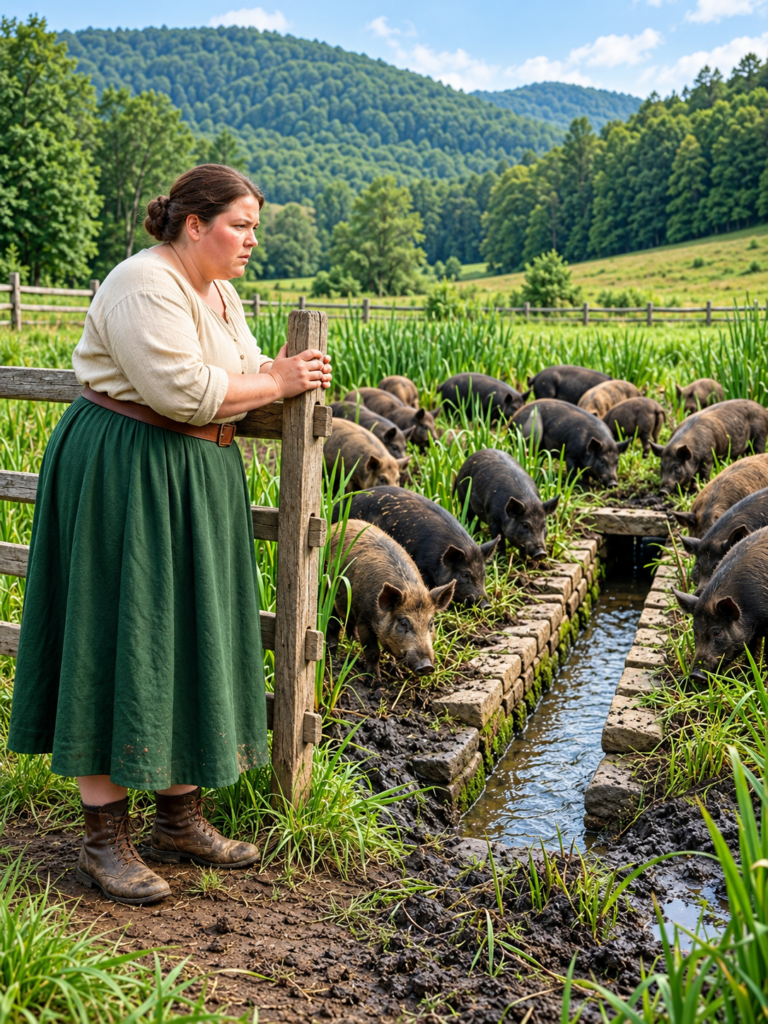
The townspeople who passed on the road at the edge of the parcel could see her working, a large woman in an oversized coat, knee-deep in muck, hauling fence posts, arguing with hogs.
It became a minor local entertainment.
People slowed their horses to watch. Some of them shouted things.
“How’s the swamp queen doing today?”
“You planning to marry those pigs, Adeline, since that’s all you’ve got out there?”
The worst ones said things about her size, that the hogs had finally found someone who could keep up with them, that the swamp had been waiting for someone heavy enough to sink all the way down.
She heard every word.
She drove the next fence post a little harder.
What nobody watching from the road could see was what was happening beneath the surface.
The hogs moved through the sections she directed them through and did exactly what Ephraim had said they would do. Rooted down through the reed mat, tore up root systems that had been building for decades, turned the mud over and over, and fertilized as they went.
It was messy and loud and smelled terrible and was, by every visible measure, chaos.
But in the sections they had already worked through, the reeds didn’t grow back.
And when Adeline drove a post into those worked sections, it went in clean and straight and held.
The ground was changing under her feet.
By the end of the second month, she had four enclosures working in rotation.
The pregnant sow delivered nine healthy piglets in a rough shelter Adeline had built from salvaged lumber, working by lantern light on a night cold enough to see her breath.
She lost one in the first week.
She took this matter-of-factly, the way her father had taught her to receive loss directly, without pretending it didn’t happen, without making it larger than it was.
She sent six piglets to Ephraim as agreed. She kept two along with the mother.
The herd was hers now.
Winter came down on Brier Hollow the way it always did, not suddenly, but with a slow and grinding patience that tested people’s reserves.
Adeline had laid in enough firewood and dried food to get through, barely.
She was living in a one-room structure she’d built at the edge of the parcel using materials she’d begged, borrowed, and traded for across the fall.
It was not comfortable.
The roof leaked in two places. The stovepipe drew poorly and filled the room with smoke on windy mornings.
She patched the roof twice with what she had and left the third leak because she didn’t have anything left to patch it with, set a bucket under it, and went back to work.
The hogs did not care about winter in the way people did.
They slowed down, but they did not stop.
She sectioned off a portion of the southeast corner where the standing water was shallowest and the ground was already partially broken, and she let them work through it in the coldest months while she reinforced fencing and mapped what she was seeing across the parcel.
She started keeping a notebook that winter.
Not a diary. She wasn’t built for that kind of writing.
It was a working document, measurements and observations. Where the ground changed, where the water drained naturally and where it pooled, where she suspected the best black silt lay deepest.
It was in this notebook in January that she first drew a rough map of what she was beginning to understand about her 70 acres.
And it was in this notebook, in a margin note in February, that she wrote, without yet knowing why it mattered:
Something running east to west under the southeast corner. Hogs won’t go near it. Ground sounds different when you knock it.
She didn’t know what it was yet.
She would.
The notebook entry about the east-west line under the southeast corner sat untouched for six weeks.
Adeline had too many other problems to investigate something she couldn’t yet explain.
The boar, Duke, though she still never said this aloud, had developed a persistent limp in his left rear leg that worried her enough to walk him twice a day through the worked sections rather than letting him root aggressively.
One of the younger sows had gotten through a weak panel in the third enclosure and spent two days somewhere in the uncleared north section before Adeline found her standing in belly-deep water, perfectly calm, apparently satisfied with herself.
The fence line along the road needed replacing in three spots where frost heave had pushed posts sideways over the winter, and the one-room structure’s stovepipe finally gave out entirely in late February during a cold snap that dropped the temperature low enough to freeze the bucket under the leak solid.
She fixed the pipe herself with a length of salvaged tin and a pair of borrowed pliers, cutting her thumb badly in the process and wrapping it in a strip of old flour sack that she replaced twice before it stopped seeping.
None of this was heroic.
It was just what the work required.
By the time the ground softened enough in March to make the southeast corner accessible, Adeline had six enclosures running in rotation and a herd of 14.
The hogs had cleared and turned a rough crescent of ground along the western edge of the parcel that measured, when she paced it out carefully, close to two and a half acres.
The cleared ground was dark and open and smelled like something waking up, rich and complicated the way Ephraim had described.
She went to see him in early March, walking the three miles to his operation north of town because the borrowed wagon was spoken for that week.
He was in his pen sorting animals by weight with the relaxed efficiency of a man who had done the same thing several thousand times.
He looked up when she came through the gate and read her expression before she said anything.
“You need something,” he said.
It wasn’t a question.
“Advice,” she said, “and maybe your eyes on something.”
He handed his sorting stick to the boy who helped him on mornings and climbed through the fence without hurrying.
They walked back toward the slough parcel together, talking as they went.
She told him about the notebook entry, the east-west line, the way the hogs behaved around it, not frightened exactly, but diverted, routing around it the way water routes around a stone.
The sound the ground made in that section, hollow in a way that didn’t match the density of the black silt surrounding it.
Ephraim listened without interrupting, which was something Adeline had learned to appreciate about him.
Most people interrupted before you finished describing a problem, already sure they understood it.
“How deep do you think the reeds are there?” he asked.
“Ten, twelve years’ worth of growth over whatever’s underneath,” she said. “Denser than the rest. The hogs cleared the north edge of that section and then curved away from the center.”
“Animals know ground differently than we do,” Ephraim said. “They feel it through their feet. If they’re going around something consistently, there’s something there.”
“I know,” she said. “I just don’t know what.”
They reached the southeast corner of the parcel in the late morning.
The reeds were still thick there. She hadn’t pushed the enclosures that far yet, working methodically from the western edge inward.
Ephraim walked the perimeter of the uncleared section for 20 minutes without speaking, occasionally pressing his boot against the ground or pushing a stick down through the reed mat.
Adeline followed and said nothing.
He stopped at a point about 40 yards in from the eastern boundary marker.
“Hit something solid,” he said quietly.
She pressed her own stick down beside his.
The resistance was different. Not the flexible pushback of root mat and silt, but something harder. Something that didn’t give.
“Stone,” Ephraim said.
They looked at each other.
“How far does it run?” Adeline asked.
“Push your hogs through here,” he said carefully. “Section it small. You’ll find out.”
He stayed another hour helping her plan the enclosure arrangement for the southeast corner.
When he left, he paused at the edge of the parcel and turned back.
“Adeline,” he said. “Whatever’s under there, don’t talk about it in town. Not yet.”
She didn’t ask him why. She simply nodded.
She thought about that instruction for a long time afterward.
Spring arrived the way it does in low country, gradually, then all at once.
The creek levels rose. The standing water on the uncleared sections shifted and resettled.
The first birdsong came back in the reed margins, and Adeline found herself listening for it in the mornings without quite meaning to, the way you listen for something you’ve been missing without knowing you were missing it.
The cleared western acreage had dried and settled beautifully through the winter.
The silt had compacted to a firm, workable surface that crumbled correctly between her fingers, the color and texture that Ephraim had told her to look for.
She planted potatoes in the first week of April.
Working in rows, she measured with a length of cord tied between two stakes, getting the spacing right because she couldn’t afford to waste any of the ground she’d worked this hard to open.
She planted cabbage starts two weeks later and then turnips along the lower edge where the moisture stayed longest.
She did this alone, which took longer than it would have with help.
She stopped twice each day, once in the morning and once in the afternoon, not to rest exactly, but to eat and to look at what she was doing, to hold the scale of it in her mind.
There is a particular clarity that comes from physical labor sustained over a long period.
Not peace, exactly, but a kind of useful emptiness where only what matters stays in focus.
What stayed in focus was the ground and the hogs and the notebook and the slow process of turning something nobody wanted into something that worked.
She did not think often about the people in town.
When she did, she thought about them the way you think about weather, as a condition you have to manage, not something you can change.
Rusk was a separate category.
She thought about him less frequently but differently.
He had not spoken to her since the auction.
She had seen him twice in town, once outside the bank and once at the store. And both times he had looked through her the way a man looks through a pane of glass he doesn’t care about.
It was a specific kind of dismissal, not hostile exactly, but comprehensive.
The look of a man who has already categorized you and moved on to more interesting problems.
She did not find this reassuring.
Ephraim had said to keep quiet about the stone under the southeast corner. Rusk’s sudden offer at the auction, for a parcel that had never drawn serious interest, sat in her mind alongside that instruction like two pieces of a puzzle that hadn’t connected yet.
She pushed her hogs into the southeast section in May.
She sectioned it smaller than anywhere else on the parcel, the way Ephraim had advised: four small enclosures of roughly a quarter acre each, rotated on a two-week cycle.
She drove extra stakes to reinforce the fencing.
She fed the animals carefully before moving them into each new section so they worked the ground steadily rather than frantically.
It took eight weeks.
What emerged from under the reed mat in the southeast corner was not what she had expected.
She had been hoping for more of the same black silt, more workable acreage.
What the hogs uncovered instead, working down through the root mass and the decades of accumulated organic material, was a constructed line of dressed stone running east to west, cut in a consistent width of approximately four feet and fitted with the kind of careful joinery that spoke of someone who had known exactly what they were building.
The stones were not rough fieldstone.
They had been shaped.
The courses were deliberate.
And at the eastern end of the exposed line, where the hogs had rooted deepest along a slight depression in the ground, there was evidence of a vertical structure, a slot cut in the stone, precisely dimensioned.
That made no sense unless you understood what it was meant to hold.
Adeline stood at the edge of it for a long time.
Then she went to find Ephraim.
He came the next morning and crouched at the edge of the stone line for nearly ten minutes without saying anything.
He ran his hands along the joinery. He examined the slot at the eastern end.
He stood up and looked east along the depression in the ground, tracing something in the air with one finger.
“Millrace,” he said.
She had thought the same thing and hadn’t let herself say it.
“Someone built a water channel here,” he said. “Long time ago. Directed water from somewhere upstream, probably the spring that still feeds the low section, ran it along this line, used the head pressure to drive a wheel.”
He looked at the slot.
“That’s where the wheel frame sat, in that notch.”
“How old?” Adeline asked.
“Before the marsh built up this far,” Ephraim said. “Before I was born. Before most people’s grandparents were born.”
He stood quietly for a moment.
“The whole thing got swallowed when the drainage shifted and the reeds moved in. Probably been under there 30, 40 years, maybe more.”
“Does anyone know about it?”
He looked at her.
“Someone does,” he said. “That’s all I’ll say about that.”
She looked back at the stone.
“Rusk offered me money for this parcel before the auction went through,” she said. “Not through a broker. He sent a man directly to the boarding house where I was staying after my father died. I didn’t understand why he wanted 70 acres of swamp badly enough to offer above the starting bid.”
Ephraim was quiet for a moment.
“What did you tell the man?”
“That I hadn’t decided anything yet,” she said. “Which was true.”
“And at the auction, you outbid whatever Rusk was planning.”
“He didn’t bid,” she said. “He just laughed.”
Ephraim made a sound that was not quite a laugh and not quite anything else.
“Maybe he expected you to fail fast enough that he could pick it up after. Or maybe he was waiting to see if anyone else moved on it before he showed his interest too clearly.”
He paused.
“Either way, you complicated his thinking.”
Adeline looked at the stone line running east to west beneath her property.
“We need to find where it starts,” she said. “The water source.”
“I know where it starts,” Ephraim said. “I’ve known for a while. There’s a spring in the low northwest section that runs year-round. I assumed it fed the slough by seeping through. I didn’t know about this channel.”
“If the channel runs from the spring to this wheel site, then the whole thing is one system,” Ephraim said. “Water coming in from the northwest, running along this stone race, powering a wheel at the eastern end.”
He looked at the parcel around them.
“All of it inside your 70 acres.”
They stood in the cleared southeast corner while the hogs worked the adjacent enclosure and the late June sun pressed down on the black earth around them.
“I need to go look at the county records,” Adeline said.
“Yes,” Ephraim said. “You do.”
The county records office occupied a small room at the back of the courthouse that smelled of old paper and lamp oil and the particular mustiness of documents that hadn’t been touched in a long time.
The clerk, a lean man named Otis Crane, who wore the same brown vest every time Adeline had ever seen him, looked up when she came in with the expression of a man who was not especially glad to be interrupted.
“I need to look at the land history for Black Heron Slough,” she said. “Property records, water rights filings, anything relating to structures on the parcel prior to current ownership.”
Otis looked at her over his glasses.
“That’s going to be a while.”
“I’ve got time,” she said.
She spent three afternoons in that room over two weeks.
Otis, once he understood she was serious and not going to leave, became more helpful than she’d expected, pulling boxes from the shelves in the back room, pointing her toward particular ledgers and filing categories, occasionally explaining the indexing system in the terse shorthand of a man who knew it well and rarely had to describe it to anyone.
The history of the slough parcel was complicated and in places poorly documented.
Several transfers in the 1840s and 1850s were recorded in incomplete entries, names without dates, dates without amounts, parcels described in boundary language that no longer matched current surveying standards.
She had to build the picture slowly, cross-referencing multiple ledgers, and it was imprecise work that produced a rough outline rather than a clean answer.
What she found was this.
The parcel had once been part of a larger tract owned by a family named Hollowell, who had operated a water-powered mill sometime in the 1840s.
The mill had processed grain for the surrounding farms.
At some point, the record was unclear, possibly during a flood year, possibly due to financial difficulty, the operation had been abandoned and the property broken into smaller parcels.
The mill itself had been listed in an estate inventory from 1851 as disused, structure collapsed, equipment removed.
She found the water rights filing almost by accident in a separate ledger for county water allocations that Otis pulled out on the third afternoon.
It was a document granting water rights from the spring on the northwest section of the Hollowell tract to the mill operations, specifically to the mill’s waterwheel.
The document predated the mill’s abandonment.
It was written in the legal language of its time, which was formal and precise, and importantly specific about what the rights attached to.
Not to the land generally. To the mill.
Adeline read the document three times.
Then she borrowed Otis’s pencil and copied the exact language in her notebook, word for word.
She walked home in the late afternoon with the notebook under her arm and Ephraim’s voice in her head.
Someone does. That’s all I’ll say about that.
In July, the summer settled hard over Brier Hollow, and the first real sign of what was coming showed itself in the Crane Creek levels, which dropped six inches over three weeks.
People noticed, but not urgently.
Summer always thinned the creek out, and it usually recovered by August.
It didn’t recover in August.
By September, the creek was a series of disconnected pools. The wells on the east side of town were dropping.
Three farms in the upland area north of Brier Hollow reported their shallow wells had gone dry, and their owners were hauling water by wagon from the Crane Creek basin, which was itself going dry.
Adeline saw it from her parcel without fully understanding yet what she was seeing.
Her northwest spring continued to flow.
The low section of her parcel remained wet, not flooded, but reliably moist, the way it had always been.
The black earth of her cleared western acreage held moisture longer than any surrounding ground because of its density and composition.
Her potato plants did not wilt. Her cabbage kept its color.
While the upland farms began to go yellow and dry, Adeline’s four cleared acres stayed green.
She was aware of this.
She didn’t know yet what it meant for anyone beyond her own operation.
Then in mid-September, Lenora Pike appeared at the edge of the parcel.
Lenora ran the largest restaurant in Brier Hollow, a clean, well-regarded operation on the main street that served the county’s merchants and traveling businesspeople and the occasional family celebration.
She was 51, a practical woman who dressed well and spoke directly and had built her business over 20 years without a great deal of assistance from anyone.
She was not the kind of person who showed up unannounced unless she had a reason.
Adeline was hauling fence materials along the eastern edge when she saw the woman standing at the road boundary in a dark green dress, looking out over the parcel with an expression of focused assessment.
“You’re Adeline Mercer,” Lenora said.
“I am,” Adeline said.
“I’ve been watching this place.”
Lenora looked at the cleared acreage, the hog enclosures, the dark rows of potato plants.
“I thought at first it was just stubbornness keeping you here. I revised that opinion about three months ago.”
“What changed your opinion?” Adeline asked.
“Someone told me your potatoes were coming in,” Lenora said. “I asked around about the quality. Then I came to see for myself.”
She paused.
“I’m paying three other suppliers, and the quality has been inconsistent this season. The drought is making it worse.”
“You want to buy produce,” Adeline said.
“I want a reliable supplier,” Lenora said, “which is a different thing. I’m not interested in a one-time arrangement. I need someone who can commit to a consistent volume through the fall and into winter.”
She looked at Adeline with the level attention of a person used to making quick assessments.
“Can you do that?”
Adeline thought about her stock. What was in the ground, what would come in over the next six weeks, what she could commit to without overextending.
“Potatoes, cabbage, turnips,” she said. “I can give you numbers next week when I’ve finished my estimate.”
“I’ll be here next week,” Lenora said.
She turned to go, then stopped.
“People say a lot of things about you,” Lenora said. “About why you bought this place. About whether you’re foolish or stubborn or both.”
She looked back at the cleared ground.
“From what I can see, they’ve been talking about the wrong things.”
She left without elaborating.
Adeline watched her walk back to the road, then turned around and looked at her four acres of dark green planted ground.
For the first time since the auction, something in her chest loosened by a fraction.
The harvest came in October, six weeks after Lenora’s visit, and it was better than Adeline had estimated.
The potato yield from a single acre of the black silt was nearly double what she’d seen on the upland farms in good years.
The cabbage heads were dense and heavy.
The turnips were clean and uniformly sized in a way that surprised even her.
She had expected variation, the kind of inconsistency that comes from newly worked ground still finding its character.
She delivered the first load to Lenora’s restaurant on a Tuesday morning, driving a borrowed wagon down the main street of Brier Hollow with produce stacked and covered in the bed.
People watched from the storefronts.
She kept her eyes on the road.
Lenora met her at the delivery entrance and inspected the load with the careful attention of someone who knew exactly what she was looking at.
She weighed the potatoes, cut a sample cabbage, examined the root structure of the turnips.
She said very little for ten minutes.
Then she offered a price that was slightly above what Adeline had calculated as fair.
And Adeline accepted it without negotiating because the number was already right.
“Same quantity next month?” Lenora asked.
“More,” Adeline said. “I’ve got another acre coming in by the end of November.”
Lenora wrote the arrangement in her ledger and handed Adeline a receipt.
“I’ll tell you something,” she said, not looking up from her writing. “I’ve been buying produce in this county for 20 years. The ground you’re working, I don’t know what’s in that silt, but whatever it is, it grows better vegetables than anything I’ve seen from the upland farms.”
“Forty years of reed roots composting in place,” Adeline said. “That’s what’s in it.”
Lenora looked up.
“Then you’ve got a lot of it still to clear.”
“About 65 acres’ worth,” Adeline said.
Lenora held her gaze for a moment, then went back to her ledger.
“Keep working, then.”
The money from the first delivery was not a fortune, but it was real, and it was hers.
And she sat with it in the one-room structure that evening and wrote numbers in her notebook with the same pencil she had used to copy the water rights language at the courthouse.
And the numbers, for the first time since her father died, were moving in a useful direction.
She expanded the herd through the winter, trading produce against two more sows and a young boar from a farmer northwest of town who was scaling back his operation.
She pushed the enclosure rotation faster as she learned the hogs’ pattern, the rhythm of how they worked, how long a section needed to rest after clearing before it was ready for the next stage, how to read the ground quality as it changed section by section.
By the following spring, she had cleared nine acres total, then 14.
By the second full summer, she was working close to 20 acres in active rotation.
The herd was 30 strong.
The money was not yet what anyone would call comfortable, but it was consistent and it was growing.
And she had stopped lying awake at night doing arithmetic in her head.
The arithmetic was still there. It just wasn’t frightening anymore.
She was 30 years old, and she had not been back inside the Brier Hollow courthouse since the day she signed the auction paperwork, except for her afternoons in the records office.
She had not spoken at length with anyone in town beyond Lenora and Ephraim and the farmers she traded with.
She was not interested in being accepted by Brier Hollow in any general sense.
She was interested in her ground and her hogs and the stone channel running east to west under her southeast corner and the spring in the northwest section that had never once stopped flowing, even when every other water source in the county was going dry.
That last fact had not gone unnoticed.
She didn’t know yet by whom exactly or what they intended to do about it.
But she understood, in the low and practical part of her that had learned to read situations by their weight rather than their surface, the part that had kept her alive through two brutal winters and a harvest and a lawsuit’s worth of research without anyone’s help, that whatever Thaddius Rusk had been waiting for was getting closer.
The autumn of Adeline’s second full year at Black Heron Slough, the drought returned.
Not the mild dryness of the previous summer. Something harder.
The creek levels dropped faster and further than the year before.
By October, the upland wells that had recovered through the winter were dropping again.
And this time, several of them did not recover at all.
The farms north of Brier Hollow began to suffer in a visible, serious way.
Corn that should have been eight feet tall came in at five, with ears that were light and poorly formed.
Pasture grass dried to nothing on the south-facing slopes.
Wells failed.
One family on the far north section of the county hauled water 12 miles.
The drought did not reach Adeline’s parcel.
Her northwest spring continued to flow at exactly the same rate it always had, steady and cold, seeping up from somewhere deep enough that the surface conditions didn’t affect it.
The cleared acreage held its moisture.
The crops in the ground didn’t know there was a drought at all.
People began to notice this in a different way than before.
Before, they had noticed that a heavyset woman was wading through mud with hogs, and they had found this amusing.
Now they noticed that while their fields went yellow and their wells went dry, Black Heron Slough remained wet and green and productive, and the woman who had bought it for a dollar an acre was delivering produce to Lenora Pike’s restaurant every month without interruption.
The amusement had changed to something more complicated.
She was moving a load of fence posts across the south section of the parcel on a Wednesday in late October when she heard hoofbeats on the road and looked up to see a rider she didn’t recognize pulling up at the boundary.
The man was well-dressed in the way that suggests someone else is paying for the clothes.
He had a leather satchel.
“Miss Mercer,” he said, “my employer would like to discuss the possibility of acquiring your property. He’s prepared to offer a substantial amount above assessed value.”
Adeline set down the fence post she was carrying.
“Who’s your employer?” she asked.
The man hesitated for just a fraction of a second.
It was a small hesitation, but she caught it.
“Mr. Thaddius Rusk,” he said. “He believes the parcel may have development potential that—”
“No,” Adeline said.
The man blinked.
“He’s prepared to be generous, Miss Mercer. Given the drought conditions, many landowners in the county are reconsidering their—”
“I said no,” she said. “You can tell him I said no clearly, so there’s no misunderstanding.”
The man looked at her for a moment, recalculating something behind his expression.
Then he tipped his hat, turned his horse, and rode back toward town.
Adeline watched him go.
She picked up the fence post and carried it to where it needed to go.
Three days later, she found the first section of her eastern fence line pulled down.
Not fallen. Pulled.
The post had been yanked from the ground and the wire coiled and left in a pile six feet away, which is not how fencing fails on its own.
Two of her younger hogs had gotten through the gap in the night and were loose somewhere in the uncleared north section.
She spent most of a day recovering them.
She repaired the fence and said nothing to anyone in town.
But she went home that evening and opened her notebook to the page where she’d copied the water rights language from the courthouse ledger.
And she read it again very slowly.
And then she added a new note in the margin in the same careful handwriting she used for all her records.
He knows about the spring. He knows about the millrace. He knew before I bought it.
She looked at the words for a long time.
Then she closed the notebook, set it on the shelf beside her father’s stopped pocket watch, and went to bed.
She slept badly, but she slept.
She did not tell Ephraim about the fence line right away.
She told him ten days later when she walked to his operation on a Thursday morning, ostensibly to discuss the condition of the boar’s leg, which had healed well enough but still favored the left side in wet ground.
They talked about the boar for a few minutes standing at the pen fence, and then she described the pulled posts and the wire coiled neatly beside them, and the two days she’d spent recovering the hogs.
Ephraim listened without looking at her.
He watched his animals moving in the pen.
“First time?” he asked.
“Yes.”
“It won’t be the last,” he said. “Not if he’s decided he wants what’s under your ground.”
“He sent a man with an offer three days before,” she said. “I turned it down.”
“I figured you would.”
He turned and looked at her.
“You need to be careful about what you say and to whom. And you need to think about what Rusk is actually after because it might not be just the water.”
“The millrace,” she said.
“The millrace, the spring, and maybe something else.”
He paused.
“There’s a question of what old water rights can be leveraged into in a drought year. A man who controls the only reliable water source in a dried-out county controls a great deal more than water.”
She had been thinking the same thing.
She had been thinking it since the man on the horse had ridden away and she’d stood holding the fence post in both hands.
“He knew about the spring before I bought the parcel,” she said. “I wrote it down the night after the fence. He knew about the millrace too, or suspected. That’s why he tried to offer above the starting bid before the auction. He was hoping I’d take the money and go.”
“And when you didn’t?”
“He let me buy it and planned to wait until I failed,” she said. “Only I didn’t fail fast enough.”
Ephraim made the sound he sometimes made that served as agreement.
“Now he’s shifted to something else.”
She went home and thought about what that something else might look like.
She didn’t have to wait long to find out.
The first week of November, a notice arrived at the land records office.
She heard about it from Otis Crane, who sent her a brief, carefully worded message through the postal route that said only, “There has been a filing you should be aware of. Come when you can.”
She came the next morning.
Otis was alone in the records room when she arrived.
He pulled a document from a folder on his desk and set it in front of her without preamble.
It was a water rights claim filed by Thaddius Rusk against the spring on the Black Heron Slough parcel, citing an ancestral grant of water rights held by the Rusk family through a chain of property transfers dating back to the 1840s.
The document was long, 12 pages of legal language, and attached to it was a copy of an old deed that Adeline had never seen in the county ledgers.
She read it carefully twice.
Then she sat very still.
“Where did this come from?” she asked.
“Through a law office in the county seat,” Otis said. “Attorney named Harwell. Expensive firm.”
He paused.
“I’m not supposed to tell you any of this.”
“Then why are you telling me?”
He looked at her steadily.
“Because Rusk has been in this office four times in the past two years pulling records on the slough parcel, and he never once asked permission to look at anything that was sealed.”
He straightened some papers on his desk.
“And because you came in here and spent three afternoons doing it the right way, and you wrote everything down in your own notebook, and you said thank you when you left.”
She looked at the document again.
“Is the deed real?” she asked.
“It appears to be,” Otis said carefully. “That’s all I can tell you.”
She borrowed his pencil and copied the deed language and filing number into her notebook.
She thanked him.
She walked out into the November cold and stood on the courthouse steps for a moment, breathing.
The document, if it held, would grant Rusk the right to claim the spring’s water as his own, to divert it, redirect it, or simply deny it to her operation.
Without the spring, the northwest section of her parcel would go dry.
Without moisture feeding the lower ground through the stone channel, the cleared eastern acreage would lose the subsurface hydration that made the black silt so productive.
Without the water, what she had built over three years of brutal work would begin to die from the bottom up.
She walked to Lenora’s restaurant.
It was midmorning, between the breakfast service and the lunch preparation, and Lenora was at her office table in the back with her ledgers spread around her.
She looked up when Adeline came in and read her face immediately.
“Sit down,” Lenora said. “Tell me.”
Adeline told her.
She laid the notebook on the table and showed Lenora the language she’d copied from both the original water rights filing and from Rusk’s new claim.
Lenora read both carefully.
She was quiet for a long time.
“You need a lawyer,” she said.
“I know,” Adeline said. “I don’t have money for a lawyer.”
Lenora looked at her.
“How much is the operation worth at this point? The cleared acreage, the herd, the future harvest contracts.”
Adeline had run these numbers several times.
“More than what I paid for the parcel,” she said. “Maybe more if I get the eastern section to develop the way I’m planning.”
“And without the spring?”
“Nothing,” Adeline said flatly. “The whole thing depends on the water.”
Lenora tapped one finger on the desk.
“Then you have to fight this yourself.”
“I know that too.”
“Do you have any idea how?”
Adeline picked up her notebook.
“I think so,” she said. “But I need to go back to the records office and look at something I didn’t look at before.”
She spent five full days in the records room over the following two weeks, with Otis pulling boxes and ledgers she had not previously examined: property transfer chains, estate inventories, county court records from the 1840s and 1850s.
She was looking for the Rusk family’s connection to the original Hollowell tract and the mill operation.
And what she found was more complicated than she’d expected.
The Rusk family had in fact owned a parcel adjacent to the Hollowell tract in the 1840s.
There had been a business arrangement of some kind between old Cornelius Rusk, Thaddius’s grandfather, and the Hollowell mill operation.
The deed attached to Thaddius’s water claim appeared to originate from this arrangement.
But the deed was attached to something specific.
The water rights it granted were not blanket rights to the spring.
They were operational rights, water allocated for the running of the mill.
The language was the same kind she’d found in the original Hollowell filing because it was from the same period, drawn up by the same county surveyor.
Water rights granted to a mill, not to adjacent land, not to a family name, to a specific structure and its operation.
She sat with this for a long time in the cold records room, the lamp oil burning low while Otis worked at his desk, and the afternoon outside went dark.
If the water rights attached to the mill and the mill had stood on the Hollowell tract inside what was now her 70 acres, then Rusk’s claim was not what it appeared to be.
He wasn’t asserting a family right to the spring.
He was asserting a right to water that had been granted specifically for a mill operation on property that now belonged to her.
She wrote the analysis in her notebook in plain language, the way she wrote everything, no decorative phrasing, just the facts in order.
Then she drew a map.
It was rough. She was not a trained surveyor, but she had been walking every inch of her parcel for three years, and she knew it the way she knew her own hands.
She drew the spring in the northwest.
She drew the stone channel running east to west through the southeast corner.
She drew the wheel slot at the eastern end, and she marked the location relative to the original boundary markers that appeared in both the Hollowell estate records and the county survey documents she’d been studying.
The mill site was inside her 70 acres, not adjacent to it.
Inside it.
She showed the map to Ephraim that evening.
He looked at it for a long time.
He turned it sideways, then back.
He asked her twice to explain the boundary reference points she’d used, and she explained them carefully, showing him the survey language in her notes.
“You’re certain about the boundary placement?” he asked.
“The northeast and southeast corner stakes are original iron stakes from the 1847 survey,” she said. “They’re still in the ground. I’ve been using them as reference points since I first laid out my enclosures. The wheel slot in the stone channel falls inside those stakes by at least 30 yards.”
Ephraim set the map down on his knee.
Outside his window, the November wind moved through the bare trees.
“Rusk is going to have an attorney in that courtroom,” he said. “A good one. I know you’re planning to go in there yourself.”
“Yes.”
He looked at her with the expression he sometimes got, not doubtful exactly, but careful, measuring the distance between what was true and what could be demonstrated.
“They’ll try to make you look like you don’t understand what you’re talking about,” he said.
“They’ll try,” she said.
He handed the map back.
“Then you’d better understand everything.”
She went home and studied.
She studied the water rights document Rusk had filed until she could reproduce the key language from memory.
She studied the original Hollowell filing until she understood not just what it said but why it was written that way, what the legal conventions of the period required, what the surveyor’s language would have meant to a county court in 1840, as opposed to what Harwell would try to make it mean to a county court in 1882.
She studied her own map.
She revised it three times as she found more precise reference points in the survey records.
She measured and remeasured the boundary calculations until she was confident in them.
She practiced explaining it out loud alone in the one-room structure, to the walls and the stopped pocket watch and the notebook on the shelf.
She was not a practiced speaker.
She stumbled over the legal language at first and had to back up and restate things.
She did it again the next night and the night after that until the stumbling smoothed out.
Not perfect, but clear.
The hearing was set for the second week of December.
In the same courthouse where Adeline had bought 70 acres of swamp for a dollar an acre, in the same room where Thaddius Rusk had laughed loud enough to shake the rafters.
She walked in on the morning of the hearing wearing her father’s coat, which still didn’t fit properly, and carrying her notebook and her map rolled into a cylinder under one arm.
Rusk was already there with his attorney, a city man named Harwell, who wore an expensive suit and carried a leather case that cost more than Adeline’s first month of produce sales.
Harwell was the kind of lawyer who used volume and pace and complicated phrasing to make opposing parties feel small and outmatched.
He was good at it.
Adeline had asked around carefully and quietly, and what she’d heard was consistent.
Harwell won by making the other side feel they had already lost before the judge said a word.
She sat at the respondent’s table and arranged her materials in front of her.
She put the notebook on the left, open to the copied language from the original filing.
She put the map on the right, weighted at the corners with two small stones she’d brought from the parcel, a habit she’d developed from years of holding maps down in wind.
Rusk looked at the stones, and something moved briefly across his face, not quite a smile.
The judge was a man named Aldis Puit, who had been on the county bench for 11 years and who had, in Otis Crane’s assessment, no patience for theater and considerable patience for facts.
Adeline had taken this description seriously.
It was the only advantage she’d been given that she hadn’t had to earn herself, and she intended to use it.
Harwell opened for the plaintiff with 30 minutes of careful, measured argument.
He laid out the deed, the chain of property transfers, the Rusk family’s long association with water resources in the county.
He was polished and comprehensive, and he spoke about Adeline’s property the way you speak about a thing you have already decided belongs to someone else, with a kind of proprietorial ease that was designed to make the assumption seem natural.
He described the spring as the source of a water right that had been attached to the Rusk family’s interests since before Adeline was born.
He described her operation as having inadvertently benefited from water that had never rightfully been hers to use.
He was careful never to say anything insulting directly, but the shape of his argument contained an implication that a woman of her background and limited education had simply not understood what she was buying when she acquired the parcel.
Judge Puit listened without expression.
When Harwell finished, Puit looked at Adeline.
“Miss Mercer,” he said, “you may respond.”
She stood up.
She did not try to match Harwell’s style.
She had understood from the beginning that she couldn’t.
She didn’t have his vocabulary or his courtroom fluency.
What she had was something different.
“Your Honor,” she said, “I want to start by saying that the deed Mr. Harwell presented is genuine. I’ve reviewed it carefully, and I’m not disputing its authenticity.”
There was a small stir in the room.
Rusk leaned slightly toward Harwell and said something quietly.
Harwell’s expression did not change, but something in his posture recalibrated.
Puit’s eyebrows moved slightly.
“Go on,” he said.
“The document is real,” Adeline said. “The question is what it actually grants.”
She unrolled her map on the table and put the stones on the corners.
“The water rights in that deed are not general rights to the spring on my property. The language, and I’ve copied it here word for word, allocates water specifically to the operation of a mill. Not to adjacent land, not to a family, to a mill.”
She read the language aloud from her notebook clearly and without rushing.
“That mill,” she continued, “was the Hollowell mill, which operated in the 1840s and was listed as disused and structurally collapsed in the Hollowell estate inventory of 1851. But the physical infrastructure of that mill, the water channel, the wheel housing, the dressed stone race running 60 yards east to west, is still present on my property. My hogs uncovered it this past summer.”
She placed the map in front of Judge Puit and walked him through the reference points, the original 1847 survey stakes, the location of the stone channel relative to those stakes, the wheel slot’s position.
She had written the boundary calculations on the back of the map in clear figures that anyone could follow.
“The mill stood inside my 70 acres,” she said. “Not adjacent to them. Inside them. Which means the water rights in Mr. Rusk’s deed attached to a structure that exists on my property.”
The room was quiet.
Harwell was on his feet with an objection before she finished the sentence, procedural language questioning the validity of her survey methodology, her qualifications to present physical evidence.
Puit listened, then said, “She’s a property owner describing features of her own land that she has direct knowledge of. Continue, Miss Mercer.”
She continued.
She walked through the history of the millrace, what it was, how it functioned, how it connected the spring in the northwest section to the wheel site in the southeast, why the entire system existed within the parcel boundary.
She explained what the hogs had done to uncover it and how she had documented the discovery in her notebook over the course of five months.
She did not use dramatic language.
She used the kind of language she used in her notebook, plain and specific and ordered.
She said, “I found,” “I measured,” and “The record shows,” rather than “I believe” or “It seems.”
Harwell cross-examined her for 40 minutes.
He challenged her survey methodology, her reading of the historical documents, her interpretation of the deed language.
He was skillful and persistent, and he found three places where her knowledge had genuine gaps, places where she had inferred rather than confirmed, where the record was incomplete.
He pressed on these gaps efficiently.
She acknowledged them directly.
She did not try to paper over them or argue around them.
She said, “You’re right that I can’t confirm that specific date from the records I’ve reviewed, and that’s a fair point. The estate inventory doesn’t specify the foundation dimensions.”
She gave him what was true and held the line on what she was certain of.
When Harwell sat down, he had created some doubt.
She could see it in the room, the sense that the question was closer than it appeared after her opening.
Then Rusk made a mistake.
He leaned over to Harwell and spoke quietly, but not quietly enough.
He said, “Tell Puit the foundation walls we surveyed last August showed—”
He stopped himself, but the sentence had already happened.
Adeline heard it.
From the slight change in Puit’s expression, the judge had heard it too.
She stood up.
“Your Honor,” she said. “Mr. Rusk just referenced a survey of the foundation walls on my property conducted last August.”
Her voice was level.
“I’d like to ask when that survey was conducted relative to his offer to purchase the parcel, which his agent presented to me in October. And I’d like to ask how Mr. Rusk knew there were foundation walls to survey, given that the stone channel wasn’t uncovered until my animals cleared the southeast section in late May, and I told no one about the discovery until this hearing.”
The room went very still.
Puit looked at Rusk.
“Mr. Rusk,” he said in the tone of a man who has all the patience in the world and intends to use it slowly, “would you like to address that?”
Rusk’s face had gone a particular shade.
His attorney put a hand on his arm.
“My client has no further statement at this time,” Harwell said.
“I see,” Puit said.
He called a recess.
During the recess, Adeline stood in the corridor outside the courtroom and pressed her back against the cold plaster wall and breathed.
Her hands were shaking slightly, not from fear, she thought, but from the sustained effort of holding everything steady for two hours straight.
Lenora had come to the hearing and found her in the corridor and stood beside her without speaking, which was exactly the right thing to do.
After a moment, Lenora said, “You heard it?”
“Yes,” Adeline said.
“He surveyed your property without permission.”
“Before he made the offer. Before I turned him down. Probably before he filed the water rights claim.”
She pressed her fingers flat against her thighs to stop the trembling.
“He knew what was under the southeast corner before I did. He knew the whole system, the spring, the channel, the wheel site. He’s known for a long time.”
“And he waited,” Lenora said.
“He waited for me to fail, and then he waited for the drought,” Adeline said. “And when neither of those worked the way he expected, he decided to take the water instead.”
Lenora was quiet for a moment.
“Will Puit rule in your favor?”
“I don’t know,” Adeline said honestly. “The argument is sound, but there are gaps in the record that Harwell found, and he found them correctly.”
She looked at the courthouse floor.
“I did my best.”
“I know,” Lenora said.
They went back inside when the recess ended.
Judge Puit did not rule that day.
He took the matter under advisement and set a date three weeks out for his decision, which was standard practice for complex property disputes.
He asked both parties to submit written summaries of their key arguments, which gave Harwell’s law firm a significant advantage in polish and format.
Adeline spent two evenings writing her summary in plain language at the kitchen table of Lenora’s restaurant because Lenora had offered the space and because the one-room structure at the parcel was cold enough in December that her fingers cramped over the pencil.
She wrote the summary the way she wrote everything: facts in order, language plain, nothing more than what she could demonstrate.
She submitted it to the courthouse on the morning of the deadline and walked home in the cold.
The three weeks of waiting were the hardest part.
Not because she was idle. The parcel didn’t care about court proceedings, and the hogs still needed feeding, and the fence lines still needed checking.
And two of the younger animals had developed a skin condition that required daily attention.
But underneath all of it, the waiting had a weight that the work couldn’t fully displace.
She found herself taking her father’s pocket watch off the shelf in the evenings and holding it without winding it or looking at it, just holding it the way she had on the night after the auction, sitting on the edge of the bed in the room above the harness shop.
She was 30 years old.
She had built something from $70 and three years of work that nobody thought would survive a winter.
She had cleared 30 acres of black earth, grown a herd from three animals, secured a reliable supply contract with the best restaurant in the county, and uncovered a piece of engineering that had been lost under the mud for 30 years.
She had done all of it alone, and in three weeks, a judge was going to tell her whether it was hers to keep.
On the morning of the 16th day, Otis Crane appeared at the edge of the parcel.
He had never come to find her before. She had always gone to him.
She saw him from across the cleared acreage, standing at the road boundary in his brown vest, looking uncomfortable with the mud on his boots.
She walked to him.
“Puit ruled this morning,” Otis said. “Early. He sent the decision to the filing office, and I’ve got it recorded.”
He paused.
“I thought you should hear it before it gets around town.”
She looked at him.
“He ruled in your favor,” Otis said. “Full ruling. You own the property, the mill site, and the spring.”
He cleared his throat.
“He also included a note in the ruling, unusual for Puit, noting that evidence presented during the hearing suggested Mr. Rusk or his agents may have conducted an unauthorized survey of the respondent’s property. He’s referred the matter to the county prosecutor’s office for review.”
Adeline stood in the cold air at the edge of her 30 acres of black earth, with her father’s coat hanging from her shoulders and the hog pen behind her, and the stone channel running east to west under her southeast corner and the spring flowing steadily in the northwest section, the way it had flowed through every dry summer and hard winter since before anyone in Brier Hollow could remember.
She didn’t say anything for a moment.
“Thank you, Otis,” she said.
He nodded, looked at his boots, and then looked up at the cleared acreage spreading out behind her, the dark rows, the methodical fence lines, the hogs working in the far enclosure.
“It’s something,” he said quietly. “What you’ve done here.”
“It’s a start,” she said.
He walked back to the road.
She turned around and looked at her parcel, all 30 cleared acres of it, with the remaining 40 still waiting under the reeds.
The spring was still running.
The ground was still rich.
The work was still there to do.
She went back to it.

