
Part 1
“Fifty dollars!”
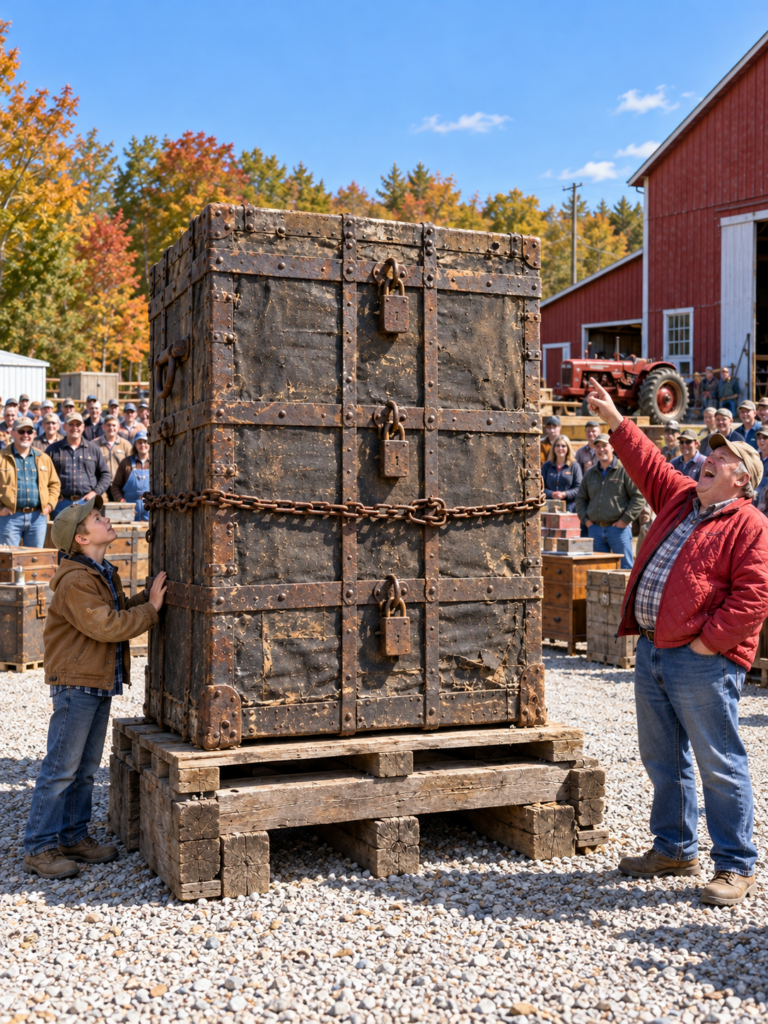
Royce Tibbit threw both arms into the air, making certain that everyone in the auction yard could hear him.
“Folks, did you hear that? The Kenny boy just spent fifty good dollars on a box of mouse nests taller than his own granddaddy!”
Laughter swept across the gravel lot.
Some men shook their heads. Others turned around for a better look at the skinny twelve-year-old standing beside the enormous wooden trunk. A teenager near the hay wagons bent forward laughing, while two farmers exchanged amused glances over the beds of their pickup trucks.
Royce was enjoying himself more than anyone.
He reached into the back of his red pickup, pulled out a crowbar, and held it toward the boy.
“Here you go, son. Open your treasure. Let’s all see what fifty dollars bought you.”
Arlo Kenny didn’t take it.
Instead, he placed one hand against the cold iron band around the trunk and looked at the man who had been making fun of him for the last ten minutes.
“No, sir.”
Royce raised his eyebrows.
“What was that?”
“I’m not opening it here.”
The laughter grew louder.
Royce turned toward the crowd, grinning.
“Did you hear him? He’s taking it home so nobody can watch him cry!”
Arlo didn’t answer.
His grandfather stood a few feet away, silent beneath the brim of his old work cap.
What nobody in that auction yard understood was that Arlo had a reason for refusing.
He had spent three weeks studying something that most grown men in Clement County had forgotten existed. That morning, beneath ninety years of accumulated dirt, he had found two clues that made his heart beat faster.
He wasn’t certain what the trunk contained.
And if he was wrong, fifty dollars—all the money he had earned that summer—would be gone.
But if he was right, opening it carelessly in front of a laughing crowd could destroy something that had survived almost a century.
The auction had begun several hours earlier, on a warm morning in the small Ohio River town of Pell’s Landing.
Old furniture, farming equipment, household goods, and forgotten pieces of local history were arranged in long rows across the gravel yard. Men wandered between the lots carrying coffee in paper cups. Trucks and trailers lined the fence. Every so often, auctioneer Lyall Ostrander’s voice rose above the conversation as another possession changed hands.
Arlo had come with his grandfather, Hollis Kenny.
At seventy-three, Hollis was lean and white-haired, with rough hands, careful movements, and the quiet disposition of a man who had spent most of his life repairing things other people had given up on.
For years, he had owned a hardware store on Front Street.
It had been a modest place, but he knew every shelf, every drawer, and every customer who came through the door. Farmers trusted him to find the right part for an aging machine. Children knew he kept small jars of candy near the register.
Six years earlier, the business had closed.
Hollis rarely discussed those final months. When the building was emptied and the shelves auctioned off, he had watched pieces of his working life disappear for prices that barely covered the trouble of carrying them away.
Royce Tibbit had purchased much of the shelving and the old metal nail bins.
Then he had spent the following year telling anyone who would listen about how cheaply he had gotten them.
Royce owned Tibbit Salvage, a sprawling operation along River Road where wrecked cars, machinery, scrap metal, and unwanted estate purchases passed through his hands.
He was a heavyset man in his fifties, accustomed to winning arguments by speaking louder than everyone else.
And he had a talent for making another man’s misfortune sound like a joke.
Arlo knew the story of his grandfather’s hardware store. He had heard the laughter at the feed store. He had seen the way Hollis sometimes grew quiet when they drove past the old brick storefront.
That morning, however, Arlo wasn’t thinking about Royce.
He was studying Lot 96.
The trunk had been brought down from the Ashby hayloft, where it had stood undisturbed for generations.
It was an extraordinary thing to look at.
Nearly half again as tall as a grown man, it stood upright on a heavy wooden pallet. Gray oak slats showed beneath a covering of old tarred canvas. Three broad iron bands encircled its body, and three enormous padlocks hung down the front.
An additional chain had been wrapped around the case and secured to itself.
The locks were so badly corroded that their original finish could no longer be identified.
Someone had made a considerable effort to keep the trunk closed.
And then, apparently, everyone had forgotten about it.
Four men and a come-along had been required to move it from the hayloft and stand it in the auction yard. Nobody knew where its keys were. Nobody could say when it had last been opened.
Lyall Ostrander approached it with his clipboard.
“Lot ninety-six. One large freight trunk, contents unknown. Locked, no keys. Removed from the old Ashby hayloft.”
He examined the crowd.
“Who’ll give me a hundred dollars?”
Nobody moved.
“Seventy-five?”
A few men smiled.
“Fifty?”
Royce called from the front.
“I’ll give you five dollars to haul it off, Lyall, and that’s charity!”
A ripple of laughter passed through the bidders.
Lyall waited another moment.
He was preparing to move on when a young voice came from behind the crowd.
“Fifty dollars.”
Heads turned.
Arlo stood beside Hollis, holding up bidder card 240.
For a moment, Lyall appeared unsure whether he had heard correctly.
“Fifty?”
“Yes, sir.”
Lyall looked at Hollis.
The old man gave a small nod.
Arlo was using his grandfather’s bidding number, but the purchase would be his own.
Inside his brown canvas chore jacket were two twenty-dollar bills and one ten.
He had earned every dollar mowing lawns along Cherry Street since the beginning of June.
The work had meant long afternoons pushing a mower through thick summer grass, stopping to clear clippings from the wheels, and going home with dust on his socks and aching shoulders.
He had saved the money without spending any of it.
Now he was offering all of it for something nobody else wanted.
“Fifty dollars,” Lyall repeated. “Do I hear sixty?”
Royce gave an incredulous laugh.
“Sixty? Lyall, nobody else wants that monstrosity! The boy could’ve had it for a nickel!”
No one raised a hand.
Lyall brought down the gavel.
“Sold! Bidder two-forty. Fifty dollars.”
Arlo lowered his card.
He felt the familiar thickness of the folded bills in his pocket and knew that in a few moments they would be gone.
He wasn’t frightened of losing money so much as he was frightened of having misunderstood the evidence.
Then Royce began his performance with the crowbar.
He walked a slow circle around the trunk, occasionally tapping its wood with the metal tool.
“Rotten curtains,” he announced. “That’s what’s in here. The Ashbys never threw anything away. Probably kept every old window rag they ever owned.”
He knocked against the middle iron band.
“You bought yourself a coffin for curtains, son.”
The crowd laughed again.
Arlo stared at the trunk.
He knew what the others saw: rotten wood, rusted iron, and a transportation problem.
But he remembered the faded lettering he had uncovered with his thumb earlier that morning.
He remembered the shape of the brass plate.
And he remembered something written in an old newspaper.
Royce held up the crowbar again.
“Last chance, Kenny. Let’s open it.”
“No, thank you.”
Royce shrugged dramatically.
“Fine. Tell you what. I’ll give you ten dollars for the iron bands and those big locks. At least you’ll get something back.”
Arlo shook his head.
“Twelve dollars, then.”
“No, thank you, Mr. Tibbit.”
Royce’s smile hardened.
“Kennys,” he muttered, loudly enough for the nearest men to hear. “Never could tell a bargain from a bill.”
Hollis’s face tightened.
Arlo recognized the expression. He had seen it whenever someone mentioned the closing sale of the hardware store.
He looked at his grandfather.
Hollis looked back.
Neither spoke.
There were things more important than giving Royce the satisfaction of an argument.
After a moment, Hollis turned toward a neighboring farmer.
“Gus, you got an hour?”
Gus Varner, who lived near the Kenny place, studied the enormous trunk.
Then he examined Hollis’s old flatbed Ford.
“I reckon we can figure something out.”
Gus’s grown son came over to help, and Lyall lent them two heavy ratchet straps.
Moving the trunk proved every bit as difficult as Royce had predicted.
It weighed more than half a ton.
The old Ford had a hand winch mounted behind the cab, but the load was too awkward to lift without careful preparation.
They backed the truck into position, laid out a long plank, checked the cable, and began inching the case toward the flatbed.
Arlo pulled on a pair of his grandfather’s spare work gloves.
He stayed where the men told him to stand, watched the straps, and called out whenever something shifted.
Royce leaned against his pickup with the crowbar across one shoulder.
“Careful with those curtains!”
Nobody answered.
“Don’t shake it too hard. You’ll wake the raccoons!”
Gus kept his attention on the winch.
Hollis guided the lower edge of the trunk.
Arlo watched the chain stretch and listened to the ancient wood creak under its own weight.
For a frightening moment, one corner began sliding sideways.
“Strap’s slipping!” he called.
Gus stopped the winch.
They reset the load, tightened the straps, and started again.
Nearly an hour after the auction ended, the trunk stood secured behind the truck cab, towering above the roof.
Hollis checked every fastening twice.
Arlo climbed into the passenger seat.
As his grandfather started the engine, Royce cupped both hands around his mouth.
“Hey, Arlo! When you finally open that thing, make sure you call me! I want to see your face!”
The boy rolled down his window.
For several seconds, he studied the man standing beside the red pickup.
Then he answered.
“I will, Mr. Tibbit.”
Royce grinned.
“You promise?”
“Yes, sir. I promise.”
The Ford pulled away.
Royce was still laughing when it disappeared beyond the auction yard.
The Kenny property stood on four acres above the Ohio River.
The white wooden house had a porch that leaned a little toward one corner, and the machine shed needed repairs around the roof. But Hollis kept the place as carefully as he could.
His tools had their places. The workbench was clean. Even the dirt floor of the shed was swept regularly.
When they arrived, Hollis backed the flatbed inside far enough that the enormous trunk cast a shadow across his workbench.
He set the parking brake, chocked the wheels, and shut off the engine.
The old Ford ticked quietly as it cooled.
Hollis climbed down and stared at their purchase.
Then he removed his glasses.
“All right,” he said. “Tell me.”
Arlo reached inside his jacket.
He withdrew a folded piece of paper that had been handled so many times its corners were becoming soft.
Three weeks earlier, he had printed it at the Clement County Historical Society.
He spent many Saturdays there helping Odessa Puit, the seventy-eight-year-old woman who had devoted much of her life to preserving the county’s records.
Mrs. Puit kept the historical society running from an old converted bank building on Front Street. Arlo helped her sort documents, organize newspapers, and work with the microfilm equipment.
He enjoyed it more than most boys his age would have understood.
To him, the past wasn’t merely a collection of dates.
It was a world that had existed in the same streets he walked, in buildings that had burned down, in the names carved into headstones, and in ordinary people whose lives had nearly disappeared from memory.
One Saturday, while examining old newspapers, he had found an advertisement from the spring of 1881.
He unfolded the first page and handed it to his grandfather.
At the top, printed in heavy lettering, was an announcement for a farewell exhibition at the Garnet Opera House.
The attraction was Josiah Caro’s Grand Moving Panorama of the Ohio River.
Three nights only.
Nine hundred feet of painted canvas.
An entire journey from Pittsburgh to Cairo presented in a single evening.
Hollis read the advertisement slowly.
“Moving panorama?”
“That’s what I wanted to know,” Arlo said.
He explained how, before motion pictures became popular, artists created enormous continuous paintings that could be rolled from one wooden spindle onto another.
Some were hundreds of feet long.
The audience sat inside a theater while workers turned the cranks, slowly moving the painted scenery across the stage.
With music playing, viewers could watch rivers, mountains, villages, and cities pass before them as though they were traveling through the landscape themselves.
The paintings had been expensive to produce and difficult to transport.
Most eventually disappeared.
Some were destroyed in fires. Others rotted in storage or were cut into smaller pieces when their owners no longer had a use for them.
Very few survived intact.
Hollis glanced toward the towering trunk.
Arlo turned the paper over.
On the back was another newspaper clipping, this one from 1931.
It described the closing of the Garnet Opera House.
Among the items being distributed was a short reference to the old Caro panorama, packed inside its traveling case and sealed against dampness.
The article stated that Mr. Ashby had agreed to store it in his hayloft.
Hollis looked up.
“The Ashby hayloft?”
Arlo nodded.
“The same one.”
For a long moment, the old man said nothing.
Then he took his flashlight and followed Arlo around the left side of the trunk.
Near the lower iron band, beneath layers of dust and grime, faint lettering appeared on the old canvas covering.
Arlo pointed.
“I found that this morning.”
Hollis crouched closer.
Much of the stencil was illegible, but fragments of several letters remained.
A C.
An A.
Two faded Rs.
And farther along, what appeared to be part of a W.
There was also a small brass plate riveted into the oak.
The metal had turned green with age.
Arlo showed his grandfather where he had carefully rubbed away a little grime.
The plate carried a manufacturer’s name from Cincinnati.
Beneath it were two words.
ROLL ONE.
Hollis examined the top of the trunk with the flashlight.
At the back corners, two capped iron hubs protruded through the structure.
Arlo pointed them out.
“That’s what made me think it wasn’t an ordinary trunk.”
Hollis stood very still.
He studied the old newspaper clipping, then the brass plate, then the great wooden case.
At last, he gave a short laugh.
Not the cruel laugh Arlo had heard at the auction.
This one was full of astonishment.
“Well,” Hollis said quietly. “Would you look at that.”
Arlo didn’t smile yet.
“It’s only a possibility, Grandpa.”
“I know.”
“It could be something else.”
“I know that, too.”
Hollis folded the newspaper carefully.
Then he asked the question Arlo had known was coming.
“Why didn’t you open it back there? You could’ve shut Royce up in front of everybody.”
Arlo looked toward the rusty padlocks.
“Because I wasn’t sure.”
His grandfather waited.
“If it’s really the panorama, it might’ve been locked up since 1931. The canvas could be rotten. The paint might be coming off. If Mr. Tibbit had started prying it apart in that yard, or people reached in and pulled things out…”
He stopped.
The thought of something surviving ninety years only to be destroyed in a few careless minutes made his stomach tighten.
“And if it fell apart,” he continued, “nobody would’ve believed what it was. They’d just say we bought old rags.”
Hollis lowered his gaze.
He understood more than the boy realized.
He knew what it felt like when other people decided your possessions were worthless before they understood what those possessions meant.
Arlo looked directly at him.
“I want someone who knows what they’re looking at. Someone the town will believe.”
His grandfather nodded slowly.
“And then?”
“Then I want the people who laughed to see it themselves.”
Hollis studied him for a moment.
“Even Royce?”
“Especially Royce.”
That afternoon, they called Odessa Puit.
When Arlo described the trunk and read aloud the 1931 clipping, Mrs. Puit went quiet.
“Hollis,” she finally said, “is that case still locked?”
“Yes, ma’am.”
“Has anyone tried to open it?”
“No.”
“Good. Keep it that way.”
She paused.
“I’m calling Ruth Amler.”
Dr. Ruth Amler had spent thirty-four years as senior curator of paintings at the state historical museum.
Now working as an independent appraiser, she was known for examining historical artwork and providing evaluations that museums and insurers could rely on.
She returned their call shortly before one o’clock.
But rather than speaking with Hollis, she asked for Arlo.
“You’re the young man who purchased the case?”
“Yes, ma’am.”
“Tell me exactly what you’ve found.”
Arlo described the wood, the tarred canvas, the iron bands, the three padlocks, the brass plate, and the faded lettering.
He explained the newspaper clippings and the unusual iron hubs visible near the top.
Dr. Amler asked him to repeat the part about the hubs.
When he finished, her voice had become more serious.
“Those may be the roller spindles.”
Arlo gripped the telephone a little tighter.
“Does that mean it’s really the painting?”
“It means your interpretation is worth investigating. But I need you to understand something.”
She explained that old painted canvases were extremely vulnerable to moisture, mold, and changes in temperature.
A sealed wooden case left in a hayloft for nine decades could contain little more than decayed fabric.
Even if the painting was authentic, it might have deteriorated beyond recovery.
“I’ve opened cases like that before,” she told him. “Sometimes the canvas has turned to dust.”
Arlo swallowed.
“Yes, ma’am.”
“Don’t let your expectations run ahead of the evidence.”
“I won’t.”
“Now promise me something. Nobody opens that case until I arrive.”
“I promise.”
“I can be there by seven tonight.”
Arlo stared at the clock on the kitchen wall.
“Tonight?”
“If it is what you think it is, I want it examined properly as soon as possible.”
When the call ended, Arlo sat at the kitchen table for several minutes.
Outside, the late afternoon sunlight stretched across the yard. The enormous trunk remained untouched in the shed.
His fifty dollars were gone.
He had no proof that anything valuable waited inside.
But a woman who had spent most of her life studying historical paintings was driving to Pell’s Landing because of something he had noticed.
He took out a pencil and a sheet of notebook paper.
At the top, he wrote the names of people he wanted present.
Lyall Ostrander, the auctioneer.
Peg Ostrander, who had recorded the sale.
Odessa Puit.
Gus Varner and his wife, Bonnie.
His mother, Karen, who would finish her shift at the county hospital at six.
His grandfather.
And one final name.
When Hollis looked over his shoulder, he saw that Arlo had underlined it twice.
Royce Tibbit.
Hollis raised his eyebrows.
“You sure about that?”
Arlo put down his pencil.
“I gave him my word.”
Then he looked toward the shed.
“And if we’re right, Grandpa, I want him to understand exactly what he was laughing at.”
Part 2
Tibbit Salvage occupied six acres along River Road, where piles of twisted automobile frames stood beside rows of old farm equipment and coils of rusting cable.
Near the entrance was a small cinder-block office with a wooden porch.
That afternoon, Royce Tibbit sat on the porch with two of his employees, still entertaining them with the story of the boy who had spent fifty dollars on a locked wooden trunk.
“And then,” Royce said, imitating Arlo’s voice, “he tells me, ‘No, sir, I’m not opening it here.’”
His employees laughed.
Royce leaned back in his chair.
“Poor Hollis. Imagine having to haul that thing home for your grandson.”
One of the men happened to look toward the driveway.
His smile vanished.
Royce followed his gaze.
Arlo Kenny was walking toward the porch.
Hollis remained in the Ford, parked near the office with the driver’s window open.
“Well, look who’s here,” Royce called. “Did you get your treasure open, son?”
“No, sir.”
“What’s the matter? Too many dead mice?”
“I haven’t opened it yet.”
Royce shook his head.
“Then what brings you all the way out here?”
Arlo stood at the bottom of the porch steps.
“I’m going to open it tonight at seven o’clock. At the Grange Hall on Mill Road.”
Royce stared at him.
Arlo continued.
“There’s an appraiser coming from out of town. She used to work at the state historical museum.”
For a moment, nobody spoke.
Then Royce burst into laughter.
“An appraiser?”
“Yes, sir.”
“For that box?”
“Yes, sir.”
Royce slapped his knee.
“Son, you are the best entertainment Clement County has had all year!”
The two employees joined in.
But Arlo didn’t turn away.
“You asked me to call you when I opened it,” he said. “So I came to tell you personally. You’re invited.”
Royce wiped his eyes.
“I wouldn’t miss it.”
“Seven o’clock.”
“I heard you.”
“At the Grange Hall.”
Royce grinned.
“Front row, son. I’ll be sitting in the front row. Maybe I’ll bring popcorn.”
Arlo gave a small nod.
“Thank you, Mr. Tibbit.”
Then he returned to the truck.
Royce watched him climb into the passenger seat.
There was something about the boy’s calm manner that annoyed him more than an argument would have.
A child who had been humiliated before an entire auction yard ought to have been embarrassed.
Instead, Arlo had returned with an invitation.
Royce shook his head and laughed again.
He was certain that by evening he would have another story to tell.
The Grange Hall stood on Mill Road, a long white building with plain windows and a pressed-tin ceiling.
It had hosted wedding receptions, community meetings, charity dinners, and funeral lunches for generations.
There was a modest stage at one end of the room and a storage area crowded with folding chairs.
By five o’clock, Hollis, Gus, and Lyall had moved the trunk from the flatbed and carefully guided it up a temporary ramp onto the stage.
The process required nearly as much effort as getting it onto the truck in the first place.
The building had never been designed to accommodate a wooden case weighing more than half a ton.
They checked the planks, positioned the load, and worked slowly until the trunk stood upright in the center of the stage.
Its original locks and chain remained untouched.
Arlo watched every movement.
Twice he asked the men to stop because he thought the case was leaning.
Both times, Hollis checked it without complaint.
By the time the work was finished, the great wooden trunk stood beneath the hall’s overhead lights, looking even more mysterious than it had in the auction yard.
Here, there were no piles of discarded household goods surrounding it.
No farm equipment or scrap metal competed for attention.
It stood alone.
A relic from a different century, still holding whatever someone had sealed inside.
Bonnie Varner arranged twelve borrowed chairs in two short rows facing the stage.
Peg Ostrander arrived carrying a coffee urn.
Peg was the sort of woman who believed that if people were going to gather somewhere, they ought to have something hot to drink.
She set it on a side table, arranged paper cups, and then opened the small clerk’s book she had brought from the auction office.
“Lot ninety-six,” she said, running a finger down the page. “Bidder two-forty. Arlo Kenny. Fifty dollars cash.”
Lyall glanced at her.
“Probably the strangest sale I’ve made all year.”
“You didn’t know what was in it?” Bonnie asked.
“Not a blessed thing,” he answered. “All I knew was where it came from and that nobody had a key.”
Mrs. Puit arrived with a camera, a notebook, and a box of white cotton gloves.
She spent several minutes circling the trunk, occasionally bending closer to study the old markings.
Arlo followed her around.
“Did you find anything else in the newspapers?” he asked.
“Nothing that proves what’s inside,” she said. “But the reference you found is real, and the Ashby connection is worth taking seriously.”
She looked at him over her glasses.
“You did well to notice it.”
Arlo glanced at the locks.
“I hope it wasn’t all for nothing.”
Mrs. Puit placed a hand on his shoulder.
“Even if the canvas is ruined, you found a piece of local history that deserves to be examined. That matters.”
Arlo nodded, though he couldn’t stop thinking about the money.
Fifty dollars was a small sum to some of the adults in the room.
To him, it represented an entire summer of work.
He had pushed a mower through the heat to earn it. He had counted those bills again and again, trying to decide whether to keep saving for something useful.
Now the money belonged to the auction company.
And the future of his purchase rested inside a case no one knew how to open safely.
At a little after six, Karen Kenny came straight from her shift at the county hospital.
She was still wearing her navy cardigan, with her employee badge clipped to the pocket.
She walked into the hall and stopped when she saw the trunk.
For several seconds, she simply stared.
“Arlo.”
“Yes, Mom?”
“You bought that?”
“Yes, ma’am.”
“With your own money?”
He nodded.
“All fifty dollars?”
“Yes.”
Karen studied the towering case, then her son.
There was concern in her expression, but also curiosity.
She knew Arlo had been spending Saturdays at the historical society.
She knew he preferred old newspaper stories to most of the things that entertained other children.
And she knew he didn’t usually spend money impulsively.
Still, the sight of that enormous object standing on a stage was something she had not expected when she left the hospital.
“Do you really think there’s something inside worth seeing?”
“I think there might be.”
He handed her the two newspaper clippings.
She read them carefully.
Then she looked back at the trunk.
“Well,” she said, “I suppose we’ll find out.”
She rested her hand against the back of his neck.
It was a familiar gesture, one she had used when he was much younger.
Arlo didn’t pull away.
They stood that way for a moment, looking at the old case together.
At ten minutes to seven, a red pickup rolled into the parking lot.
Royce Tibbit climbed out with his nephew Kyle and one of the men from the salvage yard.
Royce was wearing the same bright red quilted jacket he had worn at the auction.
He entered the hall with the exaggerated confidence of a man arriving at a sporting event.
“Evening, everybody!”
Several people nodded.
Nobody seemed particularly eager to talk to him.
Royce walked down the center aisle and took the middle chair in the front row.
Across his knees he laid the same crowbar he had offered Arlo that morning.
“In case the professor needs a tool that actually works,” he announced.
No one laughed.
Royce looked around.
“Well, you people sure got serious about a bunch of old curtains.”
Arlo remained near the stage.
He could feel his mother’s attention on him, but he kept watching the parking lot through the windows.
At three minutes to seven, headlights swept across the glass.
A car pulled into the parking area.
Dr. Ruth Amler entered carrying two hard leather cases.
She was a small, silver-haired woman in her sixties, wearing a long camel-colored coat. Her reading glasses hung from a cord around her neck.
She greeted Hollis and Mrs. Puit first.
Then she approached Arlo.
“You must be the buyer.”
“Yes, ma’am.”
She offered her hand.
Arlo shook it.
She gave him the same firm, respectful greeting she had given the adults.
“I’m Ruth Amler. I understand you’ve been doing some research.”
“A little.”
“More than a little, from what Odessa tells me.”
She looked toward the stage.
The expression on her face changed.
She paused, taking in the height of the wooden case, the iron bands, the old canvas covering, and the unusual construction around the upper corners.
For a moment, she appeared to forget the people around her.
“Well,” she murmured.
Then, almost affectionately, she added, “Look at you.”
Arlo watched her closely.
“Do you think it’s the panorama?”
“I think we should examine what we have before making any declarations.”
She turned back toward him.
“And remember our agreement. You’re the buyer, so you’ll be the one who opens it when I tell you. Not a moment before.”
“Yes, ma’am.”
Dr. Amler removed a flashlight and camera from one of her cases.
She began a slow inspection.
First she photographed the three locks and the chain.
Then she recorded the old brass manufacturer’s plate.
She examined the remnants of the stenciled lettering, studied the wood grain, and looked carefully at the iron hubs.
Mrs. Puit followed with her notebook.
At one point, Dr. Amler leaned close to the seam between the tarred canvas and the oak.
She touched it gently with a gloved fingertip and brought the glove toward her nose.
“Pine tar.”
Mrs. Puit looked up.
“Along the seam?”
“Everywhere they could seal it.”
Dr. Amler followed the seam down the length of the case.
“Someone went to considerable trouble to protect this from dampness.”
She straightened.
“That may be the only reason anything inside has a chance of surviving.”
Royce shifted in his chair.
“That’s an awful lot of fuss over a curtain box, ma’am.”
Dr. Amler looked at him.
“Then you won’t mind waiting while we find out.”
Royce opened his mouth, thought better of it, and leaned back.
At exactly seven o’clock, the inspection was complete.
Dr. Amler turned toward Lyall.
“We can start with the outer chain.”
Lyall brought forward a pair of heavy bolt cutters.
He positioned the jaws against one of the old links and squeezed.
The first attempt barely marked the metal.
He adjusted his grip and tried again.
With a sharp crack, the chain separated.
It slipped down the trunk and landed on the stage in a heap of rusty iron.
The sound echoed through the hall.
Arlo felt his pulse quicken.
The chain had been there since long before he was born.
Perhaps since 1931.
Now, for the first time in decades, it was gone.
But the three padlocks remained.
Lyall tried the cutters again.
The old shackles were too thick.
Dr. Amler studied the metal fittings and the wooden frame.
“We’ll have to work on the hasps,” she said. “But we need to avoid damaging the case any more than necessary.”
Hollis returned from the truck carrying a long pry bar.
He showed Arlo where to place its flat end behind the first metal fitting.
Arlo put on safety glasses and work gloves.
His grandfather positioned his own hands beside the boy’s.
“Easy now,” Hollis murmured.
Dr. Amler stood close enough to intervene.
“Slow pressure. Don’t jerk it.”
Arlo leaned into the bar.
Nothing moved.
He pushed harder.
The wood gave a low creak.
For an uncomfortable moment, he feared the entire front of the case might split.
Then one of the old screws began to lift.
The hasp loosened.
With a sharp cracking sound, the final screws pulled free and the first padlock swung away.
It struck the oak with a dull thud.
Royce clapped three slow times from the front row.
Arlo ignored him.
The second hasp proved easier.
The third was stubborn.
By the time it finally came free, Arlo’s forearms ached and sweat had gathered beneath his work gloves.
He stepped back, breathing hard.
The locks were no longer holding the door.
Only the long tarred seam remained.
Dr. Amler opened one of her cases and took out a thin palette knife.
She carefully worked it along the old seal, separating the hardened material from the wooden frame.
Nobody spoke.
When she finished, she stepped away.
“Arlo.”
He looked at her.
“It’s your trunk. Open it.”
Hollis came to his side.
Together, grandfather and grandson took hold of the door.
They pulled gently.
At first, it didn’t move.
Then the ancient strap hinges gave a faint squeal.
A narrow black gap appeared.
Air escaped from inside with a soft, lingering sigh.
Arlo caught a strange smell.
Not mold.
Not rotting cloth.
Something dry and rich, like old wood and preserved oil.
Later, Mrs. Puit would say that it reminded her of the interior of an old church.
Hollis pulled again.
The door swung open.
Inside stood an enormous wooden roller, filling nearly the entire height of the case.
Around it was a thick bundle of canvas protected by oilcloth darkened with age.
Beside it, secured in a separate cradle, rested a second wooden roller.
This one was empty.
Two iron crank handles hung from pegs inside the door.
Behind them lay a flat packet tied with a faded ribbon.
For several seconds, Arlo could only look.
He had imagined the roller while reading those old newspapers.
But imagination hadn’t prepared him for its size.
The thing was taller than any man in the hall.
And someone had taken extraordinary care to pack it for a journey that had apparently ended ninety-five years earlier.
Dr. Amler stepped closer.
“Please don’t touch anything yet.”
She examined the outer wrapping.
The oilcloth had become stiff, but it had protected the layers underneath.
She arranged for several people to help while Mrs. Puit recorded the process.
Five pairs of gloved hands carefully lifted the oilcloth away.
Beneath it was a second protective layer of soft muslin.
That, too, had aged.
But it was dry.
Dr. Amler drew the fabric back slowly, watching for any sign of paint adhering to the covering.
Arlo stood near her shoulder.
He could hear the faint rustle of the muslin as it separated from the roll.
Then a patch of color appeared.
Blue.
A deep, clear blue.
Below it was a narrow stretch of white.
Dr. Amler stopped moving.
Arlo leaned closer without touching.
As the remaining cloth was eased away, the shapes became recognizable.
Water.
A steamboat.
White smokestacks.
Painted onto a canvas that had spent nearly a century in darkness.
The colors were not the dull brown Arlo had feared.
They were startlingly vivid.
Dr. Amler stared at the surface for several long seconds.
Then she released a breath.
“Would you look at that.”
Hollis rested one hand against the open wooden door.
Mrs. Puit raised her camera.
In the front row, Royce leaned forward until his elbows rested on his knees.
Nobody was laughing anymore.
But Dr. Amler wasn’t ready to declare what they had found.
An old painting of a river could be many things.
To identify it, she needed to examine more of the artwork and the accompanying materials.
She looked at the empty roller, then at the iron crank handles.
“Help me set this up,” she said.
Hollis moved closer.
Arlo looked from the painted canvas to the empty spindle.
For the first time all day, he allowed himself to smile.
The trunk hadn’t held curtains.
It hadn’t held mouse nests.
It contained a painted river.
Now the only question was whether it was the lost river he had spent three weeks trying to find.
And whether the next few turns of an iron crank would finally prove it.
Part 3
The first movement of the iron crank was so small that almost nobody noticed it.
Hollis held one handle.
Arlo took the other.
Dr. Amler stood beside the canvas, guiding its edge with her gloved hands as the painted surface slowly transferred from the old roller to the empty one.
“Steady,” she said. “Just a little at a time.”
The canvas moved.
And the Ohio River appeared.
It was eight feet tall, stretching across the stage like an enormous window into another century.
A wide brown river curved beneath a soft summer sky.
Sycamore trees leaned over the banks. A sternwheeler traveled upstream, its white smokestacks releasing a plume of smoke. Near the shore, a man wearing a straw hat sat fishing from a flatboat.
The artist had painted his fishing line with a single delicate stroke of white.
Arlo couldn’t stop looking at it.
Someone had painted that tiny detail more than a century and a half earlier, never imagining that a twelve-year-old boy would one day stand before it in a small community hall.
The painted river continued to unfold.
Ten feet.
Twenty.
Thirty.
Every turn of the crank revealed another piece of the landscape.
The colors remained remarkably clear.
The water seemed to move even though the canvas traveled slowly. The changing shorelines made the audience feel as though they were watching from the deck of an actual riverboat.
People rose from their folding chairs.
They approached the stage quietly, drawn forward by something none of them had expected to witness.
Mrs. Puit lowered her camera for a moment.
She had spent decades studying old photographs of the Ohio River.
But photographs had never shown her anything quite like this.
Here was the world before the bridges, highways, and flood walls.
Before the old wooden warehouses were replaced.
Before entire neighborhoods disappeared.
Then the river curved around a familiar bend.
A settlement came into view on a high bank.
There was a brick warehouse at the landing.
A white church steeple rose above the rooftops.
A narrow road wound upward from the water.
Bonnie Varner brought one hand to her mouth.
“Oh, my goodness.”
Mrs. Puit stepped closer.
She recognized the shape of the shoreline immediately.
So did Hollis.
So did nearly everyone who had lived in Clement County for any length of time.
It was Pell’s Landing.
Not the town they knew.
It was Pell’s Landing as it had looked in 1849.
Before the flood wall.
Before the bridge.
Before generations of families had built, demolished, repaired, and rebuilt the streets.
Bonnie pointed toward the church.
“That’s the old steeple.”
She turned toward her husband.
“My grandmother used to talk about that church. Before the fire.”
Hollis studied the painted road leading away from the landing.
He could imagine the streets he had walked all his life buried beneath the details of the old picture.
The town had not always looked the way he remembered it.
Even the buildings he considered old had once been new.
He glanced at his grandson.
Arlo’s hands remained on the iron crank.
He was watching the picture with an intensity that made Hollis’s chest tighten.
There were things he had hoped to teach the boy about patience, workmanship, and the value of noticing what other people overlooked.
Yet here stood Arlo, teaching all of them.
Another turn brought a small ferry into view.
It was approaching the landing with a wagon and a team of mules aboard.
The artist had painted the vessel with painstaking attention, from the paddle housing to the figures standing near the railing.
Across its white paddle box appeared a name in neat red lettering.
TIBBIT.
Royce rose from his chair.
Nobody saw him stand.
One moment he was sitting in the front row.
The next he was at the edge of the stage, staring at the painted ferry.
His crowbar hung loosely from one hand.
He leaned forward.
Then he spoke in a voice so quiet that the people nearest him had to strain to hear.
“That’s Amos.”
Kyle looked at his uncle.
“What?”
Royce didn’t answer immediately.
He pointed toward the painted name.
“Amos Tibbit. My great-great-grandfather.”
He swallowed.
“My mother has a photograph of that ferry at her house.”
The room remained quiet.
Royce continued staring.
“I’ve seen that picture all my life.”
He looked at the brown river, the red lettering, and the little figures standing on the ferry.
“Never saw it in color.”
Something had changed in his face.
The broad grin was gone.
So was the swagger he had carried into the hall.
For the first time that day, Royce seemed unaware of the people watching him.
He wasn’t thinking about an auction bargain.
He was looking at a part of his own family’s history.
A part he hadn’t known still existed.
Dr. Amler had been examining the ribbon-tied bundle discovered inside the case.
It contained an old printed exhibition program and a handwritten ledger.
The ledger recorded the towns where the panorama had been exhibited during its years of travel.
She studied several pages beneath the hall lights.
Then she returned to the stage.
“Arlo,” she said.
He stopped turning the crank.
“Yes, ma’am?”
Dr. Amler removed her glasses.
“I believe we can now identify your discovery.”
Arlo felt his grandfather’s hand settle gently on his shoulder.
“This is Josiah Caro’s Grand Moving Panorama of the Ohio River.”
She glanced toward Mrs. Puit.
“The work was painted in 1849 and exhibited in more than two hundred towns. Historical references have long listed it as lost.”
She paused, looking toward the enormous painted river.
“Only a handful of moving panoramas survive in this country. None of the great Ohio River canvases was known to have survived intact.”
She turned back to Arlo.
“Until tonight.”
The words seemed almost too large for the little hall.
Arlo looked at the canvas.
Then at the old wooden case standing behind it.
All afternoon, he had imagined hearing those words.
Now that he had, he couldn’t think of anything to say.
Dr. Amler continued carefully.
“A complete examination will be necessary. We need to assess the entire length under controlled conditions and document its condition before I issue a formal valuation.”
She looked around at the witnesses.
“But based on what I’ve seen, I can make a preliminary statement.”
Royce remained near the stage.
Mrs. Puit picked up her notebook.
Dr. Amler turned toward Arlo.
“For insurance purposes, I would not permit this work to leave here valued at less than six hundred and forty thousand dollars.”
Peg Ostrander lowered herself into a folding chair.
Gus Varner muttered something under his breath.
Bonnie turned sharply toward him.
“Gus!”
He looked embarrassed.
“I’ll apologize to the pastor Sunday.”
Nobody cared.
Karen Kenny stood motionless near the back of the stage.
She had heard the number.
She understood it.
But it took several seconds for her mind to connect it with the enormous trunk her son had purchased that morning.
Six hundred and forty thousand dollars.
A preliminary insurance valuation for a historical painting he had bought for fifty.
She crossed the stage in three quick steps.
Then she wrapped both arms around Arlo from behind and held him.
Arlo stayed where he was, his hands still close to the iron crank.
“Mom?”
She shook her head.
For a moment, she couldn’t speak.
Finally, she kissed the top of his head.
“Oh, Arlo.”
Hollis turned away briefly.
He was smiling, but his eyes had filled.
For six years, the memory of his failed hardware store had followed him through the streets of Pell’s Landing.
He had endured the jokes, the bargains made at his expense, and the quiet embarrassment of losing something he had spent decades building.
Now he stood beside his grandson as the entire town discovered that the boy had recognized something every adult at the auction had overlooked.
Across the stage, Royce said nothing.
He kept staring at the ferry.
Kyle approached his uncle.
He looked from the painting to the crowbar in Royce’s hand.
Then he said, without intending any cruelty, “Uncle Roy, you offered him twelve dollars for the iron.”
A few people laughed.
It was different from the laughter in the auction yard.
There was surprise in it.
And disbelief.
Royce looked down at the crowbar.
For a moment, he seemed uncertain why he was holding it.
Then he turned away.
He walked to the front row, laid the crowbar across his empty chair, and continued up the aisle.
At the back of the hall, he sat down by himself.
Lyall cleared his throat.
“Well,” he said, “I suppose there’s one thing we ought to make clear.”
He looked toward his wife.
“Peg?”
She opened the auction ledger.
Lyall addressed the room.
“Lot ninety-six. Sold to bidder two-forty. Arlo Kenny. Fifty dollars cash.”
He glanced toward the boy.
“That sale is finished. The trunk and its contents belong to Arlo.”
Dr. Amler nodded.
“And now,” she said, “we need to protect them.”
She would allow no further unrolling that night.
The canvas had survived more than ninety years inside its sealed case. Exposing hundreds of additional feet without suitable equipment would risk damaging the paint and fabric.
With careful guidance, Arlo and Hollis turned the cranks in reverse.
The painted river disappeared slowly back onto its roller.
The old ferry passed from view.
Then the church steeple.
Then the little town on the high bank.
Finally, the last stretch of painted water vanished into the enormous wooden case.
Dr. Amler supervised the rewrapping and explained that the full conservation process would require a climate-controlled facility and a trained team.
That night, the trunk returned to the Kenny machine shed.
Hollis placed a lawn chair beside it.
He brought a thermos of coffee and stayed there until dawn.
Several times during the night, he rose and walked around the case.
He examined the old iron bands.
He studied the brass plate.
Then he sat down again.
Before sunrise, Arlo came out to see him.
“You didn’t sleep?”
“Some.”
“You didn’t have to stay out here.”
Hollis smiled.
“Suppose I wanted to.”
Arlo sat on a low stool beside him.
For a while, neither spoke.
Then Hollis looked at his grandson.
“You know what impressed me most yesterday?”
Arlo glanced toward the trunk.
“Finding the painting?”
“No.”
“The fifty dollars?”
Hollis shook his head.
“You knew when not to open it.”
Arlo considered that.
“I almost wanted to.”
“I know.”
“At the auction, I mean. When Mr. Tibbit kept laughing.”
His grandfather nodded.
“That’s why it mattered.”
The calls began on Monday.
News of the discovery spread beyond Clement County with remarkable speed.
A dealer in New York offered nine hundred thousand dollars without having seen the complete painting.
A collector in Texas called twice.
Others wanted photographs, condition reports, and information about the old traveling case.
The offers were difficult to comprehend.
A few days earlier, Arlo had wondered whether he could recover fifty dollars from an embarrassing mistake.
Now strangers were discussing sums of money he had never imagined possessing.
Dr. Amler kept her promise.
She arranged for the canvas to be examined properly, and at the end of the month, her formal report arrived.
It ran forty pages.
The documentation confirmed the identity and extraordinary significance of the panorama and supported the assessment she had given at the Grange Hall.
But Arlo had been thinking about something beyond its price.
He remembered the faces of the people who had recognized the painted town.
He remembered Bonnie pointing at the old church.
And he remembered Royce Tibbit standing before the ferry bearing his family’s name.
When the question of selling the panorama became unavoidable, Arlo made his decision.
He would sell it to the state museum for its appraised value.
Not for a higher offer from a private buyer.
But he had two conditions.
First, the museum would conserve the full nine hundred feet of canvas and display it as a working moving panorama, with the great rollers turning as they had been designed to turn.
Second, its first public showing after restoration would take place in Pell’s Landing.
The museum director listened carefully.
“Why is that second condition so important to you?”
Arlo thought about the picture of the old landing.
“Because it’s their river,” he said. “The people here should get to see it first.”
The museum agreed.
The sale changed the Kenny family’s circumstances.
Money was set aside for Arlo’s education.
The leaning porch of the white farmhouse was repaired.
The machine shed received a new roof.
And on Front Street, in the very same brick storefront where Hollis had once run his hardware business, a new hardware store opened.
At first, Hollis insisted he was too old to manage it.
Karen pointed out that he had spent years looking for reasons to return to Front Street.
Arlo reminded him that he still knew more about nails, hinges, and farming tools than anyone else in the county.
Hollis finally agreed to help get the business started.
Then he began opening the shop every morning.
Before long, it was clear that he had no intention of leaving.
One Saturday, a familiar red pickup stopped outside.
Royce Tibbit climbed out.
He walked to the back of the truck and lowered the tailgate.
Inside were several old metal nail bins.
Hollis recognized them immediately.
They were the same bins Royce had purchased at the closing auction six years earlier.
Hollis stepped onto the sidewalk.
“Royce?”
Royce nodded toward the truck.
“Thought you might have room for these.”
Hollis looked at the bins.
“Those are yours.”
“Not doing much good sitting at my place.”
“How much do you want?”
Royce shook his head.
“Nothing.”
Hollis studied him.
“Royce, I can pay you.”
“I know you can.”
He looked toward the open hardware store.
“Just take them.”
They carried the bins inside.
Hollis mounted them behind the counter, close to where they had stood years earlier.
Neither man made much of the occasion.
But when Royce left, Hollis remained behind the counter for a long time, looking at the familiar metal drawers.
Some things, he thought, had a way of finding their way home.
The museum’s restoration team spent fourteen months carefully cleaning and conserving the panorama.
Every section had to be examined.
Every damaged edge required attention.
Nine hundred feet of old painted canvas demanded patience, specialized skill, and thousands of small decisions.
The conservators found that the Pell’s Landing section was among the finest passages in the entire work.
The artist had devoted remarkable care to the buildings, boats, shoreline, and details of the settlement.
It was almost as if he had lingered there longer than intended.
When the restoration was complete, preparations began for the first public exhibition.
The following December, the Grange Hall on Mill Road filled with people.
It was the largest gathering the building had hosted in years.
Chairs were borrowed from three churches.
Families came from four counties.
People arrived early, eager to see the great panorama that had once traveled from town to town before disappearing into an Ashby hayloft.
Mrs. Puit sold printed programs near the entrance.
The price was twenty-five cents.
That was what a ticket to the old exhibition had cost in 1881.
Every quarter collected went toward repairing the historical society’s roof.
Karen sat among the audience, watching the stage with an expression of quiet pride.
Gus and Bonnie Varner were there.
Lyall and Peg Ostrander were there.
Dr. Amler had returned for the occasion.
Near the back of the hall sat a heavyset man in a red quilted jacket.
Royce Tibbit had purchased his ticket like everyone else.
He arrived quietly.
He carried no crowbar.
And he made no jokes.
At the appointed time, the lights dimmed.
A woman from the Methodist church began playing the piano.
The first notes drifted softly through the crowded hall.
On the stage, museum conservators had prepared the great rollers.
Arlo stood between his grandfather and one of the conservators.
He placed his hands on an iron crank.
The same kind of crank that theater workers had turned more than a century earlier.
Hollis glanced down at him.
“Ready?”
Arlo nodded.
Together, they began to turn.
The river moved.
The audience watched as the landscape of another century slowly traveled across the stage.
Trees passed.
Steamboats appeared.
Small riverside settlements slipped by.
The painted water seemed to carry the entire room along with it.
No one spoke.
Then came the familiar bend.
Pell’s Landing appeared.
The old warehouse.
The white church steeple.
The narrow road winding upward from the river.
A soft sound passed through the audience.
Not applause.
Something gentler.
The sound people make when they recognize a face they believed they would never see again.
Arlo continued turning.
The ferry came into view.
Across its white paddle housing, the red letters appeared.
TIBBIT.
Several people glanced toward the back row.
Royce didn’t look away.
He watched the vessel move slowly across the stage.
He thought of the photograph at his mother’s house.
Of Amos Tibbit.
Of the family stories that had become little more than names and dates.
Then he remembered the auction yard.
He remembered holding up a crowbar.
He remembered telling a twelve-year-old boy that he had spent his summer savings on worthless rags.
Royce lowered his head and wiped his eyes with the back of his hand.
For the remainder of the exhibition, he sat quietly.
When the final stretch of painted river had passed and the piano music ended, the audience rose in applause.
People lingered long afterward, talking about old neighborhoods, forgotten relatives, riverboats, and the town their grandparents had known.
Arlo helped the museum staff secure the equipment.
Hollis stood nearby.
As the last groups of visitors made their way toward the doors, Royce came down the aisle.
He held his cap in both hands.
He stopped in front of Arlo.
For a moment, he seemed to struggle with what he wanted to say.
Then he looked the boy directly in the eyes.
“I laughed at you.”
Arlo nodded.
“Yes, sir.”
Royce swallowed.
“I made a fool of you in front of everybody.”
Arlo waited.
Royce looked toward Hollis, then back at the boy.
“I was wrong.”
“Yes, sir,” Arlo said softly.
There was no triumph in his voice.
He had wanted Royce to see the discovery.
He had wanted him to understand.
Now he did.
Arlo extended his hand.
Royce stared at it briefly.
Then he took it.
The man’s large, work-roughened hand closed around the boy’s smaller one.
They shook hands while Hollis watched.
Nothing more needed to be said.
Years afterward, people in Clement County would still talk about the auction.
Some remembered the enormous trunk with its three padlocks and rusted chain.
Others recalled the astonishing moment when Dr. Amler announced a preliminary insurance value of six hundred and forty thousand dollars.
The men who had helped load the trunk remembered how heavy it had been.
Peg Ostrander kept the record of Lot 96.
Mrs. Puit never tired of telling visitors how a boy’s research had helped recover one of the country’s lost moving panoramas.
But Hollis remembered something different.
He remembered his grandson standing in the gravel auction yard, surrounded by people who believed they knew more than he did.
He remembered the laughter.
He remembered Royce holding out the crowbar.
And he remembered Arlo refusing to open the case.
Not because the boy was afraid of being wrong.
Not because he lacked the courage to defend himself.
But because he understood that something fragile deserved care, whether it turned out to be valuable or not.
The treasure was extraordinary.
It gave Arlo a future, helped restore his family’s home, and reopened the hardware store his grandfather thought he had lost forever.
It returned a forgotten piece of the Ohio River to the people whose history it preserved.
And it gave a proud man the chance to recognize his mistake.
Yet none of those things would have happened in quite the same way if Arlo had allowed the crowd to decide what he should do.
He had spent fifty dollars.
He had kept his promise.
And when everyone else wanted him to force the locks and prove himself immediately, he had chosen to wait.
Sometimes the most valuable things in the world aren’t hidden because someone meant to keep them secret.
Sometimes they’re simply waiting for the right person to notice.
And sometimes, the person who sees their worth first is the one everyone else is laughing at.

