
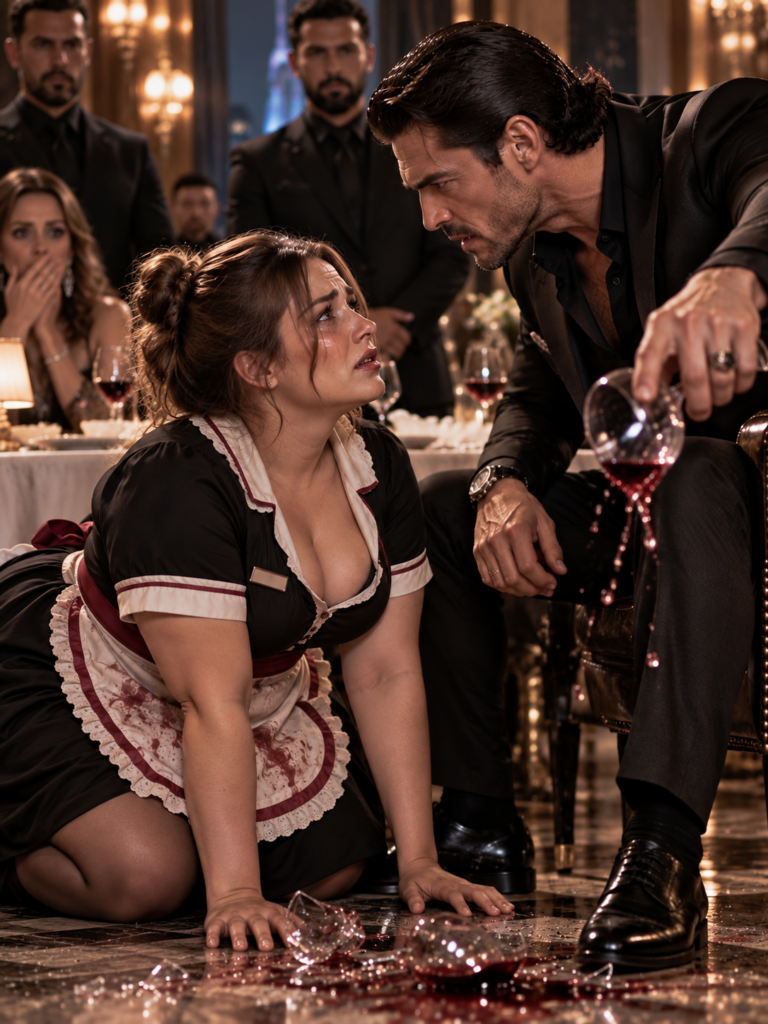
The crystal glass shattered at Isadora’s feet, but she did not flinch.
Giovanni Rossi called her garbage in front of half the Amalfi Coast—and she answered by pouring ice down the front of his five-thousand-dollar suit.
Then she leaned close enough for only him to hear and said, “Your father warned me you would become this man.”

PART 1 — THE WAITRESS WHO KNEW A DEAD MAN’S NAME
The dining room of La Corona fell silent.
A violinist stopped with his bow suspended above the strings. Candlelight trembled across white linen, polished silver, and the faces of politicians who had learned never to stare openly at Giovanni Rossi.
Isadora Marino stood beside his table with blood brightening a shallow cut along her jaw. She wore the restaurant’s plain black dress, her dark hair pinned into a severe knot. At twenty-nine, she looked too composed to be frightened and too proud to apologize.
Gio rose slowly.
He was not the largest man in the room, but power filled the spaces around him. His tailored charcoal suit concealed the hard body of someone who had survived every challenge to his authority. Black ink curved beneath his cuffs, and his expression had gone dangerously still.
“You careless piece of garbage,” he said in Italian.
He threw his linen napkin against her chest.
Everyone waited for Isadora to lower her eyes.
Instead, she crouched beside the shattered glass, gathered several melting cubes, and stood.
“Your father taught you better than that, Giovanni.”
His real name struck the room like another broken glass.
Before Gio could respond, Isadora stepped forward and pressed the handful of ice against the front of his expensive trousers. Water spread across the silk in a dark stain.
Someone gasped.
Gio’s guards, Luca and Matteo, moved their hands beneath their jackets.
Isadora dropped the remaining ice into his wine.
“Now we have both been insulted.”
She turned her back on the most feared man on the coast and walked toward the kitchen.
The moment the swinging doors closed behind her, her calm deserted her. Her pulse hammered against her throat. Garlic, hot oil, and wood smoke thickened the air while cooks stared at her as though she had entered carrying a bomb.
Emilio, the head chef, caught her arm.
“Leave,” he whispered. “Before he decides fascination is weaker than rage.”
Isadora hurried to the locker room. Her plan was simple: take her backpack, reach the station, and use the passport hidden beneath its lining before Gio’s men sealed the roads.
She opened her locker.
The backpack was gone.
So were her wallet, passport, phone, and the cash she had spent four years saving.
Only her staff card remained, hanging from a metal hook.
Cold panic slid beneath her ribs.
“Emilio.” She returned to the kitchen. “Who took my bag?”
The chef kept wiping his counter. His scarred hands moved too deliberately.
“No one steals inside Gio’s restaurant.”
“Then where is it?”
Emilio finally looked at her. Fear lived in his eyes, but it was not fear for himself.
“Someone knew you would provoke him tonight. Someone made sure you could not run afterward.”
Before Isadora could ask who, the rear door opened.
Luca and Matteo stood in the rain-dark alley. Their suits were immaculate, their expressions almost courteous.
“The boss would like you to return,” Luca said.
“Am I being arrested?”
Matteo gave a thin smile. “If he wanted you punished, we would not be having a conversation.”
Isadora lifted her chin. “What does he want?”
Luca’s gaze dropped briefly to the faded silver locket at her throat.
“He wants to know how a waitress learned the private name of his dead father.”
They escorted her back through the kitchen.
Gio sat alone at his table, his ruined trousers hidden beneath the cloth. A silver key rested beside his hand.
Isadora stopped across from him.
“Sit,” he said.
She remained standing.
Gio pushed the key toward her. “Your belongings are in a station locker. Take them, leave tonight, and never speak my father’s name again.”
Freedom lay six inches from her hand.
Isadora picked up the key, felt its cold weight, and dropped it into his wine.
“I’m not leaving, Giovanni.”
His eyes narrowed. “Then what do you want?”
She leaned across the table.
“Your empire,” she whispered. “And the truth about what you did to my mother.”
Gio’s face lost every trace of color.
Behind Isadora, someone quietly locked the restaurant doors.
PART 2 — THE GHOST INSIDE HIS EMPIRE
The Key He Could Not Buy Her With
For several seconds, neither Gio nor Isadora moved.
Rain struck the windows in soft bursts. The silver key gleamed at the bottom of his wineglass, distorted by the dark red liquid.
Gio dismissed his guards with two fingers.
Luca hesitated. Matteo looked openly offended, but both men moved far enough away to grant the illusion of privacy.
“My father died ten years ago,” Gio said. “If he harmed your mother, you waited a long time to complain.”
“Women like my mother rarely get to complain to men like your father.”
“And women like you?”
“Women like me learn patience.”
He examined her face as if another identity might emerge beneath the restaurant makeup. Her Italian carried no regional accent, yet she had known when to soften a consonant exactly as his father had. The locket at her throat looked older than she was.
“What was her name?”
Isadora gave him a measured smile. “If I tell you now, you will stop asking the useful questions.”
“I do not ask useless questions.”
“You asked what I wanted. You should have asked why someone stole my bag before I humiliated you.”
A faint change passed through his expression.
“You believe I arranged that?”
“You own the restaurant, the staff housing, the street behind it, and half the police officers who would pretend not to see me disappear. Either you took it, or your control is an illusion.”
Gio’s jaw tightened.
She had done it again. She had offered two possibilities, and both insulted him.
He lifted the wineglass and studied the key submerged inside.
“You planned tonight.”
“I planned to see what kind of man you were.”
“And?”
“You break expensive things, insult employees, and offer money when fear fails.”
His gaze hardened. “You poured ice down my trousers in front of men who would kill to occupy my chair.”
“And none of them laughed.”
“That should concern you.”
“It concerns you more.”
The silence between them sharpened.
Gio set the glass down. “You have until tomorrow night to tell me who you are. If I dislike the answer, you will wish you had taken the train.”
Isadora stepped away from the table.
“If I intended to run, Giovanni, I would not have spent six months learning how your house breathes.”
She walked toward the kitchen.
Gio watched the swinging doors close behind her. The wet stain across his trousers had become cold against his skin, but the humiliation no longer mattered.
What mattered was the precision of her attack.
She had known his temper, his father’s name, and the existence of something buried inside the Rossi family. She had also known he would choose curiosity over immediate retaliation.
She had not merely provoked him.
She had predicted him.
“Luca,” he said.
His chief guard returned.
“I want everything on Isadora Marino. Birth, school, bank accounts, medical records, every border she has crossed.”
“We checked before hiring her.”
“Then check the person who checked.”
“And her missing property?”
Gio looked toward the kitchen. “Find it before she does.”
Luca lowered his voice. “She said something about her mother.”
“I heard.”
“Do you believe her?”
Gio removed the silver key from his wine and dried it with the same napkin he had thrown at Isadora.
“No,” he said.
But when he placed it in his pocket, his fingers were unsteady.
By eight the next morning, Luca had learned that Isadora Marino barely existed.
Her social insurance number was valid but had been activated only seven months earlier. Her passport had been issued in Kingston, Jamaica, five years ago. The woman in the photograph was unmistakably Isadora, yet there were no school records, no childhood address, and no family names attached to the application.
Her apartment lease belonged to a holding company registered in Rome.
The company’s director was Lorenzo Moretti.
Gio read the name twice.
Lorenzo had advised his father, attended his funeral, and stood beside Gio during the violent months that followed. He was the closest thing Gio possessed to an uncle who had remained loyal.
“Where is Lorenzo?” Gio asked.
“In Naples,” Luca replied. “He claims he is negotiating a port contract.”
“Claims?”
“We have not confirmed it.”
Gio pushed back from his desk.
The office above La Corona faced the sea. Morning sunlight turned the water hard and white, while fishing boats moved below like black stitches across silk.
“Bring him back.”
“And the waitress?”
“Watch her.”
Luca nodded, then stopped near the door. “She is not in the staff apartment.”
Gio’s head lifted.
“Where is she?”
“At a café near the municipal archive. She is meeting a night custodian named Marco.”
Gio reached for his jacket.
Isadora saw the black sedan before she entered the café.
It waited across the narrow street beneath a flowering balcony. The driver made no effort to hide.
Good, she thought. Men became careless when they wanted you to know you were watched.
Inside, the café smelled of bitter espresso and warm pastry. Marco Bellini sat in a rear corner twisting a paper napkin between his fingers.
He worked nights cleaning the municipal archives and spent mornings terrified that one of the records he sold would eventually kill him.
“They searched your identity,” he whispered.
“I expected that.”
“They found the Jamaican passport.”
“Anything else?”
Marco slid a folded page beneath her coffee saucer. “Your apartment is leased through Mare Blu Holdings. Rome registration. Director: Lorenzo Moretti.”
Isadora kept her expression still.
Lorenzo was supposed to be her protector.
Four years earlier, he had found her in Kingston and delivered the leather journal that had changed her life. He had told her Salvatore Rossi destroyed her family. He had trained her to enter Gio’s world, gain access to the hidden fortune, and dismantle the Rossi organization from within.
If Lorenzo controlled her apartment, he could also access her locker.
He had stolen her bag.
“Why would he trap me here?” she asked.
Marco’s eyes darted toward the window. “Maybe he wanted Rossi to catch you.”
“Or he wanted to prevent me from leaving before I finished.”
She unfolded the page.
Beneath Lorenzo’s name appeared another shareholder concealed behind a coded trust. Marco had circled it in pencil.
V. MORETTI.
“Find the full name,” Isadora said.
“I’m done.”
“You said that last month.”
“This is different. Gio’s people came to the archive before dawn. They know someone accessed the company file.”
She pushed an envelope across the table. “Enough to get you to Florence.”
Marco stared at it. “And if they stop me?”
“Then tell them I forced you.”
“Would they believe that?”
“No. But you would die feeling less guilty.”
Despite himself, he gave a nervous laugh.
Isadora rose. “Leave by bus. Trains are easier to watch.”
When she returned to the street, Luca leaned against the sedan, smoking.
“Productive breakfast?” he asked.
“The coffee was weak.”
“You seem to inspire weakness.”
“I inspire men to reveal it.”
Luca dropped his cigarette and crushed it beneath his shoe. “The boss wants to see you.”
“I saw him last night.”
“He has developed new questions.”
“So have I.”
She stepped close enough that the sunlight reflected from his polished glasses.
“Tell Gio my bag contained a letter from Salvatore Rossi.”
Luca’s expression changed.
“A letter saying what?”
“That depends on how quickly Gio agrees to meet me alone.”
“You enjoy dangerous games.”
“I enjoy discovering who believes he makes the rules.”
She started walking.
Luca called after her. “What name is on the letter?”
Isadora looked back.
“Anya.”
The cigarette at Luca’s feet continued smoking after she disappeared around the corner.
The Woman in the Photograph
Gio opened his father’s private safe for the first time in nine years.
It stood behind a painting in the library of the Rossi villa, a room preserved exactly as Salvatore had left it. Dust softened the shelves. His favorite tobacco still lingered inside the desk drawers, mixed with old leather and the dry sweetness of decaying paper.
The combination lock resisted at first.
Gio entered his mother’s birthday. Nothing.
He tried his own.
The safe opened.
Inside were property deeds, foreign account statements, two passports, and a photograph wrapped in a silk handkerchief.
Salvatore stood on a Jamaican beach with one arm around a dark-haired woman. He looked younger and lighter than Gio remembered, his head thrown back in laughter.
The woman wore a silver locket identical to Isadora’s.
On the back, someone had written:
Salvatore and Lucia, Kingston, 1995. Keep Anya safe.
Gio sat in his father’s chair.
The room tilted around him.
His mother had spent thirty years defending Salvatore’s honor. She had died without mentioning Lucia or Anya. Either she had not known, or the entire family had conspired to erase them.
Luca entered quietly.
“We located Isadora,” he said. “She wants to meet at the old coastal overlook tonight. Alone.”
Gio handed him the photograph.
Luca studied it. “The woman resembles her.”
“Not enough.”
“The locket does.”
Gio rubbed one hand across his mouth. “Who is Anya?”
“We found an old transfer from your father to a private clinic in Jamaica. The beneficiary was Lucia Moretti. The payments ended ten years ago.”
“The year my father died.”
“Yes.”
“Any child registered?”
“No. But the clinic records were destroyed in a fire.”
“Convenient.”
Luca returned the photograph. “Do not meet her alone.”
“She asked because she expects me to refuse.”
“That is not a reason to go.”
“It is exactly the reason.”
The coastal overlook sat above dark cliffs where the wind tore spray from the sea. Isadora waited near the stone wall in jeans and a black jacket, her hair loose around her shoulders.
Gio arrived without his guards.
He stopped ten feet away.
“You wanted me alone.”
“I wanted to know whether you were capable of coming without an army.”
He showed her the photograph.
For the first time since entering his restaurant, Isadora failed to control her face.
Her eyes widened. Her fingers rose instinctively toward her locket.
“Where did you find that?”
“My father’s safe.”
She reached for the photograph.
He pulled it back. “Tell me who she is.”
“Lucia.”
“Your mother?”
“Yes.”
“Who is Anya?”
Wind lifted her hair across her mouth. She turned toward the sea.
“Salvatore’s daughter.”
Gio felt the answer enter his body like winter.
“My sister?”
“Half sister.”
“Where is she?”
“I don’t know.”
“Do not lie to me.”
Isadora faced him. “I was told she died.”
“By whom?”
“Lorenzo.”
Gio’s anger sharpened. “Lorenzo Moretti?”
“He found me after my mother was killed. He said Lucia had worked for Salvatore in Jamaica. She discovered that your father was moving criminal assets through humanitarian shipping companies. When she threatened to expose him, the operation hunting those assets murdered her.”
“What operation?”
“The Scorpion.”
The name was almost unknown outside certain intelligence circles. Gio had heard it only once, from his father during a fevered conversation after a failed shipment.
“You expect me to believe my father’s adviser recruited you to destroy me?”
“I expect you to notice that your trusted adviser hid my identity, arranged my apartment, stole my passport, and trapped me inside your city.”
“Why would he protect you and expose you at the same time?”
“That is what I intend to ask him.”
“You claimed you were taking my position.”
“I was.”
“Was?”
“Before I realized Lorenzo had built my mission from selected truths.”
Gio came closer. “What is the mission?”
Isadora’s eyes held his. “Your father left a fortune outside the family books. Not cash. Gold. Enough to buy governments.”
He laughed once, but no humor reached it. “My father died with debts.”
“He wanted everyone to believe that.”
“And you know where this fortune is?”
“I know it is connected to Anya.”
“Why?”
“Because the legal ownership was placed in her name.”
The ocean crashed below them.
Gio looked again at the photograph. His father’s happiness disturbed him more than any evidence of betrayal. Salvatore had never smiled that way in the family villa.
A movement sounded behind him.
Gio turned.
Lorenzo emerged from the darkness, a handgun steady in his right hand.
His silver hair moved in the wind. The face Gio had trusted since childhood contained no apology.
“I told you not to reveal the gold until you had the key,” Lorenzo said to Isadora.
Gio reached beneath his coat.
“Don’t,” Lorenzo warned. “I raised you well enough to know how fast you are.”
“You raised me?”
“I corrected your father’s failures.”
Gio’s voice became quiet. “You stole her bag.”
“I delayed her escape.”
“Why?”
“Because she lost discipline. She was supposed to enter quietly, gain access to the old records, and leave. Instead, she poured ice down your trousers.”
Isadora glanced at Gio. “He deserved that.”
Even with a gun between them, Gio nearly smiled.
Lorenzo’s mouth hardened. “Give me the photograph.”
“No,” Gio said.
“You have no idea what it proves.”
“It proves my father had another family.”
“It proves where he hid the first piece.”
Lorenzo reached for the photograph.
A sharp crack split the night.
Lorenzo collapsed.
Isadora dropped behind the stone wall. Gio drew his weapon and searched the darkness above the road.
Twenty yards away, Emilio stood beneath a bent pine tree holding a hunting rifle.
He lowered it toward Isadora.
“Emilio?” she called.
His face was pale with grief.
“You were supposed to take the records and leave,” he said. “Not wake the entire coast.”
“You knew Lorenzo was using me.”
“I knew he would sacrifice you when the time came.”
Gio aimed at him. “Put the rifle down.”
Emilio looked almost amused. “You still believe this is your war.”
“What is it, then?”
“A funeral that took ten years to begin.”
Isadora rose slowly. “You knew my mother.”
Emilio’s expression broke.
“I was her husband.”
The wind seemed to leave the cliffs.
Isadora stared at him. Lucia had told her that her father died before she was born. Lorenzo had repeated the same story.
“You’re lying.”
Emilio touched the wedding ring hanging from a chain beneath his chef’s jacket.
“I taught you to hold a knife when you were six. I carried you out of Kingston when the Scorpion came for the code. Lorenzo took you from me because he believed revenge required a cleaner weapon than a grieving father could raise.”
Isadora’s hands began to shake.
“Then why did you attack me in the apartment?”
“To frighten you into leaving.”
“You put your hand around my throat.”
“I needed anyone watching to believe I was loyal to Gio.”
“You nearly killed me.”
“I have made many mistakes trying to keep you alive.”
Gio glanced at Lorenzo’s motionless body, then at the chef who had worked beneath him for seven years.
“My entire staff appears to have a second profession.”
Emilio lifted the rifle again. “You find that amusing?”
“No. I find it clarifying.”
Headlights appeared on the road.
Several vehicles were approaching.
Emilio looked toward them and cursed. “Lorenzo’s people. You have minutes.”
“Where is Anya?” Isadora demanded.
“Alive.”
Gio stepped forward. “Where?”
“Isola dei Silenzi. The monastery your family pretends not to own.”
Gio knew the island. It lay beyond Capri, a rock of cypress and ruined stone officially abandoned for half a century.
“Why hide her there?”
“Because the vault is beneath it,” Emilio said. “Anya controls the account name. Salvatore kept the physical access separate.”
“And the key?” Gio asked.
Emilio looked at Isadora’s locket.
Her hand closed around it.
She had worn the necklace since childhood. Lucia had told her never to remove it, even while sleeping.
Isadora opened the locket.
Behind her mother’s photograph rested a thin copper key.
Gio stared at it.
Lorenzo had spent four years guiding Isadora toward his empire while the object everyone sought hung openly against her skin.
Emilio raised his rifle toward the approaching headlights. “Take the lower path. There is a boat at the old dock.”
“You’re coming,” Isadora said.
“No.”
“You do not get to reveal you are my father and disappear again.”
Pain tightened his face. “If I go with you, every man arriving here follows.”
“Then let them follow.”
The first car stopped at the top of the road.
Black-clad figures emerged, moving too quickly and silently to belong to Gio’s organization.
Silver scorpions gleamed on their collars.
Emilio looked at the copper key.
“They did not come for Giovanni,” he said. “They came for you.”
The Man Beneath the Tailored Suit
They escaped down a narrow path carved into the cliffs.
Gunfire cracked above them, sharp against the roar of the sea. Emilio stayed behind long enough to misdirect the Scorpion team while Gio and Isadora reached the small dock below.
A motorboat waited with its keys inside.
Gio started the engine. Isadora released the line, leaped aboard, and nearly lost her footing when the boat surged away from the rocks.
Cold spray struck her face.
“Sit down,” Gio ordered.
“Stop issuing commands.”
“We are being shot at.”
“You were issuing commands long before that.”
A bullet struck the water behind them.
Gio turned the boat sharply, driving into the black channel between two cliffs. The engine howled beneath their feet. Above, headlights swept the rocks but lost them in the narrow passage.
Only when the coastline receded did Isadora sit.
Her hands shook openly now. She pressed them between her knees.
Gio removed his jacket and held it toward her.
“I’m not cold.”
“You are shivering.”
“My father tried to strangle me twelve hours before introducing himself. Temperature is not my immediate concern.”
Gio placed the jacket beside her rather than forcing it over her shoulders.
She looked at it, then at him.
“That may be the first respectful thing I have seen you do.”
“I offered you your passport.”
“You offered exile.”
“I believed it was mercy.”
“Powerful men often rename their convenience.”
He looked toward the dark horizon. “My father did.”
The admission quieted her.
They reached a private boathouse near Positano before dawn. Luca and Matteo were waiting, weapons drawn. Both lowered them when Gio stepped ashore.
“Lorenzo?” Luca asked.
“Dead.”
“Emilio?”
“Alive.”
Matteo stared at Isadora. “Why is she still with you?”
“Because she knows where my sister is.”
Luca’s face remained controlled, but Matteo looked as if the ground had shifted.
“You have a sister?”
“So it appears.”
Inside the boathouse, Gio spread old coastal maps across a workbench. Diesel fumes mingled with salt and wet rope. A single yellow bulb swung overhead.
Isadora placed the copper key beside the island.
“Lorenzo told me the vault required three elements,” she said. “Physical access, the legal account name, and a numerical sequence.”
“Who has the sequence?”
“My mother believed Salvatore divided it between people who hated one another.”
“An effective security system.”
“A cruel one.”
Luca tapped the island. “If Anya has lived there for years, someone supplies her.”
“Religious charities send food twice a month,” Matteo said. “One boat from Capri.”
Gio looked at him.
Matteo shrugged. “My grandmother donates.”
For the first time that night, Isadora almost laughed.
The sound died when the boathouse roof groaned.
Metal tore above them.
A small canister dropped onto the concrete.
“Down!” Luca shouted.
White light swallowed the room.
The blast struck without heat, but the sound emptied Isadora’s senses. Gio seized her arm and dragged her behind an engine block as masked figures descended through the roof.
They moved with military precision.
Matteo fired toward the rafters. Luca overturned the workbench for cover.
One intruder shouted through an electronic mask.
“Isadora, return home.”
The words froze her.
Home.
The Scorpion had used that word during her training. Lorenzo’s instructors had claimed they were former intelligence officers preparing her to destroy the people who killed Lucia.
They had been Scorpion operatives all along.
Her training had not been preparation for revenge.
It had been cultivation.
Gio saw the realization cross her face.
“Your people?” he asked.
“They were never my people.”
An attacker rounded the engine block.
Isadora caught his wrist, redirected the weapon, and drove him against the wall. The movement came without thought—one of a thousand patterns trained into her body.
Gio disarmed another man.
The first attacker recovered and aimed at Isadora.
Gio knocked her down and covered her as shots tore through the wood behind them.
For a breathless second, his body shielded hers.
“Why?” she demanded.
“Because you have the key.”
It was the answer she expected.
Then he added, “And because I will not watch another Rossi secret destroy a woman.”
The attackers shifted toward the entrance.
Luca shouted that the rear vehicle was clear.
Gio pulled Isadora to her feet. They ran through a wall of smoke, reached the black SUV, and drove out as flames began crawling along the boathouse roof.
Matteo and Luca followed in a second vehicle.
On the coast road, a motorcycle appeared beside them.
The rider raised a compact weapon.
Isadora grabbed the emergency flare launcher from beneath the seat.
“Hold steady.”
“I am driving on a cliff.”
“Then try not to fall off.”
She leaned through the window and fired toward the pavement ahead of the motorcycle. The flare burst against the road in a violent wash of red light.
The rider swerved, lost control, and slid into a line of empty market crates.
Gio accelerated.
“You missed,” he said.
“I wasn’t trying to hit him.”
He glanced at her.
“A dead man cannot answer questions,” she added.
“You continue to surprise me.”
“You continue to sound surprised that women think.”
“I was surprised you chose restraint.”
She examined the shallow cut across his cheek. “And I am surprised you shielded me.”
“I told you why.”
“No. You told yourself why.”
The sky ahead had begun to pale.
They drove in silence until the port appeared below.
At the private dock, no fisherman would meet Gio’s eyes. News of the humiliation at La Corona had already traveled. So had whispers that Lorenzo had betrayed him and armed men had breached his property.
His authority was bleeding in public.
Gio saw it in every turned shoulder.
Isadora saw him notice.
“You can still return,” she said. “Punish someone publicly. Make the city afraid again.”
“And leave Anya?”
“You have never met her.”
“She is my sister.”
“She may hate your family.”
“She would have reason.”
The simple acceptance unsettled her.
“What happens to your empire if you leave now?” she asked.
“It weakens.”
“And if you do not return?”
“Someone takes it.”
“Does that frighten you?”
“Yes.”
She waited for denial.
None came.
Gio looked at the morning sea. “But the possibility that my father buried a woman on an island to protect his fortune frightens me more.”
They boarded a fishing boat just before sunrise.
As the harbor receded, Isadora opened the leather journal she had recovered from a waterproof pocket inside her coat. It had belonged to Lucia.
Several pages had been removed.
One remaining entry described Vito Moretti, Lucia’s older brother. He had vanished twenty years earlier after swearing to ruin Salvatore Rossi.
“Vito is the hidden shareholder,” Isadora said.
Gio read the page beside her. “My mother had a brother named Vito. He supposedly drowned.”
“He is Lucia’s brother too.”
“That is impossible.”
“Unless Lucia Moretti and your mother were related.”
Gio stared at the family names.
His father had not taken a random mistress. Lucia had belonged to the same extended Sicilian family as Gio’s mother—a cousin raised in Jamaica after a feud divided their parents.
The affair had reopened an old wound and created a child who could claim both sides of the bloodline.
Anya was more than a hidden daughter.
She was the legal bridge to the entire fortune.
The boat’s engine abruptly died.
The fisherman cursed and leaned over the controls.
A steel cable tightened around the propeller.
Searchlights ignited across the water.
A yacht emerged from the morning mist. Armed men lined its deck.
At their center stood a large, silver-haired man.
Gio recognized him from a childhood photograph.
“Uncle Vito,” he whispered.
The man raised a rifle.
“You have something that belongs to me, Giovanni.”
His voice rolled across the water.
Gio reached for his weapon.
Vito aimed at the fishing boat’s hull.
“Throw me the copper key,” he called, “or I sink you and take Isadora from the water.”
Isadora stood.
“What are you doing?” Gio demanded.
“Buying you time.”
She slipped the key into his palm, closed his fingers around it, and kissed his knuckles—not with affection, but to conceal the transfer from the yacht.
Then she climbed onto the rail.
“Tell Anya her mother never abandoned her.”
Before Gio could catch her, Isadora dived into the freezing sea and began swimming toward Vito’s boat.
Vito lowered his rifle.
His men pulled her aboard.
Gio watched helplessly as the yacht turned toward the Island of Silence.
Then three black speedboats appeared behind it.
Silver scorpions shone on every hull.
PART 3 — THE FORTUNE BENEATH THE ISLAND OF SILENCE
Three Families, One Lie
The Scorpion boats did not fire immediately.
They spread across the water, cutting off Vito’s yacht from the open sea. Their engines growled beneath the pale morning sky while armed figures stood motionless along the rails.
Isadora knelt on Vito’s deck, soaked and shivering.
Two men held her arms. Vito stood before her in a dark overcoat, anger deepening the lines around his mouth.
“You were supposed to bring me the key,” he said.
“It is at the bottom of the sea.”
“You are lying.”
“You trained me to lie.”
“I arranged your training. Lorenzo handled the details.”
“With Scorpion instructors.”
A flicker of surprise betrayed him.
Isadora laughed without humor. “You never knew.”
Vito struck her across the face.
Pain flashed through her jaw. She tasted blood, but kept her eyes on him.
“You thought you created a weapon,” she said. “They created a tracking device.”
“You have your mother’s talent for insolence.”
“You mean your sister.”
His expression closed.
“You let me believe Salvatore killed her.”
“He created the circumstances.”
“That was not my question.”
Vito glanced toward the Scorpion boats. “Lucia became sentimental. She decided the gold should disappear rather than fund another generation of our family.”
“So you gave her location to the Scorpion.”
His silence answered.
The truth entered Isadora slowly.
For years, she had aimed her grief at Salvatore and Gio. She had walked into La Corona prepared to destroy a dynasty because Vito had directed her rage there.
But Vito had betrayed Lucia first.
“You killed your own sister for money.”
“I protected the family legacy.”
“You sound exactly like Salvatore.”
Vito’s face twisted.
He seized her wet hair and forced her head back. “Do not compare me to him.”
“Why? Because he used people more successfully?”
A voice boomed from the nearest Scorpion vessel.
“Vito Moretti, surrender Isadora and the final sequence.”
Vito released her.
“What sequence?” he shouted.
The Scorpion commander stepped into view.
She was a tall woman with pale eyes and gray-blond hair pulled tightly behind her head. Unlike the masked operatives, she wore no helmet.
“Lucia divided the vault protocol,” the woman said. “The girl remembers the first component. Anya Rossi controls the second. You carry the third.”
Vito stared at Isadora.
“You told them I had it.”
“I did not know you had it.”
The commander’s smile was cold. “Salvatore placed the final digits inside the date you could never forget.”
Vito’s face turned gray.
Isadora understood.
“Lucia’s birthday.”
He stepped backward.
October tenth, 1975—the date engraved inside Emilio’s wedding ring, repeated in Lucia’s journal, and used as the cipher key in the letters Vito had sent Isadora during training.
The code had been hidden inside his grief.
Salvatore had entrusted each part to someone who could not willingly cooperate with the others. His mistress’s child, her furious brother, and the heir who believed no fortune existed.
Hatred had been the lock.
The Scorpion had spent twenty years forcing the pieces together.
“You never controlled the legacy,” Isadora said. “You were part of its security.”
Vito looked as though Salvatore had reached from the grave and struck him.
On the disabled fishing boat, Gio cut the steel cable from the propeller while the fisherman restarted the engine.
He could not hear the conversation, but he could see Vito’s posture change. The older man’s confidence had collapsed.
Gio opened his hand.
The copper key lay against his wet palm.
It was lighter than an empire should be.
The fisherman started the engine. “They will kill us before we reach the yacht.”
“Then we do not approach as ourselves.”
Gio retrieved the boat’s emergency flares.
He fired one high above Vito’s yacht.
Brilliant white light spread across the morning sky.
Every armed man looked upward.
The fisherman drove forward.
On the yacht, Vito dragged Isadora toward the stern and pressed a pistol against her temple.
“Tell me the full sequence.”
“I don’t know the format.”
“Giovanni does.”
“Why?”
“Salvatore used a military date format for shipping codes. Gio processed those shipments after his father died.”
Vito turned toward the approaching fishing boat.
“Giovanni!” he shouted. “Give me the format, or your little waitress dies before you reach us.”
Gio raised the flare launcher.
“You kill her, and the first code disappears with her.”
“I know the date.”
“You know one date. You don’t know what Lucia gave her.”
The hesitation was enough.
Isadora drove her elbow into Vito’s ribs and dropped. The pistol discharged into the air.
The Scorpion boats surged forward.
Gunfire erupted across the water.
Gio fired a flare into the sea beside the closest speedboat. Its driver swerved blindly through the smoke and collided with another vessel.
Vito’s men scattered.
Isadora ran toward the rail.
A dark fishing trawler emerged from behind the island.
Emilio stood at its wheel.
The old boat drove directly toward Vito’s yacht.
“Jump!” Emilio shouted.
Isadora leaped.
She struck the water seconds before the trawler’s steel bow crashed into the yacht’s side. Metal screamed. Both vessels rolled violently, throwing men across the decks.
Gio reached Isadora first.
He caught the back of her jacket and dragged her toward the fishing boat.
Vito surfaced nearby, blood running from his brow.
Emilio saw him.
He abandoned the trawler and entered the water with a length of broken wood in one hand.
“You gave them Lucia,” Emilio said.
Vito tried to swim away.
Emilio caught him and raised the wood.
“Stop!” Isadora shouted.
Emilio’s arm froze.
“He deserves it.”
“I know.”
“He murdered your mother.”
“I know.”
“Then let me finish it.”
Isadora clung to the side of Gio’s boat, barely strong enough to keep her head above water.
“If you kill him now, he escapes every truth he made us carry.”
Emilio looked at Vito.
The older man was gasping, stripped of his guards, wealth, and authority. For the first time, he looked less like a mastermind than a frightened man who had mistaken patience for intelligence.
Gio swam beside them.
“Anya is still on the island,” he said. “We need Vito alive long enough to expose the accounts.”
Emilio’s grip loosened.
Vito tried to reach for the wood.
Emilio struck his hand aside, then pulled him onto a piece of wreckage.
“This is not mercy,” he said.
“No,” Isadora replied. “It is evidence.”
The remaining Scorpion boats turned away when sirens sounded from Capri. Matteo had alerted the coastal police and, for once, had not used one of Gio’s controlled channels.
Luca arrived with another boat.
Together, they reached the Island of Silence.
The Girl in the Bell Tower
The monastery stood above the shore behind cypress trees bent by decades of wind.
Its limestone walls were pale and cracked. Rust covered the bell, and weeds grew through the courtyard tiles. The silence felt inhabited rather than empty.
Vito was restrained aboard Luca’s boat under Matteo’s guard. Emilio wanted to accompany them, but Isadora forced him to let a medic examine his injured shoulder.
“You have been absent for most of my life,” she told him. “Do not make your return brief out of stubbornness.”
Emilio almost smiled.
“That sounded like your mother.”
“I hope so.”
Gio, Isadora, and Luca climbed the hill.
The monastery doors opened before they reached them.
An elderly nun stood inside holding an oil lamp. She wore gray rather than black, and her lined face showed neither surprise nor fear.
“You took too long,” she said to Gio.
“You know me?”
“You have your father’s eyes. Unfortunately.”
“Where is Anya?”
The nun studied Isadora’s locket. “Who are you?”
“Lucia’s daughter.”
The woman crossed herself.
“We believed you were dead.”
“Many people found that belief convenient.”
The nun led them through a stone passage smelling of wax, damp earth, and rosemary. Their footsteps echoed beneath the arched ceiling.
“Salvatore brought Anya here when she was six,” the nun explained. “He said men would come for her name. We were paid to educate and protect her.”
“Paid with whose money?” Gio asked.
“Money we never touched. Food and medicine arrived through a foundation.”
“The foundation belonged to the Scorpion,” Isadora said.
The nun stopped.
“Then they always knew where she was.”
“They knew the island. They did not know which woman was Anya. Salvatore altered the records.”
“How many women live here?”
“Until last year, nine.”
“And now?”
“Two.”
A door opened somewhere above them.
Soft footsteps moved across the ceiling.
The nun looked toward the staircase. “She heard us.”
They found Anya in the bell tower.
She stood near an open window with a kitchen knife held in both hands. She was thirty, small and slender, with nearly white-blond hair cut at her shoulders. Her eyes were a clear, startling blue.
She looked nothing like Isadora.
She looked unmistakably like Salvatore.
“Stay back,” Anya said.
Gio stopped.
“My name is Giovanni Rossi.”
“I know who you are.”
“I am your brother.”
“My father said his son would come only if the vault was in danger.”
The sentence wounded him visibly.
“I did not know you existed.”
“You expect that to comfort me?”
“No.”
His answer surprised her.
Gio removed the pistol from his coat and placed it on the floor. Then he knelt.
Luca shifted uncomfortably behind him, but Gio did not look away from Anya.
“Our father hid you because he placed a fortune in your name. Men are here to claim it.”
“And you?”
“I came to take you away from them.”
“Not the gold?”
“I learned about it last night.”
Anya gave a small, bitter laugh. “Men always discover money quickly.”
Isadora stepped forward.
“Your mother left this.”
She removed the silver locket.
Anya’s knife lowered.
“My mother?”
“Lucia.”
“That was not her name.”
“What did you call her?”
“Amara.”
Isadora stopped.
The photograph in the locket showed Lucia standing on a Kingston balcony, smiling into tropical sunlight. On the back, beneath years of wear, Isadora had always seen only the initials L.M.
Lucia Moretti.
But the woman had used another name while caring for Anya.
“She came here?” Isadora asked.
“Every year until I was twelve. Then she stopped.”
The timing matched Lucia’s death.
Anya looked at Isadora’s face. “Who are you?”
“Her daughter.”
For the first time, Anya released the knife.
It struck the stone floor with a clear metallic sound.
“She told me she had a little girl,” Anya whispered. “She said she could not bring you because men were watching.”
Isadora’s knees weakened.
For years, Vito had told her Lucia devoted herself to Salvatore’s secret child while leaving Isadora behind. He had used that wound to sharpen her resentment.
But Lucia had visited Anya to protect both girls.
She had not abandoned either of them.
She had been holding together lives created by powerful men and their secrets.
Anya crossed the room slowly.
Her hand lifted toward the locket, stopping before she touched it.
“May I?”
Isadora placed it in her palm.
Anya opened the tiny case and began to cry without sound.
Gio remained on his knees.
He looked toward the sea through the bell-tower window. Boats circled the island below. His city, his organization, and every enemy he had accumulated waited beyond that horizon.
“What did our father tell you about me?” he asked.
Anya wiped her cheek. “That you would become either his greatest achievement or his final punishment.”
“Which?”
“He did not live long enough to decide.”
“I think he did.”
A bell rang beneath them.
Not the tower bell.
An alarm.
The nun appeared at the stairs. “Men have entered the courtyard.”
Luca looked through the window. “Scorpion. At least eight.”
Gio picked up his pistol.
Anya stiffened. “There is another exit.”
“Where?”
“Through the vault.”
She led them down a narrow spiral staircase into the monastery’s crypt.
Behind the altar stood a steel door embedded in rock. Three brass panels were mounted across its surface.
The first contained a keyhole.
The second required a name.
The third displayed six empty digits.
Gio inserted the copper key.
Nothing happened.
Anya placed her palm over a dark glass plate beneath the second panel.
The machine awakened with a low mechanical hum.
Words appeared in faded green light:
ACCOUNT HOLDER?
“Anya Rossi,” she said.
The second lock opened.
Footsteps thundered above.
The final panel waited for Vito’s code.
“October tenth, 1975,” Isadora said. “But Gio knows the format.”
He stepped toward the keypad.
Six digits could open the vault and place an invisible fortune within reach. Billions in gold could rebuild his organization, buy protection, and crush every rival who had watched him weaken.
The power to reclaim everything waited beneath his fingers.
“What is behind the door?” Anya asked.
“Enough money to make us prisoners for the rest of our lives,” Isadora said.
Gio stared at the keypad.
The footsteps drew closer.
A bullet struck the outer crypt door.
Luca raised his weapon. “Boss, enter the code.”
Gio did not move.
“If we open it,” he said, “they follow us inside.”
“If we don’t, we have no exit,” Luca replied.
Anya touched the steel door. “There is a sea tunnel beyond the vault. The nuns used it during the war.”
Isadora looked at Gio. “We need to open it.”
He entered the date in military format.
The third lock disengaged.
The steel door opened with a groan that shook dust from the ceiling.
Cold air breathed from the darkness.
Their flashlights revealed stacked wooden crates disappearing into a cavern. One had split with age, exposing rows of dull gold bars.
The fortune was real.
Anya stared without wonder.
“My whole life was for this?”
“No,” Gio said. “Your captivity was for this.”
He ushered them inside. Luca closed the door as the Scorpion team entered the crypt.
The lock held, but not for long.
They crossed the cavern between towers of gold. Each crate bore dates, ports, and the names of companies Gio recognized from his father’s records.
At the far end, black water moved through a natural tunnel.
An old motor launch waited beside a stone landing.
“Fuel?” Luca asked.
Anya checked the tank. “The sisters maintain it.”
A cutting torch ignited beyond the vault door.
Orange light appeared along the steel seam.
Gio looked back at the gold.
With that fortune, he could save La Corona, pay every loyal soldier, purchase new identities, and disappear without ever answering for the years of extortion beneath his command.
Isadora saw the calculation in his face.
“This is the moment,” she said.
“What moment?”
“The one where you show me whether pouring ice on you accomplished anything.”
He almost smiled.
Then his eyes moved to Anya.
She stood in a borrowed gray coat, clutching Lucia’s locket. She had lived twenty-four years behind walls because the men in her family valued metal more than her freedom.
Gio removed the copper key from the first mechanism.
“What are you doing?” Luca asked.
“Ending the inheritance.”
He crossed to the channel and threw the key into the black water.
It vanished without a splash.
Luca stared at him. “That gold could protect us.”
“It never protected anyone.”
“It could buy the entire coast.”
“I already owned the coast.” Gio looked at Isadora. “It did not make me a man worth following.”
The cutting torch broke through the vault door.
Gio boarded the launch.
“Start the engine.”
What the Sea Refused to Keep
They escaped through the tunnel seconds before the Scorpion team breached the vault.
The launch emerged beneath the eastern cliffs, hidden from the monastery by low morning fog. Luca steered toward Capri while Gio remained at the stern, watching the island recede.
Isadora sat beside Anya under a wool blanket.
Neither spoke for several minutes.
Anya held the locket open against her knee.
“Lucia told me stories about you,” she said eventually.
“What kind of stories?”
“That you hated shoes, climbed kitchen shelves, and bit a priest who tried to take your candy.”
“I was four.”
“She was proud of the bite.”
Isadora laughed and covered her mouth as tears came.
Anya leaned her head against her shoulder.
The gesture was tentative, but Isadora did not move away.
Behind them, smoke rose from the monastery’s courtyard. The Scorpion had found the gold, yet without the physical key and with the account exposed, moving it would be nearly impossible.
More importantly, Matteo had transmitted the vault coordinates and financial records to Italy’s anti-mafia directorate before the attack.
Gio had given the order.
By noon, government aircraft circled the island.
Vito was arrested at the Capri harbor. Emilio gave investigators the journals, names, and correspondence he had preserved for a decade. He also confessed his role in Lorenzo’s death and the attack on Vito’s yacht.
Isadora sat beside him in the ambulance.
A bandage wrapped his shoulder. Without his chef’s jacket, he looked smaller, worn down by the years he had spent guarding her from a distance.
“Why didn’t you tell me?” she asked.
“I believed Lorenzo could train you to survive.”
“He trained me to become useful.”
“I know.”
“You watched me work in that restaurant for six months.”
“Every day.”
“You let me believe I was alone.”
His mouth trembled. “I had already failed to save your mother. I thought loving you openly would put you in the same grave.”
“That is the excuse men use when they want love without trust.”
He lowered his eyes.
“I learned it from Salvatore.”
Isadora took the wedding ring from the chain around his neck.
Inside were the words:
LUCIA—10 OCTOBER 1975. NO MORE SECRETS.
“She asked you for that promise.”
“Yes.”
“And you broke it.”
“Every day after she died.”
Isadora returned the ring to him.
“I cannot forgive you today.”
“I know.”
“But you will tell me everything.”
“If the prison permits it.”
“You will write.”
His eyes filled.
“Every week.”
“You will not turn the letters into apologies. I want facts.”
A fragile smile crossed his face. “You are exactly like her.”
“No. I am what she protected long enough for me to become.”
Police took Emilio away after treatment.
Gio stood at the end of the dock speaking with Luca.
The humiliation at La Corona had begun a collapse. His lieutenants were dividing, authorities were seizing his businesses, and rival families were moving toward his territory.
He could still fight.
Isadora knew that was what everyone expected.
Gio joined her near the water.
“Anya is under official protection,” he said. “Matteo is going with her.”
“She trusts him?”
“She likes his grandmother.”
“That is not the same thing.”
“It may be better.”
They watched Anya enter an unmarked vehicle. Before the door closed, she pressed Lucia’s locket against her heart and raised one hand.
Isadora waved back.
“What happens now?” she asked.
“I surrender the organization’s accounts.”
“All of them?”
“All that I control.”
“And the judges you bought?”
“Their names too.”
She looked at him. “Why?”
“Because if I keep one door open, I will eventually walk through it.”
“That sounds almost wise.”
“I have had a difficult evening.”
Despite everything, she smiled.
Gio touched the shallow cut on his cheek. “You have destroyed my reputation, exposed my father, delivered my uncle to the police, emptied my organization, and led the government to a fortune no one believed existed.”
“You forgot the ice.”
“I will never forget the ice.”
His smile faded.
“I called you garbage.”
“Yes.”
“I have spoken to many people that way.”
“I know.”
“I thought fear was proof that I deserved my position.”
“And now?”
“Now I think fear merely prevented anyone from telling me I was unfit for it.”
Isadora folded her arms against the wind. “Do not expect one decent decision to make you innocent.”
“I don’t.”
“Do not expect me to wait while you become a better man.”
“I won’t ask.”
“Do not tell me I saved you.”
His gaze held hers. “You didn’t.”
The answer startled her.
“You humiliated me,” he continued. “You deceived me. You forced me to see what was already there. But the choice at the vault was mine.”
“Yes.”
“So are the consequences.”
For the first time, she believed he understood.
Gio surrendered that afternoon.
The investigation consumed three years.
The gold beneath the monastery was seized and divided through international courts. Part of it funded restitution for families harmed by the Rossi network, including dockworkers, business owners, and witnesses forced from their homes.
La Corona closed.
Luca accepted a reduced sentence in exchange for testimony. Matteo entered witness protection with Anya and his grandmother. Emilio pleaded guilty to manslaughter and conspiracy, then spent six years writing Isadora one factual letter every Sunday.
He never missed a week.
Vito went to trial believing his family name would protect him. Lucia’s journals dismantled his defense. So did recordings Lorenzo had kept in case Vito betrayed him.
The court sentenced Vito to life imprisonment.
The Scorpion commander disappeared before authorities entered the vault. Her organization fractured after its financial network became public, though rumors persisted that she had escaped across the Adriatic.
Gio received twelve years after surrendering evidence against his own organization.
At sentencing, he did not ask for mercy.
“I inherited a violent system,” he told the court. “Then I chose to preserve it because it benefited me. Blood may explain what a man receives. It does not excuse what he keeps.”
Isadora attended from the last row.
He saw her only as officers led him away.
Neither waved.
The Table by the Window
Seven years later, Isadora opened a small restaurant in Naples.
She called it Lucia’s Table.
It had blue shutters, imperfect wooden floors, and no private office overlooking the staff. The kitchen remained visible through a broad archway. Employees owned shares after their second year.
Anya managed the accounts.
She had cut her white-blond hair short and developed a habit of humming while balancing receipts. She still disliked closed doors, so every room in her apartment had brass wedges beneath them.
Emilio worked in the prison kitchen.
His letters became less defensive over time. He described Lucia as a woman rather than a martyr: how she burned rice when distracted, laughed during thunderstorms, and cheated at cards.
Isadora eventually answered.
Her first letter contained one sentence:
Tell me about the day I was born.
His response was twelve pages long.
Gio was released after serving nine years.
Good conduct and his cooperation reduced the sentence, though freedom did not restore what he had surrendered. The villa belonged to the state. The remaining businesses had new owners. Men who once lowered their voices at his name now passed him without recognition.
He arrived in Naples on a rainy November evening carrying one canvas bag.
Lucia’s Table glowed at the end of a narrow street.
Through the window, he saw Isadora clearing plates. She wore black trousers and a white shirt with the sleeves rolled above her elbows. A thin silver line remained along her jaw where the crystal had cut her.
Anya was laughing near the register.
Gio stood across the street until the rain soaked his coat.
Isadora noticed him.
Her hands stopped over a stack of plates.
Nine years compressed into the space between them: the shattered glass, the silver key, the boat, the vault, and the moment he had thrown his inheritance into black water.
She walked outside.
“You are getting the pavement wet,” she said.
“I thought that was the rain.”
“You always had an excuse.”
“I am trying to use fewer.”
She studied him.
Gray threaded his dark hair. The expensive suits were gone. He wore a plain wool coat and boots marked by travel. His hands remained visible at his sides.
“When were you released?”
“This morning.”
“Why come here?”
“Because it was the only place I wanted to see.”
“That is not an answer.”
He looked through the window at Anya.
“I wanted to know she was free.”
“She is.”
“And you?”
Isadora considered the question.
“I own a restaurant. I sleep most nights. I speak to my father twice a month, though we still disagree about nearly everything.”
“Good.”
“It is complicated.”
“Most honest things are.”
She lifted an eyebrow. “Prison made you philosophical.”
“It made me quiet. People sometimes confuse the two.”
A customer inside raised his hand for service.
Gio noticed.
“May I come in?”
“As what?”
“A customer.”
“You used to own every table you sat at.”
“I do not own this one.”
“No.”
“I understand.”
Isadora opened the door.
He entered behind her.
The restaurant smelled of lemon, baked bread, and rosemary. Copper pans gleamed above the kitchen. No guards watched from the corners.
Anya saw him.
Her smile disappeared.
Gio stopped several feet away.
“Hello, Anya.”
She folded her arms. “You look older.”
“I am.”
“You missed seven birthdays.”
“I know.”
“You sent books.”
“I did not know what else you liked.”
“I liked the books.”
Her voice remained guarded, but she pointed toward an empty table by the window.
“You can sit there.”
Gio removed his coat and took the seat.
No one bowed. No conversation stopped. A server asked whether he wanted still or sparkling water without recognizing him.
“Still,” he said.
Isadora brought bread.
She placed it between them but did not sit.
“You paid for this place yourself?” he asked.
“With a loan and the restitution money owed to Lucia’s estate.”
“No gold?”
“No gold.”
“Good.”
“Do not sound proud. You did not give it up for me.”
“I know.”
She watched his face, searching for the old hunger to be praised.
It was absent.
“What will you do now?” she asked.
“There is a ship repair company in Bari willing to hire me.”
“Do they know who you are?”
“Yes.”
“And?”
“They need an accountant who understands creative criminal bookkeeping.”
“That sounds dangerous.”
“The owner is a seventy-year-old widow named Francesca. She told me if I steal from her, she will throw me into the harbor.”
“I like her.”
“So do I.”
Silence settled between them, but it was no longer a weapon.
Gio broke a piece of bread.
“I thought about this table for nine years,” he said.
“You had never seen it.”
“I thought about whatever table belonged to you. In every version, I knew exactly what to say.”
“And now?”
“Now I know rehearsed apologies are another form of control.”
Isadora sat across from him.
Outside, rain polished the streetlights. Inside, Anya counted receipts while a saucepan hissed in the kitchen.
Gio looked at the scar along Isadora’s jaw.
“I am sorry I threw the glass.”
“You did not throw it at me.”
“I caused it to break.”
“Yes.”
“I am sorry I called you garbage.”
“You should be.”
“I am sorry I believed attraction gave me a claim on your attention.”
Her expression shifted.
He continued before courage deserted him.
“I am sorry that when you showed me pain, my first instinct was to ask how it threatened my authority. I am sorry I confused protecting you with possessing the outcome.”
Isadora looked down at her hands.
“You frightened me,” she said.
The confession hurt more than anger.
“I know.”
“No. You knew I was trained. You knew I could fight. You saw me challenge armed men, and I think you decided that meant I was never afraid.”
His fingers tightened around the bread.
“But I was,” she continued. “In that restaurant, at the cliffs, on Vito’s yacht—I was terrified. I kept moving because stopping would have given everyone else permission to choose for me.”
“I should have seen it.”
“You saw what was useful.”
“Yes.”
She breathed slowly.
“I hated you for that.”
“Do you still?”
“Some days.”
He accepted the answer.
“And other days?” he asked.
“Other days I remember the vault.”
“The gold?”
“No. The moment before you threw away the key. You were afraid too.”
“I was.”
“You made the choice anyway.”
He looked through the rain-streaked window. “It was the first thing I ever surrendered without expecting something in return.”
“Not the first.”
His eyes returned to her.
“You let me walk away from La Corona after I humiliated you.”
“I expected you to return.”
“That is still letting someone walk away.”
A faint smile touched his mouth.
Anya approached carrying a small dessert plate.
On it rested a glass bowl filled with ice.
She placed it in front of Gio.
He stared at it.
Anya’s expression remained perfectly serious. “Compliments of the house.”
Isadora covered a laugh with her hand.
Gio picked up one cube. “Am I expected to put this in my drink?”
“That depends,” Anya said. “Have you insulted any waitresses today?”
“Not yet.”
“Then your odds are improving.”
She returned to the register.
Gio set the ice cube in his water.
“I deserved that,” he said.
“You did.”
They finished dinner after closing.
Isadora told him about Emilio’s letters and Anya’s first apartment. Gio described the prison workshop, the men he had helped prepare for financial-crime trials, and the strange humiliation of earning twelve euros a week.
He did not ask where she lived.
He did not ask whether she had loved anyone during his absence.
At midnight, Isadora brought his bill.
He paid in cash and counted the change.
“I should go,” he said.
“Yes.”
He put on his coat.
At the door, he turned. “May I return?”
She could have said no.
Part of her wanted to preserve the clean distance she had built. Another part understood that freedom was not the absence of every risk. It was the right to choose which doors opened and when.
“You may have dinner here,” she said. “Once a week.”
He waited.
“That is all I am offering.”
“It is more than I expected.”
“If you become demanding, it ends.”
“I understand.”
“If you investigate my schedule, it ends.”
“I understand.”
“If you send expensive gifts—”
“I cannot afford expensive gifts.”
“Good.”
He stepped into the rain.
Isadora watched him walk toward the station without a driver, guards, or anyone clearing the path ahead.
Three months passed.
He returned every Thursday.
He sat at the same table, paid for every meal, and never stayed after she brought the bill. Sometimes they spoke. Sometimes Isadora was too busy, and he ate alone without complaint.
One night in early spring, a man at table six snapped his fingers at a young waitress.
Gio looked up.
The old anger flashed through Isadora—not at the customer alone, but at the memory of La Corona and the woman she had been forced to become inside it.
Before she could cross the room, the waitress approached the man.
“If you need my attention, sir, raise your hand. I do not respond to snapping.”
The customer stared at her.
Then, under the weight of the room’s silence, he lowered his hand.
“Sorry,” he muttered. “May I have more bread?”
“Of course.”
The waitress walked away with her shoulders straight.
Gio glanced at Isadora.
Neither spoke.
They did not need to.
After closing, he helped her lift the chairs onto the tables. He did not assume permission; she had asked because Anya had left early.
When the last chair was raised, Isadora found him standing beside the window.
Rain had stopped. Dawn approached in a faint silver line above the rooftops.
“You once said you were taking my empire,” he said.
“I remember.”
“You did.”
“No. Your father built it on secrets. Vito built his revenge on lies. You built your authority on fear. It was already collapsing.”
“You gave it a memorable push.”
“That I did.”
He looked around Lucia’s Table.
“What did you build from it?”
“A place where no one has to lower their eyes.”
“That is better than an empire.”
“Yes.”
She reached into the drawer beneath the register and removed an old silver key.
Gio recognized it immediately.
The station-locker key he had offered her after she humiliated him. Luca had recovered it from the wineglass and preserved it among Gio’s personal effects. After the trial, Isadora had found it sealed inside an evidence envelope.
She placed it in Gio’s palm.
“What does it open?” he asked.
“Nothing. The station removed those lockers years ago.”
“Then why keep it?”
“To remind myself that freedom offered by a powerful man can still be another kind of cage.”
He closed his fingers around it.
“And now?”
“Now it reminds me that I refused to disappear.”
He offered it back.
Isadora shook her head.
“Keep it.”
“Why?”
“Because you once believed mercy meant sending me away. Perhaps it should remind you that real mercy leaves the other person with a choice.”
Gio slipped the key into his pocket.
Then he looked at her with the same intensity he had possessed across the table at La Corona, but without the entitlement that once poisoned it.
“Isadora.”
“Yes?”
“I have loved you badly in my thoughts for years.”
She remained still.
“I turned you into punishment, salvation, judgment, and hope,” he continued. “All of that was unfair. You are none of those things. You are a woman who owes me nothing.”
The room seemed to hold its breath.
“What are you asking?” she said.
“For permission to love you as a person instead of a symbol.”
“That is not a small request.”
“No.”
“And if I refuse?”
“I return to Bari tomorrow. I continue the life I should have chosen years ago.”
“You would not punish me?”
“No.”
“You would not wait outside?”
“No.”
“You would not tell yourself my refusal is fear?”
“No.”
She stepped closer.
He did not reach for her.
That mattered more than any speech.
Isadora lifted one hand and touched the scar near his eyebrow, a thin mark left by the fighting on the island. His breath caught, but he remained motionless.
“You may begin,” she said.
“Begin what?”
“Knowing me.”
The answer was not forgiveness.
It was not a promise of marriage, forever, or the easy happiness people demand after surviving tragedy.
It was permission for one honest beginning.
Gio covered her hand with his, lightly enough that she could withdraw it.
She did not.
Across the room, morning entered through the windows and touched the empty tables one by one. The old silver key rested in his pocket, opening nothing, while the front door remained unlocked behind them.
Then a shadow crossed the frosted glass.
Someone slid a black envelope beneath the door.
Isadora and Gio separated.
No name appeared on the envelope—only a silver scorpion stamped into the seal.
Inside was a recent photograph of Anya leaving her apartment.
On the back, five words had been written in Lucia’s handwriting:
THE GOLD WAS NEVER THE LEGACY.

