
Part 1
“Sixty dollars.”
The voice came from somewhere near the back of the crowd, small enough that auctioneer Royce Mabry almost missed it.
He lowered his microphone and looked across the dusty farmyard.
“Who said that?”
A boy in a faded blue baseball cap raised his hand a little higher.
“I did, sir. Sixty dollars.”
For perhaps two seconds, nobody spoke.
Then Dale Puit began laughing.
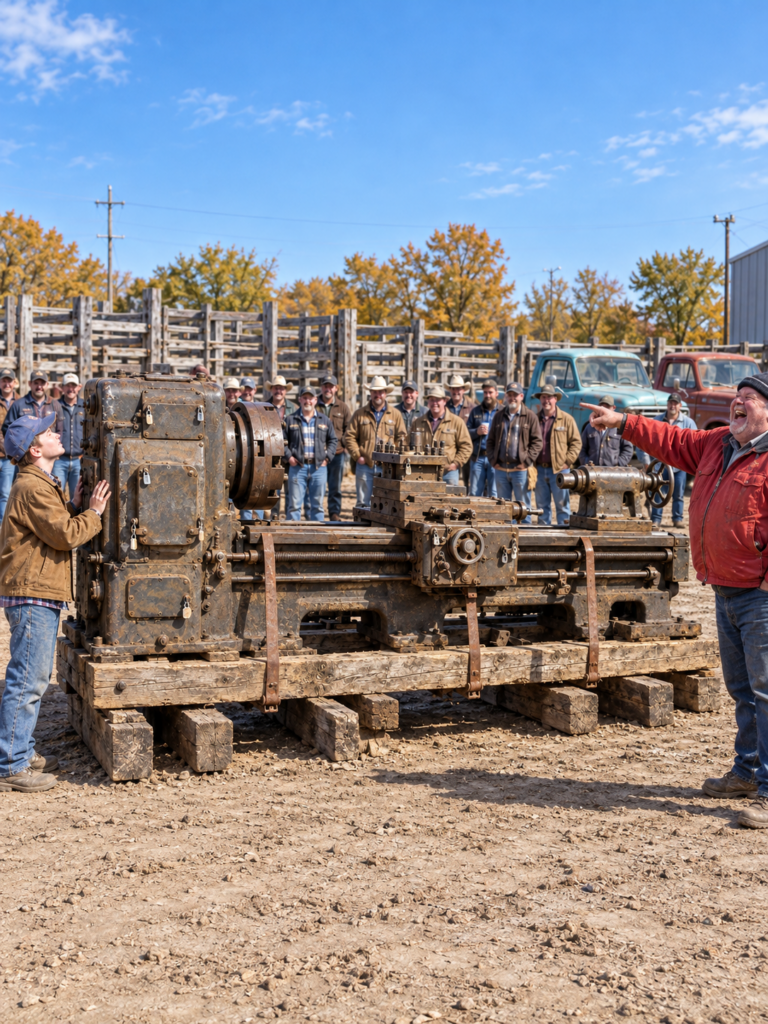
He laughed so hard he had to grab the tailgate of a nearby pickup truck. His face turned red above the collar of his jacket, and his enormous shoulders shook. Someone beside him chuckled. Another man joined in. Within moments, nearly thirty people were laughing at the twelve-year-old who had just offered every dollar he owned for fourteen tons of rusted iron.
“Well, look at that!” Dale shouted. “We finally found somebody foolish enough to buy the thing!”
The boy lowered his arm.
His name was Ezra Pel, and although his ears were burning, he didn’t look away.
He stepped out from the crowd, walked toward the enormous machine resting on an oak skid, and placed his palm against its cold iron side.
“Go on, son!” Dale called. “Cut those seals off! Show everybody what sixty dollars of junk looks like inside!”
Ezra had a pair of wire cutters in his pocket.
He knew exactly where they were. He could feel their weight against his leg.
But he didn’t reach for them.
Instead, he studied one of the small gray seals hanging from a twisted wire on the machine’s headstock.
Stamped into its dull surface was a tiny anchor.
Ezra recognized that anchor.
And although everybody around him thought he had made the worst purchase of his young life, the boy was remembering something his grandfather had told him years earlier.
Something about old machines.
Something about the Navy.
And something about why certain seals should never be broken in front of people who didn’t understand what they were looking at.
The machine sat in the yard of the Brandt farm outside Quarters Mill, where a tractor had dragged it from an old equipment shed earlier that morning.
It was longer than a pickup truck, with a massive square headstock at one end, a heavy tailstock at the other, and a thick iron bed running between them. Its surfaces were covered in brown grease that had hardened over decades. Dust, bits of straw, and traces of old mouse nests clung to almost every corner.
Wide steel bands fastened the machine to an oak skid nearly as substantial as a railroad tie.
Nobody seemed entirely certain what it had once been used for.
The auction listing described it simply as Lot 104.
One large old machine. Condition and contents unknown. Buyer to remove within seven days.
Royce Mabry had already spent twenty minutes trying to get somebody interested.
He had started the bidding at five hundred dollars.
Nobody moved.
He dropped to two hundred.
Still nothing.
At one hundred dollars, a few men shook their heads as though the auctioneer had personally insulted them.
Finally, Royce pushed back his white straw hat.
“Folks, I’ll take fifty dollars from anybody with a pulse.”
Even that produced no offers.
That was when Dale Puit decided to explain the machine’s true value to everybody standing around it.
Dale owned Puit Equipment and Salvage, a sprawling business along the state highway. He had spent twenty years buying and selling used tractors, farm trailers, industrial scrap, and broken equipment. He knew what iron brought by the ton, what it cost to move heavy machinery, and how to make a profit from somebody else’s mistakes.
He also liked making sure everybody knew how much he knew.
“That’s an old industrial lathe,” he announced, slapping the hardened grease on its side. “Made for some factory that probably disappeared before half of us were born.”
He pointed at the enormous bed.
“You know what that thing weighs? Fourteen tons. You can’t just hook that behind a pickup and drive home.”
Several men nodded.
Dale continued.
“Even if it ran, where would you put it? You need a reinforced floor, heavy electrical service, somebody who knows how to operate it. Nobody around here has any use for that monster.”
He paused, making sure everyone was listening.
“Cast iron’s bringing about a hundred and ten dollars a ton. By the time you hire a crane and a lowboy trailer, you’ll be three thousand dollars in the hole. That’s scrap that costs you money. Worst kind there is.”
The crowd accepted his judgment.
Dale knew machinery, after all.
And nobody wanted to spend money hauling a problem home.
Nobody except Ezra.
He had been standing near the back, holding an empty paper cup that had contained hot cocoa, staring at those little gray seals.
Not the rust.
Not the grease.
The seals.
Ezra had come to the sale with Hollis Grange, an elderly tow-and-rigging operator who had known his family for decades. Hollis wanted to examine a gooseneck trailer. Before wandering off, he had bought Ezra a drink and told him to stay close to the coffee wagon.
Ezra had obeyed.
At least until the auction reached Lot 104.
He knew what a lathe was.
His grandfather, Walt Pel, had spent nearly thirty years operating large machines at the pump works beside the river before the plant closed.
When Ezra was younger, he spent countless afternoons in Walt’s garage, perched on an overturned bucket while the old machinist worked.
His grandfather taught him the names of things other boys his age had never heard of.
Headstock.
Carriage.
Lead screw.
Tailstock.
Chuck.
He taught Ezra to recognize the difference between a machine that was broken and one that had simply been neglected.
More importantly, he taught him to pay attention to the details most people ignored.
Walt had died two winters earlier.
But Ezra still remembered his voice.
And now, looking at the little anchor stamped into the gray metal, he could almost hear it again.
An old machine can have a story, Ezra. Sometimes that story’s worth more than the iron.
Royce looked from the boy to the crowd.
“Sixty dollars,” he said into his microphone. “I have sixty from the young man in the blue cap. Anybody give me seventy?”
Nobody did.
Several people were too busy laughing.
Royce waited another moment.
“Going once. Going twice. Sold for sixty dollars.”
He lowered the microphone.
“I suppose we’ll put that on Hollis Grange’s bidder number, since he brought you.”
Ezra barely heard the laughter that followed.
He was looking at what he had bought.
Then Hollis came through the crowd.
He was broad-shouldered despite his age, with a white beard and gray coveralls stained from years of working around trucks, chains, and hydraulic equipment.
“Ezra?”
The boy turned.
Hollis looked at the machine, then at the auctioneer, then back at Ezra.
“What did you just do?”
“I bought it.”
“I can see that.”
“With my own money.”
Hollis rubbed his forehead.
“Son, that thing weighs fourteen tons.”
“I know.”
“Fourteen tons, Ezra.”
“I heard Mr. Puit.”
Hollis stared at him for another second.
Then Ezra pointed toward the headstock.
“Mr. Grange, look at this.”
Hollis leaned closer.
A gray seal hung from a wire twisted around two bolts.
“See the anchor?”
“Sure do.”
“That’s a Navy seal.”
Hollis narrowed his eyes.
Ezra went on.
“Grandpa showed me one. He said when a Navy inspector sealed a new machine, nobody was supposed to break it until the right people were there to see what was inside.”
Hollis examined the seal again.
It was small, almost insignificant against the machine’s enormous iron body.
But it looked deliberate.
It wasn’t a piece of wire someone had wrapped around a broken latch.
It had been placed there for a reason.
“Did you open anything?” Hollis asked.
“No, sir.”
“Good.”
Behind them, Dale Puit approached with a broad smile.
“Well, Hollis, looks like you’ve got yourself a new hauling job.”
Hollis straightened.
Dale laughed.
“Hope the boy’s got another three thousand dollars hidden somewhere.”
Ezra said nothing.
Dale leaned toward him.
“Tell you what, son. I’ll make you an offer.”
He pulled a folded bill from his pocket.
“Cut one of those little seals. Open the gearbox. If there’s anything in there besides rust and mouse nests, I’ll give you a hundred dollars for the whole machine.”
He waved the money.
“You’ll make forty bucks without lifting a finger.”
Several people gathered closer.
It was the kind of offer Dale enjoyed making: generous enough to sound kind, insulting enough that everyone understood the joke.
Ezra looked at the money.
Then at the seal.
“No, sir.”
Dale’s eyebrows rose.
“Come again?”
“I’m not cutting it.”
“Why in the world not?”
“Because my grandpa told me never to break a Navy seal in a sale yard.”
Dale smirked.
“That so?”
“He said you do it where people who know what they’re looking at can see it. People who can write down what they found.”
For the first time, Dale’s smile faltered.
Only for a moment.
Then he threw back his head.
“Well, boys, you heard him! We’re waiting on the United States Navy!”
Laughter rolled across the yard again.
Hollis didn’t laugh.
He studied Ezra’s face, then placed a heavy hand on the boy’s shoulder.
“A man’s bid is his bid,” he said. “Go pay the clerk.”
Ezra went to the auction trailer.
He counted out six ten-dollar bills, money he had earned mowing lawns throughout the summer. There was nothing left in his pocket afterward except a few coins, his wire cutters, and a notebook.
The clerk wrote out a receipt.
One large old machine. Condition and contents unknown.
Ezra folded it carefully and put it away.
That afternoon, his mother arrived at the Brandt farm still wearing her green nursing-home scrubs.
Carla Pel had been halfway through her shift when the first call came.
A neighbor told her Ezra had bought something ridiculous at the farm auction.
The second caller said it was a giant factory machine.
The third was laughing so hard Carla could barely understand her.
She left work as soon as she could.
By then, most of the crowd had gone.
She found her son sitting on the edge of an enormous oak skid, with Hollis standing nearby.
The machine towered behind them.
“Ezra Walter Pel.”
Her son looked up.
Carla stood with her car keys in one hand, staring at fourteen tons of iron.
For a long moment, she couldn’t find the right words.
“Mom, I bought it with my mowing money.”
She turned toward him.
“Honey, I know.”
“All sixty dollars.”
“It’s not the sixty dollars I’m worried about.”
She gestured at the lathe.
“How are we supposed to get that home?”
Ezra looked toward Hollis.
Carla followed his gaze.
“Hollis, please tell me you didn’t agree to haul this.”
“I’ll move it,” the old man replied.
“Hollis—”
“I’ve got the equipment.”
“That isn’t the point. You know I can’t afford to pay for a job like this.”
“You aren’t paying.”
She shook her head.
“I can’t ask that of you.”
“You’re not asking.”
Hollis removed his cap.
“Back in the flood of ’97, my boy drove his truck off the ferry road into the river.”
Carla’s expression changed.
She remembered that night.
Or at least the story of it.
“Walt went into that water,” Hollis continued. “Up to his chest, in the dark, with a tow strap. Pulled my son out when nobody else wanted to get close.”
He looked at Ezra.
“Your daddy’s father wouldn’t take a dime from me afterward.”
Hollis put his cap back on.
“I’ve owed this family a favor for twenty-nine years. Figure diesel and a Saturday won’t begin to settle it.”
Carla’s eyes softened.
She looked at the enormous machine again.
Then at her son.
“Do you even know what you’ve bought?”
Ezra nodded slowly.
“I think so.”
“Think?”
“I know it’s a lathe. I know Grandpa would’ve recognized it.”
“That doesn’t mean it’s worth anything.”
“No, ma’am.”
He touched the nearest seal.
“But I don’t think anyone here knows everything about it.”
Before Carla could answer, Neil Brandt walked over.
Neil was the great-nephew of the farmer whose estate was being sold. He had driven from Louisville to help clear the property, and the exhaustion of the long auction showed on his face.
“I’m glad somebody took an interest in it,” he told Ezra.
Carla managed a tired smile.
“We’re still trying to figure out how much interest we can afford.”
Neil glanced toward the highway.
“Truth is, I was about ready to pay Dale Puit four hundred dollars to haul it away for scrap.”
Hollis looked at him sharply.
“Four hundred?”
Neil nodded.
“He said he’d take it off my hands.”
Hollis let out a quiet breath.
Now Dale’s performance at the auction made a little more sense.
A twelve-year-old with sixty dollars had just taken fourteen tons of potential scrap and a paid removal job away from him.
In front of the entire county.
Ezra was thinking about something else.
“Mr. Brandt, do you know where the machine came from?”
Neil sat on the skid beside him.
“Spring of 1947, as far as I know. Great-uncle Auggie bought it at a government surplus sale up in Cincinnati.”
“From the Navy?”
“I couldn’t swear to that. But government surplus, definitely.”
“How much did he pay?”
“Four hundred dollars. Which was serious money back then.”
Ezra opened his spiral notebook.
Neil watched him.
“You’re writing this down?”
“Yes, sir.”
“Well, Auggie had a plan. Thought he’d start a repair business here. Tractors, combines, anything the farmers around the valley needed.”
Neil glanced toward the empty shed.
“He borrowed a lowboy, hauled this thing out here, and put it under a roof. But the electric company never ran heavy three-phase service to the farm.”
“So he couldn’t use it?”
“Not once.”
“Did he ever open the covers?”
Neil shook his head.
“He used to say whoever cut those seals had better know what he was doing, because he certainly didn’t.”
Ezra wrote every word he could remember.
“Then what happened?”
“Nothing happened. That was the problem.”
Neil looked back toward the machine.
“It just stayed in that shed. Year after year. Auggie never opened a shop. And when he was gone, nobody else knew what to do with it.”
He gave a small, regretful smile.
“Seventy-nine years of sitting around, and now it belongs to you.”
That night, Ezra hardly touched his supper.
After Carla went inside to wash the dishes, he walked to the garage behind their small house.
The building still looked much as Walt Pel had left it.
A bench lathe stood beneath a dusty cover. A drill press occupied the far corner. Shelves held dozens of coffee cans filled with bolts, washers, and odd machine parts.
Each can had a label written in Walt’s careful square handwriting.
Ezra remembered sitting beside that workbench as a little boy, handing his grandfather tools he could barely lift.
Walt never hurried when he was teaching.
If Ezra gave him the wrong wrench, he didn’t scold him. He explained why the correct one mattered.
If the boy asked a question, Walt answered it as seriously as if he were speaking to another machinist.
Once, when Ezra was eight, Walt had taken a cigar box from a shelf.
Inside was a tiny gray object attached to a short piece of twisted wire.
A Navy seal.
The old man held it between his thumb and forefinger.
“This came off a pump that had never been run,” he explained.
Ezra remembered studying the little stamped anchor.
“Why would they put a seal on a pump?”
“So people could tell whether somebody had opened it after inspection.”
“Does that make it special?”
“Sometimes.”
Walt smiled.
“A sealed machine has a history. If somebody breaks that seal in private, the history gets harder to prove.”
He dropped the seal gently back into the cigar box.
“Never throw away proof just because you don’t know what it’s proving yet.”
Now, two winters after Walt’s death, Ezra took down that same box.
The old seal lay exactly where his grandfather had left it.
He carried it beneath the workbench light and compared it to the photograph he had taken at the farm.
The anchors matched.
He checked again.
Then he sat on the stool and studied his notebook.
He had purchased something enormous.
Something his family couldn’t afford to operate.
Something the whole town was laughing about.
Yet one question mattered more than all of that.
Why would a government inspector have sealed a machine before it left the factory, and why had nobody opened it in seventy-nine years?
The following morning, Hollis arrived with his red wrecker and a lowboy trailer.
Moving the lathe took almost the entire day.
Hollis worked slowly, checking his rigging and positioning the trailer before putting any strain on the machine. He attached the winch cable to the heavy oak skid, then pulled the load toward the ramps a few inches at a time.
The cable tightened.
The old timbers groaned.
Ezra watched from a safe distance beside Carla, exactly where Hollis had told him to stand.
By noon, people were parking along the road to watch.
Some were merely curious.
Others had come because the story of the boy who bought the giant machine had become the best joke in Quarters Mill.
A man unfolded a lawn chair.
Someone passed around a thermos of coffee.
Dale Puit drove by in his white company pickup shortly after two.
He slowed beside the gathering.
“Careful, Hollis!” he called. “Don’t break your back hauling sixty dollars’ worth of firewood!”
The spectators laughed.
Hollis kept working.
When the lathe was finally secured, he drove it toward town at barely eight miles an hour.
People stepped out of the diner to watch.
Customers came out of the hardware store.
Outside the bank, several older men rose from their bench and pointed at the enormous load.
“There goes the Navy!” someone shouted.
More laughter followed.
Ezra sat beside Hollis in the wrecker’s cab.
He kept his eyes on the road ahead.
For the first time since the auction, he wondered whether believing in something was supposed to feel this lonely.
By evening, the lathe rested on cribbing beside his grandfather’s old garage.
Hollis covered it with a blue tarp, making sure the corners were tightly secured.
Ezra walked around it twice with a flashlight.
Then he went inside, opened his notebook, and carefully recorded every seal number he could find.
Nineteen seals.
All intact.
He copied the old markings on the oak skid, including the letters USN and the long number following them.
Finally, he drew a line beneath his notes.
He had the auction receipt.
He had Neil Brandt’s account of the machine’s history.
He had nineteen unbroken seals.
And somewhere, perhaps, there was a person who could explain what those things meant.
He didn’t yet know whether he had bought a priceless machine or fourteen tons of trouble.
But he knew one thing.
He wasn’t going to destroy the evidence just to satisfy the people laughing at him.
Part 2
By Monday morning, nearly everybody in Quarters Mill had heard what Ezra Pel had bought.
At the feed store, Dale Puit entertained the men gathered around the coffee counter with his version of the story.
“The boy thinks he’s got some kind of Navy treasure sitting in his backyard,” he said, stirring his coffee. “Twelve years old. Doesn’t know what a decent tractor costs, but he’s waiting for admirals to come knocking.”
One of the men asked whether the machine might actually be worth something.
Dale snorted.
“Maybe if you melt it down. And that’s assuming you don’t go broke hauling it to the scrapyard.”
He rested his elbows on the counter.
“Mark my words. Before Friday, that boy’ll be inside the gearbox with a hacksaw. And all he’ll find is a pile of rust and a mouse with a pension.”
The men laughed.
By Wednesday, the joke had spread beyond the feed store.
Ezra stopped at the gas station after school to buy a soda.
He had just stepped away from the cooler when he heard Dale calling across the pumps.
“Hey, Admiral!”
Ezra stopped.
Dale stood beside his white pickup, filling the tank.
“That Navy of yours write back yet?”
Two men beside another truck turned to look.
Ezra tightened his grip on the bottle.
“No, sir.”
“Well, don’t worry. Maybe they’re still trying to find a ship big enough to carry your money.”
The men laughed.
Ezra paid for his soda and walked home without opening it.
At first, people calling him “Admiral” seemed harmless enough.
Then grown men started saluting him outside the post office.
Some meant it as friendly teasing.
Others waited until he looked uncomfortable before laughing harder.
The machine acquired a nickname of its own.
The Navy boat.
Ezra tried not to react.
But Carla noticed how quiet he had become.
He no longer stayed in the kitchen talking about school after dinner. Instead, he went directly outside to check the tarp covering the lathe. Then he sat at the table with his notebook until bedtime.
One evening, she watched him writing beneath the kitchen light.
“What are you working on, honey?”
“Letters.”
“To whom?”
“People who might know about the lathe.”
Carla pulled out a chair.
“Who?”
Ezra turned the notebook toward her.
He had found a stack of machinery auction catalogs in Walt’s garage, on a shelf above the drill press.
His grandfather had collected them for years. Some were worn nearly through at the corners. Others had pencil notes in the margins beside machines Walt apparently found interesting.
One catalog came from an industrial auction house in Cincinnati.
On the back page was a list of machinery appraisers.
Beside one name, Walt had placed a small pencil check.
Ruth Anne Vickery.
Accredited Senior Appraiser, Machinery and Equipment.
Ezra tapped the name.
“Grandpa marked her.”
Carla adjusted the kitchen light.
“That doesn’t necessarily mean he knew her.”
“I know. But he must have thought she was somebody worth remembering.”
He showed his mother the rough draft.
“Dear Ms. Vickery,” it began.
He had explained that he had purchased an old machine at a farm auction near Quarters Mill. He believed it might be a Navy shaft lathe, and he had found nineteen gray seals bearing anchor stamps.
He described the oak skid, the USN markings, the machine’s dimensions as best he understood them, and what Neil Brandt had told him about the 1947 surplus sale.
At the bottom, he had written that nobody had opened the sealed covers.
He intended to keep them closed until someone qualified could inspect the machine with witnesses present.
Carla read the letter twice.
Then she looked at her son.
“Where did you learn to write something like this?”
“Grandpa said if you want somebody to take you seriously, give them facts they can check.”
Carla smiled faintly.
“That sounds like him.”
She helped Ezra correct the spelling and tidy the paragraphs.
He rewrote the letter in ink.
Then they chose six photographs from the pictures taken at the farm and at their house.
There was one showing the full length of the lathe.
Another showed the headstock.
Three displayed the seals and their stamped anchors.
The last showed the numbers stenciled along the heavy skid.
Carla had the photographs printed at the drugstore.
Ezra arranged them in order and placed them in an envelope.
Then he wrote a second letter.
This one was addressed to the commanding officer of a large Navy shipyard in Virginia, whose contact information he had found online.
It contained the same basic facts.
He did not claim to have discovered a fortune.
He didn’t ask for a reward.
He simply explained what he had and asked whether anyone knew what it was.
Carla read that letter too.
“Are you sure you want to send both?”
Ezra nodded.
“If Grandpa was right, somebody ought to know.”
They mailed the letters on Thursday.
Afterward, Ezra began checking the mailbox every afternoon.
At first, he expected an answer quickly.
A few days seemed long enough for somebody to read a letter.
When nothing came, he told himself the post office might be slow.
After a week, he began wondering whether he had addressed the envelopes correctly.
By the second week, he was afraid neither letter had reached anyone willing to take it seriously.
He would come home from school, walk directly to the mailbox, and open it with the same careful hope.
Some days there was a bill.
Sometimes a seed catalog.
Sometimes nothing at all.
His mother watched him from the kitchen window.
She wanted to tell him that grown people often ignored letters, especially letters from children.
But each time she considered saying it, she remembered the seriousness with which he had prepared those envelopes.
He hadn’t asked anyone to believe a fantastic story.
He had offered evidence.
And now he was waiting for somebody to look at it.
Meanwhile, the lathe remained beside the garage.
The blue tarp rose and settled with the wind.
Every few days, Ezra checked the ropes and made certain rainwater had not collected in the folds.
He never touched the seals.
Hollis stopped by occasionally to examine the cribbing and make sure the machine remained safely supported.
He could see that the boy was struggling.
One afternoon, while Carla was working, Hollis found Ezra sitting on the back steps.
“No word?”
Ezra shook his head.
“Not yet.”
Hollis sat beside him.
“Those people get a lot of mail, I’d imagine.”
“Probably.”
“Doesn’t mean they won’t answer.”
Ezra picked at a loose thread on his jeans.
“Mr. Puit says I’m wasting my time.”
Hollis looked out at the covered lathe.
“Dale has an opinion on most everything.”
“He knows machinery.”
“Sure does.”
“More than me.”
“On some things.”
Ezra looked up.
Hollis rubbed his beard.
“Knowing what scrap iron sells for isn’t the same as knowing what an old machine was built to do.”
He stood and brushed off his coveralls.
“Your grandpa understood that.”
It wasn’t a promise that Ezra would be proved right.
Hollis wasn’t the kind of man who made promises he couldn’t keep.
But Ezra felt a little steadier after he left.
The next Saturday, Dale Puit drove into the Pel driveway.
His white pickup rolled across the gravel and stopped near the blue tarp.
Two of his employees rode in the truck bed.
Dale lowered the window.
“Afternoon, Ezra.”
“Afternoon, Mr. Puit.”
Dale looked toward the machine.
“Still got her, I see.”
“Yes, sir.”
“Well, I’ve been thinking.”
He reached into his shirt pocket.
“I’ll give you two hundred dollars cash for that thing. And I’ll haul it away myself.”
He held the money where Ezra could see it.
“That’s more than three times what you paid. Not bad for a couple weeks of ownership.”
Ezra remained beside the porch.
“No, thank you.”
Dale blinked.
“Two hundred dollars, son.”
“I heard you.”
“You’ll have your mother’s yard back. You won’t have to worry about those ropes snapping every time a storm comes through.”
Ezra said nothing.
Dale leaned an elbow on the truck door.
“You haven’t heard from the Navy, have you?”
The boy looked down.
Dale took the silence as his answer.
“Of course you haven’t. The Navy doesn’t read letters from twelve-year-olds.”
The men in the truck bed grinned.
“Nobody’s coming, son. That’s what you need to understand. You’re waiting for a ship that’s never going to sail.”
He tucked the money away.
“When you finally get tired of being the town joke, you call me.”
He started the engine.
“Price might be lower by then.”
The truck pulled away.
Ezra stood in the driveway until it disappeared around the bend.
He knew Dale wanted him to feel foolish.
What troubled him was the possibility that Dale might be right.
That night, the weather turned.
Wind moved in from the west after sunset, pushing heavy clouds over Quarters Mill.
By midnight, rain was driving against the windows.
Carla woke to a sharp cracking noise outside.
Then another.
She sat upright.
The tarp.
She reached the kitchen and found Ezra already pulling on his boots.
“Stay inside,” she told him.
“Mom, the ropes are coming loose.”
She looked through the window.
The blue tarp was whipping above the lathe like an enormous sail.
Carla grabbed two rain jackets and handed one to her son.
“Then we’re doing this together.”
They stepped into the storm with flashlights.
Cold rain struck their faces.
One corner of the tarp had broken free, and wind was forcing itself beneath the fabric. The loose edge slapped against the iron with a sound like gunfire.
Carla held the flashlight while Ezra pulled the corner down.
They struggled with the wet rope, tightened it, and moved toward the next one.
Their fingers were cold.
Mud collected around their boots.
By the time they secured the final corner, they were soaked through.
Carla looked at her son and began laughing quietly.
Ezra stared at her.
“What?”
She shook her head.
“Just imagining what your grandpa would say if he could see us out here in the middle of the night, tying down a fourteen-ton machine.”
For a moment, Ezra laughed too.
Then his expression changed.
Carla aimed her flashlight toward the headstock.
He had placed one hand against the old iron.
In the other, he was holding Walt’s wire cutters.
“Ezra?”
He looked at the cutters.
“I wasn’t going to.”
Carla waited.
“Well,” he admitted, “I thought about it.”
Rain ran from the brim of his cap.
“I just wanted to know.”
He looked toward the dark shape beneath the tarp.
“What if Mr. Puit’s right?”
Carla stepped closer.
“What do you mean?”
“What if there’s nothing special inside? What if it’s all rust? What if nobody ever writes back?”
His voice shook.
“I spent every dollar I had. Everybody thinks I’m stupid. And I keep thinking Grandpa knew what he was talking about, but what if I misunderstood him?”
Carla took the wire cutters gently from his hand.
She didn’t tell him the machine was valuable.
She didn’t pretend to know what the Navy would say.
Instead, she looked at the boy standing in the rain beside her.
“Your grandpa kept his word his whole life,” she said.
Ezra wiped his face with his sleeve.
“He never got rich.”
“No,” Carla agreed. “He didn’t.”
She held the cutters between them.
“But when he told somebody he was going to do a thing, they knew he meant it.”
Ezra stared at her.
“If this turns out to be nothing,” she continued, “then we’ll deal with that. But you said you were going to wait until somebody qualified could look at those seals.”
He nodded.
“Then don’t let Dale Puit decide when you break your promise.”
For a moment, the only sound was the wind moving through the trees.
Finally, Ezra stepped away from the headstock.
“Okay, Mom.”
They went inside.
Carla dried the cutters and returned them to Walt’s cigar box, beside the old gray seal.
The nineteen seals on the lathe remained untouched.
Another few days passed.
Then, on a Tuesday evening, twenty-three days after the auction, the telephone rang.
Carla was preparing supper.
Ezra was at the kitchen table with his notebook open.
He barely looked up when his mother answered.
“Hello?”
She listened for a moment.
Then she turned toward him.
“Ezra. It’s for you.”
He took the phone.
“Hello?”
A woman’s voice answered.
“Is this Ezra Pel?”
“Yes, ma’am.”
“My name is Ruth Anne Vickery. You wrote me a letter.”
Ezra stood so quickly that his chair tipped backward onto the floor.
Carla turned from the stove.
“Yes, ma’am,” he said again, suddenly unable to think of anything else.
“I received your photographs. Do you still have that machine?”
“Yes, ma’am.”
“Are you standing near it?”
“No, ma’am. I’m in the kitchen.”
“Can you take the phone outside? I need you to read some numbers to me.”
Ezra hurried toward the back door.
Carla followed, carrying the phone as he gathered his notebook.
Outside, he lifted the edge of the tarp enough to see the markings without disturbing the seals.
Ruth Anne asked for three seal numbers.
He read them slowly.
Then she asked for the long number stenciled on the oak skid after the letters USN.
He read that too.
The line went quiet.
“Ma’am?”
No answer.
“Ms. Vickery?”
“I’m here, Ezra.”
She sounded different now.
More careful.
“Has anybody opened that machine?”
“No, ma’am.”
“Any of the covers?”
“No.”
“Has anybody clipped one of those seals? Even one?”
“No, ma’am. They’re all still on there.”
She exhaled.
“Good.”
Ezra heard paper moving at the other end.
“Listen carefully. Don’t let anybody touch them.”
“I won’t.”
“I’m going to make another telephone call tonight. Then I’m coming down to see you.”
Ezra pressed the receiver tighter against his ear.
“You’re coming here?”
“Yes. And I’m bringing somebody with me.”
She paused.
“Your letter said you wanted witnesses present if the machine was opened.”
“My grandpa told me that.”
“Your grandfather knew exactly what he was talking about.”
Ezra looked at Carla.
His mother’s face had gone very still.
Ruth Anne continued.
“Choose a Saturday. Invite the people who know where the machine came from. Invite whoever handled the sale. And if you have somebody locally who understands machinery, ask that person to come too.”
“Yes, ma’am.”
“We’ll examine everything properly.”
After the call ended, Ezra remained outside with the receiver in his hand.
Carla touched his shoulder.
“What did she say?”
He looked up.
“She’s coming.”
“Who?”
“Ms. Vickery.”
Carla smiled.
“That’s wonderful.”
“And she’s bringing somebody.”
“Somebody who knows about the lathe?”
Ezra nodded.
“She didn’t tell me everything. But she said not to touch the seals.”
Carla looked at the enormous covered machine.
For three weeks, the tarp had seemed like a reminder of everything her son might have lost.
Now, for the first time, she wondered whether the strange object sitting in her yard might actually be what Ezra believed it was.
That night, they made a guest list.
Carla would be there.
So would Hollis Grange.
Ezra invited Royce Mabry, the auctioneer who had sold the machine, and Neil Brandt, whose great-uncle had bought it in 1947.
He asked Mrs. Odum, who wrote for the weekly newspaper, to attend and take notes.
Mr. Kettering, the machine shop instructor at the county career center, agreed to come as well.
Then Ezra wrote one final name at the bottom of the page.
Dale Puit.
Carla frowned.
“Dale?”
Ezra nodded.
“Why would you invite him?”
“Because he said it was scrap.”
“Honey, he hasn’t been very kind to you.”
“I know.”
Ezra laid down his pencil.
“But if it turns out he was wrong, I want him to see it for himself.”
Carla studied him.
There was no anger in his voice.
That surprised her more than anything.
The next day, Ezra gave Dale the invitation at the feed store.
Dale read it aloud to the men gathered around the coffee counter.
“Formal inspection of one old machine,” he announced in a mock-serious voice. “Witnesses requested!”
The men chuckled.
Dale folded the paper.
“Wouldn’t miss it, Admiral. I’ll bring a hacksaw in case the Navy forgets theirs.”
On Saturday morning, Carla borrowed eight folding chairs from the Methodist church and arranged them in a semicircle on the gravel beside the garage.
Hollis came early and removed the blue tarp.
Sunlight touched the machine’s iron surfaces.
For the first time in seventy-nine years, the old lathe stood in the open beneath the October sky.
Its grease was still hard.
Its metal was still discolored.
Its wide steel bands still held it to the oak skid.
And every one of the nineteen little gray seals remained exactly where it had been.
The witnesses arrived gradually.
Royce Mabry came wearing his familiar straw hat.
Neil Brandt drove down from Louisville.
Mrs. Odum brought a notebook and two extra pens.
Mr. Kettering arrived with his reading glasses pushed onto his forehead.
Hollis wore freshly washed coveralls.
Dale appeared last.
He parked his white pickup near the driveway, stepped out in his red jacket, and leaned against the door with a bag of sunflower seeds.
He made no move toward the folding chairs.
At ten o’clock, a white car pulled into the driveway.
A woman in her fifties stepped out, wearing a navy blazer and carrying a clipboard.
Her gray hair was cut short.
She introduced herself as Ruth Anne Vickery.
Behind her, a second vehicle stopped.
A compact, serious-looking man climbed out wearing a khaki shirt. A badge clipped to his pocket identified him with a Navy shipyard in Virginia.
He carried a long case filled with measuring instruments.
Ruth Anne shook Ezra’s hand.
“You must be the young man who wrote me.”
“Yes, ma’am.”
She gestured toward her companion.
“This is Gil Choa. He runs the heavy machine shop at the shipyard.”
Gil studied the machine.
Then he looked down at Ezra.
“Your letter to the Navy ended up on my desk the same week Ms. Vickery contacted me.”
Ezra swallowed.
“Did you recognize it?”
Gil didn’t answer immediately.
He walked toward the lathe and examined the headstock.
“I recognized enough to want to come down here.”
Behind them, Dale stopped chewing his sunflower seeds.
Ruth Anne set her camera on a tripod.
Then she began working.
She moved slowly along the machine, photographing each seal and reading its number into a recorder.
Gil followed with a printed list.
At each seal, he checked the number, examined the stamped anchor, and made a mark on the page.
When he reached the final one, he went back and inspected several again.
Mr. Kettering stood close enough to watch without interfering.
He noticed the precision with which Gil handled the measuring tools.
He also noticed something else.
The man’s hands weren’t quite steady.
Gil measured the bed.
He checked the height of the spindle above it and the distance between the centers.
He recorded each figure, then compared the measurements to another page in his case.
Ruth Anne consulted her clipboard.
The two exchanged a look.
No one explained it.
Dale finally pushed away from his truck.
“Well?” he called. “Is it scrap or isn’t it?”
Ruth Anne didn’t turn around.
“We haven’t finished the inspection.”
Gil closed his measuring case.
Then he said something quietly to her.
She nodded.
A moment later, Ruth Anne approached Ezra.
“Ezra, this is your machine.”
He stood straighter.
“We’ve documented the exterior and checked the identifying marks. We’d like to inspect the interior.”
He nodded.
She held up a pair of cutters.
“Do we have your permission to break the seals?”
Every person in the yard turned toward the boy.
For weeks, people had demanded that he cut those wires.
They had laughed when he refused.
Now two qualified professionals had driven across the country because he hadn’t.
Ezra looked at the little gray anchor hanging from the headstock.
Then he looked at the appraiser.
“Yes, ma’am.”
Ruth Anne nodded.
“Then we’ll make a proper record of what we find.”
Part 3
Ruth Anne Vickery placed the jaws of her wire cutters around the first gray seal.
Before she squeezed, she checked the camera.
“Headstock cover. Seal number verified. Witnesses present.”
Then she cut the wire.
The tiny seal dropped into her gloved hand.
She placed it inside a clear evidence bag, wrote the identifying number on a label, and set it beside her clipboard.
Gil Choa and Hollis Grange began loosening the bolts holding the enormous iron cover in place.
It was heavy enough that they had to work together.
The bolts resisted at first, their threads stiff from decades without movement. Hollis adjusted his wrench, and Gil supported the cover as they worked it free.
The machine was cold.
There was no power connected to it.
It had not been operated or warmed up for the demonstration. Whatever they were about to find would be exactly what had waited beneath that cover for seventy-nine years.
Finally, the last bolt came loose.
“Ready?” Hollis asked.
Gil nodded.
Together, they lifted the cover away and carefully lowered it to the gravel.
The people in the folding chairs leaned forward.
Ezra stepped closer.
And what he saw inside was nothing like the rusty machinery Dale had described.
The gears were bright.
Not merely clean.
Bright.
A clear amber-colored preservative coated the teeth and bearings, protecting surfaces that looked as sharp and precise as the day they had left the factory.
There was no blanket of rust.
No broken gear.
No evidence of years of grinding wear.
Gil leaned over the opening and examined the teeth with a flashlight.
He moved the beam slowly from one surface to another.
Then he looked at Ruth Anne.
“Look at this.”
She stepped closer.
Gil pointed into the housing.
“No wear pattern.”
He examined another gear.
“None there either.”
Mr. Kettering came near enough to see.
He gave a low whistle.
Ezra looked from one adult to another.
“Is that good?”
Gil straightened.
For the first time that morning, the serious little man almost smiled.
“Son, that’s very good.”
Ruth Anne continued photographing the interior.
Then Gil noticed something tucked against the underside of the removed cover.
It was a stiff envelope wrapped in oilcloth.
He carefully lifted it free.
Ruth Anne photographed it before he opened it.
Inside was a folded card.
Gil unfolded the paper and held it where the light could reach the printing.
For several seconds, he didn’t speak.
Then he read aloud.
“Strand and Whitam Machine Company. Cincinnati, Ohio.”
He paused.
“Heavy shaft lathe. Built to Navy drawing. Inspected and accepted. August 1945. For installation at the Navy yard.”
He lowered the card.
Ezra looked at him.
“What does that mean?”
Gil glanced once more at the shining gears.
“It means your machine was manufactured for the United States Navy.”
Ezra waited.
“It passed its inspection in August of 1945. But the war ended, and the order was canceled before the machine was installed.”
Gil turned toward the witnesses.
“Then it was sold as government surplus.”
Neil Brandt slowly nodded.
“Spring of ’47,” he murmured.
“Exactly,” Gil said.
He held up the card.
“The machine your great-uncle purchased had never been put into service.”
Ezra looked down into the headstock.
“So it’s never been used?”
“Not according to this documentation and what we’re seeing here.”
Gil leaned closer to the boy.
“These gears have no operating wear. The protective coating is still in place. The original seals were intact until this morning.”
He glanced at Ruth Anne.
“This machine has never turned over. Not once.”
The words seemed to take time to reach everybody.
For nearly eighty years, people had looked at that enormous object and seen an obsolete, rusty piece of equipment.
A farmer had purchased it with plans he couldn’t carry out.
His family had stored it, moved around it, and eventually decided to sell it.
A scrap dealer had judged its value by weight.
An entire town had laughed at the boy who bought it.
And all that time, beneath the grease and weathered iron, the working parts had remained in the condition in which they had left the factory.
Ezra looked toward his mother.
Carla had one hand pressed against her mouth.
He wanted to say something to her.
He wanted to tell her he had been right.
But the look on Gil’s face suggested the story wasn’t finished.
“Mr. Choa,” Ezra asked, “why did you come all the way from Virginia?”
Gil folded the acceptance card carefully.
“Because I’ve been looking for one of these for eight months.”
He turned toward the witnesses.
“Our shipyard maintains older harbor tugs. They’re the vessels that move big ships in and out of their berths.”
He explained that the tugs relied on long, heavy propeller shafts made to older Navy specifications.
Those shafts couldn’t simply be replaced with modern parts taken from a warehouse shelf.
They had to be machined to the correct dimensions.
For years, Gil’s shop had kept an old shaft lathe specifically for that work.
Then, in April, the machine’s bed cracked.
The damage put it out of service.
“We looked for a replacement,” Gil said. “A new machine large enough for the work was about two years away.”
He looked toward the open headstock.
“Outside shops were quoting as much as eighteen months.”
In the meantime, some of the harbor tugs were tied up at the pier, waiting for shafts that couldn’t be finished.
Gil had spent months searching for another machine capable of handling the work.
He checked equipment dealers.
He examined old machinery listings.
He contacted people who specialized in large industrial lathes.
Nothing suitable turned up.
Then a letter arrived at his shipyard.
A twelve-year-old boy in Quarters Mill had written about an old lathe with Navy seals, sitting beside a garage under a blue tarp.
“The dimensions you described caught my attention,” Gil told Ezra.
He glanced at the acceptance card.
“The markings made it more interesting.”
He placed a hand on the machine.
“But this is the part I needed to see.”
Ezra looked up.
“What part?”
“That it’s the same kind of machine we need.”
Gil pointed toward the bed.
“Built to the old Navy drawing. Made in the right period. Proper capacity. And never worn out.”
He smiled.
“Ezra, this lathe could do the work our broken one can’t.”
Ruth Anne stepped forward with her clipboard.
“Before we discuss anything further, I’d like to record my appraisal.”
Everybody turned toward her.
She looked at Ezra, then Carla.
“For insurance purposes, considering the machine’s condition, its original documentation, and the inspection we’ve completed today, my appraised value is sixteen thousand dollars.”
Nobody spoke.
Royce Mabry slowly removed his straw hat.
“Sixteen thousand?” he repeated.
Ruth Anne nodded.
“Sixteen thousand dollars.”
Carla gripped the back of her folding chair.
Ezra stared at the machine.
He had paid sixty.
Sixty dollars that he had earned pushing a lawn mower through neighborhood yards all summer.
The money he had saved in small amounts, one lawn at a time, had bought a machine worth more than Carla could earn through many months of difficult shifts at the nursing home.
For a moment, Ezra thought that was the end of the surprise.
Then Gil stepped forward.
“There’s something else.”
Ruth Anne turned to him.
Gil faced Carla and Ezra.
“The Navy would like to make an offer.”
Dale, still standing beside his pickup, lowered his bag of sunflower seeds.
Gil continued.
“We don’t need to purchase the lathe outright. We’d like to lease it.”
Ezra looked confused.
“Lease it?”
“Use it for a specific job and then return it to you.”
Gil explained the arrangement carefully.
The Navy would arrange transportation to the shipyard at its own expense.
The machine would be insured.
Its machinists would install and operate it to produce the needed shafts.
When the work was completed, the lathe would be returned.
“How many shafts?” Ezra asked.
“Eleven.”
Gil paused.
“For the use of your machine to produce those eleven shafts, I’m authorized to offer two hundred and sixty-eight thousand dollars.”
Carla sat down.
Royce let out a long, low whistle.
Mr. Kettering slowly removed his glasses and cleaned them with a handkerchief, although they weren’t dirty.
Hollis stared at Gil.
Mrs. Odum stopped writing.
Then she looked down at her notebook as if she needed to make certain she had recorded the number correctly.
Two hundred and sixty-eight thousand dollars.
Not for the scrap.
Not even for the sale of the machine.
For the use of it.
Eleven shafts.
And then it would come home.
Ezra looked at his mother.
“Mom?”
Carla tried to answer.
She couldn’t.
She had spent the last three weeks wondering how she would help her son live with the humiliation of an expensive mistake.
She had worried about moving the machine.
She had worried about the neighbors.
She had worried about how deeply the laughter was hurting him.
Now she was sitting in a folding chair borrowed from the Methodist church, listening to a man from a Navy shipyard offer more money than she had ever imagined receiving.
Her eyes filled with tears.
Ezra stepped toward her.
“Is that enough to pay for the house?”
She gave a small, broken laugh.
“Oh, honey.”
She pulled him close.
“Yes,” she whispered. “It’s enough.”
Across the yard, Dale Puit stood completely still.
His bag of sunflower seeds hung forgotten in one hand.
He stared at the bright gears, the old acceptance card, and the two professionals who had come to inspect a machine he had dismissed as worthless.
Ezra looked toward him.
“Mr. Puit?”
Dale blinked.
The boy spoke in the same clear, polite voice he had used at the auction.
“You remember when you said that if there was anything inside besides rust and mouse nests, you’d give me a hundred dollars for it?”
For a second, nobody reacted.
Then Royce Mabry began laughing.
Not cruelly.
Not loudly at first.
Just a quiet sound he couldn’t seem to stop.
Hollis lowered his head.
Mr. Kettering smiled.
Then laughter spread through the little semicircle of folding chairs.
For the first time anybody in Quarters Mill could remember, Dale Puit was the one standing in front of a crowd that had found something funny about him.
His face turned the color of his jacket.
He cleared his throat.
“Well, now, son, nobody knew what that thing was.”
Ezra didn’t argue.
Dale looked toward Gil, then back at the boy.
“I’ll tell you what. I’ll give you fifteen thousand dollars cash right now. Save your family all that government paperwork.”
Carla looked up sharply.
Ezra shook his head.
“No, sir.”
Dale hesitated.
“Thirty thousand.”
“No, sir.”
“Thirty thousand dollars, son. Cash.”
Ezra looked at the machine.
Then at his mother.
Then at the little gray seal Ruth Anne had carefully placed in its labeled bag.
“It’s going to the Navy.”
Dale stared at him.
“Why?”
Ezra answered without raising his voice.
“My grandpa served on a Navy repair ship.”
He rested one hand against the iron.
“I think he’d like knowing his machine was helping them.”
There was nothing Dale could say to that.
He put the sunflower seeds in his truck, climbed behind the wheel, and drove away.
He didn’t look back.
Afterward, people in Quarters Mill talked about the inspection for weeks.
Mrs. Odum wrote about it in the weekly paper.
Royce Mabry told the story at the next auction, although his version grew a little more dramatic with each telling.
Hollis insisted the boy deserved most of the credit.
Ezra wasn’t certain that was true.
He knew he never could have brought the machine home without Hollis.
His mother had helped him write the letters.
Neil had supplied its history.
Ruth Anne and Gil had understood what the markings meant.
And Walt had taught him why the seals mattered in the first place.
But it was true that Ezra had done something nobody else at the auction had been willing to do.
He had looked past the rust.
And when people told him he was wrong, he had waited for proof.
Three weeks after the inspection, a heavy-haul convoy arrived from the Navy shipyard.
A long, low trailer pulled into the driveway, followed by a crane truck.
The crew examined the lathe, prepared the rigging, and secured the enormous machine for its journey east.
Ezra watched with Hollis.
The old man inspected the work with professional interest, asking the crew a few questions and nodding as they prepared the load.
When everything was ready, the convoy pulled onto the road toward Quarters Mill.
Once again, the fourteen-ton lathe traveled through town at about eight miles an hour.
But this time, the sidewalks were crowded for a different reason.
People came out of the diner.
They stood outside the hardware store.
They lined the street near the bank.
The same men who had pointed and laughed from their bench now stood with their hats in their hands.
Nobody shouted, “There goes the Navy!” as a joke.
Nobody called Ezra a fool.
They watched the machine pass with a kind of respect that had been entirely absent a few weeks earlier.
The convoy continued toward the state highway.
As it rolled past Puit Equipment and Salvage, a large man in a red jacket stood alone at the edge of the lot.
Dale watched the trailer go by.
He kept his hands in his pockets.
And for once, he had nothing to say.
That winter, letters and photographs began arriving from Virginia.
Gil sent pictures of the lathe installed on the shipyard floor.
In one photograph, the enormous headstock was turning for the first time since the machine had been manufactured.
In another, a long steel shaft gleamed beneath the shop lights.
Ezra studied every picture.
He kept them in a folder beside his grandfather’s old catalogs.
Sometimes he spread them across the kitchen table and tried to understand the work being done.
He examined the cutting tools.
He studied the position of the carriage.
He traced the length of the shaft with his finger and imagined the enormous machine operating beneath the hands of experienced machinists.
When he didn’t understand something, he wrote a question.
Gil answered whenever he could.
Ezra learned more about heavy machining that winter than he had ever expected to learn from books.
And the more he learned, the more he understood why his grandfather had loved the work.
The machine wasn’t valuable because it was enormous.
It wasn’t valuable simply because it was old.
It was valuable because someone had built it to do a difficult job precisely, and after all those decades, it was still capable of doing that job.
In March, the Navy flew Ezra and Carla to Virginia.
They visited the shipyard and met Gil in person again.
He gave them safety glasses and hearing protection before escorting them onto the shop floor.
Ezra stood beside his mother behind a yellow safety line.
Across the enormous room, the lathe stood bolted to its foundation.
Its headstock turned smoothly.
A machinist worked at the controls.
And nearby lay the long, finished shafts that the Navy had needed so badly.
Ezra could hardly believe this was the same machine he had first seen lying in the dirt of the Brandt farm.
The same rust-colored hulk.
The same headstock.
The same enormous iron bed.
Only now, the heavy protective grease had been cleaned away, the machine was running, and its purpose was visible to everyone.
That day, Ezra watched as the machinist lifted the eleventh shaft from the lathe.
The final one.
Gil stood beside him.
“That’s the last of them,” he said.
Ezra watched the shining metal rise.
“All eleven?”
“All eleven.”
Gil smiled.
“Your machine did its job.”
Ezra looked across the shop.
He wished Walt Pel could have been standing beside him.
His grandfather would have known the names of the tools.
He would have understood every movement.
He probably would have asked the machinist a dozen questions before anyone could stop him.
Ezra imagined Walt looking at those finished shafts and smiling the quiet smile he always wore when a difficult piece of work came out right.
For a moment, that thought mattered more than the money.
The payment arrived in April.
Two hundred and sixty-eight thousand dollars.
Carla used part of it to pay off their house.
For the first time in years, she could look at the place they lived without worrying about the next payment.
She stopped working double shifts at the nursing home.
She still worked, because caring for people was what she knew, but she no longer had to accept every extra shift just to keep up with the bills.
The remainder of the money went into the bank in Ezra’s name, set aside for whatever he might choose to become.
Carla didn’t pressure him to decide.
He was twelve years old.
He still had school, homework, chores, and plenty of growing up to do.
And even with money in the bank, he still liked spending Saturday afternoons in his grandfather’s garage.
In May, the lathe returned to Quarters Mill.
But it didn’t go back beneath the blue tarp beside the house.
Ezra had made another decision.
Mr. Kettering, the machine shop instructor at the county career center, had a building with a floor strong enough to support the lathe.
The school also had the electrical service needed to operate it.
So Ezra lent the machine to the career center.
It would no longer sit outdoors, waiting for somebody to discover what it could do.
Students would see it.
They would learn from it.
And perhaps some of them would develop the same love of machinery that Walt Pel had passed down to his grandson.
The school installed a small brass plate on the headstock.
It carried a simple inscription.
In Memory of Walt Pel, Machinist.
The day the plate was attached, Ezra stood beside the machine for a long time.
He ran a finger across his grandfather’s name.
Then he stepped back to look at the entire lathe.
It still seemed enormous.
But it no longer frightened him.
On Saturdays, Mr. Kettering let Ezra come into the shop.
The boy swept the floor and helped with small tasks.
Then, wearing safety glasses, he stood beside the instructor and learned more about the machine.
He learned how its controls worked.
He learned why the bed had to remain straight and true.
He learned what it meant to hold a precise dimension across a long steel shaft.
And sometimes, when the machine was quiet, he thought about the old garage and the dusty coffee cans marked in his grandfather’s handwriting.
Walt had never lived to see the giant lathe come out of the farm shed.
He hadn’t been at the auction.
He hadn’t heard the laughter.
He hadn’t watched the Navy’s truck carry it away.
But the lesson he had given his grandson years earlier had traveled through every part of the story.
Don’t throw away proof simply because you don’t understand it.
Don’t let somebody else’s confidence replace your own careful judgment.
And when something matters, be patient enough to learn the truth.
As for Dale Puit, the town had one final story to tell.
At the next farm auction, Royce Mabry brought out a rusty old crate bound tightly with metal bands.
Nobody seemed certain what was inside.
It was heavy.
It was dirty.
And it looked as though it had been sitting untouched for decades.
Royce barely began calling for bids before a hand shot into the air.
Dale Puit’s hand.
He wasn’t about to let somebody else discover another valuable old machine while he stood around laughing.
He bid aggressively.
Nobody tried very hard to compete with him.
By the time Royce brought down his hand, Dale had paid four hundred dollars for the mysterious crate.
The men standing nearby watched eagerly as he pried it open.
Dale pulled back the lid.
Then he stared inside.
The crate was filled with fence staples.
Nothing rare.
Nothing valuable.
Just ordinary fence staples.
For a few seconds, Dale didn’t move.
Then somebody behind him began laughing.
And soon half the auction yard was laughing with him.
But several miles away, in the machine shop at the county career center, Ezra Pel knew nothing about the crate.
He was standing beside a fourteen-ton lathe, wearing his safety glasses, listening as Mr. Kettering explained the proper setup for another machining operation.
On the headstock, a small brass plate caught the afternoon light.
In Memory of Walt Pel, Machinist.
Ezra rested his hand against the old iron.
It felt cool beneath his palm, just as it had on the day of the auction.
Only now, when he looked at the machine, he no longer heard the laughter of the crowd.
He heard the low, steady voice of his grandfather.
And he knew that the most valuable thing Walt Pel had left him had never been a machine, a bank account, or a hidden fortune.
It was the knowledge to recognize something worth saving.
And the courage to stand by it until the truth could speak for itself.

