
Part 1
In the spring of 1987, there was a cabinet shop at the edge of Gruber’s Crossing, Wisconsin, where good wood went into the dumpster every Friday afternoon.
The shop stood along a county road that turned to gravel a couple of miles beyond the grain elevator. From the road, it looked like any other small manufacturing business in Shawano County. There was a broad overhead door, a gravel parking area, a modest sign identifying the place as Bjornstad Millwork, and the steady smell of sawdust that drifted across the lot whenever the weather was warm enough to leave the shop doors open.
Curtis Bjornstad had operated the business since 1971.
He made custom kitchen cabinets, shelving, and built-in woodwork for contractors throughout the Green Bay corridor. His customers knew him as a dependable craftsman, a man who measured twice because cutting twice was expensive, and who believed that the condition of a workshop revealed the quality of the work produced inside it.
His table saw remained level. He checked the calibration of his dado stack twice every year. Tools went back where they belonged. At the end of each working week, he made certain the offcut bin was emptied.
He did not believe in letting scraps accumulate.
Most of those discarded pieces were three-quarter-inch birch plywood. Some were only four inches wide. Others measured fourteen inches across. Their lengths varied, generally from eight to twenty-two inches, with an occasional larger section left over from a curved cabinet pattern.
The pieces were irregular, inconvenient, and of little practical use to someone manufacturing custom cabinetry.
Curtis regarded them as the unavoidable remains of honest work.
Every Friday, they went into the dumpster behind the building. Every Tuesday, the county waste truck carried them away.
It was a sensible arrangement, and Curtis had never found a reason to reconsider it.
Then, one Saturday morning in April, a fourteen-year-old girl arrived on a bicycle.
Her name was Fern Halverson.
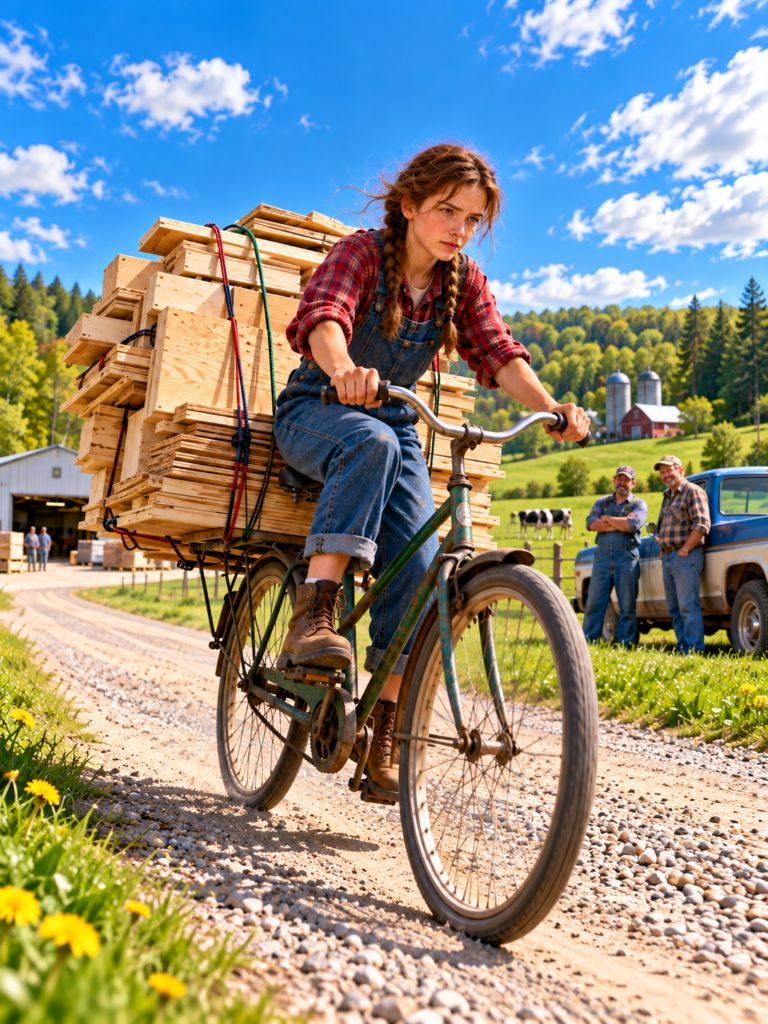
She had ridden three and a half miles from her family’s farm on County Road K. She wore work gloves, and two bungee cords were fastened to the carrier rack above her rear wheel.
She leaned the bicycle against the side of the building and went looking for Curtis.
He was working near the saw table when she appeared.
“Mr. Bjornstad?”
Curtis looked up.
“Morning, Fern.”
She glanced toward the offcut bin.
“Are you throwing those pieces away?”
“That’s usually what happens to them.”
“Could I have them?”
Curtis set down what he was holding.
He looked at the plywood, then at the bicycle outside.
“What would you want with all that?”
“I need some wood to build boxes.”
“Boxes?”
“Yes, sir.”
He studied her for another moment.
There was nothing particularly strange about a farm child wanting scrap lumber. Children built things. Most of those things ended up abandoned behind barns or taken apart for another project. Curtis had grown up around enough farms to know how that worked.
Still, this girl seemed remarkably serious about it.
He looked back at the bin.
“Fifty cents,” he said. “That’ll save me carrying it out myself.”
Fern reached into a small coin purse and placed two quarters on the workbench.
Curtis watched her go outside.
She began loading plywood onto the rear rack of her bicycle, choosing the pieces carefully, aligning their edges and arranging the heavier ones near the bottom. She tightened the bungee cords, tested the balance with one hand, and then started toward home.
Curtis returned to his work.
He assumed that was the end of it.
But Fern came back.
She made four trips that Saturday, carrying plywood along the county road while the spring wind pushed against her handlebars. When she found that she could not transport everything before the day was over, she returned the following weekend for the remaining pieces.
By the time she finished, she had brought home 112 pieces of birch plywood.
She had paid fifty cents for all of them.
Behind the Halverson barn stood an old calf shed. Fern carried the wood inside and sorted it by width, placing the pieces on shelves she had made from leftover lumber the previous fall.
She did not throw the strangely shaped pieces into a heap.
She examined them, measured them, and kept their usable edges together.
By Monday, somebody had mentioned her unusual purchase at the feed store.
By Wednesday, people at the co-op had heard about it.
The story became one of those small-town curiosities that required no particular reason to repeat.
Dwayne Halverson’s daughter had ridden her bicycle over to the cabinet shop and paid money for somebody else’s garbage.
Apparently, she wanted to make boxes.
Nobody was especially vicious about it.
That was almost the point.
People smiled when they told the story. Some shook their heads with mild amusement. Others said it was good to see a young person making something with her hands, although they said it in a tone suggesting the project was a harmless way to occupy a child’s time.
A few wondered why Dwayne had not simply given her some lumber from the farm.
Then the conversation moved to feed prices, equipment repairs, and whether the ground would dry enough for spring planting.
For the people telling the story, the matter was already finished.
For Fern, it had barely begun.
The Halverson family farm covered 160 acres of mixed ground east of Gruber’s Crossing.
Dwayne raised dairy cattle, maintained the buildings, and managed the endless labor that came with keeping a small Wisconsin farm in operation. Fern’s mother, Selma, tended a kitchen garden with the same discipline Dwayne applied to his livestock.
Their farm was not prosperous in the way outsiders sometimes imagined farm ownership. It was stable because the family paid attention to small expenses, repaired what could be repaired, and did not confuse having something with being able to afford it.
Fern had grown up with those habits.
She understood that useful things did not become useless merely because somebody stopped needing them.
She also understood something about bees.
That knowledge had come from Alma Voss.
Alma lived about a mile south of the Halverson property, along a narrow two-track road the county had stopped maintaining in 1974.
She was seventy-one years old in 1987.
Her forty-acre place was quiet, weathered, and easy to overlook. But behind the house, beyond the ordinary work of maintaining a rural property, stood a collection of beehives that had occupied Alma’s attention for more than three decades.
Her husband had brought home two small colonies in 1952.
After his death in 1969, she had continued caring for the bees herself.
By the mid-1980s, she usually maintained fourteen hives, occasionally sixteen, depending on the season.
Every Saturday from July through October, she set a card table near the end of her driveway and sold honey to anyone willing to make the trip.
Quart jars cost two dollars and fifty cents.
Cash only.
Fern had first visited that table with her mother when she was seven.
The honey was good, but the jars had not been what held her attention.
She wanted to know what happened behind the house.
When she was nine, she finally asked Alma if she could watch her work.
Alma studied the girl, went into the shed, and returned with a veil and a pair of gloves.
She handed them over without a speech.
That was how Fern’s education began.
For the next five years, she spent Saturday mornings following Alma through the bee yard.
Alma was not a woman who wasted words.
She opened a hive, lifted out a frame, and waited.
“What do you see?”
At first, Fern saw what most people would have seen: thousands of bees moving across yellow and brown comb.
Alma let her look longer.
Fern began noticing the arrangement of brood, the thickness of the honey stores, the behavior of the workers, and the small differences between a healthy colony and one beginning to struggle.
Sometimes Alma would point toward a section of comb.
“Look again.”
Then she would wait.
Gradually, Fern learned that a hive had its own logic.
The temperature inside it mattered. The queen’s laying pattern mattered. The amount of room around the frames mattered. The difference between an ordinary movement of bees and a warning sign mattered.
Alma taught her to recognize those differences before expecting her to explain them.
Fern watched colonies being divided, queens replaced, honey removed, and winter preparations made before the Wisconsin cold arrived.
She helped wrap hives in tar paper and watched Alma attach guards to keep mice from entering during the winter.
She learned to use the old hand-cranked extractor that Alma kept in her shed, a machine manufactured in 1938.
Most importantly, she learned that keeping bees required more than affection for them.
It required exactness.
A beekeeper who made assumptions instead of observations could lose an entire colony.
By the autumn of 1986, Alma’s knees had become a serious obstacle.
Carrying heavy honey supers from the yard to the extraction shed required her to stop and rest.
One afternoon, she mentioned to Fern that a younger pair of legs would be useful around the place.
She did not complain.
She merely stated the problem.
Fern understood.
That evening, she sat at the Halverson kitchen table with a yellow legal pad and began writing down measurements.
She knew the dimensions of a standard Langstroth hive body because Alma had made her measure them repeatedly.
A deep hive body stood nine and five-eighths inches high. Its exterior width was sixteen and one-quarter inches, and its length was nineteen and seven-eighths inches.
The interior spaces had to be precise.
The frames needed room to hang properly. The bees required their natural working clearance between surfaces. If the spacing was wrong, the bees would build unwanted comb that made ordinary inspections difficult.
The frame rests had to be cut correctly.
The joints had to be tight.
A hive body was not just a wooden box.
It was part of a system that depended on measurements established more than a century earlier.
Fern filled the legal pad with dimensions, sketches, and calculations.
Then she thought about the plywood she had seen through the window of Bjornstad Millwork.
Curtis was discarding material that was strong, smooth, and comparatively stable under changes in moisture.
Three-quarter-inch birch plywood could be cut into hive components. Properly joined, primed, and painted, it could withstand Wisconsin weather.
What Curtis saw as misshapen cabinet scraps, Fern saw as unfinished beekeeping equipment.
She began calculating what could be made from the pieces.
A new unassembled hive body cost approximately four dollars and eighty cents from the beekeeping supply catalog Alma kept in her extraction shed.
A properly assembled and painted body could sell locally for eight or nine dollars.
Fern estimated that even a small collection of discarded plywood could produce enough usable components to make the work worthwhile.
The numbers were promising.
But she needed a table saw.
One evening, she showed her calculations to Dwayne.
He read through the pages without interrupting.
He examined the measurements, turned back to the price figures, and read them again.
Finally, he looked at his daughter.
“You’ll need a table saw.”
“I know.”
“Where are you planning to get one?”
“Mr. Lindfist said I could work at the vocational school on Saturdays. After hours.”
Dwayne returned his eyes to the page.
He did not tell Fern that she was brilliant.
He did not tell her that she was going to become a successful businesswoman.
He knew the difference between an idea and a finished product.
After another moment, he folded the legal pad closed.
“All right.”
On the first Saturday in May, Dwayne loaded plywood into the farm truck and drove Fern to the vocational school.
She spent four hours inside the workshop.
He stayed in the parking lot reading a farm magazine.
When she emerged with freshly cut components, he put the magazine aside and helped her load them.
He did not ask whether the work had been difficult.
He could see what she had accomplished.
For the next three Saturdays, Fern returned to the school.
Mr. Lindfist showed her how to use the pneumatic nailer properly, and she followed his instructions. She applied waterproof wood glue before securing the joints, sanded each exposed surface, and checked the corners to make certain they were square.
She worked with eighty-grit sandpaper, then one-hundred-and-twenty.
For the primer, she followed Alma’s advice and used a shellac-based product suitable for the demands of outdoor exposure.
She painted everything white.
Two coats.
By the end of May, Fern had built eleven complete deep hive bodies, three medium supers, and four bottom boards.
She had used 107 of the 112 plywood pieces.
The five pieces that remained went back onto the calf shed shelves.
She saw no reason to discard them.
When the paint had cured, Dwayne helped load the finished equipment into the truck.
They drove to Alma’s farm on a Saturday morning in early June.
Fern arranged the new hive bodies across the tailgate.
Alma approached slowly.
She picked up one of the boxes, turned it over, checked the joints, and ran her thumb along the rabbet where the frames would rest.
She examined another corner.
Then another.
Fern waited.
“Where’d you get the wood?” Alma asked.
Fern explained the arrangement with Curtis.
“What’d it cost you?”
“Fifty cents.”
Alma looked at the box again.
For a while, she said nothing.
Then she set it down.
“That’s a fair piece of work.”
Fern knew Alma well enough to understand the weight of those words.
Alma did not hand out praise for effort.
She cared whether something was right.
She purchased four deep hive bodies and two medium supers for thirty-eight dollars in cash, counting the bills from the coffee can she kept in her extraction shed.
She had been wanting to expand her operation, she explained, but ordering equipment from a catalog took time, and the local farm supply store no longer stocked everything she needed.
Before Fern left, Alma told her she would buy more if she made them.
She also knew two beginning beekeepers near Bonduel who might be interested.
Fern brought the money home and entered it in a spiral notebook.
For the first time, the plywood that had cost fifty cents had produced income.
She had no intention of stopping.
The following Friday, Fern returned to Bjornstad Millwork.
Curtis was near the saw table when she came inside.
“Back for another load?”
“Yes, sir.”
He glanced toward the bin.
“How’d those boxes turn out?”
“I sold some of them.”
Curtis paused.
“Sold them?”
“Mrs. Voss bought some. And I have other people interested.”
He considered that.
Fern asked whether she could collect the offcuts every Friday for fifty cents a load.
Curtis looked toward the dumpster, then back at her.
He had no reason to object.
“That sounds fair.”
She paid him and took the scraps.
By then, Dwayne had begun letting her use the truck for the Friday pickups.
He never announced that he believed in her business.
He simply made sure she could transport the wood.
Over the next two years, Fern developed a routine that fitted around school and farm life.
Friday afternoons were for collecting scraps.
Saturday mornings were for cutting components at the vocational school.
Saturday afternoons belonged to assembly in the old calf shed.
Sundays were for sanding, priming, and organizing.
Painting and final inspection came when the earlier work had dried.
About every six weeks, she delivered finished equipment to Alma and to other local beekeepers who had heard about her work.
Each sale went into the notebook.
Every expense went there too.
By the end of 1987, Fern had sold twenty-six deep hive bodies, nine medium supers, eight bottom boards, and four inner covers.
Her total revenue was $411.
She had spent $6.50 on plywood and about forty dollars on glue, fasteners, primer, and paint.
The remaining $364.50 went into a savings account at the local Shawano County Bank branch.
She was fourteen years old.
The people who had smiled at her fifty-cent purchase never heard the full accounting.
They knew she was making bee boxes.
That was all.
Nothing about the activity seemed important enough to revive the old feed-store story.
And Fern did not volunteer an explanation.
She had work to do.
In 1988, Alma divided two healthy colonies and helped Fern establish her first hives on the Halverson property.
For the first time, Fern was responsible not only for building the equipment but for the living colonies inside it.
She had to inspect them, monitor their condition, prepare for winter, and make decisions without always having Alma standing beside her.
She kept records of everything.
By spring 1989, her small bee yard had grown to four hives.
The previous summer’s honey harvest had totaled sixty-two pounds. She had sold jars at Alma’s roadside table, keeping forty-eight dollars after paying for jars and lids.
But something else was becoming clear.
The biggest obstacle for people wanting to keep bees was often the initial cost.
A beginner looking to establish two hives might need to spend roughly $140 on equipment before purchasing a single colony.
Some prospective beekeepers abandoned the idea when they saw the total.
Others bought poorly made equipment and soon found themselves fighting crooked frames, badly spaced interiors, and unwanted comb.
Fern recognized the problem because she had spent years studying the importance of those measurements.
Her own customers were having better experiences.
Their equipment fitted correctly.
The frames hung properly.
The colonies could be inspected without unnecessary disruption.
People who succeeded with their first bees were more likely to remain beekeepers.
And people who remained beekeepers needed more equipment.
In the spring of 1989, Fern asked Curtis to change their arrangement.
Instead of paying fifty cents for each load, she proposed paying one dollar per week, settled monthly, in exchange for a regular Friday pickup.
Curtis thought about the arrangement.
The scraps were disappearing without requiring his employees to carry them to the dumpster.
His disposal expenses had even declined a little.
He agreed.
They shook hands.
There was no written contract.
By the end of that year, Fern had sold forty-one hive bodies, fourteen medium supers, twelve bottom boards, and seven inner covers.
She had earned approximately $665 after materials expenses.
She was sixteen.
Her father looked through her records one evening, studying the orderly columns of income and expenses.
“You’re keeping good books,” he observed.
Then he returned to his dinner.
Fern did not need anything more from him.
She was learning to recognize the Halverson family’s particular way of showing confidence.
Dwayne had been driving her to the workshop long before he commented on her ledger.
Alma had purchased equipment long before she praised her craftsmanship.
Curtis kept saving the offcuts every Friday.
And Fern kept building.
What none of them yet understood was how valuable those years of patient work would become when the bees across Shawano County began to die.
Part 2
By the summer of 1990, Alma Voss could no longer pretend that her knees would improve if she simply ignored them.
She was seventy-four years old, and the work that had once carried her comfortably through an entire beekeeping season had become increasingly difficult.
Opening a hive was manageable.
Lifting a full honey super was another matter.
When she visited her doctor in Shawano that June, he told her to stop lifting anything heavier than twenty pounds.
Alma knew exactly what that meant.
A full super could weigh sixty or seventy pounds.
She could no longer do the work that had sustained her bee yard for nearly forty years.
On a Saturday morning in July, Fern found her sitting in the extraction shed.
The old hand-cranked extractor stood nearby. Through the open doorway came the steady sound of bees moving among the flowers.
Alma told Fern what the doctor had said.
Fern listened.
“I can take care of the hives,” she replied.
Alma nodded, as though this merely confirmed something she had already decided.
They worked out the arrangement without much ceremony.
Fern would manage all fourteen of Alma’s hives, including inspections, treatments, honey collection, and the heavy lifting. She would receive forty percent of the honey revenue.
Alma would continue selling the jars at her roadside table.
Her knees were unreliable, but she could still sit in a chair, recognize every customer who came up the driveway, and tell them exactly which batch of honey they were buying.
That summer, Fern worked eighteen hives altogether: Alma’s fourteen and her own four.
Every ten days through July and August, she inspected the colonies.
She watched the brood patterns, checked their stores, and looked for evidence of disease or parasites.
She followed the treatment guidance Alma had collected from university extension publications, using oxalic acid according to the protocol available to them.
She documented what she did and what she observed.
When extraction time came, Fern collected 438 pounds of honey from Alma’s colonies and another sixty-one pounds from her own.
The old extractor required roughly four minutes of hand cranking for each load.
Fern calculated that she spent about nine hours turning its handle that season.
She wrote that figure in her ledger.
Not because she wanted to complain.
Because nine hours was information, and information could someday help her make a better decision.
Alma’s honey brought in $382.
Fern received $152.80 for managing the hives. She earned another $54.75 from her own honey and approximately $790 in net income from selling hive equipment.
Her income for the year came to almost one thousand dollars.
She was seventeen.
In a community where many families were struggling to maintain farms with aging equipment and narrow margins, it was not a fortune.
But Fern understood that the money represented something important.
She had begun with almost nothing.
She owned her tools, the hives she had built, and the money she had saved.
And she had acquired something no bank statement could measure: experience.
The following spring, Alma told Fern that she wanted to reduce her operation permanently.
She would keep six hives and continue selling honey.
The remaining eight colonies were more than she wished to maintain.
Fern asked what would happen to them.
“I thought you might want them,” Alma said.
“How much?”
“Two hundred dollars. Bees and equipment together.”
Fern knew it was a favorable price.
Most of those boxes had passed through her own hands during construction.
She also understood what Alma was offering.
It was more than surplus equipment.
Alma was trusting her with living colonies that had been part of her life for decades.
Fern paid the money from her savings account.
On the day she moved the eight hives, she secured them in the farm truck and drove slowly along the rural road with the windows open.
Dwayne watched from the porch when she arrived.
He saw his daughter carrying home eight colonies of bees in boxes she had made from discarded wood.
He helped where he was needed.
By the end of the move, Fern owned twelve hives.
She was eighteen that autumn.
Her list of customers had grown to thirty-seven beekeepers across Shawano, Oconto, and Menominee counties.
Some bought a single box.
Others returned for additional equipment after successful seasons.
A few purchased complete arrangements of hive bodies, covers, and bottom boards.
Fern remembered what they had ordered and how they intended to use it.
She understood that selling a badly made box could cost a customer far more than the price of the box itself.
So she continued checking every measurement.
In the spring of 1992, Fern graduated from Shawano County High School.
She had $4,180 in savings.
College was a possibility, but the cost was substantial, and Fern had not found a field of study that justified spending the money.
She decided to continue her business instead.
Dwayne did not argue.
He had never attended college himself, and he knew that being capable of doing useful work was not something that came exclusively from a classroom.
But graduation created an immediate difficulty.
Fern no longer had access to the vocational school workshop.
For five years, that shop had allowed her to convert scrap plywood into saleable equipment.
Without a table saw and a dependable workbench, her production would slow dramatically.
One morning, she visited Curtis Bjornstad.
The back corner of his cabinet shop held several piles of wood, miscellaneous tools, and a broken router table that Curtis had been meaning to repair.
Fern studied the space.
Then she made him an offer.
She wanted to rent the corner for twenty dollars a month.
She would work from six until eight every weekday morning, before his employees arrived.
She would keep the area clean, stay out of their way, and pay her rent on the first of the month.
Curtis thought about it.
He knew she had collected scraps faithfully for five years.
She had never caused trouble.
Twenty dollars a month seemed reasonable for an otherwise unused corner.
“All right,” he said.
Fern moved in that June.
Before sunrise on weekday mornings, she drove from the farm to the shop, turned on the lights in the back corner, and began working.
She cut panels, shaped frame rests, assembled boxes, and swept the floor before the regular crew arrived.
She paid Curtis promptly every month.
He did not interfere with her operation, and she did not interfere with his.
By the end of 1992, her production had increased substantially.
She sold sixty-eight deep hive bodies, twenty-three medium supers, nineteen bottom boards, and eleven inner covers.
Equipment sales produced $1,240 in revenue, with $1,172 remaining after the recorded materials costs. Honey from her twelve hives brought in another $219.
Her savings reached $5,571.
She was nineteen years old.
To most people in Gruber’s Crossing, she was still simply the Halverson girl who kept bees.
But beyond the town, something dangerous was moving through the honeybee population.
For several years, a parasitic mite known as Varroa destructor had been spreading through North American colonies.
The mites weakened bees and contributed to the collapse of hives that were not properly managed.
Wisconsin agricultural officials and university extension specialists had been publishing warnings and recommended treatment procedures.
Fern read them.
Alma read them.
They compared the recommendations against what they observed in their own colonies.
In 1991, Fern had lost two hives before getting her treatment schedule properly adjusted.
Those losses had troubled her.
She had built the boxes, raised the colonies, and spent months caring for them. She could not accept the idea that their deaths were simply bad luck.
She recorded the dates, the visible symptoms, and the probable cause.
She studied the timing of mite increases in her area.
Then she made a change.
Instead of waiting until the treatment period suggested by the regional schedule, she began treating three weeks earlier in the fall.
She monitored the colonies and continued recording the results.
That adjustment made a difference.
She did not lose another hive to mites during the following years.
In the spring of 1993, the consequences of the wider infestation became impossible to overlook.
Wild honeybee colonies that had lived for years in hollow trees and old barns were disappearing.
Beekeepers who had not followed treatment protocols opened hives and found colonies severely weakened or dead.
Some orchards around the Green Bay corridor faced shortages of pollinating bees.
A cherry operation in Oconto County reported an estimated thirty-percent reduction in fruit set.
In previous years, many growers had depended on both managed bees and wild colonies.
Now the wild colonies were increasingly absent.
And suddenly, people began asking questions they had not thought important before.
Why had some beekeepers lost their colonies while others had not?
Who still had healthy bees?
Where could they find replacement colonies?
Fern’s telephone began ringing.
The first calls came from people who had purchased equipment from her.
Then came calls from their friends.
Before long, beekeepers across three counties were asking what she had done differently.
Fern explained the records she kept, the extension bulletins she had studied, the monitoring she performed, and the earlier treatment schedule she had adopted after her losses in 1991.
She did not pretend to be an extension specialist.
She spoke about her own bees and the results she could document.
Some callers wanted equipment.
Others needed living colonies.
Fern examined her strongest hives and planned a limited number of splits.
She offered nucleus colonies for twenty-two dollars each, to be ready in early June.
Nine customers purchased them that spring.
Those sales brought in $198.
She also sold forty-four hive bodies to people rebuilding their bee yards.
By the end of 1993, Fern’s savings account held $9,340.
She was twenty years old.
The story of the girl who had purchased plywood scraps for fifty cents had long since disappeared from local conversation.
But a new story was spreading.
Somewhere near Gruber’s Crossing, a young woman had healthy bees while others were losing theirs.
She built equipment that fitted properly.
She kept careful records.
And when people needed help, she could explain exactly what she had done.
This time, the story did not move through the feed store as an amusing anecdote.
It traveled from beekeeper to beekeeper because people needed the information.
Curtis Bjornstad heard about it at a lumberyard in Shawano.
He was collecting materials for his cabinet business when a contractor he knew mentioned a neighbor who had bought bees and hive equipment from a young woman near Gruber’s Crossing.
The contractor said she was apparently doing very well.
Curtis recognized the description.
“I know her,” he said.
The other man seemed surprised.
“Do you?”
“She’s been renting a corner of my shop.”
The contractor nodded.
“Well, she must know something about bees.”
Curtis carried that conversation home with him.
The next morning, he looked toward the back corner of his workshop.
For years, he had been selling Fern the contents of his offcut bin.
He had received the same dependable payments.
Later, he had rented her space for twenty dollars a month.
He had watched her arrive early, clean up after herself, and quietly disappear into the rest of her day.
But he had never really examined the business she was building.
He had been busy running his own.
Now he understood that the arrangement meant considerably more to Fern than it did to him.
He considered the years of Friday collections and the hundreds of dollars he had earned from scraps that would otherwise have cost money to discard.
He thought about the boxes she had been making.
He did not feel cheated.
He had agreed to a fair price, and Fern had paid it.
What surprised him was that something substantial had grown out of such an ordinary arrangement without his noticing.
At the beginning of the following month, he told her the rent would remain twenty dollars.
He also said she could use the shop until eight-thirty in the morning if she needed the extra time.
His employees usually did not arrive before eight-fifteen anyway.
Fern thanked him.
Then she returned to her work.
In 1994, Fern made the largest equipment purchase of her young business.
For years, she had known how much time was consumed by honey extraction.
The nine hours spent cranking Alma’s old machine in 1990 had stayed in her ledger.
A commercial extractor could handle more frames at once and free time for equipment production and hive management.
A retiring beekeeper in Marinette County was selling a used twelve-frame radial extractor for $850.
Fern drove to see it with Dwayne.
The machine had been built in 1979. Its stainless-steel interior was sound, the motor worked, and the honey gate did not leak.
Fern examined it carefully.
Then she paid the asking price in cash.
They brought it home in the farm truck.
The old calf shed had already begun changing from a storage building into a honey-processing area.
Fern had insulated its walls using rigid foam board purchased as factory seconds at forty-one cents per square foot.
She had sealed the floor with epoxy paint.
Running a new water line to the shed would have required a trenching project costing roughly six hundred dollars, so she had installed a utility sink with a thirty-eight-dollar hand pump instead.
It was not an elaborate facility.
But it was clean, functional, and built around the work she needed to do.
With the new extractor installed, Fern could process honey far more efficiently.
She began offering extraction services to other beekeepers for eight cents per pound.
For customers who otherwise needed to transport their harvests to Green Bay, the service made practical sense.
During the 1994 season, she processed 2,140 pounds of honey belonging to seven other beekeeping operations.
That produced $171.20 in extraction fees.
Her own twelve hives yielded 418 pounds, with honey sales bringing in $338.50.
Her equipment business continued growing.
She standardized her products, offering deep hive bodies for nine dollars, medium supers for seven dollars, and complete beginner kits for forty-two dollars.
The kits included the essential wooden components and frames needed for someone starting with two hives.
They became particularly popular.
Fern understood why.
A person new to beekeeping did not necessarily know which pieces to order from a catalog.
If all the necessary components came together, properly fitted, the first step became less expensive and less intimidating.
The business she had begun with discarded plywood was now providing equipment, bees, honey, and extraction services.
By the end of 1994, her savings had reached $11,420.
Then, in February 1995, Alma Voss died.
She was seventy-nine years old.
She had kept bees until the previous October, when the season ended and the colonies were prepared for winter.
Her death was quiet, as much of her life had been.
For Fern, it meant losing the person who had taught her how to look at the world.
Alma left her six remaining hives, their equipment, and the forty-three dollars kept in the coffee can in her extraction shed.
She arranged for the old hand-cranked extractor to go to the Shawano County Historical Society, along with an explanation of its history.
On the Saturday after Alma’s death, Fern drove along the neglected two-track road.
Snow covered the ground.
The hives stood silent beneath their winter wraps.
Fern walked among them for a while.
There was no inspection to perform.
No honey to collect.
Nothing that required immediate attention.
For once, she had come to the bee yard without work waiting for her.
Inside the extraction shed, she found the shelves where Alma had kept her records.
There were composition notebooks going back to 1952, filled with handwritten observations of seasons, colonies, treatments, harvests, and losses.
Fern opened one.
She recognized the handwriting immediately.
For more than forty years, Alma had recorded what she saw and what she learned.
Fern took the notebooks home.
The historical society would preserve the old extractor.
Fern would preserve the knowledge.
That March, she moved Alma’s remaining six hives to the Halverson farm.
She now maintained eighteen colonies.
And she was beginning to reach another limit.
The family property had enough clover, basswood, and flowering field margins to support a healthy bee yard, but eighteen hives were near the upper end of what Fern believed the available forage could sustain without additional feeding.
If she wanted to expand, she needed more flowers.
She took out the county plat maps and began studying the surrounding parcels.
Immediately north of the Halverson farm lay forty acres that had once belonged to Gordon Radkkey.
The land had previously supported rotations that included clover and alfalfa.
But after Gordon retired, it had been rented for corn production.
Corn was useful farmland, but it offered little of the nectar resources Fern needed.
She imagined the parcel planted in flowering forage instead.
She calculated the potential increase in honey production.
Then she examined her savings.
The parcel was assessed at $41,000.
When she contacted the owner’s family, the asking price was $47,500.
Fern had approximately $12,910 available.
She could make a substantial down payment, but she could not purchase the property outright.
So she went to the Shawano County Bank.
The loan officer was a man named Lyall Pedabone.
Fern sat across from him and placed four ledger notebooks on his desk.
Lyall was accustomed to farm loans.
He was not accustomed to a twenty-two-year-old woman arriving with eight years of detailed handwritten business records.
Fern showed him her revenue, costs, annual savings, customer growth, and plans for expanding the bee yard.
He asked questions.
She answered with figures.
He wanted to know why she needed forty acres.
She explained the limits of the forage surrounding her present hives, the benefits of clover and wildflowers, and the additional colonies she could support once the planting became established.
She had calculated the expected honey production and considered the mortgage costs.
Lyall studied the notebooks for nearly twenty minutes.
He could see that she had not simply imagined a future business.
She had already operated one for eight years.
And she could account for where the money had gone.
He finally told her he believed he could arrange the financing.
Fern closed on the forty-acre parcel in June 1995.
The negotiated purchase price was $46,000.
She put twelve thousand dollars down and financed the remaining thirty-four thousand through a fifteen-year mortgage.
The land belonged to her, subject to the loan.
But ownership brought obligations that could not be postponed if a honey harvest came in poorly.
That autumn, she planted Dutch white clover, crimson clover, phacelia, and borage.
The seed cost $437.
She borrowed a broadcast seeder from Dwayne and planted the ground herself.
Then she waited.
She knew the forage would require time to establish.
The full benefit would not arrive until the second growing season.
By the end of 1995, Fern had eighteen hives, a functional processing shed, a commercial extractor, a rented workspace, a mortgage, and forty acres beginning their transformation from corn ground into flowering meadow.
Her savings account stood at $4,230.
She had committed much of what she had earned over eight years to land that would not provide an immediate return.
There were no guarantees.
But Fern had spent most of her life learning that worthwhile systems required patience, observation, and the discipline to keep working before the result became visible.
She hung the plat map on the wall of the calf shed.
Then she drew a red line around the forty acres.
For the first time, the future of her business was marked directly onto a piece of land.
Part 3
By the summer of 1997, the forty acres north of the Halverson farm had become something entirely different from the cornfield Fern had purchased.
The clover stood knee-high by the middle of June.
Phacelia bloomed in soft waves of blue and purple through July. White clover spread beneath it, and patches of other flowering plants filled the spaces between.
On warm afternoons, the air smelled of grass, flowers, and honey.
Bees moved constantly above the field.
Fern had spent two years waiting for that sound to grow stronger.
She now maintained twenty-four hives, having added six colonies from her strongest stock.
Every new hive stood in equipment she had built herself.
Some components came from Bjornstad Millwork’s offcuts. Others required fresh plywood, which she purchased when the scrap pieces were not large enough.
The principle remained unchanged.
Use what was available.
Measure carefully.
Build it correctly.
During that summer, the twenty-four hives produced 811 pounds of honey.
It was Fern’s largest harvest yet.
She sold the honey for four dollars per quart jar, a price the local market had gradually come to accept as supplies of dependable local honey became harder to find.
Her customers knew what they were buying.
The honey came from healthy, carefully managed colonies surrounded by good forage.
Fern made no extravagant claims about it.
She did not need to.
People tasted the honey, returned for more, and told their neighbors.
Honey sales that year reached $1,162.
Equipment production brought in another $1,408 net, while extraction services added $289.
Her combined income from those activities was $2,859.
It was a strong working year.
But the mortgage on the forty acres still demanded more money than those earnings alone could cover.
Fern paid the difference from her savings.
She entered every payment in her ledger and continued reviewing the numbers.
She knew that the land was producing value.
She also knew that value and available cash were not the same thing.
The meadow might support more bees for years to come, but the bank required its payment every month.
Fern made changes where she could.
She managed production carefully, continued selling equipment to her growing customer base, and worked to improve the income generated by the bee yard.
In 1998, the business finally reached the level of cash flow she had been working toward.
The land could support its costs.
Fern did not celebrate with an expensive purchase.
She made the appropriate entries in her notebook and continued working.
Over the next several years, the operation expanded steadily.
By 2001, Fern maintained thirty-one hives.
Her savings account held $22,340.
Her customer records included 412 beekeepers across six Wisconsin counties who had purchased equipment from her at least once.
Some customers had begun with a single starter kit.
Others operated established bee yards and bought replacement equipment or new components as their colonies expanded.
Fern still knew that a hive body was only as good as its measurements.
She still checked the frame rests with her thumb.
And she still collected plywood offcuts from Curtis Bjornstad.
There was one important change.
She no longer did all the work alone.
A seventeen-year-old girl named Dagny Joerger had started coming to the Halverson farm on Saturday mornings.
Dagny lived on another farm about three miles south along County Road K.
She helped with extraction and equipment assembly, carrying supplies, cleaning components, and learning the routine of the bee yard.
At first, she watched Fern closely.
Fern recognized something familiar in the girl’s attention.
When they opened a hive together, she did not begin by explaining every detail.
Instead, she lifted a frame and held it where Dagny could see.
“What do you see?”
Dagny described the bees.
Fern waited.
“What else?”
The girl leaned closer.
Over time, she began noticing the arrangement of brood, the condition of the comb, and the behavior of the colony.
Fern taught her much as Alma had taught her.
She showed her what mattered and gave her enough time to recognize it for herself.
Dagny also learned to cut plywood.
She practiced setting the equipment correctly, measuring the components, and checking the joints before assembly.
She learned that a poorly cut piece could create problems long after the box had been painted and installed.
Fern did not need to convince her of the importance of that lesson.
A few mistakes at the workbench were enough.
By the spring of 2003, Dagny wanted to work more than Saturdays.
Fern agreed.
She began paying the nineteen-year-old eight dollars an hour, more than the local minimum wage.
Dagny could answer the telephone, help maintain the ledgers, assemble equipment, and handle ordinary hive work with care.
Fern considered those abilities valuable.
She had spent sixteen years learning how much skill could be hidden inside work that appeared simple.
That same spring, Curtis Bjornstad told Fern he was retiring.
He was sixty-one years old.
His back had been bothering him for several years, and neither of his sons wanted to take over the cabinet business.
He had found a buyer for the building and some of the equipment.
He wanted Fern to have ninety days to make other arrangements for her workspace.
She had been renting the back corner since June 1992.
Eleven years.
Curtis believed she deserved more notice than he was legally obligated to provide.
Fern listened quietly.
She thanked him.
Then she asked who was buying the property.
Curtis told her.
She looked around the workshop.
The familiar table saw stood where it always had.
There was the dado stack she had used for years, the workbench, the shelves of plywood, and the router table Curtis had never found time to repair.
She thought about how much of her business had passed through that back corner.
Then she asked a question Curtis had not expected.
“What are you asking for the place?”
He reminded her that he already had a buyer.
“I understand,” Fern said.
Curtis hesitated.
Then he told her the asking price.
One hundred and twelve thousand dollars.
Fern did not answer immediately.
She thought about her savings, her equipment sales, the income from the bee yard, and the financial obligations she already carried.
She knew the property was valuable.
More importantly, she knew exactly how useful it could be to her.
She would no longer need to work around somebody else’s production schedule.
She could organize the entire building for hive-equipment manufacturing.
She could store materials properly, expand her output, and give Dagny more responsibility.
Fern looked at Curtis again.
“Would you consider holding the note if I made a substantial down payment?”
Curtis studied her.
He had a buyer who already had financing arranged.
This was not a decision to make casually.
Fern proposed putting twenty-five thousand dollars down.
Curtis said he would have to think about it.
She told him she understood.
A week later, he called her.
He had considered the offer.
He would sell the property with twenty-six thousand dollars down and carry an eighty-three-thousand-dollar note himself.
The interest rate would be seven percent over ten years.
The arrangement would include the building, the lot, and the equipment.
Fern accepted.
They completed the sale in September 2003.
For sixteen years, Fern Halverson had been visiting Bjornstad Millwork to collect scraps.
For eleven of those years, she had rented a corner of the building.
Now she owned the shop.
She was thirty years old.
The business sign that had carried Curtis Bjornstad’s name since 1971 came down.
A new sign went up.
HALVERSON APIARY SUPPLIES
Beneath the name, in smaller lettering, were the words:
Hive Equipment and Honey.
For the first time in many years, the story of Fern’s fifty-cent plywood purchase returned to Gruber’s Crossing.
People talked about it at the feed store.
They mentioned it at the co-op.
Someone brought it up near the old sale barn.
The details had not changed.
They still remembered the fourteen-year-old girl who had ridden her bicycle to the cabinet shop, bought discarded plywood, and hauled it home in awkward loads secured with bungee cords.
They still remembered that she had said she wanted to build boxes.
But now the story meant something different.
The girl had kept building those boxes.
She had sold them.
She had raised bees, supplied beekeepers, bought land, planted forage, and established a growing rural business.
And eventually, she had purchased the building where the scraps came from.
The people who had found her first project amusing were forced to reconsider what they had seen.
They had not been watching a child waste fifty cents.
They had been watching the beginning of an enterprise that would take sixteen years to become fully visible.
Curtis heard his name mentioned in the story more than once.
People seemed fascinated by the fact that he had sold her scrap plywood for years without understanding the size of the business she was developing.
He did not dispute it.
It was true.
When someone asked him what he thought, he said that Fern had always paid what she owed, kept her workspace clean, and caused him no trouble.
That was Curtis’s assessment.
He was satisfied with it.
Lyall Pedabone heard about the purchase too.
He remembered the day in 1995 when Fern had arrived at the bank with four handwritten ledgers and a plan to buy forty acres.
He told a colleague that her records had been among the cleanest he had seen from a small business owner.
He had believed the figures then.
He had been right to do so.
Fern herself spent little time listening to the talk around town.
There was too much work waiting inside the new shop.
In the first week of October, she repaired the router table Curtis had left untouched for years.
The machine needed a replacement bearing and a new part for its adjustment mechanism.
Fern already had what she needed in the collection of spare parts she had accumulated over eleven years.
Once repaired, the router table joined the other equipment in regular use.
She checked the table saw.
She calibrated the dado stack.
She reorganized the shelves and established proper storage for wood sorted by dimensions.
The old offcut bin remained in the building.
But there was one important difference.
The pieces no longer went into the dumpster.
On Friday afternoons, they moved to the sorting area.
They were measured, classified, and placed on shelves for future production.
A piece too narrow for a hive body might still provide a smaller component.
An irregular length could sometimes be cut into useful sections.
The principle was exactly the same one Fern had recognized in April 1987.
The material had not changed.
Only the person deciding what it was worth.
By the autumn of 2003, Fern’s bee yard held thirty-one hives.
The forty acres to the north had been reseeded twice to maintain the strength of its flowering plants.
The old calf shed had become a functioning honey-processing facility, with a commercial extractor, a utility sink, and shelves of records.
Those shelves held Fern’s ledgers along with Alma’s old composition notebooks.
The earliest of Alma’s records went back to 1952.
A person examining them could have traced decades of work, beginning with two colonies kept by a Wisconsin couple and continuing through the operation Fern had built.
The financial records told another part of the story.
In October 2003, Fern’s savings account stood at $31,420.
She still owed approximately nineteen thousand dollars on the forty acres, and the shop carried the ten-year note Curtis had agreed to hold.
Those debts were real.
So were the land, the equipment, the thirty-one working hives, and the customer list of more than four hundred beekeepers.
Fern had not become wealthy overnight.
She had built an operation with assets, obligations, customers, employees, and work that would continue the next morning.
Dagny had also begun keeping bees on her family’s property.
She maintained four hives of her own.
The equipment was her own work, built during early mornings at the shop from plywood pieces left over from previous production runs.
Fern noticed which materials Dagny chose.
She saw her measuring irregular scraps, turning them in her hands, and considering the best use for each one.
No one had instructed Dagny to start with discarded wood.
She had simply watched the operation long enough to understand its value.
Fern recognized the lesson.
She did not explain it.
She remembered Alma standing beside an open hive, waiting for a child to see something that was already there.
One cold Monday morning in November 2003, Dagny arrived at the shop before Fern.
The gravel lot was quiet.
She unlocked the door, switched on the lights, and walked to the sorting shelves.
There was a stack of three-quarter-inch birch plywood offcuts waiting from the previous Friday.
The pieces varied in width and length.
Some had angled ends.
Others had curved cuts left from larger production patterns.
Dagny selected the pieces she needed.
She carried them to the table saw and checked the measurements against a wooden story pole she had made during her early months at the shop.
The pole was a simple length of scrap wood marked with the critical dimensions she used repeatedly.
Some pencil lines had been erased and redrawn so many times that the surface had grown worn beneath them.
Dagny checked the blade setting.
She made the first cut.
Then another.
By the time Fern’s truck pulled into the parking lot, eight freshly cut side pieces were stacked neatly on the workbench.
Fern entered the shop and removed her work gloves.
Dagny continued arranging the wood.
Fern walked over to the bench.
She examined the first piece, then picked it up and turned it in her hands.
The edge was smooth.
The dimensions were right.
The rabbet was clean and correctly positioned.
Fern ran her thumb along the cut.
For a moment, the movement reminded her of Alma Voss examining that first hive body on the tailgate of Dwayne’s truck in June 1987.
Alma had checked the same kinds of details.
She had looked at the joints, felt the frame rest, and considered what the girl standing in front of her had made.
Then she had offered a few quiet words of approval.
Sixteen years had passed.
Curtis’s discarded plywood had become the foundation of a business.
A fourteen-year-old girl’s fifty-cent purchase had led to years of carpentry, beekeeping, recordkeeping, land purchases, and patient work.
The shop where people once threw away the wood now belonged to the woman who had recognized its possibilities.
And another young woman was standing at the workbench, learning to recognize those possibilities herself.
Fern placed the piece back on the stack.
Dagny looked up briefly.
There was no correction to make.
No measurement to adjust.
Fern gave a small nod and moved toward the next task.
The saw started again.
Outside, the morning light settled across Gruber’s Crossing, across the county road and the fields beyond it, where the Halverson bees waited out the approaching Wisconsin winter.
Inside the shop, another day’s work had begun.
The offcut bin would be filled again.
It would be emptied on Friday.
And somewhere in the building, every piece of usable wood would find its place.
Because the most important thing Alma Voss had taught Fern Halverson had never been about honey or carpentry or even bees.
It was about learning to see what was actually in front of her.
And sometimes, when a thing had been made correctly, there was nothing more that needed to be said.

