
Part 1
“You’re nineteen years old, Hannah. Nineteen.”
Grant Holloway leaned back in the old oak chair as though he owned the kitchen, the house, and every acre beyond its windows.
“You haven’t even finished college. Your grandmother was a farmer. A good one, too. But knowing how to drive a tractor doesn’t mean you know how to run a business.”
Hannah Reed stood on the other side of the kitchen table, her arms folded across a faded denim work shirt. A few strands of sandy-blonde hair had escaped her ponytail. Her fair, freckled face was sunburned along the bridge of her nose, and there was a smear of red Missouri clay on one sleeve.
She had spent the morning repairing an irrigation line that no longer carried enough water to justify the effort.
“I’m not selling,” she said.
Grant smiled. It was the patient smile of a man who had heard those words before and never taken them seriously.
He slid a cream-colored envelope across the table.
“Two hundred and ten thousand dollars. Cash offer. No contingencies worth worrying about. My attorneys handle the paperwork, you settle what you owe the bank, and you go back to school. You’ve got your whole life ahead of you.”
Hannah didn’t reach for the envelope.
“And if I say no?”
Grant glanced toward the window.
Beyond the farmhouse, thirty-eight acres of struggling crops lay beneath the hard August sun. The hills along the southern Missouri horizon had taken on that dusty gray-green color that came with a summer too dry even for the Ozarks.
“Then you keep pouring money into land that can’t support itself,” he said. “Eventually, the bank makes the decision for you.”
He stood and adjusted the cuffs of his expensive western-cut shirt.
“My offer won’t stay on the table forever.”
Hannah looked him straight in the eye.
“Neither will your truck, if you don’t get moving.”
For a moment, the smile disappeared.
Then Grant gave a small laugh, picked up his hat, and walked out.
Hannah watched through the screen door as his spotless black pickup rolled down the gravel driveway. Dust rose behind it, drifted across the mailbox, and slowly settled onto the weeds along the fence.
Only when the truck disappeared did she let herself breathe.
She turned toward the envelope.
Two hundred and ten thousand dollars.
It was more money than she had ever held in her life.
And Grant Holloway had offered it because he believed she was desperate enough to accept.
The worst part was that he wasn’t entirely wrong about the desperation.
Reed Farm sat outside the fictional town of Ash Creek, in the limestone country of southern Missouri, where wooded ridges broke into small valleys and family farms had been passed down for generations.
The property covered sixty-four acres, including thirty-eight acres of cultivated ground, a patch of old pasture, a wooded slope, and a weathered farmhouse with a green metal roof.
It wasn’t much compared with Holloway Agricultural Holdings.
Grant controlled nearly six thousand acres through a web of companies, leases, and partnerships. He owned grain operations, cattle pastures, storage buildings, and enough equipment to keep half a dealership busy.
Hannah owned a twenty-year-old pickup, two tractors that required regular persuasion, and a farm that had belonged to her family since before the interstate highway reached that part of the state.
More importantly, she had inherited the debts.
The drought had come in stages.
First, a dry spring. Then a June with barely enough rain to dampen the dust. By late July, the creek had shrunk to disconnected pools, the pond behind the equipment shed was mostly mud, and the old well could barely maintain pressure.
Tomatoes hung on exhausted vines. Pepper plants were dropping their flowers. Rows of sweet corn had curled inward until the leaves resembled narrow green blades.
The local extension office had started distributing emergency drought guidance. Farmers crowded the feed store each morning discussing hay prices, well levels, and whether selling cattle early would be cheaper than feeding them through winter.
Hannah had heard all of it.
She had also heard people talking about her.
Poor Evelyn’s granddaughter.
Sweet girl, but she doesn’t know what she’s getting into.
Shame about the farm.
Evelyn Reed had died seven months earlier.
Hannah had been halfway through her first year at a community college agricultural program when the call came.
Her grandmother had gone to bed on a Sunday night and never awakened.
No long illness. No warning.
One phone call, and the person who had taught Hannah nearly everything she knew about the land was gone.
There were mornings afterward when Hannah still expected to see Evelyn standing at the back door, holding a cup of black coffee and complaining that young people wasted too much daylight sleeping.
Evelyn had been small, stubborn, and remarkably strong.
She could change a tractor belt, mend fencing, bargain with a produce buyer, and tell when rain was coming just by watching how the clouds formed over the western ridge.
She had raised Hannah for much of her childhood after family circumstances made the farm the one place that always felt permanent.
Most of the people in Ash Creek remembered Hannah as the freckle-faced little girl following Evelyn through the farmers market, carrying a cardboard box of tomatoes almost too heavy for her arms.
They had watched her grow up.
Unfortunately, that meant they still saw a little girl whenever she made a decision they didn’t understand.
Gerald Mercer, the loan officer at the local bank, was kinder about it than most.
He had known Evelyn for thirty years.
One afternoon, he sat across from Hannah beneath a framed photograph of the county courthouse and explained that the farm could not continue operating indefinitely on borrowed money.
“Your grandmother was a remarkable woman,” he said. “But the numbers don’t care who your grandmother was.”
Hannah watched him turn a financial statement toward her.
Operating credit.
Equipment debt.
Outstanding payments.
Interest.
Everything arranged in neat rows, every number pointing in the same direction.
“I’m not asking you to give me a miracle,” she said.
Gerald took off his glasses.
“Then tell me what you’re asking for.”
“Time.”
He looked genuinely sorry.
“Time is the one thing the bank can’t manufacture.”
Every morning before sunrise, Hannah walked the property.
She carried a notebook, a soil probe, and an old stainless-steel water bottle that had once belonged to Evelyn.
She recorded soil conditions, crop damage, and the pressure readings from the well.
Sometimes she stopped beside the fences and simply listened.
There wasn’t much sound anymore.
The usual chorus of insects had quieted. Even the cattle on a neighboring property moved slowly, gathering beneath the remaining shade instead of grazing across the fields.
Evelyn had taught Hannah that walking land was different from looking at it from a truck.
“You can’t understand a place at forty miles an hour,” she used to say.
When Hannah was eight, her grandmother would kneel beside a patch of grass and ask her what she noticed.
Hannah might point to a beetle.
Or a weed.
Or a different shade of soil.
Evelyn would nod, then ask the same question again.
Eventually, Hannah learned to look for patterns rather than isolated details.
Where did the grass grow thickest?
Where did frost linger?
Why did the cattle prefer one corner of a pasture over another?
Why did a field dry unevenly even when the soil appeared identical?
By twelve, Hannah could identify subtle changes in ground moisture better than some adults who had farmed for years.
By seventeen, she was helping Evelyn plan crop rotations and repair irrigation equipment.
And now, with the farm dying around her, those lessons were all she had left.
On the ninth morning after Grant Holloway’s visit, Hannah noticed something strange near the eastern fence.
A strip of grass.
Barely four feet wide.
It ran diagonally across a field that had gone brown weeks earlier.
At first, she assumed it was a shadow effect or the remains of an old irrigation leak.
But there was no irrigation line beneath that particular section.
And the grass wasn’t merely less dead than everything around it.
It was green.
Not bright spring green, but unmistakably alive.
Hannah crouched and pushed two fingers through the brittle surface.
Dry dust.
Hard clay.
Then, several inches deeper, something unexpected.
Cool, damp earth.
She pressed farther.
Moisture.
Real moisture.
Hannah sat back on her heels.
There hadn’t been meaningful rain for weeks.
She stood and followed the green strip toward the fence line.
It didn’t match the slope of the property.
It didn’t follow a drainage ditch.
It angled across the field as though something underneath the soil had drawn an invisible line.
She walked it twice.
Then she went back to the barn and returned with a shovel.
The first day, she dug almost two feet.
Nothing.
Just hard clay, scattered limestone, and roots that resisted every movement.
By noon, her shoulders burned.
She went home with blisters and dirt beneath her fingernails, wondering whether exhaustion had made her imagine the significance of a narrow patch of grass.
The next morning, she came back.
This time, she widened the trench and worked along the line where the soil was dampest.
Several hours later, she reached a layer of limestone.
Solid enough to make a shovel nearly useless.
She fetched a digging bar from the equipment shed.
By evening, the trench looked like an unfinished drainage project.
One of the neighbors spotted her working and mentioned it at the feed store.
By the following afternoon, the story had reached Grant Holloway.
Hannah heard about his remark from Dale Whitfield, an older farmer who stopped by to ask whether she needed anything.
“Grant says you’re trying to dig yourself a new well with a garden shovel.”
Hannah kept tightening a bolt on the tractor.
“That’s one way to describe it.”
“He thinks you’re wasting your time.”
“He ought to find something better to do with his.”
Dale chuckled, but his expression softened.
“You be careful, Hannah. This heat is no joke.”
She thanked him.
After he left, she returned to the field.
It was her third day digging.
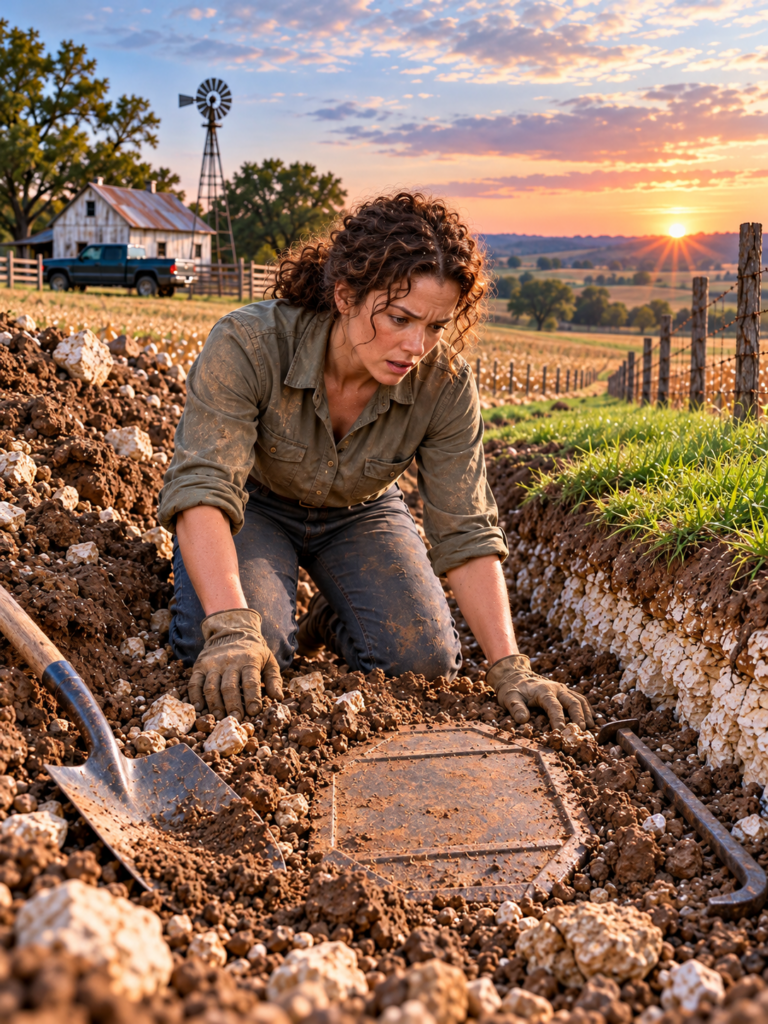
The sun had started lowering over the western ridge when the shovel struck something hard.
Clang.
Hannah froze.
Limestone didn’t sound like that.
She struck the same spot again.
Clang.
Metal.
Dropping to her knees, she brushed away loose dirt with both hands.
A curved black edge emerged.
Then another.
She worked carefully, uncovering what appeared to be a heavy cast-iron lid embedded in an old concrete collar.
Across the metal surface were raised letters and numbers, nearly hidden beneath decades of corrosion.
R. W.
1948.
Hannah stared at the markings.
Robert Wesley Reed.
Her great-grandfather.
He had died long before she was born, but she knew his name from Evelyn’s stories.
Robert had cleared sections of the original farm, built the stone foundation beneath the oldest barn, and installed a water system no one had used in Hannah’s lifetime.
Evelyn sometimes mentioned that the property had once had better water than any other place in the valley.
Hannah had always assumed she meant the old well.
Now she wasn’t so sure.
She fetched a pry bar from the truck and worked the lid loose.
It shifted with a low metallic groan.
Cool air rose from the darkness beneath.
Hannah leaned forward and aimed her flashlight inside.
The lid covered an old stone-and-concrete collection chamber.
Roots hung along one side. Sediment had collected around the outlet. The walls were stained with minerals left by years of seepage.
But at the bottom, beneath the pale beam of her flashlight, something moved.
Water.
Clear water.
Not a puddle left by rain.
Not stagnant runoff.
Water rising slowly through a fracture in the limestone floor.
Hannah watched it gather, spread across the chamber, and disappear into an outlet partly clogged with silt.
She stayed there for several minutes, listening to the faint sound of running water beneath a field everyone believed was dying.
Then she climbed out of the trench, wiped her hands on her jeans, and took out her phone.
There was only one person she wanted to call.
Dr. Malcolm Pierce answered on the fourth ring.
He taught geology and groundwater science at the community college Hannah had attended.
She had taken one of his introductory courses the previous semester and had stayed after class so often that he eventually joked about charging her for office hours.
“Hannah Reed,” he answered. “Please tell me you’re calling about coming back to school.”
“Not exactly.”
“Should I be worried?”
“I found something on the farm.”
“What kind of something?”
“A buried collection chamber. Old concrete, cast-iron cover, limestone underneath.”
He paused.
“Is it dry?”
“No, sir.”
“How much water?”
“Enough that I think you ought to see it.”
Another pause.
“Are you sure it’s flowing groundwater?”
“That’s what I need you to tell me.”
Malcolm arrived two days later in a dusty Subaru loaded with measuring instruments, water-testing equipment, and notebooks.
He was a tall man in his late fifties who had spent more of his professional life outdoors than in a classroom.
At first, he treated the discovery with cautious interest.
Then he inspected the chamber.
Then he studied the surrounding geology.
Then he stopped speaking for almost five minutes.
Working together, they cleared sediment from the outlet and exposed the original intake.
Malcolm used a portable flow meter to take a preliminary reading.
Fifty gallons per minute.
He frowned.
“That’s already substantial.”
They cleared another obstruction farther down the old collection channel.
The reading rose.
One hundred and ten gallons per minute.
By late afternoon, after tracing the main outlet and adjusting his measurements, Malcolm’s expression had changed completely.
He took a final reading, checked the equipment, and repeated the test.
Four hundred and twenty gallons per minute.
He looked at Hannah.
“Do you understand what that means?”
She shook her head.
“It means you’ve got a major spring discharge here. And judging by the limestone formation, this may be part of a much larger groundwater system.”
Hannah looked toward the withered fields.
“Could it save the farm?”
Malcolm gave a short, incredulous laugh.
“Hannah, if the water quality, seasonal flow, and legal access all check out, this could change the economics of farming in this valley.”
He wanted additional testing.
He wanted to contact groundwater specialists.
He wanted to notify the appropriate state authorities and begin documenting the discovery properly.
Hannah listened.
Then she asked him to keep the location confidential while they completed the preliminary survey.
“Why?” he asked.
“Because Grant Holloway’s been trying to buy this farm.”
Malcolm looked toward the exposed chamber.
“And you think he’d be interested in this?”
“I think a man who owns six thousand acres knows the difference between a dry field and a good water source.”
She hesitated.
“I just don’t know how much he knows about this one.”
Malcolm agreed to keep the preliminary findings private while they arranged the testing, safety inspections, and regulatory review that would be necessary before any substantial use.
But as he loaded his equipment, he gave her one warning.
“Discovering water isn’t the same as owning unlimited rights to use it, Hannah. Whatever you decide, we’ll need to do this properly.”
She nodded.
“I know.”
What she didn’t tell him was that she had already begun looking beyond the boundaries of her own property.
That evening, Hannah spread three maps across the farmhouse kitchen table.
One was a county property map.
Another showed local topography.
The third was Malcolm’s preliminary sketch of the underground limestone fractures.
She placed small stones at the corners to keep the pages flat.
The formation extended northeast beneath the neighboring farms.
And the most promising sections appeared to run directly beneath land that was losing value with every passing month.
Dale Whitfield owned eighty-two acres east of the Reed property.
Carol Voss owned another hundred and four to the north.
The Hendersons, a retired couple, held sixty-seven acres bordering an old farm road.
Roy Samson owned one hundred and thirty-nine acres directly above what Malcolm believed could be an important section of the groundwater formation.
Other nearby parcels completed a patchwork of struggling farms.
Hannah studied the maps until the kitchen light drew moths against the window.
Then she opened her notebook.
She couldn’t afford to buy even one neighboring farm outright.
Not yet.
But she had been studying farm financing and land contracts long enough to understand that immediate ownership wasn’t the only possibility.
An option agreement could give her the right, but not the obligation, to purchase a property at an agreed price within a specified period.
It would cost money upfront.
It would require legal advice.
And it would carry real risk.
But it might also give her something Grant Holloway had spent years collecting.
Time.
The following morning, she drove to Dale Whitfield’s house.
He met her on the porch holding a chipped coffee mug.
“Well,” he said, “if it isn’t the girl digging holes.”
Hannah smiled.
“Morning, Dale.”
“You find China yet?”
“Not quite.”
He moved aside so she could enter.
His kitchen smelled of bacon grease and fresh coffee. A calendar from the local farm supply store hung beside the refrigerator.
Hannah sat across from him and asked about his land.
Dale talked for nearly an hour.
The drought.
The feed bills.
The cost of repairing fences.
The mortgage he had refinanced three years earlier, thinking another good growing season would put him ahead.
At sixty-four, he was tired.
Not of farming.
Of wondering whether he could afford to continue.
When Hannah asked whether he had considered selling, Dale looked down at his hands.
“Every day lately.”
She opened her notebook.
“What if you didn’t have to decide today?”
He frowned.
She explained the option arrangement slowly.
He would receive a payment upfront.
For twelve months, she would have the exclusive right to purchase the land at the price they negotiated.
If she exercised that right, the sale would proceed.
If she didn’t, he would keep the option payment under the contract terms and retain the land.
She also insisted that he have an independent attorney review the agreement and understand the potential value and risks before signing.
“You offering to buy my farm?” he asked.
“I’m offering to pay for the chance to buy it.”
“With what money?”
“Not enough,” Hannah admitted. “Not right now.”
Dale watched her carefully.
“Your grandmother know you were this stubborn?”
“She taught me.”
He laughed.
For the first time that morning, it sounded genuine.
They agreed on a purchase price of $118,000, subject to the option terms and independent review.
A week later, Dale signed.
Hannah drove home with a copy of the agreement on the passenger seat.
It was the first serious financial commitment she had ever made.
And if her plans failed, it could become one more expensive mistake on an already dangerous pile.
She continued meeting neighboring landowners.
Some wanted immediate sales.
Others wanted flexibility.
Roy Samson made her sit on his porch for almost an hour before discussing anything resembling business.
When she finally explained why she was there, he narrowed his eyes.
“Grant Holloway send you?”
“No, sir.”
“Good. Because I’ve turned that man down twice, and I don’t intend to entertain him a third time.”
Hannah tried not to smile.
Within two months, she had negotiated five option agreements covering 487 acres.
The combined purchase prices came to just under $640,000.
Her attorney had warned her about every possible problem: financing risk, title defects, disclosure obligations, and the danger of gambling on preliminary geological findings.
Hannah knew the agreements were not a guarantee of wealth.
She also knew one other thing.
Grant Holloway had no idea what she was doing.
For now, he still saw a nineteen-year-old girl trying to save a dying farm.
And Hannah was beginning to understand that being underestimated could be useful.
Part 2
The first tomatoes came back slowly.
At first, Hannah noticed only a deeper shade of green in the leaves near the eastern field.
Then the plants stopped dropping their blossoms.
New growth appeared along the lower stems.
Within two weeks, rows that had looked finished began producing again.
There was nothing miraculous about it.
There was water, careful management, and more work than one person should reasonably have attempted.
Malcolm helped Hannah arrange additional flow and water-quality testing, and she worked with local officials and an irrigation contractor to establish what could legally and safely be drawn from the spring. They monitored the source rather than assuming that one impressive reading guaranteed an endless supply.
The old chamber required repairs.
Its outlet had to be cleaned and stabilized, and damaged sections of the collection system needed replacement.
Hannah emptied most of her remaining savings into that work.
She sold an unused piece of machinery, negotiated a payment extension on another, and took every extra farm job she could find.
Then she began converting her irrigation system.
The old overhead sprinklers lost too much water to wind and evaporation. Drip irrigation delivered smaller amounts directly to the roots.
Hannah worked beside the installation crew whenever she could, then spent her evenings repairing leaks, checking pressure, and calculating water use.
The fields didn’t turn green overnight.
There was no sudden transformation visible from the highway.
But the soil held moisture longer.
The plants began to recover.
And for the first time since Evelyn died, Hannah woke up without immediately calculating how many weeks remained before the money ran out.
She also changed what she planted.
Evelyn had always preferred crops with dependable local buyers, but Hannah understood that a small operation could no longer compete purely on volume.
She focused on high-value produce: heirloom tomatoes, specialty peppers, fresh herbs, and carefully selected seed crops.
A chef from Springfield visited after tasting her tomatoes at a regional farmers market.
A produce buyer from a grocery distributor followed.
Hannah learned to talk about grading standards, refrigerated transportation, weekly volume commitments, and the cost of meeting a delivery schedule.
She made mistakes.
One early shipment of peppers arrived with too much cosmetic damage and was discounted heavily.
A late-summer equipment failure cost her nearly two days of harvesting.
During a busy September week, she slept four hours a night and ate more gas-station sandwiches than she cared to remember.
But the crops kept coming.
By the end of that growing season, Reed Farm had recorded just under $870,000 in gross revenue from produce, premium contracts, and related farm sales.
The profit was far smaller.
Expenses had swallowed much of the money, and Hannah still had debt to service.
Even so, it was the first financial statement she could take to Gerald Mercer without feeling that she was asking him to believe in something invisible.
He studied the figures twice.
Then he looked at her.
“Your grandmother would be proud.”
Hannah lowered her eyes.
“She’d probably ask why my fuel costs are so high.”
Gerald smiled.
“Probably.”
The next breakthrough came from a regional food distributor.
Hannah had spent months proving that Reed Farm could deliver consistent quality.
The distributor wanted specialty produce for grocery stores and restaurant groups across Missouri, Arkansas, Kansas, and Oklahoma.
Its purchasing manager, Rebecca Collins, was direct about the opportunity.
“We like your product, Hannah. But we need reliability. Not a good week followed by three bad ones.”
Hannah showed her the production records, irrigation plans, greenhouse proposals, and labor forecasts.
Rebecca reviewed everything.
Then she asked a question Hannah had hoped someone would eventually ask.
“How much more can you grow?”
Hannah opened a property map.
“Enough to make this worth both our time.”
After several negotiations, Reed Farm secured a three-year supply agreement with projected purchases totaling $3.8 million, subject to delivery volumes and quality standards.
The contract wasn’t a guaranteed check.
It was a commercial opportunity tied to Hannah’s ability to perform.
But it gave agricultural lenders a reason to consider the farm’s future earning capacity rather than only its past losses.
Hannah assembled a financing package built around equipment, land collateral, projected cash flow, and the new supply relationship.
Not every lender was interested.
Two rejected her outright.
A third offered terms she couldn’t reasonably accept.
Eventually, she found a lender willing to finance a phased expansion.
The next morning, Hannah drove to Dale Whitfield’s house.
This time, she wasn’t there to discuss an option.
She was there to purchase his farm.
Dale met her at the door.
“You actually pulled it off?”
“One part of it.”
He glanced toward the gravel drive, where Hannah’s battered pickup sat beneath a maple tree.
“I thought maybe you’d disappear when you realized how much money farming takes.”
Hannah smiled.
“Thought about it once or twice.”
He held out his hand.
“Well, let’s get the paperwork done.”
Over the following months, Hannah exercised the remaining agreements as financing and legal approvals allowed.
She acquired Carol Voss’s land, the Henderson property, Roy Samson’s acreage, and the fifth neighboring tract.
By the time the transactions were complete, Reed Farm controlled just over 550 acres.
But the most important thing Hannah had acquired wasn’t acreage.
It was a way to connect the land.
With the required permits and technical assessments, she began extending irrigation infrastructure across the properties where water use was authorized and sustainable.
She installed holding tanks and reservoirs, upgraded pumping equipment, and built the first high-tunnel growing structures.
The work was slow.
Every improvement required money.
Every additional acre required labor, machinery, water planning, and a buyer for its eventual crop.
Hannah had no interest in repeating Grant Holloway’s habit of treating land like a number on a balance sheet.
She wanted farms that could actually function.
And for that, she needed people.
Dale stayed on as a paid operations adviser during the first expansion season.
Two younger farmworkers from Ash Creek joined the crew full-time.
A mechanic named Travis Boone began managing equipment maintenance after Hannah realized that losing a tractor during harvest was more expensive than paying someone to keep it running.
What had once been a struggling family farm became a small agricultural business.
Then a larger one.
By the end of its second full year under Hannah’s management, Reed Farm had expanded active production and recorded approximately $4.6 million in annual revenue.
The following year, the business approached $9.8 million.
There were now packing lines, refrigerated storage, a growing transportation operation, and employees whose families depended on the farm’s continued success.
Hannah was no longer merely trying to survive another summer.
She was responsible for an entire operation.
And people in Ash Creek had begun speaking about her differently.
At the county agricultural association’s annual meeting, Hannah was invited to explain how Reed Farm had expanded during a period when many operations were contracting.
The meeting took place in a brick community building outside town.
Folding tables lined the walls, and someone had brought three slow cookers filled with pulled pork.
Farmers stood in small groups discussing equipment prices and the possibility of rain.
Hannah arrived wearing clean jeans, brown boots, and a navy blazer she had bought for lender meetings.
She felt more comfortable repairing a drip line than standing behind a microphone.
But when she began discussing soil conditions, irrigation efficiency, and crop economics, her nervousness faded.
She had lived every number on the presentation.
She knew what those numbers meant.
Halfway through, she noticed Grant Holloway sitting near the back of the room.
His face revealed nothing.
She continued.
After the presentation, several farmers approached to ask questions.
One wanted to know how much water she was using per acre.
Another asked whether high tunnels were worth the maintenance cost.
A young couple whose farm had barely survived the previous summer wanted to know how she had convinced a lender to take them seriously.
Hannah answered as carefully as she could.
When she glanced toward the back of the room again, Grant’s chair was empty.
He had left before the meeting ended.
Three weeks later, Hannah received a phone call that changed everything.
Her attorney, Michael Benton, had been reviewing the title history of a 116-acre parcel Hannah wanted to purchase.
The property sat between two sections of Reed Farm, making it strategically important for roads, equipment movement, and future irrigation planning.
Michael had found something unusual.
“There’s an old easement in the record,” he said.
“What kind?”
“That’s what I’m trying to establish. It references a spring collection corridor on the original Reed property.”
Hannah stopped walking.
She was standing beside the packing facility, watching workers unload pallets.
“Read that again.”
Michael repeated the description.
The document dated to the early 1950s.
It referred to a collection system installed several years earlier.
The corridor appeared on one set of historical property records but had not been consistently included in later title summaries.
Hannah felt something tighten in her chest.
“Michael, I want everything you can find about that spring.”
“Everything?”
“Every survey. Every recorded agreement. Every map going back to 1948.”
He paused.
“Is there something you haven’t told me?”
Hannah looked toward the distant eastern field.
“I’m beginning to think there’s something nobody told me.”
Michael recommended an experienced local records researcher named Helen Brooks.
Helen was a semi-retired woman with silver hair, reading glasses on a chain, and an encyclopedic knowledge of county property records.
She had worked in and around the courthouse for more than thirty years.
When Hannah explained what she needed, Helen listened without interruption.
Then she asked one question.
“What’s the name of the original owner?”
“Robert Wesley Reed.”
Helen nodded.
“I remember the Reed family records. Your great-grandfather was particular about documentation.”
“Can you find them?”
“I can try.”
For several days, the two women worked through old maps, deed books, survey records, and county files.
They found a 1948 spring collection record.
Then a 1951 survey.
Then references to the same water source in agricultural studies from the following decade.
The spring had been identified, measured, and recorded as a significant feature of the property.
Early maps showed an extensive limestone fracture system beneath the eastern valley.
Hannah recognized the pattern immediately.
It matched Malcolm’s preliminary geological survey.
But there was something else.
During the mid-1960s, the spring gradually disappeared from later summaries.
Older documents remained in the archive, but newer surveys seemed to treat the original collection point as abandoned.
Helen looked through the records again.
“Odd.”
Hannah leaned across the table.
“What is?”
“There’s no clear record explaining why this system stopped being listed as active.”
“Maybe it went dry.”
“Maybe,” Helen said. “But I’d expect to find something documenting that.”
Two days later, Helen found a contractor invoice.
It had been misfiled among older infrastructure records.
The document was dated 2004.
It described excavation, sealing of an abandoned spring access point, and restoration of the surrounding ground.
The location matched the eastern boundary of Reed Farm.
And the company that paid the contractor was unmistakable.
Holloway Agricultural Holdings.
Hannah read the name once.
Then again.
She sat very still.
Helen watched her.
“Do you know that company?”
Hannah let out a slow breath.
“Yeah.”
She looked down at the invoice.
“I know them.”
The next discoveries came quickly.
A private groundwater assessment commissioned by Holloway Agricultural Holdings in 2001 had identified the limestone formation beneath Reed Farm as unusually productive.
The company had paid for detailed geological work in the Eastern Valley corridor.
The findings included the location of the old spring and the potential agricultural value of surrounding land.
Then came the offers.
In 2002, Grant Holloway had offered to buy Evelyn Reed’s farm.
She refused.
Another offer followed in 2003.
Then another.
Then one more in early 2004.
Evelyn rejected every proposal.
Later that year, Holloway Agricultural Holdings paid a contractor to seal the spring access point.
No corresponding permission from Evelyn appeared in the land records.
Hannah and Michael continued checking whether there had been a valid authorization, permit, or other lawful explanation.
None surfaced.
The evidence did not yet explain every conversation or private decision Grant had made.
But it established a disturbing sequence.
He had studied the water source.
He had repeatedly tried to buy the land.
After those offers failed, his company had paid to bury the visible access to the spring.
And years later, he had offered Hannah $210,000 for the same farm, describing it as a property with little future.
Hannah took copies of the records home.
That evening, she spread them across the kitchen table.
The same table where Grant had left his first envelope.
She remembered how calmly he had spoken.
How confidently he had described the land as worthless.
How certain he had been that she would eventually surrender it.
For years, Hannah had believed the Reed family’s problems were simply the result of drought, debt, and bad luck.
Now she had reason to question how much of that story had been shaped by someone else’s actions.
She looked toward Evelyn’s empty chair.
“What did you know, Grandma?”
The farmhouse was silent.
Grant moved before Hannah could decide what to do with the evidence.
His attorneys filed a formal complaint concerning Reed Farm’s groundwater extraction and expanded irrigation operations.
The filing alleged that the farm’s use of a shared groundwater system might adversely affect neighboring properties.
It also questioned whether Hannah had obtained all the necessary approvals for the newer infrastructure.
The dispute reached state water regulators and the county circuit court.
Grant’s legal team sought a temporary restriction on the farm’s expanded pumping until technical and legal questions could be reviewed.
Within days, Hannah faced an interim order limiting certain newer operations.
The original farm continued functioning, but the expansion was suddenly in jeopardy.
Construction had already begun on a $7.5 million greenhouse development.
A regional grocery chain was negotiating a four-year supply agreement worth $12 million.
When the chain’s attorneys learned about the dispute, they postponed final approval.
The greenhouse lenders demanded updated risk assessments.
Hannah spent two consecutive days on the phone.
Then Grant gave an interview to a regional agricultural newspaper.
He described his concerns about concentrated control over a shared natural resource.
He questioned the fairness of buying struggling farms before revealing the discovery of a major water source.
He suggested that Reed Farm’s growth had created serious competitive issues in the valley.
He used the word monopoly.
And suddenly, the conversation in Ash Creek changed.
Some people defended Hannah.
Others began asking whether the farmers who sold her their land had received fair treatment.
Dale Whitfield came to see her one evening.
He stood in the packing shed with his hands in his coat pockets.
“Hannah, I need to ask you something.”
She put down the inventory sheet she was reviewing.
“Go ahead.”
“When you made me that offer, did you already know there was water under my farm?”
Hannah didn’t look away.
“I knew we’d found water on ours. Malcolm thought the formation might extend under several properties, including yours. We didn’t know what access would be possible or what the rights would be.”
Dale absorbed that.
“Why didn’t you tell me?”
Hannah took a moment before answering.
“Because the testing was preliminary, and I didn’t know whether I could make any of this work. I had you get independent advice, and I didn’t make you any promises about what your land was worth.”
Dale rubbed his jaw.
“Still would’ve been useful to know.”
“Yeah,” Hannah said quietly. “It would have.”
He looked toward the employees working beyond the open doors.
“You’ve done something good with the place. I’m not denying that. But don’t get so busy fighting Holloway that you forget other people had something at stake, too.”
She nodded.
“I won’t.”
Dale left without raising his voice.
Somehow, that made the conversation harder to forget.
Hannah understood that winning a legal argument was not necessarily the same as earning everyone’s trust.
And she also understood that Grant had chosen an attack capable of damaging her reputation whether he won or lost.
Her attorney, Sandra Okafor, advised patience.
Sandra specialized in property, land-use, and water disputes.
She was calm, meticulous, and not easily impressed.
“The evidence concerning the old spring is significant,” she told Hannah. “But you cannot assume the court will resolve everything in one hearing.”
“How long?”
“Long enough that you need to protect your business while we fight.”
Hannah stared at the financial projections on her desk.
“What happens if the grocery contract falls apart?”
“We prepare for that possibility.”
“And the greenhouses?”
“We prepare for that, too.”
Hannah looked at her.
“That’s a lot of preparing for things I can’t afford.”
Sandra’s expression softened slightly.
“I know.”
Then she added, “But panic won’t improve our position.”
Grant’s final offer arrived on a Friday afternoon.
A courier delivered a thick envelope to the office.
Inside was a formal proposal to purchase the entire Reed Farm operation.
The land.
The equipment.
The packing facility.
The greenhouses under development.
The supply contracts.
The company’s interest in its water infrastructure and any transferable rights.
The amount was printed in bold.
$18,000,000.
Hannah read the figure three times.
Eighteen million dollars.
Even after debts, taxes, transaction costs, and other obligations, a successful sale could leave her financially secure.
She would never have to worry about a broken tractor deciding whether the bank got paid.
She would never have to plead with a lender for another season.
She could finish college, buy a house anywhere she wanted, and live comfortably for the rest of her life.
Grant’s cover letter described the offer as a practical solution that would prevent the expense and uncertainty of prolonged litigation.
Hannah carried the envelope into the original farmhouse.
She made coffee.
Then she sat at the kitchen table, exactly where she had been when his first offer arrived.
The old clock above the stove ticked steadily.
Outside, late-afternoon light stretched across the yard.
Her grandmother’s blue metal toolbox sat on the shelf near the back door.
Hannah looked at it for a long moment.
Then she stood, lifted it down, and set it on the table.
She had used the tools inside hundreds of times.
Pliers.
A socket wrench.
Screwdrivers.
A folding rule marked with Evelyn’s initials.
But as Hannah moved the tools aside, she noticed something she had never paid attention to before.
The inside bottom of the box seemed unusually shallow.
She ran her fingers along the edge.
There was a narrow seam.
Hannah fetched a flathead screwdriver and carefully worked it beneath the metal panel.
The false bottom lifted.
Inside was a small bundle wrapped in an old cotton handkerchief.
A brass key.
Several folded documents.
A hand-drawn map.
And a letter addressed in Evelyn Reed’s unmistakable handwriting.
For Hannah. When you need to know why I wouldn’t sell.
Part 3
Hannah unfolded the letter with trembling hands.
The paper had yellowed slightly, but the handwriting was familiar.
Evelyn had always written with a black ballpoint pen, pressing hard enough that her words left impressions on the next page.
My sweet Hannah,
If you’re reading this, I imagine you’ve found yourself in a situation where somebody is telling you what’s best for our land.
Hannah swallowed.
I know you. You’ll have listened politely. Then you’ll have gone outside and made up your own mind.
Despite herself, Hannah smiled.
There’s something I should have told you years ago. I didn’t keep it from you because I doubted you. I kept it because I wanted you to have a childhood before you had to carry the troubles of this farm.
The letter explained how Evelyn had become suspicious of Grant Holloway in the late 1990s.
At first, his interest seemed ordinary.
A wealthy landowner buying neighboring properties.
But Grant kept returning.
He asked about wells, drainage, historical surveys, and access roads.
He showed unusual interest in the eastern boundary.
Eventually, Evelyn hired a retired state geologist named Dr. Arthur Webb to examine the land.
His report confirmed what her father-in-law, Robert Wesley Reed, had understood decades earlier.
Beneath the Reed property lay an important access point to a substantial limestone groundwater system.
The spring was valuable.
Not simply because it provided water, but because it could support carefully managed agricultural production across parts of the valley.
Evelyn had preserved copies of the survey, the original collection records, and the legal documents concerning the spring corridor.
She had also worked with an attorney to register conservation protections for that portion of the property and ensure that the farm would pass directly to Hannah through her estate plan.
The most important documents were in a safe-deposit box at the bank.
The brass key was tucked beside the letter.
Near the bottom of the final page, Evelyn had written:
People like Grant Holloway think owning more makes them smarter than everyone else. Sometimes it just means they’ve forgotten how to listen.
Your great-grandfather listened to this land. So did I.
You always did, too.
I remember you at eight years old, kneeling by the east fence because the grass there looked different. You kept asking why it stayed green when the rest of the pasture went dry.
I never gave you the answer. I wanted you to learn how to find it.
Hannah pressed her hand over her mouth.
She remembered that afternoon.
Evelyn kneeling beside her.
The scent of warm grass.
The old woman’s voice asking what she noticed.
Hannah had thought it was just another lesson.
Now she understood.
Evelyn had been preparing her for a question she might someday need to answer on her own.
The letter ended with a few lines.
You don’t owe this land your whole life, Hannah. That’s important. Don’t stay because you think a dead woman expects it.
But if you choose to stay, don’t ever let another person convince you that you aren’t enough.
I left you the farm because you see what other people walk past.
Trust that.
Love, Grandma.
Hannah sat alone in the kitchen until darkness settled over the windows.
Grant’s eighteen-million-dollar offer lay beside the toolbox.
For the first time, the decision felt clear.
She wasn’t going to sell.
The next morning, Hannah went to the bank.
Gerald Mercer recognized the safe-deposit key immediately.
He led her to the secure room and left her alone with the box.
Inside were the documents Evelyn had described.
Dr. Webb’s geological report.
Historical surveys.
Detailed maps of the spring’s recharge area.
Correspondence with attorneys.
Recorded conservation documents.
And copies of the original agreements concerning the collection corridor.
Hannah spent more than an hour reviewing the contents.
Then she called Sandra Okafor.
“I found something.”
Sandra listened as Hannah explained.
“How old are the records?” she asked.
“Some go back to 1948. The geological report is from the nineties.”
“Are the originals intact?”
“Yes.”
“Don’t write on anything. Don’t separate the pages. Photograph the arrangement as you found it, and bring everything to my office so we can document the chain of custody.”
Hannah looked down at the box.
“Does this help?”
“It may help considerably.”
There was a brief pause.
Then Sandra said, “Hannah, I think your grandmother left you more than a farm.”
The hearing took place several weeks later at the county courthouse.
By then, Sandra’s team had assembled the historical records, contractor invoices, geological assessments, property documents, and expert testimony.
Malcolm had reviewed Dr. Webb’s original findings.
An independent hydrogeologist had examined the modern flow data and assessed the effect of Reed Farm’s current withdrawals on surrounding properties.
The evidence supported the use of the spring within defined limits and with continued monitoring.
It did not establish that Hannah owned every drop of water beneath the valley.
Sandra made that distinction clear.
But the records did establish something else.
The spring had been documented for decades.
Access to it had been deliberately sealed in 2004.
And Grant Holloway’s company had paid for that work.
Grant sat with his attorneys on the opposite side of the room.
He wore a dark suit and looked older than Hannah remembered.
During the hearing, Sandra introduced the invoice.
Then the 2001 geological assessment.
Then the purchase offers sent to Evelyn.
Then the historical documents establishing the spring corridor and the rights and protections associated with it.
Helen Brooks testified about where the records had been found and how their authenticity had been verified.
Malcolm explained the geological history and why the spring’s continued flow was consistent with the earlier studies.
Grant’s attorneys challenged the interpretation of several documents and maintained that the company had believed the old access point was abandoned.
But no convincing evidence of permission to perform the sealing work emerged.
The dispute was no longer simply about whether Hannah’s irrigation system affected nearby properties.
It had become a question of why an outside company had altered access to a documented water source on land it did not own.
Hannah listened without speaking.
At one point, she glanced across the room.
Grant was staring at the invoice.
He didn’t look at her.
The court’s findings arrived shortly afterward.
The temporary restrictions on Reed Farm’s expanded irrigation operations were lifted, subject to the applicable permits, monitoring obligations, and lawful limits on water use.
The historical property documents supported Reed Farm’s right to maintain and access the spring collection infrastructure.
The evidence concerning the unauthorized sealing work was referred to the appropriate authorities for further investigation.
The findings did not instantly settle every possible civil claim.
Additional legal consequences would require separate proceedings.
But Grant’s immediate attempt to stop the farm’s expansion had failed.
And the documents his company had hoped would remain buried were now part of the official record.
When Hannah emerged from the courthouse, reporters were waiting near the steps.
One asked whether she planned to sue Holloway Agricultural Holdings.
Another wanted to know whether she intended to purchase more land.
A third asked how it felt to defeat one of the wealthiest landowners in the region.
Hannah considered the question.
Then she said, “I didn’t start any of this because I wanted to beat somebody.”
She looked toward the courthouse doors.
“I wanted to keep my grandmother’s farm.”
Sandra stood nearby, carrying a leather document case.
Malcolm had driven down for the hearing and waited beside his truck.
When the reporters finally moved away, he approached Hannah.
“You know,” he said, “when you called me about that spring, I thought you might not understand what you’d found.”
Hannah smiled.
“I didn’t.”
He shook his head.
“You understood enough to ask the right questions.”
Sandra offered her hand.
“You have a business to run,” she said. “Go run it.”
And Hannah did.
The grocery chain finalized its four-year supply agreement, valued at approximately twelve million dollars over the contract period.
Construction resumed on the greenhouse development.
The lenders released the next scheduled financing tranche after completing their reviews.
Crews returned to work.
Packing lines ran at full capacity.
Delivery trucks rolled out before dawn.
There were still problems.
A storm damaged two greenhouse roofs.
An equipment failure delayed an important shipment.
Labor costs rose.
A disease outbreak forced Hannah to destroy part of a tomato crop.
No court ruling could make farming easy.
But those were problems she understood.
Problems that could be studied, planned for, and solved.
She no longer had to spend every morning wondering whether the land itself held a future.
As the business grew, Hannah also began addressing the questions raised by the neighbors who had sold their farms.
She met privately with former owners who wanted to understand the original transactions.
She explained what the early geological surveys had shown, what had remained uncertain, and how Reed Farm’s business plans had developed.
Those conversations weren’t always comfortable.
Some people were satisfied.
Others believed they might have negotiated differently if they had known more.
Hannah couldn’t change the past, but she could make certain future agreements were more transparent.
She established written disclosure procedures for land acquisitions and began working with independent advisers to develop cooperative arrangements with neighboring growers.
Gradually, the resentment began to ease.
The farm’s success was no longer measured only by the acreage Hannah controlled.
It was also measured by what the surrounding community could build alongside it.
Five years after Grant Holloway first walked into her kitchen with a $210,000 offer, fourteen agricultural students arrived at Reed Farm for a field visit.
Their professor, Dr. Claire Hensley, had spent nearly two years arranging the trip.
Hannah met the group at the main gate.
She was twenty-four now.
Her sandy-blonde hair was pulled beneath a worn baseball cap, and she wore the same practical work boots she preferred to any business clothes.
She looked less like the owner of a multimillion-dollar agricultural company than someone preparing to repair a piece of equipment.
That suited her.
The students followed her through the packing facility, where automated grading equipment sorted fresh produce into labeled containers.
Beyond the loading docks, refrigerated trucks waited for shipments destined for grocery stores and restaurants across several states.
The group continued through cold-storage buildings, greenhouses, and fields arranged in long, precisely managed rows.
Soil-moisture sensors monitored irrigation needs.
Weather stations recorded local conditions.
Water use was tracked, and the spring’s performance was monitored alongside other legally authorized sources serving the expanded operation.
Reed Farm now managed approximately 1,480 acres.
Forty acres were devoted to climate-controlled greenhouse production.
Annual revenue had reached $24.7 million in the most recent fiscal year.
An independent valuation placed the business and associated assets at slightly more than $58 million.
Hannah shared the numbers without trying to make them sound impressive.
She preferred discussing operating costs, crop loss, and the importance of having dependable buyers.
Near the eastern fields, a student named Theo raised his hand.
“Can I ask you something?”
“Sure.”
“How did you know the neighboring properties would become valuable?”
Hannah considered him.
“I didn’t know for certain.”
“But you bought the land before everyone else realized what was underneath it.”
“I had evidence that gave me a reason to investigate,” she said. “That’s different from knowing something will work.”
Theo nodded slowly.
“So you took a gamble.”
“Several,” Hannah admitted. “And if you want to farm for a living, you’d better learn which gambles you can survive losing.”
A few students laughed.
Then she led them toward the original equipment shed.
Inside, mounted on the far wall, was a heavy cast-iron cover.
The metal had been cleaned but not polished.
Its surface still showed the scars of decades underground.
At the center were the original markings.
R. W.
1948.
Beneath the cover, a small wooden plaque carried two words.
PAY ATTENTION.
Hannah waited while the students gathered around.
A young woman near the back raised her hand.
“Was finding the spring the thing that made you successful?”
Hannah looked at the old iron cover.
“The spring mattered,” she said. “Without it, we wouldn’t have built this operation the way we did.”
She paused.
“But that water had been there for generations.”
She told them about Robert Wesley Reed building the collection chamber.
About Evelyn refusing to sell the property.
About the old maps and the buried records.
About a powerful company that had known more than it admitted.
Then she told them about the narrow strip of grass that remained green when everything around it had dried out.
“The most important thing wasn’t finding something valuable,” Hannah said. “It was refusing to assume the land was worthless just because everybody kept saying it was.”
The students listened.
Hannah rested one hand against the wooden frame beneath the iron cover.
“People can tell you what something is worth. Banks can put numbers on it. Buyers can make offers. Your neighbors can tell you what they think.”
She glanced around the room.
“Some of them might even be right. But before you accept their answer, do your own homework.”
Before the students left, Hannah took them to the northern edge of the property.
Several holding reservoirs stood beyond the fields, connected to a carefully managed distribution system.
The infrastructure was part of a program Hannah had established for smaller family farms in the surrounding area.
She called it the Reedwater Reserve.
It provided participating farms with technical support, water-efficiency planning, and access to approved water infrastructure where legally and environmentally feasible.
During its first two years, the program had helped eleven farms manage drought stress.
Hannah also funded assistance for younger growers struggling with equipment costs, soil monitoring, and production planning.
She remembered how isolated she had felt at nineteen.
How often people had told her to sell.
How few had offered practical help that gave her another choice.
She couldn’t protect every family farm in Missouri.
But she could help some of them remain in business.
And that mattered to her more than adding another impressive figure to the company’s annual report.
After the visit, the students climbed back into their university van.
Dr. Hensley thanked Hannah.
Theo lingered for a moment.
“I think I learned more today than I did in a whole semester of lectures.”
Hannah grinned.
“Don’t tell your professors that.”
He laughed and hurried to the van.
As it disappeared down the county road, Hannah stood beside the gate and watched the dust drift slowly over the gravel.
For a moment, she remembered another truck traveling down the same driveway.
Grant Holloway’s black pickup.
The envelope on the kitchen table.
The certainty in his voice when he told her the land would become his eventually.
That day had felt like the beginning of the end.
Instead, it had been the beginning of something neither of them could have imagined.
Later that afternoon, Hannah returned to the equipment shed alone.
She stood before the iron cover.
Robert Wesley Reed had installed it nearly eight decades earlier.
He could never have known that his great-granddaughter would one day uncover it with a shovel.
He could not have imagined the business that would grow from the discovery.
Or the legal battle.
Or the years of expansion.
Evelyn had understood more.
She had protected the documents, preserved the land, and trusted Hannah to find her own way forward.
But even Evelyn couldn’t have predicted every consequence of that decision.
Hannah reached into her jacket pocket.
She still carried her grandmother’s letter, now folded carefully inside a protective sleeve.
The paper had grown soft along the creases.
She didn’t need to read it anymore.
She knew the words by heart.
Outside, the late-afternoon sun spread amber light across the fields.
A refrigerated truck rolled away from the loading dock.
Greenhouse fans hummed in the distance.
Workers finished another harvest as the shadows lengthened along the limestone ridge.
There had been a time when Hannah could stand in that same spot and see almost nothing but dry soil and failing crops.
Now the land was alive with work.
People.
Possibility.
She looked once more at the two words beneath the iron cover.
Pay attention.
Then she switched off the shed lights and stepped outside.
The farm had survived because a young woman noticed something other people had walked past.
But its future had taken more than a discovery.
It had taken patience, sound decisions, difficult conversations, and the courage to keep working when success was far from guaranteed.
Hannah crossed the yard toward the farmhouse.
Tomorrow would bring another early morning.
Another long list of problems.
Another day of making sure the land remained productive.
She wouldn’t have wanted it any other way.
Behind her, the fields stretched toward the wooded hills, green and steady beneath the Missouri evening sky.
And somewhere deep below the limestone, the spring continued to flow.

