
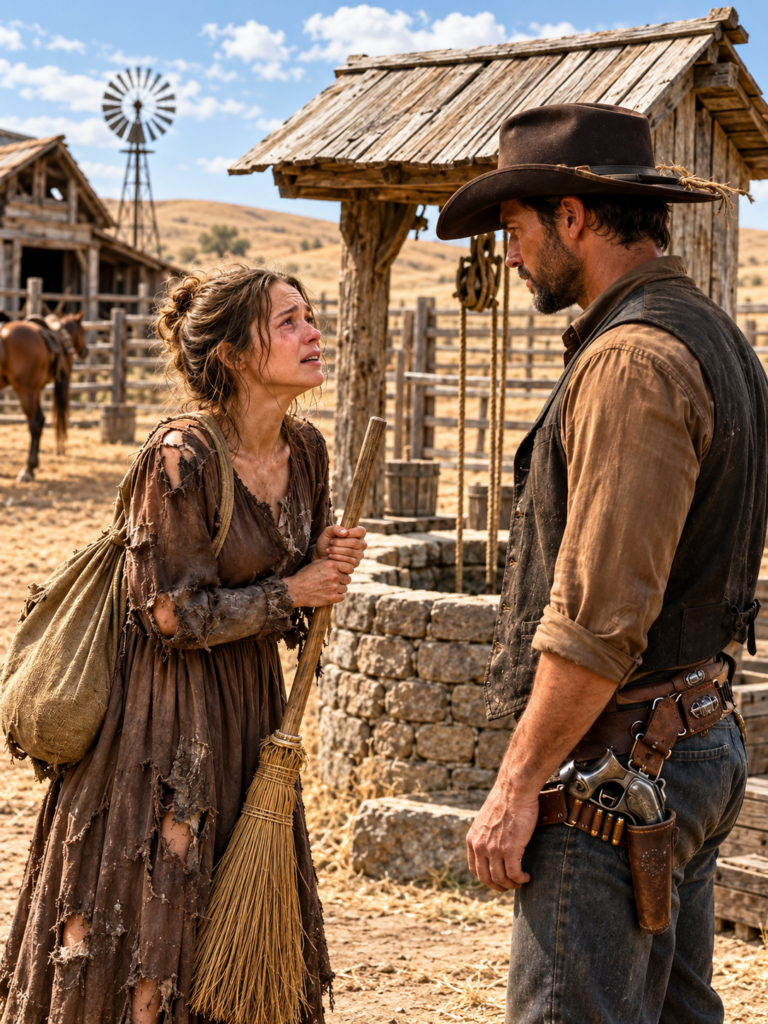
Emma Collins hit the frozen ground before she even realized her legs had given out. Her knees cracked against the porch boards. Her fingers, raw, bleeding, wrapped in nothing but torn wool, scraped across the wood as she tried to push herself back up and failed.
She had knocked on eleven doors that day. Eleven. Every single one had closed in her face.
And now, kneeling in the snow outside the last farmhouse at the end of a dirt road in Wyoming Territory, Emma did the one thing she had promised herself she would never do.
She begged.
The wind off the Wyoming plains in January of 1883 did not blow so much as it attacked. It came in sideways, sharp as a skinning blade, cutting through every gap in a coat, every thin place in a scarf, every crack in a boot sole that had been resoled one too many times.
It carried ice crystals that stung exposed skin like thrown gravel, and it howled between the bare cottonwood trees along the road with a sound that was almost human, almost like something grieving.
Emma Collins knew that sound well.
She had been walking since before first light, moving from farmhouse to farmhouse across the flat, frozen county outside the town of Milford, Wyoming Territory.
She carried nothing but a canvas bag with a broken strap that she held together with her left hand, and she wore every piece of clothing she owned, which was not nearly enough.
Her boots had holes in both soles. She had stuffed newspaper inside them that morning, but the newspaper had soaked through before she reached the second farm.
She had not eaten since the morning of the day before, a half-eaten biscuit she had found wrapped in cloth near the back of a church hall. And she had not slept properly in three nights.
But Emma Collins was not there to be pitied.
She was there to work.
That was the only thing she asked at every door she knocked on.
Not money, not food as charity, not shelter out of mercy. She asked for work, honest, hard physical work in exchange for fair compensation.
She could cook. She could clean. She could mend. She could haul. She could help with animals or laundry or mending fences if someone showed her how.
She was young, and her back was strong. And her hands, though small, had never once refused a task set before them.
At the first farm that morning, a woman in a good wool coat had looked Emma up and down from behind a half-open door and said without a moment’s hesitation, “We don’t take in strays.”
And shut the door so hard the frame rattled.
At the second farm, a man had stepped onto his porch, looked at her worn clothing, and said, “You one of them railroad drifters? We got nothing for your kind here.”
He had not waited for her answer.
At the third farm, a woman had actually been kind, had smiled at Emma and said she was sorry. Truly sorry. But her husband had strict rules, and she couldn’t go against them.
“You understand, don’t you, dear?”
And then she too had closed the door, and Emma had stood there in the cold for a moment, staring at the painted wood before turning and walking on.
By the fifth farm, she had stopped explaining herself in full sentences.
By the eighth, she had stopped looking people in the eye when they answered.
By the eleventh, a wide-set house with a painted fence and smoke curling from two chimneys, she had knocked and waited, and a man had opened the door, taken one look at her, and called back into the house without turning around.
“Martha, there’s a beggar woman out front.”
Then he had looked at Emma with a kind of blank, bored disdain and said, “We don’t have work for your type. Move along before you freeze to death on my property and I have to deal with the paperwork.”
Emma had nodded and walked away.
She had not said a single word.
There was nothing left to say.
The sun was dropping fast by the time she reached the end of the dirt road that branched off the main county path, and the temperature was falling with it.
The cold had moved from painful to something beyond pain. Something that felt almost peaceful, which she knew from the stories she had heard was not a good sign.
Her feet had stopped hurting an hour ago.
That was not a good sign either.
And then she saw it.
At the very end of the dirt road, past a broken-down fence rail and a row of bare-limbed elms, a single light burned in the window of an old farmhouse.
It was not much.
A plain wooden structure, two stories, a covered porch that ran the full length of the front. A barn set back behind it, doors closed. A water pump in the yard that had a cloth wrapped around the handle to keep it from freezing.
Smoke rose from the chimney in a thin, steady line.
Someone lived there.
Emma’s legs were shaking by the time she reached the porch steps.
She had not noticed them shaking until she tried to lift her foot onto the first step and found she had to think deliberately about the action. Had to tell her leg specifically what she needed it to do.
She climbed the steps one at a time.
She raised her fist and knocked.
Then her knees buckled.
She did not feel herself fall.
One moment she was standing, and the next her knees were on the porch boards, and the wood was rough and cold against her palms, and she could hear herself breathing in short, strange gasps that she could not seem to control.
She pressed one hand flat against the door to try to push herself upright.
The door opened.
Emma looked up.
Standing in the doorway was an old man, tall, lean, with white hair and a face that had been weathered by decades of Wyoming wind into something hard and deeply lined.
He wore a plain flannel shirt, suspenders, heavy boots that he had not yet laced for the evening.
He was holding a coffee cup in one hand.
He looked down at her with an expression she could not immediately read.
Not pity, not irritation, not the blank dismissal she had seen on eleven other faces that day.
Just a long, steady look.
“I’m not…” Emma started, and her voice came out wrong, thin and cracked in a way that embarrassed her.
She swallowed hard and tried again.
“I’m not asking for charity, sir. I’m asking for work. I can cook and clean and haul and mend. Whatever you need done, I’ll earn whatever you give me. I just…”
She stopped.
She had run out of words.
The old man looked at her for another long moment.
Then he said in a voice that was low and unhurried, “Can you stand?”
Emma blinked.
“Sir?”
“I asked if you can stand, miss. Can you get up off my porch floor under your own power, or do you need help?”
Emma gritted her teeth.
She pushed one foot flat on the boards, then the other. Her legs shook violently, but she got herself upright, one hand still pressed to the doorframe for balance.
She straightened her spine.
She looked him in the eye.
“Yes, sir,” she said. “I can stand.”
The old man studied her for a moment longer.
Then he stepped back from the door and said, “Come in before you die on my porch. That would be an inconvenience for both of us.”
Emma crossed the threshold.
His name was Walter Hayes, though she did not learn that until later.
He was sixty-seven years old, and he had lived alone on that farm for six years since his wife Margaret had passed from a fever the winter of 1877.
He had a son somewhere out in Colorado. Estranged, uncommunicating, a wound he kept under wraps the way you keep a bad hand covered in cold weather so it doesn’t get worse.
He set Emma at the kitchen table near the stove and put a bowl of soup in front of her without ceremony or comment.
Then he sat down across from her with his coffee and watched her eat with the calm, patient attention of a man who had learned long ago that most things worth understanding revealed themselves if you just stayed quiet and waited.
Emma ate slowly, even though everything in her body was screaming at her to devour it.
She had learned the hard way over years that eating too fast after going hungry made you sick, and she could not afford to be sick.
When she was halfway through the bowl, she set the spoon down and looked up at him.
“I’ll wash the dishes,” she said. “And whatever else needs doing tonight. I want to be clear about that. I’m not here for charity.”
“You said that already,” Walter said.
“I know. I just want to make sure you understand.”
“I understood the first time, miss.”
He tilted his head slightly.
“What’s your name?”
“Emma. Emma Collins.”
“Walter Hayes.”
He did not extend his hand, just said it plain and direct, the way old men in Wyoming spoke when they were too tired for formality.
“Where are you from, Emma Collins?”
Emma wrapped both hands around the soup bowl for warmth and considered what to say.
“East originally,” she said. “Came out here three years ago with my… I came out here for work.”
Walter did not press the pause she left.
“And the people who brought you out here?”
“They’re gone,” Emma said.
The word gone was doing a great deal of work in that sentence, but she did not elaborate, and he did not ask her to.
They sat in silence for a moment.
The fire in the stove cracked and settled.
“You can sleep in this back room tonight,” Walter said finally. “It’s cold, but it’s dry. There are blankets in the chest by the window.”
He stood, picking up his coffee cup.
“I’ll figure out the work situation in the morning.”
Emma looked up at him.
“I can start now.”
“You can start in the morning,” he said with a finality that was not unkind. “Whatever you think you owe, it’ll keep till daylight.”
He left the kitchen.
Emma sat alone at the table for a long time after that, listening to the wind push against the house and the fire tick inside the stove.
Then she finished the soup.
She washed the bowl and the spoon and the pot he had used to heat it, dried them all, and put them back in the places that seemed most logical.
She swept the kitchen floor with the broom she found hanging by the back door.
Then she went to the back room, pulled the blankets from the chest, lay down on the narrow bed, fully clothed, and was asleep before the thought of closing her eyes had fully formed.
She did not dream.
She did not hear the wind.
For the first time in a very long time, Emma Collins slept the whole night through.
When Walter came downstairs the next morning before sunrise, he expected to find the back room empty.
He had been prepared for that, had told himself it was likely.
Young women in desperate circumstances made desperate decisions. She might have taken something from the kitchen on her way out.
He would not blame her if she had.
What he found instead was a kitchen he barely recognized.
The stove was already lit and burning hot.
The smell of wood smoke and coffee and something frying in the iron skillet hit him at the bottom of the stairs.
The floor had been swept. The table had been wiped down. Someone had reorganized the shelf above the washbasin so that the cups were accessible and the soap was on a proper dish instead of sitting in its own dried puddle.
Emma was standing at the stove with her back to him, one hand holding the skillet steady, the other pushing eggs around with a spatula she had found hanging on a nail.
She heard him on the stairs and said without turning around, “I found fatback in the cellar and eggs in the barn. I hope that’s all right. I fed the chickens while I was out there. They looked like they hadn’t been fed yet.”
Walter stood at the bottom of the stairs and looked at his kitchen.
Then he walked to the table and sat down.
“They hadn’t,” he said.
“I thought so.”
She set a plate in front of him, eggs and fatback and a piece of bread she had found in the box and toasted on the stovetop.
A cup of coffee, black and strong.
She sat across from him with nothing for herself, her hands folded in her lap.
Walter looked at his plate, then at her empty hands, then at her face.
“You’re not eating.”
“I already ate.”
“What did you eat?”
A beat of silence.
“Bread.”
“One piece?”
Emma said nothing.
Walter pushed the plate toward the center of the table and got up and got a second plate from the shelf.
He split everything on the first plate between the two and set one side in front of her.
Then he sat back down and picked up his fork.
Emma looked at the food.
“I didn’t earn all that yet.”
“We’ll settle accounts later,” Walter said. “Eat your breakfast.”
She ate.
They worked in silence that morning.
Walter on the fence line at the east edge of the property. Emma in the barn, mucking stalls and organizing feed bags that had been left in chaotic arrangement since his hired hand quit the previous summer.
At noon, she came out to where he was working and stood a polite distance away.
“Mr. Hayes.”
He kept working.
“The left rear wall of the barn has a gap at the base about this wide.”
She held her hands eight inches apart.
“It’s been letting cold air in. I found some spare planks, and I could nail it if you have a hammer and nails you’re willing to spare.”
Walter looked at her over his shoulder.
“You know how to swing a hammer?”
Emma looked at him steadily.
“I know how to do most things that need doing, Mr. Hayes. That’s what I’ve been trying to tell you.”
He told her where the tools were.
She fixed the gap.
She also found two additional places where the barn wall had begun to separate and fixed those as well without being asked.
She rehung a gate latch that had been misaligned so that the gate no longer required being lifted and shoulder-checked simultaneously to open.
She sorted through a pile of rusted tools in the back corner and separated the salvageable ones from the ones that were past saving.
When Walter came to look at her work that evening, he stood in the barn doorway for a long moment, saying nothing.
“You missed supper,” he said finally.
“I wanted to finish.”
“It’ll keep till tomorrow.”
Emma looked at the patched wall with a critical eye.
“I know, but I started it.”
Walter looked at the patched wall, too.
The boards were straight. The nails were driven clean. The gaps were properly sealed.
“You do good work,” he said.
Emma did not look at him.
“Thank you, Mr. Hayes.”
“How long since you’ve had steady work?”
She was quiet for a moment.
“A while.”
“How long is a while?”
Her jaw tightened just slightly.
“Long enough.”
He did not push.
He had learned from his wife, from years of living, that some stories came out on their own time or they didn’t come out at all, and forcing them just made people lock the door tighter.
“Room in the back is yours as long as you’re working here,” he said. “Meals included. I’ll pay you two dollars a week.”
Emma finally looked at him.
Two dollars a week was a fair wage, not generous, but fair.
And he had said it like it was already settled, like it wasn’t a negotiation or a favor, but simply the correct and obvious arrangement.
“That’s acceptable,” she said.
“Good.”
He turned toward the house.
“Come eat before it gets cold.”
Emma stood alone in the barn for a moment after he left.
The animals shifted in their stalls. The new planks in the wall held against the wind.
She picked up the hammer and set it back on its hook.
Then she walked toward the house, toward the light in the window, toward the smell of food cooking.
And she told herself firmly and clearly the same thing she had told herself a hundred times in a hundred different difficult moments over the last three years.
This is temporary.
Don’t let yourself believe it’s more than it is.
Don’t trust it.
Don’t get comfortable.
Everything that opens eventually closes.
She believed that absolutely.
She had learned it the hardest possible way.
And she was, for the moment, entirely wrong.
Three weeks passed.
Walter Hayes was not a man who kept close track of time.
He measured it in feed cycles and fence repairs and the slow creep of frost across the water trough each morning.
But he noticed when three weeks had gone by because the barn had never been cleaner in twenty years, and there was always coffee ready before he got downstairs, and the farmhouse no longer felt like a place where a man was simply waiting to die quietly.
He noticed things about Emma Collins, too.
Small things at first.
The kind of things that, taken alone, might not have meant anything, but stacked up together told a story he was starting to read with growing unease.
She hid food.
He saw it.
The third morning, a biscuit wrapped carefully in a square of cloth, tucked behind the flour tin on the top shelf.
He didn’t say anything.
The next morning, there were two biscuits.
The morning after that, half a corncake.
She never touched any of it during the day. She just put it there.
And every few nights, it would disappear, replaced by something fresh, and the cycle would start again.
He understood what that meant.
A person didn’t hide food unless they’d had it taken from them.
A person didn’t hide food unless some deep-wired part of their brain refused to believe that the next meal was guaranteed, no matter what they were told, no matter what evidence the present moment offered.
He didn’t say anything about the food, but he started leaving the biscuit tin on the lower shelf.
The second thing he noticed was the flinching.
It happened the morning he came in from the barn early because he’d forgotten his gloves, and the back door was heavy, and he let it swing shut behind him harder than he meant to.
And Emma, who had been standing at the stove with her back to him, reacted like she’d been shot.
Her whole body jerked.
She spun around with one arm half raised, and for a split second her face showed something raw and terrible before she locked it back down behind her usual expression.
They stared at each other.
“Sorry,” Walter said. “Door got away from me.”
“It’s fine,” Emma said.
Her voice was steady.
Her hand, when she set it back on the stove handle, was not.
He went to get his gloves.
He came back outside and stood by the water pump for a long minute, doing nothing in particular, just breathing cold air and thinking about the way she had raised her arm.
The third thing happened on a Tuesday.
He had gone to town for feed and hadn’t told her he was going.
He hadn’t thought to, hadn’t considered that it would matter.
And when he came back two hours later, Emma was standing on the porch in the cold without her coat, staring down the road.
The moment she saw the wagon, she went very still.
And then something in her face went loose with relief, so intense it looked like pain.
She turned immediately and went back inside without a word.
Walter unhitched the horse and came in and found her at the stove doing something unnecessary with a pot that was already clean.
“You all right?” he asked.
“Fine,” she said.
“You were standing out in the cold without your coat.”
“I needed air.”
He looked at her.
She kept her back to him.
The pot scraped against the iron stovetop as she moved it for no reason.
“Emma.”
She stopped moving the pot.
“If something’s worrying you,” he said carefully, “you can say so.”
A long pause.
Then, very quietly, “You didn’t say you were going to town.”
Walter set down the bag of feed he’d carried inside.
“I didn’t think I needed to.”
“You don’t,” she said quickly. “You don’t need to. It’s your farm. You go wherever you want. I just…”
She stopped, set down the pot, turned around, and looked at him with an expression he could only describe as exhausted.
“I just didn’t know where you were.”
He understood then.
He thought he understood a great deal more than she had told him, but he only said, “Next time, I’ll leave a note.”
Something crossed her face too fast to name.
“You don’t have to do that.”
“I know I don’t have to,” Walter said. “I’m going to anyway.”
He picked the feed bag back up and headed toward the back.
“Supper ready soon?”
“Half an hour,” she said.
“Good.”
That was a Tuesday.
On Thursday, the first person from town came.
His name was Harold Briggs, and he owned the largest dry goods store in Milford, and he and Walter had been neighbors in the loose Wyoming definition of the word, which meant they lived within five miles of each other for nearly thirty years.
He rode up in the late afternoon while Emma was splitting wood behind the barn and Walter was repairing a section of roof on the chicken coop.
“Walter.”
Harold sat his horse the way a man sits when he hasn’t decided yet whether he’s staying or going.
“Got a minute?”
“I’ve got several,” Walter said, not looking up from the shingle he was nailing. “Talk while I work.”
Harold cleared his throat.
“People have been noticing.”
“Noticing what?”
“The girl.”
Walter drove a nail.
“She has a name.”
“People have been noticing,” Harold repeated, choosing to ignore that, “that you’ve got a young woman living out here. A stranger. Nobody knows where she came from. My wife said she saw her in town last week when she came in for supplies.”
“And did she cause trouble in town?”
“No, but…”
“Did she steal anything?”
“Walter…”
“Did she speak rudely to anyone, disturb anyone, break any law that I should know about?”
Harold shifted in his saddle with the discomfort of a man who knows he’s losing the logical argument and is hoping to win on social grounds instead.
“It’s not about any of that. It’s about how it looks. A young woman, a single man living under the same roof.”
“I’m sixty-seven years old, Harold.”
“That’s not the point.”
“Then get to the point.”
Harold’s jaw tightened.
“People are talking. Some of them think she’s taking advantage of you. Using you. You know how it goes with drifters.”
Walter finally looked up.
He looked at Harold Briggs with the full weight of thirty years of knowing a man and deciding to be honest with him.
“She fixed three gaps in my barn wall,” he said. “She reorganized four years of accumulated junk in my tool corner. She’s up before me every morning, and she works until I tell her to stop. She eats less than my dog used to, and she has never once asked me for a single thing she didn’t earn first.”
He went back to his shingle.
“What exactly is she taking advantage of?”
Harold opened his mouth, closed it.
“Tell your wife I said hello,” Walter said.
Harold rode away without another word.
Walter finished the shingle.
Then he sat back and pressed his thumb against the nail head and thought about the way Harold Briggs had said drifter. The particular flatness of it, the casual certainty that the word said everything that needed saying about a person.
He thought about Emma standing on the porch in the cold without her coat.
He thought about a biscuit wrapped in cloth and hidden behind a flour tin.
That evening after supper, while Emma was washing the dishes with the focused, efficient silence she brought to every task, Walter said, “How long were you with them?”
Emma’s hands slowed in the washbasin.
“With who?”
“The people who hurt you.”
The word hurt landed in the room and sat there between them.
Emma didn’t move for a moment.
Then she resumed washing.
“I never said anyone hurt me.”
“No,” Walter agreed. “You didn’t.”
Another long silence.
The water moved in the basin.
A log shifted in the stove.
“Four years,” she said finally.
Her voice was flat and factual. The way people talk about things they’ve had to make peace with or go crazy.
“After my mother passed, her cousin took me in.”
A pause.
“That was what they called it. Took me in.”
“And what was it actually?”
Emma set a plate on the drying rack and picked up another.
“They needed someone to work,” she said. “And they needed it to be someone they didn’t have to pay. And I didn’t have anywhere else to go. So…”
She lifted one shoulder.
“It was a good arrangement for them.”
“For how long was it a good arrangement for you?”
“It wasn’t,” she said simply. “But I didn’t have a choice for a long time. And then when I finally did, when I started working at the laundry in town and keeping my own wages, that was when it stopped working for them, too.”
She set the last plate on the rack, dried her hands on the cloth, turned around, and looked at him with something that was almost defiant, like she was daring him to offer sympathy she hadn’t asked for.
“They told me I was ungrateful. That everything they’d done for me, and I was too selfish to help them in return. And then they told me to leave.”
A beat.
“In January. Without my winter coat because my aunt decided it was hers.”
Walter looked at her.
“The coat you’re wearing,” he said, “is Margaret’s.”
Emma blinked.
“I… You said I could use it. I wasn’t taking…”
“I know,” he said. “I wanted you to have it.”
He stood up from the table.
“Keep it. She’d have wanted it used.”
Emma looked down at the coat hanging on the hook by the door.
Heavy wool, dark green, warm as anything.
And when she looked back up, her eyes were very bright, and she was pressing her lips together in a way that suggested she was engaged in a private and serious internal struggle.
“Thank you,” she said in a voice that was barely above a whisper.
“Go get some sleep,” Walter said. “We’ve got a fence line to check tomorrow.”
She went.
Walter sat alone at the table for a long time after that.
The fire ticked.
The wind pushed against the house.
He thought about Harold Briggs and his wife and the word drifter and the other farms that had closed their doors on a twenty-year-old woman in a Wyoming snowstorm.
He thought about his son out in Colorado who hadn’t written in two years.
He thought about Margaret, who had always said he was too slow to see what was right in front of him.
“All right,” he said quietly to nobody in particular. “I see it now.”
The next morning, a thing happened that Walter would think about for a long time afterward.
He came into the kitchen at his usual hour and found Emma at the table.
Not cooking, not cleaning, just sitting, which was unusual enough to make him pause on the stairs.
She was sitting with her hands flat on the table in front of her, and she was staring at nothing, and she looked the way a person looks when they’ve been somewhere else in their head for a long time and haven’t quite found their way back.
“Emma.”
She came back, blinked at him.
“Morning. Coffee’s ready.”
“I can see that.”
He sat down across from her.
“What’s wrong?”
“Nothing’s wrong.”
“You were sitting at the table doing nothing. In the four weeks you’ve been here, I’ve never seen you sit at a table doing nothing.”
She looked at him for a moment.
Then, like a person choosing to put down something heavy they’ve been carrying a long way:
“Harold Briggs’s wife came to the fence line yesterday while you were in the north field.”
Walter went still.
“What did she say?”
“She was polite about it,” Emma said. “She was very polite. She asked me how I knew you, and I said I worked for you. And she said…”
A pause.
She smoothed one hand along the table surface.
“She said I should think carefully about what I was doing. That a young woman in my position could cause a great deal of trouble for a good man. She said the people in this county looked after their own, and that outsiders who came in and disrupted things often found the county a very uncomfortable place to be.”
Walter’s jaw was very tight.
“She said that she was smiling the whole time,” Emma said. “Very friendly smile.”
She looked up at him.
“I’ve seen that kind of smile before, Mr. Hayes. I know what it means.”
“What are you going to do?”
Emma seemed surprised by the question.
“That’s not my decision to make. This is your county. These are your neighbors. If I’m causing trouble for you…”
“You’re not.”
“If I’m making things difficult…”
“Emma.”
His voice was quiet, but it stopped her.
“I asked what you are going to do. Not what you think I want. Not what’s easiest for me. What do you want?”
She stared at him.
It was the kind of stare that told him that question, What do you want?, was not a question she had been asked very often.
Maybe ever.
She seemed to be testing the words for some kind of trick, examining them from the inside out.
“I want to keep working,” she said finally. “I want to fix the rest of that roof line before the next freeze. I want to reorganize the root cellar because whoever set it up didn’t know the first thing about air circulation, and half the stores are going to rot before spring if nobody does something about it.”
Walter looked at her.
Then he picked up his coffee cup.
“Then that’s what we’ll do,” he said.
The trouble was, Milford, Wyoming, in the winter of 1883 was a very small place, and small places have a way of making decisions for people whether people want them to or not.
The next week, Emma went into town for supplies.
Walter had written her a list and given her money from the lockbox, and she had taken the buckboard in with the calm competence she brought to everything.
She was gone three hours, which was about right for the distance and the errand.
She came back and unloaded the supplies and didn’t say a word.
That evening at supper, she said, “Three people at the general store asked me what my business was with you.”
“What did you tell them?”
“The truth. That I work for you.”
“What did they say to that?”
Emma looked at her plate.
“One of them said it wasn’t decent. One of them said she hoped I knew what I was getting into. And one of them…”
She paused.
Her fork turned in her hand once, slowly.
“One of them told me directly that if I was smart, I’d move on before people decided to move me themselves.”
The kitchen was very quiet.
“Who said that?” Walter asked.
“It doesn’t matter who said it.”
“It matters to me.”
Emma looked at him with an expression that was careful and assessing, like she was calculating something.
“Mr. Hayes, I’ve had people try to move me before. I’ve survived every single one of them so far.”
A beat.
“I’m not afraid of gossip.”
She was lying.
Walter could see it in the very straightness of her spine, in the way she held her fork slightly too tightly.
She was afraid not of the gossip itself, but of what it might cost him.
She was afraid that being worth fighting for was a thing she did not yet have the right to assume.
And that was the moment Walter Hayes decided that he was done letting things happen slowly.
“I’m going to town tomorrow,” he said. “I have some things to say.”
Emma looked up sharply.
“Don’t do that on my account.”
“I’m doing it on mine.”
He met her eyes and held them.
“I have been quiet in this county for six years, Emma. I have kept to myself and minded my business and let things go that I should have spoken to long before now.”
He set down his coffee cup.
“I’m done being quiet.”
Emma stared at him across the table in the firelit kitchen of a farmhouse that had been silent for six years.
And for just a moment, just one unguarded moment, something in her face broke open.
Not tears.
Just the look of a person who has been waiting so long for someone to speak up that they’d stopped believing it would ever happen.
She dropped her eyes.
“Eat your supper,” she said softly. “It’ll get cold.”
Walter picked up his fork, but his mind was already in town, already standing in the middle of Milford’s main street with thirty years of quiet patience burned down to its last ash.
He had some things to say, and he intended to say every single one of them.
Walter went to town the next morning like he said he would.
He did not tell Emma exactly what he planned.
He told her he had business at the feed store and the post office, which was true as far as it went, and he told her not to wait on him for the noon meal, which she heard clearly enough to understand that whatever business he had was not the kind that got finished quickly.
She watched the wagon roll down the dirt road and disappear behind the tree line and then stood in the cold for a moment longer than she needed to before going back inside to work.
She spent the morning on the root cellar.
It needed doing.
She had not been exaggerating about the air circulation problem, and physical work was the only thing that reliably kept her head quiet.
She reorganized the shelving, moved the winter squash to the lower racks where the temperature was steadier, and checked every stored item for early rot with the systematic care of someone who knew exactly what it meant to watch food go to waste when you couldn’t afford to replace it.
She found a jar of preserved peaches at the very back of the lowest shelf behind a broken crate.
The label on the lid was in a woman’s handwriting, not Walter’s.
The ink had faded, but the letters were still clear.
Margaret, summer 1876.
Emma held the jar for a long moment.
Then she set it carefully at the front of the shelf where it wouldn’t get lost again and kept working.
Walter came back in the late afternoon.
He came in through the kitchen door and set his hat on the hook and poured himself a cup of the coffee Emma had left on the stove and drank half of it standing up before he said anything.
His face was the particular kind of closed that meant he was deciding what to share and what to keep to himself.
“Well?” Emma said.
She was at the table with a torn harness strap she’d been mending, and she kept her eyes on her work.
“I spoke to some people,” he said. “And I said what needed saying.”
He sat down.
“Harold Briggs won’t be sending his wife to the fence line again.”
Emma’s hands didn’t stop moving.
“How do you know?”
“Because I told him clearly what would happen to our thirty-year business arrangement if she did.”
The harness strap went still in her hands.
She looked up.
“Walter, you didn’t have to do that.”
“I know I didn’t have to.”
“These are people you’ve known for decades. I’m not worth…”
“Stop,” he said.
Not loud, not harsh, just final.
“Don’t finish that sentence.”
Emma closed her mouth.
He looked at her across the table with the steady, unhurried directness of a man who had made up his mind about something and was not interested in revisiting the decision.
“I went to town because I chose to go. I said what I said because it was true and because it needed saying. You don’t get to tell me what you’re worth, Emma. That’s not your call.”
The kitchen was very quiet for a moment.
“Okay,” she said.
“Good.”
He picked up his coffee.
“How’s the root cellar?”
“Better. It’ll take another day to finish properly.”
“Take whatever time it needs.”
They ate supper.
They didn’t talk much.
But the silence was different from the silences of the first week.
Less careful, less provisional, more like the silence of two people who had each decided the other could be trusted and were no longer spending energy on being guarded.
That night, Emma slept straight through again.
Three days later, the county deputy rode out.
His name was Calhoun, a young man, maybe twenty-five, with a serious face and the careful manner of someone who was new enough to his job to still believe that official procedure and actual justice moved in the same direction.
He knocked on the front door at midmorning while Emma was inside and Walter was in the yard, and he addressed himself to Walter with the formal courtesy of official business.
“Mr. Hayes, I’ve got a complaint filed with the county office that I’m required to follow up on.”
Walter looked at him.
“What kind of complaint?”
“Complaint alleging that you may be harboring an individual of unknown character and origin. There’s some concern expressed about…”
Deputy Calhoun paused, choosing his words with visible care.
“The nature of the arrangement.”
“The nature of the arrangement,” Walter repeated, “is that I hired a worker. She works. I pay her. Are you going to tell me that’s illegal in Wyoming Territory?”
“No, sir. But the complaint also includes a claim…”
Another careful pause.
“A claim that the individual in question may have left a prior situation under… that there may be parties with a legal interest in her whereabouts.”
Walter went very still.
“What kind of parties?” he said.
Before Calhoun could answer, the front door opened and Emma stepped out onto the porch.
She had heard the wagon. She had been listening probably since before the knock.
She looked at Deputy Calhoun with a face that gave absolutely nothing away, and she said, “Who filed the complaint?”
Calhoun looked at Walter, then back at Emma.
“I’m not at liberty to…”
“Was it a woman named Clara Marsh?” Emma said. “From Cheyenne. My mother’s cousin.”
A pause.
Something moved behind Calhoun’s careful expression.
That was answer enough.
Emma came off the porch steps with the slow, deliberate movement of someone who has just received news they were dreading, but not surprised by.
She stood in the yard with her arms at her sides and her face absolutely composed.
“She claimed I stole from her,” Emma said.
It wasn’t a question.
Calhoun shifted his weight.
“The complaint alleges that certain items of value went missing from the household around the time of your departure.”
“The coat I was wearing when I arrived here belonged to this man’s wife,” Emma said. “Ask him. Everything else I had was mine. Three dresses, one pair of boots, a canvas bag, and forty-two dollars I earned at the laundry, and that she tried to take before I left.”
She met Calhoun’s eyes steadily.
“I kept the forty-two dollars. That was the extent of what I took.”
“Ma’am, I’m not here to charge you with anything. I’m here to follow up on a formal complaint, which requires a county hearing. Both parties present. That’s the process.”
“When?” Walter said.
“End of the week. Friday at the county hall.”
Calhoun looked between them.
“I’d advise you both to be there.”
He rode away.
Emma stood in the yard after the sound of hooves faded and breathed very carefully through her nose and said nothing for a long time.
Then she said, “She tracked me here.”
“Appears so.”
“She waited until I had something to lose.”
Her voice was very flat.
“That’s what she does. She waits.”
Walter looked at her.
“Has she done this before?”
“When I left the first time, when I tried to leave, she told everyone in town that I had stolen jewelry. It wasn’t true. There was an investigation. Nothing came of it because there was nothing to find. But by the time it was over, the laundry wouldn’t take me back, and I had nowhere to go. So I went back to her house.”
She said it all in the same flat, factual voice she used to describe damaged fence rails and root rot.
“That was two years ago.”
Walter understood several things at once.
Then he understood why she had walked through a Wyoming blizzard knocking on eleven doors.
He understood why she had been twenty miles outside Milford when she collapsed on his porch instead of finding shelter in town.
He understood why she had said, “The people in Cheyenne know me,” with such a particular careful blankness when he’d once asked why she didn’t go back south.
She hadn’t been fleeing toward something.
She had been fleeing while being hunted.
“I’ll pack my things,” Emma said.
“You’ll do no such thing.”
She looked at him sharply.
“Walter…”
“You said she’s done this before. If you run, she’ll do it again. To you or to the next person she finds who’s weaker than she is.”
His voice was controlled, but there was something underneath it that hadn’t been there before.
Something that had been sleeping for six years and was wide awake now.
“You’re not running. We’re going to the hearing on Friday, and we’re going to let the county do what it’s supposed to do.”
“You don’t know Clara Marsh.”
“No, but I know what a false complaint looks like, and I know every man on that county panel, and I have been keeping my mouth shut in this county for six years.”
He met her eyes.
“I am done keeping my mouth shut.”
Emma stared at him.
Then she looked away, and her jaw worked for a moment like she was chewing on something that tasted bad.
And finally she said, “She’s going to say things in front of everyone.”
“Let her.”
“Things about me, about my character, about…”
“Emma.”
He waited until she looked at him again.
“Let her.”
The week before the hearing was the longest of Emma’s life, which was saying something considerable given the life she had lived.
She kept working.
She always kept working.
It was the only reliable way she knew to stop her mind from eating itself.
But the quality of the silence in the farmhouse changed.
It became weighted.
She caught herself listening for horses on the road at odd hours.
She stopped leaving the farm at all, even for small tasks that would have taken her to the edge of the property.
She also stopped hiding biscuits behind the flour tin.
Walter noticed that.
He didn’t say anything about it, but he noticed.
Thursday night, the night before the hearing, Emma came downstairs at some hour well past midnight and found Walter sitting at the kitchen table in the dark with a cup of cold coffee he hadn’t been drinking.
She stopped on the last stair.
“Can’t sleep either?” she said.
“Reckon not.”
He didn’t look up.
“Sit down.”
She sat.
They stayed like that for a while in the dark kitchen with the fire burned low.
Two people who were each carrying too much to lie down comfortably.
“Tell me something,” Walter said finally. “When you were walking through the county that day, knocking on those doors, what were you going to do if nobody opened one?”
Emma thought about it.
“Keep walking,” she said.
“To where?”
“I didn’t know. Just away. Far enough that she couldn’t find me again.”
A pause.
“I had forty-two dollars. That was enough to get somewhere. I just needed to get through the winter first.”
“And if you didn’t get through the winter?”
She was quiet for a moment.
“Then I didn’t.”
The words landed in the kitchen and sat there in the cold and the dark between them.
Walter pressed his hands flat on the table.
“You said that very calmly,” he said.
“I was very tired,” Emma said. “Tired people get calm about things that ought to frighten them. I think that’s how it works.”
Walter looked at her, then really looked at her the way he hadn’t permitted himself to look directly before.
The way you don’t look directly at something that’s going to break your heart if you let it.
“How long had you been that tired?”
Emma opened her mouth, closed it, looked down at the table.
“A long time,” she said.
Neither of them spoke for a while after that.
The fire settled.
The clock on the wall marked the slow movement of the hours.
Then Walter said, “My wife used to sit here when she couldn’t sleep, right where you’re sitting. She’d drink cold coffee and read whatever book she had going, and when I came down to see about her, she’d tell me to go back to bed. She was fine.”
He looked at the coffee cup in front of him.
“I used to go back to bed.”
Emma listened without moving.
“I should have stayed down here with her more,” he said. “She was always fine, but that’s not the point.”
Emma looked at him.
“What’s the point?”
“The point is that this chair has been empty for six years,” he said quietly. “And right now, it isn’t. And tomorrow, we’re going to go into that county hall and deal with Clara Marsh and whatever she’s decided to say. And it is going to be unpleasant. And I want you to know before we walk in there that it doesn’t matter what she says.”
He looked at Emma with an expression she had no previous template for.
Not pity, not charity, not the complicated generosity of someone keeping score.
Just certainty.
“What matters is what’s true. And the truth is that you work hard and you’re honest and you deserve to be left alone to live your life. And I will say that in front of every person in Milford if I have to.”
Emma’s throat moved.
“Walter…”
“Go back to bed, Emma.”
She stood up from the table.
She stood there for a moment, not quite moving.
“Thank you,” she said, “for opening the door.”
He looked up at her.
“I almost didn’t,” he said. “I heard the knock and I thought, it’s late and it’s cold and I’m tired, and I nearly left it.”
He shook his head slowly.
“Nearly left it.”
Emma walked back upstairs.
She lay in the dark and stared at the ceiling and thought about nearly, about the distance between what happened and what almost happened, about eleven closed doors and one that had opened, and what the difference was, and whether it was luck or something more than luck, and whether a person was allowed to believe it was something more than luck without it meaning they’d gone soft and foolish and dangerously willing to trust.
She decided she was too tired to solve that question tonight.
She closed her eyes.
The county hearing was at nine in the morning.
When Emma came downstairs at seven, Walter was already dressed in his good coat, the dark one he wore to church on the rare occasions he attended, and he had her coffee ready and a plate of eggs on the table, and he was standing by the window with his back to her.
“Eat,” he said. “We leave in an hour.”
Emma sat down.
She picked up her fork, and then the sound of a second wagon reached them from the road.
Not Deputy Calhoun, not a neighbor.
And Walter turned slowly from the window with an expression on his face that Emma had never seen before.
“Clara Marsh didn’t come alone,” he said.
Emma set down her fork.
“How many?” she said.
“Two wagons.”
He turned from the window.
His voice was very steady.
“She brought a man with her. Looks like a lawyer.”
The eggs on Emma’s plate went cold.
She had known in some part of herself that this was coming.
She had known that the hearing was not going to be a simple matter of one complaint and one rebuttal and a fair panel making a sensible decision.
She had known because she knew Clara Marsh.
Clara Marsh had known her for four years, had watched her work with the patient, methodical cruelty of a person who had learned that the best way to destroy someone was never to rush it.
She stood up from the table, picked up her coat, looked at Walter with the clear, steady eyes of someone who had decided they were done running.
“Then we’d better not be late,” she said.
The county hall in Milford was a single-story building with wooden floors that creaked under every step and windows that let in more cold than light.
By nine in the morning, it held more people than Emma had seen gathered in one place since she left Cheyenne.
Most of the town, it seemed, had decided that a Friday hearing involving Walter Hayes and a young drifter woman was worth the cold walk from the main street.
Emma walked in beside Walter and did not look at any of them.
She looked straight ahead, kept her shoulders back, and breathed deliberately through her nose the way she had learned to breathe through difficult things, steadily, evenly, one breath at a time, until she reached the long table at the front where the three county panel members were already seated.
Clara Marsh was on the left side of the room.
Emma had not seen her in nearly eight weeks.
Clara was a tall woman, broad-shouldered, with the kind of face that could arrange itself into perfect Christian sympathy at a moment’s notice, and frequently did.
She was dressed well, better than she usually dressed, which meant this trip had been planned carefully and well in advance.
Beside her sat the lawyer, a thin man in a gray coat with a leather satchel on his knee, who was already sorting papers with the brisk efficiency of someone who had done this many times before and expected to be done by noon.
Clara looked at Emma when she walked in.
She smiled.
Emma sat down next to Walter and put her hands flat on the table in front of her and kept her eyes on the panel.
“Don’t look at her,” Walter said quietly.
“I’m not,” Emma said.
The panel chairman, a heavyset man named Alderman Fletcher, who ran the county land office and had known Walter Hayes for twenty-five years, called the hearing to order with three sharp wraps of his hand on the table.
He read the complaint aloud in the flat, official monotone of someone reading a legal document, which was what it was.
A claim filed by one Clara Marsh of Cheyenne, Wyoming Territory, alleging that her ward, one Emma Collins, had absconded with property belonging to the Marsh household, and further alleging that Miss Collins was in the unlawful company of an elderly man of diminished judgment who required protection from exploitation.
Diminished judgment.
Emma heard Walter’s breathing change beside her.
Clara’s lawyer stood and introduced himself, a Mr. Theodore Ames, and began speaking in the practiced, reasonable voice of a man who understood that the best way to destroy someone in a public setting was to sound regretful while doing it.
He expressed his client’s deep concern for the welfare of both Miss Collins and Mr. Hayes.
He noted that Miss Collins had a history of instability. Here he produced a paper, and that she had previously been the subject of investigation in Cheyenne regarding missing household items.
He said the word items in a way that implied the items had been considerably more valuable than a canvas bag and forty-two earned dollars.
He said his client only wanted what was best for the girl.
He said girl three times in the first five minutes.
Walter’s hand resting on the table had gone from flat to fisted.
Fletcher asked if Mr. Hayes wished to respond.
Walter stood up.
He stood up the way a man stands up when he has been sitting quietly for a very long time and has finally run out of patience for sitting.
Slowly, fully, with the particular weight of a person who has earned the right to take up space in a room.
He was sixty-seven years old, and he had lived in this county for forty of those years.
And every man on that panel had bought feed from him or borrowed tools from him or shaken his hand at a funeral.
And the room went quiet.
In the way rooms go quiet when a person who does not usually speak stands up to speak.
“I’m going to say some things,” Walter said. “And I’d appreciate if everyone would let me finish before they respond.”
Fletcher nodded.
“Emma Collins came to my door seven weeks ago,” Walter said. “She had walked through a January blizzard. She had not eaten in two days. She had holes in her boots. She knocked on eleven doors in this county before she knocked on mine, and every single one of those doors was closed in her face.”
He paused.
He looked briefly at several people in the room who he knew had been on that road.
One woman looked at her lap.
“She did not ask for charity. She asked for work. She said she would earn whatever she was given, and she has every single day since, without complaint and without asking for a single thing above what was agreed.”
He looked at Ames.
“Now, you called her unstable. I want to know what your definition of instability is, because in my experience, a person who walks twenty miles in a blizzard asking for honest work instead of sitting down in the snow and dying is not unstable. That is the opposite of unstable. That is one of the most determined things I have ever seen a human being do.”
Someone in the room toward the back made a sound.
Not quite a word, just a sound.
“You said she had a history of investigation regarding stolen property,” Walter continued. “I did some checking of my own this week. I have a friend in Cheyenne, Bill Tarrant, some of you know Bill. I wrote to him ten days ago and asked him what he knew about Clara Marsh and about Emma Collins and about an investigation into missing household items.”
He reached into his coat pocket and produced a folded letter.
“Bill knows the sheriff down there. The investigation was closed. No charges were filed. No evidence of theft was ever found. What was found, according to this letter, was testimony from two women who worked at the same laundry as Emma Collins, stating that Clara Marsh had arrived at the laundry on two separate occasions to demand that Emma hand over her wages directly. The laundry owner refused to allow it on the second occasion and asked Clara Marsh to leave the premises.”
The room was very still.
Clara Marsh’s smile had not moved, but something behind her eyes had.
“That girl,” Walter said, and he said girl the way you say it when you’re angry at someone else for saying it, pointedly, deliberately, to show what it sounds like when it’s weaponized, “walked away from a situation that would have broken most people twice over. She walked away with what was hers and nothing else, and she spent weeks trying to find legitimate work before she ended up on my porch. And she has not done a single dishonest thing in the seven weeks I have known her.”
He looked at Fletcher.
“I am not a man of diminished judgment. I am a man of sixty-seven years who has seen enough of the world to know decent character when it’s standing in front of him.”
He sat down.
“That’s what I have to say.”
The room stayed quiet for a moment longer than it needed to.
Fletcher asked if Miss Collins wished to speak.
Emma had not expected to be asked.
She had sat through Walter’s words with her hands pressed flat on the table and her jaw tight and her eyes dry.
She had made herself a promise about the eyes.
And now Fletcher was looking at her with the expression of a man who was beginning to understand that this hearing was not going to go the direction he had expected when he woke up this morning.
She stood up.
Her legs were steady.
She had made them be steady the same way she made everything else happen when she needed it to, by deciding firmly and in advance that they would be.
She looked at the panel and not at Clara.
“I’m not a good speaker,” she said. “I’ll just tell you what’s true.”
And then she told them.
She told them about the four years.
Not with self-pity. She didn’t have the energy for self-pity and wouldn’t have used it even if she did.
But with the plain, factual precision of someone who has had to explain themselves to authority before and has learned that what works is specific detail.
She told them which household she had cleaned and for how long.
She told them what she had been paid and what she had been told she owed back against the cost of her room and food and how that number never seemed to decrease no matter how much she worked.
She told them about the first time she had tried to keep her own wages from the laundry and what had happened after.
She told them about the coat she had worn to Walter’s door.
Not Margaret’s coat, which she had been given, but the coat she had arrived in, a thin thing barely worth calling a coat, and about how her own winter coat had been declared Clara’s property the morning Emma tried to leave.
She told them she had stolen nothing.
Her voice did not break.
Her hands did not shake.
But when she got to the last part, when she said quietly and without drama, “I stopped believing that doors stayed open for people like me,” something in the room shifted in a way that was almost physical.
A woman in the third row pressed her handkerchief to her mouth.
One of the panel members, a younger man named Gideon Park, who had said nothing this entire time, looked down at the table.
Clara’s lawyer started to rise, and Clara put her hand on his arm, and he sat back down.
That was when the second door in the back of the room opened.
Everyone turned.
The woman who walked in was perhaps fifty, stout, with a practical face and the look of someone who had traveled a distance and was not pleased about the time it had taken.
She introduced herself to Fletcher without preamble.
Ruth Callaway, owner of the Callaway Laundry, Cheyenne, Wyoming Territory.
She had received a letter from a Mr. Walter Hayes asking if she was willing to provide a written account of Emma Collins’s employment record and character, and she had decided a written account was insufficient and had come in person instead.
Clara Marsh looked at Ruth Callaway for three full seconds.
Then she looked at Walter.
Walter looked at the letter in his hands.
He had not written to Bill Tarrant only.
Ruth Callaway told the panel that Emma Collins had been one of the most reliable workers she had employed in twenty years of running a laundry.
She told them about the two visits from Clara Marsh.
She told them that on the second visit, Clara Marsh had told Emma in front of three other employees that if Emma did not hand over her wages that day, she would make sure Emma never worked in Cheyenne again.
She told the panel what Emma’s face had looked like when Clara said it.
Like someone who already knew it was true.
Ruth said, “Like someone who’d heard it before.”
Fletcher asked Clara Marsh if she wished to respond.
Clara Marsh looked at her lawyer.
Her lawyer shuffled his papers.
The shuffling went on for slightly too long.
Then he said in a considerably quieter version of his earlier confident voice that his client maintained her position, but understood that the panel required time to deliberate.
The panel did not take long.
Fletcher spoke for all three of them, reading from a single sheet of paper in the same flat official voice he used for everything, which meant the words landed without inflection and were therefore somehow louder.
The complaint was dismissed for lack of evidence.
The claim of stolen property was found unsubstantiated.
The characterization of Mr. Hayes as a man of diminished judgment was found to be unsupported and, in the panel’s view, demonstrably false.
There was no recommendation of further action against Emma Collins.
The room exhaled.
Emma stood very still.
She heard the words.
She understood them.
But some part of her brain, the part that had been on alert for so long it had forgotten how not to be, was still waiting for the next thing.
Still waiting for the catch, the reversal, the moment when the floor dropped out from under her the way it always did.
Walter put his hand on the table beside hers.
Not touching, just there.
“It’s done,” he said quietly.
Emma looked at the panel, at Fletcher folding his paper, at Gideon Park, who was watching her with an expression she had no name for.
At Ruth Callaway, who gave her a short, firm nod from across the room.
She looked at Clara Marsh.
Clara was speaking quietly and rapidly to her lawyer, who was repacking his satchel with sharp, irritated movements.
She did not look at Emma.
She did not look at Walter.
She had already begun the process of rewriting this in her own head.
Emma could tell.
Already constructing the version of events in which she had been wronged, in which this was an injustice, in which Emma Collins had somehow won by cheating.
Clara Marsh would find a way to believe that.
Clara Marsh would believe it sincerely and completely and for the rest of her life.
Emma understood that now in a way she hadn’t before.
She understood that Clara’s cruelty wasn’t strategic.
It wasn’t personal even.
Clara Marsh looked at Emma and saw something she was owed.
That was all.
And no county hearing, no dismissed complaint, no public testimony was going to change what Clara Marsh saw when she looked at Emma Collins.
Emma turned away from her.
She picked up her coat from the chair.
“Ready?” Walter said.
“Yes,” Emma said.
They walked out together through the room full of people who parted to let them through, past Ruth Callaway, who pressed Emma’s hand briefly and hard and said, “You write me if you need anything, you hear?”
And then they were outside in the cold January air, and the hearing was behind them, and the road back to the farm was ahead.
They rode in silence for a long time.
The horse moved at its usual steady pace.
The flat white fields of the county spread out on either side, and the sky was the pale, washed-out blue of a Wyoming winter, and Emma sat on the buckboard seat with her hands folded in her lap and felt something she couldn’t immediately name.
It took her several miles to identify it.
Empty.
Not in the bad way.
Not the hollow, desperate empty of someone with nothing left.
Just the absence of the weight she had been carrying for four years, and most especially for the last three weeks.
The constant low-level pressure of dread and weariness and the specific, particular exhaustion of being hunted.
It was gone.
She didn’t know what to do with that.
“You wrote to Ruth Callaway,” she said finally.
“I did.”
“You didn’t tell me.”
“Didn’t want you to worry about whether she’d come.”
Emma looked at the road ahead.
“How did you even know about her?”
“You mentioned the laundry first week.”
He kept his eyes on the horse.
“I listen, Emma.”
She pressed her lips together, looked out at the white fields.
“She came all the way from Cheyenne.”
“She did.”
“That’s a long way to come for someone who used to work for her.”
Walter said nothing for a moment.
Then, “Maybe that tells you something about what kind of person you are.”
Emma didn’t answer.
But when they turned down the dirt road toward the farm, and she saw the farmhouse at the end of it, the porch, the smoke from the chimney, the barn with its newly patched walls, she felt something else move through the empty space the dread had left behind.
Something small and fragile, and for the first time in a very long time, not immediately suspicious of itself.
Something that felt cautiously and carefully, and with its guard still partly up, like the first distant approach of peace.
The week after the hearing, something shifted in Milford.
It did not happen all at once.
It happened the way thaws happen in Wyoming, gradually, unevenly, with patches of old ice persisting long after the surrounding ground has softened.
But it happened.
The first sign was Harold Briggs himself, who stopped Walter on the main street three days after the hearing and stood there in the cold, working his hat brim with both hands in the way men do when they are trying to find the words for something they should have said sooner.
He said he had not known the full story.
He said his wife felt terrible about the visit to the fence line.
He said, and this cost him something, Emma could tell from the way Walter described it later, that he thought Emma Collins had handled herself with more dignity in that county hall than most people he’d known for decades.
Walter had told him he appreciated that.
He had not said, “I told you so.”
Which Emma thought showed considerable restraint.
The second sign was a woman named Agnes Pruitt, who came to the farm on a Tuesday morning with a covered dish and the complicated expression of someone arriving to make an apology they’d been rehearsing.
Agnes was the woman who had pretended not to hear Emma’s knock on that first day, the third house on the road.
Emma recognized her the moment she came up the porch steps.
Agnes recognized Emma, too.
They looked at each other for a moment in the cold morning air.
“I brought a casserole,” Agnes said.
“I see that,” Emma said.
Another pause.
Agnes Pruitt looked at the covered dish in her hands like it had personally failed her.
“I should have opened the door,” she said. “That day. I saw you through the curtain. I knew you were there. I just…”
She stopped.
Her jaw moved.
“I should have opened the door.”
Emma took the casserole dish from her hands.
“Come inside,” she said. “Coffee’s hot.”
Agnes Pruitt stayed for two hours.
She told Emma she had come west with her husband fifteen years ago and had lost him to a fever the third winter and had spent every year since then doing whatever it took to not be seen as someone who needed help.
Because needing help in a county like this one meant becoming a person people made decisions for.
Emma listened to all of it without interrupting.
When Agnes finally stood up to leave, she paused at the door.
“You’re tougher than you look,” she said.
“Most people are,” Emma said.
Agnes nodded once, like that confirmed something, and left.
Emma stood at the window and watched her go and felt something warm and complicated move through her that she didn’t try to name or analyze.
She just let it be there.
The days lengthened slowly, the way February days do.
Not warmly, not generously, but with the grudging incremental increase of light that tells you spring is coming, even if it doesn’t feel like it yet.
Emma and Walter worked through all of it.
There was always work.
The farm had accumulated six years of one man’s worth of maintenance, which was not enough for a property that size, and with two people, the backlog began to shrink in a way it hadn’t when Walter worked it alone.
They settled into a rhythm without discussing it.
Walter handled the heavy stock work and the larger repairs.
Emma handled the household, the smaller animals, the accounts.
And it was in the accounts that she found the first real problem.
She brought it to him on a Thursday evening, setting the ledger open on the table in front of him with her finger on a specific column.
“Your grain supplier has been overcharging you,” she said. “For at least two years that I can trace in these records. Here and here. The price per bushel is above the county standard. Not by a lot each time, but consistently.”
Walter looked at the numbers, then at her.
“You can read ledgers?”
“I taught myself. When I was working, when I was keeping my own wages before Clara found out.”
She pulled out a separate sheet of paper where she had recopied the relevant figures.
“I calculated you’ve overpaid by somewhere between sixty and eighty dollars over two years. I can’t be exact without seeing his records, but the pattern is clear.”
Walter sat back in his chair.
“Jim Carver’s been my grain supplier for fifteen years,” he said.
“I know. It’s in the ledger.”
“Which is probably why he thought you weren’t watching closely.”
Walter looked at the numbers for a long time.
Emma waited.
Then he looked up and said, “What would you do about it?”
She had already thought about this.
“Write him a letter. Document the discrepancy. Give him the opportunity to correct it before you take it to anyone official. Most people, when they realize they’ve been caught and given a dignified way out, will take the dignified way out. And if he doesn’t, then you take it to someone official.”
Walter nodded slowly.
“Write the letter,” he said. “I’ll sign it.”
She wrote it that night, careful and precise, professional without being hostile.
The kind of letter that communicated clearly that the writer knew exactly what they were doing and was extending a courtesy that would not be extended twice.
Walter read it, changed two words, and signed it.
Jim Carver sent a banknote for seventy-three dollars within the week.
Walter put forty of it in the household account and set the other thirty-three on the table in front of Emma without comment.
She looked at the money.
“That’s yours.”
“I didn’t…”
“You found it,” he said. “You documented it. You wrote the letter. In any fair arrangement, that earns a share.”
“Walter…”
“Don’t argue with me about money, Emma. I will always win because I am older and more stubborn.”
She looked at him for a moment.
Then she picked up the thirty-three dollars.
“Thank you,” she said.
“Don’t thank me.”
One afternoon, Walter received a letter from his son in Colorado.
He sat at the kitchen table with it for a long time.
When Emma came in, he was still holding it.
His throat moved.
“He says he didn’t know how to say he was sorry for leaving the way he did.”
Emma stepped fully into the kitchen.
She sat down across from him.
“Are you glad?” she asked.
Walter pressed his hand flat over the letter.
He thought about it honestly, the way he did everything, without rushing, without performing the expected emotion.
“I don’t know yet,” he said. “I’ve been angry at that boy for six years. That doesn’t just…”
He shook his head.
“I don’t know.”
“That’s a fair answer,” Emma said.
“Is it?”
“Yes. You’re allowed to not know how you feel about something. That’s not weakness. That’s just being honest.”
Walter looked at her.
“When did you get so wise?”
“I’ve had a lot of practice deciding how I actually feel about things instead of how I was supposed to feel about them,” she said. “It took a while to learn, but it sticks.”
He almost smiled.
“I’m going to write him back.”
“Good.”
“Don’t know what I’ll say yet.”
“You’ll figure it out. You’re good at saying what’s true.”
He looked at her for a moment.
“I had a good example recently,” he said.
Emma looked at the table.
Her face was warm.
“Write your son,” she said. “I’ll start supper.”
The months moved.
March came, and with it the first real warmth, the kind that actually meant something, that softened the ground and brought the first green shoots up along the south-facing fence lines.
Emma planted the kitchen garden with seeds she’d ordered from the catalog, using her own money.
Carefully chosen, cross-referenced against the growing season and the soil conditions she’d assessed through the winter.
She put in squash and beans and tomatoes and two varieties of herbs she’d read that Margaret had grown, found in an old letter tucked in the back of the kitchen drawer.
Walter found her in the garden one afternoon and stood watching her work for a long moment before he said, “You read Margaret’s letters.”
Emma looked up.
“I found one in the drawer. I wasn’t searching. I should have…”
“No.”
He shook his head.
“It’s all right. Which letter?”
“The one to her sister. From the first spring they were here.”
Emma sat back on her heels.
“She wrote about the garden, what she was planting. She said she wasn’t sure it would take, that the soil was harder than she expected, but that she was going to try anyway because…”
She paused, remembering the exact words.
“Because something that takes root in hard ground grows stronger than something that grows easy.”
Walter was quiet for a moment.
“That sounds like her,” he said.
“She sounded like someone worth knowing,” Emma said.
He looked at the rows she’d planted, straight and evenly spaced.
“She would have liked you,” he said. “She had no patience for self-pity and considerable patience for people who refused to have it.”
He turned back toward the barn.
“I know,” Emma said to his retreating back.
Spring deepened into something almost warm.
And one evening in late April, Walter came inside from the barn to find the kitchen empty and the back door open.
He followed it and found Emma standing on the back step, looking at the darkening sky, perfectly still in a way that would have worried him two months ago, but no longer did.
She had learned, in the months since the hearing, something he recognized as peace.
Not the peace of giving up, but the peace of a person who has put down a weight and chosen not to pick it back up.
“Supper’s on the stove,” she said without turning around. “Don’t let it burn.”
“Then come inside,” he said.
“In a minute.”
He leaned against the doorframe.
“What are you looking at?”
“Nothing.”
A pause.
“Everything.”
She turned slightly, not quite looking at him.
“I keep waiting for it to stop feeling like this.”
“Like what?”
She thought about the right word.
“Safe,” she said finally.
Like the word cost her something to say out loud.
“I keep waiting for it to go back to how it was before. Like it’s temporary. Like any morning I could wake up and it’ll be over and I’ll have to start over somewhere else.”
Walter was quiet.
“Does it feel less like that than it used to?” he said.
Emma thought about it honestly.
“Some days.”
She turned back to the sky.
“More days than before.”
“That’ll keep improving,” he said. “In my experience.”
“You have experience with this?”
“After Margaret died,” he said, “I kept setting two cups out for coffee every morning for a year. Kept thinking I heard her on the stairs. Kept expecting her to walk in.”
He paused.
“It gets better. Not gone. Better.”
Emma finally turned and looked at him.
He was backlit by the kitchen light.
A tall old man in a worn flannel shirt, sixty-seven years old and more alive than he’d been in six years.
And she thought about all the things that had happened in the four months since she had collapsed on his front porch with broken boots and forty-two dollars and the specific survival instinct of someone who had refused to lie down in the snow.
“Walter,” she said.
“Hmm?”
“I need to tell you something.”
He waited.
“I don’t have anywhere else I’m going,” she said. “I need you to know that it’s not because I don’t have options now. Ruth Callaway offered me a position, and I have enough saved that I could go somewhere and start properly. I’m not staying because I have to.”
Walter looked at her steadily.
“I know that.”
“I’m staying because I want to,” she said. “Because this is…”
She stopped, looked for the word.
“Because this is home, if that’s all right.”
He looked at her for a long moment in the half-light between the kitchen and the coming dark.
“Emma,” he said, “I filed papers with the county solicitor last week.”
She blinked.
“What kind of papers?”
“The kind that say this farm and everything on it goes to you if anything happens to me.”
He said it the way he said all important things, simply, directly, without decoration.
“James will get his share. That’s already settled separately. But the house and the land are yours. I should have done it sooner, but I wanted to make sure you were staying because you wanted to and not because you felt obligated.”
The back step was very quiet.
Emma pressed both hands flat against her sides.
“You can’t do that,” she said, and her voice came out strange.
“Already did.”
“Walter…”
“You fixed the barn wall,” he said. “You reorganized the root cellar. You caught Jim Carver stealing from me for two years. You planted Margaret’s garden.”
He looked at the rows of seedlings barely visible in the failing light.
“You belong here more than most people who were born here.”
Emma’s throat worked.
Her eyes were very bright, and she was fighting it.
Fighting it the way she had fought everything, with her jaw tight and her spine straight.
But it was a losing fight this time.
And some part of her knew it and perhaps was ready for it.
One night, a few weeks later, Walter came downstairs late and found Emma standing in the front hallway.
Not moving, just standing facing the front door.
He watched her for a moment from the stair landing.
“Emma.”
She turned.
“Sorry, I didn’t hear you.”
“What are you doing?”
She looked back at the door.
“I do this sometimes,” she said. “At night, I come down and I…”
She stopped, started again.
“I check it to make sure it’s still…”
She pressed her lips together.
“That it’s still open. That I could open it if I needed to. I know that’s… I know it doesn’t make sense.”
Walter came down the rest of the stairs.
He walked to the front door and placed his hand flat against it.
Then he looked at Emma.
“This door,” he said, “will never close on you again.”
It was not a complicated sentence.
It was not decorated or elaborate.
It was eight words spoken by an old man in a flannel shirt in the front hallway of a Wyoming farmhouse in the early months of 1883.
Spoken in the same quiet, final way he said everything that he meant.
Absolutely.
Emma Collins, who had not cried in four years, who had dried herself out so completely in the service of survival that she had begun to believe the capacity was simply gone, who had built herself into something that endured by refusing to bend, broke.
Not loudly.
She was not a loud person.
She pressed one hand over her mouth, and the tears came anyway, fast and silent.
The way water comes through a crack that’s been holding against too much pressure for too long.
Walter let her cry.
He didn’t try to stop it or manage it or move her through it faster.
He stood there by the door and let it happen the way you let a storm happen, with the understanding that it has to run its course and that the ground is better for it afterward.
When it slowed, Emma pressed both hands against her face and breathed through them for a moment.
Then she took them away and looked at him with red eyes and a steadiness that was different from her usual steadiness.
Softer somehow.
Less armored.
More real.
“I’m sorry,” she said.
“Don’t apologize,” he said.
“I don’t usually.”
“I know you don’t.”
He looked at her with the full, clear-eyed attention he had given her from the very first night at the kitchen table with the soup bowl between them.
“That’s why it matters.”
Outside, snow was falling.
The last snow of the season, soft and quiet, the kind that melts before morning.
It gathered on the porch railing and on the bare branches of the elms along the road, and on the roof of the barn, where two people had spent a winter and part of a spring putting things back together that had been broken for a long time.
Emma looked at the door, at Walter’s hand still resting on it, at the window beside it, where the snow fell silent and white in the darkness.
“Go to sleep,” she said. “We have the south fence to check tomorrow.”
“We do,” Walter agreed.
She went upstairs.
He stood alone by the door for a moment after she was gone, listening to the quiet of the house.
The good quiet.
The kind that comes from being full rather than empty.
Then he went back to bed.
Outside, the snow kept falling.
And inside the old farmhouse at the end of the dirt road, two people who had each believed themselves entirely alone in the world slept soundly through the night.
And the front door stood exactly where it had always stood.
Open.

