
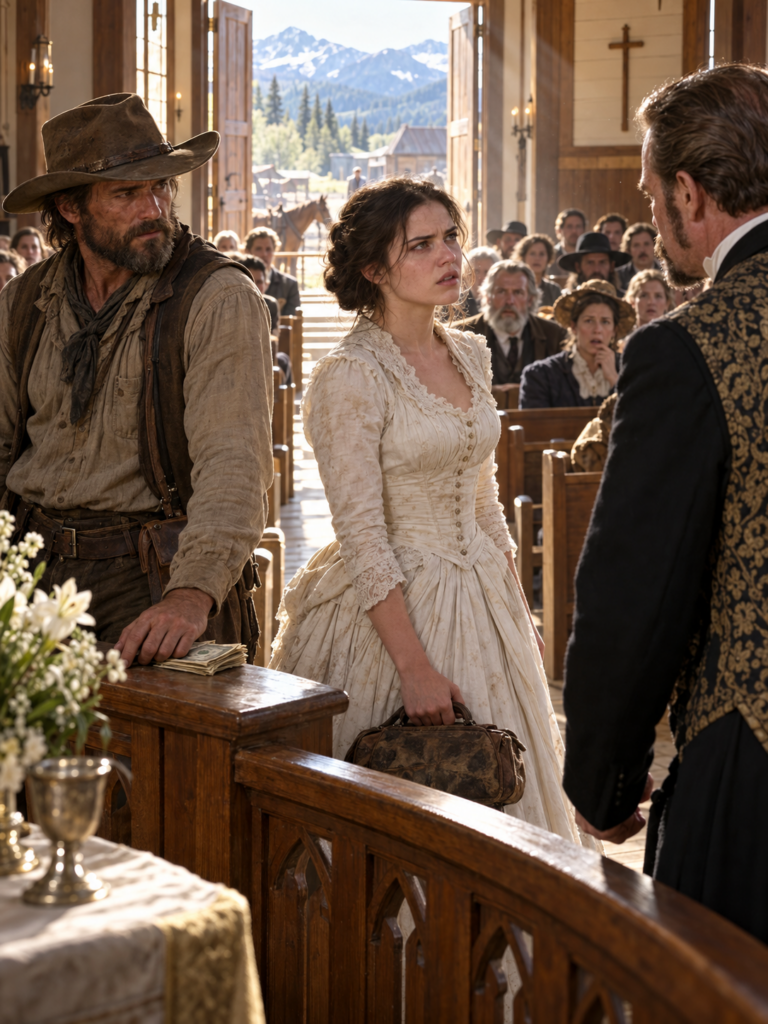
The church door struck its frame with a heavy wooden thud, and Clara’s fingers remained wrapped around the handle.
Behind it stood everyone who had known her since childhood.
In front of her stood a stranger who had paid a debt without asking what he would receive in return.
She was suddenly aware of how little she knew about him.
“Ethan Callahan?” she asked.
“That’s right.”
“Why were you in town?”
“Salt. An axe handle.”
She looked at him.
“And rescuing women from unwanted marriages?”
“That wasn’t on my list.”
Despite herself, she almost smiled.
Across the street, a gray horse stood beneath the livery overhang.
Ethan nodded toward it.
“That’s Greystone. He’ll carry us up the mountain, if that’s where you decide to go.”
“Your mountain?”
“My cabin. There’s food, a roof, and work if you want it. I can’t promise much beyond that.”
Clara tightened her hold on the bag.
“You expect me to live alone with you?”
“I expect you to decide where you’d rather be.”
She searched his face for the calculation she had seen in Harlon’s.
There was none she could detect.
“Why did you pay the money?”
Ethan glanced toward the church.
“Because somebody should have listened when you said no.”
For several seconds, she could not speak.
Then she said, “I’ll repay you.”
“You don’t owe me.”
“I know. I intend to repay it anyway.”
He considered her.
“Then we can keep account.”
That answer mattered more than he seemed to realize.
Clara approached Greystone and examined the saddle.
The animal was sturdy and calm, with the look of a horse accustomed to difficult trails.
“How far is your place?”
“Several hours north. Higher ground once we leave the valley.”
“Anyone else living there?”
“No.”
“Then I’ll need a place where I can close a door, or at least a curtain, and keep my belongings to myself.”
Ethan nodded.
“There’s a sleeping room. You can have it.”
“And where will you sleep?”
“By the stove.”
She examined him again.
“Mr. Callahan, I haven’t agreed to remain beyond a night.”
“I haven’t asked you to.”
Clara breathed slowly.
She had just refused a marriage because she would not become a man’s property.
She would not walk into another kind of captivity simply because it came disguised as kindness.
“Then I’ll see your cabin,” she said. “After that, I’ll decide.”
He helped her mount only when she accepted his hand.
They left Cold Water Creek under the curious eyes of its residents.
The broad road narrowed after several miles.
Pine trees rose along the slopes. The summer air cooled as the trail climbed.
For a while, Clara concentrated on the rhythm of Greystone’s steps.
Then Ethan spoke.
“You taught school.”
She turned slightly.
“How do you know?”
“I’ve heard people speak of your work.”
“People speak of many things.”
“They said you kept your father’s place going through two difficult winters. And that you challenged the water board when their measurements were wrong.”
She was startled.
“That’s what you remember?”
“Seemed worth remembering.”
It was the first time in months someone had described her abilities before describing her debts.
By late afternoon, they reached the cabin.
It was sturdier than she expected, with a sound roof, a narrow porch, and a neglected garden beside the east wall.
Inside stood a wood stove, neatly arranged supplies, two chairs, and a curtained sleeping space.
Ethan carried her bag inside and placed it where she directed.
“The bed is yours,” he said. “I’ll sleep out here.”
Clara looked at the room.
There was work to be done, but there was also something she had nearly forgotten how to recognize.
A place where nobody was telling her what she must become.
She set the tin box on the table.
Its broken latch fell open.
Ethan reached to help, then stopped when he saw her reaction.
“Private?” he asked.
“For now.”
He withdrew his hand.
She closed the lid.
Later, while they prepared a simple supper, Ethan mentioned the valley farm he had once owned.
“Lost it six years ago,” he said.
“To whom?”
“An arrangement involving the bank, a disputed deed, and a man named Nathaniel Brooks.”
Clara went still.
The spoon slipped from her fingers and struck the table.
Ethan looked up.
She slowly opened the tin box.
Inside lay a letter in her father’s handwriting.
At the top of a list of disputed properties was the same name.
Nathaniel Brooks.
Clara unfolded the page and turned it toward the lamplight.
“Mr. Callahan,” she whispered, “I think my father was investigating the man who took your farm.”
She pushed the letter across the table toward him.
Ethan placed one hand on the letter but did not lift it.
He stared at the name written near the top.
Nathaniel Brooks.
Six years had passed since he lost his valley farm, yet the sight of those letters could still make the old helplessness return.
“Your father knew about Brooks?” he asked.
“He was investigating property transfers. Eight of them, by my count.”
Clara sat opposite him.
Her father’s handwriting ran down the page in narrow, closely spaced lines. Alongside each property were dates, acreage descriptions, and references to changes made in county records.
Ethan recognized the third entry.
His own farm.
He read it twice.
“There’s a notation about the creek.”
“Yes.”
“The amendment removed my access to the water.”
“Was that disputed?”
“I had an original deed showing the boundary before the change.”
Clara leaned forward.
“Had?”
“Still have.”
She looked at him sharply.
“Where?”
“In the barn. Wrapped and hidden beneath a floorboard.”
For the first time since leaving Cold Water Creek, Clara felt something resembling genuine hope.
Not the fragile comfort of being sheltered.
Something better.
Evidence.
“Tomorrow,” she said, “I want to compare that deed with my father’s notes.”
Ethan refolded the letter.
“There’s more I ought to tell you.”
She waited.
“The farm wasn’t the only thing I lost.”
His voice changed.
“My wife, Margaret, was already ill when the dispute began. Losing the land left us with little. She died the following spring.”
Clara lowered her eyes.
“I’m sorry.”
He nodded.
“We had a son. Thomas.”
She looked up.
“Where is he?”
“With Margaret’s sister in Colorado.”
“How old?”
“Nine.”
The answer surprised her.
“You haven’t brought him here?”
“He was three when his mother died. His aunt could give him a steadier home than I could then.”
“And now?”
Ethan looked toward the unlit window.
“Now I’ve been alone so long I scarcely know how to change it.”
Clara didn’t challenge him that night.
She could hear how much it cost him to speak.
But she remembered the name.
Thomas.
And she remembered that somewhere in Colorado lived a boy whose father had not stopped loving him, only stopped believing he could give him enough.
The next morning, Ethan took up the third floorboard inside the barn and retrieved a parcel wrapped in oilcloth.
Clara spread the contents on a workbench.
The deed had weathered the years remarkably well.
She placed her father’s notes beside it.
The comparison was unmistakably troubling.
The original description included creek access.
The subsequent county record, as described in James Whitfield’s notes, did not.
More disturbing still, several other transfers showed similar changes, each involving the same recorder, Warren Fitch, and property that Nathaniel Brooks had subsequently controlled.
Clara ran her finger beneath one entry.
“My father was trying to prove this wasn’t a single mistake.”
“Did he?”
“He believed he could.”
She met Ethan’s eyes.
“He spent fourteen months gathering these records. He died in the land office before he could finish.”
Ethan remained silent.
Clara knew what people whispered about her father’s death.
They said his heart had failed.
That was the official explanation.
But he had been in the land office when he collapsed, pursuing questions that powerful men did not welcome.
She had wondered whether there was more to it.
She had no proof.
And she would not allow suspicion to become a fact merely because it would make the story easier to understand.
“What do you want to do?” Ethan asked.
“Finish the work.”
She gathered the papers.
“If there’s a proper inquiry, these records deserve to be examined.”
He studied her.
“Brooks has friends in Cold Water Creek.”
“I know.”
“Friends at the bank and the land office.”
“I know that, too.”
“He may not leave you alone.”
Clara carefully refolded the deed.
“Then we’ll have to be wiser than he expects.”
Over the following days, the cabin acquired a new rhythm.
Mornings belonged partly to the garden.
Clara thinned crowded onion rows, cleared the squash vines, and helped organize the work needed before autumn.
Ethan repaired fencing, hauled wood, and maintained the stock of food and supplies.
Neither treated the other’s contribution as an obligation.
When Clara cooked, Ethan cleared the table.
When he prepared breakfast, she washed the dishes.
On some evenings they worked separately.
On others they sat at the table comparing her father’s notebooks.
The papers revealed eight disputed property transfers over a period of years.
Different owners.
Different parcels.
The same troubling pattern.
Clara cross-referenced every date and name she could.
Ethan supplied details from his own experience, correcting her assumptions when his memory contradicted them.
He never asked to take over the investigation.
She noticed that.
She also noticed the way he maintained the cabin.
The joints were fitted carefully.
The tools were cleaned after use.
The woodpile stood protected from damp.
This was not a man incapable of living among people.
It was a man who had built a world where nobody else could take anything from him.
One afternoon, she found him standing beside the garden.
“Margaret planted it,” he said.
Clara looked over the uneven rows.
“Was she fond of gardening?”
“Very. She planned every bed herself.”
“That explains why you kept the layout.”
He glanced at her.
“You noticed?”
“The sun exposure isn’t ideal in two places. But the arrangement is deliberate.”
He gave a small, reluctant smile.
“She liked the view from the kitchen.”
Clara looked toward the window.
“Then we ought to preserve it.”
He seemed relieved.
She didn’t suggest moving the rows or replacing his wife’s work.
She helped him maintain what remained.
That evening, she raised a more difficult subject.
“Thomas should see this place.”
Ethan looked down.
“Perhaps someday.”
“He’s nine, Ethan. Someday comes quickly for a child.”
His face tightened.
She continued gently.
“I’m not asking you to uproot him. I am asking whether you’ve considered that he might want to know you better.”
“Every day.”
“Then tell him.”
Ethan said nothing for a long while.
Finally, he nodded.
“I’ll write.”
Their work continued.
The cabin grew less lonely without either of them declaring that it had changed.
They developed small habits.
Ethan left coffee near her notebooks when she forgot to drink.
Clara reminded him to eat when he became absorbed in repairs.
He showed her which mountain trails became difficult after rain.
She showed him how the garden could produce more without disturbing Margaret’s original layout.
He made room for another person’s judgment.
She learned that sharing work did not mean surrendering it.
Then, on the sixth day, a rider came up the mountain.
Joey Marsh arrived on a tired horse carrying news from his father.
Harlon Briggs had been asking questions.
He wanted to know whether Clara had been taken north against her will.
“He says the sheriff might be called in,” Joey admitted.
Clara stepped forward before Ethan could answer.
“Then tell anyone who asks that I left willingly. You may use my exact words.”
Joey nodded.
She added, “I was not carried away. I chose to leave.”
After the young rider departed, Ethan looked toward the trail.
“Briggs won’t stop.”
“No,” Clara said. “But I don’t believe this is only about the marriage anymore.”
“What do you mean?”
“If he can persuade the sheriff that you took me unlawfully, the authorities can come here looking for evidence.”
Ethan looked toward the barn.
The deed.
Clara followed his gaze.
“Exactly.”
That night they reviewed every notebook again.
Clara wanted an inquiry beyond the influence of Cold Water Creek’s local officials.
Her father’s records pointed toward avenues for presenting disputed land documents to territorial authorities.
The proper procedures would have to be established.
But one thing was clear.
They could not depend upon Harlon Briggs and Nathaniel Brooks deciding to leave them alone.
Two weeks after Clara came to the mountain, another message arrived.
This time it was a formal letter from Aldis Prine, Brooks’s lawyer.
It demanded that Ethan present Clara to the Cold Water Creek sheriff within seven days to answer allegations that she had been removed unwillingly.
A separate reference to old property documents made the threat unmistakable.
Clara read the letter.
Then she handed it to Ethan.
“They’re trying to bring us back on their terms.”
He nodded.
“If we ignore it, the sheriff may come here.”
“And if we return without preparing, Brooks has the advantage.”
They sat quietly.
Then Clara opened her father’s second notebook.
She found his notes concerning a previous petition for an investigation into official records.
“We need to go to Helena.”
Ethan looked at her.
“That’s a hard journey.”
“Then tell me the safest route.”
“I’ll go with you.”
She watched him carefully.
“As my escort?”
“As someone who knows the crossings and has an original deed involved in the same case.”
She considered the distinction.
“Then we go together.”
They arranged for Cal Hendricks, another man affected by the disputed water claims, to look after the cabin.
Clara prepared the documents herself.
She wrote a petition, gathered copies of the relevant records, and secured the original evidence for travel.
Ethan checked the saddlebags and provisions.
Before they left, he read her petition.
“It’s thorough,” he said.
“Are there errors?”
“None I can see.”
“Then we’ll take it.”
He smiled faintly.
“You’re not easily discouraged.”
“My father didn’t raise me to stop because a man expected me to.”
They left before sunrise.
The journey demanded care, especially where the mountain trail narrowed near water.
Ethan chose their route.
Clara kept the documents dry and protected.
At an overnight stop, as they sat beside a small fire, she asked a question she had been avoiding.
“When this is finished, will you go back to living alone?”
He stared into the flames.
“I don’t know.”
“Is that what you want?”
He looked at her.
“For six years, I thought it was.”
Clara waited.
He added, “Then somebody walked into my cabin with a tin box and started asking questions.”
She looked down to hide her smile.
“And ruined your peace?”
“Changed it.”
The answer stayed with her through the night.
At Helena, she took the petition into the commissioner’s office and presented her father’s records.
Ethan remained beside her, letting her explain the work she knew better than anyone.
The official, Mr. Gaines, questioned the documents carefully.
Clara answered each question with a reference to a page, a date, or a property description.
Ethan produced his original deed.
Together, the records showed enough troubling discrepancies to warrant further examination.
Gaines agreed to arrange an expedited inquiry and a hearing in Cold Water Creek.
The news came with a warning.
Brooks would learn that his transactions were under scrutiny.
Clara gathered her notebooks.
“Then he will also know my father wasn’t forgotten.”
As they prepared to return, Ethan asked her to stand beside him beneath the office’s shaded porch.
“There’s something I want you to know before we ride back.”
She turned.
He looked unusually uncertain.
“I’ve spent years telling myself there was nothing left for me to want.”
Clara felt her heartbeat quicken.
“And now?”
He took a breath.
“Now I’m wondering whether the life I left behind is the only one I’m meant to have.”
She looked at his outstretched hand.
Then she took it.
But before either could say more, they heard a horse approaching along the street.
A messenger pulled up with news from Cold Water Creek.
Brooks had learned of the inquiry.
And men associated with Briggs were already watching the roads.
Clara tightened her hold on the documents.
“Then we ride back,” she said.
Ethan looked at her.
“You’re certain?”
“More certain than when we left.”
He helped her secure the saddlebags.
Together they turned toward the road that would take them back to the town where Clara had been told she no longer belonged.
The road out of Helena stretched toward the mountains, and Clara kept one hand near the saddlebag containing her father’s notebooks.
She had carried those papers through eight months of uncertainty.
Now they had been examined by an official willing to take them seriously.
But they were not yet safe.
Nor was the man riding beside her.
Ethan knew the dangers of the route better than she did, and he watched the country with the attention of someone accustomed to traveling where help could be hours away.
At a narrow section of road, he slowed.
Clara heard approaching hoofbeats.
Three riders appeared ahead.
One wore a sheriff’s badge.
She recognized him.
Dale Curran.
The sheriff of Cold Water Creek.
Beside him rode Harlon Briggs.
Clara felt anger rise, but she kept her voice steady.
“Sheriff.”
Curran looked first at Ethan.
“Callahan, I’ve been instructed to bring Miss Whitfield back to town.”
Clara straightened.
“Then you can speak to Miss Whitfield.”
Curran shifted in his saddle.
“There are concerns about whether you left willingly.”
“I did.”
“Mr. Briggs has made a complaint.”
“Mr. Briggs was present when I refused to marry him.”
Harlon moved forward.
“She’s under this man’s influence.”
Clara looked directly at him.
“You’ve mistaken disagreement for influence ever since I was old enough to speak.”
Ethan said nothing.
He had promised her that her decisions were her own.
Now he kept that promise when it mattered.
Curran looked uncomfortable.
Clara continued.
“My father spent fourteen months investigating disputed property transfers. I have brought those records to Helena. An inquiry has been authorized, and you can confirm that through the territorial office.”
Curran’s expression changed.
“What kind of inquiry?”
“One involving eight properties, amended deeds, and Nathaniel Brooks.”
Harlon swore under his breath.
“She’s inventing accusations.”
“No,” Clara said. “I’m asking the authorities to examine evidence.”
She opened the saddlebag and showed Curran the official acknowledgment of her petition.
“These proceedings concern documents my father gathered before he died. Ethan Callahan’s original deed is part of that evidence.”
The sheriff examined the paper.
Clara watched his face.
He had known her father.
He had attended the funeral.
He knew James Whitfield had been a careful man.
“Why didn’t you bring this to me?” he asked.
“Because I had reason to doubt you would be free to act.”
Curran looked toward Harlon.
For a long moment, nobody spoke.
Then the sheriff handed the paper back.
“I’ll verify the matter.”
Harlon turned sharply.
“You can’t let them go.”
Curran’s voice hardened.
“I can decline to settle this on the roadside without examining the facts.”
Clara closed the saddlebag.
“That’s all I’m asking.”
The riders moved aside.
As she and Ethan continued, Clara felt her hands begin to shake.
Not from regret.
From the effort of remaining composed while another man tried to decide her fate.
Ethan noticed.
“Do you need to stop?”
“Not yet.”
He nodded.
He didn’t tell her she ought to be grateful.
He didn’t tell her she had been brave.
He simply kept the horse moving at a manageable pace until the road widened.
Then he said, “You handled that well.”
Clara released a long breath.
“I was frightened.”
“I know.”
“I don’t want fear to become another reason somebody thinks I can’t act.”
“It doesn’t.”
She looked at him.
For perhaps the first time, she fully believed that he meant it.
Farther along the road, another group of riders approached.
This time Cole Briggs, Harlon’s nephew, led them.
He brought an offer from Brooks.
Money.
A possible settlement of Clara’s remaining concerns.
Even a suggestion that part of Ethan’s former property might be returned if the matter could be resolved quietly.
Clara listened.
Then she shook her head.
“This isn’t only about my father’s land or Ethan’s farm.”
Cole frowned.
“That’s what you’ve been demanding.”
“No. I’ve been demanding that the records be examined.”
She rested a hand on the saddlebags.
“Eight property owners were affected. My father believed the transfers were fraudulent. He died before anyone investigated them properly.”
Cole glanced toward Ethan.
Ethan remained silent.
Clara continued.
“I won’t trade away eight families’ right to answers for a private arrangement.”
Cole’s mouth tightened.
“Brooks won’t appreciate that.”
“He needn’t.”
The riders eventually moved aside.
Clara and Ethan continued toward Cold Water Creek.
By the time they reached town, word of the inquiry had traveled ahead of them.
People watched from storefronts.
Some looked suspicious.
Others looked curious.
A few greeted Clara by name.
She noticed the difference immediately.
When she had left, they had watched her as though she were a disgrace.
Now they watched her as though she might know something important.
She refused to let either opinion determine who she was.
At the hotel, Clara asked for a room.
The clerk hesitated.
Then he handed her a key.
Ethan took the room nearby.
They had grown close during their time on the mountain, but neither had forgotten how important it was that Clara’s choices remain hers.
That evening, Sheriff Curran came to speak with her.
He confirmed that he had withdrawn his attempt to return her to town under the disputed complaint.
He also agreed to give a statement concerning what he knew of Brooks, Briggs, and the circumstances surrounding the accusation against Ethan.
Clara listened carefully.
When he finished, she asked, “Will you tell the truth even if it costs you your position?”
Curran looked down.
“I should have asked myself that question sooner.”
She nodded.
“My father would have appreciated your answer.”
After he departed, she walked to Ethan’s door.
He opened it almost immediately.
“Good news?” he asked.
“Some.”
She explained the sheriff’s decision.
Ethan listened.
Then Clara said, “There’s something else.”
He stepped back, allowing her to enter if she wished.
She remained in the doorway.
“I’ve been thinking about what you said outside the commissioner’s office.”
He waited.
“About wanting a different life.”
Ethan’s expression softened.
“I meant it.”
“I know.”
She looked at his face, weathered by years of mountain sun and a loneliness he had chosen after losing too much.
“I need you to know I don’t want to be another person you hide from the world with.”
He went still.
“I want a life that includes people. Work that matters. A place where I can speak without asking permission.”
“You should have it.”
“And Thomas.”
Ethan looked away.
Clara continued gently.
“Your son deserves a father who is willing to be part of his life, even if the beginning is difficult.”
Ethan nodded.
“I know.”
She held his gaze.
“Then if there’s going to be a future for us, it must include that effort.”
There was a long silence.
Then he said, “I won’t ask you to replace Margaret.”
“I wouldn’t try.”
“And I don’t know if I’m capable of being the man I was before.”
“I don’t want the man you were before.”
She took his hand.
“I want the man who is willing to live now.”
Something in Ethan’s face gave way.
Not into weakness.
Into the relief of finally being understood.
He raised her hand toward his lips, then paused.
Clara moved closer of her own accord.
Their first kiss was gentle and brief, without hurry or claim.
When they parted, she could see how much it had meant to him.
“That doesn’t settle every question,” she said softly.
“No.”
“But I think it answers one.”
He smiled.
“Which one?”
“Whether I want to find out what comes next.”
The following morning, Nathaniel Brooks approached them in the hotel dining room.
He came dressed in an expensive coat, with Aldis Prine carrying documents beside him.
Brooks sat without invitation.
“Miss Whitfield, I believe we can reach a reasonable settlement.”
Clara set down her cup.
“I’ve already told your nephew my answer.”
“An inquiry is an expensive business. You have little to gain by pursuing it.”
“That depends on what you believe is worth gaining.”
Brooks glanced toward Ethan.
“Callahan has an interest in his former land. Surely something can be arranged.”
Clara remained calm.
“My father documented suspicious changes in eight separate property records. Those records are now being examined. Nothing you offer me will make those questions disappear.”
Brooks studied her.
For the first time, he seemed unable to understand why she would refuse.
He had spent years measuring people by the amount required to make them cooperate.
Clara’s refusal disturbed that calculation.
“You may regret this.”
“I’ve regretted remaining silent,” she replied. “I don’t intend to repeat it.”
Brooks left.
Prine followed.
When the door closed, Clara realized that the entire dining room had been listening.
Martha Holt sat at a nearby table.
She was the woman whose dress Clara had borrowed for the wedding that never happened.
Martha looked at Clara for a moment.
Then she said, “Your father was a decent man. I’m glad somebody has carried on his work.”
Clara felt tears rise unexpectedly.
Not because the words erased what had happened.
They didn’t.
But because someone in her hometown had finally said aloud what had been missing for months.
James Whitfield had mattered.
And the truth he pursued still mattered.
On Friday, Clara entered the room arranged for the hearing carrying the battered tin box.
Ethan walked beside her.
Cal Hendricks was there.
Sheriff Curran attended.
Other affected property holders had come to hear what the records might reveal.
Nathaniel Brooks sat with his lawyer.
Harlon Briggs remained near the back.
The examining judge listened as Clara described her father’s investigation.
She spoke of the disputed transfers, the repeated recorder’s name, and the alterations affecting creek access and water rights.
She submitted the notebooks.
Then Ethan presented his original deed.
The judge compared the evidence and questioned those who had knowledge of the transactions.
Clara answered carefully, distinguishing what her father had documented from what she merely suspected.
When asked about his death, she did not claim to know that he had been murdered.
She explained where he had collapsed, what he had been investigating, and why she believed the circumstances deserved further attention.
That distinction mattered.
Clara wanted truth, not a story made more dramatic by certainty she did not possess.
The judge authorized the broader examination of the disputed land records.
The eight cases would remain under review.
The challenged transfers would not simply be accepted without scrutiny.
Officials connected to the records would be questioned.
Ethan’s claim would be considered alongside the other affected holdings.
The decision did not instantly restore every acre or return the years the families had lost.
But it meant the evidence could no longer be hidden inside one town’s silence.
When the proceedings ended, Clara remained seated.
Her father’s notebooks lay before her.
For eight months, she had carried them as though the responsibility might crush her.
Now other people had finally accepted a share of that responsibility.
Ethan stood beside her.
“You did it,” he said.
Clara shook her head.
“We began it.”
He looked at the papers.
“Your father would have been proud.”
Her eyes filled.
This time, she allowed the tears to fall.
Afterward, they walked through Cold Water Creek.
The streets were the same.
The church still stood where it had stood the morning Harlon tried to claim her.
The feed store was open.
The schoolhouse windows shone in the afternoon light.
But Clara no longer looked at the town as the only place she could possibly belong.
She had learned something important on the mountain.
A home could be more than an inheritance.
It could be a place where her judgment mattered and her choices remained her own.
Ethan stopped beside a bench.
“There’s something I haven’t asked you.”
Clara sat.
“Go on.”
“Will you come back to the cabin?”
She looked at him.
“As what?”
He thought carefully before answering.
“As Clara Whitfield. The woman who knows more about the garden than I do, keeps better records, and won’t let me hide from my own son.”
She smiled.
“And?”
“As someone I love.”
Her breath caught.
Ethan continued.
“I won’t ask you to marry me out of gratitude. And I won’t pretend the cabin is a grand estate. It’s a good place, but it needs work, and I have responsibilities I’ve neglected.”
Clara waited.
“I want to make room for you there, if that’s what you want. Not because you’ve nowhere else to go.”
She reached for his hand.
“I do want to return.”
He breathed out slowly.
“But I want to continue my father’s work. There may be more hearings. More records to examine. People who still need help proving what happened.”
“Then we’ll make the journeys that are needed.”
“And the garden?”
“We’ll keep it.”
“And Thomas?”
Ethan’s expression grew serious.
“I’ll write to his aunt as soon as we reach home. I want him to visit at the end of summer, if he’s willing.”
Clara nodded.
“Then I know where I want to be.”
They rode north that afternoon.
Cal Hendricks had kept the cabin and animals in good order during their absence.
He greeted them at the corral.
“How did it go?”
Clara told him about the inquiry.
When she explained that all eight disputed transactions would be examined, Hendricks stood silent.
Then he removed his hat.
“James Whitfield,” he said.
Clara understood.
Her father had visited Hendricks during his investigation, listening to his account of lost water rights and taking careful notes.
He had never promised what he could not prove.
But he had refused to ignore what he found.
Clara glanced toward the cabin.
“He’d be glad the work is continuing.”
Hendricks nodded.
Ethan asked him to stay another morning.
He wanted to discuss the possibility of working the south pasture together during the next season.
It was a small but important change.
For six years, Ethan had tried to manage his mountain life entirely alone.
Now he was inviting another man into a working partnership.
He was beginning to see that rebuilding a life did not mean returning to exactly what had existed before.
That evening, Ethan sat at the table and wrote to Margaret’s sister in Colorado.
Clara prepared supper, pausing now and then to examine the garden through the kitchen window.
The onion rows would need attention.
The cellar needed additional shelves.
Several more weeks of summer remained before the first cold nights would require proper stores of preserved food.
It was ordinary work.
She found herself grateful for it.
When Ethan finished writing, he put down his pen.
“I asked whether Thomas might come at the end of summer.”
Clara looked toward him.
“What did you tell his aunt about me?”
“That you’re a schoolteacher. That you’ve been helping with important work. And that I care about you.”
Clara smiled.
“That sounds respectable.”
“I also said you’re inclined to correct me.”
“Only when necessary.”
“She’ll know what that means.”
Clara laughed.
He watched her with a happiness that still felt unfamiliar.
She approached the table and rested her hand on his shoulder.
“Thomas may not know what to make of me.”
“He may not.”
“And he may not wish to stay on the mountain.”
“I know.”
“Then we’ll listen to what he wants.”
Ethan covered her hand with his.
“That’s what I should have been doing all along.”
The fire burned quietly in the stove.
On the shelf near the table stood Clara’s dented tin box.
Its latch remained broken.
She had considered repairing it several times.
Now she was almost fond of its imperfection.
The box had traveled from her father’s house to a room above the dry goods store, through the church where her future was nearly decided without her, up a mountain trail, across miles of difficult country, and into the room where her father’s evidence was finally heard.
It had carried something far more valuable than money.
It had carried a man’s unfinished work and his daughter’s refusal to let it be forgotten.
Clara looked at Ethan.
“There’s something else I’d like.”
“Tell me.”
“A proper place for my books and papers. Somewhere the damp can’t reach them.”
He nodded.
“We can build shelves along the north wall.”
“Not above the stove.”
“Too much heat.”
“Exactly.”
He smiled.
“Then show me where you want them.”
She walked to the wall and indicated the space.
Ethan came beside her.
Together they measured it.
The following morning, he began the shelves while Clara returned to the garden.
They worked without ceremony.
At noon, they ate together beneath the porch roof.
Later, Clara sorted her father’s notebooks and began preparing a record of what had occurred at the hearing.
The investigation would take time.
Its final conclusions were not yet known.
There would be more questions for Brooks and the men involved in the disputed transfers.
Ethan’s former farm remained a matter for examination rather than a possession magically restored overnight.
Clara accepted that.
She had never expected a single hearing to undo years of wrongdoing.
What mattered was that the process had begun openly, with the evidence preserved and the people affected finally heard.
As summer advanced, the cabin gradually changed.
The garden recovered.
The cellar grew better organized.
The new shelves filled with Clara’s books and the records she continued to prepare.
Ethan repaired the porch step and improved the storage beside the barn.
They planned the next season’s work with Hendricks.
And Ethan wrote further letters concerning Thomas.
Every evening, there were two cups on the table.
Not because Clara could not survive without Ethan.
Not because Ethan needed a woman to repair his loneliness.
But because each had found another person with whom the difficult work of living seemed worth sharing.
One evening, Clara stood at the garden fence while Ethan came down from the barn.
The last sunlight touched the mountain peaks.
He stopped beside her.
“Thinking about Cold Water Creek?”
“A little.”
“Do you miss it?”
“Some of it. My father. The school. The people who were kind.”
“And the rest?”
She looked toward the mountains.
“I don’t miss being told what my life should be.”
Ethan took her hand.
She let him.
They watched the light fade over Margaret’s garden, now carefully tended without losing the shape its first gardener had given it.
Clara thought of a nine-year-old boy in Colorado who might come to know his father’s mountain home.
She thought of the landholders waiting for decisions on their claims.
She thought of her father’s handwriting, preserved in the new shelves inside.
And she thought of the man beside her, who had once chosen solitude because he believed it was the safest way to endure loss.
“Ethan?”
“Yes?”
“The day you walked into that church, you gave me the chance to leave.”
He nodded.
“You made the choice.”
“I did.”
She turned toward him.
“And I’m making another one now.”
He waited.
“I’m staying because I want to build a life here. With you. Not because you paid a debt. Not because I have nowhere else to go.”
His eyes softened.
“That’s the only reason I’d want you to stay.”
She moved closer and kissed him.
This time neither of them was standing on the edge of an uncertain escape.
They were standing beside a garden that required care, looking toward a cabin that still needed work, with responsibilities waiting inside and a future neither could entirely predict.
When they parted, Ethan rested his forehead gently against hers.
“I’m glad you came up the mountain,” he said.
Clara smiled.
“I’m glad you walked into that church.”
Behind them, the cabin windows glowed with evening lamplight.
The door stood open.
And Clara Whitfield, who had once been told that a woman without money or land had no right to choose her own future, walked toward that open door beside the man she loved.
She had not been rescued into another man’s ownership.
She had been given the chance to choose.
And this time, she was choosing to stay.

