
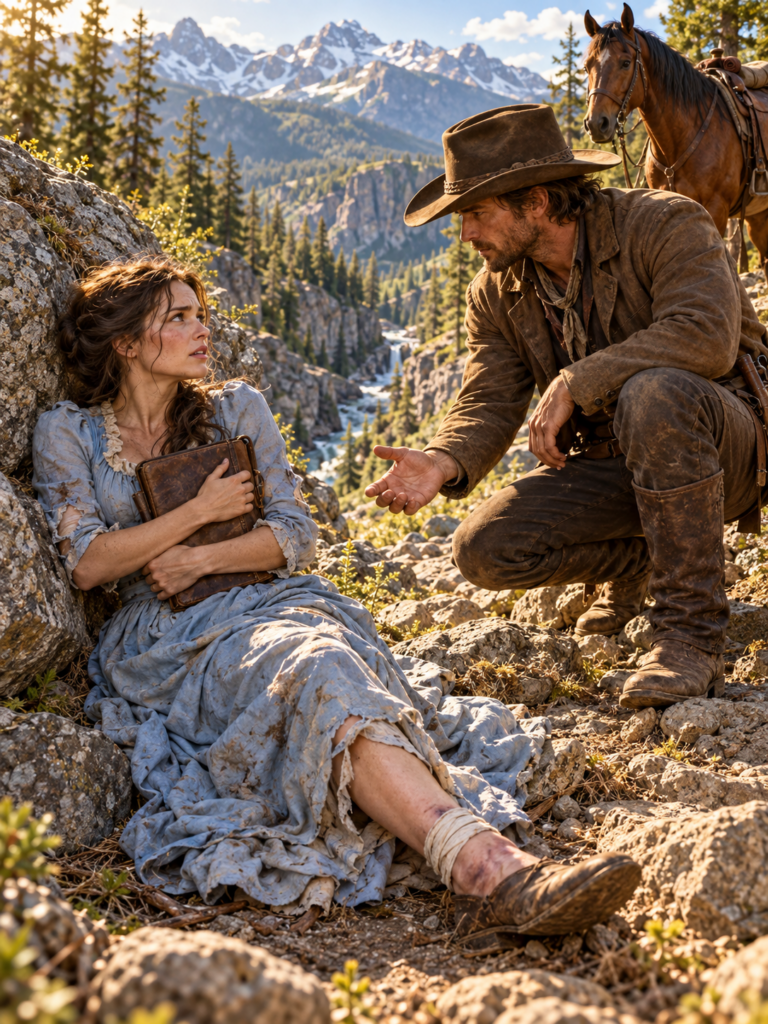
The two riders slowed their horses at the foot of the clearing while Ethan stepped quietly toward the window.
Clara shut the leather pouch.
“Did they see us?”
“I don’t think so.”
He watched through the narrow opening beside the shutter.
The men were not riding like travelers looking for water. One examined the cabin while the other studied the barn and the ground around it.
Clara struggled to rise.
Pain crossed her face.
“Stay where you can see the door,” Ethan said. “I’m not going outside unless there’s a need.”
She stopped and looked at him.
“You’ve done this before.”
“Watched men looking for someone?”
“Yes.”
“More times than I care to remember.”
One rider pointed toward the house.
The other shook his head.
After a brief exchange, they turned south and disappeared among the pines.
Ethan waited until their hoofbeats faded.
Then he faced Clara.
“They weren’t lost.”
“No,” she said. “They were looking for me.”
“Why would Harrington send riders this far north?”
She drew a folded document from the pouch.
“My husband surveyed land for him. After James died, Harrington produced papers claiming our property had been transferred to his company.”
“Did James sign them?”
“No.”
“How certain are you?”
“I helped keep our accounts for years. I watched James prepare his surveys. I know his handwriting.”
She spread two sheets across the table.
One bore her husband’s original measurements.
The other described a different boundary.
“The altered survey moves valuable land into Harrington’s holding,” she explained. “And the conveyance carries a forged signature.”
Ethan studied the papers without taking them from her.
“Who else has seen these?”
“Enough people to make Harrington afraid.”
She drew out a third sheet.
“A former employee provided an account of payments to county officials.”
“Which officials?”
“Sheriff Driscoll. Judge Bowmont.”
Ethan sat back.
Now he understood why she had refused Crestwood.
And why she had traveled alone.
“Where were you going?”
“To find someone who couldn’t be bought as easily.”
“Denver?”
She nodded.
“Marshal Thomas Haynes. I have reason to believe he’ll examine the evidence fairly.”
“That’s a long journey with an injured ankle.”
“I know.”
“Harrington will watch the main roads.”
“He already has men watching the stage lines.”
Ethan looked toward the window again.
He had spent years refusing involvement in other people’s disputes.
His former trade had taught him that a badge or warrant could make wrongdoing appear respectable.
That knowledge had driven him into the mountains.
Now it had followed him home.
Clara gathered the papers.
“You should take me to the edge of your property,” she said. “I can find another way.”
“Not on that ankle.”
“I will not have you injured because of me.”
“Helping you was my decision.”
“You didn’t know what you were accepting.”
“Then let me make the decision with the facts in front of me.”
She held his gaze.
“I will not surrender these documents, Ethan. Not to Harrington, not to Driscoll, and not to you.”
He nodded.
“They’re yours to protect.”
“And you will not decide where I go without telling me.”
“No.”
Her shoulders eased slightly.
“Then we understand one another.”
Ethan stood and brought a worn trail map from a shelf.
“The southern road is dangerous. But there’s a northern route through the timber country.”
“Toward Denver?”
“Not directly. There’s a logging camp beyond the ridge. Men there may know a safer way to send word.”
Clara leaned toward the map.
“My husband surveyed timber near that camp.”
“Then you may know more of the country than I do.”
She traced a route with her finger.
“James used this crossing. It meets the northeast trail.”
Ethan examined the marks.
“That could save us from passing Crestwood.”
For the first time, they were making a plan together.
Then he looked at her swollen ankle.
“We must move before those riders return. But Gideon will need water, and you’ll need something to eat.”
“I can be ready.”
He fetched bread, dried meat, and a second blanket.
Clara repacked the documents carefully, securing the brass clasp.
Outside, the late sun struck the porch.
She reached for the edge of the table and stood on her good leg.
“Ethan?”
He turned.
“If you help me take these papers to the right people, Harrington may come after your ranch as well.”
Ethan opened the door and looked toward the trail where the riders had vanished.
He had almost walked away from her once.
Now he knew precisely what walking away would mean.
He went to the barn, lifted Gideon’s saddle from its peg, and carried it toward the horse.
Clara followed as far as the doorway, holding the pouch against her chest.
At the barn rail, Ethan began tightening the saddle cinch.
And beyond the trees, another horse gave a distant, unfamiliar whinny.
Ethan stopped tightening the saddle cinch.
He listened.
The unfamiliar horse called again from beyond the trees.
Clara stood motionless in the cabin doorway.
“Is it them?”
“Could be. Or someone on the ridge trail.”
He kept one hand on Gideon’s saddle, listening for approaching hooves.
None came.
After several minutes, he finished fastening the tack and led the horse toward the house.
“We’ll use the back trail.”
Clara waited until he came close enough to help her mount.
“Where will we go first?”
“The logging camp. If your husband’s survey men are still there, they may help us.”
“Dutch Callaway,” she said.
Ethan looked at her.
“You know him?”
“James spoke well of him.”
“Then we’re going to find out whether his opinion was deserved.”
They departed before sunset, taking the narrow trail that climbed north behind the ridge.
Ethan walked beside Gideon.
Clara rode carefully, keeping her injured ankle clear of the stirrup.
After an hour, the fading light forced them to slow.
They could not cover twelve mountain miles safely in darkness.
Ethan found a sheltered place beside the trail where Gideon could rest.
He helped Clara dismount and brought her water.
She accepted it without protest.
That worried him more than her earlier stubbornness.
“Your ankle?”
“Throbbing.”
“You should have told me.”
“I knew we couldn’t stop in the open.”
“We’re stopped now.”
He checked the wrapping and helped her position the injured leg more comfortably.
While they ate, Clara removed the leather pouch from her shoulder.
“James was a careful man,” she said.
Ethan looked toward her.
“He kept copies of everything. Surveys, contracts, correspondence. I used to tease him about it.”
“What happened to him?”
“Fever. Two winters ago.”
She spoke quietly, without dramatics.
“He had been strong all his life. Then he was ill, and within a short time he was gone.”
Ethan waited.
“Harrington began pressing his claim within months.”
“Did your husband suspect him?”
“Yes. But James believed the proper authorities would correct whatever was wrong.”
She looked into the small cooking fire.
“I believed that, too. Until I saw the signatures.”
“And then?”
“I made copies. I found men willing to testify. I learned how much county officials had been paid.”
She touched the pouch.
“I also learned that knowledge can make a person very lonely.”
Ethan understood.
For years, he had believed that keeping to himself protected him from doing harm.
But sometimes a man could cause harm by refusing to act.
He said, “I once brought in a cattleman on a warrant.”
Clara turned toward him.
“The man who hired me claimed he’d taken land unlawfully. I believed the papers.”
“What happened?”
“The accusation was arranged by someone who wanted the cattleman’s property.”
Ethan stared into the fire.
“By the time I understood, the man had lost his livelihood. His family was gone from the place. He died before the year was over.”
Clara said nothing.
“I was paid for that job.”
“Did you keep the money?”
“No.”
“Did returning it repair anything?”
“No.”
“Then perhaps that’s why you’re still carrying him.”
He met her eyes.
She did not offer easy forgiveness for something she had not witnessed.
Instead, she said, “You were wrong once. That doesn’t mean every choice afterward must be made out of fear.”
Ethan looked away.
He had not expected an injured widow, carrying evidence that might destroy a powerful mining owner, to understand him so plainly.
They rested for several hours.
Before dawn, they resumed the trail.
By late morning, the smell of cut pine reached them.
The logging camp lay in a clearing below the northeast ridge.
Dutch Callaway came out of the mill shed as they approached.
He examined Ethan, Clara, and the bandaged ankle.
“That’s trouble,” he said.
“Possibly,” Ethan answered.
Clara leaned forward in the saddle.
“Mr. Callaway? I’m Clara Whitmore. James Whitmore’s wife.”
The foreman’s expression changed.
He removed his hat.
“I knew your husband.”
“I remember he spoke of you.”
Dutch glanced at her injury.
“Come inside.”
They were given a place in the cook tent.
A quiet cook named Po brought cornbread, coffee, and a stool on which Clara could rest her leg.
Dutch listened while she explained the forged surveys.
He did not interrupt.
When she finished, he said, “Harrington’s men came through yesterday.”
Ethan straightened.
“How many?”
“Three. Asking after a woman traveling alone.”
“What did you tell them?” Clara asked.
“That I didn’t know where she was.”
“You didn’t know then.”
“No. And I don’t intend to tell them now.”
Clara looked down at her hands.
“James always said you were fair.”
“Your husband was fair to my men. That matters.”
Ethan examined the trail map.
“We need to reach Denver without using the southern stages.”
Dutch pointed toward the northeast.
“Ridgeline has a telegraph office. Raymond Yates runs it.”
“Can he be trusted?”
“Harrington tried to influence him once. Yates refused.”
Clara leaned forward.
“If I can notify Marshal Haynes directly, he may send officers to receive the evidence.”
“That’s better than carrying it through every town between here and Denver,” Ethan agreed.
Dutch nodded.
“I’ll send Garrett with you. He knows the crossing.”
Garrett was a young timber worker with a steady manner and a good knowledge of the trails.
After the horses had been fed and watered, the three travelers continued toward Ridgeline.
Clara rode Gideon.
Garrett rode his own horse.
Ethan borrowed a camp horse for the next stage.
They moved carefully, avoiding the more traveled crossings.
Near midday, Garrett raised his hand.
Below them, two mounted men crossed a shallow draw.
One wore a coat marked by silver dust.
Clara recognized him.
“He works for Harrington.”
Ethan guided the horses behind a screen of pines.
They waited while the riders passed.
Garrett watched the crossing.
“They’re searching farther north now.”
Clara tightened her hold on the pouch.
“Then we must reach Yates before they reach him.”
The remaining journey demanded patience.
Clara’s ankle was swollen and painful, but she refused to pretend otherwise.
When she needed rest, she said so.
When Garrett proposed a steep shortcut, she examined the ground and rejected it.
“That slope might save time for a sound horse and a healthy rider. It could cost us both.”
Garrett considered the terrain.
Then he nodded.
They took the longer trail.
By afternoon, the roofs of Ridgeline appeared below them.
Ethan left the horses with Garrett near the livery.
He offered Clara his arm.
She accepted it, leaning only enough to relieve the injured ankle.
They crossed the street together.
Inside the telegraph office, Raymond Yates looked up from his desk.
Clara gave her name and requested a message to Marshal Thomas Haynes in Denver.
Yates’s expression became attentive when she mentioned James Whitmore.
“He used to send survey information through this office.”
“He kept very careful records,” Clara replied.
“So I recall.”
She wrote the message herself.
It described the forged property documents, the supporting statements, and her request for federal assistance.
Yates read the address.
“I’ll send it promptly.”
“Will it remain private?”
“I shall treat it as confidential. But I cannot promise no one will learn that a message was sent.”
“I understand.”
Ethan and Clara waited outside.
The afternoon sun warmed the boardwalk.
For the first time since the ravine, she sat beside him without clutching the pouch so tightly.
“Why are you still helping?” she asked.
He looked toward the mountains.
“Because you have the right to seek justice.”
“That is the proper answer.”
“It’s also true.”
“And the other answer?”
He took a moment.
“I’ve spent three years telling myself the safest way to live was to need nobody.”
She listened.
“Then I found someone who needed help, and I discovered that I was tired of being the sort of man who could walk away.”
Clara studied him.
“You almost did.”
“Yes.”
“But you came back.”
“I did.”
She looked at her injured foot.
“I’m glad.”
His eyes met hers.
“So am I.”
A short while later, Yates brought the reply.
Marshal Haynes had received the message.
Deputies Mallister and Ford would travel to Ridgeline to examine the evidence.
Clara read the words twice.
“How long?”
“About a day and a half,” Yates said, allowing for the journey.
Ethan calculated the time.
“We’ll need somewhere safe to wait.”
Dutch had mentioned an old shepherd’s hut in the high pasture beyond Ridgeline.
It was out of ordinary use after spring.
Ethan knew the route.
They collected Gideon from Garrett and sent the young man back toward the logging camp with thanks for his help.
Then they climbed toward the high pasture.
The journey was hard on Clara.
By the time they reached the hut, her face was pale with exhaustion.
Ethan helped her from the saddle.
This time, she allowed her hands to remain briefly on his shoulders while she found her balance.
He did not draw her closer.
She noticed.
Inside, the hut contained a bench, a small hearth, and enough shelter to make waiting possible.
They settled the horse, ate what provisions remained, and arranged a place where Clara could rest.
Ethan took the position nearest the door.
At dusk, she opened the pouch and examined her papers.
“James loved maps,” she said.
Ethan listened.
“He said a good survey showed more than what a man owned. It showed what he was responsible for.”
She smiled sadly.
“I used to think he cared too much about lines on paper.”
“And now?”
“Now those lines may give me back my home.”
She folded the documents.
“Ethan, what will you do when this is over?”
“Go back to North Ridge.”
“Alone?”
He looked toward her.
“I suppose that depends on what happens afterward.”
She lowered her eyes.
“I want my ranch returned. I don’t want to live the rest of my life hiding.”
“You shouldn’t have to.”
“And I don’t want to forget James.”
“You needn’t.”
Her eyes lifted.
“Does that trouble you?”
“No. He was part of your life. He matters.”
She remained silent for a moment.
Then she said, “You make it difficult to keep thinking of you as a stranger.”
Ethan smiled faintly.
“That’s fortunate. I’m beginning to think of you as something more than a guest.”
Neither moved closer.
There was still too much uncertainty.
But the silence between them had changed.
Near dawn, Ethan heard footsteps outside.
He rose carefully.
Two men approached the shelter where the horses stood.
Their clothing was ordinary.
Their movements were not.
Ethan stepped outside before they reached the animals.
“Morning,” he said.
The taller man stopped.
“We’re looking for a woman.”
“Who sent you?”
The man ignored the question.
“Traveling alone. Hurt her foot.”
Ethan remained beside the hut.
“My companion is resting inside. I won’t disturb her for strangers who won’t identify themselves.”
The shorter man glanced toward the doorway.
Ethan kept his hands visible.
“I suggest you take your questions back to the road.”
The men exchanged looks.
They had expected a frightened traveler.
Instead, they found a rancher who knew how to stand his ground without reaching for a weapon.
After an uneasy pause, they withdrew.
Ethan watched them ride away.
Clara appeared in the doorway.
“They’ll report back.”
“Yes.”
“Harrington will come himself if he thinks the documents are close.”
“Probably.”
She looked toward the distant trail.
“Then we cannot remain here.”
Ethan nodded.
They moved again, taking a rough route through the higher country.
When they reached an overlook above Ridgeline, the town was visible beneath them.
And there, entering the street with several mounted men, rode a gentleman in an expensive dark coat.
Clara recognized him immediately.
“Charles Harrington.”
Ethan watched the riders stop near the deputy’s office.
Harrington dismounted.
Then he looked directly toward the telegraph building.
Clara’s face hardened.
“He knows about the message.”
Ethan turned toward her.
“Then we have to make certain the evidence survives until Haynes’s deputies arrive.”
She looked down at the pouch.
For fourteen months, the papers had been the only thing standing between her and the loss of everything James had left.
Now Harrington himself was in Ridgeline.
And the men who could help her had not yet arrived.
Ethan took the reins.
“There’s a sheltered ridge above town. We can watch the southern road from there.”
Clara looked toward the buildings.
“And Yates?”
“We’ll make sure he’s warned.”
She nodded.
Together, they turned their horses toward the northern approach, knowing that the next hours would determine whether her husband’s work finally reached the hands of honest lawmen.
The horses turned north, climbing through the pines until Ridgeline disappeared behind a shoulder of rock.
Ethan knew a narrow route that brought them around the settlement without passing its main street.
They left Gideon and the other horse sheltered above town and approached on foot.
Clara’s ankle slowed them.
She disliked that.
But she had learned that moving carefully was not the same as surrendering.
At the rear of the telegraph office, Ethan paused.
“Can you wait here?”
“I can. But if Harrington has already threatened Yates, we may need to act quickly.”
“I’ll find out.”
He entered through the rear door.
Raymond Yates sat at his desk, spectacles low on his nose.
He looked up without surprise.
“Harrington has been here,” he said.
“What did he want?”
“To know whether a message had been sent to Denver.”
“What did you tell him?”
“That I send messages for anyone who pays the proper fee.”
Ethan glanced toward the front window.
Two of Harrington’s men stood on the boardwalk.
“He left those fellows behind?”
“Yes.”
“Has another message arrived?”
Yates opened a drawer.
“Marshal Haynes confirms that his deputies are still coming. They expect to reach Ridgeline tomorrow morning.”
Ethan folded the note.
“Can Harrington stop them?”
“Not easily. But he may try to make the evidence disappear before they arrive.”
Ethan thanked him.
When he returned to Clara, she studied the message.
“Tomorrow morning.”
“Yes.”
She looked toward the hotel.
“Harrington has everything to lose.”
“And we have to keep these papers safe until the deputies reach town.”
They moved through the rear of a dry-goods store after its owner allowed them passage.
On the main street, Harrington stood speaking to a local deputy.
Clara saw him before he saw her.
For a moment, she became very still.
Ethan noticed.
“Do you want to wait?”
“No.”
She slipped her hand through his arm.
“Walk with me.”
They crossed the street at an ordinary pace.
No one stopped them.
At the far end, Clara released a breath she had been holding.
“You looked perfectly calm.”
“I wasn’t.”
She glanced at him.
“Neither was I.”
They shared a brief smile.
Then they climbed toward the horses.
The higher ridge offered shelter beneath an overhanging shelf of rock.
They could see the approaches to Ridgeline and remain largely concealed from the town below.
Ethan settled the horses where they could rest, with water and feed from their limited supplies.
Clara sat beside the rock wall, her ankle supported.
For the first time that day, they had a moment without immediate movement.
She opened the leather pouch.
“I’ve spent so long guarding these papers that I scarcely remember what it feels like to make plans beyond them.”
“What would you do first?”
“If the ranch were mine again?”
“Yes.”
“Repair the fences. Inspect the barn. Look over the accounts.”
He smiled.
“That sounds like several weeks of work.”
“It is.”
“And afterward?”
She hesitated.
“There’s a kitchen garden behind the house.”
“Was it yours?”
“James tended it. He was better with growing things than I was.”
She looked toward the distant valley.
“After he died, I stopped planting it. I told myself there was too much else to do.”
Ethan said nothing.
“The truth was that I couldn’t bear seeing his work continue without him.”
He understood more than he could say.
For years, his north ridge cabin had remained exactly as he wanted it.
Bare.
Orderly.
Unchanged.
It was easier to preserve loneliness than to risk feeling loss again.
Clara fastened the pouch.
“What would you do if you no longer needed to hide from people?”
He considered the question.
“Perhaps visit Dutch more often.”
She smiled.
“An ambitious beginning.”
“Perhaps let someone visit me.”
“That would be remarkable.”
He looked at her.
“Perhaps stop thinking that every person who comes through my door will eventually leave me worse than they found me.”
Her smile faded into something gentler.
“You don’t have to make that decision today.”
“No.”
“Neither do I.”
He nodded.
They sat quietly until the last light left the town below.
During the night, they took turns listening for movement along the ridge.
By morning, the southern road showed the dust of approaching riders.
Ethan studied them from the shelter of the rocks.
Two men rode ahead, with the measured pace of travelers who knew their destination.
“Could be Haynes’s deputies,” he said.
Clara stood with his assistance.
“Then we need to reach them before Harrington does.”
They waited until the riders passed a known crossing.
Then Ethan guided the horses down a sheltered trail toward Ridgeline.
The final mile was slow.
Clara could no longer pretend that riding had not worsened her ankle.
But she remained alert, the pouch secured across her chest.
As they entered town, a man with a federal badge stepped from the hotel porch.
“Mrs. Whitmore?”
Clara stopped Gideon.
“Yes.”
“Deputy Mallister. This is Deputy Ford.”
Ethan helped her dismount.
Mallister glanced toward the pouch.
“We received Marshal Haynes’s instructions. We’d like to examine the evidence.”
Clara looked at the badge.
Then she looked directly at the deputy.
“I will show you everything. But I want each document listed before it leaves my possession.”
Mallister nodded.
“That is reasonable.”
“And I want a written acknowledgment of what you take.”
“You shall have one.”
She entered the hotel with the deputies.
Ethan followed.
For several hours, the dining room became an improvised place of inquiry.
Clara laid out the records one by one.
Original survey copies.
Altered boundaries.
A conveyance bearing a signature she knew James had not written.
Statements from former workers.
A ledger page describing payments that demanded investigation.
Mallister asked questions.
Clara answered each carefully.
When a date was uncertain, she said so.
When a fact depended upon another witness, she identified that witness.
She made no effort to improve the story by exaggeration.
The papers were strong enough without it.
Deputy Ford recorded the documents and arranged for the essential information to be sent to Marshal Haynes through the telegraph office.
When the formal inventory was complete, Clara released the pouch.
It was the first time in fourteen months that she had willingly allowed the evidence beyond her reach.
Her hands remained open on the table.
She stared at them.
Ethan sat beside her.
“Are you all right?”
“I don’t know.”
She flexed her fingers.
“I thought I would be happy.”
“You’ve been frightened a long time.”
“I thought relief would feel different.”
He looked at her hands.
“Perhaps it takes time to learn that you don’t have to hold on quite so tightly.”
She looked toward him.
Then she rested her hand beside his.
He placed his own hand near it, leaving the choice with her.
After a moment, she turned her palm upward and took his fingers.
They remained like that until Mallister returned.
“Mrs. Whitmore, we have enough to begin formal proceedings. There will be further questions, and we may require your testimony in Denver.”
“I expected that.”
“Harrington is at the hotel. We intend to speak with him now.”
Clara lifted her chin.
“I wish to be present when you confront him.”
Mallister considered the request.
“You may accompany us, provided you leave the questioning to the officers.”
She agreed.
Charles Harrington appeared in the hotel lobby wearing an immaculate coat and a carefully controlled expression.
He looked first at the badges.
Then at Clara.
For a brief instant, the confidence left his face.
“Mrs. Whitmore.”
“Mr. Harrington.”
Mallister explained that a federal investigation had begun into the property records, suspected forged conveyances, and allegations of payments to public officials.
Harrington asked for his lawyer.
That request was permitted.
But the documents were already accounted for, and word of the investigation had reached Denver.
He could no longer settle the matter quietly through Sheriff Driscoll.
Clara watched him carefully.
For months, she had imagined standing before this man.
She had rehearsed angry speeches.
Now that the moment had arrived, she found she needed none of them.
“My husband kept copies,” she said.
Harrington looked at her.
“Yes, Mrs. Whitmore. So I gather.”
“He trusted the records to speak honestly.”
She met his eyes.
“You should have understood that I knew how to read them.”
Harrington offered no answer.
The deputies proceeded with the investigation, arranging for him to accompany them to Denver as the formal process advanced.
His influence in Ridgeline diminished almost immediately.
Men who had been eager to please him began avoiding his company.
The local deputy asked to cooperate.
Raymond Yates continued transmitting official messages.
Nothing was resolved in a single morning.
There would be hearings.
There would be testimony.
There would be arguments from lawyers paid to make the truth difficult to establish.
But the evidence had passed beyond Harrington’s private control.
That evening, Ethan found Clara outside the hotel.
She stood facing the mountains, both hands empty.
“The papers are gone,” she said.
“They’re where you wanted them.”
“I know.”
She looked at her fingers.
“I used to wake in the night and check the clasp.”
“You won’t need to do that tonight.”
She turned toward him.
“Ethan, what happens to us now?”
He could have given her an answer meant to make her stay.
Instead, he told her the truth.
“You have a ranch to recover. I have work waiting on North Ridge. Neither of those things disappears because we happened to meet.”
She lowered her eyes.
“No.”
“But if you want company while you find your way back, I’d like to come.”
She looked up.
“Not to decide things for me?”
“No.”
“Not because you believe I owe you?”
“Never.”
“Then I’d like that.”
He smiled.
They stood beside the hotel steps as the evening cooled.
After a moment, she leaned closer and rested her head briefly against his shoulder.
He remained still.
For a man who had spent years avoiding human closeness, the small gesture felt extraordinary.
The following weeks required patience.
Clara gave further statements.
Harrington’s claims were examined.
The forged survey work drew scrutiny from federal officials, and the questions extended to Sheriff Driscoll and Judge Bowmont.
Albert Cruz, the former bookkeeper whose record supported the allegations, eventually came forward to assist the inquiry.
With the evidence strengthened and the fraudulent conveyance challenged successfully, Clara regained lawful control of the Whitmore ranch.
The news reached her while she was staying at Ethan’s cabin during her recovery.
She read the letter standing beside his kitchen table.
Then she sat down abruptly.
Ethan turned from the hearth.
“What is it?”
She held out the paper.
“It’s mine.”
He took the letter and read it.
Then he looked at her.
“The ranch?”
She nodded.
“The land. The house. The barns.”
Her eyes filled.
“James’s work.”
Ethan returned the letter.
“What would you like to do?”
“Go home.”
He nodded.
“Then you should.”
She watched him for a moment.
“You could come with me.”
He looked surprised.
“Would you want that?”
“Yes.”
It was the simplest answer she had given him.
And perhaps the most important.
They traveled south when her ankle had recovered enough for the journey.
The road from North Ridge to the Whitmore ranch took them down from the high mountains into a broader valley.
Clara recognized the country.
She had once fled it with a leather pouch across her chest, afraid that anyone who saw her might report her whereabouts.
Now she returned openly.
At the boundary fence, she stopped her horse.
Afternoon sunlight lay across the fields.
“James loved this light,” she said.
Ethan waited.
“He said you could see the shape of the land clearly at this hour.”
She looked across the valley.
“He wanted to build something that would last.”
“Then perhaps you’ve brought that work home.”
She turned toward him.
There was no need for him to claim that he could replace the husband she had lost.
He understood that a future need not erase the past.
They rode through the gate.
The ranch was neglected, but not ruined.
Some fences needed rebuilding.
The barn required clearing.
The house had been used carelessly by men who had never expected to remain.
And behind the kitchen stood the garden Clara had abandoned after James died.
Its beds were overgrown.
Yet the old paths remained.
She walked slowly to the edge.
Ethan joined her.
“I haven’t planted anything here in years,” she said.
“You could again.”
“I know.”
She looked toward him.
“Would you help?”
“I don’t know much about gardens.”
“I could teach you.”
He smiled.
“Then I expect we’ll have some poor crops before we have good ones.”
“Probably.”
She laughed.
It was a sound he had come to recognize.
Not a promise that hardship had ended.
Only proof that joy could return without asking permission.
They spent the next days assessing the property.
Clara made lists.
Ethan repaired what needed immediate attention.
They worked separately when their tasks required it and together when two sets of hands made the work easier.
He did not mistake helping her for ownership.
She did not confuse accepting help with surrendering independence.
On the second afternoon, Martha Hendris, a neighboring ranch woman, arrived with a covered dish of beef and potatoes.
She examined Ethan with frank curiosity.
“So this is the man who helped you?”
“Ethan Walker,” Clara said.
Martha looked at him.
“You got her home.”
“She got herself home,” Ethan answered. “I kept her company through some of the difficult parts.”
Martha considered him.
Then she nodded.
“That’s a fair answer.”
After the older woman departed, Clara stood on the porch watching her wagon roll away.
“She’ll tell everyone in the valley about you.”
Ethan looked toward the road.
“A few weeks ago, that would have bothered me.”
“And now?”
“Now I suppose they’ll find out I’m capable of conversation.”
Clara smiled.
“Some conversation.”
“Occasionally.”
Their growing affection was not built upon constant declarations.
It appeared in ordinary work.
Ethan noticed when Clara’s ankle tired and suggested a task she could finish seated.
Clara learned which supplies North Ridge needed before winter and helped him keep better accounts.
He asked her opinion before making plans that affected both ranches.
She made room for him in her life without abandoning her own responsibilities.
When she traveled north, she had work of her own to attend to.
When he rode south, he came because she had invited him.
The distance between their properties remained real.
So did their separate obligations.
But neither treated those facts as reasons to withdraw.
One morning, a letter came from Deputy Mallister.
The investigation had uncovered suspicious timber-rights transactions on properties adjoining Ethan’s North Ridge ranch.
The pattern resembled the scheme used against Clara.
Harrington had also intended to extend his influence over the timber near Ethan’s land.
Ethan read the letter twice.
Clara watched his face.
“He was coming for your property, too.”
“So it seems.”
“Even if you hadn’t helped me?”
“Apparently.”
She sat beside him.
“Does that change why you did it?”
He considered the question.
“No.”
She nodded.
“I didn’t think it would.”
He looked at her.
“What’s on your mind?”
She took his hand.
“When you found me on that slope, you could have left me there.”
“Yes.”
“And when you learned what I carried, you could have taken me to the county line.”
“Yes.”
“But you stayed.”
“I chose to.”
She held his hand a little more firmly.
“I want you to know that I’m choosing now, too.”
Ethan went still.
She smiled faintly.
“I don’t know exactly what our future will look like. I know we have two ranches, a long road between them, and enough work to keep us busy for years.”
“That’s true.”
“But I know I’d rather make those decisions with you than without you.”
He looked down at their joined hands.
For years he had believed that caring for someone invited loss.
Now he understood that refusing to care had already cost him much of his life.
“I feel the same,” he said.
She leaned closer.
He kissed her gently.
There was no audience.
No grand speech.
Only the quiet acknowledgment that they wanted to build something neither could have planned when they met.
Autumn came to the valley.
The legal proceedings continued, and Harrington’s influence diminished as evidence produced convictions on several counts.
Judge Bowmont left the territory.
Sheriff Driscoll was replaced as the investigation exposed the failure of county authority.
The land Clara had recovered remained hers, and Ethan’s North Ridge holding was no longer an unnoticed target of the same scheme.
They kept both ranches.
Clara managed the valley property.
Ethan continued caring for the North Ridge land.
They traveled between them when work and weather allowed, and discussed ways to make the distance less burdensome.
Neither expected love to remove the hard work of living.
Instead, they began making the hard work something they could share.
In late October, the first snow appeared on the distant peaks.
Ethan was repairing a section of fence at the Whitmore ranch when Clara came from the barn.
She stood beside him and looked across the fields.
“I planted the garden yesterday,” she said.
He turned.
“Did you?”
“Garlic. Onion sets. Things that can rest through winter and begin again in spring.”
He smiled.
“Sounds sensible.”
She brushed dust from her hands.
“I didn’t ask you to help yesterday.”
“You didn’t need me.”
“No.”
She looked toward the garden.
“But in spring, there’ll be more to do.”
He waited.
“I’d like you here for it.”
The wind moved a loose strand of hair across her cheek.
Ethan gently moved it aside.
“I’d like that.”
She turned her face toward his hand.
The gesture was small.
But both understood what it meant.
The following winter was cold.
North Ridge remained a lonely place when Ethan was there without company.
But loneliness no longer seemed like a rule he had to obey.
Clara sometimes stayed in the valley because the ranch needed her.
Sometimes Ethan came south.
Sometimes she rode north and found him waiting on the porch beside Gideon.
They learned one another’s habits, temperaments, worries, and stubbornness.
They disagreed over work.
They made decisions.
They changed their plans when circumstances demanded it.
And neither disappeared into silence when something mattered.
As spring returned, the kitchen garden began to show green.
Clara knelt beside the rows, loosening soil around the new shoots.
Ethan approached carrying a bucket of water.
“Where do you want this?”
“Beside the onions.”
He set it down.
She looked at his hands.
“You’ve been fixing fences again.”
“One post was rotten.”
“Only one?”
He smiled.
“For once.”
She stood and brushed soil from her skirt.
“Ethan?”
“Yes?”
“Do you remember what I said when you found me?”
He looked toward the mountains.
“I remember.”
“I couldn’t walk.”
“No.”
“I thought I was going to die there. Or be found by men who wanted those papers.”
He took her hand.
“You had reason to be frightened.”
“I was.”
She looked around at the restored garden, the repaired fences, and the fields that were hers again.
“But I can walk now.”
He smiled.
“Yes, Clara.”
“And I can decide where I’m going.”
“Yes.”
She stepped closer.
“Then I’d like to keep walking beside you.”
He rested his forehead against hers.
“I’d be glad to.”
Behind them, the kitchen garden stirred in the spring breeze.
It was not the same garden Clara had known with James.
Nor was it a denial of that life.
It was something living in ground that had once seemed too painful to touch.
And far above the valley, Ethan’s cabin still stood on the north ridge.
Its porch faced the same mountains.
Its walls remained rough.
Its work remained unfinished.
But the man who had once sat there counting the days since his last human touch no longer counted.
He had discovered that solitude could be a place of rest without becoming a prison.
And Clara had discovered that reclaiming her home did not require protecting it alone forever.
The leather pouch that had once been pressed against her chest now lay empty in a drawer.
Its work was finished.
Her hands were free for the land, for the garden, and for the man who never asked her to surrender either.
One summer morning, as they rode together beneath the Colorado peaks, Ethan drew Gideon alongside her horse.
“Where to?” he asked.
Clara looked toward the open valley.
“Home.”
“Which one?”
She smiled at him.
“We’ll decide together.”
And they rode on.

