
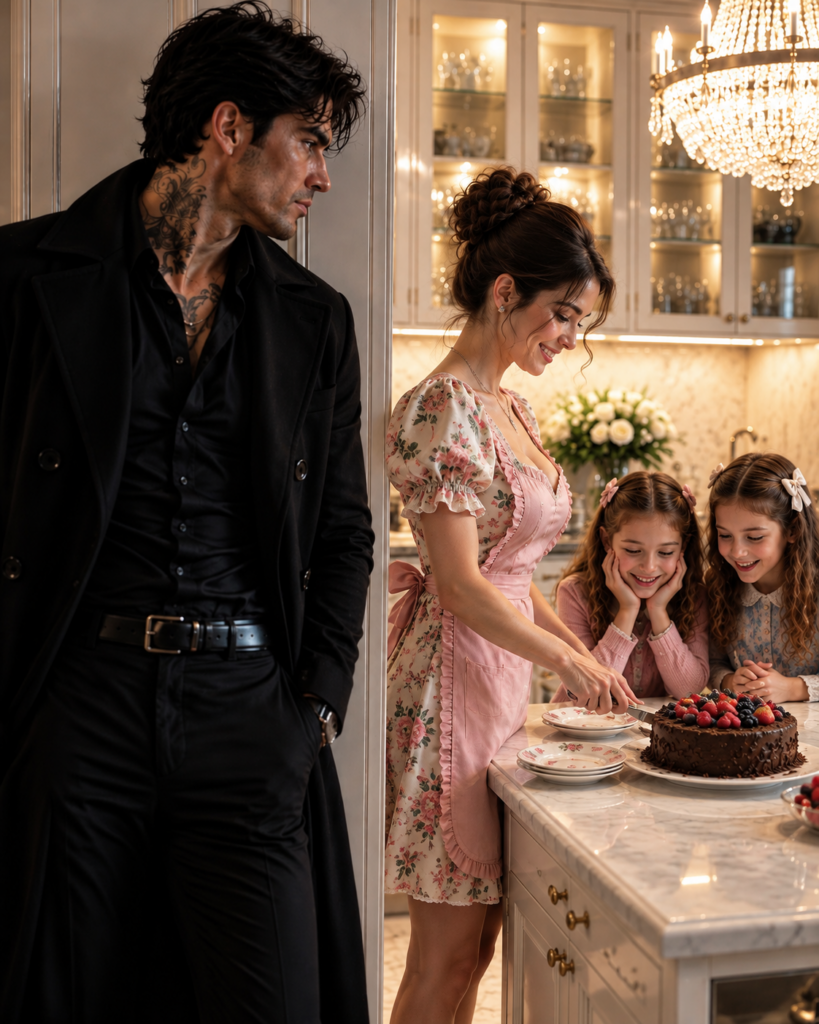
For several seconds, I remained outside the kitchen without moving.
I had built an entire life around being the man who noticed things first.
A change in someone’s voice.
A car that appeared twice on the same street.
A business associate who suddenly stopped making eye contact.
I had survived because I knew how to read rooms before anyone else realized there was something worth reading.
Yet in my own kitchen, surrounded by the people who mattered most to me, I had somehow become the least observant man in the house.
Avery was carefully separating the layers of frosting from her slice of cake.
Sophie had climbed onto a stool beside Clara and was telling her a story about a bird she had seen outside the playroom window.
Clara listened as though there were nowhere else she needed to be.
Not pretending to listen.
Actually listening.
I thought of how many conversations with my daughters I had conducted while checking messages on my phone.
“Daddy, look.”
“One second.”
“Daddy, Sophie took my—”
“Tell Mrs. Nolan.”
“Daddy, can you—”
“Tomorrow.”
Tomorrow.
It was remarkable how often a father could use that word without realizing his children were learning not to believe it.
I stepped backward before any of them saw me.
For the first time since returning to the house, my hand moved completely away from the weapon beneath my coat.
I went upstairs.
My study occupied the west corner of the second floor, overlooking the gardens and the long reflecting pool Madeline had chosen when we bought the property.
She had laughed the first time she saw the house.
“It looks like a hotel where everyone is afraid to touch the furniture.”
Three months later she had filled it with books, flowers, toys, mismatched family photographs, and enough color to offend every interior designer who had originally worked on the place.
After she died, the color had gradually disappeared.
Not because anyone removed it.
Because no one replaced it.
I stood beside the window, looking down at the garden.
From there, I could see the little wooden playhouse beneath the live oak trees.
Madeline had ordered it before the twins were born.
I remembered complaining about the delivery truck blocking the driveway.
That memory embarrassed me now.
There were entire years of my life in which I had been physically present and emotionally absent.
A quiet knock sounded at the door.
I turned.
My head of security, Daniel Reyes, stood there.
Daniel had worked for me for more than a decade. He was one of the few men in my world who could enter a room without asking permission and still keep his job.
His eyebrows lifted when he saw me.
“You’re supposed to be halfway to the airport.”
“Change of plans.”
He studied me.
“Everything all right?”
“No.”
Daniel closed the door behind him.
“What happened?”
I considered the question.
Then I realized I didn’t know how to answer it.
Nothing had happened.
That was the problem.
Nothing had happened, and somehow I had seen more in ten minutes than I had allowed myself to see in two years.
I walked behind my desk.
“Tell me about Clara Bennett.”
Daniel’s expression changed slightly.
Not alarm.
Interest.
“What about her?”
“Everything.”
“I assume you’ve already read her file.”
“I read a summary.”
“That’s not the same thing.”
“No.”
He waited.
I disliked when people waited. It forced me to keep talking.
“Patricia thinks Clara has become too involved with the girls.”
Daniel leaned against the chair across from my desk.
“And what do you think?”
“I’m asking you.”
“You usually don’t.”
“That’s why I’m asking now.”
Something passed across his face. Approval, perhaps, though Daniel was too smart to show much of it.
“She passed every background check,” he said. “No unexplained financial problems. No unusual contacts. No record of dishonesty. Before coming here, she worked at a private elementary school for four years.”
That surprised me.
“As a housekeeper?”
“As a classroom aide.”
I frowned.
“Why wasn’t that in the summary?”
“It was.”
I looked at him.
Daniel almost smiled.
“You didn’t read past page two.”
There had been sixteen pages.
I sat down.
“What else?”
“She left the school because her mother became ill. She cared for her for nearly two years. After her mother died, Clara needed work with flexible hours. Mrs. Nolan interviewed her first.”
Mrs. Nolan managed the household staff.
“What did the school say about her?”
“They wanted her back.”
I stared toward the window.
“Why didn’t she return?”
“She told them she needed a change.”
That answer seemed too simple.
“People rarely need change without a reason.”
Daniel nodded.
“I thought so too.”
I looked at him.
“And?”
“One of the children she worked with lost a parent unexpectedly. Clara became close to the family afterward. Apparently the experience affected her more than she expected.”
A silence settled between us.
I thought of Avery and Sophie.
“Do the girls know that?”
“I doubt it.”
“Does Patricia?”
Daniel’s expression became more guarded.
“I don’t know.”
That was unusual.
Daniel generally knew everything that happened within a hundred yards of my house.
“What do you know about Patricia’s conversations with the staff?”
“Enough to know she’s been asking questions.”
“What kind?”
“Schedules. Responsibilities. Who spends the most time with the twins. Whether Clara gives instructions to other employees.”
My attention sharpened.
“Why didn’t you tell me?”
“Because none of the questions were inappropriate.”
“But?”
“But you taught me to pay attention whenever someone wants to understand a structure they don’t technically manage.”
I leaned back.
There it was.
Not evidence.
Not accusation.
A pattern.
“What does Patricia want?”
Daniel shrugged.
“That’s the question, isn’t it?”
It was.
And for once, I didn’t want the easiest answer.
I wanted the correct one.
Before leaving, Daniel paused at the door.
“Ethan.”
“What?”
“If you’re looking into Clara because of something Patricia said, talk to Clara before you make up your mind.”
I gave him a look.
“When did you start giving me personal advice?”
“When your personal life started creating extra paperwork for security.”
The door closed before I could respond.
I almost smiled.
Almost.
Twenty minutes later, I went downstairs again.
The kitchen was empty.
I found Clara in the laundry room folding tiny pink pajamas.
She glanced up.
For one brief second, genuine surprise crossed her face.
“Mr. Whitaker.”
“You thought I was in Chicago.”
“I did.”
“I came back.”
“I can see that.”
There was no nervous babbling.
No overexplaining.
I suddenly understood why she had lasted eighteen months in a house where half the staff were intimidated by me.
Clara wasn’t fearless.
She simply didn’t perform fear for anyone.
“Can we talk?”
Her hands stopped over a folded shirt.
“Of course.”
“In the sitting room.”
Something changed in her expression then.
Not panic.
Resignation.
She already believed she knew what was coming.
That realization bothered me.
We crossed the hallway to the small sitting room near the library.
Madeline had called it the blue room because of the faded blue rug beneath the windows.
Clara remained standing until I motioned toward the sofa.
She sat.
I stayed in the chair opposite her.
For perhaps the first time in my adult life, I had no idea how to begin a conversation I had requested.
Eventually I said, “Patricia has concerns about your relationship with Avery and Sophie.”
Clara looked down.
“I know.”
I hadn’t expected that.
“She spoke to you?”
“Not directly.”
“How do you know?”
“People become careful around someone before they explain why.”
That sentence landed harder than I expected.
“What changed?”
“Mrs. Nolan began asking me to spend less time in the playroom. The evening sitter was told she didn’t need to follow the bedtime routine I wrote down. Avery’s art supplies were moved from the breakfast room without anyone telling her.”
I frowned.
“What does that have to do with you?”
“Nothing.”
She looked up.
“That’s why I didn’t complain.”
I waited.
Clara folded her hands.
“Children notice routines. Sometimes adults think small things don’t matter because they’re small to us. But when a child has already had something enormous change without warning, predictable little things can matter a great deal.”
Madeline.
Everything in this house eventually led back to Madeline.
“Why didn’t you tell me?”
Clara was quiet.
Then she asked, “Would you have listened?”
I should have been offended.
Instead, I found myself remembering every time I had walked through the foyer while she tried to update me about the girls.
Sophie had stopped eating eggs.
Avery was afraid of a particular thunderstorm warning sound.
Both girls had begun waking around the anniversary of Madeline’s death.
I had nodded.
Said thank you.
Kept walking.
“No,” I said.
Clara blinked.
Apparently she hadn’t expected the answer.
“No,” I repeated. “I probably wouldn’t have.”
Something in her posture relaxed.
Not much.
But enough.
“I was planning to speak to you,” she said.
“When?”
“After you returned from Chicago.”
“About Patricia?”
“About the girls.”
I waited.
She took a breath.
“Avery asked me last week whether she would still be allowed to live here if you got married again.”
My chest tightened.
“What?”
“She heard two staff members talking about Patricia.”
“Who?”
Clara shook her head.
“That isn’t important.”
“It is to me.”
“It shouldn’t be.”
The calmness of her answer stopped me.
“The important part is that Avery became worried.”
“Why would she think I would send her away?”
“She didn’t think you would send her away.”
Clara hesitated.
“She thought you might not need her as much.”
I stared at her.
Children had strange ways of arranging adult ideas into conclusions.
Still, they rarely created fears from absolutely nothing.
“What did you tell her?”
“That families can change shape without anyone becoming less important.”
“And Sophie?”
“She worries differently.”
“How?”
“She’s been asking whether Patricia will move into the house.”
I looked toward the dark fireplace.
Patricia and I had discussed marriage.
Not formally.
Not with dates.
But enough that the possibility existed.
“Why hasn’t Sophie asked me?”
Clara’s answer was almost unbearably gentle.
“She may not know if you want to talk about it.”
I leaned forward.
“She’s five.”
“Yes.”
“That shouldn’t be complicated.”
“No.”
Clara met my eyes.
“But adults can make simple questions feel complicated when children are unsure whether there’s room for the answer.”
For years, people had told me what they thought I wanted to hear.
Clara Bennett apparently had never learned that survival technique.
And somehow, in that room, I was grateful for it.
“Are you trying to replace their mother?”
The question sounded ugly as soon as I said it.
Clara did not react with anger.
She looked wounded.
That was worse.
“No.”
Her answer came quietly.
“I would never do that.”
“I didn’t mean—”
“Yes, you did.”
She wasn’t accusing me.
She was simply refusing to soften the truth.
“I care about your daughters. I care about them very much. But they had a mother. They still have a mother in every memory they’re trying to keep.”
Her eyes moved toward the family photographs on the shelves.
“I don’t ask them to stop missing her. I don’t tell them they have to be cheerful. And I never let them think loving someone new means loving her less.”
I swallowed.
Those were concepts I had paid professionals to explain to me.
Clara had somehow made them sound obvious.
“Did Patricia ever ask you to leave?”
“No.”
“To reduce your involvement?”
“Not exactly.”
“What exactly?”
Clara hesitated.
“Mr. Whitaker, I don’t want to create trouble inside your home.”
“The trouble already exists.”
She considered that.
Then she said, “Patricia asked me whether I thought it was healthy for the girls to rely on me so heavily.”
“When?”
“About three weeks ago.”
“What did you say?”
“I said children rely on whoever is consistently available.”
The words sat between us.
There was no criticism in them.
That made them impossible to dismiss.
“What did she say?”
“She said consistency could create confusion.”
“And?”
“I told her confusion usually comes from adults changing expectations without explaining them.”
I nearly laughed.
“You said that to Patricia?”
“Yes.”
“How did she respond?”
“She thanked me for my opinion.”
That sounded exactly like Patricia.
Graceful.
Polite.
Controlled.
I had seen her end business dinners with the same smile she used when she had already decided someone would never be invited again.
“What do you think of her?”
Clara looked uncomfortable.
“That isn’t my place.”
“I’m making it your place.”
“That doesn’t mean it should be.”
I studied her.
“Fine. What do you think of how she treats my daughters?”
“That’s different.”
“And?”
Clara took a moment before answering.
“I think Patricia wants them to like her.”
There was something in the phrasing.
“But?”
“I think she sometimes tries so hard to become important to them that she forgets they’re not ready to decide what she should mean to them.”
I understood immediately.
Patricia arrived with gifts.
Matching dresses.
Museum outings.
Private dance lessons.
Elaborate birthday arrangements.
Every gesture was thoughtful.
Every gesture also arrived with expectation.
A photograph.
A thank-you.
A hug.
Evidence that the gesture had succeeded.
Clara brought no gifts.
She remembered Bunny belonged on Sophie’s left side.
That afternoon, I did something I had not done in months.
I canceled everything.
Not rescheduled.
Canceled.
I told my office I was unavailable.
Then I found my daughters in the garden.
Avery was digging a hole beneath the oak tree with a plastic shovel.
Sophie sat beside her arranging stones in a line.
They both looked up when they saw me.
“Daddy?”
Avery seemed confused.
“You came back.”
“I did.”
“Did Chicago finish early?”
I sat on the grass.
“I never went.”
Their eyes widened.
Sophie leaned toward me.
“Did you forget?”
“No.”
“What happened?”
I looked from one little face to the other.
“I wanted to spend the afternoon with you.”
Avery immediately narrowed her eyes.
“Why?”
That hurt more than it should have.
“Because I should.”
She seemed to consider whether this was a trick.
Children could be devastating without intending to be.
“What are you doing?” I asked.
“Building a fairy hospital,” Avery said.
“Why do fairies need a hospital?”
“Because Sophie stepped on one.”
“I did not.”
“You might have.”
“I looked first.”
Their argument continued for another minute.
Normally, I would have interrupted.
Instead, I listened.
Eventually Sophie handed me a stone.
“You can make the waiting room.”
And just like that, I had a job.
For forty minutes, one of the most feared men in Texas arranged pebbles around a hole beneath an oak tree because his daughter informed him that injured fairies deserved comfortable chairs.
It may have been the most useful thing I did all week.
That evening I handled bedtime myself.
Or attempted to.
I immediately put Bunny on the wrong side.
Sophie corrected me.
“The left.”
“Of course.”
“You always forget.”
“I didn’t know.”
She looked genuinely surprised.
“Clara knows.”
There was no accusation.
Just fact.
I placed the rabbit on her left.
“What else does Clara know that I don’t?”
Sophie thought about this with great seriousness.
“That Avery doesn’t like sock lines.”
From the other bed, Avery gasped.
“Sophie!”
“What are sock lines?”
“The line at the end,” Avery said reluctantly.
“Of what?”
“My socks.”
I looked at her feet.
Apparently I had entered a world of complicated household intelligence.
“What else?”
Sophie smiled.
“Clara knows everything.”
“No one knows everything.”
“You do.”
I almost laughed.
If only she knew.
After stories, I left the blue lamp on.
The bedroom door remained open several inches.
I was halfway into the hall when Avery called my name.
“Daddy?”
I turned.
“Yeah?”
She twisted the blanket between her fingers.
“Are you going to marry Patricia?”
There it was.
Not delivered by staff.
Not interpreted by Clara.
My daughter’s own question.
I went back and sat between their beds.
“I don’t know.”
“Do you want to?”
“I thought I might.”
Avery watched me carefully.
“What happens if you do?”
“What do you mean?”
“Does she become our mom?”
“No.”
The answer came immediately.
Both girls looked relieved.
“She would become part of the family,” I continued. “But nobody becomes your mom just because adults get married.”
Sophie hugged Bunny.
“Okay.”
“What are you worried about?”
Avery whispered, “Patricia said families need to move forward.”
My stomach tightened.
“When?”
“When we were looking at dresses.”
“What else did she say?”
“That sometimes keeping too many old things makes people sad.”
I remained very still.
“What old things?”
Avery shrugged.
“Pictures.”
Sophie spoke next.
“And Mommy’s yellow sweater.”
Madeline’s sweater hung in the back of my closet.
Sophie sometimes asked to hold it.
I had always assumed Clara allowed it.
“Did Patricia tell you we should get rid of those things?”
Avery shook her head quickly.
“No. She said maybe someday we wouldn’t need them everywhere.”
That was different.
Not cruel.
Not monstrous.
Perhaps even understandable from Patricia’s perspective.
But something about the idea made my daughters look smaller.
I smoothed Avery’s hair away from her face.
“You never have to earn the right to remember your mother.”
Avery’s chin trembled slightly.
“Even if you get married?”
“Especially then.”
Sophie lifted one hand.
“Can Clara still live here?”
I looked at her.
“Why wouldn’t she?”
“Patricia said when families change, staff changes too.”
The room seemed to become very quiet.
“Did she say Clara would leave?”
“No.”
Avery answered this time.
“She said maybe Clara would find a family that needed her more.”
I felt something inside me settle.
Not anger.
Clarity.
I kissed them both goodnight and stayed until their breathing became slow and even.
In the hallway, Clara was sitting on a bench with a folded basket of laundry beside her.
She stood when she saw me.
“They asked about Patricia,” I said.
Clara nodded.
“They’ve been asking more lately.”
“Tomorrow I want you to take the morning off.”
Her face changed.
“Mr. Whitaker—”
“You’re not being dismissed.”
Relief appeared before she could hide it.
That bothered me too.
“I’m going to talk to Patricia.”
Clara looked toward the twins’ bedroom.
“Please don’t make this about me.”
“It isn’t.”
“Good.”
Her answer was immediate.
“Because whatever happens between you and Patricia should happen because of what you want for your family. Not because your employee has an opinion.”
I stared at her.
“You’re remarkably comfortable telling me what to do.”
“Only about your daughters.”
“Why?”
For the first time, Clara had no quick answer.
Her fingers tightened slightly around the edge of the laundry basket.
Then she said, “Because there was a time when I didn’t speak soon enough.”
She walked away before I could ask what she meant.
I remembered Daniel’s comment about the child who had lost a parent.
There was more to that story.
The next morning, I met Patricia for breakfast at a private table overlooking Buffalo Bayou.
She arrived exactly on time, wearing a cream-colored suit and the small gold earrings I had given her last Christmas.
When she saw me, she smiled.
“I thought Chicago had stolen you.”
“I changed my plans.”
Her smile remained, but her eyes sharpened.
“You never change plans.”
“I’m trying something new.”
We ordered coffee.
For several minutes, we discussed ordinary things.
A charity dinner.
A construction project.
An invitation from friends in Dallas.
Then I asked, “Why do you want Clara gone?”
Patricia’s cup stopped halfway to her mouth.
“I don’t.”
“You think she’s too close to the girls.”
“I think there should be boundaries.”
“Why?”
She set down the cup carefully.
“Because I’ve watched what’s happening.”
“What’s happening?”
“Your daughters are building their emotional life around an employee.”
The statement was blunt, but there was something underneath it.
Not contempt.
Fear.
“Why does that bother you?”
Patricia looked toward the water.
“You really want the answer?”
“Yes.”
“Because I don’t know where I fit.”
That was not what I expected.
She folded her hands.
“When I met you, Ethan, you were alone. Completely alone, despite living in a house full of people. You told me you wanted to build something again.”
“I remember.”
“I believed you meant a family.”
“I did.”
“But you already have one.”
Her voice had softened.
“You have Avery and Sophie. You have this strange, complicated household where everybody knows their role except me.”
“You could have talked to me.”
“I tried.”
“When?”
“Every time I asked about the girls.”
“You criticized Clara.”
“Because Clara already had the relationship with them that I thought I was supposed to build.”
The honesty of it disarmed me.
Patricia looked tired in a way I had never seen before.
“I know how that sounds.”
“It sounds human.”
She gave a faint laugh.
“That may be the nicest thing you’ve said to me in months.”
I looked down at the table.
Another uncomfortable truth.
“I wasn’t trying to hurt them,” she continued. “I thought if Clara stepped back, the girls might come toward me.”
“They’re five.”
“I know that now.”
Something in those words caught my attention.
“Now?”
Patricia reached into her handbag.
She placed an envelope on the table.
“What is that?”
“Something I should have given you three weeks ago.”
I stared at it.
My name was written across the front.
Not in Patricia’s handwriting.
In Clara’s.
“I found it in the hallway outside your study,” Patricia said. “It had slipped beneath the console table.”
“You opened it?”
“No.”
“Then why didn’t you give it to me?”
She looked ashamed.
“Because I saw her name on the return address.”
There was no return address.
I looked at her.
Patricia closed her eyes briefly.
“All right. I knew it was from Clara because I saw her carrying it earlier.”
“Why keep it?”
“Because I thought she was resigning.”
“And you wanted her to.”
“Yes.”
The word barely carried across the table.
“I’m not proud of that.”
I picked up the envelope.
It had already been sealed.
“Why give it to me now?”
“Because yesterday Mrs. Nolan called me.”
“Why?”
“She said you had returned unexpectedly and spent the afternoon with the girls.”
Patricia looked at me.
“And I realized something.”
“What?”
“I’ve spent months worrying that Clara was standing between me and your family.”
Her expression became painfully sincere.
“But maybe you were standing outside your own family, and Clara was simply holding the door open.”
I said nothing.
Patricia stood.
“We probably shouldn’t decide anything about us today.”
“Probably not.”
She nodded.
There was sadness in her smile, but also a strange relief.
“Read the letter.”
Then she walked away.
I remained at the table alone.
For several minutes, I simply looked at the envelope.
Finally, I opened it.
Inside were three handwritten pages.
The first sentence stopped me.
Mr. Whitaker,
There is something about your daughters I believe you deserve to know, and I have been afraid that telling you might make you misunderstand why I came to work for your family.
I read the next paragraph.
Then the next.
And slowly, the room around me seemed to disappear.
Clara had not applied to work in my home by accident.
She had known Madeline.
Not well.
But enough.
Years earlier, before the twins were born, Madeline had volunteered twice a month at the elementary school where Clara worked.
They had helped run a reading program together.
Clara wrote that Madeline spoke constantly about the daughters she hoped to have one day.
There was a photograph enclosed.
Madeline stood beside six children in a brightly painted classroom.
Clara was beside her.
Both women were laughing.
On the back, in Madeline’s handwriting, were four words.
For the children who need us.
I read Clara’s final paragraph twice.
When she learned of Madeline’s death, she had remembered her.
Months later, when the Whitaker household advertised privately for additional staff, Clara recognized the family name.
She had applied because she wanted to help.
But after meeting Avery and Sophie, she became afraid that admitting her connection to Madeline would make her motives appear dishonest.
Her last sentence was the one that stayed with me.
I never meant to become important to your daughters, Mr. Whitaker. I only meant to make sure that while their father found his way back to them, they never had to feel that everyone who loved their mother had disappeared too.
I sat there for a long time with Madeline’s photograph in my hand.
Clara had known her.
Patricia had hidden the letter.
My daughters had been carrying fears I had never noticed.
And somewhere inside all of it was a truth I was only beginning to understand.
The question was no longer whether Clara belonged in our home.
The question was whether I was finally ready to belong there too.
I drove home with Madeline’s photograph on the passenger seat.
The Houston morning had turned bright and clear, sunlight flashing across glass towers and the slow-moving water of Buffalo Bayou.
Ordinarily I would have spent the drive answering calls.
That morning, my phone remained face down.
At a red light, I picked up the photograph again.
Madeline looked younger than I remembered.
Not because the photograph had been taken so many years earlier.
Because grief had altered the version of her that lived inside me.
Over time, I had reduced her into moments.
Her hospital bracelet when the twins were born.
Her bare feet crossing the kitchen at midnight.
The blue dress she wore to our anniversary dinner.
The last voicemail she ever left me.
I had protected those memories so fiercely that I had forgotten she had possessed an entire life beyond them.
Friends I didn’t know well.
Volunteer work I had barely asked about.
People she had helped.
People who remembered her independently of me.
Clara had been one of them.
When I reached the mansion, Mrs. Nolan met me in the foyer.
“Mr. Whitaker.”
“Where’s Clara?”
“She left for the morning, as you requested.”
“What time will she return?”
“Two.”
“And the girls?”
“Music lesson.”
I glanced toward the stairs.
“Cancel the rest of their afternoon.”
Mrs. Nolan’s eyebrows rose.
“Everything?”
“Everything.”
“They have swimming at three.”
“They can swim tomorrow.”
“And French—”
“The French language survived several centuries without Avery and Sophie. It’ll survive one more day.”
Mrs. Nolan almost smiled.
“Yes, sir.”
I started toward my study, then stopped.
“Mrs. Nolan.”
“Yes?”
“Did Patricia ask you to change Clara’s responsibilities?”
Her expression became cautious.
“Not formally.”
“What does that mean?”
“She made suggestions.”
“And you followed them?”
“Some.”
“Why?”
Mrs. Nolan considered her answer carefully.
“Because I believed she might become part of the family.”
There it was again.
The uncertainty Patricia had described.
A household full of roles shifting around a future no one had actually defined.
“I should have made expectations clearer.”
Mrs. Nolan looked surprised.
“That isn’t your responsibility alone.”
“It’s my house.”
“Yes.”
I glanced at the staircase.
“But that’s exactly the problem, isn’t it?”
She understood.
I had spent years treating the mansion as property.
Not home.
People moved through it according to rules I barely noticed.
I had assumed money created order.
Instead, uncertainty had quietly filled every room I left unattended.
“From now on,” I said, “changes involving the girls come through me.”
Mrs. Nolan nodded.
“And Clara?”
“Clara keeps her responsibilities.”
Relief softened her face.
“I think the girls will be pleased.”
“I’m starting to think everyone in this house understands my daughters better than I do.”
Mrs. Nolan gave me a look.
“Perhaps not better.”
“What would you call it?”
“They’ve simply had more practice.”
I laughed quietly.
“Daniel has been spending too much time with you.”
“Possibly.”
Upstairs, I placed Madeline’s photograph on my desk.
Then I opened a drawer I had not touched in nearly a year.
Inside were several boxes containing pieces of the life I had packed away after her death.
Letters.
Birthday cards.
Photographs.
A hospital bracelet.
A restaurant receipt from Austin.
A folded note written on hotel stationery.
For months after Madeline died, I could not look at any of it.
Then, eventually, I stopped trying.
Grief had been easier to manage when confined to a drawer.
I opened the first box.
Two hours disappeared.
I found a photograph of Madeline holding both girls on their first Christmas.
A grocery list with Avery’s name written beside strawberries.
A card Madeline had written to me on our eighth anniversary.
You don’t have to solve every problem, Ethan. Sometimes you can just come home.
I sat back.
Even years earlier, she had known.
Perhaps she had always known.
At two fifteen, a quiet knock sounded.
Clara stood in the doorway.
Mrs. Nolan had clearly told her I wanted to see her.
She looked composed, but I noticed the way she held her hands together.
“You read it,” she said.
It wasn’t a question.
“Yes.”
She nodded.
“I should have told you sooner.”
“You should have.”
“I know.”
There was no excuse in her tone.
That mattered.
“Why didn’t you?”
She stepped into the room.
“Because the first week I worked here, Avery asked whether I remembered her mother.”
My breath caught.
“How would she know?”
“She saw the photograph.”
“What photograph?”
“The same one you have.”
Clara looked toward the desk.
“I kept a copy.”
I waited.
“She recognized Mrs. Whitaker.”
“Madeline.”
Clara looked at me.
“Madeline.”
Something about hearing her use the name made the connection real.
“What did you tell Avery?”
“That I met her mother a long time ago.”
“That’s all?”
“Yes.”
“And then?”
“She asked whether her mother was happy.”
I looked down.
Clara continued.
“I told her yes. Then she asked whether her mother talked about having children.”
My throat tightened.
“What did you say?”
“The truth.”
She smiled faintly.
“I told her Madeline talked about becoming a mother constantly.”
I imagined Avery hearing that.
A child who had lost a parent early enough to worry that memory itself might eventually abandon her.
Knowing she had been wanted before she existed.
Knowing her mother had anticipated her.
“What happened after that?”
“Avery asked me not to tell anyone she had seen the picture.”
“Why?”
“She thought you would be sad.”
I closed my eyes.
Five years old.
Already trying to protect me.
That was not the kind of strength I wanted my daughters to learn.
“They shouldn’t be responsible for my grief.”
“No.”
Clara’s voice was gentle.
“But children sometimes try to carry what adults leave lying around.”
I looked at the boxes across my desk.
“I left a lot lying around.”
“You lost your wife.”
“That explains it.”
I met her eyes.
“It doesn’t excuse everything.”
Clara said nothing.
For once, I appreciated the silence.
“Why were you going to tell me now?”
“Because the girls are older.”
She took a breath.
“And because Patricia started talking about changing the house.”
“What changes?”
“Photographs. Their rooms. Routines.”
“Did Patricia say she planned to remove Madeline’s photographs?”
“No.”
I noticed the distinction.
“Then what did she say?”
“She said perhaps it would help if some of the family spaces reflected the present instead of the past.”
That sounded like Patricia.
Not malicious.
Not unreasonable on its face.
But incomplete.
“What did you think?”
“I thought the present doesn’t have to erase the past.”
Clara glanced at the photograph on my desk.
“And I thought you should know that some of your daughters’ comfort with me came from knowing I remembered their mother too.”
“Did Patricia know that?”
“No.”
“Why not?”
“It wasn’t hers to know before you.”
A small truth, but an important one.
I stood.
“I owe you an apology.”
Clara immediately shook her head.
“You don’t—”
“I do.”
She stopped.
“I let someone else’s concerns become evidence because questioning you was easier than questioning myself.”
Clara’s expression softened.
“You were worried about your daughters.”
“No.”
I shook my head.
“I was worried about losing control.”
The difference mattered.
“I thought being their father meant ensuring nothing dangerous reached them.”
“That matters.”
“But it isn’t enough.”
“No.”
Again, she didn’t rescue me from the truth.
I was beginning to understand why my daughters trusted her.
“Are you planning to leave?”
The question surprised both of us.
Clara looked toward the window.
“I considered it.”
“Because of Patricia?”
“Because I wasn’t sure my staying was helping.”
“The girls need you.”
“They need you more.”
“I know.”
I forced myself not to turn that statement into a defense.
“But those two things don’t have to compete.”
Clara looked back at me.
“No.”
“They never should have.”
“No.”
“What do you need in order to stay?”
She seemed startled.
“No one has ever asked me that.”
“I’m asking.”
After a moment, she sat in the chair across from the desk.
“I need clearer boundaries.”
That was not the answer I expected.
“You want less involvement?”
“I want appropriate involvement.”
She chose her words carefully.
“I’m their housekeeper, but that stopped describing my role a long time ago.”
“Yes.”
“I help with routines. I communicate with their caregivers. I sometimes coordinate with their therapist. I sit with them when they’re worried. But none of that has ever been formally discussed.”
“You want a new title.”
“I want everyone to understand what I’m responsible for.”
That was practical.
I respected practical.
“What else?”
“Time off.”
I blinked.
Clara almost smiled.
“You asked.”
“How much time off?”
“Two consecutive days each week.”
“Done.”
“And I want you to learn their bedtime routine.”
I stared at her.
“That’s an employment condition?”
“It is now.”
I laughed.
For the first time, Clara did too.
“All right.”
“And breakfast.”
“Breakfast?”
“Avery doesn’t eat well when mornings are rushed.”
“I have meetings.”
“You asked what I needed.”
I leaned back.
“How many mornings?”
“Three.”
“Two.”
“Three.”
I narrowed my eyes.
“You negotiate like Daniel.”
“Three.”
“Fine.”
Her smile disappeared as quickly as it came.
“There’s one more thing.”
“What?”
“If you and Patricia continue your relationship, the girls need to know what that means before the household starts changing around them.”
I nodded.
“I agree.”
Clara rose.
“Then I’ll stay.”
Relief moved through me so quickly that I almost resented it.
“Thank you.”
She reached the door.
“Clara.”
She turned.
“What was Madeline like at the school?”
The question seemed to surprise her.
Then she smiled.
“She was terrible at keeping children in straight lines.”
I laughed.
“That sounds right.”
“She once organized a reading circle and somehow turned it into a pirate treasure hunt.”
“That also sounds right.”
“And she cheated at musical chairs.”
“She absolutely cheated at everything.”
Clara’s smile became warmer.
“She talked about you.”
My laughter stopped.
“What did she say?”
Clara looked at me for a moment.
“That you acted like the whole world was a problem you had been personally assigned to solve.”
I rubbed a hand over my face.
“And?”
“That she loved you anyway.”
I looked down.
“Anything else?”
“Yes.”
Clara’s voice softened.
“She said she hoped having daughters would teach you that being needed and being loved were not the same thing.”
After she left, I sat alone with that sentence.
That evening, I called Patricia.
We met two days later.
Not at a restaurant.
Not somewhere designed for elegant conversations.
I asked her to walk with me through Memorial Park.
She arrived in sneakers and sunglasses, looking almost unfamiliar without the careful architecture of a social occasion around her.
For several minutes we walked without speaking.
Eventually she asked, “Was the letter bad?”
“No.”
“Did Clara resign?”
“No.”
Patricia nodded.
“I assumed not.”
“She knew Madeline.”
Patricia stopped walking.
“What?”
I told her.
Not everything.
Some memories belonged to the girls.
But enough.
When I finished, Patricia looked genuinely shaken.
“I had no idea.”
“I know.”
“If I had known—”
“Would it have changed anything?”
She thought about that.
“At first?”
“Yes.”
“No.”
The honesty surprised me.
“I probably would have felt even more threatened.”
I nodded.
“But now?”
“Now I understand I was competing with something that wasn’t a competition.”
We resumed walking.
“I wanted the girls to choose me,” she said.
“They shouldn’t have to choose.”
“I know.”
A family passed us on bicycles.
A little girl rode between her parents, shouting something about going faster.
Patricia watched them disappear.
“My parents divorced when I was seven.”
I glanced at her.
She rarely talked about childhood.
“My father remarried quickly. His new wife moved into our house and changed everything.”
“What kind of things?”
“Furniture. Food. Holidays. She wasn’t cruel.”
Patricia pushed her sunglasses onto her head.
“That almost made it harder to explain why I was angry. She was perfectly nice. She simply behaved as though the family had begun when she arrived.”
I understood suddenly.
“And you were trying to do the opposite.”
“I thought I was.”
She smiled sadly.
“But maybe I was repeating it in a prettier way.”
There was no villain in that admission.
Only a woman trying to outrun a childhood experience she had never fully understood.
“What do you want?” I asked.
Patricia looked at me.
“From us?”
“From your life.”
She was silent for nearly a minute.
“I don’t know.”
“When was the last time anyone asked?”
“You just did.”
“No one before me?”
She shook her head.
I thought about how similar we were in ways I had never noticed.
Both of us had built adult identities around control.
Mine came from danger.
Hers from uncertainty.
Neither had prepared us for children who required patience instead of plans.
“I don’t think we should get married,” I said.
Patricia looked down.
“No.”
The answer hurt, despite its certainty.
“I care about you.”
“I care about you too.”
“But that isn’t the same as being ready to build a family together.”
“No.”
We kept walking.
There was sadness.
But there was also relief.
Not every relationship ended because someone had been terrible.
Some ended because two people finally stopped asking affection to solve incompatibility.
“What will you tell the girls?” she asked.
“The truth.”
“That we broke up?”
“That we decided not to get married.”
Patricia smiled faintly.
“Five-year-olds may call that breaking up.”
“Then I’ll survive the terminology.”
She laughed.
Before we parted, she said, “I’d like to apologize to Clara.”
I considered it.
“You should.”
“Would that make things awkward?”
“Probably.”
She sighed.
“Fair.”
“But awkward isn’t always bad.”
That afternoon, Patricia came to the house.
I remained nearby, but I did not control the conversation.
Clara met her in the blue sitting room.
Patricia spoke first.
“I owe you an apology.”
Clara looked surprised.
“I made assumptions about you,” Patricia continued. “And I let my uncertainty turn into pressure you didn’t deserve.”
Clara listened.
“I also kept a letter that belonged to Ethan.”
“Yes.”
Patricia’s cheeks reddened slightly.
“That was wrong.”
“Yes.”
I almost smiled.
Clara had never been particularly interested in making difficult truths comfortable.
“I’m sorry,” Patricia said.
Clara nodded.
“Thank you.”
There was a pause.
“I was jealous of you,” Patricia admitted.
“That seems unnecessary.”
Patricia gave a startled laugh.
“Possibly.”
Clara’s expression softened.
“For what it’s worth, the girls wanted to like you.”
Patricia’s smile disappeared.
“Did I make that difficult?”
“Sometimes.”
Another quiet pause.
Then Clara added, “But children are generous when adults stop asking them to prove things.”
Patricia nodded slowly.
“I’ll remember that.”
The conversation lasted less than ten minutes.
No dramatic reconciliation.
No instant friendship.
Just two adults leaving the room with slightly more understanding than they carried into it.
Sometimes that was enough.
The larger change happened gradually.
I began eating breakfast with Avery and Sophie three mornings a week.
At first, it was chaos.
I put milk in Avery’s bowl before the cereal.
Apparently this was unacceptable.
Sophie informed me that bananas could not touch pancakes because they became “too breakfasty.”
I had no idea what that meant.
Neither did Clara.
But she backed Sophie anyway.
I learned that Avery hated sock seams.
Sophie needed quiet before school.
Both girls preferred strawberries cut lengthwise rather than across.
These were insignificant facts.
That made them precious.
My business meetings changed too.
Not the work itself.
My relationship to it.
I stopped treating every problem as an emergency requiring my personal presence.
Daniel took over more responsibilities.
For the first week, he seemed suspicious.
“You feeling okay?” he asked when I delegated a Friday meeting.
“I have somewhere to be.”
“Where?”
“A kindergarten art show.”
Daniel stared at me.
“Do I need to call a doctor?”
“Get out.”
He grinned all the way to the door.
At the art show, Avery had painted our house.
The proportions were terrible.
The mansion looked approximately twelve feet wide, while the oak tree was larger than the entire city of Houston.
Five figures stood in front.
Avery.
Sophie.
Me.
Clara.
And Madeline.
I knew it was Madeline because she had yellow wings.
I crouched beside Avery.
“Tell me about this.”
“That’s our family.”
I pointed carefully.
“And Mommy?”
“She’s still family.”
“Yes.”
Avery looked at me.
“Even though she’s dead?”
“Yes.”
She nodded.
Children sometimes accepted truths adults spent years arguing with.
I pointed to Clara.
“And Clara?”
“She lives here.”
“Is everyone who lives here family?”
Avery frowned.
“No. Mr. Gomez lives in the guesthouse and he is not family because he smells like fertilizer.”
I laughed so loudly the teacher looked over.
Mr. Gomez was our gardener.
I made a mental note never to tell him.
Sophie appeared beside us carrying her own painting.
Hers showed three enormous butterflies and something that might have been a dog.
“Daddy, look.”
Years earlier, I might have said one second.
This time I put Avery’s picture down.
“I’m looking.”
Months passed.
The household settled.
Clara officially became the girls’ family care coordinator, though Sophie announced the title sounded like someone who organized vegetables.
Patricia stepped away from our daily lives for a while.
Occasionally she sent cards.
Nothing expensive.
Nothing requiring a thank-you photograph.
For Avery’s sixth birthday, she sent a small book about horses with a handwritten note.
I saw this and thought of you. No need to write back. Just enjoy it.
Avery read the note twice.
Then she asked if she could call Patricia.
I let her decide.
That was new for me too.
One Sunday evening, nearly a year after the morning I pretended to leave for Chicago, a thunderstorm rolled across Houston.
The lights flickered.
Sophie immediately looked toward the windows.
I noticed her hand begin to tremble.
Before Clara could move, I sat beside her.
I didn’t say, “You’re okay.”
I didn’t tell her the house had generators.
I didn’t explain the engineering of lightning rods or the statistical safety of reinforced construction.
I simply sat down.
“I’m right here.”
Sophie looked at me.
The thunder came again.
She moved closer.
A minute later, Avery joined us with Bunny.
Clara remained in the doorway.
Our eyes met.
She didn’t smile.
Neither did I.
We didn’t need to.
After the girls went to bed, I found Clara in the kitchen making tea.
“You let me handle that.”
“You didn’t need help.”
A surprisingly large thing to hear.
I leaned against the island.
“Do you ever think about leaving?”
She looked at me over the kettle.
“That’s an ominous way to begin a conversation.”
“I mean eventually.”
“Everyone leaves eventually.”
“Very comforting.”
She smiled.
“I’m happy here.”
“So are they.”
She poured tea.
“And you?”
The question caught me off guard.
I considered it seriously.
“I think I’m learning.”
“That wasn’t the question.”
“No.”
I looked toward the hallway where the girls’ drawings had gradually taken over the walls.
“Yes.”
The word felt unfamiliar.
Then true.
“I am.”
Clara handed me a mug.
A photograph sat on the refrigerator beneath a magnet shaped like Texas.
It had been taken at Avery and Sophie’s birthday party.
The girls stood in the center.
I was behind them.
Clara stood several feet away holding a cake knife.
Daniel was accidentally visible at the edge of the frame, glaring suspiciously at a balloon.
Madeline wasn’t in the picture.
But she was present.
In the yellow sweater Sophie still kept folded in a special drawer.
In the school photograph framed upstairs.
In the stories we told without lowering our voices.
In the fact that love had stopped being treated like something with limited space.
I finally understood what Clara had done.
She had not saved my daughters from me.
She had not replaced their mother.
She had not even repaired our family.
She had simply protected a small light until I remembered how to find my way home.
The rest had been my choice.
And that was perhaps the hardest lesson of all.
A man could spend his life building walls high enough to keep every threat outside and still discover that safety was not the same thing as belonging.
Belonging required showing up.
Listening.
Admitting mistakes.
Allowing people to matter without controlling exactly how.
It required accepting that love did not weaken authority.
Sometimes it made authority unnecessary.
Upstairs, a small voice called from the hallway.
“Daddy?”
I set down my tea.
“I’ve got it,” I told Clara.
She nodded.
I found Sophie standing outside her bedroom.
Her hair was tangled from sleep.
“What happened?”
“Bunny fell.”
The stuffed rabbit lay approximately two feet from the bed.
A crisis.
I picked it up.
“Anything else?”
She nodded sleepily.
“Blue light.”
“It’s on.”
“Door.”
I opened it slightly farther.
“Like that?”
“More.”
I moved it another inch.
She climbed beneath the blanket.
I placed Bunny on her right side.
Sophie stared at me.
I stared at Bunny.
Then I moved it to the left.
Sophie smiled.
“You remembered.”
“I’m getting better.”
She closed her eyes.
I stood there for a moment.
Then Avery spoke from the other bed.
“Daddy?”
“Yes?”
“Are you going to Chicago tomorrow?”
I thought about my schedule.
There was, in fact, a meeting.
Once, the answer would have been automatic.
“Yes.”
Instead I asked, “Why?”
“We’re making pancakes.”
I smiled.
“What time?”
“Seven.”
“That’s very early.”
“Clara said you complain when pancakes are before seven-thirty.”
“Clara talks too much.”
From the hallway, I heard a quiet laugh.
Avery waited.
I looked at both girls.
“I’ll leave after breakfast.”
“That means yes?”
“That means pancakes at seven.”
Satisfied, Avery rolled over.
I stood in the doorway, looking at them.
Years ago, I thought love was proven by what I could provide.
A guarded house.
Private schools.
Financial security.
Protection from every danger I could imagine.
Those things mattered.
But they were not what my daughters had been asking for.
They had been asking me to notice the blue light.
To remember which side Bunny belonged on.
To look when they said, “Daddy, look.”
To stay when I could.
To come back when I couldn’t.
Downstairs, Clara turned off the kitchen lights.
Outside, the storm was moving east, leaving the garden shining beneath the lamps.
I closed the girls’ bedroom door until only a narrow opening remained.
Exactly the way Sophie liked it.
Then I stopped.
Through that small opening, blue light stretched across the hallway floor.
For nearly three years, I had believed grief had taken the center out of our family.
Maybe that had never been true.
Maybe the center was still there.
Two little girls.
A mother remembered.
A woman kind enough to care without claiming what wasn’t hers.
Friends willing to tell me uncomfortable truths.
Even Patricia, who had made mistakes, admitted them, and walked away with grace rather than forcing herself into a future that no longer fit.
And me.
Finally present.
Not perfect.
Not transformed into a different man overnight.
Simply more willing to understand what being a father required.
I walked downstairs.
On my desk, beside several files I would read tomorrow, Madeline’s anniversary card remained open.
Sometimes you can just come home.
For years, I had thought home was the place I built for my family.
Only now did I understand.
Home was the place where I finally chose to remain.

