
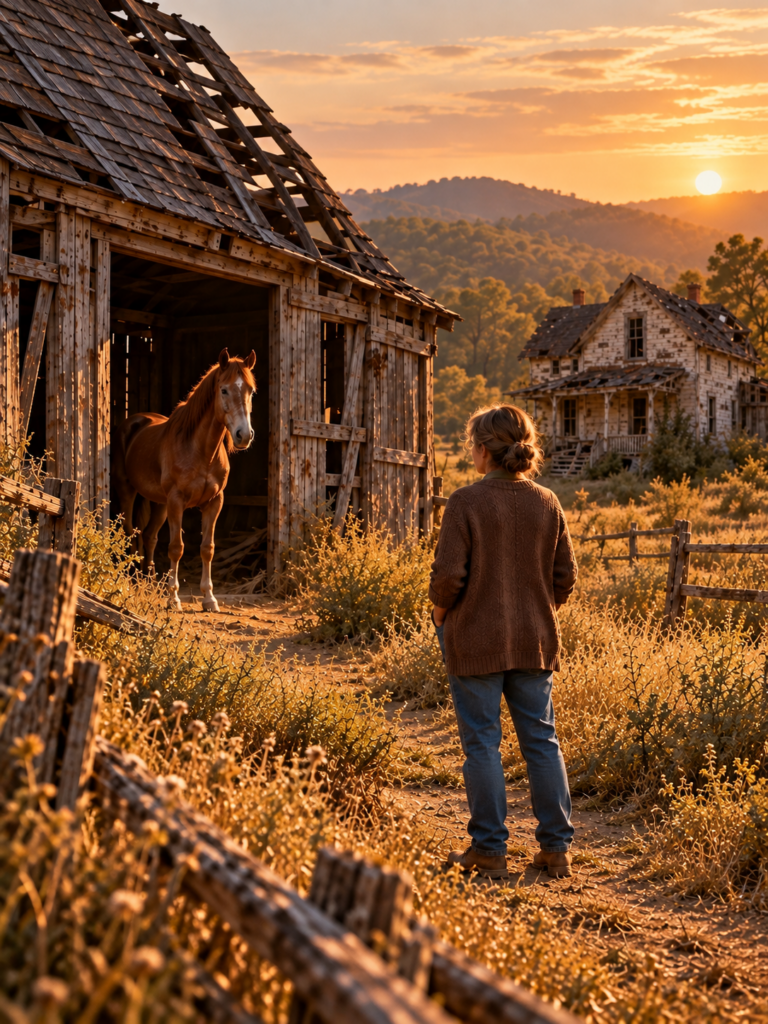
she bought a forgotten kentucky farm for one dollar—then found an old horse still waiting at the gate for the family who vanished ten years before
Part 1
Every evening, the old chestnut mare walked to the same broken gate and waited for somebody who did not come.
Nora Whitfield did not understand that on her first day at the farm.
All she knew was that she had paid one dollar for twelve acres of Kentucky weeds, a leaning farmhouse, a damaged stable, two collapsing fence lines, and enough deferred repair work to frighten nearly every sensible person in Millstone Creek.
At fifty-eight, Nora had learned that sensible people often had roofs over their heads.
That gave them the luxury of laughing.
She had spent twenty years moving from one rented room to another with a sewing machine strapped into the back of an aging station wagon. She mended work shirts for mechanics, shortened church dresses, replaced zippers in winter coats, repaired curtains, hemmed trousers, and occasionally made wedding dresses for women young enough to call her ma’am.
Her belongings fit into three suitcases.
She had a sewing basket that had belonged to her mother.
A coffee percolator with a cracked handle.
Two good quilts.
A folding cot.
And a round cookie tin hidden beneath her spare tire where she kept her savings.
On a strip of masking tape across the lid, she had written one word.
SOMEDAY.
For years, someday had meant a little house.
Nothing grand.
A porch.
A kitchen table.
A patch of earth where she could plant beans.
Maybe a room where she could leave fabric spread out overnight without having to fold everything away because a landlord was coming to inspect.
Maybe a place where she could unpack every suitcase.
At twenty-eight she had believed someday was coming soon.
At thirty-eight, she said she was still saving.
At forty-eight, she told herself freedom mattered more than ownership.
By fifty-eight, the word had begun to sound less like hope and more like an excuse.
Then she saw the notice pinned outside Beasley’s Grocery.
PROPERTY TRANSFER PROGRAM.
ABANDONED FARM.
RESTORATION REQUIRED.
OWNER OCCUPANCY REQUIRED.
PURCHASE PRICE: $1.
Most people passed it.
Two men near the ice machine stopped long enough to laugh.
“One dollar,” one said.
“They ought to pay somebody to take it.”
The other man snorted.
Nora waited until they walked away.
Then she read the notice twice.
An hour later she was sitting across from Orson Pike at the county clerk’s office.
Orson wore thick glasses and the expression of a man who had seen optimism create paperwork.
He spread photographs across his desk.
“Before we get any further, Mrs. Whitfield, you need to understand that the dollar is not the expensive part.”
“Nora.”
He blinked.
“Excuse me?”
“You can call me Nora.”
Orson looked down at the file.
“Fine. Nora. The property was donated to the county after tax problems and abandonment. It is part of the restoration program. Whoever takes title agrees to live on the property and complete minimum repairs within the required period.”
“How long?”
He pointed to the paperwork.
“Primary safety repairs within twelve months. Structural stabilization first.”
Nora studied the photographs.
Sagging porch.
Broken gutters.
Water staining an upstairs ceiling.
Stable roof collapsed on one end.
Fence buried in honeysuckle.
Then she saw one picture of the kitchen.
The room was dark.
Cabinet doors hung crooked.
Linoleum peeled near the sink.
But the window frame had been painted yellow.
Bright yellow.
Not recently.
The paint was chipped.
Still, somebody had once chosen it.
Nora touched the edge of the photograph.
“Water and electricity?”
“Disconnected, but service can be restored.”
“Well?”
“Existing.”
“Condition?”
“Unknown.”
“Roof?”
“Leaks.”
“I can see that.”
Orson pushed his glasses higher.
“Most people look at these pictures and understand why nobody wants the place.”
Nora continued staring at the yellow window.
“I see a kitchen.”
Orson waited.
She finally looked at him.
“Who lived there?”
“Family left years ago. Property changed hands after that. Nobody stayed long.”
“Why?”
He hesitated.
“Repairs mostly.”
“Mostly?”
Orson sighed.
“You’re reading too much into it.”
“I was a seamstress before I was old enough to drive. Reading what people leave unsaid is half the work.”
That almost made him smile.
He turned the contract toward her.
“Read every condition.”
She did.
Every page.
Every deadline.
Every penalty.
Every clause allowing the county to reclaim the property if she abandoned it or failed to make reasonable progress.
Then she drove back to her rented room, opened the cookie tin, and counted the someday money.
It was not much.
Enough to begin.
Not enough to make mistakes carelessly.
That frightened her.
The following morning, Nora Whitfield signed her name.
She placed one dollar on Orson Pike’s desk.
He looked at the bill.
Then at her.
“You understand this could swallow every cent you’ve saved.”
Nora folded the ownership papers into her purse.
“Then I suppose I’d better make sure it chews slowly.”
Her station wagon groaned into the farm drive just after noon.
The lane was barely visible beneath weeds.
Branches scraped both sides of the car.
At the end stood the farmhouse.
It was worse than the photographs.
The porch leaned toward the left.
One shutter hung from a single hinge.
Honeysuckle had wrapped itself around the rail.
The front steps had separated from the porch by nearly two inches.
Grass reached Nora’s knees.
She switched off the engine.
For several moments she did not move.
This was the moment sensible people were supposed to regret everything.
Nora looked at the house.
The house looked back in the way abandoned places sometimes seemed to.
Tired.
Waiting.
She opened the car door.
“Well.”
Wind moved through the weeds.
“I’ve lived in worse.”
That was not entirely true.
Inside smelled of damp wood, plaster dust, mouse droppings, and closed windows.
Nora opened the kitchen first.
There it was.
The yellow frame.
Sunlight passed through dirty glass and laid a warm rectangle across the floor.
Nora carried in her sewing machine and set it on the old table.
The legs were uneven.
She folded a scrap of cardboard beneath one.
Then she stood back.
“You and me.”
A hollow knock came from behind the house.
Nora turned.
Another knock.
Not the house settling.
Something hitting wood.
She stepped outside.
A path disappeared through weeds toward the stable.
One end of the roof had collapsed inward.
Daylight showed between boards.
Nora approached carefully.
“Hello?”
Movement inside.
A horse stood beneath the surviving section.
Chestnut.
Old.
Gray around the muzzle and eyes.
Thin through the hips.
One ear carried a small notch.
The mare rested her nose against the latch of an empty stall.
Nora stopped in the doorway.
“Well, aren’t you a surprise.”
The horse turned one eye toward her.
Nora kept her distance.
She knew almost nothing about horses beyond the ordinary rules.
Do not approach fast.
Do not stand directly behind one.
Do not assume something large and quiet cannot hurt you.
“Where’s your person?”
The mare lowered her head.
Nora saw the trough.
Water.
A little hay.
Somebody had been here.
A brush leaned against a wall.
Fresh hoofprints crossed muddy ground.
That made the mare’s thinness more troubling.
She walked slowly toward a peg.
A leather halter hung there.
Cracked with age.
A brass plate was fastened near the cheekpiece.
BELLE.
Nora touched the name.
Boots scraped behind her.
She turned sharply.
An elderly man stood near the stable entrance carrying a sack of feed.
“Didn’t mean to scare you.”
Nora pressed a hand to her chest.
“You succeeded.”
“Sorry.”
He shifted the sack.
“I’m Hollis Vann. Across the creek.”
He was in his seventies, perhaps older, with a sun-browned face and a permanent tilt caused by favoring one leg.
Nora pointed toward Belle.
“Is she yours?”
Hollis shook his head.
“Town didn’t tell you?”
“No.”
He muttered something beneath his breath.
“What?”
“I said they should’ve.”
Nora waited.
Hollis lowered the feed sack.
“Neighbors have been seeing to her since the last owner left. Used to be a woman down the road handled most of it. She moved last year. I’ve been doing what I can.”
Nora looked at Belle’s narrow body.
“What you can isn’t enough.”
Hollis’s face changed.
Shame.
Nora regretted the words immediately.
His bad hip.
The feed sack.
The distance across the creek.
He knew.
“I didn’t mean—”
“You’re right.”
He looked toward Belle.
“Winter was hard. My hip got worse. I keep water in front of her. Hay. But I can’t do the trimming. Couldn’t get her seen proper.”
Nora softened.
“Vet?”
“Elspeth Mercer. Good one.”
“Call her.”
Hollis nodded.
“Tomorrow morning.”
Belle suddenly raised her head.
Her ears went forward.
A truck was approaching on the county road.
The mare walked out of the stable.
Nora and Hollis followed.
Belle crossed the yard with slow, careful steps.
She stopped at the front gate.
The truck came closer.
Her head lifted.
For one second she looked younger.
The truck passed.
Its tires hummed over the pavement.
Belle watched until the sound disappeared.
Then her ears lowered.
Nora looked at Hollis.
“What was that?”
He rubbed his hands together.
“She does that.”
“What?”
“Comes to the gate near sundown.”
“Why?”
“Couldn’t say.”
“Every day?”
“Whenever I’m here, yes.”
“For how long?”
Hollis looked toward the mare.
“Folks say years.”
Nora stared at Belle.
“Waiting for somebody?”
“Maybe.”
“You don’t know?”
“People tell stories after enough time passes. Best not trust all of them.”
Hollis picked up his feed sack.
“I’ll call Elspeth tonight.”
He drove away before dark.
Nora should have gone inside.
She had windows to cover.
A cot to assemble.
Buckets to place beneath roof leaks.
Instead she carried a folding chair to the gate.
Belle glanced at her.
Nora sat.
“Don’t mind me.”
The old mare faced the road.
Another car appeared.
Her ears rose.
It passed.
Then another.
Same thing.
Nora understood more than she wanted to.
She had spent years doing her own version of this.
Christmas in rented rooms.
Thanksgiving with the radio playing too loudly.
Birthdays when she checked the telephone twice even though nobody had promised to call.
A sister in Ohio had died six years earlier.
No husband.
No children.
Friends, yes.
Clients.
Women who hugged her at church.
People who liked her.
But liking someone was not the same as being expected at a table.
Nora had become skilled at saying she preferred independence.
Most days she believed it.
Some days she did not.
Darkness gathered.
She brought the old halter from the stable and laid it across her lap.
Near the buckle, a blue ribbon had been tied.
Faded almost white.
A tiny, uneven knot.
Nora touched it.
“You’ve been carrying somebody’s memory around longer than I have, haven’t you?”
Belle did not move.
When the last light disappeared, the mare turned.
She walked back toward the stable.
Nora followed with a flashlight.
Belle entered the empty stall and rested her nose near the latch.
No bedding.
No feed there.
Nothing.
Just an empty place.
“Everybody has one,” Nora whispered.
“A place they remember.”
That night she lay on her cot in the kitchen because the upstairs ceiling leaked.
Water dripped into a roasting pan.
Plink.
Plink.
Plink.
Nora had wanted quiet.
Instead she listened for the horse.
Part 2
Frost covered the weeds the next morning.
Hollis arrived shortly after eight with Dr. Elspeth Mercer.
The veterinarian was a sturdy woman in her sixties with gray hair escaping beneath a wool cap and a voice that seemed designed to calm animals and nervous owners in equal measure.
She did not walk straight at Belle.
She turned slightly sideways.
Held out a hand.
Waited.
Belle smelled her fingers.
“Good girl.”
Nora stood nearby twisting a loose thread around one finger.
“How bad?”
Elspeth examined Belle’s mouth.
“Old doesn’t mean bad.”
“I know.”
“Thin doesn’t mean hopeless either.”
“Can we help her?”
Elspeth checked her teeth.
“Yes.”
Nora released a breath.
“But slowly.”
The list became long.
Dental work.
Hoof trimming.
Parasite evaluation.
Weight monitored.
Feed increased gradually.
No sudden rich meals.
Fresh water.
Shelter repaired.
Bedding.
Movement as tolerated.
Patience.
Nora wrote every instruction down.
“How old?”
“Hard to know exactly. Mid-to-late twenties, perhaps.”
Nora looked at Belle.
“She goes to the gate every evening.”
Elspeth continued examining the mare.
“Horses like routine.”
“Could she remember someone?”
“Of course.”
“For ten years?”
Elspeth stood.
“Memory in animals is complicated. I won’t tell you exactly what she’s thinking because I don’t know.”
Nora appreciated that.
“But familiar places and patterns can last a long time.”
Belle turned toward the gate.
Elspeth smiled faintly.
“Whatever it means to her, it means something.”
Hollis helped Nora clear damaged boards from the safe part of the stable.
His hip forced him to stop twice.
The second time, he braced one hand against the wall and closed his eyes.
Nora dragged over a chair.
“Sit.”
“I’m fine.”
“I’ve heard men say that before.”
“Neither one of us ought to be doing this.”
“True.”
He lowered himself into the chair.
“Yet here we are.”
They smiled.
For the first week, Nora’s life narrowed into practical pieces.
Morning feed measured carefully.
Water.
Stable cleaning.
Brushing only when Belle welcomed it.
Sewing work at the kitchen table.
House repair when money allowed.
Food for herself.
Bills.
Then evenings at the gate.
Nora set up envelopes in a drawer.
HOUSE.
BELLE.
FOOD.
The house envelope remained thin.
Belle’s was thinner than Nora wanted.
She took every sewing job offered.
Beasley’s Grocery needed work shirts repaired.
A woman from church brought curtains.
Two boys needed school trousers hemmed.
Nora stitched beneath the yellow-framed window while rain found another opening above the kitchen.
Drip.
Stitch.
Drip.
Stitch.
One afternoon Orson Pike drove out.
Nora met him on the porch.
“You omitted something.”
He looked at the stable.
“I know.”
“The horse.”
“There was confusion regarding responsibility.”
“Convenient confusion.”
“The last owner surrendered the animal to the town when he left.”
“And nobody mentioned that when I bought the property.”
Orson rubbed his forehead.
“The paperwork should have.”
“It didn’t.”
He had no answer.
Nora pointed toward Belle.
“Who’s responsible now?”
“Technically the town unless—”
“No.”
Orson looked at her.
“Transfer her to me.”
He blinked.
“You want ownership?”
“I want it clear who is responsible.”
He studied her.
“The cost—”
“Do the paperwork.”
Two days later Nora signed.
Belle belonged to her.
The word belonged made her uncomfortable.
Living things were not furniture.
Still, the responsibility was now clear.
Nora had asked for it.
That mattered.
News traveled.
Millstone Creek had opinions.
At the hardware store, a man buying fence staples watched Nora count money for roofing nails.
“You’re the woman who took Calder Farm.”
“Whitfield Farm now.”
He chuckled.
“That place will swallow every penny you’ve got.”
Nora put the nails into a paper sack.
“Then I’d better keep sewing.”
The man was not wrong.
That afternoon, a carpenter gave Nora a roof estimate that made her stomach turn.
She sat at the kitchen table.
Rain tapped above.
The estimate lay in front of her.
Her someday savings had already shrunk.
Electric reconnect.
Water.
Veterinarian.
Feed.
Basic lumber.
Nails.
Tarps.
The roof could empty what remained.
She stared at the numbers.
Leaving was still possible.
Pack the machine.
Load the wagon.
Find another room.
Tell herself she had tried.
Nobody could accuse a fifty-eight-year-old seamstress of failing because she lacked enough money to rescue an abandoned farm.
Outside, Belle called.
Low.
Once.
Nora remained seated.
Again.
Softer.
She closed her eyes.
“Don’t.”
Another sound.
Nora stood.
Belle waited near the pasture opening.
Not the road.
The house.
Nora approached.
Belle reached her muzzle toward Nora’s sleeve.
Touched it.
Stayed.
Nora pressed her palm against the warm cheek.
No one else saw.
No music played.
No miracle occurred.
The roof still leaked.
The bills still existed.
But the tight feeling in Nora’s chest loosened.
“All right.”
Belle breathed.
“One more day.”
That became how Nora survived the farm.
Not with certainty.
One more day.
Sunday brought steady rain.
Nora spent the afternoon under the stable roof while Belle ate.
She began clearing an old cupboard buried behind rusted tools.
A cracked picture frame lay on the top shelf.
Nora wiped the glass.
A younger Belle stood beside a man and a little girl.
The girl was missing both front teeth.
A blue ribbon held her hair back.
Nora stared.
The color.
She reached for Belle’s old halter.
The faded ribbon tied near the buckle had once been that same blue.
Behind the girl and her father, a wooden star hung on the stall door.
Nora looked toward Belle’s empty stall.
Two nail holes remained.
Around them, a lighter outline in the wood.
Star-shaped.
Nora carried the photograph inside and telephoned Hollis.
“Everett Calder,” he said after she described it.
“And the girl?”
“Leora.”
“Where are they?”
Silence.
“Hollis?”
“Everett died.”
Nora looked at the photograph.
“When?”
“Years ago.”
“The girl?”
“Left before that, I think. Or around then. My sister knew more. I wasn’t living across the creek yet.”
“Where did Leora go?”
“Relative somewhere.”
“You don’t know?”
“No.”
Nora frowned.
“What happened?”
“Bad winter. Couldn’t keep the house heated. Everett lost his wife before that. Debt. Work dried up.”
Hollis paused.
“Nora.”
“Yes?”
“Don’t build a story from town talk.”
She looked at Belle.
“I won’t.”
After the call, Nora returned to the stable.
She searched the cupboard more carefully.
Behind the top shelf, she found a tin box.
Inside lay the wooden star.
A child’s drawing.
And letters tied with string.
Several envelopes bore the farm address.
RETURN TO SENDER.
Nora sat on an overturned bucket.
The first letter was dated ten years earlier.
Dear Daddy,
You said we would go back before she forgot us.
Nora stopped.
Outside, an engine approached.
Belle’s head rose.
The sound passed.
The mare lowered her head again.
Nora returned to the page.
Leora wrote about school.
About an aunt’s apartment.
About missing apples sliced thin because Belle liked them that way.
She asked whether Belle still feared thunder.
She reminded her father that the stable door needed a new lower hinge.
At the bottom of the page were three crude figures.
Man.
Girl.
Horse.
Standing beside a gate.
Nora read another.
Then another.
The rest of the box explained what hope had hidden.
Everett’s wife had died after a long illness.
Medical bills followed.
Then a bitter winter froze the farmhouse pipes.
The furnace failed.
Everett sent seventeen-year-old Leora to stay with his sister Dorothea.
He left temporarily for machinery work two counties away.
A neighbor agreed to care for Belle.
Everett wrote that his first spare wages would go toward bringing Leora home.
The next document was a hospital notice.
Industrial accident.
Nora read the date twice.
Everett had died from his injuries.
Dorothea’s note explained the returned letters.
For months afterward, Leora kept writing to the farm.
Not because she believed her father would answer.
Because sending words to the last place they had lived together was easier than writing them nowhere.
Eventually Dorothea collected the returned letters.
Years later, she brought them back to the farm with relatives and hid them in the stable cupboard, hoping a future owner might preserve them.
She asked about Belle.
Someone told her the horse was cared for.
For a while, perhaps she was.
Then responsibility thinned.
Owner after owner.
Neighbor after neighbor.
A bucket.
Some hay.
Enough to remain alive.
Not enough to thrive.
Nora held the photograph.
Belle waiting at the gate was no longer a charming mystery.
Somebody had told a child they would come back.
Then death prevented it.
The horse could not know death.
Could not understand debt.
Could not understand distance.
She knew only that people had once left through that gate.
Perhaps every evening she still listened.
Nora returned to the kitchen.
Under Dorothea’s name was an old telephone number.
Disconnected.
There was also a return address.
Nora found stationery.
She wrote slowly.
My name is Nora Whitfield. I recently took ownership of the Calder farm outside Millstone Creek…
She described the letters.
The photograph.
The star.
Then stopped before the final sentence.
She looked out the yellow window.
Belle grazed near the stable.
Nora wrote:
Belle is still here. She is old, but she is receiving veterinary care and doing better.
She sealed the envelope.
Waiting for an answer did not stop the roof from leaking.
Hollis found a carpenter willing to trade.
He needed curtains made for his wife’s small boardinghouse.
Nora needed a roof patch.
“How many curtains?” she asked.
“Eighteen.”
Nora stared.
“That’s robbery.”
“He said twenty.”
“Tell him sixteen.”
Hollis laughed.
They settled on seventeen.
Nora sewed late under a borrowed work lamp.
Her shoulders ached.
At midnight the needle blurred.
She stopped.
Went outside.
Belle lay in fresh bedding.
Nora stood quietly at the stall.
“You’re expensive.”
Belle flicked one ear.
“Don’t look innocent.”
Nora went back inside.
Spring gradually loosened winter’s grip.
Belle’s coat shed in clumps.
Her hooves improved.
Her weight rose.
Her steps steadied.
One morning she greeted Nora with a low nicker before breakfast.
Nora smiled all day.
Evenings remained unchanged.
Belle walked to the gate.
Waited.
Nora waited beside her.
Fourteen days after the letter went out, Nora found an envelope in the mailbox.
A man named Philip Dawson had received the forwarded message.
Dorothea had been his mother.
She had died the previous year.
But he knew where Leora lived.
He would pass Nora’s letter along.
No promise beyond that.
Nora placed the envelope beside the old photograph.
Then returned to sewing.
Hope, she had learned, could become another form of waiting if a person was not careful.
So she worked.
Far away, in a small apartment above a laundry, a twenty-seven-year-old woman opened a letter from a stranger.
She read one sentence five times.
Belle is still here.
For ten years, Leora Calder had protected herself by believing the horse was gone.
Gone was terrible.
Uncertainty was worse.
At eighteen she depended on Dorothea for rides, money, a room.
Later she got work.
Then her own apartment.
She could have searched.
That was the truth she hated.
Nobody had physically prevented her.
She had postponed.
One winter.
Then one spring.
Then another.
Because returning meant facing the farm without her father.
It meant discovering Belle might be dead.
It meant learning that home had continued without her.
So she stopped asking.
Until Nora’s letter arrived.
Leora sat until darkness covered the window.
Then she put her car keys beside the envelope.
Part 3
The blue car arrived on a Saturday morning.
Nora was carrying an empty feed bucket.
The sound of tires on gravel made Belle lift her head.
Nora looked toward the road.
A young woman stood beside the car.
Plain brown coat.
Dark hair pulled back.
One hand gripped Nora’s letter.
“Mrs. Whitfield?”
“Nora.”
The woman’s eyes were already moving past her.
“Leora?”
She nodded.
“I meant to call.”
Nora set down the bucket.
“You don’t need an explanation.”
“I should’ve—”
“You drove here.”
Leora looked toward the stable.
Nora opened the gate.
“Come on.”
They crossed the yard.
Halfway there, Leora stopped.
Belle stood beneath the stable doorway.
Sunlight touched the chestnut coat.
Gray showed heavily around her face now.
Leora’s hand rose to her mouth.
“Oh.”
Belle looked toward her.
Leora’s face crumpled.
“You’ve gotten old.”
Nora stepped back.
Silence held.
Then Leora made a soft clicking sound with her tongue.
Belle’s ears moved forward.
Leora whispered, “Come here, my Sunday girl.”
The sound Belle made was unlike anything Nora had heard.
Not the low breakfast nicker.
Not the call from the pasture.
Deep.
Immediate.
The mare stepped out.
Age slowed her.
One careful step.
Then another.
Leora did not move.
Tears ran down her face.
Belle crossed the yard.
Reached her.
Leora put both hands around the old muzzle.
Belle breathed against her cheek.
Then pressed beneath her chin.
Leora broke.
“I’m sorry.”
She buried her face in the chestnut mane.
“I’m sorry. I’m sorry.”
Her fingers found the notch in Belle’s ear.
“I asked about you. I did. Then I stopped asking.”
Belle stood.
No judgment.
No explanation.
Hollis’s truck appeared at the gate.
He climbed out carrying feed.
Saw Leora.
Stopped.
His eyes filled.
Nora righted the overturned bucket because she needed something ordinary to do with her hands.
Leora continued murmuring into Belle’s mane.
“Forgive me.”
Nora wanted to tell her animals did not keep moral ledgers.
Wanted to tell her seventeen-year-old girls were allowed to be overwhelmed by grief.
Wanted to say ten years was both long and short.
She said nothing.
Some reunions did not need witnesses explaining them.
Leora remained until sunset.
She and Belle stood at the gate together.
The old mare still faced the road at first.
Then Leora rested one hand on her neck.
When darkness came, they walked back toward the stable.
Later, Leora stood on Nora’s porch.
“Could I stay until morning?”
Nora looked toward the upstairs windows.
One room did not leak anymore.
She had a clean quilt still folded in a suitcase.
For twenty years, Nora had kept spare things packed for moving.
Now she imagined unfolding one for someone arriving.
“Yes.”
Leora’s shoulders dropped.
“We’ll make room.”
Nora prepared the upstairs bed.
Leora stood uncertainly in the doorway.
“You don’t have to fuss.”
“I’m not fussing.”
“You’re tucking the corners.”
“That’s called making a bed.”
Nora left the hallway light on.
She did not ask whether Leora wanted it.
Breakfast meant two coffee cups beside the stove.
Nora brought down a second chair.
It rocked on one short leg.
Leora folded cardboard beneath it.
“There.”
Nora looked at the chair.
“Useful woman.”
“My father taught me.”
The room became quiet.
Outside came the scrape of Belle grazing.
Leora wrapped both hands around coffee.
“I was seventeen.”
Nora waited.
“That picture was taken years before we left. Daddy made the stall into a little place for me when I was small.”
“The star?”
Leora smiled sadly.
“He cut it from scrap wood. I painted it crooked.”
“Looks straight enough.”
“It wasn’t.”
Leora looked through the yellow window.
“Belle used to come to the stall door while I sat on a stool and did schoolwork.”
“The letters were later?”
Leora nodded.
“After Mom died.”
She took a breath.
“After Daddy died, writing to the farm was the closest thing I had to talking to him.”
Nora set down her mug.
“Your aunt kept them.”
“I didn’t know.”
“She brought them back later.”
Leora’s eyes filled.
“Aunt Dorothea tried.”
“I believe that.”
“She was grieving too.”
Leora looked down.
“When I got old enough to search for myself, I kept putting it off.”
Nora said nothing.
“That’s the part nobody did to me.”
Leora’s voice shook.
“I did that.”
Nora rested one hand beside hers.
“You’re here now.”
Leora cried quietly.
By the next weekend, she returned wearing work gloves.
She brought groceries.
The weekend after that, more tools.
Soon Nora found herself listening for the blue car.
Leora had a job two towns away and an apartment above a laundry.
The commute was possible but tiring.
Then June Bell, who ran the Millstone Creek feed store, needed help.
Leora applied.
Two weeks later, she carried two boxes and a suitcase upstairs.
Nora stood in the hall.
“That everything?”
“Almost.”
“Where’s the rest?”
“Car.”
They made three trips.
On the fourth, Leora carried in another suitcase.
Nora pointed.
“Put it under the bed.”
Leora looked at her.
Nora paused.
For years every suitcase Nora owned had lived partly packed.
Ready.
She looked toward her own bedroom.
Then back at Leora.
“No.”
Leora waited.
Nora smiled.
“Unpack it.”
That afternoon drawers opened and closed upstairs.
Hangers clicked.
Shoes appeared beneath the bed.
For the first time in decades, Nora unpacked all three of her own suitcases too.
The empty cases went into the attic.
The sight made her unexpectedly nervous.
No quick escape.
No proof she could leave within an hour.
That night, she sat at the kitchen table.
Leora came downstairs.
“You okay?”
Nora laughed.
“I put my suitcases in the attic.”
Leora waited.
“That sounds good.”
“It feels reckless.”
Leora smiled.
“Maybe staying is reckless.”
“Maybe.”
“Want me to put one back downstairs?”
Nora thought.
“No.”
Healing did not arrive cleanly.
Leora had mornings when dreams about Everett sent her to the stable before sunrise.
She would sit outside Belle’s stall and talk quietly.
Nora never listened unless invited.
Nora had her own habits.
She counted money twice before buying anything for herself.
Sometimes three times.
She still cut worn towels into rags rather than replace them.
A ten-dollar purchase could send her into an hour of doubt.
Leora noticed.
One afternoon she found Nora holding a new pair of work gloves at the store.
“You need them.”
“Old ones have life.”
“They have two fingers.”
“Three.”
“One barely counts.”
Nora stared at the price.
Leora said, “House envelope?”
“Food.”
“Your hands are food.”
Nora frowned.
“That sentence makes no sense.”
“Buy the gloves.”
Nora did.
The farm slowly changed.
Flowers appeared beside the steps.
The porch straightened.
The worst roof sections were repaired.
The yellow kitchen frame received fresh paint in almost the same color.
Nora refused brighter yellow.
“Too cheerful.”
Leora laughed.
Hollis helped when his hip allowed.
Sometimes he came merely for coffee.
Belle gained weight.
Her coat improved.
She still walked to the gate each evening.
Now Leora often went with her.
Some habits were not cured by reunion.
They changed meaning.
Belle no longer seemed to be waiting alone.
One afternoon Dr. Elspeth Mercer arrived for a checkup.
After examining Belle, she leaned against the fence.
“I have a question.”
Nora immediately distrusted the tone.
“No.”
Elspeth laughed.
“I haven’t asked.”
“I know what animal people sound like before they ask somebody to take another animal.”
Leora laughed from the water trough.
Elspeth shook her head.
“Old gelding. Amos.”
“No.”
“Owners moved.”
“No.”
“Temporary care now.”
“We can barely afford Belle.”
“I know.”
“Then why tell us?”
“Because you might want time to consider. Not because you should say yes.”
That mattered.
Nora looked toward Belle.
“How urgent?”
“Not emergency. But his current situation won’t last indefinitely.”
Nora sighed.
“You’re dangerous.”
“Think about it. No promise.”
That night bills covered the kitchen table.
Nora and Leora counted everything.
Feed.
Hay.
Vet.
Farrier.
Roof.
Taxes.
Electricity.
Emergency reserve.
Fence materials.
Nora circled numbers.
“Good intentions won’t feed him in February.”
Leora nodded.
“We need steady hay delivery.”
“Separate space at first.”
“Vet reserve.”
“Fence.”
“Somebody besides us who can help.”
Leora stared at the total.
“We start small.”
“We already started.”
“You know what I mean.”
Nora did.
They could not become the kind of people who promised care first and figured out the consequences later.
Everett’s letters had taught them how quickly life could interrupt good intentions.
A promise needed structure.
Nora took another envelope from the drawer.
She wrote HORSES across the front.
For six weeks, they prepared.
Hollis found used fencing.
A carpenter donated leftover lumber.
Elspeth advised on separate turnout.
Leora arranged regular hay delivery.
Nora accepted quilt orders for winter.
Neighbors offered help.
Nora was suspicious of offers at first.
Years of self-reliance had made receiving feel dangerous.
Then one Saturday a church group arrived to set posts.
Nora stood with coffee while six people worked.
She whispered to Hollis, “What do they want?”
“Breakfast, probably.”
“I’m serious.”
“So am I.”
“They just came.”
“People do that.”
Nora looked at him.
“In your world.”
Hollis leaned on his cane.
“Could be yours.”
By August, Amos arrived.
An elderly bay gelding.
Head lowered.
Quiet.
When he stepped from the trailer, Belle called from the adjoining pasture.
His ears lifted.
They did not force an introduction.
For days the horses watched each other through fencing.
Then grazed near the same boundary.
Then rested within sight of one another.
No dramatic friendship.
Slow trust.
Nora understood that.
The idea of a sanctuary began with conversation.
Not fantasy.
Could they help more old horses?
Maybe.
Should they?
Only if numbers allowed it.
They researched paperwork.
Insurance.
Feed costs.
Veterinary requirements.
Volunteer schedules.
Land limits.
The word limit became important.
One afternoon, a man called about three neglected horses.
Nora wanted to say yes.
Leora looked at the feed ledger.
“No.”
Nora stared.
“Could make room.”
“Where?”
“Back pasture.”
“Fence needs work.”
“We fix it.”
“With what money?”
Nora became angry.
Not at Leora.
At reality.
“We can’t leave them.”
“We can help find somewhere.”
“What if nobody takes them?”
Leora’s eyes filled.
“Then saying yes doesn’t create hay.”
Nora looked away.
“A promise has to fit what we can do.”
Leora’s voice broke.
“Otherwise we’re just another person who means well until the feed runs out.”
Nora sat on the porch afterward and cried.
Leora sat beside her.
They found another rescue with room.
It did not feel like enough.
Maybe responsible care often felt inadequate because need was larger than any one person.
Nora began to understand that too.
In October, Orson Pike returned for the restoration inspection.
He stepped onto a porch that no longer shifted.
Checked the rail.
Looked at the repaired ceiling.
Tested the water.
Reviewed receipts.
Then stood in the kitchen.
Sunlight passed through the yellow window.
He looked around.
“You met the requirements.”
Nora had not realized how tense she was until her lungs emptied.
“All of them?”
“Primary requirements, yes.”
He signed.
At the door, Orson rested one hand against the frame.
“I was wrong about this place.”
Nora smiled.
“It needed work.”
“So did my opinion.”
Outside, Belle and Amos stood beneath the oak.
Leaves drifted around their feet.
Nora watched them.
The farm no longer felt like something she had purchased.
It felt like something they had agreed to keep becoming.
Part 4
The following spring, a local newspaper printed Belle’s story.
Leora agreed only after the reporter promised not to turn it into a fairy tale.
“No horse waited exactly ten years at one gate without doing anything else,” Leora said.
The reporter smiled.
“I understand.”
“No, I’m serious.”
Nora hid a laugh.
Leora pointed toward Belle.
“She’s a horse. She ate. Slept. Got stubborn. Got old. She wasn’t standing there like a statue every day.”
The reporter lowered his notebook.
“Then what matters?”
Leora looked toward the road.
“She kept going back.”
That line became the heart of the article.
People responded.
Not with fortune.
With practical things.
Fifty dollars for hay.
Three feed tubs.
Fence boards.
Buckets.
A stack of blankets.
A retired teacher mailed twenty-five dollars and wrote, For the old ones nobody planned for.
Nora kept every note.
She answered each with a handwritten thank-you.
Leora created a ledger.
Donations in.
Expenses out.
Hay.
Vet.
Farrier.
Repairs.
Nothing guessed.
Nothing hidden.
On Saturdays, volunteers came.
Before touching feed, they learned the routine.
No dumping extra grain because an old horse looked hungry.
No feeding treats without asking.
No entering pastures alone if inexperienced.
No children behind horses.
No promises without checking the schedule.
Nora became stricter than anyone expected.
The hardware-store man who had warned her the farm would swallow every penny arrived one afternoon carrying two feed tubs.
He stood beside his truck.
“Looks like the place hasn’t swallowed you yet.”
Nora grabbed one handle.
“Give me a hand before it changes its mind.”
He laughed.
Above a bench near Belle’s stall, Leora hung the wooden star Everett had made.
Beside it went the childhood photograph.
The blue ribbon was protected behind glass.
The letters stayed inside the house.
Private.
Not everything needed display.
At the first open afternoon, children gathered near the pasture.
Volunteers showed them how to hold a flat palm.
Belle carried no riders.
Nora refused.
“She’s earned retirement.”
A little boy asked, “What does she do?”
Nora looked toward the mare.
“Whatever she wants.”
The boy considered this.
“That’s a good job.”
“Best one here.”
By late afternoon visitors left.
Golden light spread across the fields.
Leora stood beside Belle at the gate.
She rested her cheek against the mare’s neck.
“Do you think Daddy would understand?”
Nora leaned on the rail.
She had learned not to answer the dead too confidently.
“I think he’d be glad you came back through the gate.”
Leora nodded.
Belle faced the road.
For a while, all three watched it.
Then Leora clicked softly.
“Come along, my Sunday girl.”
Belle’s ear turned.
Then her head.
Then her whole body.
They walked toward the stable at the mare’s pace.
Nora closed the gate.
Supper waited in the house.
Two people at the table.
Animals who recognized footsteps.
A roof that mostly held.
Mostly.
That winter tested their planning.
Cold came early.
Hay prices rose after a poor cutting season.
A water line froze near the stable.
Amos developed a hoof abscess.
Belle lost appetite for two days.
Nora barely slept.
Elspeth came twice.
“It’s manageable.”
Nora crossed her arms.
“You say that too calmly.”
“Because panic isn’t treatment.”
Leora brought warm mash.
Belle began eating again.
The crisis passed.
But the sanctuary account dropped dangerously low.
Nora opened her sewing calendar.
Already full.
She added more.
Leora noticed.
“You can’t sew fourteen hours a day.”
“I’ve done worse.”
“You were younger.”
Nora glared.
Leora waited.
Nora sighed.
“I hate when people use age against me.”
“I’m using shoulders against you. Your shoulders hurt.”
They sat at the kitchen table.
Again.
Numbers.
Always numbers.
Leora suggested a winter fundraiser.
Nora hated asking publicly for money.
“We accepted donations.”
“That’s different.”
“How?”
“They offered.”
Leora leaned back.
“You’d rather work yourself sick than say what we need.”
“I’ve paid my way my whole life.”
“So?”
“So I don’t beg.”
Leora’s expression hardened.
“Calling it begging doesn’t make you noble.”
Nora stared.
Leora immediately looked guilty.
But did not take it back.
“People want to help.”
Nora stood.
“I need air.”
She went to the stable.
Belle stood inside chewing hay.
Nora rested her forehead against the doorframe.
Anger burned.
Underneath it, shame.
Asking meant exposure.
Exposure meant somebody could say no.
Sewing harder meant control.
Her mother had raised three children after Nora’s father left.
Never asked.
Worked until her hands bent permanently.
Nora had admired that.
Had copied it.
Now she wondered how much of what she called independence was fear of being refused.
Hollis found her there.
“Leora sent you?”
“No.”
He lowered himself onto a bucket.
“She sent me.”
Nora almost laughed.
“Traitor.”
“Apparently.”
He rubbed his bad hip.
“You know why I couldn’t take proper care of Belle?”
“Your hip.”
“Partly.”
Nora looked at him.
“What’s the rest?”
“I didn’t ask enough.”
Silence.
“When Mary Fowler moved away, I figured I’d manage. Hay, water. Then winter came. Hip went bad. I still figured I’d manage.”
He stared at the floor.
“Shame made that horse thinner than she should’ve been.”
Nora’s anger left.
Hollis continued.
“Didn’t want folks thinking I couldn’t handle things.”
Nora looked toward Belle.
Hollis smiled sadly.
“Pride’s expensive.”
The fundraiser happened.
It was modest.
Church basement.
Soup.
Cornbread.
Auctioned quilts.
Local music.
Children decorated paper horses.
Nora stood by the door feeling uncomfortable for the first hour.
Then an elderly woman handed her ten dollars.
“My husband died last year.”
Nora started to refuse.
The woman closed Nora’s hand around the bill.
“Let me decide.”
The words struck.
Nora accepted.
“Thank you.”
By the end of the evening, they had enough for the winter hay reserve and veterinary cushion.
Not a fortune.
Enough.
Nora went home exhausted.
Leora counted receipts.
“See?”
Nora pointed.
“Don’t become insufferable.”
“Too late.”
The sanctuary eventually took one additional horse.
Only one.
A gray mare named Tilly whose elderly owner entered long-term care.
Before accepting her, Nora and Leora waited three months.
Regular donations had to cover cost.
Another volunteer committed to mornings.
Fence work completed.
Emergency reserve restored.
They wrote their maximum capacity inside the feed cupboard.
THREE RESIDENT HORSES UNTIL RESOURCES CHANGE.
Visitors occasionally urged them to take more.
Nora pointed at the sign.
“No.”
“But you have land.”
“Land doesn’t buy hay.”
“You could ask for more donations.”
“We don’t promise with money we don’t have.”
Some people thought that sounded cold.
Nora let them.
Compassion without limits could become another form of neglect.
She had seen Belle’s narrow hips.
She would not repeat it.
Years passed gently.
Not easily.
Gently.
Hollis’s hip worsened.
Eventually he stopped crossing the creek alone.
Leora and Nora brought supper.
He complained about the portions.
They ignored him.
Orson retired from the county office.
At his farewell gathering, he told everyone Nora’s one-dollar farm had created more paperwork than some commercial developments.
She took it as praise.
Belle aged.
Gray spread across her face.
She moved more slowly.
Her teeth required extra care.
Some mornings she stood stiff until sunlight warmed her.
Leora adjusted expectations.
No long walks.
No pressure.
No demand that reunion make an old body young.
One autumn evening, Belle did not go to the gate.
Leora noticed immediately.
She found the mare resting beneath the oak.
Nora came out.
“Something wrong?”
Leora knelt near the fence.
“Maybe.”
Elspeth arrived after dark.
She examined Belle.
Nothing catastrophic.
Age.
Arthritis.
A tired day.
“Watch her.”
Leora remained in the stable until nearly midnight.
Nora brought a blanket for herself.
“You don’t have to stay.”
“I know.”
They sat together.
Around ten, Belle stood.
Slowly.
She ate a little hay.
Then took several steps.
Leora cried with relief.
Nora pretended not to see.
The next evening, Belle walked to the gate again.
Not as far.
Not as long.
She stood perhaps ten minutes.
Then turned before any car came.
Leora watched.
“Maybe she isn’t waiting anymore.”
Nora looked at her.
“Maybe she’s tired.”
Leora smiled through tears.
“That too.”
Nora had learned to distrust beautiful explanations when ordinary ones were enough.
Still, something had changed.
Belle began spending more evenings near the stable.
Near Amos.
Near the house.
Near voices.
The road mattered less.
Or perhaps home mattered more.
Part 5
By the time Nora turned sixty-five, the farm no longer resembled the property in Orson Pike’s photographs.
The porch stood straight.
The roof held.
The yellow kitchen window remained yellow.
Not because yellow had magical meaning.
Because Nora liked it now.
The stable roof was repaired.
Fences were sound.
A small sign near the gate read:
CALDER-WHITFIELD RETIREMENT PASTURE
OLD HORSES. SMALL NUMBERS. CARE BEFORE PROMISES.
Leora had insisted Everett’s name remain.
Nora insisted hers come second.
They argued.
Hollis suggested alphabetical order.
Nobody listened.
The sanctuary stayed small.
That mattered.
People sometimes assumed success should mean expansion.
More horses.
More acreage.
More publicity.
Nora disagreed.
Success meant the animals they already had were cared for through February.
It meant hay before decorations.
Veterinary reserve before a new sign.
Volunteers trained before responsibility.
It meant saying no in time to keep previous yeses honest.
Leora married no one.
Neither did Nora.
People occasionally asked.
Both learned to answer with a look that ended the subject.
Leora eventually bought into the farm legally.
Not because Nora expected to disappear.
Because clarity mattered.
They sat with an attorney and created agreements.
Ownership.
Animal care.
What happened if Nora became ill.
What happened if Leora moved.
What happened after either died.
Nora hated discussing death.
Leora insisted.
“We learned what unfinished promises cost.”
Nora could not argue.
Belle lived long enough to see another four Kentucky springs.
Her final year, she rarely went to the gate.
Instead she waited near the stable at supper time.
If Leora was late, Belle stood facing the house.
One evening, Leora came home from work after sunset.
She crossed the yard carrying groceries.
Belle nickered.
Leora stopped.
“You waited for me.”
Nora stood on the porch.
The words entered both women differently.
Leora set down the grocery bag and walked to Belle.
Nora turned away.
Some moments deserved privacy.
Belle died in late summer.
Not suddenly.
Not in fear.
Elspeth had warned them weeks before that the mare was declining.
Eating became difficult.
Standing required more effort.
Pain medication helped until it no longer helped enough.
The day came when care and keeping alive stopped meaning the same thing.
Leora knew before anyone said it.
She sat in the kitchen with both hands around a cold cup of coffee.
Nora sat across from her.
“I can’t.”
Nora knew what she meant.
“Yes, you can.”
“No.”
“You can.”
Leora shook her head.
“I left her once.”
Nora’s voice became firm.
“This is not leaving.”
“It feels like it.”
“Then feel it.”
Leora looked up.
Nora’s own eyes filled.
“But don’t make her carry pain because you need more time.”
Leora covered her face.
Nora moved around the table and held her.
The veterinarian came that afternoon.
Belle lay beneath the oak.
Leora sat beside her.
Nora stayed nearby.
Hollis, now unable to walk the distance, watched from a chair they had driven across in the pickup.
Amos grazed in the adjoining field.
Leora stroked Belle’s gray face.
“Sunday girl.”
Belle breathed.
“You remember the apples?”
No answer.
Leora laughed through tears.
“Of course you remember apples.”
Nora looked toward the gate.
So many evenings.
Headlights.
Waiting.
Then reunion.
Then years.
Life did not repay lost time.
It gave different time.
That had to be enough.
When Belle was gone, Leora remained beside her for a long while.
Nobody rushed.
They buried the mare on the hill overlooking the pasture.
Not near the gate.
Leora chose the oak.
“She spent enough time facing the road.”
Nora nodded.
They placed no expensive marker.
Just a flat stone.
BELLE
HOME AGAIN
That night, the stable felt enormous.
Amos called once.
Then quieted.
Leora sat on the porch steps.
Nora brought two mugs of coffee.
Neither woman drank much.
“I thought when she died it would feel like losing Daddy again.”
Nora waited.
“It doesn’t.”
“How does it feel?”
“Like losing Belle.”
Nora nodded.
“That’s enough.”
Leora leaned her head against Nora’s shoulder.
The sanctuary continued.
Not because continuing erased grief.
Because care remained.
Tilly needed medicine.
Amos needed his morning feed.
Fence boards still broke.
Hay still arrived whether somebody’s heart hurt or not.
The next winter, Leora took the wooden star from the stable wall.
She cleaned it.
Then hung it over a bench near the entrance.
Underneath she placed a small framed copy of the photograph.
Belle.
Everett.
Young Leora.
The original stayed protected indoors.
Children who visited sometimes asked who they were.
Leora told the story without making anyone a villain.
Her father had tried.
Her aunt had tried.
Neighbors had helped incompletely.
She herself had stayed away longer than she wished.
Nora had found the letters.
Belle had survived.
Not perfectly.
Not because one heroic person saved everything.
Because enough people eventually accepted responsibility clearly.
That was the lesson Leora cared about.
One spring afternoon, a woman arrived at the farm.
Late sixties.
Recently widowed.
She had read Belle’s story years earlier.
She stood beside Nora near the fence.
“I sold my house.”
Nora looked at her.
“Why?”
“Too much.”
“Your choice?”
The woman smiled.
“Yes.”
Nora nodded.
“Then good.”
“My daughter keeps telling me I should live with her.”
“You want to?”
“No.”
“Then don’t.”
The woman laughed.
“I thought you’d say something more inspirational.”
Nora looked toward the horses.
“I’ve got stalls to clean.”
The woman volunteered twice a month after that.
Older people found the farm for reasons Nora never planned.
Widows.
Retired teachers.
Men who had lost spouses.
Women whose children lived far away.
Some came for horses.
Some came because animals did not ask whether a life had gone according to plan.
Nora noticed something.
People were willing to talk while doing chores.
A man would say almost nothing over coffee.
Give him a brush beside an old gelding and twenty minutes later he might tell you his wife had died in March and he still cooked too much oatmeal.
Nora did not turn the farm into therapy.
She disliked labels she could not afford to insure.
It remained what it was.
A small place.
Old horses.
People helping.
Sometimes that was enough.
Hollis died during Nora’s sixty-seventh year.
His nephew called before sunrise.
Nora sat on the edge of her bed after hanging up.
Leora found her there.
“Who?”
“Hollis.”
Leora closed her eyes.
They drove across the creek later.
His house smelled like coffee and woodsmoke.
On the kitchen table sat a folded paper addressed to Nora and Leora.
Inside he had written:
Don’t let them say I saved Belle. I kept her going some. You two gave her a life again. Also Nora still owes me for three fence posts.
Nora laughed so hard she cried.
They paid for three fence posts to be donated to another horse rescue in Hollis’s name.
At his funeral, Nora stood near the back.
People spoke about his work.
His wife.
His bad jokes.
His kindness.
Nobody mentioned his shame about Belle.
Nora was glad.
A person’s worst failing did not need to become the final sentence.
He had admitted it.
Learned.
Helped.
That mattered.
Years later, the old one-dollar transfer papers remained inside a drawer near Nora’s sewing machine.
The machine still worked.
So did Nora.
She reduced the number of outside jobs but never stopped sewing.
Clients brought clothes to the farm.
Sometimes they stayed to visit horses.
The someday tin remained too.
Nora kept it empty.
Leora once asked why.
Nora turned it over in her hands.
“Because someday happened.”
Leora smiled.
“Pretty sentimental.”
“Don’t repeat it.”
On Nora’s seventieth birthday, volunteers organized supper beneath the oak.
Nothing fancy.
Fried chicken.
Potato salad.
Beans.
Cake.
Nora complained about attention until the first plate arrived.
Children ran near the house.
Older volunteers sat in folding chairs.
Three horses grazed quietly.
Leora hung lanterns from the porch.
After dark, Nora stood near the gate.
The same gate.
Rebuilt, but in the same place.
Leora joined her.
“You thinking about her?”
“Belle?”
“Who else?”
Nora looked toward the road.
“First night.”
“You sat here with her.”
“Felt foolish.”
“Probably were.”
Nora nudged her.
Passing headlights appeared.
For a moment, Nora imagined old Belle lifting her ears.
Waiting.
Then she looked behind them.
The farmhouse windows glowed yellow.
People were laughing in the kitchen.
Someone called for more coffee.
A volunteer checked the feed board.
Leora stood beside her.
The mare had once taught Nora something she did not understand at the time.
Waiting was not always hope.
Sometimes it was habit.
Sometimes grief.
Sometimes the body returning to the last place where a promise had made sense.
Nora herself had waited for someday for twenty years.
She had imagined that someday would arrive as money.
Security.
A perfect little house.
Instead it arrived as a one-dollar wreck with a leaking roof and a starving old horse.
Nothing had gone according to the dream.
The farm was harder.
More expensive.
More crowded.
More painful.
And more alive.
Nora touched the repaired gate.
“Ready?”
Leora looked at her.
“For what?”
“People are eating my cake.”
Leora laughed.
“They bought it for you.”
“Exactly.”
They walked toward the house.
Halfway across the yard, Leora stopped.
Nora turned.
Above the stable bench hung Everett’s wooden star.
The photograph beneath it caught lantern light.
A child.
A father.
A younger chestnut mare.
Leora looked at it.
Then toward Belle’s hill.
“You think he would’ve been disappointed in me?”
Nora knew which he she meant.
“No.”
Leora waited.
Nora continued.
“You were seventeen.”
“I was twenty-seven when I came back.”
“Yes.”
“I could’ve come earlier.”
“Yes.”
Leora appreciated that Nora did not erase the truth.
“I was afraid.”
“Yes.”
“I wasted years.”
Nora looked toward Belle’s grave.
“Maybe.”
Leora’s eyes filled.
Nora took her hand.
“But the years you had afterward weren’t fake because they came late.”
Leora nodded.
Nora squeezed once.
“Late is not the same as never.”
They continued toward the house.
That became something people remembered about Nora Whitfield.
Not speeches.
She did not give many.
Not the one-dollar purchase.
Plenty of newspapers liked that detail.
Not even the sanctuary.
People remembered that Nora had little patience for grand conclusions.
If somebody said she had rescued the farm, she answered that the farm had also worked her half to death.
If somebody said Belle had waited ten years because she knew Leora would return, Nora said nobody could know exactly what a horse believed.
If somebody called the reunion destiny, Nora reminded them that a stranger had to open a cupboard, find letters, write an address, and put a stamp on an envelope.
Love mattered.
So did practical action.
That was Nora’s religion by then.
A feeling became meaningful when somebody did something with it.
A promise needed hay.
A home needed a roof.
An old horse needed a veterinarian.
A lonely woman needed to unpack her suitcase.
A grieving daughter needed to drive through a gate.
A sanctuary needed limits.
A neighbor needed to admit when his hip prevented him from doing enough.
A community needed to show up with fence boards instead of praise.
Years after Belle died, the gate still stood.
Sometimes horses waited there.
Not for ghosts.
For the feed truck.
For a volunteer.
For Leora’s car.
For Nora walking slowly from the house carrying sliced apples.
One autumn evening, Nora stepped onto the porch wearing a cardigan against the cold.
Her knees bothered her now.
She used the railing.
She had once imagined age would mean becoming dependent in ways she feared.
Instead, age had taught her to distinguish dependence from belonging.
Dependence meant one person held all the power.
Belonging meant people carried different pieces.
Leora handled feed orders.
A volunteer repaired fencing.
Nora kept books.
Elspeth’s younger partner handled veterinary care.
Neighbors checked during storms.
Nobody did everything.
That was why things lasted.
Nora crossed the yard.
At the gate, Leora stood beside an elderly gray mare they had accepted the previous spring.
“She likes the road.”
Nora leaned on the fence.
“Maybe she likes watching.”
“Maybe she’s waiting.”
“For what?”
Leora smiled.
“Could be anything.”
Nora looked down the road.
Headlights appeared around the bend.
The gray mare lifted her head.
The vehicle slowed.
Turned into the drive.
A young volunteer stepped out carrying two feed bags.
The mare nickered.
Nora laughed.
“There’s your mystery.”
Leora opened the gate.
Together they carried the bags toward the stable.
Inside the kitchen, supper warmed.
Nora’s sewing machine rested beside the yellow window.
The someday tin sat empty in its drawer.
The old halter with Belle’s brass nameplate hung above the back door.
Not as a shrine.
As a reminder.
Once, a horse had waited at a broken gate for a family that could not return.
Then a woman with no permanent home bought the farm for one dollar.
She found the horse.
She found the letters.
She found the daughter.
And eventually, without quite noticing when it happened, she found herself surrounded by something she had stopped believing belonged to her.
A place at a table.
People who noticed when she was late.
Animals who knew her footsteps.
Neighbors who came through the gate without needing to be invited twice.
Work worth doing tomorrow.
Home.
That evening, Nora paused before closing the stable.
She looked toward the hill beneath the oak.
“Good night, Belle.”
Wind moved through dry grass.
No answer came.
None was needed.
Ahead, Leora opened the kitchen door.
Warm light spread across the yard.
“Nora?”
“Coming.”
She fastened the latch.
Then crossed the dark yard toward the people waiting inside.

