
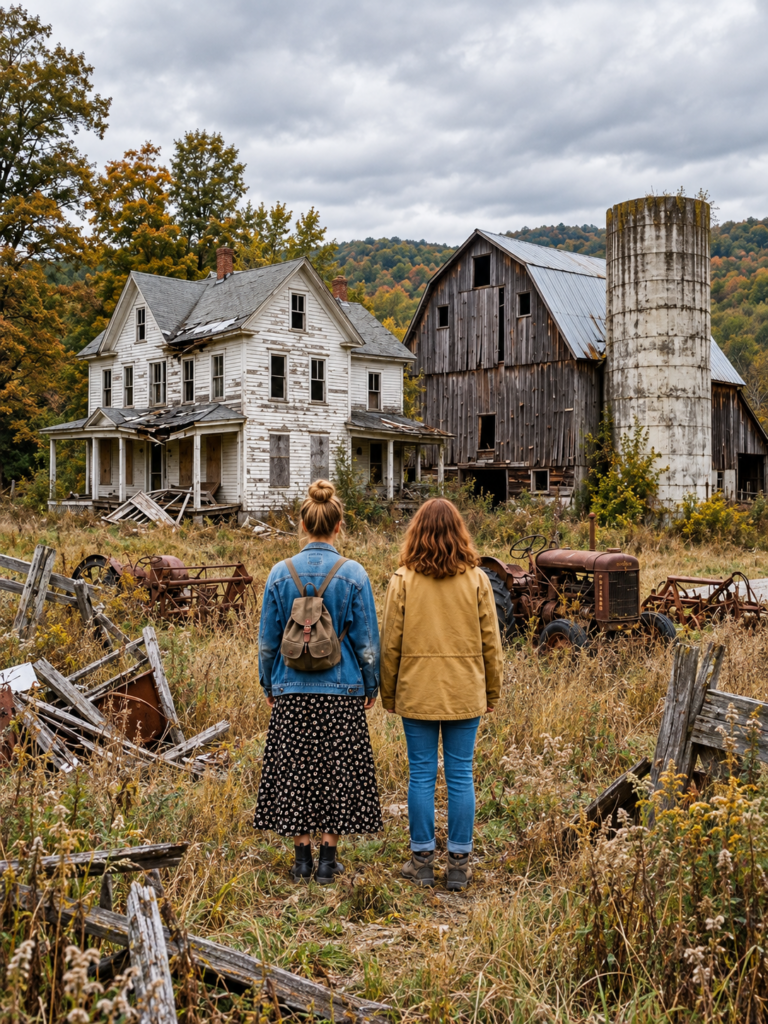
two homeless sisters inherited a dying dairy farm everyone wanted seized — then they found what their uncle had hidden beneath the old silo
Part 1
By the time Chloe Reed turned nineteen, she knew exactly how long a Honda Civic could idle before a quarter tank of gas became an emergency.
Eleven minutes if the heater was on high.
Seventeen if she kept it low.
Zero if the temperature outside dropped below twenty degrees and her sixteen-year-old sister was shivering beside her.
That November morning in northern Pennsylvania, Chloe chose eleven minutes.
She turned the key.
The engine coughed twice before catching.
Weak heat crawled through the vents.
Jess shifted beneath the thin sleeping bag stretched across her knees.
“You started the car?”
“Go back to sleep.”
“We don’t have gas.”
“We have enough.”
“That’s what you said yesterday.”
Chloe stared through the windshield.
Frost had formed on the inside of the glass.
She scraped a small circle clear with an old grocery loyalty card.
Beyond it sat the rear wall of a twenty-four-hour supermarket.
Dumpsters.
Delivery trucks.
A row of metal shopping carts covered in frozen dew.
Home.
At least until security told them to move again.
Three months earlier they had lived in a two-bedroom apartment outside Scranton with their mother, Denise.
It had never been a particularly good apartment.
The upstairs neighbors fought.
The plumbing groaned.
The kitchen window leaked.
But there had been a table.
Beds.
A refrigerator.
A yellow ceramic bowl their mother kept by the door for keys.
Then Denise died.
Pancreatic cancer.
Fast.
Six months from diagnosis to funeral.
The hospital bills were not technically Chloe’s responsibility, but rent was.
Utilities were.
Food was.
Jess was still in high school.
Chloe worked mornings at a diner and evenings stocking shelves.
For a while she believed she could hold everything together.
Then she missed work twice because Jess had the flu.
The diner manager reduced her hours.
The landlord raised the rent.
The electric company disconnected service.
Within eight weeks, the sisters were living in the Honda their mother had left behind.
At first Chloe called it temporary.
Then temporary became September.
September became October.
Now November had arrived.
Living in a car taught lessons nobody should have to learn.
Which gas stations locked their bathrooms after midnight.
Which parking lots had security guards willing to pretend not to see you.
How to wash your hair using a sink without making people uncomfortable.
How to sleep with your shoes on.
How to recognize the slow approach of a police cruiser before its headlights reached your mirror.
How hunger changed your personality.
How shame could make you quieter than exhaustion.
Jess had stopped complaining weeks ago.
That frightened Chloe more than anything.
The phone vibrated against the dashboard.
Both girls stared at it.
Their prepaid phone almost never rang.
Chloe picked it up.
“Hello?”
A man’s voice answered.
“May I speak with Chloe Reed?”
“Who is this?”
“My name is Martin Mitchell. I’m an attorney in New York. I’m trying to locate Chloe and Jessica Reed regarding the estate of Calvin Reed.”
Chloe’s grip tightened.
“Calvin?”
“Your great-uncle.”
Jess was awake now.
She sat up.
“What’s happening?”
Chloe raised one finger.
“I don’t know any Calvin.”
“Your paternal grandfather’s brother.”
That explained it.
Their father’s side of the family was mostly a blank page.
Dean Reed had left nine years earlier.
No goodbye.
No child support after the first six months.
No birthday cards.
No Christmas calls.
He simply vanished.
Their mother had kept one box of old photographs.
In one of them stood a thin, stern-looking farmer identified in faded handwriting as Uncle Calvin.
Chloe remembered asking who he was.
Her mother had shrugged.
“Somebody your father didn’t like.”
That had been enough.
Mitchell continued.
“Mr. Reed died recently.”
“I’m sorry.”
“He had no spouse, children, or closer surviving relatives. Under New York intestacy law, you and your sister appear to be the remaining heirs.”
Chloe looked at Jess.
Jess mouthed, What?
Chloe turned away.
“What did he leave?”
There was a pause.
“A dairy property.”
Chloe’s mind produced an image she knew was ridiculous.
White farmhouse.
Red barn.
Green fields.
Cows behind fences.
Mitchell destroyed that image immediately.
“The operation has been inactive for years. Significant delinquent property taxes. Deteriorated structures. County enforcement issues.”
“So it’s debt.”
“Essentially.”
Chloe closed her eyes.
Of course.
“What happens if we don’t want it?”
“I can prepare a disclaimer or quitclaim arrangement. Given the tax exposure, that may be the most prudent decision.”
Jess whispered, “Ask if there’s a house.”
Chloe almost ignored her.
Then looked around the Honda.
“Does the farm have a house?”
“Yes.”
“Roof?”
“Technically.”
“Door?”
Mitchell sounded confused.
“I believe so.”
“Does it lock?”
“I haven’t personally tested it.”
Chloe looked at Jess.
The younger girl’s face was pale from cold.
“When do we need to decide?”
“The county may move against the property within sixty days.”
Chloe stared at the empty parking lot.
“Text me the address.”
“Miss Reed, I strongly recommend—”
“Address.”
They drove north that afternoon.
Seven hours.
The Honda overheated twice.
They ate crackers from a vending machine.
When the fuel light came on, Chloe calculated every remaining mile aloud because silence made Jess nervous.
They reached Oak Haven County shortly before sunset.
Mitchell’s office occupied the second floor of a brick building beside the courthouse.
He was thinner than Chloe expected.
Wire-rimmed glasses.
Gray suit.
Perfectly clean fingernails.
He gave them a folder.
Keys.
Tax statements.
A stack of forms.
Then he slid a document toward Chloe.
“This would allow the Oak Haven Land Trust to assume title and resolve the tax liability.”
Chloe read the first page.
“You already have a buyer?”
“More of a salvage arrangement.”
“For land you said was worthless.”
Mitchell smiled.
“Land always has some utility.”
Jess shifted beside her.
Chloe folded the document.
“We’ll look first.”
Mitchell’s smile tightened.
“Naturally.”
The sisters arrived at the Reed farm at 5:14 p.m.
The weak November sun had dropped behind a row of leafless maple trees.
Chloe stopped the car at the beginning of the driveway.
Neither sister spoke.
The farm looked dead.
A collapsed wire fence ran along the road.
Rusted machinery rested in tall brown weeds.
The dairy barn leaned noticeably toward the east, its boards gray and split.
A concrete silo rose behind it, cracked around the base.
The farmhouse had once been beautiful.
Maybe seventy years earlier.
Two stories.
Wide porch.
Tall windows.
Now paint curled from the clapboards.
Half the windows were covered with plywood.
The gutters hung loose.
One porch column had sunk several inches into the ground.
Jess whispered, “We drove seven hours for this?”
Chloe switched off the engine.
“It’s got a roof.”
“Part of one.”
“It’s more roof than the Honda.”
Jess looked at her.
Then laughed.
Not much.
But enough.
That was the first moment Chloe thought maybe they could survive it.
They carried everything they owned to the porch.
Two duffel bags.
One plastic bin.
The sleeping bag.
Their mother’s sewing box.
A grocery sack of food.
The brass key turned reluctantly in the deadbolt.
Chloe pushed.
The door opened.
Cold air met them.
The smell came next.
Mouse droppings.
Wet wood.
Dust.
Old newspapers.
Something sour from the direction of the barn.
Jess covered her nose.
“Oh my God.”
Chloe found the light switch.
Nothing.
“Power’s off.”
“Perfect.”
They used flashlights.
Calvin had filled the house with junk.
Newspapers rose in stacks along the hallway.
Old milk bottles.
Rusty tools.
Broken chairs.
Feed catalogues.
Electrical wire.
Coffee cans full of screws.
A narrow path connected the rooms.
“He lived like this?”
Jess asked.
“Apparently.”
“Why?”
Chloe had no answer.
The living room contained a massive stone fireplace.
That mattered.
Heat mattered more than cleanliness.
The sisters spent two hours dragging broken fence wood from the yard.
Chloe checked the chimney as best she could.
The first fire filled the room with smoke.
The second drew properly.
They found a mattress downstairs.
Dirty but dry.
Together they hauled it in front of the hearth.
Then spread their sleeping bag across it.
Jess lay down.
Her whole body relaxed.
“I forgot beds went flat.”
Chloe sat beside her.
For ninety nights they had slept upright or curled sideways.
Now both sisters stretched their legs.
Jess stared at the fire.
“Chloe?”
“Yeah?”
“What if the county takes this?”
Chloe watched sparks rise.
“Then we stay until they do.”
“And after?”
“We figure it out.”
“How?”
“I don’t know.”
Jess turned toward her.
“You always say that.”
“Say what?”
“‘We’ll figure it out.'”
“It’s worked so far.”
“No.”
Jess’s voice was quiet.
“It hasn’t.”
Chloe looked at her.
Jess continued.
“Mom died. We lost the apartment. You lost your job. I’m not in school. We’re living in a dead man’s house with mice.”
The words landed hard.
Chloe wanted to defend herself.
Instead she said, “You’re right.”
Jess’s eyes filled.
“I don’t want to live like this anymore.”
Chloe looked toward the fire.
“Neither do I.”
That night Chloe barely slept.
Every creak sounded like something entering the house.
Every gust moved air through cracks in the windows.
Yet sometime near dawn she woke and realized Jess had not moved for hours.
Her sister was sleeping deeply.
Warm.
Flat.
Safe enough to dream.
That alone made the inheritance worth one night.
Morning exposed everything darkness had hidden.
Water stains.
Rot.
Dust.
The kitchen looked unusable.
The plumbing had been shut down.
The pantry contained ancient cans swollen with rust.
Chloe spent an hour trying to turn the main water valve with an old wrench.
Nothing.
“Snow,” she said.
Jess frowned.
“What?”
“We melt snow.”
“For drinking?”
“Until we get to town.”
They filled cooking pots.
Jess began clearing the fireplace while Chloe explored.
At the rear of the house she found Calvin’s office.
Unlike the other rooms, it was organized.
Messy.
But deliberate.
Ledgers covered a large desk.
Maps hung on the wall.
Tax notices were pinned in chronological order.
Chloe opened the nearest ledger.
Milk production.
Feed purchases.
Veterinary bills.
Ordinary farm accounting.
Then around 1998 the entries changed.
Numbers.
Letters.
Abbreviations.
14C — 400 intact.
22A — 150 moved.
Silo base secure.
Chloe frowned.
She kept reading.
Behind another ledger she found bank statements.
Large deposits.
Ten thousand.
Twenty thousand.
More.
Then massive cash withdrawals.
Almost everything gone.
Yet the farm was collapsing.
Taxes unpaid.
Where had the money gone?
A heavy thud sounded from the living room.
“Jess?”
No answer.
Chloe ran.
Jess knelt inside the fireplace.
Her hands were black with soot.
“What happened?”
“I moved the grate.”
“So?”
“Look.”
Beneath decades of ash were uneven stones.
One sat higher than the others.
Fresh scrape marks crossed its edges.
The same room contained another detail Chloe had noticed the night before without understanding it.
A clean square of hardwood directly in front of the hearth.
Everything else was buried beneath grime.
That square had been used.
Recently.
Something heavy had been moved across it repeatedly.
Chloe grabbed the iron poker.
Together the sisters pried at the stone.
It resisted.
Then shifted.
Jess pulled.
The stone came free.
Beneath it was darkness.
A cavity inside the foundation.
Chloe shined the flashlight down.
Metal.
She reached in.
A handle.
Together they lifted an old ammunition box onto the floor.
The seams had been sealed with hardened beeswax.
Jess sat beside it.
“Money?”
“Probably spiders.”
“Don’t say that.”
Chloe found a screwdriver.
She broke the wax.
Opened the latch.
Inside was no cash.
No jewelry.
No gold.
There was a leather journal.
A heavy brass key.
And a photograph.
Chloe picked it up.
Her stomach turned.
A younger Dean Reed stood in front of the silo outside.
Their father.
Holding a shovel.
Jess saw his face.
“No.”
Chloe placed the photograph down.
Her hands had begun to shake.
Dean had abandoned them nine years earlier.
They had spent years imagining where he went.
Now his face had appeared beneath the fireplace of a dead uncle they barely knew.
Chloe opened the journal.
Calvin’s handwriting was neat.
October 14.
Dean came back today. Still thinks there is easy money here. Always did mistake shortcuts for cleverness.
Another entry.
Caught Dean digging at the silo again. Told him once more there is nothing there for him.
Another.
If he returns after dark, call sheriff.
Jess whispered, “Dad knew about something.”
“Yeah.”
“What?”
Chloe continued reading.
Calvin wrote about taxes.
County officials.
Pressure to sell.
Land companies approaching him.
Strange reassessments.
Neighbors losing farms.
Then one sentence appeared several times.
They don’t want the dairy.
They want what’s underneath it.
Chloe turned the page.
A hand-drawn map showed the silo.
At its base was a square marked with an X.
Silo vault secured.
Key remains where fire survives longest.
Both sisters looked at the brass key.
Jess shook her head immediately.
“No.”
“Jess.”
“No. Absolutely not.”
“There’s something under the silo.”
“There could be rats under the silo.”
“Calvin hid that key inside the fireplace.”
“So?”
“So he wanted whoever found the journal to use it.”
Jess stood.
“It’s freezing.”
“Exactly.”
Chloe pocketed the key.
“If there’s anything out there we can sell, maybe we get a motel tonight.”
That changed everything.
They wrapped themselves in old blankets and went outside.
The silo stood one hundred yards from the house.
Wind tore across the dead pasture.
By the time they reached it, Jess’s teeth were chattering.
Chloe studied the foundation.
Nothing.
Then Jess pointed.
“No weeds.”
A strip of ground beside the concrete was strangely bare.
They dug with their hands.
Frozen dirt cut beneath Chloe’s fingernails.
Five inches down they struck steel.
A square plate.
Industrial padlock.
Chloe pulled out the brass key.
It fit.
The lock opened with a crack that echoed inside the empty silo.
Together they lifted the hatch.
A ladder descended into darkness.
Jess backed away.
“No.”
Chloe pointed down.
“Calvin built it.”
“Calvin also lived in garbage.”
“Fair.”
“We don’t know if there’s air.”
Chloe considered that.
She lowered the flashlight.
The passage looked dry.
“I’ll go first.”
“Chloe.”
“If I feel weird, I come back.”
“That’s not scientific.”
“It’s what we’ve got.”
She descended.
Fifteen feet.
Concrete floor.
Dry air.
Warmer than outside.
She called up.
Jess eventually followed.
A narrow tunnel extended beneath the silo.
Fifty feet later it opened into a room.
Chloe stopped.
Shelves covered every wall.
Heavy canvas bags were stacked from floor to ceiling.
Jess touched one.
The fabric tore.
Metal bars spilled onto the concrete.
Silver.
Hundreds of bars.
Maybe thousands.
Neither sister spoke.
Chloe picked one up.
Ten ounces.
Tarnished.
Stamped.
Heavy.
Real enough to make her knees weak.
Then her flashlight reached a desk at the far end.
Black binders.
Maps.
Documents.
Records.
Chloe opened the first.
Property assessments.
Bank transfers.
Letters.
Shell companies.
Calvin had not only hidden money.
He had hidden evidence.
Jess stood beside her.
“What is it?”
Chloe turned another page.
Then saw the name.
Martin Mitchell.
Circled in red.
The probate lawyer.
The man who had offered to help them walk away.
Chloe read for twenty minutes.
Her fear changed.
Not disappeared.
Changed.
The county had been pushing struggling farmers toward foreclosure for years.
Mitchell’s family controlled an investment company purchasing the properties afterward.
Calvin believed valuable natural gas lay beneath the limestone ridge crossing several of those farms.
The dairy business had failed.
But the land had not been worthless.
It had been targeted.
And Mitchell had looked at two homeless sisters and assumed they would be desperate enough to sign it away.
Jess picked up another silver bar.
“How much is here?”
Chloe looked around.
“I don’t know.”
“Thousands?”
“Maybe.”
“Are we rich?”
Chloe thought about the Honda.
Fourteen dollars.
The freezing farmhouse.
The tax deadline.
Then she looked at the binders.
“No.”
Jess frowned.
Chloe placed one hand on her sister’s shoulder.
“But we’re not helpless anymore.”
Part 2
The first thing Chloe bought with Calvin’s silver was gasoline.
The second was heat.
The third was dinner.
She and Jess took only six bars from the bunker.
They locked everything else below the silo.
Then drove south into another county.
Chloe did not trust anyone in Oak Haven.
Not Mitchell.
Not the local bank.
Not the county office.
Not yet.
A precious-metals dealer examined the first bar through thick glass.
He looked at Chloe’s coat.
Then her hands.
Then the silver.
“Where’d you get this?”
“Inheritance.”
“What kind?”
“The kind with lawyers.”
He grunted.
Tested the bar.
Weighed it.
Offered less than market value.
Chloe knew enough from her phone search to realize the offer was poor.
She accepted anyway.
Survival first.
Negotiation later.
An hour later they had more than a thousand dollars in cash.
Jess held the envelope in both hands.
“I’ve never seen this much money.”
“Don’t get used to cash.”
“What do we do?”
“Gas.”
Chloe filled the Honda completely.
She watched the numbers on the pump climb and felt something absurdly close to luxury.
Then a hardware store.
Two kerosene heaters.
Fuel.
Sleeping bags rated below zero.
Heavy coats.
Gloves.
Boots.
Flashlights.
Batteries.
Locks.
A better pry bar.
Plastic storage tubs.
Then food.
They chose a roadside diner.
Warm air hit them when they entered.
Coffee.
Grease.
Bread.
Jess sat in the booth without removing her coat.
The waitress brought burgers.
Fries.
Soup.
Jess stared at the plate.
Chloe noticed her lower lip tremble.
“Eat.”
Jess picked up the burger.
One bite.
Then another.
Tears ran down her face.
She wiped them angrily.
“I’m not crying.”
“I didn’t say anything.”
“It’s stupid.”
“No.”
“We found all that money and I’m crying about fries.”
Chloe picked up one.
“Good fries.”
Jess laughed through tears.
For ten minutes they ate without speaking.
Then Chloe opened one of the photographs she had taken of Calvin’s documents.
“We need a lawyer.”
Jess almost choked.
“Mitchell is a lawyer.”
“A different lawyer.”
“How do we know who isn’t corrupt?”
“We don’t.”
“Great.”
“We go outside the county.”
Jess looked toward the window.
“What about the taxes?”
“Calvin’s records say eighty-four thousand.”
“We don’t have eighty-four thousand.”
“We do.”
“In silver.”
“Silver sells.”
Jess leaned back.
“So we just pay?”
“If the amount is legally owed, yes.”
“Even if they cheated him?”
“We pay first. Fight later.”
Jess looked surprised.
“Why?”
“Because if foreclosure is the weapon, remove the weapon.”
That was the way Chloe thought now.
Three months of homelessness had burned away any expectation that institutions would rescue them.
She did not want revenge before safety.
She wanted doors that locked.
Heat.
Food.
Legal ownership.
Then revenge could wait its turn.
They returned to the farm that night.
The heaters changed the living room completely.
Warmth dried the air.
For the first time they could remove their coats indoors.
Jess fell asleep almost immediately.
Chloe stayed awake.
She read Calvin’s binders.
He had been obsessive.
Maybe paranoid.
But paranoia did not make a bank record fake.
It did not invent property maps.
It did not create copies of internal county emails.
Calvin had tracked at least seven farms.
All experienced dramatic tax increases.
All were eventually purchased through related entities.
Three sat above the same geological formation.
Calvin’s own land sat near the center.
One note read:
Dean figured out the silver. He never understood the land.
That sentence hurt.
Chloe had spent years wondering whether her father left because his daughters had somehow become too much.
Too expensive.
Too difficult.
Now she saw another possibility.
Dean Reed had always been chasing money.
Maybe he abandoned them because another shortcut appeared.
That did not make it better.
It made it smaller.
He had not left because Chloe failed as a daughter.
He had left because he failed as a father.
The distinction mattered.
Near dawn Chloe found a sealed envelope labeled:
For whoever gets this place after me.
Inside was a letter.
If you’re family, I’m sorry you got the mess.
Chloe almost smiled.
Calvin explained the silver.
When milk prices collapsed, he sold equipment.
Land leases.
Investments.
Anything liquid.
He distrusted the bank after becoming convinced local officials were targeting him.
So he converted savings into precious metal over many years.
He also wrote:
Don’t mistake the silver for the inheritance.
That line bothered Chloe.
What else could there be?
Then:
Money kept me standing.
Records kept them honest enough to stay away.
The farm is what matters.
Not because it is pretty.
Because people tried to take it.
If you’re tempted to sell, understand what you’re selling first.
Chloe read the letter twice.
At 8:30 the next morning an engine entered the driveway.
Black SUV.
Expensive.
Clean.
Chloe watched through a crack beside the plywood covering the front window.
Martin Mitchell stepped out.
Another man accompanied him.
Large.
Work jacket.
Broken nose.
Not a lawyer.
Jess came behind Chloe.
“Is that him?”
“Yeah.”
“What do we do?”
“Lock the door.”
“You’re going outside?”
“Yes.”
“No.”
“Jess.”
“He brought somebody.”
“So did I.”
Chloe tapped the heavy pry bar leaning near the wall.
Jess did not smile.
“That’s not funny.”
“I know.”
Chloe stepped outside without the bar.
She wanted her hands visible.
Mitchell looked at her new coat.
His eyes noticed the boots.
The small improvement in her appearance registered immediately.
“Miss Reed.”
“Mr. Mitchell.”
“I’ve been trying to reach you.”
“Phone died.”
“I have the transfer documents.”
He opened his briefcase.
“The county deadline is approaching.”
“So I’ve heard.”
“The tax balance is substantial.”
“Eighty-four thousand, six hundred and twelve dollars.”
Mitchell’s expression paused.
Chloe continued.
“Oddly high for a dead dairy farm.”
Mitchell recovered.
“Assessments are determined by the county.”
“Especially interesting considering the Henderson farm down the road had its assessment reduced sixty percent immediately after Oak Haven Land Trust bought it.”
The large man shifted.
Mitchell lowered the papers.
“Where did you hear that?”
“Public records.”
“You’re misunderstanding complex valuation issues.”
“Probably.”
Chloe stepped down one porch stair.
“I misunderstand lots of things.”
Mitchell said nothing.
“For example, I don’t understand why the probate lawyer advising us to surrender this property has family connections to the company trying to acquire it.”
The wind moved between them.
Mitchell’s face changed.
Not fear.
Not yet.
Calculation.
“You need to be careful making accusations.”
“I am.”
“Your uncle had mental problems.”
“Maybe.”
“He believed conspiracies.”
“Some paranoid people still keep excellent receipts.”
Mitchell stared.
Chloe reached into her coat pocket.
The large man stepped forward.
She withdrew one silver bar.
Then tossed it onto the snow between them.
Mitchell looked down.
Color left his face.
Chloe said, “Calvin wasn’t broke.”
No response.
“And neither are we.”
Mitchell slowly looked up.
“Where did you find that?”
Chloe smiled.
“That’s an interesting question.”
“Miss Reed.”
“Here’s what happens next.”
Her voice shook slightly.
She hated that.
So she slowed down.
“Breathe,” she told herself internally.
“Tomorrow we pay the tax balance.”
Mitchell opened his mouth.
Chloe continued.
“Then we hire counsel outside Oak Haven County.”
His eyes narrowed.
“Then we decide which state agency gets copies of Calvin’s records first.”
The big man muttered, “Boss—”
Mitchell snapped, “Quiet.”
Chloe heard fear now.
Good.
“You have no idea what your uncle collected.”
“I know enough.”
“He was stealing documents.”
“Then somebody can explain that to investigators.”
Mitchell’s jaw tightened.
“You think paying delinquent taxes makes you untouchable?”
“No.”
Chloe looked toward the farmhouse.
“Nothing makes anybody untouchable.”
That was the most important thing homelessness had taught her.
“But it makes us owners.”
Mitchell took a step forward.
Jess appeared behind the locked glass of the front door.
Chloe saw her.
She also noticed the large man looking toward the house.
So Chloe raised her voice.
“My sister is recording.”
Jess understood immediately.
She lifted the phone.
Mitchell stopped.
Chloe had never been prouder of her.
“Leave.”
Mitchell stared at the silver.
“You’re making a mistake.”
“Probably.”
“Calvin did too.”
“Maybe.”
“Look how he died.”
Chloe felt something cold move through her.
“Is that a threat?”
Mitchell realized too late how the sentence sounded.
“No.”
“Good.”
She pointed toward the driveway.
“Then go.”
Mitchell turned.
His companion remained for another second.
Then followed.
The SUV reversed.
Gravel sprayed.
Chloe watched until it disappeared.
Then sat hard on the porch.
Her body began shaking.
Jess opened the door.
She sat beside Chloe.
Neither spoke.
After a minute Jess said, “I wasn’t recording.”
“I know.”
“My phone storage is full.”
“I know.”
Jess laughed.
Chloe did too.
Then both cried.
Not because they had won.
They had not.
But fear had moved.
For ninety days fear had been everywhere.
Police.
Landlords.
Gas gauges.
Cold.
Hunger.
Now it had crossed the yard and climbed into someone else’s car.
That was new.
Over the next seventy-two hours, Chloe moved fast.
She called five attorneys.
Three refused when she mentioned county corruption.
One quoted a retainer she could not stomach.
The fifth was a woman named Nora Bennett in Albany.
Sixty-two.
Former assistant state attorney general.
Now ran a small land-rights practice.
Nora listened without interrupting.
Then said, “Do not sell another ounce of anything until ownership is documented.”
“Too late.”
“How much?”
“Six bars.”
“Fine. Stop at six.”
“We need to pay taxes.”
“Yes.”
“Tomorrow.”
“Not tomorrow.”
Chloe stiffened.
“Why?”
“Because first I verify the amount and obtain written payoff figures. You don’t walk into a potentially compromised county office waving money.”
That sentence alone made Chloe trust her.
Nora arrived two days later.
She drove an old Subaru.
Wore practical boots.
Carried three legal pads.
When Chloe showed her the bunker, Nora stood at the bottom of the ladder and whispered, “Good grief.”
Jess smiled.
“That’s basically what we said.”
Nora spent nine hours reviewing documents.
Near midnight she closed the final binder.
“Your uncle wasn’t crazy.”
Chloe looked at the piles of newspapers upstairs.
“Let’s not go that far.”
Nora almost smiled.
“But this is serious.”
“Criminal?”
“Potentially.”
“Mitchell?”
“Potentially.”
“County officials?”
“Potentially.”
“Can they take the farm?”
“Not if we handle this correctly.”
That became their plan.
Safety first.
Evidence second.
Public fight third.
Three days later, a cashier’s check cleared the verified tax balance.
The county issued a satisfaction notice.
The foreclosure process stopped.
For the first time in their lives, Chloe and Jess owned something no landlord could take because rent was late.
A dying dairy farm.
A broken house.
A leaning barn.
A silo hiding silver.
But theirs.
That evening Jess taped the tax receipt above the fireplace.
Chloe laughed.
“Decorating?”
“Best thing in the house.”
“Mom would hate the frame.”
“There is no frame.”
“Exactly.”
They ate canned tomato soup and grilled cheese sandwiches.
Real butter.
Real bread.
Four sandwiches each.
Outside snow began falling.
Jess looked toward the window.
“You think we can fix this place?”
“The house?”
“Everything.”
Chloe looked at the cracked ceiling.
The barn.
The unpaid life Calvin had left behind.
Then she thought about his letter.
The farm is what matters.
“I don’t know.”
Jess smiled.
“There it is.”
“What?”
“‘We’ll figure it out.'”
Chloe smiled back.
This time, when she said it, they both believed her.
Part 3
Fixing the farmhouse cost more than Chloe expected.
Fixing a farm cost more than she could imagine.
The silver changed what was possible, but Nora made one rule clear.
“Do not treat the bunker like an ATM.”
So they didn’t.
They sold enough silver legally to repair essential systems.
Roof.
Plumbing.
Electrical service.
Heating.
Structural work.
Everything documented.
Taxes paid.
Transactions reported.
No secret cash.
No shortcuts.
“Your uncle spent twenty years afraid of institutions,” Nora told Chloe. “Some of that fear was justified. Don’t let it teach you to become reckless.”
Chloe listened.
The farmhouse began changing.
Contractors removed fourteen dumpsters of trash.
They found hardwood floors beneath newspapers.
Original oak cabinets beneath layers of grease.
A pantry wall marked with pencil lines recording children’s heights decades earlier.
Calvin had not always lived alone.
One line read:
Dean — 8 yrs.
Another:
David — 11.
Chloe touched the name.
Her father had spent time here as a child.
She knew almost nothing about Dean’s childhood.
That unsettled her.
Outside, the farm revealed more damage.
Collapsed fencing.
Broken milking equipment.
A barn roof failing in two sections.
No cows.
No functioning tractor.
No productive herd.
The county agricultural extension officer, a woman named Patricia Cole, walked the property with them.
She was seventy-one and supposedly retired.
Nobody had successfully informed her.
“Your soil’s decent,” Patricia said.
Chloe looked across frozen mud.
“Doesn’t look decent.”
“Neither do you after sleeping in a car. Doesn’t mean you can’t recover.”
Jess loved her immediately.
Patricia knew Calvin.
“Mean old cuss.”
“Everybody says that.”
“Because it was true.”
“Did you like him?”
“No.”
Patricia kept walking.
“But I respected him.”
“Why?”
“He paid cash. Kept fences good. Never cheated anybody.”
She stopped near the barn.
“Until he stopped being himself.”
“When?”
“After your father came back.”
Chloe looked at her.
“You knew Dean?”
“Everybody did.”
“What happened?”
Patricia sighed.
“Your father was charming.”
“That’s not how I remember him.”
“He was.”
She faced Chloe.
“That was the problem.”
Dean Reed could make a stranger believe in him within ten minutes.
He tried several businesses.
Horse trading.
Equipment sales.
Construction.
None lasted.
Calvin repeatedly hired him.
Repeatedly fired him.
“Your father always believed one good deal would save him from becoming responsible,” Patricia said.
Chloe stared toward the silo.
“Did he know about the gas?”
“Maybe.”
“The silver?”
“Probably.”
Patricia’s expression became cautious.
“What did you find?”
“Enough.”
The older woman did not press.
That was another reason Chloe liked her.
By January, Nora had turned Calvin’s binders over to state investigators.
The response was not immediate.
Chloe hated that.
Evidence seemed overwhelming to her.
Government moved differently.
Records were subpoenaed.
Audits opened.
Officials hired lawyers.
Mitchell stopped calling.
But no one went to jail.
Not yet.
Meanwhile, life continued.
Jess needed school.
That became their first major argument.
“I’m not going back.”
“Yes, you are.”
“I’m a year behind.”
“Then you’re a year behind.”
“Everybody will know.”
“Know what?”
“That we were homeless.”
Chloe stopped.
Jess stared at the kitchen table.
“I smell like that car in my head.”
Chloe’s anger disappeared.
Jess continued.
“When I walk into a bathroom, I still think somebody’s waiting outside to tell me I’m not allowed to be there.”
Chloe sat beside her.
“I know.”
“No, you don’t.”
“I do.”
“You act like it didn’t happen.”
Chloe looked away.
Because Jess was right.
Chloe had survived by refusing to feel things until later.
Later had arrived.
And she didn’t know what to do with it.
“I still wake up checking the gas gauge,” she admitted.
Jess looked at her.
“I woke up last night thinking we were parked behind Walmart.”
Neither spoke.
Then Chloe said, “Maybe we both need help.”
Jess made a face.
“Therapy?”
“Probably.”
“That’s expensive.”
“We have silver.”
That made Jess laugh.
They found a counselor in the neighboring county.
Weekly sessions.
Uncomfortable.
Necessary.
Chloe learned that safety did not automatically switch off the habits developed under danger.
She still saved restaurant napkins.
Still kept crackers in her coat.
Still parked where she could leave quickly.
Still panicked when the checking account fell below a number that would once have looked enormous.
Jess returned to school in February.
The first week was terrible.
The second was worse.
By March, she had one friend.
By April, three.
She joined the agricultural science club after Patricia bullied her into attending a meeting.
Chloe completed her GED.
Then took online community-college courses in business administration.
“Why business?” Jess asked.
“So nobody with a tie ever explains our own numbers to us again.”
Spring came slowly.
Snow melted into mud.
Then grass.
The farm looked less dead once color returned.
Patricia encouraged them to begin small.
“Do not buy fifty cows because your sign says dairy.”
“We don’t even have a sign,” Chloe said.
“Exactly.”
They bought six Jersey cows from a retiring farmer.
All older.
Healthy.
Affordable.
Chloe learned milking.
Badly.
The first cow kicked over the bucket.
The second stepped on her foot.
The third hit her in the face with its tail.
Jess laughed until she fell against the stall.
“You are useless.”
“Come closer and say that.”
“No.”
They repaired pasture fence themselves.
Chloe learned post-hole digging was an excellent way to reconsider every decision leading to farm ownership.
Jess became better with animals.
One cow named Maple followed her everywhere.
The barn slowly revived.
Not the industrial dairy Calvin once ran.
Something smaller.
A family operation.
Raw work.
Early mornings.
Feed costs.
Veterinary calls.
Mud.
The kind of life internet pictures never showed correctly.
One April morning Chloe found an envelope inside the mailbox.
No return address.
Inside was a letter.
Dean Reed.
Her father.
She knew his handwriting.
She nearly tore it up without reading.
Instead she carried it to the kitchen.
Jess saw her face.
“What?”
Chloe placed the envelope down.
Jess went still.
“No.”
“He wrote.”
“Throw it away.”
“Maybe.”
“No maybe.”
Jess stood.
“He doesn’t get to show up because we found money.”
“We don’t know that’s why.”
Jess laughed bitterly.
“You actually believe that?”
“No.”
Chloe opened the letter.
Dean wrote that he had heard about Calvin’s death.
He had heard the sisters inherited the farm.
He claimed he had spent years trying to find them.
That sentence made Chloe furious.
Their mother’s address had not changed for seven years.
Then he wrote:
There are things about Calvin you don’t understand.
Things about the farm.
I can explain.
Jess folded her arms.
“He wants the silver.”
“Probably.”
“Don’t answer.”
Chloe looked at the letter.
“I want to.”
“Why?”
“Because I’m tired of him being a ghost.”
Jess’s face tightened.
“I prefer the ghost.”
Chloe understood.
But she answered anyway.
One meeting.
Public place.
No promises.
Dean arrived at a diner two weeks later.
He was fifty-two.
Older than Chloe’s memory.
Gray at the temples.
Same smile.
That hurt.
For a second she remembered him carrying her on his shoulders.
Teaching her to ride a bicycle.
Making pancakes shaped like animals.
People were never only the worst thing they did.
That was inconvenient.
Dean stood.
“Chloe.”
She did not hug him.
“Sit.”
He did.
“You look like your mother.”
“Don’t.”
He lowered his eyes.
“Fair.”
Chloe put Calvin’s photograph on the table.
Dean saw himself.
His face changed.
“You found that.”
“Where is the bunker?”
Dean looked at her.
She repeated.
“Where?”
“Under the silo.”
“So you knew.”
He closed his eyes.
“Not exactly.”
“Try again.”
Dean explained.
When he was in his twenties, Calvin had hired him.
The dairy was still functioning.
Dean discovered Calvin had begun buying silver.
Later Dean found strange financial records.
He assumed Calvin had hidden cash.
He searched the property repeatedly.
One night Calvin caught him digging near the silo.
“What happened?”
“He beat the hell out of me.”
Chloe said nothing.
“I deserved some of it.”
“Some?”
Dean gave a tired smile.
“Probably all.”
“Why did you leave us?”
The question changed him.
He looked toward the window.
“That’s not about Calvin.”
“I didn’t ask if it was.”
Dean rubbed both hands together.
“I owed money.”
“To who?”
“People.”
“What people?”
“Gambling.”
Chloe looked down.
Of course.
“I thought I could fix it.”
“By disappearing?”
“I thought I’d come back once I had money.”
“But you didn’t.”
“No.”
“Mom got cancer.”
His face collapsed slightly.
“I heard.”
“You heard.”
“I sent—”
“No.”
Chloe’s voice sharpened.
“Do not tell me you sent something.”
Dean stopped.
“You didn’t.”
“No.”
“She died wondering why you never called.”
He covered his face.
For several seconds neither spoke.
Then Chloe said the thing she had wanted to say since childhood.
“We thought you left because of us.”
Dean lowered his hands.
“No.”
“Jess thought if she had been quieter you’d have stayed.”
His eyes filled.
“No.”
“I thought if I helped Mom more maybe you would’ve come home.”
“Chloe—”
“You don’t get to say my name like that.”
He nodded.
She breathed.
“You left because you were a coward.”
Dean cried silently.
Chloe expected satisfaction.
It did not come.
Only exhaustion.
Eventually he whispered, “Yes.”
That answer mattered.
Not because it repaired anything.
It didn’t.
But because he did not defend himself.
He did not blame Calvin.
Their mother.
Debt.
Alcohol.
Bad luck.
He said yes.
“I was a coward.”
Chloe pushed the photograph toward him.
“Do you want money?”
Dean looked up sharply.
“No.”
“Don’t lie.”
“I could use money.”
“That’s different.”
He nodded.
“But I didn’t come for that.”
“Why?”
“Because Calvin’s dead.”
Chloe waited.
Dean swallowed.
“And your mother is dead.”
Still Chloe waited.
“And one day I realized the only people left who might care whether I’m alive are two daughters who have every reason not to.”
Chloe felt tears coming.
She hated it.
“What do you want?”
“A chance to apologize.”
“You did.”
“A chance to do more than that.”
“I don’t know if there is more.”
“I understand.”
He stood.
Chloe stopped him.
“Dean.”
He turned.
“Don’t contact Jess.”
Pain crossed his face.
“Unless she asks.”
He nodded.
“Okay.”
Chloe watched him leave.
Then sat alone for twenty minutes.
When she returned to the farm, Jess was waiting.
“How’d it go?”
“Bad.”
“Good.”
“Also not bad.”
“That’s worse.”
Chloe told her everything.
Jess listened.
When Chloe finished, Jess said, “I don’t want to see him.”
“Okay.”
“You’re not going to tell me I should forgive him?”
“No.”
“Good.”
Chloe looked toward the barn.
“Forgiveness isn’t access.”
Jess was quiet.
“Patricia say that?”
“Therapist.”
“Figures.”
They both smiled.
The farm kept growing.
Six cows became twelve.
Then eighteen.
A small creamery opened in the old milk room.
Jess designed labels.
REED SISTERS FARM.
Customers came from town.
Some out of curiosity.
Some because the yogurt was actually good.
Patricia claimed credit.
Chloe refused to give it.
For the first time, the farm generated income.
Not enough to explain Calvin’s obsession.
But enough to feel alive.
Then Nora called.
“State investigators want to meet.”
“About Mitchell?”
“About everyone.”
“Is this good?”
“Yes.”
“Is it over?”
“No.”
Chloe looked across the pasture.
Nothing important ever seemed to be over when you wanted it to be.
“What do they need?”
“You.”
Part 4
The investigation lasted another year.
Chloe gave testimony.
So did Patricia.
Former farmers were located.
Families brought old tax bills from kitchen drawers and safe-deposit boxes.
A pattern emerged.
Properties above the limestone formation had been reassessed aggressively.
Owners who challenged the increases faced fees.
Liens.
Legal pressure.
Then Oak Haven Land Trust or related companies appeared with offers.
Mitchell had not built the scheme alone.
A county assessor was involved.
A former clerk.
Two investors.
A bank vice president.
None looked like villains.
That bothered Chloe.
They looked ordinary.
Good coats.
Church memberships.
Family photographs on office walls.
One investigator told her, “Most corruption isn’t dramatic. It’s paperwork nobody expects poor people to challenge.”
Chloe never forgot that.
The natural gas reserve turned out to be real.
Large enough to make Calvin’s land extremely valuable.
That created another problem.
Energy companies arrived.
Offers.
Leases.
Buyouts.
Millions.
One executive sat at Chloe’s kitchen table and slid a number across the wood.
Jess read it.
Her eyes widened.
Chloe folded the paper.
“No.”
The man smiled.
“Take your time.”
“I did.”
“You’re nineteen.”
“Twenty now.”
“Exactly. You could walk away from farming forever.”
Chloe glanced toward the barn.
Maple mooed loudly outside.
Jess laughed.
The executive continued.
“You could buy any house you want.”
Chloe thought about beds.
Cars.
Parking lots.
For months after becoming safe, she had imagined luxury as the opposite of homelessness.
Eventually she learned it wasn’t.
Ownership was not marble.
It was permanence.
A kitchen where you knew which drawer held the forks.
A porch repaired by your own hands.
A sister upstairs complaining about homework.
Cows waiting at dawn whether you felt successful or not.
“I don’t want any house,” Chloe said.
“I want this one.”
The energy company returned with improved terms.
Then again.
Chloe and Jess eventually agreed to limited subsurface leasing on part of the acreage, but only after Nora negotiated water protections, environmental monitoring, restoration bonds, and royalties.
Most importantly, they did not sell the farm.
The money changed their lives anyway.
Not overnight.
Deliberately.
They established an emergency fund.
Investments.
College accounts.
Farm improvements.
Then Chloe made a decision Jess questioned.
“We’re creating a land-defense fund.”
“A what?”
“Legal help for farmers facing foreclosure or predatory assessments.”
Jess stared.
“That’s going to cost a fortune.”
“We have one.”
“You sound weird saying that.”
“I feel weird saying it.”
“Why us?”
Chloe looked toward Calvin’s binders.
“Because nobody helped the people Mitchell took farms from.”
Jess thought.
Then nodded.
“Okay.”
They named it the Calvin Reed Rural Land Fund.
Patricia hated the name.
“He’d haunt you.”
“Probably.”
“What about Mom?”
Chloe’s expression changed.
They renamed it the Denise Reed Farm Stability Fund.
That felt right.
Their mother had never owned farmland.
But she understood what it meant to lose housing because numbers on someone else’s paper changed.
The fund hired lawyers.
Accountants.
Agricultural advisers.
It offered emergency loans.
Not gifts whenever possible.
Chloe wanted people to retain dignity and control.
“Help isn’t deciding for people,” she remembered from somewhere deep inside herself.
The farm became profitable.
Jess graduated high school at eighteen.
Chloe sat in the auditorium crying harder than their mother ever had at ceremonies.
Jess found her afterward.
“You’re embarrassing.”
“Completely.”
“Stop.”
“No.”
Two years later Jess entered Cornell’s agricultural program.
She wanted to study dairy science and sustainable farming.
Chloe felt panic.
Not pride first.
Panic.
Ithaca was hours away.
Jess had never lived anywhere without Chloe except the car.
“You don’t have to go.”
Jess stared.
“I want to.”
“I know.”
“You said that like you don’t.”
“I’m working on it.”
Jess sat beside her.
“You can’t keep me safe by keeping me home.”
Chloe looked down.
Their therapist would have been proud.
“I hate when you say healthy things.”
“Learned from watching you pay somebody.”
They laughed.
Jess left in August.
The farmhouse became too quiet.
Chloe had spent years defining herself through responsibility.
Feed Jess.
Protect Jess.
Keep Jess warm.
Get Jess to school.
Save Jess.
Now Jess did not need saving.
Chloe had to discover what remained.
Farm work.
Plenty.
But also herself.
She dated badly.
Stopped.
Dated again.
Learned she liked being alone more than she feared it.
She took additional business classes.
Joined the county agricultural board.
Then resigned after three meetings because listening to men twice her age explain her own farm to her made violence seem reasonable.
Patricia applauded.
Dean wrote occasionally.
Never demanding.
Never visiting uninvited.
Birthday cards.
Short notes.
He had joined a recovery program.
Worked maintenance at a warehouse outside Erie.
Three years passed before Jess agreed to read one of his letters.
Another year before she answered.
Their reconciliation was not cinematic.
No running hug.
No instant family.
Dean visited the farm.
Jess stayed twenty feet away for most of the afternoon.
He helped repair a fence.
She handed him tools without conversation.
At dinner she asked, “Why didn’t you call?”
Dean answered honestly.
“Because every year I waited made the next call harder.”
Jess’s eyes filled.
“That’s stupid.”
“Yes.”
“I hate you for that.”
“I know.”
She looked at him.
“I don’t forgive you.”
“Okay.”
Dean nodded.
“But you can come back next month.”
He cried.
Jess looked irritated.
“Don’t make this dramatic.”
That was how it began.
The criminal case moved forward.
Mitchell was indicted.
So were four others.
The courthouse lawn filled with cameras.
Chloe avoided them.
One reporter caught her leaving.
“How does it feel to bring down a corrupt land scheme?”
Chloe stopped.
“I didn’t.”
“You found the evidence.”
“My uncle did.”
“But you exposed it.”
“Farmers lost homes before I was born.”
The reporter waited.
Chloe looked toward the courthouse.
“If you want a story, talk to them.”
Some did.
The public learned names.
The Hendersons.
The Carters.
The Ruiz family.
The old widow whose orchard had been seized after a tax increase she could never pay.
Mitchell eventually accepted a plea agreement involving fraud, conspiracy, and other charges.
Chloe expected the news to feel like victory.
Instead she milked cows that evening.
Cleaned equipment.
Made invoices.
Ate dinner alone.
Then looked at the tax receipt still framed above the fireplace.
Justice, she realized, did not reverse time.
The Henderson farm did not reappear.
Calvin did not become less lonely.
Their mother did not survive cancer.
Jess did not get her lost high-school year back.
Winning meant preventing the damage from continuing.
Sometimes that had to be enough.
One autumn afternoon Patricia found Chloe inside Calvin’s old office.
The room had been restored.
Not cleaned of him entirely.
Chloe kept his desk.
Maps.
One ledger.
The photograph of Dean near the silo.
Patricia sat.
“You ever wonder why Calvin left it all to you?”
“He didn’t. He died without a will.”
“You believe that?”
Chloe looked at her.
“Nora checked.”
“I know.”
Patricia smiled.
“Not legally.”
“What do you mean?”
“Calvin knew who you were.”
Chloe went still.
“How?”
“Your mother called him.”
“When?”
“After Dean left.”
Chloe stared.
“Why?”
“Money.”
Chloe’s chest tightened.
“Did he help?”
Patricia shook her head.
Anger came instantly.
“Of course.”
“Wait.”
“Mom was raising two kids alone and he had a bunker full of silver.”
“Calvin didn’t trust her.”
“My mother?”
“He didn’t trust Dean.”
“Dean wasn’t there.”
“He thought Dean would return if money appeared.”
Chloe stood.
“That’s a terrible excuse.”
“Yes.”
“She was sick later.”
“He didn’t know.”
“How convenient.”
Patricia let her be angry.
Eventually she said, “Your mother called him once more.”
Chloe looked over.
“When?”
“Three months before she died.”
Chloe could barely speak.
“What happened?”
“She told him about the cancer.”
Chloe’s eyes filled.
“Did he help then?”
Patricia nodded.
“Five thousand dollars.”
Chloe frowned.
They had never received five thousand dollars.
“He sent it anonymously through the hospital foundation.”
Chloe sat.
Patricia continued.
“Your mother figured it out.”
“How?”
“Calvin wasn’t subtle.”
“Why didn’t she tell us?”
“Maybe because she didn’t want you thinking he was family only when money arrived.”
Chloe looked toward the window.
“Did he ever ask about us?”
“Every time I saw him.”
That hurt in a different direction.
“Then why didn’t he call?”
Patricia sighed.
“Because Calvin was good at worrying and terrible at loving people in ways they could actually feel.”
Chloe understood that kind of person.
The farm was proof.
Calvin had protected land.
Documents.
Silver.
He had watched his family from a distance.
He had probably told himself protection was love.
Sometimes it was.
Sometimes it was cowardice wearing work clothes.
Patricia stood.
“There’s something else.”
She gave Chloe a small envelope.
“I found it years ago in the feed office. Forgot I had it.”
On the front was written:
Chloe and Jess.
Chloe opened it.
Two paragraphs.
Girls,
Your father and I made the same mistake differently.
He ran from responsibility.
I hid inside it.
Neither of us did your mother much good.
If this ever gets to you, I hope you are smarter than both of us.
Land can hold a family together.
It can also become the excuse that keeps a man from them.
Don’t let this place own you.
C. Reed
Chloe read it several times.
That evening she called Jess.
“Come home this weekend.”
“Emergency?”
“No.”
“Cow emergency?”
“No.”
“Then what?”
“I found something.”
Jess came Saturday.
They sat beside the fireplace.
Chloe handed her Calvin’s letter.
Jess read.
Then leaned back.
“He sounds less crazy in two paragraphs.”
“Low bar.”
“What do you think?”
Chloe looked around.
House repaired.
Fire burning.
Pictures on the mantel.
Their mother.
Calvin.
Even one recent photograph with Dean standing awkwardly beside them at Thanksgiving.
“I think everybody in our family was scared of something.”
Jess nodded.
“Dad was scared of failing.”
“Calvin was scared of losing the farm.”
“Mom?”
Chloe thought.
“Being a burden.”
Jess looked at her.
“And you?”
Chloe knew immediately.
“Losing you.”
Jess smiled sadly.
“You almost did.”
“I know.”
“Not because I left.”
“I know.”
“Because you were trying so hard to protect me you stopped letting me choose things.”
Chloe winced.
“Therapy made you unbearable.”
“Expensive wisdom.”
They laughed.
Then Chloe asked, “You coming back after college?”
Jess looked toward the barn.
“I don’t know.”
For once Chloe did not say anything.
She simply nodded.
That was love too.
Part 5
Eight years after Chloe and Jess first arrived with fourteen dollars and a dying Honda, Reed Sisters Farm looked nothing like the place Mitchell had expected them to surrender.
The farmhouse remained old.
Chloe insisted on that.
New windows.
New wiring.
Repaired porch.
Fresh paint.
But still the same house.
The dairy barn had been stabilized and restored.
Twenty-eight Jersey cows grazed the lower pasture.
A small creamery produced yogurt, butter, cheese, and bottled milk sold throughout the region.
The rusted machinery was gone except for one old tractor Chloe kept beside the barn as a reminder.
Jess returned after college.
Not because Chloe asked.
Because she chose to.
She came home with a degree, ideas, and the irritating confidence of someone who had learned modern dairy science from professors.
Her first week back, she told Chloe they needed to redesign the manure-management system.
Chloe stared.
“I survived homelessness.”
“Congratulations.”
“I uncovered county corruption.”
“Very impressive.”
“I rebuilt this farm.”
“And your manure system is inefficient.”
Chloe threw a rag at her.
They became business partners.
Not parent and child.
Not protector and protected.
Sisters.
That adjustment took time.
They argued over investments.
Jess wanted technology.
Chloe wanted cash reserves.
Jess wanted to expand.
Chloe remembered empty bank accounts.
Eventually they learned.
Some money should protect.
Some should grow.
Some should be spent improving life before you’re too old to enjoy it.
The silver remained mostly untouched.
Nora helped establish a diversified trust.
A portion funded the farm.
A portion supported the Denise Reed Fund.
A small amount stayed beneath the silo.
Not because they distrusted banks.
Because history mattered.
The bunker became climate-controlled.
Calvin’s documents were archived.
Researchers eventually used them to study rural land fraud.
The farm hosted educational programs on property rights, inheritance planning, and financial literacy for farming families.
Chloe found that amusing.
She had once slept in a supermarket parking lot.
Now attorneys asked her to speak about land preservation.
She always began the same way.
“Never sign something just because the person explaining it owns a better coat.”
People laughed.
She didn’t.
Not entirely.
The land-defense fund helped thirty-two families during its first decade.
Not everyone kept their farm.
That surprised Chloe.
Sometimes selling was the right decision.
The difference was choice.
One elderly dairy farmer named Henry Wallace came to Chloe after his wife died.
He was seventy-seven.
No children wanted the farm.
Debt was growing.
The fund could have helped restructure it.
Henry shook his head.
“I don’t want another season.”
Chloe understood.
“What do you want?”
“To sell without being robbed.”
So they helped him.
That experience changed the fund’s mission.
Saving farms did not always mean preserving ownership forever.
Sometimes dignity meant being allowed to leave honestly.
Patricia lived to eighty-eight.
She spent most of retirement pretending she wasn’t retired.
On her eighty-fifth birthday, Chloe surprised her by naming a calf Patricia.
Patricia was offended.
“That animal has terrible legs.”
“Family resemblance.”
“You little brat.”
They loved each other deeply.
When Patricia died, half the county attended.
Jess spoke at the funeral.
“Patricia taught us cows, soil, and fences. Mostly she taught us that competence is a form of kindness.”
Chloe cried through the entire speech.
Dean became a quiet part of their lives.
Never central.
That position belonged to the people who stayed.
But present.
He recovered.
Worked.
Paid old debts slowly.
He never asked the sisters for money.
Once Chloe offered to help with medical expenses.
He refused.
“Let me do one thing myself.”
She respected that.
When he died at sixty-eight, the sisters were beside him.
Jess had forgiven him by then.
Not forgotten.
Not rewritten.
Forgiven.
At the funeral Chloe found herself thinking about inheritance.
Their father left almost nothing.
A pickup truck.
Tools.
Some savings.
A photograph of Chloe and Jess beside the barn taped inside his closet.
Yet the greatest thing he left was uncomfortable truth.
People could fail badly and still change later.
Change did not erase damage.
But refusing change because damage already existed only created more.
Jess married a veterinarian named Michael Ortiz.
Their wedding took place on the farm.
Chloe hated every minute of planning and loved every minute of the day.
Before the ceremony, Jess entered Calvin’s old office wearing her wedding dress.
Chloe was fixing the veil.
Jess looked at the framed tax receipt above the fireplace.
“You kept that thing.”
“Historical artifact.”
“It’s ugly.”
“So were those taxes.”
Jess laughed.
Then became quiet.
“Remember the car?”
Chloe stopped.
“Yeah.”
“I used to imagine if we ever got a house, I’d sleep for a week.”
“You almost did.”
“I thought having a bed would fix everything.”
Chloe adjusted the veil.
“Me too.”
Jess looked at her sister in the mirror.
“You fixed everything.”
Chloe shook her head.
“No.”
“You did.”
“No.”
Chloe turned her around.
“We fixed enough things to keep living.”
That was different.
Jess’s eyes filled.
“Don’t make me cry before pictures.”
“Then stop being sentimental.”
They laughed.
The wedding was held beneath maple trees behind the barn.
One hundred thirty people attended.
Farmers.
Attorneys.
Former homeless-services workers Chloe later supported.
Families the land fund had helped.
Nora Bennett, now retired.
Investigators from the old case.
Neighbors.
Dean sat near the front.
Patricia complained about the folding chairs.
Afterward, Chloe wandered away from the music.
She walked toward the silo.
The same concrete tower still stood.
Restored now.
Safe.
She unlocked the steel hatch.
Descended.
The bunker lights came on automatically.
Silver filled fewer shelves than before.
The rest had become something else.
Roofing.
Education.
Legal defense.
Cows.
Therapy.
Security.
Choice.
Chloe touched one bar.
Cold.
Dense.
She remembered the first one.
Jess kneeling beside torn canvas.
Both terrified and starving.
“We aren’t sleeping in the car ever again.”
She had said that.
At nineteen, Chloe believed silver had saved them.
At thirty, she knew better.
Silver bought time.
Evidence bought leverage.
Nora provided law.
Neighbors provided knowledge.
Jess provided purpose.
Their mother had given them endurance.
Even Calvin, damaged and suspicious, had given them one final chance.
But none of those things alone saved them.
They survived because they kept choosing the next useful action.
Heat first.
Food.
Taxes.
Lawyer.
Roof.
School.
Fence.
Cow.
Another day.
Another winter.
Lives were rebuilt like farms.
One post at a time.
One board.
One bill.
One repaired thing beside another.
Years later Chloe married too.
Not quickly.
She was thirty-four.
His name was Daniel Mercer.
A carpenter.
Widowed.
Two children.
He never treated Chloe’s independence like something he needed to conquer.
The first time he stayed overnight at the farm, he woke at five because Chloe was already dressing.
“Where are you going?”
“Barn.”
“It’s dark.”
“Cows remain dairy animals before sunrise.”
He groaned.
Chloe smiled.
“Go back to sleep.”
He came anyway.
That was one reason she married him.
Their life was ordinary in the best sense.
Breakfast.
School schedules.
Broken equipment.
Bills.
Arguments about leaving boots beside the door.
Sunday dinners.
Chloe never stopped appreciating ordinary.
People who had always possessed stability often called it boring.
Chloe considered boredom one of civilization’s finest achievements.
No eviction notices.
No sleeping upright.
No wondering where the next meal came from.
Just Tuesday.
Beautiful Tuesday.
On the twentieth anniversary of their arrival at the farm, Jess found the Honda.
Chloe had sold it years earlier to a mechanic.
Jess tracked it through records and bought it back from a junkyard.
Or what remained.
Rust.
Broken transmission.
Cracked windshield.
She had it towed to the farm.
Chloe stood beside the truck when it arrived.
“What is wrong with you?”
Jess was delighted.
“Anniversary gift.”
“That’s garbage.”
“History.”
“That’s tetanus.”
They argued.
The car stayed.
Eventually they placed it inside a renovated equipment shed beside an exhibit about Calvin’s records and rural housing insecurity.
Visitors found it more moving than the silver.
A Honda Civic.
Two reclining seats.
Thin sleeping bag.
Replica prepaid phone.
Chloe hated seeing it at first.
Then a woman visited with her teenage son.
She stood beside the car for a long time.
Finally she approached Chloe.
“I lived in one too.”
Chloe nodded.
“How long?”
“Six months.”
The woman cried.
“My son doesn’t know.”
The teenager stood several feet away.
He clearly knew now.
Chloe asked, “Do you want him to?”
The woman looked at him.
Then said yes.
They sat on a bench.
For an hour, mother and son talked.
Afterward Chloe stopped hating the display.
Shame thrived in secrecy.
The car could do useful work now too.
Time changed Oak Haven.
The natural gas boom came.
Then slowed.
Some farms sold.
Others adapted.
The land fund expanded into estate planning because Chloe saw too many families lose property simply because nobody wanted to discuss death.
Law students interned there.
Agricultural students visited.
Jess became the technical mind of the dairy.
Chloe became the person people called when a letter arrived from a bank and nobody understood what it meant.
She always asked one question first.
“Have you signed anything?”
If the answer was no, she smiled.
“Good. We have time.”
Calvin’s farmhouse became a place where frightened people came carrying folders.
Tax notices.
Foreclosure letters.
Probate forms.
Divorce papers.
Sometimes the fund could help.
Sometimes it couldn’t.
Chloe learned not to promise miracles.
She had been promised too many.
She offered facts.
Options.
Coffee.
A chair.
That was enough more often than people expected.
When Chloe was sixty-three, a young woman arrived at the farm office in January.
Nineteen.
Thin coat.
Exhausted eyes.
Her younger brother waited outside in an old sedan packed with belongings.
The girl placed a county letter on Chloe’s desk.
“My grandmother died.”
Chloe read.
Small farm.
Tax arrears.
Potential sale.
The girl spoke quickly.
“We don’t really want the property. I mean, maybe. I don’t know. The lawyer says it’s a mess.”
Chloe looked toward the window.
Old sedan.
Fogged glass.
Blankets piled inside.
For one second she was nineteen again.
Cold.
Angry.
Fourteen dollars.
A dead dairy farm.
A lawyer saying walk away.
Chloe folded the girl’s letter.
“Where are you sleeping tonight?”
The girl stiffened.
“We’re fine.”
Chloe knew that answer.
“That’s not what I asked.”
The girl’s eyes filled.
“In the car.”
Chloe stood.
“We have a guesthouse.”
“No, ma’am. We can’t pay.”
Chloe almost laughed.
A different story.
A familiar sentence.
“You can stay.”
“We don’t take charity.”
“Good.”
Chloe handed her a key.
“Tomorrow you can help Jess feed calves.”
The girl hesitated.
“Who’s Jess?”
From the hallway came her sister’s voice.
“The smarter owner.”
Jess entered carrying coffee.
At sixty, she still had the same smile she wore at sixteen whenever she was about to annoy Chloe.
Chloe pointed toward the young woman.
“Two guests.”
Jess saw the car.
Then understood.
Her expression changed.
“Guesthouse is warm.”
The girl looked between them.
“Why are you doing this?”
Chloe glanced toward the framed photograph on the wall.
Their mother.
Denise.
Calvin.
Dean.
Patricia.
Nora.
A lifetime of imperfect people.
“Because somebody should.”
That night snow fell across Reed Sisters Farm.
The young woman and her brother slept in beds.
Not forever.
One night.
Then another.
Enough to think.
Enough to read documents without shivering.
Enough to make a decision that belonged to them instead of fear.
Chloe stood at the kitchen window.
Jess came beside her.
“You realize what you did.”
“What?”
“You’ve become Patricia.”
“Take that back.”
“Same age.”
“Absolutely false.”
“Same bossiness.”
“Leave my house.”
Jess laughed.
They watched snow cover the old silo.
The bunker still existed.
A few hundred silver bars remained.
Not millions anymore.
Most of Calvin’s hidden wealth had been converted into visible things.
Education.
Homes.
Legal representation.
Barn roofs.
Emergency loans.
A scholarship.
A preserved creek.
Families remaining on land long enough to decide their own futures.
Calvin had buried money because he feared everyone.
Chloe eventually understood that keeping all of it hidden would have repeated his life.
So they used it.
Carefully.
Not wastefully.
But used.
That became the deepest difference between Calvin and the sisters who inherited him.
Calvin believed security meant holding tightly enough that nobody could take anything.
Chloe learned security sometimes meant building enough relationships that loss did not leave you alone.
When she was seventy-four, Chloe walked more slowly.
Jess used a cane after knee surgery and complained about it constantly.
The sisters no longer milked cows.
Younger workers ran the dairy.
But every morning they drank coffee together in the farmhouse kitchen.
One November morning, exactly fifty-five years after Calvin’s death, Jess placed an old object on the table.
The brass silo key.
Chloe smiled.
“Where’d you find that?”
“Drawer.”
“Thought it was in the archive.”
“Apparently not.”
Jess turned it in her fingers.
“Funny.”
“What?”
“That thing used to feel enormous.”
Chloe took it.
Heavy brass.
Worn teeth.
“It was enormous.”
“It’s a key.”
“No.”
Chloe looked toward the window.
“The night we found it, this was the difference between going back to the car and finding another possibility.”
Jess nodded.
“Do you think Calvin knew we’d find it?”
“He didn’t know we’d inherit.”
“True.”
“Maybe he just hoped whoever came next would look.”
Jess smiled.
“You always look.”
“So do you.”
They sat quietly.
Outside the fields were brown.
The barn roof shone with frost.
A young employee drove a feed cart toward the heifer shed.
Everything worked.
Not perfectly.
Nothing ever did.
But enough.
Jess asked, “If we hadn’t found the bunker, what do you think would’ve happened?”
Chloe thought for a long time.
“We might’ve lost the farm.”
“And us?”
Chloe looked at her sister.
“We would’ve kept going.”
“You sure?”
“No.”
Jess laughed.
“Finally.”
“What?”
“You admitted you don’t know.”
Chloe smiled.
Age had softened many things.
Not everything.
Some memories remained sharp.
The gas station bathroom.
The police cruiser.
Their mother’s funeral.
Jess crying over a plate of fries.
Mitchell’s black SUV.
Silver hitting snow.
But those memories no longer owned the present.
They belonged to it.
Different thing.
A month before Chloe died at eighty-two, she asked to visit the silo.
Everyone objected.
She went anyway.
Daniel had been dead six years.
Jess descended slowly behind her.
At the bottom, Chloe walked to the remaining shelf of silver.
She touched one bar.
Then Calvin’s archived letter.
Don’t mistake the silver for the inheritance.
Chloe finally understood the sentence completely.
The inheritance was never precious metal.
It was never gas rights.
Not even the farm.
The inheritance was the chance to stop one family’s pattern.
Dean chased shortcuts.
Calvin hid from the world.
Denise carried too much alone.
Chloe controlled everything because she was afraid of losing it.
Jess learned to leave and return by choice.
Each generation received the damage of the one before.
Each also received the opportunity to do something different.
Chloe looked at Jess.
“We did okay.”
Jess snorted.
“High praise.”
“I’m serious.”
“So am I.”
They stood there beneath the silo.
Two sisters who had once been cold enough to count minutes of heater use.
Now old women surrounded by evidence that they had survived long enough to become more than survivors.
Jess reached for Chloe’s hand.
They climbed back into daylight.
After Chloe died, the farm did not become a shrine.
She had specifically forbidden that.
Cows still needed milking.
Invoices still arrived.
Children still ran through the creamery.
Students still visited.
Families still walked into the land fund carrying frightening envelopes.
The farmhouse kitchen remained in use.
Above the fireplace hung the old tax receipt.
Beside it, Calvin’s brass key.
And under both, Jess added a small plaque.
NOT EVERYTHING BURIED IS TREASURE.
NOT EVERYTHING LOST IS GONE.
Years later, visitors usually came expecting to hear about silver.
Hundreds of bars hidden beneath an abandoned silo made a good story.
The guide would show them the bunker.
The binders.
The old Honda.
Calvin’s photograph.
Mitchell’s newspaper clipping.
But the tour always ended inside the farmhouse.
At the kitchen table.
The guide would explain that two girls arrived there with almost nothing.
No permanent address.
No heat.
No food worth mentioning.
No certainty.
They inherited debt before they discovered wealth.
They found corruption before they found justice.
They repaired a farm before they understood family.
And the most important thing they built was not a dairy.
It was a place where frightened people could arrive before somebody pressured them into making a permanent decision during a temporary crisis.
One winter night, decades after Chloe and Jess were gone, a storm closed the county roads.
Travelers became stranded.
The farm opened its community hall.
People slept on cots.
Volunteers cooked soup.
Children played cards.
Someone asked the manager whether they should charge a small overnight fee.
The manager looked toward the old farmhouse.
Then shook her head.
“No.”
“Why not?”
She smiled.
“Old rule.”
“What rule?”
“If somebody needs warmth, give them warmth first.”
Outside, snow covered the silo.
Inside, nobody asked who had money.
For one night, nobody needed to.
And that was how Calvin Reed’s hidden fortune finally became something he had never managed to build while he was alive.
Not protection from people.
A reason for people to protect one another.

