
Part 1
The first four notes stopped Hayden Crane in the middle of the executive hallway.
For sixteen years, he had carried that melody like a wound that had never quite healed. He had composed it when he was twenty-three, for a young woman he intended to marry. He had never published it, never recorded it, and never allowed anyone else to hear it.
Yet someone was playing it downstairs.
And when the music reached the place where he had deliberately left the ending unwritten, three unfamiliar notes sounded through the silence.
Someone had finished his song.
Hayden stood motionless, one hand resting against the polished brass railing. Beyond the tall windows, freezing rain swept across downtown Little Rock. Behind him, executives continued discussing the company’s year-end financial performance.
He heard none of it.
Because sixteen years ago, he had promised a girl named Abby Lyle that he would finish that melody on the night he asked her to marry him.
That night had never come.
And now, somewhere below him, a child was playing the ending he had never written.
At 3:40 that afternoon, Abby Rourke walked out of the manager’s office at Crane Piano’s Main Street showroom with a smile she had practiced for years.
It was the particular smile a person learned to wear when disappointment had become too familiar to deserve tears.
Her interview had lasted forty minutes.
Brent Ogle, the showroom manager, had been courteous throughout. He had even complimented her playing.
That was almost the cruelest part.
“Mrs. Rourke, you’re an extraordinary pianist,” he had told her, folding his hands on his desk. “When you played that grand for the customer earlier, she forgot she was supposed to be shopping for a piano.”
Abby had waited for the compliment to become good news.
Instead, Brent had given her an apologetic look.
“I need someone who can close a sale.”
She understood the distinction.
Beautiful music did not necessarily sell expensive instruments. And admiration did not pay rent.
She thanked him anyway.
Now, standing on the showroom’s gleaming hardwood floor, she adjusted the collar of her thin winter coat and tried not to calculate the money in her checking account.
She was $212 short on rent.
Monday was the deadline.
There were groceries to buy, utility bills waiting on the kitchen table, and a little girl who needed new winter boots.
That little girl stood beside her, repeatedly opening and closing the zipper of her purple jacket.
Eight-year-old Posie Rourke had accompanied her mother because the after-school program had closed early under a severe weather warning. She had spent the interview sitting outside Brent’s office, swinging her feet and reading the same library book twice.
When Abby emerged, Posie looked up immediately.
“Did you get it, Mommy?”
Abby crouched to straighten her daughter’s scarf.
“Not today, sweetheart.”
Posie nodded solemnly.
“Maybe the next one.”
There was something unbearable about hearing a child offer an adult the reassurance she needed herself.
“Maybe the next one,” Abby agreed.
Outside, the freezing rain had intensified.
Through the showroom windows, Abby watched ice accumulate along the sidewalks. Cars crept through traffic with their headlights on, and the electronic sign at the streetcar stop displayed a twenty-minute delay.
She checked her phone.
No improvement.
“Looks like we’re staying here for a little while,” she told Posie.
“That’s okay. It’s warm.”
Then Posie saw the piano.
It stood near the enormous Christmas tree in the center of the showroom, nine feet of polished black lacquer reflecting hundreds of tiny golden lights. Its lid rose over the strings like the wing of a magnificent bird.
A small sign rested on the music stand.
PLEASE PLAY.
Posie caught her mother’s sleeve.
“Mommy, play our song.”
Abby followed her daughter’s gaze.
“Oh, honey, that’s a very expensive piano.”
“But the sign says we can.”
“That doesn’t mean—”
“Please?”
Abby looked around.
A salesman was occupied with a telephone call. An older couple examined an upright piano near the opposite wall. No one seemed interested in them.
She studied the instrument again.
A piano like that cost more than she could reasonably expect to earn in three years.
At home, she and Posie had a secondhand keyboard with a sticky middle C. Little pieces of masking tape covered the keys, each labeled in square, careful handwriting.
Bo’s handwriting.
Abby’s expression softened despite herself.
“All right,” she said. “Just once.”
Posie grinned.
They crossed the showroom together.
Abby removed her gloves and sat on the padded bench. Posie immediately squeezed beside her, settling into the familiar position she had claimed when she was four.
For a moment, Abby rested her fingers above the keys.
Then she began.
The opening notes were delicate, almost uncertain. Gradually, the melody gathered warmth and movement, unfolding into something wistful and deeply personal.
It wasn’t an elaborate composition.
There was no dazzling display of technical brilliance, no attempt to impress the people browsing the showroom.
It sounded like a memory searching for somewhere to belong.
Abby knew every phrase.
She had played it through happiness, heartbreak, marriage, motherhood, illness, and grief.
She had played it when her husband was alive.
She had played it after he died.
And now, as the music approached its familiar silence, she felt Posie straighten beside her.
The melody stopped.
Not because Abby had forgotten the next note.
The pause belonged there.
It had always belonged there.
Posie stretched her small hand across her mother’s arm and pressed three keys.
D.
A.
D.
Then Abby played the closing phrase.
The final chord lingered under the Christmas lights.
Neither of them noticed the man coming down the stairs.
Hayden Crane had spent most of the day listening to people explain numbers he could already recite.
At thirty-nine, he was chief executive of a piano company founded by his great-grandfather in 1919.
Crane Piano had survived wars, recessions, changing musical tastes, and two economic downturns severe enough to threaten its existence.
Hayden had helped steer the business through the last two.
He understood manufacturing costs, labor negotiations, distribution contracts, and the importance of protecting a family name that had stood for craftsmanship for more than a century.
What he had never managed to understand was how one woman could disappear from his life and remain present in almost every quiet moment afterward.
Sixteen years earlier, Abby Lyle had been a twenty-one-year-old music student.
He remembered her sitting at a piano in the tuning room of the Conway factory, her hair escaping its clip as she bent over a difficult passage.
He remembered the way she listened to instruments.
Most people heard a note and decided whether it sounded beautiful.
Abby listened for what was hidden inside it.
They had first crossed paths when Hayden, sent to repair a sticking piano key in a college rehearsal hall, had sat in the back row and forgotten to leave.
After that, they kept finding reasons to see each other.
He had written the melody late one night in the factory’s tuning room.
It was meant for Abby alone.
He had left the final passage blank because he wanted the song to contain a promise.
“When I’m ready to ask you the most important question of my life,” he had told her, “I’ll play you the ending.”
She had laughed and accused him of being terribly dramatic.
He had been.
He had also been completely serious.
Now, sixteen years later, the sound of that melody had driven him out of an executive meeting and toward the staircase.
He barely registered the employees who stepped aside as he descended.
The song had reached the pause.
His pause.
Then came three notes that should not have existed.
By the time the final chord dissolved, Hayden was standing at the entrance to the showroom.
He saw the child first.
Small, dark-haired, wearing a purple jacket, her feet dangling above the floor.
Then he saw the woman beside her.
She was older than the girl who lived in his memory.
There were faint lines near her eyes, and the tiredness in her face spoke of responsibilities he knew nothing about.
Her coat was too thin for the weather.
But her posture at the keyboard was unchanged.
The slight angle of her head.
The patient way she listened to the dying resonance.
The delicate movement of her wrists.
“Abby?”
The word escaped before he could decide whether to speak.
She turned.
For one suspended second, recognition passed across her face.
Then it hardened into something he had never seen directed at him before.
Fear.
Anger.
And a hurt so old it seemed to have become part of her.
Abby stood abruptly.
“Posie, sweetheart. Put your jacket on properly.”
“Mommy?”
“We’re leaving.”
Hayden moved closer.
“Abby, please. Just—”
She turned toward him.
“Don’t.”
Her voice was low, but it stopped him more effectively than shouting could have.
“You don’t get to say my name like that.”
He stared at her.
For sixteen years, he had believed Abby had walked away without an explanation.
Now she was looking at him as though he were the one who had abandoned her.
They almost made it outside.
At the front doors, the streetcar sign changed.
DELAYED became SUSPENDED.
Ice had covered the tracks.
A security guard was taping an official notice against the glass when Abby and Posie reached the entrance.
Abby read it twice.
Behind her, Hayden kept several feet between them.
“My driver can take you home,” he offered.
“No, thank you.”
“The roads are getting worse.”
“We’ll find another way.”
He glanced at Posie.
The child’s teeth were beginning to chatter.
“Then at least let her get warm. There’s a coffee area in the back. No one will bother you.”
Abby wanted to refuse.
Every instinct told her to take her daughter and leave.
But Posie was shivering, and the cold was becoming dangerous.
Five minutes later, they were sitting at a small table in the showroom’s coffee area.
Posie had hot chocolate with an extravagant mound of marshmallows.
Abby had placed $2.75 in coins beside her cup.
Hayden noticed how she arranged the coins into careful little stacks.
He remembered another evening, long ago, when Abby had insisted they divide the cost of a three-dollar pizza exactly.
He had thought her stubborn then.
Now he wondered how many years she had spent making small amounts of money stretch farther than they should.
“Thank you for the chocolate,” Posie announced.
“You’re welcome,” Hayden said.
She studied him over her cup.
“Are you the boss of all these pianos?”
“Something like that.”
“Can you play?”
“A little.”
“Mommy plays better than everybody.”
Hayden looked at Abby.
“I remember.”
Her fingers tightened around her cup.
Posie, unaware of the tension, continued talking.
She worried about Friday’s spelling test because she always forgot how to spell necessary. Her mother sometimes left grocery coupons on the refrigerator. Their keyboard had a key that stuck whenever the weather got cold.
Then she mentioned her father.
“Daddy put letters on all our piano keys because he couldn’t read music.”
Hayden smiled.
“That sounds clever.”
“He was clever. He fixed lots of things.”
The child dipped a marshmallow into her drink.
“He even made up his own part of our song.”
Hayden became still.
“His own part?”
“The three notes when Mommy stops. Daddy said the song was waiting for us in that quiet place.”
Abby stared into her cup.
After a moment, she spoke.
“Posie’s father passed away almost two years ago.”
Hayden’s expression changed.
“I’m sorry.”
“His name was Bo. He maintained school buildings in North Little Rock.”
She rotated her cup slowly.
“He was the kind of man who repaired things before anyone noticed they were broken.”
Hayden listened.
“We had a good marriage,” she added. “A real marriage.”
There was unmistakable steel in her voice.
Hayden understood what she was telling him.
She would not allow him to look at the life she had built as some unfortunate substitute for the future they had lost.
He wanted to ask a hundred questions.
How had she met Bo?
When had Posie been born?
Had she ever thought about him?
Had she hated him?
Instead, he said nothing.
His achievements suddenly seemed irrelevant.
He could have told Abby how he had saved the company through two financial crises, or how employees now treated almost every decision he made as final.
He could have told her he still ate dinner at his desk most evenings.
That he had never married.
That somewhere in his office was a notebook containing the unfinished melody he had once written for her.
But none of that belonged in the conversation.
Not yet.
He chose something practical.
“About the job,” he began. “I could speak with Brent.”
“No.”
The answer came immediately.
“Abby, I wasn’t suggesting—”
“I know exactly what you’re suggesting.”
Her face colored.
“I don’t want a job I haven’t earned. And I won’t have my daughter thinking a wealthy man has to rescue us because we’re pitiful.”
“I don’t think you’re pitiful.”
“Then don’t treat us that way.”
Posie looked between them.
She liked Mr. Hayden.
He had bought her hot chocolate, and he listened when she spoke.
Why was Mommy so angry?
Then she gasped.
“My glove!”
Abby turned.
“What?”
“I left it by the piano.”
“Go get it, sweetheart. Come straight back.”
Posie hurried into the showroom.
The moment she was beyond hearing, Abby leaned toward Hayden.
“Your aunt came to see me that night.”
Hayden frowned.
“What?”
“Sixteen years ago. The night you made your promise.”
A different kind of cold moved through him.
“Patricia?”
“She told me you couldn’t face me yourself. That you’d changed your mind about everything.”
“Abby, I never sent her to break things off.”
“She gave me your message.”
“What message?”
Abby’s eyes shone.
“That the song had no ending.”
Hayden stopped breathing for a moment.
Only two people were supposed to know that detail.
Himself.
And Abby.
Then memory struck.
On the afternoon of their planned meeting, he had stood in Patricia Crane’s office with a small velvet ring box in his hand.
He had shown his aunt the ring.
He had told her about Abby.
About the melody.
About the empty final passage.
About the promise he intended to fulfill that night.
He had trusted Patricia with every detail.
“Abby,” he said carefully, “where were you at nine o’clock that night?”
“Exactly where you told me to be. In the tuning room.”
His mouth went dry.
“You weren’t there,” she continued. “Your aunt was.”
Hayden shook his head.
“No. I wasn’t there.”
“At least you can admit that much.”
“Abby, my father collapsed at the company Christmas dinner. I was in an ambulance on the way to Conway Regional.”
She stared at him.
“The doctors thought he was having a major cardiac event. I went with him to the hospital.”
Across the showroom, Posie triumphantly waved her recovered glove.
Neither adult noticed.
Sixteen years of certainty had just begun to fracture.
Abby agreed to speak with him again under one condition.
They would meet on her terms.
Not in Hayden’s office.
Not at the showroom.
And certainly not somewhere his money and position could make her feel outnumbered.
The following Tuesday, at 5:15 in the afternoon, Hayden Crane sat on a folding chair inside the music room at Rose City Community Center.
An old upright piano stood against one wall. A bulletin board displayed paper snowmen made by children in the after-school program.
From the adjoining room came the excited voices of Posie’s art group, who appeared to be having a serious disagreement about glitter.
Abby remained standing near the window.
“I’ll tell you what happened to me,” she said. “Then you tell me what happened to you.”
“All right.”
“And I’ll decide what I believe.”
Hayden nodded.
She folded her arms.
“That isn’t fair, I know.”
“It’s fair enough.”
“No,” she replied. “It’s all we have.”
She began with her phone.
It had been a prepaid cellphone. The minutes had run out, and she was waiting for her work-study paycheck before she could buy more.
She hadn’t been able to call Hayden.
So she had gone to their meeting exactly as promised.
The factory yard had been bitterly cold that night.
She remembered crossing it with her coat pulled tightly around her body, her shoes slipping over patches of frost.
When she opened the tuning-room door, Hayden wasn’t there.
Patricia Crane was.
So was Caroline Vale.
“Caroline was standing by your piano in a green dress,” Abby said. “Like she belonged there.”
Hayden said nothing.
“Your aunt told me the company was in trouble. She said the Vale family loan was the only thing keeping three hundred people employed.”
Abby looked down.
“She told me you and Caroline would announce your engagement at New Year’s.”
Hayden closed his eyes briefly.
“She said you’d asked her to explain because you couldn’t bear doing it yourself.”
“That’s not true.”
“I didn’t believe her at first,” Abby replied. “I told her I wanted to hear it from you.”
She paused.
“Then she told me what you’d supposedly said about the song.”
Hayden understood.
It hadn’t been the arranged marriage.
It hadn’t been the money.
It had been the secret only he should have known.
That had made Patricia’s lie believable.
When Abby finished, Hayden told her about his father.
Truman Crane had collapsed at 7:40 that evening during the company’s Christmas dinner.
Hayden had ridden in the ambulance, terrified he would lose him.
At the hospital, he had asked Patricia to find Abby and explain what happened.
“I told her to ask you to wait for me,” he said.
His voice was rough.
“I called your phone eleven times. From my cellphone and the hospital telephone.”
Abby remembered the dead phone in her pocket.
“Then?”
“Patricia came back around eleven. Alone.”
He looked directly at her.
“She said you’d decided you didn’t want the life that came with my family. That you’d told her not to let me follow you.”
Abby pressed a hand against the windowsill.
“You believed her.”
“My father was behind the cardiac-unit doors. I wasn’t thinking clearly.”
“That isn’t an answer.”
“No,” he said quietly. “It isn’t.”
He told her he had gone to her apartment two days later.
Her roommate said she had left with two suitcases and no forwarding address.
Abby remembered those suitcases.
She had taken the bus to Memphis the following morning, carrying clothes, sheet music, and every broken expectation she possessed.
She had abandoned her college degree with just nine credit hours remaining.
In Memphis, she found work at a music store on Poplar Avenue.
Two years later, a school maintenance worker named Bo Rourke walked in looking for an inexpensive keyboard he had no idea how to play.
He made her laugh.
He returned to the shop.
Eventually, he asked her to dinner.
They married the following year.
When a school district in Arkansas offered Bo a position, they moved back.
Hayden listened without interrupting.
“And Caroline?” Abby finally asked.
“I never married her. I told my father in January that I wouldn’t.”
She studied him.
“Maybe your ambulance story is true. Maybe it’s easier to believe everything else now.”
“I’m not asking you to believe me just because I say it.”
“Good.”
She lifted her chin.
“Then ask the people who were there.”
From the next room came Posie’s bright laughter.
For an instant, Abby’s expression softened.
Hayden watched that small change and understood something he had not expected.
He hadn’t found the girl he had lost sixteen years earlier.
He had found a woman whose life had continued without him.
A mother.
A widow.
A musician who had spent years doing whatever was necessary to keep her family afloat.
If he wanted any place in her present, he would have to stop treating her as a missing piece of his past.
And before he could even begin, he needed to discover what had really happened in that tuning room.
Part 2
On Thursday morning, Hayden drove thirty miles north to Conway.
He had spent two nights examining the same memories from different angles.
His father’s collapse.
The emergency room.
Patricia returning to the hospital alone.
Abby’s unanswered phone.
The terrible certainty with which his aunt had described Abby’s supposed rejection.
He could no longer separate what he had witnessed from what he had merely been told.
And that disturbed him more than he wanted to admit.
Mavis Raddle lived in a modest brick house four blocks from the piano factory.
At seventy-one, she was still thin and sharp-eyed, with hands that seemed made for delicate mechanical work.
She had been one of Crane Piano’s finest tuners.
When Hayden was nineteen, she had taught him how to shape felt hammers by listening rather than relying entirely on instruments.
She opened the door, looked at his face, and stepped aside.
“Come in, Hayden.”
She made coffee.
Then she listened to his entire story without interrupting.
When he finished, she set her cup down.
“I remember that Christmas night.”
Hayden leaned forward.
“Tell me what you remember.”
“I was closing up the finishing room. Maybe ten minutes before nine, Patricia came looking for the tuning-room key.”
His pulse quickened.
“Was she alone?”
Mavis shook her head.
“There was a younger woman with her. Pretty, dressed in green.”
“Caroline Vale.”
“That may have been her name.”
Mavis watched him closely.
“A little later, I saw another girl run across the courtyard. No hat. Thin coat. The sleet was coming down sideways.”
“Abby.”
“She looked like she was crying.”
Hayden stared at the coffee in his cup.
Mavis continued.
“I thought I ought to ask whether she needed help. But she was already gone, and I told myself it wasn’t my business.”
Her expression tightened.
“I’ve regretted that.”
Hayden shook his head.
“You didn’t know.”
“No. But I knew she was hurting.”
He remained silent.
Then Mavis said something that changed the conversation.
“There’s something else.”
Hayden looked up.
“That night, Patricia didn’t go straight back to the hospital.”
“What do you mean?”
“She sat in my truck for nearly an hour.”
Mavis’s fingers closed around her cup.
“She was crying, Hayden. I had never seen that woman cry before.”
“Did she say why?”
“Only one thing.”
Mavis looked toward the window.
“She said she’d done to you what her father had done to her.”
Hayden frowned.
He knew his aunt as an exceptionally disciplined woman.
Patricia Crane understood numbers, debt, contracts, and the unspoken hierarchy of wealthy families better than anyone he had ever met.
She rarely revealed emotion.
She had never married, although Hayden had always assumed that was a choice.
“What did her father do to her?”
Mavis was quiet for a long time.
Then she began telling him about her younger brother, Jimmy.
In the spring of 1981, Patricia Crane was twenty-three years old.
She fell in love with Jimmy Raddle, a young man working on the factory’s finishing line.
Jimmy didn’t come from money.
He worked with his hands, laughed easily, and sang while he finished piano cases.
Patricia was the daughter of the man who controlled the company.
For a brief time, they had believed that difference did not matter.
Then Patricia’s father discovered their relationship.
Within a month, Jimmy had been transferred to a supplier in Detroit.
The decision had been presented as a business arrangement.
No one had asked Jimmy what he wanted.
Patricia had not fought it.
She remained in Conway, continued working for the company, and eventually became one of its most powerful decision-makers.
She never married.
“She didn’t even speak his name afterward,” Mavis said.
Hayden looked at her.
“Not once?”
“Not to me. Not for forty-five years.”
Mavis’s voice grew thinner.
“I lost my brother to distance. She lost him to a decision she never had the courage to challenge.”
Hayden thought of Patricia standing in her office sixteen years earlier.
He could remember the exact way she had looked at the engagement ring.
Calm.
Attentive.
Almost affectionate.
He had believed she was happy for him.
Now, he wasn’t sure what he had seen.
Life did not become easier for Abby because the truth had begun to surface.
The following Friday morning, she packed Posie’s lunch as she always did.
Peanut butter.
Apple slices.
One cookie wrapped in a napkin decorated with a smiling face.
She taught three beginning piano students after school. All three were struggling with different sections of “Jingle Bells,” and she sent them home with encouragement they hadn’t entirely earned.
That evening, she sat at the kitchen table studying two unpaid bills.
Gas.
Electricity.
Both mattered.
Neither could be ignored indefinitely.
Abby moved the envelopes into separate piles and calculated how much she could earn from the following week’s lessons.
The problem was not that she didn’t work hard.
She did.
The problem was that hard work did not always pay enough.
After Posie fell asleep, Abby opened her old laptop.
A college website illuminated the dark kitchen.
For several minutes, she simply stared at the course-registration page.
Nine credits.
That was all she had needed to graduate in 2010.
Nine credits had stood between her and a degree that might have changed the kind of employment she could pursue.
She had been twenty-one when she left Conway with her life packed into two suitcases.
Back then, finishing school had seemed impossible.
Then came marriage, motherhood, bills, and the thousand urgent obligations of ordinary life.
She had never stopped thinking about those missing credits.
But thinking about them had been easier than paying for them.
Abby selected evening classes beginning in January.
She reviewed the tuition.
She checked her savings twice.
Then she registered.
The payment consumed most of the money she had put aside for Christmas.
She closed the laptop and remained at the table, listening to the refrigerator hum.
For the first time in years, she felt something dangerously close to hope.
It frightened her.
Not because she doubted she could complete the work.
Because hope had once cost her so much.
Across the river, Hayden was beginning to understand a different kind of loss.
For sixteen years, he had remembered Abby as a twenty-one-year-old girl laughing over sheet music.
In his mind, she had never grown older.
He had preserved her exactly as she had been before the night she disappeared.
But Abby was no longer that girl.
She was a woman who made decisions with her child’s needs at the center.
A woman who loved a dead husband without apology.
A woman who counted grocery coupons and nevertheless managed to make Posie’s lunches cheerful.
Hayden had spent years believing something precious had been stolen from him.
Only now was he beginning to ask what had been stolen from Abby.
And whether his family had been responsible.
On Sunday evening, Abby sat on the edge of the bathtub, braiding Posie’s hair.
Her daughter watched their reflection in the mirror.
“Mommy?”
“Yes, baby?”
“Did Mr. Hayden know you before you knew Daddy?”
Abby’s fingers slowed.
“Yes.”
“A long time before?”
“A very long time.”
Posie considered that.
“Did you love him?”
Abby finished another section of the braid.
“Yes, sweetheart. I did.”
“Even though you loved Daddy?”
Abby tied the end of the braid and rested her hands on her daughter’s shoulders.
“People can love different people at different times in their lives. Loving someone later doesn’t make the love that came before less important.”
Posie studied her face.
Then she asked the question Abby had been avoiding since the showroom.
“Is our song really Mr. Hayden’s song?”
Abby opened her mouth.
Nothing came out.
The truth seemed too large for an eight-year-old.
Worse, Abby had not yet worked out what it meant for herself.
“Go put on your pajamas, sweetheart.”
Posie obeyed.
But she glanced back from the doorway.
Abby knew the question had not gone away.
On Monday, Hayden made another mistake.
He waited outside Rose City Community Center after Abby finished her last lesson.
She saw him beside his car and nearly turned around.
Then she noticed he wasn’t smiling.
“I spoke with Mavis Raddle,” he said.
Abby stopped.
Hayden told her about the tuning-room key, Caroline’s green dress, and the girl Mavis had watched running through the courtyard.
He told her about Patricia sitting in the truck afterward.
About her tears.
About the strange confession that she had repeated her father’s cruelty.
Abby listened without interrupting.
When he finished, the silence between them felt different.
For the first time, Hayden had brought her something more substantial than memories.
He had brought evidence.
Then he ruined it.
“Abby, let me help you.”
She looked at him.
“With what?”
“Whatever you need. Posie’s lessons. Your expenses.”
He hesitated.
“And that keyboard you mentioned. I could have a proper upright delivered by Friday. Something she can really learn on.”
Abby’s expression closed.
“The keyboard?”
“Yes.”
“The one with the letters on the keys?”
Hayden realized too late what he had done.
“Abby—”
“Bo wrote those letters.”
She spoke so quietly that he had to concentrate to hear her.
“Every single one. He sat on our living-room floor with masking tape and a marker because Posie wanted him to help her practice.”
Hayden looked away.
“That keyboard has his handwriting on it,” she continued. “It’s one of the things we still have exactly as he left it.”
He had thought about replacing a defective instrument.
She had heard him offering to erase a piece of her husband.
“I’m sorry,” he said.
Abby waited.
“That was thoughtless.”
“Why did you offer?”
Hayden considered giving her the easy explanation.
That he wanted to help Posie.
That he cared about music.
That he had resources she didn’t.
All of those things were true.
None was the whole truth.
“Because paying your bills feels easier than facing what happened to us.”
Abby’s eyes changed.
He continued.
“I know how to write a check. I know how to solve a financial problem. But I don’t know how to give you back sixteen years.”
The winter wind lifted a strand of hair against her cheek.
“I don’t even know whether I hate you anymore,” she admitted.
The words hurt.
He accepted them.
“But not hating you isn’t the same as trusting you.”
“I know.”
“Do you?”
He met her eyes.
“I’m learning.”
She walked away without answering.
Hayden watched her go.
Then he took out his phone.
It was time to speak with Caroline Vale.
Caroline didn’t answer his first call.
Nor his second.
The third went straight to voicemail.
Hayden stood alone in his kitchen after the recording tone, trying to find words that did not sound like an accusation.
He eventually ended the call without leaving a message.
There was a time when he believed problems yielded to persistence.
Contracts could be renegotiated.
Suppliers could be replaced.
Factories could be restructured.
But people carried memories that couldn’t be summoned on command.
And Caroline, he suspected, carried one she had been avoiding for sixteen years.
On Thursday, December seventeenth, Abby was finishing a music lesson when the door opened.
A woman in a camel-colored coat stood in the doorway.
She had silver hair, pearl earrings, and the composed expression of someone who had spent a lifetime expecting other people to rearrange themselves around her.
Patricia Crane.
Abby recognized her immediately.
Some faces remained as clear in memory as photographs.
Patricia waited until the student’s mother collected him and the hallway fell quiet.
“Mrs. Rourke.”
Abby set the music books on the piano.
“Mrs. Crane.”
“I believe you and I have a conversation to finish.”
Sixteen years earlier, Patricia had come to Abby first.
She had chosen the room, controlled the conversation, and determined what Abby was allowed to know.
Abby had no intention of allowing it to happen again.
“Not here,” she said.
Patricia lifted one eyebrow.
“Excuse me?”
“Not in front of my students. Not in my classroom.”
Abby picked up her bag.
“You chose where we spoke last time. This time, I choose.”
“And where would you prefer?”
“The tuning room at the Conway factory. Saturday morning.”
Something flickered across Patricia’s face.
Then she nodded.
“Ten o’clock.”
“Ten o’clock,” Abby repeated.
Patricia left.
Only after the sound of her footsteps disappeared did Abby realize how tightly she had been gripping her bag.
On Saturday morning, Abby borrowed her downstairs neighbor’s old Buick and drove to Conway.
Posie remained with the neighbor.
The road north was dry, and pale December sunlight stretched across the surrounding countryside.
Abby had expected the journey to feel impossibly long.
Instead, the thirty miles passed before she was ready.
The Crane factory appeared beyond the familiar brick buildings.
She parked.
For a moment, she remained behind the wheel.
Sixteen years earlier, she had crossed that courtyard in freezing weather, imagining that the man she loved was waiting to begin their future.
She had left believing he had deliberately broken her heart.
Now she walked the same route again.
The tuning room looked smaller.
A grand piano stood partly dismantled near the workbench. Rows of felt-covered hammers lay arranged on a table. Tuning tools hung neatly against the wall.
The room smelled of old wood, wool, and machinery.
Patricia sat beside the window, her coat folded over her lap.
“Mrs. Rourke.”
Abby closed the door.
“Let’s hear what you came to say.”
Patricia smoothed one sleeve.
“My nephew is a good man.”
Abby said nothing.
“But I believe you’re both confusing the past with the present.”
Patricia spoke gently.
That made her words more dangerous.
“Hayden remembers a twenty-one-year-old girl. The girl he loved existed before life’s responsibilities changed either of you.”
Abby watched her.
“He may always love that memory,” Patricia continued. “But eventually, he will have to confront the woman you are now. And you may find that memory is not enough.”
Still Abby remained silent.
Patricia leaned forward.
“Your daughter has already buried one father. Are you truly prepared to let her grow attached to another man who might leave?”
The words struck precisely where Patricia intended.
Abby thought of Posie asking questions in the bathroom.
Of the little girl searching Hayden’s face in the showroom.
Of how fragile her daughter’s world had become after Bo’s death.
Sixteen years ago, such an attack would have sent Abby fleeing.
Not now.
She placed her bag on the workbench.
“Tell me what you said that night.”
Patricia blinked.
“What?”
“The message Hayden supposedly sent through you.”
“Mrs. Rourke—”
“Say it again. Word for word.”
Patricia hesitated.
Then her old certainty returned.
“He asked me to tell you that the song had no ending.”
Abby took one step closer.
“He told you that because he trusted you.”
Patricia became very still.
“He stood in your office holding an engagement ring. He shared something private because you were his aunt and he believed you cared about him.”
Abby’s voice remained steady.
“You took that secret and used it to convince me he didn’t love me.”
Neither woman spoke.
From the doorway behind Abby came a man’s voice.
“Is that true, Aunt Pat?”
Abby turned.
Hayden stood at the entrance.
His face had lost its color.
Mavis had seen Patricia’s Lincoln in the factory parking lot and called him. Hayden had driven from Little Rock, arriving in time to hear the final portion of their conversation.
He hadn’t known Abby would be there.
He hadn’t known exactly what he would find.
Now he looked directly at the woman who had helped raise him.
“Did you tell Abby I wasn’t coming?”
Patricia rose slowly.
“Hayden—”
“Did you?”
For the first time since Abby had met her, Patricia seemed unable to find the correct response.
Then she straightened.
“Yes.”
Hayden closed his eyes.
“I told her you wouldn’t come,” Patricia admitted.
Abby gripped the edge of the workbench.
Even after everything she had learned, hearing the confession felt unreal.
Patricia continued.
“The company was in serious financial trouble. Your father was in cardiac intensive care. The Vale loan was the only thing standing between three hundred families and unemployment.”
Hayden opened his eyes.
“If that’s why you did it, why didn’t you tell me in January?”
Patricia frowned.
“What?”
“The loan was finalized in January. There was no engagement agreement attached to it.”
He stepped farther into the room.
“I signed the documents myself. The jobs were protected. The company survived.”
Patricia’s lips parted.
Hayden stared at her.
“If you believed you were saving those jobs in December, why didn’t you tell me the truth once the loan was secure?”
She had no answer.
“You knew I could have found Abby.”
Still nothing.
“You knew we might have had a chance.”
The old heating system clicked against the wall.
Hayden looked at his aunt for a long time.
Then he said quietly, “Please leave.”
Patricia’s face changed.
Not with outrage.
With something closer to resignation.
She picked up her coat.
Abby expected Hayden to approach her, perhaps to apologize for his family or demand that she forgive him.
He did neither.
He stood back.
He let her make sense of what she had heard.
He did not ask her to comfort him.
And for the first time since their reunion, Abby saw a decision from Hayden that she could trust completely.
He had chosen the truth over protecting the last close family member remaining in his life.
Patricia reached the doorway.
Then she stopped.
“Ask him about June 2013, Mrs. Rourke.”
Abby looked up.
Patricia turned slightly.
“Ask him what he did when I showed him your wedding announcement.”
And then she walked away.
Hayden did not deny it.
That was the first thing Abby noticed.
He didn’t ask what Patricia meant.
He didn’t pretend to be confused.
He simply stood in the tuning room, his silence filling the space between them.
“You knew?” Abby asked.
Hayden looked down.
“Abby—”
“You knew where I was?”
“Not at first.”
“When?”
He rubbed a hand over his face.
“June 2013.”
Abby stared at him.
Thirteen years.
For thirteen years, he had possessed a clue that might have led him to her.
And he had done nothing.
That evening, after Posie went to sleep, Hayden came to Abby’s apartment.
He stood beside the kitchen table.
He didn’t remove his coat.
In front of him was a man accustomed to commanding conference rooms and factories.
But here, he looked like someone awaiting a verdict.
“Patricia brought a newspaper clipping into my office,” he began.
Abby stood across from him.
“A Memphis newspaper. Your wedding announcement.”
Her throat tightened.
“There was a photograph. You were laughing.”
Hayden remembered it clearly.
The joy on her face had been unmistakable.
“I’d spent two and a half years believing you’d left because you couldn’t accept my family or what my life required.”
He swallowed.
“And then I saw you getting married.”
“To Bo.”
“Yes.”
He looked at her.
“You looked happy. I thought finding you would be selfish. That the decent thing was to leave you alone.”
Abby stared at him for several seconds.
“Decent?”
“That’s what I believed.”
“You decided for me.”
He winced.
“Just like Patricia.”
Her voice rose despite her effort to control it.
“Everyone in your family keeps deciding what I can survive. What I deserve to know. What I’m allowed to choose.”
“Abby, I thought—”
“If you’d come to Memphis just once, Hayden, I would have known the truth before I married Bo!”
The words came faster than she could stop them.
They seemed to remain suspended in the kitchen.
Abby heard them.
Heard what they might imply.
She shook her head sharply.
“And I still would have married him.”
Her eyes filled.
“Do you understand me? I would have married Bo anyway.”
Hayden said nothing.
“Because I loved him. Because he was good to me. Because he gave me a life that mattered.”
“I know.”
“No, Hayden. I need you to know.”
He held her gaze.
“Then I do.”
Neither of them noticed the small shadow in the hallway.
Posie had awakened and come looking for her mother.
She had heard the first part of the argument.
If you’d come just once, I would have known before I married Bo.
She had not heard the correction.
Quietly, she backed into her bedroom.
The door closed without a sound.
And in the darkness, eight-year-old Posie began to wonder whether her mother wished she had never married her father.
Part 3
Two days before Christmas, Posie Rourke disappeared.
At 4:30 that afternoon, the day camp at Rose City Community Center ended.
Abby was finishing a music lesson at the other end of the building.
When she reached the hallway ten minutes later, Posie’s backpack was still hanging from its hook.
But her daughter was gone.
At first, Abby assumed Posie had wandered into another classroom.
She checked the art room.
The bathrooms.
The small library.
Then she searched the playground, calling her daughter’s name into the freezing rain.
No answer.
She called the downstairs neighbor.
Then Posie’s closest friend’s family.
No one had seen her.
By five o’clock, Abby had called the police.
An officer took Posie’s description while another searched the surrounding streets.
But Abby couldn’t remain still.
She walked between buildings, looked beneath covered entrances, and searched places where an eight-year-old might have sheltered from the cold.
Her thoughts grew more terrifying with every passing minute.
Posie had never gone anywhere alone.
Not like this.
Abby called Hayden.
He was in his car ten minutes later.
He searched North Little Rock with the windows lowered, moving slowly enough to inspect sidewalks and bus shelters.
Every few minutes, Abby’s phone rang.
“I’m checking Broadway.”
Then another call.
“I’m going toward the library.”
He didn’t tell her everything would be fine.
He didn’t make promises he couldn’t keep.
He simply kept looking.
At 6:05, Abby stood on her front steps, rain soaking through her coat.
Her phone rang again.
“Abby.”
It was Hayden.
She couldn’t force herself to speak.
“She’s safe.”
Her knees nearly gave way.
“Where?”
“At the showroom. Brent called me. I’m outside the window. I can see her.”
Abby sat heavily on the wet step.
For a moment, she couldn’t do anything but breathe.
Posie had gone to the streetcar stop in Argenta.
She knew the route by heart.
Every Saturday, she and her mother crossed the river, got off at the same station, and walked the same two blocks toward Main Street.
She had never made the journey without Abby holding her hand.
Until today.
By the time she reached Crane Piano, her jacket was damp and her cheeks were red from the cold.
She walked to the grand piano beneath the Christmas tree.
Brent Ogle was preparing to close when he heard the familiar melody.
He recognized it immediately.
He remembered the way his company’s chief executive had practically run down the stairs when a woman played it weeks earlier.
Brent contacted Hayden.
When Hayden arrived, Posie was still at the keyboard.
But the music sounded different.
The opening was right.
The middle was right.
Then came the pause.
And nothing.
She didn’t play the three notes.
She started again.
Hayden approached quietly and sat at the far end of the bench.
For a while, neither spoke.
Then Posie whispered, “Was it your song first?”
Hayden studied her small hands.
“I wrote the beginning.”
“And the ending?”
“I couldn’t figure out how to finish it.”
Posie’s chin trembled.
“Was my daddy just finishing your song?”
Hayden felt the weight of the question.
He looked at the little girl whose father he had never met.
“Who taught you those three notes?”
“Daddy.”
Her voice broke.
Before Hayden could answer, the showroom door opened.
Abby hurried across the floor, soaked to the skin.
She dropped to her knees in front of the bench and pulled Posie into her arms.
“Oh, sweetheart.”
She held her so tightly that Posie squeaked.
“You frightened me. You frightened me so much.”
Posie began to cry.
“You said you wished you didn’t marry Daddy.”
Abby went still.
“What?”
“I heard you talking to Mr. Hayden.”
The truth struck with terrible clarity.
Abby looked into her daughter’s face.
“No, baby. No.”
She held Posie’s hands.
“I never wished that.”
“But you said—”
“I know what you heard. And I am so sorry I made you think that.”
Hayden rose and moved away from the bench, giving them space.
Abby brushed the wet hair from Posie’s forehead.
“Can I tell you something about Daddy?”
Posie nodded.
“On our third date, we went to a barbecue restaurant in Memphis.”
Despite her tears, Posie listened.
“While we were eating, I started humming this song. Daddy asked what it was.”
Abby smiled faintly.
“So I told him everything. About Hayden, about the song, and about how sad I had been when I left Conway.”
“What did Daddy say?”
“He said a song shouldn’t have to stay sad just because of the person who wrote it.”
Posie wiped her nose.
“He said we should make it ours, too.”
Abby took a breath.
“When you were four, you asked why the music stopped before the ending.”
Posie’s eyes widened.
“I remember.”
“Daddy didn’t know how to read music. But he knew the letters on your keyboard.”
Abby touched three keys.
D.
A.
D.
“He found those notes himself. He helped you play them in the empty space.”
Posie stared at the keyboard.
“So Daddy made that part?”
“Yes.”
“Even though Mr. Hayden wrote the beginning?”
“Yes, sweetheart.”
Abby kissed her forehead.
“Daddy didn’t just finish someone else’s song. He helped us make our own.”
Posie threw her arms around her mother.
Abby held her until the shaking stopped.
Several feet away, Hayden watched without moving closer.
He understood something he should have understood from the beginning.
Bo Rourke had not taken his place.
There had never been a place reserved for Hayden in Abby’s life after she left him.
Bo had built a life with her.
He had loved Posie.
He had given three small notes a meaning Hayden could never have invented.
And whatever future Hayden hoped for, it could not come at the cost of erasing that man.
When Abby and Posie were ready, Hayden escorted them outside.
Freezing rain drifted beneath the streetlights.
Beside his car stood a woman in a dark coat, her collar raised against the cold.
Hayden stopped.
“Caroline?”
Caroline Vale stepped forward.
Her face held the strained expression of someone who had rehearsed an apology for years.
“Mavis told me you’d been trying to reach me.”
She looked toward Abby.
“I was in that room sixteen years ago. And I’ve stayed quiet long enough.”
Later, Caroline sat at Abby’s kitchen table, holding a cup she never drank from.
Posie was asleep.
Hayden stood near the counter.
Caroline began speaking.
“Patricia found me at a restaurant that evening.”
Her fingers tightened around the cup.
“She said there was a young woman bothering Hayden. A college girl who didn’t understand that he wasn’t interested.”
Abby said nothing.
“She told me it would help if I stood beside the piano and let her handle the conversation.”
Caroline’s eyes filled.
“I was twenty-four. I was afraid of my father, and I was afraid of Patricia.”
She swallowed.
“So I did what she asked.”
Hayden stared at her.
Caroline looked directly at Abby.
“I saw your face when she told you he was marrying me.”
Her voice faltered.
“I’ve remembered it every Christmas since.”
Abby wanted to say something.
She couldn’t.
Some apologies arrived so late that they could not change the life that had followed.
Then Caroline turned to Hayden.
“There’s something else.”
He waited.
“My father agreed to renew the company loan in November.”
Hayden frowned.
“Before the Christmas dinner?”
“Several weeks before it.”
“With the engagement condition?”
“There was no condition.”
Caroline shook her head.
“He told Patricia himself. The loan was approved whether you married me or not.”
The kitchen seemed to contract around them.
Hayden gripped the edge of the counter.
The jobs had never depended on the marriage.
Three hundred families had not been waiting for Patricia’s intervention.
She had known that.
From the very beginning.
Two days after Christmas, Abby drove to Conway alone.
Hayden remained with Posie because Abby had asked him to.
It was the first time she had entrusted him with her daughter without an emergency forcing the decision.
He understood what it meant.
He did not make a speech about it.
The old Crane house stood on a hill overlooking town.
White columns framed the entrance. Dark shutters bordered the tall windows.
Patricia answered the door herself.
Without the authority of an office or factory around her, she seemed smaller.
Older.
In the front parlor, an upright Crane piano stood beneath a lace covering.
Framed photographs lined its top.
Dust had gathered along the hinges.
Abby could tell it hadn’t been played in years.
Patricia gestured toward a chair.
Abby remained standing.
“I only have one question.”
Patricia waited.
“Who did you lose?”
For a long time, Patricia looked toward the piano.
Then she spoke.
“His name was Jimmy Raddle.”
Her voice was barely above a whisper.
“He worked on the finishing line. He used to sing while he worked.”
She sat down slowly.
“My father discovered us in 1981. By summer, Jimmy was in Detroit.”
Abby listened.
“My father told me the company came first. He said I had responsibilities.”
Patricia touched the dusty piano cover.
“I believed him.”
She looked toward the window.
“I let Jimmy leave. And afterward, I never played that piano again.”
Abby waited.
Patricia’s mouth trembled.
“Then Hayden came into my office with an engagement ring.”
She closed her eyes.
“He was twenty-three. The same age I had been.”
A long silence followed.
“He was so happy. He told me about a scholarship student he loved. About a song he couldn’t finish.”
Patricia’s fingers twisted together.
“And all I could think was, why should he be allowed to keep what I had been forced to surrender?”
Abby felt the weight of the confession.
Patricia opened her eyes.
“I told myself it was about the loan. About the workers. About the company.”
Her voice cracked.
“But it wasn’t.”
She looked directly at Abby.
“I wasn’t saving the business. I simply couldn’t bear to be the only one who had lost.”
Abby did not offer forgiveness.
She couldn’t.
Understanding another person’s pain did not make their cruelty harmless.
“Then tell Hayden,” she said.
Patricia looked startled.
“What?”
“Tell him yourself. Everything. Without excuses.”
Patricia reached for the telephone on the side table.
Her hands shook as she dialed.
Abby stood by the window while Patricia confessed what she had done and why.
When she finished, the line remained quiet.
At last, Hayden spoke.
“I’ll come see you when I can.”
Nothing more.
For the moment, that was all he could give.
January arrived.
Then February.
There was no dramatic declaration of love.
No expensive proposal.
No sudden transformation that made sixteen years of damage disappear.
Instead, Hayden learned ordinary things.
He learned that Posie needed to be collected at the flagpole at 3:15 on Tuesdays and Thursdays.
He was never late.
On evenings when Abby attended classes, he sat at the kitchen table helping Posie practice spelling.
He discovered that remembering long division after several decades was considerably harder than analyzing company finances.
Posie enjoyed pointing out his mistakes.
One Saturday, Hayden asked whether he could bring something to the apartment.
Abby regarded him cautiously.
“What?”
“My old tuning tools.”
He arrived carrying a worn fabric roll filled with small instruments.
Then he knelt beside the secondhand keyboard.
The middle C had been sticking for months.
He examined the mechanism, adjusted it carefully, and had the key working in less than ten minutes.
He didn’t remove a single strip of masking tape.
Bo’s square handwriting remained on every key.
Posie watched him.
“How did you do that?”
“Your keyboard just needed a little attention.”
She considered this.
“Daddy could fix things like that.”
Hayden stayed kneeling.
“What was he like?”
Posie talked about her father for almost an hour.
Hayden listened to every word.
In March, Posie performed at Rose City’s spring recital.
Parents and grandparents filled the folding chairs, raising phones above their heads to record the children.
Hayden sat in the back row with his coat folded across his knees.
He made no effort to be noticed.
Before Posie began playing, she searched the audience.
When she found him, her shoulders relaxed.
She played the familiar melody.
At the pause, her fingers touched D-A-D.
Abby smiled through sudden tears.
Then she noticed someone sitting near the rear doorway.
Patricia Crane.
Alone.
Uninvited.
Her gloved hands rested quietly in her lap.
Abby did not go over to her.
But she did not ask her to leave.
It was not forgiveness.
It was simply room enough for a person to begin behaving differently.
By May, Abby had completed her final nine college credits.
She crossed the graduation stage in a borrowed cap and gown, sixteen years later than she had originally planned.
Posie shouted her name so loudly that people several rows away turned around.
Hayden, sitting beside her, didn’t attempt to stop her.
He applauded until Abby disappeared from the stage.
That evening, there was no elaborate celebration.
There was dinner, laughter, Posie telling the same story about her mother’s graduation several times, and an ordinary kitchen that no longer felt quite so lonely.
As the months passed, Hayden became part of that ordinary life.
One Tuesday evening, after drying the last dish, he hung the kitchen towel over the oven handle and reached for his coat.
“Same time Thursday?” he asked.
“Hayden.”
He turned.
Abby stood in the kitchen doorway.
There was no crisis.
No argument about the past.
Only the refrigerator humming and Posie’s night-light glowing faintly down the hall.
“Come back tomorrow,” she said.
He hesitated.
“Is everything all right?”
“Yes.”
“Do you need something?”
Abby looked at him.
“Not for Posie.”
He stayed very still.
“Not because anything’s wrong,” she continued.
Her voice softened.
“Because I want you here.”
For several seconds, Hayden couldn’t speak.
Then he nodded.
“I’d like that.”
In August, Abby auditioned for an accompanist position in the college music department.
She did not mention Hayden’s name.
She didn’t need to.
She played for twenty minutes.
Halfway through, the hiring committee stopped taking notes.
The position offered stable hours, health insurance, and a key to the same concert hall where she had practiced as a young music student.
It was the place where a twenty-three-year-old man had once arrived to repair a sticking piano key, sat in the back row, and forgotten why he was supposed to leave.
She got the job.
She continued teaching six students at Rose City on Saturdays.
The pay was modest.
The work mattered.
Hayden still ran Crane Piano.
He and Abby still argued sometimes.
Mostly about money.
Occasionally about how often Posie should be allowed to hear the word yes.
Hayden was almost always the softer one.
But they no longer argued like people preparing to leave.
They argued like people who expected to stay.
Posie spoke about Bo whenever she wanted.
His birthday remained marked on the kitchen calendar.
Hayden never asked to be called Dad.
He was simply Hayden.
And that was enough.
Patricia remained in Conway.
Some Sundays, she visited Mavis Raddle, and the two women sat together on the small brick porch, often without saying much.
They had spent decades missing the same man in different ways.
Hayden visited his aunt once a month.
Their relationship was not magically repaired.
But the conversations were finally truthful.
In December, a Christmas card arrived from Fayetteville.
Caroline Vale appeared in the photograph with her husband and three children, all dressed in matching sweaters.
The children had signed their names in crayon.
Abby put the card on the refrigerator.
The past no longer needed to be hidden away.
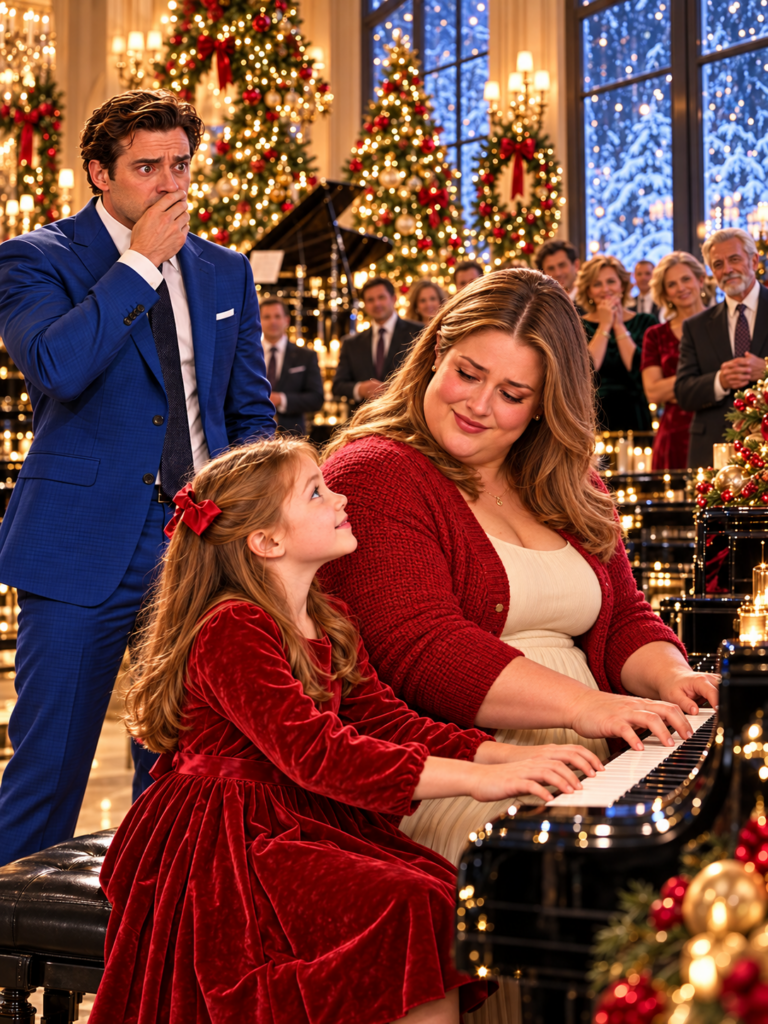
On the second Friday in December, the nine-foot grand piano once again stood beneath the Christmas tree in Crane Piano’s Main Street showroom.
Its polished black lid was raised like a wing.
Brent Ogle, who had grown close enough to Abby to share occasional dinners and who understood the instrument’s significance, had kept the piano bench unoccupied all afternoon.
Posie was nine now.
She had grown tall enough to reach her mother’s shoulder.
She stood beside the instrument, looking from Abby to Hayden.
“Mommy, play our song.”
Abby lifted an eyebrow.
“Our song?”
Posie smiled.
Then she reached for Hayden’s hand.
“All of ours.”
Abby sat down.
Hayden took the lower end of the bench.
Posie squeezed between them.
For a moment, none of them moved.
Then Abby began.
The opening melody floated through the showroom as it had a year earlier.
But this time, Hayden added a quiet harmony beneath her playing.
He didn’t try to dominate the music.
He listened.
Followed.
Let her guide the phrases.
The melody rose, turned, and approached its familiar silence.
Then Posie reached forward.
Three notes.
D.
A.
D.
Her father’s notes.
And for the first time in sixteen years, Hayden played the passage that followed.
He had written it that summer at his kitchen table, on a small sheet of music paper.
It began on D, exactly where Posie’s final note ended.
It did not replace Bo’s contribution.
It grew from it.
The melody opened into a warm, gentle conclusion.
Not triumphant.
Not sorrowful.
Simply complete.
The final chord lingered beneath the Christmas lights.
A small crowd had gathered.
Shoppers holding bags.
A security guard.
A grandmother standing with her grandson.
Someone began applauding.
Others followed.
A man near the front called out, “What’s that song called?”
Before Abby or Hayden could answer, Posie turned around.
“It doesn’t have a name,” she said.
She looked proudly at the two adults beside her.
“It has a family.”
There was no engagement ring that evening.
No speech.
No proposal made before strangers.
Later, as they walked through the cold toward the streetcar stop, Hayden tucked his hands into his coat pockets.
“I used to think the ending was mine to write,” he said.
Abby looked up at him.
For a moment, she remembered the young man in the tuning room, holding a promise neither of them had been allowed to keep.
Then she thought of Bo, sitting on their living-room floor with a marker and masking tape.
Of Posie’s small hands pressing three keys.
Of all the years that had carried them to this moment.
“So did I,” she said.
She leaned her shoulder against his.
“Turns out we were both wrong.”
That night, their old keyboard stood against the living-room wall.
The masking-tape letters had faded to a soft gray.
Every key worked now.
Posie had fallen asleep on the couch beneath a blanket, one hand resting near the instrument.
Abby lowered the keyboard cover gently.
In the kitchen, Hayden dried the last cup and hummed the melody’s new ending.
Sixteen years earlier, a young man had composed a love song and deliberately left its final passage unwritten.
He believed those empty measures belonged to the night he would ask a woman to marry him.
But life had written something he could never have imagined.
The silence had held room for a maintenance worker who couldn’t read sheet music.
For a little girl who learned to spell her father’s name on piano keys.
For a grieving mother who discovered that loving again did not mean betraying the husband she had lost.
And for a man who finally understood that love was not something he could reclaim simply because he had loved first.
The song had survived a lie.
It had survived sixteen years of separation.
It had survived grief, regret, and every unfinished conversation that came afterward.
In the end, the missing music had never belonged to one person.
It had been waiting for the right hands to find one another.
And at last, they had.

