
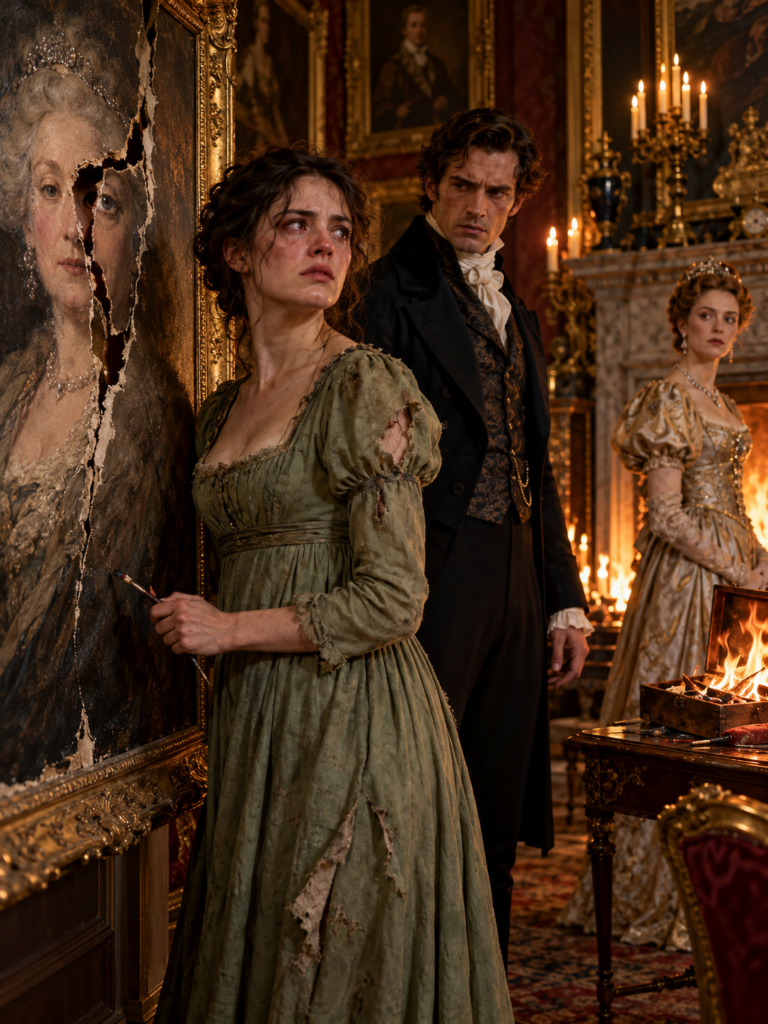
Her shoulder struck the gilded frame just as it slipped toward the floor.
“Hold it!” Eleanor cried.
The footman caught the upper rail with both hands, his boots sliding on the ladder.
For one terrible instant, the portrait hung between them.
Another fall would destroy the fragile fragments Eleanor had come to save.
“Lower your end slowly,” she commanded. “Do not pull it toward you.”
The young man obeyed.
Inch by inch, they brought the frame down until its weight rested safely upon the long worktable.
Eleanor stood breathing hard.
A narrow red mark crossed her shoulder where the wood had struck.
The footman looked miserable.
“I nearly ruined it again.”
“No,” she answered. “You helped prevent it.”
She spread clean linen across the table and examined the torn canvas.
The damage was worse than she had hoped.
A long split ran through the Duchess’s face. Paint flakes lay scattered across the frame and floor, and a large section of the left eye was missing.
Some of the original paint had curled away from the canvas.
But much remained.
Enough, perhaps, if her hands remembered what her father had taught them.
She gathered every fragment she could find with the damp tip of her worn brush.
One tiny piece held part of an eyelid.
She placed it on a sheet of paper as carefully as if it were a jewel.
“Will it work, miss?” the footman asked.
“I cannot promise.”
“Then why risk being turned out without a reference?”
Eleanor looked at the damaged face.
“Because somebody ought to try.”
They turned the portrait over.
She gently aligned the torn threads and prepared a linen support for the damaged area.
The work demanded patience, and there was very little time.
The King would arrive that afternoon.
By dawn, she was supposed to be miles away.
By the time the support was secured, her back ached and her fingers had begun to stiffen.
She reached for the small laundry iron.
It was hotter than she expected.
When she tried to lift it, the metal caught three fingertips.
Pain shot through her hand.
She gasped.
“Miss!”
“Bring the cloth.”
Her fingers were already reddening.
She wrapped the handle and continued cautiously, pressing through protective paper to settle the repair.
The footman watched anxiously.
“You ought to stop.”
“I will stop when it is safe to stop.”
When the supported canvas could be turned again, the jagged flap no longer hung loose.
The tear remained visible, but its edges were held together.
Eleanor examined the repair.
Then she sent the footman to bed.
“You have done enough. Go before someone notices you are missing.”
He hesitated.
“Will you be all right?”
She smiled faintly.
“I have spent half my life with paint beneath my nails.”
When he had gone, she began the slower work.
She secured the surviving flakes.
She filled the areas where the paint had disappeared.
Then, with pigments made from the humble supplies of the still room, she started rebuilding the Duchess’s cheek.
Her father’s words returned as she worked.
Replace only what is missing. Never cover the hand that came before yours.
She obeyed that principle through every exhausting hour.
The cheek gradually regained its warmth.
The curve of the mouth became whole.
The delicate shadow beside the nose returned.
By two o’clock, the ruined face had begun to resemble the woman in the portrait again.
Then Eleanor turned to the eye.
It was the most difficult part.
An eye could be copied in shape.
But the smallest alteration could change an expression.
The old Duchess’s remaining eye held unmistakable warmth and amusement.
Eleanor needed the restored one to answer it.
She mixed the brown.
Painted the iris.
Softened the eyelid.
Adjusted the shadow beneath the brow.
At last she sat back.
Something was wrong.
The reconstructed eye had no life.
It looked outward without truly seeing.
She knew why.
A single tiny reflection was missing.
One touch of light.
But her injured fingers had begun to tremble uncontrollably.
She rested her hand.
Tried again.
The brush wavered.
She withdrew it.
A careless stroke could spoil everything she had achieved.
At that moment, the gallery door opened.
The Duke stood in the doorway carrying a lamp.
His gaze moved from the empty wall to the portrait upon the table.
Then to Eleanor’s stained hands.
His face darkened.
“I gave explicit orders that this room remain locked.”
“Yes, Your Grace.”
“You have disobeyed me.”
“Yes.”
He advanced.
“You have taken my mother’s portrait from its place.”
Eleanor rose, gripping the brush.
“Please look at her before you condemn me.”
He stopped.
Then his eyes went to the canvas.
For several long seconds, he did not speak.
The torn cheek had become whole.
The broken mouth had regained its smile.
Only the unfinished eye remained.
His expression changed, but his voice stayed cold.
“The King’s painter will examine this at three. If he judges you have made matters worse, you will leave this house without recommendation or further assistance.”
Eleanor felt the last of her courage strain.
“Then I must finish before he comes.”
The Duke turned away.
But at the door, he paused.
He looked once more at his mother’s face.
Then he left his lamp on the table.
And went out without locking the gallery.
Eleanor stared after him.
No apology had been offered.
No permission had been given.
Yet the door stood open, the additional lamp burned steadily, and the broken portrait waited beneath her shaking hand.
She turned back, raised her brush toward the lifeless eye, and heard approaching footsteps in the corridor.
The footsteps passed the gallery door without stopping.
Eleanor kept her brush raised until the sound faded.
Only then did she lower her hand.
The Duke’s lamp burned beside her own candle, casting two unsteady reflections across the repaired canvas.
She tried once more to steady her fingers.
The pain from the burns had become a dull, persistent throb.
She could reproduce the eyelid, the iris, even the delicate shadow beneath the lashes.
But the tiny point of reflected light required absolute control.
She could not risk it while her hand shook.
“Not yet,” she whispered.
She placed the brush aside and waited.
At some point, exhaustion overtook her.
When she woke, daylight had entered the gallery.
And Lady Tyrwhitt was standing above her.
“Good heavens.”
Her sister’s voice cut across the quiet room.
“So this is where our little Drab has spent the night.”
Miss Fetterplace stood beside her, examining the portrait.
For a moment, neither woman spoke.
The old Duchess’s face was almost whole.
The long, dreadful tear had all but vanished.
Lady Tyrwhitt recovered first.
“Look at that eye.”
Miss Fetterplace leaned closer.
“How peculiar.”
“It is unfinished,” Eleanor said, rising stiffly.
Lady Tyrwhitt laughed.
“Unfinished? It looks like the eye of a dead fish.”
Eleanor moved toward the portrait.
“Please do not touch it. The paint is still delicate.”
“You presume to instruct me now?”
Lady Tyrwhitt turned toward the servants.
“Cover this absurdity. Miss Dorn’s carriage is waiting.”
Before either footman moved, a voice came from the doorway.
“She remains until three.”
The Duke entered in formal dress.
His expression was unreadable.
“I promised the King’s painter that he would examine the work.”
Lady Tyrwhitt frowned.
“And afterward?”
The Duke looked at Eleanor.
“Afterward, Miss Dorn leaves.”
The words struck harder than Eleanor expected.
But she had survived the night.
She would survive the afternoon.
At three o’clock, the gallery filled with the King’s party.
Chandeliers blazed above richly dressed ladies and gentlemen. A smell of wax, perfume, and polished wood filled the room.
The King sat at the far end, his painful foot supported upon a stool.
Eleanor stood beside the covered portrait.
Her gown was plain sage green.
Her fingertips were bandaged.
Black pigment remained beneath her nails despite repeated washing.
The King’s painter stepped forward with his eyeglass.
“Shall we see what Miss Dorn has accomplished?”
The Duke nodded.
The sheet was removed.
Silence spread through the room.
The Duchess appeared in white muslin, pearls resting between her fingers, her familiar smile restored.
The King’s painter bent closer.
He examined the cheek.
Then the jaw.
Then the long line where the canvas had torn.
He stepped sideways to catch the light.
“Remarkable.”
He looked at Eleanor.
“Where is the damage?”
“Supported from behind, sir. The losses have been filled and retouched.”
“With what materials?”
“Whatever I could obtain from the household. Soot, whiting, red pigment, oil, egg yolk, and a little glue.”
A murmur passed among the guests.
The painter examined the eye.
Then he straightened.
“But it is not finished.”
“No, sir.”
“The expression is nearly correct, but the eye lacks its reflection.”
“My hand would not keep steady enough.”
Lady Tyrwhitt stepped forward.
“This is plainly some deception. She must have employed a tradesman and claimed his work.”
The King’s painter ignored her.
Instead, he opened his case and selected a fine sable brush.
He held it toward Eleanor.
“Then finish it now.”
Eleanor looked at the brush.
She had never owned one so fine.
Her burned fingers closed carefully around its handle.
“May I?”
“Certainly.”
She took a trace of pale pigment.
The entire room seemed to fall silent.
She stood before the Duchess’s painted face and remembered her father’s instruction.
Look at the living eye. Understand where the light has fallen.
She drew a breath.
Let part of it escape.
Then touched the brush to the reconstructed iris.
One small mark.
No larger than a seed.
She stepped away.
The expression changed.
The left eye answered the right.
The Duchess no longer seemed merely to sit for a portrait.
She seemed on the verge of laughing at something delightful.
The King’s painter stared.
Then the King began to applaud.
His slow clapping filled the room.
Others joined him.
The painter bowed toward Eleanor.
“Miss Dorn, I have spent forty years with a brush in my hand. I would not have attempted that repair under such circumstances.”
Lady Tyrwhitt’s face became rigid.
The King regarded her with amusement.
“Your mysterious tradesman must be exceptionally talented, madam. Perhaps you will introduce him to us.”
Laughter rippled through the gallery.
Miss Fetterplace turned pale.
Lady Tyrwhitt snapped her fan shut so violently that one of its ivory sticks broke.
She left without another word.
Eleanor scarcely noticed.
For the first time in years, she stood among people who were looking at her work rather than her poverty.
The Duke remained silent.
It was not until the King’s party had withdrawn that he found her in the eastern passage.
“Miss Dorn.”
She stopped.
“Your Grace?”
“Where did you learn such work?”
“My father restored paintings.”
“I was told he was an unsuccessful artist.”
“He was a skilled restorer whose sight failed before his work was finished.”
She held his gaze.
“When he could no longer manage the finest details, I worked beside him. Later, I did those details myself.”
The Duke looked down at her bandaged hand.
“Why was I never told?”
Eleanor gave a small, tired smile.
“In three years, Your Grace, you never asked.”
He did not answer.
She continued.
“Your mother once visited my father’s workshop. She stayed nearly an afternoon, watching us work. She spoke to me about the paintings, not my prospects or my lack of a husband.”
Something shifted in his face.
“I did not know.”
“When my father died, I wrote to her for advice. I did not know she was already dead. Your sister answered and offered me a place here.”
The Duke looked away.
“And you became her companion.”
“Her unpaid dependent, if we speak plainly.”
He flinched.
Eleanor had not intended to wound him.
Yet she was no longer willing to make the truth comfortable.
“You called me the Drab,” she said quietly. “You laughed whenever she did.”
His mouth tightened.
“I was wrong.”
It was the first admission he had made.
But she needed more than a sentence.
“Yes,” she replied. “You were.”
Two days later, before leaving with the royal party, the King’s painter presented Eleanor with a mahogany case.
Inside were fine brushes, proper colors, and a slender palette knife with an ivory handle.
“I want you to use these,” he said. “There are other pictures in this gallery in distress.”
The Duke stood nearby.
“Can you restore them, Miss Dorn?”
“Some of them, Your Grace. After examining them properly.”
“Then tell Mrs. Bell what you need.”
Thus began the happiest weeks Eleanor had known since her father’s workshop closed.
She cleaned darkened landscapes.
Stabilized loose paint.
Removed layers of dirt that had hidden bright skies and forgotten faces.
The young footman helped carry the smaller pictures.
Mrs. Bell brought her meals when Eleanor forgot to leave the gallery.
And the Duke began visiting.
At first, he merely watched.
Then he held a lamp while Eleanor worked.
Soon he learned to pass her cloths and tools without interrupting her concentration.
One afternoon, an ancestral portrait emerged from years of darkened varnish.
The Duke stared at it.
“I thought my great-grandfather had the complexion of a preserved walnut.”
Eleanor laughed.
The Duke looked startled.
Then he laughed too.
It was the first laughter they had shared.
One evening, while she cleaned a landscape, he asked, “Why did you always paint roses?”
“Because your sister’s guests requested roses.”
“And if you had been free to choose?”
“Faces.”
“Whose?”
“Mrs. Bell concentrating over her preserves. The young footman trying not to fall asleep. People as they are when no one expects them to pose.”
He considered that.
“And me?”
Eleanor hesitated.
“You would dislike the result.”
“Why?”
“Because I think you are very lonely.”
His hand tightened around the lamp.
But he did not turn away.
“Perhaps,” he said eventually, “you might paint me one day.”
“Perhaps.”
“Not until I have given you a reason to see me differently.”
Their eyes met.
Neither spoke.
Over the following evenings, the Duke began telling her about his mother.
How she had filled the gardens with sweet peas.
How she disliked ceremony.
How she had found amusement in the stiffest members of the family.
And how a sudden fever had taken her while he was away in London.
“I returned too late,” he said one evening.
Eleanor lowered her brush.
“That is why her portrait mattered so much.”
He nodded.
“For nine years, I could not bear to move it.”
“And yet you let me take it down.”
“I did not let you,” he said quietly. “You had the courage to do what I could not.”
For a brief moment, the distance between them felt very small.
He reached for her hand.
Her burns had nearly healed, leaving tender new skin across three fingertips.
He touched the marks gently.
Then let her go.
Neither spoke of it afterward.
But Lady Tyrwhitt noticed.
And she had never forgiven Eleanor for the humiliation in the gallery.
The King was expected back for a grand ball.
Lady Tyrwhitt intended the house to surpass every fashionable residence in the county.
She ordered enormous lengths of white muslin suspended above the pictures.
New brass candle branches were attached along the gallery walls.
Five hundred candles were planned.
When Eleanor saw the arrangements, her stomach tightened.
Several paintings had recently received new varnish.
The muslin hung close above the proposed flames.
“Lady Tyrwhitt,” she said, “this is extremely dangerous.”
Her ladyship looked down at her.
“You have become quite an authority.”
“The cloth could catch. The varnished pictures are especially vulnerable to heat.”
“It is my brother’s house.”
“Then please allow me to speak to him.”
Eleanor went directly to the Duke.
She explained the danger.
He listened, frowned, and promised to address the matter.
But Lady Tyrwhitt reached him first.
The following morning, Eleanor was summoned to the library.
The Duke stood behind his desk.
His sister and Miss Fetterplace sat near the window.
“Miss Dorn,” he began, “there has been unpleasant talk.”
Eleanor remained standing.
“What sort of talk?”
“About our evenings in the gallery.”
She stared at him.
“The door is sometimes closed to prevent drafts while I work.”
“I know.”
“Then what is the difficulty?”
His jaw tightened.
“Certain persons have chosen to interpret those evenings improperly.”
Lady Tyrwhitt lowered her eyes in an imitation of embarrassment.
“People do enjoy scandal.”
Eleanor understood.
The same people who had once laughed at her uselessness were now willing to ruin her reputation because she had proved useful.
The Duke continued.
“The King arrives next week. I cannot allow speculation to attach itself to this house.”
Eleanor looked directly at him.
“Do you believe the gossip?”
“No.”
“Then say so.”
He was silent.
Lady Tyrwhitt smiled faintly.
“The school in Bath still has a place. You may leave on Monday.”
Eleanor felt something inside her become very still.
She turned back to the Duke.
“Is that what you want?”
“It is the proper arrangement.”
“That is not what I asked.”
He looked at her.
For a moment she thought he might finally choose courage over appearances.
But he said nothing.
Eleanor gave a small bow.
“Then I understand, Your Grace.”
On Monday morning, the carriage arrived in the rain.
Mrs. Bell pressed food into Eleanor’s hands.
The young footman loaded her trunk.
And Eleanor entered the carriage without looking toward the library windows.
The Duke watched her leave.
He remained at the window long after the carriage disappeared.
But he did not call it back.
In Bath, Eleanor found a narrow attic room at the school.
Her students wanted roses on cards, boxes, and decorative screens.
She taught them patiently.
She was paid.
She had a small room of her own.
And she was no longer dependent upon the Duke’s charity.
Yet every evening, when she looked at the newly healed skin on her fingertips, she remembered the way he had held her hand.
She tried not to.
At Cheney House, preparations continued.
The muslin remained.
The candle branches remained.
And the Duke, though he had been warned, did nothing.
Then, on the afternoon of the ball, the King’s painter arrived unexpectedly at Eleanor’s school in Bath.
He had come with an offer.
A proper position in his London workshop.
Work worthy of her training.
Wages equal to those he would pay a skilled male assistant.
And full acknowledgment of her work.
Eleanor could scarcely speak.
At last she said, “I shall consider it most seriously.”
He smiled.
“I had hoped you would.”
As he prepared to leave, she asked about the gallery.
He described the cleaned paintings with enthusiasm.
Then casually mentioned the muslin and the extraordinary number of candles arranged beneath it.
Eleanor gripped the banister.
“They have not taken it down?”
“No. Why?”
“The ball is tonight?”
“At ten.”
Eleanor went cold.
She had warned them.
She had explained.
And nobody had listened.
She ran upstairs for her cloak.
Then descended with every coin she possessed.
At the nearest inn, she hired a carriage and a pair of horses for the journey back.
The postboy looked at her money and agreed to drive as quickly as the road permitted.
Hours later, after the rain had stopped, the carriage climbed the final hill toward Cheney House.
From the crest, Eleanor could see the great building illuminated below.
Most windows glowed yellow.
But those of the western gallery shone an unnatural orange.
The light moved.
It flickered against the night sky.
Eleanor leaned forward.
“Faster,” she whispered.
Then she saw flames rising behind the gallery windows.
Flames climbed behind the tall windows, turning the western end of Cheney House into a blazing lantern.
Eleanor seized the leather carriage strap as the horses descended the hill.
“Drive to the front entrance!” she called.
The postboy urged the team onward.
By the time they reached the avenue, smoke was streaming above the trees.
Carriages crowded the drive.
Servants ran across the lawns carrying buckets.
Ladies in evening gowns stood shivering beneath borrowed coats, their jewels glittering strangely against smoke-blackened faces.
The air smelled of scorched cloth and burning wood.
Eleanor jumped down before the carriage had fully stopped.
“Where is the Duke?”
Nobody answered.
She caught a servant by the arm.
“His Grace. Where is he?”
The young man pointed toward the house.
“He got His Majesty out, miss. Then he went back for the pictures.”
Eleanor’s heart seemed to stop.
“The gallery?”
“Yes, miss.”
She was already running.
Lady Tyrwhitt stood on the front steps in a damaged crimson gown, clutching her diamonds.
When she recognized Eleanor, she moved across the doorway.
“You have no business here!”
Eleanor did not slow.
“Your brother is inside.”
“He ordered you away!”
“And you may remind him of that when he is safely outside.”
She stepped around Lady Tyrwhitt and ran up the stairs.
Smoke hung thickly along the upper corridor.
Eleanor pulled her cloak over her nose and mouth and crouched beneath the densest layer.
Every breath tasted bitter.
Somewhere beyond the gallery doors, glass shattered.
A heavy object crashed to the floor.
Then she heard a man’s voice.
“Lift it! For God’s sake, lift!”
She followed the sound.
The Duke stood beneath his mother’s portrait with two footmen.
His formal coat was gone.
His shirt was torn at one shoulder.
Soot covered his face.
All three men were struggling to free the huge gilded frame from its wall hooks.
The upper decorations had caught fire.
Smoke curled beneath the ceiling.
The varnish on nearby paintings glistened under the rising heat.
“Your Grace!”
He turned.
For a moment, he simply stared.
“Eleanor?”
It was the first time he had spoken her name without the cold distance of formality.
“You must get out!”
“So must you.”
“My mother’s portrait—”
“I can see it.”
“The frame will not come free!”
“Then leave the frame.”
He looked at her as though he had not understood.
Eleanor pulled the ivory-handled palette knife from her pocket.
She had carried it every day since the King’s painter gave it to her.
“Listen carefully,” she said. “The painting can be removed without taking the frame.”
He stared at the tool.
Then at her.
“Tell me what to do.”
The words mattered more than either of them could have known.
A month earlier, he had laughed when she asked for a brush.
Now, surrounded by smoke, he waited for her instructions.
“Bring the ladder. You must climb because you can reach the upper edge.”
He turned to the footmen.
One ran for the ladder.
The other moved toward the doors to help keep the passage clear.
Eleanor pointed to the narrow gap between painted canvas and carved wood.
“Work along the inside. Keep the blade clear of the paint wherever you can. Free the canvas from its fastening.”
The Duke climbed.
She steadied the ladder.
His hands shook with effort.
He worked the knife carefully around the interior edge of the frame.
Above them, burning muslin dropped in fragments.
One landed on the floor beside Eleanor.
She crushed it beneath her shoe.
“Quickly,” she said.
He continued.
The final edge gave way.
The canvas sagged forward.
“Catch it!”
The Duke caught the loosened portrait against his chest.
Eleanor helped him carry it clear of the wall.
Together they laid it down on a space of floor still free of debris.
She examined it briefly.
The paint had survived the cutting, though the edges would need careful treatment.
“Take her out,” she said.
“And you?”
“There are other paintings.”
“Eleanor—”
“Take her out first.”
He hesitated only a second.
Then obeyed.
When he returned, she was preparing the next painting.
They worked as quickly as they dared.
The Duke climbed and released each canvas.
Eleanor showed him where the painted surface was vulnerable, how to handle the loosened fabric, and how to avoid crushing the paint.
The two footmen carried the freed pictures down to the lawn whenever they could.
A stern ancestor emerged from his frame.
Then the hunting picture with its brilliant white horse.
Then a lady dressed in blue beside a window.
One by one, the most accessible paintings were rescued.
Each journey became more difficult.
The smoke deepened.
The heat grew unbearable.
The Duke’s shirt clung to his back.
At the eighth painting, a burning fragment of wooden molding fell against the ladder.
He flung it aside with his bare hands.
The pain made him stumble.
Eleanor caught the ladder.
“Your hands!”
He looked down.
His palms were reddened and blistering.
“We cannot continue like this,” she said.
“One more.”
She looked toward the remaining paintings.
They had already saved more than she thought possible.
But the gallery was failing around them.
A sharp cracking sound came from overhead.
She knew the danger had changed.
“After that, we leave,” she said.
The Duke nodded.
They freed the next accessible pictures, with the footmen returning to help carry them as the smoke allowed.
By the time the eleventh canvas was outside, pieces of the ceiling were beginning to fall.
Eleanor seized the Duke’s sleeve.
“Now.”
He looked once toward the wall.
His mother’s empty frame hung crookedly above the smoke.
For nine years, he had refused to let anyone disturb it.
Now he turned away without hesitation.
They reached the corridor.
A tremendous crash sounded behind them.
The western roof had begun to give way.
Eleanor felt the force of the collapse through the floor.
The Duke stumbled.
She pulled his arm across her shoulders.
He was taller and heavier, but he had lost strength from smoke and pain.
Together they staggered down the stairs.
Then the night air struck their faces.
Cold.
Wet.
Blessedly clear.
The Duke drew a ragged breath.
Eleanor bent over, coughing until her eyes streamed.
Behind them, the gallery burned.
Neither spoke for several minutes.
At last the Duke lifted his head.
“Mother?”
Eleanor looked toward the lawn.
Beneath the cedar tree, the young footman stood guard over the rescued canvases.
The portrait of the late Duchess lay among them.
“Safe,” she whispered.
The Duke closed his eyes.
For the first time that night, he allowed himself to sit.
By dawn, the western gallery was a blackened ruin.
The royal party had been moved to safety.
The surviving guests had taken shelter in nearby houses or departed in their carriages.
The servants carried water, food, and blankets across the grounds.
Eleven rescued paintings rested beneath protective coverings near the cedar tree, guarded from further damage.
The Duke sat on a low stone bench while Eleanor examined his hands.
They were badly burned.
She sent for clean water, dressings, and assistance.
Mrs. Bell came with the household’s medical supplies and arranged for a surgeon to be summoned.
Eleanor carefully washed away the soot that could be removed without disturbing damaged skin.
The Duke watched her in silence.
“You should have stayed in Bath,” he said at last.
“Perhaps.”
“You could have been killed.”
“So could you.”
He had no answer.
She wrapped his injured hands loosely in clean dressings.
The tenderness of her own three fingertips had long since faded.
But she remembered exactly how they had felt after the hot iron.
“Now you know,” she said quietly, “what it is to burn your hands trying to save somebody else’s mother.”
He lowered his eyes.
“Yes.”
For a while, only the distant sounds of the ruined house reached them.
Then the Duke spoke again.
“I heard your warning.”
Eleanor continued securing a dressing.
“I know.”
“I understood it.”
She looked up.
He was staring at the damaged building.
“And I did nothing.”
“No.”
“My sister told me the arrangement was necessary for the ball. I decided it would be inconvenient to oppose her.”
His voice grew rough.
“Then I sent you away because she made your presence inconvenient too.”
Eleanor tied the final bandage.
The Duke lifted his injured hands slightly.
“I cannot excuse it.”
“No,” she said. “You cannot.”
He drew a slow breath.
“I knew the gossip was false. I knew the way my sister treated you. I watched you restore my mother’s portrait, watched you work until your hands were injured, and still I let people laugh at you.”
Eleanor said nothing.
She had imagined hearing these admissions.
In Bath, lying awake in her freezing attic, she had sometimes wished he would come to the school simply to acknowledge what he had done.
Now the words were arriving at last.
But the ruin behind them had made any easy forgiveness impossible.
“You had opportunities to stop it,” she said.
“I did.”
“You could have contradicted your sister.”
“Yes.”
“You could have kept me in the gallery as a restorer, with proper payment and a proper position.”
“I should have.”
“And when I warned you about the candles, you could have listened.”
The Duke looked at his burned palms.
“I should have trusted you.”
Eleanor sat back.
“Not because you thought well of me. Because I knew the work and you did not.”
He nodded.
“Yes.”
The answer surprised her.
He was no longer attempting to soften the truth.
She looked toward the cedar tree.
The footman was adjusting the coverings over the rescued pictures.
Mrs. Bell directed two servants carrying hot tea.
The sun had just begun to touch the wet lawns.
“Your mother came to our workshop when I was young,” Eleanor said.
The Duke turned toward her.
“She asked my father about every picture he handled. But she asked me about my work too.”
He listened.
“Most visitors treated me as part of the furniture. Your mother asked why I used a certain color. She waited for the answer. Then she asked another question.”
Eleanor smiled faintly.
“She made me feel that knowing something mattered.”
The Duke closed his eyes for a moment.
“That sounds like her.”
“I was frightened when I learned she had died. I had written to her hoping she might help me find employment after my father’s death.”
“And my sister offered you a home.”
“Yes.”
He shook his head.
“She offered you a place where you would be made to feel grateful for every kindness.”
Eleanor did not defend Lady Tyrwhitt.
She had spent too many years doing precisely that.
At length the Duke said, “Will you return to London?”
Eleanor considered him.
“The King’s painter has offered me work.”
“I know.”
“He came to Bath yesterday. He has offered to pay me properly and acknowledge my restorations under my own name.”
“Then you ought to accept.”
She searched his face.
“You would not object?”
“How could I?”
She smiled without amusement.
“A few weeks ago, Your Grace, you objected to my touching a painting.”
He lowered his head.
“I deserved that.”
He sat quietly.
Then, with visible effort, he looked directly at her.
“Eleanor, I have made a miserable business of knowing you.”
She felt a painful tightening in her throat.
“You scarcely tried.”
“No.”
“I spent three years in your house. You never asked what I had done before I came there.”
“No.”
“You never wondered why I had paint on my cuffs, or why I looked at pictures longer than anybody else.”
“I should have.”
She looked at his bandaged hands.
“Why are you telling me now?”
His answer came slowly.
“Because when I saw you standing in that gallery tonight, I understood that I had sent away the one person who had never asked me to be a duke before being a man.”
Eleanor looked away.
He continued.
“You came back though I gave you every reason not to.”
“I came because the pictures were in danger.”
“I know.”
“And because you were inside.”
His face changed.
The admission had escaped more plainly than she intended.
For a moment, the silence between them became almost unbearable.
The Duke shifted forward.
“Eleanor, may I ask you something?”
“You may ask.”
“I want you to stay.”
She did not answer.
“Not as my sister’s companion. Not as a dependent. Not even simply as the restorer of my collection.”
His voice trembled.
“I have come to love you.”
Eleanor looked at him sharply.
He did not retreat.
“I think I began loving you in the gallery, while you worked. I loved the way you saw what others had stopped seeing. The way you spoke plainly to me. The way you could be angry without becoming cruel.”
He paused.
“But I behaved as though losing the approval of people I despised mattered more than losing you.”
A bird called from the cedar tree.
The ruined gallery smoked behind them.
The Duke lifted his heavily bandaged hands.
“I cannot even take your hand to ask this properly.”
“Ask what?”
“Whether you would consider becoming my wife.”
Eleanor’s breath caught.
He looked at her steadily.
“I do not ask because you saved the portraits. I do not imagine you owe me anything. You would be entirely justified in returning to London and never entering this house again.”
He swallowed.
“But if you could forgive me, I should like the chance to build a different life with you.”
The words remained between them.
Eleanor looked down at her own hands.
Hands that had restored his mother’s face.
Hands that had painted roses for women who thought her foolish.
Hands that had earned her first real opportunity in years.
She had wanted to be loved.
But she had also wanted the freedom to work, to be respected, to exist without somebody else’s permission.
She could not surrender one dream merely to secure the other.
“If I accepted,” she said carefully, “I would not abandon my work.”
“I would never ask you to.”
“You once asked me to stop working because your sister was displeased.”
His expression tightened.
“I know.”
“And when the county began gossiping, you did not defend me.”
“I know that too.”
She held his gaze.
“Then how can I be certain you would not do it again?”
He considered her question seriously.
“You cannot be certain merely because I promise.”
She had not expected that answer.
“I must show you,” he continued. “In what I do, not just in what I say.”
Eleanor remained quiet.
“The King’s painter has made you an offer,” he said. “Accept it if you wish. Work in London. Build your name. I will not stand in your way.”
“And if I choose to marry you?”
“Then the work remains yours. Your wages, your commissions, your decisions about your paintings. I will help you have a workshop if you wish one here, but it will not be a room in which I can order you about.”
She searched his face.
“You have had very little practice at not ordering people about.”
For the first time since the fire, he smiled.
“Painfully little.”
Eleanor almost laughed.
Then she grew serious again.
“Your sister cannot continue treating me as she has.”
“She will not.”
“Not because I become a duchess.”
“No. Because she was wrong to treat you that way when you had no title at all.”
Eleanor felt tears rise unexpectedly.
That was the answer she had needed.
Not a promise of jewels.
Not a title.
Not even the declaration of love.
Recognition.
The acknowledgment that her dignity had existed before he discovered it.
She reached forward.
The Duke held very still.
She placed one hand against his soot-blackened cheek.
He closed his eyes.
“I love you too,” she whispered.
He opened them.
“I have tried very hard not to.”
A helpless, astonished laugh escaped him.
“Have you?”
“Ever since you held the lamp for me and managed not to tell me how to paint.”
“That was an exceptional exercise in restraint.”
She smiled.
Then her expression softened.
“I will marry you,” she said. “But not because of the fire. And not because your mother’s portrait survived.”
“Then why?”
“Because I know what you have been, and I have seen what you may yet become. I want to see whether we can make something good of it together.”
He looked at her as though the morning had suddenly grown brighter.
“Then I shall have to deserve that confidence.”
“Every day,” she said.
“Every day.”
She leaned toward him and kissed him.
It was a gentle kiss.
Nothing in it erased the pain of the past.
But it marked the beginning of a future neither of them had dared imagine.
When they separated, the housekeeper was standing at the terrace with a tray of tea.
The young footman stood beside her.
Both were making a determined effort to look toward the cedar tree.
Mrs. Bell cleared her throat.
“Your Grace, the surgeon is coming. And Miss Dorn ought to eat something before she falls over.”
Eleanor laughed.
“Yes, Mrs. Bell.”
The housekeeper looked at their faces.
Then she smiled.
“Well. That is one sensible thing to come out of this terrible night.”
The weeks that followed were not easy.
The Duke’s burns required care, and his hands remained painful and stiff for some time.
The damaged portion of the house had to be secured.
There were accounts to examine, workmen to employ, and surviving furnishings to protect.
The saved paintings needed careful assessment.
Some had suffered heat or smoke damage.
Others had torn edges from their hurried removal.
Eleanor worked closely with the King’s painter, who traveled to Cheney House after hearing what had happened.
He examined the rescued canvases.
Then he looked at the blackened remains of the gallery.
“You saved what could be carried away,” he told her. “That is more than many would have managed.”
Eleanor did not pretend every painting was unharmed.
There would be months of labor ahead.
But she knew how to begin.
She accepted the painter’s offer of professional work and continued to undertake commissions under her own name.
At Cheney House, a temporary workspace was prepared in a well-lit room away from the damaged wing.
The Duke, whose hands were still healing, could do little more than watch at first.
Eleanor made him useful where she could.
He kept records.
He ordered materials according to her lists.
He wrote letters to craftsmen.
And he learned that assisting a skilled person was not the same as directing one.
One afternoon, while she studied a damaged landscape, he looked over a set of expenses.
“Your brushes cost more than I expected.”
“Good brushes are costly.”
“So I see.”
“They are considerably less expensive than replacing a ruined painting.”
He considered that.
“An excellent argument.”
She smiled.
“An argument my father frequently used.”
The Duke set down his pen.
“I wish I had known him.”
Eleanor glanced at him.
“He would have liked you better now.”
“That is a qualified recommendation.”
“He was a difficult man to impress.”
“Then I should have been in trouble.”
“You would have been made to hold the lamp.”
He looked at the row of brushes beside her.
“I have acquired some experience.”
It was not a grand exchange.
Nobody overheard it.
But Eleanor remembered it more fondly than many elaborate declarations.
The Duke had begun to understand that love did not require him to be impressive.
It required him to be present.
Lady Tyrwhitt did not remain at Cheney House.
The fire had exposed not only the danger of her arrangements, but also her refusal to heed repeated warnings.
The Duke made clear that she would no longer direct his household.
She left for Bath that spring.
Miss Fetterplace accompanied her.
They continued to maintain that the tragedy had been an unforeseeable accident.
But among those who had witnessed Eleanor’s warnings, the explanation found little sympathy.
The King, who had seen Eleanor’s work before the fire, retained a favorable opinion of her.
The King’s painter was equally firm in defending her abilities.
No scandal could erase the evidence of what she had accomplished.
When Eleanor and the Duke married, it was without the extravagant ceremony Lady Tyrwhitt would once have demanded.
The gathering was modest by the standards of his rank.
Mrs. Bell attended.
So did the young footman who had helped Eleanor lower the damaged portrait.
The King’s painter came from London.
Eleanor wore a simple gown chosen because she liked it.
The Duke’s hands were still marked by the fire.
As he placed the ring upon her finger, she noticed the pale scars crossing his palms.
He followed her gaze.
“Not very elegant hands for a duke.”
“They are good hands,” she said.
“Are they?”
“They have learned when to hold a ladder.”
He laughed softly.
And she smiled at him with a happiness that had nothing to do with becoming a duchess.
The following year, the rebuilt gallery was completed.
Its windows admitted generous daylight.
The new arrangement placed greater care upon the safety and preservation of the collection.
There were no dangerous swags of fabric hanging above candles.
No freshly treated canvases exposed to open flames.
The Duke insisted that Eleanor and the King’s painter advise upon the placement and care of the paintings.
But when the time came to rehang his mother’s portrait, he left the final decision to his wife.
Eleanor examined the repaired canvas in the new daylight.
The damage from the ladder had been stabilized.
The traces of the hurried rescue had been treated as carefully as possible.
The old Duchess’s smile remained.
And in her reconstructed left eye, the tiny point of light still shone.
Eleanor stood back.
“There,” she said. “She can return.”
The footmen lifted the portrait into its place.
The Duke stood beside Eleanor as the frame settled upon the wall.
For a long while, he said nothing.
Then he took her hand.
His palms had healed, but the scars remained.
Her own fingertips bore faint traces of the burns from that first night.
He turned her hand gently and looked at them.
“I used to think this room contained everything I had left of my mother.”
Eleanor glanced toward him.
“And now?”
“Now I think she would have been disappointed that I spent nine years guarding her picture while forgetting most of what she taught me.”
“What did she teach you?”
“That kindness matters more than appearances. That a person ought to be judged by what they do. And that being important is not the same as being worthy of respect.”
Eleanor looked toward the painted woman.
“She remembered those lessons better than you.”
“Considerably better.”
He smiled.
Then his expression softened.
“I think she would be very pleased with you.”
“She was pleased with me long before you were.”
“I know.”
Eleanor squeezed his hand.
Above them, the old Duchess seemed to gaze down with familiar amusement.
A woman who had once been torn almost beyond recognition.
A woman whose image had brought two lonely people together, though neither understood it at the time.
The Duke studied the painted eyes.
“She looks as though she knows something we do not.”
Eleanor smiled.
“Perhaps she does.”
He lifted her hand and kissed the three fingertips that had once burned saving his mother’s face.
Then he looked around the restored gallery.
It no longer felt like a shrine to a loss.
It was a place where Eleanor worked, where visitors came to admire her restorations, where the Duke sometimes held a lamp or sat quietly and watched her paint.
And where laughter had returned.
“What will you paint next?” he asked.
Eleanor considered the question.
Then she looked directly at him.
“You.”
He raised an eyebrow.
“Have I finally earned the privilege?”
“Perhaps.”
“And how shall you paint me?”
She smiled, remembering the conversation they had shared over a dark little landscape long ago.
“Exactly as you are when you believe nobody is watching.”
The Duke looked toward the portrait of his mother.
Then back at his wife.
“I suppose that means you will paint a rather foolish man.”
“A man who has learned a few things.”
“Such as?”
“That a woman’s hands may hold skills he knows nothing about.”
He nodded.
“Certainly.”
“That love cannot be commanded.”
“Most certainly.”
“And that sometimes the wisest thing a gentleman can do is hold the ladder and listen.”
The Duke laughed.
Then he drew her gently toward him.
The old Duchess smiled above them.
Eleanor looked once more at the tiny spark of white she had placed in the painted eye.
She had made that mark when she possessed almost nothing.
No fortune.
No position.
No expectation of kindness.
Only a borrowed brush, a little courage, and the skill her father had placed in her hands.
Now she had a home, a profession, and a husband who had learned to honor both.
Yet the part of her life that mattered most had not changed.
She was still Eleanor.
Still an artist.
Still the woman who had asked for a brush when everyone else believed the picture was ruined.
And every time the Duke passed beneath his mother’s portrait, he remembered the lesson that had saved far more than a painted face.
What is broken is not always lost.
But nothing worth restoring can be mended by pride alone.


