
Part 1
Nine days after her husband’s funeral, Claire Bennett sat at the kitchen table while his family divided up everything she had spent twenty-nine years helping him build.
His brother Frank was taking the farmhouse. His other brother, Andrew, was getting the hayfield along the creek. Even Molly, the old dairy cow Claire had raised from a calf, had been promised to Andrew’s wife before anyone bothered to ask Claire how she felt about it.
And Claire?
She was being told to find somewhere else to live.
There was still a sympathy card taped to the refrigerator. Michael’s favorite coffee mug sat beside the sink, exactly where she had left it the morning he died.
Claire was fifty-one years old. She had $230 in her checking account, two changes of clothes she considered suitable for looking for work, and no idea where she would sleep when winter arrived.
Then her sister-in-law suggested a solution.
For ten dollars, Claire could have an abandoned cottage on the far side of the lake.
The porch was collapsing. The roof needed repairs. Nobody had lived there in two years, and the family had been trying to get rid of the property for months.
When Claire accepted, they laughed.
What none of them knew was that the old craftsman who had once lived there had left something behind.
Something worth more than the farmhouse, the hayfield, and the cow combined.
And the most valuable part of his secret wasn’t what anyone would have expected.
The farmhouse kitchen smelled of reheated casseroles and stale coffee.
Friends from church had brought food after Michael’s funeral, and most of it was still stacked in plastic containers inside the refrigerator. A dish of scalloped potatoes sat untouched on the table.
Marilyn Bennett, Frank’s wife, opened a blue folder and removed several documents.
“We might as well get everything sorted while we’re all together,” she said.
Claire looked at the papers.
“What exactly are we sorting?”
“The property, Claire.”
Marilyn spoke with the patience of someone explaining something painfully obvious.
“Frank’s mother transferred the farmhouse into his name years ago. You know that.”
Claire did know.
Eight years earlier, when Michael’s mother had needed full-time care, Frank had taken responsibility for managing the family property. The understanding had always been that Michael and Claire could continue living there.
Nothing had been put in writing for them.
Back then, nobody had imagined Michael would die first.
“He lived here his whole life,” Claire said.
“And nobody’s arguing about that.”
Marilyn folded her hands.
“But he’s gone, Claire. Frank owns the place, and we can’t keep maintaining two houses.”
Frank stared into his coffee.
Claire waited for him to speak.
He didn’t.
“I cared for your mother for almost six years,” she reminded him. “And I looked after Michael until the day he died.”
Marilyn sighed.
“We appreciate everything you’ve done. But taking care of someone doesn’t put your name on a deed.”
The words were delivered quietly, almost pleasantly.
That made them worse.
Claire looked around the kitchen.
She had painted those cabinets herself. The curtains were made from fabric she’d bought at a clearance sale in Duluth. Behind the refrigerator was a pencil mark showing Michael’s height from the year they first moved in, made as a joke when they were newlyweds.
There was a dent in the wooden floor where he’d dropped a cast-iron skillet during their first Thanksgiving together.
For twenty-nine years, every corner of that house had held some small part of their marriage.
Now Marilyn was discussing it like a piece of surplus equipment.
“Andrew and Judy will take the lower field,” Marilyn continued. “They’ve got the heifers, and they need the hay.”
Judy, Andrew’s wife, nodded enthusiastically.
“And Molly can come to our barn.”
Claire straightened.
“Molly?”
“The cow,” Judy said.
“I know which cow.”
Claire looked at Andrew.
“I bottle-fed her when she was born. You remember that, don’t you?”
Andrew shifted in his chair.
“Sure, Claire.”
“She nearly died that first winter.”
“I remember.”
“And now you’re just taking her?”
Judy set down her fork.
“What are you going to feed her with? You won’t have the pasture.”
Through the kitchen window came the distant clatter of a livestock trailer.
Claire turned.
Molly was standing beside the barn while Andrew’s hired hand adjusted a rope around her halter.
Someone had already decided.
Claire pushed her chair back.
“Where are you going?” Marilyn asked.
“Outside.”
“Sit down. We’re not finished.”
Claire stopped.
For a moment, she considered telling Marilyn exactly what she thought of her.
But grief had left her exhausted, and the sight of Michael’s empty chair had become almost unbearable.
She sat.
Judy poured more coffee.
“So where will you go?”
Claire stared at her.
“What?”
“You’ve got that sister in Duluth, right?”
“She’s raising two grandchildren in a one-bedroom apartment.”
“Well, maybe there’s some kind of senior housing.”
“I’m fifty-one, Judy.”
Judy shrugged.
“I was only trying to help.”
Claire opened her checking account on her phone.
Two hundred and thirty dollars.
Most of their savings had disappeared during Michael’s illness. After the funeral expenses and the last hospital bills, the balance was almost insulting.
Michael had always been the one who said things would work out.
He wasn’t there to say it anymore.
Marilyn suddenly leaned back in her chair.
“Wait a minute.”
Everyone looked at her.
“What about Arthur Bell’s old cottage?”
Andrew gave a short laugh.
“That dump?”
“Why not?”
Marilyn turned toward Claire.
“It’s sitting empty on the north side of Alder Lake. Frank and Andrew have been trying to sell it for two years.”
Arthur Bell had been an elderly relative of the Bennett family, a retired mason who specialized in traditional wood-burning fireplaces and masonry heaters.
He had died two years earlier.
His small property had passed to Frank and Andrew through an old family deed. Neither man wanted it.
The place was too remote for most buyers, and the building needed more work than anyone cared to tackle.
Marilyn smiled.
“We could sell it to Claire.”
“For what?” Judy asked. “A couple hundred dollars?”
“Ten.”
Andrew laughed.
“Ten dollars?”
“Why not? We can put ten dollars and other consideration on the deed. She gets somewhere to live, and we stop worrying about the place.”
Judy started laughing too.
“That’s some generous family discount.”
Marilyn looked directly at Claire.
“Well? Want to become a homeowner for ten bucks?”
Claire remembered Arthur.
For three winters before his death, she’d delivered fresh milk to his cottage because he had difficulty driving into town.
He had always invited her inside, pulled a chair close to the fireplace, and offered her dried cranberries or homemade biscuits.
He spoke more about bricks and mortar than most people spoke about their grandchildren.
None of the Bennett brothers visited him often.
Claire had never understood why.
“Does the fireplace still work?” she asked.
Frank looked up for the first time.
“Probably. Arthur built the thing himself.”
“You’d have to get it inspected,” Andrew added.
Judy laughed again.
“Well, there you go. If nothing else, you can sleep next to it.”
Claire opened her purse and removed a ten-dollar bill.
She placed it on the table.
“I’ll buy it.”
Marilyn blinked.
“You’re serious?”
“Yes.”
“Claire, it’s practically falling down.”
“You named the price.”
Frank glanced at the money.
Then at his wife.
Marilyn shrugged.
“Fine. We’ll get the paperwork done.”
Judy covered her mouth, but Claire could still hear her giggling.
Ten dollars for a house.
It was the funniest thing they’d heard all week.
Claire looked at the bill lying between the dirty coffee cups.
It was the first decision she had made for herself since Michael died.
And she wasn’t taking it back.
A few days later, they met at the office of a real estate attorney in the county seat.
The transfer was straightforward, at least on paper.
Frank and Andrew were the recorded owners of Arthur Bell’s cottage. The property had no mortgage, and the deed would convey it as-is, including the fixtures and personal property remaining inside.
Marilyn was so eager to get rid of the place that she agreed to cover the recording and closing costs.
When the attorney saw the ten-dollar consideration, he looked over his glasses.
“Everybody understands what they’re signing?”
“Absolutely,” Marilyn said.
“And you’re transferring the property voluntarily?”
“Yes.”
The attorney looked at Claire.
“You understand the condition of the building? Any repairs, taxes, and insurance will be your responsibility.”
“I understand.”
He gave her a long look.
Then he handed her the pen.
Claire signed.
She knew the property was worth more than ten dollars simply because it stood on land near the lake.
But she also knew why nobody wanted it. The roof was leaking, the approach road was poor, and bringing the building up to a comfortable standard would cost far more than she possessed.
Even so, she now had something she hadn’t had when she entered Marilyn’s kitchen.
A place no one in that family could order her to leave.
On Friday morning, she packed what she could carry.
Her clothes. Her mother’s old Bible. Michael’s photograph. A quilt they had received as a wedding gift.
She also took his favorite coffee mug.
Marilyn watched from the kitchen doorway.
“You can leave the mug. We’ve got plenty.”
Claire held it close to her chest.
“It was Mike’s.”
Without another word, she walked outside.
Frank stood beside his pickup truck.
He looked as if he wanted to say something.
Claire didn’t give him the chance.
She climbed into the passenger seat of a neighbor’s truck and rode toward Alder Lake.
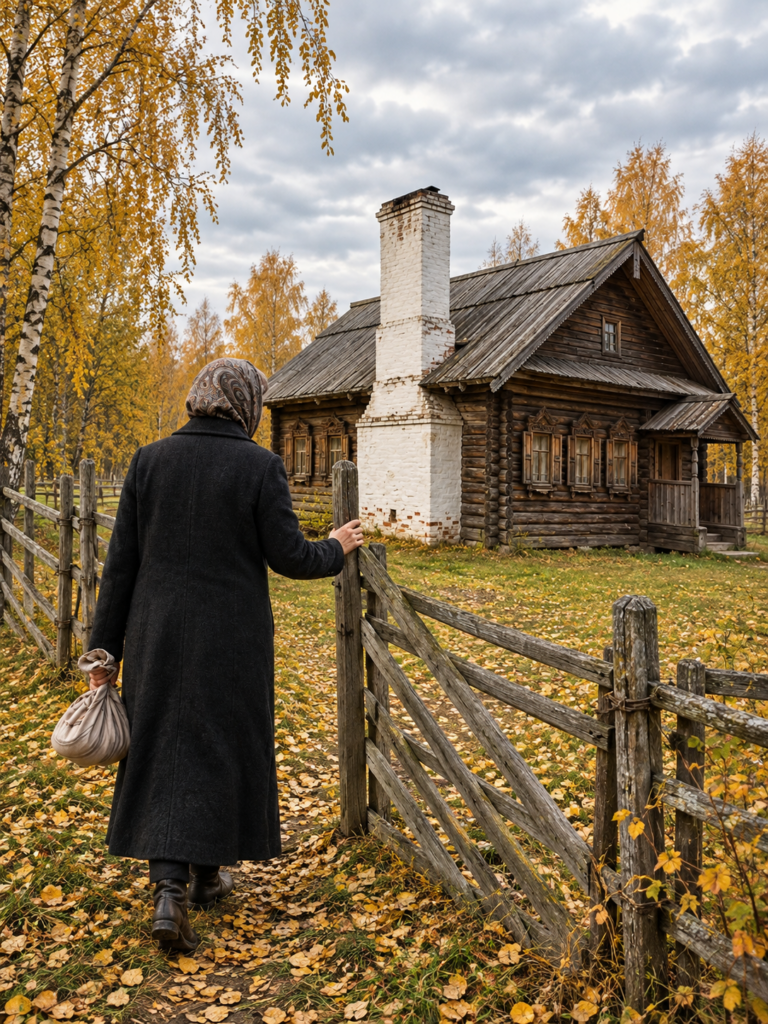
The cottage stood beyond the last houses of Ash Creek, a small northern Minnesota town surrounded by pine woods, marshland, and miles of lakeshore.
Its roof sagged slightly above the porch. The bottom step had rotted through, and weeds grew high around the foundation.
A large birch tree leaned over the side of the building.
Beyond it, the lake stretched beneath the gray September sky.
Claire stood at the gate with her bags.
“Well,” she whispered. “Here we are.”
A voice called from next door.
“Claire Bennett? Is that you?”
Edith Lawson sat on her porch, peeling apples into a metal bowl.
She was eighty-two, wore a faded blue cardigan, and knew almost everything that happened in Ash Creek.
“I heard Marilyn got you out of the farmhouse.”
Claire lowered her bags.
“She sold me Arthur’s place.”
“Sold it?”
“Ten dollars.”
Edith stopped peeling.
For a moment, she simply stared.
Then she gave a low whistle.
“Arthur would’ve gotten a kick out of that.”
Claire couldn’t tell whether the old woman was joking.
She took the key from her pocket and opened the front door.
Cold, stale air greeted her.
Dust covered the floor. A single bulb hung from the ceiling, and an old wooden table stood beneath the front window.
But the fireplace was extraordinary.
It wasn’t an ordinary brick fireplace. Arthur had constructed a massive masonry heater, the kind designed to absorb heat from a wood fire and release it slowly through the surrounding stonework.
Its broad brick bench extended along one side of the room.
Above the bench was a strip of decorative ceramic tiles.
Claire moved closer.
The tiles were beautiful.
One showed a blue bird on a flowering branch. Another showed a little house among trees. A third was decorated with curling leaves.
Their colors were surprisingly vivid beneath the dust.
At the far end of the row was a crooked blue rooster.
Its tail was much too large. One foot appeared to be missing, and its round body made it look slightly ridiculous.
Claire smiled despite herself.
“Arthur, what on earth were you thinking?”
His old tools still hung on nails beside the fireplace.
There was a worn trowel, a plumb bob, and a wooden square polished smooth from years of use.
In the back room, Claire discovered an iron bed frame, a small desk, and a low brick foundation covered with boards.
She tapped it.
Hollow.
Edith appeared in the doorway.
“Arthur was planning another heater in here.”
“Another one?”
“Kept saying it would be the finest thing he’d ever built.”
“Why didn’t he finish it?”
Edith looked at the tools on the wall.
“His hands gave out.”
She set her apple bowl on the table.
“One thing before you do anything else. Don’t light that fireplace until Ethan checks the chimney.”
“Ethan?”
“Arthur’s grandson. He installs masonry heaters for a living.”
“What’s wrong with the chimney?”
“Birds have been nesting in it for two years. You could fill the house with smoke, or worse.”
Claire looked at the dark opening.
“Can he come soon?”
“I’ll call him.”
That evening, Edith returned with half a loaf of bread, a jar of pickles, and an extra blanket.
Claire laid her quilt over Arthur’s old bench and tried to sleep.
Outside, branches scratched against the roof.
Something moved inside the chimney.
She pulled the blanket higher.
There was no central heating. No firewood. No money for repairs.
And the nights were already getting colder.
She placed Michael’s photograph and coffee mug on the windowsill.
“Well, Mike,” she whispered. “It’s not much.”
She paused.
“But it’s ours.”
The following morning, Edith woke her by knocking on the window.
“Get dressed, honey. You’ve got work to do.”
Claire opened the door.
“What work?”
“Cranberries.”
Edith pointed toward the marsh beyond the meadow.
“They’re thick out there this year. Cabin owners along the highway will pay good money for fresh wild berries.”
Claire looked at her empty kitchen shelves.
“How much money?”
“Enough to buy groceries if you stop standing there asking questions.”
Arthur had left a berry basket and an old wooden scoop inside the storage shed.
Claire carried them into the marsh.
By noon, her back was aching.
By three, she could barely straighten her fingers.
But the basket was full.
Edith provided clean jars, and Claire spent the evening washing and sorting the berries.
The following morning, she set up a folding table beside the county road.
Her first customer was a woman driving a silver SUV.
“Did you pick these yourself?”
“Yesterday.”
The woman examined a jar.
“How much?”
“Twelve dollars.”
“I’ll take three.”
Claire counted the cash twice after the woman drove away.
Thirty-six dollars.
She had earned it herself.
By the end of the afternoon, every jar was gone.
She bought bread, oatmeal, coffee, eggs, and a bar of soap.
For the first time since Michael’s death, she felt a small, private sense of relief.
She might not know how to rebuild a roof.
She might not have enough money to survive the winter.
But she could still work.
And as long as she could work, she had a chance.
A few days later, Andrew’s green pickup slowed beside her roadside stand.
Judy leaned out the passenger window.
“Well, would you look at that! Claire Bennett’s running her own little business.”
Claire kept arranging the jars.
Judy grinned.
“Hey, can family get a discount? Maybe ten dollars for the whole table?”
Andrew touched his wife’s arm.
“Judy. Come on.”
But she was already laughing.
The truck accelerated, kicking dust across the jars.
Claire waited until it disappeared, then wiped each jar clean.
She didn’t cry.
She had too much work to do.
A week later, Marilyn came to the cottage.
She arrived without calling and walked inside as though she still owned the place.
“I’m here for Arthur’s old copper kettle.”
Claire looked toward the shelf.
“The one he used on the stove?”
“That’s it. Family keepsake.”
Claire took the kettle down and handed it over.
Marilyn turned it in her hands.
Then she looked around the room.
“Good Lord. That fireplace is enormous.”
“Arthur built it himself.”
“It probably takes a mountain of wood to heat this place.”
“I’ll manage.”
Marilyn noticed the jars on the table.
“Are those cranberries?”
“Yes.”
“You should give me a couple. I haven’t made preserves this year.”
“They’re for sale.”
Marilyn looked surprised.
“Excuse me?”
“I’m selling them, Marilyn. I need the money.”
For several seconds, neither woman spoke.
Then Marilyn picked up the kettle.
“Suit yourself.”
She walked out and slammed the door.
Claire stood beside the table, her heartbeat quickening.
She had spent almost three decades agreeing with Marilyn because disagreeing never seemed worth the trouble.
Now, for the price of two jars of cranberries, she had finally learned to say no.
And she discovered that nothing terrible happened afterward.
By the end of September, the cottage was cleaner than it had been in years.
Claire scrubbed the floors, washed the windows, and removed old mouse nests from beneath the cabinets.
Behind a shelf, she found Arthur’s glasses.
On the wall near the back door hung an old calendar, still open to a date two years earlier.
She left it there.
One morning, she stepped outside and discovered a large stack of split firewood beside the fence.
Someone had delivered it during the night.
Fresh tire tracks crossed the damp ground.
Claire recognized the pattern.
Frank’s tractor had unusually wide rear tires, with a damaged tread on one side.
She stood beside the woodpile for several minutes.
Frank had allowed Marilyn to take her home.
He had watched while his family divided up her possessions.
Yet somehow he had managed to leave her enough wood to get through the first cold spell.
Edith came over and examined the tracks.
“Well, I’ll be.”
She looked toward the road.
“Maybe Frank’s conscience finally woke up.”
Claire said nothing.
She spent two days stacking the logs beneath the overhang.
By the second evening, her shoulders were sore, and her palms were covered with blisters.
But she slept more soundly than she had in weeks.
In early October, Ethan Bell arrived.
He was thirty-two, with a reddish beard, work boots caked in mud, and a white service truck carrying ladders and chimney-cleaning equipment.
He stepped out and looked at the cottage.
“So you’re the lady who bought Grandpa’s place for ten bucks.”
“That’s me.”
Ethan shook his head, smiling.
“He would’ve loved that.”
He spent an hour examining the masonry heater.
He checked the firebox, flue passages, dampers, and chimney before climbing onto the roof.
When he lowered his cleaning brush, an astonishing amount of debris came down.
Twigs. Feathers. Dust. Pieces of an old nest.
Claire held a metal bucket beneath the opening.
“How many birds were living in there?”
Ethan laughed.
“Enough to start their own neighborhood.”
Once everything was cleared, he performed the remaining safety checks and explained how to use the heater.
“Don’t build a roaring fire the first time. The masonry’s been cold for years. Warm it up gradually.”
He ran his hand across the decorative tiles.
“Grandpa collected these for decades.”
“Do you know where they came from?”
“Not really. He always said he rescued them from places people had forgotten.”
His finger stopped on the crooked rooster.
“That one’s different.”
“It certainly is.”
“Looks like a kid painted it.”
Claire laughed.
“Maybe Arthur wasn’t much of an artist.”
Ethan smiled.
“He was a better bricklayer than a painter, that’s for sure.”
Before leaving, he refused her offer of payment.
“Grandpa taught me everything I know. He never charged me a dime. Consider this one on him.”
That night, the first hard frost arrived.
By dawn, ice covered the puddles outside.
Claire got up before sunrise and arranged kindling inside the heater.
She opened the damper, struck a match, and waited.
At first, the flames struggled.
Then the draft caught.
A low hum traveled through the masonry.
Claire added another small log.
By noon, the brickwork had begun releasing heat into the room.
For the first time since moving in, she could take off her coat indoors.
After lunch, she sat on the wide bench and placed her hand against the decorative tiles.
They were warm.
The bird. The little house. The flowers.
Every tile radiated a gentle heat.
Except one.
The crooked rooster.
Claire frowned.
She touched it again.
Cool.
She moved her hand to the neighboring tile.
Warm.
Back to the rooster.
Cold.
She leaned closer.
The mortar around its edges was a different shade from the surrounding joints.
And the workmanship was sloppy.
Arthur Bell had built fireplaces so precisely that Ethan said his grandfather could spot a crooked brick from across the room.
This joint looked as though someone had filled it with a butter knife.
Claire climbed down and fetched the old fireplace poker.
Carefully, she pressed its tip into the seam.
The mortar crumbled.
She pressed again.
The tile shifted.
Then it came loose in her hand.
Behind it was a narrow, dark space.
Claire brought over a flashlight.
Something lay inside.
An elongated package wrapped in waxed canvas.
And beside it, an old metal candy tin.
She reached into the opening and pulled them out.
The canvas bundle was heavier than she expected.
She placed everything on the kitchen table.
Tucked beneath the string was a folded piece of paper.
On the outside, written in Arthur’s uneven handwriting, were five words.
For whoever lights the fire.
Claire sat down.
Then she untied the string.
Inside was a thick, clothbound album filled with drawings and handwritten notes.
Beneath it were dozens of newspaper-wrapped packages.
She opened the first.
A ceramic tile depicting a beautiful blue bird.
The second showed a lion with an oddly human face.
The third was decorated with a sailing ship.
She kept unwrapping.
Flowers. Horses. Houses. Birds. A city skyline.
Thirty-nine tiles altogether.
They were unlike anything she’d ever seen.
Inside the metal tin, she found a brass maker’s stamp bearing the initials A.B., along with a small handwritten inventory.
The first page read:
Historic Fireplace Tiles.
Total Collection: 40.
Claire counted again.
Thirty-nine packages.
Then she looked at the crooked rooster lying beside her.
Forty.
She opened the inventory.
Each tile had a number, a description, and a location.
An old lakeside mansion demolished in 1952.
A grand hotel that had once stood near Lake Superior.
A Victorian estate dismantled after years of neglect.
Several entries described tiles Arthur had rescued from fireplaces before the buildings were torn down.
It was a record of places that no longer existed.
The final entry was different.
Number 40.
Blue rooster.
Made by an unknown artist.
The finest of them all.
Claire looked at the ridiculous little bird.
“Oh, Arthur,” she murmured. “You really did have a sense of humor.”
Then she unfolded the letter.
And began reading.
Part 2
Arthur’s letter was written on two sheets of yellowed notebook paper.
The handwriting was rough but surprisingly clear.
If you’re reading this, somebody has finally made a fire in my old heater.
That means you noticed the blue rooster never gets warm.
Good.
I always figured the right person would notice.
Claire glanced toward the fireplace.
The fire had burned down to glowing embers.
She turned back to the letter.
Frank and Andrew won’t bother with this place. They have bigger houses and more important things to worry about. They’ll sell it or let it rot.
But somebody else will come along. Somebody who needs a roof and a warm room more than they need anything fancy.
That’s who I’m writing to.
Claire felt a strange tightness in her chest.
Arthur had written those words before Michael died.
Before Marilyn decided to claim the farmhouse.
Before anyone knew Claire would end up in his cottage.
She continued.
When I was young, I worked on old fireplaces around Minnesota and Wisconsin. Big houses, fancy hotels, lakeside estates. A lot of those buildings were pulled down after the war. Nobody cared much about the old tilework. They smashed it with everything else.
Whenever I could, I saved a few pieces.
I wrote down where each one came from. Not because I thought they’d make me rich, but because somebody ought to remember the people who made them.
I’ve been holding on to these for most of my life.
There’s a foundation in the back room. You’ll find the plans on the last page of my album.
Build the heater.
Don’t break up the collection, no matter what somebody offers you.
These tiles spent their first lives keeping people warm. I’d like them to have another chance.
Put the rooster right in the middle.
You’ll understand why.
Arthur Bell.
Claire lowered the letter.
For a long time, she sat listening to the faint ticking of the cooling masonry.
Then she opened the album.
Page after page contained hand-drawn fireplaces, old heating systems, measurements, and notes about different houses.
Some entries were dated in the 1950s.
Others were much more recent.
On the final page was a detailed drawing of a round tiled masonry heater.
Forty numbered spaces covered its outer surface.
Number forty sat at the very center.
Above the drawing, Arthur had written:
For the one who lights the fire.
Claire looked toward the back room.
The brick foundation was already there.
So were the tiles.
And somewhere in the shed, she suspected, Arthur had left other materials.
He had been preparing for this project for years.
He had simply run out of time.
Edith came over after supper.
Claire showed her the collection.
The older woman stood beside the table, turning slowly from one tile to another.
“Well, would you look at that.”
“Did you know he had these?”
“Not a clue.”
Edith picked up the tile depicting the sailing ship.
“Arthur used to disappear for days when he was younger. Come back with a truck full of old bricks and dusty boxes. Everybody thought he was collecting junk.”
“He was saving pieces of old buildings.”
“Looks that way.”
Claire showed her the inventory.
Edith examined it carefully.
“Some of these places have been gone longer than you’ve been alive.”
“I know.”
“Are they valuable?”
“I have no idea.”
Edith set down the notebook.
“Then you ought to find out. Quietly.”
Claire looked at her.
“You think somebody might try to take them?”
Edith gave her a dry smile.
“Honey, you know Marilyn Bennett better than I do.”
Claire wrapped the tiles again and placed the album beneath her pillow.
That night, she barely slept.
It wasn’t just the possibility of money.
For years, she had thought of Arthur as a lonely old man who knew how to build fireplaces.
Now she understood that he had spent much of his life rescuing objects other people had thrown away.
He had saved them quietly, without praise or attention.
And he had trusted a stranger to finish his final project.
A stranger who might never have appeared.
The following weekend, the Bennett family gathered at the cemetery to put fresh flowers on Michael’s grave.
Claire arrived carrying a small bunch of white chrysanthemums.
Marilyn was already standing beside the headstone in a new wool coat.
Judy looked Claire up and down.
“Well, you’re still alive. Guess that cottage hasn’t frozen you to death.”
“I’m doing fine.”
Marilyn turned.
“Did you get the fireplace working?”
“Yes.”
“Where’d you get the wood?”
Claire glanced toward Frank.
He was standing a few feet away, examining the grass near another headstone.
“I managed.”
Judy smiled.
“I hope you’re not burning the house down one log at a time.”
Claire ignored her.
She knelt beside Michael’s grave and arranged the flowers.
His photograph was embedded in the headstone.
He looked so much younger than he had during the final months of his illness.
She rested her hand on the cold granite.
For one brief moment, she wanted to tell the family what she had found.
She wanted Marilyn to know that Arthur’s so-called worthless cottage contained rare antiques.
She wanted Judy to stop laughing.
She wanted to watch their faces when they learned the truth.
But she remembered Edith’s warning.
So she said nothing.
When the others left, Claire remained beside the grave.
“I bought a house, Mike,” she whispered.
A breeze moved through the pine branches.
“Ten dollars. You would’ve laughed yourself silly.”
She paused.
“There’s something hidden inside the fireplace. Arthur left a letter and some beautiful old tiles. I think they might be worth money.”
She looked at her husband’s name.
“I wish you were here. You’d know what to do.”
Claire sat there until her knees grew stiff.
By the time she stood, she had made up her mind.
She would take the tiles to somebody who understood them.
The following Tuesday, Claire wrapped two tiles in clean towels and took the county shuttle into town.
The local history museum occupied a restored brick building near the main street.
Inside, a young woman with dark-framed glasses was sorting pamphlets behind the front desk.
“Can I help you?”
“I hope so.”
Claire placed her canvas bag on the counter.
“I found something in an old house. I was wondering whether anyone here could tell me what it is.”
The woman’s name was Grace Nolan.
She unwrapped the first tile.
Then the second.
Her expression changed.
“Where did you get these?”
“From my fireplace.”
Grace examined the back of the sailing ship.
“Do you know how old this is?”
“No.”
“Do you have any others?”
“Thirty-nine more pieces in the collection, counting the one I took out of the wall. Forty altogether.”
Grace looked up.
“Forty?”
“There’s also a notebook. It tells where they came from.”
Grace carefully set down the tile.
“Would you mind waiting here?”
She disappeared into an office.
Claire could hear her speaking excitedly on the telephone.
When she returned, she was smiling.
“I’ve spoken to a historic materials conservator in Minneapolis. Her name is Margaret Voss. She’s worked on architectural ceramics for more than thirty years.”
Claire nodded.
“All right.”
“She wants to come see them.”
“To my cottage?”
“Yes.”
Claire frowned.
“That’s a long drive.”
Grace laughed.
“I don’t think she’ll mind.”
Margaret Voss arrived three days later.
She was in her early sixties, with short gray hair, practical shoes, and a small equipment case.
She greeted Claire warmly before asking permission to examine the collection.
Claire laid the tiles on a clean sheet across the kitchen table.
Margaret didn’t touch them immediately.
She simply looked.
Then she leaned closer.
“Good heavens.”
Claire’s stomach tightened.
“Is something wrong?”
“Quite the opposite.”
Margaret put on her gloves.
For the next two hours, she examined each tile under a bright lamp.
She studied the glaze, the clay body, the firing marks, and the small differences in workmanship.
Some pieces appeared to be American decorative tiles from the late nineteenth century. Others belonged to the early twentieth-century Arts and Crafts movement.
The sailing ship, she explained, might be associated with a workshop whose surviving pieces were now extremely rare.
The lion was particularly unusual.
But the inventory interested her most.
She read Arthur’s notes, then compared them with the marks on the tiles.
“Claire, do you understand what makes this collection extraordinary?”
“The designs?”
“Those are part of it. But it’s the documentation.”
Margaret tapped the notebook gently.
“Most salvaged architectural pieces lose their history. Nobody remembers which building they came from, or when they were removed, or who made them.”
She opened the inventory to a page about a demolished hotel near Lake Superior.
“Arthur recorded all of that. He preserved their provenance.”
Claire listened.
“So they’re worth something?”
Margaret hesitated.
“I would need additional research and independent authentication before giving you a formal appraisal. But I can give you a preliminary range.”
Claire folded her hands in her lap.
“All right.”
“Some individual tiles like these could sell for several thousand dollars. A few might be worth considerably more.”
She looked over the collection again.
“With the condition they’re in, and with this level of documentation, I wouldn’t be surprised if the entire collection was valued somewhere between two hundred and fifty thousand and four hundred thousand dollars.”
Claire stared at her.
She thought she must have misheard.
“How much?”
Margaret repeated the figures.
Claire slowly sat down.
Four hundred thousand dollars.
The number was almost impossible to understand.
She thought about the ten-dollar bill on Marilyn’s kitchen table.
Judy laughing.
Frank staring into his coffee.
Molly being led into the trailer.
All the small humiliations of that terrible afternoon returned at once.
And here, in a cottage everyone considered worthless, sat a collection that might be worth more than the farmhouse and hayfield combined.
Margaret watched her carefully.
“Are you all right?”
Claire nodded.
“I think so.”
“There’s something else you need to know.”
“What?”
“Once people hear about this, they’ll start showing up with offers. Some will be legitimate. Some won’t. Don’t sign anything without independent advice.”
Claire looked at Arthur’s letter.
“I’m not selling.”
Margaret raised an eyebrow.
“Not selling?”
“No.”
“Claire, that’s a significant amount of money.”
“I know.”
“Are you sure you understand what keeping these means?”
Claire picked up Arthur’s letter and handed it to her.
Margaret read it slowly.
When she finished, she looked toward the unfinished foundation in the back room.
“He wanted another heater.”
“Yes.”
“With all forty tiles.”
“That’s right.”
Margaret sighed.
“Most conservators would insist on keeping these in controlled storage.”
“Would you?”
The older woman considered her answer.
“Not without examining how the design could protect them. These were made to be part of architectural surfaces, but historic materials can be fragile. They’d need to be mounted carefully, with proper documentation and a way to remove them if necessary.”
Claire waited.
Then Margaret smiled.
“But I think we could figure it out.”
Claire looked down at the tiles.
“You’d help?”
“I’d be glad to.”
That afternoon, Margaret photographed every piece, recorded dimensions, and documented the collection.
She promised to prepare a professional catalog and help Claire establish a clear record of the discovery and ownership.
Before leaving, she took Claire’s hand.
“Arthur Bell was an extraordinary man.”
Claire looked toward the fireplace.
“Yes,” she said softly. “I think he was.”
The secret lasted less than a week.
Someone saw Margaret’s car in Claire’s driveway.
Someone else heard Grace discussing the collection at the museum.
By Monday, people were talking about an abandoned cottage containing a fortune in antique tiles.
By Wednesday, Marilyn was knocking on Claire’s door.
She had brought Judy and Frank.
Claire opened the door.
Marilyn smiled tightly.
“Mind if we come in?”
Claire stepped aside.
They sat around the kitchen table.
Marilyn kept glancing toward the masonry heater.
Finally she spoke.
“We hear you’ve found something interesting.”
Claire nodded.
“Some old tiles Arthur saved.”
“Valuable tiles, apparently.”
“Possibly.”
Marilyn folded her hands.
“Well, that creates a problem.”
Claire waited.
“Arthur was part of our family. His belongings belong to the family.”
“The property belongs to me.”
“The house does. But we didn’t know those things were hidden inside it.”
Claire walked to the drawer and removed the closing documents.
She laid them on the table.
“The deed and purchase agreement transferred the cottage with its fixtures and the personal property left behind. You all signed.”
Marilyn barely glanced at the papers.
“We sold you a broken-down house for ten dollars. That doesn’t mean you get to keep four hundred thousand dollars’ worth of antiques.”
“You chose the price.”
“Claire, don’t be difficult.”
“I’m not being difficult.”
Marilyn leaned forward.
“We can work this out as a family.”
Judy smiled quickly.
“Exactly. Maybe we could split the money. You’d still have plenty.”
“I’m not selling anything.”
Marilyn stared.
“Don’t be ridiculous.”
“I mean it.”
“You’re going to keep hundreds of thousands of dollars sitting in a falling-down cottage?”
“That’s my decision.”
Marilyn’s cheeks reddened.
“After everything this family has done for you—”
Frank interrupted.
“That’s enough, Marilyn.”
His wife turned.
“Excuse me?”
“I said that’s enough.”
He looked across the table at Claire.
“We sold her the place. We signed the papers. We made fun of her for buying it.”
Marilyn opened her mouth.
Frank continued.
“And we knew what we were doing.”
“Frank—”
“No. I’ve kept my mouth shut long enough.”
His voice was steady.
“Claire spent twenty-nine years working on that farm. She cared for Mom when none of us wanted to deal with it. She looked after Michael when he got sick.”
He lowered his eyes.
“And we treated her like she was just another bill to get rid of.”
Marilyn stood abruptly.
“Well, if that’s how you feel.”
She grabbed her purse.
Judy hurried after her.
Frank remained seated for a moment.
“I’m sorry, Claire.”
She looked at him.
He struggled with the next words.
“I should’ve said something that day.”
“Yes,” she replied. “You should have.”
Frank nodded.
He stood and put on his jacket.
At the doorway, Claire asked, “Was it you who brought the firewood?”
He looked back.
Then nodded.
“It wasn’t enough.”
“No,” Claire said. “But it helped.”
Frank left without another word.
Marilyn went to see an attorney the following week.
It didn’t turn out the way she expected.
The attorney examined the signed purchase agreement, confirmed that the family had knowingly transferred the property, and explained that discovering valuable items after closing did not automatically give the former owners a right to reclaim them.
He also warned that any legal challenge would be expensive and uncertain.
Claire sought independent advice as well, using the documents Margaret had helped her organize.
She made sure the recorded deed was correct and arranged appropriate protection for the collection.
Marilyn stopped calling.
But that didn’t mean the visitors stopped coming.
One afternoon, a black SUV pulled into the driveway.
A well-dressed man stepped out.
He introduced himself as a private collector from Chicago.
“I understand you have some interesting architectural ceramics.”
Claire hesitated.
Then she invited him inside.
He examined the tiles carefully.
After several minutes, he removed a pen from his jacket and wrote a figure on the back of his business card.
He slid it across the table.
Claire looked down.
$325,000.
For a moment, she imagined what that money could buy.
A warm apartment in Duluth.
A reliable car.
Enough savings to stop worrying about grocery bills.
She could have left the cottage, the broken porch, and the long Minnesota winters behind.
The collector studied her face.
“It’s a serious offer. And I can move quickly.”
Claire looked at Arthur’s letter.
Then at the empty foundation in the back room.
She slid the card back across the table.
“No, thank you.”
The man frowned.
“Is the amount the problem?”
“No.”
“Then perhaps I can improve it.”
“They’re not for sale.”
He leaned back.
“May I ask why?”
“Because the man who saved them wanted them built into a heater.”
The collector looked almost offended.
“These are museum-quality objects.”
“I know.”
“You can’t seriously intend to put them back into a working fireplace.”
“It’s a masonry heater. And with the conservator’s help, that’s exactly what I’m planning to do.”
He stared at her.
“You’re turning down more than three hundred thousand dollars to heat a cottage?”
Claire smiled faintly.
“I guess that’s one way to put it.”
The man shook his head.
He left his card on the table and walked outside.
Claire watched his SUV disappear down the road.
Then she put the card in a drawer.
She did not need to destroy it to prove she meant what she had said.
A few days later, Andrew arrived with a fifty-pound sack of potatoes.
He stood awkwardly on the porch.
“Judy sent these.”
Claire stepped aside.
“Come in.”
He carried the sack into the kitchen.
For a while, they talked about the weather.
Then Andrew rubbed his hands together.
“Claire, I’ve been meaning to apologize.”
She looked at him.
“For what?”
“The way we treated you after Mike died.”
He swallowed.
“I laughed with Judy. I shouldn’t have.”
Claire nodded.
“Thank you for saying that.”
Andrew looked relieved.
Then his expression changed.
“There’s another reason I came.”
“What is it?”
“It’s Molly.”
Claire straightened.
“Is she sick?”
“No. Vet says she’s fine. But she’s barely giving any milk, and she makes a racket every night.”
Claire stared at him.
Andrew looked embarrassed.
“I think she misses you.”
The next morning, Claire went to Andrew’s barn.
Molly recognized her footsteps before she reached the stall.
The cow lifted her head and gave a long, familiar moo.
Claire laughed.
“Hello, sweetheart.”
Molly pressed her broad nose against Claire’s shoulder.
For several minutes, Claire stood with her face buried against the animal’s warm neck.
Then she sat on the old milking stool.
Almost immediately, the familiar rhythm returned.
Milk struck the pail in steady streams.
Judy watched from the barn doorway.
She didn’t make a single joke.
When Claire finished, Andrew carried the pail inside.
“You can come anytime,” he said.
Claire rubbed Molly’s forehead.
“I will.”
And she did.
Every morning when she could manage it.
The first snow fell in early November.
Claire called Ethan and told him about Arthur’s letter and the drawings.
He arrived the next morning.
When he saw the plan for the round heater, he went completely still.
“Grandpa talked about this.”
Claire stood beside him.
“He did?”
“Ever since I was a kid. He wanted to build a heater using all the old tiles he’d collected.”
Ethan traced the drawing.
“He planned the flue channels, the foundation, everything.”
He turned toward her.
“Claire, I think we can finish it.”
“What would it take?”
“Time. Materials. A lot of careful work.”
“I don’t have much money.”
Ethan smiled.
“Grandpa already took care of most of that.”
He led her outside to the sagging shed.
Together they pulled aside an old canvas tarp.
Behind it were stacks of carefully selected firebricks, clay containers, and masonry supplies.
Claire stared.
“He kept all this?”
“Looks like it.”
Ethan picked up a brick and tapped it with his knuckle.
A clear ringing sound came back.
“That’s how Grandpa checked good brickwork. He could tell a lot from the sound.”
He examined the stack.
“He spent years getting ready for this.”
They began working in mid-November.
Ethan handled the construction. Margaret supervised the conservation and mounting plan for the historic tiles. Claire helped wherever she could.
She cleaned bricks, carried supplies, mixed mortar, and kept the workspace organized.
The work was slow.
Some days they spent hours on a section that barely rose a few inches.
But Claire didn’t mind.
Each evening, she looked at the growing structure and felt a quiet satisfaction she hadn’t experienced in years.
One afternoon, Ethan watched her pass him a brick.
“Who taught you to hand bricks over like that?”
Claire looked puzzled.
“Like what?”
“With the good face toward the mason.”
She shrugged.
“Just seemed right.”
Ethan smiled.
“Grandpa was always particular about that.”
Claire laughed.
“Maybe I would’ve made a decent bricklayer.”
“Maybe you already are.”
By early December, the round heater had taken shape.
Margaret returned to help with the decorative tiles.
They followed Arthur’s numbered diagram.
The bird on the flowering branch went first.
Then the lion.
Then the ship.
Each piece was photographed and checked before being mounted.
They used a method designed to protect the old ceramic surfaces and allow future removal for conservation if needed.
As the tiles went into place, Claire read their histories aloud from Arthur’s notebook.
A lost lakeside estate.
A demolished hotel.
A grand fireplace that had warmed visitors a century earlier.
The stories seemed to fill the little room.
And slowly, Arthur’s final design came to life.
By the middle of December, thirty-nine tiles were in position.
Only one remained.
The crooked blue rooster.
Its place was at the center of the heater, exactly where Arthur had instructed.
Claire decided to clean it herself.
That evening, after Ethan and Margaret left, she spread a towel on the table.
She filled a small bowl with warm water and took out a soft brush.
The rooster was stained with years of soot.
Claire worked carefully, lifting away the dirt bit by bit.
As the glaze brightened, she noticed something strange.
The blue tail.
The awkward round body.
The missing foot.
There was something familiar about the way the bird had been drawn.
She turned it over.
The back was covered with hardened clay.
She began removing the loose material.
Then she saw a faint scratch beneath it.
A letter.
Then another.
She brought the lamp closer.
Slowly, the words appeared.
Claire D.
Age 9.
1984.
Claire stopped breathing for a moment.
Her brush slipped from her hand.
She stared at the inscription.
And suddenly, after more than forty years, she remembered.
A little house beside a creek.
Her father’s blacksmith shop.
A broken fireplace.
And a tall, thin craftsman who had once handed a nine-year-old girl a paintbrush and told her to make something beautiful.
Part 3
In the summer of 1984, Claire Dawson was nine years old and convinced she could do anything her father could do.
Her father, James Dawson, was a blacksmith in a small northern Minnesota community not far from Ash Creek.
He repaired farm equipment, shod horses, and made decorative ironwork for people who still wanted things built by hand.
Their house stood beside a creek, with a workshop behind it and a vegetable garden her mother tended every summer.
That year, the old masonry fireplace developed a serious crack.
Smoke began leaking into the kitchen, and her father decided the entire firebox needed rebuilding.
He hired a craftsman from a neighboring town.
His name was Arthur Bell.
Claire remembered him now.
He was tall and thin, with gray beginning to show at his temples. His hands were enormous, and he carried a battered leather tool bag everywhere he went.
He worked carefully, measuring each course of bricks before laying the next.
Claire followed him around for three days.
At first, he ignored her.
Then he told her to go play.
She refused.
Finally, he handed her two bricks.
“All right, little lady. If you’re going to stand there watching, you might as well help.”
She carried them to the fireplace.
“Not like that,” Arthur said.
He showed her how to hold each brick and turn its smooth face toward the mason.
“Try again.”
She did.
“That’s better.”
After that, she became his assistant.
For nearly a week, she carried bricks, swept the floor, and fetched tools from his bag.
Her fingers were scraped raw.
Arthur noticed.
“Hands hurting?”
Claire shook her head.
“No, sir.”
He smiled.
“Good apprentice.”
On the final afternoon, while the last of the mortar was setting, Arthur brought out a plain ceramic tile.
He placed it on the workbench and handed her a small brush.
“Every good craftsman ought to make something of their own.”
Claire looked at the tile.
“What should I paint?”
“Anything you like.”
She thought for a moment.
Then she began painting the family’s rooster, Charlie.
Charlie had an enormous tail, a bright red comb, and a bad habit of chasing visitors across the yard.
Claire painted the tail first.
It took up almost half the tile.
Then she added the round body, the head, and a pair of skinny legs.
As she tried to paint the second foot, her sleeve dragged across the wet glaze.
The little foot became a blue smear.
Claire stared at it.
“Oh, no.”
Arthur leaned over.
“What’s wrong?”
“I ruined it.”
He examined the rooster.
Then he laughed.
“Looks like Charlie to me.”
“He’s supposed to have two feet.”
“Well, maybe he’s standing on one.”
Claire wasn’t convinced.
She reached for the brush.
Arthur gently stopped her.
“Leave it. That’s your rooster. Nobody else’s.”
He gave her a small pointed tool.
“Now sign your work.”
She scratched her name into the back.
Claire D.
Age 9.
1984.
Arthur examined it.
“Very good.”
“When can I take it home?”
“I’ll have to fire it in my kiln.”
“Can I come get it?”
“Of course.”
She looked at him seriously.
“Promise you won’t lose it?”
Arthur placed his hand over his heart.
“Cross my heart.”
But Claire never collected the tile.
That autumn, her mother became ill.
The following year, she died.
A few years later, her father passed away too.
There were relatives, school, work, and eventually Michael Bennett.
Claire moved into the farmhouse when she married him.
Life became a long succession of responsibilities.
Somewhere along the way, the little girl who had painted a funny rooster was forgotten.
And Arthur Bell, the man who had once called her his apprentice, became simply the elderly craftsman who lived alone by Alder Lake.
Until now.
Claire sat at the kitchen table with the tile in her hands.
She remembered visiting Arthur during the last years of his life.
He always seemed pleased to see her.
He never let her leave without tea or something to eat.
And once, when she’d brought him milk on a particularly cold afternoon, he’d asked an odd question.
“Claire, you ever paint anything these days?”
She’d laughed.
“Me? I can barely draw a straight line.”
Arthur had smiled to himself.
“That’s a shame. You used to have a good hand.”
She hadn’t understood what he meant.
She thought he was teasing.
Now she knew.
He had remembered her all along.
Claire set down the rooster and pulled the album from its shelf.
She turned through the pages, looking for the early 1980s.
There were several entries about small farmhouses and rural fireplaces.
Then she found it.
Dawson farmhouse, Mill Creek Road. July 1984.
Below the drawing of her childhood fireplace, Arthur had written a note.
Assistant: Claire Dawson, age nine.
Carried bricks properly. Never complained.
Painted a blue rooster.
I kept it.
Best tile I ever owned.
Claire read the words again.
Then she pressed her hand over her mouth.
For more than forty years, Arthur had kept the tile she made as a child.
Not because it was old.
Not because it was worth money.
Because she had made it.
She looked toward the back room, where the new heater stood waiting for its final tile.
Arthur had spent his life saving beautiful things that other people considered worthless.
And somewhere among those treasures, he’d kept a crooked rooster painted by a nine-year-old girl.
A girl who had grown into a woman who no longer believed she was capable of making anything beautiful.
Claire began to cry.
She cried for her parents, for Michael, and for all the years she had spent trying to make other people happy.
She cried for Arthur, who had recognized something in her that she herself had forgotten.
And when she finally stopped, she understood why he had wanted the rooster placed at the center.
It had never been about artistic perfection.
It was about remembering where something came from.
And who had made it.
Edith arrived shortly after dark.
She knocked once, then let herself in when Claire called out.
“Honey, your lights have been on for hours. Everything all right?”
Claire showed her the tile.
Edith studied the scratched letters.
Then she sat down slowly.
“Well, I’ll be.”
“You knew him back then?” Claire asked.
“Of course. Arthur worked all over this county.”
“Did you know he remembered me?”
Edith hesitated.
“Actually, yes.”
Claire stared at her.
“He told me once, after you started bringing him milk. Said you were James Dawson’s little girl. Said you’d helped him rebuild your father’s fireplace.”
“Why didn’t he tell me?”
Edith shrugged.
“You know Arthur. He never liked making a fuss.”
She examined the rooster again.
“He always said you were the best apprentice he’d ever had.”
Claire laughed through her tears.
“I was nine.”
“Didn’t matter to him.”
Edith placed the tile carefully on the towel.
“He told me the Bennett boys would never want this cottage. Said somebody else would come along who needed it.”
Claire looked toward Arthur’s letter.
“Somebody who would light the fire.”
Edith nodded.
“Sounds like he was right.”
The next morning, Ethan and Margaret returned.
Claire showed them the inscription and the old album entry.
Ethan read the words twice.
Then he looked at the rooster.
“Grandpa kept this for forty-two years?”
Claire nodded.
Margaret removed her glasses.
“Work of an unknown artist,” she said softly. “The finest of them all.”
Claire smiled.
“Well, we know the artist now.”
They prepared the last tile.
Margaret checked its condition and helped Claire position the protective mounting materials.
Ethan moved the step stool into place.
“Want me to do it?”
Claire shook her head.
“No. This one’s mine.”
She climbed onto the stool.
For a moment, she remembered Arthur standing in her father’s kitchen, teaching her how to pass bricks.
She remembered the smell of fresh mortar, the warmth of the summer afternoon, and the pleasure of being trusted with a real job.
Then she lifted the rooster.
She fitted it into the empty space at the center of the heater.
It settled into place perfectly.
Claire pressed gently around the edges.
Ethan stepped back.
For a long time, he simply looked at the completed work.
Then he smiled.
“Well, Grandpa. We finally finished it.”
They waited several days before lighting the new heater.
The mortar needed time to cure, and Ethan insisted on checking the completed system carefully.
On the fourth morning, Claire prepared a small fire.
She opened the damper, arranged the kindling, and struck a match.
The flames caught.
The heater began warming slowly.
By afternoon, heat was spreading through its brickwork.
Margaret had designed the decorative tile installation so the historic pieces could warm gently without being exposed to the strongest thermal stresses.
Claire waited until Ethan told her it was safe to touch the surface.
Then she placed her palm against the blue rooster.
Warm.
Just like the others.
She smiled.
“There you are.”
For forty-two years, that little bird had been waiting in a box, behind a wall, and finally inside Arthur’s last unfinished project.
Now it had a place of its own.
Right in the middle.
January brought heavy snow to Ash Creek.
The lake froze solid, and the temperature dropped well below zero.
But Arthur’s cottage remained warm.
Smoke rose steadily from its chimney, and light glowed through the windows long after dark.
Word of the completed heater spread through town.
At first, neighbors came out of curiosity.
Then people began traveling from nearby communities to see the historic tiles and hear their stories.
Claire never charged anyone to visit.
She served coffee at the kitchen table and showed them Arthur’s album.
Each tile had a history.
A mansion lost to time.
A grand hotel demolished to make room for something newer.
A fireplace that had warmed families long before Claire was born.
And at the center, the odd little rooster.
One afternoon, Grace arrived from the museum with a group of schoolchildren.
They crowded into the back room, their cheeks pink from the cold.
Claire explained how Arthur had rescued the old tiles.
She showed them photographs of the buildings where the pieces had originally been installed.
Then a little girl with curly hair raised her hand.
“Why is that rooster in the middle?”
Claire smiled.
“Because a little girl your age made it.”
“Who?”
“Me.”
The children laughed in surprise.
“You made that?”
“I did.”
The little girl studied the crooked rooster.
“He’s funny.”
“He certainly is.”
“Why does he only have one foot?”
Claire laughed.
“Because I made a mistake.”
“Didn’t you fix it?”
“No.”
“Why not?”
Claire looked at the bird.
“Because a very wise man told me that sometimes the mistakes are what make something ours.”
Ethan, who had come to help with the visit, brought out a box of plain ceramic tiles.
Margaret had arranged for the children to try painting their own designs using materials suitable for later firing.
The children spent the afternoon making birds, houses, flowers, and whatever else they could imagine.
One little boy painted a red pickup truck.
Another painted his dog.
The girl with curly hair painted a blue bird with an enormous green tail.
When they finished, Claire handed each child a small wooden tool.
“Now write your name on the back.”
“Why?”
“Because one day, somebody might want to know who made it.”
The children carefully signed their work.
And Claire thought Arthur would have loved every minute of it.
Later that winter, Marilyn Bennett came to the cottage.
She arrived alone.
There was no expensive coat, no handbag held tightly against her chest, and no confident knock.
Just three quiet taps on the door.
Claire opened it.
“Marilyn?”
Her sister-in-law looked uncomfortable.
“Hi, Claire.”
“Come in. It’s freezing.”
Marilyn stepped inside and removed her gloves.
She looked around the warm little cottage.
Her eyes stopped on the tiled heater in the back room.
“Frank told me you’d finished it.”
“We did.”
“It’s beautiful.”
“Thank you.”
For a while, Marilyn stood silently beside the table.
Then she cleared her throat.
“Claire, I need to ask you something.”
“What is it?”
“It’s the fireplace at the farmhouse.”
Claire looked at her.
“What’s wrong with it?”
“It’s smoking. Every time we light it, smoke comes back into the kitchen. Frank had the chimney checked, but they couldn’t find a blockage.”
“Did you call someone to inspect the flue passages?”
“Everyone we’ve called is booked for weeks.”
Marilyn looked embarrassed.
“I know I don’t have any right to ask, but…”
She stopped.
Claire waited.
“Could you come take a look? You always knew how to keep it working.”
Claire thought of the farmhouse.
The kitchen she’d painted.
The curtains she’d sewn.
The woodstove she had cleaned every autumn for almost three decades.
She thought of Marilyn standing in that same kitchen with a blue folder, telling her she had no claim to the house.
Then she looked at the woman standing before her.
“Let me get my coat.”
The farmhouse looked exactly as Claire remembered.
The porch light still flickered.
Michael’s old boots were gone from beside the door.
But the kitchen curtains remained, and the dent in the wooden floor was still there.
Smoke hung faintly in the air.
Frank stood beside the fireplace, looking frustrated.
“Thanks for coming, Claire.”
She nodded.
Then she walked to the side of the hearth.
Near the bottom, behind a narrow trim panel, was a small metal clean-out door.
She removed the panel.
Marilyn leaned forward.
“What’s that?”
“The clean-out.”
“I’ve never seen it.”
“I know.”
Claire opened the door and examined the passage with her flashlight.
As she suspected, soot had built up inside.
She showed Frank the obstruction.
“This passage needs cleaning. I’ve been doing it every fall for years.”
Frank stared at the opening.
“I didn’t know it was there.”
Claire looked at him.
“I know that, too.”
They cleared the blockage and checked the passage before testing the draft.
This time, the smoke traveled properly into the flue.
The fire burned evenly.
Marilyn stood beside the hearth, watching the flames.
Then she turned to Claire.
“There’s something I should have said months ago.”
Claire waited.
“I’m sorry.”
The words came out quietly.
“For the way I treated you after Michael died. For making you feel like you didn’t belong here.”
Claire looked at her.
Marilyn’s eyes filled.
“You spent almost thirty years taking care of this place. You took care of Mom. You took care of Michael.”
She swallowed.
“And I acted like none of it mattered.”
Claire was silent for several seconds.
“Marilyn, I don’t know if I can forget what happened.”
“I understand.”
“But I don’t want to spend the rest of my life being angry about it.”
Marilyn nodded.
“I’m not asking you to come back. I know this isn’t your home anymore.”
Claire looked around the kitchen.
For the first time, she realized that was true.
Not because Marilyn had taken it.
Because Claire no longer wanted to live there.
She had built something else.
Something that belonged to her.
She put away her flashlight.
“Have Frank clean that passage every fall. And get the whole system inspected regularly.”
“I will.”
Claire picked up her coat.
At the doorway, Marilyn spoke once more.
“Thank you, Claire.”
Claire gave her a small nod.
“Take care of yourself.”
Outside, Frank stood near the pickup truck.
He removed his cap when she came onto the porch.
Neither spoke.
Claire walked down the steps.
From Andrew’s barn across the yard came a long, familiar moo.
Molly.
Claire smiled.
“I’ll see you tomorrow, sweetheart.”
The cow answered with another low call.
Claire continued down the snow-covered driveway.
By the time she reached Alder Lake, stars had begun appearing above the trees.
The cottage windows glowed warmly against the darkness.
Inside, the air smelled of fresh coffee, woodsmoke, and the cranberry bread Edith had brought over that morning.
Michael’s photograph stood on the windowsill beside his old mug.
Claire removed her boots and coat.
Then she walked into the back room.
The round heater stood exactly where Arthur had planned it.
Thirty-nine historic tiles surrounded one crooked blue rooster.
She rested her hand on the warm masonry.
After a while, she returned to the kitchen and opened Arthur’s album.
There were several blank pages after the final drawing.
Claire found a pencil.
For a moment, she considered what to write.
Then she began.
Ash Creek, Minnesota.
Arthur Bell’s lakeside cottage.
Round masonry heater completed January 2027.
Built according to Arthur Bell’s original plans.
Forty historic decorative tiles.
Master mason: Ethan Bell.
Conservation assistance: Margaret Voss.
Assistant: Claire Bennett, age 51.
She stopped.
Then smiled and added one more line.
She carried the bricks properly and never complained.
Claire placed the pencil beside the album.
Through the doorway, she could see the rooster watching over the warm little room.
The bird was still crooked.
Its tail was still too large.
And its missing foot would never win an art competition.
But it was hers.
She thought about the day Marilyn had offered her the cottage for ten dollars.
Everyone had laughed.
They believed they were handing her a burden.
An unwanted building.
A leaking roof.
An old fireplace nobody cared about.
They had no idea what Arthur Bell had hidden behind that wall.
And they certainly didn’t know that the greatest treasure waiting there wasn’t the collection of rare tiles.
It was a memory.
A small piece of Claire’s childhood that someone else had treasured for forty-two years.
Arthur had remembered a nine-year-old girl who wanted to help.
He had remembered her scraped hands, her stubborn determination, and the funny little rooster she’d painted.
While Claire spent decades doubting herself, he had preserved proof that she had once believed she could make something worthwhile.
Now she had finished his final project.
And in doing so, she had found a new beginning for herself.
Claire closed the album.
Outside, winter wind moved through the trees, and the frozen lake creaked beneath the stars.
Inside, the old cottage was warm.
The fire burned steadily.
And for the first time since Michael’s death, Claire wasn’t wondering where she belonged.
She already knew.
She was home.


