
Part 1
By the time the divorce papers were ready to sign, Nadine Kovar had learned that a person could lose almost everything without anyone in the room raising their voice.
She was forty-three years old, had been married for eighteen years, and was sitting across from her husband in a conference room above the courthouse square. Two attorneys were sorting through the remains of their marriage while a pot of burnt coffee cooled on a cabinet behind them.
Her husband, Kurt Mazine, looked perfectly comfortable.
His dealership had been transferred into a holding company before either of them filed for divorce. The house had a mortgage attached. The truck belonged to the business. The retirement account had been moved twice, and what remained of it barely amounted to $2,800.
Every time Nadine thought there had to be something else, her attorney turned another page and explained why there wasn’t.
Then Kurt’s lawyer mentioned the lake property.
Two-point-six acres. Two hundred and ten feet of shoreline. A six-hundred-square-foot cabin and an old cedar dock.
Kurt was willing to give her the entire parcel.
“No mortgage,” his attorney said. “She would own it outright.”
Nadine’s attorney looked down at her notes.
“There’s a failed septic system, more than eleven thousand dollars in outstanding assessments, and an active removal order on the dock. The access road isn’t maintained by the county.”
Kurt leaned forward.
“I just want you to have something that’s yours, Nadine. Something with your name on it.”
He said it gently enough that someone who didn’t know him might have believed it.
Nadine had spent eighteen years learning the difference between his gentle voice and his generous intentions.
She looked at him.
“How much did Lyall Bruma offer you for it?”
Kurt blinked.
“Who?”
“The man who owns the resort on the point. He’s been buying lakefront land for years.”
“Nobody offered me anything.”
She watched him for another moment.
Then she signed.
When they came out of the courthouse, Kurt’s mother was standing beside her son’s car.
“That was good of you,” she told him. “Nobody would’ve made you give her that place.”
Nadine heard every word as she walked past.
She got into her car and sat with her keys resting against her knees.
Her ex-husband hadn’t given her a home.
He had given her a debt with a lake view.
And she had nowhere else to go.
Her daughter, Josie, was twelve and had recently perfected the art of answering questions without looking up from her phone.
Their rental building was being converted into condominiums. They had until August to leave. Nadine had checked every affordable apartment within driving distance of the clinic where she worked. The few available places were either too expensive, too far away, or barely fit to live in.
She had spent eleven years working long shifts at the clinic, calming frightened patients and explaining procedures in a voice that never promised more than she could deliver.
She was good at telling people what would happen next.
It was much harder when she didn’t know herself.
“We’re moving to the lake,” she told Josie.
Josie finally looked up.
“Dad’s dump?”
“It’s a cabin.”
“He calls it a dump.”
“Your father calls a lot of things a lot of things.”
They drove out on the last Saturday in June.
Eleven miles beyond town, the pavement ended. The private access road was washed out in three places. Nadine steered through the ruts slowly enough that the underside of her car still scraped against the ground.
“Mom, this isn’t a road.”
“I noticed.”
Then the trees opened.
The lake lay ahead, wide and gray beneath the summer sky.
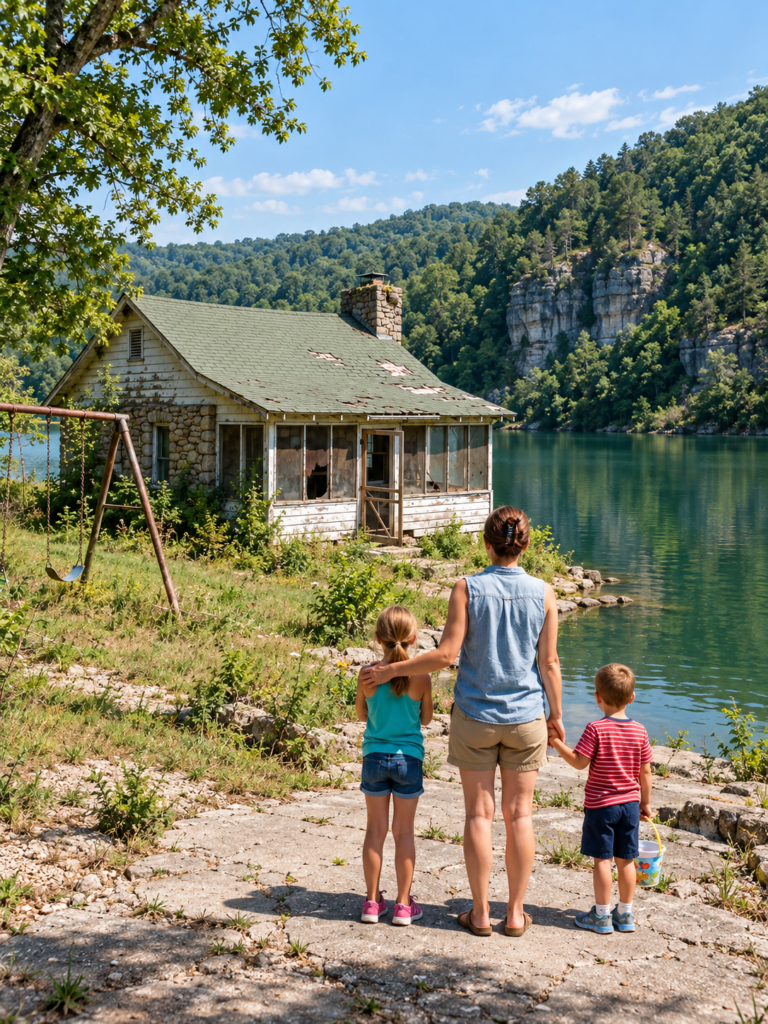
The cabin stood about forty feet from shore. Its siding had once been white. The porch sagged at one corner, supported by a galvanized pipe where a wooden post should have been. Weeds reached halfway up the steps.
And stretching sixty feet into the water was the dock.
Its cedar boards had weathered silver, and the outer sections leaned toward one side as though the whole structure had become tired of standing.
Josie stared at it.
Nadine said nothing.
There wasn’t much to say.
Inside, they found a wood stove with a cracked door, a hand pump at the kitchen sink, a table, two chairs, and a sleeping loft whose mattress had become a home for mice.
Josie opened the bathroom door.
“The toilet doesn’t work.”
“The septic system needs fixing.”
“So the bathroom doesn’t work.”
“There’s an outhouse behind the shed.”
Josie turned toward her slowly.
“You’re kidding.”
“We can shower at the clinic until we get things sorted.”
“Mom.”
“I know.”
“No, you don’t.”
Josie walked outside.
Nadine stayed in the middle of the cabin, studying the warped floorboards.
She had been making lists since April.
Heat. Water. Food. Gasoline. A safe place for Josie to sleep.
Everything else would have to wait.
Near the driveway, she noticed a rusted mailbox lying sideways in the weeds. Its painted name had nearly disappeared, but raised letters remained on the metal flag.
FORNIER.
She rubbed her thumb across the name.
It meant nothing to her.
She left it where it was.
That night, they slept on air mattresses with the door propped open to let out the stale smell.
Josie lay awake until her phone died.
“Everybody at school is going to know we live in a shed.”
Nadine stared up at the ceiling.
“It has a roof. And it has our name on it.”
“That’s supposed to make me feel better?”
“It’s two things we didn’t have on Tuesday.”
Josie turned away.
Outside, something struck the surface of the lake, and the splash carried through the open doorway.
Nadine listened until the water was quiet again.
She had spent years imagining that leaving Kurt would give her room to breathe.
Instead, she was lying in a cabin without working plumbing, wondering whether she could afford to keep the place through Christmas.
The county’s letter arrived over the Fourth of July weekend.
The dock had been declared unsafe.
She had until September 15 to remove it completely, including the underwater structure.
If the county performed the removal, another $3,200 would be added to her outstanding balance.
At the bottom of the second page was the number she already knew too well.
$11,416.
And beneath it, a warning that the property would be included in the November tax sale if she failed to bring the account current.
Nadine read the notice twice.
Then she turned over the envelope and began calculating.
Sixty feet of cedar decking might be worth something if she could salvage it.
She couldn’t afford a demolition crew.
But she had hands, a few days off each week, and a daughter who needed a home.
At a bait shop four miles down the lake road, she found a long pry bar and a socket set.
The man behind the counter was in his seventies, broad-shouldered, with reading glasses pushed into his white hair.
“You’re staying at the old Fornier place,” he said.
“I’m at the cabin on Point Road.”
“That’s the Fornier place.”
He watched her count out forty-one dollars.
“You planning to tear that dock apart?”
“County says I have to.”
“Take your time with it.”
Nadine gave him a tired smile.
“I’ve got nine weeks and nobody helping me.”
He nodded.
“Name’s Sully. I’m here most days if you need something.”
She thanked him and drove away.
At the time, she had no reason to remember his name.
On August 10, Nadine woke Josie at seven and told her to put on old shoes.
They started with the boards nearest the shore.
The galvanized spikes were eight inches long. Many had rusted into the joists so stubbornly that Nadine had to lever each board loose a fraction at a time.
By noon, her shoulders were aching.
By four, blisters had opened beneath her work gloves.
Josie’s job was to carry the boards to a stack on shore.
She did it with the concentrated resentment of a child who believed her entire summer had been stolen.
“How long is this going to take?”
“Two weeks, maybe three.”
“Three weeks?”
“There’s sixty feet of dock, Josie.”
Josie threw another board onto the stack.
“Dad was right about this place.”
Nadine kept working.
“What did he say?”
“That it’s a dump. That you’ll sell it before Christmas.”
“Your father owned this property for years and never bothered to cut the grass.”
“He said it to Grandma.”
Nadine pressed the pry bar beneath another board.
“He can say whatever he likes.”
“He said you can’t afford it.”
Something in Nadine gave way.
“Then maybe you should go live with him and see how much room they’ve got for you.”
The words were out before she could stop them.
Josie stood perfectly still.
Then she set down the board she was carrying and walked back to the cabin.
She didn’t shout. She didn’t slam the door.
Nadine almost wished she had.
For the next several days, mother and daughter spoke only when they absolutely needed to.
Nadine continued pulling boards. She worked between shifts at the clinic, returning to the lake with sore hands and barely enough energy to stand.
On the fifth day, Josie came outside without being asked.
She picked up a board and carried it to the pile.
Neither of them mentioned their argument.
Some apologies arrive without words.
By August 22, the decking was gone and Nadine had reached the frame of the third section.
The remaining crossbeams were bolted through nine pilings. The bolts on the inner face could only be reached from the water.
She waded in with the socket wrench.
The lake was unexpectedly cold near the end of the dock. An underwater spring came up somewhere beneath the last section, chilling the water enough to steal her breath whenever she submerged.
She worked carefully, gripping the timber with one hand while loosening bolts with the other.
On one dive, her fingers slid along the underside of a crossbeam.
Her knuckles struck something that wasn’t wood.
She felt it again.
Flat. Broad. Wrapped in a hardened fabric.
And securely fastened to the beam.
Nadine surfaced so suddenly that she hit her elbow against the timber.
“Josie!”
Her daughter looked up from the shore.
“Get the flashlight!”
The object was held beneath the beam by galvanized pipe straps and four bolts.
Three bolts broke rather than turn. The fourth finally gave way when Nadine wedged her pry bar against the piling and pushed with everything she had.
The object dropped into her arms.
Its weight forced her underwater.
She kicked toward the surface, holding it against her chest.
Josie lay flat on the exposed frame and reached down.
Between them, they managed to drag it above the water.
It was a steel ammunition box, painted army green beneath a layer of black paint.
Someone had wrapped it in heavy canvas, sealed the fabric, and bolted the whole thing beneath the dock.
They carried it together to the porch.
The table shifted under its weight.
Water streamed across the boards.
Josie stared.
“Is it money?”
“I don’t know.”
“Why would somebody hide it underwater if it wasn’t money?”
Nadine fetched a screwdriver and a towel.
The canvas had hardened almost into a shell. Beneath it, the box had been sealed with tar, tape, and a rubber gasket.
It took her ten minutes to clear the lid.
Then she lifted the clamp.
The seal broke with a soft, hollow sound.
Inside was the smell of old paper, wax, and something faintly sweet.
Josie aimed the flashlight into the opening.
Her expression changed.
“Those are books.”
Twenty-two small notebooks lay inside, arranged in carefully wrapped bundles.
Beside them was a cloth sack of hardened rice.
And in one corner lay a brass whistle attached to a worn bootlace.
Nadine picked up the whistle.
Its metal was dark with age. Several small tooth marks were impressed along one side.
Josie took it and turned it in her hand.
“Somebody bit this.”
“Looks like they held it between their teeth.”
“Why?”
“Maybe they needed both hands free.”
Nadine didn’t know why that answer came so easily.
She set the whistle down and opened the first bundle.
The oldest notebook was labeled 1961–1964.
The last was marked 1996.
Every page was divided into columns: name, age, date, and a line or two of handwritten observations.
Nadine opened the first page.
Bernice Otto. Eight years old. June 19, 1961. Afraid of weeds. Would only go in where she could see her feet. Walked out to her waist on the third day and would not stop grinning.
Josie sat beside her.
“Read another.”
Rudy Otto. Ten. Brother can already swim. Showing off. Sent him to the raft twice to get him out of my hair.
Another child refused to put her face in the water.
Another cried for three days before reaching the swimming rope.
The writing was practical, sometimes funny, always exact.
Whoever had written it had remembered each child as an individual.
Halfway through the 1962 notebook, Nadine found an entry about a nine-year-old boy terrified of the lake’s sudden drop-off.
He refused to swim beyond the second piling.
He returned every day anyway.
On the ninth day, he reached the raft.
The boy’s name was Aloysius, and the surname matched the old man who had sold Nadine her tools.
Sully.
She looked toward the window.
“That man at the bait shop knows something about this.”
Josie barely heard her.
She was counting.
They spent more than an hour sorting the notebooks into chronological order.
When Josie finished, she put her pencil down.
“Six hundred and eleven.”
“What?”
“Six hundred and eleven kids, Mom.”
Nadine looked at the notebooks spread across the table.
From 1961 through 1996, somebody had taught 611 children to swim.
For thirty-six summers, a person had stood in the same cold lake where Nadine had found the box, watching children learn to trust the water.
Yet none of the notebooks contained the teacher’s name.
Nadine remembered the broken mailbox.
She walked up the driveway to the one place where her phone could catch a signal and searched for Adella Fornier.
After a long minute, an old newspaper clipping appeared.
Adella M. Fornier, 63, died in February 1997.
She had taught fourth grade for thirty-one years and retired in 1990.
Her service had been private.
The final sentence was only four words.
There are no survivors.
Nadine read it several times.
Then she looked downhill toward the cabin.
Twenty-two notebooks were lying across her kitchen table.
Six hundred and eleven names.
And the county newspaper had given the woman who wrote them four sentences.
When Nadine returned, Josie was examining the ammunition box.
“There’s something else.”
Beneath the notebooks was a folded oilcloth packet sealed with red candle wax.
Inside were two documents.
One was a three-page handwritten letter.
The other was a typed legal agreement in a blue-backed cover.
Nadine unfolded the letter and began reading aloud.
The writer introduced herself as Adella Fornier.
She explained that her hands had been failing when she prepared the box. She knew she would never repair the dock herself, and she also knew that eventually someone would be forced to dismantle it.
She had deliberately hidden the box somewhere a hired demolition crew might overlook.
A crew would cut the pilings and haul the dock away.
But someone poor enough to remove every board by hand might have to go beneath the crossbeams.
That was the person she wanted to find it.
Nadine stopped reading.
Josie looked up.
“Keep going.”
Adella wrote that she had come to the county in 1959 with eleven dollars and a teaching job.
The following year, she bought the lake property for four hundred dollars.
She never married.
She taught school for thirty-one years.
And every summer, she offered swimming lessons without charging the children anything.
The lake was already paid for, she wrote.
Nadine looked down at the paper.
Adella had kept the notebooks because she never wanted the children to become an anonymous crowd. Each child deserved a name, a date, and one true thing that belonged to them.
Then the letter turned to the property.
In 1971, Adella had sold the neighboring point to Abram Bruma for $11,000.
She needed money for repairs to her home.
But there had been a condition.
Abram had signed an agreement. His attorney had notarized it.
Adella had deliberately kept the document instead of recording it at the courthouse because she had seen important papers there become lost or misfiled, with ordinary families suffering the consequences.
The letter explained that if the beach remained open to the public, whoever found the box should put the agreement away again.
But if the beach had been closed, the discoverer held proof of a broken promise.
Nadine unfolded the second document.
It was dated April 9, 1971.
The agreement stated that the swimming beach on the point, along with the footpath leading from the public road, must remain open to everyone, without charge, forever.
Then came the condition that made Nadine straighten in her chair.
If either the beach or the footpath remained closed to public use for more than twelve consecutive months, ownership of the conveyed parcel would revert to Adella or the qualifying successor connected to her adjoining land.
Nadine read it again.
And again.
Josie leaned over her shoulder.
“What does it mean?”
“It means she sold the point with a condition attached.”
“What condition?”
“That people could keep using the beach.”
Josie frowned.
“But the beach is closed.”
Nadine knew.
She had driven past the locked metal gate all summer.
PRIVATE — RESORT GUESTS ONLY.
“What happens if they close it?” Josie asked.
Nadine looked at the legal description, then at the old map references.
“It says the land comes back.”
“To who?”
“To the adjoining property.”
Josie glanced around the cabin.
“That’s us.”
“Maybe. We don’t know if this document is enforceable.”
“Mom.”
“There’s a lot we have to find out.”
“But that’s us.”
Nadine said nothing.
Across the lake, the resort’s lights shone along the narrow point.
Nine rental cabins.
A concrete boat ramp.
A floating pier.
And a boat launch that seemed busy every time Nadine looked across the water.
She had been staring at that property for two months, thinking it belonged to people who would never have to worry about an eleven-thousand-dollar county bill.
Now there was a fifty-four-year-old agreement lying on her table.
A document hidden beneath freezing water by a schoolteacher who had been dead for nearly three decades.
Nadine had no idea whether it would survive a lawyer’s scrutiny.
But for the first time since the divorce, she understood that the cabin Kurt had called worthless might be connected to something far larger than either of them had imagined.
And the person who knew why was a seventy-two-year-old man selling bait four miles down the road.
Part 2
Nadine slept less than two hours.
By eight the next morning, she had made three photocopies of the agreement at the public library and hidden the original beneath a loose floorboard in the sleeping loft.
At eight-thirty, she was standing at the county recorder’s counter.
The woman behind it looked about Nadine’s age.
“I need the deed history for two parcels,” Nadine said.
The clerk brought out an enormous plat book and turned it toward her.
There was Nadine’s property, narrow along the shore.
Beside it, a hooked peninsula reached into the lake. The resort’s cabins and launch occupied the valuable point.
The recorder’s records showed that Adella Fornier had transferred the land to Abram Bruma in 1971.
The deed had been recorded.
Nadine pointed to the entry.
“Was there a separate agreement filed with it?”
The clerk searched.
She checked the original deed, the accompanying documents, the property index, and a miscellaneous register.
Nothing.
“It’s a clean warranty deed,” she said.
Nadine placed the photocopy on the counter.
“What about this?”
The clerk read it.
Then she read the second page again.
“Where did you get this?”
“Bolted underneath my dock.”
The clerk looked up.
For a moment, she appeared unsure whether Nadine was making a joke.
Finally, she set the document flat.
“I’m not an attorney, so I can’t tell you what this does legally.”
“I understand.”
“But if it’s genuine, and if the condition was actually broken, you’re going to want someone who understands real estate law.”
“Is it enforceable?”
“I don’t know.”
The clerk lowered her voice.
“This document has never been recorded here. You need a lawyer. And if I were you, I’d find one outside this county.”
Nadine left carrying the copies in a folder pressed tightly beneath her arm.
She had wanted an answer.
Instead, she had acquired another problem she couldn’t afford to solve.
At ten o’clock, she parked outside Sully’s bait shop.
Two customers were inside.
She waited in her car until they left.
When she entered, Sully was sorting fishing hooks behind the counter.
“Need another pry bar?”
Nadine took the old brass whistle from her jacket.
She laid it beside his coffee cup.
The hooks stopped moving in his hand.
For several seconds, he simply stared.
“Where?”
“Under the third crossbeam. Four bolts. Two pipe straps.”
Sully lowered himself onto a stool.
“Four galvanized bolts,” he said. “Half-inch drill. My brother-in-law’s.”
Nadine pulled out the stool opposite him.
“You put it there.”
He nodded.
“September twelfth, 1996. About seven in the morning.”
He picked up the whistle and turned it over, his thumb settling naturally against the tooth marks.
“Miss Dell asked me to do it.”
“Adella Fornier?”
“That’s what the county called her. To us, she was Miss Dell.”
Sully explained that by the last summer of her life, Adella’s rheumatoid arthritis had made it difficult for her to grip tools.
She had already prepared the steel box.
She asked him to fasten it beneath the dock and not tell anyone.
So he did.
“She didn’t explain what was inside?”
“She said they were her books.”
“And you never went back?”
“No.”
“Not even after she died?”
Sully shook his head.
“I thought about it plenty. But she asked me not to say anything, and I gave her my word.”
He looked at the whistle again.
“After enough years, it became harder to explain why I’d stayed quiet.”
Nadine told him about the letter.
It was addressed to whoever dismantled the dock by hand.
Sully gave a short, breathless laugh.
“That sounds exactly like her.”
He turned the shop sign to CLOSED.
Then he made coffee, pulled up another chair, and told Nadine about the woman whose property she now owned.
Adella arrived in town when children still learned to swim by watching older children.
The lake had a public beach, but there were no organized lessons.
Every few summers, somebody drowned.
The community talked about those deaths as though they were unavoidable.
Adella disagreed.
She began with a handful of children in 1961. Before long, she was teaching dozens every summer.
Tuesday mornings. Thursday mornings. All day Saturday.
Ten weeks each season.
She built a floating raft beyond the drop-off using fifty-five-gallon barrels and a wooden deck.
The children swam toward it until they could reach it without assistance.
When they succeeded, Adella gave them a stick of Blackjack gum.
“That’s what we got,” Sully said. “A piece of gum and her telling us to get back to shore before supper.”
“She never charged?”
“Never. If somebody’s mother handed her money, she put it into the school fund.”
After her death in 1997, the lessons stopped.
The county took the property for unpaid taxes, and Kurt’s father bought it at the sale.
For years, the nearby public beach remained open.
Abram Bruma maintained access, and people came and went without thinking much about it.
Then, in June 2009, his son Lyall installed a metal gate.
Sully remembered the day.
“People were furious. We stood down there hollering about it.”
“What happened?”
“Nothing. Everybody said he owned the land, and an owner could shut his gate.”
Nobody knew about Adella’s agreement.
Not even Sully.
Nadine went home understanding two things.
Someone living could confirm that the box had been hidden in 1996.
And the beach had been closed far longer than the twelve months described in the agreement.
But proof wasn’t the same thing as money.
The county still wanted $11,416.
She picked up extra shifts at the clinic.
She sold the salvaged cedar boards for $940 to a buyer who drove in from several counties away with a trailer.
She took her mother’s ring to a resale shop and received $310.
That was the hardest transaction.
She sat in her car afterward, turning the empty ring box over in her hands before finally starting the engine.
By the end of August, she had saved $2,160.
The tax sale was scheduled for November 18.
She tried every way she could think of to make the numbers work.
They didn’t.
She called lawyers.
One had a conflict of interest.
Another refused to handle unrecorded property agreements.
The third, a woman in a city two hours away, listened without interrupting.
“Read me the reversion language,” the attorney said.
Nadine read it.
Then the attorney asked about the signatures and notary seal.
“If this is genuine, there may be an enforceable property interest,” she said. “But that doesn’t mean you’ll win quickly.”
She explained the likely arguments.
The resort might challenge the document’s authenticity, the long delay in asserting the claim, the circumstances of the beach closure, or Nadine’s status as the adjoining property owner.
Even if Nadine ultimately prevailed, litigation could take years.
“How much to start?” Nadine asked.
“Five thousand dollars.”
Nadine stared at the nine bare pilings beyond the cabin window.
“I don’t have that.”
“I understand.”
“Could I pay over time?”
“I’d need the retainer before filing.”
When the call ended, Nadine stayed outside beside the broken mailbox.
She had potentially found a claim involving valuable lakefront property.
And she couldn’t afford the first step toward proving it.
That Sunday, Kurt arrived to pick up Josie.
He walked to the shoreline and examined the remains of the dock.
“You did all this yourself?”
“Josie helped stack.”
Kurt nudged one of the pilings with his shoe.
“I’ve been thinking about this place.”
Nadine waited.
“The septic alone will cost twelve thousand. The road is a mess. And you’ve got that county balance hanging over you.”
“I know what it costs.”
“I could take it back.”
Nadine turned toward him.
“What?”
“Fifteen thousand. You pay the assessment, walk away with a little cash, and find somewhere decent in town.”
She studied his face.
“Is Lyall Bruma the buyer?”
Kurt looked toward the lake.
“He’s interested in shoreline property.”
“How much would he pay you?”
“Twenty-two. Maybe twenty-five if I pushed.”
“So you’d make ten thousand dollars buying my problem.”
Kurt stiffened.
“I’m offering you a way out.”
“At a profit.”
“Nobody’s forcing you.”
Nadine looked across the water.
For years, she had accepted Kurt’s descriptions of situations as though they were facts.
She wasn’t going to do it again.
“I’m not selling.”
He didn’t argue further.
Later that evening, after he returned Josie, Nadine waded into the lake to rinse sawdust out of her hair.
Josie came down carrying a towel.
“Come in,” Nadine called. “It’s warmer than standing there.”
“I’m fine.”
“The water’s only four feet deep here.”
“I said I’m fine.”
Nadine watched her daughter sitting at the water’s edge.
Something about the way Josie kept her feet on dry ground made her pause.
“Josie, can you swim?”
Her daughter didn’t answer.
“You took lessons at the pool when you were nine.”
Josie stared down at the towel.
“I sat on the steps.”
“What?”
“For six weeks. I sat there while everybody else went in.”
Nadine felt the cold water pressing against her waist.
“But I picked you up after every lesson.”
“When you got there, I got my hair wet first.”
“Josie.”
“Nobody asked me if I was learning anything.”
Her voice was steady, which somehow made it worse.
“Dad was always on his phone. You were always working. I kept waiting for somebody to ask.”
Nadine opened her mouth.
There was no explanation she could offer that wouldn’t sound like an excuse.
Josie stood.
“That’s why I don’t go in the lake.”
She carried the towel back toward the cabin.
Nadine remained in the water until her skin began to ache.
That night, she took out Adella’s notebooks.
She wasn’t looking for a particular name.
But when she opened the volume from 1988, she found one she knew.
Curtis Mazine. Nine years old. June 21, 1988.
A boy afraid to put his face underwater.
A boy who cried but kept coming back.
On the twelfth day, he had reached the raft and refused to come in for supper.
Nadine read the entry four times.
Then she called Kurt.
“Tell me about the summer you were nine.”
He was quiet.
“Why?”
“Because I’m holding a notebook with your name in it.”
He came out at seven the following morning.
Nadine had laid four notebooks across the porch table.
She turned the 1988 volume toward him.
Kurt leaned over.
As he read, his face changed.
“Miss Dell,” he whispered.
He sat back slowly.
“She had a whistle. She used to hold it in her teeth.”
“I found the whistle.”
He looked at the lake.
Then at the pilings.
“This was her place?”
“Yes.”
“I didn’t know.”
Nadine let that sit between them.
“You spent a summer here. You knew her name. Your father bought the property. And you called it a dump in front of your daughter.”
Kurt rubbed his forehead.
“I was nine, Nadine.”
“You were nine when she taught you. You weren’t nine when you decided this place was worthless.”
He looked down.
After a while, he admitted Lyall had promised him a $2,000 finder’s fee if he helped secure the property before the tax sale.
Lyall was arranging new financing and wanted the shoreline acquisitions settled before the bank reviewed his holdings.
“So he needs this land,” Nadine said.
“He wants it.”
“There’s a difference.”
Kurt didn’t answer.
Then she put the 1971 agreement in front of him.
He read every page.
At the end, he pushed back his chair.
“Is this real?”
“Sully says he hid the box for her. The county has the original deed transfer.”
Kurt looked across the lake.
“There’s a boat launch over there, Nadine.”
“I know.”
“And those cabins. You’re talking about the whole resort point.”
“I know.”
“You need a lawyer.”
She looked him directly in the face.
“I need five thousand dollars to hire one.”
He had no answer for that either.
The next morning, Nadine drove to the resort.
Lyall Bruma met her in his office overlooking the point.
He was fifty-eight, broad through the waist, wearing a fleece vest embroidered with the resort’s name.
He smiled when she introduced herself.
“You’re the woman at the Mazine cabin.”
“Nadine Kovar.”
“Right. I’ve been hoping we’d talk.”
He gestured toward a chair.
“I can offer twenty-five thousand. I’ll pay your outstanding assessments on top of it.”
“I’m not selling.”
“Twenty-eight.”
Nadine placed the photocopy on his desk.
“I came about something else.”
Lyall picked it up.
He read the first page casually.
On the second page, his expression altered.
He returned to the beginning and read again.
“Where did you find this?”
“Under my dock. In a sealed steel box.”
“This was never recorded.”
“No.”
He stood and went to the window.
Outside, rental boats were tied along the pier. Guests crossed the gravel lot with coolers and fishing equipment.
He could see the whole business from where he stood.
After another moment, he telephoned his attorney.
The lawyer asked him to read the clause aloud.
Lyall read it twice.
“How long has the public beach been closed?” the attorney asked.
“Since June 2009.”
“Is Mrs. Kovar still in your office?”
“Yes.”
“Then call me back after she leaves.”
The line disconnected.
Lyall set down the receiver.
For a while, neither spoke.
Finally, he said, “Do you know why I closed that beach?”
“Because it belonged to you.”
“No.”
He opened a desk drawer, looked inside, and closed it.
“August eleventh, 2008. There was a boy in the water out there. Eleven years old. Denny Ruiz.”
Nadine remained seated.
“He was swimming with other kids. No lifeguard. No adult close enough to help.”
Lyall swallowed.
“I heard someone screaming. I ran down the path. Went into the water with my boots on.”
He stared toward the dock outside.
“I wasn’t the first person to reach him.”
Nadine understood before he finished.
The boy had drowned.
Lyall had carried him from the water to the road.
He remembered the distance because he later paid to have the path paved.
The family sued.
His insurer settled the claim, then warned that coverage would not continue if he maintained an unsupervised public swimming beach.
At the time, the resort was already carrying substantial debt.
Eighteen employees depended on the business.
His father had died leaving complicated financial obligations.
“So I put up the gate,” Lyall said. “I thought I was keeping another child from dying.”
Nadine looked toward the shore.
“What happened to the swimming lessons?”
“Miss Dell died. They stopped.”
“She taught six hundred and eleven children.”
“I know.”
“Eleven years after she stopped, a child drowned.”
Lyall pressed his palm against his eyes.
“I’ve thought about him every year since.”
Nadine had entered the office expecting to find a greedy man protecting an unfair advantage.
Instead, she found someone who had made a frightened decision and then lived with it for sixteen years.
That didn’t erase the agreement.
But it changed what she understood about the gate.
Lyall had twenty-two employees now.
The resort was his livelihood and theirs.
And he had no idea how to satisfy Adella’s promise without risking the business he had spent decades trying to keep alive.
As Nadine prepared to leave, he stopped her.
“I can make you an offer.”
He wrote a figure on a sheet of paper.
$140,000.
He explained that he could borrow against his home.
That was the limit of what he could personally raise.
She would sign a permanent release extinguishing the reversion claim.
The resort would keep its property.
And Nadine could repair her cabin, pay off the assessments, and give Josie a more comfortable life.
She took the paper.
She sat in her car for forty minutes afterward.
One hundred and forty thousand dollars.
She could install a septic system, repair the roof, buy a vehicle suited to the private road, and finally stop calculating every purchase at the grocery store.
She could pay for Josie’s braces.
She could even afford to return to nursing school if she wanted.
She thought about her mother’s ring.
About standing at the clinic after a twelve-hour shift knowing she still couldn’t pay the county.
About Josie sleeping beneath a leaking roof.
She tried to convince herself that accepting the offer would be the responsible choice.
But every time she imagined signing the release, she pictured Adella Fornier fastening twenty-two notebooks into a waterproof box with hands that could barely close around a tool.
A woman who had sold land for $11,000 and protected a public beach instead of demanding more money.
Nadine drove home without accepting the offer.
That evening, she and Josie ate grilled cheese sandwiches on the porch.
Nadine said nothing about the meeting.
At eleven, she realized she had spent the entire evening doing exactly what she resented Kurt for doing.
Making decisions that affected Josie without allowing her to know the truth.
She went upstairs, retrieved the notebooks, and woke her daughter.
“I need to tell you something.”
Josie sat up sleepily.
Nadine brought her to the kitchen table and told her everything.
The drowned boy.
The insurance company.
The gate.
The resort’s employees.
And the offer.
She unfolded the paper with $140,000 written across it.
Josie stared at the number.
“Are you going to take it?”
“No.”
“Why?”
Nadine took a moment to answer.
“Because Miss Dell sold that point for eleven thousand dollars and a promise. If I take this money, I’m selling the promise.”
Josie folded the paper and pushed it away.
“Okay.”
She reached for the 1996 notebook.
The last page held only six entries.
Below them were rows of empty lines.
“She didn’t finish this one.”
“She got sick,” Nadine said.
“She thought she’d come back the next summer?”
“Maybe.”
Josie traced one of the blank lines.
“If somebody started teaching kids here again, would they need another notebook?”
Nadine looked at her daughter.
“I don’t know.”
Josie closed the book carefully.
“There’s room in this one.”
For the first time, Nadine wondered whether the answer to her problem wasn’t hidden in the value of the resort land at all.
Maybe it was in the thing Adella had expected people to do with it.
The following week, Nadine learned that the county board was scheduled to consider a petition to permanently vacate the old public access route to the resort beach.
Lyall’s attorney had filed the request months earlier as part of the resort’s refinancing.
If approved, the old public access would disappear from the county’s recorded plat.
The hearing was set for October 9, at six in the evening.
The clerk at the recorder’s office gave Nadine the date.
Then she looked at her for a long moment.
Nadine understood.
She might not have five thousand dollars to fight a lawsuit.
But she had twenty-two notebooks, a signed agreement, and a room where the people making the next decision would have to listen.
Part 3
The first thing Sully brought was a shoebox.
Inside were photographs taken in June 2009.
Eleven showed the newly installed gate.
Two showed angry residents gathered beside the road.
Sully had written the date on the back of each photograph.
June 18, 2009.
He also brought a yellowed newspaper clipping about the closure.
“Always took pictures of things that made me mad,” he explained.
Nadine arranged the evidence beside the agreement.
The photographs established when the beach had closed.
The newspaper showed the dispute had been public knowledge.
And Sully could testify to the history of the land and the box.
She now had enough information to make people ask questions.
What she didn’t have was enough money to save her own property.
On September 29, she returned from a twelve-hour clinic shift and found a coffee can sitting on the porch table.
A rubber band held a folded note around it.
Inside were fourteen names.
The pharmacist. The man who occasionally plowed the private road. Two women from the diner. Sully and his wife. Several other people Nadine barely knew.
Beneath the note was $2,230.
She counted it twice.
Then she sat on the steps and cried.
It was the first time she had allowed herself to do that since the divorce.
Even with the donations, she was still thousands of dollars short.
The deadline was approaching.
On October 4, Kurt’s dealership truck came up the road.
He didn’t get out.
Nadine walked to the driver’s window.
Kurt handed her a receipt from the county treasurer.
It showed the outstanding property balance had been paid in full.
All $11,416.
Nadine stared at the paper.
“Kurt, I can’t take this.”
“It’s already done.”
“Why would you pay it?”
“I put the payment under Josie’s name.”
He kept his eyes on the windshield.
“When you showed me that notebook, I remembered something.”
Nadine waited.
“When Miss Dell finally let me swim out to the raft, she gave me a stick of Blackjack gum.”
He smiled faintly.
“I kept the wrapper in my dresser until I was fifteen.”
Then the smile disappeared.
“I hadn’t thought about her in years. Not until you turned that book around.”
Nadine looked at the receipt again.
Kurt put the truck into reverse.
“Give Josie a hug for me.”
He backed down the driveway before she could say anything else.
Nadine watched until the truck disappeared among the trees.
The money didn’t undo what he had done during the divorce.
It didn’t restore their marriage.
But the county could no longer force her off the property in November.
For the first time in months, she had the freedom to make a decision without the threat of losing her home.
On October 9, Nadine entered the county boardroom carrying a plastic milk crate.
There were about forty people seated in the folding chairs.
Sully sat near the front with his hat in his lap.
Lyall Bruma sat beside his attorney.
Seven board members faced the room.
Nadine placed the crate on the table.
The chairman asked her to state her name.
“Nadine Kovar.”
“Mrs. Kovar, we’re here to consider a petition concerning the public access route.”
“I know.”
She took a notebook from the crate.
“This will take about eleven minutes.”
The chairman glanced at the other board members, then nodded.
Nadine opened the first notebook.
“Bernice Otto. Eight years old. June nineteenth, 1961.”
She read about a little girl frightened of weeds who wouldn’t enter water deep enough to hide her feet.
Then about her brother Rudy, who showed off because he already knew how to swim.
She read about a child who cried for three days.
A boy who ignored warnings about the drop-off.
A girl who refused to put her face underwater.
At first, the board members looked puzzled.
But Nadine continued.
She read the names exactly as Adella had written them.
When she reached the summer of 1962, she found Sully’s entry.
A nine-year-old boy frightened of deep water.
A boy who kept returning until he could swim to the raft.
Sully lowered his head.
Nadine kept reading.
She skipped ahead through the years, opening pages that held familiar names.
A woman in the audience recognized her mother’s name.
The county clerk stopped typing when she heard her husband’s.
Then Nadine reached 1974.
“Lyall Bruma. Seven years old. July third.”
She read the entry about a stubborn boy who refused to release the swimming rope.
Adella had permitted him to hold on for six days.
On the seventh, he let go by himself.
She had wisely said nothing about it.
Lyall sat very still.
Nadine closed the notebook.
“Six hundred and eleven,” she said.
“That’s how many children Adella Fornier taught to swim between 1961 and 1996.”
She looked toward the audience.
“She never charged them anything. She gave thirty-six summers to this lake.”
Then she described Adella’s death.
The brief obituary.
The absence of family.
The metal cemetery marker scarcely larger than a postcard.
“The obituary said there were no survivors,” Nadine told the board.
She looked at the notebooks.
“But she left six hundred and eleven people who survived something they might otherwise have been afraid to face.”
A few people shifted in their seats.
“Some of you are sitting in this room.”
Nadine reached into the crate again.
She brought out the original 1971 agreement.
“The land on the resort point was sold with a condition,” she said. “The beach and the footpath had to remain open to the public.”
She placed the paper on the table.
“If access remained closed for more than twelve months, the agreement provided for the land to revert to Adella or her qualifying successor.”
She explained the discovery of the box.
The dated photographs.
The notarized signatures.
The closure in June 2009.
She did not tell the board that ownership had already been legally decided. She knew the document was unrecorded and its effect could be disputed.
But she also knew what the agreement said.
And she knew what it would cost Lyall to fight over it.
“I’m willing to release the claim,” she said.
Lyall raised his head.
“Not for money. I’ll sign a permanent release so the resort can keep operating.”
She held up three fingers.
“For three things.”
First, the county must preserve public access through a permanent, recorded twenty-foot-wide easement from the road to the water, named for Adella Fornier.
Second, the beach must reopen with proper supervision. The resort must fund ten weeks of free swimming lessons each summer, staffed by two certified instructors and available to children throughout the county.
Third, Adella must receive a proper gravestone.
“With her name spelled correctly,” Nadine said. “And something on it that tells people what she did.”
She sat down.
Lyall’s attorney began to stand.
But Lyall touched his arm and rose instead.
He turned away from the board and faced the audience.
“Denny Ruiz,” he said.
His voice faltered.
He waited until he could speak again.
“He was eleven years old. He drowned at this lake on August eleventh, 2008.”
No one interrupted.
“I put that gate up because the insurance company told me I couldn’t keep an unsupervised swimming beach open.”
He looked toward the back of the room.
“And I let everybody believe I closed it because I wanted the beach for resort guests.”
He paused.
“That was easier than talking about what happened.”
For sixteen years, he had avoided saying Denny’s name in public because he feared another lawsuit.
Now he said it again.
Then he faced the board.
“I’ll pay for the swimming lessons. Two certified instructors, ten weeks each summer. Whether this petition passes or not.”
The board voted five to two to reject the vacation request and proceed with preserving public access.
The dissenters were not cruel men.
One genuinely questioned whether the county should make a permanent decision involving a decades-old document found beneath a dock.
He had reason to be cautious.
But the majority believed the public access deserved protection.
The remaining agreements took weeks to finalize.
In December, Nadine traveled two hours south and signed the permanent release at the office of the attorney who had earlier quoted her a $5,000 retainer.
The lawyer completed the work for $400.
When they finished, she capped her pen.
“Do you understand what you just gave up?”
“Eleven acres.”
“Eleven acres with nine cabins and a commercial boat launch.”
Nadine nodded.
“I ran an estimate,” the attorney said. “Depending on valuation, that property could be worth between two and a half and three million dollars.”
Nadine looked at the signed documents.
“Okay.”
The attorney studied her.
“I’ve practiced law for twenty-six years. I don’t think I’ve ever seen someone voluntarily release a claim that valuable.”
Nadine put on her coat.
“I wasn’t trying to buy a resort.”
Winter arrived early.
The private road washed out again during the January thaw, and Nadine spent two weekends spreading crushed rock with a shovel and Sully’s tractor.
Her roof still needed repairs.
The cabin was still small.
And nobody had handed her a million dollars.
But she was no longer facing a tax sale.
In January, she enrolled in a sixteen-week water safety instructor course at the community college.
On the first evening, she walked into the building and recognized the hallway.
Years earlier, she had abandoned a nursing program there, telling herself she would return when life became less complicated.
For a moment, she stood looking toward the old classroom.
Then she found the room for her new course.
She took a seat, opened her textbook, and began.
On April 14, after the ground thawed, Adella received her gravestone.
It cost $860.
The remaining community donations paid for most of it.
Sully’s brother-in-law helped install it.
Nearly sixty people appeared at the cemetery, many without having been formally invited.
The inscription read:
ADELLA M. FORNIER 1934–1997 SHE TAUGHT 611 CHILDREN TO SWIM
Nadine stood near the back with Josie.
Sully removed his hat.
Nobody made a long speech.
The stone said enough.
The resort’s gate was removed on June 6.
The maintenance crew used a tractor to pull up the posts.
They loaded the chain, sign, and concrete footings onto a truck.
The next morning, the beach opened.
At the road stood a new cedar sign identifying the Adella Fornier Public Access.
Nine children came to the first swimming lesson.
By the second week, there were thirty-one.
By mid-July, there were fifty-four, and the instructors had to divide them into two sessions.
The resort funded the certified instructors as promised.
Nadine joined them, working especially with children who were frightened of the water.
She knew how to stand beside someone who was afraid without pretending there was nothing to fear.
One seven-year-old boy refused to go past his knees for nine days.
On the tenth, Nadine stood beside him while he walked into deeper water.
She didn’t drag him.
She didn’t tell him he was being silly.
She waited.
On the eleventh day, he made it to his shoulders.
That evening, Nadine wrote it down.
Sully came to the beach every Tuesday and Thursday.
He brought a lawn chair and sat at the edge of the sand.
His wife brought a cooler.
He wore a whistle around his neck, though everyone understood he wasn’t going to use it.
Josie watched from a towel near the shore.
She was thirteen now.
For two weeks, she watched children younger than herself learning something she had been too ashamed to admit she couldn’t do.
Nadine never pressured her.
Then, on the third Saturday in June, after the last group had finished, Josie stood.
She pulled off her sweatshirt.
“Okay.”
Nadine looked up.
“Okay?”
“Let’s do it.”
They began where Josie could stand comfortably.
Nadine moved backward three feet at a time.
Josie followed.
They spent more than an hour working toward the deeper water.
Beyond them floated a newly built raft, made from barrels and wooden planks using Adella’s old drawings.
Josie looked down.
“I can’t see the bottom.”
“I know.”
“How deep is it?”
“Eleven feet, then it drops toward twenty.”
“That’s not helping.”
“You asked.”
Josie looked toward the raft.
“How far?”
“Thirty feet. Maybe nine or ten strokes.”
“What if I stop halfway?”
“I’ll be right behind you.”
Josie drew a long breath.
“What if I can’t do it?”
“Then I’ll help you. But you don’t have to think about the whole distance. Just the next thing you can reach.”
Josie studied the raft.
Then she lowered her face into the water.
She began swimming.
Her strokes were uneven.
Her legs sank too low, and she held her head too high.
Halfway there, she lifted her face and nearly lost her rhythm.
Nadine stayed close enough to help without touching her.
Josie kept going.
Eleven strokes.
Twelve.
Thirteen.
Her hand struck the raft.
She grabbed the edge and hung there, breathing hard.
For several seconds, she couldn’t speak.
Then she pressed her forehead against the wet wooden deck.
“Mom.”
“I’m here.”
“I made it.”
“I see you.”
“I’m actually on it.”
Onshore, Sully rose from his lawn chair.
He removed his hat and stood watching the girl who had just reached the same raft he had reached more than sixty years earlier.
Nadine didn’t tell Josie how proud she was until they were back in shallow water.
She didn’t want to make the moment about anything other than what her daughter had done.
At the end of July, Kurt arrived with a truckload of cedar lumber.
He brought enough boards for a new dock, along with extra material for future repairs.
Two employees helped him unload.
He stacked the lumber neatly so it would dry.
Then he shook Sully’s hand.
Josie ran up from the beach and hugged him.
He held her for a moment before leaving.
He didn’t ask to come inside.
Nadine didn’t invite him.
They had reached a place where not every old argument required another conversation.
Over three weekends in August, Nadine rebuilt the dock.
She reused the same nine pilings, cut and prepared the new timbers, and leveled the crossbeams herself.
Josie helped without complaining about her summer.
The new septic system went in during September, financed through payments.
The roof would have to wait another year.
Nadine could live with that.
On the last Saturday of the swimming season, she carried the old steel box out of the cabin.
She repacked all twenty-two notebooks in fresh wax paper.
Adella’s letter went on top.
But this time, she didn’t seal the box and hide it beneath the dock.
She placed it on the shelf Sully had built above the wood stove.
Anyone entering the cabin could see it.
She took Adella’s whistle down to the water.
At the far end of the new dock, where the underwater spring made the lake colder, she hung it on a galvanized nail.
A teacher standing there could reach it whenever necessary.
Beside it, she placed the 1996 notebook inside a protective plastic bag.
The final page still had room.
Josie had written the first new entry herself.
Josie Kovar. Thirteen years old. June twenty-first. Would not look at the water for two weeks. Thirteen strokes to the raft. Did not stop.
Nadine stood reading the line until Josie called to her from the beach.
Later that evening, Sully brought down two folding chairs.
They sat together on the new dock watching the light move across the water.
After a while, he asked the question he’d been holding all summer.
“Do you ever think about what you gave up?”
Nadine looked across the lake at the resort cabins.
“For about a week, I thought about it every day.”
“And then?”
“Then I stopped.”
Sully turned his coffee cup in his hands.
“Three million dollars.”
Nadine smiled a little.
“For a lake that was already paid for.”
He laughed.
Then he looked back toward the cabin.
“You know what gets me? Everybody called this place worthless for years. Your husband said it. The whole county said it.”
Nadine followed his gaze.
The sagging porch was still there.
The roof still needed work.
The road still washed out when the rain came hard.
But below the cabin stood a new dock.
And beyond it floated the raft.
“They weren’t lying about the problems,” she said. “They just didn’t know what the place was for.”
Sully nodded slowly.
Beyond the end of the dock, thirty feet out, Josie sat on the raft with her feet in the water.
She was watching the evening light move across the lake.
She didn’t look back toward shore.
She didn’t need to.
On the last dock post, Adella’s brass whistle turned gently on its worn bootlace.
And beside it, inside the old notebook, there was still room for another name.


