
she opened her door to a half-frozen stranger in the blizzard and never guessed he owned the company that meant to take her land
Part 1
The wind drove snow against the cabin walls so hard the lamp flame on the table leaned sideways and nearly died. Eloise Hart sat with her hands folded over the open Bible, the last heel of bread beside it and the final cup of flour in the tin. Samuel, eight, and Ruthie, five, slept under the single quilt near the stove, their heads close together so they could share what little heat remained. She had not eaten since the morning before. At supper Ruthie had looked up and asked if there was any more, and Eloise had smiled, slid her own piece across the table, and said Mama had already eaten.
It had not always been this way. She had been raised in Missouri, the daughter of a preacher, in a house where scripture was read at every meal. When she was nineteen she gave her heart to Silas Hart, a man her father had warned her against. Silas was handsome and loud and full of promises. Her father had said the man did not fear God and that she would weep for marrying him. She married him anyway. He brought her west to this rough cabin on the creek, and the promises ended at the door. He shouted over burnt biscuits. He mocked her prayers. He called her Bible a waste of lamp oil. Two winters ago he rode toward the gold camps in Montana and never looked back. Last spring a letter came from a stranger. Silas had been killed in a quarrel over a card table. He left her nothing but two children and a debt at the general store.
She could have written home. She thought about it every night. But shame is a heavy lock on a door. How could she go back to the father she had defied and tell him he had been right about everything? So she stayed. She took in washing. She mended shirts for the stage station. She stretched one sack of flour across a whole month. Through every hungry night she held to one stubborn belief that God had not forgotten her, that one day He would give her a sign.
That night she ran her fingers over a page wet with her own tears and whispered, “Lord, I don’t know what to do anymore. I tried to save. I tried to work. I tried to be strong. But tomorrow my children are going to wake up hungry, and I have no answer to give them.”
Her eyes fell on the scripture and she read it slowly, out loud. “Neither know we what to do, but our eyes are upon thee.”
The fear inside her went quiet for the first time that night. “Then my eyes are on You, Lord. Only on You.”
Three heavy knocks struck the door.
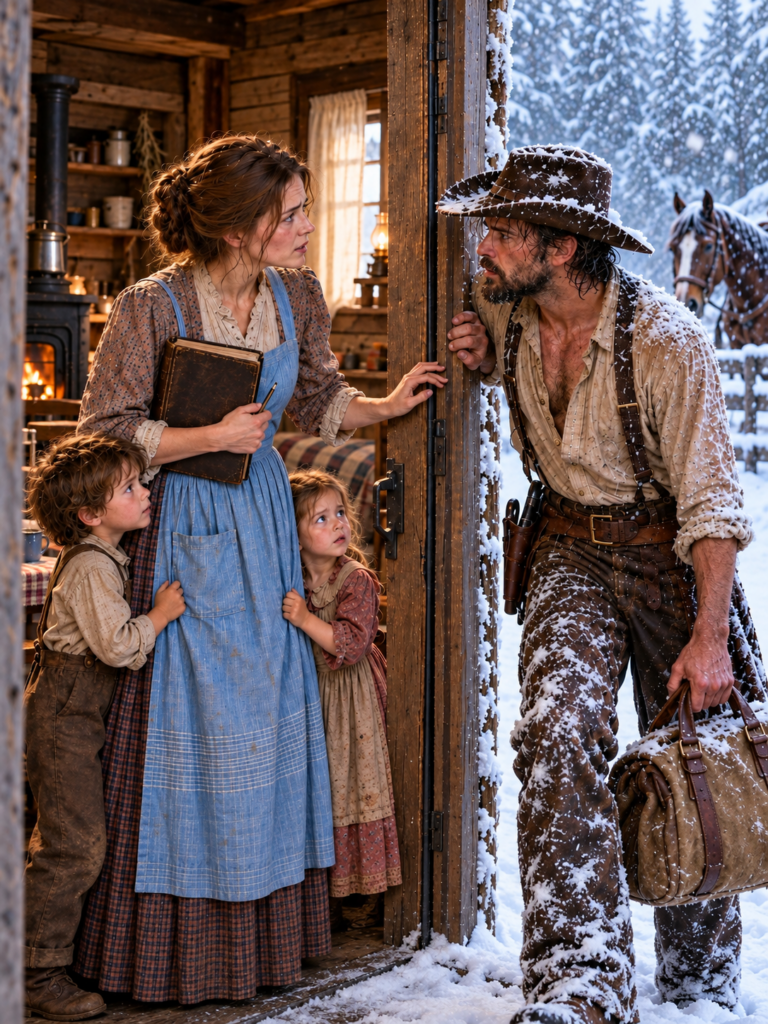
Samuel sat straight up. Ruthie ran barefoot across the floor and took hold of her mother’s skirt. Nobody came down that creek road after dark, and no honest visitor came calling in a blizzard. Eloise gathered the Bible against her chest the way a soldier takes up a shield and pulled the door open against the wind.
A man held on to the door frame with one hand as if it were the only thing keeping him on his feet. He wore no coat. His shirt was frozen stiff. Snow lay thick on the brim of his hat and his trousers were caked with ice and creek mud to the waist. Behind him in the storm stood a bay horse with its head hanging low, favoring one foreleg.
“Ma’am,” he said. His voice was rough with cold. “Please. I just need somewhere warm.”
Eloise looked at him. Then she looked back at her table: one heel of bread, one cup of flour, two children pressed against her skirt. A question rose inside her that she was almost ashamed to ask. Lord, I asked You for help. Why would You send me one more hungry mouth?
There was no answer, only the wind. But somewhere beneath the wind she remembered her father’s voice from the pulpit, telling of the widow of Zarephath, a widow gathering sticks to cook one last meal for herself and her son, and a stranger at the gate asking her for bread. That widow gave it, and the scripture said the barrel of meal wasted not, neither did the cruse of oil fail. Eloise had heard that story a hundred times. She never imagined God would ask her to live it.
“Come in quickly now. Samuel, lead that poor horse around to the lean-to and put the old blanket over him.”
She sat the stranger down beside the stove and laid the quilt from her own bed across his shoulders. His hands shook so badly he could not hold them still. Between breaths he told her that his horse had broken through the ice at the creek crossing. He had gone into the water up to his waist to pull the animal out. His coat froze as stiff as a board and he had to leave it behind. Then he walked three miles, leading a lame horse toward the only light he could see.
“Just let me warm up a few minutes, ma’am. Please don’t send me back out there.”
“Hush now. You are safe here.”
Then she did something she knew made no sense at all. She took the heel of bread, the one she was saving for her children’s breakfast, warmed it over the stove, and set it in front of him. Beside it she placed a tin cup of hot water steeped with dried apple peel. It was the closest thing to cider she had.
Ruthie tugged at her apron and whispered, “Mama, that’s our breakfast.”
Eloise knelt down and kissed her forehead. “I know, baby, but tonight he is colder than we are hungry.”
The man heard every word. He looked at the bread. Then he looked at the bare shelf behind her. “Ma’am, that is the last of what you’ve got. I can’t take bread from your children.”
“My grandmother used to say, if a body is hungry or cold, you help them. You don’t count what is in their pocket first, and you don’t count what is in your own either.”
“And tomorrow? What will you give them tomorrow?”
“Tomorrow belongs to the Lord. He has kept us this long.”
He bowed his head over that bread for a long moment before he ate. Little Ruthie, who used to hide from the sound of her own father’s voice, walked up and laid her rag doll on the stranger’s knee so he would not be lonesome.
What Eloise did not know was this. His name was Gideon Thorne, owner of the Thorne Land and Cattle Company. In his world every kindness had a price. Men shook his hand and counted his cattle. He lived alone in a great stone house outside Cheyenne with twelve rooms and nobody to speak to across the table. That day was the anniversary of his mother’s death. She had been the only person on this earth who loved him for who he was. She used to read the Bible to him when he was a boy, and he had not opened one since the day they buried her. Heavy with grief, he had ridden out alone to her grave on the ridge without telling a soul. The storm caught him on the way home, and now he sat in a cabin with gaps in the walls, holding a child’s rag doll and eating a widow’s last piece of bread. For the first time in ten years he was not thinking about the price of cattle.
He nodded toward the Bible. “You were reading when I knocked.”
“I was praying. I had only just finished asking God what I ought to do.”
“And did He tell you?”
She almost laughed. “He sent you. I have not worked out yet what He meant by it.”
He slept on the floor by the stove. By morning the storm had broken and the whole valley lay white and still. The bay horse was walking sound enough to travel.
“My name is Gideon,” he said at the door. He left off his last name on purpose.
Eloise took a gray wool scarf from the peg, one she had knitted herself, and wrapped it around his neck. “It is still bitter out there. If you ever pass this way again, you can bring it back.”
She watched him lead his horse up the road. Then she scraped the last cup of flour into a pot, made a thin gruel for her children, and gave thanks over it as if it were a feast.
Part 2
Three days later, at dusk, there was another knock, softer this time. Gideon stood on the step in the same worn shirt, with the gray scarf folded in one hand and a heavy sack over his shoulder. He had left his fine coat hanging on its peg and his hired man at home. He had told nobody where he was going.
“I brought back your scarf, ma’am, and I owe you a loaf of bread. A man pays his debts. I would be obliged if you’d let me work off the rest.”
He set the sack on her table. Flour, beans, bacon, coffee, and a twist of peppermint candy for each of the children. Eloise stared at it. Three days earlier she had given away the last bread in her house and now a whole sack of flour was standing on her table. She turned toward the stove so the children would not see her cry and she whispered under her breath, “The barrel of meal wasted not.”
After that he came nearly every evening. He split her firewood. He patched the roof. He fixed the door that had never shut right. He taught Samuel how to mend a harness. Little Ruthie took to falling asleep against his arm. A man who gave orders to two hundred riders now carried water and scrubbed pots beside a widow in a faded calico dress. And he was happier doing it than he had ever been in his big stone house.
After supper Eloise would read scripture by the lamp. Gideon would sit and listen with his hat in his hands the way he used to listen to his mother. One evening Samuel looked up at him.
“Mr. Gideon, don’t you have a Bible of your own?”
“I had one once, son. It was my mother’s. I haven’t opened it in a long, long time.”
Eloise answered quietly without looking up from the page. “Then it has been waiting on you a long, long time.”
That night, alone in his silent house, Gideon Thorne opened a drawer, took out his mother’s Bible, and read until the lamp burned low. And for the first time since her funeral, he prayed.
Little by little Eloise told him her story too. The father she had defied. The letter she had never found the courage to write.
“A father who prayed over you all those years does not just stop, Eloise. Write to him.”
“I am not brave enough yet.”
“Then I will ask God to make you brave.”
A week later, with trembling hands, she sent that letter east on the morning stage.
He loved her. Not only because she was lovely, though she was. He loved her for her honest heart. She wanted nothing from him because she believed he had nothing to give. Then one evening he found her sitting at the table with a paper in her hand and her eyes red. The children were silent in the corner.
“A company bought this whole valley last week. Every acre along the creek. A man wrote out this morning and handed me this.”
“What does it say?”
“Silas never proved up the claim. He never filed the papers. So this land was never ours. They say I can buy it for four hundred dollars or be gone in two weeks. Gideon, I have never seen four hundred dollars in my whole life.”
“Did you speak to the man?”
“I begged him. He told me the company does not concern itself with widows and washtubs. He said if we are still here in two weeks they will set our things out in the snow. My home. My children’s beds. Everything I have held on to.”
“Which company, Eloise?”
She turned the paper around. Across the top in black ink were the words Thorne Land and Cattle Company. His own name. His own company. His land agent had bought the whole creek for winter water, and Gideon had signed the purchase in a stack of papers without reading a line. The cruelty on that page carried his signature.
He took her hands in his. “Look at me. Nobody is taking this home from you. I promise you that.”
“You are a good friend, Gideon. The best one I have ever had. But you don’t understand. They have money and lawyers and a hundred riders. What can plain folks like us do against people like that?”
“Just trust me. Get up tomorrow and do what you do every morning. Leave them to me.”
She could not see how a drifter who chopped her firewood was going to stop a cattle company. But something in his eyes gave her a hope she could not explain. And that night when he was gone she opened her Bible to the very same page. Neither know we what to do, but our eyes are upon thee.
Part 3
At eight the next morning Gideon Thorne walked into his office in Cheyenne. That day he was not a cattle baron counting profit. He was a man keeping a promise. His land agent, Harlon Pike, stood at the wall map, boasting to the clerks.
“The whole Creek Valley is ours now. There’s a washerwoman squatting in a cabin down there with two brats. If she’s not out in two weeks, pull it down and use the logs for fence posts. I mean to turn a profit on that water. Whatever it takes.”
Then he turned around and the color left his face. “Mr. Thorne. Sir, nobody told us you were coming in today. We were just discussing the creek purchase.”
“Cancel it. Every notice you sent today.”
“But sir, that water is worth thirty thousand a year to this company.”
“I do not want one dollar that comes from putting a widow and her children out in the snow. Not one. Do you understand me?”
“Yes, sir. Of course, sir.”
“And the cabin on the creek. What do you want done with it?”
“Survey one hundred sixty acres around that cabin, creek frontage and all. Draw up the deed free and clear in the name of Mrs. Eloise Hart and have it recorded. And Pike, when that is done, you will ride to every family on that creek and apologize to them, or you can collect your wages.”
“Yes, sir. I will start this hour.”
One day remained before the deadline. No word had come that the notice was withdrawn, and Gideon had not been by in four days. Eloise packed what little they owned into a single crate: the quilt, the skillet, and on top of it all, her Bible. She told herself not to be bitter. He was a poor man who had made a kind promise he could not keep. Still, with her hand resting on that Bible, she whispered it one more time. “My eyes are upon Thee, Lord, even now.”
Then she heard horses. A buggy was coming down the creek road with four riders behind it. A man stepped down in a fine black coat and a clean hat. Samuel ran to the window.
“Mama, it’s Mr. Gideon.”
Around his neck, over that fine coat, he wore a gray wool scarf.
“Gideon, what is all this? That coat? Those men? Whose horses are those?”
“I told you I would speak to them, remember? I came to bring you your papers myself.”
He placed a folded document in her hands. She read it once, then again.
“This says one hundred sixty acres in my name, paid in full. No rent, no debt. Nobody can ever put you off this land again. How is this possible? Who are you truly?”
“My name is Gideon Thorne. The company that tried to take your home is mine.”
She took a step back. “You let me believe you had nothing.”
“The night I came to your door, I did have nothing. No coat, no faith, no one. I had sixty thousand acres and not one soul on this earth who would share a crust of bread with me without wanting something back. You gave me your children’s breakfast, Eloise, and you did not even know my name. I kept quiet because for the first time in my life somebody was being kind to me and not to my money. I should have told you sooner, and I ask your forgiveness for that.”
He lowered his eyes. “And that notice was sent by my own man under my own name, on a paper I signed without reading. That sin is mine. I have set it right for you and for every family on this creek.”
Eloise looked down at the deed, then at the Bible lying on top of the crate, and she finally understood. She had asked God for an answer, and He had sent her a freezing stranger. She thought the Lord had laid one more burden on her, but the hands she warmed by her stove that night were the very hands God would use to save her home. She remembered a verse her father used to read. Be not forgetful to entertain strangers, for thereby some have entertained angels unawares.
“I am no angel, Eloise.”
“No, you are not. But God sent you all the same.”
He turned his hat in his hands. “This land can never repay what you did for me. You saved my life twice. Once from the cold and once from myself. I do not want to go back to that big silent house. I would like your leave to court you properly before God, before your children, and before your father, if he will have me.”
She was crying and smiling at the same time. “Then stay for supper, Gideon Thorne. There is bread to bake, and this time there is enough flour.”
Two weeks later a letter arrived from Missouri in a shaky hand. Daughter, I have stood at the gate every evening for nine years. There is nothing to forgive that I did not forgive long ago. Let me come to you.
And in June, in a little white church on the prairie, an old preacher with tears running down his face joined his daughter’s hand to the hand of the man God had sent through a blizzard. Gideon carried his mother’s Bible. Samuel and Ruthie had a father. And Eloise Hart, who once believed she had thrown her whole life away, stood in the middle of everything she had ever prayed for.
Before she had even found the words, the answer was already walking toward her through the snow. God used a blizzard. He used a lame horse. He used a heel of bread, a gray wool scarf, and even a cruel piece of paper. He wasted nothing. A lonely man’s grief became a widow’s rescue. A widow’s last bread became a lonely man’s salvation. Two prayers answered with one knock on one door.
On the porch that evening the lamp burned steady in the window. The children slept under the quilt that was no longer the only warmth in the house. Eloise stood beside Gideon and watched the last light leave the valley. The creek ran quiet under the new grass. The land was hers. The man beside her was free. And for the first time in years the cabin felt like a home that would hold.


