
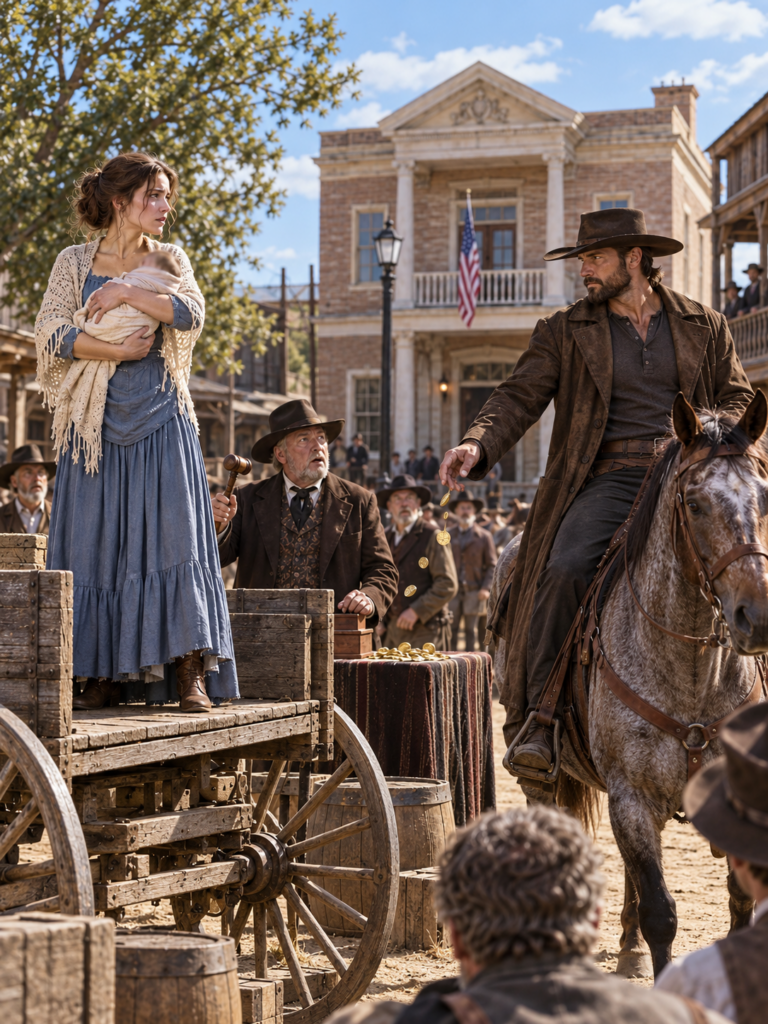
the town was auctioning a widow and her baby for forty dollars — the silent mountain man threw down gold and claimed them both
Part 1
Dust choked the town square, thick with the smell of cheap whiskey and men’s ugly intentions. Cora stood on the bed of a buckboard wagon, her boots planted on the splintered planks, her arms wrapped so tightly around three-month-old Seth that her knuckles were white. She kept her chin tipped up. She would not cry. She had done all her crying two weeks ago when they buried her husband Thomas in the rocky soil behind the church. The cholera had taken him fast, leaving her with a mountain of debt, a failing homestead, and a hungry infant.
Mayor Thaddeus Webb stood beside her on the wagon. He was a fleshy man who sweated profusely into his stiff collar, holding a wooden gavel. “All right, boys. Settle down.” He wiped his brow with a soiled handkerchief. “The bank claims the Evans property as of sunrise. But the widow’s remaining debts to the general store and the feed lot stand at forty dollars. Now the law says a destitute widow can have her labor contracted to satisfy the creditors. So we are auctioning a year of her services. A year of cooking, cleaning, or whatever work you see fit.”
The crowd chuckled. It was an ugly sound. The men gathered around the wagon were not the respectable sort. The respectable folks were hiding in their parlors, peeking through lace curtains, too cowardly to stop it and too ashamed to watch. The men in the dirt were drifters, heavy-handed farmers looking for a field hand they did not have to pay, and saloon owners looking for cheap entertainment.
“Do I hear ten?” Webb called out.
“Ten,” barked a voice. It was Amos, a pig farmer from the salt flats whose last two wives had died of exhaustion. Cora’s stomach pitched. She looked at Amos’s dirt-caked fingernails and the yellowed grin splitting his face. She pulled Seth closer to her breast. The baby whimpered, sensing the rigid terror in his mother’s body.
“I got twelve,” drawled a man leaning against the assayer’s office. It was a man named Cole who ran a gambling tent on the edge of town. His eyes dragged up and down Cora’s form, lingering on the worn fabric of her faded blue dress. “She’ll look pretty fetching serving whiskey.”
“Fifteen,” Amos growled.
“Twenty.” Cole struck a match on the heel of his boot and lit a cigar.
Cora stared at the horizon. She focused on the jagged peaks of the Bitterroot range cutting into the hazy blue sky. She imagined walking into them, disappearing into the timberline. Anything was better than this. She was a piece of meat, a ledger entry.
“I got twenty-five,” Amos spat, counting coins in his grubby palm. “That’s it. She ain’t worth more with a squalling brat attached to her.”
“Twenty-five,” Webb said, his voice dripping with bored finality. “Any other takers? A year of labor, boys. A bargain. Going once. Going twice.”
The rhythmic clop-clop-clop of heavy hooves cut through the stifling air. It was not a fast approach. It was deliberate. The crowd parted instinctively, men shuffling backward into the dust without realizing why. He rode a massive roan gelding, a beast with a chest like a whiskey barrel and a scarred nose. The man in the saddle was cut from the same rough cloth. He wore a heavy canvas duster despite the sweltering heat, dusted with the pale gray ash of the high country. A wide-brimmed hat cast his face in deep shadow, but a tangled beard of dark threaded with gray spilled down his chest. A Winchester rifle rested across his thighs.
He pulled the roan to a halt ten feet from the wagon. The horse snorted, stamping a hoof that sent a cloud of dust over Amos’s boots. The silence in the square was absolute. Even Mayor Webb had stopped sweating for a second, the gavel frozen in midair.
The rider did not yell. He did not posture. He simply reached into his vest pocket, retrieved something small and heavy, and flicked his thumb. A heavy minted gold double eagle sailed through the air. It hit the wooden planks of the wagon bed with a sharp, resonant clack right at Webb’s polished boots.
“Forty dollars,” the rider said. His voice was like a heavy stone grinding over gravel, low, deep, and carrying a quiet authority that made the hair on the back of Cora’s neck stand up. “Debts paid in full.”
Webb stared at the gold coin, then up at the man. “Forty. Well, I’ll be. Name yourself, stranger. Who holds the contract?”
“No contract,” the man said. He shifted in the saddle, the leather creaking loud in the quiet square. “Boon Fletcher. And I’ll take them now.”
Amos took a step forward, his face flushed red. “Hey now, mountain man, you can’t just ride down here and—”
Boon did not look at Amos. He did not even turn his head. He just let his right hand rest casually on the dark oiled wood of the Winchester stock. Amos stopped. He swallowed hard, took a step back, and suddenly found the saloon doors very appealing.
Boon finally lifted his head beneath the brim of his hat. Striking pale gray eyes locked onto Cora. They were not leering. They were not angry. They were unreadable, evaluating her with the clinical detachment of a man checking a saddle girth.
“Get your things,” Boon said to her.
Cora did not move. Her heart hammered against her ribs. She was trading one monster for another. A pig farmer, a pimp, or a feral mountain man? What difference did it make? “I have nothing,” Cora said, her voice raspy from disuse and dust. “Just my boy.”
Boon nodded once. He moved his boot out of the left stirrup and extended a massive calloused hand toward her. Cora looked at Mayor Webb, who was already bending over to pocket the gold coin. She looked at the crowd, already dispersing, losing interest now that the blood sport was over. No one was going to help her. No one cared.
She took a breath, adjusted Seth in her arms, stepped to the edge of the wagon, and took Boon Fletcher’s hand. His grip was like iron, but the pull was surprisingly gentle. In one smooth motion, Boon hoisted Cora and the baby up, seating her sideways behind the cantle of his saddle. She instinctively grabbed a handful of his thick canvas duster to steady herself. Underneath the heavy cloth, his back felt like a slab of granite.
Boon did not say a word. He neck-reined the roan around, ignoring the stares of the townsfolk, and pointed the horse toward the northern trail. They left Oak Haven in silence. Within twenty minutes the town was gone, hidden behind the rolling scrub-brush hills. The stifling heat of the valley floor began to break, replaced by the scent of dry pine and sage. Cora sat rigidly. Every sway of the horse threatened to dislodge her, but she refused to cling to him any tighter than necessary. She kept one arm wrapped around Seth, who had mercifully fallen asleep, lulled by the rhythmic rocking of the horse.
Hours passed. The trail narrowed, turning from a wagon rut into a deer path winding upward into the jagged teeth of the Bitterroots. The air grew thinner, cooler. The scrub brush gave way to towering Douglas firs and blue spruce, their branches blocking out the sun and casting the trail in a permanent cool twilight. Cora watched the back of Boon’s neck. He rode with a loose, relaxed posture, anticipating every slip and slide of the roan over the rocky terrain. He belonged to this landscape. He was a predator in its natural habitat, and she was the prey he had just purchased.
“What do you want from me?” she finally asked. The words tore out of her, fueled by miles of silent panic.
Boon did not stop the horse. He did not turn around. “Keep your voice down. Cougar track a mile back. No need to ring the dinner bell.”
Cora clamped her mouth shut, her eyes darting to the dark timber flanking the trail. Her imagination painted yellow eyes in every shadow. Another hour passed. The temperature plummeted. August in the valley meant nothing up here. At eight thousand feet the wind had teeth. Cora shivered, pulling her thin shawl tighter over Seth. She was freezing, her teeth beginning to chatter uncontrollably.
The roan stopped. Boon swung out of the saddle. He did not look at her. He moved to the saddlebags, rummaged inside, and pulled out a heavy dark wool blanket that smelled of woodsmoke and wet dog. He walked around to the side of the horse, reached up, and draped it over Cora’s shoulders, making sure it covered the baby entirely. He did not linger. He did not brush his hand against hers. He just stepped back and swung back up into the saddle.
“Thirty more minutes,” he said quietly.
Cora pulled the heavy wool around herself. It was scratchy, but it was gloriously warm. The scent of woodsmoke was surprisingly comforting. It smelled like safety. She looked at his back again. He had surrendered his only extra layer. The canvas duster he wore was tough, but it was not insulated. Why, she thought. Why did you buy me?
The trail leveled out as they crested a ridge. The trees broke, revealing a hidden valley cradled between three sheer granite peaks. The sky was bruising into twilight, painting the clouds in violent streaks of purple and bruised orange. A small clear creek cut through the center of the valley, winding toward a cluster of towering pines. Nestled in the timber, built against the sheer rock face of the mountain itself, was a cabin. It was not a crude shack. It was constructed of massive peeled logs, perfectly notched and chinked with mud. A stone chimney ran up the side. It looked immovable, permanent.
Boon rode up to a small corral beside the cabin, swung down, and tied the reins to the fence. He turned to Cora and offered his hand again. She took it, letting him help her down. Her legs were numb from the ride, and she stumbled as her boots hit the ground. Boon caught her elbow, steadying her effortlessly. As soon as she found her balance, he let go.
“Go inside,” he said, nodding toward the heavy wooden door. “It ain’t locked.”
Cora hesitated, clutching Seth. The baby woke up and let out a thin, hungry wail. Boon turned his back to her and began unsaddling the roan. “Door’s open,” he repeated. “I’ll be in when I finish with the horse.”
Cora walked to the cabin. Her hand trembled as she grabbed the iron latch. She pushed the door open. It was dark inside, smelling of cold ash and dried herbs. She stood in the doorway, waiting for her eyes to adjust. There was a large stone hearth dominating one wall. A heavy oak table with two chairs sat in the center. In the corner, a cast-iron stove. Hanging from the rafters were bundles of dried sage, onions, and cured meats. And in the far corner, tucked against the wall, was a bed. A single large bed covered in furs.
Cora’s stomach plummeted. She backed against the wall, sliding down until she hit the floorboards, pulling Seth to her chest. The warmth of the wool blanket meant nothing now. The cold reality of her situation settled into her bones. One bed. One man. A locked valley miles from the nearest semblance of law. She squeezed her eyes shut as tears finally broke free, stinging her dusty cheeks. She rocked her crying baby, waiting for the door to open, waiting for the heavy boots to cross the floorboards.
The door creaked open ten minutes later. Cora tensed, pressing herself harder against the logs, trying to make herself invisible in the shadows. Boon stepped in, carrying a large bundle of firewood in one arm and his saddlebags in the other. He kicked the door shut with a booted heel. He did not look toward the corner where she huddled. He walked straight to the hearth, dropped the wood with a heavy clatter, and knelt. Within moments he had a fire blazing, the flames throwing warm, flickering light across the rough-hewn interior. He rose, walked to a shelf, took down a kerosene lantern, and lit it. The yellow glow chased the shadows away.
Only then did he turn and look at her. Cora stared back, her breath hitching. She was a trapped animal, waiting for the snare to pull tight. Boon looked at her pale face, at the way she shielded the baby, at her white-knuckled grip on the blanket. His expression did not soften, but something in his eyes shifted. A flicker of understanding, perhaps, or irritation. It was hard to tell.
“Floor’s drafty,” he said. His voice was a low rumble. “Put the boy on the bed.”
Cora did not move. “I’m fine here.”
Boon sighed. It was not a sigh of anger, but of bone-deep weariness. He unbuckled his gun belt, the heavy Colt revolver and leather holster thudding softly as he draped it over the back of a wooden chair. He took off his hat, revealing dark, unruly hair matted with sweat. He walked to the cast-iron stove and struck a match to the kindling inside. “You ain’t fine, and the boy is hungry. Put him on the bed. I ain’t going near it.”
Cora hesitated, analyzing his posture. His back was to her again. He was filling a tin coffee pot from a water bucket. Slowly, her legs trembling, she pushed herself up and walked to the bed. She laid Seth down on the thick bear fur. The baby, exhausted from crying, immediately began rooting around, chewing on his little fist. Cora sat on the edge of the mattress, pulling her dress loose to feed him, keeping her eyes glued to Boon’s broad back.
Boon worked methodically. He put the coffee on, then took a cast-iron skillet, sliced some salt pork, and threw in a handful of dried beans he had soaked in a tin. The smell of frying fat hit the air, and Cora’s stomach gave a violent, embarrassing rumble. She had not eaten since yesterday morning. Boon heard it. He did not say anything. When the food was hot, he scooped half of it onto a tin plate, grabbed a fork, and set it on the oak table. He poured a cup of coffee and set it next to the plate. Then he took the skillet, sat heavily on the floor, cross-legged in front of the hearth, and began to eat straight from the pan.
Cora finished nursing Seth, buttoned her dress, and watched him. He had given her the table, the plate, and the chair. He was sitting on the floor.
“Eat,” Boon said, not looking up. “Before it congeals. Fat ain’t good cold.”
Cora carefully placed the sleeping baby in the center of the bed, surrounded by furs so he could not roll, and walked to the table. She sat down. The food was not fancy, but to her starving body it tasted like a banquet. She ate quickly, manners forgotten, scraping the tin plate clean. When she finished, the cabin was quiet save for the crackle of the fire and the wind howling against the logs outside.
“Thank you,” she whispered.
Boon wiped his mouth with the back of his hand, stood up, and took her plate. He dropped it in a wash basin.
“I asked you on the trail,” Cora said, her voice finding a bit of its old strength now that she had food in her belly. “What do you want from me?”
Boon leaned against the counter, crossing his arms. In the lantern light she could see the miles on him. Deep lines framed his eyes. A pale scar ran from his collarbone, disappearing under the collar of his thermal shirt. “I come down to Oak Haven twice a year,” Boon said, his voice quiet. “Spring for traps, late summer for flour and coffee. I saw a crowd. I saw Webb. I know what they do to widows in that town.”
“So you bought me out of pity.” Cora’s pride flared, sharp and defensive.
“No.” Boon looked at the fire. “I bought you because I needed someone up here.”
Cora’s heart began to race again. “For what?”
Boon pushed off the counter. He walked to a wooden chest at the foot of the bed, opened it, and pulled out a heavy canvas bedroll. He tossed it onto the floorboards in front of the hearth. “Winter hits in six weeks,” Boon said. “Once the snows come, the pass is blocked until May. I trap, I hunt, I skin. I’m gone from sunup to sundown.” He looked at her, his pale eyes steady. “I need someone to keep the fire from going out. I need someone to salt the meat so it don’t rot. I need someone to mind the cabin. You want a housekeeper,” she said, incredulous.
“I want survival,” Boon corrected. “A cold cabin means a dead man if I come back wet or hurt. I do the outside. You do the inside. We don’t bother each other. Come spring, when the thaw hits, I’ll ride you back down to the railhead in Cheyenne. I’ll give you fifty dollars and we go our separate ways.”
Cora stared at him. She searched his face for the lie. Men always lied. They hid their true intentions behind logic and bargains. But Boon Fletcher’s face was like a closed book. There was no deceit, no hidden smirk, just cold, hard pragmatism. “Why me?” she asked. “You could have hired a man in town.”
“Men in town drink,” Boon said flatly. “They steal. They get cabin fever and start swinging axes. A woman with a baby, she won’t run. She’ll keep the fire hot because she has to keep the boy warm. You got a reason to live, lady. That makes you reliable.”
It was the most cynical, calculating, and deeply honest thing she had ever heard. He was not saving her. He was using her. But he was using her to survive, not to satisfy a sickness.
“My name is Cora,” she said, lifting her chin. “Not lady. And the boy is Seth.”
Boon nodded once. He kicked off his boots, laid down on the canvas bedroll by the fire, and pulled a blanket over his chest. “Sun comes up early, Cora. Flour is in the barrel. Lard is in the tin.” He closed his eyes. “Good night.”
Cora sat at the table for a long time, watching him breathe. The man who had bought her at auction was sleeping on the floor, leaving her the bed. She did not trust him. The frontier had taught her that trust was a luxury she could not afford. But as she walked over to the bed and curled up next to her sleeping son, listening to the wind rage outside the thick log walls, she realized something profound. For the first time since Thomas died, she felt entirely, inexplicably safe.
Part 2
September bled into October with a sudden, violent chill that did not so much arrive as it felt like a dropped gate. One morning Cora stepped out onto the front porch to empty the night’s slop bucket and found the tall grass stiff with white frost, every blade looking like it had been dipped in glass. The peaks of the Bitterroots had changed overnight too. The dark, jagged granite was erased, capped under a thick layer of early snow that caught the morning sun and turned it blindingly white.
Inside the cabin Boon was already awake. He was standing by the heavy oak table, meticulously oiling the moving parts of his Sharps rifle with a greasy rag. He wore his heavy thermal undershirt, the sleeves rolled up to reveal thick forearms corded with muscle and crisscrossed with faded jagged lines from old knife scars and animal claws.
“The pass is glazing over,” Boon said, his voice level as he worked the lever of the rifle. “If we needed any salt or extra lead from Oak Haven, window’s shut from here on out. What’s in the root cellar is what we have.”
Cora walked back inside, pulling her shawl tight around her shoulders. She set the empty bucket by the door and walked over to the wood-fired stove where a pot of black coffee was already beginning to steam. “We have enough flour for two months,” Cora said, her voice steady. She had spent the last three weeks cataloging every single item in the cabin with the meticulous precision of a woman who knew what starvation looked like. “And the side of bacon you hung in the larder should last until November if I ration it right. After that, we’re relying entirely on what you shoot.”
Boon stopped oiling the rifle. He looked up, his pale gray eyes meeting hers. There was a quiet appreciation in his gaze, brief and hard-won. Over the past six weeks the initial terror Cora had felt had worn down into a strange functional rhythm. They did not speak much. Words were wasted breath in the high country. But a language of survival had grown between them. He chopped the wood. She stacked it. He brought home deer, elk, and grouse. She skinned, salted, and smoked the meat over the alderwood fire pit behind the cabin. He did not bother her. She did not bother him.
Yet every evening when Boon returned from a twelve-hour trek through the freezing timberline, he would silently walk over to Seth, who was now crawling and pulling himself up on the furniture, and drop a polished river stone, a bright blue jay feather, or a carved wooden horse into the baby’s tiny hands. He never said a word when he did it. He just placed the token down, washed his hands in the basin, and sat down to eat what Cora had cooked.
“I’m heading up to the high ridge today,” Boon said, standing up and sliding his rifle into the leather scabbard by the door. “Saw sign of a big bull elk yesterday afternoon before the snow hit. If I drop him, we’ll have enough tallow and red meat to see us through the dead of January.”
“It’s dropping below freezing out there now,” Cora said, her eyes dropping to his worn canvas duster. “The wind is coming straight off the glacier.”
Boon paused, his hand on the iron door latch. He looked back at her, a faint cynical twitch at the corner of his mouth. “Mountain ain’t a place for soft wool, Cora. I’ll be back before dark.”
“You said that two days ago and came back covered in ice with a gash on your shoulder,” Cora snapped, surprising even herself with the sharp edge in her voice.
Boon did not yell. He did not bristle. He simply stared at her for a long, heavy moment, processing the fact that someone in this world actually gave a damn whether he came back off the mountain or froze in a snowdrift. “I’ll be back before dark,” he repeated, softer this time. Then he pulled the door open and stepped out into the biting wind.
Cora watched him through the small window, his massive frame fading into the gray-blue pines as he climbed upward into the white wilderness. She turned back to the room, picked up Seth, who was babbling happily at a wooden toy horse Boon had carved the night before, and set to work. The day passed in a blur of domestic labor. She scrubbed the pine floorboards with lye soap, washed a batch of diapers in a tin tub by the fire, and hauled two more buckets of water from the freezing creek before the ice crusted over the surface entirely.
By late afternoon the wind outside had turned from a steady howl into a screaming gale. Snowflakes began to hammer against the cabin glass, thick and blinding, wiping out the view of the timberline completely. Cora felt a cold knot twist in her stomach. A whiteout in October was no joke. Up on the high ridge, visibility would be zero. A man could walk in circles twenty feet from his own cabin and freeze to death in a snowdrift while screaming at the top of his lungs.
She fed Seth, put him down for his afternoon nap on the bed, and walked to the window, pressing her forehead against the cold glass. Nothing. Just a churning white wall of wind and blowing snow. “Damn you, Boon,” she whispered into the empty room.
She did not wait. She grabbed Boon’s extra canvas coat, the heavy one he kept hanging by the door, and pulled it over her shoulders. It swallowed her whole, the sleeves hanging down past her hands, smelling strongly of woodsmoke, old leather, and pine resin. She wrapped a woolen scarf around her face, tied a heavy shawl over her head, and reached for the iron latch. She stepped out into the storm.
The wind hit her like a physical blow, stealing the breath right out of her lungs. The snow was horizontal, biting into her skin like a handful of thrown glass shards. “Boon!” she screamed, but the wind tore the sound away instantly, swallowing it into the vast, indifferent wilderness. She did not go far. She could not. If she lost the cabin, she and Seth would both die out here. She stayed within twenty yards of the porch, wading through drifts that came up to her thighs, her boots heavy and freezing. She held her arm over her eyes, peering into the swirling white maze.
“He’s a mountain man,” she told herself frantically, panic clawing at her throat. “He knows these woods better than the deer do. He’s fine. He’s coming back.”
And then, through the shriek of the wind, she heard it. Not a shout. A dull, heavy thud, followed by the crunch of boots breaking through crusted snow. Out of the white void a dark shape emerged. Boon was staggering forward, leaning heavily to his left side. He was not carrying his rifle. It was slung over his shoulder, but he was dragging a massive canvas sack over the snow behind him, filled with butchered meat. Half of his face was caked in ice, and his duster was stiff and frozen solid. He did not see her until he was three feet away. He blinked hard through the frost clinging to his eyelashes, his pale eyes widening in shock as Cora threw herself forward through the drift and grabbed the heavy leather strap of his coat.
“What in hell are you doing out here?” Boon roared over the wind, his voice rough and cracking with cold. “Are you out of your mind?”
“The boy’s in the cabin.” Cora’s voice broke with a sudden overwhelming wave of anger and relief. “I thought you were dead. I thought you froze to death on my account.”
Boon stared at her. The fury in his face melted away, replaced by a strange, stunned stillness. The wind raged around them, trees groaning under the weight of the ice, but for a second the world narrowed down to the space between them in the snow. He did not say another word. He dropped the meat sack, reached out with a heavy gloved hand, grabbed Cora by the back of the coat, and hauled her against his chest, shielding her completely from the biting gale. His body was radiating a fierce, furnace-like heat that melted the ice on her shawl.
“Let’s get inside,” he muttered against her hair, his voice thick, “before we both turn to stone.”
By midnight the storm had blown itself out, leaving the valley buried under three feet of pristine, untouched snow. The sky cleared, exposing a vast, cold canopy of stars that glittered like diamond dust over the silent peaks. Inside the cabin the fire was roaring, throwing a brilliant orange glow across the room. Boon sat at the edge of the bed, stripped down to his thermal shirt, while Cora stood over him with a wet cloth and a bowl of warm water. The gash on his left shoulder, torn open when he slipped on an icy ledge while dragging the elk carcass, was ugly, jagged, and crusted with dried blood.
“Hold still,” Cora muttered, pressing the warm cloth against the wound. Boon winced, his jaw clenching tightly, but he did not pull away. “I told you I was coming back.”
“People say a lot of things before they die in a snowdrift,” Cora retorted sharply, though her hands were gentle as she cleaned the dirt and pine needles out of the torn flesh. She reached for a jar of rendered bear fat mixed with pine salve that she had prepared the week before, scooping out a dollop with her fingers and smoothing it over the cut. As her fingers brushed against his bare shoulder, Boon’s breathing hitched. It was not from the pain of the wound. Cora froze. She looked down and realized how close she was to him. She was standing between his knees, her face inches from his chest. She could feel the steady, powerful thud of his heart beneath the thin fabric of his shirt. She should step back. Every instinct she had cultivated over a life of hardship told her to put distance between herself and a dangerous man, but she did not move.
Boon slowly raised his eyes. In the warm lantern light the hard, cynical armor he wore like a second skin was completely gone. His gaze tracked from her hands up to her lips and finally settled on her eyes. There was no calculation in them now. Just a raw, aching hunger that had nothing to do with food and everything to do with the crushing loneliness of the high country.
“Cora,” he whispered. It was the first time he had ever said her name like that. Not as an order, not as a statement of fact, but like a question hanging in the dark.
“I’m not looking for a savior, Boon,” she said softly, her breath catching in her throat. “And I’m not a charity case.”
“I know,” Boon replied, his voice a low, rough rumble. He reached up, his massive calloused hand hesitating for a fraction of a second before gently cupping the side of her face. His thumb brushed across her cheekbone, wiping away a stray smudge of soot. “You ain’t neither of those things. You’re the only real thing I’ve seen in ten years on this mountain.”
Cora closed her eyes for a second, leaning instinctively into the warmth of his palm. The touch felt dangerous, forbidden, and utterly necessary all at once. The memory of Thomas flickered briefly in her mind, a gentle fading ghost, followed by the ugly reality of the auction block in Oak Haven, where her life had been bartered for forty dollars. That life was a million miles away. Down in the valley, men traded human beings like cattle. Up here, in the brutal, beautiful isolation of the Bitterroots, value was measured in survival, trust, and the warmth of two bodies against a freezing world.
She opened her eyes, looked straight into his pale, unyielding gaze, and leaned down. When her lips met his, it was not a gentle romantic kiss. It was rough, desperate, and laden with the heavy weight of everything they had survived. Boon groaned softly, his hands moving from her face down to grip her waist, pulling her flush against him. He stood up from the bed, lifting her effortlessly as his mouth locked onto hers with a sudden fierce intensity that sent the water bowl crashing to the floorboards. In the corner of the room Seth stirred in his sleep, letting out a soft baby sigh, completely unaware that the world outside had shifted on its axis.
Boon carried her toward the deep furs on the bed, the fire casting long dancing shadows across the cabin walls as the winter locked the world outside in a grip of ice and snow.
Part 3
January did not arrive on the mountain. It settled over the valley like an iron slab. The temperature plunged so far below zero that the sap in the pine trees froze solid, cracking the trunks open at night with sharp, violent pops that sounded like rifle fire. The snow drifted all the way up to the bottom edge of the cabin windows, turning the interior into a perpetual dim twilight. They lived in a world composed entirely of firelight, wool, and the smell of salted meat.
The frantic, desperate coupling of that first night during the October blizzard had not been a one-time breaking of the rules. It had forged a new reality. They did not talk about it. There were no grand declarations of devotion whispered into the dark. The frontier did not have the patience for poetry. Instead their bond was etched in the brutal everyday mechanics of staying alive. When Boon crawled out of the furs in the freezing pitch black of four in the morning to stoke the embers, he would deliberately pull the heavy blankets tighter around Cora’s shoulders before he left the bed. When Cora stood over the stove, boiling down rendered fat to make soap, Boon would sit by the hearth with his skinning knife, silently whittling a smooth, rounded rattle out of cedarwood for Seth.
The baby was growing fast, fortified by bone broth and mountain air. He was a loud, crawling menace, constantly trying to put handfuls of ash or stray rifle casings into his mouth. Boon, a man who had spent ten years avoiding human contact, had somehow become a heavily armed babysitter. He would lie on the floorboards, letting the boy climb over his massive chest, his pale gray eyes watching Seth with a quiet, fierce protection.
But the mountain was always waiting for a mistake. The mistake happened in the second week of February. It started with the wind changing direction, blowing down from the jagged peaks instead of up through the valley. It brought a smell with it, musky, foul, and rank. Boon smelled it first. He was sitting at the oak table, greasing his boots, when his head snapped up. He went perfectly still. Outside, the roan gelding let out a high, panicked whinny from the reinforced corral, kicking violently against the heavy log rails.
Boon dropped the boot. He did not say a word. He stood up, grabbed his Winchester from the wall scabbard, and shucked a shell into the chamber. The metallic clack-clack was deafening in the small room. “Stay away from the window,” Boon said, his voice stripped of all warmth. It was the voice of the predator Cora had met in Oak Haven. He kicked the heavy oak door open and stepped out into the blinding glare of the snow.
Cora scrambled off the bed, grabbed Seth, and pushed him into the heavy wooden crate they used as a crib, throwing a blanket over him. She did not listen to Boon’s order. She crept to the frosted window and wiped a small circle clear with her thumb. The wolves were not the small, scrawny timber varieties that scavenged in the foothills. These were high-ridge grays driven down into the valley by starvation. There were six of them, heavily muscled and desperate, circling the smokehouse out back where Boon had hung the elk meat.
Boon stood on the porch, the Winchester tucked into his shoulder. He fired. The report was a physical blow to the eardrums. The lead wolf, a massive male with a scarred snout, dropped in its tracks, its chest blown wide open. The others scattered, plunging into the deep snow, but they did not run away. Starvation had made them bold. Two of the wolves broke from the timberline to the left, flanking the porch. Boon levered the rifle, tracking the movement, and fired again. A second wolf went down, spinning in a spray of crimson snow.
As Boon worked the lever for a third shot, the mechanism jammed. A brass casing, warped by the freezing cold, caught in the ejector port. Boon cursed, dropping his thumb to dig the hot brass out. From the roof of the smokehouse a third wolf leapt. It had climbed a snowdrift in the back and used it as a ramp. It sailed through the air, eighty pounds of desperate muscle and teeth, aiming straight for Boon’s blind side.
Cora did not think. The civilized woman who had wept on the auction block was dead. She turned, grabbed the heavy Colt revolver from Boon’s gun belt hanging on the chair, and sprinted for the open door. The gun was impossibly heavy, cold iron biting into her palms. She threw herself onto the porch just as the wolf hit the planks, its jaws snapping inches from Boon’s heavy leather boots as he spun to use the rifle as a club.
Cora did not aim down the sights. She just pointed the heavy barrel at the mass of gray fur and pulled the trigger. The recoil nearly dislocated her shoulder. The gun roared, kicking violently upward, blinding her with a flash of burning powder. When the smoke cleared, the wolf was a heap of ruined fur at Boon’s feet. The remaining pack members, terrified by the thunder and the sudden death of their kin, vanished into the treeline, leaving nothing but silence and blood-stained snow.
Boon stood breathing hard, the jammed Winchester still gripped in his hands. He looked down at the dead wolf, then slowly turned his head to look at Cora. She was standing in her woolen stockings on the frozen planks, the Colt still gripped in both hands, her chest heaving, smoke curling from the barrel. Her hands were shaking violently, but her eyes were locked on his, dark and defiant.
Boon reached out and gently pushed the barrel of the revolver toward the ground. He stepped forward, took her face in his rough, cold hands, and kissed her. It tasted of gunpowder, sweat, and absolute survival. “You’re freezing,” he muttered against her mouth. He took the gun from her trembling fingers, scooped her up under one arm, and carried her back inside, kicking the heavy door shut against the dead winter.
The thaw came in early May, turning the valley into a deafening roar of melting ice. The creek swelled over its banks, rushing with furious muddy water. The snowpack retreated, revealing dark, wet earth, resilient clumps of sage, and the sharp green tips of mountain grass. For months the impending spring had hung over the cabin like a drawn knife. The deal was fifty dollars and a ride to the railhead in Cheyenne. It was a business transaction forged in dust and desperation. But over the last seven months the world had shifted. Cora had mended Boon’s skin, kept his fire, and saved his life. Boon had fed her, protected her, and become a father to Seth in everything but blood.
Yet as the mud dried and the trail to the pass became visible, a heavy, suffocating silence fell between them. Boon grew distant. He spent hours in the corral, currying the roan and preparing the pack saddles. He checked the harnesses, oiled the leather, and packed the canvas bags with dried meat and hardtack. He was a man bound by his own strict, unbreakable code. He had promised this woman her freedom. He had promised her civilization, a train ticket, and a chance to raise her boy in a place with schools and doctors. He looked at his own scarred hands, smelled the blood and dirt deeply ingrained in his skin, and decided she deserved exactly what he had promised.
Cora watched him pack, her heart twisting into a tight, miserable knot. He was throwing her out. That was how she saw it. He had bought her for the winter, and now the winter was over. Men used women and moved on. It was the way of the world. She packed her few belongings into a burlap sack, wrapping Seth’s wooden toys carefully in a spare blanket, refusing to let Boon see the tears burning in her eyes.
On a crisp Tuesday morning Boon led the roan and a gray pack mule to the front of the cabin. “Saddles ready,” he said, his voice flat, staring over her shoulder at the treeline.
Cora walked out carrying Seth. She did not look at the cabin. If she looked at the heavy oak door, the stone hearth, or the bed in the corner, she would break down, and she refused to give him that satisfaction. She let Boon help her up onto the saddle, holding Seth tight against her chest. They rode out.
The descent was brutal. As they dropped in elevation, the crisp, clean air of the high country gave way to the heavy, dust-choked heat of the lower plains. The sprawling emptiness of the Wyoming territory opened up before them, endless and flat. By mid-afternoon they reached the crossroads. To the right a rutted wagon trail wound its way back north toward Oak Haven. To the left a wider, heavily traveled stage route cut south toward the bustling railhead of Cheyenne.
Boon pulled the roan to a halt in the middle of the crossroads. The dust swirled around the horse’s hooves, settling on Boon’s heavy canvas duster. The heat was already oppressive. He reached into his saddlebag and pulled out a heavy leather pouch. The coins clinked together, a dull, heavy sound that made Cora’s stomach churn. Boon did not look at her. He kept his eyes fixed on the horizon, his jaw locked tight. He held the pouch out toward her.
“Fifty dollars,” Boon said, his voice sounding like it was being dragged over broken glass. “Like we agreed. Stagecoach runs through Cheyenne every morning. You can buy a ticket east. St. Louis, maybe. Good place for a boy to grow up. Safe.”
Cora stared at the leather pouch. It hung in the air between them, representing everything she had begged for on the auction block. Freedom, agency, a way out. She looked at Boon. She looked at the deep lines of exhaustion around his eyes, the scar on his neck, the broad shoulders that had stood between her and the brutal reality of the frontier. He was offering her the world, and it was tearing him apart to do it.
“You’re a fool, Boon Fletcher,” she said softly.
Boon flinched. He finally turned his head, his pale eyes narrowing in confusion. “A deal’s a deal, Cora. I told you I’d set you up. I ain’t going back on my word.”
“Your word.” Cora snapped, the anger finally cracking through her rigid control. She shifted Seth to one arm and slapped the leather pouch out of Boon’s hand. It hit the dirt with a heavy thud, gold coins spilling out into the Wyoming dust, flashing in the afternoon sun. “I don’t give a damn about your word, and I don’t give a damn about St. Louis,” Cora yelled, her voice echoing across the empty plains. “You think I want to sit in some stifling parlor sipping tea with people who would have watched me get sold to a pig farmer? You think I want to raise my son around cowards?”
Boon stared at the gold in the dirt, completely stunned.
“I kept your fire, Boon,” Cora said, her voice dropping, trembling with fierce emotion. “I shot that wolf. I rubbed salve into your back when you were too stubborn to admit you were dying. I earned my place on that mountain.” She leaned forward in the saddle, her eyes blazing, stripping away the last of the hardened shell she had built to survive the world. “I am not a contract, and you are not getting rid of me that easily. Now pick up your damn money and take us home.”
The silence hung heavy over the crossroads. The only sound was the roan gelding snorting and the distant cry of a red-tailed hawk. Boon looked at the gold in the dirt. He looked at the stage route leading to civilization. Then he looked at Cora. For the first time since she had met him, Boon Fletcher smiled. It was not a cynical twitch or a grimace of survival. It was a genuine, full-blooded smile that transformed his scarred face, lighting up his pale eyes with a sudden, blinding warmth.
He did not pick up the money. Boon grabbed the reins of her saddle, spun the roan around, and pointed the horse back toward the jagged snowcapped peaks of the Bitterroots. He nudged his horse forward, reaching out a heavy, scarred hand to rest it gently on Cora’s knee. As they rode, they left the gold in the dust. The mountain was waiting, and they had a fire to light.


