
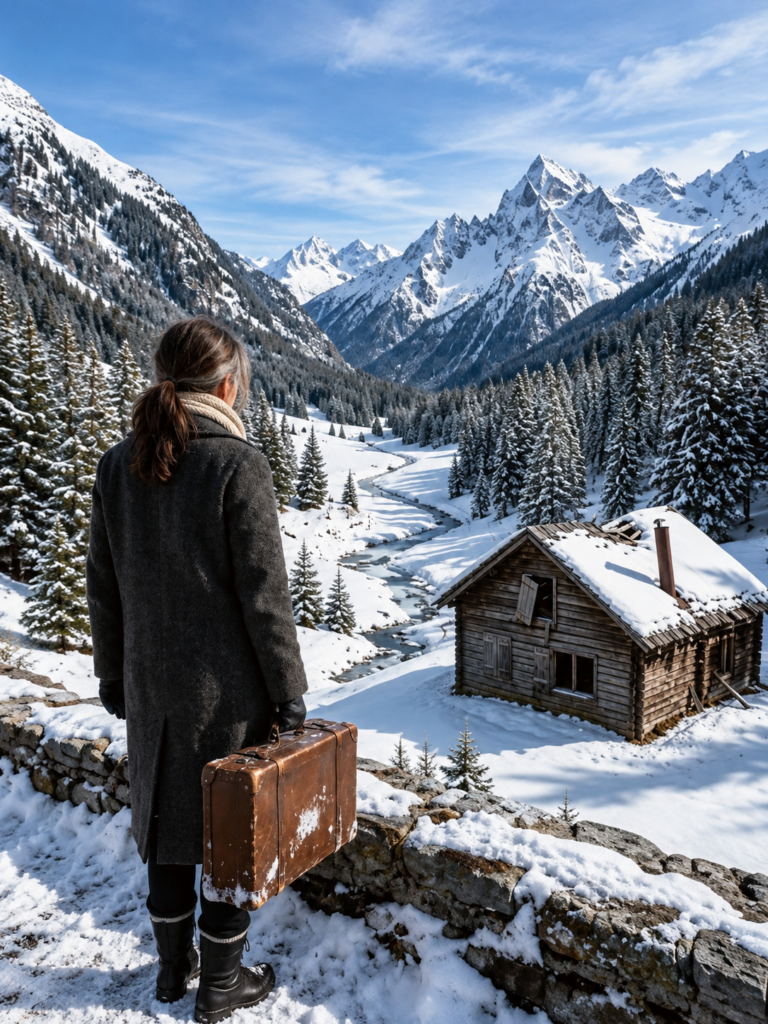
abandoned by her husband at forty-three with sixty-one dollars and a brass key her mother never mentioned she drove into the first blizzard and found the cabin that had been waiting forty years
Part 1
The kitchen still smelled like the coffee she had made at six that morning. Marin stood at the sink with her back to the table and listened to Wade clear his throat the way he always did before he asked her to pick up his dry cleaning. She had already done the quarterly numbers for the business. Her back ached. She was glad when he said her name and told her to sit down.
She thought he wanted to talk about money. They always talked about money in November, when the furnace calls came in and the cash finally loosened. Instead he looked at the salt shaker and said he had been unhappy for a long time. He was fifty-one. He had a new haircut she had pretended not to notice and a gym membership she had paid for out of the household account. There was an apartment across town already rented. The paperwork was with a lawyer. He spoke in the flat voice he used with vendors who had overcharged him. He said it would be cleaner this way for both of them.
Marin repeated the word. Cleaner. He told her she would be taken care of. She did not cry. She looked at his hands on the table, the same hands she had wrapped in gauze the winter he sliced his palm on a sheet-metal duct back when they had one van and no insurance. She had stitched the cut herself at this very table because the emergency room would have cost them a week of groceries. He had thanked her then. He had called her the best thing that ever happened to him. She remembered the exact words because she had written them on the inside cover of her checkbook, a small private treasure she could check on when the days got hard.
“Who is she?” Marin said. It was not really a question.
Wade told her the name. It did not matter. What mattered was what came after, and what came after was a machine that had clearly been running for months while Marin slept beside the man who built it. The business went first, and it went without a sound. Holt Heating and Air had started as a rusted white van she helped him buy with four thousand dollars of her own savings, money she had set aside from twenty years of nursing. She had answered the phones. She had done the books, chased the receivables, learned the tax code, talked frightened old people through the night when their heat died at two in the morning and Wade was asleep. Somewhere along those years the company had been quietly incorporated and her name had come off the documents, and she had signed where he pointed because that is what you do when you trust someone. The business was worth more than six hundred thousand dollars. Now, on paper, none of it was hers.
The house went next. It had been in his name from before they married, and she had only poured fifteen years of paint and mortgage payments into it. The bank accounts had been moved in October to a branch she could not reach. When she drove home from the lawyer’s office three days later, there was a locksmith’s van in the driveway and a young man on a ladder changing the deadbolt and a woman she had never met sitting in a silver sedan, scrolling her phone, waiting to come inside.
Marin did not make a scene. On the drive over she had imagined she might, and then she got there and found she had nothing left to make one with. She asked the young man on the ladder if she could have two minutes. He looked to the woman in the sedan, and the woman gave a small nod without looking up from her phone. That was how Marin came to be granted two minutes inside her own front door. She took the duffel she had already packed. Her mother’s sewing tin came down off the closet shelf. On her way out she saw that the woman had brought her own throw pillows, still in the store bag by the door, and Marin understood that the house had been measured and chosen while she was still living in it.
He took the house, the business, and the bank account. He left her the one thing he never knew was worth anything. That night Marin counted what she had: a duffel bag of clothes she had grabbed before the lock changed, her mother’s old sewing tin, which she had carried from apartment to apartment for years and never opened, a nineteen-year-old Honda with a quarter tank of gas, and sixty-one dollars and forty cents in a checking account he had forgotten to close because it was the small one, the one she used for stamps and school fundraisers too trivial to be worth taking.
She slept in the car the first night in the lot behind a hardware store because a motel was nineteen dollars she could not spare, and she did not yet know who to call. She had spent two decades being the person other people called. Now she lay in the back seat under her coat and tried to make a list of friends and found that every name on it was really Wade’s. The couples they had dinner with, the men from his church group. Even her own sister had stopped returning her messages two weeks before, which told Marin that her sister had known and had chosen Wade, the one with the house and the boat.
Around four in the morning, unable to sleep, she finally opened her mother’s sewing tin. Her mother had died six years earlier. Karen Sorenson had been a quiet woman who raised Marin alone, worked double shifts at a laundry, and never once in her life talked about the past. When Marin was small and asked where her father was, her mother would only say, “Gone before you knew to miss him,” and change the subject. When Marin asked where they had lived before the city, her mother’s face would close like a door. Marin had stopped asking. She had assumed there was simply nothing there.
Inside the tin, under the spools and the pinking shears and a thimble worn smooth, there was a folded square of paper, a brass key heavy enough to feel important in the palm, and an envelope soft as cloth from age. The paper was a map hand-drawn in pencil. It showed a county road far to the north, a turn at an old quarry, and a lane that ended at a small square someone had labeled in handwriting Marin did not recognize with a single word: home. The envelope held a deed. It was made out to Karen Sorenson, and it described forty acres and a cabin in a county Marin had never visited, and it had been signed and notarized when Marin was barely a year old.
Her mother had owned a cabin in the mountains for more than four decades and never said a word about it. Had never gone there. Had carried the key in a sewing tin through a dozen cheap apartments and a hard, narrow life and let her daughter believe they had nothing. Marin sat in the cold car with the key in her hand and understood two things at once. The first was that her mother had kept a secret her entire life. The second was that the secret was now the only thing in the world that belonged to Marin and Marin alone. She did not stop to wonder why. She was too tired to wonder and too hollowed out. And a person who has lost everything will drive toward the one lit window left to her without asking who lit it.
By the time the gas stations opened, she had made up her mind. She spent eleven dollars on a full tank and four on coffee and a sandwich, and she pointed the old Honda north toward a square on a pencil map labeled home. The drive took four hours and then some. The city thinned into suburbs, the suburbs into farmland, the farmland into dark walls of pine that pressed close on both sides of a two-lane road. The sky had been gray all morning. By early afternoon it had gone the color of wet ash, low and heavy, and the first snow began to spit against the windshield. The radio crackled a warning between songs. A storm was moving down out of the north. The first real blizzard of the season, ten to sixteen inches with wind, and the man on the radio told anyone who did not have to travel to stay home.
Marin did not have a home to stay in. She kept driving. She passed through a small town called Calder a little after three: one stoplight and a feed store and a diner with steamed-up windows and a low cinder-block store with two gas pumps out front and a hand-painted sign. She almost stopped. Her stomach was tight with hunger and her hands were stiff on the wheel. But the snow was coming harder now, no longer spitting but pouring, and she was afraid that if she stopped she would lose her nerve. So she drove on out the far side of town with the heater roaring and the wipers losing the fight.
The county road climbed. The pavement gave out and became packed dirt under a smooth new sheet of white. Twice the back end of the Honda swung wide and she steered into it, calm the way you stay calm with a patient who is coding, because panic helps no one. She found the old quarry where the map said it would be, a black gouge in the hillside half filled with snow. And just past it, a lane so narrow and overgrown she nearly missed the gap in the trees. The Honda made it maybe two hundred yards up the lane before it sank to the axles in a drift and stopped. The engine ticked. The wind shoved the little car sideways and rocked it. Through the windshield Marin could see nothing but white and the dark suggestion of trees. And for one long moment she sat with her hands in her lap and understood that she had driven with her whole life in a duffel bag into the middle of nowhere, into a storm that could kill her, on the strength of a word on a map.
Then she got out of the car because sitting still in the cold was how people died, and she had spent her whole life keeping people from dying. She took the duffel and the tin and the flashlight from the glove box and she walked. The snow was already past her knees in the drifts. The wind found every gap in her coat. She followed the lane because there was nothing else to follow. Twice she fell and twice she got up, and her face went numb and her breath came in short white bursts. And just as the light was failing and she had begun, quietly, to be afraid in a way she had not let herself be afraid in the kitchen or the lawyer’s office or the cold car, the trees opened.
The cabin sat at the end of the lane in a clearing the storm was busy erasing. It was small and square and low, built of dark logs gone silver with age. The porch had caved on one side under the weight of some long-ago winter. One window gaped black and empty, the glass gone, snow already drifting through it into the dark inside. It looked like a thing the forest had been slowly taking back for a long time. It looked to Marin like the most beautiful building she had ever seen.
She walked to the door and put her shoulder to it. It was swollen in the frame and would not give. She hit it harder, then harder, until something inside gave way, and it scraped open over a floor gritty with the leavings of years. She fell through into stillness. After the roar of the wind, the silence of the room landed on her like a weight. Marin stood in the dark and swung the flashlight around, and her breath caught. The cabin had not been stripped. It had been left. There was a table with two chairs, a narrow iron bed under a moth-eaten quilt, and a wall of shelves still holding rusted cans and a row of cracked enamel mugs. A cast-iron stove squatted in the center of the room with a box of split wood beside it, dry under the eave of the roof, as if whoever lived here had stepped out one afternoon to fetch water and simply never come back.
She was too cold to marvel. Her fingers had stopped working properly, and that frightened her more than the storm, because she knew what came after that. She knelt at the stove and opened the iron door and found, to her disbelief, a bed of old ash, the stub of a candle, and a tin of wooden matches gone soft but not dead. It took her four matches and most of her patience, but the dry kindling caught, and then the split logs caught, and a small orange light bloomed in the belly of the iron and pushed the dark back into the corners of the room.
Marin crouched in front of the open stove door with her hands held out to it and shook, and the warmth came into her slowly, painfully, the feeling returning to her fingers in hot needles. Outside, the wind screamed against the logs and could not get in. The cabin held. It had stood a hundred winters, and it stood this one, and it kept the storm off her, as it had kept the storm off someone else long ago. And Marin did not yet know that her own life had been saved in this exact room before she was ever born.
When the worst of the shaking passed and she could think again, she stood and moved the flashlight slowly along the walls, taking the measure of the place that was now somehow hers. That was when she saw the doorframe. It was the frame of the inner door between the main room and a small back room she had not yet entered, and it was covered in marks, pencil lines, dozens of them scored across the wood at every height from a small child’s to a grown woman’s. Beside each line was a date and a set of initials. The earliest she could make out read 1951. The lines climbed and crowded over each other, decades of them, a whole forest of small, careful measurements. They were not the growth marks of one family’s children. There were too many different initials. There were too many years. Marin ran her cold thumb down the column of dates and felt the hair lift on the back of her neck. Someone had stood a great many people against this doorframe and marked how tall they were. Children, grown men and women. Year after year, in a cabin at the end of a forgotten road that her mother had owned in secret and never once mentioned.
She was still standing there, her thumb on the wood, trying to make the marks mean something, when she heard it. It came from the front door under the howl of the wind, low and ragged and unmistakable. A scratching, a scraping of something living against the wood, and then a sound that was almost a voice, a thin, broken cry that was not the storm. Something was out there in the dark at the door of a cabin forty miles from the nearest town on the worst night of the year, and it wanted in.
Marin’s heart slammed once, hard. She picked up the flashlight and she crossed the room and she put her hand on the cold iron latch and she opened the door. The wind came in first, a wall of cold and snow that nearly put out the flashlight. Then something fell against her legs and slid down into the room, and Marin stumbled back and swung the light down, and the breath went out of her.
It was a dog, an old one by the gray on its muzzle, a big rangy animal with its ribs showing through a wet coat and ice crusted along its belly. It lay where it had fallen across the threshold, sides heaving, too spent to lift its head. One amber eye rolled up to look at her, and the thin broken cry came again. And then the dog simply put its head down on the floorboards and waited the way the very old and the very tired wait for whatever is going to happen next.
Marin shut the door against the storm and dropped to her knees beside it. “Oh, you poor thing,” she said. “Look at you. Where did you come from?” She did not expect an answer, and she did not get one. Instead she got her hands under the dog and dragged it the last few feet to the stove, and it let her, which told her how far gone it was. Two decades of nursing had taught her to read a body for how much time was left in it, and this one was close to the edge. Its gums were pale. Its paws were torn. When she pressed a thumb to the skin between its shoulders, the skin stayed tented a moment too long before it sank back. The dog was starving and it was freezing and it had walked through a blizzard to scratch at a door, and Marin did not stop to ask herself why a dog would do that. She did what she knew how to do.
She built the fire up until the iron glowed. Her own dry sweater came out of the duffel and went under the dog for insulation off the cold floor. She melted snow in a cracked enamel mug and held it to the dog’s mouth, and after a while a gray tongue came out and lapped at it. In her bag she still had a sleeve of crackers and half the sandwich she had been saving without admitting she was saving it, and she fed the sandwich to the dog in small pieces, watching it swallow, watching the amber eye come back into focus.
“There,” she murmured. “There. Slow. There’s more where that came from.” There was not, in fact, more where that came from. She had crackers and sixty-one dollars and a tank of gas, and now she had a dying dog. But a person says what a frightened creature needs to hear, and Marin had said it to a great many people in a great many last hours, and the saying of it steadied her own hands as much as it steadied the dog.
She sat up with the animal most of that first night. Sometime before dawn the heaving slowed and evened out, and the dog slept, and its paws twitched with whatever dogs run from in their dreams. Marin leaned against the warm flank of the stove and slept too, sitting up as she used to in hospital chairs. When she woke, the storm was over and the world was white and blinding and silent. She got up stiff and went to the door and pushed it open on a morning so bright it hurt. The clearing was a smooth blue-white bowl. Snow weighed the pines down until they bowed. The sky had cleared to a hard pale blue, and the only sound in all that country was snow sliding off a branch somewhere and the soft tick of the cooling stove behind her.
She stood in the doorway and breathed, and for the first time in three weeks no one was about to take anything from her because there was nothing left to take, and no one for miles who knew her name. Behind her a tail thumped once against the floor. The dog had lifted its head. It was watching her from the nest of her sweater. And when she crouched and held out her hand, it stretched its long neck and pressed its cold nose into her palm. And Marin felt a warmth in her chest she had not felt in a long time, which was that she was needed by a creature that asked nothing of her but kindness.
“All right,” she said. “All right. You and me, then.”
She named her that morning. She did not plan to. The dog followed her on shaky legs to the woodpile and back, never more than a step behind. And when Marin turned to speak to her, she needed a word. So she used the first one that came. Juno. Her mother had liked the old stories, the few times she let her guard down, and there had been a queen of the gods in them by that name, watchful and loyal and slow to forgive. The dog’s ears came up at the sound of it. After that, she was Juno.
The dog shadowed her through the rest of that morning. When Marin hauled water, Juno walked at her hip. When she sat to rest, the dog lay across her feet and sighed and went instantly to sleep, trusting the floor and the woman on it completely, and the sight of it put a lump in Marin’s throat. Three weeks had taught her that the people closest to her would step over her body to get where they were going. Here was an animal that had known her one night and would not let her out of its sight.
The two of them got the Honda out together, which is to say Marin dug for two hours with a flat coal shovel she found by the stove while Juno supervised from a bare patch of ground by the chimney. The lane ran downhill to the county road, and once the drifts were cleared from around the wheels, Marin rocked the old car backward and let it slide and steer its own way down to the bottom, where a plow had already scraped the county road to gravel. She drove back to Calder with the dog on the passenger seat because she could not leave a starving animal alone in a freezing cabin and because she did not want to.
The store with the two gas pumps was open. A bell over the door announced her, and the woman behind the counter looked up from a crossword. A stout woman past sixty with reading glasses pushed into iron-gray hair and a hand-knit cardigan the color of a robin’s egg.
“Well,” the woman said, looking past Marin to the dog’s face in the car window. “You found Vera’s place. I’d guess you’ve got the look of somebody just come down off that mountain.”
Marin stopped with her hand still on the door. “I’m sorry?”
“The Lond place up past the quarry. Nobody’s been up that road in years. I saw smoke off the ridge last night in the middle of all that weather and I said to myself, somebody’s either crazy or in trouble. You don’t look crazy.”
“I might be a little of both,” Marin said, and surprised herself by almost smiling.
The woman’s name was Fay, and she had run the store at the junction for longer than there had been much of a junction to run. Marin put a basket on the counter and walked the three short aisles and did the math in her head as she went, adding and subtracting and putting things back. A bag of rice, a sack of dried beans, two cans of soup, the cheapest bag of dog food on the shelf and a soup bone from the cooler. A box of matches that actually worked. When she set it all down, the total was more than she had, and she stood there and felt her face go hot and began quietly to put the dog food back.
Fay reached over and stopped her hand. “Leave it,” Fay said. “I run a tab for folks up the valley. You’ll pay me when you’re able.”
“You don’t know me.”
“I know you bought dog food before you bought enough for your own self.” Fay started bagging the groceries. “Out here we don’t ask what a person did to end up in the snow. We get them warm first and sort the rest out after. You can tell me the rest when you feel like it, or never. Suit yourself.”
Marin stood at the counter with her throat tight and could not speak for a moment. In three weeks not one person had done her a single kindness without a form to fill out or a price attached. She had forgotten it was a thing that happened.
“Thank you,” she finally said.
“Don’t thank me. It’s groceries.” Fay slid the bags across the counter and watched her gather them into the crook of her arm. “You planning to winter up there?”
“I don’t have anywhere else to be.”
“Husband?”
“There was one last week.” Marin surprised herself again, this time by how flat and final it came out. “He kept the house. I kept the dog.”
Fay nodded slowly and let that sit. “All right, then. And here’s the only advice I’ll give you unasked. That road drifts shut after every blow, so you keep a shovel in the car and you don’t let your tank drop below half. And if I don’t see your face down here for two weeks running, I’ll send somebody up to make sure you haven’t froze stiff. That part’s not optional. You don’t get to vanish on me.”
“Why would you do that?”
“Because that’s how it works up here,” Fay said. “You’ll figure it out.” Then her face changed and she leaned a little on the counter. “And I’ll tell you something else, since you’re up there. You ought to know that place is going to tax sale.”
The warmth went out of Marin’s chest. “What do you mean, tax sale?”
“Back taxes. Years of them. The county’s been trying to get shed of that parcel for a long while. And there’s an outfit been buying up the whole valley. Quiet-like. The old farms and the timber lots, paying pennies on the courthouse steps. They’ll have the Lond place too, come the sale. Middle of January, I think the notice said.” She looked at Marin, not unkindly. “I only tell you so you don’t go falling in love with a roof that isn’t going to be yours.”
Marin drove back up the mountain with the groceries and the dog and a cold weight sitting where the warmth had been. She had come four hours north to the one thing in the world that belonged to her, and she had been there a single night, and already the world was reaching for it. The deed in her mother’s tin said Karen Sorenson. It did not say the taxes were paid. It said nothing about a county and a sale and an outfit buying up the valley for pennies.
She fed Juno first when she got back. The soup bone went into a pot on the stove with rice and a can of soup, and soon the cabin filled with the smell of it, and she gave the dog a careful first meal and watched her eat like a creature who had forgotten food existed, slowly at first and then all at once. When the bowl was clean the dog looked up at her with an expression Marin could only call gratitude, though she knew better than to trust a word like that about a half-wild animal. Then Marin ate, sitting on the floor with her back to the warm iron, and the two of them shared the quiet.
That afternoon, while the light held, she finally opened the inner door and went into the back room she had not yet entered. It was smaller than the front, with a single shuttered window, and it had been kept ready. A second narrow bed stood made up under a clean wool blanket, the corner squared, ready for a guest who might arrive within the hour. Against one wall sat a wooden trunk, and along the other a row of iron pegs, and on the pegs hung coats. These were not one woman’s coats. They came in a dozen sizes. A child’s red parka beside a man’s canvas work jacket beside a girl’s thin spring coat, each one clean, each one waiting on its peg for whoever turned up needing it.
Marin stood in the doorway and looked at that row of borrowed warmth for a long while, and the cabin gave up a little more of its secret, though she did not yet have the word for what it was. She should have been thinking about the taxes. Instead she found herself looking again at the doorframe and its crowded ladder of pencil marks, at the decades of small careful measurements climbing the wood, and she could not let it alone.
Juno noticed her looking. The dog got up, crossed the room, and went to a spot on the floor near the inner door and began to dig. She scratched at the boards with her torn paws, whining low, the same urgent sound she had made at the door in the storm.
“Hey. Easy. Your feet.” Marin went to pull her back. And then she stopped because she saw what the dog was scratching at. One floorboard sat slightly proud of the others, its nail heads gone, the wood around it worn pale and smooth from long handling. It had not worked loose by accident. It was a board that had been lifted on purpose many times.
Marin got the coal shovel and worked the blade into the seam and pried, and the board came up with a dry groan. And underneath, in a hollow scooped out of the earth and lined with flat stones, sat a flat tin box, the kind that once held biscuits, rusted at the corners and furred with cold. Her hands were not quite steady when she lifted it out. Juno had gone still beside her, watching, her job apparently done.
Marin worked the lid free. Inside, wrapped in a square of oilcloth, was a book. It was thick and water-stained and swollen, bound in cracked black leather, the kind of ledger a shopkeeper keeps. She opened it on her knees by the firelight, and the pages were full, edge to edge, top to bottom, in a dozen different hands but mostly in one, a strong slanting script that pressed hard into the paper. They were names, hundreds of them. Each entry was a name, a date, and a line or two beneath it, and Marin turned the brittle pages and read them by the orange light of the stove.
A man and his two boys, January of 1958, the truck gone off the grade in the ice. Three nights. Came in cold, left warm. A girl of sixteen, the spring of 1963, no other word but run written beside her name. Eleven nights. Came in cold, left warm. There was a whole family the winter of 1971, the father with his arm broken, burned out of their place down the valley. Most of a month. Came in cold, left warm. Two children on their own, a brother and a sister, the winter of 1969, walked eleven miles in the dark from a county home that had shut its doors. The better part of a season. Came in cold, left warm. Some of the entries were two lines, some filled half a page, a few had a second hand beneath the first, a thank-you scratched in shaky pencil. Once a child’s drawing of a stick-figure dog standing guard beside a stick-figure house with smoke coming out of the chimney. On and on, page after page, year after year. Travelers caught in the weather, children with nowhere to go, women who arrived in the night with bruises they did not explain and left when they were strong enough to leave. After each one, in that same hard slanting hand, the same three words like a prayer or a tally or a promise kept: came in cold, left warm.
Marin understood it then, all at once. The doorframe and its ladder of marks. The dry woodpile, the made bed, the cracked mugs lined up on the shelf for guests, the coats in every size waiting on their pegs. This place had not been a home. It had been a refuge. Someone had lived at the end of this forgotten road for half a century and taken in everyone the storm or the world had cast out, and measured the children against the doorframe, and written every single soul into this book so they would not be forgotten.
She turned the pages slowly now, almost afraid of them, the firelight shaking on the paper and the old dog warm against her hip. And near the back, in the winter of 1982, in that same strong hand, she found a name she knew. She read it once, and her vision blurred, and she had to wipe her eyes with the back of her wrist and read it again to be sure the cold and the firelight were not playing tricks on her.
Karen Sorenson, 19, and the baby coming. Sick the whole winter, stayed till the thaw.
Marin read the entry a third time, and a fourth, until the letters stopped being letters and became only the shape of her mother’s name in a stranger’s hand. Karen Sorenson, 19, and the baby coming. She did the arithmetic slowly, already knowing the answer, only looking for a place to set it down. The winter of 1982. Her mother, 19. The baby coming. Marin was born the following spring in a town she had always assumed meant nothing, the nearest hospital to a mountain she had never heard of. The baby in the ledger was her.
She sat very still on the cold floor with the book open on her knees and the dog warm against her hip, and the whole shape of her mother rearranged itself in the firelight. The double shifts at the laundry, the closed face, the one sentence about her father and never another word. All of it pointed back to this. Her mother had not come from nothing. She had come from here, from a cabin at the end of a buried road, nineteen and pregnant and abandoned, taken in by a stranger and kept alive through a winter that should have killed her.
And then Marin noticed the thing that would not let her sleep that night. Under every other name in that book, in the same hard slanting hand, were the same three words. Came in cold, left warm. Hundreds of times over, a small completed circle, a job finished. Under her mother’s name there were no such words. The entry simply stopped. Sick the whole winter, stayed till the thaw, as though whoever kept the book had not been able in good conscience to write that this one had left warm. That circle had been left open on purpose, it seemed to her, and left waiting.
Marin did not sleep much. She lay on the iron bed under the moth-eaten quilt with her coat on top of it and Juno a heavy warmth against her back, and she watched the firelight move on the log walls and listened to the cabin tick and settle in the cold, and she thought about a frightened girl lying in this same bed with a baby coming and nowhere on earth to go.
In the morning she drove down to the store. Fay was at the counter with her crossword and her coffee, and she took one look at Marin’s face and got up and poured a second cup without being asked.
“Sit,” Fay said. “You look like you’ve seen a ghost.”
“Tell me about Vera Lond,” Marin said.
Fay studied her for a moment over the rims of her glasses. Then she set the coffee down in front of Marin and lowered herself onto the stool behind the register. And she told her. Vera Lond had come up to that mountain as a young woman before Fay was born, a war widow with no children and no people left, and she had taken the old cabin at the end of the quarry lane and never come down off the mountain to live again. The first winter she was there, a family slid their truck off the grade in a blizzard and walked to the only light they could see, and Vera took them in and fed them and kept them until the roads cleared. After that it just never stopped. She never turned a soul off that mountain, Fay said. Not in fifty winters. Hunters caught out in weather. Folks burned out of their houses, runaways, girls in trouble, the sort nobody else would take in back then. She wrapped both hands around her cup. The county knew. The church knew. Nobody made it official because official meant forms and rules and somebody deciding who deserved it. Vera didn’t believe anybody had to deserve it. You were cold, she got you warm. That was the whole of it.
Fay told her about the winter a church van went off the pass with eleven people in it and how Vera fed all eleven for four days on what should have been one woman’s winter stores and sent them down the mountain with their coats mended. She told her about a man who came up running from the law and how Vera warmed him and fed him and only then, when he was rested, asked him quietly what he had done and listened to the whole of it and then drove him down to the sheriff herself, because some things a person has to answer for, but she would be damned if he answered for them frozen. She had a rule about it, Fay said. Warm first, truth after. Never the other way round.
“The doorframe,” Marin said. “The marks.”
“She measured the children.” Fay smiled, but her eyes were wet. “Every kid that came through, she stood them against that frame and marked how tall they were and put the date. Said it was so they’d have somewhere that remembered them growing. Some of those kids came back grown, with kids of their own, and stood them on the same spot.” She shook her head. “Half this valley passed a winter up at Vera’s at one time or another. You’d be surprised who. There’s a man works down at the county now, runs the very office that’s selling the place, and he was one of Vera’s. Came up there a half-frozen boy and left in the spring with shoes that fit.”
Marin turned her coffee cup in a slow circle on the counter and did not drink it. “There was a girl,” she said. “The winter of 1982. Nineteen years old. She was pregnant and she was sick all winter and she stayed until the thaw.”
Fay went still. “Her name was Karen Sorenson,” Marin said. “She was my mother.”
For a long moment the only sound in the store was the hum of the cooler and the soft tick of snow against the window. Fay took off her glasses and pressed her fingers to the bridge of her nose. And when she looked up, her face had gone soft and old and full of something that had been waiting a long time to come out.
“I was nineteen myself that winter,” Fay said quietly, working the same counter for my mother. “I remember a girl. Dark hair, big frightened eyes. Hardly said two words. Vera brought her down once in the spring for the doctor, and she sat in that chair right there by the stove with her hands over her belly and wouldn’t look at anybody.” Fay’s voice caught. “I never knew her name. I never knew what became of her. And here you are, the baby, sitting in my store more than forty winters later.”
Marin found that she could not speak. Vera left her the place, you know, Fay went on gently. When she got old she didn’t have anybody of her own, and out of every soul that came through that cabin she picked your mother to leave it to, signed it over and everything. I always wondered why the girl never came back to claim it. Vera lived up there alone till she passed near thirty winters ago, and the place just sat. Folks figured the girl was dead or didn’t want it. She looked at Marin. “But she wasn’t dead. She just couldn’t come back, could she?”
“No,” Marin said. Her voice came out rough. “She kept the key in her sewing box for the rest of her life. She never told me any of it. I think she couldn’t stand to look at it, and she couldn’t stand to let it go.”
Her mother had not run to nowhere. She had run here. And then, when the worst was over and the baby was born and the world had handed her a deed to the one place that had ever been kind to her, she had run from that too, because going back would have meant standing again in the winter that broke her. She had carried the key for the rest of her life as the one thing she could neither use nor throw away. All the small strange things about her mother made a different kind of sense now. She had kept their apartment too warm, even in summer, even when the bill frightened her. There was always a plate of food set aside for the man who slept in the stairwell of their building, though they had little enough themselves. And once a teenage girl from down the hall turned up at their door with a black eye and a packed bag, and Marin’s mother, who barely spoke to the neighbors, took her in without a single question and let her stay a week on the couch. Marin had thought it was simply her mother’s way. She understood now that it was Vera’s way, taught to her in this room, carried down the mountain and kept alive in a rented apartment by a woman who could not come home and could not stop being what home had made her.
Marin drove back up the mountain that afternoon with her chest aching and her mind clearer than it had been in weeks. She had come here as a woman running from a life that had thrown her away. She was beginning to understand that she had run straight back to the place that caught her mother when the same thing happened, in this same cold, with a baby coming and a man already gone. The symmetry of it sat heavy and strange and almost holy in the old car, but understanding the past did not pay the county. The notice was real, and Fay had not softened it because there was no soft way to say it. The taxes on the parcel had gone unpaid since Vera died, near thirty winters of them, and the county had finally bundled the debt and set the land for the January tax sale, and an outfit that had been quietly buying up the valley would be standing on the courthouse steps with cash in hand.
Marin had sixty-one dollars and a dog and a stove. She did not have weeks. She had until the middle of January, which was less than five weeks away. She drove down to the county seat two days later, stood at a counter under humming fluorescent lights, and learned the exact size of the thing coming for her. The back taxes on the parcel, with the penalties and the interest stacked up over all those empty winters, came to a little over three thousand dollars. The clerk who told her was not unkind. He said the sale was set and the list was published, and unless somebody paid the debt in full before the gavel came down, the land would go to the highest bidder on the courthouse steps in January, and everybody already knew who that would be. Marin thanked him and drove back up the mountain with the number sitting on her chest like a stone.
One night that week she went through the cabin properly by candlelight and firelight, opening every drawer and lifting every loose board, certain now that the place had something more to tell her. She was not looking for money, not yet. She was looking for her mother and for Vera and for some thread that tied the woman who saved girls to the girl Marin had become. The ledger, it turned out, held more than names. Tucked into a slit in the back cover, folded so many times the creases had gone soft, was a single sheet of paper in that same hard hand. It was a letter, and it was not addressed to anyone by name. Across the top Vera had written four words: to whoever comes next.
Marin read it crouched by the stove with Juno’s chin on her knee. If you are reading this, the letter said, then you are standing in my house, and the stove is warm, which means you found the wood I left dry, which means you needed it. I am too old now to keep this up forever, and I have made my peace with that. But the mountain does not stop sending people. They come in the bad weather, off the road and out of worse lives, and they need a door that opens. So I am asking you, whoever you are, leave the door unlocked and the stove laid. Someone always comes. There is money put by for the county, enough to keep the wolf off the parcel, in the place a person would look if she were cold and alone and had nothing. You will know it when you were cold enough to think of it. Keep the book. Write them down so nobody who comes through here is ever forgotten again.
There was no signature. There did not need to be one. Marin sat with the letter in her hands for a long time while the fire burned down. She thought about the man who had run her out of her own life with lawyers and changed locks, and how small and far away he seemed now, up here on this mountain in this room that had been built for exactly the person she had become. She thought about her mother, frightened and nineteen, kept alive in this room by a stranger who asked nothing, and she thought about the open circle under her mother’s name in the book, the words that were never written: came in cold, and then nothing. The sentence left unfinished for four decades.
She understood, sitting there, that she had a choice to make, and that it was not really the choice she had thought she was facing. She had believed the question was whether to fight for a cabin she could not afford against an outfit that could buy the whole valley out of petty cash. That was not the question. The real one was whether she would be one more Sorenson woman who took what this place gave her and then ran, or whether she would stay and finish the sentence her mother never got to finish and keep the door open for the next person who came up the mountain with nothing.
She folded the letter and put it back in the ledger, and she banked the fire, and she lay down on the bed where her mother had lain. And for the first time since the ordinary Tuesday in the kitchen, she knew exactly what she was going to do. She was not leaving. It was not a brave decision, and she did not feel brave making it. She felt, for the first time in a long while, like a person with a job to do. She had been good at exactly one thing her whole life, which was caring for the people the world had stopped caring for, and she had let a man persuade her that the thing she was good at counted for nothing beside the thing he was building. Up here, at the end of a buried road, in a house built for that one thing, the arithmetic finally ran the other way.
She would have to find the money. She would have to face the county and the outfit and the winter and whatever else came up that buried road. How she would manage any of it she did not know yet. But she lay in the dark with the dog breathing against her and the cabin ticking in the cold, and the fear that had been her constant companion for three weeks finally gave way to something steadier, which was purpose.
The next morning Marin turned on the old radio she had found on the shelf, the one that still pulled in the station out of the county seat, and a man’s voice was reading the long-range forecast in the flat calm tone they save for the worst news. A system was building far to the north and west, the largest of the young winter, and it was tracking down toward the valley. They were calling it a once-in-a-decade storm. It was due, the man said, in the second week of January.
Marin stood very still in the middle of the cabin with the coffee going cold in her hand. The second week of January. That was the week of the tax sale. The same week she would have to be down off the mountain at the courthouse with money she did not have. The storm of the decade would be closing the only road she had. Juno crossed the floor and leaned her whole weight against Marin’s leg and looked up at the door, and a low sound started in the old dog’s chest, and Marin reached down to quiet her without taking her eyes from the window, in the white country beyond it, where everything that was coming was already on its way.
But the storm was weeks off yet, and there was work to do before it came, and work was the one thing Marin had never run short of. She started with the door, because a door that would not close was the first thing Vera’s letter had asked her to fix. She planed the swollen edge until it shut true and latched soft. The caved corner of the porch she braced with two posts cut from a fallen pine, squared up to hold a winter’s snow. The empty window she could not glaze, not yet, so she boarded it tight and stuffed the gaps with rag, and the wind stopped finding its way into the room at night. Each small repair gave back a little more of the cabin and a little more of Marin with it.
Money came the only way she knew how to make it. Word travels in a thin valley, and within a week of Fay mentioning that the woman up at the Lond place had been a nurse, people began to find her. An old man two valleys over with a hip gone bad and no one to drive him to the clinic. A retired schoolteacher whose blood pressure no one had checked in years. Marin went to them and bandaged and dosed and listened as she had for two decades before she traded it all for a front office and a man’s last name, and they paid her what they could.
The widow in town was the first of them. She was eighty-one and sharp as a tack and frightened because her eyes had gone bad and she could no longer read the markings on her insulin and she had nearly killed herself twice with the wrong dose. Marin spent an afternoon with her. She sorted the pens and marked the doses with strips of tape a blind woman could feel, wrote out a chart in letters two inches tall, and sat at the kitchen table afterward drinking weak coffee while the old woman talked about a husband long dead. When Marin stood to go, the woman pressed two folded twenties into her hand and would not hear a word against it.
“You sat with me,” she said. “Nobody sits with me. The county sends a girl who looks at her phone the whole time.”
Word of that afternoon went around town before Marin’s car reached the county road, and by week’s end there were three more visits like it. Some of it was cash. Some of it was a sack of potatoes left on her porch, or a cord of split wood, or a winter coat that had once belonged to somebody’s mother and fit Marin close and warm. The plow driver took to running his blade up her lane after he finished the county road, though no one had asked him and she could not pay him for it. The first time she went out to thank him he just touched the brim of his cap and said Vera had pulled his father out of a ditch in a whiteout once before he was born, and that was the end of the conversation and the beginning of a clear lane all winter.
Other things appeared. A box of canning jars on the porch one morning, no note. A quarter of a deer, butchered and wrapped, from a man she had never met who had heard there was somebody up at the Lond place again. The valley had a long memory, and it was beginning, quietly, to decide that Marin belonged to it.
She kept the money in a coffee can on the shelf, and she counted it some nights by the stove. Ninety, then one hundred seventy, then two hundred forty. It climbed slow, and the tax sale came on fast, and the gap between what she had and what the county wanted stayed wide enough to swallow her whole. She knew there was more. Somewhere Vera’s letter had promised money put by, enough to keep the wolf off the parcel, in the place a person would look if she were cold and alone and had nothing. Marin read that riddle aloud to the dog some evenings, hoping the sound of it would shake something loose. She had checked under the hearthstones and behind the loose chinking and inside the hollow posts of the bed. The cold and alone she understood too well by then. It was the word nothing she kept circling, and the calendar kept turning.
Juno grew strong over those weeks. The ribs disappeared under a thick gray coat, and the torn paws healed, and the old dog took to walking the clearing every morning with her nose to the wind. She slept at the foot of the bed and woke when Marin woke and followed her from room to room. The two of them fell into the rhythm of the place, the wood to be split and the water to be hauled and the long blue evenings by the stove with the ledger open on Marin’s knees while she read the names of all the people this room had saved.
Marin changed over those weeks too, though she could not see it in herself as plainly as she saw it in the dog. The work put muscle back into her arms. The cold air and the early dark put her to sleep at a decent hour for the first time in years, and she woke without the weight on her chest that had sat there every morning since the kitchen. She ate better on rice and beans and venison than she had eaten in her own bright kitchen with the double oven. Some mornings she caught herself humming and could not have said when she started.
Then, in the second week of January, the radio stopped reading songs between the weather and read only the weather. The storm came up the valley a little after dark. Marin had spent the whole day getting ready, and she had done it once already, alone and half frozen and ignorant, so she did it now with the steady hands of someone who knew exactly how bad it could get. Every pot and jug she owned she filled with water, because a pump was a luxury this cabin had never had. Juno’s bed came in close to the stove. The lamp and the matches went where her hand would find them in the dark, and she laid a second fire ready in case the first went out. By full dark the wind was screaming down off the ridge and the snow came sideways, and the cabin filled with the deep cold roar of it, and Marin sat by the stove with the dog and a cup of coffee and felt almost safe. She had decided she would drive down in the morning before dawn, ahead of the worst of it, and stand at the courthouse with her coffee can and beg the county for time. It was a poor plan. It was the only one she had.
A little before midnight Juno stood up. The dog crossed to the door and stood rigid, her ears forward, the gray hackles lifting along her spine, and she let out a low sound that climbed into a whine and then a sharp insistent bark. Marin got up and put her hand on the cold door and listened and heard only the storm.
“There’s nothing out there, girl,” she said. “Nobody’s fool enough to be out in this but us.”
Juno barked again, louder, and scratched at the door with both paws, the same urgent dig she had made at the floorboard, the same broken cry from the first night. Marin went still because she had learned to trust this dog about doors. She opened it a crack. The wind nearly tore it from her hand. The world beyond the porch was a wall of moving white with nothing in it. She almost shut the door again. Then the wind shifted for half a breath, the snow thinned, and far down the black slope toward the county road she saw it. A faint smear of light, low to the ground, blinking. Headlights, half buried, pointed up at the sky. Somebody had gone off the road.
Marin did not let herself think about it for long, because thinking was the enemy now. She pulled on the dead woman’s coat and a second pair of socks and her boots, and she filled her pockets with what she might need, and she lit the lamp and took the long coil of rope from its peg by the door, the rope Vera had left, and she tied one end to the porch post so she could find her way home. Then she stepped off the porch into the storm with the old dog plunging ahead of her into the dark.
The walk down that slope was the hardest thing she had done in her life. The snow was thigh-deep and the wind shoved her flat twice, and the cold went through the coat and through her skin and reached for the core of her. She could not see the lamp’s light past her own arm. What she could see was Juno, a gray shape breaking trail ahead, stopping every few yards to look back and make sure Marin was still coming, leading her down the mountain through a whiteout toward a light Marin could no longer see.
The car was a small sedan, nose down in the ditch where the lane met the county road, already half a snowdrift. Marin reached it and clawed the snow from the driver’s window and looked in, and her heart turned over. A young woman sat slumped behind the wheel, her lips gone blue, barely conscious. In the back, strapped into a car seat under a thin blanket, was a little boy, three or four years old, and he was not crying and he was not shivering, and that frightened Marin more than anything, because a body that has stopped shivering has stopped fighting.
The door was jammed with snow and ice. Marin dug and hauled and got it open, and the young woman’s eyes fluttered toward her.
“My boy,” the woman whispered. “Get my boy.”
“I’ve got you both,” Marin said. “Look at me. I’m a nurse. You’re going to be all right, but you have to help me. Can you walk?”
The woman tried and could not, her legs gone useless under her. Marin made the choice in a half-second. She unbuckled the boy first and zipped him inside her own coat against her chest, his cold face against her neck, and she got an arm under the mother and hauled her upright and looped the woman’s arm over her shoulders, and she found the rope with her free hand and started back up the mountain.
She would not remember much of that climb afterward, only pieces of it: the rope burning through her glove, the small dead weight against her heart, and the terrible stillness of the boy. Somewhere in the middle of it, the mother’s feet dragging and her own legs failing and the certainty that she was not going to make it, that all three of them would die thirty yards from a warm stove. And then Juno circling back, barking in her face, leaning her whole strong body against Marin’s hip and driving her forward, one step and then another, up the rope, up the slope, until the black shape of the cabin rose out of the storm and the porch was under her boots and the door was there.
She fell through it as her mother must have fallen through it half a lifetime before. What happened in the next hour was the work Marin had been put on earth to do. She laid the boy down by the stove and got him out of his wet clothes and wrapped him in dry blankets warmed at the fire, and she put her own warm hands flat against his cold chest and his back, and she talked to him low and steady while she worked. The same for the mother, dry clothes and warm blankets and warm sweet tea once the woman could hold a cup, not too hot, never too hot, slow and steady, the cold coming out of them in violent shudders that Marin welcomed because shivering meant the body had decided to live.
For a while the boy did not answer at all. He lay limp and gray in the firelight while Marin rubbed his small back and murmured to him the same nonsense she had murmured to the dying dog, the same nonsense she had murmured to a hundred frightened people on a hundred bad nights. Come on now. Come on back. You’re not done, little man. Not tonight. His mother knelt across from her, gray-lipped and shaking, watching her son’s face for any sign at all, and Marin made herself sound certain even though she was not, because a frightened person needs one calm voice in the room more than anything else on earth.
The boy came back. Color crept into his face and his eyes focused, and at last, blessedly, he began to cry, the thin furious wail of a child who was cold and frightened and alive. His mother heard it from across the room and broke down weeping, and Marin knelt between them with a hand on each and let herself feel, for the first time since the climb, the plain relief of having reached them in time.
The young woman’s name was Cass. She was twenty-three and the boy was Eli, and she had been driving north through the storm because she was running from a man in a town to the south with a child in the back seat and almost nothing in her pocket. When the road disappeared and the ditch found her, she had not known there was a cabin on the mountain at all.
“I don’t know where I was even going,” Cass said when she could talk. She held her son against her and stared into the fire. “I just knew I had to get him out of there. I didn’t have a plan. I didn’t have anywhere. I just drove.”
Marin looked at this frightened girl with a baby and nowhere to go, in this room, in this storm, in the years between, folded shut like a hand. “You’re not lost,” Marin said. “You just stopped at the right door.”
Cass began to cry then, the bone-deep cry of a person who has been holding herself together with both hands for a long time and has finally found a place to set the weight down. Marin did not try to stop her. She made more tea and she found dry socks for the boy and she fed the stove and she let the girl cry herself empty in the warm. Somewhere in it Cass said she was sorry. Sorry for the trouble. Sorry for the gas she could not pay for. Sorry for needing any of it, because somewhere along the line she had been taught that needing help was a kind of failing.
“You don’t apologize here,” Marin told her. “Not in this house. This house was built for exactly this.” And she believed it now, all the way down, which she could not have done a month before.
She got up before dawn while the two of them slept, and she took the ledger down from the shelf and opened it to the first blank page, and she dipped Vera’s old pen in the ink she had found in the tin and freshened, and she wrote the date, and below it, Cass and her son Eli, off the road in the storm of the decade, nowhere to go. And under that, in her own hand, now in the hand of the keeper, she wrote the three words that finished the circle. Came in cold, left warm.
She was still sitting with the book open on her knees when the storm broke at first light, the wind dying all at once into a great white silence, and the sun came up red and enormous over the ridge and lit the whole buried valley on fire. And through that silence, far down the mountain, Marin heard the slow grind of an engine on the lane, and she went to the door and saw headlights coming up through the snow toward the cabin, slow and certain, the reckoning she had been bracing for all winter finally climbing the mountain to find her.
The first vehicle up the lane was the plow truck, and Marin let out a breath she had not known she was holding. She knew that truck. It had been clearing her road all winter without being asked. Behind it, riding in the cleared track, came a county sedan with chains on its tires, and Marin stood on her rebuilt porch with the dog beside her and waited for whatever it carried.
The plow driver got down first and walked over and looked at her, and looked past her at the smoke rising straight up out of the chimney into the still bright air. “You made it through, then,” he said. “I came up soon as I could. Worst one in years.” He glanced back at the sedan. “Brought somebody who wanted to see the place. Hope that’s all right.”
Out of the sedan, with some difficulty over the snowbank, climbed Fay in her robin’s-egg cardigan and a heavy coat, and behind her a man Marin had never met, sixty or so, gray and careful in a county jacket with a courthouse badge clipped to the pocket. Marin’s stomach tightened. This was the office that was selling her home out from under her. This was the outfit’s first foot in the door.
“Mrs. Holt,” the man said. Then he stopped and corrected himself, because Fay had clearly told him. “Miss Sorenson. My name doesn’t matter much. I run the tax office down at the county seat.”
“I know what you run,” Marin said, as steady as she could manage. “You’ve come a long way up a bad road to tell me something you could have mailed.”
“I have,” the man agreed. He was not looking at her now. He was looking at the cabin, at the squared porch and the smoke and the warm light in the boarded window, and his face had begun to come apart in a way he was fighting to control. “May I come in? Just for a minute. I haven’t been inside this place in a very long time.”
Marin stood aside and let them in because Vera’s letter had told her to, and because she did not know what else to do. The man from the county stepped through the door and stopped. Cass sat by the stove with Eli asleep in her lap, both of them wrapped in the warmed blankets, safe. The ledger lay open on the table where Marin had left it, and on the inner doorframe the long crowded ladder of pencil marks climbed the wood, fifty winters of children measured and dated and remembered.
The man walked to the doorframe slowly, and he bent down, and he put one finger on a mark low to the floor beside a set of initials and a date. “That’s me,” he said. His voice had gone to almost nothing. “1966. I was seven. My folks were gone and the county had me, and the county had a bad winter and no room, and somebody drove me up here and left me with a woman I’d never met. I cried the whole first night.” He straightened up and wiped his face with the flat of his hand and did not apologize for it. “She measured me against this frame the next morning, told me I’d be taller by spring. I was, too. I left here in April with shoes that fit and a coat that was mine, and I have spent the rest of my life pretending I got where I got on my own.”
The room was very quiet. The fire ticked. “I thought this place was just a parcel,” he said. “A number on a delinquent roll. I signed the order for the sale myself last fall, and I never once let myself think about whose roof it was.” He looked at Marin. “And then Fay called me three days ago and told me Vera’s cabin had smoke coming out of it again, and that the woman living in it was Karen Sorenson’s girl, and that she’d just been written up in the only book that matters.” He nodded at the ledger on the table. “I have something to tell you, and I need you to sit down for it, because I have been sitting with it for three days and I am still not steady.”
Marin sat. “The sale is off,” the man said. “The back taxes are paid. All of them. Three thousand two hundred eleven dollars cleared in full day before yesterday.”
Marin’s mouth opened and nothing came out.
“It wasn’t me,” he said quickly. “I want to be honest with you. It wasn’t me, though I’d have found a way given another week. It was the valley. Fay told a few people, and those people told a few people, and it turned out half the county had a stake in this mountain they’d never spoken about out loud. A farmer down on the flats who spent the winter of ’59 up here, the woman who runs the pharmacy whose mother was one of Vera’s girls, a long-haul driver, a schoolteacher, a man who fixes furnaces.” He shook his head slowly. “They came into my office one at a time and in twos and threes, all day, with cash and with checks and one of them with a jar of coins, and they paid down Vera Lond’s tax bill a few dollars at a time until there was nothing left to sell. I have never seen anything like it in all my years behind that counter. Half of them cried. I cried, and I was supposed to be running the register.”
He reached into his county jacket and brought out a long envelope and set it on the table beside the ledger, almost shy about it. “That’s the parcel marked paid and clear, in your mother’s name, which makes it yours,” he said. “I drove it up myself instead of mailing it because I wanted to stand in this room one more time before I got too old to climb the road, and because I wanted to be the one to tell you the outfit doesn’t get it. Not this place. Not Vera’s.” He looked again at the mark on the doorframe that was his own. “I spent the better part of my life not talking about this mountain. Turns out the whole valley was doing the same. It took a stranger lighting that stove to get any of us to say it out loud.”
Marin put her hand over her mouth and held it there, and the tears came at last, the ones she had not let herself cry in the kitchen or the lawyer’s office or the freezing car or the killing storm. Fay crossed the room and put both arms around her and held on, and Marin wept into the shoulder of a woman she had known for six weeks, while the dog leaned against her legs and the boy slept by the fire and the man from the county stood with his hat in his hands in the doorway of the place that had once given him shoes that fit.
The outfit buying up the valley never did get the Lond place. There was nothing left to buy. Later that day, when they had gone, Marin finally understood Vera’s riddle. She had turned it over all winter, the money put by in the place a person would look if she were cold and alone and had nothing. The floorboards and the rafters and the back of every shelf, she had searched them all. What she had never thought of was the one spot in the whole cabin a freezing person goes to first. The stove, the warmth itself. She knelt and reached behind the iron firebox into the cavity in the chimney stones where the heat lived, and her fingers found a flat tin gone warm to the touch. Inside was a roll of old bills, careful and dry, more than a thousand dollars Vera had saved a little at a time against exactly the day the county might come, and folded with it a single photograph, cracked white along the creases, of a young dark-haired woman standing in front of a new cabin with a family she had just pulled out of the snow, all of them squinting into the sun. On the back, in that hard slanting hand, the first time those words were ever written: came in cold, left warm.
Marin did not need the money for the taxes now. The valley had seen to that. So she put it back in the warm dark behind the stove where Vera had kept it for the next time the wolf came to the door, and she set the photograph on the mantel where she would see it every day, and she got back to work.
Wade came up the mountain in the last week of February. She heard the car she did not recognize and went out to the porch, and there he was, in good shoes that were wrong for the snow, picking his way up from where he had had to leave the rental at the bottom of the lane. He looked smaller than she remembered. He had papers for her to sign, the final ones, and he could have mailed them, and they both knew it. He stood in the cleared yard and looked at the cabin, at the new glass in the window catching the light, at the woman in a dead stranger’s coat with a big gray dog at her knee and color in her face and no fear in it anywhere.
“You look good, Marin,” he said, and he sounded surprised and a little lost. “I heard about all this. The whole thing. I didn’t believe it.” He glanced around the clearing. “You did all this out here with nothing.”
“I had more than nothing,” she said. “I just didn’t know it yet.”
He nodded slowly. For a second his face did a thing she had not seen on it in years, a crumpling at the edges, and she thought he might actually say he was sorry. She found, standing there in the cold sun with her dog and her stove and her mother’s mountain behind her, that she did not need him to. The wanting had gone out of her somewhere on the climb through the storm, and it had not come back, and she was glad to be rid of it.
He held out the papers, and she read them on the porch rail and signed them with Vera’s pen. And at the bottom, where the old name was printed, she wrote her name the new way, the old way, her mother’s way. Marin Sorenson. Wade watched her do it. For a moment he seemed about to offer something, an apology or a second chance or a check, and Marin waited, not unkindly, to see which one it would be. In the end he could not find any of them. He had driven all this way looking for the woman he left, the one who answered the phones and signed where he pointed and made his whole life possible while he forgot she was there. That woman was not on the porch. He had come four hours up a mountain to meet a stranger.
“Take care of yourself, Wade,” she said, and she meant it. And that was the kindest and the last thing she ever said to him. He went back down the lane and she did not watch him go. She had a stove to feed.
Cass and Eli stayed through the rest of that winter. The boy grew strong and loud and followed the dog everywhere, and one morning Marin stood him against the doorframe and marked his height in pencil and wrote the date, the first new mark on that wood in near thirty winters, and the boy was so proud he made her measure him again. The next week Cass got her feet under her. She found work at the diner in town and then a small place to rent near it, and when the roads cleared in April she packed her car, the same car the plow driver had hauled out of the ditch and fixed for the cost of nothing, and she came up to say goodbye.
“I don’t know how to thank you,” Cass said, holding Eli on her hip. “You saved our lives. You know that. We’d have died down there.”
“You don’t thank me,” Marin said. “You keep going, and someday you leave a door open for somebody else. That’s the whole arrangement. That’s all any of it is.” She crouched down to the boy’s level and tucked his collar up. “And you, you come back and get measured, you hear? This frame’s going to want to know how tall you got.”
She watched them down the lane that time, all the way to the county road, and then she went inside and wrote in the ledger, Cass and Eli, gone on to town on their own feet, and under it she wrote the words, and this time they were simply true. Came in cold, left warm.
As winter turned to spring the mountain gave the cabin back to itself. The snow pulled away from the clearing, and the broken places Marin had braced through the cold she now rebuilt for good. New glass went in all the windows. The porch came level and solid under her boots. She glazed and painted and planted, and the old dog lay in the sun on the warm boards and grew sleek and content, and Marin, who had come up this mountain with sixty-one dollars and a duffel bag and a life that had thrown her away, grew into the keeper of the place that had caught her family twice.
People came, not in a flood. The mountain had never worked that way, but steadily, as they always had. A pair of hunters caught out in a late squall. A young man walking the county road with everything he owned on his back, headed nowhere, who stayed three nights and split a winter’s wood out of gratitude and went on stronger than he came. Each of them got a hot meal and a dry bed and a name written in the book. Each child got stood against the doorframe and measured. And every one of them, before they left, heard Marin say some version of the only sermon the place had ever preached, which was that they owed her nothing at all. They only owed it forward to the next person they themselves found out in the cold.
The brass key her mother had carried for a lifetime, the one thing Wade never knew was worth anything, Marin hung on a nail beside the door. She never used it again. Vera had asked for the door to stay unlocked, and it stayed unlocked through every season, so the key hung there in the light, catching dust, a thing that had let her in once and would never be needed again.
In the first week of the thaw a man she had never seen walked up the lane on foot, gaunt and ashamed and out of every option, and stood at the bottom of the steps, not quite able to ask. Marin came out onto the porch and the dog came with her, and she did not ask him what he had done to end up at the end of a mountain road with nothing. She had learned from a woman she never met and a mother who never told her that nobody has to deserve it.
“You look cold,” she said. “Come in. The stove’s going and there’s coffee, and you can tell me as much or as little as you want.” She held the door. “A person is never poor as long as they’ve got a warm place to offer somebody colder than they are. Come on. You found the right door.”
That night, after the man was fed and warm and asleep in the back room, Marin took the ledger down and turned by the light of the stove all the way back to the winter of 1982, to her mother’s name in a stranger’s hand and the entry that had been left open and waiting for four decades. Karen Sorenson, 19, and the baby coming. Sick the whole winter, stayed till the thaw. She dipped the pen, and under her mother’s name, at long last, she finished the sentence that Vera had not been able to finish and that her mother had carried unfinished to her grave. Two words in the hand of the keeper, closing the circle for good. Left warm.
She sat with the closed book in her lap a while in the quiet of the warm room, the dog asleep by the stove and a stranger breathing easy in the next room and her mother’s name made whole at last. She had come up this mountain to disappear. What she found instead was the one place on earth where nobody was allowed to. Then Marin set the pen down and banked the fire for the night and left the door unlocked, as it would stay for as long as she was there to keep it, because the mountain does not stop sending people, and someone always comes.


