
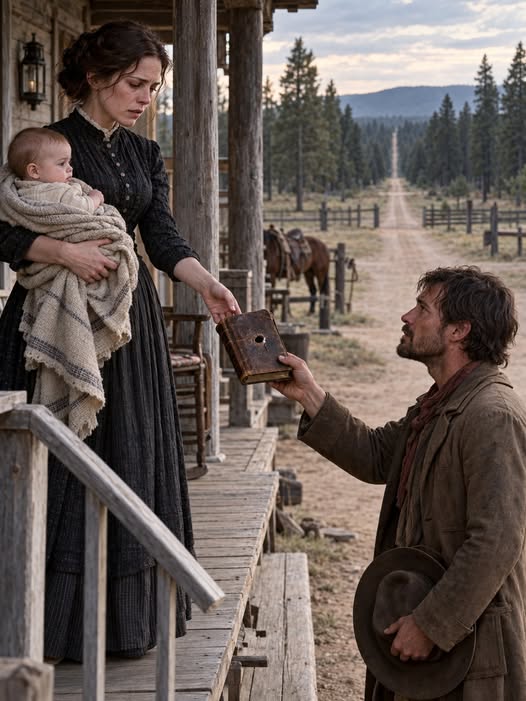
“I have handled dynamite with less concern.”
Eliza wrung another shirt and dropped it into the rinse water.
“Samuel is not dynamite.”
The baby pulled Asa’s collar harder.
Asa looked down.
“That remains unproven.”
Samuel sneezed.
Asa flinched.
Eliza laughed.
The sound escaped before she could stop it.
She went still.
So did Asa.
For months, laughter had felt almost indecent inside the Bellamy house.
Too bright.
Too alive.
Something Jonah would never hear.
Eliza turned back to the wash before Asa could see her face change.
Samuel made another delighted noise.
Asa said quietly, “You want him back?”
“No.”
He looked alarmed.
“I mean—”
“I know what you mean.”
She scrubbed at a stain harder than necessary.
“Keep holding him.”
Asa adjusted the baby against his chest with the same concentration he used when setting a gate hinge.
Samuel settled.
That mattered more than either of them said.
Autumn came early.
The hay sold well.
The repaired headgate held.
Eliza bought enough feed to carry the cattle through winter without selling breeding cows.
She paid Asa part of what he had refused to discuss since arriving.
He counted the notes once.
Then set half back on the table.
“No.”
Eliza looked up.
“That is your pay.”
“Too much.”
“It is what your work is worth.”
“I agreed to one winter, not half the ranch.”
“You repaired the headgate, fencing, two wagon wheels, the east barn doors, and enough tack to make me question what Jonah and I were doing for six years.”
Asa’s mouth moved faintly.
“You were raising cattle.”
“You know what I mean.”
He looked at the money.
“You need cash for winter.”
“I have cash for winter.”
“And Samuel.”
“I have money for Samuel.”
“Eliza—”
She became very still.
It was the first time he had used her name without invitation.
Asa realized it.
“I apologize.”
She waited.
Then said, “Do not.”
He looked at her.
“It is my name.”
The air between them changed in a way neither addressed.
Eliza pushed the money toward him again.
“You worked for it.”
Asa took the full amount.
That mattered too.
No debt hidden inside kindness.
No man quietly becoming indispensable by refusing payment.
The agreement between them remained clear.
One winter.
Then he would leave.
Eliza told herself she preferred it that way.
November brought the first hard freeze.
The cattle settled well in the lower ground.
Samuel began sleeping longer at night.
Asa moved his bedroll from the tack room loft into the warmer feed-room corner only after asking whether Eliza minded.
She did not.
She minded how relieved she felt knowing he would not freeze.
That was different.
Or she told herself it was.
One evening she found him repairing the leather cover on a small notebook.
“What is that?”
Asa looked down.
“Nothing important.”
“That answer usually means the opposite.”
He hesitated.
Then handed it over.
Inside were names.
Dates.
Places.
Men.
Some crossed out.
Some not.
Eliza recognized none of them.
“What is this?”
Asa looked toward the barn doorway.
“Men from my company.”
Her fingers tightened on the notebook.
“Jonah?”
Asa did not answer immediately.
That was answer enough.
Eliza turned pages.
Then found it.
Jonah Bellamy.
April 18.
A small cross beside the name.
Nothing more.
The room seemed to tilt.
“You wrote it down.”
“Yes.”
“All of them?”
“As many as I could.”
“Why?”
Asa leaned against the workbench.
“Because men disappear in war.”
His voice was quiet.
“Sometimes the government gets a name wrong. Sometimes nobody knows where a body went. Sometimes a wife gets one sentence from a stranger and has to build the rest herself.”
Eliza looked at him.
“You thought writing them down would fix that?”
“No.”
“Then why?”
“Because somebody should remember who they were before they became numbers.”
That night Eliza opened Jonah’s Bible for the first time.
She sat by the north window after Samuel slept.
The bullet hole passed through the front cover and thirty-eight pages.
A torn channel through Psalms.
She traced it.
Then turned farther.
Inside the back cover, in Jonah’s handwriting, were dates.
Calving numbers.
A reminder about fence posts.
A note to buy coffee.
Ordinary life.
The sight broke something open.
Eliza cried harder than she had the day Asa arrived.
Not because Jonah was dead.
She had known that.
Because his handwriting still expected another Tuesday.
Another spring.
Another fence.
Another sack of coffee.
Grief was not only missing the dead.
It was discovering how much future they had assumed without ever naming it.
Asa heard her from the barn.
He did not come in.
The next morning, Eliza asked why.
“I heard you.”
“I know.”
“I thought about coming.”
“Why didn’t you?”
“Because you did not call.”
She looked at him for a long moment.
“Thank you.”
After that, Jonah’s Bible remained open sometimes.
Not always.
But no longer untouched.
Winter came in earnest in December.
Snow covered the upper pasture.
One calf developed a cough.
A wagon axle split.
Samuel cut his first tooth and punished the entire household for the experience.
Asa became good with him.
Not naturally.
Deliberately.
He learned how to settle the baby by walking slowly near the stove.
Learned which blanket Samuel hated.
Learned that bouncing him too quickly produced the opposite of sleep.
Once Eliza came in from feeding chickens and found Asa sitting on the floor with Samuel asleep against his chest.
The sight stopped her at the door.
Asa looked up.
Neither spoke.
Samuel’s hand had closed around one of Asa’s fingers.
Eliza felt a strange, sharp fear.
Not because Asa looked wrong there.
Because he looked right.
Too right.
That evening she became distant.
Asa noticed.
He did not ask.
The next day she gave him work farther from the house.
He accepted it without complaint.
That made her angrier.
Three days later she found him splitting wood.
“You could ask why.”
He stopped.
“Why what?”
“Why I have been avoiding you.”
“I assumed you would tell me if you wanted to.”
She crossed her arms.
“That is infuriating.”
“I have been told.”
“By whom?”
“You.”
She almost smiled.
Then the smile disappeared.
“I saw you with Samuel.”
Asa set the maul down.
“Eliza—”
“I know you did nothing wrong.”
He waited.
“That is the problem.”
He frowned.
She looked toward the house.
“For one moment it looked like a family.”
Asa did not move.
“I had one.”
Her voice thinned.
“I had a husband. Samuel had a father even if he never held him.”
Asa said nothing.
“And you sitting there felt—”
She stopped.
“Like replacement?” he asked.
Eliza looked at him.
“Yes.”
Asa nodded slowly.
“I am not Jonah.”
“I know.”
“I do not want to be.”
“I know that too.”
“He loved you.”
Eliza’s eyes filled.
“Yes.”
“I know enough from the way he spoke about you.”
Her gaze sharpened.
“He spoke about me?”
Asa seemed to realize he had opened something.
“Yes.”
“How much?”
“Enough.”
“That is not enough for me.”
Asa took a breath.
“He talked about this ranch. You. The baby.”
“He never met Samuel.”
“No.”
“What did he say?”
Asa looked away.
“Not today.”
Eliza stiffened.
“You brought his Bible. You told me how he died. You agreed to stay because he asked. Do not now decide which parts of my husband belong to me.”
The words hit.
Asa did not defend himself.
“You are right.”
That stopped her.
He continued.
“I was trying to protect you from something you did not ask me to protect you from.”
Eliza’s anger softened only slightly.
“What?”
Asa looked toward the barn.
“Jonah thought he would come home.”
Her throat closed.
“He talked about teaching Samuel to ride before he knew whether Samuel was a boy.”
A sound escaped her.
Half laugh.
Half grief.
“He said if the child was a girl, he would teach her too, and you would object only because he would start before she could walk.”
Eliza covered her mouth.
Asa continued carefully.
“He said you would pretend to be angry when he put muddy boots near the kitchen door.”
“I was always actually angry.”
“I suspected.”
She laughed through tears.
Asa’s voice lowered.
“The day he died, he had already been talking about home all morning.”
Eliza looked at him.
“He was not afraid?”
“I did not say that.”
That honesty mattered.
“He was afraid.”
“Yes.”
“Did he know?”
Asa looked down.
“He knew he was badly hurt.”
The yard went still.
Eliza had asked months earlier whether Jonah suffered.
Asa had told her not long.
Now she understood there had been more.
“Tell me.”
He hesitated.
“Tell me the truth.”
Asa nodded.
“We got him behind the wagon line.”
His voice changed.
Not distant.
Careful.
“He knew he was bleeding badly.”
Eliza held herself rigid.
“He asked whether the man he pulled free had lived.”
“Did he?”
“Yes.”
“What was his name?”
“Caleb Harlan.”
The name meant nothing to her.
It meant everything now.
“Jonah asked for his Bible.”
Eliza looked toward the house.
“I gave it to him.”
Asa swallowed.
“He tried to open it. Could not.”
“What did he say?”
Asa’s eyes met hers.
“He said you would know he meant to come home.”
Eliza broke.
Not loudly.
She sat on the chopping block because her legs stopped working.
Asa stayed where he was.
She cried into both hands.
After a time she said, “That was what you were afraid to tell me?”
“No.”
She looked up.
Asa’s face had gone pale.
“There was more.”
“Tell me.”
“He asked me to promise I would make sure you were safe through winter.”
“I know.”
“He also said something else.”
Eliza waited.
“He told me not to stay if you did not want me.”
Her breath caught.
Asa continued.
“He said you hated being managed.”
Despite everything, Eliza laughed.
A broken little sound.
“That sounds like Jonah.”
“He said if I tried ordering you around, you would likely shoot me and God would have difficulty deciding whose fault it was.”
Now she laughed properly.
Tears still on her face.
Asa smiled.
Then his expression turned serious.
“He did not ask me to replace him.”
“I know.”
“He asked me to help until you could choose what came next.”
That sentence stayed with Eliza through Christmas.
Christmas morning was quiet.
She placed Jonah’s Bible beside her plate.
Not hidden.
Not worshiped.
Present.
Asa gave Samuel a small carved horse.
One leg was slightly shorter than the others.
Eliza held it up.
“You made this?”
“Yes.”
“It limps.”
“It has character.”
Samuel immediately put the tail in his mouth.
Asa looked vindicated.
In return, Eliza gave Asa gloves lined with wool.
“You bought these?”
“I traded eggs and butter.”
“You should not have.”
“That is a poor response to a gift.”
He put them on.
“They fit.”
“I measured your old pair.”
“You went through my possessions?”
“They were hanging on a nail.”
“Scandalous.”
They smiled.
Then Eliza noticed something leaning beside his bedroll near the door.
His saddle.
Packed.
“You are leaving.”
Asa looked at her.
“After New Year.”
The words had always existed.
One winter.
Nothing more.
Still, hearing them felt like losing something she had not admitted she possessed.
“You found work?”
“Possibly west.”
“When?”
“Second week of January.”
Eliza looked toward Samuel.
“Of course.”
Asa heard the hurt.
“Eliza.”
“You promised one winter.”
“Yes.”
“The winter is not over.”
“No.”
“Then why January?”
“The ranch is ready.”
She stared at him.
He continued.
“The headgate is sound. Hay is sufficient. Cattle are settled. Fences are better than when I arrived. You know the work.”
“I knew the work before you arrived.”
“Yes.”
“You think that makes me able to do everything alone?”
“No.”
“Then what?”
Asa looked toward Jonah’s Bible.
“I think if I stay because you need labor, sooner or later neither of us knows why I am here.”
Eliza went quiet.
He was right.
She disliked him for it.
“And if you leave?”
“You know.”
“No.”
“I find work.”
“That is not what I mean.”
Asa met her eyes.
For once, he did not retreat behind courtesy.
“If I leave, I will miss you.”
Her breath caught.
“And Samuel.”
He looked toward the cradle.
“And this place.”
“Then stay.”
The words came too quickly.
Asa’s face changed.
Eliza immediately regretted how they sounded.
He saw it.
“For what reason?”
She became angry because she did not know.
“That is an unfair question.”
“It is the only one that matters.”
“You want me to decide now whether—”
“No.”
He shook his head.
“I am asking whether you want a hired man, a promise to Jonah, or me.”
Eliza looked away.
“I do not know.”
Asa nodded.
“Then I should go.”
She hated the calmness of it.
“You make leaving sound noble.”
“It is not.”
“What is it?”
“Necessary.”
He went outside.
Eliza stood alone beside the table.
Jonah’s Bible lay near her hand.
She opened it without thinking.
Her finger landed beside the bullet-torn pages.
For months she had believed strength meant enduring what remained.
Now another possibility frightened her more.
Strength might mean choosing something new without pretending the old thing had never mattered.
New Year came.
Asa packed.
He did not rush.
He finished repairs already begun.
Restacked feed.
Left written notes about the headgate.
Showed Eliza where he had reinforced the north fence.
He did not create reasons she would need him later.
That hurt most.
On the morning he meant to leave, the temperature dropped hard.
His horse stood saddled.
Bedroll tied.
Eliza came outside carrying Samuel.
Asa took off his hat.
“This is not goodbye forever.”
She disliked that sentence.
“It usually is.”
“Not if you do not want it to be.”
Eliza looked at him.
“What would bring you back?”
“You.”
The simplicity of the answer frightened her.
“Not the ranch?”
“No.”
“Not Jonah’s promise?”
“That promise is finished.”
“Is it?”
Asa glanced around.
“You made it through winter.”
“It is January.”
“You know what I mean.”
She did.
The ranch was not safe forever.
No ranch was.
But it was hers again.
Not a place waiting for Jonah.
Not a place temporarily held together by Asa.
Hers.
Samuel stirred against her.
Asa stepped toward his horse.
Eliza said, “Wait.”
He stopped.
She looked toward the house.
Then the fields.
Then the road.
Finally back at him.
“I do not want you to stay because Jonah asked.”
Asa waited.
“I do not want you to stay because I need another pair of hands.”
Still he waited.
“And I am not ready to call you anything I cannot take back.”
His face softened.
“That is fair.”
Eliza swallowed.
“But I want you here.”
Asa did not move.
“For how long?”
“I do not know.”
“Doing what?”
She almost laughed.
“Must everything have terms?”
“You taught me to ask.”
That was true.
Eliza shifted Samuel higher.
“Stay until spring.”
Asa’s expression remained careful.
“As what?”
She thought.
Then answered.
“As Asa.”
Something passed through his face.
Relief.
Fear.
Hope.
All restrained.
“All right.”
He unsaddled.
Nothing else happened.
That was how their courtship began.
No declaration.
No kiss.
A man putting a saddle back on a rack because a woman had asked him to stay for himself.
Through late winter, Asa worked for wages Eliza insisted on paying.
Not because he needed the arrangement to be cold.
Because she needed it clear.
By March, he moved from the tack room to a small spare cabin near the orchard after she repaired its stove.
He suggested the move.
“I think people are talking.”
Eliza raised an eyebrow.
“People have always talked.”
“I know.”
“Then why?”
Asa looked toward the house.
“Because I want to court you, not create a situation where you feel watched into deciding.”
She stared at him.
“You want to court me?”
“Yes.”
“You might have mentioned that before moving houses.”
“I am mentioning it now.”
She laughed.
“Very efficient.”
“Is that a yes?”
Eliza considered.
“Slowly.”
Asa nodded.
“Slowly.”
Spring returned.
The headgate survived runoff.
Hay ground greened.
Samuel learned to crawl.
Then stand.
Asa became one of the few people Samuel reached toward without hesitation.
Eliza watched that relationship carefully.
Not suspiciously.
Honestly.
Asa never asked Samuel to call him anything.
Never called himself father.
Never behaved as though Jonah’s absence had created a vacancy.
He was simply Asa.
That made the bond safer.
In May, a letter arrived.
From Missouri.
Addressed to Eliza.
The name inside was Caleb Harlan.
The man Jonah had saved.
Eliza read it alone first.
Then again with Asa.
Caleb wrote that he had delayed for a year because he did not know whether a letter would help or reopen pain.
He described the wagon.
Jonah returning under fire.
The axle pinning Caleb’s leg.
Jonah and Asa dragging him free.
The shot.
Nothing theatrical.
Nothing clean.
He wrote that Jonah could have stayed behind cover.
He did not.
He wrote that Caleb had married after the war and named his first son Jonah.
Eliza stopped reading.
Asa looked away to give her privacy inside the same room.
She finished later.
At the bottom Caleb had written one thing that mattered more than heroism.
Your husband talked about coming home almost until he could not talk anymore.
Eliza folded the letter.
For years afterward she kept it inside the Bible.
Not because Jonah had died heroically.
She eventually disliked that phrase.
Heroism did not make Samuel fatherless less painful.
It did not make death fair.
The letter mattered because Jonah had remained himself to the end.
A man trying to come home.
By summer, Eliza understood something else.
She loved Asa.
The knowledge arrived without drama.
One evening they were checking fence near Blue Draw.
Asa knelt to reset a loose staple.
Eliza watched his scarred hands work.
Nothing about the moment should have mattered.
Yet suddenly she could imagine fifty years of such evenings.
That frightened her enough that she said, “I love you.”
Asa hit his thumb with the hammer.
He swore.
Eliza stared.
Then began laughing.
He stood.
“That is an unreasonable response.”
“You hit yourself.”
“You told me you loved me.”
“I noticed.”
He flexed his thumb.
“You could have chosen supper.”
“I did not know there was a proper schedule.”
Asa looked at her.
The humor left his face.
“Say it again.”
Eliza’s throat tightened.
“I love you.”
He closed his eyes briefly.
When he opened them, they were wet.
“I love you too.”
She stepped closer.
Asa did not touch her.
Not until she placed her hand against his chest.
Then he kissed her.
Once.
Carefully.
No promise solved by it.
No grief erased.
Just two living people allowing truth to become physical for one moment.
They married in October.
Eighteen months after Asa brought Jonah’s Bible home.
Eliza chose the date.
Not because it avoided any anniversary.
Because the cattle work was lighter.
Asa approved of the practicality.
Before the ceremony, Eliza took Jonah’s Bible to the oak behind the house.
She sat there with Samuel beside her.
He was walking badly by then.
Falling often.
Laughing every time.
Eliza rested one hand on the grave marker.
“I loved you.”
She said it aloud.
Samuel wandered through the grass.
“I still do.”
That was harder.
“And I am going to marry him.”
Wind moved through the oak.
Nothing answered.
Eliza did not need it to.
“I think you would have liked him.”
She smiled.
“Eventually.”
Samuel fell into the grass.
Got up again.
Eliza watched him.
Then touched the stone one last time.
“You came home as far as you could.”
She stood.
“That has to be enough.”
The wedding was small.
Asa wore a dark coat borrowed from a neighbor.
Eliza wore no mourning black.
Samuel attempted to eat one flower during the ceremony.
No one stopped laughing for several minutes.
Afterward, Asa did not move into Jonah’s place.
That mattered.
He moved into Eliza’s life.
Different thing.
They kept the ranch in her name.
Not as a gesture.
Because it was hers.
Asa bought cattle gradually with his wages, and those cattle became part of the shared herd by agreement.
He managed some work.
Eliza managed other work.
Neither pretended marriage erased ownership or judgment.
When they disagreed over selling heifers, they argued.
When she was right, Asa said so.
When he was right, Eliza eventually did too.
Samuel grew.
He learned Jonah’s name before he understood what death meant.
Asa made sure of it.
A framed photograph stood near the north window.
Jonah’s Bible remained below it.
When Samuel was old enough to ask why there was a hole through the cover, Eliza told him.
Not the whole war.
Not all at once.
Only enough.
“Your father was carrying it.”
“My father?”
“Yes.”
“Not Asa?”
“No.”
Samuel looked toward the yard where Asa was repairing harness.
“Then what is Asa?”
Eliza smiled.
“You should ask him.”
Samuel did.
Asa took a long time to answer.
Then said, “I am the man lucky enough to help raise you.”
Samuel considered.
“Are you my father too?”
Asa’s face changed.
“If you want me to be.”
Samuel nodded.
“All right.”
Then he ran off.
Asa sat alone in the barn for several minutes afterward.
Eliza found him.
She said nothing.
She simply took his hand.
Years passed.
The ranch grew modestly.
Not vast.
Not rich.
Secure.
The headgate had to be rebuilt again twelve years later.
This time Samuel was old enough to help.
Asa suggested moving it slightly downstream.
Eliza looked at him.
He immediately said, “Or we leave it exactly where Jonah put it.”
Samuel laughed.
They left it.
Not because Jonah’s choice had become sacred.
Because the gravel bar was still the best place.
That distinction would have pleased him.
The Bible aged.
The bullet hole remained.
For years Eliza had thought of it only as evidence of death.
Later, it changed meaning.
It became proof that something damaged could remain useful without pretending the damage had vanished.
She never said that aloud.
It sounded too much like something a preacher might use in a sermon.
But she understood it.
So did Asa, perhaps.
One winter evening, many years after his arrival, they sat beside the fire while snow pressed against the windows.
Samuel had a family of his own by then.
The house was quieter again.
Asa reached for Jonah’s Bible.
He still asked with his eyes before taking it.
Eliza nodded.
He opened it carefully.
“You know,” he said, “I was terrified the day I rode up here.”
Eliza looked over.
“You hid it poorly.”
“I thought I did quite well.”
“You looked as though you were carrying a coffin.”
“That is unpleasantly accurate.”
He touched the damaged cover.
“I thought you would hate me.”
“I did.”
Asa turned.
“You did?”
“For approximately three minutes.”
“That seems manageable.”
“Then I hated the Bible.”
“Fair.”
“Then the war.”
He nodded.
“Then God.”
Asa looked at her.
“For longer than three minutes?”
“Considerably.”
He smiled.
Eliza watched the fire.
“I used to think you were the answer to a prayer.”
Asa’s smile disappeared.
“That is a dangerous job.”
“Yes.”
She leaned back.
“So I stopped thinking it.”
“Good.”
He sounded relieved.
Eliza took his hand.
“I think the answer was that I survived long enough to choose again.”
Asa looked at her.
“And you?”
She squeezed his fingers.
“You were the choice.”
Outside, Blue Draw ran beneath winter ice.
The headgate stood where Jonah had placed it and where Eliza and Asa had rebuilt it together.
The Bible remained scarred.
Samuel carried two fathers in his history without either man needing the other erased.
And the ranch no longer belonged to a woman waiting for someone to come home from war.
It belonged to Eliza Bellamy Crane, who had learned that grief could remain true without being the last truth.
Asa had kept his promise to Jonah.
He stayed through the first winter.
Everything after that had been Eliza’s decision.

