
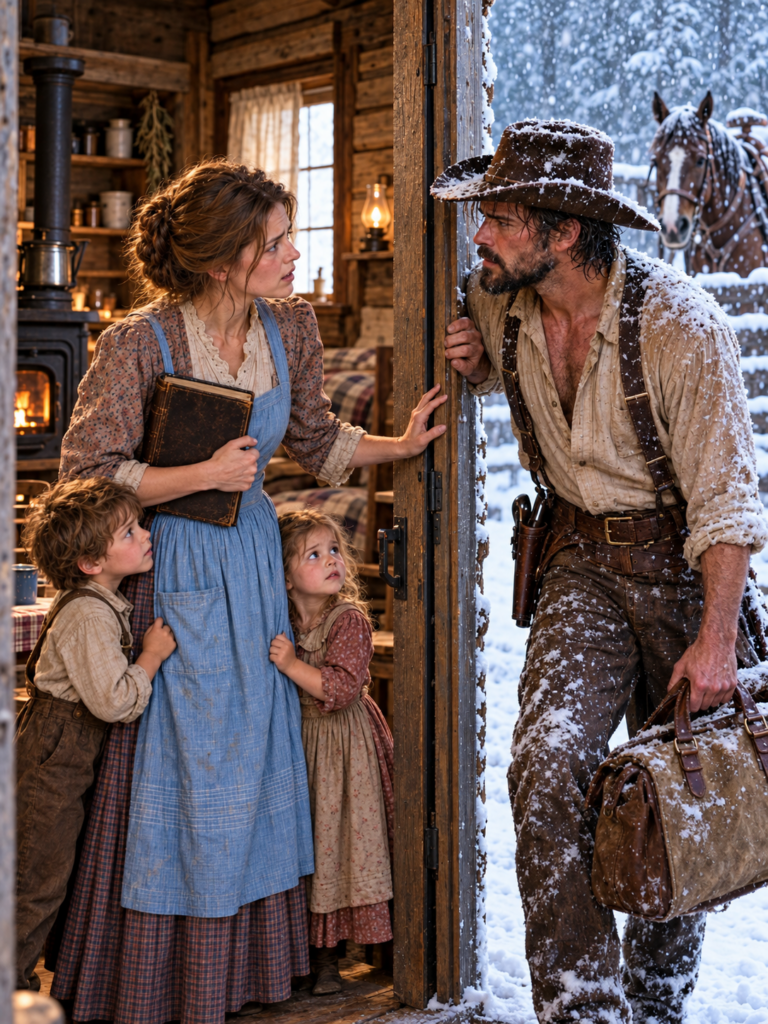
she gave her children’s last bread to a freezing stranger — then discovered the poor drifter owned half the valley
Part 1
The night Eleanor Hart gave away her children’s breakfast, the temperature outside her Wyoming cabin had fallen so low that ice formed along the inside edges of the windows.
Wind came down from the mountains in long, angry gusts.
It pushed snow beneath the door.
It rattled the stovepipe.
It made the walls creak like an old wagon traveling over frozen ground.
Eleanor sat alone at the kitchen table with her Bible open beneath the yellow light of a kerosene lamp.
Three things remained in front of her.
A heel of bread.
One cup of flour.
And an eviction notice.
Her son Samuel slept near the stove with one arm around his younger sister, Ruth.
Samuel was eight.
Ruth was five.
They had only one good quilt between them, so Eleanor had spread it across both children and tucked their coats beneath the edges to hold in the warmth.
An hour earlier Ruth had asked the question Eleanor had been dreading.
“Mama, is there any more supper?”
Eleanor had smiled.
“There’s a little.”
She pushed her own bread toward the girl.
“What about you?”
“I ate while I was cooking.”
Samuel had looked at her.
He was old enough now to know when his mother lied.
He said nothing.
That hurt more.
Eleanor had not eaten since the previous morning.
Her stomach had moved beyond hunger into a dull, empty ache.
She pressed both hands against the worn pages of her Bible.
At thirty-two, Eleanor had become skilled at surviving humiliation quietly.
She could sew by lantern light until her fingers cramped.
She could make a pound of beans last five meals.
She knew which branches produced the least smoke when burned damp.
She could wash clothes in water that made her knuckles split.
She could smile while giving her children food she wanted badly enough to dream about.
What she could not do was create money from nothing.
The notice on the table made that painfully clear.
VACATE WITHIN FOURTEEN DAYS.
The cabin and the eighty acres surrounding it had never legally belonged to her husband.
Eleanor had discovered that only that afternoon.
Silas Hart had told her for thirteen years that the land was theirs.
He had spoken proudly of “my creek” and “my pasture.”
But he had never completed the federal claim paperwork.
He had never paid the required filing fees.
He had never done half the things he said he had done.
Now Silas was dead.
And a cattle company had purchased almost the entire valley.
Including the ground beneath Eleanor’s cabin.
She read the notice again.
The company was willing to sell her eighty acres for four hundred dollars.
Four hundred.
Eleanor had nineteen dollars and sixty-two cents hidden in a coffee tin.
That was everything.
She lowered her head.
It had not always been this difficult.
She had grown up in Missouri, the daughter of Reverend Abel Warren.
Her childhood home had been modest but secure.
Her mother kept chickens.
Her father preached Sunday mornings and repaired wagons during the week.
They were not wealthy, but Eleanor never remembered wondering whether there would be breakfast.
Her father had been strict.
Too strict, she believed when she was nineteen.
That was when Silas Hart arrived.
Silas had dark hair, a beautiful smile, and enough confidence for three men.
He talked about Wyoming Territory as though gold grew beside the roads.
He promised land.
Cattle.
Freedom.
A new beginning.
Reverend Warren had disliked him immediately.
“That man loves the sound of his own promises more than the work required to keep them,” he told Eleanor.
She had been furious.
“You don’t know him.”
“I know men.”
“You only want me to stay because you think I can’t make decisions.”
Her father’s face had changed.
“Eleanor.”
But she was nineteen.
Pride feels like courage when you’re nineteen.
She married Silas.
They left Missouri.
Her father stood beside the road the morning they departed.
He did not curse her.
He did not say, I told you so.
He simply pressed a small Bible into her hands.
“You will always have a home with me.”
Eleanor did not write for years.
Partly because Silas hated her father.
Mostly because she was ashamed.
Her father had been right.
Silas worked hard when someone was watching and poorly when nobody was.
He spent money before he earned it.
He drank.
Gambled.
Mocked Eleanor’s prayers.
The first time he called her Bible foolishness, she cried.
The tenth time, she opened it after he fell asleep.
The first years brought Samuel and Ruth.
The children were the reason Eleanor remained after love disappeared.
Then, two winters earlier, Silas rode north toward the Montana gold camps.
He kissed neither child goodbye.
He told Eleanor he would return rich.
He never returned.
A letter came seven months later.
Silas had died during a fight in a mining-town saloon.
No savings.
No property.
No claim.
No apology.
Eleanor folded the letter and put it inside the Bible her father had given her.
Then she went to work.
Now, two years later, even work was not enough.
She touched the eviction notice.
“Lord,” she whispered, “I don’t know what to do anymore.”
The words came out rough.
She glanced at the sleeping children.
“I tried working.”
Silence.
“I tried saving.”
The fire popped.
“I tried being strong.”
Her eyes filled.
“Tomorrow they’re going to wake hungry.”
She stared at the page before her.
Her vision blurred.
Then a verse caught her attention.
She read it slowly.
“We do not know what to do, but our eyes are on you.”
Eleanor closed her eyes.
“My eyes are on you.”
Nothing changed.
No food appeared.
No money fell from the ceiling.
The eviction notice remained.
But something inside her loosened.
Not the problem.
The fear.
Three knocks struck the door.
Eleanor’s head lifted.
Samuel sat upright.
Ruth screamed and ran to her mother.
Nobody traveled the creek road at night during winter.
Nobody sane traveled it during a blizzard.
Eleanor stood.
Another knock.
Heavy.
Desperate.
Samuel whispered, “Mama?”
“Stay behind me.”
Eleanor took the lantern.
She opened the door only a few inches.
Wind nearly tore it from her hand.
A man stood outside.
Bareheaded.
No coat.
Ice clung to his beard.
His shirt and trousers were frozen stiff.
One hand gripped the doorframe as if without it he might fall.
“Ma’am.”
His lips were blue.
“I need somewhere warm.”
Eleanor stared.
Behind him stood a bay horse with its head down.
One front leg was lifted awkwardly.
The man swayed.
“I’ve got no money.”
Eleanor almost laughed.
The absurdity of that statement.
As though money mattered now.
She looked at her table.
One heel of bread.
One cup of flour.
Two hungry children.
Then back at the stranger.
For one shameful second she thought:
Lord, I asked you for help.
Why did you send me another person who needs something?
Then the man’s knees buckled.
Eleanor opened the door fully.
“Get inside before you freeze.”
The stranger stumbled in.
Cold seemed to enter the room with him.
Samuel stared.
Ruth hid behind Eleanor’s skirt.
“Samuel, take the old horse blanket. Put his animal in the lean-to.”
“Mama—”
“Quickly.”
Samuel pulled on his boots and coat.
Eleanor guided the stranger toward the stove.
“Sit.”
“I’m wet.”
“I own a mop.”
Despite everything, the man almost smiled.
She wrapped her own bed quilt around his shoulders.
His hands shook violently.
“What happened?”
“Horse broke through creek ice.”
His voice was weak.
“I went in after him.”
“How long ago?”
“Don’t know.”
“Where’s your coat?”
“Froze solid.”
He swallowed.
“Left it.”
“How far did you walk?”
“Three miles. Maybe more.”
Eleanor touched his hand.
His skin was frighteningly cold.
She heated water.
Not too fast.
Her mother had once taught her that freezing hands should be warmed gradually.
The stranger watched her.
“You should know I can’t pay you.”
“Nobody pays for not dying in my kitchen.”
He looked around.
His eyes paused on the nearly empty shelves.
Samuel returned.
“Horse is under cover.”
“Good boy.”
Ruth crept closer.
The stranger looked toward her.
“Hello.”
Ruth said nothing.
Her father had taught her to fear men’s voices.
After Silas left, even friendly strangers made her retreat.
Eleanor looked at the heel of bread.
Tomorrow’s breakfast.
She picked it up.
Samuel’s face changed.
He knew.
Eleanor warmed the bread near the stove.
Then set it on a tin plate before the stranger.
He stared.
“No.”
“Eat.”
“That’s all you’ve got.”
“You need it.”
“So do your children.”
Ruth whispered, “Mama, that’s breakfast.”
Eleanor knelt.
“I know, baby.”
Ruth’s lower lip trembled.
Eleanor kissed her forehead.
“Tonight he’s colder than we are hungry.”
The stranger heard.
He pushed the plate back.
“I can’t.”
Eleanor pushed it toward him again.
“My grandmother used to say if somebody’s hungry or freezing, help them first and count later.”
The stranger looked at her.
“Count what?”
“Everything.”
She poured hot water over dried apple peel.
It wasn’t cider.
But it smelled sweet.
The stranger held the cup.
“What happens tomorrow?”
Eleanor looked at him.
“Tomorrow belongs to tomorrow.”
He bowed his head.
For several seconds he did not move.
Then he whispered something Eleanor couldn’t hear.
A prayer, perhaps.
He ate slowly.
Halfway through, Ruth approached.
She held her rag doll.
Its yarn hair was falling out.
One eye was missing.
Ruth placed it on the stranger’s knee.
“So you don’t get lonesome.”
The man’s face changed.
He looked at the doll.
Then at Ruth.
“Thank you.”
She climbed onto Eleanor’s lap.
The stranger slept beside the stove.
Eleanor remained awake long after the children returned to their bedding.
His name, he eventually told her, was Gideon.
Only Gideon.
What Eleanor did not know was that Gideon Thorne was the richest cattleman for a hundred miles.
He owned sixty thousand acres.
More cattle than Eleanor could imagine.
A stone house near Cheyenne with twelve bedrooms.
A payroll containing two hundred names.
Bankers rose when he entered their offices.
Men waited outside his door hoping to sell him land.
Politicians remembered his birthday.
Yet that night none of it mattered.
His horse had gone through river ice.
Gideon had nearly died pulling the animal free.
He had walked toward the only light visible through the storm.
He did not tell Eleanor his surname.
At first because he was exhausted.
Later because something stopped him.
For ten years nearly every person who approached Gideon wanted something.
Land.
Credit.
A contract.
Employment.
Influence.
Money.
Eleanor wanted nothing.
She believed he had nothing.
She had given him the last bread in her home anyway.
Near midnight Gideon opened his eyes.
Eleanor sat at the table sewing by lamplight.
“You’ll ruin your eyes.”
She looked up.
“Then I’ll sew badly tomorrow.”
He noticed the Bible.
“You were reading when I came?”
“Praying.”
“For what?”
Eleanor considered lying.
Then decided there was no point.
“Help.”
Gideon looked at the bare shelf.
“And instead you got me.”
“That’s what I told God.”
He laughed softly.
The sound surprised both of them.
Eleanor threaded her needle.
“I suppose He has a sense of humor.”
Gideon looked toward the children.
“Your husband?”
“Dead.”
“I’m sorry.”
“I’m not.”
The words came too quickly.
She lowered her eyes.
“I suppose I should be.”
“No.”
Gideon stared into the stove.
“Some dead people leave grief. Some leave relief. We don’t get to choose which.”
Eleanor studied him.
“Who did you lose?”
He did not answer immediately.
“My mother.”
“When?”
“Ten years ago today.”
Eleanor understood then why he had been riding alone in a storm.
“I’m sorry.”
Gideon looked toward the Bible.
“She used to read one like that.”
“Used to?”
“Every night.”
“You don’t?”
“Haven’t opened one since she died.”
“Angry?”
“Maybe.”
“At God?”
“Maybe.”
Eleanor nodded.
“Seems exhausting.”
He looked at her.
“What?”
“Being angry with someone you’re pretending not to believe in.”
Gideon stared.
Then started laughing.
He covered his mouth because the children were asleep.
Eleanor smiled.
“Go back to sleep.”
“Yes, ma’am.”
By dawn the storm had passed.
The world outside had become white and still.
Samuel inspected Gideon’s horse.
“He’s walking better.”
Gideon nodded.
“Good work.”
Samuel’s face brightened.
Eleanor gave Gideon a knitted gray scarf.
“No.”
“Take it.”
“I already ate your breakfast.”
“And now you’re arguing about a scarf.”
“I’ll return it.”
“If you pass this way.”
Gideon wrapped it around his neck.
“I will.”
Eleanor watched him disappear along the creek road.
Then she returned inside.
Samuel stood beside the table.
“Is he coming back?”
“I don’t know.”
“Do you think he was an outlaw?”
Eleanor smiled.
“Very polite outlaw.”
Ruth asked, “What do we eat?”
Eleanor looked at the single cup of flour.
She made thin porridge.
Three bowls.
Mostly water.
They bowed their heads.
Eleanor gave thanks.
She did not mention that the pantry was now empty.
Three evenings later someone knocked.
Samuel ran to the door.
“Mama!”
Gideon stood outside.
This time he carried a flour sack over one shoulder.
The gray scarf was folded in his hand.
“I came to return this.”
Eleanor stared at the sack.
“And that?”
“A debt.”
“You don’t owe me anything.”
“A man pays for bread.”
“You told me you had no money.”
Gideon paused.
“I found work.”
That was not exactly a lie.
He had gone home to his ranch and spent the first morning looking at his own kitchen.
More food sat in one pantry than Eleanor’s family could eat in a year.
He had felt ashamed.
So he filled a sack.
Flour.
Beans.
Coffee.
Bacon.
Rice.
Sugar.
Dried fruit.
And two peppermint candies.
One for each child.
He carried it inside.
Ruth squealed when she saw the candy.
Samuel tried to act older but failed.
Eleanor touched the flour sack.
“How much did this cost?”
“Less than freezing to death.”
“You shouldn’t have.”
“I know.”
Gideon took off his hat.
“Which is why I brought something else.”
Eleanor stiffened.
“Money?”
“No.”
“Good.”
“I brought myself.”
She frowned.
“Your roof leaks.”
“Several places.”
“Your front step is loose.”
“I know.”
“Door doesn’t close.”
“I also know.”
“I can work.”
Eleanor folded her arms.
“You’re planning to repay one piece of bread by rebuilding my cabin?”
“If you’ll allow it.”
She studied him.
“You’re strange.”
“So I’ve been told.”
For the first time in months, Eleanor laughed.
Part 2
Gideon returned the next evening.
Then the evening after that.
At first Eleanor assumed he felt indebted.
She expected the visits to stop once the roof was patched.
They didn’t.
He repaired the door.
Split firewood.
Fixed the chicken enclosure.
Reset a fence post.
Taught Samuel to oil leather harness properly.
Ruth followed him everywhere.
“Mr. Gideon?”
“Yes?”
“Why are you so tall?”
“Vegetables.”
“I don’t like vegetables.”
“Then you’ll stay short.”
Ruth considered this terrible possibility.
That night she ate three carrots.
Eleanor noticed something else.
Gideon worked well.
Not like Silas.
Silas had made a performance of labor.
He cursed tools.
Complained about weather.
Looked around constantly to see whether anyone appreciated him.
Gideon simply worked.
Quietly.
Efficiently.
When something went wrong, he stopped and considered it.
No anger.
No thrown hammer.
No blame.
That difference unsettled Eleanor more than charm would have.
She had forgotten men could be gentle without being weak.
Sometimes Gideon stayed for supper.
Meals improved after he began bringing supplies.
Eleanor objected the first three times.
On the fourth she stopped.
“You’ll insult me if you bring bacon every night.”
“So beans?”
“Gideon.”
He smiled.
The children adored him.
Samuel became especially attached.
He had been five when Silas left.
Old enough to remember being afraid.
Too young to understand why his father never returned.
One evening Gideon found him sitting behind the barn with a broken harness buckle.
Samuel’s face was red with frustration.
“I can’t do it.”
Gideon sat beside him.
“Can’t do what?”
“Fix this.”
“Yet.”
“My pa could.”
Gideon picked up the buckle.
“Your pa teach you?”
Samuel shook his head.
“Then you’re comparing what he knew at thirty with what you know at eight.”
Samuel looked suspicious.
“That doesn’t seem fair, does it?”
“No.”
“Good.”
They worked until the buckle held.
Samuel carried it inside like a trophy.
That night, after the children slept, Eleanor said quietly, “Thank you.”
“For what?”
“You know.”
Gideon looked toward Samuel.
“He needs somebody to show him things.”
“He had somebody.”
“No.”
Eleanor’s eyes lifted.
Gideon’s voice remained gentle.
“He had a father. That’s not always the same as having somebody teach you.”
She looked away.
He regretted it immediately.
“I’m sorry.”
“No.”
Eleanor folded a dish towel.
“You’re right.”
Silence stretched.
Then Gideon asked, “Have you written your father?”
Her hands stopped.
“I don’t know what you’re talking about.”
“You told me you haven’t seen him in thirteen years.”
“That doesn’t mean I should write.”
“Why not?”
“Because I left after he warned me.”
“So?”
“He was right.”
“And?”
Eleanor turned.
“You enjoy making everything sound simple.”
“No. I’m asking why being wrong means you don’t get to go home.”
She stared.
Gideon regretted that question too.
But Eleanor did not become angry.
Instead her eyes filled.
“Because I said terrible things before I left.”
“So did I.”
“To your mother?”
“Yes.”
“Did she forgive you?”
“Every time.”
“Then you were lucky.”
Gideon nodded.
“I was.”
He looked at her Bible.
“Maybe your father wants the chance to be lucky too.”
A week later Eleanor wrote.
Dear Papa,
I do not know whether this letter will be welcome.
She stopped.
Cried.
Started again.
She told him Silas was dead.
Told him about Samuel and Ruth.
Told him she had been afraid to return because every mile east felt like admitting she had wasted thirteen years.
Then she wrote the hardest sentence.
You were right about Silas, but I was wrong about you.
She mailed it before she could change her mind.
Gideon never told her he had prayed that morning.
It was the first prayer he had offered in ten years.
He had returned to his large stone house after leaving Eleanor’s cabin the first time and found it unbearable.
The silence.
The polished floors.
Twelve rooms.
No laughter.
No little girl putting a rag doll in his lap.
He entered his mother’s bedroom.
Nobody had changed it.
Her Bible remained inside the top drawer.
Gideon opened it.
The leather creaked.
A dried wildflower fell out.
For two hours he read.
Most of the words were familiar.
His mother had read them aloud throughout his childhood.
What felt different was himself.
At forty-one, Gideon Thorne had everything his younger self thought mattered.
Land.
Cattle.
Influence.
Money.
He could buy almost anything.
Yet the happiest evening he remembered in years had occurred in a leaking cabin eating another person’s last bread.
He began visiting Eleanor because he told himself she needed help.
Eventually he understood that he needed the cabin more.
Then came the eviction notice.
Eleanor had kept it hidden beneath a flour tin.
Gideon discovered something was wrong when he arrived one evening and found Samuel building a wooden crate.
“What are you making?”
“A box.”
“For?”
“Our things.”
Gideon looked toward Eleanor.
She sat at the table holding a document.
Her face was pale.
“What happened?”
“Nothing you can fix.”
“Try me.”
She pushed the paper toward him.
Gideon read the heading.
THORNE LAND AND CATTLE COMPANY.
For several seconds he heard nothing.
Not the wind.
Not Ruth playing.
Not the stove.
His own name seemed enormous on the paper.
Eleanor said, “A company bought the valley.”
Gideon continued reading.
His land agent, Harlan Pike, had purchased the disputed creek parcels.
Any resident unable to prove title would either purchase the land or leave.
Four hundred dollars for Eleanor’s cabin and eighty acres.
“Who brought this?”
“Mr. Pike.”
Gideon’s jaw tightened.
“What did he say?”
“Does it matter?”
“Yes.”
Eleanor hesitated.
“He said the company doesn’t concern itself with widows and washtubs.”
Gideon folded the paper.
Carefully.
“What else?”
“That if we’re here after two weeks, they’ll put our furniture outside.”
Samuel was listening.
Eleanor lowered her voice.
“I begged him, Gideon.”
Shame entered her expression.
“I hate that I begged.”
“You were trying to protect your children.”
“I told him I could pay monthly.”
“What did he say?”
“He laughed.”
Something cold moved through Gideon.
Harlan Pike had worked for him eleven years.
Gideon trusted him to acquire grazing land, negotiate leases, settle water rights.
Gideon signed stacks of documents almost every week.
He remembered approving the creek acquisition.
Winter water.
That was Pike’s argument.
They needed reliable access to the stream.
Gideon had barely looked at the map.
He had signed.
The cruelty in Eleanor’s hand carried his authorization.
“Which company?” Gideon asked, though he already knew.
Eleanor pointed.
“You can read.”
He nodded.
“Thorne.”
“Biggest outfit in the territory.”
She laughed bitterly.
“Imagine owning enough land that eighty acres doesn’t matter.”
Gideon looked at her.
“It should matter.”
“Not to men like that.”
Men like that.
He felt the words.
Eleanor continued.
“I have never had four hundred dollars.”
“You won’t need it.”
She smiled sadly.
“Gideon.”
“I’m serious.”
“What are you going to do?”
“I’ll speak to them.”
“To the Thorne Company?”
“Yes.”
She almost laughed.
“You chop wood for supper.”
“I know.”
“They have lawyers.”
“I know.”
“They have riders.”
“I know.”
“You can’t walk into a cattle company’s office and tell them what to do.”
Gideon looked at the eviction paper.
“Maybe not.”
Eleanor’s expression softened.
“You’re kind.”
His shame deepened.
“But kindness doesn’t change a deed.”
He took her hands.
“Nobody is putting you out of this cabin.”
She searched his face.
“How can you promise that?”
“Trust me.”
“I don’t trust promises.”
Silas had taught her that.
Gideon nodded.
“Then trust what I’ve done, not what I’m saying.”
“What have you done?”
“Not enough yet.”
The next morning Gideon entered the Thorne Land and Cattle office in Cheyenne wearing the black coat he had deliberately left home during every visit to Eleanor.
Clerks stood when he entered.
Harlan Pike was in the map room.
Gideon heard him before he saw him.
“Clear every disputed cabin before spring.”
Pike tapped a map.
“We need uninterrupted creek access.”
One clerk asked, “What about the Hart place?”
“The washerwoman?”
“Yes.”
“If she doesn’t leave, pull the cabin apart. Logs are usable.”
Gideon stepped through the doorway.
“Are they?”
Pike turned.
His face drained.
“Mr. Thorne.”
Nobody spoke.
Gideon removed his gloves.
“Close the door.”
Pike did.
“Explain the Hart notice.”
“Standard acquisition.”
“You visited her?”
“Yes.”
“What did you say?”
Pike shrugged.
“She became emotional.”
“What did you say?”
“I told her the company can’t run on charity.”
Gideon placed the notice on the desk.
“My signature authorized this purchase.”
Pike relaxed slightly.
“Exactly. It’s valuable winter water. Once we control both creek banks—”
“Cancel it.”
Pike stopped.
“Sir?”
“Cancel the evictions.”
“All of them?”
“Every family currently living on disputed creek parcels.”
Pike stared.
“Do you know what that’s worth?”
“Yes.”
“Thirty thousand a year, minimum.”
“Then we can afford decency.”
Pike’s face hardened.
“With respect, Mr. Thorne, this is business.”
“No.”
Gideon stepped closer.
“Business is buying cattle.”
He tapped the notice.
“This is throwing children into snow because a dead man failed to file paperwork.”
“Those people don’t own the ground.”
“And we don’t need every foot of it.”
“The creek—”
“Design easements.”
“That costs money.”
“Spend mine.”
Pike stared.
Gideon continued.
“Survey one hundred sixty acres around the Hart cabin.”
“One hundred sixty?”
“Yes.”
“Why?”
“Because eighty barely supports a family.”
Pike’s eyes narrowed.
“Who is she?”
Gideon looked at him.
“A woman you insulted.”
“I asked who she is to you.”
“Your final warning.”
Pike looked away.
Gideon said, “Deed it free and clear to Eleanor Hart.”
“You’re giving away company land?”
“I’m giving away my land.”
“And the other squatters?”
“Offer valid homestead leases. Fair rates. No winter removals.”
Pike’s mouth tightened.
“This is sentimental foolishness.”
Gideon’s voice became quiet.
“Apologize.”
“What?”
“To Eleanor.”
Pike laughed once.
Then saw Gideon’s face.
“You want me to ride twenty miles and apologize to a washerwoman?”
“Yes.”
“Absolutely not.”
Gideon nodded.
“Then collect your wages.”
Pike stared.
“You’d fire me over this?”
“No.”
Gideon opened the office door.
“I’m firing you because a man I trusted became cruel while using my name, and I was too busy counting cattle to notice.”
Pike left before noon.
Gideon spent four days correcting contracts.
That was why he did not visit Eleanor.
She noticed every day.
The first evening she told herself he was working.
The second she worried the company had threatened him.
The third she wondered whether she had imagined the closeness growing between them.
The fourth she stopped wondering and began packing.
One day remained before the deadline.
Samuel placed cookware in the crate.
Ruth wrapped her doll inside a blanket.
“Where are we going?”
Eleanor had no answer.
“East.”
“To Grandpa?”
“Maybe.”
“Will he know us?”
Eleanor looked away.
“I hope so.”
That afternoon she heard horses.
Four riders accompanied a buggy down the creek road.
A man in a fine black coat stepped down.
Samuel pressed against the window.
“Mama.”
Eleanor approached.
Then froze.
Gray scarf.
Around the fine coat.
Gideon.
He climbed the steps carrying papers.
Eleanor opened the door.
She stared at the horses.
The riders.
The expensive coat.
Then at him.
“Who are you?”
Gideon removed his hat.
“I owe you an explanation.”
“Who are you?”
“My full name is Gideon Thorne.”
Silence.
Eleanor looked toward the eviction notice.
Then back.
“Thorne.”
“Yes.”
“The company.”
“Mine.”
She stepped backward.
Samuel stared.
Ruth appeared from behind the table.
Eleanor whispered, “You lied to me.”
“I let you believe something that wasn’t true.”
“That’s called lying.”
“Yes.”
He accepted it.
“I should have told you.”
“When?”
“The second time I came.”
“Why didn’t you?”
Gideon looked down.
“Because you were kind to me before you knew what I owned.”
Eleanor’s jaw tightened.
“So you tested me?”
“No.”
“It sounds like a test.”
“It wasn’t meant to be.”
“Men with money always think intent matters more than what they do.”
Gideon flinched.
She saw it.
She did not regret the words.
Not yet.
He offered the papers.
“Please read these.”
“I don’t want your money.”
“It’s not money.”
She didn’t take them.
Gideon placed the documents on the table.
“The company canceled the eviction.”
Eleanor stared.
“For me?”
“For every family on the creek.”
She looked at him.
“Why?”
“Because it should never have happened.”
He pointed to another document.
“That deed is yours.”
She unfolded it.
One hundred sixty acres.
Creek frontage.
Cabin.
Pasture.
Paid.
No debt.
She read twice.
“I can’t accept this.”
“It’s already recorded.”
Her hands shook.
“You did this without asking me.”
“Yes.”
“Why?”
“Because my signature caused the problem.”
“You didn’t know.”
“I signed without knowing. That’s still my responsibility.”
Eleanor sank into a chair.
Ruth climbed beside her.
Gideon remained standing.
“The night I came here, Eleanor, I did own land.”
She looked at him.
“But I wasn’t lying when I said I had nothing.”
She said nothing.
“I had rooms nobody used. Money nobody loved me for. Men who laughed when I laughed because I paid them.”
He swallowed.
“My mother had been dead ten years. I hadn’t prayed in ten years.”
His eyes moved to the Bible.
“You gave me your children’s breakfast.”
Eleanor’s face softened slightly.
“I didn’t even give myself that kind of mercy.”
He lowered his hat.
“I understand if you don’t want me here again.”
Ruth suddenly began crying.
“No.”
Everyone looked at her.
She ran to Gideon and wrapped both arms around his leg.
“No go.”
Gideon’s eyes filled.
He crouched.
“Ruthie.”
“You fix the chicken house.”
Samuel looked at his mother.
Eleanor stared at the deed.
Then at Gideon.
Her anger remained.
So did gratitude.
Trust was more complicated.
“Stay for supper,” she said finally.
Gideon looked surprised.
“That isn’t forgiveness.”
“I know.”
“It’s supper.”
“Understood.”
She pointed toward the woodpile.
“And if you’re still the same Gideon who chops wood, prove it.”
For the first time all day, he smiled.
“Yes, ma’am.”
Part 3
Forgiveness did not arrive quickly.
That mattered to Gideon.
He had spent years in a world where money shortened uncomfortable conversations.
If a business partner became angry, compensation settled the problem.
If a ranch hand was injured, a payment was made.
If a neighbor disputed water, land could be exchanged.
Eleanor could not be bought into trusting him.
She accepted the deed because refusing it would harm the children.
She did not suddenly treat Gideon as though his silence about his identity had been harmless.
For several weeks their conversations changed.
She was polite.
Nothing more.
Gideon continued visiting.
He still chopped wood.
Still repaired things.
Still helped Samuel.
But now his horse was recognized.
People along the creek knew who he was.
Neighbors sometimes approached the cabin just to see the cattle baron eating beans from a chipped bowl.
Gideon hated it.
Eleanor found that satisfying.
One evening she handed him a stack of plates.
“Wash.”
He blinked.
“Wash?”
“You knew how before I knew your surname.”
He rolled up his sleeves.
“Yes, ma’am.”
Samuel whispered, “Mama’s still mad.”
Gideon whispered back, “I’ve noticed.”
Eleanor heard both.
She almost smiled.
Spring approached.
Snow withdrew from the lower valley.
The creek rose.
Mud replaced ice.
Gideon brought seed.
Eleanor refused half.
“We can plant more.”
“I can afford my own seed now.”
“With what?”
“Sewing.”
“That’s not the point.”
“It’s exactly the point.”
Gideon put the sack down.
“Eleanor.”
“No.”
“You’ve got one hundred sixty acres.”
“And I intend to work them.”
“You can’t work all of this alone.”
“I know.”
“Then let me help.”
“Help isn’t deciding for me.”
That stopped him.
Eleanor took a breath.
“Silas decided everything. Where we lived. What we bought. What debts he made. Whether I knew about them.”
She looked at him.
“When you recorded that deed without asking, you saved my home.”
Gideon lowered his eyes.
“But you also decided for me.”
He nodded.
“I understand.”
“Do you?”
“I’m trying.”
She softened.
“Ask.”
He looked up.
“May I give you seed?”
“No.”
He smiled faintly.
“May I sell it to you at cost?”
“No.”
“May I loan you seed until harvest?”
Eleanor considered.
“Yes.”
“Good.”
“But write it down.”
Gideon stared.
“You’re making me write a seed loan?”
“Absolutely.”
He started laughing.
So did she.
Trust began rebuilding through small things.
Not declarations.
Questions.
Gideon asked before bringing supplies.
Eleanor told him when she needed help.
Samuel began working two afternoons a week at one of Gideon’s nearer ranch stations, learning horses under an older foreman named Amos Reed.
Eleanor insisted he be paid normal wages.
Gideon agreed.
Ruth started school in town.
Eleanor bought her first new dress in years.
Blue cotton.
Ruth twirled until she fell over.
Life became less desperate.
Not easy.
The cabin still required work.
The garden failed in one corner.
A late frost killed half the beans.
One cow Gideon helped Eleanor purchase became sick.
Money remained tight.
But tight was different from impossible.
Then a letter arrived from Missouri.
Eleanor recognized the handwriting before opening it.
Her father.
She sat at the kitchen table.
Her hands began shaking.
Gideon happened to be repairing the porch railing.
He saw through the window.
He entered quietly.
“From him?”
Eleanor nodded.
“Want me to leave?”
“No.”
She opened it.
Daughter,
I have read your letter until the folds have nearly torn.
For thirteen years I have wondered whether pride kept you away because I made home feel like judgment.
If so, I ask your forgiveness.
There is nothing you must confess to me.
Nothing you must earn.
You are my daughter.
I stood at the lane many evenings imagining you coming around the bend.
If you will permit an old man one selfish request, tell me where to find you.
Eleanor stopped.
Tears fell.
Gideon looked away to give her privacy.
She continued.
I would like to meet Samuel and Ruth before I am too old to travel.
And I would like to hold my daughter once more.
Papa.
Eleanor pressed the letter to her mouth.
For thirteen years she had imagined her father angry.
Triumphant.
Waiting to say he had warned her.
In reality, he had been waiting for an address.
Gideon sat across from her.
“He wants to come.”
“I heard.”
“I wasted thirteen years.”
“No.”
She looked up sharply.
“Don’t.”
“I’m not going to tell you it didn’t matter.”
“Good.”
“It mattered.”
Her tears continued.
“But if you’ve learned anything from it, then don’t waste fourteen.”
She closed her eyes.
A month later Reverend Abel Warren arrived on the morning stage.
He had become smaller.
That was Eleanor’s first thought.
Her father had once seemed enormous behind a pulpit.
Now he was sixty-nine.
White-haired.
Stooped slightly.
He stepped from the stage holding one leather bag and the same black hat Eleanor remembered.
For a second they simply looked at each other.
Then he opened his arms.
Eleanor ran.
Not gracefully.
Not slowly.
She became nineteen again somewhere between the station platform and her father’s chest.
“I’m sorry.”
“No.”
He held her tighter.
“Papa—”
“No.”
His voice broke.
“No more years wasted apologizing.”
Samuel and Ruth stood nearby.
Reverend Warren eventually released Eleanor and knelt despite his stiff knees.
“You must be Samuel.”
“Yes, sir.”
“And Ruth.”
Ruth hid behind Eleanor.
Reverend Warren smiled.
“I’ve been waiting a very long time to meet you.”
Ruth looked at him.
“Are you Mama’s papa?”
“I am.”
“Did you know she gives away breakfast?”
Eleanor closed her eyes.
Gideon, standing several feet away, laughed aloud.
Reverend Warren looked confused.
“It’s a long story,” Eleanor said.
Her father stayed two months.
He helped plant.
Read Bible stories to the children.
Repaired a chicken coop badly.
Argued theology with Gideon.
Discovered Gideon could afford better whiskey than he admitted.
Then refused to drink it.
One evening the two men sat outside after Eleanor and the children went to bed.
Reverend Warren asked, “Do you love her?”
Gideon almost dropped his coffee.
“Sir?”
“You heard me.”
“Yes.”
“Then why haven’t you told her?”
Gideon looked toward the cabin.
“Because she’s had men decide what she needs.”
The older man nodded.
“Good answer.”
“That doesn’t mean I’m not going to.”
“When?”
“When she knows she can say no without losing anything.”
Reverend Warren studied him.
“You own half this territory.”
“Less.”
“I’ve seen the maps.”
Gideon smiled.
Reverend Warren became serious.
“A powerful man can be dangerous even when he’s kind if he forgets how much easier it is for everyone else to surrender.”
Gideon absorbed that.
“Silas was not powerful.”
“No.”
“But he needed everyone around him to feel small.”
The old preacher looked toward the stars.
“Don’t become the opposite version of the same problem.”
Gideon nodded.
“I won’t.”
That summer Eleanor transformed the land.
She did not do it alone.
That was another lesson she had resisted.
Amos helped repair fencing in exchange for Eleanor sewing winter coats for his grandchildren.
A neighboring widow traded two milk goats for hay rights.
Gideon loaned equipment under written agreements Eleanor insisted upon.
Samuel learned to ride properly.
Ruth collected eggs.
Eleanor planted vegetables along the creek.
Her hands remained rough.
Her back hurt.
But there was food stored for winter before September.
For the first time in years, Eleanor entered cold weather without panic.
Then trouble returned.
Not from poverty.
From people.
Harlan Pike had not forgiven Gideon.
After being dismissed, Pike began telling anyone who would listen that Eleanor had manipulated Gideon.
A widow had trapped the cattle baron.
She had used religion.
Children.
Food.
A bed.
The rumors grew uglier.
One afternoon Eleanor entered the general store and conversation stopped.
She knew that silence.
Women turned away.
A man smirked.
Eleanor purchased coffee.
Outside she found Gideon waiting beside his horse.
“What happened?”
“Nothing.”
“Eleanor.”
She mounted the wagon.
“Drive.”
He did.
Halfway home she told him.
Gideon’s face hardened.
“I’ll handle Pike.”
“No.”
“He doesn’t get to—”
“No.”
Gideon looked at her.
“If you threaten him, everyone will believe I’m under your protection because I’m your kept woman.”
“You are not—”
“I know.”
She gripped the reins.
“But that’s what they’re saying.”
“What do you want me to do?”
Eleanor thought.
“Nothing.”
“I hate that answer.”
“So do I.”
The rumors continued for weeks.
Eleanor endured them.
Then a winter fever struck several ranch families.
Children became sick first.
The doctor could not reach the upper creek because snow blocked the road.
Eleanor spent six days moving between cabins.
She carried broth.
Washed bedding.
Sat with frightened mothers.
Reverend Warren prayed.
Gideon’s riders delivered medicine.
Nobody asked whose name was on the land.
Nobody cared who had been rich or poor.
By the time the fever broke, even some of the people repeating Pike’s stories had accepted Eleanor’s help.
Rumors died from embarrassment.
Harlan Pike left the territory the following spring.
Not because Gideon forced him.
Because nobody trusted him anymore.
Eleanor learned something from that too.
Reputation could be defended with words.
Character was defended by repetition.
Do the same decent thing long enough and eventually lies grow tired.
The following June Gideon asked Eleanor to walk with him toward the creek.
Wildflowers covered the bank.
Samuel and Ruth were fishing downstream.
Gideon carried his hat.
That made Eleanor nervous.
“Gideon.”
“Yes?”
“If you’re about to tell me somebody bought the valley again, I’m going home.”
He laughed.
“No.”
“Good.”
They reached the cottonwood where his horse had first broken through ice months before.
Gideon stopped.
“This is where it happened.”
“The accident?”
“Yes.”
He looked at the water.
“I thought I was going to die.”
Eleanor said nothing.
“I remember lying on the bank thinking about my mother.”
He smiled faintly.
“Then I saw your lamp.”
Eleanor looked toward the distant cabin.
“You couldn’t have seen much.”
“Enough.”
He turned toward her.
“Eleanor, I don’t want to repay you anymore.”
Her heart changed rhythm.
“I don’t want you grateful to me either.”
“Gideon—”
“I love you.”
There it was.
Simple.
No speech.
No kneeling.
“I’ve loved you for months.”
Eleanor looked down.
He continued.
“I’m not asking because I saved your land.”
“You didn’t.”
He smiled.
“You’ve made that clear.”
“Good.”
“I’m not asking because your children need a father.”
She looked up.
“They don’t need me. I’d like to be one, but that’s different.”
Her eyes filled.
“And I’m not asking because you need a bigger house.”
“Definitely not.”
“I hate that house.”
She laughed.
He stepped closer.
“I want to court you.”
“You already have.”
“Poorly.”
“Very.”
“I’d like to continue officially.”
Eleanor wiped her eyes.
“And if I say no?”
“I’ll still help Samuel with horses if you let me.”
“And Ruth?”
“I apparently promised to build her a sled.”
“You did.”
“I regret it.”
Eleanor smiled.
“Then yes.”
Gideon blinked.
“Yes?”
“You may court me.”
He looked absurdly relieved.
“Thank God.”
She laughed.
“You should.”
“I intend to.”
Part 4
Gideon’s courtship was less romantic than Ruth expected.
Ruth, now six, believed courtship should involve flowers every day.
Gideon brought nails.
Seed.
A new hinge.
One evening he arrived with a calf suffering from pneumonia.
Eleanor stared.
“This is your idea of romance?”
“He needed warmth.”
“Of course he did.”
The calf spent two nights near the stove.
Ruth named him Moses.
He survived.
Samuel said that meant Gideon had proposed to the cow.
Reverend Warren laughed so hard he coughed.
But Gideon did bring flowers.
Sometimes.
Usually wild ones.
He never arrived without asking Eleanor whether she needed anything.
Gradually the difference between being helped and being controlled became something Eleanor could feel.
Silas had given gifts as evidence of what she owed him.
Gideon gave things and forgot them.
Silas had demanded gratitude.
Gideon became embarrassed by it.
Silas wanted obedience.
Gideon argued with Eleanor as an equal.
They argued often.
Water rights.
Samuel’s work.
Whether Ruth should ride alone.
How much money Eleanor should accept toward improving the cabin.
Faith.
Gideon believed again now, but belief after ten years of anger was not simple.
Sometimes he asked Reverend Warren questions deliberately designed to irritate him.
“Why pray if God already knows?”
“Why breathe if He already knows you need air?”
“That’s not an answer.”
“It’s enough of one before breakfast.”
Eleanor loved listening.
Her father’s visit extended.
Then extended again.
Eventually he admitted Missouri held little except memories.
He accepted a small pastorate near the creek.
For the first time since Eleanor was nineteen, father and daughter lived within walking distance.
Life did not become perfect.
Gideon’s wealth created real problems.
When Eleanor visited his stone house for the first time, she hated it.
Servants opened doors.
Rooms echoed.
Portraits stared.
A dining table seated twenty.
Gideon and Eleanor ate alone at one end.
She put down her fork.
“I understand why you’re lonely.”
He looked wounded.
“It’s terrible.”
“My mother designed it.”
“I’m sorry.”
He smiled.
“She hated it too.”
After marriage was discussed seriously, Gideon assumed they would live there.
Eleanor said no.
“Where then?”
“My place.”
“Five people in that cabin?”
“Build another room.”
Gideon stared.
“You want me to leave a twelve-room house and add a bedroom to a two-room cabin?”
“Yes.”
“Why?”
“Because my children finally believe this is home.”
That ended the argument.
Gideon sold the stone house two years later.
But before marriage there was one more test.
A brutal drought struck southern Wyoming.
The creek shrank.
Grazing land browned.
Cattle prices dropped.
Small ranchers began selling animals cheaply because they could not feed them.
Gideon’s company was large enough to survive.
Barely.
His managers urged him to fence the best creek access.
“Your deed allows it,” one said.
Eleanor sat silently through the meeting.
Gideon looked at the map.
The old Gideon might have agreed.
Water meant cattle.
Cattle meant survival.
But controlling the creek would devastate neighboring homesteads.
“What if we reduce our herd?”
His manager stared.
“Sell cattle in a falling market?”
“Yes.”
“We’ll take a loss.”
“Better than taking everyone’s water.”
The man looked toward Eleanor.
Gideon saw it.
That suspicion.
She’s influencing him.
Eleanor saw it too.
She stood.
“I’ll leave.”
Gideon frowned.
“Why?”
“Because this is your business.”
“It’s also our valley.”
“No.”
Her voice was firm.
“If you decide while I’m sitting here, they’ll always say I made you do it.”
Gideon understood.
Eleanor walked outside.
He remained with the men.
Two hours later he emerged.
“We’re selling twenty percent of the herd.”
Eleanor nodded.
“Your decision?”
“Mine.”
“Good.”
“Expensive decision.”
“Still yours.”
The water remained open.
The drought worsened.
Gideon’s company lost money.
So did everyone.
But fewer families lost their land because they could keep livestock alive.
That autumn those same neighbors helped Gideon move cattle before the first storm.
Nobody had to be asked.
Reciprocity, Eleanor realized, was different from charity.
Charity moves one direction.
Community moves both.
By winter Gideon’s financial loss was significant.
He never complained.
One evening Eleanor found him at her table reviewing accounts.
“You regret it?”
“No.”
“Really?”
“I regret that cattle can’t eat moral satisfaction.”
She laughed.
He looked at the numbers.
“But no.”
Eleanor touched his hand.
“Good.”
A month later he surprised her.
“Marry me.”
She stared.
They had discussed marriage many times.
But he had never formally asked.
“That’s not very elaborate.”
“I’m nervous.”
“You own sixty thousand acres.”
“Fifty-eight now.”
“You’re nervous asking one widow a question?”
“Terrified.”
Eleanor smiled.
“Good.”
He reached into his pocket.
A simple ring.
Not huge.
Not flashy.
He knew her.
“I had another one.”
“What happened?”
“Too expensive.”
“How expensive?”
“Enough that you’d refuse me out of principle.”
“Correct.”
“So I returned it.”
She laughed.
Then grew serious.
“Gideon.”
“Yes?”
“Before I answer, I want to know something.”
“Anything.”
“If we marry, whose money is it?”
He frowned.
“Ours.”
“Whose land?”
“Ours.”
“My one hundred sixty?”
“Yours.”
“Why?”
“Because I gave it to you before asking you to marry me.”
“Good.”
She paused.
“And if I disagree with you publicly?”
“I’ll survive.”
“If my children disagree?”
“I’ll survive less happily.”
“And if one day you begin sounding like Silas?”
Gideon’s face softened.
“Tell me.”
“That simple?”
“No.”
He looked at Reverend Warren’s Bible sitting nearby.
“But I’d rather be corrected than obeyed.”
Eleanor began crying.
Gideon’s expression became alarmed.
“Is that yes?”
She laughed through the tears.
“Yes.”
They married in June.
Not at Gideon’s ranch.
Not in Cheyenne.
At the little white church beside the creek.
Reverend Warren performed the ceremony.
His voice broke halfway through.
Samuel stood beside Gideon wearing a jacket too large for him.
Ruth carried wildflowers.
Around Gideon’s neck, beneath his formal coat, was the old gray scarf.
Eleanor noticed before walking down the aisle.
She started crying.
Her father leaned close.
“Are you sure?”
“Yes.”
“Then why are you crying?”
“Because I finally know crying doesn’t always mean you’re sad.”
Afterward everyone returned to Eleanor’s land.
Tables were built beneath cottonwoods.
Neighbors brought food.
Roast beef.
Beans.
Potatoes.
Bread.
Four cakes.
Somebody played fiddle.
Ruth fell asleep under a table.
Samuel ate until he became sick.
At sunset Gideon and Eleanor stood beside the creek.
“This is where I almost died,” he said.
“I remember.”
“And up there is where you fed me.”
“Unfortunately.”
“Best bread I ever ate.”
“It was stale.”
“I was freezing.”
“Exactly.”
He smiled.
Eleanor looked at the water.
“You know what frightened me most that night?”
“What?”
“Giving away the bread.”
“Not letting a strange man inside?”
“No.”
He looked offended.
“You were too frozen to be threatening.”
“Thank you.”
“I had prayed for help.”
She glanced at him.
“Then you knocked.”
Gideon laughed softly.
“I thought, Lord, you’ve misunderstood.”
He took her hand.
“Maybe He hadn’t.”
“No.”
Eleanor squeezed his fingers.
“Maybe I had.”
Part 5
The first years of their marriage were neither miraculous nor effortless.
That was important.
People later told their story as though one blizzard solved everything.
It did not.
Gideon still worked too much.
Eleanor remained too proud about asking for help.
Samuel became a teenager and tested every boundary available to him.
Ruth developed Gideon’s talent for arguing.
Reverend Warren grew older.
Cattle died.
Crops failed.
Winters came.
Bills existed even for wealthy people.
Marriage required the same thing the cabin had required.
Work.
Once, after a bitter argument about Samuel taking a job on a distant cattle drive, Gideon slept in the barn.
He claimed it was because a mare was foaling.
Eleanor knew better.
In the morning she brought coffee.
“You still angry?”
“Yes.”
“Me too.”
They drank.
Then talked.
That became their pattern.
Nobody left.
Not emotionally.
Not physically.
Silas had taught Eleanor the terror of instability.
Gideon learned that sometimes love meant repeatedly proving you were still there.
Samuel eventually became one of the best horsemen in the region.
At twenty-three he purchased a small ranch with money he had saved himself.
Gideon offered to buy it.
Samuel refused.
Eleanor smiled when she heard.
“Good.”
Gideon looked wounded.
“I was helping.”
“He learned from me.”
“Unfortunately.”
Ruth became a teacher.
Then shocked everyone by attending medical training in Denver.
Reverend Warren proudly told anyone who would listen that his granddaughter knew more Latin than most ministers.
He lived long enough to see both children grown.
On his final evening, Eleanor sat beside his bed.
He was eighty-six.
His breathing had become slow.
“Papa.”
His eyes opened.
“You here?”
“Yes.”
“Good.”
He squeezed her fingers weakly.
“You came home.”
Eleanor’s throat tightened.
“It took me thirteen years.”
“Still came.”
Those were among his last words.
After the funeral Eleanor found the letter she had written from Wyoming decades earlier.
Her father had kept it in his Bible.
The paper was worn soft from handling.
On the back he had written one sentence.
Answered prayer, May 1885.
Eleanor cried for an hour.
Years later Gideon asked why she still kept the eviction notice.
It lived inside a wooden box beside her Bible.
“You hate that thing.”
“I do.”
“Burn it.”
“No.”
“Why?”
She removed it.
Thorne Land and Cattle Company.
His signature appeared below.
Gideon grimaced.
“I’m not proud of that.”
“That’s why I keep it.”
He raised an eyebrow.
Eleanor smiled.
“It reminds me good men can cause harm when they stop paying attention.”
“Comforting.”
“It should be.”
She returned the notice to the box.
“And it reminds me bad decisions can be corrected.”
That lesson shaped the rest of Gideon’s life.
As the cattle company grew, he refused to become distant from the people affected by his decisions.
Managers hated some of his policies.
No winter evictions.
No signing land acquisitions without resident review.
Emergency grazing access during drought.
Widows received extra time on debts.
Workers injured on company property continued receiving wages while recovering.
Some businessmen called him sentimental.
Gideon responded that sentiment was cheaper than becoming the kind of man who could throw a child into snow and still enjoy supper.
Eleanor never became comfortable with wealth.
She became responsible with it.
There was a difference.
She expanded the cabin instead of replacing it.
Two bedrooms.
A larger kitchen.
A proper porch.
Gideon insisted on adding indoor plumbing when technology made it practical.
Eleanor resisted.
Then used it once and admitted she had been an idiot.
The original front door remained.
So did the table.
So did the place beside the stove where Gideon had slept his first night.
When Ruth married, she asked whether the ceremony could take place there.
“Why here?” Gideon asked.
Ruth stared at him.
“Because this is where our family began.”
Gideon looked at Eleanor.
She smiled.
The wedding happened beneath the cottonwoods.
Samuel returned with his wife and two children.
Reverend Warren’s empty chair sat near the front.
Eleanor placed his Bible on it.
She did not think grief and joy needed separate rooms anymore.
Both belonged.
At seventy, Gideon reduced his cattle interests.
At seventy-five he officially retired.
At seventy-six he became unbearable.
Eleanor found him repairing fences nobody asked him to repair.
Teaching grandchildren to rope furniture.
Following ranch hands and offering suggestions.
One foreman finally told Eleanor, “Ma’am, if you don’t find Mr. Thorne a job, we’re going to bury him under the barn.”
Eleanor gave Gideon responsibility for maintaining the community creek roads.
He took it absurdly seriously.
Every bridge received inspection.
Every ditch was discussed.
Every neighbor learned to avoid asking him about drainage unless they had an hour.
Eleanor laughed more in those years than she had when young.
That surprised her.
She had believed youth owned romance.
It didn’t.
There was romance in knowing exactly how somebody took coffee.
In a coat placed over your shoulders before you realized you were cold.
In hearing the same footsteps cross a porch for forty years.
In arguments that ended because both people valued tomorrow more than winning tonight.
One January evening, almost forty-five years after the blizzard, snow began falling.
Eleanor and Gideon sat beside the stove.
The children were long grown.
Grandchildren lived scattered across Wyoming and Colorado.
The cabin was quiet.
Gideon held his mother’s Bible.
Eleanor looked over.
“You still read that old thing?”
He smiled.
“Lady who rescued me said I should.”
“I don’t remember saying that.”
“You implied it.”
He turned a page.
The gray scarf lay folded over the back of his chair.
Eleanor had repaired it so many times almost none of the original yarn remained.
She pointed.
“You know that’s barely the same scarf.”
“Of course it is.”
“Half that wool came from repairs.”
“Still the same scarf.”
“How?”
Gideon looked at her.
“Because you say it is.”
She laughed.
Later that night the wind strengthened.
Snow hit the windows.
Eleanor woke after midnight.
Gideon’s side of the bed was empty.
She found him sitting at the kitchen table.
His face looked pale.
“Gideon?”
He pressed a hand to his chest.
Eleanor moved quickly.
By dawn the doctor arrived.
Gideon had suffered a heart attack.
He survived.
But the man who had once ridden fifty miles in a day became slower afterward.
For the first time, Eleanor cared for him physically.
Helped him dress.
Reminded him to rest.
Walked beside him.
He hated the weakness.
She understood.
One afternoon he snapped at her.
“I can do it myself.”
Eleanor stepped back.
“Then do it.”
Gideon tried fastening his boot.
His hand shook.
He failed.
He sat there, furious.
Then ashamed.
“I’m sorry.”
Eleanor knelt.
“Do you remember the first night?”
“Unfortunately.”
“You couldn’t hold a cup.”
“I remember.”
“Did I think you were weak?”
“No.”
“Then don’t insult me by thinking I see you that way now.”
His eyes filled.
She tied the boot.
“You spent half your life helping everybody.”
“More than half.”
“Exactly. Now practice receiving.”
He grumbled.
But he learned.
Gideon lived six more years.
His final winter was gentle.
Almost no major storms.
He died in March at eighty-three.
Eleanor sat beside him.
The gray scarf lay across his chest.
He opened his eyes near dawn.
“El?”
“I’m here.”
“Cold?”
“No.”
“Children?”
“Coming.”
He nodded.
After a moment he whispered, “That bread.”
Eleanor smiled through tears.
“What about it?”
“Best thing anybody ever gave me.”
“It was stale.”
“Still arguing.”
“Always.”
His eyes closed.
Then opened once more.
“You opened the door.”
Eleanor squeezed his hand.
“You knocked.”
He smiled.
Then he was gone.
For months afterward Eleanor kept expecting to hear him outside.
A hammer.
Boots.
His voice asking where she had hidden a tool that was directly in front of him.
She understood Millicent’s temptation.
To preserve.
To stop time.
But Eleanor had spent a lifetime learning that faith did not prevent grief.
It carried you through it.
She remained on the creek property.
Samuel begged her to move closer.
Ruth suggested living with her family.
Eleanor refused.
“This is home.”
At eighty she still kept a garden.
At eighty-five she reduced it.
At eighty-eight she finally permitted Samuel’s oldest son to take over most ranch work.
People from the valley visited often.
Some remembered the poor widow.
Most knew only Mrs. Thorne.
Eleanor preferred when they remembered both.
One winter evening a young mother named Clara arrived.
Her husband had abandoned her.
Two children waited in a wagon.
Clara stood at Eleanor’s door shivering.
“I’m sorry to bother you.”
Eleanor saw herself.
Not literally.
Life never repeats that neatly.
But she recognized the look.
Shame.
Pride.
Hunger.
Fear of asking.
“What do you need?”
“Work.”
“Tonight?”
“Anything.”
Eleanor looked toward the wagon.
“Children eaten?”
Clara lowered her eyes.
That was answer enough.
Eleanor opened the door.
“Bring them in.”
“I can’t pay—”
Eleanor laughed.
Clara looked confused.
“Forgive me.”
Eleanor wiped her eyes.
“I heard that sentence before.”
She made stew.
Bread.
Hot milk.
The children slept near the stove.
Later Clara sat at the kitchen table.
“Why are you doing this?”
Eleanor looked toward the old Bible.
“Because somebody knocked once.”
Clara did not understand.
Not yet.
The next morning Eleanor arranged work for her at the ranch office.
Six months later Clara rented a small cottage.
Two years later she purchased it.
Eleanor never told anyone that story proudly.
To her, generosity was not impressive.
It was repayment on a debt that could never be calculated.
She had given a man bread.
He had saved her land.
She had helped restore his faith.
He had helped restore her family.
Her father returned.
Her children found stability.
A valley learned that power and decency were not enemies.
No single person deserved credit.
That was the lesson.
On Eleanor’s ninety-first birthday the entire family gathered at the old property.
The original cabin had been preserved inside a larger farmhouse.
Samuel had gray hair.
Ruth was a respected physician nearing retirement.
Grandchildren filled the yard.
Great-grandchildren ran through the grass.
Someone found the old gray scarf.
A little boy wrapped it around his head.
“Don’t stretch it,” Eleanor said.
Everyone laughed.
After supper, Ruth asked Eleanor to tell the story again.
The youngest children gathered.
Samuel groaned.
“We’ve heard it a thousand times.”
“You leave,” Ruth said.
“I know it better than Mama.”
“Impossible.”
Eleanor sat beside the stove.
The same location.
Different stove.
Same door.
Different hinges.
She looked at the children.
“It was colder than this.”
Samuel interrupted.
“It was always colder every time she tells it.”
“Quiet.”
Everyone laughed.
Eleanor continued.
“There were three knocks.”
A child asked, “Were you scared?”
“Of course.”
“Then why did you open the door?”
Eleanor thought.
That question mattered more than the rest.
“Because I saw someone colder than I was frightened.”
The room became quiet.
“What if he’d been bad?”
“I don’t know.”
“Would God have protected you?”
Eleanor smiled.
“Faith isn’t a promise that nothing bad happens.”
The adults listened too.
“It means you choose what kind of person you’ll be even when you’re afraid.”
She told them about the bread.
The scarf.
The eviction.
Gideon’s identity.
Their marriage.
She did not turn Gideon into a saint.
He had hated that.
She told them about his mistakes.
His temper.
His pride.
His willingness to change.
When she finished, one great-granddaughter asked, “Was he your answer?”
Eleanor looked toward Gideon’s photograph.
“No.”
Everyone seemed surprised.
“He was part of it.”
She touched her Bible.
“The answer wasn’t one person.”
She looked around.
“It was a door opening one direction, then another.”
Eleanor died the following spring.
Peacefully.
Ruth found her in bed shortly after sunrise.
Her Bible rested on the nightstand.
Inside was the original eviction notice.
Beside it, folded carefully, was Gideon’s gray scarf.
At Eleanor’s funeral Samuel stood before hundreds of people.
He was seventy-three.
His voice shook.
“My mother spent years believing her greatest mistake was leaving home.”
He looked toward the old preacher’s Bible lying beside her coffin.
“But if she hadn’t traveled west, none of us would be here.”
He paused.
“That doesn’t mean the bad years were good.”
Ruth lowered her head.
“It means God did not waste them.”
The family buried Eleanor beside Gideon beneath the cottonwoods overlooking the creek.
On their shared stone they carved no mention of cattle.
No acreage.
No wealth.
Only two names.
And beneath them:
THE DOOR WAS OPEN.
Decades later, the original cabin remained.
The Thorne family donated it to a local historical trust.
Visitors came expecting the story of a wealthy cattle baron.
Guides instead began at the table.
A reproduction heel of bread sat beneath glass.
Nearby lay the gray scarf.
On the wall hung the eviction notice bearing Gideon Thorne’s own company name.
Children often asked why anyone would display a document connected to something shameful.
The guide always gave Eleanor’s answer.
Because good people can cause harm when they stop paying attention.
And because mistakes corrected honestly can become the beginning of something better.
There was another object in the room.
A small rag doll.
Ruth had kept it her entire life.
One eye missing.
Yarn hair uneven.
The doll a frightened little girl had placed on a freezing stranger’s knee so he would not feel alone.
Of all the valuable objects the Thorne family eventually owned, that doll became the one nobody would sell.
People sometimes asked how much it was worth.
The family always gave the same answer.
Nothing.
And everything.
One winter, more than a century after Eleanor’s night of desperation, a storm crossed the valley.
Roads closed.
Electricity failed.
Travelers became stranded.
The historical cabin, renovated but carefully preserved, was opened as an emergency shelter.
Volunteers brought blankets.
Coffee.
Soup.
Bread.
A young employee standing near the entrance began counting how many people had arrived.
An older volunteer stopped her.
“Plenty of room.”
“But what if we run out?”
“We’ll make more.”
“More what?”
The woman smiled.
“Everything.”
Outside, snow covered the creek road.
Inside, strangers sat shoulder to shoulder.
Nobody asked who owned how much land.
Nobody checked bank accounts.
Nobody charged for warmth.
And above the old wooden doorway hung a small carved sign added by Eleanor’s grandchildren years before.
It contained the sentence their grandmother had lived by long before she ever understood what it would cost her.
Nobody pays to get warm in this house.
That was what survived.
Not Gideon’s sixty thousand acres.
Much of that land was eventually sold, divided, inherited, or protected.
Not his cattle empire.
Companies changed.
Markets changed.
Names disappeared.
Not Eleanor’s poverty either.
The empty pantry became history.
The eviction notice yellowed.
Even the cabin was rebuilt piece by piece until people argued about how much original wood remained.
But the choice she made lasted.
A woman had one piece of bread.
A stranger needed it.
She gave it.
That stranger possessed enough wealth to rescue her, yet discovered that she had already rescued something inside him first.
Neither understood what was happening while it happened.
Most important moments are like that.
They do not announce themselves.
They arrive hungry.
Cold.
Inconvenient.
Sometimes frightening.
Sometimes disguised as one more problem when you have no strength left.
And somewhere beneath all the stories later told about cattle, land, money, marriage, and answered prayer remained one ordinary truth Eleanor tried to teach every child who sat beside her stove.
When you have little, generosity feels dangerous.
When you have much, generosity feels optional.
Character is what you do in both conditions.
On the worst night of Eleanor Hart’s life, she believed she had reached the end of what she could give.
Then somebody knocked.
She opened the door.
And discovered she still had something.
Warmth.
Bread.
A chair.
A place beside the stove.
A little courage.
Sometimes that is enough to begin changing two lives at once.

