
Part 1
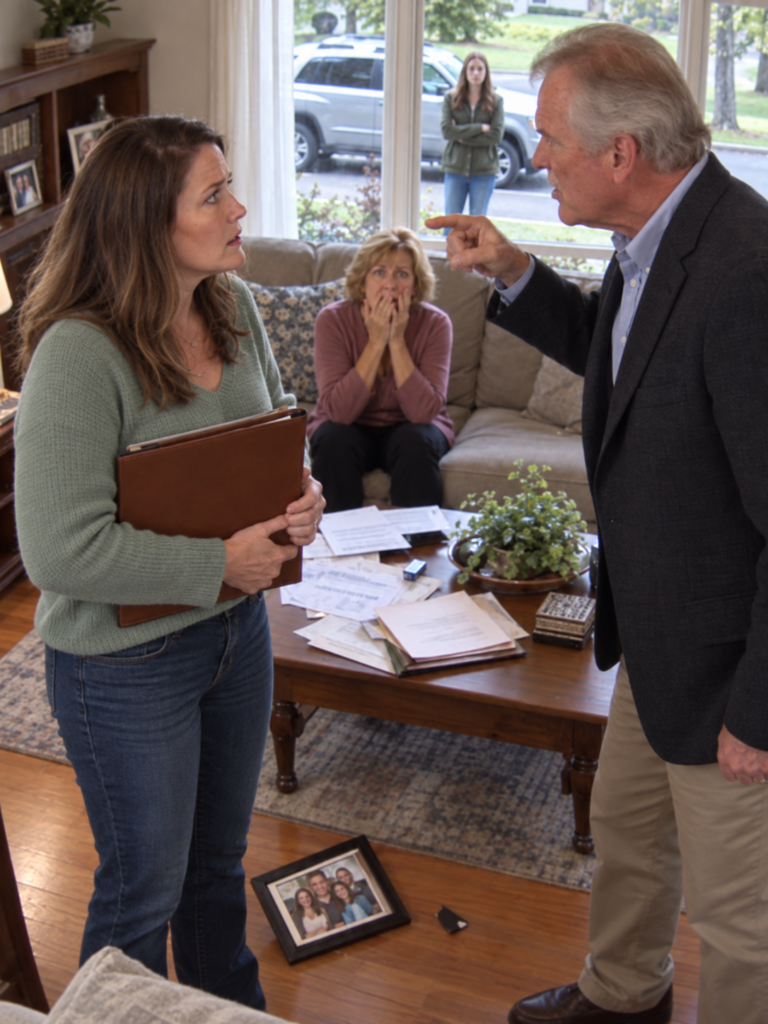
The photograph fell before I realized how hard he had hit me.
It struck the hardwood floor beside the bookcase, the glass cracking across my son’s smiling face. For one strange second, that was all I could see.
Not my father standing in front of me with his hand still raised.
Not my mother pressing her fingers against her lips.
Not the leather folder lying open on my coffee table.
Just a photograph of Ben on his first day of middle school, broken because his grandfather couldn’t stand hearing the word no.
My left cheek burned. A sharp ache spread down my jaw, and I could taste blood where my teeth had caught the inside of my mouth.
“Don’t look at me like that,” my father said.
His voice was surprisingly calm.
“You pushed me too far, Naomi.”
I was thirty-nine years old.
I had survived a divorce, raised a child through years of uncertainty, and worked enough overtime to know what exhaustion felt like in my bones.
Yet my father, Daniel Brooks, was standing in my home speaking to me as though I were a disobedient teenager.
Behind him, my mother, Caroline, lowered her hand.
“Everyone needs to calm down,” she whispered.
I looked at her.
She had watched him hit me.
She had seen my shoulder strike the shelf.
And somehow, in her mind, we were all equally responsible for what had happened.
Then I heard footsteps above us.
Ben.
His bedroom was directly over the living room.
I knew he had heard the argument because our old house carried sound through the heating vents. I also knew he had never heard an adult strike me before.
“Ben,” I called, keeping my voice steady, “go into your room and lock the door, sweetheart.”
The footsteps stopped.
“Mom?”
“I’m okay. Please do what I asked.”
There was a silence that seemed to last forever.
Then I heard his bedroom door close.
My father glanced toward the staircase.
“Now you’ve frightened the boy for nothing.”
I turned back toward him.
“You need to leave.”
He looked almost amused.
“We haven’t finished our conversation.”
“Yes, we have.”
He pointed toward the folder.
“Your mother and I have a financial obligation that needs to be handled. This family has always helped one another. You’re going to sign those papers.”
I pressed my tongue against the cut inside my cheek.
“No.”
His expression darkened again.
But this time I didn’t move backward.
My mother stepped between us, holding both hands out as though she were separating two unreasonable children.
“Naomi, please. Think about what you’re doing to your sister.”
It was the same sentence, in one form or another, that I had heard all my life.
Think about Lila.
Understand Lila.
Be patient with Lila.
Make things easier for Lila.
Nobody ever seemed particularly concerned with what those requests cost me.
I walked to the front door and opened it.
“Get out of my house.”
For several seconds, my father stared at me.
Then he picked up his car keys.
“You have until Friday,” he said. “After that, we’ll stop asking.”
He walked past me without another word.
My mother hesitated beside the sofa.
Her eyes moved from my swollen cheek to the papers on the table.
For one hopeful moment, I thought she might apologize.
Instead, she said, “You could have prevented all of this by being reasonable.”
Then she followed him outside.
My younger sister, Lila, was waiting beside their silver SUV.
She wore expensive sunglasses and a cream-colored cardigan that probably cost more than my monthly grocery bill.
A woman sat in the passenger seat holding a black document case.
I would later learn she was a notary.
At that moment, all I understood was that my family had arrived expecting paperwork to be signed, not a conversation to be had.
Lila watched my father approach the car.
Then she looked toward me.
She didn’t ask whether I was hurt.
She didn’t ask what had happened.
She merely raised her eyebrows, as though I had ruined a perfectly reasonable afternoon.
I shut the door.
And for the first time in my life, I turned the deadbolt against my parents.
I stood there until the SUV disappeared down our street.
Only then did my knees begin to shake.
“Mom?”
Ben was standing halfway down the staircase.
He had one hand wrapped around the railing and the other clutching the hem of his T-shirt.
His eyes went straight to my face.
“Grandpa hit you.”
It wasn’t a question.
I wanted to tell him he had misunderstood.
I wanted to say adults sometimes argued and everything was fine.
But I had spent enough of my childhood watching my mother explain away things that should never have happened.
I wasn’t going to teach my son the same lesson.
“Yes,” I said. “He did.”
Ben came down the last few steps slowly.
“Is he coming back?”
“Not inside this house.”
“How do you know?”
I looked at the front door.
It was a fair question.
“Because I’m going to make sure of it.”
He walked into my arms.
I held him there for a long time, feeling his shoulders tremble beneath my hands.
When I finally stepped back, he noticed the broken photograph.
“I can fix that frame,” he said.
His voice cracked.
I looked at the picture on the floor.
“No, honey. I’ll take care of it.”
He shook his head.
“I know how. Mr. Lawson showed us in shop class.”
Something about that nearly undid me.
My son had just heard his grandfather assault his mother, and he was trying to repair a picture frame because it was the only problem he knew how to solve.
I kissed his forehead.
“Let’s make some hot chocolate first.”
He nodded.
But as we walked toward the kitchen, I glanced at the small security camera mounted above the front window.
A blue indicator light blinked steadily.
And I remembered something my father had forgotten.
The camera didn’t just record the driveway.
It recorded the living room.
Six months earlier, after someone stole packages from our porch, I’d installed a security system with an indoor view of the front entrance.
I had wanted to identify whoever was taking Ben’s school supplies.
I had never imagined it might protect us from my own family.
That afternoon, after Ben settled in front of the television, I opened the security app.
The recording was there.
My father’s arrival.
The folder.
My mother sitting on the sofa.
The entire argument.
And the moment my father raised his hand.
I watched it once.
Then I saved it to a separate drive, uploaded another copy to secure storage, and sent a third copy to an email account my family didn’t know existed.
I also called the police.
By the time an officer arrived, my cheek had begun to swell.
He photographed the injury, documented my account, and reviewed the recording.
He explained that the incident could be investigated as an assault and asked whether I felt safe remaining in the house.
I looked toward Ben, who was pretending not to listen from the hallway.
“Yes,” I answered. “But I need to make sure my father stays away.”
The officer gave me information about protective orders and told me to preserve every message and document connected to the incident.
After he left, I returned to the living room.
The leather folder was still on the coffee table.
My mother had forgotten it.
I almost called her to come retrieve it.
That was how deeply my family’s habits were embedded in me.
Even after everything that had happened, part of my mind was still occupied with keeping their belongings safe.
Instead, I opened it.
Inside were twelve pages of legal paperwork.
The first document was a quitclaim deed.
It identified me, Naomi Mercer, as the current owner of my home in Marietta, Georgia.
It identified the proposed recipient as Brooks Ridge Holdings LLC.
I had never heard of that company.
The deed included a complete legal description of my property.
My parcel number.
My street address.
And a blank signature line bearing my printed name.
Someone had attached yellow adhesive flags to the pages requiring my signature.
A separate page listed the company’s managing member.
Daniel Brooks.
My father.
I sat back.
For the first time, the full meaning of their visit began to settle over me.
They hadn’t come to ask for a loan.
They hadn’t asked me to help Lila with a mortgage payment.
They had arrived with a legal document designed to transfer ownership of my house into a business controlled by my father.
I turned the next page.
A financing worksheet listed several amounts, including a payment of $287,500 due within ninety days.
Underneath it, in my mother’s unmistakable handwriting, someone had written:
Naomi’s house should cover the remaining obligation.
I read the sentence three times.
Then I photographed every page.
To understand how we reached that moment, you have to understand my younger sister.
Lila was thirty-four, married to a man named Trevor, and the mother of two children.
She had a beautiful family, expensive tastes, and a lifelong talent for turning her desires into everybody else’s responsibilities.
Three days earlier, my mother had posted photographs of Lila standing beneath the enormous front entrance of a new home in Milton, north of Atlanta.
The house cost approximately $860,000.
It had five bedrooms, a dramatic curved staircase, a pool, and several acres of land.
Lila had been talking about owning horses for years, although she’d never actually kept one.
My parents had sold their own home to contribute toward the purchase.
I learned that from a Facebook post.
Nobody told me they were selling.
Nobody mentioned helping Lila buy the property.
The caption beneath the photographs said:
Nothing makes parents happier than helping their children build the future they deserve.
I remembered staring at those words while sitting at my kitchen table with a stack of unpaid dental bills.
That month, Ben needed orthodontic treatment.
I had postponed replacing our failing dishwasher because the cost of his braces mattered more.
My parents knew about the braces.
They’d never offered a dollar.
Not that I’d asked.
I had learned years earlier what happened when I asked.
When my marriage ended, my former husband left me with credit card debt, a used car, and a frightened six-year-old boy who thought every argument meant someone was leaving.
I worked at a medical billing company during the day and took additional contract assignments at night.
For eighteen months, I slept five hours whenever I was lucky.
My parents visited occasionally, usually to criticize the neighborhood or ask why I hadn’t found a better job.
Once, when I told my father I was struggling, he said, “You’re an adult, Naomi. Nobody is responsible for your decisions.”
I took him seriously.
I repaired my credit.
I paid down the debt.
I saved.
And eventually, I purchased a modest three-bedroom house with a little backyard and an oak tree that dropped leaves into the gutters every fall.
It wasn’t impressive compared with Lila’s mansion.
But it belonged to me.
Every mortgage payment represented something I had endured.
Every repaired floorboard and repainted wall carried a memory of my son and me building a stable life.
My parents had contributed nothing toward the down payment.
They had never paid the mortgage.
They had never paid the property taxes.
And until that Tuesday, they had never suggested my home somehow belonged to the family collectively.
I turned another page in the folder.
Attached to the financing worksheet was a short memorandum describing my property as a potential asset available to secure additional borrowing.
The wording was vague, but the intention was unmistakable.
Someone wanted to use my house to support the debt connected to Lila’s new home.
What frightened me most wasn’t the amount of money.
It was the preparation.
My father had come with a complete legal description, financing paperwork, a newly formed company, and a notary waiting outside.
This wasn’t a temperamental man making an unreasonable demand in the heat of an argument.
This had been planned.
I called a real estate attorney whose name I’d received from a coworker several years earlier.
Her name was Avery Collins.
I had never needed her services before.
When she answered, I apologized for calling so late.
“Tell me what happened,” she said.
I started with the deed.
Then I told her about my father hitting me.
She stopped me.
“Do you have evidence of the assault?”
“Yes.”
“Did you sign anything?”
“No.”
“Did you give anyone permission to use your property as collateral?”
“Absolutely not.”
I heard her pen moving.
“Naomi, I want you to stop communicating with your family about this property. Preserve the recording and the entire folder. Don’t make marks on any original documents.”
I swallowed.
“Can they really take my house?”
“Not legally just because they’re related to you. But if they’re willing to forge or misrepresent documents, we need to find out what they’ve already done.”
A cold feeling moved through my chest.
“What do you mean, already done?”
She paused.
“Has your father ever had access to paperwork containing your signature?”
I thought back to my divorce.
Two years earlier, when I was clearing out storage boxes, my father had offered to help transport some records.
A file containing copies of my driver’s license, divorce documents, tax records, and mortgage information disappeared.
When I questioned him, he said he’d accidentally left it in his truck.
He returned the folder almost three weeks later.
At the time, I’d thought nothing of it.
Now I remembered how annoyed he’d been when I asked where it was.
“Yes,” I said quietly. “He has.”
Avery didn’t respond immediately.
Then she said, “Bring everything to my office tomorrow morning.”
I spent the rest of the evening with Ben.
We ordered Chinese food, though neither of us ate very much.
He insisted on sleeping with his bedroom light on.
At nine o’clock, while I was folding laundry, he appeared in my doorway.
“Mom, can people really make somebody give away their house?”
I put down a towel.
“No, sweetheart. Not just because they want it.”
“Grandpa said you had to.”
“Grandpa was wrong.”
Ben stared at the floor.
“Is Aunt Lila going to live here?”
“No.”
He let out a breath I hadn’t realized he was holding.
“Good. Because I like our house.”
I pulled him close.
“So do I.”
He hesitated.
“Even the dishwasher?”
I laughed despite everything.
“Even the dishwasher.”
That night, after he fell asleep, I sat alone at the kitchen table.
My cheek throbbed.
The folder lay beside me.
For years, I had told myself my parents’ favoritism was painful but harmless.
They gave Lila more attention.
They gave her more money.
They expected more patience from me.
It was unfair, but I’d convinced myself I could live with it.
Now I understood how dangerous that thinking had become.
My parents didn’t simply believe Lila deserved more.
They believed that, when Lila needed something badly enough, I should be required to surrender it.
Even if that meant taking the roof from over my son’s head.
The next morning, Avery reviewed the documents while I sat across from her in a small office above a downtown law practice.
She wore reading glasses on a thin chain and had a habit of pausing before she asked important questions.
When she reached the financing worksheet, she frowned.
“This looks like a bridge-financing arrangement.”
“Meaning?”
“Your parents may have committed more money to your sister’s house than they actually have. They’re attempting to fill the gap by putting another property into the transaction.”
“My property.”
“Yes.”
She turned the page.
“Do you recognize this name?”
Near the bottom was a reference to an individual identified as a witnessing party.
Edwin Tate.
I stared at it.
Mr. Tate had been a longtime friend of my father’s.
He used to run a small accounting office near our childhood home. When I was little, he gave us peppermint candies at Christmas and called my father Danny.
I hadn’t thought about him in years.
“Why?” I asked.
Avery pointed to the name.
“I’m curious why he’s connected to this file.”
A memory surfaced.
I had attended Mr. Tate’s funeral.
His wife had died before him, and my mother helped organize the reception at our old church.
“He died,” I said.
Avery looked up.
“When?”
“Two years ago.”
She made a note.
“Are you certain?”
“Yes. I was at the funeral.”
She placed the folder on her desk.
For the first time since I’d walked into her office, she looked genuinely concerned.
“We’ll need to examine the recording history of your title and any documents that have already been presented to a lender.”
She explained the first steps she intended to take: notifying the appropriate county offices and my title insurer of the suspected fraud, checking for suspicious filings, and preparing legal action if necessary.
She also urged me to address the assault and my family’s threats through appropriate protective measures.
I drove home feeling frightened but less helpless.
Someone finally understood that this wasn’t an ordinary disagreement between relatives.
Eight days later, Avery called me at work.
I was eating a sandwich at my desk when my phone rang.
“Naomi,” she said, “are you somewhere private?”
My stomach tightened.
“Yes.”
“I need you to come to the office.”
“What’s happened?”
She took a breath.
“A deed transferring your property to Brooks Ridge Holdings has appeared in the county’s recorded documents.”
I stared at my computer screen.
“That isn’t possible.”
“I know you didn’t authorize it.”
“I never signed anything.”
“I believe you.”
I stood so quickly my chair rolled backward.
“Then whose signature is on it?”
Avery’s answer was quiet.
“Yours.”
I couldn’t speak.
She continued.
“And Naomi, there’s something else.”
I closed my eyes.
“Tell me.”
“The document includes a witness certification bearing Edwin Tate’s name.”
The room seemed to tilt beneath my feet.
My father had threatened to take my house without my cooperation.
Now someone had filed paperwork claiming I had surrendered it voluntarily.
And the name of a man who had been dead for two years appeared on the document.
That was when I understood that my father’s slap hadn’t been the worst thing he’d done that afternoon.
It had simply been the first crime I’d actually watched him commit.
Part 2
The recorded deed looked ordinary.
That was what frightened me most.
It had an official recording stamp, page numbers, a notarial certificate, and the kind of formal language most people would never read carefully.
There was nothing on its face that announced it was a lie.
My signature appeared near the bottom.
It wasn’t perfect, but it was close.
The long curve on the N looked familiar. The final letter in Mercer had the same awkward hook I’d been making since high school.
Someone had practiced.
Avery placed the document beside an old copy of my divorce settlement.
“Look here,” she said.
She pointed to two small marks beneath the signatures.
One was an irregular dark fleck below the letter M.
The other was a tiny break in the line where I usually lifted my pen.
Both marks appeared in precisely the same positions.
“Do you see it?”
I leaned closer.
“They look identical.”
“That’s because they may be identical. Not simply similar. Someone may have reproduced your signature from an existing document.”
I felt sick.
The divorce settlement was among the papers my father had borrowed.
Avery explained that the signature comparison would need expert examination, but the similarities were significant enough to investigate.
Then she turned to the witness page.
The document claimed Edwin Tate had watched me sign.
His supposed signature appeared beneath mine, along with another certification made by a notary named Janice Whitcomb.
Mr. Tate had died in February 2024.
The deed was dated in October 2026.
It was impossible.
“Why would anyone use a dead man’s name?” I asked.
“Possibly because they had an old document containing his signature,” Avery said. “Or because they assumed nobody would check.”
I remembered my father’s confidence.
The way he spoke at church.
The way he introduced himself to bank managers.
The way he’d always believed a firm handshake and an authoritative voice could settle almost anything.
Maybe he’d assumed nobody would question him.
After all, he’d spent decades teaching me not to.
Avery slid another page across the desk.
“We also found a financing inquiry associated with the company. We don’t have the full file yet, but we’re contacting the lender and taking steps to challenge the deed.”
“What happens to my house while we do that?”
“We’ll ask the court to prevent any further transfer or encumbrance. We also need to identify every party that may be claiming an interest in the property.”
I glanced at the copy of my signature.
“Can they force Ben and me out?”
“Not merely by producing a disputed recorded deed. But I don’t want to minimize the problem. A fraudulent document can create a serious title dispute, particularly if someone has relied on it for financing.”
I nodded as though I understood.
Then I went into the hallway and cried.
Not loudly.
I sat on a wooden bench beside an office plant and pressed my hands over my face.
I had spent seven years making that house secure.
Someone had spent a few hours creating paperwork that threatened everything I’d built.
And those people were my parents.
When I finally returned home, my phone was full of messages.
My mother had called eleven times.
Lila had sent three texts.
The first read:
Mom says you’ve hired a lawyer. That’s completely unnecessary.
The second arrived twenty minutes later.
Dad is under a lot of stress. You know he didn’t mean to hurt you.
The third was longer.
Trevor and I have children and real obligations. You’re making this much harder than it needs to be. Please stop treating everything like an attack.
I read it twice.
Then I saved screenshots and forwarded them to Avery.
I didn’t answer.
That evening, my aunt Denise called.
She was my mother’s older sister, a retired elementary school teacher who lived outside Athens.
Denise had always been kind to me, though she tended to avoid conflict.
“Naomi,” she said carefully, “your mother says there’s been some misunderstanding about the house.”
I leaned against the kitchen counter.
“What did she tell you?”
“That you’d agreed to help with temporary financing and then changed your mind.”
I closed my eyes.
“I never agreed to anything.”
“She says your father lost his temper because you became abusive.”
I looked toward the living room, where Ben was building a model bridge for school.
“He hit me.”
Denise went quiet.
“What?”
“Dad slapped me in my own living room. Ben heard it.”
A long silence followed.
Then she asked, “Why didn’t your mother tell me that?”
I almost laughed.
“Because it makes the story harder to tell her way.”
Denise exhaled slowly.
“I don’t know what to say.”
“Neither did I.”
Before hanging up, she promised she wouldn’t repeat my parents’ version without knowing the facts.
It wasn’t much.
But it was the first time anyone in my extended family had questioned what my parents were saying.
Within a week, people from our old church began contacting me.
One woman said she was praying for reconciliation.
Another urged me to remember that family mattered more than money.
A third asked whether it was true I’d refused to help my sister save her home.
I wondered whether any of them would have offered their own houses if my father asked.
My mother had always understood the power of social pressure.
She didn’t have to demand something directly when she could arrange for other people to tell me I was selfish for refusing.
My parents had also temporarily moved into a furnished rental after selling their previous home.
They told friends they were making sacrifices to secure Lila’s future.
The public version of the story made them sound generous.
Nobody mentioned that their generosity had apparently been financed with promises involving property they didn’t own.
Three weeks after the assault, I ran into Lila at a grocery store.
I was choosing apples when I heard the distinctive clicking of her heels.
“Naomi.”
I turned.
She stood near the produce scales, holding a basket containing flowers, bottled water, and some expensive imported snacks.
Her expression was irritated rather than embarrassed.
“Can we talk?”
“About what?”
She glanced around.
“Do you have to be like this?”
I put an apple into a plastic bag.
“Like what?”
“Cold.”
I stared at her.
“You’re upset that I’m being cold?”
“I’m upset that you’ve turned a private family matter into a legal nightmare.”
I could feel two women nearby pretending not to listen.
“Lila, someone forged my signature on a deed.”
Her expression shifted.
“Dad said there was a misunderstanding with the paperwork.”
“Then why did he threaten me when I refused to sign it?”
She looked down at her basket.
For a moment, she said nothing.
Then she whispered, “You don’t understand what we’re facing.”
“Then explain it.”
She hesitated.
“The house wasn’t supposed to cost this much.”
I waited.
“Trevor’s consulting work slowed down. We were expecting a payment that got delayed. Dad said he could arrange financing until things improved.”
“Using my house?”
“Temporarily.”
I stared at her.
“My home is not temporary financing.”
Her mouth tightened.
“You act like you’re the only person who has ever struggled.”
“No. I act like the person who owns the house you’re trying to take.”
She looked around again.
“Could you lower your voice?”
That sentence almost made me smile.
My father had slapped me.
My signature had been forged.
My title was in dispute.
But Lila was embarrassed that somebody near the avocados might overhear.
I stepped closer.
“Did you know about the deed before Dad came to my house?”
She blinked.
“Of course not.”
“Lila.”
“I knew he was going to ask for help.”
“Did you know he planned to transfer my property into his company?”
She looked away.
And I knew.
She hadn’t been an innocent bystander in the driveway.
She had understood what they wanted.
Maybe she hadn’t known every legal step, but she knew enough to recognize that her future depended on taking something from mine.
She lowered her voice.
“Dad said once everything was settled, you’d get your house back.”
I almost dropped the apples.
“Get it back?”
She said nothing.
“Lila, you can’t promise to give someone back something you have no right to take.”
Her eyes filled with angry tears.
“You’ve always been so judgmental.”
I shook my head.
“No. I’ve been too forgiving.”
I left my basket beside the produce counter and walked away.
My hands trembled all the way to the parking lot.
When I got home, Ben was at the kitchen table with his schoolwork.
He looked up.
“Bad day?”
I tried to smile.
“A little.”
He pushed a small metal cookie tin toward me.
“What is this?”
“My savings.”
I opened it.
Inside were folded bills, loose coins, and several gift cards.
He’d been saving birthday money for a gaming console.
“I counted it,” he said. “It’s almost four hundred dollars.”
My throat tightened.
“Why are you showing me?”
He stared at his notebook.
“Because houses cost money. And if we have to pay Grandpa to leave us alone, you can use mine.”
I closed the tin.
For a moment, I couldn’t speak.
Then I moved around the table and knelt beside him.
“Ben, listen to me carefully.”
He looked at me.
“You are not responsible for fixing grown-up problems. You don’t have to give anybody your savings. You don’t have to earn the right to live here.”
“But what if—”
“No.”
I took his hands.
“My job is to protect you. Your job is to go to school, play basketball, complain about homework, and decide whether you still want that gaming console.”
His eyes filled.
“Are we going to lose our house?”
I wanted to promise him the answer with absolute certainty.
But I had learned what happened when adults made promises they couldn’t control.
“I’m fighting to make sure we don’t,” I said. “And I have people helping me.”
He nodded.
Then he wrapped his arms around my neck.
That night, after he was asleep, I sat in the kitchen and looked at the cookie tin.
I thought about calling my mother.
A terrible, familiar part of me wanted to apologize just to make everything stop.
I could almost hear her voice telling me that nobody wanted a long legal fight and that families needed to compromise.
For a moment, I wondered whether I could somehow agree to a smaller amount.
Maybe a loan.
Maybe a payment plan.
Maybe something that would make them leave us alone.
Then I looked at the tin again.
My twelve-year-old son had offered me his birthday money because adults who were supposed to love him had made him afraid of losing his bedroom.
I moved the tin into the cabinet.
And I never made that call.
Several days later, Avery received a response from the financial institution involved in the transaction.
She had requested records relevant to the disputed filing and notified the lender of the suspected fraud.
The institution’s legal department had begun an internal review.
When I arrived at Avery’s office, she had arranged several documents across her desk.
“The situation is more complicated than we first thought,” she said.
I sat down.
“How much more?”
She handed me a copy of a credit application.
Brooks Ridge Holdings had sought financing connected to Lila’s mansion.
My property appeared in the application as an asset being transferred into the company.
My estimated equity had been listed with surprising accuracy.
So had the year I bought the house.
And the approximate balance of my mortgage.
I stared at the figures.
“How would they know all of this?”
“Some information is publicly available. Some could have come from your old records.”
Then Avery showed me a date.
The application had been prepared before my parents came to the house.
Not one or two days before.
Almost six weeks earlier.
I frowned.
“They’d been planning this for six weeks?”
“At least that long.”
She turned to an email included in the lender’s preliminary review.
The message had been sent from my mother’s personal address.
It read:
Naomi is the practical daughter. She has no husband and only one child. The property is larger than she needs, and we expect her to cooperate once Daniel explains the family’s situation.
I stared at the screen.
Only one child.
There it was again.
As though the number of children a person had determined how much security they deserved.
Avery watched me quietly.
“There’s another message.”
I nodded.
She opened it.
This one had been sent by my mother to my father and Lila.
We cannot afford to lose the Milton property after everything we have put into it. Daniel needs to be firm. Naomi responds badly when she thinks she has a choice.
I read it twice.
Then a third time.
I had always thought my mother was the softer parent.
My father was loud, impatient, and easily offended.
My mother was the one who smiled afterward, made excuses, and told me to understand his temper.
I had spent years believing she was trapped between him and us.
But those emails were not written by a frightened woman reluctantly following her husband.
They were written by someone managing a plan.
My father had delivered the threats.
My mother had helped prepare the ground.
Avery gave me a moment.
“There’s a scanned attachment referenced in an earlier email,” she said. “The lender hasn’t yet provided the full original file. But the correspondence suggests your family may have represented that they already had authority to transfer your property.”
I felt numb.
“Before Dad even asked me?”
“Yes.”
Something inside me shifted.
All week, I’d been replaying the moment my father struck me, wondering whether I could have prevented it with a different word or a different tone.
But now I understood.
The confrontation had never been a normal request.
It had been one stage of a scheme already underway.
Avery leaned forward.
“Your father wanted your genuine signature. That would have made the transaction much easier to defend. But the paperwork suggests they were preparing alternatives if you refused.”
I remembered his words.
After Friday, we’ll stop asking.
He hadn’t been threatening to invent a plan.
He’d been telling me that he already had one.
The following Sunday, Aunt Denise arrived at my door.
She carried a casserole dish and looked older than she had during our last family Christmas.
“I didn’t know whether you’d let me come,” she said.
I stepped aside.
“Of course.”
We sat at the kitchen table while Ben played basketball outside.
Denise looked around the room.
“You’ve made this place lovely.”
“Thank you.”
She ran her fingers around the rim of her coffee cup.
“Your mother called me yesterday.”
I waited.
“She says you’ve misunderstood everything. She says Daniel was only trying to protect Lila’s children.”
I looked down.
“And what did you say?”
“I asked her whether she’d forgotten you have a child too.”
My eyes filled unexpectedly.
Denise reached across the table.
“Naomi, I owe you an apology.”
“For what?”
“For how many years I’ve watched them do this.”
I shook my head.
“You didn’t cause it.”
“No. But I saw it.”
She told me something I’d never known.
Years earlier, when my grandfather died, he’d left a modest amount of money to be divided equally between my mother and Denise.
My mother had talked about placing some of her share aside for my future education.
Later, during one of Lila’s difficult years, she’d used those funds to pay Lila’s expenses instead.
Denise had questioned the decision.
My mother had replied that Naomi would be fine because she always found a way.
I stared at my aunt.
“She actually said that?”
Denise nodded.
“I remember it because I argued with her.”
I looked toward the window.
Ben was dribbling his basketball beneath the oak tree.
For years, I had assumed my parents simply didn’t notice my struggles.
Now I wondered whether they noticed perfectly well.
They had just decided my ability to endure pain made it acceptable to cause more.
Denise squeezed my hand.
“Being strong doesn’t mean you don’t need anybody.”
I began to cry.
Not because the words were complicated.
Because nobody in my family had ever said them to me before.
A week later, the financial institution provided additional records through the legal process.
Among them was a scanned transfer document that had been included in the loan file before the confrontation at my house.
My signature appeared on it.
The same forged signature.
Avery showed me the document without speaking.
It wasn’t dated the Tuesday my father struck me.
It wasn’t dated the following Friday.
The file’s submission record showed that an image of the supposedly signed document had been sent to the lender before my father ever walked through my front door with the folder.
I stared at the screen.
“So even if I’d signed that day…”
“Someone had already created a document purporting to bear your signature,” Avery answered.
My stomach turned.
They hadn’t simply tried to pressure me into a bad financial decision.
They had prepared to use my identity without permission.
Then Avery revealed the most serious development yet.
A security deed had also been recorded against the property after the disputed transfer.
It purported to secure substantial borrowing by Brooks Ridge Holdings.
The amount was more than three hundred thousand dollars.
I sat perfectly still.
“My house has a loan against it?”
“A recorded claim of security, yes. We’re challenging its validity, along with the underlying transfer. The lender has been notified of the suspected fraud, but this expands the dispute.”
I looked at her.
“What if something happens before we win?”
“We’re seeking immediate court protection. The lender’s legal department has been cooperative so far, but we need an order that prevents further action against the property while the dispute is investigated.”
My entire body felt cold.
I had never borrowed that money.
I had never signed the deed.
I had never agreed to support Lila’s mortgage.
Yet my home was tangled in their financial arrangement.
And the documents were sitting in official records with my name attached.
Avery gathered the papers into a neat stack.
“The court has scheduled an emergency evidentiary hearing. We’ll present the recording, the signature evidence, the witness issue, and what we’ve obtained from the financing file.”
I looked at her desk.
There was so much paper.
So many dates.
So many signatures.
And somewhere beneath all of it was one simple fact.
I had said no.
They had decided that my answer didn’t matter.
The night before the hearing, I barely slept.
At two in the morning, I walked downstairs and found Ben sitting on the bottom step.
He wore his pajamas and held the old photograph from the broken frame.
“Couldn’t sleep?” I asked.
He shook his head.
I sat beside him.
He traced the crack across the glass with one finger.
“Grandpa was always nice to me.”
“I know.”
“Was he pretending?”
The question hurt more than I expected.
“I don’t know, honey. Sometimes people can be kind in one moment and do something very wrong in another.”
Ben considered that.
“Does he still love us?”
I stared into the dark living room.
“I can’t tell you what’s in Grandpa’s heart.”
He looked at me.
“But love doesn’t make what he did okay,” I added.
Ben nodded slowly.
Then he handed me the photograph.
“Can you take this to court?”
“Why?”
“So they know what our family looks like.”
My eyes filled.
I took it from him.
“I’ll keep it with me.”
The following morning, I entered the courthouse carrying two folders.
One contained the evidence Avery had asked me to bring.
The other held Ben’s photograph.
My parents were already waiting in the hallway.
My father stood beside his attorney, wearing the dark suit he reserved for church services and important meetings.
My mother sat with her purse clasped in both hands.
Lila stood near the window, whispering into her phone.
When my father saw me, his expression hardened.
He took one step in my direction.
Avery moved beside me.
“Please communicate through counsel,” she said.
My father stopped.
Then my mother stood.
“Naomi,” she whispered, “please don’t let this destroy our family.”
I looked at her.
For years, she had used those words to convince me to accept things I shouldn’t have accepted.
But this time, I understood the difference between keeping a family together and keeping its secrets hidden.
“You should have thought of that before you used my name,” I said.
Her face tightened.
My father looked toward the courtroom doors.
“You have no idea what you’re doing.”
I held his gaze.
“Neither did you when you left that folder in my house.”
For the first time, he looked uncertain.
Then the courtroom doors opened.
And we walked inside.
Part 3
The judge was a woman in her early sixties named Margaret Hensley.
She had silver hair, narrow reading glasses, and the expression of someone who had listened to every possible excuse a person could make.
She began by confirming the purpose of the hearing.
The court wasn’t there to decide every criminal accusation.
It was there to determine whether immediate protection was necessary to prevent further harm while the ownership dispute proceeded.
My father’s attorney argued that the matter was a family financial arrangement that had simply gone wrong.
He described my parents as generous people who had attempted to help their younger daughter avoid financial hardship.
Then he referred to my refusal as an unfortunate misunderstanding.
Avery stood.
“Your Honor, my client is the sole lawful owner of this property. She never authorized its transfer, never agreed to pledge it as security, and never signed the recorded deed.”
She placed copies of the documents before the court.
“This is not a disagreement about the terms of a family loan. This is an allegation of a forged real estate transfer supported by documentary evidence.”
The judge reviewed the papers.
Then she looked at my father.
“Mr. Brooks, you’re identified as the manager of the company claiming ownership?”
My father sat straighter.
“Yes, ma’am.”
“And the company was created shortly before the disputed transfer?”
“Yes.”
“Did your daughter receive payment for this property?”
My father’s attorney rose.
“We dispute the characterization of the transaction, Your Honor.”
The judge nodded.
“Then we’ll examine the evidence.”
Avery began with the title history.
She explained when I purchased the house, how it had remained in my name, and how Brooks Ridge Holdings had appeared in the records through a deed I denied signing.
She introduced the signature comparison and the financing documents obtained from the lender.
Then she reached the witness certification.
“Your Honor, the purported witness, Edwin Tate, died more than two years before this deed was supposedly executed.”
Avery submitted a certified death record.
The judge examined it.
Then she examined the deed.
She turned toward my father’s attorney.
“Do you contest the date of Mr. Tate’s death?”
He consulted his papers.
“Not at this time, Your Honor.”
“Then I would like to understand how he witnessed this transaction.”
My father shifted in his chair.
He began whispering to his attorney.
The attorney raised a hand slightly, signaling him to stop.
Avery continued.
The notary whose name appeared on the document had provided information to investigators.
She acknowledged that she had met my father but had not personally witnessed me sign the disputed paperwork.
According to her account, she’d been told the documents were part of an arrangement I had already approved.
She was now cooperating with the authorities reviewing the transaction.
The judge’s expression grew colder.
“And the borrower used this recorded deed as part of a financing transaction?”
“Yes, Your Honor,” Avery said.
Counsel for the lending institution confirmed that the disputed deed and related records were under internal review.
The institution had been notified of the allegations and was not seeking to enforce its claimed security interest while the issue was being examined.
Still, the documents remained in the public record.
The uncertainty had not disappeared.
Avery then asked permission to introduce the security recording from my living room.
My father leaned toward his attorney.
Something about seeing the recording listed among the exhibits changed his expression.
Until then, he’d looked irritated.
Now he looked afraid.
The judge permitted the authenticated recording to be shown for the limited purpose relevant to the dispute.
The first image appeared on the courtroom monitor.
My living room.
The green sofa.
The bookcase.
The crooked lamp Ben had knocked sideways playing indoor basketball the previous winter.
I felt strangely embarrassed to have strangers looking into my home.
Then I saw my father enter with the leather folder.
My mother followed him.
His voice came through the speakers.
He was explaining that Lila’s financial situation required a solution.
I heard myself ask why that solution involved my property.
My father pointed to the deed.
My mother told me that Lila’s family had greater needs.
Then I heard myself refuse.
The judge watched without moving.
My father’s posture became increasingly rigid.
On the screen, he stepped toward me.
I heard him tell me I was being ungrateful.
Then his hand moved.
The slap echoed through the courtroom.
Even though I’d watched that recording several times, I flinched.
The photograph struck the floor.
And my father said the sentence I would never forget.
“You pushed me too far.”
Avery stopped the recording.
The courtroom was silent.
My mother stared at her hands.
Lila covered her mouth.
My father’s attorney leaned close and spoke to him in a low voice.
The judge looked at the screen.
Then at my father.
“Your daughter clearly refused to sign the document shown in this recording.”
My father said nothing.
The judge continued.
“Yet a document bearing her apparent signature was subsequently recorded. And the evidence indicates that a version of it was supplied to a lender even before this confrontation.”
My father suddenly spoke.
“I was trying to keep my family from losing everything.”
His attorney touched his sleeve.
But my father continued.
“My younger daughter has two children. We sold our home to help her. We were committed. We had obligations.”
The judge looked at him steadily.
“That does not answer the question of authorization.”
My father’s face reddened.
“Naomi has always been the one who can manage. She’s got a steady job. She doesn’t need nearly as much as Lila.”
I stared at him.
There it was.
The entire philosophy of our family, spoken aloud in a courtroom.
Because I could survive without help, I was expected to survive without rights.
Because Lila needed rescuing, I was supposed to surrender whatever made her rescue possible.
The judge glanced at the documents again.
“Mr. Brooks, your daughter’s financial stability does not give you authority over her property.”
My father finally stopped talking.
Then Avery presented the correspondence from my mother.
The email describing me as practical.
The note about my having only one child.
The message suggesting I needed to be made to understand that I had no choice.
My mother began shaking her head.
“That isn’t what I meant.”
Avery looked toward her.
“What did you mean, Mrs. Brooks?”
My mother glanced at her attorney.
He advised her not to answer.
But she couldn’t seem to stop herself.
“We thought Naomi would help once she understood how desperate things were.”
Avery remained still.
“Did she ever agree?”
My mother lowered her eyes.
“No.”
The word was barely audible.
“Did she authorize anyone to reproduce her signature?”
“No.”
“Did she agree to transfer her home into your husband’s company?”
My mother began crying.
“No.”
I sat very still.
I had spent my entire life wanting my mother to acknowledge what was happening in our family.
Not explain it.
Not excuse it.
Just acknowledge it.
Now, surrounded by lawyers, official records, and a judge who refused to accept vague answers, she finally had.
She knew I hadn’t agreed.
She knew what they wanted.
And she had helped them pursue it anyway.
Lila began crying too.
She whispered something to Trevor, who sat beside her, but he didn’t answer.
Avery then introduced the remaining lender correspondence, including the earlier submission of the apparently signed deed.
The timing made the purpose of my parents’ visit painfully clear.
They’d hoped to obtain my real signature.
But they had already begun preparing to proceed without it.
My father hadn’t come to negotiate with me.
He had come to turn a prepared deception into something that looked voluntary.
The judge reviewed the evidence for several minutes.
Then she announced that the record presented substantial grounds for immediate protection.
She ordered temporary restrictions preventing further transfer or encumbrance of my property while the litigation proceeded.
She also directed the parties to preserve relevant records and scheduled additional proceedings to determine the validity of the disputed instruments.
The allegations involving possible forgery and financial misrepresentation remained matters for the appropriate investigative authorities.
It wasn’t the end of the case.
But it was the first moment since the assault when I felt I could breathe.
My house wasn’t suddenly free of every legal complication.
The financial institution’s claim still had to be addressed.
The false documents still had to be removed or invalidated through the proper process.
Yet my parents could no longer behave as though their paperwork settled everything.
My father stood as soon as the judge concluded.
He looked toward me.
“Are you satisfied now?”
His voice carried across the courtroom.
“You’ve humiliated your own parents.”
Avery touched my arm.
I knew I didn’t owe him an answer.
But I also knew he would keep telling himself that I was the one who had destroyed the family unless someone spoke the truth plainly.
So I turned.
“You hit me in front of my son’s bedroom,” I said. “You used my signature without permission. You tried to put debt against my house. And you’re worried about being embarrassed?”
His face twisted.
I continued.
“You weren’t worried about my reputation when you told people I’d agreed to help. You weren’t worried about Ben when you threatened to take the house where he sleeps.”
My mother began to sob again.
I looked at her.
“And you knew.”
She shook her head.
“Naomi, please.”
“You knew I hadn’t signed. You knew Dad was using my old paperwork. You knew I was scared.”
My voice trembled.
“But you cared more about saving Lila’s mansion than protecting your daughter.”
My mother covered her face.
I turned back to my father.
“You didn’t lose this family because I went to court. You lost it when you decided my home was yours to give away.”
Then I walked out.
I didn’t look behind me.
The months that followed were exhausting.
There were more meetings with attorneys, questions from investigators, and financial records to examine.
Experts reviewed the suspicious signatures.
The lender evaluated the circumstances under which Brooks Ridge Holdings had obtained financing.
The notary’s actions received separate scrutiny.
My father and mother retained different attorneys.
For the first time, they began contradicting each other.
My father claimed Lila and Trevor had pressured him because they were terrified of losing the mansion.
My mother said she’d believed he would eventually persuade me to agree.
Lila insisted she’d never understood how serious the forgery was.
But none of those explanations changed what had happened.
My signature had appeared on a document I never signed.
My house had been placed into a financial arrangement I never approved.
And every person involved had known I was against it.
The civil case eventually established that the purported transfer was unauthorized.
The court entered the necessary orders invalidating the fraudulent deed and resolving the company’s claim.
The related security interest also had to be addressed, with the lender participating in the proceedings.
It took considerable time and legal work, but the records were ultimately corrected to reflect my ownership free of the unauthorized transaction.
When Avery called with the final confirmation, I was standing in a hardware store comparing replacement kitchen faucets.
For a moment, I couldn’t process what she was telling me.
“So it’s over?” I asked.
“The property dispute is resolved,” she said. “Your ownership is protected, and the fraudulent documents no longer create the claims they once appeared to create.”
I leaned against a display cabinet.
“Thank you.”
My voice cracked.
Avery was quiet for a moment.
“You did the important part, Naomi. You kept the evidence. You took action. And you refused to let anyone convince you that being family made this acceptable.”
I ended the call and stood staring at a wall of chrome faucets.
Then I began to cry.
A store employee approached and asked whether I needed help.
I laughed through my tears.
“No,” I said. “I think I’m finally okay.”
The criminal matters continued on a separate track.
My father ultimately entered a plea agreement involving his role in the fraudulent property documents and the assault.
His sentence included supervised probation, financial obligations, and restrictions on contacting me.
My mother also faced legal consequences for her participation in the transaction.
Lila cooperated with investigators, although that did little to repair what she’d done.
The financial disaster surrounding her mansion unfolded more slowly.
Trevor’s business income never recovered enough to support their expenses.
My parents had exhausted much of the money from the sale of their former home.
And once they lost access to the financing they had hoped to secure through my property, there was no easy way to fill the gap.
Eventually, Lila and Trevor sold the mansion under financial pressure.
They moved into a smaller rented house.
The horses Lila had dreamed of owning never arrived.
I found out through Aunt Denise.
She seemed unsure whether the news would make me happy.
It didn’t.
I wasn’t pleased that my nieces had to leave a home they loved.
I wasn’t happy that my parents had lost their savings.
But I also wasn’t responsible for rescuing them from decisions they had made at my expense.
There was a time when I would have taken out a second mortgage just to stop my mother from crying.
That woman no longer existed.
About four months after the court resolved the property dispute, Lila came to my house.
It was a rainy Saturday.
Ben was at a friend’s birthday party, and I was cleaning the kitchen when the doorbell rang.
I checked the camera.
Lila stood on the porch with wet hair and an old denim jacket.
She looked smaller somehow.
Not physically.
Just less certain that the world would rearrange itself for her.
I opened the door but left the screen door between us.
“Hi,” she said.
“Hi.”
“Can we talk?”
I hesitated.
Then I stepped onto the porch, pulling the door closed behind me.
“What do you want to say?”
Lila stared at the yard.
“I wanted to apologize.”
I waited.
She wiped rain from her cheek.
“I knew Dad was going to ask you about the house. I knew he wanted to use it for the loan. But I didn’t know he’d actually forge your signature.”
I crossed my arms.
“You knew I hadn’t agreed.”
“Yes.”
“You knew they were threatening me.”
Her eyes filled.
“Yes.”
“Then you knew enough.”
She nodded.
We stood in silence.
Finally, she said, “I’ve spent my whole life being terrified of disappointing them.”
I looked at her.
“Lila, you’ve spent your whole life being rewarded for needing them.”
She flinched.
I continued more gently.
“I understand that you felt pressure. I understand losing the mansion was embarrassing and frightening. But you had choices.”
She started crying.
“I thought if we lost that house, Mom and Dad would blame me.”
“They probably would have.”
She looked surprised by my answer.
“But that doesn’t mean you had the right to make me pay for it.”
Lila covered her face.
“I don’t know how we got like this.”
I looked out at the rain.
I knew.
It hadn’t happened overnight.
It had happened during family vacations when Lila chose the hotel and I was told to be flexible.
It had happened when my parents paid for her college apartment while I worked evenings to cover mine.
It had happened when they praised me for never asking for help and then used that independence as an excuse to offer none.
And it had happened every time my mother told me to keep the peace.
“We got like this one decision at a time,” I said.
Lila lowered her hands.
“Do you think we can ever be sisters again?”
I thought about the little girl who used to follow me around our backyard.
The teenager whose hair I curled for prom.
The young woman who asked me to be her maid of honor.
I had loved her through every version of herself.
Part of me still did.
But love wasn’t enough to restore trust.
“I don’t know,” I answered.
She began crying again.
“I really am sorry.”
“I believe you’re sorry now.”
Her expression tightened.
“You think I’m only sorry because we lost everything?”
“I think losing everything made you understand what you were willing to take from me.”
She looked away.
After a while, she whispered, “Can I hug you?”
I thought about it.
Then I shook my head.
“Not today.”
She nodded.
And for once, she accepted my answer without arguing.
I watched her walk down the driveway in the rain.
I didn’t feel victorious.
I felt sad.
But sadness was no longer a reason to abandon my boundaries.
That summer, Ben asked if we could repaint his bedroom.
He’d decided he was too old for the gray walls we’d chosen when he was nine.
He wanted blue.
A deep, bright blue that reminded him of the sky before a thunderstorm.
We spent an entire Saturday moving furniture, covering the carpet, and arguing about whether the ceiling should stay white.
At one point, he accidentally dragged his paint roller across my arm.
I stared at the blue streak.
He stared back.
Then we both started laughing.
By the end of the day, there was paint on our clothes, the floor covering, and probably the dog next door.
But the room looked beautiful.
Ben stood in the doorway, hands on his hips.
“It’s better than before.”
I smiled.
“It really is.”
He glanced at me.
“Are Grandpa and Grandma ever coming here again?”
The question caught me off guard.
I set down the paint tray.
“Not anytime soon.”
“Good.”
He turned back toward the room.
Then he said something I’ll never forget.
“I like it when nobody’s yelling.”
I looked at him.
At the blue walls.
At the old basketball posters waiting to be hung again.
And I understood how much my parents’ behavior had affected him.
He didn’t need a bigger house.
He didn’t need expensive furniture or grand vacations.
He needed to know that the people who came through our front door would treat us kindly.
That was all.
And it was worth more than anything my parents had ever offered Lila.
Nearly a year after the assault, I received a letter from my mother.
It arrived in a plain white envelope with my name written across the front.
I recognized her handwriting immediately.
I left it unopened on the kitchen counter for three days.
Finally, one evening after Ben went to bed, I made a cup of tea and sat down to read it.
My mother wrote about regret.
About the money.
About how quickly everything had fallen apart.
But this letter was different from the messages she’d sent when the legal case began.
She didn’t ask me to withdraw anything.
She didn’t ask for money.
She didn’t tell me I was tearing the family apart.
Instead, she wrote:
I believed Lila needed protecting because she was always afraid of failing. I believed you didn’t need protecting because you never let us see you fall.
I stopped reading.
Then I continued.
I used to tell people how proud I was that you could manage on your own. The truth is, it was convenient for me. I could give your sister everything and tell myself you would understand.
I felt tears gather.
When your father struck you, I should have stopped him. I should have taken you and Ben out of that room. Instead, I was thinking about the papers and the money and what would happen to Lila.
There was another paragraph.
I cannot ask you to trust me. I have not earned it. I only want you to know that I finally understand how wrong I was.
I sat with the letter for a long time.
Part of me wanted to believe it was the beginning of a real change.
Another part remembered all the times my mother had apologized just enough to restore our relationship without changing her behavior.
I folded the pages carefully.
Then I placed them in a drawer beside the documents proving my ownership.
I didn’t throw the letter away.
I didn’t answer it either.
Maybe someday I would.
But that choice belonged to me.
In October, exactly one year after my father came to my house with the leather folder, I replaced the frame that had broken during the assault.
Ben helped me choose it.
The new one was made of dark walnut, with a plain white border around the photograph.
We placed it on the repaired bookcase.
He stood back to inspect it.
“Looks good,” he said.
“It does.”
Then he went upstairs to finish his homework.
I remained in the living room.
The sofa was the same.
The lamp was still slightly crooked.
The oak tree outside the window had begun shedding its leaves again.
And the small security camera remained above the front entrance.
But something fundamental had changed.
For most of my life, I had believed being a good daughter meant being easy to love.
Never asking for too much.
Never making trouble.
Never forcing anyone to choose between my needs and Lila’s.
I had mistaken silence for kindness and endurance for peace.
Now I understood that a family wasn’t healthy simply because nobody was allowed to object.
Real love didn’t require one person to keep surrendering so everyone else could remain comfortable.
My father had believed his authority entitled him to my property.
My mother had believed my strength made my pain less important.
My sister had believed her future mattered more than mine.
And for years, I’d helped them maintain those beliefs by accepting whatever they offered and pretending it was enough.
But I had finally stopped.
I hadn’t done it to punish them.
I had done it because a child was watching me.
A child who needed to learn that loving someone didn’t mean allowing them to hurt you.
That evening, Ben came downstairs carrying his basketball.
“Mom, can you come outside?”
I looked at the clock.
“Ten minutes. Then homework.”
He grinned.
“Fifteen?”
“Twelve.”
“Deal.”
We went into the backyard.
The October air was cool, and the last sunlight caught the upper branches of the oak tree.
Ben tossed me the ball.
I missed my first shot so badly that it bounced off the side of the garage.
He laughed until he nearly fell over.
“Mom, that was terrible!”
“Keep laughing. I’ll make you do the dishes.”
“You’d have to buy a working dishwasher first!”
I laughed too.
For a while, we forgot everything except the ball, the chilly evening, and the ridiculous competition he was determined to win.
When we finally went inside, Ben ran upstairs to shower.
I stood in the doorway, watching the quiet street.
I thought about the afternoon my father had stood in that same place and threatened to take everything I had built.
I remembered the fear in Ben’s voice.
The broken photograph.
The blood in my mouth.
And the folder my mother had left behind.
For a long time, I had imagined that winning would mean hearing my father admit he was wrong.
I thought I needed my mother to choose me.
I thought I needed Lila to understand.
But standing there in my own doorway, I realized my peace no longer depended on any of those things.
The house was still mine.
My son was safe.
And the people who had once controlled my happiness no longer had the power to decide what I deserved.
I turned off the porch light.
Then I closed the front door and slid the deadbolt into place.
Upstairs, Ben called out, “Love you, Mom!”
I smiled.
“Love you too, sweetheart!”
And for the first time in longer than I could remember, the sound of the lock didn’t remind me of danger.
It reminded me that everything worth protecting was already inside.


