
Part 1
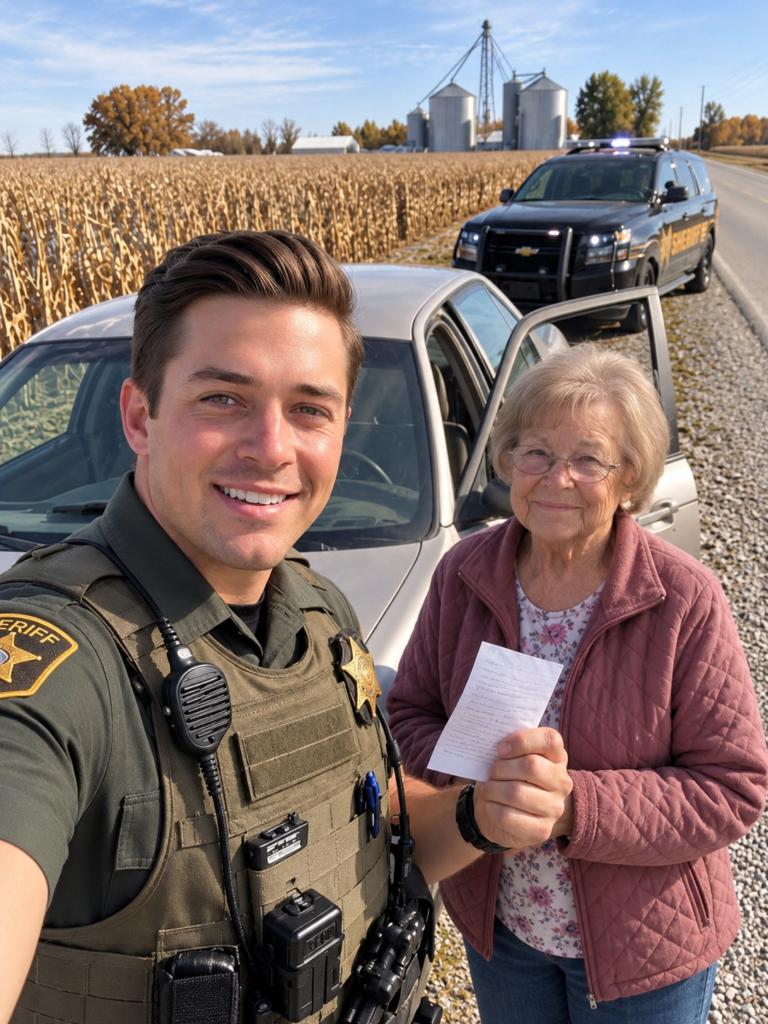
The soles of my mother’s shoes had begun sticking to the softened asphalt.
I noticed it when she shifted her weight, lifting one foot with a little pulling sound that seemed terribly loud in the afternoon stillness.
Her name was Ruth Bellamy, and she was seventy-three years old.
She had survived breast cancer, buried a husband, raised two children, and spent most of her adult life working nights so our family could afford the ordinary things other families seemed to take for granted.
Yet on that August afternoon, standing beside her silver Mercury on State Route 14, she looked smaller than I had ever seen her.
Her white cotton blouse was damp beneath the arms. A strand of silver hair had escaped its careful twist. Her cheeks had turned an alarming shade of red.
Deputy Noah Pierce stood a few feet away, studying the temporary driver’s license as though he expected it to confess something.
“Mrs. Bellamy, I’m going to ask you one more time,” he said. “Where did you get this?”
“The license office in Briar Glen.”
“And you understand this is just a piece of paper?”
“I understand it’s a temporary license.”
He gave a tight, impatient smile.
“At your age, maybe you ought to have somebody else take care of these things.”
I was sitting in the passenger seat with my hand wrapped around the door handle.
For most of my forty-two years, I had been the calm one in our family. I worked as a secretary at Briar Glen Middle School, where I spent my days dealing with angry parents, frightened children, and teachers who sometimes forgot that everyone else was doing the best they could.
But there was something about watching a stranger speak to my mother as though she were an incompetent child that made my chest feel painfully tight.
“Deputy,” I called through the open window, “could she please sit in the car? She’s getting overheated.”
He looked at me without moving.
“Ma’am, I’ve already told you to remain in the vehicle.”
“I am in the vehicle. I’m asking about my mother.”
“I’m handling it.”
That was his favorite answer.
He’d said it when Mom first explained that the plastic replacement card hadn’t arrived in the mail.
He’d said it when I suggested calling the driver’s licensing office.
And he’d said it fifteen minutes earlier when Mom asked whether she could retrieve the bottle of water from her purse.
I’m handling it.
Except he wasn’t.
He was making a seventy-three-year-old woman stand beside a dangerous highway in ninety-four-degree heat while he decided whether an official document looked official enough to satisfy him.
Mom caught my eye.
“Don’t fuss, Hannah.”
Her voice was gentle, but I saw her fingers trembling against the side of the car.
That frightened me more than anything the deputy had said.
My mother never complained about discomfort.
She once finished cooking Thanksgiving dinner with a broken toe because she didn’t want to disappoint the grandchildren.
When she said she was fine, it usually meant she intended to worry about herself later.
But later wasn’t guaranteed on a roadside with heat shimmering above the pavement.
We had left home shortly after one o’clock, headed for a community fundraiser at the old Methodist fellowship hall.
Mom had spent nearly three months sewing a quilt for the church’s emergency assistance fund. She’d used pieces of fabric donated by half the women in town, including two squares cut from one of Dad’s old work shirts.
The quilt was folded carefully inside a cotton bag on the back seat.
We were supposed to arrive early, help arrange the tables, and enjoy an afternoon among people we’d known for years.
Instead, a patrol car had appeared behind us just outside town.
Mom had been driving four miles under the speed limit.
At first, I assumed one of the Mercury’s taillights had burned out.
Deputy Pierce told us later that he’d stopped her because her registration sticker looked faded.
It took him less than a minute to establish that the registration was current.
That should have been the end of it.
But when Mom handed him her temporary license, his expression changed.
The county licensing office had moved into temporary quarters while the courthouse underwent renovations. For several weeks, the state had been issuing printed interim licenses while permanent cards were mailed from the central processing office.
Mom’s document bore an identification number, expiration date, security markings, and the information necessary to verify it.
To me, it looked exactly like what it was.
To Deputy Pierce, it looked suspicious.
He had recently attended a training session about fraudulent identification documents, and somewhere between learning to recognize a forgery and learning to distrust everyone holding a piece of paper, he’d apparently forgotten how to listen.
When Mom calmly explained the licensing office’s temporary procedure, he told her she was arguing.
When she offered to show him the receipt in her purse, he told her not to reach for anything.
Then he ordered her out of the car.
That had been thirty-seven minutes earlier.
A highway department pickup approached from the east, its amber light turning slowly.
The woman driving slowed when she saw Mom.
For a moment, I thought she might stop.
But Deputy Pierce raised his hand and waved her forward.
The truck continued toward Briar Glen.
Mom watched it go.
“May I at least stand in the shade of your patrol car?” she asked.
There wasn’t much shade, but his vehicle was parked at an angle that offered a narrow strip beside its rear door.
“No, ma’am. Stay next to your own vehicle.”
“Why?”
“Because that’s where I’ve instructed you to stand.”
I felt something inside me snap.
I opened my door.
“Hannah,” Mom warned.
I stepped onto the gravel anyway.
“She’s not refusing to cooperate,” I said. “She’s asking for shade and water.”
Deputy Pierce turned toward me.
“If you interfere with this stop, I can cite you.”
“Then cite me. But please tell me why my mother has to stand out here.”
He reached for the radio clipped to his shoulder, then changed his mind.
“Get back in the car.”
I looked at Mom.
Her lips were dry.
There was a strange brightness in her eyes that I recognized from the summer she’d fainted in our vegetable garden.
I sat back inside, but I left the door open and started recording with my phone.
I wish I could say I had done something more courageous.
I wish I had insisted on taking her somewhere cool, consequences or not.
But a uniform, a badge, and the threat of arrest can make even an adult woman feel helpless.
I had spent years telling the children at school to ask for help when something was wrong.
Now, when it mattered, I wasn’t sure how.
Mom was the one who finally changed things.
She straightened her shoulders and looked directly at the deputy.
“Son,” she said, “would you mind putting my name over your radio?”
He blinked.
“What?”
“Just tell your dispatcher that you have Ruth Bellamy here.”
“Why would I do that?”
“Because somebody there may be able to help us sort this out.”
He gave a short laugh.
“Mrs. Bellamy, knowing people at the sheriff’s office doesn’t make an invalid license valid.”
“I didn’t say it did.”
“Then what exactly are you expecting?”
Mom looked toward the empty fields beyond the road.
“I’d like somebody to understand what’s happening here.”
Something in her answer made him angry.
Perhaps he thought she was threatening him.
Perhaps he believed an elderly woman asking for help was challenging his authority.
He looked down at the license again.
“All right,” he said. “If that’s what you want.”
He lifted the microphone.
“Central, Unit Twelve.”
The reply came after a burst of static.
“Go ahead, Twelve.”
“I have a traffic stop on Route Fourteen near the Miller Creek turnoff. Driver has questionable temporary identification and insists somebody at dispatch should recognize her.”
Mom closed her eyes briefly.
“Name is Ruth Bellamy,” he continued. “Anybody know her?”
The radio went quiet.
Not the ordinary pause between transmissions.
An actual silence.
A few seconds passed.
Then a woman’s voice answered.
“Unit Twelve, would you repeat the driver’s name?”
“Ruth Bellamy.”
“Ruth as in Ruth Bellamy who worked county emergency communications?”
Deputy Pierce frowned.
“That’s what she says.”
Mom opened her eyes.
I watched a tiny change come over her face.
Not triumph.
Not satisfaction.
Recognition.
“Is that Teresa?” she asked.
The deputy stared at her.
Before he could answer, the dispatcher spoke again.
“Unit Twelve, is Mrs. Bellamy currently outside her vehicle?”
“Yes.”
“Is she injured?”
“No.”
I leaned toward the open window.
“She’s been standing in this heat nearly forty minutes!”
The deputy shot me an angry look.
But the dispatcher had heard.
“Unit Twelve, confirm how long the driver has been outside.”
He hesitated.
“Approximately thirty to forty minutes.”
“Copy. I’m notifying the duty supervisor. Please move her into a cooled vehicle or other safe location immediately and request medical assistance if indicated.”
Something changed in his posture.
For the first time since the stop began, he looked uncertain.
“Central, I’m still conducting my investigation.”
“Understood, Twelve. Her immediate safety needs attention while you continue.”
Mom moved one hand toward the car door.
Deputy Pierce stepped aside.
“Fine. You can sit down.”
I was out of the passenger seat before he’d finished speaking.
I opened the driver’s door and helped Mom lower herself behind the wheel.
Her knees buckled slightly.
She caught the steering wheel to steady herself.
That was when I saw the fear behind her calm expression.
“Mom?”
“I’m all right.”
“You’re not.”
“Just give me a minute.”
I reached across her for the bottle of water in the cup holder.
She took two small sips, then rested it against her lap.
Her hands wouldn’t stop shaking.
Deputy Pierce stood near the front bumper, listening to his radio.
Another voice came through.
“Central, this is Sheriff Vega. I’m responding. Unit Twelve, confirm your exact location.”
“Route Fourteen, just east of Miller Creek.”
“Copy. And Noah?”
The deputy straightened.
“Yes, Sheriff?”
“Have you verified the license number through the state system?”
A pause.
“Not yet, ma’am. The document appeared irregular.”
“Have you checked the temporary-license bulletin issued last month?”
Another pause.
“No, ma’am.”
“I suggest you do.”
I had known Sheriff Marisol Vega for years, mostly through community events and school safety meetings.
She was a quiet woman who rarely raised her voice.
She didn’t need to.
Even through the small radio speaker, I could hear the difference between her authority and the deputy’s.
He had been using his authority to make somebody feel small.
She was using hers to make somebody answer a question.
The dispatcher returned.
“Unit Twelve, for your information, the temporary format matches the current state-issued paperwork. The identification number should be verifiable through the state system.”
Deputy Pierce looked down at the page in his hand.
He had spent nearly forty minutes treating that piece of paper as a personal insult.
Now it appeared to be exactly what Mom had told him.
But the radio wasn’t finished.
A second voice came through, older and rougher than the others.
“Central, Fire Four.”
“Go ahead, Fire Four.”
“Did I hear you say Ruth Bellamy?”
The deputy looked toward his microphone.
“Fire Four, this is an active traffic stop.”
“I understand that. I need to know if you said Ruth Bellamy.”
The dispatcher answered.
“Affirmative.”
The man on the other end took an audible breath.
“Is she all right?”
I saw Mom lift her head.
She recognized the voice.
I knew it immediately from the way her expression softened.
“That’s Ben,” she whispered.
Deputy Pierce looked toward our car.
“Who’s Ben?”
Mom didn’t answer.
The radio crackled again.
“Noah, this is your father.”
The deputy went completely still.
“Dad?”
“Tell me something, son. Is that woman sitting safely somewhere?”
“Yes.”
“Has somebody checked on her?”
“She’s fine.”
There was a long, terrible silence.
Then the older man said something I would remember for the rest of my life.
“Don’t tell me she’s fine until you’ve asked her. Twenty-four years ago, that woman stayed on the radio with me when everybody else thought I was already dead.”
The deputy stared at the microphone.
Inside the Mercury, Mom turned her face toward the window.
And I realized there was a whole chapter of my mother’s life that neither my brother nor I had ever been allowed to read.
The radio went silent again.
This time, nobody laughed.
Part 2
Sheriff Vega arrived seven minutes later.
Behind her came a volunteer rescue truck and a county ambulance.
The deputy was standing beside his patrol car, still holding Mom’s license.
The sheriff went to my mother first.
“Ruth, can you tell me how you’re feeling?”
Mom managed a tired smile.
“Like an old fool who forgot her sunhat.”
“That wasn’t my question.”
Mom looked down at her hands.
“Lightheaded. A little sick to my stomach.”
The sheriff nodded toward the paramedics.
“Let’s have them check you.”
Deputy Pierce opened his mouth.
“Ma’am, I was trying to—”
“Not now, Noah.”
Two words.
That was all it took.
He stopped talking.
A paramedic brought a folding chair from the ambulance and placed it beneath the narrow shade of an open rear door. Another checked Mom’s blood pressure and asked her how much water she’d had that day.
I stood beside her, feeling both relieved and furious.
She was dehydrated and showing signs of heat exhaustion. Her blood pressure had dropped when she stood, and the paramedic recommended that she be evaluated at the clinic.
Mom argued that we were already late for the fundraiser.
Nobody laughed.
That was how I knew the situation had been serious.
While the paramedics attended to her, a broad-shouldered man climbed out of the volunteer rescue truck.
He looked to be in his early sixties, with weathered skin, gray hair, and an old fire department T-shirt tucked into his jeans.
He walked toward us quickly.
“Ruth?”
My mother’s expression changed.
“Benjamin Pierce.”
He stopped beside her chair.
For a moment, they simply looked at each other.
Then he reached for her hand.
It wasn’t the formal handshake of two acquaintances.
He held both her hands as though checking that she was real.
“I heard your name on the radio,” he said. “I thought there had to be some mistake.”
“Apparently, I caused a little excitement.”
His face tightened.
“I’d say more than a little.”
Behind him, his son stood motionless.
“Dad, you know her?”
Ben slowly turned.
“Noah, this is Mrs. Bellamy.”
“I understand that.”
“No. I don’t believe you do.”
Mom squeezed Ben’s hand.
“Don’t make this harder than it already is.”
He looked down at her.
“You always did worry about everybody else.”
Then he turned back to his son.
“Do you remember me telling you about the Miller Creek flood?”
The deputy frowned.
“The one when the old bridge washed out?”
“That’s right.”
“You almost died out there.”
Ben nodded.
“I did.”
He looked at Mom.
“And this woman is the reason I came home.”
I knew about the flood.
Everyone in Briar County knew about it.
In May of 2002, three days of heavy rain had turned the creeks into rivers.
The old Miller Creek bridge had collapsed. Two farms had been cut off. A volunteer firefighter had broken his leg during an evacuation, and the county nursing home had lost power for most of one night.
I remembered the storm because it had ruined the evening of my senior awards ceremony.
I had been eighteen, wearing a navy-blue dress Dad bought on sale, waiting in the school auditorium for Mom to arrive.
She had promised to be there.
My name was called for a scholarship.
Dad stood and applauded.
The seat beside him remained empty.
I had spent years pretending that memory didn’t bother me.
Now, twenty-four years later, Ben Pierce was about to tell me what had been happening somewhere beyond those auditorium walls.
He pulled a chair close to Mom.
“Do you mind if I tell him?”
Mom looked at Noah, then at me.
“I suppose it’s time.”
Ben sat heavily.
“That night, I was taking emergency supplies out toward the nursing home. We had portable lights, batteries, and a small generator in the truck.”
He stared toward the fields, as if he could still see the rain.
“I took the county service road because the highway was already underwater. The road looked solid, but a section of the shoulder had washed away.”
His truck slipped off the pavement.
It rolled down an embankment and landed on its side in a drainage channel.
Water began pouring through the passenger window.
Ben had hit his head on the steering wheel.
His left shoulder was badly injured.
He couldn’t force the driver’s door open.
The county radio in his truck had been damaged, but he managed to get a weak signal through.
At the dispatch center, Mom answered.
“She asked me for my location,” Ben said. “And I didn’t know.”
He shook his head.
“I was confused. Everything outside looked the same. Trees, water, darkness. I’d turned off the main road somewhere, but I couldn’t remember where.”
Mom had the county maps spread across her desk.
She asked which direction he’d been traveling, which bridge he’d crossed, and whether he’d passed the old grain elevator.
He gave confused answers.
The storm had knocked out several communication towers, and the emergency channels were crowded.
A less patient person might have decided there wasn’t enough information to send help.
Mom didn’t.
She asked him to describe everything he could see.
A crooked fence.
An abandoned tobacco barn.
A white mailbox with a broken post.
Then she remembered something.
Months earlier, county maintenance workers had reported a collapsed culvert near the old Jennings property. It wasn’t marked on the standard highway map, but a handwritten note about it had been left in the dispatch office.
Mom found that note.
She sent rescuers toward the Jennings farm instead of the main bridge.
Then she kept talking.
“For almost an hour,” Ben told us, “she never let me think I was alone.”
He had begun to drift in and out of consciousness.
Mom asked him questions about his wife.
About his job.
About the little boy waiting for him at home.
“She wanted to know what my son liked to do,” Ben said.
He glanced at Noah.
“I told her you were seven years old and obsessed with fire engines. You’d built that ridiculous red one out of cardboard boxes.”
For the first time, the deputy’s expression broke.
“I remember that truck.”
“Your mother kept it in the garage for years.”
Ben’s voice thickened.
“Ruth made me tell her everything about you. Your birthday. Your favorite cereal. How you wanted to ride on a real fire truck when you got bigger.”
He rubbed a hand across his mouth.
“Every time I started getting sleepy, she’d bring me back to talking about my boy.”
Mom looked uncomfortable.
“Ben, you helped yourself. You stayed awake.”
“No, Ruth. You helped me stay awake.”
He turned to his son.
“She kept asking what I planned to do when I got home. And I told her I was going to take you fishing, because I’d promised you for three Saturdays and kept letting something interfere.”
Noah was staring at the ground.
“Do you remember that fishing trip?” Ben asked him.
The deputy nodded slowly.
“We caught two little bluegill.”
“And you cried when I said we had to put them back.”
A tiny smile crossed Noah’s face.
Then it vanished.
Ben leaned forward.
“Son, I only got to have that day because this woman wouldn’t stop looking for me.”
Nobody spoke.
The wind pushed dry grass against the fence.
I watched Mom lower her eyes, embarrassed by the attention.
That was the strangest part.
If I had spent an hour keeping a badly injured man alive while directing rescuers through a flood, I would have told the story at every family gathering for the next twenty years.
Mom looked as though she wished someone would change the subject.
Sheriff Vega finally stepped forward.
“Noah, I need you to finish securing the stop information. Then we’re going to have a conversation.”
Deputy Pierce looked at Mom.
“I’m sorry, Mrs. Bellamy.”
It came out quietly.
Mom studied him.
“Are you sorry because you know who I am?”
He didn’t answer.
“Or because you know what happened?”
His face colored.
“I didn’t realize—”
“That I used to work dispatch?”
“No, ma’am. That you were getting sick.”
She nodded toward the ambulance.
“That’s something you could have discovered by asking.”
He looked away.
Mom wasn’t finished.
“And the next woman you stop may have spent her life cleaning motel rooms. Or raising children. Or doing nothing anybody remembers. She still deserves a chance to sit down when she’s feeling faint.”
The deputy swallowed.
“Yes, ma’am.”
I wondered whether he truly understood.
At that moment, I wanted to believe he did.
I would learn that understanding and admitting the truth were two different things.
The clinic kept Mom for several hours.
They gave her fluids, monitored her condition, and warned her to avoid prolonged heat exposure for the next few days.
By the time we got home, the quilt fundraiser had ended.
A message from the church secretary waited on our answering machine.
They’d saved a place at the table for her.
Mom listened to it twice.
Then she went into the kitchen and started washing dishes that were already clean.
I recognized the habit.
Whenever she was upset, she found work for her hands.
“Mom, sit down.”
“I’m only washing a few things.”
“There’s nothing to wash.”
She looked at the spotless plate in her hand.
Then she set it back in the cupboard.
I pulled out a chair.
“Please.”
She sat.
I made us tea, although neither of us particularly wanted any.
For a long time, the only sound was the refrigerator humming.
Finally, I asked the question that had been building inside me since Ben Pierce climbed out of that rescue truck.
“Why didn’t you ever tell us about him?”
Mom stared into her cup.
“I did mention the flood.”
“You said the dispatch center was busy.”
“It was.”
“Mom.”
She looked up.
“You never told me you saved somebody’s life that night.”
Her expression softened.
“Hannah, I didn’t save him alone. The rescue crew found him. The firefighters got him out.”
“You found where to send them.”
“I helped.”
“Why are you so determined to make that sound like nothing?”
She gave a sad smile.
“Because it wasn’t nothing to the man in the truck. And I didn’t think it should become a story about me.”
I looked toward the family photographs on the refrigerator.
There was one of Dad holding a large catfish.
One of my brother, Michael, with his wife and children.
One of me at eighteen, standing in my navy dress beside Dad after the awards ceremony.
Mom wasn’t in that picture.
I had seen it thousands of times.
Now it felt different.
“That flood happened the night of my scholarship ceremony,” I said.
Mom’s smile disappeared.
“I know.”
“You promised you were coming.”
“I remember.”
“I thought you chose work over me.”
She shut her eyes.
For a moment, she looked older than she had on the roadside.
“I tried to find someone to cover my shift.”
“Nobody could?”
“Two dispatchers had called in because the roads were flooding. Teresa had been on duty since morning. We were receiving calls from people trapped in their houses, families who couldn’t reach elderly relatives, motorists driving into water.”
She paused.
“I thought I could leave for an hour. Then Ben’s call came through.”
I felt the old resentment rising, but something else rose with it.
Shame.
“I sat there looking at that empty chair,” I whispered.
Mom reached across the table.
“I know, sweetheart.”
“You never explained.”
“I didn’t want to tell you another family’s frightening story just to make myself look better.”
“But you let me think you didn’t care.”
She lowered her head.
“That was my mistake.”
I had expected her to defend herself.
Instead, she said something that hurt even more.
“I should have told you how sorry I was. I should have made room for your disappointment instead of pretending a good reason made it disappear.”
I began crying.
Not loudly.
I simply couldn’t stop the tears.
Mom reached for my hand.
“I’m proud of you, Hannah. I’ve always been proud of you.”
I wanted to be eighteen again.
I wanted to sit in that auditorium and look across the crowd with the knowledge I had now.
I wanted to understand that my mother’s absence wasn’t indifference.
And I wanted her to understand that, even when there was a good reason, it had still hurt.
We sat together until the tea grew cold.
The next morning, my brother called.
Michael was four years older than me and owned a heating and air-conditioning business just outside town.
He had always been practical, confident, and deeply uncomfortable with public disagreements.
He loved Mom.
I knew that.
But his usual response to trouble was to make it smaller until everyone agreed to stop talking about it.
“I heard about the traffic stop,” he said.
“Then you heard she ended up at the clinic.”
“Ben Pierce called me. He said she was all right.”
“She’s recovering.”
“Good. Listen, Hannah, don’t turn this into something bigger.”
I stared at the phone.
“Excuse me?”
“Noah’s young. He made a mistake. His dad’s a good man, and the sheriff already knows what happened.”
“Mom was kept in the heat until she nearly fainted.”
“I understand.”
“No, I don’t think you do.”
He sighed.
“Look, our family has known these people forever. Mom doesn’t need everybody in the county gossiping about her.”
I looked toward the living room, where she was asleep in Dad’s old recliner.
“Maybe the problem isn’t people gossiping about Mom. Maybe the problem is what happened to her.”
“You’re always ready for a fight.”
I nearly hung up.
Instead, I said, “You weren’t there, Michael.”
“Neither were most of the people who are going to hear about it.”
That sentence stayed with me.
Because by Monday morning, people were already hearing about it.
And some of what they were hearing wasn’t true.
The story began circulating through town before breakfast.
According to one version, Mom had refused to show identification.
According to another, she had demanded special treatment because she’d once worked for the county.
Someone claimed she had threatened to have Deputy Pierce fired.
A woman from church called to ask whether it was true that Mom had deliberately stayed outside to embarrass him.
I could hardly believe the question.
“She was ordered to stay outside.”
The woman hesitated.
“Well, that’s not what I heard.”
“Who told you?”
“I’d rather not say.”
By noon, a local community page had a post referring to the incident.
It didn’t use Mom’s full name, but everyone in Briar Glen knew who it meant.
An elderly former county employee, the post suggested, had attempted to use her connections to avoid a routine traffic citation.
There had never been a legitimate citation.
The license was valid.
The registration was current.
The sheriff’s office had confirmed both.
But facts were slower than gossip, and gossip made people feel as though they belonged to something.
Mom read the post on her tablet.
She said nothing.
Then she closed the cover and went outside to water her flowers.
I found her ten minutes later, standing beside her roses with the hose running across the same patch of dirt.
“Mom?”
She turned off the water.
“People get bored, Hannah.”
“That’s not an excuse.”
“No.”
“Then why aren’t you angry?”
She looked at the roses.
“I am.”
Her answer surprised me.
I’d spent my life thinking my mother never got angry.
She grew quiet.
She kept moving.
She made coffee for people who insulted her and sent birthday cards to people who forgot hers.
But anger, I realized, didn’t always look like shouting.
Sometimes it looked like a seventy-three-year-old woman standing in a garden, trying not to let strangers see her cry.
That afternoon, I drove to the sheriff’s office.
I asked to submit a formal statement.
Sheriff Vega met me in a small conference room beside the records department.
There was no dramatic confrontation.
Just a scarred wooden table, a water pitcher, and a yellow legal pad.
I told her everything.
The length of the stop.
The deputy’s comments about Mom’s age.
His refusal to let her sit.
The warning he gave me when I tried to help.
I showed her the recording on my phone.
Unfortunately, I’d started recording only during the final portion of the stop.
It captured Mom asking to have her name announced over the radio.
It captured her unsteady movements and the deputy’s tone.
But it didn’t capture the first half hour.
The sheriff listened carefully.
Then she set my phone on the table.
“There’s something I need you to know,” she said.
My stomach tightened.
“Deputy Pierce filed his incident report this morning.”
“And?”
“His description differs from yours.”
She slid a copy of the relevant portion across the table.
I read it once.
Then again.
According to his report, Mom had been asked to wait outside briefly while her identification was checked. He stated that she had declined an opportunity to return to her vehicle and had shown no obvious signs of distress until I became agitated.
I felt my face turn hot.
“That’s not true.”
The sheriff said nothing.
“She asked to sit down. More than once.”
“I understand.”
“He told her no.”
“I understand that you’re disputing his report.”
“I’m not disputing an opinion, Sheriff. I’m telling you what happened.”
She folded her hands.
“We’re reviewing his body-camera footage, radio traffic, and all available evidence.”
“Then you’ll see it.”
Her expression grew serious.
“The camera was not activated at the beginning of the stop. We have footage from the later portion, but not from the initial detention.”
I stared at her.
“Why wasn’t it recording?”
“That’s part of the review.”
A cold feeling moved through me.
Noah Pierce had spent nearly forty minutes refusing to believe my mother.
Now he’d submitted an official account suggesting that she was partly responsible for what happened.
And the one recording that might have shown everything was incomplete.
The sheriff leaned forward.
“Hannah, I won’t promise an outcome before we’ve finished investigating.”
“I understand.”
“But I will promise this: your mother is entitled to have her complaint taken seriously.”
I nodded.
Then I asked something I hadn’t intended to ask.
“If she weren’t Ruth Bellamy, would we even be sitting here?”
The sheriff was quiet for several seconds.
Finally, she answered.
“That’s a fair question. And I don’t like that you have to ask it.”
That evening, Michael came to Mom’s house carrying a casserole.
He placed it on the counter as though a homemade dinner could make the last forty-eight hours disappear.
Mom thanked him.
We sat around her kitchen table, the same table where we’d eaten thousands of family meals.
Michael cleared his throat.
“I spoke with Noah’s father.”
I stopped cutting my food.
“About what?”
“He feels terrible. The whole family does.”
Mom nodded.
“Ben called me too.”
“He says Noah is getting torn apart over this.”
I looked up sharply.
“Mom was the one who needed medical attention.”
“Nobody’s denying that, Hannah.”
“Then why are we talking about how awful Noah feels?”
Michael put down his fork.
“Because he’s a person too.”
Mom raised a hand.
“Both of you.”
But Michael wasn’t finished.
“There’s something else. I posted a short message asking people to stop spreading rumors.”
I reached for my phone.
“What did you say?”
He looked uncomfortable.
“Just that this was an unfortunate misunderstanding and everybody involved was safe.”
“Did you tell people Mom had refused to sit in the car?”
He didn’t answer quickly enough.
“Michael?”
“I repeated what I understood from the deputy’s account.”
I felt the room tilt.
“You told people your own mother was responsible?”
“That’s not what I said.”
“You weren’t there.”
“I was trying to calm everybody down!”
Mom sat very still.
She didn’t raise her voice.
She didn’t accuse him.
She simply asked, “Did you call me before you wrote it?”
Michael looked at her.
“No, Mom.”
“Then why did you believe him before you believed me?”
I had never heard my mother ask such a question.
Michael opened his mouth.
Then closed it.
For the first time since he arrived, he seemed to understand that his casserole wasn’t going to fix anything.
“I thought I was helping,” he said.
Mom nodded slowly.
“So did that deputy.”
The words settled over the table.
Michael left soon afterward.
He took the uneaten casserole home.
Later that night, I found Mom in the back bedroom.
She was kneeling beside a cedar chest that had belonged to my grandmother.
Inside were old family photographs, my father’s letters, childhood artwork, and the small keepsakes Mom never threw away.
She held an envelope with a faded blue stamp.
“Hannah, would you help me up?”
I offered my hand.
We sat together on the edge of the bed.
She opened the envelope and removed a folded piece of construction paper.
It was a child’s drawing.
A red fire truck with enormous black wheels.
A stick-figure man stood beside it, holding the hand of a smaller figure.
Above them, written in uneven letters, were the words:
THANK YOU FOR HELPING MY DAD.
At the bottom was a name.
Noah.
I stared at it.
“That’s from him?”
Mom nodded.
“Ben brought it to the dispatch center a few weeks after the flood. His boy drew it.”
I ran my finger along the creased edge.
“You kept it all these years.”
“Of course.”
“Did you know who Deputy Pierce was when he stopped us?”
“Not at first. Pierce is a common enough name. But when he introduced himself as Noah, I wondered.”
“Why didn’t you tell him?”
She looked down at the drawing.
“Because I shouldn’t have needed to.”
I couldn’t answer.
Mom returned the drawing to its envelope.
“That little boy loved his father so much. I remember Ben telling me that.”
She swallowed.
“I don’t want Noah’s life ruined over one terrible afternoon.”
“Mom, he lied in his report.”
“I know.”
“That’s not a misunderstanding.”
“I know that too.”
I studied her face.
“What are you going to do?”
She looked toward the window, where the last light of evening was disappearing beyond the yard.
For a moment, I thought she would ask me to withdraw the complaint.
Instead, she carefully placed the envelope on the bedside table.
“Tomorrow,” she said, “I’m going to tell the sheriff exactly what happened. Every bit of it.”
I waited.
“And I want Michael to hear it too.”
I nodded.
Mom picked up the child’s drawing one more time.
Then she said something I hadn’t expected.
“I spent years telling frightened people they had to speak clearly so someone could help them. I can’t spend the rest of my life wishing I’d spoken clearly for myself.”
That was the moment I understood.
My mother wasn’t fighting to be recognized as a hero.
She was fighting not to disappear behind somebody else’s version of the truth.
And for the first time, she was willing to let the whole county hear her voice.
Part 3
The woman who finally proved what happened was someone none of us knew.
Her name was Tasha Reed.
She worked for the Briar County Highway Department, driving an inspection truck and checking rural roads for damaged shoulders, blocked culverts, and missing signs.
She was the woman in the yellow pickup who had slowed near our car that afternoon.
Three days after the traffic stop, she walked into the sheriff’s office carrying a small memory card.
She had heard about the incident from her husband.
At first, she’d dismissed the rumors. Then she’d read a description of an elderly woman supposedly refusing to return to her vehicle, and she remembered something that troubled her.
When she passed us on Route 14, she’d seen Mom standing beside the Mercury.
Tasha had stopped long enough to ask whether everything was all right.
The deputy had waved her on.
But her department-issued dashboard camera had been recording.
The footage didn’t show the entire stop.
It showed less than two minutes.
That was enough.
There was Mom, leaning one hand against the car.
There was Deputy Pierce standing between her and the driver’s door.
And there was Mom reaching for the door handle, only to pull her hand back when the deputy gestured for her to remain where she was.
Tasha’s written statement added what the camera couldn’t capture.
She’d heard Mom ask whether she could get back inside.
She’d heard the deputy refuse.
The truck’s timestamp placed the exchange nearly twenty-five minutes after the stop began.
Mom had continued standing outside for many minutes afterward.
By Thursday, the sheriff had enough evidence to establish that the deputy’s initial report was inaccurate.
But evidence alone wasn’t the end of the matter.
There was still the question of what he intended to do about it.
Sheriff Vega called us back to her office on Friday afternoon.
Mom wore a light-blue blouse and carried her handbag over one arm.
She had insisted on driving herself.
I offered three times to take the wheel.
Finally, she looked at me across the kitchen.
“Hannah, my license is valid. My car works. And I remember how to get to the sheriff’s office.”
I laughed despite myself.
“All right, Mom.”
She smiled.
“Thank you.”
It was a small moment.
But I understood something important.
After the roadside incident, I’d been so frightened that I was beginning to treat Mom the same way the deputy had.
As though being older meant she could no longer make decisions.
As though vulnerability erased independence.
I had to learn to protect her without taking over her life.
We reached the sheriff’s office just after two.
Michael was waiting outside.
He wore his good brown jacket, the one he usually saved for church funerals and business meetings.
When he saw Mom, he stepped forward.
“Can we talk?”
She looked at him.
“Of course.”
He glanced at me, then back at her.
“I took down that post.”
“I heard.”
“I put up a correction too.”
Mom waited.
Michael swallowed.
“I said I was wrong to repeat something I hadn’t checked. I told people you’d asked for help and weren’t given it.”
“Thank you.”
He looked miserable.
“Mom, I should have believed you.”
She touched his sleeve.
“Yes. You should have.”
There was no anger in her voice.
Somehow that made the words more powerful.
Michael lowered his eyes.
“I was embarrassed. Everyone was talking, and I wanted it to stop.”
“I know.”
“I thought if I made it sound smaller, it would go away.”
Mom considered that.
“Michael, sometimes when you make another person’s suffering smaller, what you’re really doing is making your own discomfort easier to carry.”
He nodded.
“I know that now.”
She looked toward the sheriff’s office door.
“Then come inside. I asked you to be here because I want both my children to hear what I say.”
He held the door open for her.
And for once, he didn’t try to explain anything.
The meeting took place in the same conference room where I’d submitted my statement.
Sheriff Vega sat at one end of the table with an investigator from the department’s professional standards unit.
Deputy Pierce sat near the opposite end.
His father was beside him.
Noah looked different without the easy confidence he’d worn on Route 14.
He had dark circles beneath his eyes.
His uniform was neat, but his hands were clasped so tightly that the knuckles had turned pale.
He stood when Mom entered.
“Mrs. Bellamy.”
She nodded.
“Deputy.”
Ben gave her a small, apologetic smile.
Mom returned it.
Then everyone sat.
Sheriff Vega explained that the department’s review was continuing under its formal procedures. She had invited Mom to provide a final statement about the impact of the stop and to hear the deputy’s corrected account.
His employment consequences would be handled separately.
The investigator placed several documents on the table.
They had reviewed the available body-camera footage, the radio recordings, the licensing records, and Tasha Reed’s statement.
The stop had lasted forty-six minutes from the first recorded contact to the time emergency assistance was requested.
The license was valid.
The registration was current.
The deputy had not completed the available verification procedure before deciding that Mom’s document was suspicious.
And he had kept her outside in excessive heat after she requested relief.
Noah stared at the table.
Sheriff Vega turned toward him.
“Deputy Pierce, you submitted a supplemental statement yesterday. Would you explain why?”
He drew a breath.
“Because my first report wasn’t accurate.”
The room was very still.
He continued.
“I wrote that Mrs. Bellamy declined an opportunity to wait inside her vehicle.”
He looked at Mom.
“That wasn’t true.”
She said nothing.
“I told her to stay outside. When she asked to sit down, I wouldn’t let her.”
He stopped and rubbed his palms against his knees.
“I kept thinking I was close to figuring out whether the license was legitimate. Every time someone questioned what I was doing, I got more determined not to be wrong.”
Sheriff Vega watched him carefully.
“Why did you write something different?”
His face turned red.
“Because when I sat down to write the report, I knew what it sounded like.”
“What did it sound like?” the investigator asked.
Noah looked toward Mom.
“Like I’d treated an older woman badly for no good reason.”
Nobody rescued him from that admission.
Not his father.
Not the sheriff.
Not my mother.
Finally, he said, “I was afraid of what would happen to me if I told the truth.”
Mom folded her hands.
“And were you thinking about what would happen to me if you didn’t?”
He shook his head.
“No, ma’am.”
The answer was so plain that it seemed to take all the air from the room.
Mom looked at him for a long moment.
“That’s what I needed you to understand.”
Noah’s eyes filled.
“I do.”
“I hope so.”
She reached into her handbag.
For a second, I wondered whether she was taking out her license.
Instead, she removed the old envelope.
She slid the child’s drawing across the table.
Noah unfolded it carefully.
I watched recognition spread across his face.
“My fire truck.”
Ben leaned forward.
“I haven’t seen that in years.”
Mom smiled faintly.
“You sent it to me after your father came home.”
Noah traced the crooked red wheels with one finger.
“My mom made me sit at the kitchen table and draw a thank-you picture. I remember asking what you looked like.”
“She told me.”
He looked up.
“Did she?”
Mom nodded.
“She said you asked if I wore a firefighter’s helmet because I’d helped your daddy.”
Ben laughed softly.
Even the sheriff smiled.
Noah’s mouth trembled.
“I thought you were some kind of rescue lady.”
“I was a dispatcher.”
“Same thing to a seven-year-old.”
Mom regarded him kindly.
Then her expression became serious.
“Noah, I kept that picture because a little boy was grateful his father came home.”
He nodded.
“But I didn’t bring it here to make you feel guilty about what happened twenty-four years ago.”
“Then why?”
“Because I want you to understand that the little boy who drew this was worth helping long before I knew his name.”
She paused.
“And so was his father.”
Noah looked down.
“So was I,” Mom continued. “Even before you knew mine.”
The deputy wiped his eyes.
For a long while, nobody spoke.
Then Mom gently took back the drawing.
“I don’t want you to lose everything over this,” she said. “But I don’t want you to walk away thinking an apology makes it finished.”
“I understand.”
“If you stay in this profession, people will meet you on some of the worst days of their lives. They won’t always be pleasant. They won’t always have their papers arranged exactly the way you expect.”
She looked toward Sheriff Vega.
“And they may not have a former dispatcher sitting beside them to call for help.”
The sheriff nodded.
“That’s exactly why this review matters.”
Mom leaned back.
“I’m willing to accept an apology. I’m not willing to pretend it didn’t happen.”
Noah lowered his head.
“That’s fair.”
For the first time, I believed he meant it.
The department completed its investigation the following month.
Deputy Pierce received a formal disciplinary finding for his treatment of Mom, his failure to follow verification and roadside safety procedures, and his inaccurate initial report.
He was suspended without pay for thirty days.
He was removed from regular patrol duties pending additional training and evaluation. His return to field work would depend on completing that process, with further misconduct potentially ending his employment.
Sheriff Vega also ordered a review of how deputies handled drivers with temporary documents and people who needed medical or physical assistance during traffic stops.
Her office introduced clearer guidance requiring deputies to consider heat exposure, age, visible distress, and requests for water or a safe place to sit.
A supervisor was also required to review extended roadside detentions when identification could not be verified promptly.
Mom read the written findings at the kitchen table.
She didn’t smile.
She didn’t celebrate.
She simply nodded.
“Good,” she said.
I studied her.
“That’s all?”
“What else should I say?”
“I thought you’d feel vindicated.”
She folded the paper.
“I do. But I don’t enjoy knowing somebody had to be disciplined before the department took a problem seriously.”
She looked out the window.
“What matters is what happens to the next person.”
I would hear those words again and again in the months that followed.
They weren’t a slogan to Mom.
They were how she’d lived her life.
One afternoon in October, Ben Pierce came to visit.
He carried a small box of apple cider doughnuts from the bakery outside town.
Mom invited him onto the porch.
I was there helping her clear away the summer flowerpots.
Ben settled into Dad’s old rocking chair.
“I wanted to thank you,” he said.
Mom looked surprised.
“For what?”
“For not asking me to use my connections to make this go away.”
Mom frowned.
“Ben, I would never ask you to do that.”
“I know. But some people expected me to.”
He stared down at the paper bag.
“When I heard what happened, the first thing I felt was anger at my son. Then I felt ashamed. And after that, I was afraid.”
“Afraid of what?”
“Of watching him lose the career he’d worked so hard to build.”
Mom waited.
Ben sighed.
“I thought about calling Marisol. Telling her Noah was a good kid who’d made a mistake.”
“You could have.”
“I didn’t.”
He looked toward the street.
“Because you hadn’t called anybody when I was trapped in that truck. You didn’t ask whether I was a good man. You didn’t ask what my job was. You just tried to get me home.”
Mom’s eyes softened.
Ben looked at her.
“I figured the least I could do was let the truth stand on its own.”
They sat quietly together.
Then Mom reached into the doughnut bag.
“Well, Benjamin, if you’re going to give a speech that serious, you might as well have something to eat.”
He laughed.
For a little while, they talked about ordinary things.
The weather.
The harvest.
The old fire station that needed a new roof.
I watched from the kitchen doorway.
There was something comforting about seeing two people who had shared a frightening hour twenty-four years earlier sitting together in the autumn sunshine, talking about doughnuts.
The past had changed both their lives.
But it didn’t have to control every moment afterward.
Noah returned to the sheriff’s office later that fall.
Before resuming patrol, he completed additional training and spent several supervised observation shifts in the emergency communications center.
He wasn’t allowed to answer calls independently.
He sat beside experienced dispatchers, listened to approved training recordings, and watched how they handled frightened callers.
The work was much quieter than he expected.
There were no flashing lights.
No traffic stops.
No roadside confrontations where everyone could see who held authority.
There were just voices.
A woman who couldn’t remember her address because her husband had collapsed.
A teenager crying because her younger brother wasn’t breathing normally.
An elderly man who kept apologizing because he couldn’t explain what was happening to him.
Noah later told Mom that one call stayed with him.
A woman had phoned about her neighbor, who was confused and wandering outside in the cold.
The caller was upset and couldn’t answer the dispatcher’s questions in order.
Noah had listened, growing impatient.
He kept thinking about what he would have said if he’d been the person taking the call.
Where are you? What’s the address? Slow down and answer me.
Instead, the dispatcher spoke softly.
“Ma’am, I’m going to stay with you. Tell me what you can see from where you’re standing.”
The woman calmed enough to identify her street.
Then the nearest intersection.
Then the house.
Help was sent.
Noah said he finally understood how much difference a person’s tone could make when someone felt powerless.
Not every emergency required somebody to take charge in a loud voice.
Sometimes it required somebody patient enough to let another person find the words.
By November, the church held another fundraiser.
The quilt Mom had intended to donate in August was displayed across a long wooden table beneath the fellowship hall windows.
It was beautiful.
A patchwork of faded blues, soft greens, yellow flowers, and small squares cut from old shirts and dresses.
In one corner, she’d sewn two pieces of Dad’s blue work shirt.
I recognized the cloth immediately.
He had worn that shirt when he repaired our porch railing.
When he drove me to my first job.
When he taught Michael how to change the oil in the family car.
Mom had kept it after he died because, she once told me, throwing it away felt like losing him twice.
Now a piece of it was part of something meant to keep another family warm.
People gathered around the quilt, admiring the stitching.
Some asked Mom about the traffic stop.
Others apologized for believing the gossip.
She accepted their apologies politely.
But she never turned the afternoon into a public account of what she’d endured.
When Mrs. Calder, a woman from church, told her she ought to be proud that everyone had finally learned how important she’d been, Mom smiled.
“Everybody’s important to somebody, Margaret.”
The older woman blinked.
“I suppose that’s true.”
Mom smoothed one corner of the quilt.
“The trouble starts when we forget it.”
Michael stood beside me with a paper cup of coffee.
He watched Mom speaking to her friends.
“I really messed up,” he said.
I didn’t pretend otherwise.
“Yes.”
He looked at me.
“You don’t have to agree that fast.”
I smiled.
“You brought it up.”
He laughed quietly.
Then his face grew thoughtful.
“I always thought Mom was the sort of person who didn’t need anybody to stand up for her.”
“She’s strong.”
“I know. But I think I used that as an excuse.”
I turned toward him.
He looked down at his coffee.
“If Mom could handle anything, then I never had to ask whether she should have to.”
I thought about the years she’d worked nights.
The holidays she’d arranged around everybody else’s plans.
The times she’d told us she wasn’t tired when her eyes said otherwise.
Maybe that had been our family’s mistake.
We had mistaken her endurance for proof that she didn’t need anything.
Michael touched my shoulder.
“Thanks for being there that day.”
I nodded.
“I wish I’d done more.”
“You did what you could.”
I watched Mom tuck a loose thread into the edge of her quilt.
For once, I let that be enough.
There was one more surprise waiting for me that winter.
I found it while helping Mom sort through a cabinet in the spare bedroom.
She’d decided to give away some of her old books and finally organize the boxes left from her retirement.
At the bottom of one carton was a small wooden frame wrapped in tissue paper.
Inside was a photograph of me at eighteen.
I was standing in the high school auditorium, holding my scholarship certificate.
Dad had taken the picture after the awards ceremony.
I remembered the moment clearly.
I had smiled because he told me to.
Behind the smile, I’d been hurt that Mom wasn’t there.
Now I turned the frame over.
A folded program was tucked behind the cardboard backing.
It was from the same ceremony.
My name had been circled in blue ink.
Beside it, in Mom’s handwriting, were four words.
My girl. So proud.
I carried it into the kitchen.
Mom was making biscuits.
“Where did you get this?” I asked.
She looked at the frame.
“Oh, your father brought me that after the ceremony.”
“You kept it?”
“Of course.”
I opened the program.
“You circled my name.”
She smiled.
“I read it a hundred times.”
I sat down.
For years, I’d believed that my mother’s absence meant I hadn’t mattered enough.
Now I was holding proof that she’d carried that moment with her.
“Why didn’t you show me?”
Mom wiped flour from her fingers.
“I suppose I thought you knew.”
I looked at the photograph.
“I didn’t.”
She pulled out the chair beside me.
“I’m sorry, Hannah.”
I shook my head.
“You’ve already apologized.”
“Well, I’m saying it again.”
We laughed a little.
Then I began crying.
Mom put her arm around me.
I leaned against her shoulder, feeling the familiar warmth of the woman who had held me through childhood fevers, heartbreaks, and all the ordinary disappointments of growing up.
For twenty-four years, I’d remembered an empty chair.
Now I understood that love could be present even when the person wasn’t.
That didn’t erase the disappointment of that night.
But it gave the memory another side.
And I no longer wanted to spend the rest of my life staring at the empty part.
The following spring, I went with Mom to the sheriff’s office for a community safety meeting.
Sheriff Vega had invited residents to speak about interactions with law enforcement, especially situations involving older adults and people with disabilities.
Mom hadn’t intended to say anything.
She’d told me she was going strictly to listen.
But near the end, a woman in the second row raised her hand.
She was a widow named Ellen Porter, nearly eighty, who lived alone on the far side of town.
She described getting confused when a deputy questioned her about a minor accident outside the grocery store.
Nobody had mistreated her.
But she’d been frightened.
She said the questions came so quickly that she couldn’t understand what the officer needed.
Then she began apologizing for being old.
Mom’s expression changed.
She raised her hand.
Sheriff Vega recognized her.
“Mrs. Bellamy?”
Mom stood slowly.
She didn’t mention the heat.
Or her temporary license.
Or Ben Pierce.
She looked toward Mrs. Porter.
“I worked in emergency communications for a long time,” she said. “And I learned something that helped me more than any piece of equipment we had.”
The room grew quiet.
“When people are frightened, they don’t always behave the way we expect. They forget details. They say things out of order. Sometimes they get angry because they’re scared.”
She paused.
“That doesn’t mean they don’t deserve our patience.”
Sheriff Vega nodded.
Mom looked around the room.
“And sometimes the person who seems calm is frightened too. So it’s worth asking how they’re doing before deciding they’re all right.”
She sat down.
That was all.
No speech about being a hero.
No demand for recognition.
Just a simple truth, offered by someone who had spent most of her life trying to make frightened people feel heard.
After the meeting, I saw Noah Pierce standing near the back door.
He was in uniform again.
He approached Mom carefully.
“Mrs. Bellamy?”
She turned.
“Hello, Noah.”
He looked more settled than the last time I’d seen him.
“I wanted you to know something.”
“What’s that?”
“I stopped an older gentleman last week because one of his lights wasn’t working. He had trouble finding his registration, and he started getting upset.”
Mom waited.
“I told him to take his time. Then I asked whether he wanted to sit in the shade while we sorted it out.”
She smiled.
“That sounds sensible.”
“He said nobody had ever asked him that before.”
Noah looked down, then back at her.
“I just thought you should know.”
Mom nodded.
“I’m glad you told me.”
He gave a small smile.
Then he walked away.
I watched him cross the parking lot.
He was still young.
He would make other mistakes.
But perhaps one afternoon on Route 14 had changed the kind of mistakes he was willing to excuse in himself.
And perhaps that was what Mom had wanted all along.
These days, my mother still drives her silver Mercury.
She still goes to church, tends her roses, and brings too much food whenever someone invites her to dinner.
She still answers the telephone in the same warm voice I remember from childhood.
But something between us has changed.
Every Wednesday evening, I go to her house for supper.
Sometimes Michael comes with his family.
Sometimes it’s only the two of us.
We cook together, play cards, or sit at the kitchen table discussing things that don’t seem particularly important.
A neighbor’s new puppy.
The price of groceries.
Whether the tomatoes will ripen before the first frost.
And every now and then, Mom tells me another story from her dispatch years.
Not because I ask her to prove she was important.
Not because she needs admiration.
But because I’ve finally learned how to listen.
Last Wednesday, I arrived early and found her in the living room, sitting beside the window.
An old black headset lay on the table next to her chair.
The foam padding was worn thin, and the cord had been carefully wrapped around the earpiece.
She’d found it while cleaning out another box.
I picked it up.
“Is this the one you used at work?”
“One of them.”
I turned it over in my hands.
“It looks uncomfortable.”
“Oh, it was.”
We laughed.
Then I sat beside her.
“Mom, did you ever get tired of answering calls?”
She considered the question.
“Sometimes.”
“Didn’t you ever wish people would just leave you alone?”
“Of course.”
She smiled.
“Especially at four in the morning.”
I looked at the headset.
“But you always answered.”
“That was the job.”
I shook my head.
“It was more than that.”
She didn’t argue.
She simply reached for my hand.
We sat together as the last afternoon light moved across the living room.
Outside, the roses had begun blooming again.
The silver Mercury rested in the driveway, its windows reflecting the pale blue sky.
And on the wall behind us hung the quilt’s award ribbon from the church fundraiser.
For years, I had thought of my mother as the woman who missed important moments because she was busy helping strangers.
Now I knew she was also the woman who kept a child’s thank-you drawing for twenty-four years, treasured a photograph of a ceremony she couldn’t attend, and asked to be treated with dignity even when standing alone in the heat.
I set the headset back on the table.
Then I pulled my chair closer.
“Tell me another story, Mom.”
She looked surprised.
“Another one?”
“Yes.”
She smiled, settling comfortably into her chair.
“Well, there was a winter night when the roads were covered in ice, and a little girl called because she thought her grandfather had gone missing…”
I listened as her voice filled the quiet room.
There was no emergency this time.
No patrol car.
No frightened caller waiting for an ambulance.
Just my mother, a lifetime of memories, and a daughter who finally understood that some of the most important things she’d ever needed to hear had been waiting in that familiar voice all along.


