
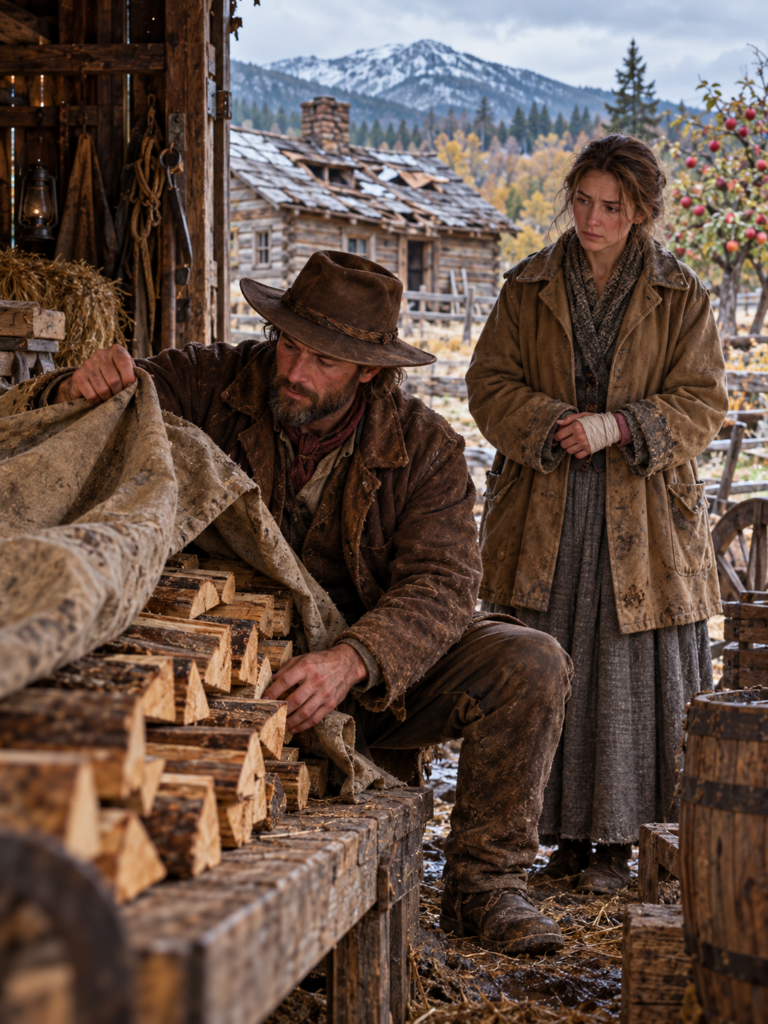
Willa’s hand stopped above her plate.
Ezra kept his eyes on hers.
“When I drove through your gate, you were standing beside the ladder. I heard what you said.”
For a moment, she did not move.
“What did I say?”
“You asked the Lord to send somebody to fix the roof before the snow.”
The color left her face.
“You heard that?”
“Yes, ma’am.”
“And you didn’t tell me?”
“I should have.”
She slowly lowered her fork.
“You watched me bargain over a dime. You saw that wrist. You knew I needed help.”
“I knew you were having trouble.”
“And you let me stand there pretending I wasn’t.”
Ezra looked down.
He had not thought of it that way.
“I didn’t want you believing I expected something in return for hearing a private prayer.”
Willa pushed back her chair.
“Then why did you stay?”
“Because you had good roofing wood and apples falling from the trees. Because I can work, and you have something worth trading.”
“That’s all?”
“It was enough.”
She walked toward the porch railing.
The orchard lay in darkness beyond the yard.
For several moments, only the sound of water dripping inside the house disturbed the silence.
Then Willa spoke.
“I’ve asked for help every night since June.”
Ezra said nothing.
“Every night. And every morning I’ve gotten up and moved another bucket.”
She let out a small, bitter laugh.
“You know what frightened me most about asking?”
He remembered the second part of her prayer.
“You didn’t want someone demanding payment you couldn’t give.”
Willa turned.
Her expression changed completely.
“You heard that too?”
Ezra nodded.
She covered her mouth.
The embarrassment in her eyes was so painful that he wished he could take back the admission.
“I’ve had men look at this place,” she whispered. “They see the orchard, the house, the land. They think a woman alone must be desperate enough to accept whatever terms they offer.”
“I haven’t asked for your land.”
“I know.”
“Or your house.”
“I know that too.”
She looked down at her bandaged wrist.
“That’s almost worse.”
Ezra did not understand.
Willa continued quietly.
“I can refuse a dishonest bargain. I can tell a man his price is too high. But I don’t know how to accept kindness without wondering what it will cost.”
“It doesn’t have to cost anything.”
“Everything costs something, Mr. Colton.”
She turned back toward the dark orchard.
“My father understood that.”
Ezra waited for her to explain.
Instead, she straightened.
“I want you gone in the morning.”
He rose slowly.
“The roof isn’t finished.”
“I know.”
“The agreement says a week.”
“I know what it says.”
Ezra glanced toward the house.
Water was still falling into the buckets.
“If that’s what you want, I’ll go.”
“It is.”
He carried his plate to the edge of the table.
“Good night, Miss Prior.”
Willa entered the cabin and shut the door.
A moment later, he heard the wooden bar fall into place.
Ezra returned to the barn.
He lay awake beneath his blanket, listening to the mules shift in their stalls.
He had promised to leave.
Yet he had also signed his name to an agreement that he had barely begun to fulfill.
He could not repair her house against her wishes.
But neither could he forget the carefully stacked pine or the desperate prayer at the foot of the ladder.
Near midnight, he heard something beyond the barn.
A dull wooden impact.
Then another.
He rose and looked toward the cabin.
A faint light showed near the work area.
Someone was splitting shakes.
The blows came unevenly, separated by long pauses.
Ezra imagined Willa holding the froe with her injured wrist.
He wanted to go outside.
He did not.
She had told him to leave.
At first light, he harnessed the mules and led them toward the gate.
The wagon wheels rattled over the frozen yard.
He left the property as instructed.
But just beyond the gate, he stopped.
The road to Loveland stretched ahead.
Behind him stood a cabin with a failing roof.
He sat on the wagon seat and waited, uncertain whether honoring Willa’s wishes required leaving immediately or giving her the chance to reconsider.
An hour passed.
Then the cabin door opened.
Willa walked across the yard, her coat fastened tightly and her right wrist freshly wrapped.
She stopped beside the gate.
“Are you leaving, Mr. Colton?”
“That’s what you told me to do.”
“Then why are you still here?”
Ezra looked at her.
“Because I gave my word about the roof. But I won’t come back onto your property unless you ask.”
Her eyes reddened.
“I asked God,” she whispered. “I don’t know how to ask you.”
Ezra removed his hat.
“Those aren’t the same thing, Miss Prior.”
Willa gripped the gatepost.
For the first time since he had met her, she seemed unable to find a proud answer.
Then she took one unsteady breath.
And began to speak.
“Stay.”
The word was so quiet that Ezra almost thought the wind had carried it away.
Willa swallowed.
“Not because you heard me praying. Not because you feel sorry for me.”
She looked directly at him.
“Stay because I’m asking you.”
Ezra climbed down from the wagon.
“Then I’ll stay.”
Her expression trembled.
“But we keep the agreement.”
“Of course.”
“Half the cider. Not a drop more.”
“Half.”
“And you’ll take your meals on the porch.”
“Yes, ma’am.”
Willa stepped aside from the gate.
Ezra led the mules back into the barn.
Neither mentioned the previous evening again.
But something had changed.
Before, Willa had treated every act of help as a possible threat to her independence.
Now, although she remained guarded, she had made the choice herself.
She had asked.
And Ezra understood that the request had cost her more than the cider she had promised him.
They resumed work.
For the next several days, the homestead filled with the ordinary sounds of labor.
At dawn, Ezra split pine bolts beside the barn.
His wooden mallet struck the froe with steady, practiced blows.
Clean shakes accumulated in neat stacks.
Willa climbed the shorter orchard ladder with a canvas sack over her shoulder, picking apples from the lower branches while protecting her injured wrist.
She pushed the filled sacks to the press shed in a wheelbarrow.
Sometimes Ezra helped turn the hand-cranked grinder.
Then Willa arranged the crushed fruit beneath the oak screw press and lowered the heavy mechanism until brown-gold cider ran into a stone trough.
The first time they worked the press together, she held out a tin cup.
“Taste it.”
Ezra drank.
The cider was sharp, cold, and wonderfully sweet.
“That’s worth hauling.”
Willa watched his face.
“My father always said the first cup belonged to whoever turned the crank.”
“Then I suppose it’s mine.”
She took the cup from him.
Filled it again.
And drank.
For a moment, they stood together in silence.
Then she said, “I haven’t shared the first pressing with anyone since June.”
Ezra noticed how quickly her face changed.
He did not ask why.
June seemed to be a month surrounded by closed doors.
The pine bolts had been stacked before summer ended.
The ladder frightened her.
Her wrist was injured.
And whenever she mentioned her father, she spoke as if the wound was still fresh.
By Thursday afternoon, Ezra had split enough shakes to begin serious roof work.
But another problem was approaching.
Willa brought the almanac to the porch table.
“Snow is expected around the tenth.”
Ezra counted the days.
“That gives us less than a week.”
“It usually comes close to what the almanac says.”
He studied the damaged roof.
The north slope was the worst.
Old tar paper covered several patches.
Flattened coffee tins had been nailed over leaking places.
Some of the original shakes were so worn that their edges had curled upward.
The entire middle section sagged.
It would take more than replacing loose boards.
Ezra would have to remove the damaged covering, inspect the structure beneath it, replace rotten material, and lay the new shakes correctly.
He understood why the second workman had refused.
The roof was not merely inconvenient.
Parts of it were dangerous.
On Saturday morning, Willa came into the yard carrying the ladder.
She set it against the north wall and held the rails with her good hand.
Ezra tested the footing.
Then he tied the upper section securely.
“You don’t have to stand there all morning,” he told her.
“I know.”
She tightened her grip.
“But I will.”
Ezra climbed carefully.
The roof creaked beneath his weight.
He kept to sound support while pulling loose the old covering.
Gray strips of weathered wood came away beneath his pry bar.
The patched places lifted reluctantly.
Beneath the sagging section, the sheathing had softened with rot.
He cut away the damaged wood until he reached sound material.
Below him, Willa watched every movement.
Once, when the ladder shifted slightly beneath the pressure of his boot, he heard her draw a sharp breath.
He looked down.
Her eyes were fixed on the rails.
“It’s secured,” he said.
“I can see that.”
But her hands remained tight.
Ezra returned to the roof.
As he worked near the lower edge of the north slope, he noticed something dark lodged in the gutter trough.
At first, he thought it was a piece of fallen roofing timber.
He reached toward it with the pry bar.
The object moved.
Metal scraped against the gutter.
Ezra leaned closer.
It was a hammer.
An ordinary claw hammer with a hickory handle, partly buried beneath old leaves and damp debris.
He lifted it free.
Rust spotted the head.
The handle had darkened from long use.
Near its end, someone had burned a name into the wood.
A. Prior.
Ezra held the tool for several seconds.
Then he looked down at Willa.
She stood beside the ladder, one hand shielding her eyes from the sun.
He could not know exactly how the hammer had come to rest in the gutter.
But he knew it belonged to her family.
And judging by the accumulated debris, it had been there for months.
He descended carefully.
When his boots reached the ground, he held out the hammer with its handle toward her.
“Miss Prior, I found something.”
Willa looked at the tool.
Her expression went blank.
Ezra waited.
She did not take it.
“Where?”
“In the gutter. Just below the old patched section.”
Willa stared at the handle.
Her breathing changed.
“It was still up there?”
“I expect so.”
She raised her good hand toward her mouth.
Then lowered it.
“The ninth,” she whispered.
Ezra said nothing.
“The ninth of June.”
She looked toward the roof.
“My father was up there.”
The meaning of the date began to emerge.
Willa spoke without looking at Ezra.
“He was patching the north slope. He’d carried a bucket of tar up that ladder. I was working in the orchard.”
Her voice was steady in a way that suggested she had repeated the memory to herself many times.
“I heard the ladder move.”
Ezra waited.
“It slipped on the wet boards.”
Her fingers tightened against her coat.
“When I turned, he was on the ground.”
Ezra glanced toward the ladder.
Willa continued.
“He was sixty-one. He’d climbed that roof more times than I could count. He wasn’t careless.”
“No, ma’am.”
“He had been promising to replace the roof properly for two years. But there was always another bill.”
She swallowed.
“My mother’s doctor. The note on the north pasture. Something else that needed paying.”
She looked again at the hammer.
“So he kept patching.”
For several moments, neither spoke.
Then Willa said, “He was alive when I reached him.”
Ezra’s hand closed around the hickory handle.
Willa’s voice weakened.
“He asked me whether the ladder was all right.”
She looked down.
“I told him it was.”
The yard seemed terribly quiet.
“That was what he worried about,” she continued. “Not himself. The ladder.”
Ezra understood now.
Her father had fallen from the roof.
The hammer had remained where the work stopped.
And Willa had spent the following months trying to finish what he had begun.
“He died?” Ezra asked softly.
She nodded.
“I’ve been patching the roof ever since.”
Her eyes filled.
“I couldn’t bear to have somebody else climb it. I couldn’t bear to leave it leaking either.”
She looked at her wrapped wrist.
“In September, I slipped on the second rung. I didn’t fall far, but I hurt this.”
Ezra remembered the morning she had demonstrated how to split a shake.
The pain she had tried to conceal.
The way she watched him whenever he approached the ladder.
“I lay on the ground afterward,” she whispered. “And all I could think about was Father asking whether it was all right.”
For the first time, she looked directly at him.
“That’s why I prayed.”
Ezra held the hammer silently.
“I couldn’t climb anymore. But I couldn’t ask a stranger to do it either.”
Now he understood the contradiction that had puzzled him since arriving.
There had never been a lack of materials.
Her father had already prepared the wood.
There had been a lack of money, an injured wrist, and grief so closely connected to the roof that Willa could scarcely face it.
The hidden hammer had not revealed a crime or a deception.
It had revealed where an ordinary day’s work had ended.
And why Willa had been unable to begin again.
Ezra held out the tool.
“He meant to finish the roof, didn’t he?”
Willa nodded.
“Then we’ll do the job properly.”
She finally took the hammer.
Her hands closed around its worn handle.
“But I want one thing.”
“Name it.”
“When we reach the final course at the ridge, I want to drive the nails myself.”
Ezra glanced upward.
The height was dangerous.
The roof would require secure footing.
And Willa’s wrist had not fully healed.
Yet he recognized what she was asking.
She did not merely want a repaired house.
She wanted to finish the work her father had left behind.
“We’ll make sure you can do it safely,” he said.
Willa nodded.
For a moment, she pressed the hammer against her chest.
Then she turned toward the house.
Ezra watched her disappear beneath the carved lintel.
He looked back at the partly stripped roof.
The remaining damage was extensive.
The weather was changing.
And now the work carried a meaning far greater than the cider he would earn.
The following evening, Willa invited him to the porch.
On the table stood a large, worn family Bible.
Beside it lay the hammer, cleaned and oiled.
She opened the book to the psalm her father had carved above the doorway.
And for the first time, she told Ezra why those words had become almost unbearable to read.
Willa rested one finger against the open Bible.
“Except the Lord build the house, they labour in vain that build it.”
She read the words slowly.
Ezra sat opposite her at the porch table.
The hammer lay between them, its old hickory handle polished by years of her father’s hands.
“My father carved those words above the door,” she said.
“I noticed them the night I arrived.”
“He believed a man ought to work hard. But he used to say there was a difference between doing your duty and thinking you could hold the whole world together by yourself.”
She turned another page.
“He always said the rest of the psalm mattered as much as the beginning.”
Ezra listened while she read the passage about rising early, sitting up late, and eating the bread of sorrows.
Then she closed the Bible.
“He told me a person couldn’t earn sleep simply by working harder.”
Her mouth tightened.
“I haven’t slept a full night since June.”
Ezra said nothing.
“I get up when the house becomes too quiet. I count the buckets. I go to the barn and split shakes until my arms hurt. Then I come back inside and listen to the roof leaking.”
She looked toward the old doorway.
“I’ve been trying to do every bit of work he left behind, as though finishing it might somehow make the day of his accident come out differently.”
The words seemed to surprise her once they were spoken.
Ezra leaned back.
He had no answer that could repair a loss like that.
He knew only that she had spent months blaming herself for things she could no longer change.
Willa touched the hammer.
“He never blamed me. Not even at the end.”
Her eyes filled.
“And I’ve been blaming myself enough for both of us.”
The evening darkened around them.
Ezra remained seated.
He did not tell her that grief would pass quickly.
He did not promise that a new roof would make everything right.
He understood that there were repairs a man could make with wood and nails, and losses those tools could never reach.
After a long silence, Willa spoke again.
“I don’t know if I believe what Father believed anymore.”
Ezra considered her words.
“Well,” he said, “you still remember them.”
She looked at the Bible.
“Yes.”
“Maybe that’s enough for tonight.”
Willa gave a small, exhausted nod.
Then the wind changed.
It came over the northwestern ridge in a thin, cold stream.
Both looked toward the orchard.
Willa rose.
“That’s snow weather.”
Ezra followed her gaze.
The western sky had taken on a dull, metallic color.
The forecast had warned of snow around the tenth.
But the weather was moving faster than expected.
“Tomorrow?” he asked.
“Maybe sooner.”
Ezra studied the roof.
They had replaced the worst of the damaged structure, but the new shakes still had to be laid across much of the north slope.
The unfinished surface remained exposed.
If snow reached the open section, moisture could work into the boards beneath.
Another hard storm could undo days of careful labor.
They had little time.
On Monday morning, they began before the light had fully reached the orchard.
Ezra worked from the secured ladder and scaffold.
Willa carried stacks of shakes to the base of the house.
She loaded them into a bucket, and Ezra hauled them upward by rope.
The work required an exact rhythm.
One course had to overlap the one below.
Each shake needed proper placement so water would run downward rather than enter the seams.
Ezra drove the nails carefully, leaving the wood room to expand and contract.
Willa kept the next supply ready.
The bucket went up.
The empty bucket came down.
Another load followed.
By midday, the new roofing stretched across the lower part of the north slope.
The warped section that had once sagged beneath layers of patchwork began disappearing under clean, straight lines.
Willa stood back once to look.
“Father would have liked the way those shakes lie.”
Ezra glanced down.
“He cut good wood.”
“He always did.”
There was no bitterness in her voice this time.
Only recognition.
They continued.
The work was physically punishing.
Ezra’s shoulders ached from hauling and hammering.
Willa’s injured wrist needed rest, so she used her stronger hand whenever possible.
They spoke only when necessary.
The weather gave them no reason to waste daylight.
By evening, half the north slope was covered.
The remaining work stretched toward the ridge.
Ezra examined the sky.
A low band of cloud had gathered beyond the hills.
He could smell snow in the wind.
They stopped only when it became too dark to place the shakes accurately.
At supper, Willa set two plates on the porch table.
Neither had much appetite.
“How much tomorrow?” she asked.
“Enough that we’ll be working every minute we have.”
“Can you finish?”
Ezra looked toward the roof.
“If the weather gives us the chance.”
Willa folded her hands.
Her gaze moved toward her father’s hammer, resting beside the doorway.
“The last course is still mine.”
“I remember.”
She did not smile.
But she looked grateful that he had not forgotten.
Tuesday arrived without a proper sunrise.
Heavy clouds hung low over the foothills.
The wind blew steadily from the northwest.
Willa came into the yard and lifted her face.
“Snow before dark.”
Ezra studied the sky.
“Then we’d better get started.”
They worked with a speed born of necessity, not recklessness.
Ezra checked the scaffold and ladder again before climbing.
The ladder’s feet were secured, and its upper section was tied firmly to the structure.
Willa inspected the ropes.
Then she began sending shakes upward.
The roof changed hour by hour.
The old dark patches disappeared.
Fresh pine covered the repaired sheathing.
Where rainwater had once run beneath crooked boards, straight courses now overlapped neatly.
At noon, Ezra paused long enough to drink water.
He looked toward the orchard.
The trees stood almost motionless beneath the heavy sky.
Thousands of apples had already been picked or pressed during the week.
The cider barrels waited in the shed.
The harvest that Willa had feared losing was no longer entirely beyond saving.
And the roof, which had haunted her since June, was nearly complete.
Ezra returned to work.
In early afternoon, the first snowflakes arrived.
Small.
Dry.
Scattered by the wind.
Willa noticed them immediately.
She said nothing.
She loaded the next bucket.
By four o’clock, the snowfall had thickened.
White flecks settled on the new pine.
The remaining daylight had become yellow and strange.
Ezra reached the upper edge of the roof.
The north slope was almost finished.
Only the final courses and the ridge cap remained.
He descended.
Willa waited beside the ladder with her father’s hammer.
“We can finish it,” Ezra said. “But conditions are getting worse.”
Willa looked upward.
Then she looked at the tool in her hand.
“The last course is mine.”
“Miss Prior, there’s snow on the wood.”
“I can see that.”
“Your wrist isn’t healed.”
“I know.”
He hesitated.
She stepped closer.
“You promised.”
Ezra studied her expression.
This was not the stubborn refusal to accept help that he had witnessed on his first day.
She had spent the week working beside him.
She had asked for assistance.
She had allowed him to repair what she could not.
Now she wanted to contribute to the final piece of work herself.
But he could not ignore the risk.
“We’ll check the footing once more,” he said. “And if it’s unsafe, we don’t do it.”
Willa looked at him for a long moment.
Then she nodded.
Together, they examined the secured ladder, scaffold, and the remaining route to the ridge.
Ezra tested the supports.
The approaching snow gave them a narrow opportunity before the surface became too slippery.
When he was satisfied that the arrangement remained stable enough for the planned work, he took his position at the ladder.
Willa put the hammer through her belt.
She placed a small supply of nails in her pocket.
Then she looked at the first rung.
Her face lost its color.
Ezra saw her hand close around the rail.
“Miss Prior?”
She swallowed.
“My father asked whether the ladder was all right.”
He nodded.
“I remember.”
“I told him it was. I hadn’t checked.”
Ezra looked directly at her.
“This one is footed and tied. I’ve tested it. I’m holding it, and I’ll stay here.”
Willa closed her eyes briefly.
Then she placed her boot on the first rung.
The ladder remained still.
She climbed to the second.
Then the third.
At the fourth, she stopped.
Ezra could feel her trembling through the rails.
He kept his hands steady.
He did not urge her upward.
After several breaths, she continued.
One rung.
Then another.
At the eighth, she paused and whispered something Ezra could barely hear.
“Lord, I’m here. Keep me steady.”
She resumed climbing.
Ezra watched every movement.
When she reached the secured working platform, she lowered herself carefully into position.
She had spent months looking up at this roof from the ground.
Now the orchard spread below her.
The barn stood across the yard.
The foothill road curved away toward Loveland.
And the last unfinished portion of the roof lay within reach.
She removed the first shake from the bucket Ezra had prepared.
Set it in place.
Then drew her father’s hammer from her belt.
The first blow sounded across the yard.
A sharp, familiar ring.
Her wrist ached.
She adjusted her grip.
The second nail went in more slowly.
Ezra watched from below.
The wind moved across the ridge.
Snow settled on Willa’s shoulders and the back of her coat.
She continued driving nails, one at a time.
At one point, her knee shifted on the damp working surface.
She stopped immediately and secured her position.
Ezra tightened his grip on the ladder.
“Are you steady?”
“Yes.”
“Don’t hurry.”
“I’m not.”
She drew a careful breath.
Then returned to the work.
The final shakes came into place.
She positioned the ridge cap across the peak.
For several seconds, she remained motionless.
Her father’s hammer rested in her hand.
She looked down along the clean new slope.
The damaged roof that had consumed her days since June was gone.
The pine her father had cut was finally where he had intended it to be.
She raised the hammer.
Drove the first ridge nail.
Then the second.
The final blow rang through the falling snow.
Willa did not move.
The tool rested against the new wood.
Her shoulders trembled.
“It’s finished,” she whispered.
Below, Ezra watched her bow her head.
He waited.
When she finally lifted her face, it was wet.
He could not tell whether the moisture came from melting snow or tears.
“Mr. Colton?”
“Yes, ma’am?”
“I’m coming down.”
“I’m here.”
She moved carefully toward the secured ladder.
Ezra held it as she lowered herself.
Her first steps were deliberate.
Halfway down, one boot slipped slightly on a damp rung.
She caught the rail immediately.
Ezra held the ladder firm.
It did not move.
Willa stopped, her cheek close to the wood.
She breathed hard.
Then she looked down at him.
“It held.”
“Yes, ma’am.”
“The ladder held.”
“It did.”
A laugh escaped her.
It sounded half like relief and half like something she had been holding inside for months.
She continued downward until both boots reached the ground.
Ezra stepped aside.
Willa leaned against the cabin wall.
Her father’s hammer rested in her lap.
For a long while, neither spoke.
Above them, snow settled on the new roof.
The north slope was complete.
That night, Willa left the buckets standing inside the house.
There were seven of them.
For months, they had been arranged beneath the familiar leaks.
She had emptied them after every storm.
She knew the sound each one made when water struck its metal bottom.
Now the snow fell steadily outside.
Nothing dripped into the buckets.
Willa moved from one to another.
She touched the rim of the nearest one.
Then looked up at the ceiling.
Quiet.
No water.
No ticking drops.
No need to empty anything.
She sat down.
For the first time since June, she allowed the silence to remain.
She did not go to the barn to split shakes.
She did not inspect the ladder.
She did not return to the porch to study the roof.
She went to bed.
And she slept.
Ezra knew something had changed when he woke in the barn the following morning.
The cabin lamp had gone out early the night before.
It had not come on again.
He stepped into the yard and examined the roof.
Snow covered the north slope in a smooth white sheet.
No black patches showed beneath it.
No dark streaks marked the walls.
The new covering had held through the night.
At seven, the cabin door opened.
Willa stood beneath the carved lintel.
She wore a clean apron.
Her hair was pinned neatly.
For the first time since Ezra had arrived, she looked rested.
He removed his hat.
“Morning, Miss Prior.”
She glanced at the roof.
Then at him.
“The agreement says meals are to be served on the porch.”
“That’s right.”
“The agreement didn’t account for snow.”
“No, ma’am.”
She stepped back from the doorway.
“Come inside, Mr. Colton.”
Ezra hesitated.
She raised an eyebrow.
“And wipe your boots.”
He smiled faintly.
“Yes, ma’am.”
Inside, the house was small but carefully maintained.
The seven buckets remained against the wall.
Every one was dry.
Willa brought bread and fried apples to the table.
Ezra sat opposite her.
For a moment, she rested her hands on the back of her chair.
Then she bowed her head.
“Lord,” she began quietly, “I asked for somebody to repair this roof.”
Ezra lowered his eyes.
“I don’t know whether you sent anybody. I only know a man came through my gate with tired mules and a leaking tarp.”
Her voice trembled.
“He worked beside me. He held the ladder. And when I went up, it held.”
She paused.
“Thank you for the roof. Thank you for his hands. Thank you for the ladder. And thank you for my father, who cut the wood.”
She swallowed.
“Amen.”
“Amen,” Ezra answered.
They ate together while snowlight filled the cabin.
After a while, Willa set down her cup.
“You still have a delivery to make.”
“That’s true.”
“The cider’s ready. Eight barrels.”
Ezra nodded.
“Your half is four.”
She looked at him sharply.
“And don’t start telling me it’s too much.”
“I wasn’t going to.”
“You looked like you might.”
He lifted his cup.
“Wouldn’t dream of it.”
For the first time, Willa smiled without trying to conceal it.
Ezra began preparing the wagon.
The mules were rested.
His hay delivery could still be completed.
He loaded the four barrels that belonged to him under their agreement.
Then he checked the harnesses and tightened the ropes.
Willa watched from the porch.
The snow had softened the entire yard.
The orchard branches bent beneath the white covering.
Beyond the gate, the road toward Loveland stretched through the foothills.
Before climbing onto the wagon, Ezra looked back at the roof.
“When spring comes,” he said, “I’d like to see how it handles the thaw.”
Willa stood beneath the doorway.
“I’d like that.”
Neither said more.
There was no promise beyond those words.
No declaration.
No attempt to turn one difficult week into something larger than either of them understood.
Ezra had come to the homestead because his mules needed shelter.
Willa had allowed him to stay because he agreed to pay for it.
The bargain that followed had been practical and fair.
But somewhere between the pine bolts, the cider press, the broken roof, and the old hammer, they had learned to trust one another.
Willa had discovered that accepting help did not require surrendering her independence.
Ezra had learned how much courage it could take for someone to ask.
And both had come to understand that the roof had represented more than a damaged building.
It was unfinished work.
It was grief.
It was the place where a father’s last ordinary morning had ended.
For Willa, repairing it had seemed impossible because she could not separate the task from the memory.
Now the roof was complete.
Her father’s wood covered the house.
His hammer had driven the final nails.
And the ladder she had feared for months had held beneath her feet.
Ezra led the wagon toward the gate.
On the post still hung the small twist of paper containing the dime he had paid on his first night.
He noticed it as he passed.
He left it there.
At the road, he turned once more.
Willa stood on the porch with one bare hand resting against the old doorframe beneath her father’s carved words.
Above her, the new roof lay white and quiet beneath the falling snow.
For months, she had looked at that roof and seen the day her father died.
Now, without forgetting him, she could see something else.
The work he had prepared.
The house he had cared for.
The man who had stopped in the sleet.
And the life she still had to live inside those walls.
Ezra lifted his hand.
Willa lifted hers.
Then he turned toward Loveland.
Behind him, the cabin stood beneath its first real snow of the season.
The seven buckets remained dry.
The hammer rested safely inside.
And for the first time in months, Willa Prior no longer needed to spend the night listening for water falling through her father’s roof.
She could hear the snow settling overhead.
And leave it there.


