
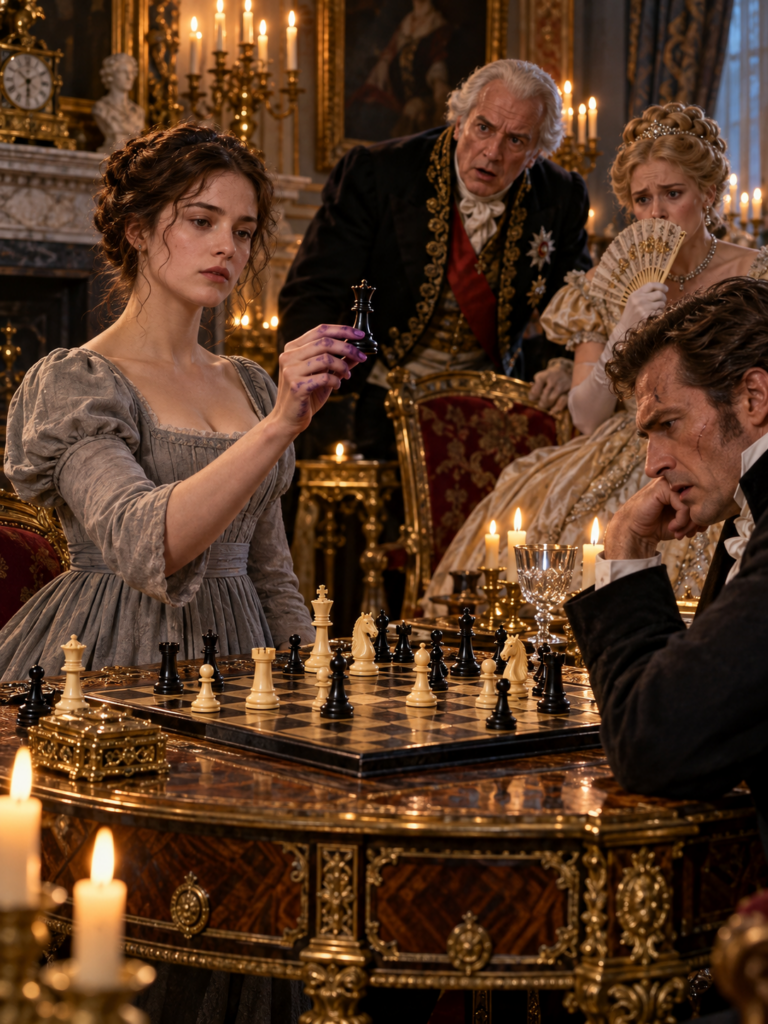
Thomasina’s fingers closed around the black ivory queen.
For one terrible instant, she thought the duke might stop her.
His scarred hand remained beside the board.
His jaw tightened.
But he did not interfere.
She lifted the queen from its square.
Every conversation in the card room died.
Miss Farquhar covered her mouth with her fan.
Count Belsky leaned forward.
Gallagher looked from the captured piece to Thomasina with something approaching wonder.
She placed the queen beside the board.
“Your move, Your Grace.”
The duke’s eyes hardened.
He continued playing.
Thomasina knew he would.
He was a soldier accustomed to fighting lost positions until the final possibility disappeared.
His remaining rook came forward.
She blocked it.
He brought his last knight toward her king.
She exchanged a bishop to remove the threat.
The spectators crowded closer.
Nobody laughed now.
Mrs. Strickland stood rigidly beside the fireplace, her hands clasped so tightly that her rings pressed into her skin.
Thomasina felt almost sorry for her.
Almost.
The duke’s defense weakened.
One of Thomasina’s rooks crossed the board.
Then the second joined it.
His king retreated behind its own pawns.
She studied the remaining squares carefully.
There was no need to hurry.
Finally, she moved her rook.
“Checkmate, Your Grace.”
The duke stared at his king.
The mantel clock ticked.
Then, with deliberate care, he laid the black king upon its side.
The room erupted.
A gentleman shouted in disbelief.
Several ladies pressed closer to examine the position.
Count Belsky approached Thomasina.
“Madam,” he said, taking her ink-stained hand, “that was among the finest games I have witnessed in years.”
He bowed.
Not the shallow nod a nobleman might offer a servant.
A full, respectful bow.
Thomasina felt her face burn.
“Thank you, Count.”
“Who taught you?”
“My father, sir. And the soldiers stationed near his chapel.”
“Then they served you wonderfully. I should consider it an honor to play you tomorrow.”
All eyes turned toward Mrs. Strickland.
“If my employer permits it,” Thomasina answered.
Mrs. Strickland forced a smile.
“Of course. Miss Carew has always been clever.”
Count Belsky’s expression cooled.
“Then perhaps you should not have threatened to withhold her wages.”
The hostess went crimson.
Miss Farquhar tried to laugh.
“Surely it was only a fortunate trick.”
The ambassador turned toward her.
“You invited this woman to a game so that she might be humiliated. She defeated your champion instead. That is what every person here witnessed.”
Miss Farquhar closed her fan.
No one came to her defense.
The duke rose abruptly.
“Gallagher. My gloves.”
He did not congratulate Thomasina.
He did not offer his hand.
Without another word, he left the room.
Thomasina watched him go.
The victory she had imagined would bring satisfaction suddenly felt strangely incomplete.
She had seen something in the duke’s face when she surrendered that fourth pawn.
Recognition.
But of what?
Gallagher followed his master.
At the doorway, he paused.
He turned and gave Thomasina the small salute of a soldier acknowledging an officer.
Then he disappeared.
***
Hours later, supper was served.
Thomasina stood beside the sideboard.
Companions did not ordinarily sit among titled guests.
The duke had returned in a fresh coat.
Miss Farquhar leaned toward him.
“Your Grace, surely you allowed her to win.”
He cut a piece of beef.
“No.”
The room became attentive.
“I played carelessly,” he continued. “Sent my queen too far into her position. She was fortunate. It won’t happen again.”
Thomasina felt the words strike harder than she expected.
Fortunate.
Not skilled.
Not deserving.
Merely fortunate.
Mrs. Strickland put down her fork.
“You see, Miss Carew? His Grace was generous enough to explain.”
Thomasina remained silent.
“You have made a spectacle of my household.”
“Madam, I only played because I was ordered to.”
“And you were expected to know when to stop.”
Mrs. Strickland rose.
“I will not retain a companion who makes her employer ridiculous. You are dismissed.”
Thomasina’s breath caught.
“Madam?”
“Your quarterly wages are forfeited. You will leave tonight.”
“Tonight? It is snowing.”
“The night mail stops at the crossroads. The gig can take you there.”
Thomasina looked toward the duke.
He could have spoken.
One word would have stopped the dismissal.
Instead, he reached for his glass.
And remained silent.
Thomasina curtsied.
“Very well, madam.”
She left through the servants’ door.
Upstairs, her little room was bitterly cold.
She pulled her trunk from beneath the bed.
Two worn gowns.
A Bible.
Her father’s sermons.
A hairbrush.
A nearly empty bottle of violet ink.
Then she reached beneath her pillow and withdrew a small folding chessboard.
Her father had made it from an old wooden ammunition box.
She opened it on the bed.
The tiny pegged pieces still stood in the position of an unfinished game.
A game played through the post.
Her opponent was a man she had never met.
For three winters he had signed his letters with a single initial.
A.
She touched the fourth pawn.
And suddenly remembered the duke’s face.
How white he had gone.
How fiercely he had studied that opening.
Thomasina’s fingers tightened around the little board.
Because she had seen that same opening before.
In the letters of the one man who knew her mind better than anyone living.
And for the first time that night, she understood whom she had defeated.
Then the bedroom door opened.
Miss Farquhar entered, smiling.
“I’ve come to wish you a pleasant journey.”
Thomasina closed the pocket chessboard.
Miss Farquhar glanced toward the snow beyond the window.
“The night coach crosses the heath,” she said. “I do hope the roads are passable.”
Thomasina slowly fastened the lid of her trunk.
“I shall discover that for myself.”
Thomasina fastened the second clasp of her trunk while Miss Farquhar stood watching.
“You needn’t look so offended,” the younger woman said. “A companion who defeats a duke cannot expect to remain unnoticed.”
Thomasina rose.
“I did not ask to be noticed.”
“No. That makes it rather worse, doesn’t it?”
Miss Farquhar smiled.
Thomasina looked at her steadily.
“You asked me to sit down because you thought I would disgrace myself.”
“Everyone enjoys a harmless joke.”
“Then I hope you enjoyed it.”
For the first time, Miss Farquhar had no immediate answer.
Thomasina lifted her cloak from the bed.
“Good night.”
The younger woman withdrew, leaving the door open behind her.
Thomasina closed it quietly.
She would not spend her final moments in this house pleading with anyone.
She wrapped her father’s chessboard in a handkerchief and placed it inside her gown.
Then she lifted her trunk.
***
Downstairs, the Duke of Eisgarth sat alone in the library.
A glass of brandy rested beside his hand.
The fire had burned low.
He had been sitting there for nearly an hour without drinking.
In his pocket lay a letter.
Not one of the letters brought that morning.
An older one.
The paper had grown soft along its folds.
He withdrew it.
The handwriting was small, upright, and precise.
The ink was violet.
He read the first line.
A chess move.
The same astonishing pawn sacrifice he had seen that evening.
He read the rest.
The writer had addressed him as a friend.
For three winters, he had exchanged chess moves and letters with a correspondent known only as T. Carew.
He had imagined an elderly scholar.
Perhaps a retired chaplain.
Someone who understood chess, loneliness, military life, and the terrible weight of memories that refused to fade.
In those letters, he had written things he had never spoken aloud.
About Spain.
About the assault on a breached fortress.
About orders obeyed in confusion.
About men he had failed to protect.
About Gallagher, whom he had carried away from danger.
T. Carew had never excused what was wrong.
But the letters had reminded him that a man’s worst hour need not define every hour afterward.
The duke unfolded the paper completely.
Near the bottom was a simple promise.
Whenever sleeplessness troubled him, his correspondent would answer.
He had believed that promise because it had been kept for three winters.
He looked at the violet handwriting.
Then remembered the companion’s fingers.
The same color stained into the skin.
He remembered her opening move.
Her insistence upon playing honestly.
Her father.
The garrison chapel.
He stood so abruptly that his brandy glass overturned.
“Gallagher!”
The former sergeant appeared almost immediately.
“Sir?”
“Miss Carew. What was her father’s position?”
“Chaplain at the garrison near Chatham, sir.”
The duke closed his eyes.
“Dear God.”
Gallagher waited.
“Where is she?”
“The gig took her to the crossroads, sir.”
“When?”
“Some time ago.”
“Then we can catch the mail.”
Gallagher hesitated.
“The mail has already gone. I heard its horn.”
The duke stared at him.
“And she is aboard?”
“As far as I know, sir.”
Outside, wind rattled the windows.
The snow was growing heavier.
The duke looked down at the letter.
“I called her fortunate.”
Gallagher said nothing.
“I sat there while Strickland dismissed her. I knew it was wrong. And I said nothing.”
“No, sir.”
The answer was painfully plain.
The duke put the letter back inside his coat.
“Have the horses saddled.”
“Sir, the heath is dangerous tonight.”
“I know.”
“We may lose the road.”
“Then we’ll find it again.”
Gallagher met his eyes.
For a moment, the old soldier looked much as he had during the war, when orders had to be judged against the lives they might cost.
“Very well, sir.”
***
Count Belsky appeared in the library doorway as Gallagher went to wake the grooms.
“Eisgarth.”
The duke turned.
The ambassador wore a dark dressing gown and carried a candle.
“Have they truly sent that young woman away in this weather?”
“Yes.”
“And you permitted it?”
“Yes.”
The count studied him.
“Then you have made a greater mistake than losing a game.”
“I know.”
“I have played kings, generals, and ministers for fifty years. Tonight I watched an extraordinary woman treated as a fool because she had no money or position.”
The duke lowered his head.
“And the only gentleman in that room whose word might have protected her remained silent.”
“Yes.”
Count Belsky sighed.
“You lost your queen twice tonight, my friend.”
The duke looked at the letter in his hand.
“I mean to recover what I can.”
“Then be certain you understand what was lost.”
***
The night mail had been crossing the heath for nearly an hour when the weather worsened.
Thomasina sat outside because the outside fare was cheaper.
Her cloak was thin.
Snow gathered along her shoulders and slipped inside her collar.
Beside her sat a young clerk who kept coughing into a handkerchief.
The guard had moved forward to help the coachman find the road.
Thomasina could no longer see the hedges.
Everything beyond the carriage lamps was white.
She thought of the duke.
For three winters she had written to A., never imagining his title.
He had told her about loneliness in rooms full of people.
About campaigns that haunted his sleep.
About a sergeant whose loyalty meant more to him than the friendship of fashionable society.
He had written with humor, anger, intelligence, and unexpected tenderness.
That man had been her friend.
The duke who sat across the chessboard had treated her as an inconvenience.
She did not know which version she ought to believe.
Then the coach lurched.
A wheel slipped.
The coachman shouted.
Thomasina grasped the edge of the roof.
The carriage tilted.
There was a tremendous crack.
And the world overturned.
***
She landed in deep snow.
For a few seconds she could not understand where she was.
Then she heard horses screaming.
The coach lay on its side in a ditch.
One wheel turned slowly above the road.
Thomasina struggled to her feet.
She found the coachman lying nearby, conscious but unable to use his injured wrist.
The guard emerged carrying a lantern.
“Are you hurt, miss?”
“I don’t think so.”
He looked toward the overturned coach.
“The passengers?”
“Still inside.”
The guard glanced down the road.
“I must take the mail forward and bring help.”
“How far?”
“Several miles. I cannot promise when I’ll return.”
Thomasina looked at the carriage.
She understood that leaving the injured passengers without help would be disastrous.
“Then go quickly.”
The guard hesitated.
“Who’s to look after them?”
“I will.”
He stared at her.
She was a companion in a thin gray cloak.
Nothing about her appearance suggested authority.
But her voice did not falter.
The guard nodded.
Then he began preparing one of the horses.
Thomasina climbed the overturned carriage and opened the upper door.
“Can everyone hear me?”
Frightened voices answered.
She lowered herself into the dark compartment.
An elderly lady was unconscious.
A wool merchant clutched his injured arm.
A soldier’s young wife was crying.
The clerk had managed to climb down after Thomasina and offered what assistance he could.
Thomasina checked that the old woman was breathing.
Then she asked the clerk for a light.
It took several attempts to kindle the carriage lamp.
At last, its weak flame illuminated the faces around her.
Everyone was frightened.
Everyone looked toward her.
“Listen carefully,” Thomasina said. “Help is being sent. Until it arrives, we must keep the cold out as well as we can.”
The wool merchant stared at her.
“Who are you to give orders?”
“Nobody important,” she replied. “A companion.”
She took a breath.
“But I can see what needs doing. Will you help?”
The soldier’s wife nodded.
The clerk said yes.
After another moment, so did the merchant.
They began working.
The clerk packed cushions against a broken window.
Thomasina used cloth and broken wood to support the coachman’s injured wrist without attempting to force the damaged joint back into place.
The soldier’s wife helped arrange blankets and dry garments around the older passengers.
Thomasina found a spade among the equipment.
She climbed outside.
The wind struck her with such force that she nearly fell.
Snow had begun piling against the carriage door.
If it became blocked, they might be unable to escape.
She cleared a passage with the spade.
Her hands grew clumsy.
Her shoulders burned.
Twice the wind knocked her to her knees.
But she kept working until the passage was open.
When she returned, the soldier’s wife helped her climb back inside.
“Your hands, miss!”
“They’ll recover.”
“Sit down.”
Thomasina almost smiled.
Someone else giving orders was rather comforting.
They wrapped her hands in dry cloth and let them warm gradually.
The old woman regained full awareness.
The coachman was shivering.
The merchant complained incessantly about his arm.
Thomasina decided his complaints were preferable to silence.
After a while, the clerk asked, “How shall we pass the time?”
Thomasina felt her father’s pocket chessboard against her side.
She took it out.
“We shall play chess.”
He stared.
“Now?”
“Especially now.”
She set up the pieces.
The clerk knew almost nothing of the game.
She taught him.
The soldier’s wife remembered a little from watching her husband.
The wool merchant insisted he had once been an excellent player and proceeded to demonstrate that he had forgotten most of the rules.
For a little while, they forgot the overturned carriage.
They were simply people moving wooden pieces and arguing about pawns.
Thomasina played one game after another.
She kept them talking.
Kept them alert.
Kept them occupied.
But beneath the blanket, her own feet were growing frighteningly numb.
And her eyes were becoming heavy.
The clerk examined the little board.
“Who taught you, miss?”
“My father. Some soldiers. And a gentleman I’ve never met.”
“How can a stranger teach you?”
“We exchange moves through the post.”
“Who is he?”
Thomasina hesitated.
“A man who signs himself A.”
“A friend?”
“Yes.”
She looked at the tiny black king.
“At least, I believed he was.”
The soldier’s wife gently touched her wrist.
“What happened?”
“I met him tonight.”
“And?”
Thomasina swallowed.
“He was not the man I expected.”
Outside, the wind howled.
Then another sound reached her.
A voice.
Distant.
Deep.
Calling through the snow.
“Carew!”
Thomasina raised her head.
The voice came again.
“Thomasina Carew!”
She knew it.
She climbed toward the door.
“Miss!” the soldier’s wife called. “Be careful!”
Thomasina pushed herself through the opening.
A lantern shone below.
In the snow stood the Duke of Eisgarth.
His dark hair was wet.
His coat was white with frost.
A gray horse waited behind him.
“Miss Carew!”
He looked up at her.
“Are you hurt?”
“No, Your Grace.”
“Thank God.”
She had no time to consider his arrival.
“The coachman’s wrist is injured. The elderly passenger is badly chilled. We have four others inside, and one lamp. Do you have blankets?”
“Yes.”
“A spade?”
“Yes.”
“Then pass them up. The door must remain clear.”
The duke obeyed immediately.
He gave her the supplies.
Then he climbed inside when she asked him to.
He did not attempt to take charge.
He helped wrap the passengers.
He cleared the passage.
He offered his greatcoat to the elderly lady.
When the merchant recognized him and began offering elaborate thanks, the duke interrupted gently.
“Do as Miss Carew directs. She’s kept you alive this long.”
Thomasina looked at him.
For the first time that night, the man before her resembled the friend she had known through his letters.
When the immediate work was finished, the duke sat beside her.
His gaze fell upon her father’s pocket board.
“May I see it?”
She handed it over.
He examined the unfinished correspondence game.
Then looked at her.
“You are T. Carew.”
“Yes.”
“And you knew at the card table.”
“After my fourth move.”
He closed his eyes.
“I should have known sooner.”
“You were rather occupied with defeating me.”
A pained smile crossed his face.
“Among other failures.”
Thomasina waited.
The duke looked at the little black king.
Then deliberately laid it on its side.
“I resign.”
She stared.
“Your Grace?”
“In our correspondence game. And in the argument I have been having with myself since supper.”
He met her eyes.
“You were not fortunate. You were better prepared, braver, and more honest than I was.”
Her throat tightened.
“I called your victory an accident because I couldn’t bear what it revealed about me. Then I watched you dismissed and said nothing.”
He lowered his head.
“I was ashamed of losing. I chose my pride when I should have chosen what was right.”
The carriage had become very quiet.
“I cannot ask you to pretend I was brave tonight,” he continued. “I wasn’t.”
Thomasina looked at the man who had written to her for three winters.
For the first time, he seemed to have nothing left to hide behind.
Then he took her hand gently, without attempting to hold it when she drew it back.
“I came because you are the one person to whom I’ve ever told the whole truth about myself.”
His voice shook.
“And I let you leave believing I thought nothing of you.”
Thomasina’s eyes filled.
Before she could answer, another lantern appeared through the snowfall.
Gallagher had returned with a wagon and men from the inn.
The passengers began preparing to leave the overturned carriage.
The duke stood and helped Thomasina gather the chess pieces.
She closed the little board.
Then she looked at him.
“You are not forgiven simply because you found me.”
He nodded.
“I know.”
“And I have no intention of returning to Mrs. Strickland.”
“I would never ask it.”
“Then there is something I need from you.”
“Name it.”
“Tomorrow, when we are warm and safe, you will listen to everything I have to say.”
The duke met her eyes.
“I will.”
Thomasina placed the pocket board inside her cloak.
“Then help me get these people into that wagon.”
The duke stepped aside and made room for Thomasina to climb down.
Then he turned to the approaching wagon.
“Gallagher! We have injured passengers. Bring it as close as the road permits.”
Gallagher jumped down from the box.
He glanced at Thomasina, then at the duke.
Relief softened his battered face.
“Glad to see you on your feet, miss.”
“Thank you, Gallagher.”
The old sergeant looked toward the overturned coach.
“You’ve had a rough night.”
“So has everyone else.”
She pointed toward the passengers.
“The coachman must be moved carefully. His wrist is badly injured.”
Gallagher nodded.
“Then we’ll see to him first.”
The duke helped the men lay fresh straw in the wagon.
Thomasina directed the removal of the passengers, beginning with those least able to manage the climb.
She refused assistance until the others were settled.
Only then did she allow the duke to help her down.
Her knees almost gave way when her boots touched the ground.
He caught her by the forearm.
“Steady.”
“I am perfectly capable of standing.”
“I know.”
He did not release her until she had found her balance.
Then his hand fell away.
Gallagher saw the exchange.
He smiled faintly and turned back to the horses.
***
They reached the inn shortly before dawn.
The building stood beyond the worst of the heath, its windows glowing yellow through the falling snow.
The landlord and his wife had prepared a kitchen fire.
Warm bread and milk awaited the exhausted travelers.
The coachman was given a bed.
The other injured passengers were settled as comfortably as possible while help was sought.
Thomasina sat near the hearth, her hands wrapped around a cup.
The heat made her fingers ache.
Her boots were wet through.
Her face was pale with exhaustion.
The duke sat across from her, having refused the private room offered on account of his rank.
For a long while, neither spoke.
Then Thomasina said, “I thought we were friends.”
He raised his eyes.
“We were.”
“Were we?”
The question hurt him.
She could see that.
But she had promised herself she would not make the truth easier merely because he was powerful.
“For three winters,” she continued, “you wrote to me as though my thoughts mattered.”
“They did.”
“You asked what I believed about courage, duty, forgiveness, and honor.”
“Yes.”
“You told me things you had never dared tell anyone else.”
“Yes.”
“And then you met me.”
His face tightened.
“You met a companion,” she said. “A woman with no title, little money, and no influence in your world.”
He did not interrupt.
“You treated me like a tiresome amusement. When I won, you called it luck. And when I was dismissed into a snowstorm, you watched me go.”
She lowered her cup.
“Which man was the real one?”
The duke looked at the fire.
For several moments he said nothing.
Then he answered.
“Both.”
Thomasina remained still.
“The man who wrote those letters wanted very badly to be decent,” he said. “The man at Strickland Park was proud, frightened of ridicule, and accustomed to being obeyed.”
He looked toward her.
“They are the same man. That’s what makes my behavior inexcusable.”
She had expected an explanation.
Perhaps a defense.
Perhaps a speech about having been misunderstood.
Instead he had accepted the contradiction.
He continued.
“I have spent years telling myself that the war made me hard. That it excused my temper. That no one could understand what I had done or what I had seen.”
“You believed I understood.”
“Yes.”
“But only because you imagined I was a gentleman.”
His expression changed.
He took a breath.
“I imagined you were an old chaplain. Perhaps a retired officer. Someone whose life had given him the authority to correct mine.”
Thomasina looked down at her hands.
“And when you learned I was merely a woman who had to earn her bread?”
“Then I discovered how little I understood about the courage I claimed to respect.”
He leaned forward.
“You were frightened at that table. Gallagher noticed it before I did. You knew your wages were at risk. You played honestly anyway.”
Thomasina thought of her father.
His thin voice.
The final games they had played beside his bed.
“I made him a promise.”
The duke waited.
“That I would never throw a game. Not to gain favor and not to avoid punishment.”
He nodded.
“Then you kept it.”
“Yes.”
“And I broke the very principles I spent three winters discussing with you.”
“Yes,” she said quietly. “You did.”
There was another silence.
This time it was not uncomfortable.
The duke looked at the folded chessboard lying beside her cup.
“May I ask you something?”
“Yes.”
“Why did you keep answering my letters?”
Thomasina considered the question.
“At first, because you were a remarkable chess player.”
He smiled a little.
“And afterward?”
“Because you were lonely.”
His smile disappeared.
She continued.
“You wrote late at night. I could tell when you hadn’t slept. Your handwriting grew less steady. Your moves became aggressive.”
He looked astonished.
“You noticed?”
“Of course.”
“I thought I concealed it.”
“Not very well.”
A faint smile touched her lips.
“You also made jokes when you were unhappy. Very poor jokes.”
He laughed once.
It sounded almost unfamiliar to him.
“And yet you continued writing.”
“Yes.”
“Why?”
Thomasina looked toward the fire.
“After my father died, the letters became the one place where I did not have to make myself smaller.”
The duke bowed his head.
She went on.
“As a companion, I was expected to be useful, pleasant, and invisible. At the chessboard, I could think as freely as I pleased.”
“You were never invisible to me.”
“In your letters, no.”
He accepted the distinction.
Then he said, “I should like to earn the right to know you as well in person.”
Thomasina felt a warmth that had little to do with the fire.
But she remembered the supper table.
His silence.
Her employer’s cruelty.
Her dismissal.
“I will need to see more than regret.”
“You shall.”
“And I cannot become another person you are kind to when no one important is watching.”
The duke looked directly at her.
“Then I must learn to be worthy of your company before the people who matter to me, not merely when we’re alone.”
She nodded.
“That would be a beginning.”
***
When the sun rose, the snow had stopped.
Pale light entered through the inn windows.
The innkeeper’s wife brought fresh tea.
Gallagher appeared to report that the injured passengers had been attended to and arrangements were being made for their onward journeys.
The duke thanked him.
Then he turned to Thomasina.
“There is another matter.”
She looked up.
He reached into his coat pocket.
Something small and black rested in his palm.
An ivory chess queen.
Thomasina recognized it at once.
“The queen from Strickland Park.”
“Yes.”
“You brought it?”
“I went back to the card room before leaving.”
He placed it on the table between them.
“I thought about that game all the way across the heath.”
“Only the game?”
“No.”
He smiled sadly.
“I thought about how confidently I believed I knew every square on the board. And how confidently I believed I knew every person in that room.”
Thomasina touched the ivory piece.
“It is a handsome queen.”
“It belongs to you.”
She looked up.
“I took it fairly.”
“Exactly.”
He hesitated.
Then his expression grew serious.
“I should like to offer you something else.”
Thomasina waited.
“My house. My name. Whatever future I can give you.”
She went very still.
The duke continued before she could speak.
“Not as compensation for what happened. And not because I think you require saving.”
He placed his hand upon the table, palm open.
“I want to marry you, Thomasina.”
Her breath caught.
Outside, a wagon rolled slowly into the yard.
Somewhere in the kitchen, dishes clattered.
The ordinary sounds seemed impossibly distant.
“You scarcely know me,” she whispered.
“I have known your mind for three winters.”
“That is not the same as knowing how we should live.”
“No,” he agreed. “It isn’t.”
She looked at him.
He continued.
“I know there are things we must learn. I know my title would change your life. I know you would be judged by people who know nothing about you.”
“And I know you do not like being contradicted.”
His mouth moved toward a smile.
“I have received convincing evidence of that.”
“You are proud.”
“Yes.”
“Stubborn.”
“Yes.”
“Sometimes terribly unkind.”
His smile faded.
“Yes.”
Thomasina looked at the queen.
“What do you imagine marriage would mean for me?”
The duke considered.
“I would hope it meant you had a home in which you could speak freely.”
“And play chess?”
“Whenever you pleased.”
“And write?”
“As much as you wish.”
“And disagree with you?”
“Frequently, I expect.”
She smiled despite herself.
He leaned forward.
“I am not asking you to become grateful for a duke’s attention. I am asking whether the man who wrote to you, and the man who failed you last night, might be given the chance to become someone you could freely choose.”
Thomasina’s eyes filled.
She had spent years being told what she could afford to want.
Safety.
A place.
Wages paid on time.
Enough coal for winter.
But she had never dared imagine being wanted for her intelligence, her laughter, her courage, or the small, curious habits that made her herself.
She looked at the man across from her.
He had traveled into a storm.
He had helped her rescue strangers without taking command.
He had admitted his disgrace before people who could repeat it.
Yet none of those acts could erase what had happened.
Only changed conduct over time could do that.
So she gave him an answer he had not expected.
“I want to marry the man I’ve known through the letters.”
His breath caught.
“But before I do,” she continued, “I want to know that he can remain that man when the whole world is looking.”
The duke nodded slowly.
“That is fair.”
“And I will not return to Strickland Park as somebody’s dependent.”
“You won’t.”
“Nor will I accept a marriage merely because you rescued me from the snow.”
“I would never wish it.”
Thomasina looked at the queen.
Then she held out her hand.
“I am willing to build that future with you, Archibald. If you are willing to prove, in ordinary life, what you have promised here.”
He took her hand.
“I am.”
She smiled through tears.
“Then yes. I will marry you.”
For a moment the duke could only look at her.
Then he bent and kissed her hand.
“Thank you, Thomasina.”
She shook her head gently.
“No. Don’t thank me as though you’ve won something.”
He looked up.
“What should I say?”
She smiled.
“Your move.”
***
Their marriage was not arranged in secret.
Nor did Thomasina allow herself to be swept into a new household without understanding the position she would occupy.
She made certain her belongings were collected.
She asked for her outstanding wages to be accounted for, though Mrs. Strickland resisted the demand.
Count Belsky lent his influence to ensuring that her dismissal and treatment were not quietly forgotten.
The duke publicly acknowledged that Thomasina had defeated him honestly.
He did not call it luck again.
When acquaintances attempted to diminish her victory, he answered without hesitation.
“She played better than I did.”
Sometimes they laughed.
Sometimes they tried to turn the matter into a joke.
He did not.
Thomasina noticed.
It was one of the first promises he kept.
***
By spring, their marriage had taken place.
The woman who had once stood silently beside Mrs. Strickland’s sideboard was now the Duchess of Eisgarth.
Her circumstances had changed beyond anything she once imagined.
But Thomasina refused to treat her new position as proof that she had become valuable.
She had been valuable when she possessed only two gowns and a worn folding chessboard.
She had been valuable when she earned twenty pounds a year.
She had been valuable when a cruel hostess forced her into a chair as a joke.
The difference was that she no longer lived in a household where those truths had to remain hidden.
At Eisgarth, she established a place for herself.
She took an interest in the estate’s accounts.
She maintained her correspondence.
She made friends among people who loved books, music, and chess rather than merely pedigree.
She treated the household staff with dignity.
And when she and Archibald disagreed, she told him plainly.
Sometimes he became impatient.
Sometimes she did.
But he learned to hear the argument beneath his pride.
And she learned that she need not prepare for dismissal every time she spoke honestly.
***
Count Belsky visited during the following winter.
He arrived in a heavy coat, carrying the same determination that had brought him to the chess table at Strickland Park.
“I’ve come to correct an old injustice,” he announced.
Thomasina smiled.
“Which injustice, Count?”
“You promised me a game. Then you married a duke and disappeared into the countryside.”
Archibald laughed.
“She hasn’t disappeared. She’s simply been defeating me in private.”
“Then I shall test her myself.”
They played that evening in the library.
The fire burned brightly.
Snow drifted past the tall windows.
Archibald sat nearby with a book he barely read.
Count Belsky lost the first game.
He demanded another.
He lost that too.
On the third evening, after studying her methods and correcting his own, he finally defeated her.
He rose from his chair in triumph.
“Madam! At last!”
Thomasina laughed.
“You have earned it, Count.”
Archibald looked up from his book.
“You allowed him to win.”
Thomasina turned.
“No.”
“You cannot expect me to believe—”
“Archibald.”
He stopped.
She raised an eyebrow.
“I never throw a game.”
The duke smiled.
“I beg your pardon.”
Count Belsky laughed so loudly that Gallagher came to the library door to see what had happened.
***
Gallagher had kept one small reminder of that first evening.
The white pawn Thomasina had sacrificed on her fourth move.
He had found it beneath the card table after the guests had gone.
For years it remained in a little drawer beside his personal belongings.
When anyone asked why he kept such an unimportant object, he gave the same answer.
“That’s the pawn that beat His Grace.”
And he smiled.
The servants eventually heard the whole story.
Not simply that the duke had been defeated.
But that a woman considered too insignificant to join the supper table had shown greater courage than almost anyone in the room.
And that the duke, having failed her, had been obliged to learn what honorable conduct required.
It became a story people told with affection rather than cruelty.
***
Years afterward, the chessboard still occupied its place beside the library fire.
The black ivory queen remained carefully preserved.
Thomasina’s father’s pocket board rested nearby.
Its corners had grown smoother with use.
The violet ink stains on her fingers came and went as she wrote letters.
Her handwriting remained as upright and precise as ever.
Sometimes Archibald would open an old letter and read a line aloud.
She would remember the winters when they had known one another only through paper and chess moves.
And sometimes they would laugh at how thoroughly they had misunderstood each other’s identities.
But they never treated that misunderstanding as the beginning of their love.
The beginning had come earlier.
In the slow exchange of thoughts.
In nights spent writing honestly.
In the discovery that another mind could understand what the world did not.
The card room had merely forced them to see the faces behind the letters.
And the storm had forced them to discover what those words were worth.
One winter evening, Archibald sat opposite Thomasina at the library chessboard.
Outside, snow rested quietly on the lawns.
Inside, the fire snapped and settled.
He arranged the black pieces.
Thomasina took white.
Then he looked at her with exaggerated confidence.
“Twelve moves, madam.”
She smiled.
“Only twelve?”
“I believe I can manage it.”
“Shall I call for a clock?”
“You may call for a witness if you like.”
Gallagher, passing the doorway, chuckled.
“Not me, sir. I know how this ends.”
Thomasina moved her first pawn.
Archibald answered.
The game developed quickly.
Her third move was quiet.
On the fourth, she offered a pawn.
Archibald looked at it.
Then at her.
His expression softened.
“Again?”
“Again.”
He studied the board.
“I know what you’re doing.”
“Then stop me.”
He captured the pawn.
She smiled.
For a while, neither spoke.
The fire burned lower.
The mantel clock measured the minutes.
Thomasina built her attack carefully, and Archibald fought against it with all the skill that had once made him famous.
At last, his queen advanced too far.
Thomasina moved her knight.
A familiar fork appeared.
Archibald leaned back.
Then he began to laugh.
Not bitterly.
Not defensively.
With genuine delight.
He moved his king.
Thomasina reached across the board and captured his queen.
“Your move, Your Grace.”
Archibald looked at her.
“My dear, I believe I have already made the most fortunate move of my life.”
“And which was that?”
He reached for her hand.
“When I stopped trying to win every game.”
Thomasina smiled.
Then she gently withdrew her fingers and pointed to the board.
“That is very touching, Archibald.”
“Yes?”
“But you are still in trouble.”
He laughed again.
And the game continued.
The woman who had once been forced into a chair as a joke now sat there because she chose to.
The man who had once mistaken pride for strength now knew the difference between being admired and being loved.
The chessboard had not changed.
The pieces were the same.
But across those sixty-four squares sat two people who had learned that the greatest victories were not the ones that left someone else humiliated.
They were the ones in which neither person had to surrender their dignity to remain together.
And when Thomasina finally laid her husband’s king on its side, Archibald bowed across the board.
“Well played, my love.”
She lifted his captured queen between two fingers.
“Thank you, Archibald.”
Then she put the queen gently beside the board, where it belonged.
And reached for his hand.

