
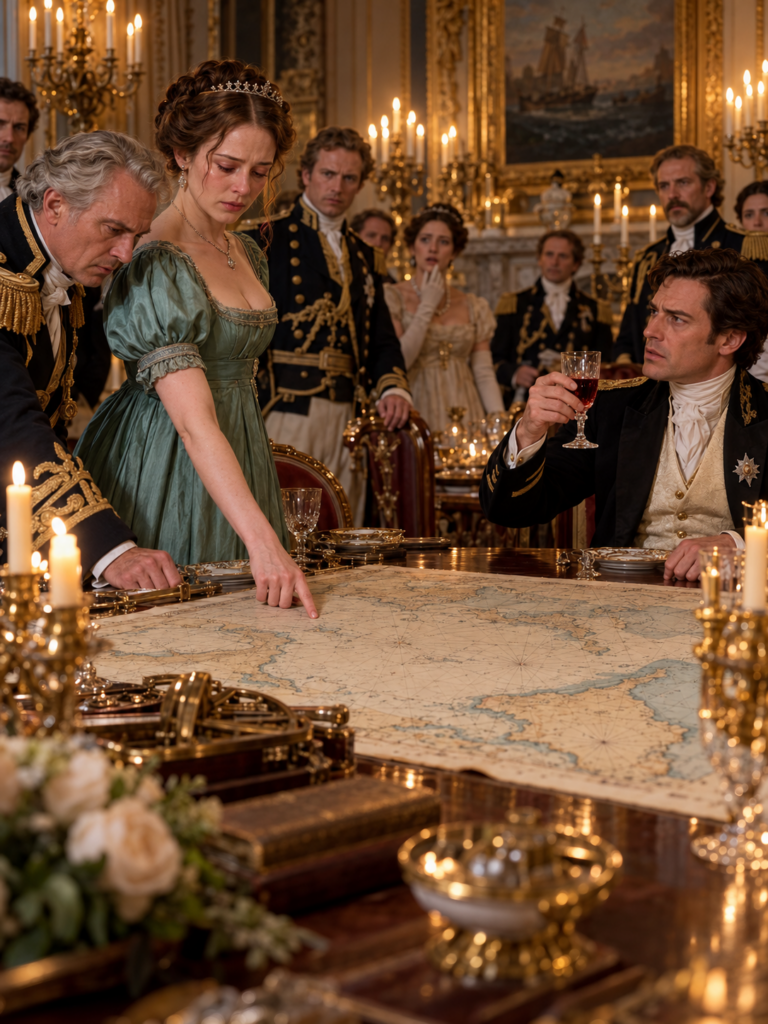
The admiral drew his chair closer to the chart and asked Clare to show him the exact position of the submerged rock.
She did not move her finger.
“It lies east of the suggested anchorage, sir. Near enough that a ship swinging at anchor could be driven across it.”
One officer leaned forward.
“The chart shows open water.”
“My father said the same thing to a captain who trusted another chart.”
Clare lifted her eyes.
“That captain lost his ship.”
The officer fell silent.
Admiral Fielding asked her to begin at the Lizard and work eastward, identifying the shoals, rocks, and approaches from memory.
She did.
Her finger traveled across the coastline with the assurance of someone tracing the rooms of her childhood home.
She described where a rock exposed its head at low water, where breakers concealed another, and which passage a skilled pilot would favor when entering Falmouth.
Her descriptions were so precise that the admiral finally stopped questioning her and simply listened.
At the head of the table, the duke lowered his glass.
He remembered Clare standing before his desk only days earlier.
He remembered the warning about Oliver’s brig.
And he remembered dismissing her because she had mentioned the swallows.
The realization struck him with unexpected force.
His wife had not been speaking foolishly.
She had been trying to save his brother.
The admiral looked up.
“Your father was one of the finest pilots I ever knew.”
Clare’s composure faltered.
“Thank you, sir.”
“He brought my frigate home when I believed I would lose her. I remember his voice in the darkness, calling the soundings as though he could see through the sea.”
He paused.
“And I remember shaking his hand afterward.”
The admiral took Clare’s hand.
“His hands were much like yours.”
Then he bowed deeply.
Not to her title.
Not to her husband.
To the knowledge and courage she had inherited.
Lady Arabella gave a brittle laugh.
“Well, what an extraordinary accomplishment. Who knew the fish trade offered such an education?”
Nobody joined her.
The admiral ignored the remark.
“I sail for Falmouth shortly, Your Grace. I should like you to accompany us south and help the harbor pilots identify this rock. It ought to be marked before my squadron arrives.”
“I can find it,” Clare answered.
“Even after eight years?”
“I have never forgotten where it lies.”
The admiral nodded.
“Then I shall depend upon you.”
The duke’s face burned.
All evening he had watched London society measure his wife against its expectations.
Now a distinguished naval officer was asking her to undertake work that could protect hundreds of sailors.
And the duke had publicly called her useless.
The dinner continued, but its old atmosphere had disappeared.
The guests no longer looked toward Clare with amusement.
Several officers approached to ask questions.
One apologized for doubting her.
She answered each without triumph.
She had not spoken to win an argument.
She had spoken because men might die if she remained silent.
***
After midnight, the last carriage departed.
The duke returned to the dining room.
Most of the candles had been extinguished.
Clare stood alone beside the chart.
Her finger rested once more on the empty water.
He stopped in the doorway.
“Why did you never tell me?”
She did not turn.
“Tell you what?”
“That you knew these things. That your father saved the admiral’s ship. That you could read a naval chart better than my guests.”
Clare looked up slowly.
“Your Grace, I tried to tell you about the weather.”
“That was different.”
“Was it?”
He said nothing.
“You refused to let me breakfast with you. You made me feel unwelcome in your study. You permitted your sister to humiliate me. And tonight you called me a fishwife before twenty people.”
She rolled the chart carefully.
“Why would I have expected you to listen?”
The duke opened his mouth.
Nothing came.
Clare tucked the chart beneath her arm.
“You ask why I did not tell you anything about myself.”
Her voice remained steady.
“Because in four months of marriage, you never once asked who I was.”
She passed him.
He did not try to stop her.
At the doorway, she paused.
“There is one thing you should know now.”
He turned.
“Your brother’s brig is still at sea. The weather will not care whether you believe me.”
Then Clare climbed the stairs, leaving her husband alone beside the fading candles.
For several moments he remained motionless.
At last he walked toward his study.
There, inside the desk, lay Oliver’s letter from Lisbon.
The duke pulled it out.
He read again the promise to reach Falmouth before the end of November.
Eleven men aboard.
Eleven lives.
He looked at the date.
Then he reached for a fresh sheet of paper and began writing a warning his wife had already asked him to send.
The duke dipped his pen and wrote urgently.
Oliver must avoid approaching the Cornish coast in an easterly gale. He must remain offshore or seek safe shelter rather than trust the anchorage near the Manacles.
The duke sealed the letter and summoned a servant to arrange its dispatch.
But as the household settled into silence, he understood the limits of what he had done.
A letter could not overtake a ship already at sea.
And his brother might already be beyond its reach.
For the first time, the duke wished he had listened when Clare first entered his study.
***
The following morning, he climbed the staircase to his wife’s chambers.
He had not visited her there since their wedding.
He knocked.
After a moment she answered.
“Come in.”
Clare was seated beside the window.
At her feet lay a coil of tarred rope marked at intervals with pieces of leather, wool, and cloth.
A lead weight rested on a folded towel.
The duke stopped just inside the doorway.
“What is that?”
“My father’s sounding line.”
She lifted the heavy lead.
“This is what we used to learn the depth beneath a boat.”
He stepped closer.
Clare showed him the hollow in the base.
“Tallow goes here. When the lead touches bottom, it may bring back sand, shell, or mud. The depth and the nature of the bottom help a pilot determine where the vessel lies.”
“And the cloth?”
“Marks for different depths. You learn to recognize them by touch as well as sight.”
He crouched to examine the rope.
Her hands moved confidently over the old markings.
A strip of leather.
A piece of white calico.
Red wool.
The marks meant something to her that they did not yet mean to him.
“Your father taught you all this?”
“From childhood.”
“Why?”
She gave him a searching look.
“Because he believed I could learn.”
The answer stung more than an accusation would have.
After a moment, the duke said, “Would you teach me?”
Clare regarded him quietly.
“Not today.”
He straightened.
“Of course.”
“I have preparations to make for Cornwall.”
“I understand.”
He turned toward the door.
“Your Grace,” she said.
He looked back.
“Someday, perhaps.”
He bowed his head.
“I should like that.”
***
Two days later, Lady Arabella attempted to revive the old laughter at breakfast.
Her friend in the violet turban sat beside her, enjoying every remark.
“Our famous duchess,” Arabella said. “Perhaps the admiral will ask her to count his fish next.”
The friend giggled.
“Or teach his officers to mend nets.”
The duke lowered his newspaper.
“Enough, Arabella.”
His sister smiled.
“Oh, don’t become solemn. You began the joke yourself.”
“Yes,” he replied. “I did.”
Clare looked at him.
He laid the paper aside.
“And it was cruel when I said it. It remains cruel when you repeat it.”
Arabella’s smile thinned.
“Really, brother, you cannot mean to make a scandal over some harmless teasing.”
“I mean to put an end to it.”
The room became silent.
Arabella looked toward Clare.
The duchess did not appear grateful.
She merely continued drinking her tea.
Later, when the duke found an opportunity to speak privately, he said, “I should have stopped that months ago.”
“Yes,” Clare replied.
She offered no easy absolution.
He had not earned one.
***
Arabella did not forgive the humiliation of being corrected.
She merely changed her method.
That afternoon Clare returned to her room and found her trunk standing open.
The sounding line was missing.
She searched beneath the bed, behind the furniture, and inside every drawer.
The rope had vanished.
So had the lead.
She went downstairs and questioned the servants.
Most avoided her eyes.
Finally, a young kitchen porter approached while she stood near the scullery.
“Your Grace,” he whispered, “Lady Arabella’s maid brought an old rope down here.”
Clare turned toward him.
“What happened to it?”
“She said it was rubbish, ma’am. The carter took it away.”
For a moment Clare could not breathe.
The line had belonged to her father.
Its markings carried the touch of his hands.
She had used it beside him on cold nights and dangerous mornings.
And now somebody had discarded it because it looked common.
“Where does the carter leave the rubbish?”
The porter told her.
Clare moved toward the rear door.
Before she reached it, her husband appeared.
He had heard enough from the household to understand.
“Clare.”
She stopped.
“Where is my father’s line?”
“I know where it was taken.”
“Then I’m going after it.”
“May I fetch it?”
She looked at him sharply.
It was the first time he had asked instead of commanding her.
“I don’t want a servant sent,” she said.
“Then I’ll go myself.”
He kept his eyes on hers.
“Please let me try.”
At last she nodded.
“Bring it home.”
***
The duke traveled to the rubbish yards near the river.
He went without changing his good coat.
He searched among broken crockery, ashes, spoiled vegetables, and household refuse.
The men working there stared at the finely dressed gentleman turning over discarded bundles.
He paid them no attention.
At last he uncovered a familiar coil of blackened rope.
Leather markers.
Faded wool.
And the heavy lead at its end.
Mud coated the weight.
He lifted the line himself.
The rope stained his gloves and cuffs.
He carried it home and washed the dirt away at the stable pump.
Then he entered the drawing room.
Arabella and her friend were playing cards.
The duke placed the damp coil across their table.
The cards scattered.
Arabella recoiled.
“What on earth are you doing?”
“Returning something you ordered thrown away.”
She looked at the rope.
“Oh, that.”
“Yes. That.”
“It was filthy.”
“It belonged to Clare’s father.”
“Brother, surely you cannot expect me to recognize every piece of old fishing equipment—”
“You knew whose room it came from.”
Arabella looked away.
He continued.
“You knew it mattered to her. That was why you chose it.”
The friend in the violet turban rose uneasily.
The duke stood very still.
“Your carriage will be ready within the hour.”
Arabella stared.
“You cannot be serious.”
“You will go to Bath. Neither of you will return to this house unless Clare wishes it.”
“Over a rope?”
“Over the deliberate humiliation of my wife.”
His voice hardened.
“And because I allowed that behavior to flourish under my own roof.”
Arabella finally understood that he would not be persuaded.
Within the hour, both women were gone.
***
Clare watched their carriage depart from the upper landing.
When she turned, her husband was standing below with the sounding line in his arms.
He climbed partway toward her and offered it.
Clare took the rope.
Her fingers moved immediately over the familiar markings.
Nothing important had been cut away.
The lead was intact.
She held it close.
“Thank you.”
“Clare.”
She looked up.
“I owe you an apology that is larger than retrieving your father’s line.”
He stood below her so that their faces were nearly level.
“I married you because my father asked it of me. I resented that obligation. And I let my resentment fall on you.”
She remained quiet.
“I was ashamed of your upbringing,” he continued. “I imagined London would laugh at me for marrying a pilot’s daughter. So I chose to laugh first.”
His voice changed.
“It was cowardly. You did nothing to deserve it.”
Clare’s eyes shone, but she did not look away.
“I cannot undo four months,” he said. “Nor can I ask you to forget them. But I will not repeat them.”
She glanced at his stained cuffs.
“You went into the rubbish yards yourself.”
“Yes.”
“Your servants will talk about that for years.”
“Very likely.”
“You’ve ruined your gloves.”
“I have others.”
Clare’s mouth softened into the smallest smile.
For the first time, he smiled back without mockery.
***
Four days later, they left London for Cornwall.
Clare carried the admiral’s chart in a leather case.
Her father’s line traveled safely with their luggage.
Rain followed their carriage across the countryside.
During the second day, the duke finally asked, “Will you tell me how the line is marked?”
Clare looked at him.
“You still wish to know?”
“I do.”
She began explaining the different markers.
He listened carefully.
When she finished, he attempted to repeat them.
He made two mistakes.
Clare corrected him.
He tried again.
This time he remembered.
“Your father must have been a patient teacher,” he said.
“Not particularly.”
She smiled.
“He made me recite the marks every evening. If I forgot one, I had to begin again.”
“Then I’ve escaped lightly.”
“You certainly have.”
He laughed.
Clare turned toward him.
It was the first time she had heard him laugh without someone else being the object of it.
A small, unexpected warmth moved through her.
Perhaps they were not beyond repair.
***
When they reached Falmouth, the harbor smelled of salt, tar, fish, and wet rope.
Clare stepped from the carriage and breathed deeply.
Home.
Women from the fish market recognized her immediately.
They came forward, embracing her and exclaiming over her clothes and her thinness.
One elderly woman held Clare’s face between her rough palms.
“My girl, have they been feeding you properly in London?”
Clare laughed.
“Yes, Mrs. Prowse.”
The woman’s gaze traveled toward the duke.
“We heard what your husband called you.”
The dockside fell quiet.
The duke removed his hat.
“Then you heard the truth, madam. I spoke shamefully about my wife before my own guests.”
Mrs. Prowse inspected him.
“At least you know it.”
“Yes.”
“That’s a beginning.”
Clare watched her husband accept the rebuke without protest.
It mattered.
But she understood that a beginning was not the same as a finished journey.
A broad-shouldered harbor pilot approached them.
His name was Keast.
He had once worked with Clare’s father and had helped teach her the practical business of the sea.
He embraced her warmly.
Then his expression grew serious.
“The admiral’s message came. He wants the uncharted rock identified before the squadron arrives.”
“I know.”
“We’ve a gig ready.”
Clare glanced at the sky.
The clouds were moving fast.
“Then we’d best go while the weather holds.”
Keast nodded.
“But there’s something else.”
The duke looked toward him.
“What?”
“The Speedwell hasn’t arrived.”
“How overdue?”
“Three days.”
The duke’s face changed.
“Three?”
“Yes, Your Grace.”
Clare followed Keast’s gaze toward the sea.
An easterly wind was beginning to strengthen.
She knew what that could mean.
***
That afternoon, Clare accompanied Keast and his crew in the harbor gig.
Her husband remained on the quay.
He watched the narrow boat make its way toward the dangerous reef.
From shore it seemed terribly small.
The men pulled in rhythm.
Keast managed the sounding line.
Clare directed their course by familiar landmarks and the appearance of the water.
They approached carefully.
The reef rose and vanished among the swells.
Clare called for the crew to hold the boat steady.
Keast lowered the lead.
When it returned, the tallow showed hard rock beneath them.
Clare looked around, aligning the shoreline marks she remembered from her father’s lessons.
“There,” she said.
“The Anvil.”
Keast nodded.
“Then we’ll mark it.”
The crew set a buoy with a visible marker near the danger.
Clare watched it rise and fall upon the waves.
Eight years earlier, the rock had taken her father’s life.
Now it was marked for every vessel approaching those waters.
She pressed her lips together.
For one moment she wished he could have seen it.
***
The duke was waiting when the gig returned.
His coat was wet from spray.
Clare stepped onto the quay.
“Was it where you remembered?” he asked.
“Exactly.”
He glanced toward the reef.
“Then the admiral will have his warning.”
“Yes.”
He hesitated.
“Next time, would you consider taking me?”
Keast laughed.
“A duke in a pilot gig?”
Clare did not laugh.
She studied her husband.
“Why?”
“Because I would like to understand what you do.”
“That water isn’t a drawing room.”
“I know.”
“Do you?”
He met her gaze.
“Not yet.”
The honesty surprised her.
She nodded.
“Then perhaps someday.”
***
By the following morning, the wind had strengthened into a gale.
Clare and the duke walked along the headland near Pendennis.
White water crashed against the rocks below.
Far out to sea, the horizon vanished behind rain.
“How bad will it become?” he asked.
“Worse tonight. Perhaps worse tomorrow.”
“And Oliver?”
“If he is still offshore, he must keep clear of the coast.”
“He is stubborn.”
“So are you.”
The duke gave a sorrowful smile.
“It appears to run in the family.”
Clare looked toward the water.
Then he noticed the red lines across her knuckles where cold and salt had reopened the old cracks.
He reached toward her, then stopped.
“May I?”
She gave him her hands.
He enclosed them gently between his palms.
For a moment neither spoke.
His thumb rested near the scar across her right hand.
“How did this happen?”
Clare looked down.
“The night my father died.”
He waited.
“I was holding a line from the gig to the merchant ship. When the ship struck, the rope began to run.”
She swallowed.
“I wouldn’t release it. I thought if I held tightly enough, somehow I could keep the vessel from the rock.”
The duke looked at her hand.
“The rope burned through my palm,” she continued. “Keast cut it before it pulled me into the sea.”
She looked toward the distant reef.
“I was angry with him. I said terrible things. I accused him of letting my father die.”
“You were nineteen.”
“I knew better.”
“You were frightened.”
“Yes,” she whispered. “I was.”
The wind tore at their clothes.
After a long silence, the duke spoke.
“My father asked me to marry you because he believed you would tell me the truth.”
Clare looked up.
“I know.”
“I thought he was telling me I could not be trusted to choose for myself.”
“Perhaps he feared you would choose someone who only told you what you wished to hear.”
He nodded slowly.
“That is exactly what he feared.”
Clare’s hands remained in his.
“I hated that he was right,” the duke admitted.
“And you punished me for it.”
“Yes.”
He did not soften the admission.
“I did.”
She considered him for a long moment.
Then she turned her hands and held his.
It was a small gesture.
But it was the first affection she had offered him freely.
***
That afternoon, Admiral Fielding’s squadron arrived.
Five great warships approached beneath reduced sail.
They remained well clear of the newly marked rock and passed into the safer waters of Carrick Roads.
Clare watched from the castle wall.
The duke stood beside her.
When the admiral came ashore, he thanked her.
His captains had seen the buoy.
The warning had changed their approach.
“You have done the fleet a great service, Your Grace.”
Clare inclined her head.
“Then please keep your ships in harbor tonight, Admiral. The worst weather is still ahead.”
He gave a grave nod.
“Your advice is received.”
The duke looked out toward the empty eastern horizon.
The admiral followed his gaze.
“Still no word of your brother?”
“No, sir.”
The admiral’s face grew solemn.
Clare looked at her husband.
For the first time she saw not a proud duke, but a frightened elder brother.
And she knew the next hours might ask far more of them than either was prepared to give.
***
During the second night of the gale, a gun sounded from the sea.
Clare heard it from the window of their lodging.
She rose immediately.
Another report followed.
“A distress signal.”
The duke was already reaching for his coat.
They hurried to the quay.
Fishermen gathered in the rain.
Lanterns swung above the wet stones.
Far beyond the harbor mouth, a solitary light rose and disappeared among the waves.
Keast stood beside a group of pilots, studying the darkness.
“A vessel’s been driven toward the Manacles,” he said.
The duke seized his arm.
“Which vessel?”
“We cannot tell.”
Then a lookout’s messenger arrived from the castle.
“A brig,” he shouted. “Green-painted sides. Two masts!”
The duke went pale.
“The Speedwell.”
Clare gripped his sleeve.
Keast was already calling for the gig crew.
The men hurried toward their boat.
Clare stepped forward.
“Keast, take me.”
He shook his head.
“Not in this weather.”
“I know the reef.”
“So do I.”
“I can guide you through it in darkness.”
He held her gaze.
“And if I take you and lose you, what would your father say to me?”
“Keast—”
“No, Clary.”
He placed a hand on her shoulder.
“You’re needed ashore if we have to bring men back.”
She wanted to argue.
But Keast had commanded boats through dangerous seas longer than most of the men on the quay had been alive.
She could not make the decision for him.
He climbed into the gig.
The oarsmen took their places.
Within moments the boat was pulling away into the black water.
Clare stood motionless.
The duke came beside her.
“Will they reach him?”
“I don’t know.”
She hated the words.
The wind drove rain across the quay.
Beyond the harbor, the brig’s light rose once more.
Then vanished.
They waited.
An hour passed.
Then another.
Clare counted the distant flashes of the signal gun whenever they came.
At last she looked at her husband.
“Keast should have reached them by now.”
The duke said nothing.
Far out beyond the harbor mouth, a tremendous wave broke white against the reef.
Then came a sound from the darkness.
A shout.
Another.
Men along the quay began running toward the castle beach.
Clare followed.
And as the first gray light appeared beneath the storm clouds, something pale rolled upside down through the surf.
The harbor gig had returned.
But it was overturned.
And Keast was nowhere to be seen.
The overturned gig crashed through the breakers, its pale hull flashing between the dark waves.
Clare ran down the shingle.
Fishermen plunged into the surf and seized the boat as it rolled toward shore.
One man clung to the keel.
Another floated beside an oar.
Three more struggled behind them.
The rescuers hauled the exhausted men out of the water.
A sixth was brought ashore barely conscious.
He coughed and began breathing more freely as the others attended him.
But Keast was missing.
Clare counted the survivors again.
And again.
There should have been seven men in the boat, including Keast.
Only six had come back.
“Where is he?” she asked.
No one answered.
She went from one drenched face to another.
“Where’s Keast?”
A young oarsman sat trembling on the stones.
“He went over when the sea struck us.”
“Did you see him surface?”
“I couldn’t see anything.”
The man began to cry.
“We were almost alongside the brig. Close enough to hear them shouting. Then a sea caught us broadside.”
Clare looked out toward the reef.
The Speedwell’s lantern still flickered above the waves.
Eleven men were trapped aboard her.
And somewhere in the water between the brig and the beach was the man who had helped raise Clare after her father’s death.
***
An hour later, fishermen found Keast at the tide line below the castle.
The sea had brought him ashore.
He was dead.
His wife came down the beach wearing a shawl over her nightclothes.
When she saw the men gathered around him, she stopped.
Clare approached her.
“Mrs. Keast—”
The older woman walked past without speaking.
She knelt beside her husband.
For years, those hands had pulled ropes and turned oars.
Now she held them between her own, rubbing them as though warmth might return.
Clare stood behind her.
Eight years earlier she had watched her father’s body brought ashore.
Now the sea had taken another man who had taught her how to navigate it.
She felt something inside her go terribly quiet.
The duke stood at her side.
He wanted to speak.
He knew there were no words that would help.
So he stayed.
Out beyond the Manacles, another signal sounded.
The Speedwell was still alive.
But not for much longer.
***
Clare turned toward the fishermen gathered on the beach.
“Who will take the gig?”
Several men looked at one another.
No one moved.
“The boat’s damaged,” one said.
“She can be righted,” Clare answered.
“The sea’s too heavy.”
“I know.”
An older fisherman stepped forward.
“Clary, we’ve lost Keast. There’s not another pilot here who knows that reef in weather like this.”
Clare looked at him.
“There is.”
He frowned.
“Who?”
“Me.”
The men fell silent.
She moved toward the overturned gig.
“Right her. Check the planking. Find sound oars.”
The duke caught up with her.
“Clare.”
She stopped.
He looked toward the crashing surf.
“You intend to go out?”
“Yes.”
“You could die.”
“I know.”
His face tightened.
“Your father died there. Keast has just died there.”
She met his eyes.
“And there are eleven men still aboard that brig.”
“Among them my brother.”
“Yes.”
She did not look away.
“I have spent eight years remembering the ship my father could not save. I cannot stand on this shore knowing where the safe water lies while those men are driven onto the same rock.”
The duke’s hands closed at his sides.
Clare continued.
“I am not going because your brother is a duke’s son. I would go for any vessel with eleven men aboard if I believed I could reach it.”
He looked at the boat.
The surviving crew were being cared for.
The remaining fishermen stood uncertainly along the shingle.
The duke had never pulled an oar in such a sea.
He knew almost nothing about handling a pilot gig.
And yet he had spent months treating Clare’s working knowledge as something beneath his station.
Now that knowledge might be the only thing that could save his own family.
He removed his coat.
Then his waistcoat.
He rolled up his sleeves.
“Then I’ll row.”
Clare stared at him.
“You’ve never done it.”
“No.”
“You could be more hindrance than help.”
“Then tell me how not to be.”
She studied him.
For once, he did not issue an order.
He waited to be judged useful.
“The men at the oars must move together,” she said. “You must follow the stroke. If you lose the rhythm, you’ll put us all in danger.”
“Then I won’t lose it.”
“You may not be able to keep it.”
“Then find me another task. But I will not stand here ordering other men to risk their lives while I remain safe.”
Clare looked toward the fishermen.
“Can you put him at an oar and keep him in time?”
A red-bearded fisherman stepped forward.
“I’ll sit ahead of him.”
Another man joined them.
Then another.
Soon the crew had been assembled.
They checked the damaged gig and made such repairs as could be managed on the shore.
The hull was battered but usable.
The oars were inspected.
A spare was brought down from the harbor.
Clare climbed into the stern with the steering oar.
Someone handed her father’s sounding line aboard.
She coiled it carefully beside her feet.
The duke took his place at an oar.
Clare looked along the boat.
“Listen to my calls. Watch the stroke. And don’t waste strength fighting the sea when the oar is out of the water.”
The men nodded.
She raised her voice.
“Give way together.”
The oars bit into the water.
The gig moved into the surf.
***
The first breaker struck almost immediately.
The bow rose steeply.
For an instant the duke could see nothing but gray sky.
Then the boat plunged forward.
Cold water poured over him.
He gasped.
“Keep the stroke!” Clare shouted.
He pulled.
The red-bearded fisherman ahead of him moved his shoulders in a steady rhythm.
The duke copied him.
Again.
And again.
His arms began to burn.
The gig climbed another wave and dropped into the hollow beyond it.
Clare steered by the breaking water and the coastal marks she could still distinguish through rain.
She knew the Manacles.
She knew where the hidden rock lay.
But knowledge did not command the storm.
The sea could overturn them in an instant.
She called adjustments to the rowers.
The men obeyed.
A long swell rose beyond the bow.
“Together!”
They drove forward.
The gig climbed.
Then broke through the crest.
The duke’s oar jarred against the water.
Pain shot through his palms.
He looked down.
Blisters were already forming.
He gripped the handle again.
They had barely begun.
There would be far more pain before they reached the brig.
If they reached her at all.
***
At last a dark shape emerged from the rain.
Two masts.
A low hull heaving toward the reef.
The Speedwell.
Her canvas had been reduced.
Her anchor was down, but the vessel continued dragging toward the rocks.
The duke saw the buoy Clare had helped place.
Its marker was being battered by the waves.
Beyond it, water exploded upward where the Anvil lay concealed.
The brig was frighteningly close.
Clare called for the crew to approach from the leeward side.
The gig fought its way alongside.
Men shouted from the deck above.
A rope ladder was lowered.
The two vessels rose and fell at different moments.
At one instant the gig seemed level with the brig’s rail.
At the next, the ship towered above them.
Clare waited for the right rise.
Then she passed the steering oar to the red-bearded fisherman and took the sounding line over her shoulder.
“Hold her steady as you can.”
The gig climbed another swell.
Clare seized the rope ladder.
Her boots struck the brig’s side.
For a moment she hung above the churning water.
Then she began climbing.
The duke followed after her, his torn palms burning against the rope.
Men leaned over the rail.
They pulled Clare aboard first.
Then the duke.
When he reached the deck, he could scarcely stand.
A young man at the wheel stared at him.
“Brother?”
Oliver.
His face was gray with exhaustion.
The duke took one step toward him.
Then looked at Clare.
“My wife knows the passage,” he said. “Do exactly as she tells you.”
Oliver glanced at her.
She was soaked, disheveled, and carrying a length of old tarred rope.
But she was already studying the water.
“Who commands this vessel?” she asked.
“I do,” Oliver answered.
“Then listen carefully, sir. Your anchor is dragging. You’re being driven toward the Anvil.”
“The chart shows—”
“Your chart does not show the Anvil.”
Oliver stopped.
Clare pointed toward the boiling white water.
“That rock will break your hull if you reach it.”
The young man looked from her to his brother.
The duke’s expression was unmistakable.
“Listen to her, Oliver.”
***
Clare explained the narrow chance before them.
The vessel needed steerageway if she was to answer her helm.
The dragging anchor had become more danger than protection.
But slipping it meant abandoning the last thing holding the brig against the gale.
Oliver looked toward his exhausted crew.
Then toward the rocks.
“Are you certain?”
Clare met his gaze.
“No one can promise you safety. But if you remain here, the sea will carry you onto that reef.”
Oliver gave the order.
The anchor cable was released.
Under carefully managed sail, the brig began gathering way.
Clare watched the water and the position of the buoy.
She gave Oliver and his seamen the necessary directions.
The helm came over.
The brig answered slowly.
Too slowly, Clare feared.
The Anvil lay close off their quarter.
White water leaped above it.
For a moment the duke believed they would strike.
Then the bow moved.
The vessel came around.
The reef began slipping astern.
A breaker struck the hull, throwing everyone toward the rail.
Clare caught a stay.
Oliver held to the wheel.
The duke dragged himself upright.
“Are we clear?” he shouted.
“Not yet!”
Clare lowered her father’s lead.
When it returned, she examined the material caught in the tallow.
She called the depth.
Then directed another sounding as the vessel moved.
The next sample carried familiar coarse shell.
Her face changed.
“That’s the bottom I wanted.”
She pointed toward the safer channel.
“Hold this course.”
The brig moved away from the reef.
Only when the violent white water had receded behind them did the duke dare breathe fully.
Clare continued taking soundings.
Depth after depth.
Bottom after bottom.
The sea had become a puzzle her father had taught her to read.
And she was reading it in the dark wind with eleven lives depending on each judgment.
Finally she recognized the approach toward Falmouth.
They brought the brig past the harbor dangers and into the more sheltered waters of Carrick Roads.
There, among the anchored warships of Admiral Fielding’s squadron, the Speedwell dropped anchor.
The cable ran out.
The vessel swung.
And held.
Eleven men were alive.
***
By daylight the rescued crew reached the quay.
The fishermen stood waiting.
So did the admiral.
And Mrs. Keast.
Clare was first up the wet steps.
She did not go toward the officers.
She went directly to the widow.
Mrs. Keast looked at her with swollen eyes.
“Did you bring them home?”
“Yes.”
“All of them?”
“All eleven.”
The older woman closed her eyes.
Clare removed the shawl from her shoulders and placed it around her.
“Keast taught me everything my father didn’t live long enough to teach,” she whispered.
Mrs. Keast began to weep.
Clare held her.
There was no triumph in that embrace.
Eleven men had survived.
But one of the finest pilots in Falmouth would never come home again.
Oliver approached quietly.
He removed his hat.
“Madam, I was captain of the ship your husband died trying to reach.”
Mrs. Keast looked at him.
“I brought my men into danger,” he continued. “I refused to wait for better weather. Your husband went to sea because of it.”
His voice broke.
“I will remember him for the rest of my life.”
Mrs. Keast nodded.
“Then live in a way that makes the remembering worth something.”
Oliver bowed his head.
“I will.”
***
The admiral came down the quay as the duke climbed ashore.
Both the duke’s hands were wrapped in bloodstained cloth.
His clothes were torn.
His face was drawn with exhaustion.
The admiral looked at him.
“You rowed?”
“Badly, sir.”
“But you rowed?”
“Yes.”
The admiral touched his shoulder.
Then he turned to Clare.
“Your Grace, you have given this harbor a service that ought never to be forgotten.”
Clare glanced toward the water.
“Please see that the rock is properly recorded, Admiral.”
“I will.”
“And that Keast’s part in the attempted rescue is remembered.”
“That too.”
The duke stepped forward.
“Admiral, may I say something?”
The older officer nodded.
The duke turned toward the fishermen, the sailors, and the women standing on the quay.
He did not lower his voice.
“In London, before my guests, I called my wife a fishwife to humiliate her.”
Clare looked at him.
The harbor fell quiet.
“I considered her upbringing something to be ashamed of. I was wrong.”
He held up his wounded hands.
“My wife guided us through water I could scarcely understand. She saved my brother and every man aboard his ship.”
He looked directly at Clare.
“But her worth did not begin when she saved them. She was worthy of respect the day I married her.”
The words struck her more deeply than all the praise of the morning.
He continued.
“I cannot ask you to forget what I did. I cannot promise that one act of courage has made me a good husband.”
His voice grew unsteady.
“But I can promise you that I will never again make you small to preserve my own pride.”
Clare stared at him.
He was not asking her to kiss him.
Or to forgive him before the crowd.
He was telling the truth where he had once told a cruel joke.
“I want to spend my life becoming someone you can trust,” he said. “But whether you allow me that chance is yours to decide.”
For a long moment Clare said nothing.
Then she approached him.
She looked down at his bandaged hands.
“You’ve made a considerable mess of yourself.”
A faint smile touched his lips.
“I believe I have.”
“You’ll need those hands tended.”
“Yes.”
“And you’re going to listen when someone tells you to rest them.”
“I shall try.”
She lifted her eyes.
Then, before the fishermen and naval officers, she took his arm.
“I will give you that chance.”
The duke’s breath caught.
“But I will not be grateful for being treated as your equal,” Clare added. “That was always my right.”
He nodded.
“I know.”
“And I will not leave behind my father’s knowledge simply to make London comfortable.”
“I would never ask it.”
“Be certain of that.”
“I am.”
She looked toward the harbor.
“Then let us begin again. Properly.”
***
The months that followed did not erase every difficulty.
The duke had spent a lifetime accustomed to being obeyed.
Clare had spent four months accustomed to being dismissed.
Neither habit vanished merely because they had survived a storm.
But now they spoke.
When Clare disagreed with her husband, he listened.
When he did not understand something, he asked.
He learned the meanings of the marks on her father’s sounding line.
He learned to read the barometer.
He learned why sailors watched the changing color of coastal water.
And she learned that beneath his reserve was a man who could admit fear, laugh at his own mistakes, and remain present when he was uncertain.
The knowledge mattered far more than a grand declaration.
Oliver also changed.
He had entered the gale believing his own judgment could overcome anything.
He returned knowing that his pride had cost a good man his life.
He honored Keast’s widow and supported the harbor community in remembering the pilot.
He never again dismissed the warnings of men and women whose experience exceeded his own.
***
When the spring surveys were completed, the naval authorities incorporated the newly identified danger into their coastal information.
Where there had once been an empty space upon the chart, there was now a marked rock.
The Anvil.
Clare studied the revised chart for a long time.
Her father had known that reef was there.
He had died trying to persuade another captain to heed the danger.
Now the hazard would no longer be absent from the information available to mariners.
She touched the mark gently.
“Papa,” she whispered, “they know where it is now.”
Her husband stood nearby.
He did not interrupt.
Some moments still belonged entirely to her.
***
In London, Lady Arabella discovered that society could remember an insult long after the person who made it wished to forget.
Her brother did not invite her back merely because time had passed.
Clare’s place in the household was no longer negotiable.
But Clare did not spend her days seeking revenge.
She had more useful things to do.
She corresponded with people in Falmouth, followed the progress of coastal surveying, and continued sharing her knowledge with those willing to learn.
Her husband encouraged her without attempting to direct the work.
And whenever their plans affected both of them, they decided together.
One evening, as they prepared to host their first important dinner since returning from Cornwall, the duke led Clare into the dining room.
Something had changed.
Above the fireplace hung the admiral’s original chart.
The one that had been spread across the table on the night Clare first challenged the proposed anchorage.
Its old wine stain remained near the Cornish coast.
Clare approached it.
“You kept the stain?”
“Of course.”
“Why?”
The duke joined her.
“Because that was the evening I learned how dangerously little I knew.”
She smiled.
“That must have been an uncomfortable discovery.”
“Extremely.”
“And you wish to remember it?”
“Every day.”
Clare looked at the chart.
Then at him.
“You’ve changed.”
“I hope so.”
“Not entirely.”
“No,” he admitted. “But I’m trying.”
She took his hand.
“That is what matters.”
***
The guests arrived that evening under clear skies.
Admiral Fielding attended.
Oliver was there.
So were several naval officers and acquaintances who had heard about the rescue of the Speedwell.
Clare entered the dining room upon her husband’s arm.
This time, her chair was beside his.
At the head of the table.
The admiral sat to her other side.
Conversation turned naturally toward the sea.
One young officer asked about the hazards near the Manacles.
The duke smiled.
“You had better ask my wife. I have learned that she knows considerably more about those waters than I ever shall.”
Clare glanced at him.
There was no mockery in his expression.
Only affection.
And respect.
She answered the young officer’s question.
The admiral joined the discussion.
Soon the table was listening to Clare explain the relationship between soundings, changing tides, and the hidden character of the seabed.
Her husband listened too.
Not because she was his wife.
Because she knew what she was talking about.
Later, when the servants had poured the final wine, the duke stood.
He raised his glass.
“To my wife, Clare.”
The guests turned toward her.
“To a woman whose knowledge saved lives, whose courage humbled my pride, and whose honesty has made this house a better place than it ever was before.”
He paused.
“And to her father, who taught her that the truth of the sea matters more than the pride of any man.”
The admiral raised his glass.
“To Clare.”
The others followed.
Clare looked around the table.
There were no mocking smiles.
No cruel laughter.
No empty place assigned to her because of her birth.
She was no longer being tolerated in her husband’s world.
She was participating in it on her own terms.
The duke set down his glass.
He reached for her hand.
It still bore the pale scar left by the rope all those years ago.
He lifted it gently and kissed her knuckles.
Then he waited.
Clare leaned toward him and kissed him in return.
Outside, London continued in all its noise and grandeur.
Far away, waves moved over the rocks off Falmouth.
The Anvil remained beneath the water, as it always had.
But now its position was known.
And in the duke’s dining room, beneath the framed chart where the truth had first been spoken, two people who had begun their marriage as strangers sat together as partners.
For Clare, the greatest change was not that society finally admired her.
It was that she no longer had to hide the woman she had always been.
And for the Duke of Ross, the greatest discovery was not the rock missing from the admiral’s chart.
It was the worth of the woman sitting beside him—a truth that had been before his eyes from the day they married, waiting only for him to learn how to see it.

