
The washcloth opened in my trembling hands.
A silver wristwatch slipped into my palm.
For a moment, I couldn’t understand what I was seeing.
Then I noticed the dark face.
The worn brown leather strap.
And the tiny scratch across the glass near the number four.
My knees weakened.
“No,” I whispered.
Mike came around his desk.
“Rachel?”
I turned the watch over.
Engraved across the back were the words my mother had chosen more than three decades earlier.
Tom. Come home to us. Love always, June.
I fell into the chair.
“Oh, my God.”
Mike knelt slightly beside me.
“What is it?”
“It’s my father’s watch.”
He looked at the silver case.
“The one in his photograph?”
I nodded, unable to look away.
For twenty-two years, Mom and I had believed that watch was lying somewhere beside Route 9.
Now it was ticking in my hand.
And the woman who had needed $8.42 for diapers had brought it to my manager’s office.
“Where did she get this?”
Mike handed me the rest of the envelope.
“I think she explains that.”
Inside were several folded bills, some coins, and two handwritten pages.
A little note attached to the money said:
$8.42. I promised I’d repay you.
I stared at those words.
She’d needed diapers desperately enough to put them back.
Yet she’d found a way to return every penny overnight.
I spread the letter across Mike’s desk.
At the top, she had written:
Dear Rachel,
My name is Maya Brooks. I’m thirty-six years old, and when I was fourteen, your father changed my life.
My throat tightened.
I read the next sentence.
Twenty-two years ago, I was living in a foster home in Kentucky.
Suddenly, the room seemed very quiet.
Maya described a winter night when she’d run away with a backpack and eleven dollars.
She didn’t explain every detail of the place she’d escaped.
She wrote only that she hadn’t felt safe there and had reached a point where leaving seemed less frightening than staying.
She walked until she found a truck stop.
Snow had soaked through her shoes.
Her hands were stiff with cold.
She entered the diner because the lights were on and the building was warm.
She didn’t have enough money for a meal.
So she sat in a booth, staring at the menu, and asked for hot water.
Then a truck driver approached.
A man wearing a baseball cap backward.
He had a wide smile and a brown work jacket.
He asked whether the menu had personally offended her, because she’d been glaring at it for so long.
Despite herself, she laughed.
He asked whether she was hungry.
She said no.
Her stomach answered for her.
He ordered pancakes, eggs, bacon, and hot chocolate.
And instead of demanding to know why a fourteen-year-old girl was alone at a truck stop, he simply let her eat.
I stopped reading.
That sounded exactly like Dad.
He had a gift for making kindness feel ordinary.
When I was little, he’d bring home stories about truck stops, roadside diners, and the people he met on his routes.
A stranded family.
A lonely veteran.
A waitress whose car wouldn’t start.
There was always someone who needed a little help.
Mom sometimes complained that he’d give away his last dollar if somebody looked cold enough.
He’d laugh and kiss her forehead.
Reading Maya’s letter, I could practically hear him laughing again.
She continued.
The truck driver introduced himself as Tom.
He talked about his wife, June, and their daughter, Rachel.
He called his daughter Rae-bug.
My eyes filled immediately.
Very few people knew that nickname.
Dad told Maya I loved animals and wanted to become a veterinarian.
He told her about the time I’d brought a wild possum into the bathroom because I thought it needed a home.
He said my laugh sounded like a hiccup.
And he’d shown Maya a photograph of a twelve-year-old girl with a missing front tooth.
I remembered that picture.
I remembered Dad carrying it in his wallet.
For several seconds, I couldn’t make myself read another word.
He’d been talking about me.
At a truck stop in Kentucky, twenty-two years earlier, my father had been telling a frightened teenage girl about his little daughter.
While I was probably home doing homework or begging Mom for another pet, he was thinking about me.
I pressed the letter against my chest.
Mike quietly moved a glass of water closer.
“You want me to call your mom?”
“Not yet.”
I needed to understand how the watch had reached Maya.
I continued reading.
Dad eventually asked whether she had anyone she trusted.
Maya told him about her mother’s sister, an aunt in Georgia whom she hadn’t seen for years.
She didn’t know whether her aunt would welcome her.
She barely knew how to contact her.
Dad said they should find out.
He took her to a bus station and made some calls.
Maya wrote that he reached a service that helped locate her aunt.
Somehow, he managed to speak with her.
The aunt agreed to take Maya in.
Dad bought the girl a ticket to Macon, Georgia.
But when he looked at the route, he became worried.
She had a long connection in Atlanta.
She’d need something to eat.
And if something went wrong, she needed money she could use in an emergency.
He checked his wallet.
He had four dollars and some change left.
Then he looked at his wrist.
I stopped breathing.
Maya described how he removed his watch and placed it in her palm.
She tried to refuse.
He insisted.
“If you get stuck,” he told her, “sell it. Get yourself where you’re supposed to go.”
Maya noticed the engraving.
She asked whether his wife had given it to him.
Dad laughed.
“June will probably lecture me for an hour. But then she’ll understand.”
A shaky laugh escaped me.
That was Dad.
Giving away something valuable and already planning how to explain it to Mom.
Only he never got the chance.
Maya wrote that before she boarded the bus, she asked why he was doing so much for a girl he’d just met.
He crouched so their eyes were level.
And he told her something.
Something I knew before I even reached the next line.
“You can’t fix the whole world, kiddo. But you can make the next ten minutes better for somebody.”
I covered my mouth.
Those words had followed me through childhood.
Dad said them when I cried over injured animals.
He said them when we collected canned food at church.
He said them when I complained that one small good deed couldn’t possibly matter.
And now those same words were written in blue ink by a woman I had never met.
A woman who had carried them for twenty-two years.
I read on.
Maya reached Georgia safely.
Her aunt met her at the bus station.
For the first time in a long while, she had a place where she felt wanted.
She stayed with her aunt, finished school, and eventually trained to become a nursing aide.
She never needed to sell Dad’s watch.
Instead, she kept it.
She wound it every morning.
When things became difficult, she listened to it ticking.
It reminded her that a stranger had once cared whether she got home safely.
I turned the watch in my hand.
The leather was cracked but carefully preserved.
The glass still had its old scratch.
Dad had made that scratch while working on his truck years before the accident.
As a child, I’d traced it with my fingertip.
Now I touched it again.
The same scratch.
The same cool silver.
The same steady ticking.
Then I reached the part of Maya’s letter that made my stomach twist.
She had spent years looking for Dad.
She knew only his first name, his wife and daughter’s names, and that he drove a blue truck.
She wrote to the truck stop.
She searched online when she got older.
But she never found him.
She had no idea he was dead.
For twenty-two years, she’d imagined Tom Hale driving down highways, telling terrible jokes and helping people who needed him.
Meanwhile, Mom and I had spent those same years grieving beside an empty chair.
Maya’s letter explained that her husband left in July, when Noah and Eli were only three months old.
He took their car and most of their money.
He hadn’t contacted them since.
She had moved to Millbrook after securing a job at Willow Creek Nursing Home.
Her first shift was scheduled for Monday.
But her first paycheck was still two weeks away.
Unexpected bank fees had reduced what little money she had left.
Yesterday morning, she sat on her kitchen floor holding Dad’s watch.
She considered selling it.
For the first time in twenty-two years.
Her boys needed diapers.
She needed food.
And she was exhausted from trying to make everything work.
Dad had specifically told her to sell the watch if she ever needed to.
But she couldn’t bring herself to do it.
She had always dreamed of returning it to him personally.
I looked at the small plastic bag of coins on Mike’s desk.
Eight dollars and forty-two cents.
That was the amount she’d needed badly enough to consider giving up her most precious possession.
My father had handed over that watch to help a frightened girl reach safety.
And more than two decades later, she had nearly parted with it to help her own children.
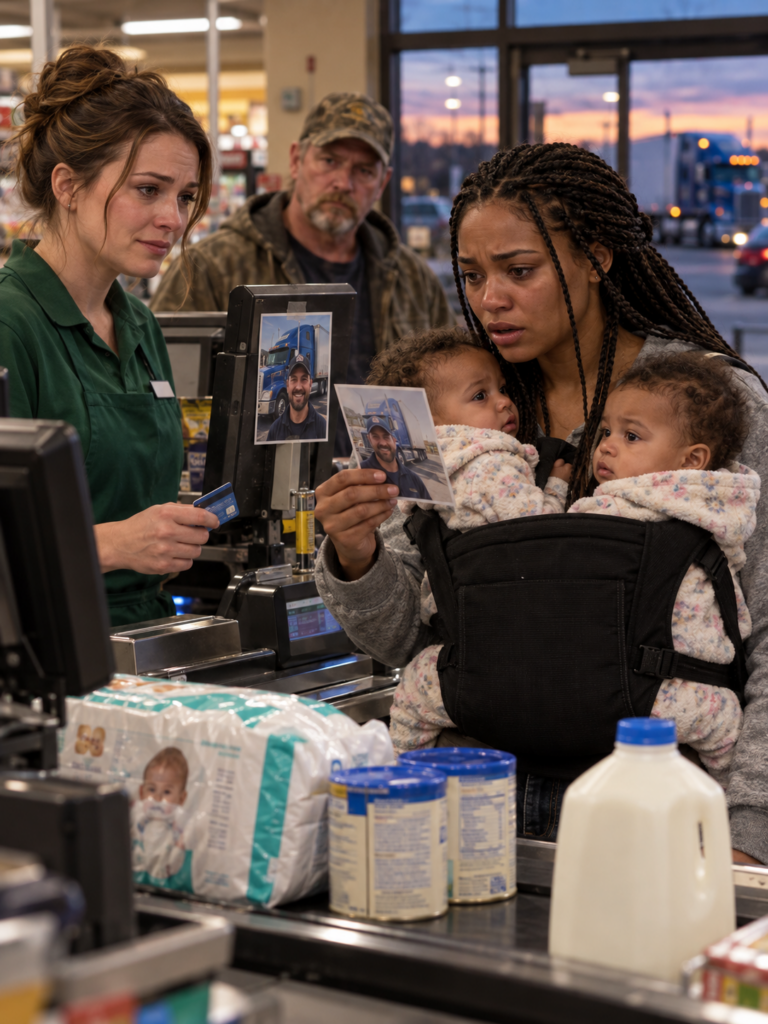
Then she’d walked into Hollis Market.
My checkout line.
Register three.
Maya described how humiliated she’d felt when her card was declined.
People were waiting.
Noah was crying.
She had been trying not to cry herself.
Then I paid for the diapers.
She wrote that I had smiled at her in a way that reminded her of someone, although she couldn’t understand why.
And then she saw the photograph.
The blue truck.
The backward baseball cap.
The same smile she’d never forgotten.
She recognized Dad immediately.
She recognized his watch in the picture.
When I told her his name was Tom and mine was Rachel, she’d felt as though the past had suddenly reached into the present.
She left because she needed to collect herself and be certain.
Later, at home, she compared the name on her receipt with everything she remembered.
She returned to the store after my shift.
Mike confirmed Dad’s name and told her he’d died when I was twelve.
I reached that sentence and couldn’t stop crying.
Maya wrote that she’d sat down when Mike told her.
She was devastated.
She had wanted to thank Dad for years.
She’d pictured meeting him and introducing her children.
Instead, she’d discovered that the man who helped her survive had died shortly after their encounter.
Then I reached the most painful paragraph.
Rachel, I’m so sorry.
I didn’t know.
I can’t explain what it feels like to learn that someone you’ve wanted to thank for twenty-two years is gone.
But I want you and your mother to know that your father’s watch was never lost.
It was with me.
I protected it.
I kept it running.
And it helped me reach the life he wanted me to have.
My hands shook so badly that the page rattled.
The final paragraph read:
Please give this watch to June.
Tell her Tom did find his way home.
It simply took twenty-two years and a frightened girl from Kentucky to bring him back.
I pressed the letter to my chest and closed my eyes.
Mike didn’t say anything.
He simply pulled another chair beside me and sat down.
After several minutes, he asked quietly, “What did she say?”
I showed him the engraving first.
Then the letter.
He read the first page carefully.
When he finished, he removed his glasses and rubbed his eyes.
“I remember your dad,” he said.
I looked up.
“You do?”
“Everybody who worked around this town back then remembers Tom Hale.”
He nodded toward the watch.
“He was a good man.”
I looked at the letter again.
“Mom searched for this watch.”
Mike waited.
“After the accident, they returned Dad’s belongings. His wallet, keys, wedding ring, even sunflower seeds he kept in his pocket. But not the watch.”
My voice broke.
“Mom called everybody. The police, the hospital, the towing company. Nobody knew where it was.”
I swallowed.
“After the snow melted, she took me to Route 9. We searched the ditch for hours.”
Mike shook his head slowly.
“All that time…”
“All that time,” I whispered, “it was keeping somebody else going.”
The clock above his door ticked.
But I couldn’t stop listening to the smaller ticking in my hand.
For the first time in twenty-two years, my father’s watch was home.
At least, almost.
I still had to give it to Mom.
And that frightened me more than I expected.
What would it do to her to hold something she’d last seen on the man she loved?
What would it feel like to learn he’d given it away?
What would she think when she discovered that the watch she’d searched for in the snow had been with a stranger all along?
Mike stood.
“Go home, Rachel.”
I looked up sharply.
“I’m scheduled until four.”
“I know.”
“We’re short-staffed.”
“I’ll manage.”
“Mike, I really can’t afford to lose hours.”
He folded his arms.
“You’re not losing your job over eight dollars. And your mother has waited twenty-two years for what’s in your hand.”
I looked down at the watch.
He was right.
I carefully wrapped it in the baby washcloth and slipped it back into the envelope with the letter.
Then I stood.
As I reached the office door, I stopped.
“Mike?”
“Yeah?”
“She left an address.”
He glanced back.
“The young woman?”
I nodded.
“The yellow house on Pike Street.”
I held up the envelope.
“I think Mom deserves to decide what happens next.”
Mike looked at me for a long moment.
Then he said, “Whatever you do, Hale, don’t leave that watch in your car.”
I almost laughed.
“I won’t.”
I passed register three on my way out.
Lori looked up from scanning groceries.
“Rachel? Honey, what happened?”
I couldn’t explain it in the middle of a checkout line.
“Something about Dad.”
Her expression softened.
“Is everything all right?”
I nodded through tears.
“I think it will be.”
I touched the corner of Dad’s photograph.
Then I walked out carrying the envelope against my chest.
When I reached home, Mom was standing at the kitchen sink.
She turned as soon as I opened the door.
“Rae? You’re home early.”
I tried to smile.
She saw my face.
“Rachel, what’s wrong?”
“Nothing bad, Mom.”
She dried her hands.
“Then why are you crying?”
I placed the envelope on our kitchen table.
The same table where we’d worried over our electric bill yesterday.
The same table where Mom had told me Dad would have helped the woman with the twins.
“Remember the mother I told you about?”
“Of course.”
“She came back to the store.”
Mom glanced at the envelope.
“Did she repay you?”
“Yes.”
I slowly pulled out the white washcloth.
“But she brought something else.”
My mother stared as I began unfolding it.
The silver watch caught the morning light.
Her lips parted.
She took one step toward the table.
And then she saw the scratch near the number four.
“No,” she whispered.
Her eyes lifted toward mine.
“Rachel… where did you get your father’s watch?”
I held it toward her.
But when she reached for it, her hand was shaking so badly she couldn’t close her fingers around the strap.
I placed my hand beneath Mom’s so the watch wouldn’t fall.
For a few seconds, she couldn’t seem to move.
Then her fingers closed around the leather strap.
She turned the watch over.
Her thumb moved across the engraving.
And something in her expression broke.
“Tom,” she whispered.
Not loudly.
Not dramatically.
Just his name, spoken the way she’d sometimes said it in her sleep during the first few months after the accident.
She pressed the watch against her mouth.
Then she began to cry.
I went around the table and wrapped my arms around her.
We stood in our little kitchen holding each other, with the watch between us and sunlight falling across the unpaid electric bill.
For twenty-two years, I’d watched my mother carry grief with extraordinary quiet strength.
She worked.
She cooked.
She paid bills.
She remembered birthdays.
She laughed at my jokes even when they weren’t funny.
But I knew there were nights when she still reached toward the empty side of her bed.
And now she was holding something that had once rested against Dad’s skin every single day.
“Where was it?” she finally asked.
Her voice was barely audible.
“Mom, there’s a letter.”
She looked at the envelope.
“Who sent it?”
“Her name is Maya Brooks.”
“The young mother?”
I nodded.
“She knew Dad.”
My mother stared at me.
“How?”
I pulled out the chair beside her.
“Sit down. There’s a lot to explain.”
She sat.
I read Maya’s letter aloud from the beginning.
At first, Mom listened with one hand covering her mouth.
Then I reached the part about the truck stop.
The frightened fourteen-year-old girl.
The hot water.
The pancakes.
My mother closed her eyes.
“Oh, Tom.”
I continued.
The bus station.
The phone calls.
The ticket to Georgia.
The four dollars remaining in Dad’s wallet.
And finally, the watch.
Mom looked down at it.
“He gave it to her?”
“Yes.”
“To make sure she could get home?”
I nodded.
Her eyes filled again.
I waited for her to speak.
For a moment, I wondered whether learning Dad had given away her anniversary gift would hurt her.
That watch had meant so much to her.
She’d saved nearly a year to buy it.
She’d chosen the engraving herself.
And she’d spent decades thinking it had been lost because of the accident.
Then Mom laughed.
A soft, disbelieving laugh.
“That foolish man.”
“You’re not angry?”
She shook her head.
“No, sweetheart.”
She touched the watch’s worn strap.
“I’m trying to remember whether I ever suspected.”
I looked at her.
“Suspected what?”
“That he’d given it away.”
My stomach tightened.
“You knew?”
“No. Not exactly.”
She looked toward the window.
“Your father came home without his watch once, shortly before the accident.”
I held my breath.
“I asked where it was, and he told me he’d left it in the truck.”
She paused.
“A few days later, I asked again. He said it needed repairing.”
“He lied?”
Mom gave a sad little smile.
“He told me something that wasn’t true.”
For some reason, those words hurt more than I expected.
Dad had always been the person I trusted completely.
The man who taught me to tell the truth even when the truth was uncomfortable.
And now I was learning he’d concealed something from Mom.
Mom must have noticed my expression.
“Rae, your father wasn’t perfect.”
I looked down.
“He should’ve told you.”
“Yes,” she said.
“He knew how important that watch was.”
“Yes.”
“Then why didn’t he?”
Mom considered the question.
“Probably because he knew I’d ask him how he managed to give away his watch when we still had bills to pay.”
She smiled faintly.
“And because he couldn’t bear to tell me a girl was out there needing help.”
I thought about our electric bill.
About the sixty-one dollars in my bank account.
About how quickly I’d reached for my card when Maya couldn’t afford her diapers.
I understood something uncomfortable.
I’d made a choice very much like Dad’s.
And I hadn’t told Mom how little money I had left, either.
It wasn’t the same as giving away an anniversary watch.
But the resemblance was enough to make me quiet.
Mom squeezed my hand.
“I would’ve been upset that he didn’t tell me,” she said. “But I would’ve understood why he helped her.”
“Even if you’d never gotten the watch back?”
She looked at the silver case.
“Rachel, I thought this was lying in a ditch for twenty-two years.”
Her voice softened.
“Instead, it helped a child get somewhere safe.”
She held it against her heart.
“If that’s where it went, then it wasn’t wasted.”
I read the rest of Maya’s letter.
The safe home in Georgia.
Her aunt.
School.
Her work as a nursing aide.
The years she spent winding the watch and hoping to meet Dad again.
When I reached the part about Maya’s husband leaving her and the twins, Mom’s expression changed.
She leaned forward.
“He left her with two babies?”
“That’s what she wrote.”
“And took the car?”
“Yes.”
Mom looked at the watch.
Then at the envelope.
“Where is she now?”
“She rented a house on Pike Street.”
“Does she have family nearby?”
“Not that I know of.”
Mom was silent.
I continued reading until I reached Maya’s request.
Please tell June that her husband did find his way home.
It simply took twenty-two years and a frightened girl from Kentucky to bring him back.
Mom started crying again.
But this time, she smiled through it.
“He came home,” she whispered.
I nodded.
“Yeah, Mom.”
She touched the watch face with one finger.
“He came home.”
For several minutes, we sat together quietly.
The kettle clicked as it cooled.
A car passed outside.
Somewhere in the house, the refrigerator motor hummed.
Ordinary sounds.
The kind Dad would have heard if he’d walked through our kitchen door on an ordinary Saturday morning.
Then Mom stood.
She picked up her purse from the hook.
“Get your keys.”
I looked up.
“Where are we going?”
“To see Maya.”
“Mom, she has twin babies. She might be exhausted. Maybe we should call first.”
Mom looked at the letter.
“Did she leave a phone number?”
I checked.
“No. Just the address.”
“Then we’ll knock. If she doesn’t want company, we’ll leave.”
I hesitated.
It was possible Maya had returned the watch because she wanted that chapter of her life to end.
Perhaps seeing us would bring back memories she wasn’t prepared to share.
Mom saw my uncertainty.
“We won’t ask her for anything, Rachel.”
She slipped the watch onto her wrist.
The band was far too big.
She held it in place with her fingers.
“I just want to thank her for looking after this.”
Then she looked directly at me.
“And I want to see the woman your father helped become an adult.”
I picked up my keys.
On our way to Pike Street, Mom asked me to stop at Hollis Market.
“Why?”
“We need a few things.”
I assumed she meant bread and milk.
Instead, she headed straight for the baby aisle.
She put diapers into the cart.
Then formula.
Then wipes.
She added eggs, oatmeal, chicken, potatoes, carrots, fruit, and bread.
I watched the cart fill.
“Mom.”
She added coffee.
“Mom.”
“What?”
“We can’t afford all of this.”
She studied me for a moment.
“How much do you have until payday?”
I almost told her not to worry.
Then I remembered Dad’s watch.
The question I’d asked about why he hadn’t told her.
I took a breath.
“Not much.”
Mom nodded.
“Then we need to be sensible.”
She looked into the cart.
For a moment, I thought she was going to put everything back.
Instead, she removed a couple of things and said, “We’ll start with what matters most.”
I still worried.
“We’ve got the electric bill.”
“I know.”
“And the car.”
“I know that too.”
She touched the watch on her wrist.
“Your father used to make it sound simple, didn’t he? Help the next person and trust that somehow everything else will work out.”
I nodded.
“Sometimes he forgot the part where you still have to pay the electricity company.”
I laughed.
“So what are we doing?”
“Something small enough that we can manage it.”
She looked at the diapers and formula.
“And something that might make a difference today.”
At the register, Lori greeted us.
Then she noticed Mom’s wrist.
Her smile disappeared.
“June?”
Mom gently lifted her arm.
Lori’s eyes widened.
“Is that Tom’s?”
I nodded.
“I’ll explain later.”
Lori looked from me to Mom.
Then she reached for the store phone.
A moment later, Mike appeared.
He glanced at our groceries.
Then at the watch.
“I heard you ladies were here.”
Mom smiled.
“Thank you for letting Rachel come home.”
Mike grunted.
“Didn’t do anything special.”
He looked at Lori.
“Thirty percent off.”
Lori raised an eyebrow.
“On whose authority?”
“Mine.”
“Since when do we offer that?”
Mike folded his arms.
“Since I said so.”
Lori smiled and rang up the order.
As we loaded the groceries into the car, I glanced at Mom.
“You think Dad would’ve liked Mike?”
“Oh, he’d have loved him.”
“Even with all the grumbling?”
“Especially with the grumbling.”
The drive to Pike Street took less than ten minutes.
Maya’s house stood near the edge of town.
It was small, painted yellow, with peeling trim and a porch that sagged slightly at one corner.
A pair of tiny blue socks hung over the railing.
Someone had placed a coffee can filled with orange marigolds beside the steps.
There was no car in the driveway.
I remembered Maya writing that her husband had taken theirs.
Mom sat quietly for a moment.
Then she reached for the grocery bag containing the diapers.
“Ready?” she asked.
I nodded.
We climbed the porch steps.
Inside, I could hear a baby crying.
I knocked.
Footsteps approached.
The door opened a few inches, stopping against a security chain.
Maya looked through the gap.
She wore the same oversized gray sweatshirt from the store.
Her braids were pulled back.
There were dark circles beneath her eyes.
When she saw me, she went still.
“Rachel?”
“Hi, Maya.”
Her gaze dropped to the grocery bags.
Then shifted toward my mother.
She stared at Mom’s face.
Then at her wrist.
Her hand flew to her mouth.
“June?”
Mom nodded.
“I’m June Hale.”
Maya’s eyes filled instantly.
She closed the door long enough to remove the chain.
Then she opened it wide.
For a few seconds, nobody spoke.
Mom stepped forward.
“I’ve wanted to meet you since I read your letter.”
Maya lowered her gaze.
“I hope it wasn’t too upsetting.”
Mom shook her head.
“Sweetheart, you’ve given me something I thought I’d never see again.”
Maya looked at the watch.
“I’m sorry I kept it so long.”
Mom reached toward her.
“Please don’t apologize.”
Then she embraced her.
Maya stood stiffly for a second.
Then her shoulders began shaking.
“I looked for him,” she whispered. “I really did.”
“I know.”
“I wanted to thank him.”
“You don’t owe him anything.”
Maya pulled back slightly.
“He gave me everything.”
Mom looked into her eyes.
“He gave you a chance. You built the life that followed.”
Maya began crying harder.
Mom pulled her close again.
Behind the door, another baby started crying.
Maya wiped her face.
“I’m sorry. They both need me.”
Mom smiled.
“Then perhaps we’d better meet them.”
Maya stepped aside.
The house was sparsely furnished.
A small sofa.
A folding table.
Two mismatched chairs.
A playpen near the window.
Everything was clean, but there wasn’t much.
In the kitchen, I noticed washed bottles lined up beside the sink.
A calendar hung on the refrigerator.
Monday was circled in red.
Maya had written a reminder about her first shift at Willow Creek Nursing Home.
It was only two days away.
She followed my eyes.
“I start work Monday.”
“That’s wonderful,” Mom said.
Maya gave a nervous laugh.
“I hope so. I haven’t worked since the boys were born.”
“Do you have childcare arranged?”
Maya nodded.
“The nursing home helped me find a place with openings. It’s going to be a tight schedule, but I think I can manage.”
Mom didn’t immediately offer to take over.
She simply nodded.
“That’s a lot to handle with two little ones.”
Maya looked relieved not to be questioned further.
Then Noah let out a furious cry.
“That’s Noah,” she said. “He likes everyone to know when he’s unhappy.”
Mom laughed.
“May I?”
Maya nodded and lifted him from the playpen.
She placed him carefully in Mom’s arms.
Mom settled him against her shoulder.
“Well, hello there.”
Noah protested.
Mom began rocking him.
“There, there. You’ve got a story to tell, don’t you?”
Within moments, his cries faded.
He grabbed a strand of her hair.
Mom smiled.
“That’s better.”
Maya watched them, looking almost disbelieving.
“He doesn’t settle that quickly for anyone.”
“Perhaps he likes old ladies.”
“Mom,” I protested.
“What? I am one.”
Maya laughed.
And the tension in the little room finally eased.
I carried the groceries inside.
When Maya saw everything, she looked horrified.
“Oh, no. Rachel, I can’t.”
“It’s okay.”
“But you already helped me yesterday.”
Mom spoke from the sofa.
“These are for the boys.”
Maya shook her head.
“I don’t know when I could repay you.”
I reached into my pocket.
I’d brought the little plastic bag containing Maya’s eight dollars and forty-two cents.
I placed it on the folding table.
“You’ve already given us something much more valuable than groceries.”
She looked at the money.
“Rachel…”
“Mom and I searched for that watch when I was twelve.”
Maya went quiet.
“We thought it was lying somewhere beside the road where Dad died.”
I swallowed.
“You kept it safe for twenty-two years.”
Her eyes filled.
“And now you’ve brought it home.”
Maya stared at the bag of money.
Then she looked at Mom.
“I never meant to keep something that belonged to your family.”
Mom smiled softly.
“Tom gave it to you.”
Maya nodded.
“He told me I might need it.”
“And you did,” Mom said.
Maya looked down.
“I never sold it.”
“No,” Mom replied. “You kept it because it meant someone cared.”
Maya began crying again.
“Some days, that watch was the only thing reminding me.”
Mom reached out with her free hand.
“Well, now you’ve got proof you weren’t wrong to believe him.”
For a while, we sat together listening to Noah babble and Eli sleep.
Then Mom suggested making lunch.
Maya looked embarrassed.
“I haven’t got much.”
Mom nodded toward the grocery bags.
“That’s why we brought ingredients.”
She made chicken soup with potatoes and carrots.
Far too much pepper.
Exactly the way Dad liked it.
Maya had only two bowls, so we served the rest in mugs.
We sat around the folding table, with the twins nearby, and listened as Maya told us things about Dad we had never heard.
She remembered his terrible joke about truck-stop coffee tasting like something brewed inside an old tire.
Mom laughed so hard she had to set her mug down.
“He said that at home too.”
Maya smiled.
“He told me he met you at a dance hall.”
Mom grinned.
“He did.”
“He said he stepped on your foot four times.”
“Five,” Mom corrected. “It was five.”
Maya laughed.
“He said you still married him anyway.”
“Against my better judgment.”
We all laughed.
Then Maya remembered something else.
“He told me Rachel once brought a wild possum into the bathroom.”
I nearly dropped my soup.
“Oh, no.”
Mom covered her face.
“I was hoping she’d forgotten that.”
Maya laughed harder.
“He said you screamed.”
“I did not scream,” Mom protested. “I expressed concern.”
“You stood on the toilet!” I reminded her.
For the first time in years, I heard my mother laugh without sadness catching at the end.
And somewhere in the middle of my own laughter, I made a strange little hiccup sound.
Maya stopped.
She stared at me.
“What?” I asked.
Her expression softened.
“That’s it.”
“What’s it?”
“Your laugh.”
She smiled.
“Exactly the way he described it.”
I felt tears coming again.
But this time, I kept smiling.
There was something extraordinary about sitting in that little yellow house with a woman who had known Dad for only a few hours.
She remembered a side of him that had existed beyond our home.
A stranger’s view of a man I thought I knew completely.
And everything she described sounded like him.
Not a perfect man.
Not a man who could make the world fair.
Just a truck driver who saw a frightened girl and decided she deserved help.
As afternoon turned toward evening, Mom offered to hold Eli while Maya put away the groceries.
I helped clear the table.
In the kitchen, Maya spoke quietly.
“Rachel, can I ask you something?”
“Of course.”
“Was your father happy?”
The question caught me off guard.
“What do you mean?”
She glanced toward the living room, where Mom was softly singing to Eli.
“When I met him, he talked about you and June constantly. He seemed so proud of his family.”
I swallowed.
“Yeah,” I said. “He was happy.”
Maya looked relieved.
“I’ve wondered about that for years.”
“He loved being a dad.”
I smiled.
“He used to wake me up on Saturday mornings by pretending the house was a truck stop and breakfast was our next scheduled delivery.”
Maya laughed.
“That sounds like him.”
Then she became serious.
“I’m sorry you lost him so young.”
I nodded.
“Me too.”
She hesitated.
“Do you ever get angry that other people got pieces of his time when you had so little?”
I looked toward the living room.
Mom was rocking Eli beneath the little window.
For a moment, I thought about all the trips Dad had taken.
The birthdays he’d nearly missed.
The evenings he’d spent hundreds of miles away.
The times Mom and I had waited for his truck to come home.
“I used to,” I admitted.
Maya looked down.
“After he died, I wanted every minute we’d missed. I wanted all the time he’d given to roads and strangers and work.”
I took a breath.
“But I don’t think his helping you took anything from me.”
She looked up.
“Because it was part of who he was.”
Maya’s eyes filled.
“I wish I could tell him thank you.”
I smiled through tears.
“I think he knew.”
When it was time for us to leave, Mom stood near the doorway with Dad’s watch on her wrist.
She looked at Maya.
“I want to ask you something.”
Maya straightened.
“Of course.”
Mom touched the watch.
“You’ve kept this for twenty-two years. Would you like to keep it?”
My mouth opened in surprise.
“Mom?”
She raised a hand gently.
“Rachel, it’s all right.”
Then she turned back to Maya.
“Tom gave it to you. And you’ve cared for it beautifully.”
Maya shook her head.
“No.”
“Are you sure?”
“Yes.”
She stepped closer.
“I wanted to find him so I could return it. I never stopped hoping.”
She looked at the engraving.
“It belongs with you now.”
Mom ran her thumb across the scratched glass.
Maya smiled through her tears.
“I don’t need it the way I once did.”
“Why not?” Mom asked.
Maya looked at us.
“Because now I know the family he talked about is real.”
Her voice trembled.
“And I know there are people here who care about us.”
Mom embraced her again.
When we finally stepped outside, Maya stood on the porch holding Noah.
Eli slept peacefully inside.
She watched as Mom and I reached the car.
“June?”
Mom turned.
“Yes, sweetheart?”
Maya glanced at the watch.
“Do you think he would have wanted me to return it?”
Mom looked at her for a long moment.
Then she smiled.
“I think Tom would’ve been happy to see you safe.”
Maya pressed Noah closer.
“And I think he’d have been delighted that you’ve got two beautiful boys.”
Maya wiped her eyes.
Mom opened the car door.
Then she looked back.
“May we visit again?”
Maya’s face changed.
For a second, she looked like the frightened girl described in her letter.
Then she smiled.
“I’d really like that.”
We exchanged phone numbers before leaving.
On the drive home, Mom kept looking at the watch.
The silver face caught the fading sunlight.
When we approached Route 9, she suddenly spoke.
“Rachel, pull over for a minute.”
I slowed the car.
“Are you okay?”
She nodded.
“Please.”
I stopped beside the road, well away from traffic.
Mom lowered her window.
The evening air was cool.
For a long time, she stared toward the fields.
“This is where we searched,” she whispered.
I looked at the roadside.
I remembered that spring day.
I was twelve.
Mom had borrowed a pair of boots for me because the ground was muddy.
We walked along the ditch, searching beneath leaves and broken branches.
She’d told me we might find Dad’s watch.
I remembered how carefully I’d looked.
How desperately I’d wanted to discover something that belonged to him.
We never found it.
Mom touched the worn leather strap.
“For twenty-two years,” she said, “I imagined it out here.”
Her voice shook.
“Buried somewhere. Rusting in the mud. Forgotten.”
She looked at the watch.
“But it wasn’t.”
“No.”
“It was with Maya.”
I nodded.
“In Georgia. In school. In nursing homes. Through every difficult year.”
She took a slow breath.
“Tom wasn’t here anymore, but something he did kept helping her.”
A tear slipped down her cheek.
I reached for her hand.
“Mom?”
She looked at me.
“I think I’ve been angry at this road for a very long time.”
“I know.”
She listened to the ticking.
“And all this time, a little piece of our life with him was somewhere else, doing exactly what he’d have wanted.”
She closed the window.
“Let’s go home, sweetheart.”
I started the engine.
As we pulled away, Mom rested her hand over the watch.
I thought that perhaps this was where the story would end.
The watch had come home.
Mom had found a little peace.
Maya had been able to return something she’d protected for most of her life.
But over the following weeks, something else began to happen.
Something Dad had understood long before I did.
A single act of kindness didn’t have to remain a single act.
And the first person to prove it was someone I never expected.
The following Friday, Dale Pruitt came through my checkout line carrying a loaf of bread and a jar of peanut butter.
I recognized him immediately.
The camouflage baseball cap.
The impatient expression.
The same man who had sighed loudly while Maya struggled to buy diapers for her twins.
I scanned his groceries.
“That’ll be $6.87.”
He handed me a ten-dollar bill.
When I gave him his change, he didn’t leave.
Instead, he glanced at the photograph of Dad beside my scanner.
“Rachel?”
“Yes?”
“That young woman. The one with the babies.”
“Maya?”
He nodded.
“I heard about the watch.”
I didn’t know what to say.
Millbrook is the kind of town where a story can travel from the grocery store to the hardware store to the church parking lot before you’ve finished your morning coffee.
I’d tried to keep the details private.
But between Lori’s enthusiasm for conversation and the people who remembered Dad, word had spread that his missing watch had finally been returned.
Dale shifted awkwardly.
“I knew your father.”
That surprised me.
“You did?”
“Yeah. Tom used to bring that blue truck to my dad’s garage.”
He looked at the photograph.
“When I was little, he paid me a dollar to clean his windshield.”
I smiled.
“That sounds like Dad.”
“I thought I was rich.”
Dale gave a small chuckle.
Then his expression changed.
“I behaved badly that night.”
I shook my head.
“It’s okay.”
“No.”
He looked directly at me.
“It wasn’t.”
He hesitated.
“I’d found out that afternoon I was going to have to let two employees go. Business has been rough. I was worried about how to tell them.”
His jaw tightened.
“And then I stood behind a woman trying to buy diapers for her babies, acting like she was ruining my evening.”
I said nothing.
Sometimes the kindest thing you can do is let somebody finish an apology without rescuing them from it.
Dale reached inside his jacket and withdrew an envelope.
He placed it on the counter.
“Would you give this to her?”
I looked at it.
“What is it?”
“Just something I should have done that night.”
“Dale, you said business is bad.”
He shrugged.
“Doesn’t change how I treated her.”
Then he nodded toward Dad’s photograph.
“Your father helped me once.”
I waited.
“When I was ten, somebody stole my bicycle from outside my dad’s shop.”
He smiled faintly.
“I cried for hours. Thought my whole world was ending.”
“What happened?”
“Tom found me sitting behind the garage. He asked what was wrong. Then he spent an hour helping me look for that bike.”
“Did you find it?”
Dale shook his head.
“Nope.”
He laughed.
“But I never forgot that he spent an hour searching with a kid he barely knew.”
My throat tightened.
Dale looked embarrassed.
“He said something about not being able to fix the whole world.”
I stared at him.
“But you could make the next ten minutes better?”
Dale smiled.
“That’s it.”
For a moment, neither of us spoke.
Then he tapped the envelope.
“Don’t tell Maya it’s from me.”
“Are you sure?”
“Yeah.”
He picked up his groceries.
“Tell her I hope things get easier.”
Then he walked away.
That evening, I stopped by Maya’s house.
She opened the door with Eli balanced on one hip.
Noah was babbling in his playpen.
“Rachel!”
“Hi. Someone left this for you.”
I handed her the envelope.
She looked confused.
“Who?”
“He wanted to stay anonymous.”
Maya opened it.
Inside were three twenty-dollar bills.
And a handwritten note.
SORRY FOR SIGHING. GOOD LUCK WITH THE BOYS.
She read it twice.
Then looked at me.
“Was this the man behind me?”
I hesitated.
She smiled.
“It’s okay. I remember him.”
She looked down at the note.
“I thought he hated me.”
“He was having a bad day.”
She nodded.
“So was I.”
For a moment, she simply held the envelope.
Then she crossed to the refrigerator and taped the note beside her calendar.
“Why keep it?” I asked.
“Because he changed his mind.”
She smoothed the paper carefully.
“And sometimes that’s worth remembering.”
I drove home thinking about Dale.
He hadn’t suddenly become wealthy.
He hadn’t solved Maya’s problems.
But he’d recognized he’d hurt somebody and had tried to make it right.
My father would have appreciated that.
Over the next few weeks, Maya settled into her job at Willow Creek Nursing Home.
The first days were exhausting.
She had to learn the routines, manage the boys’ childcare, and adjust to working again while raising two infants alone.
Some evenings, she barely had the energy to heat dinner.
But she loved her work.
She loved helping the residents.
She told me once that the hardest part was watching people who rarely received visitors.
“Sometimes they don’t need anything complicated,” she said.
“They just want someone to sit down and listen.”
I smiled.
“Sounds familiar.”
She laughed.
“Your father would’ve liked my job.”
I thought he would have too.
Mom began visiting Maya on Wednesdays and Saturdays.
At first, she helped with the twins so Maya could rest.
Then she started bringing recipes.
Chicken soup.
Pot roast.
Biscuits that never rose quite as high as she wanted them to.
Maya learned to make Dad’s favorite potato soup, although she insisted Mom used too much pepper.
Mom said that was exactly what Dad would’ve complained about.
Before long, their visits became less about childcare and more about being together.
They talked about work.
About bills.
About recipes.
About the boys.
And, sometimes, about Dad.
I watched my mother change.
Not dramatically.
There was no morning when she suddenly stopped grieving.
But she began laughing more.
She had someone new to tell stories to.
Someone who wanted to hear about the man she’d loved.
When Maya asked about their first date, Mom told her about the dance hall.
When Maya asked whether Dad ever got angry, Mom laughed and described the time he’d spent an entire afternoon trying to repair a lawn mower that had simply run out of gasoline.
When Maya admitted she’d been afraid Dad might have regretted giving her the watch, Mom told her something that stayed with me.
“Tom would’ve regretted not helping you.”
Maya stared at her.
“Are you sure?”
Mom nodded.
“He wasn’t perfect. He sometimes made decisions without thinking through what they’d cost us. But once he knew someone needed help, walking away was the thing he couldn’t bear.”
Maya lowered her eyes.
“I still wish I’d found him sooner.”
Mom reached across the table.
“You found us when you could.”
That was the first time I realized something important.
Maya had spent twenty-two years believing she owed Dad a thank-you.
Mom had spent twenty-two years believing the watch was lost.
And I’d spent twenty-two years wondering what life might have looked like if Dad had made it home.
None of us could change the past.
But we didn’t have to keep living inside the same unanswered questions.
Maya hadn’t taken anything from our family.
She’d carried something Dad freely gave her.
And by returning it, she’d given us something we never expected to have again.
A piece of his story.
A piece of his voice.
And proof that the man we’d lost had continued affecting lives beyond our own.
Winter arrived.
It wasn’t an easy one.
Maya’s furnace stopped working in January.
One of the twins developed an ear infection in February.
Her husband never returned.
There were bills to pay, sleepless nights, and mornings when she called Mom just to say she was overwhelmed.
No one came sweeping into her life with a fortune.
No mysterious benefactor purchased her a house.
She still had to work.
She still had to budget.
She still worried.
But she wasn’t alone.
The nursing home director arranged an advance on her first paycheck.
Patty from the diner began bringing dinner on Tuesdays, always pretending she’d accidentally cooked too much.
Pastor Greene delivered two gently used cribs.
Mrs. Odell, a ninety-one-year-old resident at Willow Creek, knitted sweaters for Noah and Eli.
One blue.
One green.
Maya took photographs of the boys wearing them and brought them to show her.
Mrs. Odell cried.
“I haven’t knitted for babies in years,” she said.
Maya held her hand.
“Well, these two are going to grow. You’ll have more work soon.”
Mrs. Odell laughed.
And began planning their next sweaters.
Watching all this unfold, I started noticing something about kindness.
Most of the people helping Maya weren’t wealthy.
Patty worked long hours running her diner.
Pastor Greene drove an old pickup with a rusty bumper.
Mrs. Odell lived at the nursing home.
Dale was trying to keep his repair shop going.
Mom and I still counted every dollar.
They weren’t helping because they had everything.
They were helping because they understood what it felt like not to.
And no single person was expected to fix Maya’s whole life.
That mattered.
Because I’d learned something else from my father, although it took me years to recognize it.
Helping someone shouldn’t mean destroying your own stability.
There were things Maya needed to do herself, just as there were things Mom and I still needed to manage.
Kindness worked best when it gave someone room to stand, not when it demanded that another person collapse.
Maya understood that too.
She never treated our help as something she was owed.
As her work became steadier, she began finding ways to help other people.
She picked up groceries for a neighbor who had trouble getting around.
She spent an extra few minutes listening to residents who seemed lonely.
She helped a new coworker learn the routines at Willow Creek.
Small things.
Ten-minute things.
And every time I saw one of those moments, I thought of Dad.
My own life began changing that winter.
For years, I’d told myself that becoming a veterinarian was a childhood dream I needed to outgrow.
I hadn’t had enough money for college when I was younger.
After Dad died, Mom needed help with bills.
Then one year became another.
I took the job at Hollis Market.
I learned the routines.
I became good at what I did.
But somewhere along the way, I confused accepting my circumstances with believing they could never change.
One evening in January, I found myself looking at an online veterinary assistant program.
I read the information three times.
Two evenings a week.
Eighteen months at the pace I could manage.
It wasn’t veterinary school.
It wasn’t the exact future I’d imagined as a twelve-year-old.
But it was a way back toward something I loved.
I nearly closed the page.
Then I noticed Dad’s photograph sitting beside our kitchen clock.
The one Mom had moved there temporarily while dusting.
He was smiling beside his blue truck.
I imagined him seeing me hesitate.
I could practically hear him asking why I was waiting for somebody else’s permission.
I filled out the application.
When I told Mom I’d enrolled, she began crying.
“Mom, don’t.”
“I’m happy!”
“You’re crying.”
“I can do both.”
Then she went upstairs and returned with an old photograph.
I was twelve.
Missing a front tooth.
Holding an extremely unhappy orange cat.
She placed it on the refrigerator.
“Your dad would’ve taken you out for pancakes,” she said.
I smiled.
“I know.”
We couldn’t afford a fancy celebration.
So we made pancakes for dinner.
Mom wore Dad’s watch.
I ate three.
And for the first time in years, I felt like the future held something I had chosen for myself.
Dale eventually looked at my Honda and repaired the worst mechanical problem.
When I asked what I owed him, he waved me away.
“Your dad paid me a dollar once,” he said.
“That’s not enough to cover a car repair.”
Dale grinned.
“With interest, it might be.”
I offered to pay again.
He refused.
So I thanked him and didn’t argue.
Back at Hollis Market, I started keeping a small glass jar beneath register three.
It was an old pickle jar.
I washed it carefully and attached a handwritten label.
FOR THE NEXT TEN MINUTES.
Whenever I could spare a little money, I added it.
Sometimes two dollars.
Sometimes five.
Once, after a better-than-expected paycheck, I added ten.
Lori noticed almost immediately.
“What’s that?”
I told her.
She looked at the label.
Then she reached into her purse and dropped in three dollars.
“Don’t make a big deal about it.”
I smiled.
“Wouldn’t dream of it.”
The next day, she added more.
Mike pretended not to notice.
Eventually, he quietly let us know that we could use the jar to help customers who were a few dollars short, provided we kept the transactions properly accounted for.
We didn’t announce it over the loudspeaker.
We didn’t make people explain why their cards declined.
We didn’t ask for names or addresses.
We simply helped when we could.
One morning, an older gentleman came through with bread, milk, and soup.
He was short three dollars.
I made up the difference.
He stared at the receipt.
“Are you sure?”
“You’re all set.”
He looked relieved.
Then embarrassed.
I smiled.
“Have a good morning.”
The following week, he returned and placed five dollars in the jar.
“For the next person,” he said.
Sometimes customers contributed without needing help themselves.
A few coins.
A folded bill.
Once, someone left an envelope containing sixty dollars.
The only message was:
FOR WHOEVER NEEDS IT.
I had a strong suspicion about who’d left it.
A certain man in a camouflage baseball cap suddenly seemed very interested in paying for his groceries quickly whenever I mentioned the jar.
I never asked.
I didn’t need to.
The little fund grew slowly.
Some weeks, more went out than came in.
Other weeks, it filled again.
It didn’t change the whole world.
But it changed the last few minutes of someone’s grocery trip.
And sometimes that was enough.
Months passed.
The boys grew.
Noah remained the loud one.
Eli developed an extraordinary talent for sleeping through almost anything.
They began calling Mom Nana June as soon as they could manage the words.
The first time Noah said it clearly, she called me at work.
“Rachel!”
“Mom, what’s wrong?”
“Nothing’s wrong!”
“Then why are you shouting?”
“He said Nana!”
I laughed.
“Who did?”
“Noah!”
I could hear him babbling in the background.
Mom sounded as excited as she had when I was little.
Maybe more.
She repeated the story that evening.
Then again the next morning.
Maya later told me she thought Mom had cried harder over “Nana” than either twin’s first attempts at walking.
I believed her.
Mom also wore Dad’s watch every day.
She took it to a jeweler, who made extra holes in the old leather strap so it would fit her smaller wrist.
He offered to replace the band.
She refused.
He offered to polish away the scratch near the number four.
She looked horrified.
“Don’t touch that.”
The jeweler raised his hands.
“All right, ma’am.”
“Those marks belong to Tom.”
He nodded and carefully returned it.
I asked Mom later whether she worried about wearing something so old.
“Of course.”
“Then why not keep it somewhere safe?”
She looked at me.
“Because Tom didn’t buy a watch to keep it in a drawer.”
Then she smiled.
“And after everything this little thing has been through, I think it deserves to be worn.”
A few weeks ago, Maya came through my checkout line again.
Noah and Eli were sitting in a double stroller.
Both wore the sweaters Mrs. Odell had knitted.
The sleeves were starting to look a little short.
Maya looked tired, but there was something different about her.
She wasn’t clutching her groceries anxiously.
She wasn’t staring at her phone, calculating and recalculating.
She smiled when she reached the counter.
“Evening, Rachel.”
“Hey, stranger.”
“I saw you three days ago.”
“Exactly. It’s been ages.”
She laughed.
I leaned over the counter.
“Hello, boys.”
Noah responded with an enthusiastic shout.
Eli continued sleeping.
“Some things never change,” I said.
Maya began putting groceries on the conveyor belt.
Milk.
Formula.
Size-four diapers.
Eggs.
Bread.
And a package of marshmallow cookies.
I held up the cookies.
“These are new.”
She smiled.
“I decided we deserved something fun.”
“Excellent decision.”
I scanned everything.
Then gave her the total.
Maya took out her debit card.
For the briefest moment, I remembered the first time she’d stood there.
The embarrassed smile.
The shaking fingers.
The impatient sigh behind her.
The two babies who needed diapers.
She tapped her card.
The terminal beeped.
APPROVED.
Maya looked at the screen.
Then at me.
We both smiled.
“Look at that,” she said softly.
“Look at that.”
I handed her the receipt.
She tucked it into her purse.
Then she reached inside again and withdrew a small plastic bag of coins.
I watched as she opened it and poured the money into our jar.
The coins made a bright clinking sound.
“What’s that for?” I asked.
She looked at the label.
“Eight dollars and forty-two cents.”
My chest tightened.
“Maya.”
“Every month,” she said. “As long as I can.”
“You don’t have to repay me.”
She smiled.
“I know.”
Then she looked at Dad’s photograph beside the scanner.
“That’s exactly why I want to.”
For a second, I couldn’t speak.
She reached toward the stroller and straightened Eli’s sweater.
“Your father told me somebody would need my help someday.”
I nodded.
“Maybe whoever comes through this line next.”
Maya smiled.
“Maybe.”
She started toward the exit.
Noah was shouting happily at a balloon tied near the gum machine.
Eli slept through all of it.
Just before the doors opened, Maya turned around.
“Rachel?”
“Yeah?”
“Tell Nana June we’ll see her Saturday.”
“I will.”
She waved.
Then she pushed the stroller outside.
I watched the automatic doors close behind her.
After a moment, I looked down at the jar.
Eight dollars and forty-two cents.
The same amount that had connected our lives.
I touched the photograph beside my register.
“Hi, Dad,” I whispered.
“I think you’d really like her.”
That evening, I got home later than usual.
The house was quiet.
A light was still on in the kitchen.
Mom had fallen asleep at the table with her head resting beside an unfinished crossword puzzle.
Her reading glasses had slipped down her nose.
A cold cup of chamomile tea sat nearby.
I stood in the doorway for a moment.
There had been a time when seeing her alone at that table made something ache inside me.
It reminded me of all the years she’d spent waiting for Dad.
All the evenings when the house felt too quiet.
But now the refrigerator was covered with new photographs.
Noah with his first tooth.
Eli wearing a green sweater.
Maya standing outside Willow Creek on her first day of work.
A photograph of Mom holding both boys.
And beside them, a picture of me at twelve with that extremely unhappy orange cat.
Our kitchen was still small.
The roof still needed attention.
The electricity bill still arrived every month.
Nothing about our life had magically become easy.
But the room felt different.
There was more laughter in it now.
More photographs.
More people who might call to say hello.
I walked closer to the table.
Then I saw Mom’s wrist.
Dad’s watch rested against the wood.
The scratched glass caught the light.
The old brown leather strap curved around her arm.
The silver case gleamed softly.
And beneath the quiet hum of the refrigerator, I could hear it.
Tick.
Tick.
Tick.
I sat in the chair across from her.
For twenty-two years, that watch had traveled through a life we knew nothing about.
A frightened girl had carried it from Kentucky to Georgia.
She’d worn it through school.
Through the first uncertain years of adulthood.
Through long nursing shifts.
Through loneliness.
Through heartbreak.
And finally, through the months when she was trying to keep two babies fed and safe after her husband left.
She’d kept it running.
Not because it was worth money.
But because somebody had once looked at her and decided she mattered.
When she was desperate enough to consider selling it, she walked into Hollis Market.
She came to register three.
My register.
And I happened to be there with Dad’s photograph beside me.
I thought about how easily that moment might never have happened.
I could have been working another shift.
She could have chosen another store.
I could have looked at the line, seen how impatient everyone was, and told her to put the diapers back.
Instead, I reached for my card.
Eight dollars and forty-two cents.
I didn’t have much money that day.
I still don’t.
But I had enough to help.
And because I did, a woman I’d never met recognized a man I hadn’t seen since I was twelve.
A watch came home.
My mother learned something she never knew about the husband she’d lost.
A frightened girl from Kentucky finally found his family.
Two little boys found a Nana.
And a small jar appeared beneath register three.
I looked at Mom sleeping across from me.
Her hair had grown grayer over the years.
There were new lines around her eyes.
Sometimes I still felt sad thinking about all the things Dad had missed.
He never saw me graduate high school.
He never taught me to drive.
He never watched me become an adult.
And he’d never get to see Noah and Eli grow up.
There were things kindness couldn’t fix.
No good deed could bring back those twenty-two years.
No returned watch could replace the man who wore it.
But that didn’t mean what happened was small.
I gently placed my hand over Mom’s.
Her fingers stirred.
She opened her eyes.
“Rae?”
“Hey, Mom.”
She blinked.
“What time is it?”
“Late.”
“Oh, goodness. I was waiting for you.”
“I know.”
She glanced at the watch.
Then smiled sleepily.
“Your father always hated being late for dinner.”
I laughed.
“He was late all the time.”
“Exactly. He hated it when anyone reminded him.”
She sat up and adjusted her glasses.
“How was work?”
“Good.”
“Anything interesting?”
I thought about Maya.
The approved payment.
The twins in their little sweaters.
The coins falling into the jar.
“Actually, yeah.”
I told her about Maya’s visit.
When I reached the part about the eight dollars and forty-two cents, Mom grew quiet.
Then she looked down at the watch.
“That girl,” she whispered.
I smiled.
“She’s doing pretty well.”
Mom nodded.
“I’m proud of her.”
I squeezed her hand.
“Me too.”
For a while, neither of us spoke.
The watch continued ticking between our hands.
Finally, Mom looked toward Dad’s old photograph on the refrigerator.
“You know, Rachel, I used to wonder whether your father knew how much people loved him.”
I looked at her.
“Of course he knew.”
She smiled.
“I hope so.”
Then she glanced at the watch.
“But I don’t think he ever realized how far one little act of kindness could travel.”
I thought about the frightened fourteen-year-old girl in a Kentucky diner.
About the watch being placed in her hand.
About the bus ticket to Georgia.
About the tiny blue socks on Maya’s porch.
About Noah calling my mother Nana.
And about a man in a camouflage baseball cap slipping an envelope onto my counter because he wanted to apologize.
Dad had never known any of that would happen.
He’d simply seen someone who needed help.
I looked at Mom.
“Maybe he didn’t need to know.”
She considered that.
Then she smiled.
“Maybe you’re right.”
The next morning, I arrived at Hollis Market a few minutes early.
My Honda started on the first try.
That alone felt worth celebrating.
I put on my green work shirt.
Counted my register.
Cleaned the conveyor belt.
Checked the receipt paper.
Then I looked at Dad’s photograph.
He was still standing beside his blue Peterbilt, grinning beneath his backward cap.
I touched the corner of the picture.
“Morning, Dad.”
Then I checked the little jar beneath the register.
There were a few folded bills and a handful of coins inside.
Not enough to change anybody’s entire life.
Just enough to make a difficult moment a little easier.
I added two dollars from my wallet.
A few minutes later, the automatic doors opened.
An older woman entered carrying a shopping list.
Behind her came a father holding his daughter’s hand.
Then a young man in work boots.
Ordinary people.
Living ordinary lives.
Carrying worries I might never know about.
I turned on the register light.
And as the first customer approached, I remembered Dad’s words.
“You can’t make the whole world right. But you can make the next ten minutes better for somebody.”
For most of my life, I thought he was teaching me how to be generous.
Now I understood he was teaching me something bigger.
Kindness isn’t always remembered by the person who gives it.
Sometimes its consequences happen years later, in places that person never gets to see.
Sometimes a gift leaves your family and returns with an entirely different story.
Sometimes the person you help is carrying something precious that you cannot see.
And sometimes, eight dollars and forty-two cents is enough to remind someone they haven’t been forgotten.
I smiled at the customer standing before me.
“Good morning. Did you find everything you needed?”
Behind me, Dad’s photograph caught the morning light.
Beneath the counter, the little jar waited.
And at home, on my mother’s wrist, his old silver watch was still ticking.
Not because the past had finally been repaired.
But because something good he’d begun twenty-two years earlier was still moving forward.
One person.
One small choice.
One ordinary moment at a time.


