
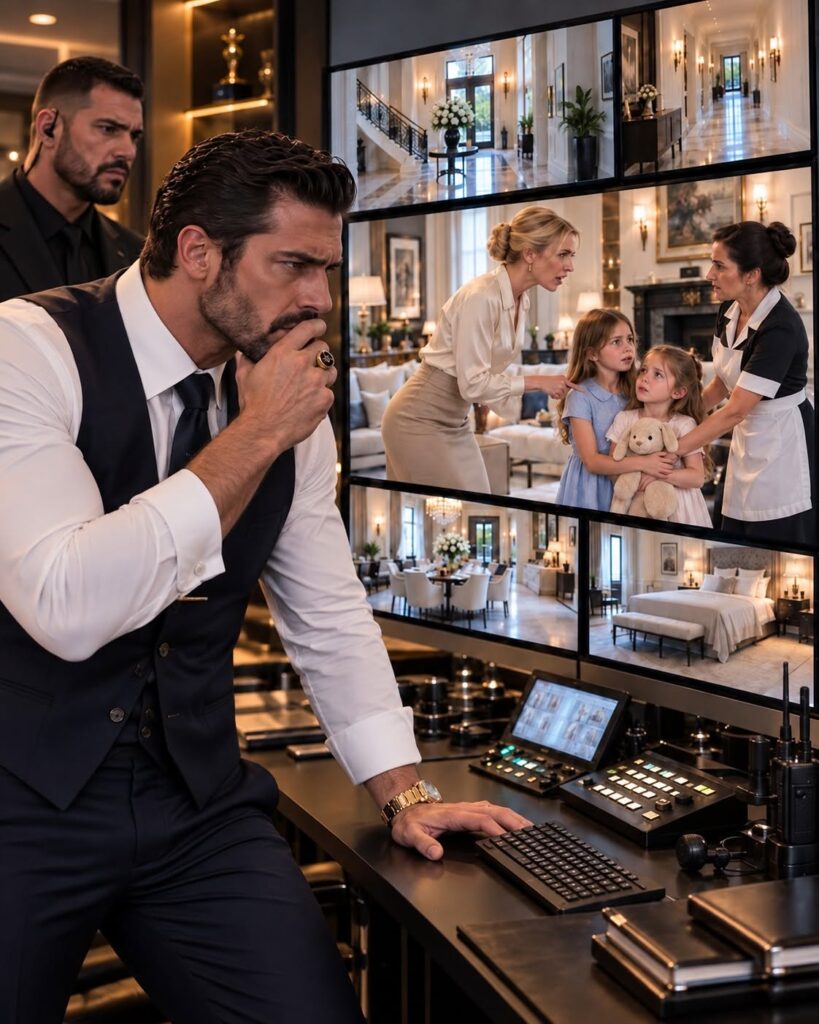
PART 2
“Do not touch her.”
Marisol’s voice came through the speakers in the monitoring room with quiet firmness.
For a second, Chloe simply stared at her.
Then she lowered her voice.
That was what frightened me most.
People shouted when they lost control.
Chloe didn’t.
She stepped closer to Marisol as if they were discussing flowers for the dining room table.
“You keep making them believe you’re the one who keeps them safe,” she said.
“And one day Alexander is going to understand exactly what you’re doing.”
Marisol released her arm immediately and took half a step back.
“I have never told those girls anything against their father.”
“I wasn’t talking about their father.”
Chloe glanced toward the staircase, making sure Valeria and Sofia were out of sight.
Then she smiled.
“You think I don’t notice what happens when they’re frightened?
They look for you.
When Sofia wakes from a bad dream, she asks for you.
When Valeria gets upset, she waits until you’re nearby before she talks.
Do you understand how that makes me look?”
Marisol was silent.
Chloe folded her arms.
“I’m supposed to become their mother.”
“No,” Marisol said softly.
“You are supposed to become their family.”
Something in the room behind the garage seemed to change.
Maybe it was only me.
Beside me, Hector stopped watching the monitors and looked at my face.
On-screen, Chloe’s expression tightened.
“There’s no difference.”
“There is to children.”
Chloe glanced again toward the staircase.
“They barely give me a chance.”
Marisol’s voice remained measured.
“They have tried.”
“They tolerate me.”
“They’re grieving.”
“It’s been three years.”
The words were not cruelly spoken.
That almost made them worse.
Marisol’s expression softened rather than hardened.
“Three years is not a deadline.”
Chloe looked away.
For the first time since she had entered the living room, I saw something other than irritation in her face.
Fear.
Not fear of Marisol.
Fear of being unwanted.
Then it disappeared.
She turned toward the shelf, took Sofia’s stuffed rabbit down, and held it for several seconds.
“I bought her a new one last Christmas,” she murmured.
“A beautiful one.
She never touches it.”
“That rabbit belonged to her mother.”
“I know.”
Marisol seemed surprised.
Chloe placed the old rabbit carefully on the coffee table.
“I know exactly where it came from.”
She walked out.
For several seconds, neither Hector nor I said anything.
Then Hector leaned back in his chair.
“What do you want to do?”
I stared at the empty living room on the monitor.
An hour earlier, I would have answered without hesitation.
I had spent most of my adult life making decisions quickly.
In my world, uncertainty was treated like weakness.
You gathered facts, identified the problem, and acted before anyone else had time to change the board.
But this wasn’t business.
This was my family.
And the first thing I had learned in the last fifteen minutes was that I understood far less about my own home than I had believed.
“I want to keep watching.”
Hector nodded once.
No judgment.
That was one reason he had worked for me for eighteen years.
We watched Marisol carry Sofia’s rabbit upstairs.
A few minutes later, she returned alone.
She finished clearing the breakfast dishes, spoke briefly with the tutor at the front entrance, and disappeared into the laundry room.
Nothing suspicious.
No stolen jewelry.
No secret phone calls.
No evidence of betrayal.
Only routine.
By noon, embarrassment had begun to settle over me.
Not because Chloe’s behavior had been appropriate.
It hadn’t.
But because I had been prepared to believe Marisol guilty based on little more than suggestion.
Five years of loyalty had been placed on one side of the scale.
A few missing objects and several whispered doubts had been placed on the other.
And somehow I had allowed suspicion to outweigh history.
At twelve fifteen, Valeria came downstairs alone.
She stood in the hallway for almost a minute before approaching Marisol.
“Can I ask you something?”
Marisol looked up from folding towels.
“Always.”
Valeria glanced toward the kitchen.
“Is Chloe mad at us?”
My chest tightened.
Marisol did not rush to answer.
“I think Miss Chloe sometimes becomes frustrated when things don’t happen the way she hopes.”
“That means yes.”
A faint smile touched Marisol’s face.
“You are very clever.”
“That’s what Dad says when he doesn’t want to answer me.”
Despite everything, Hector made a quiet sound that might have been a laugh.
I didn’t.
Valeria sat on the edge of a chair.
“Did we do something?”
“No.”
“You’re sure?”
“Yes.”
“Because Sofia thinks it’s because of Mom.”
Marisol stopped folding.
“What do you mean?”
“She thinks Chloe doesn’t like when we talk about Mom.”
My pulse slowed.
Not from relief.
From attention.
Marisol pulled another chair closer and sat facing Valeria.
“What makes Sofia think that?”
Valeria hesitated.
“She put the photograph away.”
“What photograph?”
“The silver one from the piano.”
I knew exactly which one.
Elena holding both girls on the beach in Santa Barbara.
Sofia had been barely two.
Valeria was missing a front tooth and laughing so hard her eyes were almost closed.
The photograph had stood on the piano for years.
I suddenly realized I had not seen it recently.
“When?”
Marisol asked.
“A while ago.”
“Did she tell you why?”
“She said the room looked cluttered.”
Marisol’s face revealed nothing.
“Anything else?”
Valeria rubbed her thumb against the hem of her shirt.
“She moved Mom’s cookbook.”
“From the kitchen?”
Valeria nodded.
“And the blue vase.”
My throat tightened.
Elena had loved that ridiculous blue vase.
It was crooked, slightly chipped, and worth perhaps twenty dollars, although she had treated it like museum glass because Valeria had helped paint it at a pottery studio when she was four.
I tried to remember the last time I had seen it.
I couldn’t.
Marisol reached across the space between them but stopped before touching Valeria.
“Would it make you feel better if some of those things were returned?”
Valeria nodded.
Then she whispered, “I don’t want Chloe to think we don’t like her.”
The sentence hit harder than anger would have.
Valeria was nine.
Nine years old, and already trying to manage an adult’s feelings.
Marisol’s voice became very gentle.
“You can like someone new without loving your mother less.”
Valeria looked down.
“I know.”
“Do you?”
A pause.
“No.”
Marisol waited.
Valeria’s eyes filled, though she did not cry.
“Sometimes when Dad is happy with Chloe, I feel bad for being sad about Mom.”
The room behind the garage became unbearably small.
I stood.
Hector said nothing.
I walked to the far wall and pressed my hands against it.
There are truths that arrive like explosions.
This one arrived like rain slipping beneath a door.
Quiet.
Cold.
Impossible to ignore once you felt it.
I had thought moving forward was a gift to my daughters.
I had imagined they needed to see me laugh again, needed proof that grief had not permanently emptied our home.
Maybe some part of that had been true.
But I had never asked what my happiness required from them.
Had they believed accepting Chloe was something they owed me?
Had Valeria been smiling through dinners because she thought it was her responsibility to protect me?
I turned back toward the screens.
Marisol was still sitting with her.
“Your father’s happiness is not something you have to earn,” she said.
Valeria swallowed.
“Does he know that?”
Marisol smiled sadly.
“I think sometimes grown-ups need reminders too.”
I closed my eyes.
Hector looked away.
He had known Elena for years.
He had stood at the edge of the cemetery while I held Sofia in my arms and Valeria clung to my coat.
He had watched me spend the months afterward burying myself in work because home felt too full of absence.
When I returned to my chair, he said quietly, “You can go upstairs now.”
“I know.”
“But you’re not going to.”
“No.”
“Why?”
I stared at Valeria on the screen.
“Because if I walk in now, they’ll start protecting me.”
Hector studied me.
I continued before he could speak.
“Marisol will defend them.
Chloe will explain herself.
Valeria will tell me she’s fine because she’ll see my face and decide I’ve already heard too much.
Sofia will probably run to me.”
“And?”
“And I’ll make decisions based on the first version of the truth that lets me feel useful.”
Hector nodded slowly.
“So you wait.”
“For a little longer.”
That afternoon taught me more about my household than the previous year had.
Not because anything dramatic happened.
Because ordinary things did.
I watched Chloe speak politely to the girls’ tutor.
I watched her order flowers for a charity dinner.
I watched her spend twenty minutes helping Sofia choose between two dresses for a friend’s birthday party.
At one point, Sofia even laughed at something Chloe said.
That mattered.
It would have been easier if Chloe were simply cruel.
People like simple categories because simple categories require simple choices.
But human beings rarely cooperate.
Chloe could be impatient and insecure.
She could also kneel on a bedroom rug and carefully braid Sofia’s hair after the child asked her to try.
She could remove Elena’s belongings from shared rooms.
She could also remember that Valeria hated mushrooms and ask the chef to change dinner.
By three o’clock, I no longer knew exactly what I was investigating.
I only knew it was bigger than missing perfume.
At three twenty, Marisol walked into the small office beside the kitchen carrying a basket of clean clothes.
Chloe was already inside.
She closed the door.
Hector leaned forward.
There was a camera in the office, though no audio pickup directly above the desk.
The nearest microphone was in the hallway, making their voices faint but audible.
Chloe spoke first.
“I want to know where you put them.”
Marisol set down the basket.
“I don’t know what you mean.”
“Yes, you do.”
“The photographs?”
Chloe shook her head.
“The receipts.”
I looked at Hector.
He frowned.
Marisol’s expression changed.
Only slightly.
But enough.
“What receipts?” she asked.
Chloe stared at her.
“The ones from the storage company.”
Silence.
Then Marisol said, “I haven’t touched them.”
“Someone has.”
“I don’t know anything about that.”
Chloe paced to the window.
“This is exactly what I mean.
Things keep disappearing, and somehow you’re always nearby.”
Marisol’s shoulders stiffened.
“Are you accusing me of stealing?”
“I’m asking questions.”
“No.
You are placing an answer inside the question.”
Chloe stopped.
For a moment, her face showed exhaustion.
“When I moved in here, I knew it would be difficult.”
Marisol said nothing.
“I knew Alexander had loved his wife.
I knew the girls missed their mother.
I knew half the staff had been here when Elena was alive.”
Hearing my wife’s name from Chloe’s mouth felt strange.
Not wrong.
Just unfamiliar.
She rarely said it.
“I thought,” Chloe continued, “that if I was patient, eventually there would be room for me.”
“There is room.”
“Not the kind I mean.”
Marisol’s face softened.
“That kind cannot be made by removing someone else.”
Chloe looked at her sharply.
“You think I’m trying to erase Elena.”
“Aren’t you?”
The question was not aggressive.
It was quiet.
And Chloe had no immediate answer.
She sat behind the desk.
“I moved a few things.”
“The girls noticed.”
“Of course they noticed.
They notice everything.”
“Yes.”
“I was trying to make the house feel like ours.”
Marisol corrected her gently.
“It was already theirs.”
Chloe lowered her eyes.
For the first time all day, she seemed ashamed.
“I know.”
The words were barely audible.
Then she looked up.
“But I still want those receipts.”
“What are they for?”
Chloe hesitated.
That hesitation changed everything.
I felt it immediately.
So did Hector.
He pointed toward the screen.
“There.”
“I saw it.”
Marisol waited.
Finally Chloe said, “Nothing important.”
Marisol gave her a long look.
“If they are not important, why are you worried?”
Chloe stood again.
“Forget it.”
She left.
Marisol remained alone in the office.
For several seconds, she didn’t move.
Then she crossed to the desk, opened the bottom drawer, and removed a plain white envelope.
My pulse quickened.
She slipped it beneath the folded towels in the basket.
Hector reached for the keyboard.
“Want me to zoom?”
“Yes.”
He enlarged the image.
There was writing on the envelope.
Not enough to read clearly.
But I recognized the first word.
Vance.
I leaned closer.
Marisol looked toward the closed door.
Then she carried the basket out.
For the next ten minutes, we followed her through the cameras.
Laundry room.
Service corridor.
Back staircase.
Second floor.
She paused outside Sofia’s room before continuing toward the west wing.
That part of the estate was rarely used.
Elena’s old art room was there.
So were several guest rooms and a storage closet I had not opened in years.
Marisol entered the art room.
The camera showed only the doorway and part of the room.
She remained inside for less than two minutes.
When she came out, the envelope was gone.
Hector looked at me.
“You knew about that?”
“No.”
“Want me to check?”
I almost said yes.
Instead I asked, “Check what?”
“The room.”
“No.”
He looked surprised.
“We’re already watching them without their knowledge,” I said.
“I’m not sending someone to search Marisol’s things based on another assumption.”
“That room isn’t hers.”
“No.
It was Elena’s.”
That stopped us both.
I stared at the closed door on the monitor.
Something had been hidden there.
Maybe receipts.
Maybe evidence Marisol had stolen something.
Maybe something else entirely.
At four o’clock, I finally left the monitoring room.
Not to confront anyone.
To think.
The estate sat on several acres above the city, protected by gates, walls, cameras, and people whose full-time job was to anticipate danger.
Yet walking through the narrow service corridor, I felt as though I were entering my own home for the first time.
I stopped outside the mudroom when I heard Sofia laughing upstairs.
Then Valeria said something I couldn’t make out.
Another burst of laughter followed.
I stood there, hidden from them, and realized how much of their lives I experienced secondhand.
Reports from tutors.
Messages from staff.
Photographs sent while I traveled.
Stories told over late dinners when I was only half present.
I had mistaken providing for participating.
The distinction was painful.
I returned to the monitoring room.
At five thirty, Chloe changed for dinner.
The girls finished their homework.
Marisol spoke to the chef.
Ordinary life continued.
Then Hector received a call.
He listened for nearly a minute.
“Yes,” he said.
“Send it to me.”
He ended the call.
“What?”
“One of my people checked the inventory records.”
I frowned.
“What inventory records?”
“The household insurance list.
Since Chloe said jewelry was missing, I wanted to see whether anyone had filed a claim.”
“And?”
“No claim.”
“That means nothing.”
“No.
But this might.”
His laptop chimed.
He opened an email and turned the screen toward me.
Three items Chloe had claimed were missing were listed in recent appraisal documents.
Not missing.
Moved.
The emerald bracelet was logged two weeks earlier with a private jeweler in Beverly Hills.
The antique perfume bottle had been included in a temporary storage inventory.
And the diamond earrings Chloe had specifically told me Marisol might have taken had been photographed by the appraiser four days after Chloe claimed they disappeared.
I stared at the dates.
“She lied.”
“Maybe.”
“She told me those earrings vanished before the appraisal.”
“Yes.”
“Then she lied.”
Hector remained careful.
“She may have forgotten.”
I almost laughed.
He knew Chloe rarely forgot anything involving jewelry.
“Where’s the storage inventory?”
“That’s what I’m trying to get.”
At six ten, another email arrived.
A storage company in Culver City had received twelve sealed crates from my estate over the previous eight months.
The authorization did not bear my signature.
It bore Chloe’s.
I read the item descriptions.
Decorative objects.
Books.
Framed photographs.
Kitchen items.
Personal papers.
Children’s artwork.
My throat tightened.
“Children’s artwork?”
Hector scrolled farther.
“Looks like it.”
“What exactly?”
“No details.”
“And Marisol knew about this?”
“Maybe those are the receipts Chloe was looking for.”
I stood.
This time I knew I could not remain behind the screens all night.
But before I reached the door, Sofia appeared on camera again.
She was carrying her rabbit.
Valeria followed.
They entered the living room, where Chloe stood arranging flowers.
Sofia hesitated.
Then she approached her.
“Chloe?”
Chloe turned.
“Yes?”
“Can I ask you something?”
A strange echo of Valeria’s earlier conversation with Marisol.
Sofia held the rabbit against her chest.
“Do you not like Bunny?”
Chloe blinked.
“What?”
“My bunny.”
“No.”
Sofia’s face fell.
Chloe immediately shook her head.
“No, I mean—no, I don’t dislike him.”
“Him.”
“What?”
“He’s a him.”
Chloe stared at the worn rabbit.
Then, unexpectedly, she smiled.
“I apologize to the gentleman.”
Sofia almost smiled back.
Valeria watched from several feet away.
Sofia gathered courage.
“Did you put Mommy’s picture away because you don’t like her?”
The smile vanished from Chloe’s face.
I stopped breathing.
There are questions adults spend years avoiding because they seem too complicated.
Children reduce them to ten words.
Chloe looked toward Valeria.
Then back at Sofia.
“No.”
“Then why?”
She did not answer immediately.
Finally, she sat on the edge of the sofa.
“Because sometimes I walk into a room and see your mother everywhere.”
Sofia hugged the rabbit tighter.
“That’s good.”
“For you, maybe.”
Sofia frowned.
Chloe looked suddenly tired.
“I know that sounds unfair.”
Valeria spoke.
“Daddy likes the pictures.”
“I know.”
“Then why did you move them?”
Chloe’s eyes lowered.
“Because I wanted there to be things in this house that belonged to me too.”
Valeria looked around the enormous living room.
“There’s lots of space.”
Hector looked at me.
I almost smiled despite everything.
Chloe did.
A genuine, reluctant smile.
“Yes,” she said.
“There is.”
Sofia climbed onto the sofa but left a careful space between them.
“Mommy can have some and you can have some.”
Chloe’s eyes filled.
She turned away quickly.
“Children make everything sound easy.”
Sofia considered that.
“Sometimes it is.”
I would remember that sentence for years.
Chloe reached toward the rabbit, then stopped.
“May I?”
Sofia hesitated before handing it to her.
Chloe examined one loose seam near its ear.
“I can fix this.”
Sofia shook her head.
“Marisol fixes him.”
The hurt on Chloe’s face appeared instantly.
Small.
Human.
She returned the rabbit.
“Of course.”
Sofia seemed to realize something had happened, though she did not understand what.
“You can help.”
Chloe looked at her.
“If you want.”
Sofia nodded.
That was when I understood something I had resisted all day.
The problem was real.
But perhaps the villain I had been searching for wasn’t.
There was insecurity.
Grief.
Territorial fear.
Miscommunication.
There were choices Chloe had made that had hurt my daughters.
There were choices I had made that had allowed those wounds to deepen unnoticed.
And somewhere in the middle stood Marisol, quietly trying to keep the house balanced without betraying anyone.
At seven, the girls went upstairs to wash for dinner.
Chloe remained in the living room.
Marisol entered carrying folded napkins.
Chloe looked at her.
“Do you know how to sew that rabbit?”
Marisol paused.
“Yes.”
“Will you show me?”
Marisol studied her face.
Then nodded.
“Of course.”
Chloe looked almost relieved.
I sat down again.
Hector crossed his arms.
“You still going upstairs?”
“Yes.”
“When?”
“When the girls are asleep.”
He nodded.
Dinner was strangely normal.
I watched through cameras as Chloe asked Valeria about school.
Valeria described a history project.
Sofia complained about peas.
Marisol passed through twice and reminded Sofia that she had eaten three cookies before dinner.
Nobody looked like a family in crisis.
Maybe that was part of the reason I had missed everything.
Families rarely announce the moments in which they lose their balance.
At eight thirty, Marisol helped Sofia prepare for bed.
Chloe appeared at the doorway holding a small sewing kit.
Sofia looked at her.
“You remembered.”
“I said I would.”
Together, Chloe and Marisol repaired the rabbit.
Chloe’s stitches were terrible.
Sofia informed her of this immediately.
Marisol laughed.
Even Valeria smiled from her bed across the hall.
For ten quiet minutes, the four of them seemed almost peaceful.
Then Valeria asked, “Can Mom’s beach picture come back downstairs?”
Chloe’s hands stopped.
Marisol said nothing.
Chloe looked at both girls.
“Yes.”
“Tonight?”
A pause.
“Yes.”
She stood.
“I’ll get it.”
But instead of heading toward the storage closet, Chloe walked downstairs, entered the office, and began searching the desk.
Five minutes passed.
Then ten.
Her movements grew increasingly anxious.
She opened drawers.
Checked folders.
Looked behind books.
Finally she whispered, “Where is it?”
Hector and I exchanged a glance.
Marisol entered.
Chloe turned.
“You took the envelope.”
Marisol stopped.
“What envelope?”
“Please.”
The word surprised me.
No accusation.
No anger.
Just urgency.
“Marisol, I need it.”
“Why?”
Chloe looked toward the hallway.
“Because Alexander can’t see those papers before I explain.”
My stomach tightened.
Marisol’s expression changed.
“You told him I was stealing.”
Chloe closed her eyes.
“I know.”
“Why?”
“I needed him to question you.”
Marisol stared at her.
“For what?”
“So he would stop trusting everything you said.”
The sentence hung between them.
Chloe sank into the desk chair.
“I thought if he listened to you first, he would never listen to me.”
“About what?”
Chloe covered her face with both hands.
When she looked up, the defensiveness was gone.
“I made a mistake.”
Marisol’s voice softened.
“What mistake?”
“I moved Elena’s things.”
“We know.”
“No.”
Chloe shook her head.
“Not the photographs.
Not just those.”
My heart began pounding.
“What did she move?”
Hector whispered.
I didn’t answer.
Chloe continued.
“I found boxes in the west wing last winter.
Letters.
Journals.
The girls’ baby things.
Alexander’s wedding photographs.
Elena’s sketches.
Everything.”
Marisol became very still.
“I thought they had been forgotten.”
“They were not.”
“I know that now.”
Chloe’s voice trembled.
“I sent them to storage because I wanted one room in this house where I didn’t feel like a visitor.”
Marisol took a slow breath.
“What room?”
Chloe looked toward the hallway.
“Elena’s art room.”
I stared at the monitor.
The room Marisol had entered earlier.
The room that had remained untouched since my wife died.
Chloe had cleared it.
I had not even noticed.
That realization hurt more than the act itself.
“What did you do with the room?”
Marisol asked.
“I was going to turn it into an office.”
“For yourself?”
Chloe shook her head.
“For Alexander.”
I frowned.
Marisol did too.
“Why?”
“Because he works everywhere except home.
Dining table.
Car.
Plane.
Downtown office.
I thought if I gave him somewhere here, maybe he’d stay more.”
My anger faltered.
It did not disappear.
But it changed shape.
Chloe gave a small, embarrassed laugh.
“It sounds ridiculous when I say it.”
“No,” Marisol said.
“Yes, it does.”
“You should have asked.”
“I know.”
“You should have asked the girls.”
“I know.”
“You should have asked Mr.
Vance.”
Chloe looked down.
“I know.”
Silence.
Then Marisol asked the question I had been waiting for.
“Why accuse me of taking jewelry?”
Chloe’s face tightened with shame.
“Because I panicked.”
“About the receipts?”
“Yes.”
“Because they showed you moved the boxes?”
“Yes.”
“And you believed if Mr.
Vance suspected me, he would dismiss me before I could tell him.”
Chloe nodded.
Marisol sat opposite her.
“You were afraid.”
“Yes.”
“You hurt people because you were afraid.”
Chloe looked toward the staircase.
“I know.”
Marisol remained quiet for a long time.
Then she said, “Fear explains many bad choices.
It does not repair them.”
“I know that too.”
For the first time all day, I believed her.
Chloe wiped beneath one eye.
“I don’t know how to fix this.”
Marisol looked toward the doorway.
“Start with the truth.”
Chloe laughed softly.
“That may end my engagement.”
“It may.”
“And you’re telling me to do it anyway.”
“Yes.”
“Why?”
“Because those girls already lost one mother.
They should not have to live in a house where adults hide important things because they are afraid of losing their place.”
Chloe looked at her for a long time.
Then she whispered, “You really do love them.”
Marisol’s face changed.
Not dramatically.
Just enough to make her look older.
“Yes.”
The answer was simple.
Certain.
Chloe nodded.
“I think that’s why I resented you.”
Marisol said nothing.
“You knew them before me.
You knew what Sofia needed when she cried.
You knew when Valeria wanted to talk and when she wanted silence.
Their father trusted you.
Everyone did.”
“That trust took years.”
“I wanted it immediately.”
“And when you didn’t receive it?”
“I acted like trust was something someone else had stolen from me.”
Marisol looked at her.
“That is not how trust works.”
“No.”
Chloe took a breath.
“Where’s the envelope?”
Marisol hesitated.
Then said, “In the art room.”
“I looked there.”
“You did not look where Elena used to hide Valeria’s birthday presents.”
My breath caught.
Only a handful of people knew that place.
There was a loose panel beneath the old window seat.
Elena had once hidden an entire dollhouse behind it in pieces.
Chloe stood.
“I’m going to tell him.”
Marisol stopped her.
“He is away.”
Chloe gave a tired smile.
“No, he isn’t.”
Everything inside me went still.
Hector whispered, “What?”
Marisol looked confused.
Chloe glanced toward one of the hidden cameras.
Not directly at it.
Almost.
“I know Alexander.”
My pulse hammered.
“He said Toronto,” she continued.
“But when he lies about work, he gives too many details.”
Marisol blinked.
“You think he is here?”
“I think he’s watching.”
Hector and I stared at each other.
Chloe looked around the office.
“If you are,” she said quietly, “I suppose I deserve that.”
I reached for the door.
This time, I did not stop.
Twenty minutes later, I was standing outside my daughters’ rooms.
They were asleep.
Sofia’s rabbit rested beneath one arm.
Valeria’s book lay open on her chest.
I pulled the blanket higher over her shoulder and sat between their beds for a long time.
Not a crime boss.
Not a man with security teams and influence.
Just their father.
Downstairs, three adults were waiting for a conversation none of us wanted.
But for once, I did not want the quickest solution.
I wanted the truest one.
When I entered the living room, Chloe was standing beside the fireplace.
Marisol sat near the window.
Hector remained by the door until I shook my head.
“Go home.”
He hesitated.
“Alexander—”
“I’m safe.”
He looked toward Chloe, then Marisol.
Finally he nodded.
“Call if you need me.”
When the door closed, silence filled the house.
Chloe spoke first.
“How much did you hear?”
“Enough.”
She nodded.
“I’m sorry.”
I looked at Marisol.
She met my eyes but said nothing.
Then I looked back at Chloe.
“Where are Elena’s things?”
“The storage facility.”
“All of them?”
Chloe hesitated.
“Most.”
“What does that mean?”
She glanced toward Marisol.
“There was one box I didn’t send.”
“Why?”
“Because when I opened it, I saw your name.”
My breathing slowed.
“What box?”
“Letters.”
I stared at her.
“From Elena?”
“I think so.”
“You think?”
“They were sealed.”
“You opened them?”
“No.”
Something inside me released slightly.
“Where are they?”
Chloe swallowed.
“That’s the problem.”
“What problem?”
“I left the box in the art room because I knew I shouldn’t touch it.”
Marisol frowned.
“It is not there.”
“I know.”
They looked at each other.
Then both looked at me.
For the first time that night, Chloe’s confusion appeared completely genuine.
“I went back two weeks later,” she said.
“The box was gone.”
No one spoke.
I thought about the envelope Marisol had hidden.
The storage receipts.
The secret panel.
The room no one used.
And then I remembered something Valeria had said months ago.
A small comment I had barely noticed at the time.
Mom left something for us.
I had assumed she meant memories.
Now, standing in the quiet living room with two women who had each been protecting different pieces of the truth, I began to wonder if my nine-year-old daughter knew something none of us did.
And whether the next secret in our house belonged not to Chloe or Marisol—
but to Elena.
PART 3
I did not wake Valeria that night.
That decision surprised Chloe.
It surprised Marisol too.
A year earlier, perhaps even a month earlier, I would have gone upstairs immediately, turned on the light, and asked my daughter what she knew.
Not harshly.
I told myself I was never harsh with my children.
But urgency has its own weight.
Adults forget that.
A worried father standing beside a child’s bed at midnight can make even a simple question feel enormous.
So I waited.
We sat in the living room after midnight, surrounded by the quiet evidence of choices we had all made.
Marisol brought coffee.
Chloe refused hers at first, then accepted it.
No one knew what to say.
Eventually I asked, “How long have you known about the storage unit?”
Marisol looked at Chloe before answering.
“About three months.”
“And you didn’t tell me.”
“No.”
“Why?”
“Because I was not certain what had happened.”
“You saw Elena’s things disappear.”
“I saw things being packed.”
“That should have been enough.”
Marisol accepted the criticism without defending herself.
“Yes.”
I looked away.
That somehow made me feel worse.
“Why didn’t you tell me?”
She folded her hands in her lap.
“Because every time I tried to speak about Miss Chloe, I worried you would hear something I was not saying.”
“What does that mean?”
“That I wanted her gone.”
Chloe lowered her eyes.
Marisol continued.
“I did not.”
Chloe looked up.
“You didn’t?”
“No.”
“Even after everything?”
Marisol gave her a tired smile.
“I wanted you to behave differently.
That is not the same as wanting you gone.”
Chloe absorbed that in silence.
Marisol turned back to me.
“When you first became engaged, the girls were confused.
Valeria asked me if liking Miss Chloe meant she was betraying her mother.
Sofia asked whether Elena would still know where to find her if another woman lived in the house.”
My chest tightened.
“She said that?”
“Yes.”
“When?”
“A year ago.”
I stared at her.
“And you didn’t tell me?”
“I told you they were having difficulty adjusting.”
“That is not the same thing.”
“No.”
“Why didn’t you tell me exactly what she said?”
Marisol’s answer came quietly.
“You were finally laughing again.”
I had no response.
She looked down.
“Your grief had frightened them too.”
Chloe spoke softly.
“They thought they could lose you without you dying.”
I turned toward her.
She immediately shook her head.
“I’m sorry.
I shouldn’t—”
“No.”
I forced myself to remain still.
“Finish.”
She hesitated.
“Valeria told me once that after Elena died, you stopped eating breakfast with them.”
I closed my eyes.
I remembered.
Of course I remembered.
Breakfast had been Elena’s time.
She insisted on it.
No phones.
No newspapers.
No staff hovering except Marisol and whoever cooked.
After Elena died, the sight of her empty chair had become unbearable.
So I began leaving before the girls woke.
I told myself work required it.
Eventually, the explanation became habit.
“When did Valeria tell you that?”
I asked.
“Last spring.”
“And what did you say?”
Chloe looked ashamed.
“I told her people handle sadness differently.”
“That was true.”
“It wasn’t enough.”
No, it wasn’t.
I rubbed a hand over my face.
For years I had believed protecting my children meant keeping danger far from them.
I had not understood that absence could be its own kind of uncertainty.
Not cruel.
Not intentional.
But deeply felt.
At one in the morning, we agreed to stop.
No more searching.
No waking children.
No arguments.
The storage unit could wait.
The missing letters could wait.
Morning mattered more.
I slept badly.
At six thirty, I heard footsteps outside my bedroom.
A soft knock followed.
“Daddy?”
Sofia.
I opened the door.
She stood in pink pajamas holding Bunny by one ear.
Her hair was a disaster.
“Your trip was short.”
I almost smiled.
“It was.”
“Did Canada cancel?”
Behind her, Valeria appeared.
She looked at me for half a second.
Then at my shoes.
Then at the overnight clothes I had never changed out of.
She knew.
Nine-year-olds notice more than adults want to believe.
“You never went,” she said.
Sofia gasped.
“You lied?”
The word landed exactly where it should have.
I crouched so I was closer to her height.
“Yes.”
“Why?”
I considered inventing a gentler word.
I did not.
“I was worried about something in the house, and instead of talking about it properly, I pretended to leave so I could watch what happened.”
Valeria’s expression became guarded.
“Watch?”
“There are security cameras in the common rooms.”
Both girls stared at me.
Sofia looked toward the hallway ceiling.
“There?”
“Not in bedrooms or bathrooms.
Only shared areas.”
Valeria crossed her arms.
“Did you watch us?”
“Yes.”
“Did you hear everything?”
“Some things.”
Her face reddened.
Not fear.
Embarrassment.
I realized immediately what I had done.
“I’m sorry.”
She looked surprised.
“For what?”
“For making you feel observed in your own home without telling you.”
“You’re Dad.
You own the house.”
“That doesn’t mean your feelings don’t matter.”
Valeria looked down.
Sofia was still inspecting the ceiling.
“Can the camera see me now?”
“No.”
“Good.”
She lifted Bunny.
“He didn’t brush his fur.”
Despite everything, I laughed.
Sofia grinned.
Valeria did not.
She asked, “Are you mad at Chloe?”
The question carried more weight than a child should have been responsible for.
I chose my words carefully.
“I’m disappointed by some choices she made.”
“Is she leaving?”
“I don’t know yet.”
Valeria’s eyes moved to mine.
That answer mattered to her.
Not yes.
Not no.
Truth.
I held out my hands.
“Can we have breakfast together?”
Sofia immediately took one.
Valeria hesitated.
Then took the other.
We went downstairs.
Marisol was already in the kitchen.
She stopped when she saw me between the girls.
Something passed across her face.
Relief, perhaps.
Or memory.
Chloe entered several minutes later.
She looked as if she had barely slept.
Sofia waved.
“Daddy didn’t go to Canada.”
“Toronto,” Valeria corrected.
“Toronto is Canada.”
“I know.”
“Then why did you correct me?”
“Because he said Toronto.”
Chloe sat across from them.
“I know.”
Sofia looked between us.
“You all look weird.”
That broke the tension better than any adult could have.
Marisol turned toward the stove so no one would see her smile.
I poured orange juice.
Chloe buttered toast.
Valeria watched everyone.
Finally she asked, “Are we having a family meeting?”
I almost dropped the pitcher.
“Why would you ask that?”
“Because adults make breakfast when they’re going to talk about something bad.”
Marisol coughed into her hand.
Apparently my daughters had been studying us all more carefully than we realized.
“Not bad,” I said.
“Important.”
Sofia frowned.
“Important is usually bad too.”
“No,” Chloe said softly.
“Sometimes important is just honest.”
Valeria looked at her.
The room went quiet.
Chloe placed the butter knife down.
“I moved some things that belonged to your mother.”
Valeria’s eyes sharpened.
“The picture.”
“Yes.”
“The vase.”
“Yes.”
“The cookbook.”
“Yes.”
Sofia hugged Bunny.
“Why?”
Chloe glanced at me.
I did not rescue her.
Not because I wanted her uncomfortable.
Because the apology needed to belong to her.
“I was trying very hard to feel like this was my home,” she said.
“It is your home,” Sofia replied.
Chloe’s eyes filled.
“Thank you.”
“Unless Daddy makes you leave.”
“Sofia,” Valeria whispered.
“What?
He said he doesn’t know.”
I rubbed my forehead.
Chloe almost smiled.
“That is also honest.”
Then she became serious again.
“I thought if I moved some of your mother’s things, I would feel less like I was living inside someone else’s life.”
Valeria’s voice was cautious.
“Did it work?”
“No.”
“Why not?”
Chloe looked around the kitchen.
“Because the feeling wasn’t coming from the things.”
“Where was it coming from?”
“Me.”
Valeria studied her.
That answer, more than anything else, seemed to satisfy her.
Chloe continued.
“I should have talked to your father.
I should have talked to you.
I should never have made you feel as if remembering your mother was something that bothered me.”
Sofia frowned.
“You did.”
“I know.”
“You told me not to talk about the beach picture.”
“I know.”
“Because you were sad?”
Chloe looked surprised.
Then nodded.
“Yes.”
Sofia considered this.
“When I’m sad, Marisol gives me toast.”
Everyone looked at Marisol.
She lifted both hands.
“With cinnamon.”
Sofia nodded solemnly.
“That helps.”
Chloe laughed through tears.
“I’ll remember that.”
There was no dramatic reconciliation.
Sofia did not leap into Chloe’s arms.
Valeria did not announce forgiveness.
They ate breakfast.
That was all.
Yet something had shifted.
Afterward, Valeria helped Sofia find her school shoes.
Marisol cleared the table.
Chloe carried plates to the sink.
I stood in the kitchen watching a family continue after truth had entered the room.
Then I remembered the box.
“Valeria.”
She stopped at the door.
“Yes?”
“Can we talk privately for a minute?”
Her expression changed.
She knew.
We went into the library.
I left the door open.
That was deliberate.
She sat in the large chair Elena used to read in.
I took the sofa across from her.
“Last night, Chloe told me about a box that used to be in your mother’s art room.”
Valeria immediately looked down.
“You know about it.”
She nodded.
“Where is it?”
Silence.
I waited.
Old instincts urged me to ask again.
I didn’t.
Finally she whispered, “I took it.”
“Why?”
“Because Chloe was putting Mom away.”
My chest tightened.
“Where did you take it?”
“Somewhere safe.”
“Valeria.”
Her chin lifted defensively.
“You weren’t here.”
Four words.
No accusation.
No anger.
They did not need either.
I leaned back.
“You’re right.”
She looked surprised.
“I wasn’t here enough.”
“That’s not what I meant.”
“Yes, it is.”
Her eyes filled.
“I thought if I told you, you’d say Chloe was just trying to help.”
I remembered all the times I had said exactly that.
Chloe’s trying.
Give her time.
This is new for everyone.
Every sentence reasonable.
Every sentence perhaps telling my daughters to question their own discomfort.
“I might have,” I admitted.
Valeria looked at the carpet.
“That’s why I didn’t.”
“Where’s the box?”
She hesitated.
Then said, “At Aunt Celeste’s.”
I stared at her.
My sister lived twenty minutes away in Brentwood.
“When did you take it there?”
“Two months ago.”
“How?”
“Marisol drove me.”
I almost stood.
Then forced myself to remain seated.
“Marisol knew?”
“No.”
Valeria shook her head quickly.
“She thought I was taking school things.
Aunt Celeste saw the box when we got there.”
“And?”
“I told her Mom left it for us.”
“Did she open it?”
“No.”
“How do you know?”
“She promised.”
Something in me softened.
Celeste had been Elena’s closest friend before she became my sister-in-law.
If Valeria had chosen anyone else, I might have been more worried.
But Celeste understood grief.
Perhaps better than I did.
“Why did you think the box was for you?”
Valeria reached into the pocket of her cardigan.
She unfolded a small piece of paper.
I recognized Elena’s handwriting before I read a word.
My breath caught.
Valeria handed it to me.
Alexander, if you find this before I’m brave enough to give it to you, put it back and pretend you didn’t.
I read the line twice.
Then again.
Below it:
For later.
For the girls.
For the days when memories start changing shape.
I could not speak.
Valeria watched me.
“I found that on top.”
“Was the box open?”
“A little.”
“Did you read anything else?”
“No.”
“Why not?”
She shrugged.
“Mom said later.”
Children sometimes understand boundaries better than adults.
“When is later?”
I asked.
“I don’t know.”
Neither did I.
We went to school late that morning.
I drove them myself.
No security convoy.
No driver.
Just me.
At the entrance, Sofia kissed my cheek.
“Are you leaving today?”
“No.”
“Tomorrow?”
“No.”
She narrowed her eyes.
“You promise?”
I almost gave the easy answer.
Instead I said, “I promise I’ll tell you before I go anywhere.”
She considered that.
“Okay.”
Valeria lingered beside the car.
“Are you mad that I took the box?”
“No.”
“Really?”
“I wish you had told me.”
“That means yes.”
I smiled despite myself.
“I’m worried that you felt you had to handle something so important alone.”
She looked at me.
“That’s different.”
“It is.”
She nodded.
Then went inside.
That afternoon, I canceled everything.
Meetings.
Calls.
A dinner downtown.
For years, people had told me certain matters could not proceed without Alexander Vance.
It turned out they could.
The world did not end because I spent a Tuesday dealing with my family.
At eleven, Chloe and I sat in the garden.
There was no shouting.
No accusations.
That made the conversation harder in some ways.
“You should postpone the wedding,” she said.
I looked at her.
She stared toward the roses Elena had planted years earlier.
“I’m not saying that because I want to leave.”
“I know.”
“I’m saying it because if we marry next month while everyone is pretending this can be fixed in a week, we’ll repeat the same mistake.”
“What mistake?”
“Acting like wanting something badly makes us ready for it.”
I said nothing.
She continued.
“I wanted to be part of this family so much that I treated belonging like a position I could secure.”
“That’s not all that happened.”
“No.”
She looked at me.
“You were lonely.”
I almost resisted the word.
Then didn’t.
“Yes.”
“And I liked being needed.”
There was no accusation in her voice.
Only recognition.
I thought about how quickly our relationship had become serious.
Chloe had entered my life eighteen months after Elena died.
She was intelligent, organized, warm when she felt secure, and remarkably patient with my chaotic schedule.
Being with her felt easy.
Perhaps I had mistaken ease for readiness.
“Did you love me?” she asked.
The past tense caught me.
“Do.”
Her eyes moved to mine.
“I do love you.”
“That doesn’t answer whether we should marry.”
“No.”
She nodded.
For several minutes, we sat without speaking.
Then she said, “I want to return everything.”
“We will.”
“I want the girls to decide where Elena’s things belong.”
“Some of them.”
She smiled slightly.
“You’re afraid Sofia will put everything in the kitchen.”
“I’m certain she will.”
That smile faded gently.
“I also want to apologize to Marisol.”
“You already did.”
“Not properly.”
“What does properly mean?”
“It means without expecting her to make me feel better afterward.”
That answer told me more than any promise could have.
Later, I found Marisol in the laundry room.
She looked wary when I entered.
“I owe you an apology.”
“Mr.
Vance—”
“Alexander.”
She blinked.
“You’ve earned that much.”
She set down a folded shirt.
I continued.
“I believed Chloe too quickly.”
“You loved her.”
“That doesn’t excuse it.”
“No.”
“I also depended on you too much.”
That surprised her.
“You trusted me with things I should have been doing myself.”
“You were grieving.”
“So were my daughters.”
Marisol’s eyes softened.
“Yes.”
I leaned against the counter.
“How many mornings did Sofia ask where I was?”
She did not answer.
That was answer enough.
“How many?”
“In the first year?”
“Yes.”
“Almost every day.”
I looked down.
“And Valeria?”
“She stopped asking sooner.”
Some sentences hurt because of what they contain.
Others hurt because of what they imply.
“Why?”
“She learned your schedule.”
I closed my eyes.
Marisol came closer.
“You loved them.”
“I know.”
“They knew that.”
“Did they?”
“Yes.”
I looked at her.
She smiled sadly.
“Children can know they are loved and still wish to be loved differently.”
That stayed with me.
I asked, “Why did you protect Chloe last night?”
“I did not.”
“You could have told me everything months ago.”
“Yes.”
“You didn’t.”
“That was partly for the girls.”
“And partly?”
Marisol hesitated.
“For you.”
I shook my head.
“I don’t need protecting.”
She raised one eyebrow.
It was the closest she had ever come to mocking me.
I almost laughed.
Then she said, “Everyone needs protecting sometimes.”
“From what?”
“The version of a story they are too ready to believe.”
I thought about Chloe.
About the missing jewelry.
About how quickly I had accepted suspicion because it gave uncertainty a name.
That evening, Celeste brought the box.
She carried it herself.
It was smaller than I expected.
Plain cardboard.
Elena’s handwriting appeared on three sides.
KEEP.
PHOTO ALBUMS.
ALEX + GIRLS.
Celeste placed it on the dining room table.
“You look terrible,” she told me.
“Thank you.”
“You’re welcome.”
Then she hugged me.
My sister had never been afraid of me.
Not when we were children.
Not later, when half of Los Angeles seemed to lower its voice when I entered a room.
She stepped back.
“Valeria told me you know.”
“Yes.”
“I almost called you.”
“Why didn’t you?”
“Because she asked me not to.”
“She’s nine.”
“She was also scared.”
I looked at the box.
“You should have called.”
“Probably.”
“You didn’t.”
“No.”
We stood in silence.
Then Celeste said, “You want me to apologize or explain?”
“Both.”
“Fine.
I’m sorry.
And I didn’t call because Elena made me promise something before she died.”
I looked up sharply.
“What?”
Celeste sat.
For a moment, grief changed her face.
Not fresh grief.
The older kind.
Worn smooth around the edges but still heavy.
“She told me there might come a time when the girls needed memories of her more than you did.”
I frowned.
“What does that mean?”
“She knew you.”
“That sounds threatening.”
“It was affectionate.”
I sat opposite her.
Celeste continued.
“Elena knew your instinct would be to preserve everything exactly as it was.”
“She was right.”
“She also knew eventually you might do the opposite.”
I stared at her.
“What opposite?”
“Put everything away so you could move forward.”
I looked toward the hallway.
Chloe had done that.
But maybe I had done something similar in a different way.
I had left rooms untouched, then stopped entering them.
Preservation could become another form of avoidance.
Celeste touched the box.
“Elena didn’t want to become a museum.”
My throat tightened.
“She said that?”
“More than once.”
I smiled faintly.
That sounded exactly like her.
“She said she wanted the girls to remember her as a person.
Not as a saint everyone got quiet around.”
The dining room blurred for a moment.
I blinked until it cleared.
“What’s in the box?”
“I don’t know.”
“You never opened it?”
“No.”
“Not even after Valeria brought it?”
“No.”
“Why?”
“Because it doesn’t have my name on it.”
Simple.
That evening, all of us gathered in the family room.
Me.
Valeria.
Sofia.
Chloe.
Marisol.
Celeste.
I had considered opening the box only with the girls.
Then Valeria said something unexpected.
“Mom knew all of them.”
So everyone stayed.
The first layer contained photographs.
Not formal ones.
Bad ones.
Wonderful ones.
Elena asleep on an airplane with her mouth open.
Me trying to assemble a crib upside down.
Valeria covered in spaghetti sauce.
Baby Sofia wearing sunglasses far too large for her face.
The girls laughed.
Even Chloe did.
Then we found three envelopes.
One said VALERIA.
One said SOFIA.
One said ALEXANDER.
There was also a fourth.
FOR WHOEVER LOVES THEM NEXT.
No one moved.
Chloe’s face lost all color.
Marisol looked away.
Celeste inhaled sharply.
Sofia pointed.
“That one is weird.”
Valeria whispered, “Is it for Chloe?”
No one answered.
Finally I reached for my envelope.
My hands were not steady.
I opened it.
Elena’s letter was eight pages long.
I will not pretend I remember every word from the first reading.
Grief does strange things to memory.
But I remember the beginning.
Alex,
If you are reading this, then either I finally decided to stop hiding these letters or life made the decision for me.
You are going to hate that sentence.
I smiled through tears.
She knew me.
The letter was not a farewell.
Not exactly.
It was practical in the way Elena had always been practical.
She reminded me Sofia hated socks with seams.
She predicted Valeria would eventually become better at arguing than I was.
Valeria smiled proudly when I read that aloud.
But near the end, Elena wrote something that changed the room.
Do not build a shrine to me.
Love me.
Miss me.
Tell embarrassing stories about me.
Then keep living.
If someone kind enters your life, do not make her compete with a memory.
And do not let her believe loving you gives her the right to replace me either.
There should be room for both truths.
I stopped reading.
Chloe covered her mouth.
Marisol stared at the floor.
Valeria whispered, “Keep going.”
So I did.
The girls do not need a perfect father.
They need one who comes back into the room.
When you are sad, come back into the room.
When you are busy, come back into the room.
When you are angry, come back into the room.
When you think providing for them is the same as being with them, come back into the room.
I could no longer see the page clearly.
Sofia climbed into my lap.
No one said anything.
I held her.
After a while, Valeria moved closer too.
My daughters did not ask me not to cry.
They did not seem frightened by it.
They simply stayed.
Maybe that was what Elena had meant.
Come back into the room.
When I finished my letter, Valeria opened hers.
She asked me to read it for her.
Elena told her she did not always need to be brave.
She told her taking care of Sofia was kind, but being Sofia’s sister was enough.
At that, Valeria began to cry.
Quietly.
Marisol sat beside her.
But before Marisol could reach for her, Valeria leaned against me.
I wrapped an arm around her.
Another lesson.
Small.
Important.
Sofia’s letter was shorter.
Elena had written it when Sofia was very young, so much of it described things she hoped Sofia would one day understand.
You will hear many stories about me, she wrote.
Some will be true.
Some will become better every year because people who love someone tend to improve the stories.
Sofia laughed.
Then came the fourth envelope.
No one volunteered.
Finally Chloe said, “You should read it without me.”
Valeria shook her head.
“It might be yours.”
“It might not.”
Sofia frowned.
“Who else is Daddy going to marry?”
I covered my face.
Celeste laughed first.
Then Marisol.
Then Chloe.
The tension broke.
I opened the envelope.
The first sentence answered nothing.
Hello, stranger.
Chloe made a sound between a laugh and a sob.
I continued.
If Alexander has given you this letter, or if one of my extremely nosy daughters found it first, I suppose you have entered a complicated house.
Sofia whispered, “She knows us.”
“Yes,” I said.
Elena wrote about me with affection and merciless accuracy.
She warned the future woman in my life that I confused silence with strength.
That I would say I was “fine” even when objectively not fine.
That I needed reminding to sleep.
That I would try to solve sadness like a business problem.
Chloe laughed harder than anyone.
Then the letter changed.
You are not responsible for healing what happened before you arrived.
Please remember that.
You are also not entitled to erase it.
Love has room.
If my daughters care for you, receive that love without measuring it against what they still feel for me.
If they do not trust you immediately, do not panic.
Children know when adults are trying to hurry their hearts.
Chloe lowered her head.
I stopped.
“Do you want me to continue?”
She wiped her eyes.
“Yes.”
The final paragraph was short.
If you love them, make room for their whole story.
If Alexander loves you, he must make room for yours too.
A family is not built by replacing the people who came before.
It is built by deciding there is enough room at the table.
When I finished, nobody spoke.
There was no magical solution inside that envelope.
Elena had not approved Chloe.
She had never met her.
She had not predicted Marisol’s role or my mistakes.
The letter did not erase choices or consequences.
What it offered was harder.
Perspective.
Chloe stood after several minutes.
“I think I need to move out for a while.”
Sofia immediately looked worried.
“You’re leaving?”
Chloe knelt beside her.
“For a little while.”
“Because of Mom’s letter?”
“No.”
“Because Daddy is mad?”
“No.”
She looked toward me.
“Because sometimes people need space to make better decisions.”
Sofia considered that.
“Will you come for cinnamon toast?”
Chloe smiled.
“If I’m invited.”
“You are.”
Valeria looked at me.
“Are you still getting married?”
I answered honestly.
“I don’t know.”
Chloe nodded.
“Neither do I.”
That answer did not destroy us.
It freed us from pretending certainty was the same as commitment.
The following week, Elena’s belongings returned from storage.
We did not put everything back where it had been.
That would have been another form of pretending nothing had changed.
Instead, we chose together.
The beach photograph returned to the piano.
The blue vase went to Valeria’s room.
The cookbook returned to the kitchen, where Marisol immediately complained that Elena had written measurements incorrectly in at least four recipes.
“She did not,” I said.
“She absolutely did.”
“You’ve been saying that for six years.”
“Because for six years I have been right.”
Sofia sided with Marisol.
Valeria sided with Elena on principle.
The argument became family folklore.
The art room changed too.
Not into my office.
Not back into a preserved monument.
We turned it into a room everyone could use.
Valeria kept paints there.
Sofia claimed one corner for crafts.
I put a small desk near the window.
Chloe, after some hesitation, contributed a reading chair she had bought for the room.
It stayed even after she moved temporarily into an apartment in West Hollywood.
We postponed the wedding indefinitely.
Not canceled.
Not promised.
Postponed.
Chloe began family counseling with us once a week.
At first, Valeria disliked it.
Sofia loved it because the counselor kept a jar of peppermints.
Marisol attended twice when invited.
I attended every session.
That fact surprised many people.
Including me.
My business changed too.
Not overnight.
I remained who I was.
The world I had built did not disappear because I had read one letter.
But I stopped treating every absence from work as weakness.
Hector took over more.
He complained constantly.
Then admitted he had been telling me to delegate for ten years.
Three months later, something happened that would once have seemed insignificant.
Sofia had a school performance.
Twenty-two children stood on a stage wearing cardboard stars.
Sofia had exactly one line.
I arrived forty minutes early.
Marisol came.
Celeste came.
Valeria sat between us.
Then, two minutes before the lights dimmed, Chloe slipped into the empty seat beside me.
She did not assume the seat was hers.
She looked at me first.
I nodded.
During the performance, Sofia searched the audience.
She found Marisol.
Then Valeria.
Then Chloe.
Then me.
Her face lit up.
One line.
That was all.
But I understood something while applauding that terrible school play.
Children do not always need grand protection.
Sometimes they need witnesses.
People who show up.
People who notice.
People who stay in the room.
Afterward, Sofia ran toward us wearing her cardboard star.
“You all came!”
“Of course,” I said.
She looked suspicious.
“Even Daddy.”
Everyone laughed.
I deserved it.
On the drive home, Valeria sat in the front passenger seat.
She had become unusually quiet.
“What are you thinking about?”
I asked.
“Mom’s letter.”
“Which part?”
“The table.”
“What about it?”
“She said families need enough room.”
“Yes.”
Valeria looked out the window.
“Do we have enough?”
I thought about Marisol.
About Celeste.
About Chloe.
About Elena.
About all the versions of family I had failed to recognize because I had been trying to preserve one shape.
“I think we’re learning how to make it.”
Valeria nodded.
Then she asked, “Do you forgive Chloe?”
A few months earlier, I might have answered too quickly.
Now I thought first.
“I forgive some things.”
“That sounds weird.”
“It probably does.”
“You either forgive somebody or you don’t.”
“I used to think that.”
“And now?”
“Now I think forgiveness can happen before trust is completely repaired.”
She considered that.
“So you’re not pretending it didn’t happen.”
“No.”
“And you’re not staying mad forever.”
“No.”
“That’s complicated.”
“Yes.”
She sighed.
“Adults make everything complicated.”
“You’re the one asking philosophical questions in traffic.”
She smiled.
At home, Chloe was waiting in the kitchen with Marisol.
They were making cinnamon toast.
Badly.
Marisol kept correcting her.
“You are burning it.”
“I’m not.”
“You are.”
“It’s toasted.”
“It is carbon.”
Sofia ran between them.
I stopped at the doorway.
For a moment, nobody noticed me.
The kitchen was noisy.
Warm.
Imperfect.
There were photographs on the refrigerator now.
Some of Elena.
Some of Chloe.
Some of the girls.
One of Marisol making an annoyed face at a birthday party.
One of Hector asleep in a chair during Christmas dinner.
There was no symmetry to it.
No careful presentation.
It looked lived in.
Chloe finally saw me.
“You’re staring.”
“I know.”
“At what?”
I looked around.
“The room.”
She understood.
Months later, we would decide not to resume the old wedding plans.
Instead, we started again.
Slowly.
Dinners.
Family counseling.
Weekends.
Conversations without deadlines.
Chloe eventually moved back, but into the guest suite at first.
Not because she was being punished.
Because trust deserved room to grow without pretending it had already returned.
Marisol remained with us.
Not as a substitute mother.
Not as hired help who should “know her place.”
As Marisol.
That became enough.
And me?
I learned something harder than running any empire I had ever built.
A father cannot outsource presence.
He can hire drivers, tutors, chefs, security, assistants, gardeners, accountants, and people whose entire job is to anticipate trouble.
But nobody can listen in his place.
Nobody can notice in his place.
Nobody can sit beside his daughter when she is nine and let her finish the sentence he is afraid to hear.
A year after the day I pretended to fly to Toronto, I found Sofia sitting beneath the piano.
She was holding Bunny.
Elena’s beach photograph stood above her.
“What are you doing?”
“Thinking.”
“That sounds dangerous.”
She ignored me.
Then she said, “Daddy?”
“Yes?”
“Do you miss Mommy?”
The question no longer frightened me.
“Yes.”
“All the time?”
“Not all the time.”
She looked surprised.
“Is that bad?”
“No.”
I sat on the floor beside her.
“Sometimes I miss her a lot.
Sometimes I remember something funny.
Sometimes I can go a whole day without thinking about her, and then I see something she would have liked.”
Sofia nodded.
“I forgot her voice.”
My chest tightened.
But I did not rush to fix it.
“That happens.”
“I don’t want it to.”
“I know.”
“Does that mean I’m forgetting her?”
“No.”
“How do you know?”
I thought about Elena’s letter.
Memories start changing shape.
“Because remembering someone isn’t only hearing their voice exactly.”
Sofia leaned against me.
“What else is it?”
“It’s knowing what they taught you.
Remembering how they made you feel.
Telling stories.
Keeping some things.
Letting some things go.”
She considered that.
“Mommy liked yellow.”
“She hated yellow.”
Sofia looked horrified.
“She did?”
“She said it made every room look like mustard.”
Sofia burst out laughing.
From the kitchen, Valeria shouted, “Dad!”
“What?”
“Chloe says Mom liked yellow!”
Chloe called back, “I said she owned a yellow scarf!”
“That scarf was a gift!”
Marisol’s voice followed.
“She hated that scarf.”
For several seconds, the house dissolved into argument.
Gentle.
Ridiculous.
Alive.
Sofia smiled up at me.
“See?”
“See what?”
“Everybody remembers different.”
I looked at her.
Then toward the kitchen.
Then at the photograph on the piano.
“Yes,” I said.
“They do.”
That evening, we ate dinner together.
No phones.
No meetings.
No hidden cameras.
The security system still existed, but the concealed monitors inside the family rooms had been removed months earlier.
Hector had objected.
I told him some kinds of safety required being watched.
Others required being trusted.
He told me that sounded like something from therapy.
I told him he should try it.
He told me to mind my own business.
At dinner, Valeria described a science project.
Sofia interrupted her six times.
Marisol corrected Sofia.
Chloe asked questions.
I listened.
Actually listened.
After dessert, I looked around the table.
There were empty places.
There would always be empty places.
That was not the same as an empty family.
For years, I had believed strength meant keeping everyone I loved behind walls high enough that nothing painful could reach them.
I had been wrong.
Pain had entered anyway.
Grief had entered.
Fear had entered.
Mistakes had entered.
What mattered was what we did once they were inside.
We told the truth.
Not perfectly.
Not immediately.
But eventually.
We gave each other room to change without pretending change erased the past.
We learned that forgiveness could have boundaries.
That trust could return slowly.
That love did not require replacement.
And that sometimes the person you suspect of dividing your family is the one quietly holding part of it together.
That night, after the girls were asleep, I found Chloe standing beside the piano.
She touched the frame of Elena’s beach photograph.
“Still strange?”
I asked.
She smiled faintly.
“Sometimes.”
I stood beside her.
“Does it hurt?”
“Sometimes.”
“Do you want me to move it?”
She shook her head.
“No.”
Then, after a moment, she added, “I think being part of this family means learning not to be frightened by every feeling that isn’t about me.”
I looked at her.
“That sounds like therapy.”
“Hector said you’ve become unbearable.”
I laughed.
She reached for my hand.
Not assuming.
Asking.
I took hers.
Upstairs, Sofia called out.
“Daddy?”
I looked toward the staircase.
Chloe smiled.
“Go.”
Once, I might have finished the conversation first.
Once, I might have sent Marisol.
Once, I might have called up that I would be there in a minute and then allowed five minutes to become twenty.
Not anymore.
I climbed the stairs.
Sofia stood in her doorway.
“What happened?”
“I need water.”
“You have water.”
She looked at the glass beside her bed.
“Oh.”
I crossed my arms.
She grinned.
“Maybe I just wanted you.”
There are sentences a man can spend his whole life becoming worthy of.
I picked her up.
She was getting too big for it.
Soon she would refuse.
Sooner than I wanted, she would stop calling from doorways.
But not that night.
That night, she wrapped her arms around my neck.
I carried her back to bed.
And when she asked me to stay until she fell asleep, I did.
Because there would always be another meeting.
Another flight.
Another problem demanding urgency.
But childhood did not wait.
Neither did trust.
Neither did family.
And sometimes the most important choice a man could make was not deciding who should leave his house.
It was finally learning how to remain fully present inside it.


