
Part 1
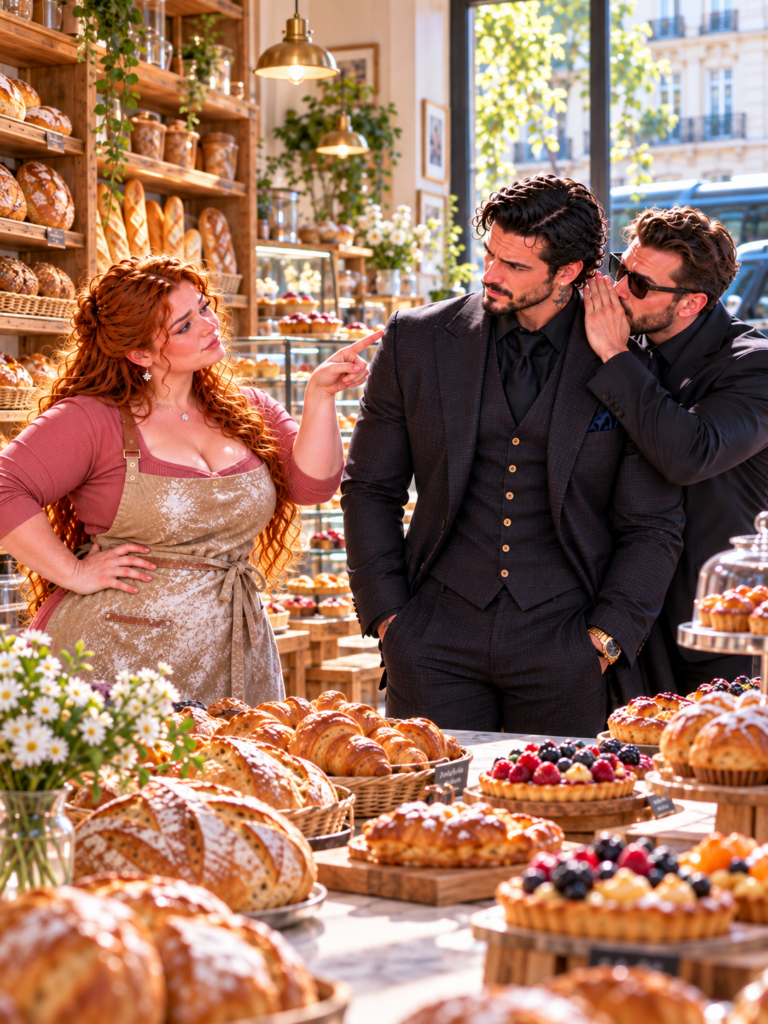
The first time Greta Shaw ordered Dante Anielli to move, everyone inside her bakery assumed they were about to witness a murder.
Dante had been feared for so long that most people had forgotten what it meant to speak to him normally.
Men apologized when he looked in their direction. Politicians became remarkably cooperative when his name appeared on their schedules. Even his closest associates measured their words as carefully as men crossing thin ice.
But Greta Shaw had eleven years of experience running a bakery, a mountain of dough waiting to be shaped, and absolutely no patience for a stranger treating her counter like his personal desk.
“Sir. Your elbows.”
The enormous man in the charcoal suit looked down.
Greta continued cutting dough.
“Those elbows belong somewhere else. This counter has survived eleven years of flour, butter, hot pans, and customers who think croissants are negotiable. I’d appreciate you not testing its limits.”
Behind him, the morning line stopped moving.
Dante Anielli removed his elbows.
Greta finally looked up.
A streak of flour marked one cheek. Her dark hair was pinned into a loose arrangement that had surrendered several strands to the morning humidity. Her generous figure filled her flour-dusted apron, and her expression belonged to a woman who had already solved twenty problems before breakfast.
“And another thing,” she said. “You stepped ahead of that woman.”
Dante turned.
Behind him stood a young mother balancing a restless child against her hip.
“She’s been waiting longer than you. So you can join the back of the line, or you can wait quietly until she’s been served.”
Greta pointed toward the end of the counter.
“Those are your choices. This is a bakery, not a hostage negotiation.”
Somewhere near the pastry case, Mr. Beam made a strangled noise.
Dante looked at the woman.
Then at Greta.
Then, with the deliberate care of a man attempting something completely unfamiliar, he stepped aside.
“The lady goes first,” he said.
“Excellent.” Greta smiled briefly. “We’re making progress.”
And then she turned toward the mother with such immediate warmth that Dante experienced an unfamiliar sensation.
He had been dismissed.
Not insulted. Not challenged for territory. Simply placed outside the center of another person’s attention.
Near the entrance, Renzo nearly forgot how to breathe.
For nine years, he had served as Dante Anielli’s lieutenant, driver, and most trusted protector. He had watched hardened criminals lose their nerve before his boss. He had seen a city councilman humiliate himself in terror and a rival collapse during a confrontation.
Never once had he witnessed someone send Dante to the back of a line.
More remarkably, Dante had obeyed.
Renzo reached toward his phone, briefly considered documenting the occasion, and stopped.
There were some events so impossible that photographic evidence would only make them less believable.
Dante eventually approached the counter again.
“What would you like?” Greta asked.
“Bread.”
She regarded him.
“That certainly narrows it down to half the building.”
His expression remained unreadable.
“Something substantial.”
Greta selected a dark, seeded loaf from the shelf.
“This one. You look like a man who could benefit from a little fiber and a great deal of structure.”
She placed it in a paper bag.
Dante paid without argument.
For reasons nobody present could understand, he appeared almost satisfied.
What Greta didn’t know was that Dante hadn’t entered Shaw’s Bakery to buy anything.
Across the narrow street stood a building belonging to a man connected to an unresolved matter involving Moreno. The table beside Greta’s front window offered an unobstructed view of the entrance.
Dante controlled the eastern half of the city through a network of loyalties, obligations, and carefully maintained fear. Monitoring a troublesome man’s movements was ordinary business.
He had intended to spend twenty minutes watching that door.
Instead, he found himself watching Greta Shaw.
She knew her regular customers by their orders, if not always by their names.
When an elderly man began counting insufficient coins onto the counter, she quietly slipped yesterday’s bread into his bag.
“It’s going stale anyway,” she told him. “You’re helping me clear the shelves.”
A teenager stumbled through an elaborate order, and she interrupted with the correct one before he finished.
Mr. Beam entered into a passionate disagreement with her concerning the proper crust on French bread.
Greta argued back as though national honor depended upon it.
Mr. Beam left delighted.
Nothing remarkable happened.
Nobody begged for anything. Nobody calculated the consequences of disagreeing with someone powerful. Nobody waited to see which direction the room’s mood would move.
For twenty minutes, Dante watched people exist without fear.
And for the first time in years, he wanted to remain somewhere after his business was finished.
He returned the following morning.
He told himself the window offered the best vantage point.
Greta didn’t bother looking up.
“Elbows.”
Dante moved them.
He had placed them on the counter deliberately.
A peculiar warmth moved through his chest when she corrected him exactly as she had the day before.
“Back again?” she asked. “Seeded loaf?”
“You remembered.”
“I remember everyone’s bread. Their names are another matter.”
She handed him the bag.
“You’re Elbows now, by the way.”
He considered that.
“Elbows?”
“Unless you’d prefer Mr. Countertop.”
“Elbows is acceptable.”
At the door, Renzo took out a small notebook normally reserved for operational details.
He wrote two words.
Boss: Elbows.
Then he underlined them.
It was the first entry in what would become the most unusual assignment of his career.
Over the following weeks, Renzo noticed a change.
Dante remained the same man during meetings: precise, controlled, and capable of ending an argument with a glance.
But on mornings when they stopped at Shaw’s Bakery, something happened after he returned to the car.
For half a second, before his face resumed its usual calculations, he looked peaceful.
Renzo had served Dante for nearly a decade.
He had never seen him peaceful.
One morning, while driving, Renzo cleared his throat.
“Boss, that bakery has excellent visibility of Moreno’s building.”
“It’s adequate.”
“Maybe we should conduct surveillance there more often.”
Dante looked at him in the rearview mirror.
“Are you directing my schedule?”
“Absolutely not.”
A pause.
“I’m suggesting operational consistency.”
Dante continued watching him.
“And perhaps a more regular assessment of the neighborhood.”
“Renzo.”
“Yes, Boss?”
“Drive.”
Renzo obeyed.
But the next morning, they visited the bakery again.
And the morning after that.
Soon, Moreno’s building apparently required surveillance on Tuesdays, Wednesdays, and practically every day ending in the letter y.
Renzo found the arrangement deeply satisfying.
He had no experience arranging romances, but he understood one essential principle: two people were unlikely to fall in love if they never occupied the same room.
Greta discovered Dante’s identity through Mr. Beam.
The old man leaned over the counter one morning, lowering his voice to a theatrical whisper.
“Greta. You know who that man is, don’t you?”
She glanced toward the window.
“Elbows?”
Mr. Beam looked physically wounded by the nickname.
“That’s Dante Anielli.”
Greta waited.
“The Dante Anielli.”
“Oh.”
“Oh? That’s all you have to say?”
“He wears very expensive suits.”
“Greta, people disappear when that man decides they should disappear.”
She looked again.
Dante was sitting quietly with his bread. The previous week, she had seen him move a chair out of the way so a mother could maneuver a stroller past his table.
“Has he given me any trouble since I explained the rules?”
“No, but—”
“Then I don’t see why I should invent some.”
Mr. Beam stared at her.
Greta returned to arranging pastries.
“Though the suit makes more sense now. Nobody dresses like that for carbohydrates.”
The following morning, she noticed Dante’s tie sitting slightly crooked.
Before thinking about it, she reached across the counter and straightened it.
“There. Better.”
Dante stopped moving.
Behind him, Renzo looked as though gravity had briefly reversed direction.
Nobody touched Dante Anielli casually.
But Greta had already turned to the next customer.
“Now you look like a man who handles business and remembers to eat breakfast.”
Dante sat at his usual table.
Four minutes passed before he remembered to glance at Moreno’s building.
That afternoon, Renzo decided the situation required professional assistance.
Unfortunately, the only professional available was himself.
“Boss,” he began carefully, “when a woman does something kind, you might consider complimenting her.”
“I speak to her.”
“You order bread.”
“That’s speaking.”
“Technically. But it’s not exactly romance.”
Dante’s eyes narrowed.
Renzo continued before self-preservation could silence him.
“Tell her the bread is good. Women appreciate knowing their work matters.”
Dante considered the suggestion with the gravity he normally reserved for negotiating territorial disputes.
The next morning, he accepted his usual seeded loaf, looked directly at Greta, and said, “Your bread meets my standards.”
Greta blinked.
“Your standards?”
“Yes.”
“Well, somebody alert the newspapers.”
He frowned slightly.
“It was intended as praise.”
“Oh, I gathered that.”
She pressed a hand against her chest.
“Mr. Beam! We’ve passed inspection. We can all go home now.”
Laughter traveled across the bakery.
Dante looked puzzled.
Greta laughed harder.
And at the entrance, Renzo closed his eyes.
He had prepared his boss for a compliment.
Somehow, the man had delivered a performance review.
Still, the incident accomplished something neither of them expected.
Greta began collecting Dante’s terrible compliments as though they were precious objects.
When another customer described a pastry as delicious, she asked whether it was truly delicious or merely up to Mr. Anielli’s exacting standards.
Mr. Beam declared a baguette adequate and was threatened with permanent banishment.
Dante eventually learned that Greta was teasing him because she enjoyed him.
That realization unsettled him more than an open threat.
For the first time in years, someone was laughing with him without needing anything in return.
Little by little, the bakery became part of his life.
He learned that four o’clock was the quiet hour when Greta reviewed her accounts.
He learned which customers were lonely and which simply enjoyed hearing themselves talk.
He learned that a man who regularly counted coins beside the register would always leave with bread, whether he could afford it or not.
One afternoon, while Greta was occupied, Dante quietly paid for the next ten loaves she intended to give away.
He instructed the recipient not to mention it.
It was the first generous act he could remember performing without expecting influence, loyalty, or repayment.
The unfamiliar feeling disturbed him.
So he ordered another loaf.
Renzo, meanwhile, had begun treating the bakery like a security assignment.
He inspected entrances, studied sightlines, and hovered near the pastry display with the grim concentration of a man guarding state secrets.
Greta eventually handed him a tray.
“If you’re going to stand around looking important, make yourself useful.”
Renzo examined the tray.
“Ma’am?”
“Top shelf. You’re tall. Put that height to work.”
The man who had intimidated criminals for nine years obediently stacked baking trays.
Within a week, he developed an embarrassing fondness for Greta’s muffins.
He tried hiding the evidence.
Greta caught him brushing crumbs from his gun holster.
“Renzo, there are crumbs in your holster.”
“Surveillance residue,” he replied solemnly.
She laughed and handed him another muffin.
Among Dante’s men, stories began circulating.
Their boss had a place.
A bakery.
There was a woman.
Tommaso, one of the crew’s toughest men, listened as Renzo described the morning Dante had been ordered to move his elbows.
“And he listened?” Tommaso asked.
“Immediately.”
The men exchanged stunned looks.
Finally, Tommaso said, “I’d take a bullet for a woman who could manage that.”
Nobody disagreed.
But the real change occurred after closing, when the customers were gone and Dante could no longer pretend that Moreno’s building gave him a reason to remain.
One evening, Greta was turning chairs upside down onto tables.
Dante stood near the counter, watching her work.
“Can I ask you something?” she said.
“Of course.”
“Why do you keep coming back?”
He glanced toward the window.
“Originally, the view was useful.”
“Originally,” she repeated.
Dante said nothing.
“Moreno’s building has been empty for weeks, hasn’t it?”
“The matter was settled two weeks ago.”
“I thought so.”
Greta placed another chair on a table.
“So why are you here at nine o’clock at night, helping me close a bakery you don’t own?”
For a long time, Dante studied the empty coffee cup in his hand.
“I don’t think you understand what happens when I enter a room.”
Greta folded her arms.
“Try me.”
“People change. They stop speaking naturally. They begin watching my hands, my face, my mood. They calculate what I might want and what might happen if they fail to provide it.”
He rotated the cup slightly.
“My own men are careful when I reach for my coffee. My barber’s hands shake.”
Greta’s expression softened.
“For years, I haven’t been a person to anyone. I’ve been a problem they must survive.”
His gaze rose to meet hers.
“Then I entered your bakery.”
She remained quiet.
“You corrected my manners. You selected my bread because you thought you knew better than I did.”
“I did know better.”
“Yes,” he said, with the faintest suggestion of a smile. “You did.”
He drew a breath.
“You straightened my tie in front of people who believed touching me without permission was dangerous. You treated me like the old man who argues about baguettes.”
“Mr. Beam.”
“Like the woman carrying her child. Like the boy who doesn’t always have enough money.”
Greta slowly lowered the chair she was holding.
Dante continued.
“For twenty minutes every morning, I can forget what I am to everyone else.”
His voice was almost inaudible.
“I come here because it’s the only place I remember how to feel human.”
Greta looked at him for a long moment.
Then she pulled out the chair and sat.
“I’m not especially brave, Dante.”
He looked surprised.
“People keep saying that about me,” she continued. “But they don’t know why I behave the way I do.”
She ran her thumb over an old mark on the wooden tabletop.
“My husband was a small man. Not physically. In every way that mattered.”
Dante became very still.
“He could make a whole house feel dangerous without raising his voice. I spent nine years learning how to recognize what kind of evening we were going to have from the sound of his footsteps.”
She gave a humorless smile.
“When he died, I was so accustomed to being frightened that I spent his funeral worrying I would somehow do it wrong.”
Dante’s expression changed.
Not with pity.
With recognition.
“And then,” Greta said, “nothing happened. He didn’t come back. He didn’t complain. He didn’t tell me I’d embarrassed him.”
She looked toward the ovens, their warmth still filling the room.
“So I made myself a promise. I would never spend another day afraid of someone inside my own bakery.”
Dante listened without interrupting.
“I’m not fearless because I’ve never been frightened,” she said. “I’m fearless because I spent so many years being frightened that I refuse to give the rest of my life to it.”
She met his eyes.
“And you, Dante Anielli, are not a monster to me.”
He remained motionless.
“You’re a very large, very lonely man who has forgotten how to ask for something without making it sound like an order.”
For perhaps the first time in his adult life, Dante did not know what to say.
After a while, he told her about his father.
How the older Anielli had ruled their side of the city with a kind of authority that made grown men pale.
How Dante had been seven when he realized that nobody dared harm the person everyone else feared.
How, by thirty, he had become more formidable than the father whose shadow had shaped his childhood.
“I became exactly what frightened me,” he admitted.
He stared at his hands.
“I thought that would make me safe.”
“And did it?”
“Nobody could reach me.”
Greta waited.
“Neither could anything good.”
For years, he had purchased safety with distance. He had made himself untouchable, then discovered too late that comfort, friendship, and tenderness required the very thing he had spent his life preventing.
Contact.
“I mistook being unreachable for being free,” he said.
Greta reached toward the empty cup between them.
“Well,” she replied softly, “you’ve found yourself in a different sort of room.”
He looked up.
“This one has bread. And people who will tell you when you’re being ridiculous.”
A fragile smile touched his mouth.
“Am I ridiculous?”
“Frequently.”
She stood and carried his cup toward the sink.
“You can stay as long as you like. But if you’re going to keep occupying my chairs after closing, the price is one sincere compliment.”
Dante watched her.
“The bread,” he said slowly, “is the best I’ve tasted since I was a boy.”
Greta stopped at the sink.
This time, she didn’t tease him.
Because they both understood that he was speaking about something far more important than bread.
And that night, for the first time in decades, Dante Anielli left a room without feeling relieved to have escaped it.
He wanted only to return.
Part 2
After that night, Greta began setting aside a seeded loaf every morning.
She placed it beneath the counter before Dante arrived, just as she reserved certain pastries for customers whose habits had become part of the bakery’s rhythm.
There was one difference.
She refused to charge him.
Dante noticed immediately.
The first morning, he left folded bills beneath his coffee saucer.
Greta discovered them after he left.
The following day, the money appeared in the same place.
She transferred it into the tip jar without comment.
By the end of the week, the arrangement had become a silent contest between two extraordinarily stubborn people.
Dante knew how to pay.
He knew how to acquire property, buy obligations, settle accounts, and purchase cooperation.
But he didn’t know what to do when a woman simply gave him something because she wanted him to have it.
Greta understood that about him.
She also understood that if she forced him to accept generosity before he was ready, she would turn her kindness into another demand.
So she let him leave the money.
And every afternoon, she emptied it into the jar used to help her employees and struggling customers.
Neither mentioned the arrangement.
Their relationship grew in the spaces between ordinary things.
On a rainy Thursday, Dante remained until closing and found himself drying baking trays while Greta washed the floor.
The radio played softly.
Rain tapped against the windows.
No one was waiting for his instructions, and nothing in the room needed to be conquered.
For nearly an hour, they worked together without saying much.
Dante discovered that silence could feel different depending on the person sharing it.
With his men, silence meant attention.
With his enemies, it meant calculation.
With Greta, silence required nothing.
He could simply stand at a sink, dry a tray, and exist.
When they finally finished, she handed him a clean towel.
“You do know you’re surprisingly useful for a man who dresses like a funeral director?”
“I’ve received worse evaluations.”
“I’m sure you have.”
“Will I be invited back?”
She gave him a sideways glance.
“You have a standing appointment with a loaf of bread.”
He looked down at the towel.
“That’s not quite what I meant.”
“I know.”
She smiled and took the towel from him.
It was enough.
But Dante’s instincts remained difficult to unlearn.
One particularly chaotic morning, the espresso machine broke during the rush.
The bakery was crowded. Forty orders waited. An employee was nearly in tears, and Greta was trying to repair the machine while simultaneously answering questions about coffee she could no longer serve.
Dante made one telephone call.
Less than an hour later, two nervous deliverymen appeared with a brand-new commercial espresso machine.
Greta stared at it.
Then at Dante.
“What is this?”
“A replacement.”
“I can see that.”
“The other machine is broken.”
“It can be repaired.”
“This one is better.”
Greta removed her apron.
“Send it back.”
Dante frowned.
“The delivery is already completed.”
“Then complete another delivery in the opposite direction.”
The men holding the machine went rigid.
Nobody refused gifts from Dante Anielli.
Nobody made demands of him while he was trying to help.
Yet Greta’s voice remained calm.
“Dante, I know what you intended. And I appreciate it.”
“Then keep it.”
“No.”
He looked genuinely confused.
She moved closer.
“I don’t want to be a woman whose problems disappear because a powerful man writes a check.”
“That’s not what I’m doing.”
“I know. But I need you to understand the difference between helping me and taking over.”
His gaze shifted toward the expensive machine.
Greta touched his arm.
“I don’t need a man who buys me new equipment every time something breaks.”
“What do you need?”
“Someone willing to sit on the floor with me after closing and figure out why the old one stopped working.”
Dante looked at her.
Then at the machine.
“Send it back,” he told the deliverymen.
That evening, the most feared man in eastern city politics and organized crime sat cross-legged on the bakery floor with his sleeves rolled up, examining an espresso machine’s internal components.
Greta held a printed diagram.
Dante held a screwdriver.
For the first hour, they accomplished very little.
For the second, they argued about a component Greta insisted had been fitted incorrectly.
She was right.
Near midnight, the machine finally worked.
Dante stared at the stream of espresso filling a cup.
Greta raised both hands in triumph.
“There!”
He looked almost astonished.
“I repaired it.”
“We repaired it.”
“Yes.”
She handed him the coffee.
“And this one didn’t cost me several thousand dollars.”
Dante drank it with the satisfaction of a man who had built something irreplaceable.
The machine would continue working for another year.
Long after Dante forgot the particulars of territorial negotiations completed that month, he remembered exactly how it felt when Greta smiled at him over that first cup.
There were other moments.
A drunken man once entered the bakery and began shouting at Greta, leaning across the counter with the deliberate aggression of someone who enjoyed making women uncomfortable.
Dante, seated ten feet away, prepared to rise.
Before he could, Greta reached across the counter, caught the man firmly by one ear, and marched him toward the exit.
She explained the bakery’s conduct policy as though escorting a misbehaving schoolboy out of class.
The drunk stumbled outside, thoroughly humiliated.
Greta returned to her counter.
Dante was still standing halfway out of his chair.
“You didn’t require my assistance,” he observed.
Greta dusted flour from her hands.
“I’ve operated a city bakery for eleven years, Dante. If I needed a dangerous man every time someone behaved badly, I’d never get any baking done.”
He sat slowly.
She leaned toward him.
“You may be the biggest person in this room, but you’re not the only one capable of standing up for herself.”
Dante regarded her with an expression Renzo later struggled to describe.
It was pride.
Affection.
And something much more vulnerable.
“I think,” Dante said, “you may be the only person here who genuinely frightens me.”
“Good.”
Greta returned to her dough before he could see the color spreading across her cheeks.
Mr. Beam was less discreet.
One afternoon, he cornered Greta while Dante was outside.
“That man looks at you the way my wife used to look at the garden when the first spring flowers arrived.”
Greta kept slicing bread.
“Mr. Beam, Dante looks at me because I control his breakfast.”
“I was married forty years. I know the difference.”
“He looks at me as though I’m the only woman who’s ever told him to wait in line.”
“Exactly,” Mr. Beam said triumphantly. “Same thing at our age.”
Eventually, the rest of Dante’s men began visiting Shaw’s Bakery.
They arrived in pairs, pretending to be ordinary customers.
Their efforts were spectacularly unsuccessful.
Ordinary customers didn’t inspect the rear door before ordering pastry.
Ordinary customers didn’t stand with their backs to walls.
And ordinary customers didn’t ask whether a croissant contained anything unexpected with the seriousness of men discussing explosives.
Greta noticed immediately.
She told Tommaso his jacket was too heavy for the warm shop.
She told another man to remove his sunglasses because she needed to see his eyes when taking his order.
Both obeyed.
One of them later confessed that he had removed his glasses without even thinking about it.
“She used my mother’s voice,” he told the others.
His mother had been dead six years.
“I was in there nine minutes. She told me to take off my glasses and buy something with jam in it. I did both. I don’t even like jam.”
He paused.
“Finished the whole thing in the car.”
Renzo was delighted.
He had spent years watching Dante command loyalty through fear and respect.
Now he was watching Greta earn it through warmth, bluntness, and the occasional pastry.
For the first time, the men surrounding their boss were beginning to understand the strange happiness he had found.
Dante understood something more dangerous.
His happiness had become visible.
Every morning, when he stepped onto Dover Street carrying his warm paper bag, he experienced two competing instincts.
One urged him to turn around and remain in the bakery.
The other began counting everything that could be taken from him.
The doors.
The windows.
The neighboring buildings.
The cars moving too slowly.
A man who owned nothing he valued could be difficult to threaten.
A man who loved someone had a place where the world could hurt him.
Greta saw the change.
One evening, while wiping the counters, she caught him studying the front entrance.
“You’re doing it again.”
“What?”
“Leaving.”
He looked at her.
“I’m standing right here.”
“Your body is. The rest of you has gone somewhere unpleasant.”
Dante hesitated.
“I’m calculating exits.”
“Why?”
“Because I care about this place.”
“And?”
“Because caring gives people opportunities.”
Greta laid down her cloth.
For a moment, she looked older than she usually did. Not because of the years in her face, but because she remembered how much of her life had once been spent anticipating harm.
“I used to count things too,” she said.
Dante remained quiet.
“Every way my husband might become angry. Every mistake I could make. Every word I should avoid. I thought that if I anticipated enough problems, I could prevent the worst ones.”
“Did it help?”
“Not once.”
She looked toward the ovens.
“The bread still needed making. The bills still needed paying. Life kept happening, and I was spending mine preparing for someone else’s cruelty.”
She picked up the cloth again.
“So count your exits if you must. But when you’re finished counting, look around and remember you’re still here.”
Dante studied her.
“And what if something terrible happens?”
“It might.”
She didn’t pretend otherwise.
“But if you stop enjoying the good days because a bad day might come, you’ve surrendered something precious without anyone even asking.”
She nodded toward the kitchen.
“We still have tomorrow’s dough to prepare.”
He remembered that conversation long afterward.
Unfortunately, the very danger he feared was already moving toward them.
Renzo was proud of Dante.
That was the beginning of the trouble.
In the years he had served him, Renzo had come to care for his boss with the loyalty of a man who had witnessed another person’s loneliness at close range and never known how to ease it.
Now, each visit to the bakery gave him proof that something had changed.
Dante smiled occasionally.
He lingered after conversations.
He allowed people to speak without anticipating the worst possible motive.
Renzo couldn’t conceal his satisfaction.
And in a city where information was currency, happiness could be as revealing as any confession.
Eventually, word traveled west.
Lucio Barbieri controlled the western half of the city.
For six years, he had searched for something he could use against Dante Anielli.
The usual methods had failed.
Dante had money, influence, men prepared to defend him, and enough caution to make approaching him dangerous.
He had no publicly recognized weakness.
Then Lucio heard about Shaw’s Bakery.
A woman on Dover Street.
A curvy, middle-aged baker who refused favors, ignored status, and corrected Dante Anielli’s manners.
A woman he visited nearly every morning.
A woman whose presence had apparently made one of the city’s most formidable men happy.
Lucio listened.
Then he smiled.
For the first time in six years, Dante had given him something he could threaten.
“Find out who owns her building,” Lucio instructed.
The answer was Caldwell.
Caldwell wasn’t a criminal mastermind. He was an ordinary, weak-willed man who had accumulated debts he couldn’t manage and obligations to people he should never have approached.
Lucio recognized the opportunity immediately.
He purchased the debt through intermediaries, using the financial arrangements surrounding the building as his instrument of pressure.
He had no interest in bread.
He wanted Dante to watch the one safe place in his life become unsafe.
The following Monday, a letter arrived at Shaw’s Bakery.
Greta opened it between breakfast orders.
She read it once.
Then again.
The landlord’s new financing arrangements supposedly required her rent to increase to three times its previous amount, effective in thirty days.
A second provision threatened the termination of her lease if she failed to pay.
Greta sat down.
For the first time since her husband’s funeral, she felt the old coldness gathering beneath her ribs.
Someone she had never met had reached into her life and decided how much space she was allowed to occupy.
She knew enough about her business to recognize that the amount was absurd.
No independent bakery could absorb such an increase in one month.
But what frightened her was not the mathematics.
It was the familiar shape of the threat.
A powerful man had decided that her fear would be useful to him.
When Dante arrived, she handed him the letter instead of his bread.
“This isn’t really about rent, is it?”
He read it.
His expression changed so completely that Greta felt the difference before he spoke.
The man who had repaired her espresso machine disappeared behind the face that had ruled eastern neighborhoods for decades.
“It’s Barbieri.”
Greta watched him.
“You’re certain?”
“It’s how he operates.”
“Why me?”
Dante lowered the letter.
“Because he knows about us.”
Behind him, Renzo went pale.
Dante didn’t need to turn around.
He understood immediately how the information had traveled.
Renzo had been too pleased, too visibly relieved that his boss had found happiness. Somewhere along the way, that pride had reached someone capable of turning it into a weapon.
“Boss,” Renzo whispered.
Dante said nothing.
“I spoke about the bakery. I didn’t think—”
“I know.”
Renzo swallowed.
“I was happy for you.”
“I know that too.”
The quieter Dante became, the more Renzo appeared to shrink.
“I’ll fix it,” Renzo said.
Dante’s gaze hardened.
“Go sit down. I’ll deal with you when this is finished.”
“No,” Greta said.
Both men looked at her.
“He’s not sitting anywhere.”
She walked around the counter.
“Renzo, look at me.”
He tried.
“You talked because you care about him.”
“I exposed you.”
“You didn’t send this letter.”
“But—”
“You didn’t decide my bakery was a bargaining chip. Somebody else did.”
His eyes were red.
Greta put one flour-dusted hand on his arm.
“I need you working, not punishing yourself. If you want to help, find out who bought Caldwell’s debt, how they did it, and what papers they used.”
Renzo stared at her.
“You’re giving me an assignment?”
“Yes. And take a pastry before you leave. You look awful.”
He accepted it with both hands.
For a moment, his voice failed.
Then he nodded and disappeared into the evening.
Dante watched the door close.
“You forgave him in less than a minute,” he said.
“He made a mistake because he loves you.”
“That mistake could cost you everything.”
“The man who sent that letter is the one responsible for what happens next.”
Dante looked down at the paper.
There was something he had to say, and Greta recognized it before he began.
“The safest solution,” he told her, “is for me to stop coming here.”
She went still.
“If Barbieri believes you no longer matter to me, he loses his reason to use you.”
“Dante.”
“I can make it convincing. I won’t contact you. He’ll eventually understand there’s nothing to gain.”
Greta stared at him.
“You’re suggesting that we pretend none of this matters.”
“I’m suggesting I protect you.”
“By disappearing?”
“If that’s what it takes.”
She moved closer.
“No.”
“Greta—”
“No. I spent years making myself smaller so an angry man wouldn’t notice me. I will not watch you erase the one good thing in your life because another angry man wants us frightened.”
His face tightened with the effort of remaining controlled.
“I won’t be responsible for destroying your bakery.”
“Then don’t destroy what we’ve found in it.”
He looked at her.
“I can survive losing the building,” she said, although the words cost her something. “What I refuse to do is hand him our happiness before he’s even forced to fight for it.”
For a long moment, neither spoke.
Then Dante placed the letter on the counter.
“All right.”
Greta exhaled.
“We don’t disappear,” he said. “We make him regret choosing this method.”
“How?”
Dante looked around the bakery.
“Tell me something. You keep your business records, don’t you?”
“Of course.”
“How carefully?”
Greta almost smiled.
“Eleven years of records. Permits, inspections, receipts, correspondence, contracts, everything.”
“Where?”
“In a green binder beneath the register.”
For the first time since reading the letter, Dante appeared interested rather than angry.
“Bring it.”
That evening, Shaw’s Bakery became the most unlikely operations room in eastern city history.
Flour remained scattered over the worktop.
The ovens cooled.
Greta opened her green binder and spread eleven years of paperwork across the marble counter.
She found the original lease.
The permits.
The amendments.
The inspection reports.
The handwritten notes she had made whenever something important changed.
Her husband had laughed at the collection.
He had called her obsessive, frightened, foolish.
Greta had continued maintaining it anyway.
Now she turned the yellowing pages while Dante examined the contract.
“I kept all this because I was afraid someone would someday accuse me of something I couldn’t disprove,” she admitted.
Dante looked at the carefully organized records.
“There’s a difference between fear that traps you and caution that gives you a foundation.”
Greta considered that.
For eleven years, she had thought the binder represented something she needed to overcome.
Perhaps it had been protecting something worth keeping.
Her business.
Her independence.
Her right to stand behind her own counter.
Dante turned another page.
Then another.
He paused at the oldest lease amendment.
“Greta.”
Something in his voice made her look up.
“Do you remember the negotiations when you signed this?”
“Every minute. My accountant thought I was asking for too much.”
Dante studied the paragraph.
“Well,” he said quietly, “I suspect your accountant is about to change his opinion.”
Greta leaned closer.
Outside, Dover Street darkened.
Inside, beneath the yellow bakery lights, the answer to Lucio Barbieri’s threat sat among papers a frightened young widow had once insisted on keeping.
And this time, the fear that had shaped her past might become the very thing that secured her future.
Part 3
Renzo spent the next three days following money.
He had spent most of his professional life following people.
People were simpler.
They made mistakes. They visited familiar places. They spoke to friends they trusted and enemies they underestimated.
Money moved differently.
It disappeared into accounts, passed through companies with meaningless names, and reappeared carrying the signatures of men who insisted they had never touched it.
But Renzo understood patience.
He knew how to remember details others dismissed and how to recognize a lie when it was surrounded by enough truth to sound respectable.
He traced Caldwell’s original debt.
He identified the creditors who had held it.
He followed its transfer through intermediaries until he reached the company Lucio Barbieri had used to conceal his involvement.
Then he followed the payments.
By the third evening, Renzo had assembled dates, transfers, signatures, and a trail of evidence connecting the attempt to pressure Greta with Lucio’s financial operation.
He returned to Shaw’s Bakery carrying a thick folder.
His eyes were bloodshot.
His clothes were wrinkled.
He looked like a man who had forgotten the existence of beds.
Greta took one look at him.
“Sit down.”
Renzo remained standing.
“Ma’am, I brought everything.”
“Wonderful. You can show us after you sit down.”
He placed the folder beside her green binder.
Dante examined it.
Renzo waited.
For three days, his guilt had kept him moving.
Now, with the evidence finally on the table, there was nothing left between him and the possibility that he had disappointed the one man he had devoted his life to serving.
“I started this,” he said.
Dante looked up.
“You didn’t.”
“I talked.”
“You were happy.”
“I was careless.”
“Yes,” Dante replied.
Renzo lowered his eyes.
“But you came back with the truth,” Dante continued. “And that’s what matters now.”
Renzo swallowed.
“Is it enough?”
Dante opened the folder and studied the first transaction.
Then the second.
Then the third.
For the first time in days, a cold, satisfied expression appeared on his face.
“It’s more than enough.”
Greta came around the counter carrying coffee.
She placed a cup in front of Renzo.
“And when you’ve finished saving my bakery, you’re going home to sleep.”
Renzo managed a faint smile.
“Yes, ma’am.”
Dante spread both folders across the counter.
One contained the history of a bakery.
The other contained the history of a threat.
Together, they told a story Lucio Barbieri had never intended anyone to read.
Dante turned Greta’s original lease toward her.
“You signed a fifteen-year fixed-term lease nine years ago.”
Greta nodded.
“That’s right.”
“And you negotiated a maximum annual rent increase of two percent.”
“My accountant told me I was being unreasonable.”
“He was wrong.”
Dante placed a finger beside the relevant paragraph.
“These terms don’t disappear because someone buys Caldwell’s debt. Any transfer of ownership remains subject to your existing lease.”
Greta leaned forward.
“So the new rent demand…”
“Has no contractual foundation.”
She stared at him.
Dante slid the letter across the counter.
“Barbieri thought buying financial leverage over Caldwell would give him control over you. He didn’t bother understanding the agreement already protecting your business.”
Greta read the paragraph again.
Then she began to laugh.
It started quietly.
After three days of fear, sleeplessness, and uncertainty, the laughter escaped before she could stop it.
“You’re telling me that man spent all that money trying to frighten me and didn’t read the lease?”
“Essentially.”
She laughed harder.
“My accountant is going to be unbearable.”
“He should be grateful you ignored him.”
Greta sank into a chair.
Relief spread through her slowly, as though her body needed convincing that she could finally let go of the tension.
But then she looked up.
“That protects the rent. Does it stop Barbieri?”
Dante’s expression grew serious.
“No.”
Greta folded her hands.
“A man who goes to those lengths doesn’t simply apologize when someone proves him wrong.”
“I agree.”
“Then what happens next?”
Dante closed the green binder.
“I’ve already taken care of Caldwell’s debt.”
Greta stared.
“What?”
“I arranged to acquire the relevant note and settle the creditors Barbieri was using to pressure him. The remaining leverage has been removed.”
“Without telling me?”
“It concerned Caldwell’s debt, not yours.”
She studied him.
“And now you control the note?”
“For the moment.”
“Dante.”
He recognized the warning in her voice.
“I have no intention of using it against you.”
“That isn’t what I’m asking.”
He waited.
“You’re not about to tell me that because you’ve paid someone’s debt, I should now allow you to decide what happens to my bakery?”
“No.”
She continued examining his face.
Dante understood why.
Her first marriage had taught her that gifts could arrive attached to invisible chains.
He had already made one mistake by attempting to replace her espresso machine.
This time, he refused to repeat it.
“I didn’t do this to purchase your gratitude,” he said. “Or your obedience. I did it because Barbieri had created a financial weapon, and I could remove it.”
Greta listened.
“But what happens to your building afterward,” he continued, “is something we will handle separately.”
The tension in her shoulders eased.
“Good.”
He almost smiled.
“You’re going to make sure of that, aren’t you?”
“Absolutely.”
Renzo, who had been listening from his chair, quietly took another sip of coffee.
For the first time since the letter arrived, the bakery felt like itself again.
But one last problem remained.
Lucio Barbieri still believed he had won.
And Dante knew men like Lucio too well to expect them to disappear merely because their paperwork had failed.
“He’s going to come here,” Dante said.
Greta looked toward the entrance.
“I know.”
“He’ll want to see whether you’re frightened.”
She considered that for a moment.
“Then we should make sure the counter is clean.”
Dante looked at her.
“Greta.”
“What?”
“You’re expecting a confrontation with one of the most dangerous men in the city.”
She picked up her cleaning cloth.
“And I’d hate for him to see the place untidy.”
Lucio Barbieri arrived on a quiet afternoon.
Two men accompanied him.
They stopped near the door while Lucio approached the counter with the easy arrogance of someone who had rarely been refused anything he truly wanted.
He was accustomed to frightened faces.
Accustomed to people explaining their problems before he had even mentioned them.
He expected Greta Shaw to look exhausted.
Perhaps desperate.
Instead, he found a curvy woman in a flour-streaked apron standing behind her counter beside an open green binder.
She regarded him with mild impatience.
“Mr. Barbieri, I assume.”
Lucio’s smile widened.
“Mrs. Shaw.”
“Miss Shaw is fine.”
“My apologies.”
He glanced around the bakery.
“A lovely establishment. It would be unfortunate if circumstances forced you to leave.”
Greta placed both hands on the counter.
“You increased my rent to three times its original amount.”
Lucio spread his hands.
“Business arrangements change.”
“Not this one.”
His smile faltered.
Greta turned the binder toward him.
“My lease has a fixed term and a two-percent annual increase limit. You can acquire as many financial interests as you like. Those terms remain binding.”
Lucio looked down at the page.
Then back at her.
She continued before he could speak.
“My attorney has a copy. So does my accountant. Your demand is invalid.”
For the first time, Lucio seemed genuinely surprised.
It was a small reaction.
But Greta noticed it.
She had spent enough of her life reading dangerous men to recognize the instant one discovered that the person he intended to intimidate was not following the expected script.
“And as I understand it,” she added, “the debt you were relying on is no longer available to you.”
His expression hardened.
“You’re being advised by people who may not understand the consequences.”
Greta looked at him steadily.
“Mr. Barbieri, you came all the way to Dover Street because you believed frightening me would hurt someone else.”
He didn’t answer.
“You assumed I’d panic. You assumed I’d beg. You assumed that because you could reach my landlord’s debts, you could reach into my life and take whatever you wanted.”
Her voice remained level.
“I spent nine years married to a man who believed fear gave him ownership of everything around him.”
Lucio shifted his weight.
“I don’t see what that has to do with—”
“I’m not finished.”
The two men at the entrance looked toward each other.
Greta didn’t notice.
“When my husband died, I promised myself I would never again let a man decide how frightened I was supposed to be.”
She rested one hand on the binder.
“I kept every document relating to this business because I wanted to protect what I built. Eleven years of records, Mr. Barbieri. And do you know what makes me happiest?”
Lucio’s eyes narrowed.
“That all these papers were already here before you decided to threaten me.”
She closed the binder.
“You came here hoping to find a frightened woman. Instead, you’ve found a baker with a valid lease and a lawyer who knows how to read.”
Lucio’s smile was gone.
He leaned forward.
“You should be careful how you speak to me.”
“She hasn’t finished speaking.”
The voice came from behind him.
Dante Anielli stood inside the entrance.
He had arrived quietly enough that Lucio hadn’t noticed.
Renzo stood nearby.
For a moment, the two men who controlled opposite halves of the city faced each other across a bakery counter.
Dante carried a single sheet of paper.
He placed it beside Greta’s binder.
“That belongs to you,” he told Lucio.
Lucio glanced down.
His face changed.
The page contained the evidence Renzo had spent three sleepless days collecting.
Dates.
Transfers.
Financial intermediaries.
The shell company used to move Caldwell’s debt.
And a clear record of the attempt to use that debt against Greta.
Dante spoke softly.
“You made an error.”
Lucio said nothing.
“You’ve spent years making certain your threats couldn’t be connected to you. This time, you used transactions and documents.”
His hand remained beside the paper.
“Transactions have dates. Documents have signatures.”
Lucio glanced toward the door.
Dante continued.
“If Greta receives another threatening letter, an unwanted visit, or any further attempt to interfere with this bakery, these records will go to the appropriate federal authorities.”
The bakery remained quiet.
Even the two men accompanying Lucio appeared unwilling to move.
“You can’t prove—” Lucio began.
Dante tapped the sheet.
“I don’t need to settle that argument here.”
He looked directly at his rival.
“You wanted to discover what mattered to me. Congratulations. You succeeded.”
Lucio’s expression darkened.
“But you misunderstood what finding it would accomplish.”
Dante moved closer.
“Greta’s bakery is not an asset of mine. It isn’t territory for you to negotiate over. And she isn’t a possession you can threaten to force my hand.”
His voice became colder.
“You made a move against something that had nothing to do with our business. And you were careless enough to leave the entire path in writing.”
Lucio looked at Greta.
Then at the green binder.
Then at the evidence bearing the fingerprints of his own arrangements.
There was no useful threat left to make.
Dante straightened.
“Go back west, Lucio.”
His voice never rose.
“Stay there. And understand that every further move you make against her will have consequences you can no longer control.”
Lucio stood motionless for several seconds.
Then he turned.
The two men at the door followed him outside.
No guns were drawn.
No furniture was overturned.
Nobody had to raise a hand.
Lucio Barbieri simply left Shaw’s Bakery with the knowledge that the very paper trail he had created to pressure an innocent woman could now destroy his own position.
He never returned.
Greta waited until his car had disappeared before speaking.
“Well.”
Dante turned toward her.
“Are you all right?”
She looked around her bakery.
The shelves were still full.
The ovens were still warm.
The green binder remained on her counter.
“Yes,” she said. “I think I am.”
Renzo exhaled so loudly that Greta turned toward him.
“Goodness, Renzo. Were you holding your breath the whole time?”
“Possibly, ma’am.”
She smiled.
“Go and have a muffin.”
He obeyed without hesitation.
Dante did not purchase Shaw’s Bakery and install himself as its owner.
He did not move Greta into a guarded residence where she would be protected from danger but separated from the life she loved.
And he never again tried to solve her problems by presenting an expensive object and expecting her to accept it.
Instead, he addressed the one remaining vulnerability.
The building itself.
Through a formal arrangement, he ensured that the property was placed in a trust for Greta’s sole benefit.
The ownership was hers.
Not his.
Not Caldwell’s.
Not something Barbieri could manipulate through another man’s unpaid debts.
Dante arranged for the necessary documents and handed her the key.
Greta studied it.
“What’s this?”
“The security of knowing nobody can use the ground beneath your feet against you again.”
She looked at the documents.
Then at him.
“Dante…”
“It belongs to you.”
She remained quiet.
“I know I could have asked you first,” he admitted. “I should have. The arrangement is there for you to accept, not a decision you owe me obedience for.”
Greta read through the papers carefully.
Dante waited.
When she finally looked up, her eyes were shining.
“I spent years building a place where nobody could frighten me,” she said.
“I know.”
“And you made sure no one can take it away from me because of you.”
“I wanted you to have the choice to stay.”
She held the key against her palm.
“You understand what matters to me now.”
Dante gave a small nod.
“I’m learning.”
She moved toward him and rested her forehead briefly against his chest.
He put his arms around her carefully.
For a man who had commanded entire neighborhoods with barely a word, it was a remarkably tentative embrace.
But Greta didn’t need grandeur.
She needed someone who would respect the boundaries of the life she had built.
Someone who could stand beside her without standing over her.
And Dante, slowly, was becoming that man.
In the weeks that followed, the bakery returned to its familiar rhythm.
Mr. Beam resumed his passionate arguments about French bread.
The afternoon customers filled the chairs.
Children pressed their noses against the pastry display.
Dante arrived every morning, openly and without making excuses about surveillance.
The entire eastern side of the city eventually learned that its most feared resident had a favorite bakery.
And that the woman behind the counter regularly corrected his manners.
Renzo appointed himself unofficial head of bakery security.
His duties consisted primarily of standing near the pastry display, arranging trays on the highest shelves, and consuming a quantity of muffins that Greta considered professionally irresponsible.
One afternoon, she caught him crying quietly beside the sourdough.
“Renzo?”
He quickly wiped his face.
“Flour, ma’am.”
“In your eyes?”
“Yes.”
“Both of them?”
He nodded.
Greta handed him a clean towel.
She didn’t press him.
He was crying because his boss was happy.
Because the mistake he had made had not destroyed the only good thing he had ever helped bring into Dante’s life.
Because a woman who could have blamed him had instead given him a chance to make things right.
And because, somehow, a room full of bread had become a home for people who had spent most of their lives standing guard outside the homes of others.
Several weeks later, Dante stayed after closing again.
The chairs had been placed on the tables.
The ovens were cooling.
Greta was finishing the day’s accounts when she noticed him standing near the counter.
“Something on your mind, Elbows?”
He smiled faintly.
“Yes.”
She closed her ledger.
“Well?”
Dante took a moment.
For years, he’d spoken to people in the language of obligation.
He offered terms.
He demanded answers.
He negotiated consequences.
What he was about to say required none of those skills.
“I don’t know how to accept gifts,” he began.
Greta remained silent.
“You know that. You’ve watched me leave money beneath the saucer every morning.”
“I have.”
“I know how to pay for things. I know how to make people obey. But when you give me something without expecting anything, I don’t understand what I’m supposed to do.”
Greta came around the counter.
Dante looked at her.
“I’ve spent my entire life learning how to make myself powerful enough that nobody could take anything from me.”
He paused.
“And then you gave me something I couldn’t have taken by force.”
“What was that?”
“A place to belong.”
Greta’s expression softened.
He took her hands.
“I don’t know if I’ll ever become good at this.”
“At what?”
“Being loved without believing I have to earn it through some transaction.”
His fingers tightened gently around hers.
“But I’d like to spend the rest of my life trying. If you’ll allow me.”
Greta’s eyes filled.
Dante continued before courage deserted him.
“I’ll make mistakes. Probably many. I’ll try to solve problems the wrong way. I’ll misunderstand things that ought to be obvious.”
“You’ll certainly do that,” she whispered.
He gave a small, helpless smile.
“But I will listen when you correct me.”
She laughed softly through her tears.
“And I want to keep coming here. To this room. To you. Not because I need a place to hide from the rest of my life.”
He looked directly into her eyes.
“Because this is where I want my life to be.”
Greta squeezed his hands.
“You know what you do when somebody belongs somewhere?” she asked.
Dante shook his head.
“You make a place for them.”
She glanced toward the shelf beneath the counter.
“I’ve been making a place for you every morning for two months.”
“The bread.”
“The bread.”
He looked down.
“And you keep trying to pay for it.”
“Old habits.”
“I know.”
Greta stepped closer.
“But you don’t have to buy your place at my table, Dante. You never did.”
He closed his eyes briefly.
For decades, he had assumed every relationship came with a price.
Greta had offered him something different.
Not safety purchased through fear.
Not loyalty demanded through power.
Simply the freedom to stay.
“We’ll figure it out together,” she said.
Dante opened his eyes.
“Together?”
“Some days you’ll be impossible. Some days I’ll be impossible.”
“That seems unlikely.”
She raised an eyebrow.
“On my part, I mean,” he added.
“Good correction.”
She smiled.
“Somewhere in the middle, we’ll learn.”
Then Greta reached up and straightened his tie.
It was already perfectly straight.
Dante knew it.
Greta knew he knew it.
Neither mentioned the fact.
“There,” she whispered. “Much better.”
He looked at her with a tenderness that would have astonished the men who feared him.
“May I stay?”
Greta’s smile trembled.
“Of course you can.”
And when he drew her into his arms, she went willingly.
No fear.
No obligation.
No condition that required her to become smaller.
Just two people who had spent much of their lives surviving very different kinds of loneliness, finally discovering that love did not have to resemble the things that had hurt them.
Years passed.
The years brought new customers to Shaw’s Bakery and turned children who had once pressed their faces against the pastry case into young adults who ordered coffee before work.
The bakery on Dover Street remained warm and busy.
Mr. Beam continued arguing about the proper crust on French bread, apparently determined to defend his position for as long as he had breath.
Renzo continued acting as though the pastry display required the same degree of security as a fortified government building.
And every morning, a large man in an expensive suit walked through the door.
Dante Anielli was still feared throughout the eastern half of the city.
He had not suddenly become harmless.
He remained formidable in business, exacting with his associates, and extraordinarily difficult to intimidate.
But there was one thing he no longer attempted to hide.
He was happy.
Every morning, he approached the counter where Greta Shaw waited with flour on her hands.
His dark seeded loaf was already beneath the counter.
It had been set aside before he arrived.
For the first year, Dante had continued trying to leave money beneath his coffee saucer.
He knew Greta would put it into the tip jar.
She knew he understood that.
Neither had made an issue of it.
Then one morning, without discussion, he stopped.
It was a small thing.
So small that nobody else noticed.
But Dante remembered it more clearly than most of the victories that had established his reputation.
He had finally learned how to receive something without trying to purchase it.
Greta noticed immediately.
She said nothing.
She simply placed his bread in front of him and smiled.
And as the years passed, that small ritual remained.
Some mornings they talked.
Some mornings they teased each other.
Some mornings Dante sat at the window, drinking his coffee while Greta worked, and discovered he no longer watched the street for threats.
The window still overlooked the building that had originally brought him to Dover Street.
He rarely thought about it.
He had come to watch a door.
He had stayed because of the woman who refused to treat him like a man the entire world must fear.
And each morning, when Dante approached her counter, Greta would glance up from her work.
“Elbows.”
He would look down.
Inevitably, his elbows would be resting on her spotless countertop.
“Off.”
Dante would move them.
Sometimes Mr. Beam would watch from his table and shake his head in wonder.
Sometimes Renzo would turn away to conceal a smile.
But Dante never minded.
He had spent most of his life entering rooms where people changed their behavior because they were afraid of him.
Now, finally, there was one room where he could change his own behavior because he loved someone.
Behind the counter stood the woman who owned her bakery, her building, and the life she had worked so hard to reclaim.
She had not surrendered her independence to the man who loved her.
He had not demanded that she enter his world to prove that she loved him.
They had made a life where both could stand without fear.
And every morning, the most dangerous man in eastern city history removed his elbows from Greta Shaw’s counter.
Then he smiled.
Not the careful expression he used in meetings.
Not the unreadable face that once kept the world at a distance.
A genuine smile.
The smile of a man who had finally discovered that being powerful was not the same as being loved.
And that the greatest gift a person could offer him was not obedience.
It was the freedom to be ordinary.
Long ago, Renzo had observed that Greta was the only woman who wasn’t afraid of his boss.
At the time, he had believed that made her extraordinary because she could stand up to a dangerous man.
Years later, he understood the deeper truth.
Greta had done more than refuse to fear Dante.
She had taught him that he didn’t need to be feared every moment of his life.
She had offered him a warm room, a place at the table, and a loaf of bread he didn’t have to pay for.
And when the world tried to take that happiness away, she had refused to abandon it.
The man who ruled half the city had spent a lifetime believing nothing was safe unless he controlled it.
All he had truly wanted was somewhere he could put down that burden.
Somewhere a woman would tell him his tie was crooked.
Somewhere the bread was always waiting.
Somewhere he could stay.
And in a little bakery on Dover Street, he finally had exactly that.


