
Part 1
The sound of metal striking metal cut through the afternoon traffic like something breaking inside a person’s chest.
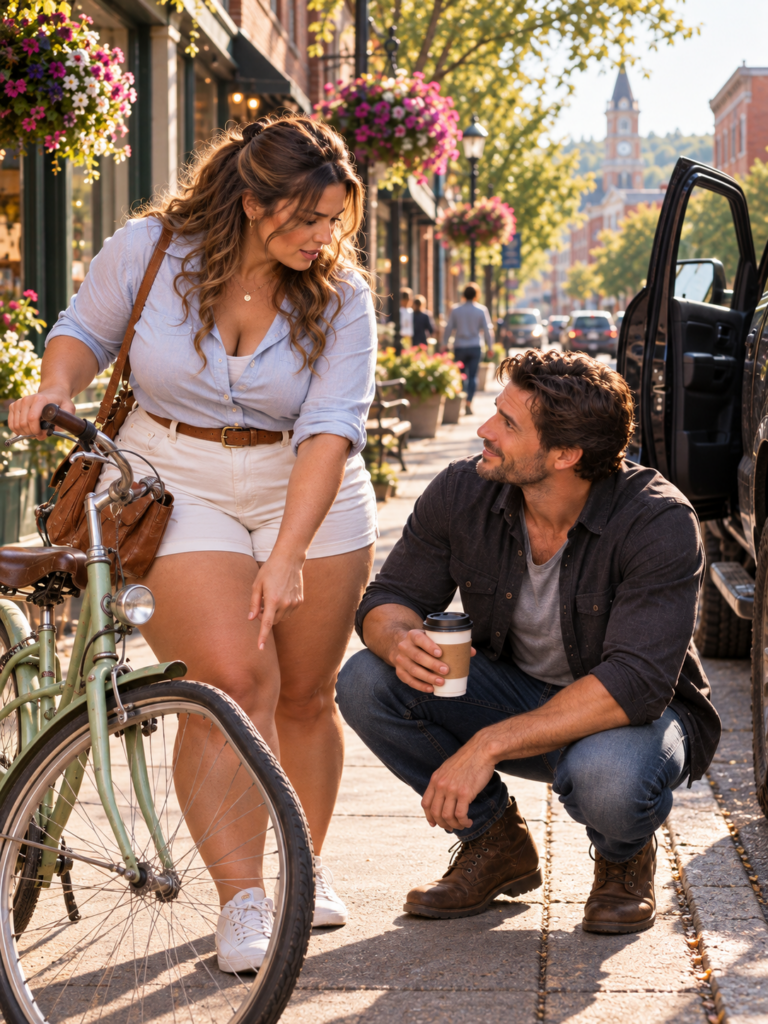
Adriana had just pushed her bicycle past a parked company truck when its door swung open.
She never had time to stop.
The edge of the heavy door slammed into her front wheel, twisting it inward. The handlebars jerked violently, and she stumbled sideways toward the window of her bookstore.
A paper bag slipped from the basket.
Books scattered across the sidewalk.
For several seconds, Adriana could only stare at the wheel.
The front rim had buckled. One of the spokes stood out at an unnatural angle, and the fender had been forced against the brake.
Then she turned toward the man climbing out of the truck.
“Are you completely blind?”
Joaquín Ferrer stopped with one foot on the pavement, a paper coffee cup still in his hand.
He was accustomed to complicated problems. As the head of Ferrero Urbana, a powerful property development company, he spent his days managing negotiations, approving acquisitions, and making decisions that involved sums of money most people would never earn in a lifetime.
But at that moment, surrounded by fallen books and facing an angry woman with a ruined bicycle, he looked remarkably uncertain.
“I’m sorry,” he said quickly. “I didn’t see you.”
“Clearly.”
He set his coffee down and crouched to collect the books.
“I’ll pay for the damage. Whatever the repairs cost.”
Adriana snatched up one of the fallen packages before he could reach it.
“You don’t understand.”
She pointed at the twisted wheel.
“My father built that bicycle himself. He collected the pieces one by one and spent months putting them together.”
Joaquín glanced at the damage.
“I understand that it has sentimental value.”
“No, you don’t.”
The sharpness of her response made him look up.
“If you understood, you wouldn’t be standing there talking about money.”
A couple of pedestrians slowed to watch.
Adriana didn’t care.
Her father had built that bicycle so she could deliver books throughout the neighborhood. Even after his death, she had maintained it with the same care he once gave every machine that passed through his hands.
It wasn’t an expensive bicycle. The paint had faded in places, and the handlebars had been repaired more than once.
But she knew the history of every scratch.
Now a stranger had damaged it without even looking.
Joaquín rose slowly.
“Then tell me what you need. A mechanic? Replacement parts? I can arrange whatever is necessary.”
“What I need is to finish my deliveries before my customers close their doors.”
He looked at the damaged wheel, then toward his truck.
“I can drive you. We’ll put the bicycle in the back.”
Adriana gave him an incredulous look.
“You expect me to climb into the truck of the man who just destroyed my bicycle?”
“I was only trying to help.”
“You could have helped by looking before opening your door.”
That was difficult to argue with.
He reached into his jacket and produced a business card.
“At least take my number. Call me when you know what the repairs will cost.”
She didn’t even glance at it.
“No.”
“Please.”
“Men like you have a card for everything, don’t you? Even the things you break.”
Joaquín lowered his hand.
For the first time, he noticed the way she studied him: the polished watch, the expensive jacket, the truck, the coffee from a café where she probably wouldn’t consider spending her money.
He suddenly felt ridiculous.
Still, habit prevailed.
He opened his wallet, withdrew several bills, and offered them to her.
“Take this for today’s inconvenience. We can work out the bicycle tomorrow.”
Adriana stared at the money.
It was more than enough to cover several deliveries, perhaps even a decent replacement bicycle.
And that was precisely what angered her.
He had produced the money so casually, as if the contents of his wallet could erase the consequences of opening a door without looking.
“Keep it.”
“Adriana—”
“You don’t know my name.”
He stopped.
She drew a breath.
“My father isn’t alive to build another bicycle. That’s the problem. And you can’t pay to bring him back.”
The words changed something between them.
Joaquín looked at the bills in his hand, then returned them to his wallet.
“I’m sorry about your father.”
She said nothing.
He crouched again, examining the wheel more carefully.
Perhaps, he thought, the rim could be straightened.
He placed both hands against the bent metal and applied pressure.
The wheel answered with an ugly scraping sound.
“Stop!” Adriana snapped. “You’re making it worse.”
He released it immediately.
“You’re right.”
“Do you know anything about bicycles?”
“No.”
Her eyebrows lifted.
“Nothing?”
“I don’t even know how to change a tire on my own truck.”
She almost laughed.
“At least you’re willing to admit that.”
“I can learn.”
Adriana folded her arms.
“And what exactly does that mean?”
“It means I’ll come back and fix what I damaged. If it takes several evenings, then I’ll come several evenings.”
She gave a short, humorless laugh.
“People like you don’t come back.”
Joaquín met her gaze.
“Then perhaps you’ll discover you’ve misjudged one of us.”
“That’s easy to say while you’re still standing here with your coffee.”
“Tomorrow I’ll say it again. Without the coffee.”
For a moment, neither spoke.
Adriana searched his face for the confident amusement she expected from someone making a promise he had no intention of keeping.
Instead, he looked almost embarrassed.
Finally, she pointed at the bicycle.
“You owe me one thing. Repair that. No money. No cards. No special favors.”
“Agreed.”
“And come after four. I’ll be out making deliveries before then.”
“After four.”
“Not whenever your important meetings happen to finish.”
He accepted the correction.
As she gathered her remaining books and prepared to push the bicycle away, Joaquín asked one final question.
“What’s your name?”
She hesitated.
“Adriana. From the bookstore.”
“Joaquín.”
“I didn’t ask.”
For the first time that afternoon, he smiled.
She didn’t return it.
Instead, she began walking down the sidewalk, pushing the bicycle while its damaged wheel scraped against the brake.
Joaquín remained beside his truck long after she disappeared.
He took out his phone and saved the address.
The bookstore was called Good Books.
He had no idea how much that name would come to matter.
Or how many things he had already broken without knowing it.
The next afternoon, Joaquín arrived at 4:10.
He was carrying a brand-new toolbox.
The price tag was still attached.
“You’re late,” Adriana said from behind the bookstore counter.
“Ten minutes.”
“The agreement was four.”
“I thought you meant around four.”
“Then you thought incorrectly.”
He placed the toolbox beside the damaged bicycle, which she had left against the outside wall.
The tools inside were immaculate. Chrome wrenches shone under the afternoon sun, and a pair of protective gloves remained folded inside their packaging.
Joaquín studied the front axle.
He selected a wrench.
Then he stared at the nut.
Adriana watched from the doorway.
“Something wrong?”
“Which direction should I turn this?”
“The direction that loosens it.”
“That’s extremely helpful.”
“You’re welcome.”
He tried turning the wrench.
Nothing moved.
He adjusted his grip, leaned closer, and tried again.
Still nothing.
From inside the store, Adriana returned to wrapping a customer’s book in brown paper.
Every few minutes, she looked through the window.
The man outside had removed his jacket. His sleeves were rolled up, and his expensive watch was lying safely inside the toolbox.
He looked like someone attempting to negotiate with a stubborn piece of metal.
A familiar customer entered the shop.
“Good afternoon, Socorro,” Adriana said. “I saved your book.”
Socorro, an older woman who visited every week, approached the counter before noticing the man outside.
“Who is that?”
“The man who hit my bicycle with his truck door.”
“And why is he still here?”
“He’s repairing it.”
Socorro watched Joaquín struggle with the same nut.
“Is he?”
Adriana almost smiled.
“He’s trying.”
Socorro studied him for another moment.
“Interesting.”
“There’s nothing interesting about it.”
“Then why did you let him come back?”
“I told him I wouldn’t accept anything except a proper repair. He decided to return.”
Socorro collected her book and change.
“Well, he’s certainly learning that the wheel doesn’t care how much money he has.”
Outside, Joaquín struck his knuckles against a spoke.
He muttered something under his breath.
Socorro glanced at him once more before leaving.
Adriana tried not to laugh.
But the amusement faded when she saw Joaquín take out his phone.
A work notification had appeared on the screen.
It concerned a land acquisition study he had authorized weeks earlier.
A street name was highlighted in yellow.
He recognized it immediately.
It was the street where he stood.
Joaquín froze.
The study belonged to Ferrero Urbana’s expansion division. There were dozens of similar documents, each identifying properties that could be purchased, consolidated, and redeveloped.
He had approved this one between meetings.
At the time, the street had been nothing more than a line on a map.
Now it contained a bookstore.
And a woman who had refused his money.
His thumb hovered over the notification.
Then he closed it.
He already remembered enough of the report to feel uneasy.
He put the phone away and returned to the wheel.
“Everything all right?” Adriana called.
“Fine.”
“Then why have you been staring at your phone?”
“I was looking for instructions.”
“Did you find any?”
“Apparently not.”
The answer was true enough to avoid further questions.
But it was not the whole truth.
For nearly an hour, Joaquín continued battling the axle nut.
He changed position, reversed the wrench, and applied enough pressure to make the bicycle fall against the wall.
Eventually he sat on the sidewalk, exhausted.
Adriana came outside.
She stood over him for several seconds, studying the useless new tools.
“That wrench is wrong.”
He looked up.
“Now you tell me?”
“You insisted on doing it yourself.”
She disappeared into the store.
When she returned, she was holding an old wrench with a worn handle.
“Try this.”
He fitted it against the nut.
It turned almost immediately.
Joaquín stared at it.
“How did you know?”
“Because I used that wrench with my father hundreds of times.”
He examined the worn handle.
“This works better than anything I bought.”
“Because it’s the right tool. You bought the pretty ones.”
He smiled faintly.
“Where can I buy one like this?”
“You can’t buy the years someone spent learning how to use it.”
She turned toward the entrance.
“And that wrench is a loan. Bring your own tools tomorrow.”
“What time do you close?”
“Seven.”
“Then I’ll come at four.”
“You’d better.”
He watched her disappear inside.
The wrench felt unexpectedly heavy in his hand.
He had spent years believing that every difficulty had a price.
He was beginning to suspect that some things required a different kind of payment.
By the third afternoon, Joaquín’s toolbox no longer looked new.
There were scratches on the wrenches, dirt on the handles, and a small tear in one of the gloves he had finally started wearing.
He arrived on time.
Adriana said nothing about it.
Instead, she brought a folding chair outside and placed it beside the bicycle.
He glanced at her.
“Is that for me?”
“Unless you enjoy kneeling on concrete.”
He sat down.
“Thank you.”
“Don’t get comfortable. You still have work.”
But she remained nearby, seated on the bookstore steps with her order ledger resting on her knees.
For a while, the only sounds were passing cars, the occasional customer entering the shop, and the soft metallic clicks of the tools.
Then Adriana began speaking.
“My father bought this bookstore twenty years ago.”
Joaquín stopped working.
She looked down at her closed ledger.
“He used the money he had left from a small appliance repair shop. In the beginning, there were only three shelves and a wooden table. He bought used books from downtown markets and sold them one at a time.”
Her expression softened.
“I grew up carrying boxes that were almost bigger than I was.”
Joaquín listened.
“Five years later, someone offered him a loan to expand.”
She paused.
“The man was polite. Well dressed. He spoke as though he wanted to help.”
Something in her voice changed.
“My father trusted him.”
The loan paid for new shelves, better lighting, and more inventory.
But the interest terms were more complicated than her father had understood.
When the first large payment came due, he couldn’t cover it.
Within months, the lender had the contractual right to take the bookstore if another payment was missed.
“My father nearly lost everything.”
Adriana looked down the street.
“He sold our car. He mortgaged what little else he owned. He worked double shifts somewhere else for months.”
Joaquín had stopped moving the wrench.
“Did he manage to save the store?”
“Just before the deadline.”
She swallowed.
“But I remember what it cost him. I was thirteen. I remember him sitting in the kitchen at night, adding the same numbers over and over.”
She rubbed her thumb along the edge of the ledger.
“We stopped buying sweet bread on Sundays. That probably sounds ridiculous.”
“No.”
“To a child, it’s the little things that tell you something terrible is happening. You don’t understand loans or interest rates. You just know that suddenly your father can’t afford what used to make him happy.”
Joaquín looked toward the bookstore.
“And the lender?”
“Moved on to another deal. He was never held accountable.”
Her face hardened.
“That’s why I don’t trust people who arrive with polished manners and easy offers.”
“People like me.”
“I didn’t say that.”
“You didn’t have to.”
She turned toward him.
“My father died three years ago. He had a heart condition that the doctors believed had troubled him since those difficult years.”
Her voice became quieter.
“All I have left is this store and the bicycle he built for deliveries.”
Joaquín looked at the wheel beneath his hands.
Until that moment, he had been repairing damaged metal.
Now he understood why every turn of the wrench mattered.
“I work with people who make deals like the one you described,” he admitted.
Adriana watched him carefully.
“In my office, an acquisition is a number. A negotiation is a percentage. A property is a line in a spreadsheet.”
“And the people?”
He had no immediate answer.
“Usually, I don’t meet them.”
“That must make your job easier.”
The observation stung because it was accurate.
“Yes,” he said.
She studied him with open surprise.
Most men would have defended themselves.
Joaquín simply returned to the wheel.
“My company buys entire blocks,” he continued. “Sometimes we negotiate with people who don’t have the same resources we do.”
“What happens if they don’t want to sell?”
“It depends. Sometimes we increase the offer. Sometimes we wait.”
He heard the words as she must have heard them.
A company waiting for someone to become desperate enough to accept.
For the first time, the language of his profession sounded different outside a boardroom.
Adriana said nothing.
That silence was worse than an accusation.
After a while, Joaquín spoke again.
“My father had a bicycle repair shop.”
She looked at him.
“Really?”
“A small one, with two employees. I practically learned to walk beneath bicycles hanging from the ceiling.”
“Then why don’t you know how to fix one?”
He gave a sad smile.
“My father never wanted me touching the tools. He told me to study so my hands wouldn’t end up black with grease like his.”
“What happened to his shop?”
Joaquín took a breath.
“A development company bought the block.”
He explained how the company had offered his father money that appeared generous but failed to reflect the value of twenty years of customers and work.
His father refused.
Then the rent tripled.
Eventually, he had no choice but to sell for less than the original offer.
“I was twelve,” Joaquín said. “I remember watching them remove his sign. He stood on the sidewalk with his hands in his pockets.”
“What did he do afterward?”
“Worked in someone else’s shop. He never owned another business.”
Adriana’s expression shifted.
“And that company?”
Joaquín looked directly at her.
“It’s the company I run now.”
She went still.
“I inherited it from my uncle, who had been a partner of the man responsible for what happened to my father.”
For several seconds, Adriana only stared at him.
“You run the company that took away your father’s shop?”
“Yes.”
“Did your uncle know what happened?”
“I never asked.”
“And you never thought that mattered?”
He lowered his gaze.
“I think I made it easier not to remember.”
The admission seemed to trouble him more than her questions.
Adriana looked toward the street.
“So now you do the same thing to other people.”
“Not exactly the same way.”
“But you buy blocks. You pressure owners. You wait for people to accept offers they don’t want.”
Joaquín looked down at the wrench in his hand.
The metal had left a dark line across his palm.
“Yes,” he admitted quietly. “Sometimes.”
She remained silent for a long moment.
Then she asked the question he had been dreading.
“Is this block part of your company’s expansion plans?”
His hand stopped.
He remembered the yellow map on his phone.
He remembered approving the study.
He remembered seeing the bookstore listed among the properties.
He could have told her the truth then.
He could have explained that the project had been approved before he met her, and that he had only recently connected the anonymous report with the place where she worked.
Instead, fear reached his mouth before honesty did.
“I’ll have to check,” he said. “There are several projects underway. I don’t remember every address.”
Adriana accepted the answer.
“All right. I was only wondering.”
She returned to her ledger.
Joaquín tightened a bolt that was already secure.
He had spent three afternoons learning how difficult it was to repair a bicycle.
With one sentence, he had damaged something far more fragile.
And this time, he knew exactly what he was doing.
Earlier that day, Antonieta Vega had entered Joaquín’s office carrying the completed acquisition documents.
Antonieta had worked on the project for months.
She was ambitious, disciplined, and highly effective at moving difficult negotiations toward completion. Her expected promotion to vice president depended heavily on the success of this expansion.
“The block is ready,” she told him. “I only need your signature to proceed.”
Joaquín opened the folder.
The properties were numbered.
Six commercial units stood inside the proposed acquisition area.
Good Books was number six.
He stared at the name.
“I need more time.”
Antonieta frowned.
“How much?”
“A few days.”
“The investors have already asked twice this week when we’re closing.”
“I know.”
“You approved the schedule.”
“I know that too.”
She studied him.
“What’s changed?”
He closed the folder.
“Nothing I can’t deal with.”
But Antonieta knew him too well to believe that.
Joaquín rarely delayed a decision.
He had built his reputation on acting quickly, negotiating aggressively, and rarely allowing sentiment to interfere with business.
Now he was refusing to sign paperwork he had approved weeks earlier.
Antonieta left the folder on his desk.
“I can’t keep the investors waiting indefinitely.”
When she departed, Joaquín tried returning to his other work.
He couldn’t concentrate.
He canceled a lunch meeting, ignored several reminders, and repeatedly glanced at the folder.
That night, after leaving Adriana and the nearly repaired bicycle, he returned to his office.
The building was quiet.
He opened the acquisition report and read every page.
He studied the proposed valuations, the owners’ names, the projected profits, and the timeline.
Then he reached the final page.
His own signature sat beneath the recommendations.
And there, in the acquisition list, was the bookstore Adriana’s father had spent his life protecting.
Property number six.
Joaquín closed the folder.
He placed it in the bottom drawer of his desk and turned the key.
He told himself he needed time to find a solution.
But beneath that excuse was another truth.
He had begun looking forward to the hours he spent outside Adriana’s bookstore.
And he was afraid the moment she learned what he had concealed, those hours would end forever.
Part 2
Antonieta arrived at Good Books shortly after midday.
She wore a tailored jacket and carried a thin folder beneath one arm. Her expression was composed, but the briskness of her movements suggested she was not accustomed to making unnecessary visits.
Adriana looked up from a book she was wrapping.
“Can I help you find something?”
“I’m looking for a few minutes of your time.”
Adriana set the book down.
“My name is Antonieta Vega. I work with Joaquín Ferrer.”
The name caught Adriana’s attention.
“Has something happened to him?”
“No. Nothing like that.”
Antonieta glanced around the store.
The old wooden display table, the neatly arranged bookshelves, and the carefully maintained counter were not impressive by the standards of her company’s development portfolio.
Yet there was something unmistakably personal about the place.
Nothing looked temporary.
Even the old shelves seemed to have been polished by years of familiar hands.
“May I come in?”
Adriana nodded.
Antonieta approached the counter.
“I’ve spent several months preparing an acquisition project for Ferrero Urbana,” she began. “Joaquín approved the preliminary work. We completed negotiations, prepared the financial projections, and scheduled the closing.”
Adriana waited.
“This week, he suddenly refused to sign.”
“I’m not sure what that has to do with me.”
“Neither was I.”
Antonieta placed the folder on the counter.
“Until I reviewed his recent schedule.”
A small uneasiness settled in Adriana’s stomach.
Antonieta continued.
“My promotion depends on bringing this project to completion. I have spent six years working on acquisitions like this, and I have never seen Joaquín delay a closing without giving a reason.”
She opened the folder.
Inside was a map.
A yellow boundary outlined an entire commercial block. Each property was numbered, with its owner and estimated value recorded beside it.
Adriana recognized the street immediately.
Then she saw number six.
Her bookstore.
She looked from the map to Antonieta.
“What is this?”
“The site survey for our expansion project.”
Adriana’s eyes moved down the page.
At the bottom was a signature.
Joaquín Ferrer.
Beside it was a date from several weeks earlier.
Before the bicycle accident.
Before his first visit with the toolbox.
Before he had stood outside her store, struggling with a wrench while she watched him through the window.
Adriana pressed her fingertips against the counter.
“That’s my bookstore.”
“Yes.”
“And he signed this?”
“He did.”
“Before we met?”
“Before the accident with your bicycle.”
Adriana stared at the signature.
She remembered asking Joaquín whether the block was part of his company’s plans.
I’ll have to check.
Those had been his exact words.
She had believed him.
“Why are you showing me this?” she asked.
Antonieta didn’t pretend the answer was simple.
“Because I believe his behavior has changed because of you. And because I need this project resolved.”
“So you’re hoping I’ll convince him to sign?”
“I’m hoping the truth will put an end to whatever is preventing him from making a business decision.”
Adriana’s expression cooled.
“You came here because I’m interfering with your promotion.”
“That is one part of it,” Antonieta acknowledged. “But you also deserve to know what he’s been doing.”
“Did you ever think he might have a good reason not to sign?”
“Then he should tell the board what that reason is.”
Antonieta folded her hands.
“I’m not here because I have anything personal against you. I didn’t know you existed until this week.”
“Well, you know now.”
For the first time, Antonieta’s composure faltered slightly.
She closed the folder and left the map on the counter.
“Keep that copy. I have another.”
Then she departed.
Adriana stood perfectly still.
The door closed.
The familiar bell above the entrance gave a soft jingle.
Outside, afternoon traffic continued as though nothing had changed.
But everything had.
For a long time, Adriana did not move the map.
She read it again.
The names of the property owners.
The proposed acquisition values.
The development boundary.
And Joaquín’s signature.
She knew the difference between a completed sale and a preliminary report. The document did not prove that she had lost her bookstore.
What it proved was worse in a different way.
Joaquín had been involved in a plan that directly affected her future, and he had allowed her to speak openly about her father’s suffering without revealing his connection to it.
She remembered the first afternoon.
The way he had tried to hand her money.
The way she had rejected his business card.
The strange sincerity with which he promised to return.
Then came the second afternoon.
The new tools.
His bleeding knuckles.
The moment he looked at his phone and suddenly became distracted.
She had noticed.
She had simply chosen not to question it.
Now she understood why.
Adriana walked outside.
Her father’s bicycle was resting against the wall, almost fully repaired.
The front wheel turned straight. The fender no longer scraped the brake. Only a small scratch remained on the frame.
Joaquín had kept his promise to work on it.
Every afternoon, he had returned.
Every afternoon, he had allowed himself to look foolish rather than abandon the repair.
And every afternoon, he had withheld the truth.
She thought of the folding chair she had brought outside for him.
The wrench she had lent him.
The stories she had told him about her father.
There had been evenings when she found herself glancing toward the street before four o’clock.
She had begun recognizing the sound of his truck.
She knew the expression he made when a bolt refused to move.
She knew he disliked admitting defeat, but had learned to accept her corrections.
Somewhere between his terrible first attempt at repairing the wheel and their conversations about their fathers, she had begun to see him differently.
Now she wondered whether she had been the only one who hadn’t understood what was happening.
Perhaps he had come back because he felt guilty about the acquisition.
Perhaps the bicycle had given him a way to stay close enough to prevent her from becoming suspicious.
Or perhaps he truly had wanted to repair it and had simply been too afraid to confess the rest.
She could not know.
And the uncertainty hurt almost as much as the document.
Back inside, she placed the map in her apron pocket and continued serving customers.
She wrapped books.
Counted change.
Answered questions.
At closing, she counted the register twice even though the first total was correct.
Her hands needed something to do.
Something with an answer she could trust.
By six o’clock, she had made one decision.
When Joaquín arrived, she would ask him directly.
And she would not allow him to escape behind another easy explanation.
He arrived a few minutes after six, carrying a small tin of matching paint and a fine brush.
His meeting had run late.
He tapped twice on the glass door.
Adriana stood behind the counter.
She saw him through the window, waiting with the familiar cautious expression he wore whenever he wasn’t certain she would let him work.
Normally, she would have opened the door immediately.
This time, she remained still.
When she finally approached, she opened it only wide enough for him to enter.
“I brought the paint,” he said.
She glanced at the tin.
“Put it on the counter.”
He obeyed.
Something in her tone made him uneasy.
“Is everything all right?”
Adriana removed the folded map from her apron.
She opened it on the counter beside the paint.
Then she stepped back.
Joaquín looked down.
The color drained from his face.
He recognized the acquisition boundary before he read a single word.
“Where did you get that?”
“Does it matter?”
He said nothing.
“Look at the date, Joaquín.”
He did.
“You signed it before you hit my bicycle.”
“Yes.”
“You knew my bookstore was on your company’s acquisition list.”
His throat tightened.
“I approved the study before we met. I didn’t connect the address with your store until I came back.”
“But you did connect them.”
“Yes.”
“When?”
“The second afternoon.”
She watched him.
“The afternoon you borrowed my father’s wrench?”
He nodded.
“The notification appeared on my phone. I recognized the street.”
Adriana looked at him for several seconds.
“Then why didn’t you tell me?”
He searched for a careful answer.
But standing in front of the document, he finally understood how much damage caution had already caused.
“I was afraid.”
“Of what?”
“That you’d think I was coming here because of the project.”
“And you thought keeping it secret would make me trust you more?”
“No.”
“Then what were you thinking?”
He rested one hand against the counter.
“I thought that if I fixed the bicycle first, if I showed you that I wasn’t like the man who hurt your father, then I could explain everything afterward.”
Adriana stared at him.
“You thought you could decide when I was allowed to know the truth.”
The statement stopped him.
Because that was exactly what he had done.
“I didn’t think of it that way.”
“That’s the problem.”
Her voice remained controlled.
She wasn’t shouting.
That made it harder for Joaquín to hide behind an emotional argument.
“You were standing outside my store every evening,” she continued. “You listened while I told you about my father counting bills in the kitchen. You knew how frightened I was of losing this place.”
“I know.”
“And when I asked whether this block was part of your company’s plans, you lied.”
He lowered his head.
“Yes.”
She drew a long breath.
“Do you know what hurts most?”
He looked up.
“Not the map. I understand that companies make plans. I understand that property developers buy buildings.”
Her fingers tightened around the edge of the counter.
“What hurts is that I started trusting you.”
Joaquín felt the words settle heavily between them.
“I never came here to manipulate you.”
“Maybe not.”
“I came because I broke your bicycle.”
“Then why didn’t you tell me about the project?”
He had no answer that would change what happened.
After a moment, he said quietly, “Every day I waited, telling you became harder.”
“That’s not an excuse.”
“I know.”
“And if Antonieta hadn’t come here today?”
He hesitated.
Adriana waited.
“When would you have told me?”
He looked directly at her.
“I don’t know.”
She closed her eyes for a moment.
He could have invented a reassuring answer.
He could have told her he planned to explain everything the following afternoon.
But even now, he couldn’t be sure that was true.
“I don’t know if I would have found the courage tomorrow,” he admitted. “Or whether I would have kept finding reasons to wait.”
Adriana nodded slowly.
“At least that’s the truth.”
She folded the map.
“But it’s too late.”
“Adriana—”
“I need you to leave.”
He stood motionless.
“What about the bookstore?” he asked. “What will you do?”
She gave him a bitter look.
“What can I do? Your company holds the power. You decide whether to buy the block. I get to live with the consequences.”
“I won’t let anyone take it without your consent.”
“Don’t.”
Her voice sharpened.
“Don’t make another promise because you think that’s what I need to hear.”
He stopped.
“You promised to return and repair my bicycle. You’ve almost done that. But you also stood here pretending there was nothing else I needed to know.”
She opened the door.
“Please go.”
Joaquín glanced toward the bicycle.
The damaged wheel had been repaired. The bent fender was straight. Only the final scratch remained.
He looked at the little tin of paint on the counter.
Then he turned toward Adriana.
“I didn’t repair it because of the acquisition,” he said. “I repaired it because I gave you my word.”
Her expression didn’t change.
“That doesn’t matter to me right now.”
There was nothing else he could say.
He left.
Adriana held the door open until he stepped onto the sidewalk.
Then she closed it.
Through the glass, she watched him walk toward his truck.
He paused beside the driver’s door.
For a moment, he looked back.
She did not go after him.
He climbed inside and sat without starting the engine.
The reflection of the bookstore’s lights trembled across his windshield.
A few minutes later, the truck pulled away.
And for the first time since the accident, Adriana knew he would not be returning the next afternoon to work on her bicycle.
Socorro arrived shortly afterward, carrying a bag of bread.
She had seen Joaquín leaving.
“He looked terrible,” she observed as she entered. “What happened?”
Adriana placed the map on the counter.
“He knew about the acquisition project from the beginning. His company wants this entire block.”
Socorro sat down.
Adriana told her everything.
Antonieta’s visit.
The document.
The date.
Joaquín’s confession.
The five days of silence.
And finally, the way she had sent him away.
Socorro listened without interrupting.
When Adriana finished, the older woman studied the map.
“Refusing his money on the first day was easy,” she said.
Adriana looked at her.
“It didn’t feel easy.”
“Perhaps not. But you knew what that money meant to you. You knew what you would lose by accepting it.”
Socorro folded her hands.
“The harder question is whether he is prepared to lose something.”
“He’s already lost my trust.”
“That is something you lost too.”
Adriana looked down.
Socorro continued gently.
“Anyone can apologize when an apology costs nothing. Anyone can promise to change while the consequences remain safely out of sight.”
“What are you saying?”
“I’m saying you should watch what he does now.”
“And if he does nothing?”
“Then you’ll have your answer.”
Adriana stared at the map.
“And if he does something?”
“Then you’ll have to decide whether it matters enough to give him another chance.”
Socorro rose and collected her bread.
“Beautiful words don’t repair anything. Hands do. And sometimes the hardest repair is the one that costs a person the life he’s grown comfortable living.”
Adriana said nothing.
She watched Socorro leave.
Then she turned toward the bicycle.
Its unfinished frame caught a strip of light from the counter.
She had spent several evenings watching Joaquín learn how to fix it.
Now the question was whether he had learned anything from those evenings beyond how to use a wrench.
Two days passed.
Joaquín did not return to Good Books.
Adriana told herself this was what she wanted.
And yet, both afternoons, she noticed when four o’clock arrived.
She looked toward the sidewalk where the folding chair had stood.
She saw the corner where his toolbox usually rested.
Once, she nearly reached for her phone before remembering she didn’t even have his number. She had refused his card on the first day.
The thought made her painfully aware of how little she knew about him outside those few afternoons.
She knew the history of his father.
She knew what his hands looked like after struggling with bicycle parts.
She knew he could admit ignorance about mechanical things more easily than he could admit fear about his own company.
But she didn’t know what he was doing now.
At night, she thought about the small tin of paint he had left behind.
Eventually, she opened it.
She cleaned the scratch on the bicycle’s frame, selected the fine brush, and carefully applied the matching color herself.
When the paint dried, she inspected the work beneath the counter light.
The bicycle was repaired.
Not restored to some imaginary perfection.
Not made new.
Its age was still visible in the paint, in the wear on the handlebars, and in the countless small marks her father had left while building it.
But the damage from the truck door was gone.
She ran her hand along the frame.
Then she put the bicycle aside.
Whatever happened next would not be decided by a wheel.
Across the city, Joaquín had begun examining the acquisition project in a way he had never examined it before.
He requested the original valuations.
Not just the figures prepared for the board, but the numbers actually presented to property owners.
He compared the documents line by line.
Three things became clear.
The proposed offers were not as generous as the board had been led to believe.
The difference was particularly significant for the bookstore and two neighboring properties.
And the negotiating pressure had been more aggressive than the project summaries suggested.
For those properties, the valuations shown to the board were twenty percent higher than the amounts offered to the owners.
Joaquín stared at the discrepancy.
He knew that negotiation margins existed.
He knew that buyers rarely began with their maximum offer.
But presenting one set of figures to directors while pressuring vulnerable owners with another raised questions he could no longer dismiss.
Then he found the email.
It had been sent by Antonieta ten days earlier to one of the property owners.
The message suggested that refusing the purchase offer could result in the city declaring the area a public-use development and acquiring the property at a lower price.
There was no company study supporting that possibility.
No official municipal determination.
No authority for Antonieta to threaten such an outcome.
The implication had been fabricated to pressure the owner into accepting.
Joaquín read the email twice.
Then he remembered something else.
Two years earlier, a complaint had been raised about similar pressure tactics during another project involving Antonieta.
He had assumed responsibility for the matter, allowing the complaint to close without a serious investigation.
At the time, he had considered it a minor management issue.
Now he understood how thoroughly his willingness to look away had protected the problem.
He gathered the valuations, correspondence, and earlier complaint records into a separate folder.
He could have handled the issue privately.
He could have quietly replaced Antonieta, negotiated a different price, and protected the company’s reputation.
He could even have removed Adriana’s bookstore from the project while allowing the other acquisitions to proceed.
All of those options would have been easier.
But the shop owners throughout the block faced the same imbalance of power that his own father had once faced.
And this time, he was not a twelve-year-old boy watching someone remove a sign from a bicycle workshop.
He was the man whose signature authorized the business.
He arranged to bring the evidence before the board.
For the first time in his career, Joaquín entered an important corporate meeting knowing that the right decision might cost him his position.
Part 3
The conference room at Ferrero Urbana was filled with the people Joaquín had spent years trying to impress.
Senior directors occupied one side of the long table. Financial officers and invited investors sat on the other.
At the front of the room, Antonieta stood beside a screen displaying the expansion proposal.
She had prepared for this presentation for months.
The projected profits were strong.
The location was commercially attractive.
And the acquisition schedule promised results within the current financial quarter.
“Negotiations for the six properties have either reached an acceptable stage or are substantially advanced,” she explained. “One remaining owner should be resolved this week.”
Joaquín sat at the head of the table.
He allowed her to finish.
Then he opened the folder he had brought.
“The remaining property is Good Books.”
Antonieta turned toward him.
“Yes.”
“The owner has not accepted an offer.”
“We’re still negotiating.”
“She’s not negotiating. She doesn’t want to sell.”
A few directors glanced toward one another.
Antonieta kept her expression controlled.
“With respect, Joaquín, you’re speaking from a personal perspective. Your relationship with that owner is not the same as your role as chief executive.”
He nodded.
“That’s a fair concern.”
She seemed momentarily relieved.
“Which is why I brought something more substantial than my personal opinion.”
He opened the folder.
“I requested an independent review of the valuations presented to three owners, including the bookstore.”
He distributed copies around the table.
“The figures reported to this board are twenty percent higher than the valuations those owners actually received.”
One of the directors adjusted his glasses.
“Twenty percent?”
“Yes.”
Antonieta straightened.
“Negotiation margins are part of normal acquisition practice.”
“They are,” Joaquín agreed. “Threatening owners with powers the company doesn’t possess is not.”
He withdrew another document.
“This email was sent from your account ten days ago.”
He placed it in front of her.
“It tells a property owner that refusing our offer could lead to the city declaring the block a public-use development, after which the property might be acquired for less than our proposed price.”
Antonieta’s face changed.
“That was an attempt to communicate the seriousness of the offer.”
“Did the city make such a determination?”
“No, but—”
“Did Ferrero Urbana commission a study establishing that it was a realistic possibility?”
She hesitated.
“Not formally.”
“So you presented a threat without any factual basis.”
“I was being firm.”
“Then read the email aloud.”
Antonieta stared at him.
“If you believe it’s merely a firm negotiating position, read it to the board and let everyone judge.”
She didn’t move.
The director with glasses picked up his copy.
“If this is accurate, it exposes the company to a substantial legal and reputational risk.”
“Exactly,” Joaquín replied.
Antonieta looked around the table.
“I was trying to complete a project this company needs. The investors have been demanding results, and everyone here knows the pressure we’ve been under.”
“No one instructed you to invent the threat of compulsory acquisition.”
Her expression hardened.
“You’re making this personal.”
Joaquín stood.
“Yes, something personal caused me to examine this project more carefully. I won’t pretend otherwise.”
He glanced toward the screen.
“But the evidence in front of you has nothing to do with my feelings. It’s correspondence sent under this company’s name, and it was allowed to happen while I was responsible.”
A younger director leaned forward.
“Are you proposing that we renegotiate the offers?”
“No.”
Joaquín closed the folder.
“I’m withdrawing the entire block from the expansion project.”
The reaction was immediate.
“All six properties?” someone asked.
“All six.”
An investor pushed back his chair.
“Do you understand how much profit that removes from this quarter?”
“Yes.”
“Months of work. Millions in projected returns.”
“I’ve reviewed the numbers.”
“And you’re prepared to throw that away because of one bookstore owner?”
Joaquín looked directly at him.
“No. I’m prepared to lose the projected returns because the negotiations used methods this company should never have tolerated.”
Another director spoke.
“This still looks like an emotional decision.”
“Then judge it without the emotion,” Joaquín replied. “A senior executive used a false threat against a property owner. Our valuation reporting concealed significant differences between internal figures and actual offers. And we have a previous complaint involving similar behavior that was never properly investigated.”
He paused.
“I was responsible for that earlier failure. I accepted an explanation without examining it closely enough.”
Antonieta stared at him.
“You said that matter was closed.”
“It was. Because I closed it.”
“Then you’re responsible too.”
“Yes.”
The admission surprised several people around the table.
Joaquín continued.
“I cannot claim to be protecting this company if I refuse to acknowledge what happened under my own signature.”
The oldest director, who had remained quiet throughout the exchange, placed both hands on the table.
“I support removing the entire block from the expansion project,” he said.
He looked at Antonieta.
“And I propose a formal investigation into this acquisition and the previous complaint.”
Antonieta opened her mouth.
But before she could respond, another director seconded the motion.
The vote followed.
A majority supported the proposal.
The project was withdrawn.
Antonieta was removed from managing the expansion, effective immediately, and a formal review of her conduct was opened.
She stood beside the screen while the directors continued discussing the consequences.
The presentation she had spent months preparing remained projected behind her.
The maps.
The timelines.
The estimated profits.
None of it mattered now.
She closed her laptop, gathered her belongings, and walked out without another word.
Her back remained straight.
But her steps had lost their earlier certainty.
Joaquín watched the door close.
He had made the decision he believed was necessary.
There was no immediate relief.
The company had lost a major project. Several investors were openly dissatisfied. His own leadership would be scrutinized.
And he knew that the board might eventually decide that his failure to supervise the acquisition process made him unsuitable to remain chief executive.
As the room emptied, the oldest director approached him.
“You did the right thing bringing this here,” he said.
Joaquín looked up.
“But don’t mistake that for a guarantee,” the director continued. “There will be people who believe you’ve lost control of your executives. This may cost you far more than a quarter’s profits.”
Joaquín nodded.
“I understand.”
“Are you prepared for that?”
He thought of his father’s bicycle shop.
The sign being removed.
The man standing on the sidewalk with his hands in his pockets.
Then he thought of Adriana’s father, awake in the kitchen, counting money while his daughter wondered why they no longer bought sweet bread on Sundays.
“I’d rather answer for failing to notice the problem sooner,” Joaquín said, “than spend another year pretending I didn’t know it existed.”
The director studied him.
Then he gave a small nod and left.
Joaquín remained in the conference room for several minutes.
The screen had gone dark.
He closed his folder, collected his papers, and walked out.
He no longer knew exactly what position he would hold at Ferrero Urbana in the months ahead.
But he knew where he needed to go that evening.
At six o’clock, Adriana saw him standing outside the bookstore.
He wore no suit jacket.
There was no company truck parked directly in front of the entrance. He had left it two blocks away.
He stood on the sidewalk with his hands empty, waiting for her to notice him.
Two days had passed since she sent him away.
During those two days, she had imagined several possible versions of this moment.
In some, she refused to open the door.
In others, she demanded an explanation.
But now that he was there, she found herself simply looking at him.
His face was tired.
Not theatrically miserable or carefully arranged to gain sympathy.
Just tired.
She approached the door.
“Why are you here?”
“To tell you what happened today.”
“What happened?”
“At the board meeting.”
Adriana remained in the doorway.
Joaquín didn’t try to enter.
“I wanted you to hear it from me,” he said. “Not from Antonieta or someone else. And I’m not asking you for anything in return.”
She remembered Socorro’s words.
Watch what he does when doing the right thing costs him something.
“All right,” Adriana said. “Tell me.”
He explained everything.
The valuations.
The email threatening the property owner.
The old complaint he had failed to investigate.
The vote.
And the decision to withdraw all six properties from the expansion project.
Adriana listened without interrupting.
When he finished, she looked at him carefully.
“All six?”
“Yes.”
“Not just my bookstore?”
“No. The entire block.”
“And Antonieta?”
“She’s been removed from managing the expansion. The board ordered a formal investigation.”
Adriana looked toward the street.
“What happens to you?”
“I don’t know yet.”
“You must have some idea.”
“The investors aren’t pleased. The board may decide that I failed to supervise the project properly.”
“Could you lose your position?”
“Possibly.”
She stared at him.
“Then why would you do that?”
Joaquín was quiet for a moment.
“Because what happened to your father wasn’t an isolated story. And neither was what happened to mine.”
He glanced at the bookstore sign.
“I spent years running the very company that took my father’s shop, telling myself that what happened back then was different from what I do now.”
His voice lowered.
“But the difference wasn’t always as large as I wanted to believe.”
Adriana said nothing.
“Socorro told you something in front of me once,” he continued. “That beautiful words don’t repair things. Hands do.”
A faint recognition crossed Adriana’s face.
“I remembered that when I looked at the project.”
He glanced down at his hands.
“I couldn’t fix what happened to our fathers. But I could stop signing papers that did the same thing to someone else.”
“And the investors?”
“They’ll decide what they think of me.”
“And if the board removes you?”
“Then I’ll have to live with that.”
Adriana looked at him for a long time.
“This doesn’t erase what you did to me.”
“I know.”
“You still lied.”
“Yes.”
“You let five days pass while I trusted you.”
“I did.”
He didn’t try to lessen the accusation.
“I didn’t come here expecting you to forget any of it.”
“Then what do you want?”
He swallowed.
“I want you to know that from now on, whatever concerns you, whatever affects this place, I’ll tell you the truth. Even when I’m afraid of what you’ll think.”
Adriana studied him.
Then she opened the door a little wider.
“Come inside.”
Joaquín looked almost surprised.
But he entered without speaking.
The bicycle stood near the wall.
Joaquín noticed it immediately.
The scratch on the frame was gone.
He approached it slowly.
“You finished the paint.”
“After you left.”
He ran a finger along the repaired section.
The finish wasn’t perfect.
The new paint was slightly brighter than the surrounding frame.
But it belonged there.
“It looks right,” he said.
Adriana folded her arms.
“It’s still my father’s bicycle. I didn’t want it looking like something that came out of a showroom.”
Joaquín gave a faint smile.
“Your father would probably be pleased with the repairs.”
“He would have pointed out everything you did wrong first.”
“I wouldn’t blame him.”
She almost smiled.
The silence between them was different now.
Not comfortable exactly.
But no longer filled with things he was refusing to say.
Adriana leaned against the counter.
“When you left the other night, I kept thinking about all the evenings you spent here.”
Joaquín turned toward her.
“I wondered whether they meant anything after what happened.”
“They meant something to me.”
“I know that now. At least, I think I do.”
She glanced at the bicycle.
“But I still don’t know what I’m supposed to do with the fact that you hurt me.”
He nodded.
“Neither do I.”
Then he reached into his pocket.
“I brought something.”
Adriana’s expression became guarded.
“Joaquín—”
“It’s not money.”
“I didn’t say it was.”
“And it’s not meant to replace an apology.”
He unfolded a small cloth handkerchief.
Inside lay an old brass bicycle bell.
Its surface was scratched and dull.
The engraved letters had nearly disappeared after years of use.
Adriana looked at it.
“What is that?”
“It came from my father’s workshop.”
He held it carefully in his palm.
“When they closed his shop, it was the only thing I kept.”
She reached out.
He placed it in her hand.
The bell was heavier than she expected.
“Why did you keep it?”
“I was a boy. I suppose I wanted something that belonged to the place before it disappeared.”
He paused.
“I kept it in the truck all these years.”
“All these years?”
“Since I was twelve.”
Adriana turned the little bell over, tracing the worn engraving with her thumb.
“And why bring it here?”
Joaquín looked toward the bicycle.
“Because I spent most of my life believing that keeping it meant I hadn’t forgotten what happened to my father.”
He took a breath.
“But remembering something isn’t the same as learning from it.”
She looked up.
“I never did anything with that memory. I built my career inside the company that hurt him. I approved projects. I signed documents. I told myself I was doing business differently without looking closely enough to find out.”
His voice became quieter.
“Then I met you.”
Adriana’s fingers closed around the bell.
“And you broke my bicycle.”
“Yes.”
“And didn’t know how to fix it.”
“Not even a little.”
The corner of her mouth lifted.
Joaquín looked at the bell again.
“I think I finally understand why I kept this.”
He moved toward the bicycle.
“May I?”
Adriana hesitated only briefly.
Then she handed it to him.
He positioned the bell on the handlebar, adjusted the clamp, and carefully tightened the screw.
There was no fumbling this time.
He selected the correct tool.
He turned the screw until it was secure without forcing it.
Then he stepped aside.
The little brass bell rested beside the worn rubber grip.
Two pieces of different lives, joined to the same bicycle.
Adriana touched it.
A clear metallic note filled the bookstore.
She looked at Joaquín.
He was watching her, not the bell.
“I don’t expect you to forgive me tonight,” he said.
She waited.
“But I would like to keep coming here.”
“To repair what?”
“Maybe nothing.”
She raised an eyebrow.
He smiled slightly.
“I’d like to sit on that folding chair again. I’d like to hear Socorro tell me I’m using the wrong tool. I’d like to learn the names of the customers who come in every week.”
He glanced around the bookstore.
“I’d like to be here while you count the register and close for the evening.”
Adriana remained quiet.
“Not because I owe you money,” he continued. “Not because I damaged a bicycle. And not because my company has a project on this street.”
He met her eyes.
“Because I want to be with you.”
She looked away.
Outside, the streetlights were beginning to come on.
“I can’t promise that trusting you again will be easy.”
“I’m not asking you to.”
“You would have to prove it.”
“Every day.”
“Even when telling the truth makes your life difficult?”
“Especially then.”
She studied him for several seconds.
Then she reached for his hand.
His fingers closed gently around hers.
For a moment, they simply stood beside the bicycle.
Adriana could feel the calluses beginning to form on his palm.
Not the hands of a man who had spent decades working with tools.
Not yet.
But no longer the perfectly soft hands of someone who had never tried.
She looked into his face.
Then she stepped closer and kissed him.
Joaquín seemed startled by the tenderness of it.
He held her carefully, allowing her to decide how close she wanted to be.
When they finally separated, Adriana rested her hand on the handlebar.
She rang the bell once.
The sound lingered in the quiet bookstore.
“After four,” she said.
He smiled.
“Four exactly.”
“And don’t be late.”
“I won’t.”
She looked down at their joined hands.
For the first time in several days, her smile reached her eyes.
Six weeks later, something new had appeared beside the entrance to Good Books.
A small workbench stood beneath a row of neatly arranged tools.
There were old wrenches, tire levers, screwdrivers, and spare parts stored in labeled compartments.
Above the bench hung a handwritten sign.
BICYCLE REPAIRS — TUESDAY THROUGH SATURDAY
Joaquín sat on the familiar folding chair, adjusting the chain of a neighborhood bicycle.
His sleeves were rolled up.
A faint streak of grease marked his forearm.
He no longer checked his watch every few minutes.
The board at Ferrero Urbana had eventually reassigned him to a smaller administrative position, removing him from the expansion projects that had once consumed nearly all his attention.
He had accepted the decision without protest.
His income was lower.
His authority had diminished.
And the men who once competed for appointments on his calendar rarely came looking for him anymore.
But almost every evening, he came to the bookstore.
With what remained of his salary and Adriana’s knowledge of bicycles, they had created the repair corner together.
Some of the tools came from neighbors.
Others were donated by the owner of a workshop preparing to close on the other side of the city.
There was nothing luxurious about the little corner.
The workbench had scratches.
The tools didn’t match.
The chair still squeaked when Joaquín leaned forward.
But people began bringing their bicycles as word spread that the bookstore had someone willing to repair a wheel without charging a fortune.
Adriana continued running the shop.
She managed orders, prepared deliveries, and greeted customers who had known her father.
On busy afternoons, she would glance toward the repair corner and find Joaquín struggling with a particular adjustment.
Sometimes she called across the room.
“Wrong wrench.”
He would look up.
“I haven’t even started.”
“And already you’re holding the wrong one.”
He would laugh, put it back, and choose another.
Other times, she came over to guide his hand, explaining why a component needed more pressure or why a screw shouldn’t be tightened further.
They still disagreed.
They still challenged one another.
But now neither tried to hide a mistake merely to appear competent.
One afternoon, Socorro arrived for her weekly book.
She stopped near the entrance to watch Joaquín adjust a bicycle chain.
His movements were careful and efficient.
The man who had once spent an hour failing to loosen a single nut was now explaining the difference between two chain adjustments to a young boy from the neighborhood.
Socorro turned toward Adriana.
“That suits him better than a big office.”
Adriana followed her gaze.
Joaquín was sitting on the same folding chair she had brought outside on his third visit.
The boy beside him watched with wide eyes.
“He seems happy,” Adriana said.
“He does.”
Socorro glanced at her.
“And so do you.”
Adriana smiled.
“I suppose I do.”
Outside, three bicycles waited against the wall.
Each had a paper tag tied to its handlebars, with the owner’s name written in Joaquín’s careful handwriting.
He had learned that keeping track of whose bicycle came first mattered, even when the repair was small.
The boy watching him reached for the next wrench before Joaquín asked.
Joaquín accepted it with a nod.
“Good. You’re learning.”
The boy grinned.
“What did you do before you worked here?”
Joaquín considered the question.
“I used to sell land.”
“Land?”
“Buildings too. I worked for a property development company.”
The boy examined the chain.
“And now you fix bicycles?”
“That’s right.”
“Which job do you like better?”
Joaquín thought about it.
He remembered the polished conference room, the acquisition maps, and the meetings where every decision was measured in percentages.
Then he looked at the bicycle in front of him.
“This one.”
“Really?”
“Without a doubt.”
The boy seemed impressed.
“Are you an expert now?”
Joaquín laughed.
“Not yet. I learn something new almost every evening.”
“Does Adriana teach you?”
“All the time.”
The boy handed him another tool.
“And she doesn’t get mad when you’re slow?”
“Oh, she gets impatient.”
From the bookstore counter, Adriana called out, “I heard that.”
Joaquín smiled.
“But she always tells me what I need to know.”
The boy laughed.
And Joaquín returned to the chain.
At seven, Adriana closed the register.
She switched off the counter lights and straightened the last stack of books.
Beside the entrance, Joaquín put away the tools, checked that everything was in its proper place, and locked the repair corner.
He checked the lock twice.
Adriana noticed.
“Still afraid someone will steal your tools?”
“Just making sure everything is safe.”
“My father used to do the same thing.”
Joaquín looked at her.
“Then I learned from a good example.”
She smiled and reached for his hand.
Her father’s bicycle stood nearby, ready for the trip home.
The little brass bell was still attached to the handlebar.
It had become their private signal.
Whenever Adriana returned from a delivery, she rang it before entering the store.
And whenever Joaquín heard it, he looked up from whatever he was repairing.
Even on the busiest evenings.
Even when his hands were covered in grease.
Before leaving, Adriana rang it one more time.
The clear sound traveled through the quiet bookstore.
Then she turned off the final light.
Outside, the street was growing dark.
The sign above Good Books remained illuminated, while the little repair corner rested in the glow of the streetlamps, ready for another day.
Joaquín took the bicycle by its handlebars.
Adriana slipped her hand into his.
Together, they began walking toward the corner.
The bicycle rolled between them, its old wheels moving smoothly over the pavement.
Every small unevenness in the sidewalk made the brass bell ring softly.
Joaquín slowed his pace.
Adriana looked at him.
“Something wrong?”
He shook his head.
“Nothing.”
He adjusted the bicycle against his leg so he could hold her hand more comfortably.
Then they continued walking.
Behind them stood the bookstore her father had saved.
Beside it was the little repair space they had built together.
And between them rolled the bicycle that had once brought them into each other’s lives by accident.
Joaquín no longer needed to make grand promises about the future.
Adriana no longer needed him to explain what every evening meant.
She had seen him return when the work was difficult.
She had seen him tell the truth when the consequences were painful.
And she had watched him give up the power he once thought defined him in order to become a man he could respect.
The little bell sounded again as the front wheel crossed a crack in the pavement.
Adriana tightened her hand around his.
Joaquín looked at her and smiled.
Then they walked on beneath the streetlights, slowly and without hurry, the repaired bicycle rolling beside them.
Because the thing that finally won Adriana’s heart was never his money, his company, or the promises he knew how to make.
It was the simple fact that, evening after evening, he had learned how to stay.


